

IEC 60404-8-7:2020
(Main)Magnetic materials - Part 8-7: Specifications for individual materials - Cold-rolled grain-oriented electrical steel strip and sheet delivered in the fully-processed state
General Information
- Abstract
IEC 60404-8-7:2020 defines the grades of cold-rolled grain-oriented electrical steel strip and sheet in nominal thicknesses of 0,20 mm, 0,23 mm, 0,27 mm, 0,30 mm and 0,35 mm. In particular, it gives general requirements, magnetic properties, geometric characteristics, tolerances and technological characteristics, as well as inspection procedures. This document applies to Goss textured grain-oriented electrical steel strip and sheet supplied in the final annealed condition in coils or sheets, and intended for the construction of magnetic circuits. The grades are grouped into three classes:
- conventional grades;
- high permeability grades;
- magnetic domain refined high permeability grades.
They correspond to Class C22 of IEC 60404-1.
This edition includes the following significant technical changes with respect to the previous edition:
- insertion of a third class of grain-oriented electrical steels for magnetic domain refined high permeability grades;
- introduction of the single sheet tester (SST) method as reference measurement method for this third class of material together with a conversion factor for transposition of the SST measurement results to equivalent Epstein values;
- update of the electrical steel range to take account of the current offers and demands of grades.
- Status
- Published
- Publication Date
- 08-Sep-2020
- Technical Committee
- TC 68 - Magnetic alloys and steels
- Drafting Committee
- WG 1 - TC 68/WG 1
- Current Stage
- PPUB - Publication issued
- Start Date
- 09-Sep-2020
- Completion Date
- 21-Sep-2020
Buy Documents
IEC 60404-8-7:2020 - Magnetic materials - Part 8-7: Specifications for individual materials - Cold-rolled grain-oriented electrical steel strip and sheet delivered in the fully-processed state Released:9/9/2020
IEC 60404-8-7:2020 RLV - Magnetic materials - Part 8-7: Specifications for individual materials - Cold-rolled grain-oriented electrical steel strip and sheet delivered in the fully-processed state Released:9/9/2020
Overview
IEC 60404-8-7:2020 is an international standard that specifies grades and delivery requirements for cold-rolled grain-oriented electrical steel strip and sheet delivered in the fully processed (final annealed) state. It applies to Goss-textured grain-oriented electrical steel in nominal thicknesses of 0.20 mm, 0.23 mm, 0.27 mm, 0.30 mm and 0.35 mm, intended for the construction of magnetic circuits (e.g., transformer and reactor cores). The standard defines general requirements, magnetic properties, geometric characteristics, tolerances, technological characteristics and inspection procedures.
Key topics
- Classification and grades
- Three classes: conventional grades, high permeability grades, and magnetic domain refined high permeability grades.
- Corresponds to Class C22 of IEC 60404-1.
- Magnetic property measurement
- Conventional and high-permeability grades use the Epstein method (IEC 60404-2).
- Magnetic domain refined high-permeability grades use the Single Sheet Tester (SST) method (IEC 60404-3) as the reference measurement.
- A conversion factor F = 0.925 is defined to transpose SST loss results to equivalent Epstein values for continuity across grade listings.
- Geometric and technological requirements
- Defines thickness, width and length tolerances, edge condition, residual curvature, stacking factor, insulation coating resistance and other technological characteristics important for manufacturing and assembly.
- Inspection and testing
- Procedures for sample selection, specimen preparation, magnetic testing and geometric checks are specified to ensure consistent evaluation and acceptance.
Applications and users
- Primary applications:
- Transformer cores, power and distribution transformers
- Reactors, magnetic circuits, and other electromagnetic devices requiring oriented electrical steel
- High-efficiency and low-loss magnetic assemblies (where high permeability and domain refinement are critical)
- Typical users:
- Steel manufacturers and rolling mills for product specification and quality control
- Transformer and motor designers specifying core materials
- Procurement and quality engineers verifying supplier deliveries
- Testing laboratories applying Epstein and SST measurement protocols
Practical value
- Enables consistent material selection for magnetic circuit performance (losses, permeability, stacking behavior).
- Clarifies measurement methods and conversion between SST and Epstein results, helping purchasers and designers compare modern domain-refined steels with conventional grades.
- Standardized tolerances and inspection rules reduce acceptance disputes and improve interchangeability between suppliers.
Related standards
- IEC 60404-1 (Classification of magnetic materials) - Class C22 reference
- IEC 60404-2 (Epstein frame method for specific total loss)
- IEC 60404-3 (Single Sheet Tester - SST method)
- Other parts of the IEC 60404 series for magnetic materials
Keywords: IEC 60404-8-7, cold-rolled grain-oriented electrical steel, magnetic materials, single sheet tester, Epstein method, magnetic domain refined, transformer core steel.
Relations
- Effective Date
- 05-Sep-2023
Buy Documents
IEC 60404-8-7:2020 - Magnetic materials - Part 8-7: Specifications for individual materials - Cold-rolled grain-oriented electrical steel strip and sheet delivered in the fully-processed state Released:9/9/2020
IEC 60404-8-7:2020 RLV - Magnetic materials - Part 8-7: Specifications for individual materials - Cold-rolled grain-oriented electrical steel strip and sheet delivered in the fully-processed state Released:9/9/2020
Get Certified
Connect with accredited certification bodies for this standard

IMQ S.p.A. (Certification)
Italian electrical product certification.

SLG Prüf- und Zertifizierungs GmbH
German testing and certification body.

UL Solutions
Global safety science company with testing, inspection and certification.
Sponsored listings
Frequently Asked Questions
IEC 60404-8-7:2020 is a standard published by the International Electrotechnical Commission (IEC). Its full title is "Magnetic materials - Part 8-7: Specifications for individual materials - Cold-rolled grain-oriented electrical steel strip and sheet delivered in the fully-processed state". This standard covers: IEC 60404-8-7:2020 defines the grades of cold-rolled grain-oriented electrical steel strip and sheet in nominal thicknesses of 0,20 mm, 0,23 mm, 0,27 mm, 0,30 mm and 0,35 mm. In particular, it gives general requirements, magnetic properties, geometric characteristics, tolerances and technological characteristics, as well as inspection procedures. This document applies to Goss textured grain-oriented electrical steel strip and sheet supplied in the final annealed condition in coils or sheets, and intended for the construction of magnetic circuits. The grades are grouped into three classes: - conventional grades; - high permeability grades; - magnetic domain refined high permeability grades. They correspond to Class C22 of IEC 60404-1. This edition includes the following significant technical changes with respect to the previous edition: - insertion of a third class of grain-oriented electrical steels for magnetic domain refined high permeability grades; - introduction of the single sheet tester (SST) method as reference measurement method for this third class of material together with a conversion factor for transposition of the SST measurement results to equivalent Epstein values; - update of the electrical steel range to take account of the current offers and demands of grades.
IEC 60404-8-7:2020 defines the grades of cold-rolled grain-oriented electrical steel strip and sheet in nominal thicknesses of 0,20 mm, 0,23 mm, 0,27 mm, 0,30 mm and 0,35 mm. In particular, it gives general requirements, magnetic properties, geometric characteristics, tolerances and technological characteristics, as well as inspection procedures. This document applies to Goss textured grain-oriented electrical steel strip and sheet supplied in the final annealed condition in coils or sheets, and intended for the construction of magnetic circuits. The grades are grouped into three classes: - conventional grades; - high permeability grades; - magnetic domain refined high permeability grades. They correspond to Class C22 of IEC 60404-1. This edition includes the following significant technical changes with respect to the previous edition: - insertion of a third class of grain-oriented electrical steels for magnetic domain refined high permeability grades; - introduction of the single sheet tester (SST) method as reference measurement method for this third class of material together with a conversion factor for transposition of the SST measurement results to equivalent Epstein values; - update of the electrical steel range to take account of the current offers and demands of grades.
IEC 60404-8-7:2020 is classified under the following ICS (International Classification for Standards) categories: 29.030 - Magnetic materials. The ICS classification helps identify the subject area and facilitates finding related standards.
IEC 60404-8-7:2020 has the following relationships with other standards: It is inter standard links to IEC 60404-8-7:2017. Understanding these relationships helps ensure you are using the most current and applicable version of the standard.
IEC 60404-8-7:2020 is available in PDF format for immediate download after purchase. The document can be added to your cart and obtained through the secure checkout process. Digital delivery ensures instant access to the complete standard document.
Standards Content (Sample)
IEC 60404-8-7 ®
Edition 5.0 2020-09
INTERNATIONAL
STANDARD
Magnetic materials –
Part 8-7: Specifications for individual materials – Cold-rolled grain-oriented
electrical steel strip and sheet delivered in the fully-processed state
All rights reserved. Unless otherwise specified, no part of this publication may be reproduced or utilized in any form
or by any means, electronic or mechanical, including photocopying and microfilm, without permission in writing from
either IEC or IEC's member National Committee in the country of the requester. If you have any questions about IEC
copyright or have an enquiry about obtaining additional rights to this publication, please contact the address below or
your local IEC member National Committee for further information.
IEC Central Office Tel.: +41 22 919 02 11
3, rue de Varembé info@iec.ch
CH-1211 Geneva 20 www.iec.ch
Switzerland
About the IEC
The International Electrotechnical Commission (IEC) is the leading global organization that prepares and publishes
International Standards for all electrical, electronic and related technologies.
About IEC publications
The technical content of IEC publications is kept under constant review by the IEC. Please make sure that you have the
latest edition, a corrigendum or an amendment might have been published.
IEC publications search - webstore.iec.ch/advsearchform Electropedia - www.electropedia.org
The advanced search enables to find IEC publications by a The world's leading online dictionary on electrotechnology,
variety of criteria (reference number, text, technical containing more than 22 000 terminological entries in English
committee,…). It also gives information on projects, replaced and French, with equivalent terms in 16 additional languages.
and withdrawn publications. Also known as the International Electrotechnical Vocabulary
(IEV) online.
IEC Just Published - webstore.iec.ch/justpublished
Stay up to date on all new IEC publications. Just Published IEC Glossary - std.iec.ch/glossary
details all new publications released. Available online and 67 000 electrotechnical terminology entries in English and
once a month by email. French extracted from the Terms and Definitions clause of
IEC publications issued since 2002. Some entries have been
IEC Customer Service Centre - webstore.iec.ch/csc collected from earlier publications of IEC TC 37, 77, 86 and
If you wish to give us your feedback on this publication or CISPR.
need further assistance, please contact the Customer Service
Centre: sales@iec.ch.
IEC 60404-8-7 ®
Edition 5.0 2020-09
INTERNATIONAL
STANDARD
Magnetic materials –
Part 8-7: Specifications for individual materials – Cold-rolled grain-oriented
electrical steel strip and sheet delivered in the fully-processed state
INTERNATIONAL
ELECTROTECHNICAL
COMMISSION
ICS 29.030 ISBN 978-2-8322-8779-8
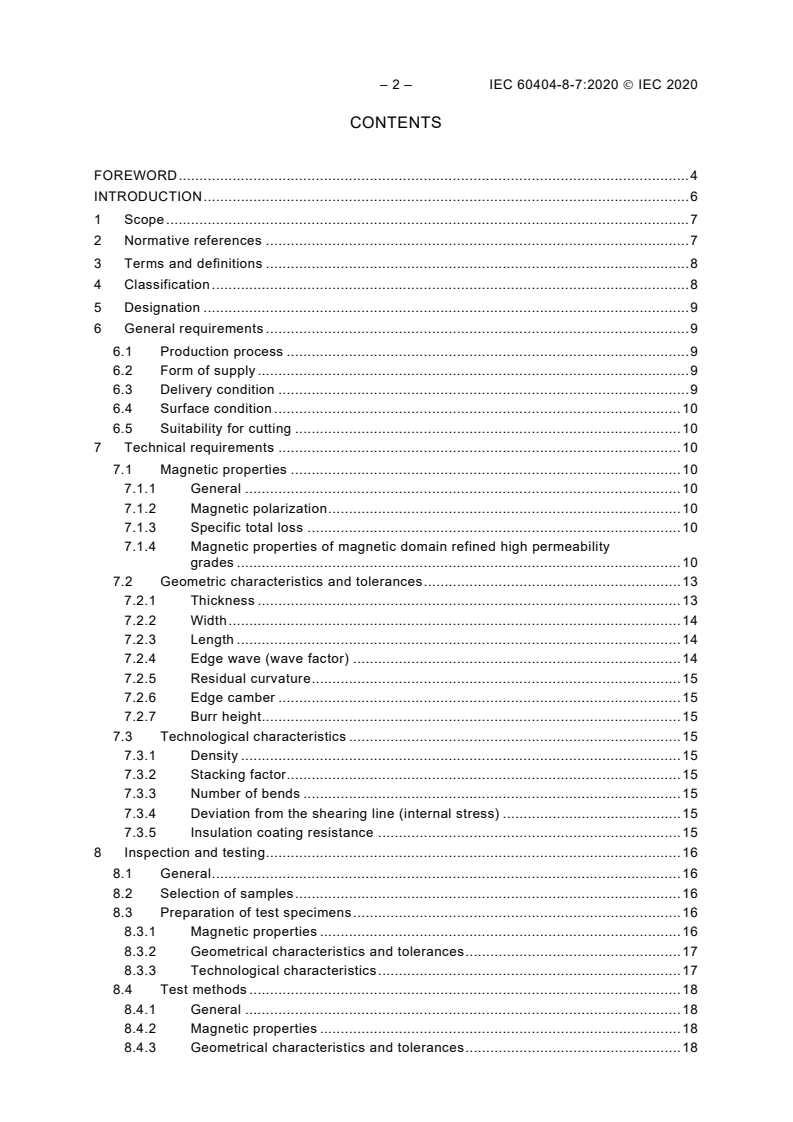
– 2 – IEC 60404-8-7:2020 IEC 2020
CONTENTS
FOREWORD . 4
INTRODUCTION . 6
1 Scope . 7
2 Normative references . 7
3 Terms and definitions . 8
4 Classification . 8
5 Designation . 9
6 General requirements . 9
6.1 Production process . 9
6.2 Form of supply . 9
6.3 Delivery condition . 9
6.4 Surface condition . 10
6.5 Suitability for cutting . 10
7 Technical requirements . 10
7.1 Magnetic properties . 10
7.1.1 General . 10
7.1.2 Magnetic polarization . 10
7.1.3 Specific total loss . 10
7.1.4 Magnetic properties of magnetic domain refined high permeability
grades . 10
7.2 Geometric characteristics and tolerances . 13
7.2.1 Thickness . 13
7.2.2 Width . 14
7.2.3 Length . 14
7.2.4 Edge wave (wave factor) . 14
7.2.5 Residual curvature . 15
7.2.6 Edge camber . 15
7.2.7 Burr height . 15
7.3 Technological characteristics . 15
7.3.1 Density . 15
7.3.2 Stacking factor. 15
7.3.3 Number of bends . 15
7.3.4 Deviation from the shearing line (internal stress) . 15
7.3.5 Insulation coating resistance . 15
8 Inspection and testing . 16
8.1 General . 16
8.2 Selection of samples . 16
8.3 Preparation of test specimens . 16
8.3.1 Magnetic properties . 16
8.3.2 Geometrical characteristics and tolerances . 17
8.3.3 Technological characteristics . 17
8.4 Test methods . 18
8.4.1 General . 18
8.4.2 Magnetic properties . 18
8.4.3 Geometrical characteristics and tolerances . 18
8.4.4 Technological characteristics . 18
8.5 Retests . 19
9 Marking, labelling and packaging . 19
10 Complaints . 19
11 Information to be supplied by the purchaser . 19
Bibliography . 21
Table 1 – Technological and magnetic properties of the conventional grades of grain-
oriented electrical steel strip and sheet (magnetic properties are measured using the
Epstein method according to IEC 60404-2) . 11
Table 2 – Technological and magnetic properties of the high permeability grades of
grain-oriented electrical steel strip and sheet (magnetic properties are measured using
the Epstein method according to IEC 60404-2) . 12
Table 3 – Technological and magnetic properties of magnetic domain refined high
permeability grades of grain-oriented electrical steel strip and sheet (magnetic
properties are measured using the Single Sheet Test method* according
to IEC 60404-3). . 13
Table 4 – Tolerances on nominal thickness . 14
Table 5 – Tolerances on nominal width . 14
– 4 – IEC 60404-8-7:2020 IEC 2020
INTERNATIONAL ELECTROTECHNICAL COMMISSION
____________
MAGNETIC MATERIALS –
Part 8-7: Specifications for individual materials –
Cold-rolled grain-oriented electrical steel strip and sheet
delivered in the fully-processed state
FOREWORD
1) The International Electrotechnical Commission (IEC) is a worldwide organization for standardization comprising
all national electrotechnical committees (IEC National Committees). The object of IEC is to promote international
co-operation on all questions concerning standardization in the electrical and electronic fields. To this end and
in addition to other activities, IEC publishes International Standards, Technical Specifications, Technical Reports,
Publicly Available Specifications (PAS) and Guides (hereafter referred to as “IEC Publication(s)”). Their
preparation is entrusted to technical committees; any IEC National Committee interested in the subject dealt with
may participate in this preparatory work. International, governmental and non-governmental organizations liaising
with the IEC also participate in this preparation. IEC collaborates closely with the International Organization for
Standardization (ISO) in accordance with conditions determined by agreement between the two organizations.
2) The formal decisions or agreements of IEC on technical matters express, as nearly as possible, an international
consensus of opinion on the relevant subjects since each technical committee has representation from all
interested IEC National Committees.
3) IEC Publications have the form of recommendations for international use and are accepted by IEC National
Committees in that sense. While all reasonable efforts are made to ensure that the technical content of IEC
Publications is accurate, IEC cannot be held responsible for the way in which they are used or for any
misinterpretation by any end user.
4) In order to promote international uniformity, IEC National Committees undertake to apply IEC Publications
transparently to the maximum extent possible in their national and regional publications. Any divergence between
any IEC Publication and the corresponding national or regional publication shall be clearly indicated in the latter.
5) IEC itself does not provide any attestation of conformity. Independent certification bodies provide conformity
assessment services and, in some areas, access to IEC marks of conformity. IEC is not responsible for any
services carried out by independent certification bodies.
6) All users should ensure that they have the latest edition of this publication.
7) No liability shall attach to IEC or its directors, employees, servants or agents including individual experts and
members of its technical committees and IEC National Committees for any personal injury, property damage or
other damage of any nature whatsoever, whether direct or indirect, or for costs (including legal fees) and
expenses arising out of the publication, use of, or reliance upon, this IEC Publication or any other IEC
Publications.
8) Attention is drawn to the Normative references cited in this publication. Use of the referenced publications is
indispensable for the correct application of this publication.
9) Attention is drawn to the possibility that some of the elements of this IEC Publication may be the subject of patent
rights. IEC shall not be held responsible for identifying any or all such patent rights.
International Standard IEC 60404-8-7 has been prepared by IEC technical committee 68:
Magnetic alloys and steels.
This fifth edition cancels and replaces the fourth edition published in 2017. This edition
constitutes a technical revision.
This edition includes the following significant technical changes with respect to the previous
edition:
– insertion of a third class of grain-oriented electrical steels for magnetic domain refined high
permeability grades;
– introduction of the single sheet tester (SST) method as reference measurement method for
this third class of material together with a conversion factor for transposition of the SST
measurement results to equivalent Epstein values;
– update of the electrical steel range to take account of the current offers and demands of
grades.
The text of this International Standard is based on the following documents:
CDV Report on voting
68/641/CDV 68/657/RVC
Full information on the voting for the approval of this International Standard can be found in the
report on voting indicated in the above table.
This document has been drafted in accordance with the ISO/IEC Directives, Part 2.
A list of all the parts in the IEC 60404 series, published under the general title Magnetic
materials, can be found on the IEC website.
The committee has decided that the contents of this document will remain unchanged until the
stability date indicated on the IEC website under "http://webstore.iec.ch" in the data related to
the specific document. At this date, the document will be
• reconfirmed,
• withdrawn,
• replaced by a revised edition, or
• amended.
– 6 – IEC 60404-8-7:2020 IEC 2020
INTRODUCTION
This revision of International Standard IEC 60404-8-7 has been prepared by the experts of the
Working Group 1 of the IEC technical committee 68: Magnetic alloys and steels.
The insertion of a third class of electrical steels for magnetic domain refined high permeability
grades is the main reason of this revision. Most of the technologies of magnetic domain
refinement result in material that does not withstand the stress relief annealing after cutting
without changing the magnetic properties (i.e. the specific total loss). In the case of this
material, the Epstein method according to IEC 60404-2, requiring the annealing of the Epstein
test specimens, is not suitable. Therefore, the single sheet tester (SST) method specified in
IEC 60404-3 is employed for such non-heatproof magnetic material.
The introduction of the SST as the reference measurement method for these magnetic domain
refined high permeability grades was preceded by intense discussions within IEC/TC 68.
The specific total loss measured by use of the SST specified in IEC 60404-3 tends to be larger
than the value measured by the use of the Epstein frame in accordance with IEC 60404-2. The
magnetic polarization at H = 800 A/m measured by use of the SST tends to be a little lower than
the value measured by the use of the Epstein frame.
The significant difference between Epstein and SST loss results made it necessary to introduce
a conversion factor, F , applied to the SST results. This conversion factor is to create continuity
c
in the quality characteristics ratio of conventional grain-oriented electrical steel grades and of
high permeability grades (Epstein related loss values) to the magnetic domain refined high
permeability grades (SST related loss values), particularly over the transition zone between
these grades. Otherwise, it could be confusing to the users of this document that the higher
quality materials assessed by the SST method would be listed with seemingly higher values of
the specific total loss, compared with the lower values obtained by the Epstein method on the
lower quality materials.
Considerations of the widely spread grades of domain refined high permeability grain-oriented
electrical steel led to the consented value of F = 0,925 to be applied to the specific total loss
c
values at 1,7 T measured by the SST method.
The magnetic polarization of magnetic domain refined high permeability grades at H = 800 A/m
is the value taken from the SST measurement without conversion to an equivalent Epstein
value.
Consequently, the magnetic domain refined high permeability grades will be listed in a new
Table 3 as a new class of grain-oriented electrical steel strip and sheet.
MAGNETIC MATERIALS –
Part 8-7: Specifications for individual materials –
Cold-rolled grain-oriented electrical steel strip and sheet
delivered in the fully-processed state
1 Scope
This part of IEC 60404 defines the grades of cold-rolled grain-oriented electrical steel strip and
sheet in nominal thicknesses of 0,20 mm, 0,23 mm, 0,27 mm, 0,30 mm and 0,35 mm. In
particular, it gives general requirements, magnetic properties, geometric characteristics,
tolerances and technological characteristics, as well as inspection procedures.
This document applies to Goss textured grain-oriented electrical steel strip and sheet supplied
in the final annealed condition in coils or sheets, and intended for the construction of magnetic
circuits.
The grades are grouped into three classes:
– conventional grades;
– high permeability grades;
– magnetic domain refined high permeability grades.
They correspond to Class C22 of IEC 60404-1.
2 Normative references
The following documents are referred to in the text in such a way that some or all of their content
constitutes requirements of this document. For dated references, only the edition cited applies.
For undated references, the latest edition of the referenced document (including any
amendments) applies.
IEC 60050-121, International Electrotechnical Vocabulary – Part 121: Electromagnetism
IEC 60050-221, International Electrotechnical Vocabulary – Chapter 221: Magnetic materials
and components
IEC 60404-1, Magnetic materials – Part 1: Classification
IEC 60404-1-1, Magnetic materials – Part 1-1: Classification – Surface insulations of electrical
steel sheet, strip and laminations
IEC 60404-2, Magnetic materials – Part 2: Methods of measurement of the magnetic properties
of electrical steel strip and sheet by means of an Epstein frame
IEC 60404-3, Magnetic materials – Part 3: Methods of measurement of the magnetic properties
of electrical steel strip and sheet by means of a single sheet tester
IEC 60404-9, Magnetic materials – Part 9: Methods of determination of the geometrical
characteristics of electrical steel strip and sheet
IEC 60404-11, Magnetic materials – Part 11: Method of test for the determination of surface
insulation resistance of magnetic sheet and strip
IEC 60404-13, Magnetic materials – Part 13: Methods of measurement of resistivity, density,
and stacking factor of electrical steel strip and sheet
ISO 404, Steel and steel products – General technical delivery requirements
– 8 – IEC 60404-8-7:2020 IEC 2020
ISO 7799, Metallic materials – Sheet and strip 3 mm thick or less – Reverse bend test
ISO 10474, Steel and steel products – Inspection documents
3 Terms and definitions
For the purposes of this document, the terms and definitions given in IEC 60050-121,
IEC 60050-221 and the following apply.
ISO and IEC maintain terminological databases for use in standardization at the following
addresses:
• IEC Electropedia: available at http://www.electropedia.org/
• ISO Online browsing platform: available at http://www.iso.org/obp
3.1
edge wave
wave factor
variations of flatness of a length of strip or a sheet taking a form of waves at the slit edge of the
product
Note 1 to entry: The edge wave is characterized by the wave factor which is the relation of the height of the wave
to its length, expressed as a percentage.
[SOURCE: IEC 60404-9:2018, 3.1]
3.2
residual curvature
variations of flatness of a length of strip or a sheet taking a permanent curvature in the rolling
direction of the product
[SOURCE: IEC 60404-9:2018, 3.2]
3.3
edge camber
greatest distance between a longitudinal edge of a length of strip or a sheet and the line joining
the two extremities of the measured length of this edge
[SOURCE: IEC 60404-9:2018, 3.3]
3.4
deviation from the shearing line
internal stress
greatest distance between corresponding points on the two sheared edges of a length of strip
or a sheet sheared in the middle of the width, in parallel to the rolling direction of the product,
which characterizes the internal stress of the materials
[SOURCE: IEC 60404-9:2018, 3.4]
3.5
number of bends
counts of alternate bending in the reverse bend test prior to the appearance of the first crack in
the base metal of the specimen visible to the naked eye or prior to when sudden failure occurs
by fracture
[SOURCE: IEC TR 63114:2018, 3.2]
4 Classification
The grades covered by this document are classified according to the specified value of
maximum specific total loss at a magnetic polarization of 1,7 T and 50 Hz, in watts per kilogram,
and according to the nominal thickness of the product (0,20 mm, 0,23 mm, 0,27 mm, 0,30 mm
and 0,35 mm).
5 Designation
The steel name comprises the following in the order given:
1) a letter “M” for electrical steel;
2) one hundred times the specified value of maximum specific total loss at 1,7 T and 50 Hz, in
watts per kilogram;
3) one hundred times the nominal thickness of the product, in millimeters;
4) the characteristic letter
– “S” for conventional grades;
– “P” for high permeability grades;
– “R” for magnetic domain refined high permeability grades;
5) one tenth of the frequency 50 Hz, i.e. 5.
EXAMPLE M120-30S5 for cold-rolled grain-oriented electrical steel strip or sheet of conventional grade with a
maximum specific total loss of 1,20 W/kg at 1,7 T and 50 Hz, and a nominal thickness of 0,30 mm, supplied in the
fully-processed state.
6 General requirements
6.1 Production process
The production process of the steel and its chemical composition are left to the discretion of
the manufacturer.
6.2 Form of supply
The product is supplied in coils in the case of strip or in bundles in the case of sheets.
The mass of the coils or bundles of sheets shall be agreed between the manufacturer and the
purchaser at the time of enquiry and order.
The recommended value for the internal diameter of coils is approximately 508 mm.
Strip shall be of constant width and wound in such a manner that the edges are superimposed
in a regular manner and the side faces of the coil are substantially flat.
Coils shall be sufficiently tightly wound in order that they do not collapse under their own weight.
Strip may exhibit welds or interleaves resulting from the removal of defective zones if agreed
between the manufacturer and the purchaser at the time of enquiry and order. If necessary, the
marking of welds or interleaves may be agreed between the manufacturer and the purchaser at
the time of enquiry and order.
For coils containing repair welds or interleaves, each part of the strip shall be of the same
grade.
The edges of parts welded together shall not be so much out of alignment as to affect the further
processing of the product.
Sheets which make up each bundle shall be stacked so that the side faces are substantially flat
and approximately perpendicular to the top face.
6.3 Delivery condition
Cold-rolled grain-oriented electrical steel products are usually supplied with an insulating
coating on both sides. This coating generally consists of an EC-5-G coating on an EC-2 coating
___________
In the rest of the document, the word "product" is used to mean "strip and sheet".
– 10 – IEC 60404-8-7:2020 IEC 2020
in accordance with IEC 60404-1-1. Other types of coating exist which are used only when
particularly specified.
6.4 Surface condition
The surfaces s
...
IEC 60404-8-7 ®
Edition 5.0 2020-09
REDLINE VERSION
INTERNATIONAL
STANDARD
colour
inside
Magnetic materials –
Part 8-7: Specifications for individual materials – Cold-rolled grain-oriented
electrical steel strip and sheet delivered in the fully-processed state
All rights reserved. Unless otherwise specified, no part of this publication may be reproduced or utilized in any form
or by any means, electronic or mechanical, including photocopying and microfilm, without permission in writing from
either IEC or IEC's member National Committee in the country of the requester. If you have any questions about IEC
copyright or have an enquiry about obtaining additional rights to this publication, please contact the address below or
your local IEC member National Committee for further information.
IEC Central Office Tel.: +41 22 919 02 11
3, rue de Varembé info@iec.ch
CH-1211 Geneva 20 www.iec.ch
Switzerland
About the IEC
The International Electrotechnical Commission (IEC) is the leading global organization that prepares and publishes
International Standards for all electrical, electronic and related technologies.
About IEC publications
The technical content of IEC publications is kept under constant review by the IEC. Please make sure that you have the
latest edition, a corrigendum or an amendment might have been published.
IEC publications search - webstore.iec.ch/advsearchform Electropedia - www.electropedia.org
The advanced search enables to find IEC publications by a The world's leading online dictionary on electrotechnology,
variety of criteria (reference number, text, technical containing more than 22 000 terminological entries in English
committee,…). It also gives information on projects, replaced and French, with equivalent terms in 16 additional languages.
and withdrawn publications. Also known as the International Electrotechnical Vocabulary
(IEV) online.
IEC Just Published - webstore.iec.ch/justpublished
Stay up to date on all new IEC publications. Just Published IEC Glossary - std.iec.ch/glossary
details all new publications released. Available online and 67 000 electrotechnical terminology entries in English and
once a month by email. French extracted from the Terms and Definitions clause of
IEC publications issued since 2002. Some entries have been
IEC Customer Service Centre - webstore.iec.ch/csc collected from earlier publications of IEC TC 37, 77, 86 and
If you wish to give us your feedback on this publication or CISPR.
need further assistance, please contact the Customer Service
Centre: sales@iec.ch.
IEC 60404-8-7 ®
Edition 5.0 2020-09
REDLINE VERSION
INTERNATIONAL
STANDARD
colour
inside
Magnetic materials –
Part 8-7: Specifications for individual materials – Cold-rolled grain-oriented
electrical steel strip and sheet delivered in the fully-processed state
INTERNATIONAL
ELECTROTECHNICAL
COMMISSION
ICS 29.030 ISBN 978-2-8322-8876-4
– 2 – IEC 60404-8-7:2020 RLV IEC 2020
CONTENTS
FOREWORD . 4
INTRODUCTION . 2
1 Scope . 7
2 Normative references . 7
3 Terms and definitions . 8
4 Classification . 9
5 Designation . 9
6 General requirements . 9
6.1 Production process . 9
6.2 Form of supply . 9
6.3 Delivery condition . 10
6.4 Surface condition . 10
6.5 Suitability for cutting . 10
7 Technical requirements . 10
7.1 Magnetic properties . 10
7.1.1 General . 10
7.1.2 Magnetic polarization . 10
7.1.3 Specific total loss . 11
7.1.4 Magnetic properties of magnetic domain refined high permeability
grades . 11
7.2 Geometric characteristics and tolerances . 15
7.2.1 Thickness . 15
7.2.2 Width . 16
7.2.3 Length . 16
7.2.4 Edge wave (wave factor) . 17
7.2.5 Residual curvature . 17
7.2.6 Edge camber . 17
7.2.7 Burr height . 17
7.3 Technological characteristics . 17
7.3.1 Density . 17
7.3.2 Stacking factor. 17
7.3.3 Number of bends . 17
7.3.4 Deviation from the shearing line (internal stress) . 17
7.3.5 Insulation coating resistance . 18
8 Inspection and testing . 18
8.1 General . 18
8.2 Selection of samples . 18
8.3 Preparation of test specimens . 18
8.3.1 Magnetic properties . 18
8.3.2 Geometrical characteristics and tolerances . 19
8.3.3 Technological characteristics . 19
8.4 Test methods . 20
8.4.1 General . 20
8.4.2 Magnetic properties . 20
8.4.3 Geometrical characteristics and tolerances . 20
8.4.4 Technological characteristics . 21
8.5 Retests . 21
9 Marking, labelling and packaging . 22
10 Complaints . 22
11 Information to be supplied by the purchaser . 22
Bibliography . 23
Table 1 – Technological and magnetic properties of the conventional grades of grain-
oriented electrical steel strip and sheet(magnetic properties are measured using the
Epstein method according to IEC 60404-2) . 12
Table 2 – Technological and magnetic properties of the high permeability grades of
grain-oriented electrical steel strip and sheet(magnetic properties are measured using
the Epstein method according to IEC 60404-2) . 13
Table 3 – Technological and magnetic properties of magnetic domain refined high
permeability grades of grain-oriented electrical steel strip and sheet(magnetic
properties are measured using the Single Sheet Test method* according
to IEC 60404-3). . 15
Table 4 – Tolerances on nominal thickness . 16
Table 5 – Tolerances on nominal width . 16
– 4 – IEC 60404-8-7:2020 RLV IEC 2020
INTERNATIONAL ELECTROTECHNICAL COMMISSION
____________
MAGNETIC MATERIALS –
Part 8-7: Specifications for individual materials –
Cold-rolled grain-oriented electrical steel strip and sheet
delivered in the fully-processed state
FOREWORD
1) The International Electrotechnical Commission (IEC) is a worldwide organization for standardization comprising
all national electrotechnical committees (IEC National Committees). The object of IEC is to promote international
co-operation on all questions concerning standardization in the electrical and electronic fields. To this end and
in addition to other activities, IEC publishes International Standards, Technical Specifications, Technical Reports,
Publicly Available Specifications (PAS) and Guides (hereafter referred to as “IEC Publication(s)”). Their
preparation is entrusted to technical committees; any IEC National Committee interested in the subject dealt with
may participate in this preparatory work. International, governmental and non-governmental organizations liaising
with the IEC also participate in this preparation. IEC collaborates closely with the International Organization for
Standardization (ISO) in accordance with conditions determined by agreement between the two organizations.
2) The formal decisions or agreements of IEC on technical matters express, as nearly as possible, an international
consensus of opinion on the relevant subjects since each technical committee has representation from all
interested IEC National Committees.
3) IEC Publications have the form of recommendations for international use and are accepted by IEC National
Committees in that sense. While all reasonable efforts are made to ensure that the technical content of IEC
Publications is accurate, IEC cannot be held responsible for the way in which they are used or for any
misinterpretation by any end user.
4) In order to promote international uniformity, IEC National Committees undertake to apply IEC Publications
transparently to the maximum extent possible in their national and regional publications. Any divergence between
any IEC Publication and the corresponding national or regional publication shall be clearly indicated in the latter.
5) IEC itself does not provide any attestation of conformity. Independent certification bodies provide conformity
assessment services and, in some areas, access to IEC marks of conformity. IEC is not responsible for any
services carried out by independent certification bodies.
6) All users should ensure that they have the latest edition of this publication.
7) No liability shall attach to IEC or its directors, employees, servants or agents including individual experts and
members of its technical committees and IEC National Committees for any personal injury, property damage or
other damage of any nature whatsoever, whether direct or indirect, or for costs (including legal fees) and
expenses arising out of the publication, use of, or reliance upon, this IEC Publication or any other IEC
Publications.
8) Attention is drawn to the Normative references cited in this publication. Use of the referenced publications is
indispensable for the correct application of this publication.
9) Attention is drawn to the possibility that some of the elements of this IEC Publication may be the subject of patent
rights. IEC shall not be held responsible for identifying any or all such patent rights.
This redline version of the official IEC Standard allows the user to identify the changes
made to the previous edition. A vertical bar appears in the margin wherever a change has
been made. Additions are in green text, deletions are in strikethrough red text.
International Standard IEC 60404-8-7 has been prepared by IEC technical committee 68:
Magnetic alloys and steels.
This fifth edition cancels and replaces the fourth edition published in 2017. This edition
constitutes a technical revision.
This edition includes the following significant technical changes with respect to the previous
edition:
– insertion of a third class of grain-oriented electrical steels for magnetic domain refined high
permeability grades;
– introduction of the single sheet tester (SST) method as reference measurement method for
this third class of material together with a conversion factor for transposition of the SST
measurement results to equivalent Epstein values;
– update of the electrical steel range to take account of the current offers and demands of
grades.
The text of this International Standard is based on the following documents:
CDV Report on voting
68/641/CDV 68/657/RVC
Full information on the voting for the approval of this International Standard can be found in the
report on voting indicated in the above table.
This document has been drafted in accordance with the ISO/IEC Directives, Part 2.
A list of all the parts in the IEC 60404 series, published under the general title Magnetic
materials, can be found on the IEC website.
The committee has decided that the contents of this document will remain unchanged until the
stability date indicated on the IEC website under "http://webstore.iec.ch" in the data related to
the specific document. At this date, the document will be
• reconfirmed,
• withdrawn,
• replaced by a revised edition, or
• amended.
IMPORTANT – The 'colour inside' logo on the cover page of this publication indicates
that it contains colours which are considered to be useful for the correct understanding
of its contents. Users should therefore print this document using a colour printer.
– 6 – IEC 60404-8-7:2020 RLV IEC 2020
INTRODUCTION
This revision of International Standard IEC 60404-8-7 has been prepared by the experts of the
Working Group 1 of the IEC technical committee 68: Magnetic alloys and steels.
The insertion of a third class of electrical steels for magnetic domain refined high permeability
grades is the main reason of this revision. Most of the technologies of magnetic domain
refinement result in material that does not withstand the stress relief annealing after cutting
without changing the magnetic properties (i.e. the specific total loss). In the case of this
material, the Epstein method according to IEC 60404-2, requiring the annealing of the Epstein
test specimens, is not suitable. Therefore, the single sheet tester (SST) method specified in
IEC 60404-3 is employed for such non-heatproof magnetic material.
The introduction of the SST as the reference measurement method for these magnetic domain
refined high permeability grades was preceded by intense discussions within IEC/TC 68.
The specific total loss measured by use of the SST specified in IEC 60404-3 tends to be larger
than the value measured by the use of the Epstein frame in accordance with IEC 60404-2. The
magnetic polarization at H = 800 A/m measured by use of the SST tends to be a little lower than
the value measured by the use of the Epstein frame.
The significant difference between Epstein and SST loss results made it necessary to introduce
a conversion factor, F , applied to the SST results. This conversion factor is to create continuity
c
in the quality characteristics ratio of conventional grain-oriented electrical steel grades and of
high permeability grades (Epstein related loss values) to the magnetic domain refined high
permeability grades (SST related loss values), particularly over the transition zone between
these grades. Otherwise, it could be confusing to the users of this document that the higher
quality materials assessed by the SST method would be listed with seemingly higher values of
the specific total loss, compared with the lower values obtained by the Epstein method on the
lower quality materials.
Considerations of the widely spread grades of domain refined high permeability grain-oriented
electrical steel led to the consented value of F = 0,925 to be applied to the specific total loss
c
values at 1,7 T measured by the SST method.
The magnetic polarization of magnetic domain refined high permeability grades at H = 800 A/m
is the value taken from the SST measurement without conversion to an equivalent Epstein
value.
Consequently, the magnetic domain refined high permeability grades will be listed in a new
Table 3 as a new class of grain-oriented electrical steel strip and sheet.
MAGNETIC MATERIALS –
Part 8-7: Specifications for individual materials –
Cold-rolled grain-oriented electrical steel strip and sheet
delivered in the fully-processed state
1 Scope
This part of IEC 60404 defines the grades of cold-rolled grain-oriented electrical steel strip and
sheet in nominal thicknesses of 0,20 mm, 0,23 mm, 0,27 mm, 0,30 mm and 0,35 mm. In
particular, it gives general requirements, magnetic properties, geometric characteristics,
tolerances and technological characteristics, as well as inspection procedures.
This document applies to Goss textured grain-oriented electrical steel strip and sheet supplied
in the final annealed condition in coils or sheets, and intended for the construction of magnetic
circuits.
three classes:
The grades are grouped into two
– conventional grades;
– high permeability grades, including grades which may be delivered in the domain refined
condition.
– magnetic domain refined high permeability grades.
They correspond to Class C22 of IEC 60404-1.
2 Normative references
The following documents are referred to in the text in such a way that some or all of their content
constitutes requirements of this document. For dated references, only the edition cited applies.
For undated references, the latest edition of the referenced document (including any
amendments) applies.
IEC 60050-121, International Electrotechnical Vocabulary – Part 121: Electromagnetism
(available at http://www.electropedia.org/)
IEC 60050-221, International Electrotechnical Vocabulary – Chapter 221: Magnetic materials
and components (available at http://www.electropedia.org/)
IEC 60404-1, Magnetic materials – Part 1: Classification
IEC 60404-1-1, Magnetic materials – Part 1-1: Classification – Surface insulations of electrical
steel sheet, strip and laminations
IEC 60404-2, Magnetic materials – Part 2: Methods of measurement of the magnetic properties
of electrical steel strip and sheet and strip by means of an Epstein frame
IEC 60404-3:1992, Magnetic materials – Part 3: Methods of measurement of the magnetic
properties of magnetic electrical steel strip and sheet and strip by means of a single sheet tester
IEC 60404-3:1992/AMD1:2002
IEC 60404-9, Magnetic materials – Part 9: Methods of determination of the geometrical
characteristics of magnetic electrical steel strip and sheet and strip
IEC 60404-11, Magnetic materials – Part 11: Method of test for the determination of surface
insulation resistance of magnetic sheet and strip
IEC 60404-13, Magnetic materials – Part 13: Methods of measurement of resistivity, density,
and stacking factor of electrical steel strip and sheet and strip
– 8 – IEC 60404-8-7:2020 RLV IEC 2020
ISO 404, Steel and steel products – General technical delivery requirements
ISO 7799, Metallic materials – Sheet and strip 3 mm thick or less – Reverse bend test
ISO 10474, Steel and steel products – Inspection documents
3 Terms and definitions
For the purposes of this document, the terms and definitions given in IEC 60050-121,
IEC 60050-221 and the following apply.
ISO and IEC maintain terminological databases for use in standardization at the following
addresses:
• IEC Electropedia: available at http://www.electropedia.org/
• ISO Online browsing platform: available at http://www.iso.org/obp
3.1
edge camber
greatest distance between a longitudinal edge of a length of strip or a sheet and the line joining
the two extremities of the measured length of this edge
Note 1 to entry: See IEC 60404-9.
3.1
edge wave
wave factor
variations of flatness of a length of strip or a sheet taking a form of waves at the slit edge of the
product
Note 1 to entry: The edge wave is characterized by the wave factor which is the relation of the height of the wave
to its length, expressed as a percentage.
[SOURCE: IEC 60404-9:2018, 3.1]
3.2
residual curvature
variations of flatness of a length of strip or a sheet taking a permanent curvature in the rolling
direction of the product
[SOURCE: IEC 60404-9:2018, 3.2]
3.3
edge camber
greatest distance between a longitudinal edge of a length of strip or a sheet and the line joining
the two extremities of the measured length of this edge
[SOURCE: IEC 60404-9:2018, 3.3]
3.4
deviation from the shearing line
internal stress
greatest distance between corresponding points on the two sheared edges of a length of strip
or a sheet sheared in the middle of the width, in parallel to the rolling direction of the product,
which characterizes the internal stress of the materials
[SOURCE: IEC 60404-9:2018, 3.4]
3.5
number of bends
number of alternate bends possible before the appearance of the first crack in the base metal
visible to the naked eye
Note 1 to entry: The number of bends constitutes an indication of the ductility of the product.
counts of alternate bending in the reverse bend test prior to the appearance of the first crack in
the base metal of the specimen visible to the naked eye or prior to when sudden failure occurs
by fracture
[SOURCE: IEC TR 63114:2018, 3.2]
3.4
internal stresses
stresses which are characterized by a deviation in relation to the line of cutting
4 Classification
The grades covered by this document are classified according to the specified value of
maximum specific total loss at a magnetic polarization of 1,7 T and 50 Hz, in watts per kilogram,
and according to the nominal thickness of the product (0,20 mm, 0,23 mm, 0,27 mm, 0,30 mm
and 0,35 mm).
5 Designation
The steel name comprises the following in the order given:
1) a letter “M” for electrical steel;
2) one hundred times the specified value of maximum specific total loss at 1,7 T and 50 Hz, in
watts per kilogram;
3) one hundred times the nominal thickness of the product, in millimeters;
4) the characteristic letter
– “S” for conventional grades;
– “P” for high permeability grades;
– “R” for magnetic domain refined high permeability grades;
5) one tenth of the frequency 50 Hz, i.e. 5.
EXAMPLE M140 M120-30S5 for cold-rolled grain-oriented electrical steel strip or sheet of conventional grade with
a maximum specific total loss of 1,40 1,20 W/kg at 1,7 T and 50 Hz, and a nominal thickness of 0,30 mm, supplied
in the fully-processed state.
6 General requirements
6.1 Production process
The production process of the steel and its chemical composition are left to the discretion of
the manufacturer.
6.2 Form of supply
The product is supplied in coils in the case of strip and or in bundles in the case of sheets.
The mass of the coils or bundles of sheets shall be agreed between the manufacturer and the
purchaser at the time of enquiry and order.
The recommended value for the internal diameter of coils is approximately 508 mm.
Strip shall be of constant width and wound in such a manner that the edges are superimposed
in a regular manner and the side faces of the coil are substantially flat.
Coils shall be sufficiently tightly wound in order that they do not collapse under their own weight.
Strip may exhibit welds or interleaves resulting from the removal of defective zones if agreed
between the manufacturer and the purchaser at the time of enquiry and order. If necessary, the
___________
In the rest of the document, the word "product" is used to mean "strip and sheet".
– 10 – IEC 60404-8-7:2020 RLV IEC 2020
marking of welds or interleaves may be agreed between the manufacturer and the purchaser at
the time of enquiry and order.
For coils containing repair welds or interleaves, each part of the strip shall be of the same
grade.
The edges of parts welded together shall not be so much out of alignment as to affect the further
processing of the product.
Sheets which make up each bundle shall be stacked so that the side faces are substantially flat
and approximately perpendicular to the top face.
6.3 Delivery condition
Cold-rolled grain-oriented electrical steel products are usually supplied with an insulating
coating on both sides. This coating generally consists of an EC-5-G coating on an EC-2 coating
in accordance with IEC 60404-1-1 . Other types of coating exist which are used only when
particularly specified.
6.4 Surface condition
The surfaces shall be smooth and clean, free from grease and rust . Dispersed defects such
as scratches, blisters, cracks, etc. are only permitted if they are within the limits of the
tolerances on thickness and if they are not detrimental to the correct use of the supplied product.
The insulation coating present on the surface of the product shall be sufficiently adherent so
that it does not become detached during cutting core manufacturing operations or heat
treatment under conditions specified by the supplier manufacturer.
If the product is to be immersed in a fluid, an agreement between the manufacturer and the
purchaser, initiated by the purchaser, should be reached to ensure compatibility between the
fluid and the coating.
6.5 Suitability for cutting
The product shall be suitable for cutting accurately into the usual shapes at any point when
appropriate cutting tools are used.
7 Technical requirements
7.1 Magnetic properties
7.1.1 General
The properties defined in 7.1.2 and 7.1.3 shall apply to products in the delivery condition defined
in 6.3 and to the aged condition defined in 8.3.1.1 and 8.3.1.2.
The Epstein strips shall receive a stress relief heat treatment after cutting under conditions
specified by the manufacturer.
The single sheet test specimens shall not be heat treated.
The test specimen for the single sheet tester (SST) method shall not be heat treated.
7.1.2 Magnetic polarization
The specified minimum values of peak magnetic polarization at the peak magnetic field strength
of 800 A/m at 50 Hz or 60 Hz shall be as given in Table 1 and Table 2 Tables 1 Table to 3.
___________
Other types of coating exist which are used only when particularly specified.
Not to be confused with some coloration of the insulating coating inherent to the manufacturing process.
7.1.3 Specific total loss
The specified values of maximum specific total loss at 50 Hz or 60 Hz shall be as given in Table
1 and Table 2 Table 1 Table to 3.
7.1.4 Magnetic properties of magnetic domain refined high permeability grades
The magnetic properties are measured in accordance with the single sheet tester method
specified in IEC 60404-3.
In Table 3, the specific total loss at 1,7 T and 50 Hz or 60 Hz is treated on the basis of an
equivalent Epstein value obtained by multiplying the SST measurement result at 1,7 T and
50 Hz or at 60 Hz by a conversion factor, F , equal to 0,925.
c
, for non-specific values, e.g. at 1,5 T, may be subject to agreement
The conversion factor, Fc
between the manufacturer and the purchaser at the time of enquiry and order.
In Table 3, the magnetic polarization at H = 800 A/m is measured in accordance with the SST
method without conversion to an equivalent Epstein value.
There are technologies of heatproof magnetic domain refinement which result in samples that
withstand the annealing without changing the magnetic properties (i.e. the specific total loss).
In that case the Epstein method according to IEC 60404-2 shall be used with annealing the
Epstein test specimen. The manufacturer shall inform the purchaser on the application of the
Epstein method at the time of enquiry and order.
___________
The specific total loss measured by an SST specified in IEC 60404-3 tends to be higher than the value measured
by an Epstein frame specified in IEC 60404-2. The magnetic polarization at H = 800 A/m measured by an SST
tends to be a little lower than the value measured by an Epstein frame.
– 12 – IEC 60404-8-7:2020 RLV IEC 2020
Table 1 – Technological and magnetic properties of the conventional
grades of grain-oriented electrical steel strip and sheet (magnetic properties are
measured using the Epstein method according to IEC 60404-2)
Steel name Nominal Maximum specific total Maximum specific total Minimum Minimum
thickness loss at 1,5 T loss at 1,7 T magnetic stacking
polarization for factor
W/kg W/kg at
a
H = 800 A/m
mm at 50 Hz at 60 Hz at 50 Hz at 60 Hz T
M110-23S5 0,73 0,96 1,10 1,45 1,78
0,23 0,945
M120-23S5 0,77 1,01 1,20 1,57 1,58 1,78
M110-27S5 0,77 1,02 1,10 1,48 1,80
M120-27S5 0,27 0,80 1,07 1,20 1,58 1,78 0,950
M130-27S5 0,85 1,12 1,30 1,68 1,71 1,78
M120-30S5 0,83 1,13 1,20 1,58 1,80
M130-30S5 0,30 0,85 1,15 1,30 1,71 1,78 0,955
M140-30S5 0,92 1,21 1,40 1,83 1,84 1,78
M135-35S5 0,97 1,29 1,35 1,78 1,80
M145-35S5 0,35 1,03 1,36 1,45 1,91 1,78 0,960
M155-35S5 1,07 1,41 1,55 2,04 1,78
a
It has been common practice for many years to give values of magnetic flux density. In fact the Epstein frame
is used to determine magnetic polarization (intrinsic flux density) which is defined as
J = B – µ H
where
J is the magnetic polarization;
B is the magnetic flux density;
–7 –1
µ is the magnetic constant: 4 π x 10 H·m ;
H is the magnetic field strength.
The difference between B and J at H = 800 A/m is equal to 0,001 T.
Table 2 – Technological and magnetic properties of the high permeability
grades of grain-oriented electrical steel strip and sheet (magnetic properties are
measured using the Epstein method according to IEC 60404-2)
Steel name Nominal Maximum specific total loss Minimum Minimum
thickness at 1,7 T magnetic stacking
W/kg polarization for factor
a
H = 800 A/m
mm 50 Hz 60 Hz T
b
0,80 1,05 1,85
M80-23P5
b
0,85 1,12 1,85
M85-23P5
b
0,90 1,19 1,85
0,23 0,945
M90-23P5
M95-23P5 0,95 1,25 1,85
M100-23P5 1,00 1,32 1,85
b
0,90 1,19 1,85
M90-27P5
b
0,95 1,25 1,85
M95-27P5
0,27 0,950
M100-27P5 1,00 1,32 1,88
M110-27P5 1,10 1,45 1,88
M100-30P5 1,00 1,30 1,88
M105-30P5 1,05 1,38 1,88
M110-30P5 0,30 1,10 1,46 1,88 0,955
M115-30P5 1,15 1,52 1,85
M120-30P5 1,20 1,58 1,85
M115-35P5 1,15 1,51 1,88
M125-35P5 0,35 1,25 1,64 1,88 0,960
M135-35P5 1,35 1,77 1,88
a
It has been common practice for many years to give values of magnetic flux density. In fact the Epstein frame
is used to determine magnetic polarization (intrinsic flux density) which is defined as
J = B – µ H
where
J is the magnetic polarization;
B is the magnetic flux density;
–7 –1
µ is the magnetic constant: 4 π x 10 H·m ;
H is the magnetic field strength.
The difference between B and J at 800 A/m is equal to 0,001 T.
b
This grade may be delivered in the domain refined condition. Domain refined products shall be distinct from
non-refined products, see Clause 11 l). The magnetic properties of some domain refined products may
deteriorate when the product is subjected to heat treatment.
– 14 – IEC 60404-8-7:2020 RLV IEC 2020
Steel name Nominal Maximum specific total loss Minimum Minimum
thickness at 1,7 T magnetic stacking
W/kg polarization at factor
a
H = 800 A/m
mm at 50 Hz at 60 Hz T
M85-23P5 0,85 1,12 1,88
M90-23P5 0,90 1,18 1,87
0,23 0,945
M95-23P5 0,95 1,25 1,87
M100-23P5 1,00 1,32 1,85
M90-27P5 0,90 1,19 1,88
M95-27P5 0,95 1,25 1,88
0,27 0,950
M100-27P5 1,00 1,32 1,88
M110-27P5 1,10 1,45 1,88
M95-30P5 0,95 1,25 1,88
M100-30P5 1,00 1,32 1,88
M105-30P5 0,30 1,05 1,38 1,88 0,955
M110-30P5 1,10 1,45 1,88
M120-30P5 1,20 1,58 1,85
M115-35P5 1,15 1,51 1,88
M125-35P5 0,35 1,25 1,64 1,88 0,960
M135-35P5 1,35 1,77 1,88
a
It has been common practice for many years to give values of magnetic flux density. In fact the Epstein frame
is used to determine magnetic polarization (intrinsic flux density) which is defined as
J = B – µ H
where
J is the magnetic polarization;
B is the magnetic flux density;
–7 –1
µ is the magnetic constant: 4 π x 10 H·m ;
H is the magnetic field strength.
The difference between B and J at H = 800 A/m is equal to 0,001 T.
Table 3 – Technological and magnetic properties of magnetic domain
refined high permeability grades of grain-oriented electrical steel strip
and sheet (magnetic properties are measured using the Single Sheet Test method*
according to IEC 60404-3).
Steel name Nominal Maximum specific total loss Minimum Minimum
thickness at 1,7 T* magnetic stacking
polarization at factor
a
W/kg
H = 800 A/m
mm at 50 Hz at 60 Hz T
M70-20R5 0,70 0,92 1,85
0,20 0,940
M75-20R5 0,75 0,99 1,85
M75-23R5 0,75 0,99 1,85
M80-23R5 0,80 1,05 1,85
0,23 0,945
M85-23R5 0,85 1,12 1,85
M90-23R5 0,90 1,18 1,85
M85-27R5 0,85 1,12 1,85
M90-27R5 0,27 0,90 1,18 1,85 0,950
M95-27R5 0,95 1,25 1,85
a
It has been common practice for many years to give values of magnetic flux density instead of values of
magnetic polarization (intrinsic flux density) which is defined as:
J = B – µ H
where
J is the magnetic polarization;
B is the magnetic flux density;
–7 –1
µ0 is the magnetic constant: 4 π x 10 H·m ;
H is the magnetic field strength.
The difference between B and J at H = 800 A/m is equal to 0,001 T.
* The values of the specific total loss are given by the results of the SST measurements multiplied by the
conversion factor, Fc, as described in 7.1.4. In the case of heat-proof DR materials, when the Epstein method
is to be applied (7.1.4), the listed values are to be considered as the grade limit loss values as measured
directly by the Epstein method.
7.2 Geometric characteristics and tolerances
7.2.1 Thickness
The nominal thicknesses of the product are 0,20 mm, 0,23 mm, 0,27 mm, 0,30 mm and
0,35 mm.
For thickness tolerance, a distinction is made between
– the allowable tolerance on deviation from the nominal thickness within the same acceptance
unit;
– the difference in thickness in a sheet or in a length of strip in a direction parallel to the
direction of rolling;
– the difference in thickness in a direction perpendicular to the direction of rolling. This
tolerance applies only to products with a width greater than 150 mm.
At any point, the allowable deviation from the nominal thickness within the same an acceptance
unit shall not exceed ± 0,030 mm except for the 0,23 mm thickness for which this tolerance
shall not exceed ± 0,025 mm the tolerances of Table 4. The additional thickness due to welds
with respect to the measured thickness of the steel product shall not exceed 0,050 mm.
The difference in thickness in a sheet or in a length of strip of 2 1 m in a direction parallel to
the direction of rolling shall not exceed 0,030 mm.
– 16 – IEC 60404-8-7:2020 RLV IEC 2020
In addition, For products with a width greater than 150 mm, the difference in thickness in a
direction perpendicular to the direction of rolling shall not exceed 0,020 mm, the measurements
being made at least 40 20 mm from the edges (see 8.4.3.1). For narrow strips, other agreements
may be needed.
Table 4 – Tolerances on nominal thickness
Nominal thickness Tolerance
mm mm
0,20 + 0,020
0,23 + 0,023
0,27 + 0,027
0,30 + 0,030
0,35 + 0,030
7.2.2 Width
The commonly available nominal widths are less than or equal to 1 000 mm.
The product can be supplied either in a width chosen from the specific range of the manufacturer
or in the finally used width.
For products supplied in a width chosen from the specific range of the manufacturer, the
+ 2
permitted tolerances shall be mm;
For products supplied in the finally used width, the tolerances of Table 5 shall apply.
Table 5 – Tolerances on nominal width
a
Nominal width l
Tolerance
mm mm
l ≤ 150
- 0,2
150 < l ≤ 400
- 0,3
400 < l ≤ 750
- 0,5
b
750 < l ≤ 1 000
- 0,6
a
By agreement between the manufacturer and the purchaser at the time of enquiry
and order, the tolerances on the nominal width can be all positive tolerances.
b
Nominal widths greater than 1 000 mm may be delivered. In this case, the tolerance
should be agreed between the manufacturer and the purchaser at the time of enquiry and
order.
For products supplied with as-rolled edges, tolerances on geometric characteristics shall be
subject to agreement between the manufacturer and the purchaser at the time of enquiry and
order.
7.2.3 Length
+ 0,5
%, but
The tolerance on the length of sheets in relation to the length ordered shall be
with a maximum of + 6 mm.
7.2.4 Edge wave (wave factor)
The verification of the edge wave does not apply to products of width less than or equal to
150 mm. The wave factor (see 8.4.3.4), expressed as a percentage, shall not exceed 1,5 %.
The verification of the edge wave applies only to products with a width greater than 150 mm.
The wave factor (see 8.4.3.3) shall not exceed 1,5 %.
7.2.5 Residual curvature
A requirement concerning residual curvature may be specified by agreement between the
manufacturer and the purchaser when ordering products of width greater than 150 mm.
In this case the distance between the bottom edge of the test piece and the supporting plate
shall not exceed 35 mm for sheets and shall be subject to agreement for coils.
The verification of residual curvature applies only to products with a width greater than 150 mm.
A requirement concerning residual curvature may be subject to agreement between the
manufacturer and the purchaser at the time of enquiry and order.
Two methods for the determination of the residual curvature in the rolling direction of the product
are described in IEC 60404-9: a horizontal method and a vertical method. The horizontal
method is recommended from the aspect of worker’s safety.
• Horizontal method:
In this method, the maximum distance between the test specimen and a flat surface table,
on which the test specimen is placed, shall not exceed 17,5 mm for sheets and shall be
subject to agreement for coils.
• Vertical method:
In this method, the maximum distance between the bottom edge of the test specimen and
the supporting plate shall not exceed 35 mm for sheets and shall be subject to agreement
for coils.
7.2.6 Edge camber
The verification of edge camber does not apply to products of width less than or equal to
1 m.
150 mm. The edge camber shall not exceed 0,9 0,5 mm for a measuring length of 2
7.2.7 Burr height
The determination of the burr height applies only to slit coils delivered in the width in which they
will finally be used width. The measured burr height shall not exceed 0,025 mm.
7.3 Technological characteristics
7.3.1 Density
The density of cold-rolled grain-oriented electrical steel is not specified.
The conventional value of density used to calculate the magnetic properties and the stacking
factor shall be 7,65 kg/dm .
7.3.2 Stacking factor
The minimum values shall be as specified in Table 1, Table 2 and Table 3.
7.3.3 Number of bends
The specified minimum number of bends is shall be 1. This value applies to test specimens cut
parallel to the direction of rolling.
7.3.4 Deviation from the shearing line (internal stresses)
The products shall be, as far as possible, free from internal stresses.
– 18 – IEC 60404-8-7:2020 RLV IEC 2020
The verification of internal stress the deviation from the shearing line is not applicable to a
product of width less than 500 mm (slit coil). The measured gap shall not exceed 1 mm (see
8.3.3.3 8.4.4.3).
7.3.5 Insulation coating resistance
.
The insulation coating resistance expressed in Ω mm² represents the electrical resistance
offered to the passage of current through the coating.
The measured insulation coating resistance before or after the possible application of a stress
Ω mm² / side unless otherwise agreed between
relief heat treatment shall be not less than 500
the manufacturer and the purchaser at the time of enquiry and order.
The stress relief heat treatment, when applied, shall be carried out under conditions specified
by the manufacturer.
8 Inspection and testing
8.1 General
The products defined by this document can be ordered with or without specific inspection in
accordance with ISO 404. However, as a dispensation from ISO 404, in the case of an order
without inspection, the manufacturer shall supply a certificate an inspection document type 3.1
according to ISO 10474 giving the specific to
...