

IEC 63249-1:2021
(Main)Waveguide to coaxial adapters – Part 1: Generic specification - General requirements and test methods
General Information
- Abstract
IEC 63249-1:2021 defines general requirements and test methods for waveguide to coaxial adapters. It includes terms and definitions, design and construction, ratings and characteristics, climatic categories, IEC type designation, requirements and test methods, quality assessment, marking, etc.
It provides the basis for establishing the sectional specifications for various waveguide to coaxial adapters.
- Status
- Published
- Publication Date
- 21-Jun-2021
- Technical Committee
- SC 46F - RF and microwave passive components
- Drafting Committee
- WG 2 - TC 46/SC 46F/WG 2
- Current Stage
- PPUB - Publication issued
- Start Date
- 22-Jun-2021
- Completion Date
- 06-Jul-2021
Overview
IEC 63249-1:2021 is an international standard published by the International Electrotechnical Commission (IEC) that defines the general requirements and test methods for waveguide to coaxial adapters. This standard provides a generic specification covering crucial aspects such as design, construction, ratings, characteristics, and quality assessment for these RF and microwave passive components. By establishing a uniform specification framework, IEC 63249-1 supports manufacturers and users in ensuring compatibility, performance reliability, and safety of waveguide to coaxial adapter products.
The standard serves as a foundational document, setting the stage for more detailed sectional specifications tailored to various waveguide-coaxial adapter types. It includes comprehensive guidelines on terms and definitions, climatic categories, electrical and mechanical testing, marking, and packaging.
Key Topics
Terms and Definitions: Clarifies nomenclature specific to waveguide to coaxial adapters to ensure consistent communication between manufacturers, testers, and end-users.
Design and Construction: Specifies general design principles, material selection, finishes, dimensional tolerances, and protective measures such as end protection.
Ratings and Characteristics: Details performance criteria including electrical ratings like voltage proof, insulation resistance, voltage standing wave ratio (VSWR), insertion loss, and RF power handling.
Climatic Categories: Defines environmental conditions, based on IEC 60068-1, under which adapters must maintain functionality, covering humidity, temperature, and salt mist resistance.
IEC Type Designation: Provides a harmonized system for identifying adapter types based on construction and performance attributes.
Test Methods: Outlines standardized procedures for visual inspection, dimensional verification, electrical and mechanical testing, including endurance, axial tension, torsion, shock, vibration, and environmental stress tests.
Quality Assessment: Includes protocols for qualification, lot-by-lot inspection, sampling plans, and periodic inspection to ensure consistent product quality.
Marking and Packaging: Specifies requirements for labeling components and packaging to support traceability and proper handling.
Applications
IEC 63249-1:2021 is essential for designers, manufacturers, testing laboratories, and end-users involved in the development, production, and utilization of waveguide to coaxial adapters used in:
Telecommunications - enabling efficient transition between waveguide and coaxial cable in RF systems.
Radar Systems - ensuring reliable transmission lines in military and civilian radar equipment.
Satellite Communications - providing robust interfaces compatible with satellite transceiver components.
Broadcasting - improving signal integrity and mechanical durability for broadcast transmission lines.
Test and Measurement Instruments - guaranteeing accurate adapter performance in labs and field measurement setups.
By following this standard, stakeholders can better assure interoperability, environmental resilience, and signal integrity of waveguide to coaxial adapters, facilitating global market acceptance and reducing technical disputes.
Related Standards
IEC 63249-1 aligns with and references several key international standards to provide an integrated approach to adapter specification and testing:
IEC 60068-1: Environmental testing standards detailing climatic categories and test conditions.
ISO/IEC Directives, Part 1 & 2: Framework for international standards development and documentation.
Other parts of the IEC 63249 series: These contain sectional or detailed specifications for specific waveguide to coaxial adapter types addressing application-specific requirements.
Electropedia and IEV (International Electrotechnical Vocabulary): Provides standardized terminology and definitions for electrotechnology components used within the IEC standards.
Compliance with IEC 63249-1 helps organizations align with internationally recognized best practices in RF component manufacturing and quality assurance, facilitating trade and innovation across the electrical and electronic industries.
Keywords: IEC 63249-1, waveguide to coaxial adapters, waveguide adapters, coaxial adapters, RF connectors, microwave components, test methods, general requirements, electrical testing, mechanical testing, climatic categories, IEC standards, quality assessment, VSWR, insertion loss, RF power handling.
Get Certified
Connect with accredited certification bodies for this standard

ANCE
Mexican certification and testing association.

Intertek Slovenia
Intertek testing, inspection, and certification services in Slovenia.

LNE (Laboratoire National de Métrologie et d'Essais)
French national laboratory for metrology and testing.
Sponsored listings
Frequently Asked Questions
IEC 63249-1:2021 is a standard published by the International Electrotechnical Commission (IEC). Its full title is "Waveguide to coaxial adapters – Part 1: Generic specification - General requirements and test methods". This standard covers: IEC 63249-1:2021 defines general requirements and test methods for waveguide to coaxial adapters. It includes terms and definitions, design and construction, ratings and characteristics, climatic categories, IEC type designation, requirements and test methods, quality assessment, marking, etc. It provides the basis for establishing the sectional specifications for various waveguide to coaxial adapters.
IEC 63249-1:2021 defines general requirements and test methods for waveguide to coaxial adapters. It includes terms and definitions, design and construction, ratings and characteristics, climatic categories, IEC type designation, requirements and test methods, quality assessment, marking, etc. It provides the basis for establishing the sectional specifications for various waveguide to coaxial adapters.
IEC 63249-1:2021 is classified under the following ICS (International Classification for Standards) categories: 33.120.99 - Other components and accessories. The ICS classification helps identify the subject area and facilitates finding related standards.
IEC 63249-1:2021 is available in PDF format for immediate download after purchase. The document can be added to your cart and obtained through the secure checkout process. Digital delivery ensures instant access to the complete standard document.
Standards Content (Sample)
IEC 63249-1 ®
Edition 1.0 2021-06
INTERNATIONAL
STANDARD
NORME
INTERNATIONALE
Waveguide to coaxial adapters –
Part 1: Generic specification – General requirements and test methods
Adaptateurs coaxiaux pour guide d'ondes –
Partie 1: Spécification générique – Exigences générales et méthodes d'essai
All rights reserved. Unless otherwise specified, no part of this publication may be reproduced or utilized in any form
or by any means, electronic or mechanical, including photocopying and microfilm, without permission in writing from
either IEC or IEC's member National Committee in the country of the requester. If you have any questions about IEC
copyright or have an enquiry about obtaining additional rights to this publication, please contact the address below or
your local IEC member National Committee for further information.
Droits de reproduction réservés. Sauf indication contraire, aucune partie de cette publication ne peut être reproduite
ni utilisée sous quelque forme que ce soit et par aucun procédé, électronique ou mécanique, y compris la photocopie
et les microfilms, sans l'accord écrit de l'IEC ou du Comité national de l'IEC du pays du demandeur. Si vous avez des
questions sur le copyright de l'IEC ou si vous désirez obtenir des droits supplémentaires sur cette publication, utilisez
les coordonnées ci-après ou contactez le Comité national de l'IEC de votre pays de résidence.
IEC Central Office Tel.: +41 22 919 02 11
3, rue de Varembé info@iec.ch
CH-1211 Geneva 20 www.iec.ch
Switzerland
About the IEC
The International Electrotechnical Commission (IEC) is the leading global organization that prepares and publishes
International Standards for all electrical, electronic and related technologies.
About IEC publications
The technical content of IEC publications is kept under constant review by the IEC. Please make sure that you have the
latest edition, a corrigendum or an amendment might have been published.
IEC publications search - webstore.iec.ch/advsearchform IEC online collection - oc.iec.ch
The advanced search enables to find IEC publications by a Discover our powerful search engine and read freely all the
variety of criteria (reference number, text, technical publications previews. With a subscription you will always
committee, …). It also gives information on projects, replaced have access to up to date content tailored to your needs.
and withdrawn publications.
Electropedia - www.electropedia.org
IEC Just Published - webstore.iec.ch/justpublished
The world's leading online dictionary on electrotechnology,
Stay up to date on all new IEC publications. Just Published
containing more than 22 000 terminological entries in English
details all new publications released. Available online and
and French, with equivalent terms in 18 additional languages.
once a month by email.
Also known as the International Electrotechnical Vocabulary
(IEV) online.
IEC Customer Service Centre - webstore.iec.ch/csc
If you wish to give us your feedback on this publication or
need further assistance, please contact the Customer Service
Centre: sales@iec.ch.
A propos de l'IEC
La Commission Electrotechnique Internationale (IEC) est la première organisation mondiale qui élabore et publie des
Normes internationales pour tout ce qui a trait à l'électricité, à l'électronique et aux technologies apparentées.
A propos des publications IEC
Le contenu technique des publications IEC est constamment revu. Veuillez vous assurer que vous possédez l’édition la
plus récente, un corrigendum ou amendement peut avoir été publié.
Recherche de publications IEC - IEC online collection - oc.iec.ch
webstore.iec.ch/advsearchform Découvrez notre puissant moteur de recherche et consultez
La recherche avancée permet de trouver des publications IEC gratuitement tous les aperçus des publications. Avec un
en utilisant différents critères (numéro de référence, texte, abonnement, vous aurez toujours accès à un contenu à jour
comité d’études, …). Elle donne aussi des informations sur adapté à vos besoins.
les projets et les publications remplacées ou retirées.
Electropedia - www.electropedia.org
IEC Just Published - webstore.iec.ch/justpublished
Le premier dictionnaire d'électrotechnologie en ligne au
Restez informé sur les nouvelles publications IEC. Just
monde, avec plus de 22 000 articles terminologiques en
Published détaille les nouvelles publications parues.
anglais et en français, ainsi que les termes équivalents dans
Disponible en ligne et une fois par mois par email.
16 langues additionnelles. Egalement appelé Vocabulaire
Electrotechnique International (IEV) en ligne.
Service Clients - webstore.iec.ch/csc
Si vous désirez nous donner des commentaires sur cette
publication ou si vous avez des questions contactez-nous:
sales@iec.ch.
IEC 63249-1 ®
Edition 1.0 2021-06
INTERNATIONAL
STANDARD
NORME
INTERNATIONALE
Waveguide to coaxial adapters –
Part 1: Generic specification – General requirements and test methods
Adaptateurs coaxiaux pour guide d'ondes –
Partie 1: Spécification générique – Exigences générales et méthodes d'essai
INTERNATIONAL
ELECTROTECHNICAL
COMMISSION
COMMISSION
ELECTROTECHNIQUE
INTERNATIONALE
ICS 33.120.99 ISBN 978-2-8322-9889-3
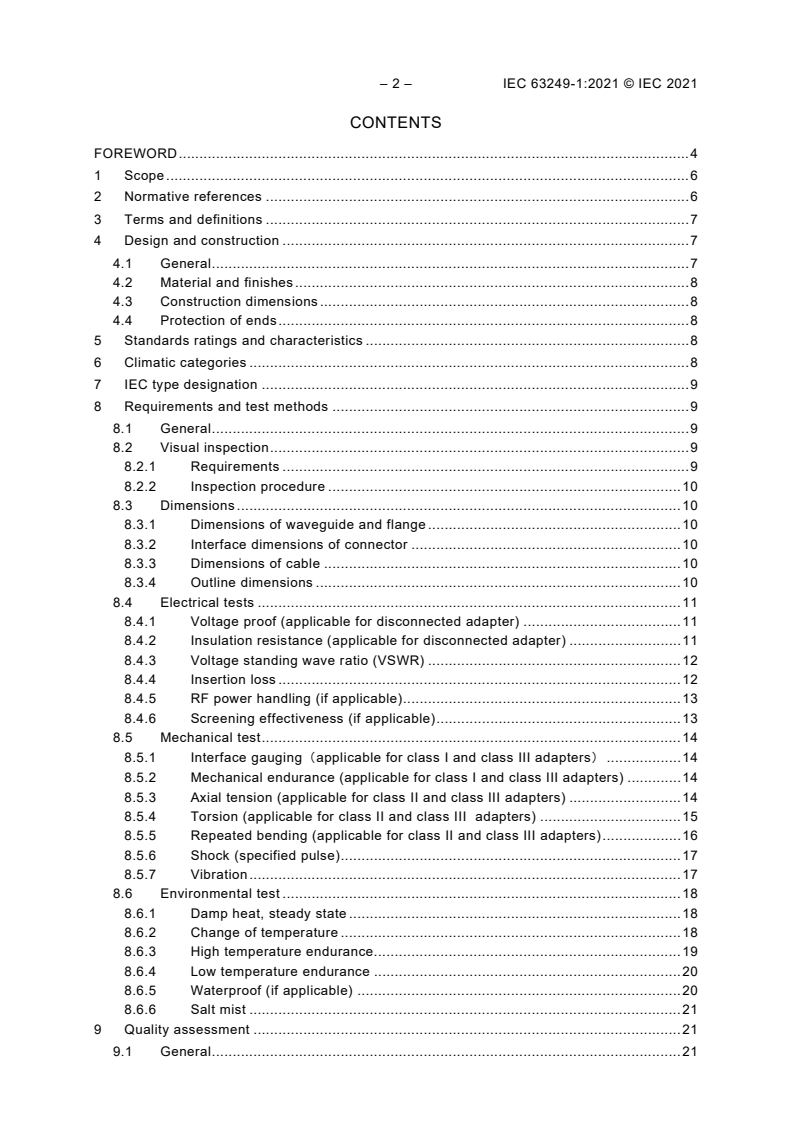
– 2 – IEC 63249-1:2021 © IEC 2021
CONTENTS
FOREWORD . 4
1 Scope . 6
2 Normative references . 6
3 Terms and definitions . 7
4 Design and construction . 7
4.1 General . 7
4.2 Material and finishes . 8
4.3 Construction dimensions . 8
4.4 Protection of ends . 8
5 Standards ratings and characteristics . 8
6 Climatic categories . 8
7 IEC type designation . 9
8 Requirements and test methods . 9
8.1 General . 9
8.2 Visual inspection . 9
8.2.1 Requirements . 9
8.2.2 Inspection procedure . 10
8.3 Dimensions . 10
8.3.1 Dimensions of waveguide and flange . 10
8.3.2 Interface dimensions of connector . 10
8.3.3 Dimensions of cable . 10
8.3.4 Outline dimensions . 10
8.4 Electrical tests . 11
8.4.1 Voltage proof (applicable for disconnected adapter) . 11
8.4.2 Insulation resistance (applicable for disconnected adapter) . 11
8.4.3 Voltage standing wave ratio (VSWR) . 12
8.4.4 Insertion loss . 12
8.4.5 RF power handling (if applicable) . 13
8.4.6 Screening effectiveness (if applicable) . 13
8.5 Mechanical test . 14
8.5.1 Interface gauging(applicable for class I and class III adapters) . 14
8.5.2 Mechanical endurance (applicable for class I and class III adapters) . 14
8.5.3 Axial tension (applicable for class II and class III adapters) . 14
8.5.4 Torsion (applicable for class II and class III adapters) . 15
8.5.5 Repeated bending (applicable for class II and class III adapters) . 16
8.5.6 Shock (specified pulse) . 17
8.5.7 Vibration . 17
8.6 Environmental test . 18
8.6.1 Damp heat, steady state . 18
8.6.2 Change of temperature . 18
8.6.3 High temperature endurance. 19
8.6.4 Low temperature endurance . 20
8.6.5 Waterproof (if applicable) . 20
8.6.6 Salt mist . 21
9 Quality assessment . 21
9.1 General . 21
9.2 Test condition . 21
9.2.1 Requirements for test mating parts . 21
9.2.2 Test specimen . 21
9.3 Qualification inspection . 22
9.3.1 Test specimens . 22
9.3.2 Inspection procedure . 22
9.3.3 Structurally similar components . 23
9.4 Conformance inspection. 23
9.4.1 General . 23
9.4.2 Lot-by-lot inspection . 23
9.5 Specification structures . 25
9.5.1 General . 25
9.5.2 Sectional specification (SS) . 25
9.5.3 Detail specification (DS) . 25
10 Marking . 25
10.1 Marking of components . 25
10.2 Marking and contents of package . 26
Figure 1 –Schematic diagram of a bending test device . 16
Table 1 – Preferred climatic categories (see IEC 60068-1) . 8
Table 2 – Recommended severities for low temperature tests . 20
Table 3 – Qualification inspection . 22
Table 4 – Lot-by-lot inspection . 23
Table 5 – Sampling plans . 24
Table 6 – Periodic inspection . 24
– 4 – IEC 63249-1:2021 © IEC 2021
INTERNATIONAL ELECTROTECHNICAL COMMISSION
____________
WAVEGUIDE TO COAXIAL ADAPTERS –
Part 1: Generic specification –
General requirements and test methods
FOREWORD
1) The International Electrotechnical Commission (IEC) is a worldwide organization for standardization comprising
all national electrotechnical committees (IEC National Committees). The object of IEC is to promote international
co-operation on all questions concerning standardization in the electrical and electronic fields. To this end and
in addition to other activities, IEC publishes International Standards, Technical Specifications, Technical Reports,
Publicly Available Specifications (PAS) and Guides (hereafter referred to as “IEC Publication(s)”). Their
preparation is entrusted to technical committees; any IEC National Committee interested in the subject dealt with
may participate in this preparatory work. International, governmental and non-governmental organizations liaising
with the IEC also participate in this preparation. IEC collaborates closely with the International Organization for
Standardization (ISO) in accordance with conditions determined by agreement between the two organizations.
2) The formal decisions or agreements of IEC on technical matters express, as nearly as possible, an international
consensus of opinion on the relevant subjects since each technical committee has representation from all
interested IEC National Committees.
3) IEC Publications have the form of recommendations for international use and are accepted by IEC National
Committees in that sense. While all reasonable efforts are made to ensure that the technical content of IEC
Publications is accurate, IEC cannot be held responsible for the way in which they are used or for any
misinterpretation by any end user.
4) In order to promote international uniformity, IEC National Committees undertake to apply IEC Publications
transparently to the maximum extent possible in their national and regional publications. Any divergence between
any IEC Publication and the corresponding national or regional publication shall be clearly indicated in the latter.
5) IEC itself does not provide any attestation of conformity. Independent certification bodies provide conformity
assessment services and, in some areas, access to IEC marks of conformity. IEC is not responsible for any
services carried out by independent certification bodies.
6) All users should ensure that they have the latest edition of this publication.
7) No liability shall attach to IEC or its directors, employees, servants or agents including individual experts and
members of its technical committees and IEC National Committees for any personal injury, property damage or
other damage of any nature whatsoever, whether direct or indirect, or for costs (including legal fees) and
expenses arising out of the publication, use of, or reliance upon, this IEC Publication or any other IEC
Publications.
8) Attention is drawn to the Normative references cited in this publication. Use of the referenced publications is
indispensable for the correct application of this publication.
9) Attention is drawn to the possibility that some of the elements of this IEC Publication may be the subject of patent
rights. IEC shall not be held responsible for identifying any or all such patent rights.
IEC 63249-1 has been prepared by subcommittee 46F: RF and microwave passive components,
of IEC technical committee 46: Cables, wires, waveguides, RF connectors, RF and microwave
passive components and accessories. It is an International Standard.
The text of this International Standard is based on the following documents:
Draft Report on voting
46F/511/CDV 46F/549/RVC
Full information on the voting for its approval can be found in the report on voting indicated in
the above table.
The language used for the development of this International Standard is English.
This document was drafted in accordance with ISO/IEC Directives, Part 2, and developed in
accordance with ISO/IEC Directives, Part 1 and ISO/IEC Directives, IEC Supplement, available
at www.iec.ch/members_experts/refdocs. The main document types developed by IEC are
described in greater detail at www.iec.ch/standardsdev/publications.
A list of all parts of the IEC 63249 series, under the general title Waveguide to coaxial adapters
can be found on the IEC website.
The committee has decided that the contents of this document will remain unchanged until the
stability date indicated on the IEC website under webstore.iec.ch in the data related to the
specific document. At this date, the document will be
• reconfirmed,
• withdrawn,
• replaced by a revised edition, or
• amended.
– 6 – IEC 63249-1:2021 © IEC 2021
WAVEGUIDE TO COAXIAL ADAPTERS –
Part 1: Generic specification –
General requirements and test methods
1 Scope
This part of IEC 63249 defines general requirements and test methods for waveguide to coaxial
adapters. It includes terms and definitions, design and construction, ratings and characteristics,
climatic categories, IEC type designation, requirements and test methods, quality assessment,
marking, etc.
It provides the basis for establishing the sectional specifications for various waveguide to
coaxial adapters.
This specification applies to waveguide to coaxial adapters (short name adapter).
For the purpose of this specification, according to ends, adapters are classified as the following:
– Class I: Waveguide to coaxial connector adapter, waveguide at one end and coaxial
connector at the other end;
– Class II: Waveguide to coaxial cable adapter, waveguide at one end,and coaxial cable at
the other end;
– Class III: Waveguide to coaxial cabled connector adapter, waveguide at one end,and
coaxial cabled connector at the other end.
According to whether the inner conductor probe of coaxial end is connected with the inner wall
of waveguide cavity or not, adapters are classified as the following:
– Connected adapter: Inner conductor probe of coaxial end is connected with inner wall of
waveguide cavity;
– Disconnected adapter: Inner conductor probe of coaxial end is disconnected with inner wall
of waveguide cavity.
2 Normative references
The following documents are referred to in the text in such a way that some or all of their content
constitutes requirements of this document. For dated references, only the edition cited applies.
For undated references, the latest edition of the referenced document (including any
amendments) applies.
IEC 60050-726, International Electrotechnical Vocabulary (IEV) – Part 726: Transmission lines
and waveguides
IEC 60068-1, Environmental testing – Part 1: General and guidance
IEC 60068-2-6, Environmental testing – Part 2-6: Tests – Test Fc: Vibration (sinusoidal)
IEC 60068-2-11, Environmental testing − Part 2-11: Tests − Test Ka: Salt mist
IEC 60068-2-14, Environmental testing – Part 2-14: Tests – Test N: Change of temperature
IEC 60068-2-27, Environmental testing – Part 2-27: Tests – Test Ea and guidance: Shock
IEC 60068-2-78, Environmental testing – Part 2-78: Tests – Test Cab: Damp heat, steady state
IEC 60153 (all parts), Hollow metallic waveguides
IEC 60154 (all parts), Flanges for waveguides
IEC 60529, Degrees of protection provided by enclosures (IP Code)
IEC 60617, Graphical symbols for diagrams (available from: http://std.iec.ch/iec60617)
IEC 61169 (all parts), Radio frequency connectors
IEC 61169-1, Radio frequency connectors − Part 1: Generic specification − General
requirements and measuring methods
IEC 61196 (all parts), Coaxial communication cables
IEC 61726, Cable assemblies, cables, connectors and passive microwave components −
Screening attenuation measurement by the reverberation chamber method
3 Terms and definitions
For the purposes of this document, the terms and definitions given in IEC 61169-1 and
IEC 60050-726 apply.
ISO and IEC maintain terminological databases for use in standardization at the following
addresses:
• IEC Electropedia: available at http://www.electropedia.org/
• ISO Online browsing platform: available at http://www.iso.org/obp
4 Design and construction
4.1 General
The adapters shall be designed and constructed to ensure such features as adequate accuracy,
long mechanical endurance, and good repeatability. The relevant specification is not intended
to restrict those designs and dimensions for details of construction which do not influence
interchange ability or performance, nor are they to be used as manufacturing drawings.
The coaxial extension of each adapter shall be positioned on the waveguide so that all the
electrical requirements are satisfied. No constructional detail of the adapters shall influence
mating of the waveguide, flange and coaxial end with their counterparts.
All of mechanical drawings shall be made as specified in IEC 60617. The dimensions and
tolerances shall be given in metric units. During conversion of dimensions given in inches into
millimeters, they shall be rounded to the nearest 0,001 mm or 0,000 05 in. However, when
mechanical and electrical conditions permit, they shall be rounded to the nearest 0,01 mm or
0,000 5 in.
– 8 – IEC 63249-1:2021 © IEC 2021
4.2 Material and finishes
The materials and finishes used for the adapters shall be as specified in the safety and
environmental regulations and in relevant specifications. Dissimilar metals between which an
electromotive couple may exist, shall not be placed in contact with each other.
4.3 Construction dimensions
Adapters shall be of the construction dimensions as stated in the relevant specification.
a) waveguide and flange
The waveguides shall be as specified in relevant specifications of IEC 60153 and the flanges
shall be as specified in relevant specifications of IEC 60154 or the relevant specification of
waveguide to coaxial adapter. The perpendicularity of waveguide flange to waveguide tube
axis should be 90 °± 0,25°.
b) coaxial connector
The coaxial connectors shall be as specified in relevant specifications of IEC 61169 or
relevant specifications of waveguide to coaxial adapter. The critical relative position
dimensions for the interface shall be as stated in the relevant specification.
c) coaxial cable
The coaxial cables shall be as specified in relevant specifications of IEC 61196 or relevant
specifications of waveguide to coaxial adapter.
4.4 Protection of ends
The ends of adapters shall be protected with caps, covers or other appropriate means to prevent
damage and entrance of moisture and foreign material.
5 Standards ratings and characteristics
The ratings and characteristics applicable to adapters should be specified in the relevant
specification. If possible, the following ratings or characteristics shall be included:
a) the working voltage at different altitudes (if applicable);
b) frequency range;
c) the climatic categories;
d) any other ratings or characteristics applicable.
6 Climatic categories
The classification of adapters with regard to climatic conditions is based on IEC 60068-1 and
indicated by a series of three sets of digits separated by oblique strokes corresponding
respectively to tests at low temperature (minus sign not shown), high temperature and the
number of days of exposure to damp heat, steady state.
The climatic severities are referenced by a cold temperature, high temperature and damp heat
steady state duration. Examples of climatic category of this are shown in Table 1:
Table 1 –Preferred climatic categories (see IEC 60068-1)
Category designation Letter Temperature range Damp heat, steady state
40/85/21 A −40 °C to +85 °C 21 days
55/125/21 B −55 °C to +125 °C 21 days
55/155/56 C −55 °C to +155 °C 56 days
7 IEC type designation
The purpose of the IEC type designation is to identify a particular adapter within the scope of
IEC waveguide to coaxial adapter standardization. It is not intended to include information in
excess of this.
In practice, it is usually necessary to identify a manufacturer's product because, although
complying with this document, there may be features that are not covered by this document.
The adapters complying with the relevant specifications shall be designated by the following
indications and in the order given:
a) the number of this document;
b) the letters "IEC";
c) the code number of each end of adapters, individually, as follows:
• Class I: Waveguide type /connector type;
• Class II: Waveguide type/cable type;
• Class III: Waveguide type/connector type - cable type.
d) additional identification as specified in the relevant specification.
NOTE When an IEC type designation is used, either for the marking of the product or in a description of the product,
it is the responsibility of the manufacturer to ensure that the item meets the requirements of the relevant specification.
8 Requirements and test methods
8.1 General
Unless otherwise specified, the following conditions shall apply:
a) tests shall be carried out under standard atmospheric conditions for testing as specified in
IEC 60068-1;
b) before measurements are made, the adapters shall be preconditioned under standard
atmospheric conditions for testing for a time sufficient to allow the entire adapter to reach
thermal stability;
c) recovery conditions for the interval after a conditioning and the next measurement of test
shall be in accordance with IEC 60068-1.
When a nominal value only is given for an applied stress and/or the duration of application, the
specified value shall be taken to indicate the minimum test severity to be applied.
The test shall be carried out on the adapters as received from the supplier.
Nominal coupling torque value shall be specified for screw-coupled connectors at coaxial ends
of adapters in the relevant specification.
8.2 Visual inspection
8.2.1 Requirements
Visual inspection shall meet the following requirements:
a) marking
It shall be correct in accordance with 10.1 and be legible after any of the specified tests.
b) Workmanship
– 10 – IEC 63249-1:2021 © IEC 2021
Adapters and associated fittings shall be processed in such a manner as to be uniform in
quality and shall be free from visible sharp edges, burrs and other defects that will affect
life, serviceability or appearance.
c) deterioration after electrical, mechanical and environmental tests
Unless otherwise specified, there shall be no visible deterioration likely to influence the
performance.
d) marking of package
It shall be in accordance with 10.1.
8.2.2 Inspection procedure
The inspection will be performed visually or by a magnifier under a magnification as stated in
the relevant specification.
8.3 Dimensions
8.3.1 Dimensions of waveguide and flange
8.3.1.1 Requirements
The dimensions of waveguide and flange shall be in accordance with the relevant specifications.
8.3.1.2 Inspection procedure
The inspection for dimensions of waveguide and flange shall be performed using measuring
tool or gauge with adequate accuracy.
8.3.2 Interface dimensions of connector
8.3.2.1 Requirements
The dimensions of connector shall be in accordance with the mating face drawings, stated in
the relevant specification.
8.3.2.2 Inspection procedure
The inspection for the interface dimensions of connectors shall be performed by mating the
gauge stated in the relevant specification with the connector.
8.3.3 Dimensions of cable
8.3.3.1 Requirements
The dimensions of cable shall be as stated in the relevant specification.
8.3.3.2 Inspection procedure
The inspection for the dimensions of cable shall be performed by using measuring tool with
adequate accuracy.
8.3.4 Outline dimensions
8.3.4.1 Requirements
The outline dimensions shall be as specified in the relevant specification.
8.3.4.2 Inspection procedure
The inspection for the outline dimensions shall be performed using measuring tool with
adequate accuracy.
8.4 Electrical tests
8.4.1 Voltage proof (applicable for disconnected adapter)
8.4.1.1 Requirements
The coaxial end of the adapter shall withstand the voltage specified in the relevant specification
without breakdown or flashover.
8.4.1.2 Test procedure
A test voltage specified in the relevant specification is applied between inner and outer
conductors of the coaxial end of the adapter, and the high voltage side of the test system is
connected to the inner conductor.
It shall be applied for 60s, unless otherwise prescribed in the relevant specification.
8.4.1.3 Information to be given in the relevant specification
The following information shall be reported in the relevant specification:
a) value of the test voltage;
b) maximum leakage current;
c) any deviation from the standard test method.
8.4.2 Insulation resistance (applicable for disconnected adapter)
8.4.2.1 Requirements
The insulation resistance for the coaxial end of the adapter shall be not less than the value
specified in the relevant specification.
8.4.2.2 Test procedure
The insulation resistance shall be measured between inner and outer conductors of the coaxial
end.
The test equipment shall have a suitable range to cover the resistance being measured.
The test voltage should be a DC voltage of 500 V±50 V or the rated voltage of the adapter,
whichever is less. The insulation resistance shall be measured in 2 min.
8.4.2.3 Information to be given in the relevant specification
The following information shall be reported in the relevant specification:
a) value of the test voltage if other than 500 V;
b) minimum value of insulation resistance;
c) any deviation from the standard test method.
– 12 – IEC 63249-1:2021 © IEC 2021
8.4.3 Voltage standing wave ratio (VSWR)
8.4.3.1 Requirements
Voltage standing wave ratio shall not exceed the value specified in the relevant specification.
8.4.3.2 Test procedure
Using the waveguide end and the coaxial end as the input end respectively, the VSWR shall be
measured over the specified frequency range. For class II adapters, the coaxial end should be
terminated with a appropriate connector.
The test procedure is as follows:
a) after the vector network analyser (VNA) is fully preheated, set measurement frequency
range, and then set the test mode as S ;
b) system calibration: Use the open, short, load separately to calibrate VNA;
c) standard test adaptor calibration (when needed): When the test cable port of VNA cannot
directly connect with the test specimen (DUT), the standard test adaptors need to be used;.
d) connect the DUT between VNA and the load or the two adapters, and record the S graph;
e) turn DUT around, test the DUT in the other direction and record S graph.
8.4.3.3 Information to be given in the relevant specification
The following information shall be reported in the relevant specification:
a) frequency range;
b) maximum value of VSWR;
c) details (or drawing) of the adaptor or load to be mated with the DUT, when needed;
d) any deviation from the standard test method.
8.4.4 Insertion loss
8.4.4.1 Requirements
Insertion loss shall be not greater than the value specified in the relevant specification.
8.4.4.2 Test procedure
Using the waveguide end and the coaxial end as the input end respectively, the insertion loss
shall be measured over the specified frequency range. For class II adapters, the coaxial end
should be terminated with a appropriate connector.
The insertion loss of adapters should be measured as follows:
a) after VNA is fully preheated, set measurement frequency range, and set test mode as S
or S ;
b) system calibration: The two test cable ports of the VNA shall be connected and calibrated;
c) connect the DUT to VNA, and record the S or S graph. If the two test ports of VNA cannot
12 21
be connected directly to the DUT, standard test adaptors are needed.
8.4.4.3 Information to be given in the relevant specification
The following information shall be reported in the relevant specification:
a) frequency range;
b) limit value of insertion loss;
c) details (or drawing) of the adaptor to be mated with the DUT, when needed;
d) cable type to be specified for waveguide to coaxial cabled connector adapter;
e) any deviation from the standard test method.
8.4.5 RF power handling (if applicable)
8.4.5.1 Requirements
Adapters shall withstand power indicated in the relevant specification at the specified frequency,
temperature, and equivalent altitude without breakdown. The VSWR and insertion loss after
test shall be as stated in the relevant specification.
8.4.5.2 Test procedure
The test procedure is as follows:
a) put the adapter into the test chamber, and connect the adapter under test to the test system;
b) the temperature and equivalent altitude in the chamber shall be in accordance with the
relevant specification;
c) set the frequency parameters, apply a small power signal to the test circuit, and check the
continuity of the test circuit;
d) apply the power value stated in the relevant specification to DUT for a period specified in
the relevant specification;
e) after test, measure VSWR and insertion loss of the DUT.
8.4.5.3 Information to be given in the relevant specification
The following information shall be reported in the relevant specification:
a) measurement frequency and power value;
b) temperature and equivalent altitude (if necessary);
c) VSWR and insertion loss;
d) details (or drawing) of the adaptor to be to be mated with the DUT;
e) any deviation from the standard test method.
8.4.6 Screening effectiveness (if applicable)
8.4.6.1 Requirements
It shall be as specified in the relevant specification.
8.4.6.2 Test procedure
The adapter shall be tested for screening effectiveness as specified in IEC 61726.
8.4.6.3 Information to be given in the relevant specification
The following information shall be reported in the relevant specification:
a) frequency range;
b) value of screening effectiveness;
c) details (or drawing) of the adaptor to be to be mated with the DUT;
d) any deviation from the standard test method.
– 14 – IEC 63249-1:2021 © IEC 2021
8.5 Mechanical test
8.5.1 Interface gauging(applicable for class I and class III adapters)
8.5.1.1 Requirements
The coaxial interface of adapters shall pass the test for gauging as stated in the relevant
specification, or comply with requirements as stated in the relevant specification.
8.5.1.2 Test procedure
The connector end of the adapter should be tested with a series of pin gauges or ring gauges
in accordance with the relevant specifications. The test insertion force and withdrawal force
shall be in accordance with the requirements specified in relevant specifications.
8.5.1.3 Information to be given in the relevant specification
The following information shall be reported in the relevant specification:
a) dimensional details of the gauge(s);
b) insertion force and withdrawal force;
c) any deviation from the standard test method.
8.5.2 Mechanical endurance (applicable for class I and class III adapters)
8.5.2.1 Requirements
After test, the coaxial end of the adapter should be free from serious mechanical damage, and
the coupling mechanism should maintain its function. The interface gauging measurement shall
be performed in accordance with 8.5.1.
8.5.2.2 Test procedure
The connector end of the adapter shall be mated with a typical production connector in
accordance with the relevant specification. The connector shall be subjected to the number of
cycles of mating and unmating specified. The connector end of the adapter and its counterpart
shall be completely engaged and fully disengaged during this cycle. Lubrication of the threads
or rotational parts shall not be employed for this test. It is permissible to shake or blow debris
from the threads or interface surfaces at intervals of not less than 50 cycles. Solvents or tools
shall not be used for cleaning.
After the test, check the appearance of the adapter and perform gauging measurements on the
interface
8.5.2.3 Information to be given in the relevant specification
The following information shall be reported in the relevant specification:
a) frequency of operations;
b) number of cycles, if other than 500;
c) any deviation from the standard test procedure.
8.5.3 Axial tension (applicable for class II and class III adapters)
8.5.3.1 Requirements
The tensile test specified in the relevant specification shall be performed on the junction of the
cable to the waveguide or to the connector. For class III adapters, both ends of the adapter
shall be subjected to the specified axial tensile test. After the test, the VSWR and insertion loss
shall comply with the relevant specifications, no visually external and mechanical damages
occurred, and the relative position dimensions of the coaxial connector of adapter shall be in
accordance with 4.3.
8.5.3.2 Test procedure
The test procedure is as follows:
a) initial inspections and measurements: Inspect the adapter for appearance, and measure
relative position dimensions at its coaxial end, and measure VSWR and insertion loss;
b) mount the adapter in the test fixture;
c) junctions between each end of the adapter and the cable shall be subjected to axial tension
as specified in the relevant specification for 30 s separately;
d) remove the adapter from the test fixture; inspect it for appearance and measure relative
position dimensions at its end, and measure VSWR and insertion loss again.
8.5.3.3 Information to be given in the relevant specification
The following information shall be reported in the relevant specification:
a) maximum axial tension;
b) VSWR and insertion loss;
c) any deviation from the standard test method.
8.5.4 Torsion (applicable for class II and class III adapters)
8.5.4.1 Requirements
The torsion test specified in the relevant specification shall be performed on the junction of the
cable to the waveguide or to the connector. Both ends of the adapter shall be subjected to the
specified torsion test. After the test, the VSWR and insertion loss shall comply with the relevant
specifications, no visually external and mechanical damages occurred, and the relative position
dimensions of the coaxial connector of adapter shall be in accordance with 4.3.
8.5.4.2 Test procedure
The test procedure is as follows:
a) initial inspections and measurements: Inspect the adapter for appearance, and measure
relative position dimensions at its coaxial end, and measure VSWR and insertion loss;
b) mount the adapter in the test fixture;
c) junctions between each end of the adapter and the cable should be subjected to torque as
specified in the relevant specification in clockwise direction for 10 s and release the force,
and then apply the same torque in the counter clockwise direction for 10 s. A complete
torsion cycle test consists of applications of torques in clockwise and counter clockwise
directions;
d) the adapter shall be subjected to five cycles of the test;
e) for the other end of the adapter, release the force, and repeat steps b) through d);
f) inspect the adapter for appearance, and measure relative position dimensions at its coaxial
end, then measure VSWR and insertion loss.
8.5.4.3 Information to be given in the relevant specification
The following information shall be reported in the relevant specification:
a) torque value;
b) VSWR and insertion loss;
c) any deviation from the standard test method.
– 16 – IEC 63249-1:2021 © IEC 2021
8.5.5 Repeated bending (applicable for class II and class III adapters)
8.5.5.1 Requirements
The repeated bending test specified in the relevant specification shall be performed on the
junction of the cable to the waveguide or to the connector. For class III adapter, both ends of
the adapter shall be subjected to this repeated bending test. After the test, the VSWR and
insertion loss shall comply with the relevant specifications, no visually external and mechanical
damages occurred, and the relative position dimensions of the coaxial connector of adapter
shall be in accordance with 4.3.
8.5.5.2 Test procedure
The repeated bending test is shown as in Figure 1. The adapter shall be subjected to repeated
bending test under the load specified in the relevant specification. The angle for bending is
applied up to 180°, and either limit position is at an angle of 90° to the vertical line, individually.
Other equivalent devices can also be used.
The flexible arm of the test device should have an adjustable fixture which can safely fix the
waveguide or connector at one end of the adapter throughout the test.
The test device should be able to swing. The specimen swings from the vertical position to right
limit position, then back to left limit position and returns to the initial vertical position to form a
cycle. Unless otherwise specified in the relevant specification, the bending velocity is about one
cycle per 2 s.
Figure 1 – Schematic diagram of a bending test device
8.5.5.3 Information to be given in the relevant specification
The following information shall be reported in the relevant specification:
a) number of bending cycles;
b) VSWR and insertion loss;
c) any deviation fro
...