

IEC 61139-2:2022
(Main)Industrial networks - Single-drop digital communication interface - Part 2: Functional safety extensions
General Information
- Abstract
IEC 61139-2:2022 specifies the extensions to SDCI in IEC 61131-9 for functional safety. This comprises:
• a standardized OSSDe interface for redundant switching signals based on IEC 61131-2,
• minor modifications/extensions to state machines of SDCI to support the safety operations,
• a lean functional safety communication protocol on top of the standard SDCI communication which is a black channel according to IEC 61784-3:2021,
• protocol management functions for configuration, parameterization, and commissioning,
• IODD extensions for functional safety,
• a Device tool interface to support Dedicated Tools according to functional safety standards.
This document does not cover:
• communication interfaces or systems including multi-point or multi-drop linkages,
• communication interfaces or systems including multi-channel or encrypted linkages,
• wireless communication interfaces or systems,
• integration of SDCI-FS into upper-level systems such as fieldbuses/FSCPs.
- Status
- Published
- Publication Date
- 18-Aug-2022
- Technical Committee
- SC 65C - Industrial networks
- Drafting Committee
- PT 61139-2 - TC 65/SC 65C/PT 61139-2
- Current Stage
- PPUB - Publication issued
- Start Date
- 19-Aug-2022
- Completion Date
- 22-Jul-2022
Overview
IEC 61139-2:2022 is an international standard published by the International Electrotechnical Commission (IEC) that defines functional safety extensions for the Single-drop Digital Communication Interface (SDCI) specified in IEC 61131-9. This document focuses on enhancing SDCI to support safety-critical industrial network applications with a robust, lean communication protocol built over the standard SDCI black channel communication.
The standard specifies:
- A standardized OSSDe interface for redundant switching signals based on IEC 61131-2.
- Updates and extensions to state machines in SDCI to enable safety operations.
- Implementation of a functional safety communication protocol adhering to IEC 61784-3:2021 black channel principles.
- Protocol management features for device configuration, parameterization, and commissioning.
- Extensions for the IODD (IO device description) to cover functional safety.
- A dedicated device tool interface supporting safety-compliant dedicated tools.
IEC 61139-2:2022 excludes multi-point, multi-drop, multi-channel, encrypted, and wireless communication interfaces, as well as integration into upper-level fieldbus or functional safety communication profiles.
Key Topics
- Functional Safety Communication Protocol: A lean protocol layered on SDCI ensuring communication integrity and error detection in safety applications.
- OSSDe Interface: A standardized output switching signal device interface allowing redundant safe switching signals in compliance with IEC 61131-2.
- State Machine Extensions: Modifications to SDCI’s data link and communication layers to support safety operations and fault monitoring.
- Safety Device and Master Architectures: Defines roles and interactions for FS-Devices (safety devices) and FS-Masters (controllers), including power supply, wake-up coordination, and fast start-up procedures.
- Parameterization and Configuration: Protocol management functions are introduced for streamlined safety parameter configuration, device commissioning, and runtime management.
- IODD Functional Safety Extensions: Enhanced device descriptions support automation tools with critical safety parameters and diagnostic data.
- Safety Layer Manager (SLM): Manages safety communication states, error handling, and safety parameterization to maintain safe operating conditions.
- Process Data Exchange and Data Storage: Extensions ensure that safety-relevant process data and device states are managed securely and reliably.
Applications
IEC 61139-2:2022 applies primarily to industrial automation systems requiring high reliability and safety compliance such as:
- Safety-critical machinery control systems that use digital communication for monitoring and controlling safety functions.
- Redundant output switching systems in safety applications requiring fail-safe signal outputs.
- Functional safety device communication in manufacturing plants to meet strict safety integrity levels.
- Integration of safety-oriented dedicated tool interfaces for device diagnostics, configuration, and maintenance.
- Applications where point-to-point communication is preferred or mandated for safe operational architectures.
- Industries such as automotive manufacturing, process automation, robotics, and material handling where functional safety standards compliance is essential.
The standard is also a foundational building block for vendors and system integrators developing safety communication solutions that align with international best practices and IEC safety standards.
Related Standards
- IEC 61131-9: Single-drop digital communication interface base standard providing the core SDCI technology extended by IEC 61139-2.
- IEC 61131-2: Standard specifying digital input/output interfaces including OSSDe devices for industrial controllers.
- IEC 61784-3:2021: Defines communication profiles including black channel principles underlying the functional safety communication protocol in IEC 61139-2.
- ISO 13849 and IEC 62061: Functional safety standards for machinery control systems which can be supported using IEC 61139-2 safety communication features.
- IODD (IO device description) standards that are extended by IEC 61139-2 to include functional safety parameters.
- Other IEC functional safety standards that address safety device design and integration within industrial automation systems.
IEC 61139-2:2022 advances single-drop digital communication with essential functional safety extensions, enabling safer, more reliable industrial network deployments. By adopting this standard, manufacturers and system integrators can ensure compliance with international safety frameworks while benefiting from streamlined communication, configuration, and management of safety devices in automated environments.
Get Certified
Connect with accredited certification bodies for this standard

DVS-ZERT GmbH
German welding certification society.
CARES (UK Certification Authority for Reinforcing Steels)
UK certification for reinforcing steels and construction.
EWF/IIW (European/International Welding Federation)
International welding personnel certification.
Sponsored listings
Frequently Asked Questions
IEC 61139-2:2022 is a standard published by the International Electrotechnical Commission (IEC). Its full title is "Industrial networks - Single-drop digital communication interface - Part 2: Functional safety extensions". This standard covers: IEC 61139-2:2022 specifies the extensions to SDCI in IEC 61131-9 for functional safety. This comprises: • a standardized OSSDe interface for redundant switching signals based on IEC 61131-2, • minor modifications/extensions to state machines of SDCI to support the safety operations, • a lean functional safety communication protocol on top of the standard SDCI communication which is a black channel according to IEC 61784-3:2021, • protocol management functions for configuration, parameterization, and commissioning, • IODD extensions for functional safety, • a Device tool interface to support Dedicated Tools according to functional safety standards. This document does not cover: • communication interfaces or systems including multi-point or multi-drop linkages, • communication interfaces or systems including multi-channel or encrypted linkages, • wireless communication interfaces or systems, • integration of SDCI-FS into upper-level systems such as fieldbuses/FSCPs.
IEC 61139-2:2022 specifies the extensions to SDCI in IEC 61131-9 for functional safety. This comprises: • a standardized OSSDe interface for redundant switching signals based on IEC 61131-2, • minor modifications/extensions to state machines of SDCI to support the safety operations, • a lean functional safety communication protocol on top of the standard SDCI communication which is a black channel according to IEC 61784-3:2021, • protocol management functions for configuration, parameterization, and commissioning, • IODD extensions for functional safety, • a Device tool interface to support Dedicated Tools according to functional safety standards. This document does not cover: • communication interfaces or systems including multi-point or multi-drop linkages, • communication interfaces or systems including multi-channel or encrypted linkages, • wireless communication interfaces or systems, • integration of SDCI-FS into upper-level systems such as fieldbuses/FSCPs.
IEC 61139-2:2022 is classified under the following ICS (International Classification for Standards) categories: 25.040 - Industrial automation systems. The ICS classification helps identify the subject area and facilitates finding related standards.
IEC 61139-2:2022 is available in PDF format for immediate download after purchase. The document can be added to your cart and obtained through the secure checkout process. Digital delivery ensures instant access to the complete standard document.
Standards Content (Sample)
IEC 61139-2 ®
Edition 1.0 2022-08
INTERNATIONAL
STANDARD
NORME
INTERNATIONALE
colour
inside
Industrial networks – Single-drop digital communication interface –
Part 2: Functional safety extensions
Réseaux industriels – Interface de communication numérique point à point –
Partie 2: Extensions de sécurité fonctionnelle
All rights reserved. Unless otherwise specified, no part of this publication may be reproduced or utilized in any form
or by any means, electronic or mechanical, including photocopying and microfilm, without permission in writing from
either IEC or IEC's member National Committee in the country of the requester. If you have any questions about IEC
copyright or have an enquiry about obtaining additional rights to this publication, please contact the address below or
your local IEC member National Committee for further information.
Droits de reproduction réservés. Sauf indication contraire, aucune partie de cette publication ne peut être reproduite ni
utilisée sous quelque forme que ce soit et par aucun procédé, électronique ou mécanique, y compris la photocopie et
les microfilms, sans l'accord écrit de l'IEC ou du Comité national de l'IEC du pays du demandeur. Si vous avez des
questions sur le copyright de l'IEC ou si vous désirez obtenir des droits supplémentaires sur cette publication, utilisez
les coordonnées ci-après ou contactez le Comité national de l'IEC de votre pays de résidence.
IEC Secretariat Tel.: +41 22 919 02 11
3, rue de Varembé info@iec.ch
CH-1211 Geneva 20 www.iec.ch
Switzerland
About the IEC
The International Electrotechnical Commission (IEC) is the leading global organization that prepares and publishes
International Standards for all electrical, electronic and related technologies.
About IEC publications
The technical content of IEC publications is kept under constant review by the IEC. Please make sure that you have the
latest edition, a corrigendum or an amendment might have been published.
IEC publications search - webstore.iec.ch/advsearchform IEC Products & Services Portal - products.iec.ch
The advanced search enables to find IEC publications by a Discover our powerful search engine and read freely all the
variety of criteria (reference number, text, technical publications previews. With a subscription you will always have
committee, …). It also gives information on projects, replaced access to up to date content tailored to your needs.
and withdrawn publications.
Electropedia - www.electropedia.org
IEC Just Published - webstore.iec.ch/justpublished
The world's leading online dictionary on electrotechnology,
Stay up to date on all new IEC publications. Just Published
containing more than 22 300 terminological entries in English
details all new publications released. Available online and once
and French, with equivalent terms in 19 additional languages.
a month by email.
Also known as the International Electrotechnical Vocabulary
(IEV) online.
IEC Customer Service Centre - webstore.iec.ch/csc
If you wish to give us your feedback on this publication or need
further assistance, please contact the Customer Service
Centre: sales@iec.ch.
A propos de l'IEC
La Commission Electrotechnique Internationale (IEC) est la première organisation mondiale qui élabore et publie des
Normes internationales pour tout ce qui a trait à l'électricité, à l'électronique et aux technologies apparentées.
A propos des publications IEC
Le contenu technique des publications IEC est constamment revu. Veuillez vous assurer que vous possédez l’édition la
plus récente, un corrigendum ou amendement peut avoir été publié.
Recherche de publications IEC - Découvrez notre puissant moteur de recherche et consultez
webstore.iec.ch/advsearchform gratuitement tous les aperçus des publications. Avec un
La recherche avancée permet de trouver des publications IEC abonnement, vous aurez toujours accès à un contenu à jour
en utilisant différents critères (numéro de référence, texte, adapté à vos besoins.
comité d’études, …). Elle donne aussi des informations sur les
projets et les publications remplacées ou retirées. Electropedia - www.electropedia.org
Le premier dictionnaire d'électrotechnologie en ligne au monde,
IEC Just Published - webstore.iec.ch/justpublished
avec plus de 22 300 articles terminologiques en anglais et en
Restez informé sur les nouvelles publications IEC. Just
français, ainsi que les termes équivalents dans 19 langues
Published détaille les nouvelles publications parues.
additionnelles. Egalement appelé Vocabulaire
Disponible en ligne et une fois par mois par email.
Electrotechnique International (IEV) en ligne.
Service Clients - webstore.iec.ch/csc
Si vous désirez nous donner des commentaires sur cette
publication ou si vous avez des questions contactez-nous:
sales@iec.ch.
IEC Products & Services Portal - products.iec.ch
IEC 61139-2 ®
Edition 1.0 2022-08
INTERNATIONAL
STANDARD
NORME
INTERNATIONALE
colour
inside
Industrial networks – Single-drop digital communication interface –
Part 2: Functional safety extensions
Réseaux industriels – Interface de communication numérique point à point –
Partie 2: Extensions de sécurité fonctionnelle
INTERNATIONAL
ELECTROTECHNICAL
COMMISSION
COMMISSION
ELECTROTECHNIQUE
INTERNATIONALE
ICS 25.040 ISBN 978-2-8322-3946-9
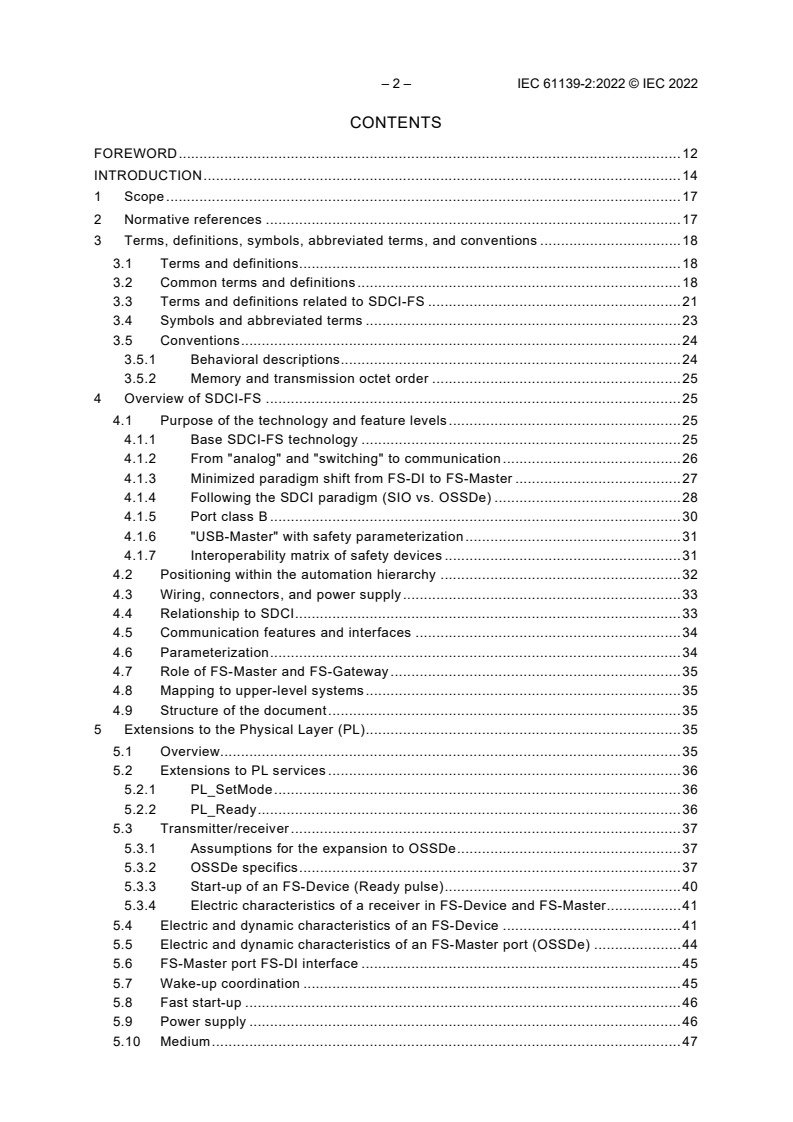
– 2 – IEC 61139-2:2022 © IEC 2022
CONTENTS
FOREWORD . 12
INTRODUCTION . 14
1 Scope . 17
2 Normative references . 17
3 Terms, definitions, symbols, abbreviated terms, and conventions . 18
3.1 Terms and definitions . 18
3.2 Common terms and definitions . 18
3.3 Terms and definitions related to SDCI-FS . 21
3.4 Symbols and abbreviated terms . 23
3.5 Conventions . 24
3.5.1 Behavioral descriptions . 24
3.5.2 Memory and transmission octet order . 25
4 Overview of SDCI-FS . 25
4.1 Purpose of the technology and feature levels . 25
4.1.1 Base SDCI-FS technology . 25
4.1.2 From "analog" and "switching" to communication . 26
4.1.3 Minimized paradigm shift from FS-DI to FS-Master . 27
4.1.4 Following the SDCI paradigm (SIO vs. OSSDe) . 28
4.1.5 Port class B . 30
4.1.6 "USB-Master" with safety parameterization . 31
4.1.7 Interoperability matrix of safety devices . 31
4.2 Positioning within the automation hierarchy . 32
4.3 Wiring, connectors, and power supply . 33
4.4 Relationship to SDCI . 33
4.5 Communication features and interfaces . 34
4.6 Parameterization . 34
4.7 Role of FS-Master and FS-Gateway . 35
4.8 Mapping to upper-level systems . 35
4.9 Structure of the document . 35
5 Extensions to the Physical Layer (PL) . 35
5.1 Overview. 35
5.2 Extensions to PL services . 36
5.2.1 PL_SetMode . 36
5.2.2 PL_Ready . 36
5.3 Transmitter/receiver . 37
5.3.1 Assumptions for the expansion to OSSDe . 37
5.3.2 OSSDe specifics . 37
5.3.3 Start-up of an FS-Device (Ready pulse) . 40
5.3.4 Electric characteristics of a receiver in FS-Device and FS-Master . 41
5.4 Electric and dynamic characteristics of an FS-Device . 41
5.5 Electric and dynamic characteristics of an FS-Master port (OSSDe) . 44
5.6 FS-Master port FS-DI interface . 45
5.7 Wake-up coordination . 45
5.8 Fast start-up . 46
5.9 Power supply . 46
5.10 Medium . 47
5.10.1 Constraints . 47
5.10.2 Connectors . 47
5.10.3 Cable characteristics . 47
6 Extensions to SIO . 47
7 Extensions to the data link layer (DL) . 47
7.1 Overview. 47
7.2 State machine of the FS-Master DL-mode handler . 47
7.3 State machine of the FS-Device DL-mode handler . 49
8 Extensions to the Master Configuration Manager (CM) . 51
9 Extensions of the FS-Device . 52
9.1 Principle architecture and models . 52
9.1.1 FS-Device architecture . 52
9.1.2 FS-Device model . 53
9.2 Parameter Manager (PM) . 54
9.3 Process Data Exchange (PDE) . 54
9.4 Data Storage (DS) . 54
9.4.1 General considerations and extensions including safety . 54
9.4.2 Backup levels . 55
10 Extensions of the FS-Master . 55
10.1 Principle architecture . 55
10.2 SMI service extensions . 56
10.2.1 Overview . 56
10.2.2 SMI_FSMasterAccess . 58
10.2.3 SMI_SPDUIn . 60
10.2.4 SMI_SPDUOut . 60
10.2.5 SMI_FSPDInOut . 60
10.3 ArgBlock extensions . 62
10.3.1 Overview . 62
10.3.2 FSMasterAccess . 62
10.3.3 FSCPAuthenticity . 63
10.3.4 FSPortConfigList . 63
10.3.5 FSPortStatusList. 66
10.3.6 SPDUIn . 67
10.3.7 SPDUOut . 67
10.3.8 FSPDInOut . 68
10.4 Safety Layer Manager (SLM) . 69
10.4.1 Purpose . 69
10.4.2 FS_PortModes . 69
10.4.3 FSP parameter . 69
10.5 Process Data Exchange (PDE) . 73
10.6 Data Storage (DS) . 74
11 Safety communication layer (SCL) . 74
11.1 Functional requirements . 74
11.2 Communication errors and safety measures . 74
11.3 SCL services . 75
11.3.1 Positioning of safety communication layers (SCL) . 75
11.3.2 FS-Master SCL services . 76
11.3.3 FS-Device SCL services . 77
– 4 – IEC 61139-2:2022 © IEC 2022
11.4 SCL protocol . 79
11.4.1 Protocol phases to consider . 79
11.4.2 FS-Device faults . 80
11.4.3 Safety PDU (SPDU) . 80
11.4.4 FS-Input and FS-Output data . 81
11.4.5 Port number . 81
11.4.6 Status and control . 81
11.4.7 CRC signature . 82
11.4.8 TADI safety considerations (informative) . 83
11.4.9 Data types for SDCI-FS . 84
11.5 SCL behavior . 85
11.5.1 General . 85
11.5.2 SCL state machine of the FS-Master . 85
11.5.3 SCL state machine of the FS-Device . 88
11.5.4 Sequence charts for several use cases . 91
11.5.5 Monitoring of safety times . 98
11.5.6 Reaction in the event of a malfunction . 99
11.5.7 Start-up (communication) . 101
11.6 SCL management . 101
11.6.1 Parameter overview (FSP and FST) . 101
11.6.2 Parameterization approaches . 103
11.7 Integrity measures . 104
11.7.1 IODD integrity . 104
11.7.2 Tool integrity . 104
11.7.3 Transmission integrity . 104
11.7.4 Verification record . 104
11.7.5 Authentication. 105
11.7.6 Storage integrity . 105
11.7.7 FS I/O data structure integrity . 106
11.7.8 Technology parameter (FST) based on IODD . 106
11.7.9 Technology parameter (FST) based on existing Dedicated Tool (IOPD) . 107
11.8 Creation of FSP and FST parameters . 108
11.9 Integration of Dedicated Tools (IOPD) . 109
11.9.1 IOPD interface . 109
11.9.2 Standard interfaces . 109
11.9.3 Backward channel . 110
11.10 Validation . 111
11.11 Passivation . 111
11.11.1 Motivation and means . 111
11.11.2 Port selective (FS-Master) . 111
11.11.3 Signal selective (FS-Terminal) . 112
11.11.4 Qualifier settings in case of communication . 112
11.11.5 Qualifier handling in case of OSSDe . 112
11.12 SCL diagnosis . 113
12 Functional safe processing (FS-P) . 114
12.1 Recommendations for efficient I/O mappings . 114
12.2 Embedded FS controller. 114
Annex A (normative) Extensions to parameters . 115
A.1 Indices and parameters for SDCI-FS . 115
A.2 Parameters in detail . 116
A.2.1 FSP_Authenticity . 116
A.2.2 FSP_Port . 116
A.2.3 FSP_AuthentCRC . 117
A.2.4 FSP_ProtVersion . 117
A.2.5 FSP_ProtMode . 117
A.2.6 FSP_Watchdog . 117
A.2.7 FSP_IO_StructCRC . 118
A.2.8 FSP_TechParCRC . 119
A.2.9 FSP_ProtParCRC . 119
A.2.10 FSP_VerifyRecord . 119
A.2.11 FSP_TimeToReady . 119
A.2.12 FSP_MinShutDownTime . 120
A.2.13 FSP_WCDT . 120
A.2.14 FSP_OFDT . 120
A.2.15 FSP_ParamDescCRC . 120
Annex B (normative) Extensions to EventCodes . 121
B.1 Additional FS-Device EventCodes . 121
B.2 Additional Port EventCodes . 121
Annex C (normative) Extensions to Data Types . 123
C.1 Data types for SDCI-FS . 123
C.2 BooleanT (bit) . 123
C.3 IntegerT (16) . 124
C.4 IntegerT (32) . 124
C.5 Safety Code . 125
Annex D (normative) CRC generator polynomials . 126
D.1 Overview of CRC generator polynomials . 126
D.2 Residual error probabilities . 126
D.3 Implementation considerations . 128
D.3.1 Overview . 128
D.3.2 Bit shift algorithm (16 bit) . 128
D.3.3 Lookup table (16 bit) . 128
D.3.4 Bit shift algorithm (32 bit) . 130
D.3.5 Lookup table (32 bit) . 130
D.3.6 Seed values . 131
D.3.7 Octet order for CRC calculation . 132
Annex E (normative) IODD extensions . 133
E.1 General . 133
E.2 Schema . 133
E.3 IODD constraints . 133
E.3.1 General rules . 133
E.3.2 Description of the IODD structure . 133
E.3.3 Behavior of "Reset" SystemCommands in SDCI-FS . 140
E.3.4 Profile Characteristic . 141
E.3.5 ProcessDataInput and ProcessDataOutput . 141
E.4 IODD conventions . 141
E.4.1 Naming . 141
E.4.2 Process Data (PD) . 141
– 6 – IEC 61139-2:2022 © IEC 2022
E.4.3 IODD conventions for user interface . 142
E.4.4 Master Tool features . 142
E.5 Securing . 142
E.5.1 General . 142
E.5.2 DefaultValues for FSP . 143
E.5.3 FSP_Authenticity . 143
E.5.4 FSP_Protocol . 143
E.5.5 FSP_IO_Description . 144
E.5.6 Sample serialization for FSP_ParamDescCRC . 144
E.5.7 FST and FSP parameters and Data Storage . 145
E.5.8 Sample IODD of an FS-Device . 145
Annex F (normative) Device Tool Interface (DTI) for SDCI . 156
F.1 Purpose of DTI . 156
F.2 Base model . 156
F.3 Invocation interface . 157
F.3.1 Overview . 157
F.3.2 Detection of Device Tool . 158
F.3.3 Program Interface Description – PID . 161
F.3.4 Temporary Parameter File – TPF . 164
F.3.5 Temporary Backchannel File – TBF . 169
F.3.6 Temporary Acknowledgment File – TAF . 171
F.3.7 Invocation behavior . 171
F.4 Device data objects (DDO) . 172
F.4.1 General . 172
F.4.2 Structure of DDO package . 173
F.5 Communication Interface . 173
F.5.1 General . 173
F.5.2 Principle of DTI communications . 174
F.5.3 Gateways . 175
F.5.4 Configuration of the Communication Server . 175
F.5.5 Definition of the Communication Interface . 176
F.5.6 Sequence for establishing a communication relation . 176
F.5.7 Usage of the Communication Server in stand-alone mode . 177
F.5.8 SDCI specifics . 178
F.5.9 Changing communication settings . 178
F.6 Reaction on incorrect Tool behavior . 179
F.7 Compatibility . 179
F.7.1 Schema validation . 179
F.7.2 Version policy . 180
F.8 Scalability . 180
F.8.1 Scalability of a Device Tool . 180
F.8.2 Scalability of a Master Tool . 181
F.8.3 Interactions at conformance class combinations . 181
F.9 Schema definitions. 181
F.9.1 General . 181
F.9.2 Schema of the PID . 181
F.9.3 Schema of the TPF . 183
F.9.4 Schema of the TBF . 185
F.9.5 Schema of the TAF . 186
F.9.6 Schema of DTI primitives . 187
Annex G (normative) Main scenarios of SDCI-FS . 189
G.1 Overview. 189
G.2 Sequence chart of commissioning . 190
G.3 Sequence chart of replacement . 191
G.4 Sequence chart of misconnection. 192
Annex H (normative) System requirements . 193
H.1 Indicators . 193
H.1.1 General . 193
H.1.2 OSSDe . 193
H.1.3 Safety communication. 193
H.1.4 Acknowledgment request . 193
H.2 Installation guidelines, electrical safety, and security . 193
H.3 Safety function response time . 194
H.4 Duration of demands . 194
H.5 Maintenance and repair . 194
H.6 Safety manual . 194
Annex I (informative) Information for test and assessment of SDCI-FS components . 195
Bibliography . 196
Figure 1 – Positioning of SDCI-FS in functional safety automation . 14
Figure 2 – Relationship of this document to standards . 16
Figure 3 – Memory and transmission octet order . 25
Figure 4 – SDCI-FS communication layer model . 25
Figure 5 – Port interface extensions for SDCI-FS . 26
Figure 6 – Migration to SDCI-FS . 27
Figure 7 – Minimized paradigm shift from FS-DI to FS-Master. 28
Figure 8 – FS-Master types and feature levels . 28
Figure 9 – Original pin layout of SDCI (port class A) . 29
Figure 10 – Optimized OSSDe commissioning with FS-Master . 30
Figure 11 – Level "d" of an FS-Master (Class B) . 31
Figure 12 – Off-site configuration and parameterization . 31
Figure 13 – SDCI-FS within the automation hierarchy . 33
Figure 14 – The SDCI physical layer of an FS-Master (class A) . 36
Figure 15 – The physical layer of an FS-Device (class A) . 36
Figure 16 – Cross compatibility OSSD and OSSDe . 37
Figure 17 – Principle OSSDe function . 38
Figure 18 – Test pulses to detect cross connection faults . 39
Figure 19 – OSSD timings. 40
Figure 20 – Typical start-up of an OSSD sensor . 40
Figure 21 – Start-up of an FS-Device . 40
Figure 22 – Switching thresholds for FS-Device and FS-Master receivers . 41
Figure 23 – Reference schematics (one OSSDe channel) . 42
Figure 24 – Voltage level definitions . 42
Figure 25 – Charge capability at power-up . 45
– 8 – IEC 61139-2:2022 © IEC 2022
Figure 26 – OSSDe input filter conflict resolution . 45
Figure 27 – Start-up of an FS-Device . 46
Figure 28 – Required fast start-up timings . 46
Figure 29 – State machine of the FS-Master DL-mode handler . 48
Figure 30 – State machine of the FS-Device DL-mode handler . 50
Figure 31 – Extension to the Configuration Manager (VerifyRecord) . 51
Figure 32 – Principle architecture of the FS-Device . 53
Figure 33 – The FS-Device model . 54
Figure 34 – Principle architecture of the FS-Master . 56
Figure 35 – SMI service extensions . 58
Figure 36 – FSP parameter use cases . 70
Figure 37 – PDE Splitter . 73
Figure 38 – PDE Composer . 74
Figure 39 – Positioning of the SDCI-FS Safety Communication Layer (SCL) . 76
Figure 40 – FS-Master Safety Communication Layer services . 76
Figure 41 – FS-Device Safety Communication Layer services . 78
Figure 42 – Protocol phases to consider . 79
Figure 43 – Safety PDUs of FS-Master and FS-Device . 80
Figure 44 – The 1 % share rule of IEC 61784-3:2021 . 83
Figure 45 – SCL state machine of the FS-Master . 86
Figure 46 – SCL state machine of the FS-Device . 89
Figure 47 – FS-Master and FS-Device both with power ON . 92
Figure 48 – FS-Master power OFF ON . 93
Figure 49 – FS-Device with delayed SCL start . 94
Figure 50 – FS-Device with power OFF and ON . 95
Figure 51 – FS-Master detects CRC signature error . 96
Figure 52 – FS-Device detects CRC signature error . 97
Figure 53 – Monitoring of the SCL cycle time . 98
Figure 54 – Parameter types and assignments . 102
Figure 55 – FSCP-Host-centric system . 103
Figure 56 – Structure of the FSP_VerifyRecord . 105
Figure 57 – Start-up of SDCI-FS . 106
Figure 58 – Securing of FST parameters via dedicated tool . 107
Figure 59 – Modification of FST parameters via Device Tool . 108
Figure 60 – Creation of FSP and FST parameters . 109
Figure 61 – Example of a communication hierarchy . 110
Figure 62 – Motivation for Port selective passivation . 111
Figure 63 – Qualifier handler (communication) . 112
Figure 64 – Qualifier handler (OSSDe) . 112
Figure 65 – Qualifier behavior per FS-Master port. 113
Figure 66 – Mapping efficiency issues . 114
Figure A.1 – Instance of an FS I/O data description . 118
Figure A.2 – Example FS I/O data st
...