

IEC 61499-2:2012
(Main)Function blocks - Part 2: Software tool requirements
General Information
- Abstract
IEC 61499-2:2012 defines requirements for software tools to support the following systems engineering tasks enumerated in IEC 61499-1:
- the specification of function block types;
- the functional specification of resource types and device types;
- the specification, analysis, and validation of distributed IPMCSs;
- the configuration, implementation, operation, and maintenance of distributed IPMCSs;
- the exchange of information among software tools. This second edition cancels and replaces the first edition published in 2005 and constitutes a technical revision. This edition includes the following significant technical changes with respect to the previous edition: The contents of Annex A have been updated to conform to the technical changes of the second edition of IEC 61499-1. CDATA sections are now allowed for the textual contents of algorithms in Tables A.4 and A.5.
- Status
- Published
- Publication Date
- 06-Nov-2012
- Technical Committee
- SC 65B - Measurement and control devices
- Drafting Committee
- WG 15 - TC 65/SC 65B/WG 15
- Current Stage
- PPUB - Publication issued
- Start Date
- 07-Nov-2012
- Completion Date
- 15-Dec-2012
Overview
IEC 61499-2:2012 is an international standard developed by the International Electrotechnical Commission (IEC) that specifies software tool requirements for engineering distributed industrial-process measurement and control systems (IPMCSs). It serves as Part 2 in the IEC 61499 series focusing on function blocks, essential for designing and managing distributed control applications.
This standard defines the functional requirements for software tools that support critical system engineering tasks such as defining function block types, resource and device types, and managing distributed systems through specification, analysis, validation, configuration, implementation, operation, and maintenance. It also facilitates the exchange of information among software tools to promote interoperability.
IEC 61499-2:2012 is a technical revision of the first edition from 2005 and incorporates updates, including enhanced support for algorithm content using CDATA sections to improve text handling.
Key Topics
Function Block Type Specification
Defines how software tools should support the creation and management of function block types, including event and data interfaces, internal variables, algorithms, and execution control charts (ECC).Resource and Device Type Specification
Covers modeling and functional description of resources and devices that host function blocks within distributed IPMCSs.Distributed IPMCS Lifecycle Support
Software tools must enable specification, analysis, validation, configuration, implementation, operation, and maintenance of distributed industrial control systems.Library Element Management
Software tools are required to exchange library elements (such as function blocks and device types) in standardized formats (see Annex A of IEC 61499-2), supporting interoperability across different tools and vendors.Information Delivery by Software Tool Suppliers
Suppliers must provide clear information regarding the types of library elements supported and the engineering tasks the tools address.Intellectual Property and Implementation Disclosure
Library element providers may supply implementations while protecting intellectual property but must provide sufficient functional details to enable effective use.Display and Editing of Declarations
Tools must present library element declarations in graphical or textual formats suitable for the engineering task and support modifications and validations.
Applications
IEC 61499-2:2012 is essential for organizations involved in:
Development of Industrial Automation Software
Software vendors can use this standard to create compliant engineering environments that support IEC 61499-compliant function blocks and distributed control systems.Design and Engineering of Distributed Control Systems
System engineers benefit from standardized tool features to design, validate, and maintain complex distributed IPMCSs across manufacturing, process control, and automation industries.Supplier and Customer Tool Interoperability
Enabling seamless exchange of library elements across software platforms ensures multi-vendor compatibility and eases system integration challenges.Intellectual Property Protection in Software Components
Library element providers can protect proprietary implementations while still delivering usable and fully functional elements for end users.
Related Standards
IEC 61499-1:2012 – Architecture
Defines the architectural framework for function blocks and distributed control systems which IEC 61499-2 complements by specifying software tool requirements.IEC 61131-3:2003 – Programmable Controllers Programming Languages
Provides programming language specifications for programmable logic controllers (PLCs), offering foundational concepts related to control software development.IEC 61499-4 – Compliance Profiles for Devices and Resources
Details classifications and technical profiles for devices and resources hosting function blocks in distributed automation systems.ISO/IEC 8824 – ASN.1 Specification
Supports standardized data exchange formats critical for interoperability between software tools exchanging IEC 61499 library elements.
Keywords: IEC 61499-2, function blocks, software tool requirements, industrial-process measurement and control systems, IPMCS, distributed control systems, library elements, engineering support system, interoperability, IEC standards, automation software.
Relations
- Effective Date
- 05-Sep-2023
Get Certified
Connect with accredited certification bodies for this standard

BSI Group
BSI (British Standards Institution) is the business standards company that helps organizations make excellence a habit.

DVS-ZERT GmbH
German welding certification society.
CARES (UK Certification Authority for Reinforcing Steels)
UK certification for reinforcing steels and construction.
Sponsored listings
Frequently Asked Questions
IEC 61499-2:2012 is a standard published by the International Electrotechnical Commission (IEC). Its full title is "Function blocks - Part 2: Software tool requirements". This standard covers: IEC 61499-2:2012 defines requirements for software tools to support the following systems engineering tasks enumerated in IEC 61499-1: - the specification of function block types; - the functional specification of resource types and device types; - the specification, analysis, and validation of distributed IPMCSs; - the configuration, implementation, operation, and maintenance of distributed IPMCSs; - the exchange of information among software tools. This second edition cancels and replaces the first edition published in 2005 and constitutes a technical revision. This edition includes the following significant technical changes with respect to the previous edition: The contents of Annex A have been updated to conform to the technical changes of the second edition of IEC 61499-1. CDATA sections are now allowed for the textual contents of algorithms in Tables A.4 and A.5.
IEC 61499-2:2012 defines requirements for software tools to support the following systems engineering tasks enumerated in IEC 61499-1: - the specification of function block types; - the functional specification of resource types and device types; - the specification, analysis, and validation of distributed IPMCSs; - the configuration, implementation, operation, and maintenance of distributed IPMCSs; - the exchange of information among software tools. This second edition cancels and replaces the first edition published in 2005 and constitutes a technical revision. This edition includes the following significant technical changes with respect to the previous edition: The contents of Annex A have been updated to conform to the technical changes of the second edition of IEC 61499-1. CDATA sections are now allowed for the textual contents of algorithms in Tables A.4 and A.5.
IEC 61499-2:2012 is classified under the following ICS (International Classification for Standards) categories: 01 - GENERALITIES. TERMINOLOGY. STANDARDIZATION. DOCUMENTATION; 25.040.40 - Industrial process measurement and control; 35.240.50 - IT applications in industry. The ICS classification helps identify the subject area and facilitates finding related standards.
IEC 61499-2:2012 has the following relationships with other standards: It is inter standard links to IEC 61499-2:2005. Understanding these relationships helps ensure you are using the most current and applicable version of the standard.
IEC 61499-2:2012 is available in PDF format for immediate download after purchase. The document can be added to your cart and obtained through the secure checkout process. Digital delivery ensures instant access to the complete standard document.
Standards Content (Sample)
IEC 61499-2 ®
Edition 2.0 2012-11
INTERNATIONAL
STANDARD
NORME
INTERNATIONALE
colour
inside
Function blocks –
Part 2: Software tool requirements
Blocs fonctionnels –
Partie 2: Exigences pour les outils logiciels
All rights reserved. Unless otherwise specified, no part of this publication may be reproduced or utilized in any form
or by any means, electronic or mechanical, including photocopying and microfilm, without permission in writing from
either IEC or IEC's member National Committee in the country of the requester.
If you have any questions about IEC copyright or have an enquiry about obtaining additional rights to this publication,
please contact the address below or your local IEC member National Committee for further information.
Droits de reproduction réservés. Sauf indication contraire, aucune partie de cette publication ne peut être reproduite ni
utilisée sous quelque forme que ce soit et par aucun procédé, électronique ou mécanique, y compris la photocopie et les
microfilms, sans l'accord écrit de la CEI ou du Comité national de la CEI du pays du demandeur.
Si vous avez des questions sur le copyright de la CEI ou si vous désirez obtenir des droits supplémentaires sur cette
publication, utilisez les coordonnées ci-après ou contactez le Comité national de la CEI de votre pays de résidence.
IEC Central Office Tel.: +41 22 919 02 11
3, rue de Varembé Fax: +41 22 919 03 00
CH-1211 Geneva 20 info@iec.ch
Switzerland www.iec.ch
About the IEC
The International Electrotechnical Commission (IEC) is the leading global organization that prepares and publishes
International Standards for all electrical, electronic and related technologies.
About IEC publications
The technical content of IEC publications is kept under constant review by the IEC. Please make sure that you have the
latest edition, a corrigenda or an amendment might have been published.
Useful links:
IEC publications search - www.iec.ch/searchpub Electropedia - www.electropedia.org
The advanced search enables you to find IEC publications The world's leading online dictionary of electronic and
by a variety of criteria (reference number, text, technical electrical terms containing more than 30 000 terms and
committee,…). definitions in English and French, with equivalent terms in
It also gives information on projects, replaced and additional languages. Also known as the International
withdrawn publications. Electrotechnical Vocabulary (IEV) on-line.
IEC Just Published - webstore.iec.ch/justpublished Customer Service Centre - webstore.iec.ch/csc
Stay up to date on all new IEC publications. Just Published If you wish to give us your feedback on this publication
details all new publications released. Available on-line and or need further assistance, please contact the
also once a month by email. Customer Service Centre: csc@iec.ch.
A propos de la CEI
La Commission Electrotechnique Internationale (CEI) est la première organisation mondiale qui élabore et publie des
Normes internationales pour tout ce qui a trait à l'électricité, à l'électronique et aux technologies apparentées.
A propos des publications CEI
Le contenu technique des publications de la CEI est constamment revu. Veuillez vous assurer que vous possédez
l’édition la plus récente, un corrigendum ou amendement peut avoir été publié.
Liens utiles:
Recherche de publications CEI - www.iec.ch/searchpub Electropedia - www.electropedia.org
La recherche avancée vous permet de trouver des Le premier dictionnaire en ligne au monde de termes
publications CEI en utilisant différents critères (numéro de électroniques et électriques. Il contient plus de 30 000
référence, texte, comité d’études,…). termes et définitions en anglais et en français, ainsi que
Elle donne aussi des informations sur les projets et les les termes équivalents dans les langues additionnelles.
publications remplacées ou retirées. Egalement appelé Vocabulaire Electrotechnique
International (VEI) en ligne.
Just Published CEI - webstore.iec.ch/justpublished
Service Clients - webstore.iec.ch/csc
Restez informé sur les nouvelles publications de la CEI.
Just Published détaille les nouvelles publications parues. Si vous désirez nous donner des commentaires sur
Disponible en ligne et aussi une fois par mois par email. cette publication ou si vous avez des questions
contactez-nous: csc@iec.ch.
IEC 61499-2 ®
Edition 2.0 2012-11
INTERNATIONAL
STANDARD
NORME
INTERNATIONALE
colour
inside
Function blocks –
Part 2: Software tool requirements
Blocs fonctionnels –
Partie 2: Exigences pour les outils logiciels
INTERNATIONAL
ELECTROTECHNICAL
COMMISSION
COMMISSION
ELECTROTECHNIQUE
PRICE CODE
INTERNATIONALE
CODE PRIX X
ICS 25.040; 35.240.50 ISBN 978-2-83220-478-8
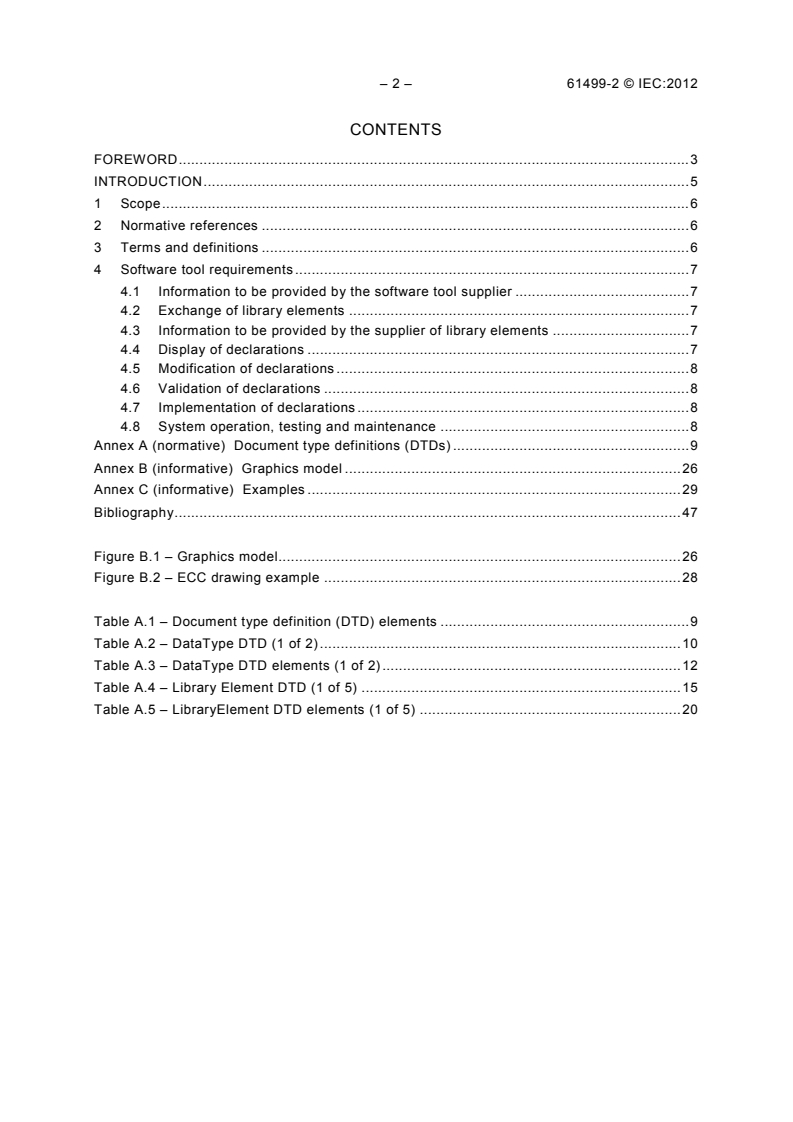
– 2 – 61499-2 © IEC:2012
CONTENTS
FOREWORD . 3
INTRODUCTION . 5
1 Scope . 6
2 Normative references . 6
3 Terms and definitions . 6
4 Software tool requirements . 7
4.1 Information to be provided by the software tool supplier . 7
4.2 Exchange of library elements . 7
4.3 Information to be provided by the supplier of library elements . 7
4.4 Display of declarations . 7
4.5 Modification of declarations . 8
4.6 Validation of declarations . 8
4.7 Implementation of declarations . 8
4.8 System operation, testing and maintenance . 8
Annex A (normative) Document type definitions (DTDs) . 9
Annex B (informative) Graphics model . 26
Annex C (informative) Examples . 29
Bibliography . 47
Figure B.1 – Graphics model . 26
Figure B.2 – ECC drawing example . 28
Table A.1 – Document type definition (DTD) elements . 9
Table A.2 – DataType DTD (1 of 2) . 10
Table A.3 – DataType DTD elements (1 of 2) . 12
Table A.4 – Library Element DTD (1 of 5) . 15
Table A.5 – LibraryElement DTD elements (1 of 5) . 20
61499-2 © IEC:2012 – 3 –
INTERNATIONAL ELECTROTECHNICAL COMMISSION
____________
FUNCTION BLOCKS –
Part 2: Software tool requirements
FOREWORD
1) The International Electrotechnical Commission (IEC) is a worldwide organization for standardization comprising
all national electrotechnical committees (IEC National Committees). The object of IEC is to promote
international co-operation on all questions concerning standardization in the electrical and electronic fields. To
this end and in addition to other activities, IEC publishes International Standards, Technical Specifications,
Technical Reports, Publicly Available Specifications (PAS) and Guides (hereafter referred to as “IEC
Publication(s)”). Their preparation is entrusted to technical committees; any IEC National Committee interested
in the subject dealt with may participate in this preparatory work. International, governmental and non-
governmental organizations liaising with the IEC also participate in this preparation. IEC collaborates closely
with the International Organization for Standardization (ISO) in accordance with conditions determined by
agreement between the two organizations.
2) The formal decisions or agreements of IEC on technical matters express, as nearly as possible, an international
consensus of opinion on the relevant subjects since each technical committee has representation from all
interested IEC National Committees.
3) IEC Publications have the form of recommendations for international use and are accepted by IEC National
Committees in that sense. While all reasonable efforts are made to ensure that the technical content of IEC
Publications is accurate, IEC cannot be held responsible for the way in which they are used or for any
misinterpretation by any end user.
4) In order to promote international uniformity, IEC National Committees undertake to apply IEC Publications
transparently to the maximum extent possible in their national and regional publications. Any divergence
between any IEC Publication and the corresponding national or regional publication shall be clearly indicated in
the latter.
5) IEC itself does not provide any attestation of conformity. Independent certification bodies provide conformity
assessment services and, in some areas, access to IEC marks of conformity. IEC is not responsible for any
services carried out by independent certification bodies.
6) All users should ensure that they have the latest edition of this publication.
7) No liability shall attach to IEC or its directors, employees, servants or agents including individual experts and
members of its technical committees and IEC National Committees for any personal injury, property damage or
other damage of any nature whatsoever, whether direct or indirect, or for costs (including legal fees) and
expenses arising out of the publication, use of, or reliance upon, this IEC Publication or any other IEC
Publications.
8) Attention is drawn to the Normative references cited in this publication. Use of the referenced publications is
indispensable for the correct application of this publication.
9) Attention is drawn to the possibility that some of the elements of this IEC Publication may be the subject of
patent rights. IEC shall not be held responsible for identifying any or all such patent rights.
International Standard IEC 61499-2, has been prepared by subcommittee 65B: Measurement
and control devices, of IEC technical committee 65: Industrial-process measurement, control
and automation.
This second edition cancels and replaces the first edition published in 2005. This edition
constitutes a technical revision.
This edition includes the following significant technical changes with respect to the previous
edition:
• The contents of Annex A have been updated to conform to the technical changes of the
second edition of IEC 61499-1.
• CDATA sections are now allowed for the textual contents of algorithms in Tables A.4 and
A.5.
– 4 – 61499-2 © IEC:2012
The text of this standard is based on the following documents:
FDIS Report on voting
65B/846/FDIS 65B/856/RVD
Full information on the voting for the approval of this standard can be found in the report on
voting indicated in the above table.
This publication has been drafted in accordance with the ISO/IEC Directives, Part 2.
A list of all parts of the IEC 61499 series can be found, under the general title Function
blocks, on the IEC website.
Terms used throughout this International Standard that have been defined in Clause 3 of
IEC 61499-1:2012 and in this International Standard appear in italics.
The committee has decided that the contents of this publication will remain unchanged until
the stability date indicated on the IEC web site under "http://webstore.iec.ch" in the data
related to the specific publication. At this date, the publication will be
• reconfirmed,
• withdrawn,
• replaced by a revised edition, or
• amended.
IMPORTANT – The 'colour inside' logo on the cover page of this publication
indicates that it contains colours which are considered to be useful for the correct
understanding of its contents. Users should therefore print this document using a
colour printer.
61499-2 © IEC:2012 – 5 –
INTRODUCTION
IEC 61499 consists of the following parts, under the general title Function blocks:
• Part 1: Architecture
• Part 2: Software tool requirements
• Part 3: Tutorial information (withdrawn)
• Part 4: Rules for compliance profiles
– 6 – 61499-2 © IEC:2012
FUNCTION BLOCKS –
Part 2: Software tool requirements
1 Scope
This part of IEC 61499 defines requirements for software tools to support the following
systems engineering tasks enumerated in IEC 61499-1:
– the specification of function block types;
– the functional specification of resource types and device types;
– the specification, analysis, and validation of distributed IPMCSs;
– the configuration, implementation, operation, and maintenance of distributed IPMCSs;
– the exchange of information among software tools.
It is assumed that such software tools may be used in the context of an Engineering Support
System (ESS) as described in IEC 61499-1.
It is beyond the scope of this standard to specify the entire life cycle of industrial-process
measurement and control systems (IPMCSs), or the entire set of tasks and activities required
to support an IPCMS over its life cycle. However, other standards which do specify such tasks
and activities may extend or modify the requirements specified in this part of IEC 61499.
2 Normative references
The following documents, in whole or in part, are normatively referenced in this document and
are indispensable for its application. For dated references, only the edition cited applies. For
undated references, the latest edition of the referenced document (including any
amendments) applies.
IEC 61131-3:2003, Programmable controllers – Part 3: Programming languages
IEC 61499-1:2012, Function blocks – Part 1: Architecture
ISO/IEC 8824 (all parts), Information technology – Abstract Syntax Notation One (ASN.1)
3 Terms and definitions
For the purposes of this document, the terms and definitions given in IEC 61499-1, as well as
the following apply.
3.1
library element
collection of declarations applying to a data type, function block type, adapter type,
subapplication type, resource type, device type, segment type, or system configuration
61499-2 © IEC:2012 – 7 –
4 Software tool requirements
4.1 Information to be provided by the software tool supplier
This Clause defines the functional requirements of software tools that support the
performance of the systems engineering tasks enumerated in Clause 1.
The supplier of a software tool shall specify the following information in addition to other
information required in this Clause:
• the type or types of library element to which the software tool applies;
• the engineering task or tasks supported by the software tool. Task descriptions may be
taken from the enumeration of engineering tasks given in Clause 1, or may be defined by
the supplier.
4.2 Exchange of library elements
A software tool shall be capable of exchanging its library elements with other software tools.
This exchange shall take the form of data in the format defined in Annex A, written on
physical media or exchanged over communication links or networks.
4.3 Information to be provided by the supplier of library elements
NOTE The provisions of this subclause are intended to provide the means by which the provider of a library
element may achieve protection of intellectual property while still providing sufficient information to permit the
effective use of the library element.
The provider of a library element may elect to provide an implementation of the library
element.
EXAMPLE 1 The provider of a function block type library element may provide an implementation of the function
block type as:
• one or more instances of the function block type in a resource contained in a device of Class 0 or higher
as described in IEC 61499-4;
• an instantiable implementation of the function block type in a resource contained in a device of Class 1 or
higher as described in IEC 61499-4;
• a file in an implementation-dependent format suitable for installation in a resource contained in a device
of Class 2 as described in IEC 61499-4, for instance using the XML syntax defined in Annex D.
When an implementation of a library element is provided, the provider is not required to
provide full details of the implementation. However, the provider shall provide sufficient
information to enable the user to fully determine the functionality of the provided library
element.
EXAMPLE 2 The requirement of the above paragraph would be met by the provider of an instance of a function
block type in a resource through the provision, at a minimum, of the following information:
• a function block type library element specifying its event interfaces, data interfaces and services as
defined in IEC 61499-1;
• resource type and device type library elements showing the occurrence and connections of the function
block instances.
4.4 Display of declarations
A software tool shall be capable of displaying the declarations of its associated library
elements in a form appropriate to the engineering task. This display may utilize the graphical
or textual formats defined in IEC 61499-1, or a format defined by the supplier of the software
tool.
NOTE The declarations of a library element may define its interfaces (event and data inputs and outputs) and
internal variables as well as its algorithms and the control of their execution, for example via an execution control
chart (ECC), etc.
– 8 – 61499-2 © IEC:2012
Software tools may provide additional features, beyond those illustrated in IEC 61499-1, in
the graphic display of declarations.
EXAMPLE 1 In the display of an Execution Control Chart (ECC), the tool may provide, along with the display of
each transition, a cardinal number indicating the order (as defined in IEC 61499-1) in which the transition is
evaluated.
EXAMPLE 2 A software tool may provide means of navigating a mapping from the display of a function block
instance in an application to its corresponding display in a resource, and vice versa.
4.5 Modification of declarations
A software tool shall enable its user to modify the declarations of its associated library
elements as appropriate to the engineering task. Such modifications may include adding,
deleting or changing the contents of declarations, and may be performed either graphically or
textually or both.
EXAMPLE The software tool may provide convenient means for the user to change the order in which
declarations are listed in their textual representation, for instance in a list of transitions in an Execution Control
Chart (ECC), without the user having to edit the textual representation by manual means such as "cut and paste".
4.6 Validation of declarations
If required by the associated engineering task, a software tool shall provide facilities for
validation of the declarations of its associated library elements. Such facilities may include,
but are not limited to:
• Checking the correctness of the syntax of declarations.
• Checking the semantic correctness of declarations, for instance, checking whether all
function block instances in an application and its associated subapplications are
properly allocated to resources, interconnected within resources, and
intercommunicating among resources in a system configuration.
• Simulation and testing of the operation of an instance of a library element type, either
by itself or in association with other instances of the same or different types.
4.7 Implementation of declarations
If required by the associated engineering task, a software tool shall provide facilities for the
implementation of the declarations of its associated library elements. Such facilities may
include, but are not limited to:
• the production of an executable code ("firmware") for embedding in instances of
resource types and device types;
• the creation and interconnection ("downloading") of function block instances in
resources and devices, for instance by using the management facilities defined in
subclause 6.3 and Annexes F and G of IEC 61499-1.
4.8 System operation, testing and maintenance
If required by the associated engineering task, a software tool shall provide facilities for the
operation, testing and maintenance of an Industrial Process Measurement and Control
System (IPMCS) specified by its associated library elements. Such facilities may include, but
are not limited to:
• the facilities described in preceding subclauses of this Clause;
• the information exchange facilities defined in IEC 61499-1.
61499-2 © IEC:2012 – 9 –
Annex A
(normative)
Document type definitions (DTDs)
A.1 General principles
This Annex presents Document Type Definitions (DTDs) for the exchange of IEC 61499 library
elements between software tools. These DTDs are defined in the syntax defined in the
eXtensible Markup Language (XML) specification at www.w3.org/TR/2000/REC-xml-20001006.
The correspondences between the DTD elements given in this annex, the library elements
defined in IEC 61499-1, C.2.1, and the textual syntax given in IEC 61499-1, Annex B are
given in Table A.1.
Table A.1 – Document type definition (DTD) elements
DTD element LibraryElement Textual syntax
data_type_declaration
DataType
DataTypeDeclaration
(IEC 61131-3, B.1.3)
FBType FBTypeDeclaration fb_type_declaration
SubapplicationType SubapplicationTypeDeclaration subapplication_type_declaration
AdapterType AdapterTypeDeclaration adapter_type_declaration
ResourceType ResourceTypeDeclaration resource_type_specification
DeviceType device_type_specification
DeviceTypeDeclaration
System system_configuration
SystemConfiguration
The first table of each subclause of this Annex contains the DTD for the corresponding library
element. The second table of each subclause provides a reference to the textual syntax (if
any) plus an explanation for the major elements and attributes in the DTD. Following this,
examples are given of the resulting XML files for typical library elements.
NOTE 1 If there is a conflict between the provisions of this Annex and the provisions of Annex B of IEC 61499-1,
the provisions of the latter prevail.
NOTE 2 The examples given in this Annex provide a representative, but not exhaustive, sample of the features of
the associated DTDs. In particular, these examples are not intended to be used as a test suite for compliance to
the provisions of this standard.
A.2 DataType DTD
An XML document complying with the DTD in Table A.2 represents a DataTypeDeclaration
object as described in C.2.2 of IEC 61499-1.
– 10 – 61499-2 © IEC:2012
Table A.2 – DataType DTD (1 of 2)
ASN1Tag?, (DirectlyDerivedType | EnumeratedType | SubrangeType |
ArrayType | StructuredType))>
Name CDATA #REQUIRED
Comment CDATA #IMPLIED>
Standard CDATA #IMPLIED
Classification CDATA #IMPLIED
ApplicationDomain CDATA #IMPLIED
Function CDATA #IMPLIED
Type CDATA #IMPLIED
Description CDATA #IMPLIED>
Organization CDATA #REQUIRED
Version CDATA #REQUIRED
Author CDATA #REQUIRED
Date CDATA #REQUIRED
Remarks CDATA #IMPLIED>
Class (UNIVERSAL | APPLICATION | CONTEXT | PRIVATE) #IMPLIED
Number CDATA #REQUIRED>
header CDATA #IMPLIED
classdef CDATA #IMPLIED>
Language (Java | Cpp | C | Other) #REQUIRED
Vendor CDATA #REQUIRED
Product CDATA #REQUIRED
Version CDATA #REQUIRED>
BaseType (BOOL | SINT | INT | DINT | LINT | USINT | UINT | UDINT
| ULINT | REAL | LREAL | TIME | DATE | TIME_OF_DAY | TOD
| DATE_AND_TIME | DT | STRING | BYTE |WORD | DWORD |LWORD |
WSTRING) #REQUIRED
InitialValue CDATA #IMPLIED
Comment CDATA #IMPLIED>
InitialValue CDATA #IMPLIED
Comment CDATA #IMPLIED>
Name CDATA #REQUIRED
Comment CDATA #IMPLIED>
61499-2 © IEC:2012 – 11 –
Table A.2 (2 of 2)
BaseType (SINT|INT|DINT|LINT|USINT|UINT|UDINT|ULINT) #REQUIRED
InitialValue CDATA #IMPLIED
Comment CDATA #IMPLIED>
LowerLimit CDATA #REQUIRED
UpperLimit CDATA #REQUIRED>
BaseType CDATA #REQUIRED
InitialValues CDATA #IMPLIED
Comment CDATA #IMPLIED>
Comment CDATA #IMPLIED>
Name CDATA #REQUIRED
Type CDATA #REQUIRED
ArraySize CDATA #IMPLIED
InitialValue CDATA #IMPLIED
Comment CDATA #IMPLIED>
Name CDATA #REQUIRED
Type (SINT|INT|DINT|LINT|USINT|UINT|UDINT|ULINT) #REQUIRED
InitialValue CDATA #IMPLIED
Comment CDATA #IMPLIED>
Explanations of the elements of the above DTD, and (where applicable) references to the
formal syntax for their attributes, are given in Table A.3.
– 12 – 61499-2 © IEC:2012
Table A.3 – DataType DTD elements (1 of 2)
Element Textual syntax Explanation
attributes (IEC 61131-3, Annex B)
DataType
See IEC 61131-3
Name data_type_name
Comment --
A comment per IEC 61131-3 without (* and *) delimiters
Identification
Information for data base retrieval
Standard
Primary reference standard in number-part-subclause format
Classification Classification code as defined in reference standard
ApplicationDomain
Application domain as defined in reference standard
Function
Function of this element as defined in reference standard
Type
Element type (e.g., device type) as defined in reference standard
Description
Descriptive phrase as defined in reference standard
VersionInfo --
Possibly one of several entries:
First entry – Most recent version
Second entry – Immediately preceding released version.
Last entry – First released version
Organization --
The organization supplying this library element
Version digit [digit] '.'
The version identification for this
digit [digit] [letter]
library element
Author --
The author of this library element
Date date_literal ['-'
The release date of this version
daytime]
Remarks --
Comments relating to this version
ASN1Tag
ASN.1 tag per ISO/IEC 8824
Class
ASN.1 tag class per ISO/IEC 8824
Number
ASN.1 tag number per ISO/IEC 8824
CompilerInfo --
Information for and about compilers used with this class
header --
Header information such as package, imports, etc.
classdef --
The class definition information such as superclass and
implemented interfaces. If none is given, a default abstract
superclass is used.
Compiler --
Possibly one of several compilers used with this version
Language --
The source language of this compiler
Vendor --
The vendor of this compiler
Product --
The product name of this compiler
Version --
The version of this compiler
DirectlyDerivedType
See IEC 61131-3, Tables 12 and 14, item 1
BaseType elementary_type_name
InitialValue constant
Comment
A comment per IEC 61131-3 without (* and *) delimiters
61499-2 © IEC:2012 – 13 –
Table A.3 (2 of 2)
Element Textual Syntax Explanation
Attributes (IEC 61131-3, Annex B)
EnumeratedType
See IEC 61131-3 Tables 12 and 14, item 2
InitialValue enumerated_value
Comment
A comment per IEC 61131-3 without (* and *) delimiters
EnumeratedValue
See IEC 61131-3 Table 14, item 2
Name enumerated_value
Comment
A comment per IEC 61131-3 without (* and *) delimiters
SubrangeType --
See IEC 61131-3 Tables 12 and 14, item 3
BaseType integer_type_name
InitialValue signed_integer
Comment
A comment per IEC 61131-3 without (* and *) delimiters
Subrange See IEC 61131-3 Tables 12 and 14, item 3
LowerLimit signed_integer
UpperLimit signed_integer
ArrayType
See IEC 61131-3 Tables 12 and 14, item 4
BaseType non_generic_type_name
InitialValues array_initialization
StructuredType See IEC 61131-3 Tables 12, item 5 and 14, item 5 and item 6
VarDeclaration
Name structure_element_name
Type non_generic_type_name
a
ArraySize
b
InitialValue
Comment
A comment per IEC 61131-3 without (* and *) delimiters
SubrangeVarDeclaration
See IEC 61131-3, 2.3.3.
Name structure_element_name
Type integer_type_name
InitialValue signed_integer
Comment
A comment per IEC 61131-3 without (* and *) delimiters
a
The syntax of this attribute when present shall be equivalent to the syntactic expression
(subrange {',' subrange}) | integer {',' integer}
where the non-terminals subrange and integer are as defined in Annex B of IEC 61131-3. Each
term of the second form is equivalent to the subrange 0.n-1, where n is the value of the
corresponding integer syntactic element. If this attribute is missing, the structure component is not
an anonymously defined array.
b
The syntax of this attribute is the syntax for initialization of the corresponding variable type as defined in
Annex B.1.4.3 of IEC 61131-3.
EXAMPLE The structured data type ANALOG_CHANNEL_CONFIGURATIONI example is expressed in
IEC 61131-3, Table 14 as follows:
– 14 – 61499-2 © IEC:2012
TYPE ANALOG_CHANNEL_CONFIGURATIONI:
STRUCT
RANGE: ANALOG_SIGNAL_RANGE;
MIN_SCALE: ANALOG_DATA:= -4095;
MAX_SCALE: ANALOG_DATA:= 4095;
END_STRUCT;
END_TYPE
A corresponding XML document could be:
>
Name="ANALOG_CHANNEL_CONFIGURATIONI"
Comment="IEC 61131-3, Table 14#5">
Function="Configuration Data"
Standard="61131-3-2.3.3.2"
ApplicationDomain="Any"
Classification="Data type"
Type="Analog"
Description="Table 14, #5"/>
Organization="IEC SC65B/WG7/TF3"
Version="2.0"
Author="JHC"
Date="2000-01-31"/>
Type="ANALOG_SIGNAL_RANGE"/>
Type="ANALOG_DATA"
InitialValue="-4095"/>
Type="ANALOG_DATA"
InitialValue="4095"/>
A.3 LibraryElement DTD
An XML document complying with the DTD in Table A.4 represents a LibraryElement object
as described in Annex C of IEC 61499-1. Possible root elements of such a document are
FBType, AdapterType, ResourceType, DeviceType, System, and SubappType,
representing the concrete subclasses FBTypeDeclaration, AdapterTypeDeclaration,
ResourceTypeDeclaration, DeviceTypeDeclaration, SystemConfiguration, and
SubapplicationTypeDeclaration of the abstract superclass LibraryElement, respectively.
The DataTypeDeclaration subclass is represented separately by the DTD given in
Clause A.2.
61499-2 © IEC:2012 – 15 –
Table A.4 – Library Element DTD (1 of 5)
Standard CDATA #IMPLIED
Classification CDATA #IMPLIED
ApplicationDomain CDATA #IMPLIED
Function CDATA #IMPLIED
Type CDATA #IMPLIED
Description CDATA #IMPLIED>
Organization CDATA #REQUIRED
Version CDATA #REQUIRED
Author CDATA #REQUIRED
Date CDATA #REQUIRED
Remarks CDATA #IMPLIED>
header CDATA #IMPLIED
classdef CDATA #IMPLIED>
Language (Java | Cpp | C | Other) #REQUIRED
Vendor CDATA #REQUIRED
Product CDATA #REQUIRED
Version CDATA #REQUIRED>
(FB*,EventConnections?,DataConnections?,AdapterConnections?)>
Name CDATA #REQUIRED
Type CDATA #REQUIRED
Comment CDATA #IMPLIED
x CDATA #IMPLIED
y CDATA #IMPLIED>
Source CDATA #REQUIRED
Destination CDATA #REQUIRED
Comment CDATA #IMPLIED
dx1 CDATA #IMPLIED
dx2 CDATA #IMPLIED
dy CDATA #IMPLIED
>
– 16 – 61499-2 © IEC:2012
Table A.4 (2 of 5)
(Identification?,VersionInfo+,CompilerInfo?,InterfaceList,
(BasicFB | FBNetwork)?, Service?) >
Name CDATA #REQUIRED
Comment CDATA #IMPLIED
>
(EventInputs?,EventOutputs?,InputVars?,OutputVars?,
Sockets?, Plugs?)>
Name CDATA #REQUIRED
Type CDATA #IMPLIED
Comment CDATA #IMPLIED>
Var CDATA #REQUIRED>
Name CDATA #REQUIRED
Type CDATA #REQUIRED
ArraySize CDATA #IMPLIED
InitialValue CDATA #IMPLIED
Comment CDATA #IMPLIED>
Name CDATA #REQUIRED
Type CDATA #REQUIRED
Comment CDATA #IMPLIED
x CDATA #IMPLIED
y CDATA #IMPLIED>
Name CDATA #REQUIRED
Comment CDATA #IMPLIED
x CDATA #IMPLIED
y CDATA #IMPLIED>
Source CDATA #REQUIRED
Destination CDATA #REQUIRED
Condition CDATA #REQUIRED
Comment CDATA #IMPLIED
x CDATA #IMPLIED
y CDATA #IMPLIED>
61499-2 © IEC:2012 – 17 –
Table A.4 (3 of 5)
Algorithm CDATA #IMPLIED
Output CDATA #IMPLIED>
Name CDATA #REQUIRED
Comment CDATA #IMPLIED>
Text CDATA #IMPLIED >
Output CDATA #REQUIRED
Expression CDATA #REQUIRED
Comment CDATA #IMPLIED>
Language CDATA #REQUIRED >
RightInterface CDATA #REQUIRED
LeftInterface CDATA #REQUIRED
Comment CDATA #IMPLIED>
Name CDATA #REQUIRED
Comment CDATA #IMPLIED>
Interface CDATA #REQUIRED
Event CDATA #REQUIRED
Parameters CDATA #IMPLIED>
Interface CDATA #REQUIRED
Event CDATA #REQUIRED
Parameters CDATA #IMPLIED>
(Identification?,VersionInfo+,CompilerInfo?,InterfaceList,Service?)>
Name CDATA #REQUIRED
Comment CDATA #IMPLIED>
– 18 – 61499-2 © IEC:2012
Table A.4 (4 of 5)
FBTypeName*, VarDeclaration*, FBNetwork?)>
Name CDATA #REQUIRED
Comment CDATA #IMPLIED>
Name CDATA #REQUIRED>
VarDeclaration*, ResourceTypeName*, Resource*, FBNetwork?)>
Name CDATA #REQUIRED
Comment CDATA #IMPLIED>
Name CDATA #REQUIRED >
Name CDATA #REQUIRED
Type CDATA #REQUIRED
Comment CDATA #IMPLIED
x CDATA #IMPLIED
y CDATA #IMPLIED>
Application*, Device+, Mapping*, Segment*, Link*)>
Name CDATA #REQUIRED
Comment CDATA #IMPLIED>
Name CDATA #REQUIRED
Comment CDATA #IMPLIED>
From CDATA #REQUIRED
To CDATA #REQUIRED>
Name CDATA #REQUIRED
Type CDATA #REQUIRED
Comment CDATA #IMPLIED
x CDATA #IMPLIED
y CDATA #IMPLIED>
61499-2 © IEC:2012 – 19 –
Table A.4 (5 of 5)
(Identification?,VersionInfo+,CompilerInfo?,SubAppInterfaceList,
SubAppNetwork?)>
Name CDATA #REQUIRED
Comment CDATA #IMPLIED>
(SubAppEventInputs?,SubAppEventOutputs?,InputVars?,OutputVars?)>
Name CDATA #REQUIRED
Type CDATA #IMPLIED
Comment CDATA #IMPLIED>
(SubApp*,FB*,EventConnections?,DataConnections?, AdapterConnections?)>
Name CDATA #REQUIRED
Type CDATA #REQUIRED
Comment CDATA #IMPLIED
x CDATA #IMPLIED
y CDATA #IMPLIED>
VarDeclaration*)>
Name CDATA #REQUIRED
Comment CDATA #IMPLIED >
Name CDATA #REQUIRED
Type CDATA #REQUIRED
Comment CDATA #IMPLIED
x CDATA #IMPLIED
y CDATA #IMPLIED
dx1 CDATA #IMPLIED>
Name CDATA #REQUIRED
Value CDATA #REQUIRED
Comment CDATA #IMPLIED>
SegmentName CDATA #REQUIRED
CommResource CDATA #REQUIRED
Comment CDATA #IMPLIED >
Explanations of some of the elements of the above DTD, and (where applicable) references to
the formal syntax for their attributes, are given in Table A.5.
– 20 – 61499-2 © IEC:2012
Table A.5 – LibraryElement DTD elements (1 of 5)
Element Syntax
Explanation
attributes (IEC 61499-1, Annex B)
Identification
VersionInfo
See Table A.3
CompilerInfo
Compiler
FBNetwork
A function block network as defined in IEC 61499-1.
FB
A function block instance as defined in IEC 61499-1.
Name fb_instance_name
Type fb_type_name
Comment
A comment per IEC 61131-3 without (* and *) delimiters
x, y
See Annex B.
Connection
An event connection, data connection or adapter connection as
defined in IEC 61499-1.
c)
Source
c)
Destination
dx1, dx2, dy
See Annex B.
FBType
A function block type as described in IEC 61499-1.
Name fb_type_name
Comment
A comment per IEC 61131 without (* and *) delimiters
Event
A declaration of an event interface.
d)
Name event_input_name
| event_output_name
Type event_type
Comment
A comment per IEC 61131-3 without (* and *) delimiters
With
A declaration of an association between an event and a variable.
d)
Var input_variable_name
| output_ variable _name
VarDeclaration
A declaration of a variable.
e)
Name input_variable_name
| output_variable_name
| internal_variable_name
Type identifier
f)
ArraySize
g)
InitialValue
Comment
A comment per IEC 61131-3 without (* and *) delimiters
See Table footnote at the end of Table A.1.
61499-2 © IEC:2012 – 21 –
Table A.5 (2 of 5)
Element Syntax Explanation
Attributes (IEC 61499-1, Annex B)
AdapterDeclaration
A declaration of a plug or socket interface of a function block type.
h)
Name plug_name | socket_name
Type adapter_type_name
Comment
A comment per IEC 61131-3 without (* and *) delimiters
x, y
Location (See Annex B) of plug or socket in the internal function
block network of a composite function block type.
ECState
An EC state as defined in IEC 61499-1.
Name ec_state_name
Comment
A comment per IEC 61131-3 without (* and *) delimiters
x, y
See Annex B.
ECTransition
An EC transition as defined in IEC 61499-1.
Source ec_state_name
Destination ec_state_name
Condition ec_transition_condition
x, y
See Annex B.
ECAction
An EC action as defined in IEC 61499-1.
Algorithm algorithm_name
Output event_output_name
a)
Algorithm
An algorithm in a specified language
Name algorithm_name
Comment
A comment per IEC 61131-3 without (* and *) delimiters
ST
An algorithm in the IEC 61131-3 ST language.
Algorithm contents in the syntax of
l)
Text a statement_list per
IEC 61131-3, Annex B.
Rung
A rung of an algorithm in the LD language
b)
Output
b) l)
Expression See and .
Other
An algorithm in a language other than FBD, ST or LD.
Language
The name of the programming
a)
language
Text
Content of the algorithm in the
a) l)
syntax defined for the particular See and .
language
Service
A declaration of a service per IEC 61499-1
RightInterface service_interface_name
LeftInter
...