

IEC 60598-1:2008
(Main)Luminaires - Part 1: General requirements and tests
General Information
- Abstract
IEC 60598-1:2008 specifies general requirements for luminaires, incorporating electric light sources for operation from supply voltages up to 1 000 V. The requirements and related tests of this standard cover: classification, marking, mechanical construction and electrical construction. This seventh edition cancels and replaces the sixth edition published in 2003. It constitutes a technical revision. The major changes which may affect certification are given in Annex R. Annex R shows where a new text has been included which contains more serious/critical requirements requiring products to be re-tested. Subclauses 1.2.71, 3.2.19, 4.21, 4.24, Annex P: Requirements self shielded lamps and UV protection. Subclauses 1.2.42, 5.2.14, 5.2.16, 8.2.3, 9.2: SELV requirements. Subclauses 1.2.78, 1.2.79, 1.2.80, 3.3, 10.1, 10.3, Annex G: Touch current, protective current and electric burn. Subclauses 1.2.81, 1.2.82, 3.2.20, 4.14.3, Table 12.1: Hot surfaces. Subclauses 0.5.2, 1.2.83, Annex V: Terminal block with integrated earthing contact. Subclauses 3.2.22, Figure 1: replaceable fuses. Subclauses 1.2.8, 8.2.1, 8.2.4, 8.2.5, 8.2.6: Access to basic insulation of luminaries. Subclauses 2.4, 12.6, 3.2.9, 3.2.21, 4.16, Annex D, Annex N: Marking of luminaires not suitable for mounting on normally flammable surfaces and covering with insulation. Subclause 4.12.4: Torque requirements for lampholders with a single means of fixing exposed to a rotary action. Subclause 9.2: Requirements for protection of lamp splashing. The contents of the corrigenda of October 2011 and December 2011 have been included in this copy.
- Status
- Published
- Publication Date
- 15-Apr-2008
- Technical Committee
- SC 34D - Luminaires
- Drafting Committee
- WG 1 - TC 34/SC 34D/WG 1
- Current Stage
- DELPUB - Deleted Publication
- Start Date
- 26-May-2014
- Completion Date
- 28-Aug-2026
Overview
IEC 60598-1:2008 is the seventh edition of the international standard specifying general requirements and tests for luminaires designed to operate with electric light sources at supply voltages up to 1,000 V. Issued by the International Electrotechnical Commission (IEC), this standard serves as an essential reference for manufacturers, designers, certifiers, and testing laboratories involved in the production and evaluation of luminaires. It comprehensively covers aspects including classification, marking, mechanical construction, and electrical construction to ensure safety, functionality, and reliability of lighting equipment.
This edition supersedes the 2003 version and introduces critical technical revisions which may affect product certification. The document incorporates key updates related to self-shielded lamps, UV protection, SELV requirements, electric shock protection, touch current limits, hot surfaces, terminal block design, insulation access, and marking requirements. Additionally, it integrates corrigenda issued in 2011 for enhanced clarity and compliance.
Key Topics
Scope and Definitions
Establishes the fundamental scope including voltage limits and defines terms critical for consistent application of the standard.Classification of Luminaires
Categorizes luminaires based on protection against electric shock, ingress of dust and moisture, mounting surface compatibility, and usage conditions.Marking Requirements
Details mandatory and additional marking on luminaires to provide essential product information, safety instructions, and compliance indicators.Mechanical Construction
Provides stringent requirements on materials, mechanical strength, replaceable components, lampholders, terminal blocks, wiring, and protective shielding.Electrical Construction and Safety
Includes rules regarding double and reinforced insulation, supply connections, earthing provisions, protection against electric shock, and terminal designs with emphasis on both screw and screwless terminals.Testing Protocols
Extensive test procedures cover insulation resistance, electric strength, touch and protective conductor current, ingress protection (IP rating tests), thermal endurance, electrical and mechanical durability, UV radiation, corrosion resistance, and resistance to heat and flame.Thermal and Endurance Tests
Describes tests for normal and abnormal operation, including those for failed windings and faults to assess luminaire safety under stress conditions.Safety Features
Includes requirements on protection of lamp splashing, hot surfaces, touch current, electric burn prevention, and terminal block earthing contacts to minimize user risks.
Applications
IEC 60598-1:2008 is fundamental in the design, manufacturing, testing, and certification of various types of luminaires used in residential, commercial, industrial, and outdoor environments. Key applications include:
Indoor Lighting Fixtures
Ceiling-, wall-, and floor-mounted luminaires compatible with typical household and office power supplies.Outdoor and Harsh Environment Lighting
Luminaires designed for dust, moisture, and vibration resistance used in street lighting, floodlighting, and industrial settings.Specialized Lighting
Luminaires utilizing self-shielded lamps or requiring UV protection for sensitive environments.Safety-Critical Installations
Lighting installations in areas needing reliable electric shock prevention, thermal management, and protective insulation such as hospitals and manufacturing plants.
By adhering to IEC 60598-1:2008, manufacturers and installers ensure compliance with international safety and quality standards, reducing liability risks while enhancing product marketability worldwide.
Related Standards
IEC 60598 Series
This part 1 general requirements standard is complemented by part 2 documents that address particular types of luminaires and their specialized requirements.IEC 61199
Standard for self-ballasted lamps – complements the luminaire safety requirements.IEC 60364
Electrical installations of buildings, covering wiring methods parallel to luminaire installation requirements.IEC 60529
Degrees of protection provided by enclosures (IP Code), directly referenced for ingress protection testing.IEC 60664
Insulation coordination for equipment within electrical installations, relevant for creepage distances and clearances in luminaires.ISO 9001
Quality management systems, often implemented by manufacturers alongside compliance with IEC 60598-1 for production consistency.
Conclusion
IEC 60598-1:2008 is a critical international standard ensuring safe, reliable, and high-quality luminaires for a wide range of electrical lighting applications. Its thorough requirements and rigorous testing protocols help manufacturers achieve global conformity while safeguarding end users against electrical hazards, mechanical failures, and thermal risks. Emphasizing classification, marking, construction, and comprehensive testing, this standard is indispensable for all stakeholders in the lighting industry seeking compliance with international best practices.
Keywords: IEC 60598-1, luminaires standards, lighting safety requirements, electrical construction, mechanical construction, ingress protection, thermal testing, electric shock protection, luminaire certification, IEC luminaires tests.
Relations
- Corrected By
IEC 60598-1:2008/COR2:2011 - Corrigendum 2 - Luminaires - Part 1: General requirements and tests - Effective Date
- 05-Sep-2023
- Corrected By
IEC 60598-1:2008/COR1:2011 - Corrigendum 1 - Luminaires - Part 1: General requirements and tests - Effective Date
- 05-Sep-2023
- Effective Date
- 05-Sep-2023
- Effective Date
- 05-Sep-2023
- Revises
IEC 60598-1:2003/AMD1:2006 - Amendment 1 - Luminaires - Part 1: General requirements and tests - Effective Date
- 05-Sep-2023
- Effective Date
- 05-Sep-2023
Get Certified
Connect with accredited certification bodies for this standard

IMQ S.p.A. (Certification)
Italian electrical product certification.

SLG Prüf- und Zertifizierungs GmbH
German testing and certification body.

UL Solutions
Global safety science company with testing, inspection and certification.
Sponsored listings
Frequently Asked Questions
IEC 60598-1:2008 is a standard published by the International Electrotechnical Commission (IEC). Its full title is "Luminaires - Part 1: General requirements and tests". This standard covers: IEC 60598-1:2008 specifies general requirements for luminaires, incorporating electric light sources for operation from supply voltages up to 1 000 V. The requirements and related tests of this standard cover: classification, marking, mechanical construction and electrical construction. This seventh edition cancels and replaces the sixth edition published in 2003. It constitutes a technical revision. The major changes which may affect certification are given in Annex R. Annex R shows where a new text has been included which contains more serious/critical requirements requiring products to be re-tested. Subclauses 1.2.71, 3.2.19, 4.21, 4.24, Annex P: Requirements self shielded lamps and UV protection. Subclauses 1.2.42, 5.2.14, 5.2.16, 8.2.3, 9.2: SELV requirements. Subclauses 1.2.78, 1.2.79, 1.2.80, 3.3, 10.1, 10.3, Annex G: Touch current, protective current and electric burn. Subclauses 1.2.81, 1.2.82, 3.2.20, 4.14.3, Table 12.1: Hot surfaces. Subclauses 0.5.2, 1.2.83, Annex V: Terminal block with integrated earthing contact. Subclauses 3.2.22, Figure 1: replaceable fuses. Subclauses 1.2.8, 8.2.1, 8.2.4, 8.2.5, 8.2.6: Access to basic insulation of luminaries. Subclauses 2.4, 12.6, 3.2.9, 3.2.21, 4.16, Annex D, Annex N: Marking of luminaires not suitable for mounting on normally flammable surfaces and covering with insulation. Subclause 4.12.4: Torque requirements for lampholders with a single means of fixing exposed to a rotary action. Subclause 9.2: Requirements for protection of lamp splashing. The contents of the corrigenda of October 2011 and December 2011 have been included in this copy.
IEC 60598-1:2008 specifies general requirements for luminaires, incorporating electric light sources for operation from supply voltages up to 1 000 V. The requirements and related tests of this standard cover: classification, marking, mechanical construction and electrical construction. This seventh edition cancels and replaces the sixth edition published in 2003. It constitutes a technical revision. The major changes which may affect certification are given in Annex R. Annex R shows where a new text has been included which contains more serious/critical requirements requiring products to be re-tested. Subclauses 1.2.71, 3.2.19, 4.21, 4.24, Annex P: Requirements self shielded lamps and UV protection. Subclauses 1.2.42, 5.2.14, 5.2.16, 8.2.3, 9.2: SELV requirements. Subclauses 1.2.78, 1.2.79, 1.2.80, 3.3, 10.1, 10.3, Annex G: Touch current, protective current and electric burn. Subclauses 1.2.81, 1.2.82, 3.2.20, 4.14.3, Table 12.1: Hot surfaces. Subclauses 0.5.2, 1.2.83, Annex V: Terminal block with integrated earthing contact. Subclauses 3.2.22, Figure 1: replaceable fuses. Subclauses 1.2.8, 8.2.1, 8.2.4, 8.2.5, 8.2.6: Access to basic insulation of luminaries. Subclauses 2.4, 12.6, 3.2.9, 3.2.21, 4.16, Annex D, Annex N: Marking of luminaires not suitable for mounting on normally flammable surfaces and covering with insulation. Subclause 4.12.4: Torque requirements for lampholders with a single means of fixing exposed to a rotary action. Subclause 9.2: Requirements for protection of lamp splashing. The contents of the corrigenda of October 2011 and December 2011 have been included in this copy.
IEC 60598-1:2008 is classified under the following ICS (International Classification for Standards) categories: 29.140.40 - Luminaires. The ICS classification helps identify the subject area and facilitates finding related standards.
IEC 60598-1:2008 has the following relationships with other standards: It is inter standard links to IEC 60598-1:2008/COR2:2011, IEC 60598-1:2008/COR1:2011, IEC 60598-1:2003, IEC 60598-1:2014, IEC 60598-1:2003/AMD1:2006, IEC 60598-1:2003/ISH1:2004. Understanding these relationships helps ensure you are using the most current and applicable version of the standard.
IEC 60598-1:2008 is available in PDF format for immediate download after purchase. The document can be added to your cart and obtained through the secure checkout process. Digital delivery ensures instant access to the complete standard document.
Standards Content (Sample)
IEC 60598-1
Edition 7.0 2008-04
INTERNATIONAL
STANDARD
NORME
INTERNATIONALE
Luminaires –
Part 1: General requirements and tests
Luminaires –
Partie 1: Exigences générales et essais
All rights reserved. Unless otherwise specified, no part of this publication may be reproduced or utilized in any form or by
any means, electronic or mechanical, including photocopying and microfilm, without permission in writing from either IEC or
IEC's member National Committee in the country of the requester.
If you have any questions about IEC copyright or have an enquiry about obtaining additional rights to this publication,
please contact the address below or your local IEC member National Committee for further information.
Droits de reproduction réservés. Sauf indication contraire, aucune partie de cette publication ne peut être reproduite
ni utilisée sous quelque forme que ce soit et par aucun procédé, électronique ou mécanique, y compris la photocopie
et les microfilms, sans l'accord écrit de la CEI ou du Comité national de la CEI du pays du demandeur.
Si vous avez des questions sur le copyright de la CEI ou si vous désirez obtenir des droits supplémentaires sur cette
publication, utilisez les coordonnées ci-après ou contactez le Comité national de la CEI de votre pays de résidence.
IEC Central Office
3, rue de Varembé
CH-1211 Geneva 20
Switzerland
Email: inmail@iec.ch
Web: www.iec.ch
About the IEC
The International Electrotechnical Commission (IEC) is the leading global organization that prepares and publishes
International Standards for all electrical, electronic and related technologies.
About IEC publications
The technical content of IEC publications is kept under constant review by the IEC. Please make sure that you have the
latest edition, a corrigenda or an amendment might have been published.
ƒ Catalogue of IEC publications: www.iec.ch/searchpub
The IEC on-line Catalogue enables you to search by a variety of criteria (reference number, text, technical committee,…).
It also gives information on projects, withdrawn and replaced publications.
ƒ IEC Just Published: www.iec.ch/online_news/justpub
Stay up to date on all new IEC publications. Just Published details twice a month all new publications released. Available
on-line and also by email.
ƒ Electropedia: www.electropedia.org
The world's leading online dictionary of electronic and electrical terms containing more than 20 000 terms and definitions
in English and French, with equivalent terms in additional languages. Also known as the International Electrotechnical
Vocabulary online.
ƒ Customer Service Centre: www.iec.ch/webstore/custserv
If you wish to give us your feedback on this publication or need further assistance, please visit the Customer Service
Centre FAQ or contact us:
Email: csc@iec.ch
Tel.: +41 22 919 02 11
Fax: +41 22 919 03 00
A propos de la CEI
La Commission Electrotechnique Internationale (CEI) est la première organisation mondiale qui élabore et publie des
normes internationales pour tout ce qui a trait à l'électricité, à l'électronique et aux technologies apparentées.
A propos des publications CEI
Le contenu technique des publications de la CEI est constamment revu. Veuillez vous assurer que vous possédez
l’édition la plus récente, un corrigendum ou amendement peut avoir été publié.
ƒ Catalogue des publications de la CEI: www.iec.ch/searchpub/cur_fut-f.htm
Le Catalogue en-ligne de la CEI vous permet d’effectuer des recherches en utilisant différents critères (numéro de référence,
texte, comité d’études,…). Il donne aussi des informations sur les projets et les publications retirées ou remplacées.
ƒ Just Published CEI: www.iec.ch/online_news/justpub
Restez informé sur les nouvelles publications de la CEI. Just Published détaille deux fois par mois les nouvelles
publications parues. Disponible en-ligne et aussi par email.
ƒ Electropedia: www.electropedia.org
Le premier dictionnaire en ligne au monde de termes électroniques et électriques. Il contient plus de 20 000 termes et
définitions en anglais et en français, ainsi que les termes équivalents dans les langues additionnelles. Egalement appelé
Vocabulaire Electrotechnique International en ligne.
ƒ Service Clients: www.iec.ch/webstore/custserv/custserv_entry-f.htm
Si vous désirez nous donner des commentaires sur cette publication ou si vous avez des questions, visitez le FAQ du
Service clients ou contactez-nous:
Email: csc@iec.ch
Tél.: +41 22 919 02 11
Fax: +41 22 919 03 00
IEC 60598-1
Edition 7.0 2008-04
INTERNATIONAL
STANDARD
NORME
INTERNATIONALE
Luminaires –
Part 1: General requirements and tests
Luminaires –
Partie 1: Exigences générales et essais
INTERNATIONAL
ELECTROTECHNICAL
COMMISSION
COMMISSION
ELECTROTECHNIQUE
PRICE CODE
INTERNATIONALE
CODE PRIX XH
ICS 29.140.40 ISBN 2-8318-9707-6
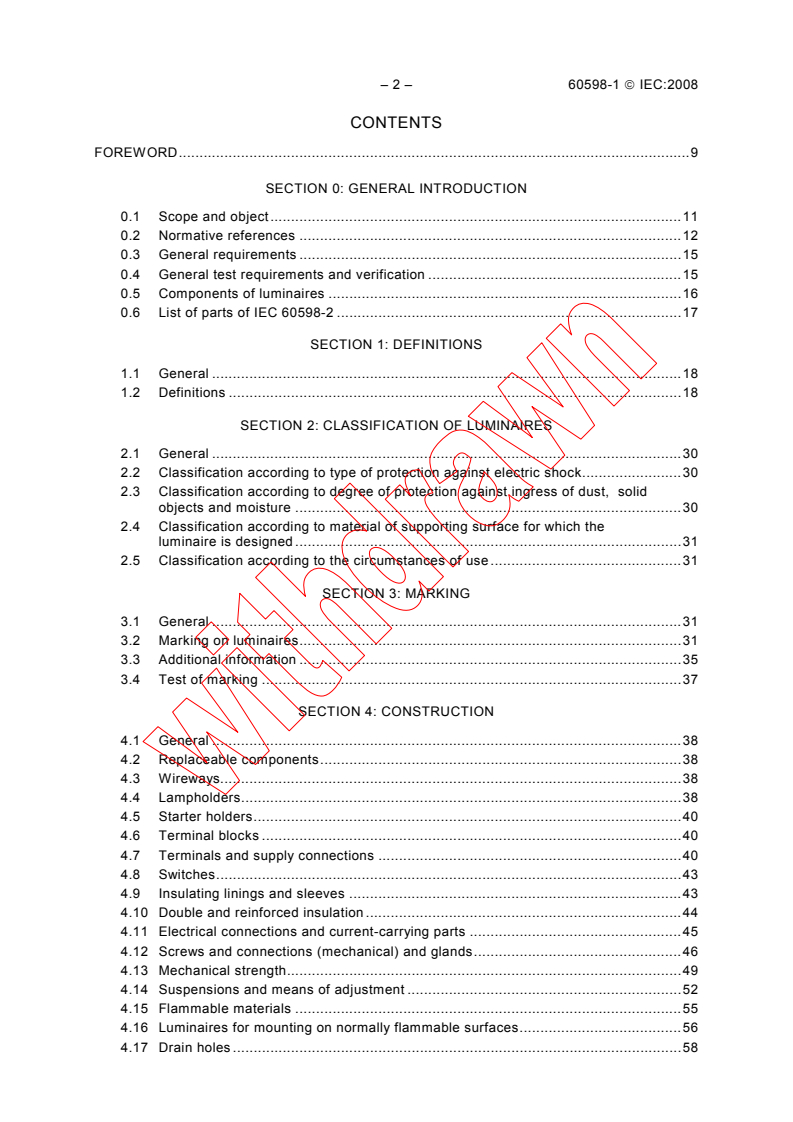
– 2 – 60598-1 © IEC:2008
CONTENTS
FOREWORD.9
SECTION 0: GENERAL INTRODUCTION
0.1 Scope and object.11
0.2 Normative references .12
0.3 General requirements .15
0.4 General test requirements and verification .15
0.5 Components of luminaires .16
0.6 List of parts of IEC 60598-2 .17
SECTION 1: DEFINITIONS
1.1 General .18
1.2 Definitions .18
SECTION 2: CLASSIFICATION OF LUMINAIRES
2.1 General .30
2.2 Classification according to type of protection against electric shock.30
2.3 Classification according to degree of protection against ingress of dust, solid
objects and moisture .30
2.4 Classification according to material of supporting surface for which the
luminaire is designed .31
2.5 Classification according to the circumstances of use.31
SECTION 3: MARKING
3.1 General .31
3.2 Marking on luminaires.31
3.3 Additional information .35
3.4 Test of marking .37
SECTION 4: CONSTRUCTION
4.1 General .38
4.2 Replaceable components.38
4.3 Wireways.38
4.4 Lampholders.38
4.5 Starter holders.40
4.6 Terminal blocks .40
4.7 Terminals and supply connections .40
4.8 Switches.43
4.9 Insulating linings and sleeves .43
4.10 Double and reinforced insulation .44
4.11 Electrical connections and current-carrying parts .45
4.12 Screws and connections (mechanical) and glands.46
4.13 Mechanical strength.49
4.14 Suspensions and means of adjustment .52
4.15 Flammable materials .55
4.16 Luminaires for mounting on normally flammable surfaces.56
4.17 Drain holes .58
60598-1 © IEC:2008 – 3 –
4.18 Resistance to corrosion .58
4.19 Ignitors .59
4.20 Rough service luminaires – Vibration requirements .59
4.21 Protective shield .59
4.22 Attachments to lamps .60
4.23 Semi-luminaires.60
4.24 UV radiation .60
4.25 Mechanical hazard.60
4.26 Short-circuit protection.61
4.27 Terminal blocks with integrated screwless earthing contacts .61
SECTION 5: EXTERNAL AND INTERNAL WIRING
5.1 General .61
5.2 Supply connection and other external wiring.61
5.3 Internal wiring.66
SECTION 6: Not used
SECTION 7: PROVISION FOR EARTHING
7.1 General .68
7.2 Provision for earthing.68
SECTION 8: PROTECTION AGAINST ELECTRIC SHOCK
8.1 General .70
8.2 Protection against electric shock.70
SECTION 9: RESISTANCE TO DUST, SOLID OBJECTS AND MOISTURE
9.1 General .74
9.2 Tests for ingress of dust, solid objects and moisture .74
9.3 Humidity test .78
SECTION 10: INSULATION RESISTANCE AND ELECTRIC STRENGTH,
TOUCH CURRENT AND PROTECTIVE CONDUCTOR CURRENT
10.1 General .78
10.2 Insulation resistance and electric strength.78
10.2.1 Test – Insulation resistance .79
10.2.2 Test – Electric strength .80
10.3 Touch current, protective conductor current and electric burn.82
SECTION 11: CREEPAGE DISTANCES AND CLEARANCES
11.1 General .83
11.2 Creepage distances and clearances.83
SECTION 12: ENDURANCE TEST AND THERMAL TEST
12.1 General .86
12.2 Selection of lamps and ballasts.86
12.3 Endurance test .86
12.3.1 Test.87
– 4 – 60598-1 © IEC:2008
12.3.2 Compliance .88
12.4 Thermal test (normal operation) .88
12.4.1 Test.88
12.4.2 Compliance .90
12.5 Thermal test (abnormal operation) .93
12.5.1 Test.93
12.5.2 Compliance .94
12.6 Thermal test (failed windings in lamp control gear).97
12.6.1 Test for luminaires without thermal cut-outs .97
12.7 Thermal test in regard to fault conditions in lamp control gear or electronic
devices incorporated in thermoplastic luminaires.99
12.7.1 Test for luminaires without temperature sensing controls.99
12.7.2 Test for luminaires with temperature sensing controls internal/external
to the ballast or transformer . 101
SECTION 13: RESISTANCE TO HEAT, FIRE AND TRACKING
13.1 General . 101
13.2 Resistance to heat. 102
13.3 Resistance to flame and ignition . 102
13.4 Resistance to tracking . 103
SECTION 14: SCREW TERMINALS
14.1 General . 103
14.2 Definitions .103
14.2.1 Pillar terminal . 103
14.2.2 Screw terminal. 104
14.2.3 Stud terminal . 104
14.2.4 Saddle terminal.104
14.2.5 Lug terminal.104
14.2.6 Mantle terminal . 104
14.3 General requirements and basic principles. 104
14.4 Mechanical tests. 106
SECTION 15: SCREWLESS TERMINALS AND ELECTRICAL CONNECTIONS
15.1 General . 110
15.2 Definitions .110
15.2.1 Screwless terminals . 110
15.2.2 Permanent connections. 110
15.2.3 Non-permanent connections . 110
15.2.4 Lead assemblies. 110
15.2.5 Non-prepared conductors. 110
15.2.6 Test current .110
15.3 General requirements . 111
15.4 General instructions on tests.112
15.4.1 Preparation of samples . 112
15.4.2 Test conductors . 112
15.4.3 Multi-conductor terminals . 112
15.4.4 Multi-way terminals .112
15.4.5 Test quantities . 112
60598-1 © IEC:2008 – 5 –
15.5 Terminal and connections for internal wiring. 112
15.5.1 Mechanical tests . 112
15.6 Electrical tests .113
15.6.1 Contact resistance test . 114
15.6.2 Heating tests .114
15.7 Terminals and connections for external wiring. 115
15.7.1 Conductors . 115
15.8 Mechanical tests. 115
15.9 Electrical tests .116
15.9.1 Contact resistance test . 116
15.9.2 Heating tests .117
Annex A (normative) Test to establish whether a conductive part may cause an electric
shock. 142
Annex B (normative) Test lamps. 143
Annex C (normative) Abnormal circuit conditions . 146
Annex D (normative) Draught-proof enclosure . 149
Annex E (normative) Determination of winding temperature rises by the increase-in-
resistance method. 152
Annex F (normative) Test for resistance to stress corrosion of copper and copper alloys .153
)
Annex G (normative) Measurement of touch current and protective conductor current . 155
Annex H (Void). 159
Annex I (Void) . 160
Annex J (informative) Explanation of IP numbers for degrees of protection . 161
Annex K (informative) Temperature measurement . 163
Annex L (informative) Guide to good practice in luminaire design. 166
Annex M (normative) Determination of creepage distances and clearances. 171
Annex N (informative) Explanation of marking for luminaires that are not suitable for
mounting on normally flammable surfaces and covering with insulation materials. 172
Annex O (Void) . 176
Annex P (normative) Absorption requirements for the protective shield to be fitted to
luminaires designed for metal halide lamps which emit a high level of UV radiation. 177
Annex Q (informative) Conformity testing during manufacture. 179
Annex R (normative) Schedule of amended subclauses containing more serious/critical
requirements which require products to be retested . 181
Annex S (normative) Requirements for the identification of a family or range of
luminaires for type testing .182
Annex T (informative) Reference to Class 0. 183
Annex U (informative) Creepage and clearances distances for luminaires where a
higher degree of availability (impulse withstand category III) may be requested. 184
Annex V (normative) Additional test requirements for terminal blocks with integrated
screwless earthing contact for direct connection to the luminaire housing or to parts of
the body.
Annex W (normative) Alternative thermal test for thermoplastic luminaires. 188
Bibliography . 190
– 6 – 60598-1 © IEC:2008
Figure 1 – Symbols .118
Figure 2 – Terminal block arrangement for installation test for luminaires with
connecting leads (tails) .120
Figure 3 – This figure has been withdrawn from the present edition. . 120
Figure 4 – Illustration of the requirements of 4.15 . 121
Figure 5 – This figure has been withdrawn from the present edition. . 121
Figure 6 – Apparatus for proving protection against dust. 122
Figure 7 – Apparatus for testing protection against rain and splashing . 123
Figure 8 – Nozzle for spray test . 124
Figure 9 – Relation between winding temperature and mounting surface temperature . 125
Figure 10 – Ball-pressure apparatus. 126
Figure 11 – Arrangement and dimensions of the electrodes for the tracking test . 126
Figure 12 – Pillar terminals.127
Figure 13 – Screw terminals and stud terminals. 128
Figure 14 – Saddle terminals.130
Figure 15 – Lug terminals.131
Figure 16 – Mantle terminals .132
Figure 17 – Construction of electrical connections . 133
Figure 18 – Examples of spring-type screwless terminals . 133
Figure 19 – Further examples of screwless terminals. 134
Figure 20 – Illustration of the terms “lopping-in” and “through wiring” . 135
Figure 21 – Apparatus for ball impact tests.136
Figure 22 – Examples of self-tapping, thread-cutting and thread-forming screws (from
ISO 1891) . 136
Figure 23 – This figure has been withdrawn from the present edition. 136
Figure 24 – Illustration of creepage and clearance measurements at a supply terminal . 137
Figure 25 – Tumbling barrel . 137
Figure 26 – Test circuit for safety during insertion. 138
Figure 27 – Ignition temperatures of wood as a function of time . 138
Figure 28 – Example of permitted degree of soldering . 139
Figure 29 – Test chain . 139
Figure 30 – Example of a thread forming screw used in a groove of a metallic material. 140
Figure 31 – Electro-mechanical contact system with plug/socket connection . 141
Figure 32 – Test circuit for luminaires incorporating fluorescent lamp ≤ 70 W . 141
Figure C.1 – Circuit for testing rectifying effect (some capacitive starterless ballasts only) . 147
Figure C.2 – Circuit for testing rectifying effect (ballasts for single pin lamps) . 147
Figure C.3 – Circuit for testing rectifying effect of some high pressure sodium and
some metal halide lamps.148
Figure D.1 – Example of test recess where a luminaire comprises separate parts . 150
Figure D.2 – Correct test box size (insulating ceilings) for an adjustable luminaire . 151
Figure G.1 – Test configuration: single-phase equipment on star TN or TT system. 157
Figure G.2 – Measuring network, touch current weighted for perception or reaction (for
all class II and fixed class I luminaires). 157
Figure G.3 – Measuring network, touch current weighted for let-go (for portable class I
luminaires). 157
60598-1 © IEC:2008 – 7 –
Figure G.4 – Measuring network, weighted for high frequency protective conductor
currents . 158
Figure K.1 – Placing of thermocouples on a typical lampholder . 165
Figure V.1 – Arrangement for voltage drop test. 187
Table 3.1 – Marking .32
Table 4.1 – Torque tests on screws .47
Table 4.2 – Torque tests on glands.49
Table 4.3 – Impact energy and spring compression .50
Table 4.4 – Test on semi-luminaires.53
Table 4.5 – Test on adjusting devices.54
Table 5.1 – Supply cords.62
Table 5.2 – Tests for cord anchorage .64
Table 9.1 – Solid-object-proof luminaire test.76
Table 10.1 – Minimum insulation resistance.79
Table 10.2 – Electric strength.81
Table 10.3 – Limits of touch current or protective conductor current and electric burn .82
Table 11.1 – Minimum distances for a.c. (50/60 Hz) sinusoidal voltages (to be used in
conjunction with Annex M).84
Table 11.2 – Minimum distances for sinusoidal or non-sinusoidal pulse voltages.86
Table 12.1 – Maximum temperatures under the test conditions 12.4.2, for principal parts.91
Table 12.2 – Maximum temperatures under the test conditions of 12.4.2, for common
materials used in luminaires .92
Table 12.3 – Maximum temperatures under the test conditions of 12.5.1.95
Table 12.4 – Maximum temperature of windings under abnormal operating conditions
and at 110 % of rated voltage for lamp control gear .96
Table 12.5 – Maximum temperature of windings under abnormal operating conditions
and at 110 % of rated voltage for lamp control gear marked “D6” .96
Table 12.6 – Temperature overshoot time limitation.98
Table 14.1 – Nominal cross-sectional areas of conductors according to terminal sizes. 105
Table 14.2 – Nominal cross-sectional areas of conductors according to maximum
current . 106
Table 14.3 – Composition of conductors . 107
Table 14.4 – Torque to be applied to screws and nuts . 108
Table 14.5 – Pull to be applied to conductor . 109
Table 15.1 – Conductor rating .115
Table 15.2 – Conductor pull force. 116
Table F.1 – pH value of the test solution. 153
Table G.1 – Position of swtitch e, n and p for the measurements of the different classes
of luminaires . 156
Table J.1 – Degrees of protection indicated by the first characteristic numeral . 161
Table J.2 – Degrees of protection indicated by the second characteristic numeral. 162
Table L.1 – Damaging influences.166
Table M.1 – Determination of creepage distances and clearances (see Table 11.1) . 171
– 8 – 60598-1 © IEC:2008
Table N.1 – Guidance on when to use the symbol and its explanation on the luminaire
or in the manufacturer’s instructions provided with the luminaire. 172
Table N.2 – Thermal protection operation .174
Table Q.1 – Minimum values for electrical tests . 180
Table U.1 – Minimum distances for a.c. (50/60 Hz) sinusoidal voltages Impulse
withstand category III . 185
60598-1 © IEC:2008 – 9 –
INTERNATIONAL ELECTROTECHNICAL COMMISSION
____________
LUMINAIRES –
Part 1: General requirements and tests
FOREWORD
1) The International Electrotechnical Commission (IEC) is a worldwide organization for standardization comprising
all national electrotechnical committees (IEC National Committees). The object of IEC is to promote
international co-operation on all questions concerning standardization in the electrical and electronic fields. To
this end and in addition to other activities, IEC publishes International Standards, Technical Specifications,
Technical Reports, Publicly Available Specifications (PAS) and Guides (hereafter referred to as “IEC
Publication(s)”). Their preparation is entrusted to technical committees; any IEC National Committee interested
in the subject dealt with may participate in this preparatory work. International, governmental and non-
governmental organizations liaising with the IEC also participate in this preparation. IEC collaborates closely
with the International Organization for Standardization (ISO) in accordance with conditions determined by
agreement between the two organizations.
2) The formal decisions or agreements of IEC on technical matters express, as nearly as possible, an international
consensus of opinion on the relevant subjects since each technical committee has representation from all
interested IEC National Committees.
3) IEC Publications have the form of recommendations for international use and are accepted by IEC National
Committees in that sense. While all reasonable efforts are made to ensure that the technical content of IEC
Publications is accurate, IEC cannot be held responsible for the way in which they are used or for any
misinterpretation by any end user.
4) In order to promote international uniformity, IEC National Committees undertake to apply IEC Publications
transparently to the maximum extent possible in their national and regional publications. Any divergence
between any IEC Publication and the corresponding national or regional publication shall be clearly indicated in
the latter.
5) IEC provides no marking procedure to indicate its approval and cannot be rendered responsible for any
equipment declared to be in conformity with an IEC Publication.
6) All users should ensure that they have the latest edition of this publication.
7) No liability shall attach to IEC or its directors, employees, servants or agents including individual experts and
members of its technical committees and IEC National Committees for any personal injury, property damage or
other damage of any nature whatsoever, whether direct or indirect, or for costs (including legal fees) and
expenses arising out of the publication, use of, or reliance upon, this IEC Publication or any other IEC
Publications.
8) Attention is drawn to the Normative references cited in this publication. Use of the referenced publications is
indispensable for the correct application of this publication.
9) Attention is drawn to the possibility that some of the elements of this IEC Publication may be the subject of
patent rights. IEC shall not be held responsible for identifying any or all such patent rights.
International Standard IEC 60598-1 has been prepared by subcommittee 34D: Luminaires, of
IEC technical committee 34: Lamps and related equipment.
This seventh edition cancels and replaces the sixth edition published in 2003. It constitutes a
technical revision. The major changes which may affect certification are given in Annex R.
Annex R shows where a new text has been included which contains more serious/critical
requirements requiring products to be re-tested.
The text of this standard is based on the following documents:
FDIS Report on voting
34D/889/FDIS 34D/895/RVD
Full information on the voting for the approval of this standard can be found in the report on
voting indicated in the above table.
– 10 – 60598-1 IEC:2008
NOTE In this standard, the following print types are used:
– requirements: in roman type;
– test specifications: in italic type;
– notes: in small roman type.
A list of all parts of the IEC 60598 series, under the general title: Luminaires, can be found on
the IEC website.
The committee has decided that the contents of this publication will remain unchanged until
the maintenance result date indicated on the IEC web site under "http://webstore.iec.ch" in
the data related to the specific publication. At this date, the publication will be
• reconfirmed,
• withdrawn,
• replaced by a revised edition, or
• amended.
The contents of the corrigenda of October 2011 and December 2011 have been included in
this copy.
60598-1 © IEC:2008 – 11 –
LUMINAIRES –
Part 1: General requirements and tests
0 SECTION 0: GENERAL INTRODUCTION
0.1 Scope and object
This Part 1 of International Standard IEC 60598 specifies general requirements for luminaires,
incorporating electric light sources for operation from supply voltages up to 1 000 V. The
requirements and related tests of this standard cover: classification, marking, mechanical
construction and electrical construction.
Each section of this Part 1 is read in conjunction with this Section 0 and with other relevant
sections to which reference is made.
Each part of IEC 60598-2 details requirements for a particular type of luminaire or group of
luminaires on supply voltages not exceeding 1 000 V. These parts are published separately for
ease of revision and additional sections will be added as and when a need for them is
recognized.
Attention is drawn to the fact that this Part 1 covers all aspects of safety (electrical, thermal
and mechanical).
The presentation of photometric data for luminaires is under consideration by the International
Commission on Illumination (CIE) and is not, therefore, included in this Part 1.
Requirements are included in this Part 1 for luminaires incorporating ignitors with nominal peak
values of the voltage pulse not exceeding those of Table 11.2. The requirements apply to
luminaires with ignitors built into ballasts and to luminaires with ignitors separate from ballasts.
For luminaires with ignitors built into lamps, the requirements are under consideration.
Requirements for semi-luminaires are included in this Part 1.
In general, this Part 1 covers safety requirements for luminaires. The object of this Part 1 is to
provide a set of requirements and tests which are considered to be generally applicable to
most types of luminaires and which can be called up as required by the detail specifications of
IEC 60598-2. This Part 1 is thus not regarded as a specification in itself for any type of
luminaire, and its provisions apply only to particular types of luminaires to the extent
determined by the appropriate part of IEC 60598-2.
The parts of IEC 60598-2, in making reference to any of the sections of Part 1, specify the
extent to which that section is applicable and the order in which the tests are to be performed;
they also include additional requirements as necessary.
The order in which the sections of Part 1 are numbered has no particular significance as the
order in which their provisions apply is determined for each type of luminaire or group of
luminaires by the appropriate part of IEC 60598-2. All parts of IEC 60598-2 are self-contained
and therefore do not contain references to other parts of IEC 60598-2.
– 12 – 60598-1 © IEC:2008
Where the requirements of any of the sections of Part 1 are referred to in the parts of
IEC 60598-2 by the phrase "The requirements of section. of IEC 60598-1 apply", this phrase
is to be interpreted as meaning that all the requirements of that section of Part 1 apply except
those which are clearly inapplicable to the particular type of luminaire covered by that part of
IEC 60598-2.
For explosion proof luminaires, as covered by IEC 60079, the requirements of IEC 60598
(selecting the appropriate parts 2) are applied in addition to the requirements of IEC 60079. In
the event of any conflict between IEC 60598 and IEC 60079, the requirements of IEC 60079
take priority.
Attention is drawn to lamp performance standards which contain “information for luminaire
design”; this should be followed for proper lamp operation; however, this standard does not
require the testing of lamp performance as part of the type test approval for luminaires.
Improvements in safety to take into account the state of the art technology are incorporated in
the standards with revisions and amendments on an ongoing basis. Regional standardisation
bodies may include statements in their derived standards to cover products which have
complied with the previous document as shown by the manufacturer or standardization body.
The statements may require that for such products, the previous standard may continue to
apply to production until a defined date after which the new standard shall apply.
0.2 Normative references
The following referenced documents are indispensable for the application of this document. For
dated references, only the edition cited applies. For undated references, the latest edition of
the referenced document (including any amendments) applies.
IEC 60061, Lamp caps and holders together with gauges for the control of interchangeability
and safety
IEC 60061-2, Lamp caps and holders together with gauges for the control of interchangeability
and safety – Part 2: Lampholders
IEC 60061-3:2007, Lamp caps and holders together with gauges for the control of
interchangeability and safety – Part 3:
...