

IEC 61375-2-6:2018
(Main)Electronic railway equipment - Train communication network (TCN) - Part 2-6: On-board to ground communication
General Information
- Abstract
IEC 61375-2-6:2018 establishes the specification for the communication between the on-board subsystems and the ground subsystems. The communication system, interfaces and protocols are specified as a mobile communication function, using any available wireless technology. This document provides requirements in order to:
a) select the wireless network on the basis of QoS parameters requested by the application;
b) allow TCMS and;or OMTS applications, installed on-board and communicating on the on-board communication network, to have a remote access to applications running on ground installations;
c) allow applications running on ground installations to have a remote access to the TCMS and;or OMTS applications installed on-board.
- Status
- Published
- Publication Date
- 13-May-2018
- Technical Committee
- TC 9 - Electrical equipment and systems for railways
- Drafting Committee
- WG 43 - TC 9/WG 43
- Current Stage
- PPUB - Publication issued
- Start Date
- 14-May-2018
- Completion Date
- 04-May-2018
Overview
IEC 61375-2-6:2018 is an international standard published by the International Electrotechnical Commission (IEC) that specifies the requirements for on-board to ground communication in electronic railway equipment. This standard is part of the IEC 61375 series, which focuses on train communication networks (TCN). IEC 61375-2-6 outlines the system architecture, communication interfaces, and protocols to enable reliable, secure, and efficient data exchange between on-board subsystems and ground installations using any available wireless technologies.
The standard’s primary objective is to facilitate seamless, interoperable connectivity between a train’s internal communication network and remote ground-based systems. This enhances operational oversight, maintenance, and control capabilities within railway applications by allowing remote access to on-board Train Control and Management System (TCMS) or Onboard Multimedia and Telecommunication System (OMTS) functionalities.
Key Topics
- System Architecture: Definition of the board-to-ground communication system, system breakdown structures, interface points, and redundancy concepts to ensure reliable and continuous communication.
- Wireless Communication Selection: Specification of how the appropriate wireless network is determined, based on quality of service (QoS) required by applications.
- Protocols and Communication Services: Support for multiple communication protocols, including HTTP(S) and MQTT, and service types such as message data, file transfer, process data, and telemetry.
- Security Measures: Requirements for ensuring data confidentiality, integrity, and authentication through security zones, security measures, and an authorization accounting model.
- Remote Application Access: Mechanisms for remote access to TCMS and/or OMTS applications from ground installations and vice versa, ensuring interoperability and operational efficiency.
- Service Provision and Interfaces: Definition of essential services provided by the Mobile Communication Gateway (MCG) and Ground Communication Gateway (GCG), including train location, train information, telemetry, and wake-up services.
Applications
IEC 61375-2-6:2018 is critical for modern railway systems where digital transformation and connectivity are vital. Key applications include:
- Remote Diagnostics and Maintenance: Ground-based systems can access real-time data and status updates from on-board equipment, supporting predictive maintenance and reducing downtime.
- Operational Management: Enables centralized control and monitoring of train performance, improving safety, scheduling, and energy efficiency.
- Passenger Services: Facilitates delivery of passenger information and on-board entertainment by enabling ground systems to communicate seamlessly with OMTS applications.
- Fleet Management: Provides up-to-date fleet information, train locations, and status updates to ground control centers, supporting efficient asset management.
- Enhanced Security: Separation into security zones and application of robust authentication measures protect critical communication channels and sensitive data.
Related Standards
IEC 61375-2-6:2018 is part of a broader ecosystem of standards for railway communication networks, including:
- IEC 61375-1: General architecture and system requirements for train communication networks.
- IEC 61375-2 Series: Covers detailed implementation of TCN sub-systems such as Ethernet Train Backbone (ETB) and Ethernet Consist Network (ECN).
- IEC 62443: Reference for cybersecurity in industrial automation and control systems, relevant for security implementation in railway communications.
- Other Railway Standards: To ensure full interoperability and safety, IEC 61375-2-6 should be applied alongside other rail and telecommunication standards as referenced within the document.
Practical Value
By providing a comprehensive specification for on-board to ground communication, IEC 61375-2-6:2018 ensures that railway operators, manufacturers, and integrators adopt consistent, interoperable solutions that support safe, reliable, and secure operations. Adoption of this standard streamlines wireless system selection, facilitates maintenance and operation, and enhances passenger experience through robust mobile connectivity between train and ground systems.
Get Certified
Connect with accredited certification bodies for this standard

IMQ S.p.A. (Certification)
Italian electrical product certification.

IRIS Certification (UNIFE)
International Railway Industry Standard certification.

SLG Prüf- und Zertifizierungs GmbH
German testing and certification body.
Sponsored listings
Frequently Asked Questions
IEC 61375-2-6:2018 is a standard published by the International Electrotechnical Commission (IEC). Its full title is "Electronic railway equipment - Train communication network (TCN) - Part 2-6: On-board to ground communication". This standard covers: IEC 61375-2-6:2018 establishes the specification for the communication between the on-board subsystems and the ground subsystems. The communication system, interfaces and protocols are specified as a mobile communication function, using any available wireless technology. This document provides requirements in order to: a) select the wireless network on the basis of QoS parameters requested by the application; b) allow TCMS and;or OMTS applications, installed on-board and communicating on the on-board communication network, to have a remote access to applications running on ground installations; c) allow applications running on ground installations to have a remote access to the TCMS and;or OMTS applications installed on-board.
IEC 61375-2-6:2018 establishes the specification for the communication between the on-board subsystems and the ground subsystems. The communication system, interfaces and protocols are specified as a mobile communication function, using any available wireless technology. This document provides requirements in order to: a) select the wireless network on the basis of QoS parameters requested by the application; b) allow TCMS and;or OMTS applications, installed on-board and communicating on the on-board communication network, to have a remote access to applications running on ground installations; c) allow applications running on ground installations to have a remote access to the TCMS and;or OMTS applications installed on-board.
IEC 61375-2-6:2018 is classified under the following ICS (International Classification for Standards) categories: 17.220.99 - Other standards related to electricity and magnetism; 29.035.01 - Insulating materials in general; 45.060.01 - Railway rolling stock in general. The ICS classification helps identify the subject area and facilitates finding related standards.
IEC 61375-2-6:2018 is available in PDF format for immediate download after purchase. The document can be added to your cart and obtained through the secure checkout process. Digital delivery ensures instant access to the complete standard document.
Standards Content (Sample)
IEC 61375-2-6 ®
Edition 1.0 2018-05
INTERNATIONAL
STANDARD
NORME
INTERNATIONALE
colour
inside
Electronic railway equipment – Train communication network (TCN) –
Part 2-6: On-board to ground communication
Matériel électronique ferroviaire – Réseau embarqué de train (TCN) –
Partie 2-6: Communication train-sol
All rights reserved. Unless otherwise specified, no part of this publication may be reproduced or utilized in any form
or by any means, electronic or mechanical, including photocopying and microfilm, without permission in writing from
either IEC or IEC's member National Committee in the country of the requester. If you have any questions about IEC
copyright or have an enquiry about obtaining additional rights to this publication, please contact the address below or
your local IEC member National Committee for further information.
Droits de reproduction réservés. Sauf indication contraire, aucune partie de cette publication ne peut être reproduite
ni utilisée sous quelque forme que ce soit et par aucun procédé, électronique ou mécanique, y compris la photocopie
et les microfilms, sans l'accord écrit de l'IEC ou du Comité national de l'IEC du pays du demandeur. Si vous avez des
questions sur le copyright de l'IEC ou si vous désirez obtenir des droits supplémentaires sur cette publication, utilisez
les coordonnées ci-après ou contactez le Comité national de l'IEC de votre pays de résidence.
IEC Central Office Tel.: +41 22 919 02 11
3, rue de Varembé info@iec.ch
CH-1211 Geneva 20 www.iec.ch
Switzerland
About the IEC
The International Electrotechnical Commission (IEC) is the leading global organization that prepares and publishes
International Standards for all electrical, electronic and related technologies.
About IEC publications
The technical content of IEC publications is kept under constant review by the IEC. Please make sure that you have the
latest edition, a corrigenda or an amendment might have been published.
IEC Catalogue - webstore.iec.ch/catalogue Electropedia - www.electropedia.org
The stand-alone application for consulting the entire The world's leading online dictionary of electronic and
bibliographical information on IEC International Standards, electrical terms containing 21 000 terms and definitions in
Technical Specifications, Technical Reports and other English and French, with equivalent terms in 16 additional
documents. Available for PC, Mac OS, Android Tablets and languages. Also known as the International Electrotechnical
iPad. Vocabulary (IEV) online.
IEC publications search - webstore.iec.ch/advsearchform IEC Glossary - std.iec.ch/glossary
The advanced search enables to find IEC publications by a 67 000 electrotechnical terminology entries in English and
variety of criteria (reference number, text, technical French extracted from the Terms and Definitions clause of
committee,…). It also gives information on projects, replaced IEC publications issued since 2002. Some entries have been
and withdrawn publications. collected from earlier publications of IEC TC 37, 77, 86 and
CISPR.
IEC Just Published - webstore.iec.ch/justpublished
Stay up to date on all new IEC publications. Just Published IEC Customer Service Centre - webstore.iec.ch/csc
details all new publications released. Available online and If you wish to give us your feedback on this publication or
also once a month by email. need further assistance, please contact the Customer Service
Centre: sales@iec.ch.
A propos de l'IEC
La Commission Electrotechnique Internationale (IEC) est la première organisation mondiale qui élabore et publie des
Normes internationales pour tout ce qui a trait à l'électricité, à l'électronique et aux technologies apparentées.
A propos des publications IEC
Le contenu technique des publications IEC est constamment revu. Veuillez vous assurer que vous possédez l’édition la
plus récente, un corrigendum ou amendement peut avoir été publié.
Catalogue IEC - webstore.iec.ch/catalogue Electropedia - www.electropedia.org
Application autonome pour consulter tous les renseignements
Le premier dictionnaire en ligne de termes électroniques et
bibliographiques sur les Normes internationales,
électriques. Il contient 21 000 termes et définitions en anglais
Spécifications techniques, Rapports techniques et autres
et en français, ainsi que les termes équivalents dans 16
documents de l'IEC. Disponible pour PC, Mac OS, tablettes
langues additionnelles. Egalement appelé Vocabulaire
Android et iPad.
Electrotechnique International (IEV) en ligne.
Recherche de publications IEC -
Glossaire IEC - std.iec.ch/glossary
webstore.iec.ch/advsearchform
67 000 entrées terminologiques électrotechniques, en anglais
La recherche avancée permet de trouver des publications IEC et en français, extraites des articles Termes et Définitions des
en utilisant différents critères (numéro de référence, texte, publications IEC parues depuis 2002. Plus certaines entrées
comité d’études,…). Elle donne aussi des informations sur les antérieures extraites des publications des CE 37, 77, 86 et
projets et les publications remplacées ou retirées. CISPR de l'IEC.
IEC Just Published - webstore.iec.ch/justpublished Service Clients - webstore.iec.ch/csc
Restez informé sur les nouvelles publications IEC. Just Si vous désirez nous donner des commentaires sur cette
Published détaille les nouvelles publications parues. publication ou si vous avez des questions contactez-nous:
Disponible en ligne et aussi une fois par mois par email. sales@iec.ch.
IEC 61375-2-6 ®
Edition 1.0 2018-05
INTERNATIONAL
STANDARD
NORME
INTERNATIONALE
colour
inside
Electronic railway equipment – Train communication network (TCN) –
Part 2-6: On-board to ground communication
Matériel électronique ferroviaire – Réseau embarqué de train (TCN) –
Partie 2-6: Communication train-sol
INTERNATIONAL
ELECTROTECHNICAL
COMMISSION
COMMISSION
ELECTROTECHNIQUE
INTERNATIONALE
ICS 45.060.01 ISBN 978-2-8322-5611-4
– 2 – IEC 61375-2-6:2018 © IEC 2018
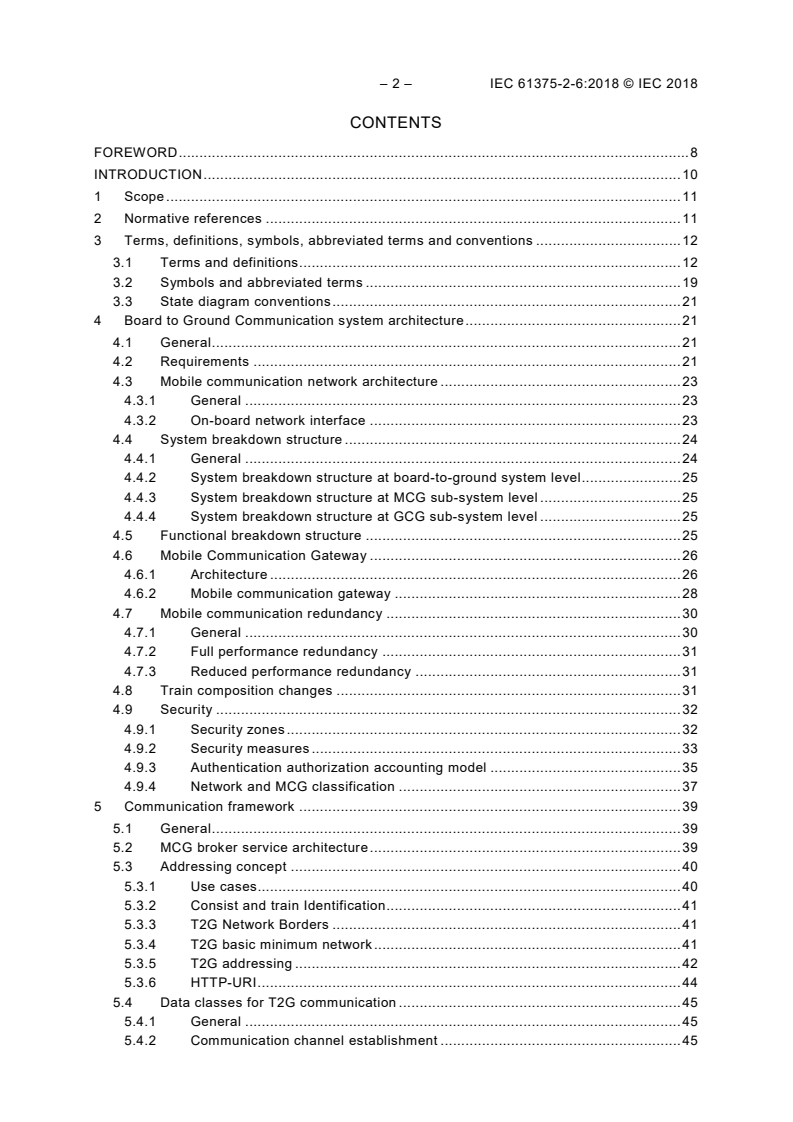
CONTENTS
FOREWORD . 8
INTRODUCTION . 10
1 Scope . 11
2 Normative references . 11
3 Terms, definitions, symbols, abbreviated terms and conventions . 12
3.1 Terms and definitions . 12
3.2 Symbols and abbreviated terms . 19
3.3 State diagram conventions . 21
4 Board to Ground Communication system architecture . 21
4.1 General . 21
4.2 Requirements . 21
4.3 Mobile communication network architecture . 23
4.3.1 General . 23
4.3.2 On-board network interface . 23
4.4 System breakdown structure . 24
4.4.1 General . 24
4.4.2 System breakdown structure at board-to-ground system level . 25
4.4.3 System breakdown structure at MCG sub-system level . 25
4.4.4 System breakdown structure at GCG sub-system level . 25
4.5 Functional breakdown structure . 25
4.6 Mobile Communication Gateway . 26
4.6.1 Architecture . 26
4.6.2 Mobile communication gateway . 28
4.7 Mobile communication redundancy . 30
4.7.1 General . 30
4.7.2 Full performance redundancy . 31
4.7.3 Reduced performance redundancy . 31
4.8 Train composition changes . 31
4.9 Security . 32
4.9.1 Security zones . 32
4.9.2 Security measures . 33
4.9.3 Authentication authorization accounting model . 35
4.9.4 Network and MCG classification . 37
5 Communication framework . 39
5.1 General . 39
5.2 MCG broker service architecture . 39
5.3 Addressing concept . 40
5.3.1 Use cases. 40
5.3.2 Consist and train Identification . 41
5.3.3 T2G Network Borders . 41
5.3.4 T2G basic minimum network . 41
5.3.5 T2G addressing . 42
5.3.6 HTTP-URI . 44
5.4 Data classes for T2G communication . 45
5.4.1 General . 45
5.4.2 Communication channel establishment . 45
5.4.3 Message data . 45
5.4.4 Process data . 46
5.4.5 Stream Data . 47
5.4.6 Best effort data . 47
5.5 Communication protocol. 48
5.5.1 General . 48
5.5.2 HTTP(S) . 48
5.5.3 MQTT (Option) . 50
5.6 Communication services . 51
5.6.1 General . 51
5.6.2 Message data communication service . 51
5.6.3 File transfer communication service . 55
6 Services and interfaces (MCG) . 76
6.1 Overview. 76
6.1.1 MCG system service architecture . 76
6.1.2 MCG / GCG system service interfaces . 77
6.1.3 MCG / GCG communication relationship . 78
6.2 Service provisioning . 78
6.3 MCG / GCG system service description . 79
6.3.1 Communication Services . 79
6.3.2 Train Location Service (Option) . 82
6.3.3 Train Information Service . 88
6.3.4 MCG Network Selector Service . 92
6.3.5 Train telemetry service (Option) . 94
6.3.6 MCG Train Wake-up Service (Option) . 104
7 Services and interfaces (GCG) . 105
7.1 GCG Overview . 105
7.2 GCG Addressing . 107
7.2.1 Wireless MCG Interface . 107
7.2.2 Ground GCG Interface . 107
7.3 GCG Implementation . 108
7.3.1 General (informative) . 108
7.3.2 GCG Availability . 108
7.3.3 GCG Workload . 108
7.3.4 GCG Security . 108
7.4 GCG services . 108
7.4.1 GCG services protocol . 108
7.4.2 GCG Fleet Database . 108
7.4.3 MCG-GCG services . 109
7.4.4 File transfer communication service . 109
7.4.5 Local Ground GCG Interface. 109
7.4.6 Home GCG – Foreign GCG services . 110
7.4.7 Public Ground GCG services . 110
Annex A (normative) Message presentation . 111
A.1 General . 111
A.2 Transmission rules . 111
A.3 Generic message . 111
Annex B (normative) Telemetry data coding and ordering . 112
– 4 – IEC 61375-2-6:2018 © IEC 2018
B.1 General . 112
B.2 MQTT payload coding . 112
B.3 Variables grouping and ordering criterion . 113
Bibliography . 116
Figure 1 – Train on-board communication system (example) . 23
Figure 2 – Ground communication system (example) . 24
Figure 3 – Option 1: End device board to ground communication via MCG . 27
Figure 4 – Option 2: End Device board to ground communication via dedicated
interface . 28
Figure 5 – MCG abstract model block diagram . 29
Figure 6 – MCG configured as ALG . 29
Figure 7 – Architectural example of redundant Board to Ground communication . 30
Figure 8 – Security zones (simplified) . 33
Figure 9 – Authentication, authorization and accounting model . 36
Figure 10 – MCG connecting open and closed transmission systems . 38
Figure 11 – MCG broker service architecture . 40
Figure 12 – Minimum Train to Ground Network Setup . 41
Figure 13 – A train consisting of four vehicles . 42
Figure 14 – Communication stacks . 49
Figure 15 – HTTP(S) MD communication pattern . 49
Figure 16 – HTTP(S) request/event. 50
Figure 17 – HTTP(S) response . 50
Figure 18 – Message Data exchange (example) . 52
Figure 19 – Message Data telegram structure . 53
Figure 20 – File upload example . 56
Figure 21 – Error case: No ComID 203 received . 61
Figure 22 – Error case: no ComID 206 received, no file uploaded to the wayside . 62
Figure 23 – Error Case: No ComID 206 received, file uploaded to the wayside . 63
Figure 24 – Error Case: No ComID 207 received . 64
Figure 25 – File download example . 65
Figure 26 – Error case: no ComID 209 received . 71
Figure 27 – Error case: no ComID 211 received . 72
Figure 28 – Error case: no ComID 210 received . 73
Figure 29 – Service architecture . 77
Figure 30 – Service interfaces . 78
Figure 31 – Procedure to establish the radio link from MCG . 80
Figure 32 – Procedure to establish the radio link from GCG . 80
Figure 33 – Procedure to update the ground DNS server . 81
Figure 34 – Example architecture to provide the train location . 83
Figure 35 – Example procedure to notify about current train location . 84
Figure 36 – Example architecture to notify about train information . 88
Figure 37 – Example procedure to notify about train information . 89
Figure 38 – Illustration of network selector . 93
Figure 39 – Architecture to provide telemetry data . 94
Figure 40 – Procedure to notify about current train location . 95
Figure 41 – Example Procedure to wake up the train . 104
Figure 42 – Train to Ground interfaces . 106
Figure B.1 – MQTT notification payload format . 112
Figure B.2 – Example of ordering criteria . 114
Figure B.3 – Example of values grouping . 114
Table 1 – Board to ground requirements . 22
Table 2 – Board-to-ground system breakdown . 25
Table 3 – MCG sub-system breakdown . 25
Table 4 – GCG sub-system breakdown . 25
Table 5 – An example of the MCG function breakdown . 26
Table 6 – An example of the GCG function breakdown . 26
Table 7 – Device – status of implementation of the TIS . 31
Table 8 – Composition – status of implementation of the TIS . 31
Table 9 – Security measures . 34
Table 10 – MCG categories . 37
Table 11 – Security requirements. 38
Table 12 – TCN-URI global DNS zone . 44
Table 13 – Recommended service parameters for message data . 46
Table 14 – Recommended service parameters for process data . 47
Table 15 – Recommended service parameters for stream data . 47
Table 16 – Recommended service parameters for best effort data . 48
Table 17 – HTTP(S) parameters request/response pattern . 50
Table 18 – General MD Header. 53
Table 19 – General MD Body . 54
Table 20 – MD Checksum . 54
Table 21 – Message types . 54
Table 22 – Message representation . 55
Table 23 – File transfer terminology . 55
Table 24 – ComID 202: MD header telegram values . 57
Table 25 – ComID 202: MD body telegram values . 57
Table 26 – ComID 202: MD body: mdPayload object . 58
Table 27 – ComID 203: MD header telegram values . 58
Table 28 – ComID 203: MD body telegram values . 58
Table 29 – ComID 203: MD body: mdPayload object . 59
Table 30 – ComID 206: MD header telegram values . 59
Table 31 – ComID 206: MD body telegram values . 59
Table 32 – ComID 206: MD body: mdPayload object . 60
Table 33 – ComID 207: MD header telegram values . 60
Table 34 – ComID 207: MD body telegram values . 60
Table 35 – ComID 207: MD body: mdPayload object . 61
– 6 – IEC 61375-2-6:2018 © IEC 2018
Table 36 – ComID 208: MD header telegram values . 66
Table 37 – ComID 208: MD Body telegram values . 66
Table 38 – ComID 208: MD Body: mdPayload object . 67
Table 39 – ComID 209: MD header telegram values . 67
Table 40 – ComID 209: MD Body telegram values . 68
Table 41 – ComID 209: MD Body: mdPayload object . 68
Table 42 – ComID 210: MD header telegram values . 68
Table 43 – ComID 210: MD Body telegram values . 69
Table 44 – ComID 210: MD Body: mdPayload object . 69
Table 45 – ComID 211: MD header telegram values . 69
Table 46 – ComID 211: MD Body telegram values . 69
Table 47 – ComID 211: MD Body: mdPayload object . 70
Table 48 – Main parts of dlTarget URI . 74
Table 49 – Main parts of host element . 74
Table 50 – Valid “device” label values . 75
Table 51 – Valid “vehicle” label values . 75
Table 52 – Valid “consist” label values . 75
Table 53 – Valid “closed train” label values . 76
Table 54 – Valid “train” label values . 76
Table 55 – Exemplary dlTarget values . 76
Table 56 – ComID 240: Capability message . 81
Table 57 – ComID 240: MD event body telegram values . 82
Table 58 – ComID 240: MD event body: mdPayload object . 82
Table 59 – ComID 230: MD request header telegram values . 85
Table 60 – ComID 230: MD request body telegram values . 85
Table 61 – ComID 230: MD request body: mdPayload object . 85
Table 62 – ComID 230: MD reply header telegram values . 86
Table 63 – ComID 230: MD reply body telegram values . 86
Table 64 – ComID 230/232: MD reply/notification body: mdPayload object . 86
Table 65 – Example of latitude/longitude with proposed fixed point notation . 87
Table 66 – ComID 232: MD header telegram values . 87
Table 67 – ComID 232: MD Body telegram values . 87
Table 68 – ComID 234: MD request header telegram values . 90
Table 69 – ComID 234: MD request body telegram values . 90
Table 70 – ComID 234: MD request body: mdPayload object . 90
Table 71 – ComID 234: MD reply header telegram values . 90
Table 72 – ComID 234: MD reply body telegram values . 91
Table 73 – ComID 234: MD reply body: mdPayload object . 91
Table 74 – ComID 236: MD header telegram values . 92
Table 75 – ComID 236: MD Body telegram values . 92
Table 76 – ComID 240: MD request header telegram values . 96
Table 77 – ComID 240: MD request Body telegram values . 96
Table 78 – ComID 240: MD reply header telegram values . 97
Table 79 – ComID 240: MD reply body telegram values . 97
Table 80 – ComID 240: MD reply body: mdPayload object . 97
Table 81 – ComID 242: MD request header telegram values . 98
Table 82 – ComID 242: MD request Body telegram values . 98
Table 83 – ComID 242: MD request body: mdPayload object . 99
Table 84 – ComID 242: MD reply header telegram values . 99
Table 85 – ComID 242: MD reply body telegram values . 100
Table 86 – ComID 242: MD reply body: mdPayload object . 100
Table 87 – ComID 243: MD request header telegram values . 101
Table 88 – ComID 243: MD request Body telegram values . 101
Table 89 – ComID 243: MD request body: mdPayload object . 101
Table 90 – ComID 244: MD request header telegram values . 102
Table 91 – ComID 244: MD request Body telegram values . 102
Table 92 – ComID 244: MD request body: mdPayload object . 102
Table 93 – ComID 244: MD reply header telegram values . 102
Table 94 – ComID 244: MD reply body telegram values . 102
Table 95 – ComID 244: MD reply body: mdPayload object . 103
Table 96 – ComID 245: MD request header telegram values . 103
Table 97 – ComID 245: MD request Body telegram values . 103
Table 98 – ComID 245: MD request body: mdPayload object . 104
Table 99 – ComID 238: twsWakeUp MD event header . 105
Table 100 – ComID 238: twsWakeUp MD event body . 105
Table 101 – ComID 238: twsWakeUp MD event body: mdPayload object . 105
Table B.1 – Example of values decoding . 115
– 8 – IEC 61375-2-6:2018 © IEC 2018
INTERNATIONAL ELECTROTECHNICAL COMMISSION
____________
ELECTRONIC RAILWAY EQUIPMENT –
TRAIN COMMUNICATION NETWORK (TCN) –
Part 2-6: On-board to ground communication
FOREWORD
1) The International Electrotechnical Commission (IEC) is a worldwide organization for standardization comprising
all national electrotechnical committees (IEC National Committees). The object of IEC is to promote
international co-operation on all questions concerning standardization in the electrical and electronic fields. To
this end and in addition to other activities, IEC publishes International Standards, Technical Specifications,
Technical Reports, Publicly Available Specifications (PAS) and Guides (hereafter referred to as “IEC
Publication(s)”). Their preparation is entrusted to technical committees; any IEC National Committee interested
in the subject dealt with may participate in this preparatory work. International, governmental and non-
governmental organizations liaising with the IEC also participate in this preparation. IEC collaborates closely
with the International Organization for Standardization (ISO) in accordance with conditions determined by
agreement between the two organizations.
2) The formal decisions or agreements of IEC on technical matters express, as nearly as possible, an international
consensus of opinion on the relevant subjects since each technical committee has representation from all
interested IEC National Committees.
3) IEC Publications have the form of recommendations for international use and are accepted by IEC National
Committees in that sense. While all reasonable efforts are made to ensure that the technical content of IEC
Publications is accurate, IEC cannot be held responsible for the way in which they are used or for any
misinterpretation by any end user.
4) In order to promote international uniformity, IEC National Committees undertake to apply IEC Publications
transparently to the maximum extent possible in their national and regional publications. Any divergence
between any IEC Publication and the corresponding national or regional publication shall be clearly indicated in
the latter.
5) IEC itself does not provide any attestation of conformity. Independent certification bodies provide conformity
assessment services and, in some areas, access to IEC marks of conformity. IEC is not responsible for any
services carried out by independent certification bodies.
6) All users should ensure that they have the latest edition of this publication.
7) No liability shall attach to IEC or its directors, employees, servants or agents including individual experts and
members of its technical committees and IEC National Committees for any personal injury, property damage or
other damage of any nature whatsoever, whether direct or indirect, or for costs (including legal fees) and
expenses arising out of the publication, use of, or reliance upon, this IEC Publication or any other IEC
Publications.
8) Attention is drawn to the Normative references cited in this publication. Use of the referenced publications is
indispensable for the correct application of this publication.
9) Attention is drawn to the possibility that some of the elements of this IEC Publication may be the subject of
patent rights. IEC shall not be held responsible for identifying any or all such patent rights.
International Standard IEC 61375-2-6 has been prepared by IEC technical committee 9:
Electrical equipment and systems for railways.
The text of this International Standard is based on the following documents:
FDIS Report on voting
9/2374/FDIS 9/2402/RVD
Full information on the voting for the approval of this International Standard can be found in
the report on voting indicated in the above table.
This document has been drafted in accordance with the ISO/IEC Directives, Part 2.
A list of all parts in the IEC 61375 series, published under the general title Electronic railway
equipment – Train communication network (TCN), can be found on the IEC website.
The committee has decided that the contents of this document will remain unchanged until the
stability date indicated on the IEC website under "http://webstore.iec.ch" in the data related to
the specific document. At this date, the document will be
• reconfirmed,
• withdrawn,
• replaced by a revised edition, or
• amended.
IMPORTANT – The 'colour inside' logo on the cover page of this publication indicates
that it contains colours which are considered to be useful for the correct
understanding of its contents. Users should therefore print this document using a
colour printer.
– 10 – IEC 61375-2-6:2018 © IEC 2018
INTRODUCTION
Considering that the TCN series includes IEC 61375-2-3: Electronic railway equipment – Train
communication network (TCN) – Part 2-3: TCN communication profile, references to this
document are given when the case applies.
This document follows the ISO-OSI model.
This document does not cover the specification of the radio technologies and protocols
relevant to the wireless communication between train and ground.
In the preparation of this document, the following main use cases, which the train to ground
communication applies to, were considered:
a) Commissioning application
1) Operational Application.
2) Mission data application.
3) Driver Assistance Application.
4) Energy Meter Application.
b) Maintenance application
1) Configuration data application.
2) Monitoring train status (e.g. telemetry).
3) Diagnostic data application.
4) Event Recorder Application.
c) Multimedia application
1) Passenger information application.
2) Passenger entertainment application.
3) Electronic ticketing application.
4) CCTV and video-surveillance.
ELECTRONIC RAILWAY EQUIPMENT –
TRAIN COMMUNICATION NETWORK (TCN) –
Part 2-6: On-board to ground communication
1 Scope
This part of IEC 61375 establishes the specification for the communication between the on-
board subsystems and the ground subsystems.
The communication system, interfaces and protocols are specified as a mobile communication
function, using any available wireless technology.
This document provides requirements in order to:
a) select the wireless network on the basis of QoS parameters requested by the application;
b) allow TCMS and/or OMTS applications, installed on-board and communicating on the on-
board communication network, to have a remote access to applications running on ground
installations;
c) allow applications running on ground installations to have a remote access to the TCMS
and/or OMTS applications installed on-board.
This document specifies further requirements which allow the applications running on-board
and the applications running on ground to connect each other applying the virtual/functional
addressing mechanism specified by IEC 61375-2-3 and exchanging application data sets
produced or consumed by the on-board functions implemented in the devices attached to the
TCN network.
Furthermore, this document covers the security requirements in order to grant the access only
to authenticated and authorised applications and to allow encryption of exchanged data.
The communication of safety related data between on-board applications and ground
applications are out of the scope of this International Standard as well as Internet connectivity
service for passengers.
2 Normative references
The following documents are referred to in the text in such a way that some or all of their
content constitutes requirements of this document. For dated references, only the edition
cited applies. For undated references, the latest edition of the referenced document (including
any amendments) applies.
IEC 61375-1:2012, Electronic railway equipment – Train communication network (TCN) –
Part 1: General architecture
IEC 61375-2-3:2015, Electronic railway equipment – Train communication network (TCN) –
Part 2-3: TCN communication profile
IEC 61375-3-4, Electronic railway equipment – Train communication network (TCN) –
Part 3-4: Ethernet Consist Network (ECN)
IEC 62280, Railway applications – Communication, signalling and processing systems –
Safety related communication in transmission systems
– 12 – IEC 61375-2-6:2018 © IEC 2018
IEC 62443 (all parts), Industrial communication networks – Network and system security
IEC 62443-3-3, Industrial communication networks – Network and system security – Part 3-3:
System security requirements and security levels
IEC 62580-1, Electronic railway equipment – On-board multimedia and telematic subsystems
for railways – Part 1: General architecture
...