

IEC 60695-11-4:2011
(Main)Fire hazard testing - Part 11-4: Test flames - 50 W flame - Apparatus and confirmational test method
General Information
- Abstract
IEC 60695-11-4:2011 provides a description of the apparatus required to produce a 50 W test flame and a description of a calibration procedure to check that the test flame produced meets given requirements. Guidance on confirmatory tests for test flames is given in IEC 60695-11-40. This first edition of IEC 60695-11-4 cancels and replaces the second edition of technical specification IEC/TS 60695-11-4 published in 2004. It constitutes a technical revision. The main changes with respect to the previous edition are the integration of minor editorial and technical changes throughout the text.
This publication is to be read in conjunction with IEC 60695-11-4:2011.
- Status
- Published
- Publication Date
- 26-Sep-2011
- Technical Committee
- TC 89 - Fire hazard testing
- Drafting Committee
- WG 12 - TC 89/WG 12
- Current Stage
- PPUB - Publication issued
- Start Date
- 27-Sep-2011
- Completion Date
- 15-Oct-2011
Overview
IEC 60695-11-4:2011 is a critical international standard established by the International Electrotechnical Commission (IEC) focusing on fire hazard testing using a 50 W test flame. This standard specifies the apparatus and confirmational test method required to produce a nominal 50 watt premixed methane flame with an approximate height of 20 mm. The document serves as a technical revision of the earlier IEC/TS 60695-11-4:2004, integrating editorial and technical enhancements for improved consistency and accuracy.
The main objective of IEC 60695-11-4:2011 is to provide technical committees and laboratories with precise guidelines to create a standardized test flame, enabling reliable and reproducible fire hazard assessments in electrotechnical product testing. It is a basic safety publication used in conjunction with other parts of the IEC 60695 series.
Key Topics
Test Flame Specifications
The standard details production of a 50 W pre-mixed methane flame, ensuring consistent flame characteristics including height (approx. 20 mm) and power. It includes descriptions of the burner design, flowmeter, manometer, control valve, copper block, thermocouple, and temperature recording devices essential for flame generation.Apparatus Requirements
Detailed requirements for the essential components such as:- Burner with adjustable air ports and a needle valve for precise gas flow control
- Flowmeter for accurate regulation of methane supply
- Thermocouples and temperature/time recording instruments for monitoring
- Laboratory fumehood or chamber to provide safe testing environment
Test Flame Production and Confirmation
Procedures for producing the standardized flame and confirmatory testing methods to verify that the flame meets set criteria are rigorously described. The standard provides calibration steps including verification of flame size, stability, and heat output to ensure testing reproducibility.Test Arrangements and Classifications
Annexes provide normative and informative guidance on burner assembly, test specimen arrangements, clearance gauges, and equipment testing setups. The standard also specifies how the flame should be designated in technical documentation.
Applications
IEC 60695-11-4:2011 is applied predominantly in fire hazard testing laboratories and product safety certification processes, especially for electrical and electronic equipment. By simulating realistic fire exposure conditions with a low-power 50 W flame, it supports:
- Fire safety evaluation of electrotechnical products to prevent ignition risks
- Development and harmonization of national and international fire testing practices consistent with IEC guide principles
- Assisting product committees in integrating consistent fire hazard tests into product standards
- Supporting regulatory compliance and certification processes for electrical safety and fire resistance
This standard ensures that fire hazard testing is performed under internationally recognized, controlled conditions to generate reliable and comparable test results, enhancing safety assurance across industries.
Related Standards
IEC 60695-11-4:2011 is part of the broader IEC 60695 series dedicated to fire hazard testing of electrical and electronic products. Related standards include:
- IEC 60695-11-2: Test flames - 1 kW nominal pre-mixed flame - Apparatus, confirmatory test arrangement and guidance
- IEC 60695-11-3: Test flames - 500 W flames - Apparatus and confirmational test methods
- IEC 60695-11-5: Test flames - Needle-flame test method - Apparatus, confirmatory test arrangement and guidance
- IEC 60695-11-40: Guide on confirmatory tests for test flames
- ISO/IEC Guides 51 and 104: Guidelines for safety considerations in standards
Additionally, other referenced standards such as IEC 60584 (Thermocouples) and ISO/IEC 13943 (Fire safety vocabulary) support proper implementation and terminology consistency.
Keywords: IEC 60695-11-4, fire hazard testing, 50 W test flame, fire safety standard, methane flame apparatus, electrotechnical product testing, test flame confirmation, IEC fire standards, standardized test flame, fire hazard assessment
Relations
- Effective Date
- 05-Sep-2023
- Effective Date
- 25-Aug-2026
- Effective Date
- 25-Aug-2026
Get Certified
Connect with accredited certification bodies for this standard

IMQ S.p.A. (Certification)
Italian electrical product certification.

SLG Prüf- und Zertifizierungs GmbH
German testing and certification body.

UL Solutions
Global safety science company with testing, inspection and certification.
Sponsored listings
Frequently Asked Questions
IEC 60695-11-4:2011 is a standard published by the International Electrotechnical Commission (IEC). Its full title is "Fire hazard testing - Part 11-4: Test flames - 50 W flame - Apparatus and confirmational test method". This standard covers: IEC 60695-11-4:2011 provides a description of the apparatus required to produce a 50 W test flame and a description of a calibration procedure to check that the test flame produced meets given requirements. Guidance on confirmatory tests for test flames is given in IEC 60695-11-40. This first edition of IEC 60695-11-4 cancels and replaces the second edition of technical specification IEC/TS 60695-11-4 published in 2004. It constitutes a technical revision. The main changes with respect to the previous edition are the integration of minor editorial and technical changes throughout the text. This publication is to be read in conjunction with IEC 60695-11-4:2011.
IEC 60695-11-4:2011 provides a description of the apparatus required to produce a 50 W test flame and a description of a calibration procedure to check that the test flame produced meets given requirements. Guidance on confirmatory tests for test flames is given in IEC 60695-11-40. This first edition of IEC 60695-11-4 cancels and replaces the second edition of technical specification IEC/TS 60695-11-4 published in 2004. It constitutes a technical revision. The main changes with respect to the previous edition are the integration of minor editorial and technical changes throughout the text. This publication is to be read in conjunction with IEC 60695-11-4:2011.
IEC 60695-11-4:2011 is classified under the following ICS (International Classification for Standards) categories: 13.220.40 - Ignitability and burning behaviour of materials and products; 29.020 - Electrical engineering in general. The ICS classification helps identify the subject area and facilitates finding related standards.
IEC 60695-11-4:2011 has the following relationships with other standards: It is inter standard links to IEC TS 60695-11-4:2004, EN ISO 10093:1998, EN ISO 9773:2024. Understanding these relationships helps ensure you are using the most current and applicable version of the standard.
IEC 60695-11-4:2011 is available in PDF format for immediate download after purchase. The document can be added to your cart and obtained through the secure checkout process. Digital delivery ensures instant access to the complete standard document.
Standards Content (Sample)
IEC 60695-11-4 ®
Edition 1.0 2011-09
INTERNATIONAL
STANDARD
NORME
INTERNATIONALE
BASIC SAFETY PUBLICATION
PUBLICATION FONDAMENTALE DE SÉCURITÉ
Fire hazard testing –
Part 11-4: Test flames – 50 W flame – Apparatus and confirmational test method
Essais relatifs aux risques du feu –
Partie 11-4: Flammes d'essai – Flamme de 50 W – Appareillage et méthodes
d'essai de vérification
All rights reserved. Unless otherwise specified, no part of this publication may be reproduced or utilized in any form or by
any means, electronic or mechanical, including photocopying and microfilm, without permission in writing from either IEC or
IEC's member National Committee in the country of the requester.
If you have any questions about IEC copyright or have an enquiry about obtaining additional rights to this publication,
please contact the address below or your local IEC member National Committee for further information.
Droits de reproduction réservés. Sauf indication contraire, aucune partie de cette publication ne peut être reproduite
ni utilisée sous quelque forme que ce soit et par aucun procédé, électronique ou mécanique, y compris la photocopie
et les microfilms, sans l'accord écrit de la CEI ou du Comité national de la CEI du pays du demandeur.
Si vous avez des questions sur le copyright de la CEI ou si vous désirez obtenir des droits supplémentaires sur cette
publication, utilisez les coordonnées ci-après ou contactez le Comité national de la CEI de votre pays de résidence.
IEC Central Office
3, rue de Varembé
CH-1211 Geneva 20
Switzerland
Email: inmail@iec.ch
Web: www.iec.ch
About the IEC
The International Electrotechnical Commission (IEC) is the leading global organization that prepares and publishes
International Standards for all electrical, electronic and related technologies.
About IEC publications
The technical content of IEC publications is kept under constant review by the IEC. Please make sure that you have the
latest edition, a corrigenda or an amendment might have been published.
Catalogue of IEC publications: www.iec.ch/searchpub
The IEC on-line Catalogue enables you to search by a variety of criteria (reference number, text, technical committee,…).
It also gives information on projects, withdrawn and replaced publications.
IEC Just Published: www.iec.ch/online_news/justpub
Stay up to date on all new IEC publications. Just Published details twice a month all new publications released. Available
on-line and also by email.
Electropedia: www.electropedia.org
The world's leading online dictionary of electronic and electrical terms containing more than 20 000 terms and definitions
in English and French, with equivalent terms in additional languages. Also known as the International Electrotechnical
Vocabulary online.
Customer Service Centre: www.iec.ch/webstore/custserv
If you wish to give us your feedback on this publication or need further assistance, please visit the Customer Service
Centre FAQ or contact us:
Email: csc@iec.ch
Tel.: +41 22 919 02 11
Fax: +41 22 919 03 00
A propos de la CEI
La Commission Electrotechnique Internationale (CEI) est la première organisation mondiale qui élabore et publie des
normes internationales pour tout ce qui a trait à l'électricité, à l'électronique et aux technologies apparentées.
A propos des publications CEI
Le contenu technique des publications de la CEI est constamment revu. Veuillez vous assurer que vous possédez
l’édition la plus récente, un corrigendum ou amendement peut avoir été publié.
Catalogue des publications de la CEI: www.iec.ch/searchpub/cur_fut-f.htm
Le Catalogue en-ligne de la CEI vous permet d’effectuer des recherches en utilisant différents critères (numéro de référence,
texte, comité d’études,…). Il donne aussi des informations sur les projets et les publications retirées ou remplacées.
Just Published CEI: www.iec.ch/online_news/justpub
Restez informé sur les nouvelles publications de la CEI. Just Published détaille deux fois par mois les nouvelles
publications parues. Disponible en-ligne et aussi par email.
Electropedia: www.electropedia.org
Le premier dictionnaire en ligne au monde de termes électroniques et électriques. Il contient plus de 20 000 termes et
définitions en anglais et en français, ainsi que les termes équivalents dans les langues additionnelles. Egalement appelé
Vocabulaire Electrotechnique International en ligne.
Service Clients: www.iec.ch/webstore/custserv/custserv_entry-f.htm
Si vous désirez nous donner des commentaires sur cette publication ou si vous avez des questions, visitez le FAQ du
Service clients ou contactez-nous:
Email: csc@iec.ch
Tél.: +41 22 919 02 11
Fax: +41 22 919 03 00
IEC 60695-11-4 ®
Edition 1.0 2011-09
INTERNATIONAL
STANDARD
NORME
INTERNATIONALE
BASIC SAFETY PUBLICATION
PUBLICATION FONDAMENTALE DE SÉCURITÉ
Fire hazard testing –
Part 11-4: Test flames – 50 W flame – Apparatus and confirmational test method
Essais relatifs aux risques du feu –
Partie 11-4: Flammes d'essai – Flamme de 50 W – Appareillage et méthodes
d'essai de vérification
INTERNATIONAL
ELECTROTECHNICAL
COMMISSION
COMMISSION
ELECTROTECHNIQUE
PRICE CODE
INTERNATIONALE
CODE PRIX S
ICS 13.220.40; 29.020 ISBN 978-2-88912-698-9
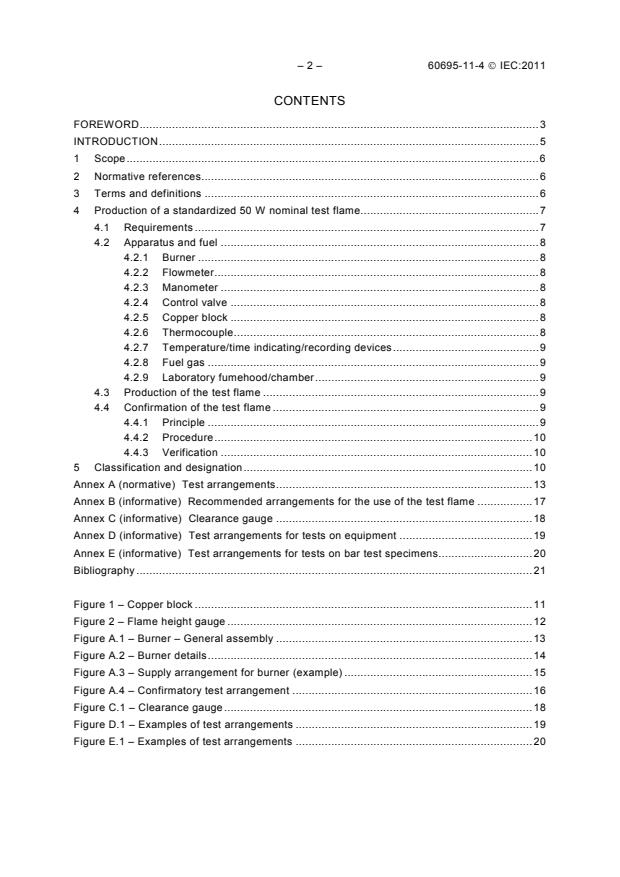
– 2 – 60695-11-4 IEC:2011
CONTENTS
FOREWORD . 3
INTRODUCTION . 5
1 Scope . 6
2 Normative references. 6
3 Terms and definitions . 6
4 Production of a standardized 50 W nominal test flame. 7
4.1 Requirements . 7
4.2 Apparatus and fuel . 8
4.2.1 Burner . 8
4.2.2 Flowmeter . 8
4.2.3 Manometer . 8
4.2.4 Control valve . 8
4.2.5 Copper block . 8
4.2.6 Thermocouple . 8
4.2.7 Temperature/time indicating/recording devices . 9
4.2.8 Fuel gas . 9
4.2.9 Laboratory fumehood/chamber . 9
4.3 Production of the test flame . 9
4.4 Confirmation of the test flame . 9
4.4.1 Principle . 9
4.4.2 Procedure . 10
4.4.3 Verification . 10
5 Classification and designation . 10
Annex A (normative) Test arrangements . 13
Annex B (informative) Recommended arrangements for the use of the test flame . 17
Annex C (informative) Clearance gauge . 18
Annex D (informative) Test arrangements for tests on equipment . 19
Annex E (informative) Test arrangements for tests on bar test specimens . 20
Bibliography . 21
Figure 1 – Copper block . 11
Figure 2 – Flame height gauge . 12
Figure A.1 – Burner – General assembly . 13
Figure A.2 – Burner details . 14
Figure A.3 – Supply arrangement for burner (example) . 15
Figure A.4 – Confirmatory test arrangement . 16
Figure C.1 – Clearance gauge . 18
Figure D.1 – Examples of test arrangements . 19
Figure E.1 – Examples of test arrangements . 20
60695-11-4 IEC:2011 – 3 –
INTERNATIONAL ELECTROTECHNICAL COMMISSION
____________
FIRE HAZARD TESTING –
Part 11-4: Test flames – 50 W flame –
Apparatus and confirmational test method
FOREWORD
1) The International Electrotechnical Commission (IEC) is a worldwide organization for standardization comprising
all national electrotechnical committees (IEC National Committees). The object of IEC is to promote
international co-operation on all questions concerning standardization in the electrical and electronic fields. To
this end and in addition to other activities, IEC publishes International Standards, Technical Specifications,
Technical Reports, Publicly Available Specifications (PAS) and Guides (hereafter referred to as “IEC
Publication(s)”). Their preparation is entrusted to technical committees; any IEC National Committee interested
in the subject dealt with may participate in this preparatory work. International, governmental and non-
governmental organizations liaising with the IEC also participate in this preparation. IEC collaborates closely
with the International Organization for Standardization (ISO) in accordance with conditions determined by
agreement between the two organizations.
2) The formal decisions or agreements of IEC on technical matters express, as nearly as possible, an international
consensus of opinion on the relevant subjects since each technical committee has representation from all
interested IEC National Committees.
3) IEC Publications have the form of recommendations for international use and are accepted by IEC National
Committees in that sense. While all reasonable efforts are made to ensure that the technical content of IEC
Publications is accurate, IEC cannot be held responsible for the way in which they are used or for any
misinterpretation by any end user.
4) In order to promote international uniformity, IEC National Committees undertake to apply IEC Publications
transparently to the maximum extent possible in their national and regional publications. Any divergence
between any IEC Publication and the corresponding national or regional publication shall be clearly indicated in
the latter.
5) IEC itself does not provide any attestation of conformity. Independent certification bodies provide conformity
assessment services and, in some areas, access to IEC marks of conformity. IEC is not responsible for any
services carried out by independent certification bodies.
6) All users should ensure that they have the latest edition of this publication.
7) No liability shall attach to IEC or its directors, employees, servants or agents including individual experts and
members of its technical committees and IEC National Committees for any personal injury, property damage or
other damage of any nature whatsoever, whether direct or indirect, or for costs (including legal fees) and
expenses arising out of the publication, use of, or reliance upon, this IEC Publication or any other IEC
Publications.
8) Attention is drawn to the Normative references cited in this publication. Use of the referenced publications is
indispensable for the correct application of this publication.
9) Attention is drawn to the possibility that some of the elements of this IEC Publication may be the subject of
patent rights. IEC shall not be held responsible for identifying any or all such patent rights.
International Standard IEC 60695-11-4 has been prepared by IEC technical committee 89: Fire
hazard testing.
This first edition of IEC 60695-11-4 cancels and replaces the second edition of technical
specification IEC/TS 60695-11-4 published in 2004. It constitutes a technical revision and now
has the status of an International Standard.
It has the status of a basic safety publication in accordance with IEC Guide 104 and ISO/IEC
Guide 51.
The main changes with respect to the previous edition are the integration of minor editorial and
technical changes throughout the text.
– 4 – 60695-11-4 IEC:2011
The text of this standard is based on the following documents:
FDIS Report on voting
89/1060/FDIS 89/1084/RVD
Full information on the voting for the approval of this standard can be found in the report on
voting indicated in the above table.
This publication has been drafted in accordance with the ISO/IEC Directives, Part 2.
A list of all the parts in the IEC 60695 series, under the general title Fire hazard testing, can be
found on the IEC website.
IEC 60695-11 consists of the following parts:
Part 11-2: Test flames – 1 kW nominal pre-mixed flame – Apparatus, confirmatory test
arrangement and guidance
Part 11-3: Test flames – 500 W flames – Apparatus and confirmational test methods
Part 11-4: Test flames – 50 W flame – Apparatus and confirmational test method
Part 11-5: Test flames – Needle-flame test method – Apparatus, confirmatory test
arrangement and guidance
Part 11-10: Test flames – 50 W horizontal and vertical flame test methods
Part 11-11: Test flames – Determination of the characteristic heat flux for ignition from a non-
contacting flame source
Part 11-20: Test flames – 500 W flame test methods
Part 11-30: Test flames – History and development from 1979 to 1999
Part 11-40: Test flames – Confirmatory tests – Guidance
The committee has decided that the contents of this publication will remain unchanged until the
stability date indicated on the IEC web site under "http://webstore.iec.ch" in the data related to
the specific publication. At this date, the publication will be
• reconfirmed,
• withdrawn,
• replaced by a revised edition, or
• amended.
60695-11-4 IEC:2011 – 5 –
INTRODUCTION
The best method for testing electrotechnical products with regard to fire hazard is to duplicate
exactly the conditions occurring in practice. In most instances, this is not possible. Accordingly,
for practical reasons, the testing of electrotechnical products with regard to fire hazard is best
conducted by simulating as closely as possible the actual effects occurring in practice.
Work initiated by ACOS resulted in a series of standards that make available standardized test
flames covering a range of powers for the use of all product committees needing such test
flames. A needle flame is described in IEC 60695-11-5, two 500 W flames are described in
IEC 60695-11-4, and a 1 kW flame is described in IEC 60695-11-2.
This international standard provides a description of the apparatus required to produce a 50 W
test flame and a description of a calibration procedure to check that the test flame produced
meets given requirements. Guidance on confirmatory tests for test flames is given in
IEC 60695-11-40.
Three 50 W test flame methods (A, B and C) were originally specified in
IEC/TS 60695-11-4:2000, with the intention that users would determine a ranking preference.
This process has resulted in two of these flame methods being withdrawn, as shown below:
50 W test flame method Flame type Gas Approximate flame height / mm
A Pre-mixed Methane 20
B Withdrawn
C Withdrawn
The method described in Clause 4 of this standard is the method that was originally designated
as Method A. It produces a 50 W nominal test flame using a single gas supply tube, a needle
valve to adjust the gas back pressure, a flowmeter to adjust the gas flow rate, and adjustable
air ports on the burner tube.
The flame is produced by burning methane, and the method makes use of a more tightly
specified version of a burner that was used in some countries for many years.
The method has been developed as a technical enhancement of previous technology.
– 6 – 60695-11-4 IEC:2011
FIRE HAZARD TESTING –
Part 11-4: Test flames – 50 W flame –
Apparatus and confirmational test method
1 Scope
This part of IEC 60695 provides detailed requirements for the production of a 50 W nominal,
pre-mixed type test flame. The approximate overall height of the flame is 20 mm. Details are
given for confirmation of the test flame.
This basic safety publication is intended for use by technical committees in the preparation of
standards in accordance with the principles laid down in IEC Guide 104 and ISO/IEC Guide 51.
One of the responsibilities of a technical committee is, wherever applicable, to make use of
basic safety publications in the preparation of its publications. The requirements, test methods
or test conditions of this basic safety publication will not apply unless specifically referred to or
included in the relevant publications.
2 Normative references
The following referenced documents are indispensable for the application of this document. For
dated references, only the edition cited applies. For undated references, the latest edition of
the referenced document (including any amendments) applies.
IEC 60584-1:1995, Thermocouples – Part 1: Reference tables
IEC 60584-2:1989, Thermocouples – Part 2: Tolerances
Amendment 1
IEC Guide 104:1997, The preparation of safety publications and the use of basic safety
publications and group safety publications
ISO/IEC Guide 51:1999, Safety aspects – Guidelines for their inclusion in standards
ISO/IEC 13943:2008, Fire safety – Vocabulary
ASTM-B187/B187M-06, Standard Specification for Copper, Bus Bar, Rod, and Shapes and
General Purpose Rod, Bar, and Shapes
3 Terms and definitions
For the purposes of this document, the terms and definitions given in ISO/IEC 13943, some of
which are reproduced below for the users' convenience, as well as the following apply.
3.1
burn, intransitive verb
undergo combustion
[ISO/IEC 13943, definition 4.28]
60695-11-4 IEC:2011 – 7 –
3.2
burn, transitive verb
cause combustion
[ISO/IEC 13943, definition 4.29]
3.3
combustion
exothermic reaction of a substance with an oxidizing agent
NOTE Combustion generally emits fire effluent accompanied by flames and/or glowing.
[ISO/IEC 13943, definition 4.46]
3.4
draught-free environment
space in which the results of experiments are not significantly affected by the local air speed
NOTE A qualitative example is a space in which a wax candle flame remains essentially undisturbed. Quantitative
–1 –1
examples are small-scale fire tests in which a maximum air speed of 0,1 m·s or 0,2 m·s is sometimes specified.
[ISO/IEC 13943, definition 4.70]
3.5
fire hazard
physical object or condition with a potential for an undesirable consequence from fire
[ISO/IEC 13943, definition 4.112]
3.6
flame, noun
rapid, self-sustaining, sub-sonic propagation of combustion in a gaseous medium, usually with
emission of light
[ISO/IEC 13943, definition 4.133]
3.7
pre-mixed flame
flame in which combustion occurs in an intimate mixture of fuel and oxidizing agent
[ISO/IEC 13943, definition 4.259]
3.8
standardized 50 W nominal test flame
test flame that conforms to this international standard and meets all of the requirements given
in Clause 4
4 Production of a standardized 50 W nominal test flame
4.1 Requirements
A standardized 50 W nominal test flame, according to this method, is one that is
• produced using hardware according to Figures A.1 and A.2,
• supplied with methane gas of purity not less than 98 % at a flow rate equivalent to
105 ml/min ± 5 ml/min at 23 °C, 0,1 MPa , using the arrangement of Figure A.3.
–––––––––––––
When corrected from measurements taken under actual conditions of use.
– 8 – 60695-11-4 IEC:2011
NOTE The expected back pressure is less than 10 mm of water.
The flame shall be symmetrical, stable and give a result of 44 s ± 2 s in the confirmatory test
described in 4.4.
The confirmatory test arrangement shown in Figure A.4 shall be used.
The overall height of the flame should be typically within the range 18 mm to 22 mm, but
targeted towards 20 mm when measured using the flame height gauge as described in
Figure 2, in the laboratory fumehood/chamber (see 4.2.9).
4.2 Apparatus and fuel
4.2.1 Burner
The burner shall be in accordance with Figures A.1 and A.2.
NOTE The burner tube, gas injector and needle valve are removable for cleaning purposes. Care should be taken
on re-assembly that the needle valve tip is not damaged and that the needle valve and valve seat (gas injector) are
correctly aligned.
4.2.2 Flowmeter
The flowmeter shall be appropriate for the measurement of a gas flow rate of 105 ml/min at
23 °C, 0,1 MPa to a tolerance of ± 2 %.
NOTE A mass flowmeter is the preferred means of controlling accurately the input flow rate of fuel to the burner.
Other methods may be used if they can show equivalent accuracy.
4.2.3 Manometer
The manometer shall be appropriate for the measurement of pressure in the range of 0 kPa to
7,5 kPa. Water manometers may be used for this purpose. They should be adapted to read
0 kPa to 7,5 kPa.
NOTE A manometer is required in conjunction with a mass flowmeter in order to maintain the required back
pressure.
4.2.4 Control valve
A control valve is required to set the gas flow rate.
4.2.5 Copper block
The copper block shall be 5,50 mm in diameter, of mass 1,76 g ± 0,01 g in the fully machined
but undrilled state as shown in Figure 1.
There is no verification method for the copper block. Laboratories are encouraged to maintain
a standard reference unit, a secondary standard reference unit and a working unit, cross-
comparing them as appropriate to verify the working system.
4.2.6 Thermocouple
A mineral insulated, metal sheathed fine-wire thermocouple with an insulated junction, is used
for measuring the temperature of the copper block. The thermocouple shall be Class 1 in
accordance with IEC60584-2. It shall have an overall nominal diameter of 0,5 mm and wires of,
for example, NiCr and NiAl (type K in accordance with IEC 60584-1) with the welded point
located inside the sheath. The sheath shall consist of a metal resistant to continuous operation
at a temperature of at least 1 050 °C. Thermocouple tolerances shall be in accordance with
IEC 60584-2, Class 1.
60695-11-4 IEC:2011 – 9 –
NOTE A sheath made from a nickel-based, heat-resistant alloy (such as Inconel 600 ) will satisfy the above
requirement.
The preferred method of fastening the thermocouple to the block, after first ensuring that the
thermocouple is inserted to the full depth of the hole, is by compressing the copper around the
thermocouple to retain it without damage, as shown in Figure A.4.
4.2.7 Temperature/time indicating/recording devices
The temperature/time indicating/recording devices shall be appropriate for the measurement of
the time for the block to heat up from 100 °C ± 2 °C to 700 °C ± 3 °C with a tolerance on the
measured time of ± 0,5 s.
4.2.8 Fuel gas
The fuel gas shall be methane with a purity of not less than 98 %.
4.2.9 Laboratory fumehood/chamber
, which has
The laboratory fumehood/chamber shall have an inside volume of at least 0,5 m
been shown to be satisfactory, unless otherwise stated in the test method for burning
behaviour. The chamber shall permit observation of tests in progress and shall provide a
draught-free environment, whilst allowing normal thermal circulation of air past the test
specimen during burning. The inside walls of the chamber shall be of a dark colour. When a lux
meter facing towards the rear of the chamber is positioned in place of the test flame, the
recorded light level shall be less than 20 lx. For safety and convenience, it is desirable that this
enclosure (which can be completely closed) is fitted with an extraction device, such as an
exhaust fan, to remove products of combustion, which may be toxic. If fitted, the extraction
device shall be turned off during the test and turned on immediately after the test to remove the
fire effluents. A positive closing damper may be needed.
NOTE 1 The amount of oxygen available to support combustion of the test specimen is naturally important for the
conduct of flame tests. For tests conducted by these methods when burning times are prolonged, chambers having
an inside volume of 0,5 m may not be sufficient to produce accurate results.
NOTE 2 Placing a mirror in the chamber, to provide a rear view of the test specimen, has been found useful.
4.3 Production of the test flame
Set up the burner supply arrangement according to Figure A.3 ensuring leak-free connections
and place the burner in the laboratory fumehood/chamber.
Ignite the gas and adjust the gas flow rate to the required value. The needle valve shall be
adjusted to set the gas flow rate. The air inlet shall be adjusted until the flame is completely
blue in colour with no inner cone.
The overall height of the flame shall be as described in 4.1. The flame shall appear stable and
symmetrical on examination.
4.4 Confirmation of the test flame
4.4.1 Principle
The time taken for the temperature of the copper block, described in Figure 1, to increase from
100 °C ± 2 °C to 700 °C ± 3 °C shall be 44 s ± 2 s, when the flame confirmatory test
arrangement of Figure A.4 is used.
–––––––––––––
This information is given for the convenience of users of this international standard and does not constitute an
endorsement by the IEC of the product named. Equivalent products may be used if they can be shown to lead to
the same results.
– 10 – 60695-11-4 IEC:2011
4.4.2 Procedure
Set up the burner supply and confirmatory test arrangements according to Figures A.3 and A.4
in the laboratory fumehood/chamber as described in 4.2.9, ensuring leak-free gas connections.
Temporarily remove the burner away from the block to ensure that there is no influence of the
flame on the copper block during the preliminary adjustment of the gas and air flow rates.
Ignite the gas and adjust the gas flow rate to the required value. Adjust the air inlet by turning
the burner tube until the moment the yellow tip of the flame disappears. Ensure that the overall
height of the flame, when measured using the gauge described in Figure 2, is within the
required limits, and that the flame is symmetrical. Wait for a period of at least 5 min to allow
the burner conditions to reach equilibrium. Measure the gas flow rate and determine that they
are within the required limits.
With the temperature/time indicating/recording devices operational, re-position the burner
under the copper block.
Determine the time for the temperature of the copper block to increase from 100 °C ± 2 °C to
700 °C ± 3 °C. If the time is 44 s ± 2 s, repeat the procedure two additional times until three
successive determinations are within specification. Allow the copper block to cool naturally in
air to below 50 °C between determinations. If the time of any determination is not 44 s ± 2 s,
adjust the flame accordingly, allow the flame to reach equilibrium, and restart the procedure.
NOTE At temperatures above 700 °C, the thermocouple can easily be damaged, therefore it is advisable to
remove the burner immediately after reaching 700 °C.
If the copper block has not been used before, make a preliminary run to condition the block
surface. Discard the result.
4.4.3 Verification
The flame is confirmed and may be used for test purposes if the results of three successive
determinations are within the range 44 s ± 2 s.
5 Classification and designation
Apparatus that conforms with the requirements of this international standard and produces the
50 W nominal test flame may be labelled:
60695-11-4 IEC:2011 – 11 –
"50 W nominal test flame apparatus, conforming to IEC 60695-11-4".
Dimensions in millimetres
∅
5,5 ± 0,01
∅
0,5 (hole drilled)
45° ± 0,5°
45° ± 0,5°
Copper block - polished all over
032/2000
Material: high conductivity electrolytic copper Cu-ETP UNS C 11000 (see ASTM-B187/B187M-06)
Weight: 1,76 g ± 0,01 g before drilling
Tolerances: ± 0,1, ± 30 min (angular) unless otherwise stated
Figure 1 – Copper block
4 ± 0,02
8,8 ± 0,02
10,3 ± 0,03
– 12 – 60695-11-4 IEC:2011
Dimensions in millimetres
45°
45°
45°
Material: 1 mm to 1,5 mm steel plate
Thermally insulating strips rivetted in place
033/2000
Tolerances: ± 0,1, ± 30 min (angular) unless otherwise stated
Figure 2 – Flame height gauge
4 ± 0,05
22 ± 0,1
60695-11-4 IEC:2011 – 13 –
Annex A
(normative)
Test arrangements
Burner tube
Valve seat
Lock-nut
Main body
Suitable packing material
Needle valve packing nut
Needle valve
Adjustable stop
for valve
IEC 034/2000
Figure A.1 – Burner – General assembly
– 14 – 60695-11-4 IEC:2011
Dimensions in millimetres
∅ 0,9 ± 0,03
∅
9,5 ± 0,3 Internal diameter
Orifice opening
∅ 8
∅ 4 ± 0,5
Maximum flat
40°
top 0,4
∅ 10 ± 0,2 × 2 deep 70°
Minimum area
of air inlets
45°
225 mm
A A
14,5 A/F
Approx. ∅ 25
Valve seat
Thread to fit 6
main body
Thread to fit
lock-nut and
main body
Thread to fit
main body
∅ 18
∅ 3
Internal diameter
Drill and tap
3,4
Valve seat
3 slots equally
spaced around
diameter
Burner tube
Lock-nut detail
IEC 035/2000
Material: brass or any other suitable material
Tolerances on linear dimensions:
xx (e.g. 20) means ± 0,5 mm
xx,x (e.g. 20,0) means ± 0,1 mm
unless otherwise stated.
Tolerances on angular dimensions:
x (e.g. 45) means ± 30 min
unless otherwise stated.
Figure A.2 – Burner details
1,5
6,5
100 ± 10
6,5
25 ± 2
60695-11-4 IEC:2011 – 15 –
Gas flowmeter
Burner
Control valve
Manometer
Adjustable
Fuel gas source
air inlet
Needle valve adjustment IEC 430/04
NOTE A manometer is required in conjunction with a mass flowmeter in order to maintain the required back
pressure.
The inner diameter of the tubes connecting the flowmeters to the burner must be of adequate size to minimize
pressure drop.
Figure A.3 – Supply arrangement for burner (example)
– 16 – 60695-11-4 IEC:2011
Dimensions in millimetres
Suspension point
Temperature measurement
apparatus
After ensuring that the thermocouple is inserted
the full depth of the hole, the copper is compressed
around the thermocouple to retain it without damage
IEC 431/04
The mode of suspension of the copper block shall be such that the block remains essentially stationary during the
test.
Figure A.4 – Confirmatory test arrangement
10 ± 1 75 min.
60695-11-4 IEC:2011 – 17 –
Annex B
(informative)
Recommended arrangements for the use of the test flame
The criteria to be used for the selection of the appropriate test arrangements are given in
Annexes D and E. Examples of test arrangements are shown in Figures D.1 and E.1.
When used for testing equipment, the recommended distance from the top of the burner tube
to the point on the surface of the test specimen to be tested is 20 mm and the burner may be
tilted to an angle of 45 ° or less and fixed in position during the test, unless otherwise stated in
the relevant specification.
When used for testing bar test specimens of materials, the operator may move the flame
during the test to follow the distorting or burning test specimen, and the recommended distance
from the top of the burner tube to the point on the surface of the test specimen to be tested is
10 mm, unless otherwise stated in the relevant specification.
NOTE The distance of 10 mm was chosen to give better reproducibility than that obtained in the position where
the tip of the flame is in contact with the bar test specimen.
If necessary, the burner may be tilted in such a way that debris falling from the test specimen
under test does not fall into the burner.
The clearance gauge shown in Figure C.1 may be secured to the top of the burner tube to
assist the operator in maintaining the specified spacing between the top of the burner tube and
the test specimen.
– 18 – 60695-11-4 IEC:2011
Annex C
(informative)
Clearance gauge
Dimensions in millimetres
7 7 7 7
45°
45°
45° 45°
45° 45°
Dimension to fit burner
∅ 18
∅
Dimension to fit burner
M4 (3×)
IEC 432/04
Material: stainless steel
Tolerances: ± 0,1, ± 30 min (angular) unless otherwise stated
Figure C.1 – Clearance gauge
8 7 10 ± 0,05
0,8
10 ± 0,05
10 ± 0,05
60695-11-4 IEC:2011 – 19 –
Annex D
(informative)
Test arrangements for tests on equipment
A
B
IEC 045/2000
NOTE The test flame is applied to an inside surface of the test specimen at a point judged likely to become ignited
because of its proximity to a source of ignition. If ventilation openings are involved, the flame is applied to an
opening, otherwise to a solid surface. In all cases, the tip of the flame should just touch the test specimen. If a
vertical part is involved, the test flame is applied at any convenient angle from the vertical.
Figure D.1 – Examples of test arrangements
For the evaluation of materials located within a fire enclosure, namely that part of the
equipment intended to minimize the spread of fire or flames from within, it is permitted to apply
the test flame to an external surface of the test specimen if its size limits application internally.
– 20 – 60695-11-4 IEC:2011
Annex E
(informative)
Test arrangements for tests on bar test specimens
Dimensions in millimetres
Specimen
ϕ
Wire gauze
Wire gauze
ϕ
Burner
Horizontal burning test
Specimen
Burner
Cotton
Vertical burning test
IEC 046/2000
Figure E.1 – Examples of test arrangements
60695-11-4 IEC:2011 – 21 –
Bibliography
IEC 60695-11-2:2003, Fire hazard testing – Part 11-2: Test flames – 1 kW nominal pre-mixed
flame – Apparatus, confirmatory test arrangement and guidance
IEC 60695-11-3:2011, Fire hazard testing – Part 11-3: Test flames – 500 W flames – Apparatus
and confirmational test methods
IEC/TS 60695-11-40:2002, Fire hazard testing – Part 11-40: Test flames – Confirmatory tests –
Guidance
___________
– 22 – 60695-11-4 CEI:2011
SOMMAIRE
AVANT-PROPOS . 23
INTRODUCTION . 25
1 Domaine d'application . 26
2 Références normatives . 26
3 Termes et définitions . 26
4 Production d’une flamme d’essai normalisée de 50 W nominale . 28
4.1 Exigences . 28
4.2 Appareillage et gaz . 28
4.2.1 Brûleur . 28
4.2.2 Débitmètre . 28
4.2.3 Manomètre . 28
4.2.4 Vanne de commande . 28
4.2.5 Bloc de cuivre . 28
4.2.6 Thermocouple . 29
4.2.7 Dispositifs d'indication ou d'enregistrement de température et de
chronométrage . 29
4.2.8 Gaz combustible . 29
4.2.9 Hotte d’extraction de fumées . 29
4.3 Production de la flamme d'essai. 30
4.4 Vérification de la flamme d'essai . 30
4.4.1 Principe . 30
4.4.2 Procédure . 30
4.4.3 Vérification . 30
5 Classification et désignation . 31
Annexe A (normative) Dispositions d’essai . 33
Annexe B (informative) Dispositions recommandées pour l'utilisation des flammes
d'essai . 37
Annexe C (informative) Calibre d'écartement . 38
Annexe D (informative) Dispositions d'essai pour les essais sur matériel . 39
Annexe E (informative) Dispositions d'essai pour les essais sur éprouvettes en forme
de barreau . 40
Bibliographie . 41
Figure 1 – Bloc de cuivre . 31
Figure 2 – Calibre de hauteur de flamme . 32
Figure A.1 – Brûleur– Assemblage général . 33
Figure A.2 – Détails du brûleur . 34
Figure A.3 – Disposition de l’alimentation du brûleur (exemple) . 35
Figure A.4 – Disposition de l'essai de vérification . 36
Figure C.1 – Calibre d’écartement . 38
Figure D.1 – Exemples de dispositions d'essai . 39
Figure E.1 – Exemples de dispositions d'essai . 40
60695-11-4 CEI:2011 – 23 –
COMMISSION ÉLECTROTECHNIQUE INTERNATIONALE
____________
ESSAIS RELATIFS AUX RISQUES DU FEU –
Partie 11-4: Flammes d'essai – Flamme de 50 W –
Appareillage et méthodes d'essai de vérification
AVANT-PROPOS
1) La Commission Electrotechnique Internationale (CEI) est une organisation mondiale de normalisation composée
de l'ensemble des comités électrotechniques nationaux (Comités nationaux de la CEI). La CEI a pour objet de
favoriser la coopération internationale pour toutes les questions de normalisation dans les domaines de
l'électricité et de l'électronique. A cet effet, la CEI – entre autres activités – publie des Normes internationales,
des Spécifications techniques, des Rapports techniques, des Spécifications accessibles au public (PAS) et des
Guides (ci-après dénommés "Publication(s) de la CEI"). Leur élaboration est confiée à des comités d'études,
aux travaux desquels tout Comité national intéressé par le sujet traité peut participer. Les organisations
internationales, gouvernementales et non gouvernementales, en liaison avec la CEI, participent également aux
travaux. La CEI collabore étroitement avec l'Organisation Internationale de Normalisation (ISO), selon des
conditions fixées par accord entre les deux organisations.
2) Les décisions ou accords officiels de la CEI concernant les questions techniques représentent, dans la mesure
du possible, un accord international sur les sujets étudiés, étant donné que les Comités nationaux de la CEI
intéressés sont représentés dans chaque comité d’études.
3) Les Publications de la CEI se présentent sous la forme de recommandations internationales et sont agréées
comme telles par les Comités nationaux de la CEI. Tous les efforts raisonnables sont entrepris afin que la CEI
s'assure de l'exactitude du contenu technique de ses publications; la CEI ne peut pas être tenue responsable de
l'éventuelle mauvaise utilisation ou interprétation qui en est faite par un quelconque utilisateur final.
4) Dans le but d'encourager l'uniformité internationale, les Comités nationaux de la CEI s'engagent, dans toute la
mesure possible, à appliquer de façon transparente les Publications de la CEI dans leurs publications
nationales et régionales. Toutes divergences entre toutes Publications de la CEI et toutes publications
nationales ou régionales correspondantes doivent être indiquées en termes clairs dans ces dernières.
5) La CEI elle-même ne fournit aucune attestation de conformité. Des organismes de certification indépendants
fournissent des services d'évaluation de conformité et, dans certains secteu
...