

IEC 63013:2017
(Main)LED packages - Long-term luminous and radiant flux maintenance projection
General Information
- Abstract
IEC 63013:2017 is applicable to LED packages for general lighting services.
It specifies procedures and conditions for measuring the luminous flux maintenance of LED packages. It also provides the procedures and conditions (criteria) of projecting the long-term luminous flux maintenance based on limited luminous flux maintenance test data collected. Within the context of this document, wherever luminous flux measurement data is specified, radiant flux measurement data can also be used.
- Status
- Published
- Publication Date
- 18-Dec-2023
- Technical Committee
- SC 34A - Electric light sources
- Current Stage
- PPUB - Publication issued
- Start Date
- 27-Jun-2017
- Completion Date
- 28-Jul-2017
Buy Documents
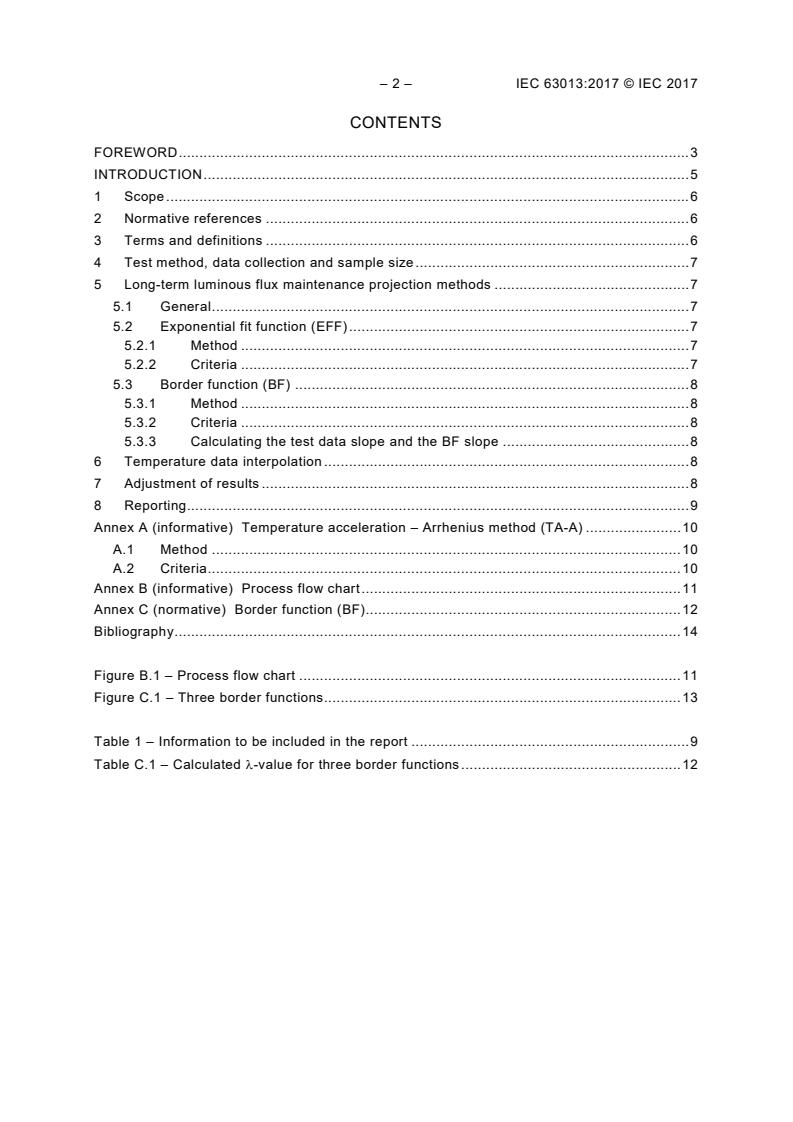
IEC 63013:2017 - LED packages - Long-term luminous and radiant flux maintenance projection Released:6/27/2017

IEC 63013:2017+AMD1:2021 CSV - LED packages - Long-term luminous and radiant flux maintenance projection Released:10/26/2021
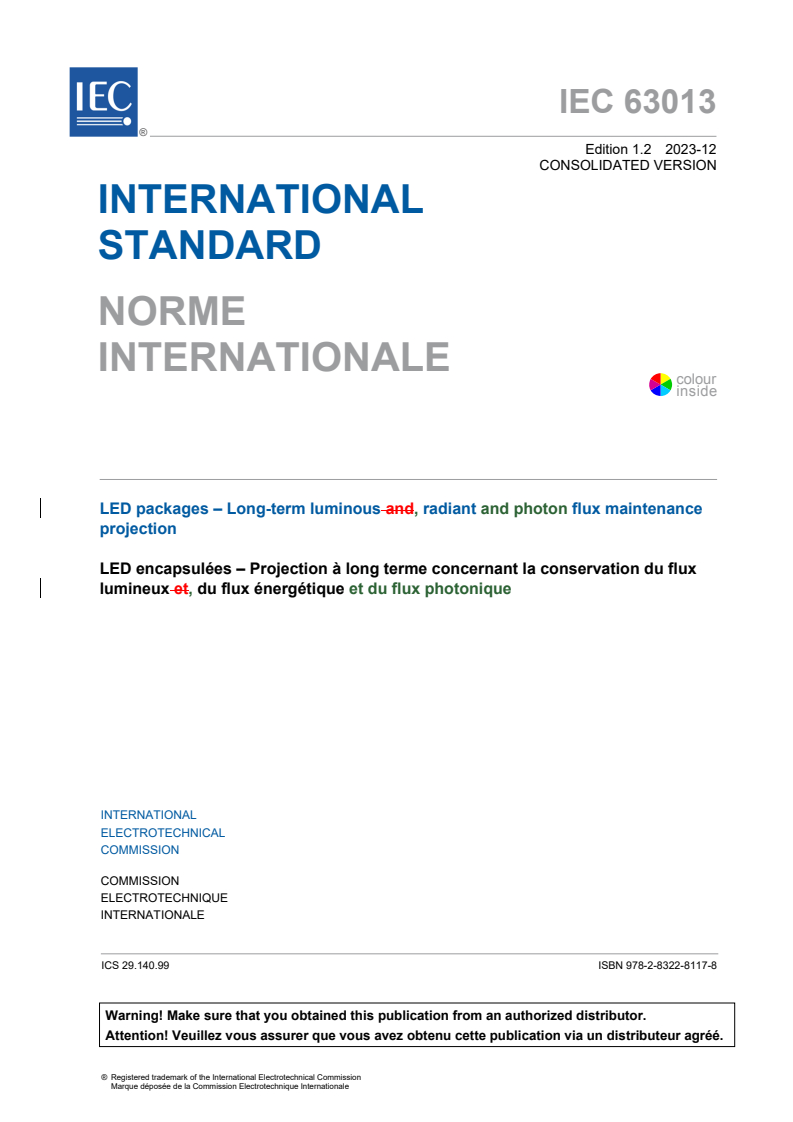

IEC 63013:2017+AMD1:2021+AMD2:2023 CSV - LED packages - Long-term luminous, radiant and photon flux maintenance Released:19. 12. 2023
Overview
IEC 63013:2017 is an international standard developed by the International Electrotechnical Commission (IEC) that focuses on the long-term luminous and radiant flux maintenance projection of LED packages. This standard is specifically applicable to LED packages used for general lighting purposes, including horticultural lighting, and excludes LED packages for automotive road vehicles.
The standard defines standardized procedures and conditions for measuring luminous flux maintenance, as well as methods for projecting long-term flux maintenance based on short-term test data. Importantly, where luminous flux data is specified, equivalent procedures apply to radiant and photon flux measurements. IEC 63013 aims to provide manufacturers, testing laboratories, and end-users with reliable and repeatable methods to assess the durability and performance of LED packages over time.
Key Topics
Scope and Application
Applicable to LED packages suitable for general and horticultural lighting, IEC 63013 excludes road vehicle LED packages. It covers luminous flux maintenance testing and projection methods based on test data derived from industry-recognized procedures like ANSI/IES LM-80.Measurement Procedures
The standard details standardized testing methods for obtaining luminous flux maintenance data, which could also be substituted or supplemented by radiant or photon flux measurements.Projection Methods
IEC 63013 specifies two primary projection techniques to estimate the long-term luminous flux maintenance from limited test data:- Exponential Fit Function (EFF): Based on the TM-21 method widely accepted in the lighting industry to project LED lumen maintenance.
- Border Function (BF): An alternative to EFF used when the TM-21 method is not applicable.
Temperature Effects and Acceleration
Recognizing the impact of temperature on LED performance, the standard includes temperature data interpolation methods and an informative annex discussing the Arrhenius temperature acceleration model to account for temperature-dependent degradation.Reporting and Documentation
IEC 63013 outlines essential reporting requirements to ensure transparency and consistency, including test conditions, sample sizes, and data analysis details.
Applications
IEC 63013:2017 serves a critical role across several sectors within the LED lighting industry:
LED Package Manufacturers
Enables manufacturers to estimate the long-term performance of their LED packages reliably, supporting product development, quality control, and marketing claims regarding product lifespan.Testing Laboratories
Provides standardized procedures to ensure credible, repeatable testing of LED packages' luminous flux maintenance, facilitating certification and compliance testing services.Lighting Product Designers and Specifiers
Assists lighting designers and specifiers in selecting LED packages with predictable long-term luminous performance, crucial for building efficient and reliable lighting systems.Horticultural Lighting Industry
Offers methods to evaluate LED packages designed for plant growth applications, where maintaining consistent photon flux is vital for crop yield and quality.Regulatory and Certification Bodies
Assists in setting compliance benchmarks for LED package performance claims, promoting consumer confidence and market transparency.
Related Standards
IEC 63013 references and complements several other important standards and documents within the LED lighting and testing ecosystem:
ANSI/IES LM-80 (Latest: LM-80-20): Approved method for measuring luminous flux and color maintenance of LED packages, arrays, and modules – serves as the foundational test procedure data source.
ANSI/IES TM-21 (Latest: TM-21-21): Method for projecting long-term lumen, photon, and radiant flux maintenance of LED light sources – forms the basis for the exponential fit function projection method in IEC 63013.
IEC 62504: Defines terms and definitions related to LED products and equipment, ensuring consistent terminology across LED standards.
Other IEC and IES Publications: Supporting documents and technical reports that provide reference methods, definitions, and models applicable in LED flux measurement and projection.
Conclusion
IEC 63013:2017 is an essential standard that fills a critical gap in LED lighting technology by offering reliable and internationally accepted methods for projecting long-term luminous, radiant, and photon flux maintenance of LED packages. This enables stakeholders across the lighting industry to make informed decisions based on standardized performance metrics, promoting product quality, longevity, and customer satisfaction.
Keywords: IEC 63013, LED packages, luminous flux maintenance, radiant flux, photon flux, TM-21 method, LED lifetime projection, general lighting, horticultural lighting, LED testing standards, ANSI/IES LM-80, LED performance, LED degradation, long-term LED reliability.
Relations
- Effective Date
- 05-Sep-2023
- Effective Date
- 05-Sep-2023
Buy Documents
IEC 63013:2017 - LED packages - Long-term luminous and radiant flux maintenance projection Released:6/27/2017
IEC 63013:2017+AMD1:2021 CSV - LED packages - Long-term luminous and radiant flux maintenance projection Released:10/26/2021
IEC 63013:2017+AMD1:2021+AMD2:2023 CSV - LED packages - Long-term luminous, radiant and photon flux maintenance Released:19. 12. 2023
Get Certified
Connect with accredited certification bodies for this standard

IMQ S.p.A. (Certification)
Italian electrical product certification.

SLG Prüf- und Zertifizierungs GmbH
German testing and certification body.

UL Solutions
Global safety science company with testing, inspection and certification.
Sponsored listings
Frequently Asked Questions
IEC 63013:2017 is a standard published by the International Electrotechnical Commission (IEC). Its full title is "LED packages - Long-term luminous and radiant flux maintenance projection". This standard covers: IEC 63013:2017 is applicable to LED packages for general lighting services. It specifies procedures and conditions for measuring the luminous flux maintenance of LED packages. It also provides the procedures and conditions (criteria) of projecting the long-term luminous flux maintenance based on limited luminous flux maintenance test data collected. Within the context of this document, wherever luminous flux measurement data is specified, radiant flux measurement data can also be used.
IEC 63013:2017 is applicable to LED packages for general lighting services. It specifies procedures and conditions for measuring the luminous flux maintenance of LED packages. It also provides the procedures and conditions (criteria) of projecting the long-term luminous flux maintenance based on limited luminous flux maintenance test data collected. Within the context of this document, wherever luminous flux measurement data is specified, radiant flux measurement data can also be used.
IEC 63013:2017 is classified under the following ICS (International Classification for Standards) categories: 29.060.10 - Wires; 29.140.99 - Other standards related to lamps. The ICS classification helps identify the subject area and facilitates finding related standards.
IEC 63013:2017 has the following relationships with other standards: It is inter standard links to IEC 63013:2017/AMD2:2023, IEC 63013:2017/AMD1:2021. Understanding these relationships helps ensure you are using the most current and applicable version of the standard.
IEC 63013:2017 is available in PDF format for immediate download after purchase. The document can be added to your cart and obtained through the secure checkout process. Digital delivery ensures instant access to the complete standard document.
Standards Content (Sample)
IEC 63013 ®
Edition 1.0 2017-06
INTERNATIONAL
STANDARD
NORME
INTERNATIONALE
LED packages – Long-term luminous and radiant flux maintenance projection
LED encapsulées – Projection à long terme concernant la conservation du flux
lumineux et du flux énergétique
All rights reserved. Unless otherwise specified, no part of this publication may be reproduced or utilized in any form
or by any means, electronic or mechanical, including photocopying and microfilm, without permission in writing from
either IEC or IEC's member National Committee in the country of the requester. If you have any questions about IEC
copyright or have an enquiry about obtaining additional rights to this publication, please contact the address below or
your local IEC member National Committee for further information.
Droits de reproduction réservés. Sauf indication contraire, aucune partie de cette publication ne peut être reproduite
ni utilisée sous quelque forme que ce soit et par aucun procédé, électronique ou mécanique, y compris la photocopie
et les microfilms, sans l'accord écrit de l'IEC ou du Comité national de l'IEC du pays du demandeur. Si vous avez des
questions sur le copyright de l'IEC ou si vous désirez obtenir des droits supplémentaires sur cette publication, utilisez
les coordonnées ci-après ou contactez le Comité national de l'IEC de votre pays de résidence.
IEC Central Office Tel.: +41 22 919 02 11
3, rue de Varembé Fax: +41 22 919 03 00
CH-1211 Geneva 20 info@iec.ch
Switzerland www.iec.ch
About the IEC
The International Electrotechnical Commission (IEC) is the leading global organization that prepares and publishes
International Standards for all electrical, electronic and related technologies.
About IEC publications
The technical content of IEC publications is kept under constant review by the IEC. Please make sure that you have the
latest edition, a corrigenda or an amendment might have been published.
IEC Catalogue - webstore.iec.ch/catalogue Electropedia - www.electropedia.org
The stand-alone application for consulting the entire The world's leading online dictionary of electronic and
bibliographical information on IEC International Standards, electrical terms containing 20 000 terms and definitions in
Technical Specifications, Technical Reports and other English and French, with equivalent terms in 16 additional
documents. Available for PC, Mac OS, Android Tablets and languages. Also known as the International Electrotechnical
iPad. Vocabulary (IEV) online.
IEC publications search - www.iec.ch/searchpub IEC Glossary - std.iec.ch/glossary
The advanced search enables to find IEC publications by a 65 000 electrotechnical terminology entries in English and
variety of criteria (reference number, text, technical French extracted from the Terms and Definitions clause of
committee,…). It also gives information on projects, replaced IEC publications issued since 2002. Some entries have been
and withdrawn publications. collected from earlier publications of IEC TC 37, 77, 86 and
CISPR.
IEC Just Published - webstore.iec.ch/justpublished
Stay up to date on all new IEC publications. Just Published IEC Customer Service Centre - webstore.iec.ch/csc
details all new publications released. Available online and If you wish to give us your feedback on this publication or
also once a month by email. need further assistance, please contact the Customer Service
Centre: csc@iec.ch.
A propos de l'IEC
La Commission Electrotechnique Internationale (IEC) est la première organisation mondiale qui élabore et publie des
Normes internationales pour tout ce qui a trait à l'électricité, à l'électronique et aux technologies apparentées.
A propos des publications IEC
Le contenu technique des publications IEC est constamment revu. Veuillez vous assurer que vous possédez l’édition la
plus récente, un corrigendum ou amendement peut avoir été publié.
Catalogue IEC - webstore.iec.ch/catalogue Electropedia - www.electropedia.org
Application autonome pour consulter tous les renseignements
Le premier dictionnaire en ligne de termes électroniques et
bibliographiques sur les Normes internationales,
électriques. Il contient 20 000 termes et définitions en anglais
Spécifications techniques, Rapports techniques et autres
et en français, ainsi que les termes équivalents dans 16
documents de l'IEC. Disponible pour PC, Mac OS, tablettes
langues additionnelles. Egalement appelé Vocabulaire
Android et iPad.
Electrotechnique International (IEV) en ligne.
Recherche de publications IEC - www.iec.ch/searchpub
Glossaire IEC - std.iec.ch/glossary
65 000 entrées terminologiques électrotechniques, en anglais
La recherche avancée permet de trouver des publications IEC
en utilisant différents critères (numéro de référence, texte, et en français, extraites des articles Termes et Définitions des
comité d’études,…). Elle donne aussi des informations sur les publications IEC parues depuis 2002. Plus certaines entrées
projets et les publications remplacées ou retirées. antérieures extraites des publications des CE 37, 77, 86 et
CISPR de l'IEC.
IEC Just Published - webstore.iec.ch/justpublished
Service Clients - webstore.iec.ch/csc
Restez informé sur les nouvelles publications IEC. Just
Published détaille les nouvelles publications parues. Si vous désirez nous donner des commentaires sur cette
Disponible en ligne et aussi une fois par mois par email. publication ou si vous avez des questions contactez-nous:
csc@iec.ch.
IEC 63013 ®
Edition 1.0 2017-06
INTERNATIONAL
STANDARD
NORME
INTERNATIONALE
LED packages – Long-term luminous and radiant flux maintenance projection
LED encapsulées – Projection à long terme concernant la conservation du flux
lumineux et du flux énergétique
INTERNATIONAL
ELECTROTECHNICAL
COMMISSION
COMMISSION
ELECTROTECHNIQUE
INTERNATIONALE
ICS 29.140.99 ISBN 978-2-8322-4487-6
– 2 – IEC 63013:2017 © IEC 2017
CONTENTS
FOREWORD . 3
INTRODUCTION . 5
1 Scope . 6
2 Normative references . 6
3 Terms and definitions . 6
4 Test method, data collection and sample size . 7
5 Long-term luminous flux maintenance projection methods . 7
5.1 General . 7
5.2 Exponential fit function (EFF) . 7
5.2.1 Method . 7
5.2.2 Criteria . 7
5.3 Border function (BF) . 8
5.3.1 Method . 8
5.3.2 Criteria . 8
5.3.3 Calculating the test data slope and the BF slope . 8
6 Temperature data interpolation . 8
7 Adjustment of results . 8
8 Reporting. 9
Annex A (informative) Temperature acceleration – Arrhenius method (TA-A) . 10
A.1 Method . 10
A.2 Criteria . 10
Annex B (informative) Process flow chart . 11
Annex C (normative) Border function (BF) . 12
Bibliography . 14
Figure B.1 – Process flow chart . 11
Figure C.1 – Three border functions . 13
Table 1 – Information to be included in the report . 9
Table C.1 – Calculated λ-value for three border functions . 12
INTERNATIONAL ELECTROTECHNICAL COMMISSION
____________
LED PACKAGES – LONG-TERM LUMINOUS
AND RADIANT FLUX MAINTENANCE PROJECTION
FOREWORD
1) The International Electrotechnical Commission (IEC) is a worldwide organization for standardization comprising
all national electrotechnical committees (IEC National Committees). The object of IEC is to promote
international co-operation on all questions concerning standardization in the electrical and electronic fields. To
this end and in addition to other activities, IEC publishes International Standards, Technical Specifications,
Technical Reports, Publicly Available Specifications (PAS) and Guides (hereafter referred to as “IEC
Publication(s)”). Their preparation is entrusted to technical committees; any IEC National Committee interested
in the subject dealt with may participate in this preparatory work. International, governmental and non-
governmental organizations liaising with the IEC also participate in this preparation. IEC collaborates closely
with the International Organization for Standardization (ISO) in accordance with conditions determined by
agreement between the two organizations.
2) The formal decisions or agreements of IEC on technical matters express, as nearly as possible, an international
consensus of opinion on the relevant subjects since each technical committee has representation from all
interested IEC National Committees.
3) IEC Publications have the form of recommendations for international use and are accepted by IEC National
Committees in that sense. While all reasonable efforts are made to ensure that the technical content of IEC
Publications is accurate, IEC cannot be held responsible for the way in which they are used or for any
misinterpretation by any end user.
4) In order to promote international uniformity, IEC National Committees undertake to apply IEC Publications
transparently to the maximum extent possible in their national and regional publications. Any divergence
between any IEC Publication and the corresponding national or regional publication shall be clearly indicated in
the latter.
5) IEC itself does not provide any attestation of conformity. Independent certification bodies provide conformity
assessment services and, in some areas, access to IEC marks of conformity. IEC is not responsible for any
services carried out by independent certification bodies.
6) All users should ensure that they have the latest edition of this publication.
7) No liability shall attach to IEC or its directors, employees, servants or agents including individual experts and
members of its technical committees and IEC National Committees for any personal injury, property damage or
other damage of any nature whatsoever, whether direct or indirect, or for costs (including legal fees) and
expenses arising out of the publication, use of, or reliance upon, this IEC Publication or any other IEC
Publications.
8) Attention is drawn to the Normative references cited in this publication. Use of the referenced publications is
indispensable for the correct application of this publication.
9) Attention is drawn to the possibility that some of the elements of this IEC Publication may be the subject of
patent rights. IEC shall not be held responsible for identifying any or all such patent rights.
International Standard IEC 63013 has been prepared by subcommittee 34A: Lamps, of IEC
technical committee 34: Lamps and related equipment.
The text of this International Standard is based on the following documents:
FDIS Report on voting
34A/2008/FDIS 34A/2015/RVD
Full information on the voting for the approval of this International Standard can be found in
the report on voting indicated in the above table.
This document has been drafted in accordance with the ISO/IEC Directives, Part 2.
– 4 – IEC 63013:2017 © IEC 2017
The committee has decided that the contents of this document will remain unchanged until the
stability date indicated on the IEC website under "http://webstore.iec.ch" in the data related to
the specific document. At this date, the document will be
• reconfirmed,
• withdrawn,
• replaced by a revised edition, or
• amended.
INTRODUCTION
One of the benefits of LED lighting is their long lifetime compared to that of many other light
source technologies.
However, there is currently no international standard for predicting the long-term luminous flux
maintenance of LED packages. This document is intended to close this gap by specifying
methods for the long-term luminous flux maintenance projection.
This document is the result of the discussions led by a special expert group within IEC
technical committee 34 on this topic.
This expert group had collected a set of luminous flux maintenance measurements of 39 LED
package types, each tested at three different temperatures.
Various projection methods were analysed based on this set of test data.
Regarding the selection of models, there was a controversial discussion among the experts
and no unanimous agreement could be found.
It was concluded at the meeting in Berlin on 21 January 2014 to choose the TM-21 method as
the starting point of the analysis and to have the border function as an alternative in case the
TM-21 method was not applicable. It was further concluded that the Arrhenius temperature
acceleration should be included in an informative annex.
At the meeting on 26 January 2015 in Washington some further editorial improvements were
made and it was agreed to submit this document to IEC as a new project with a view to
developing a full international standard.
This new project was approved and all comments received during the enquiry stage were
discussed by the project team and resolved. This document incorporates the changes agreed
by the project team.
– 6 – IEC 63013:2017 © IEC 2017
LED PACKAGES – LONG-TERM LUMINOUS
AND RADIANT FLUX MAINTENANCE PROJECTION
1 Scope
This document is applicable to LED packages for general lighting services.
It specifies procedures and conditions for measuring the luminous flux maintenance of LED
packages. It also provides the procedures and conditions (criteria) of projecting the long-term
luminous flux maintenance based on limited luminous flux maintenance test data collected.
Within the context of this document, wherever luminous flux measurement data is specified,
radiant flux measurement data can also be used.
These projection methods employ data collected as per ANSI/IES LM-80-15 (LM-80).
The long-term projection is based on the exponential-fit-function procedure of IES TM-21-11
(TM-21), and gives an alternative border function procedure in the case where the
exponential-fit-function of IES TM-21-11 is not applicable.
2 Normative references
The following documents are referred to in the text in such a way that some or all of their
content constitutes requirements of this document. For dated references, only the edition
cited applies. For undated references, the latest edition of the referenced document (including
any amendments) applies.
IEC 62504, General lighting – Light emitting diode (LED) products and related equipment –
Terms and definitions
IES TM-21-11, Projecting Long Term Lumen Maintenance of LED Light Sources
IES LM-80-08 , IES Approved Method for Measuring Lumen Maintenance of LED Light
Sources
ANSI/IES LM-80-15, IES Approved Method: Measuring Luminous Flux and Color Maintenance
of LED Packages, Arrays and Modules
3 Terms and definitions
For the purposes of this document, the terms and definitions given in IEC 62504 and the
following apply.
ISO and IEC maintain terminological databases for use in standardization at the following
addresses:
• IEC Electropedia: available at http://www.electropedia.org/
• ISO Online browsing platform: available at http://www.iso.org/obp
__________
Withdrawn. This edition was replaced in 2015 by IES LM-80-15, IES Approved Method: Measuring Luminous
Flux and Color Maintenance of LED Packages, Arrays and Modules.
3.1
case temperature
temperature value of the thermocouple attachment point as specified by the manufacturer
4 Test method, data collection and sample size
Luminous flux maintenance test data shall be collected according to the methods described in
ANSI/IES LM-80-15. Test data collected according to IES LM-80-08 shall be acceptable.
When collecting data for long-term luminous flux maintenance projection, it is recommended
to use intervals smaller than 1 000 h for the measurement of the luminous flux and to perform
measurements beyond 6 000 h.
Recommendations on sample size are found in IES TM-21-11.
5 Long-term luminous flux maintenance projection methods
5.1 General
The following projection methods are included in this document:
• Exponential fit function (EFF)
• Border function (BF)
The EFF method shall be used as the primary method, with the BF method used as an
alternative only when the EFF calculation yields a negative or zero α−value, see Annex B
(Flowchart).
If at least one temperature data set leads to the application of the BF method (α ≤ 0), then all
temperature data sets of the same LED package shall be evaluated with the BF method.
Annex A describes a temperature acceleration method according to the temperature
acceleration Arrhenius (TA-A) formula.
5.2 Exponential fit function (EFF)
5.2.1 Method
The exponential fit function method (EFF), as described in IES TM-21-11, is based on the
assumption that after early luminous flux degradation modes are complete, the subsequent
test data can be fitted and extrapolated using an exponential curve-fit function, using the
formula
f (t) = B exp(−αt) (1)
The luminous flux maintenance projection shall be performed according to IES TM-21-11,
Section 5.
5.2.2 Criteria
The EFF method shall be applied only to data sets showing normal degradation with α > 0, a
“downward” projection. In cases where the data fit yields an EFF with α ≤ 0, a “flat or upward”
projection, then the BF method shall be applied.
– 8 – IEC 63013:2017 © IEC 2017
5.3 Border function (BF)
5.3.1 Method
The border function (BF) method is based on the assumption that an exponential model is a
conservative estimation of the actual long-term luminous flux maintenance, and is applied
when the criteria of 5.2.2 have met.
The border function shall be calculated according to Annex C.
Each border function has an associated life and luminous flux maintenance target value.
The associated life target is considered to be a median life and shall be a multiple of 5 000 h
and the luminous flux maintenance target shall be 70 %, 80 % or 90 %.
5.3.2 Criteria
If
• the tested luminous flux value is greater than the value calculated as per the border
function for at least the last 2 000 h of the test, and is supported by at least 3 successive
measurements points, and
• the value of the slope of the test data for the last 2 000 h of the test is greater than the
corresponding value of the slope of the border function for the same time period (for the
calculation of the slopes see 5.3.3),
then the associated median life and luminous flux maintenance target value of the BF may be
used as the projected median life L for the tested LED package.
x
5.3.3 Calculating the test data slope and the BF slope
Calculate the slope of the test data for the last 2 000 h by making a linear fit to all averaged
test points in that time period. At least 3 successive measurement points shall be applied. The
regression coefficient of the linear fit shall be reported.
The corresponding slope of the BF for the last 2 000 h is approximated by the formula
BFslope = -λ exp(-λ (t -1 000 h)) (2)
end
where t is the time of the last test point.
end
6 Temperature data interpolation
If temperature interpolation is employed, then it shall be performed according to the Arrhenius
formula in IES TM-21-11, Clause 6.
NOTE Additional information on the Arrhenius method can be found in IEC 62506.
Temperature interpolation is limited to the temperature range between the tested
temperatures.
7 Adjustment of results
The results of 5.2 and 5.3 shall be adjusted according to IES TM-21-11, 5.2.5.
8 Reporting
The report of the luminous flux maintenance projection shall include the following information
shown in Table 1. Only L and L values adjusted as per Clause 7 shall be reported,
70 xx
according to the notation in IES TM-21-11, 5.2.6.
Table 1 – Information to be included in the report
Description of LED package tested (manufacturer, model, catalogue number)
Sample size
Number of failures during testing period
Forward current(s) used in the test mA
Maintenance test duration h
Case temperature(s) during testing
°C
Projection method used
(including values of mathematical fit parameters)
Test duration used for projection as per IES TM-21-11 h to h
Reported L (Dk) (e.g. 85 °C, tested) h
xx
Reported L (Dk) (e.g. 95 °C, interpolated) h
xx
Reported L (Dk) (e.g. 105 °C, tested) h
xx
– 10 – IEC 63013:2017 © IEC 2017
Annex A
(informative)
Temperature acceleration – Arrhenius method (TA-A)
A.1 Method
The Arrhenius method is based on the basic assumption that the ageing (degradation)
mechanism can be accelerated by raising the case temperature and that the activation energy
E can be used to describe this acceleration behaviour. The basic equations describing this
a
model are that the luminous flux degrades according to a function f(t,ρ) with degradation
parameter ρ depending on temperature T as follows
(A.1)
ρ(T ) = K exp(−E /k T )
a B
The activation energy E and two measured points at time and temperature conditions (τ ,T )
a 1 1
and (τ ,T ) where light degradation to a luminous flux maintenance factor is observed can be
2 2
used to describe an acceleration factor according to the formula
τ E 1 1
1 a
AF = = exp × − (A.2)
T
τ k T T
2 B 1 2
where
AF is the acceleration factor due to temperature differences;
T
E is the activation energy in eV;
a
k is the Boltzmann constant in eV/K;
B
τ , τ are the times with τ > τ in h;
1 2 1 2
T , T are the temperatures with T < T in K.
1 2 1 2
The Arrhenius luminous flux maintenance projection should be performed according to
IEC 62506:2013, 5.6.1.2.
A.2 Criteria
The following criteria are applicable:
– The activation energy E should be known for application of the Arrhenius model. The LED
a
package manufacturer estimates the activation energies for the relevant degradation
modes each time they qualify a new component technology. The activation energy should
be in the range 0,1 eV < E < 1,0 eV.
a
– There should be no evidence for positive degradation, i.e. no “upward” projection in the
data set.
– For each temperature in the data set, higher temperatures should show more rapid
degradation.
– The TA-A method should not be used if evidence exists that the temperature acceleration
has caused a change in degradation mode.
– If there is evidence for more than one significant degradation mode, then the TA-A method
should be applied to each degradation mode separately. For example, if the data set
shows a significant change in degradation rate, i.e. mode 1 completed and mode 2
continued onward, then the acceleration factor determined for mode 1 should only be
applied to mode 1 and not to mode 2 or any future degradation modes.
Annex B
(informative)
Process flow chart
Figure B.1 outlines the process described in this document.
LM-80 test data
Clause 4
EFF (IES TM-21-11)
Subclause 5.2.1
Cr
...
IEC 63013 ®
Edition 1.1 2021-10
CONSOLIDATED VERSION
INTERNATIONAL
STANDARD
NORME
INTERNATIONALE
colour
inside
LED packages – Long-term luminous and radiant flux maintenance projection
LED encapsulées – Projection à long terme concernant la conservation du flux
lumineux et du flux énergétique
All rights reserved. Unless otherwise specified, no part of this publication may be reproduced or utilized in any form
or by any means, electronic or mechanical, including photocopying and microfilm, without permission in writing from
either IEC or IEC's member National Committee in the country of the requester. If you have any questions about IEC
copyright or have an enquiry about obtaining additional rights to this publication, please contact the address below or
your local IEC member National Committee for further information.
Droits de reproduction réservés. Sauf indication contraire, aucune partie de cette publication ne peut être reproduite
ni utilisée sous quelque forme que ce soit et par aucun procédé, électronique ou mécanique, y compris la photocopie
et les microfilms, sans l'accord écrit de l'IEC ou du Comité national de l'IEC du pays du demandeur. Si vous avez des
questions sur le copyright de l'IEC ou si vous désirez obtenir des droits supplémentaires sur cette publication, utilisez
les coordonnées ci-après ou contactez le Comité national de l'IEC de votre pays de résidence.
IEC Central Office Tel.: +41 22 919 02 11
3, rue de Varembé info@iec.ch
CH-1211 Geneva 20 www.iec.ch
Switzerland
About the IEC
The International Electrotechnical Commission (IEC) is the leading global organization that prepares and publishes
International Standards for all electrical, electronic and related technologies.
About IEC publications
The technical content of IEC publications is kept under constant review by the IEC. Please make sure that you have the
latest edition, a corrigendum or an amendment might have been published.
IEC publications search - webstore.iec.ch/advsearchform IEC online collection - oc.iec.ch
The advanced search enables to find IEC publications by a Discover our powerful search engine and read freely all the
variety of criteria (reference number, text, technical publications previews. With a subscription you will always
committee, …). It also gives information on projects, replaced have access to up to date content tailored to your needs.
and withdrawn publications.
Electropedia - www.electropedia.org
IEC Just Published - webstore.iec.ch/justpublished
The world's leading online dictionary on electrotechnology,
Stay up to date on all new IEC publications. Just Published
containing more than 22 000 terminological entries in English
details all new publications released. Available online and
and French, with equivalent terms in 18 additional languages.
once a month by email.
Also known as the International Electrotechnical Vocabulary
(IEV) online.
IEC Customer Service Centre - webstore.iec.ch/csc
If you wish to give us your feedback on this publication or
need further assistance, please contact the Customer Service
Centre: sales@iec.ch.
A propos de l'IEC
La Commission Electrotechnique Internationale (IEC) est la première organisation mondiale qui élabore et publie des
Normes internationales pour tout ce qui a trait à l'électricité, à l'électronique et aux technologies apparentées.
A propos des publications IEC
Le contenu technique des publications IEC est constamment revu. Veuillez vous assurer que vous possédez l’édition la
plus récente, un corrigendum ou amendement peut avoir été publié.
Recherche de publications IEC - IEC online collection - oc.iec.ch
webstore.iec.ch/advsearchform Découvrez notre puissant moteur de recherche et consultez
La recherche avancée permet de trouver des publications IEC gratuitement tous les aperçus des publications. Avec un
en utilisant différents critères (numéro de référence, texte, abonnement, vous aurez toujours accès à un contenu à jour
comité d’études, …). Elle donne aussi des informations sur adapté à vos besoins.
les projets et les publications remplacées ou retirées.
Electropedia - www.electropedia.org
IEC Just Published - webstore.iec.ch/justpublished
Le premier dictionnaire d'électrotechnologie en ligne au
Restez informé sur les nouvelles publications IEC. Just
monde, avec plus de 22 000 articles terminologiques en
Published détaille les nouvelles publications parues.
anglais et en français, ainsi que les termes équivalents dans
Disponible en ligne et une fois par mois par email.
16 langues additionnelles. Egalement appelé Vocabulaire
Electrotechnique International (IEV) en ligne.
Service Clients - webstore.iec.ch/csc
Si vous désirez nous donner des commentaires sur cette
publication ou si vous avez des questions contactez-nous:
sales@iec.ch.
IEC 63013 ®
Edition 1.1 2021-10
CONSOLIDATED VERSION
INTERNATIONAL
STANDARD
NORME
INTERNATIONALE
colour
inside
LED packages – Long-term luminous and radiant flux maintenance projection
LED encapsulées – Projection à long terme concernant la conservation du flux
lumineux et du flux énergétique
INTERNATIONAL
ELECTROTECHNICAL
COMMISSION
COMMISSION
ELECTROTECHNIQUE
INTERNATIONALE
ICS 29.140.99 ISBN 978-2-8322-5475-2
IEC 63013 ®
Edition 1.1 2021-10
CONSOLIDATED VERSION
REDLINE VERSION
VERSION REDLINE
colour
inside
LED packages – Long-term luminous and radiant flux maintenance projection
LED encapsulées – Projection à long terme concernant la conservation du flux
lumineux et du flux énergétique
– 2 – IEC 63013:2017+AMD1:2021 CSV
© IEC 2021
CONTENTS
FOREWORD . 3
INTRODUCTION . 5
1 Scope . 6
2 Normative references . 6
3 Terms and definitions . 6
4 Test method, data collection and sample size . 7
5 Long-term luminous flux maintenance projection methods . 7
5.1 General . 7
5.2 Exponential fit function (EFF) . 7
5.2.1 Method . 7
5.2.2 Criteria . 8
5.3 Border function (BF) . 8
5.3.1 Method . 8
5.3.2 Criteria . 8
5.3.3 Calculating the test data slope and the BF slope . 8
6 Temperature data interpolation . 8
7 Adjustment of results . 9
8 Reporting. 9
Annex A (informative) Temperature acceleration – Arrhenius method (TA-A) . 10
A.1 Method . 10
A.2 Criteria . 10
Annex B (informative) Process flow chart . 11
Annex C (normative) Border function (BF) . 13
Bibliography . 15
Figure B.1 – Process flow chart . 12
Figure C.1 – Three border functions . 14
Table 1 – Information to be included in the report . 9
Table C.1 – Calculated λ-value for three border functions . 13
© IEC 2021
INTERNATIONAL ELECTROTECHNICAL COMMISSION
____________
LED PACKAGES – LONG-TERM LUMINOUS
AND RADIANT FLUX MAINTENANCE PROJECTION
FOREWORD
1) The International Electrotechnical Commission (IEC) is a worldwide organization for standardization comprising
all national electrotechnical committees (IEC National Committees). The object of IEC is to promote
international co-operation on all questions concerning standardization in the electrical and electronic fields. To
this end and in addition to other activities, IEC publishes International Standards, Technical Specifications,
Technical Reports, Publicly Available Specifications (PAS) and Guides (hereafter referred to as “IEC
Publication(s)”). Their preparation is entrusted to technical committees; any IEC National Committee interested
in the subject dealt with may participate in this preparatory work. International, governmental and non-
governmental organizations liaising with the IEC also participate in this preparation. IEC collaborates closely
with the International Organization for Standardization (ISO) in accordance with conditions determined by
agreement between the two organizations.
2) The formal decisions or agreements of IEC on technical matters express, as nearly as possible, an international
consensus of opinion on the relevant subjects since each technical committee has representation from all
interested IEC National Committees.
3) IEC Publications have the form of recommendations for international use and are accepted by IEC National
Committees in that sense. While all reasonable efforts are made to ensure that the technical content of IEC
Publications is accurate, IEC cannot be held responsible for the way in which they are used or for any
misinterpretation by any end user.
4) In order to promote international uniformity, IEC National Committees undertake to apply IEC Publications
transparently to the maximum extent possible in their national and regional publications. Any divergence
between any IEC Publication and the corresponding national or regional publication shall be clearly indicated in
the latter.
5) IEC itself does not provide any attestation of conformity. Independent certification bodies provide conformity
assessment services and, in some areas, access to IEC marks of conformity. IEC is not responsible for any
services carried out by independent certification bodies.
6) All users should ensure that they have the latest edition of this publication.
7) No liability shall attach to IEC or its directors, employees, servants or agents including individual experts and
members of its technical committees and IEC National Committees for any personal injury, property damage or
other damage of any nature whatsoever, whether direct or indirect, or for costs (including legal fees) and
expenses arising out of the publication, use of, or reliance upon, this IEC Publication or any other IEC
Publications.
8) Attention is drawn to the Normative references cited in this publication. Use of the referenced publications is
indispensable for the correct application of this publication.
9) Attention is drawn to the possibility that some of the elements of this IEC Publication may be the subject of
patent rights. IEC shall not be held responsible for identifying any or all such patent rights.
This consolidated version of the official IEC Standard and its amendment has been
prepared for user convenience.
IEC 63013 edition 1.1 contains the first edition (2017-06) [documents 34A/2008/FDIS and
34A/2015/RVD] and its amendment 1 (2021-10) [documents 34A/2233(F)/CDV and
34A/2253/RVC].
In this Redline version, a vertical line in the margin shows where the technical content
is modified by amendment 1. Additions are in green text, deletions are in strikethrough
red text. A separate Final version with all changes accepted is available in this
publication.
– 4 – IEC 63013:2017+AMD1:2021 CSV
© IEC 2021
International Standard IEC 63013 has been prepared by subcommittee 34A: Lamps, of IEC
technical committee 34: Lamps and related equipment.
This document has been drafted in accordance with the ISO/IEC Directives, Part 2.
The committee has decided that the contents of the base publication and its amendment will
remain unchanged until the stability date indicated on the IEC web site under webstore.iec.ch
in the data related to the specific publication. At this date, the publication will be
• reconfirmed,
• withdrawn,
• replaced by a revised edition, or
• amended.
IMPORTANT – The 'colour inside' logo on the cover page of this publication indicates
that it contains colours which are considered to be useful for the correct
understanding of its contents. Users should therefore print this document using a
colour printer.
© IEC 2021
INTRODUCTION
One of the benefits of LED lighting is their long lifetime compared to that of many other light
source technologies.
However, there is currently no international standard for predicting the long-term luminous flux
maintenance of LED packages. This document is intended to close this gap by specifying
methods for the long-term luminous flux maintenance projection.
This document is the result of the discussions led by a special expert group within IEC
technical committee 34 on this topic.
This expert group had collected a set of luminous flux maintenance measurements of 39 LED
package types, each tested at three different temperatures.
Various projection methods were analysed based on this set of test data.
Regarding the selection of models, there was a controversial discussion among the experts
and no unanimous agreement could be found.
It was concluded at the meeting in Berlin on 21 January 2014 to choose the TM-21 method as
the starting point of the analysis and to have the border function as an alternative in case the
TM-21 method was not applicable. It was further concluded that the Arrhenius temperature
acceleration should be included in an informative annex.
At the meeting on 26 January 2015 in Washington some further editorial improvements were
made and it was agreed to submit this document to IEC as a new project with a view to
developing a full international standard.
This new project was approved and all comments received during the enquiry stage were
discussed by the project team and resolved. This document incorporates the changes agreed
by the project team.
– 6 – IEC 63013:2017+AMD1:2021 CSV
© IEC 2021
LED PACKAGES – LONG-TERM LUMINOUS
AND RADIANT FLUX MAINTENANCE PROJECTION
1 Scope
This document is applicable to LED packages for general lighting services and LED packages
for horticultural lighting.
It specifies procedures and conditions for measuring the luminous flux maintenance of LED
packages. It also provides the procedures and conditions (criteria) of projecting the long-term
luminous flux maintenance based on limited luminous flux maintenance test data collected.
Within the context of this document, wherever luminous flux measurement data is specified,
radiant flux measurement data and photon flux measurement data can also be used.
These projection methods employ data collected as per ANSI/IES LM-80-15
ANSI/IES LM-80-20 (LM-80).
The long-term projection is based on the exponential-fit-function procedure of IES TM-21-11
ANSI/IES TM-21-19 (TM-21) and gives an alternative border function procedure in the case
where the exponential-fit-function of IES TM-21-11 ANSI/IES TM-21-19 is not applicable.
2 Normative references
The following documents are referred to in the text in such a way that some or all of their
content constitutes requirements of this document. For dated references, only the edition
cited applies. For undated references, the latest edition of the referenced document (including
any amendments) applies.
IEC 62504, General lighting – Light emitting diode (LED) products and related equipment –
Terms and definitions
IES TM-21-11, Projecting Long Term Lumen Maintenance of LED Light Sources
IES LM-80-08 , IES Approved Method for Measuring Lumen Maintenance of LED Light
Sources
ANSI/IES LM-80-15, IES Approved Method: Measuring Luminous Flux and Color Maintenance
of LED Packages, Arrays and Modules
ANSI/IES TM-21-19 , Technical Memorandum: Projecting Long Term Lumen, Photon, and
Radiant Flux Maintenance of LED Light Sources
ANSI/IES LM-80-20, Approved Method: Measuring Luminous Flux and Color Maintenance of
LED Packages, Arrays, and Modules
__________
Withdrawn. This edition was replaced in 2015 by IES LM-80-15, IES Approved Method: Measuring Luminous
Flux and Color Maintenance of LED Packages, Arrays and Modules.
A revision of ANSI/IES TM-21-19, and a new ANSI approved IES calculation tool are under preparation by the
Illuminating Engineering Society. Publication of ANSI/IES TM-21-21 and the ANSI/IES TM-21-21 Calculator are
expected prior to 2021-12-31.
© IEC 2021
3 Terms and definitions
For the purposes of this document, the terms and definitions given in IEC 62504 and the
following apply.
ISO and IEC maintain terminological databases for use in standardization at the following
addresses:
• IEC Electropedia: available at http://www.electropedia.org/
• ISO Online browsing platform: available at http://www.iso.org/obp
3.1
case temperature
temperature value of the thermocouple attachment point as specified by the manufacturer
4 Test method, data collection and sample size
Luminous flux maintenance test data shall be collected according to the methods described in
ANSI/IES LM-80-15 ANSI/IES LM-80-20. Test data collected according to IES LM-80-08 shall
be acceptable.
When collecting data for long-term luminous flux maintenance projection, it is recommended
to use intervals smaller than 1 000 h for the measurement of the luminous flux and to perform
measurements beyond 6 000 h.
Recommendations on sample size are found in IES TM-21-11 ANSI/IES TM-21-19.
5 Long-term luminous flux maintenance projection methods
5.1 General
The following projection methods are included in this document:
• Exponential fit function (EFF)
• Border function (BF)
The EFF method shall be used as the primary method, with the BF method used as an
alternative only when the EFF calculation yields a negative or zero α−value, see Annex B
(Flowchart).
If at least one temperature data set leads to the application of the BF method (α ≤ 0), then all
temperature data sets of the same LED package shall be evaluated with the BF method.
Annex A describes a temperature acceleration method according to the temperature
acceleration Arrhenius (TA-A) formula.
5.2 Exponential fit function (EFF)
5.2.1 Method
The exponential fit function method (EFF), as described in IES TM-21-11 ANSI/IES TM-21-19,
is based on the assumption that after early luminous flux degradation modes are complete,
the subsequent test data can be fitted and extrapolated using an exponential curve-fit function,
using the formula
f (t) = B exp(−αt) (1)
– 8 – IEC 63013:2017+AMD1:2021 CSV
© IEC 2021
f (t) = B exp(−αt) (1)
The luminous flux maintenance projection shall be performed according to IES TM-21-11
ANSI/IES TM-21-19, Section 5.
5.2.2 Criteria
The EFF method shall be applied only to data sets showing normal degradation with α > 0, a
“downward” projection. In cases where the data fit yields an EFF with α ≤ 0, a “flat or upward”
projection, then the BF method shall be applied.
5.3 Border function (BF)
5.3.1 Method
The border function (BF) method is based on the assumption that an exponential model is a
conservative estimation of the actual long-term luminous flux maintenance, and is applied
when the criteria of 5.2.2 have met.
The border function shall be calculated according to Annex C.
Each border function has an associated life and luminous flux maintenance target value.
The associated life target is considered to be a median life and shall be a multiple of 5 000 h
and the luminous flux maintenance target shall be 70 %, 80 % or 90 %.
5.3.2 Criteria
If
• the tested luminous flux value is greater than the value calculated as per the border
function for at least the last 2 000 h of the test, and is supported by at least 3 successive
measurements points, and
• the value of the slope of the test data for the last 2 000 h of the test is greater than the
corresponding value of the slope of the border function for the same time period (for the
calculation of the slopes see 5.3.3),
then the associated median life and luminous flux maintenance target value of the BF may be
used as the projected median life L for the tested LED package.
x
5.3.3 Calculating the test data slope and the BF slope
Calculate the slope of the test data for the last 2 000 h by making a linear fit to all averaged
test points in that time period. At least 3 successive measurement points shall be applied. The
regression coefficient of the linear fit shall be reported.
The corresponding slope of the BF for the last 2 000 h is approximated by the formula
BFslope = -λ exp(-λ (t -1 000 h)) (2)
end
where t is the time of the last test point.
end
6 Temperature data interpolation
If temperature interpolation is employed, then it shall be performed according to the Arrhenius
formula in IES TM-21-11, Clause 6 ANSI/IES TM-21-19, Section 6.
© IEC 2021
NOTE Additional information on the Arrhenius method can be found in IEC 62506.
Temperature interpolation is limited to the temperature range between the tested
temperatures.
7 Adjustment of results
The results of 5.2 and 5.3 shall be adjusted according to IES TM-21-11 ANSI/IES TM-21-19,
5.2.5.
8 Reporting
The report of the luminous flux maintenance projection shall include the following information
shown in Table 1. Only L and L values adjusted as per Clause 7 shall be reported,
70 xx
according to the notation in IES TM-21-11 ANSI/IES TM-21-19, 5.2.6.
Table 1 – Information to be included in the report
Description of LED package tested (manufacturer, model, catalogue number)
Sample size
Number of failures during testing period
Forward current(s) used in the test mA
Maintenance test duration h
Case temperature(s) during testing °C
Projection method used
(including values of mathematical fit parameters)
Test duration used for projection as per IES TM-21-11 ANSI/IES TM-21-19 h to h
Reported L (Dk) (e.g. 85 °C, tested) h
xx
Reported L (Dk) (e.g. 95 °C, interpolated) h
xx
h
Reported L (Dk) (e.g. 105 °C, tested)
xx
– 10 – IEC 63013:2017+AMD1:2021 CSV
© IEC 2021
Annex A
(informative)
Temperature acceleration – Arrhenius method (TA-A)
A.1 Method
The Arrhenius method is based on the basic assumption that the ageing (degradation)
mechanism can be accelerated by raising the case temperature and that the activation energy
E can be used to describe this acceleration behaviour. The basic equations describing this
a
model are that the luminous flux degrades according to a function f(t,ρ) with degradation
parameter ρ depending on temperature T as follows
ρ(T ) = K exp(−E / k T ) (A.1)
a B
The activation energy E and two measured points at time and temperature conditions (τ ,T )
a 1 1
and (τ ,T ) where light degradation to a luminous flux maintenance factor is observed can be
2 2
used to describe an acceleration factor according to the formula
τ E 1 1
1 a
AF = = exp × − (A.2)
T
τ k T T
2 B 1 2
where
AF is the acceleration factor due to temperature differences;
T
E is the activation energy in eV;
a
k is the Boltzmann constant in eV/K;
B
τ , τ are the times with τ > τ in h;
1 2 1 2
T , T are the temperatures with T < T in K.
1 2 1 2
The Arrhenius luminous flux maintenance projection should be performed according to
IEC 62506:2013, 5.6.1.2.
A.2 Criteria
The following criteria are applicable:
– The activation energy E should be known for application of the Arrhenius model. The LED
a
package manufacturer estimates the activation energies for the relevant degradation
modes each time they qualify a new component technology. The activation energy should
< 1,0 eV.
be in the range 0,1 eV < E
a
– There should be no evidence for positive degradation, i.e. no “upward” projection in the
data set.
– For each temperature in the data set, higher temperatures should show more rapid
degradation.
– The TA-A method should not be used if evidence exists that the temperature acceleration
has caused a change in degradation mode.
– If there is evidence for more than one significant degradation mode, then the TA-A method
should be applied to each degradation mode separately. For example, if the data set
shows a significant change in degradation rate, i.e. mode 1 completed and mode 2
continued onward, then the acceleration factor determined for mode 1 should only be
applied to mode 1 and not to mode 2 or any future degradation modes.
© IEC 2021
Annex B
(informative)
Process flow chart
Figure B.1 outlines the process described in this document.
LM-80 test data
Clause 4
EFF (IES TM-21-11)
Subclause 5.2.1
Criteria
α ≤ 0 Border function
Subclause
Subclause 5.3
5.2.2
α > 0
Temperature
Interpolation
Clause 6
Adjustment
Clause 7
Reporting
Clause 8
IEC
– 12 – IEC 63013:2017+AMD1:2021 CSV
© IEC 2021
Figure B.1 – Process flow chart
© IEC 2021
Annex C
(normative)
Border function (BF)
A border function B(t) shall be defined using the formula
B(t) = exp(-λt) (C.1)
where
λ is the exponential coefficient;
t is the time in hours.
Setting t = L and B(L ) = x/100 and solving this equation for λ gives the parameter for use in
x x
the border function equation.
Example:
Using 70 % as a target for the luminous flux maintenance projection, the following values for
the exponential coefficient λ are calculated, see Table C.1.
Table C.1 – Calculated λ-value for three border functions
Luminous flux maintenance L [h] 25 000 35 000 50 000
-5 -5 -6
Corresponding value of λ [1/h] 1,43 ×10 1,02×10 7,13×10
Other values for λ can be calculated for other target L values and for other L targets.
70 x
Figure C.1 shows the three border functions given in Table C.1.
– 14 – IEC 63013:2017+AMD1:2021 CSV
© IEC 2021
L 25 000 h
L 35 000 h
0,9
L 50 000 h
0,8
0,7
0,6
0,5
0 5 000 10 000 15 000 20 000 25 000 30 000 35 000 40 000 45 000 50 000 55 000
Time (h)
IEC
Figure C.1 – Three border functions
Lumen maintenance
© IEC 2021
Bibliography
IEC 62506:2013, Methods for product accelerated testing
___________
– 16 – IEC 63013:2017+AMD1:2021 CSV
© IEC 2021
SOMMAIRE
AVANT-PROPOS . 17
INTRODUCTION . 19
1 Domaine d'application . 20
2 Références normatives . 20
3 Termes et définitions . 20
4 Méthode d'essai, recueils des données et effectif d'échantillon . 21
5 Méthodes de projection concernant la conservation du flux lumineux à long terme . 21
5.1 Généralités . 21
5.2 Fonction d'approximation exponentielle (EFF) . 22
5.2.1 Méthode . 22
5.2.2 Critères . 22
5.3 Fonction enveloppe (BF) . 22
5.3.1 Méthode . 22
5.3.2 Critères . 22
5.3.3 Calcul de la pente des données d'essai et de la pente de la BF . 23
6 Interpolation des données de températures . 23
7 Ajustement des résultats . 23
8 Rapport . 23
Annexe A (informative) Accélération en température – Méthode d'Arrhenius (TA-A) . 24
A.1 Méthode. 24
A.2 Critères . 24
Annexe B (informative) Organigramme de processus . 26
Annexe C (normative) Fonction enveloppe (BF) . 28
Bibliographie . 30
Figure B.1 – Organigramme de processus . 27
Figure C.1 – Trois fonctions enveloppes . 29
Tableau 1 – Informations devant figurer dans le rapport. 23
Tableau C.1 – Valeur λ calculée pour trois fonctions enveloppes . 28
© IEC 2021
COMMISSION ÉLECTROTECHNIQUE INTERNATIONALE
____________
LED ENCAPSULÉES – PROJECTION À LONG TERME CONCERNANT
LA CONSERVATION DU FLUX LUMINEUX ET DU FLUX ÉNERGÉTIQUE
AVANT-PROPOS
1) La Commission Electrotechnique Internationale (IEC) est une organisation mondiale de normalisation
composée de l'ensemble des comités électrotechniques nationaux (Comités nationaux de l’IEC). L’IEC a pour
objet de favoriser la coopération internationale pour toutes les questions de normalisation dans les domaines
de l'électricité et de l'électronique. A cet effet, l’IEC – entre autres activités – publie des Normes internationales,
des Spécifications techniques, des Rapports techniques, des Spécifications accessibles au public (PAS) et des
Guides (ci-après dénommés "Publication(s) de l’IEC"). Leur élaboration est confiée à des comités d'études, aux
travaux desquels tout Comité national intéressé par le sujet traité peut participer. Les organisations
internationales, gouvernementales et non gouvernementales, en liaison avec l’IEC, participent également aux
travaux. L’IEC collabore étroitement avec l'Organisation Internationale de Normalisation (ISO), selon des
conditions fixées par accord entre les deux organisations.
2) Les décisions ou accords officiels de l’IEC concernant les questions techniques représentent, dans la mesure
du possible, un accord international sur les sujets étudiés, étant donné que les Comités nationaux de l’IEC
intéressés sont représentés dans chaque comité d’études.
3) Les Publications de l’IEC se présentent sous la forme de recommandations internationales et sont agréées
comme telles par les Comités nationaux de l’IEC. Tous les efforts raisonnables sont entrepris afin que l’IEC
s'assure de l'exactitude du contenu technique de ses publications; l’IEC ne peut pas être tenue responsable de
l'éventuelle mauvaise utilisation ou interprétation qui en est faite par un quelconque utilisateur final.
4) Dans le but d'encourager l'uniformité internationale, les Comités nationaux de l’IEC s'engagent, dans toute la
mesure possible, à appliquer de façon transparente les Publications de l’IEC dans leurs publications nationales
et régionales. Toutes divergences entre toutes Publications de l’IEC et toutes publications nationales ou
régionales correspondantes doivent être indiquées en termes clairs dans ces dernières.
5) L’IEC elle-même ne fournit aucune attestation de conformité. Des organismes de certification indépendants
fournissent des services d'évaluation de conformité et, dans certains secteurs, accèdent aux marques de
conformité de l’IEC. L’IEC n'est responsable d'aucun des services effectués par les organismes de certification
indépendants.
6) Tous les utilisateurs doivent s'assurer qu'ils sont en possession de la dernière édition de cette publication.
7) Aucune responsabilité ne doit être imputée à l’IEC, à ses administrateurs, employés, auxiliaires ou mandataires,
y compris ses experts particuliers et les membres de ses comités d'études et des Comités nationaux de l’IEC,
pour tout préjudice causé en cas de dommages corporels et matériels, ou de tout autre dommage de quelque
nature que ce soit, directe ou indirecte, ou pour supporter les coûts (y compris les frais de justice) et les
dépenses découlant de la publication ou de l'utilisation de cette Publication de l’IEC ou de toute autre
Publication de l’IEC, ou au crédit qui lui est accordé.
8) L'attention est attirée sur les références normatives citées dans cette publication. L'utilisation de publications
référencées est obligatoire pour une application correcte de la présente publication.
9) L’attention est attirée sur le fait que certains des éléments de la présente Publication de l’IEC peuvent faire
l’objet de droits de brevet. L’IEC ne saurait être tenue pour responsable de ne pas avoir identifié de tels droits
de brevets et de ne pas avoir signalé leur existence.
Cette version consolidée de la Norme IEC officielle et de son amendement a été
préparée pour la commodité de l'utilisateur.
L’IEC 63013 édition 1.1 contient la première édition (2017-06) [documents
34A/2008/FDIS et 34A/2015/RVD] et son amendement 1 (2021-10) [documents
34A/2233(F)/CDV et 34A/2253/RVC].
Dans cette version Redline, une ligne verticale dans la marge indique où le contenu
technique est modifié par l'amendement 1. Les ajouts sont en vert, les suppressions
sont en rouge, barrées. Une version Finale avec toutes les modifications acceptées est
disponible dans cette publication.
– 18 – IEC 63013:2017+AMD1:2021 CSV
© IEC 2021
La Norme internationale IEC 63013 a été établie par le sous-comité 34A: Lampes, du comité
d'études 34 de l’IEC: Lampes et équipements associés.
Ce document a été rédigé selon les Directives ISO/IEC, Partie 2.
Le comité a décidé que le contenu de la publication de base et de son amendement ne sera
pas modifié avant la date de stabilité indiquée sur le site web de l’IEC sous webstore.iec.ch
dans les données relatives à la publication recherchée. A cette date, la publication sera
• reconduite,
• supprimée,
• remplacée par une édition révisée, ou
• amendée.
IMPORTANT – Le logo "colour inside" qui se trouve sur la page de couverture de cette
publication indique qu'elle contient des couleurs qui sont considérées comme utiles à
une bonne compréhension de son contenu. Les utilisateurs devraient, par conséquent,
imprimer cette publication en utilisant une imprimante couleur.
© IEC 2021
INTRODUCTION
L'un des avantages de l'éclairage LED réside dans leur durée de vie plus longue comparée à
celle de nombreuses autres technologies de sources lumineuses.
Toutefois, il n'existe actuellement aucune norme internationale destinée à prévoir la
conservation du flux lumineux à long terme des LED encapsulées. Le présent document est
destiné à combler cette lacune en spécifiant des méthodes de projection concernant la
conservation du flux lumineux à long terme.
Ce document résulte de discussions d'un groupe spécial d'experts au sein du comité
d'études 34 de l'IEC sur ce thème.
Ce groupe d'experts a collecté un ensemble de mesures de la conservation du flux lumineux
de 39 types de LED encapsulées, chacune d'entre elles étant soumise à essai avec trois
températures différentes.
Plusieurs méthodes de projection ont été analysées en se fondant sur cet ensemble de
données d'essais.
Le choix des modèles a donné lieu à une controverse lors des discussions des experts et
aucun accord unanime n'a pu être obtenu.
Il a été conclu, lors de la réunion qui s'est tenue à Berlin le 21 janvier 2014 de choisir la
méthode TM-21 comme point de départ de l'analyse et d'utiliser, comme alternative, la
fonction enveloppe dans le cas où la méthode TM-21 ne serait pas applicable. Il a en outre
été conclu qu'il convenait d'inclure l'accélération en température (loi d'Arrhenius) dans une
annexe informative.
Lors de la réunion du 26 janvier 2015 à Washington, de nouvelles améliorations d'ordre
rédactionnel ont été effectuées et il a été convenu de soumettre ce document à l'IEC en tant
que nouveau projet, en vue d'élaborer une norme internationale pleinement reconnue.
Ce nouveau projet a été approuvé et tous les commentaires reçus pendant le stade enquête
ont fait l'objet de discussions au sein de l'équipe de projet et ils ont été traités. Ce document
incorpore les modifications convenues par l'équipe de projet.
– 20 – IEC 63013:2017+AMD1:2021 CSV
© IEC 2021
LED ENCAPSULÉES – PROJECTION À LONG TERME CONCERNANT
LA CONSERVATION DU FLUX LUMINEUX ET DU FLUX ÉNERGÉTIQUE
1 Domaine d'application
Le présent document est applicable aux LED encapsulées d'utilisation courante et aux LED
encapsulées destinées à l'éclairage horticole.
Elle Il spécifie les procédures et les conditions pour mesurer la conservation du flux lumineux
des LED encapsulées. Elle Il stipule également les procédures et les conditions (critères) de
projection de la conservation du flux lumineux à long terme en se fondant sur des données
d'essais collectées de la conservation du flux lumineux limitée. Dans le contexte du présent
document, chaque fois que sont spécifiées des données de mesure du flux lumineux, des les
données de mesure du flux énergétique et les données de mesure du flux photonique peuvent
également être utilisées.
Ces méthodes de projection emploient des données collectées selon l'ANSI/IES LM-80-15
ANSI/IES LM-80-20 (LM-80).
La projection à long terme repose sur la procédure de la fonction d'approximation
exponentielle de l'IES TM-21-11 ANSI/IES TM-21-19 (TM-21), et elle donne, en variante, une
procédure de la fonction enveloppe, dans le cas où la fonction d'approximation exponentielle
de l'IES TM-21-11 ANSI/IES TM-21-19 n'est pas applicable.
2 Références normatives
Les documents suivants cités dans le texte constituent, pour tout ou partie de leur contenu,
des exigences du présent document. Pour les références datées, seule l’édition citée
s’applique. Pour les références non datées, la dernière édition du document de référence
s'applique (y compris les éventuels amendements).
IEC 62504, Éclairage général – Produits à diode électroluminescente (LED) et équipements
associés – Termes et définitions
IES TM-21-11, Projecting Long Term Lumen Maintenance of LED Light Sources (disponible
en anglais seulement)
IES LM-80-08 , IES Approved Method for Measuring Lumen Maintenance of LED Light
Sources (disponible en anglais seulement)
ANSI/IES LM-80-15, Approved Method: Measuring Luminous Flux and Color Maintenance of
LED Packages, Arrays and Modules (disponible en anglais seulement)
ANSI/IES TM-21-19 , Technical Memorandum: Projecting Long Term Lumen, Photon, and
Radiant Flux Maintenance of LED Light Sources (disponible en anglais seulement)
__________
Supprimée. IES LM-80-08 a été remplacée en 2015 par l'IES LM-80-15, Approved Method: Measuring Luminous
Flux and Color Maintenance of LED Packages, Arrays and Modules.
Une révision de l’ANSI/IES TM-21-19, et un nouvel outil de calcul IES approuvé par l'ANSI sont en cours
d’élaboration par l'Illuminating Engineering Society. La publication de l’ANSI/IES TM-21-21 et le calculateur
ANSI/IES TM-21-21 sont prévus avant le 2021-12-31.
© IEC 2021
ANSI/IES LM-80-20, Approved Method: Measuring Luminous Flux and Color Maintenance of
LED Packages, Arrays, and Modules (disponible en anglais seulement)
3 Termes et définitions
Pour les besoins du présent document, les termes et définitions donnés dans l'IEC 62504
s'appliquent.
L'ISO et l'IEC tiennent à jour des bases de données terminologiques destinées à être utilisées
en normalisation, consultables aux adresses suivantes:
• IEC Electropedia: disponible à l'adresse http://www.electropedia.org/
• ISO Online browsing platform: disponible à l'adresse http://www.iso.org/obp
3.1
température du boîtier
température du point de fixation des couples thermoélectriques sur la LED encapsulée, telle
que spécifiée par le fabricant du boîtier
4 Méthode d'essai, recueils des données et effectif d'échantillon
Les données d'essai relatives à la conservation du flux lumineux doivent être collectées
conformément aux méthodes décrites dans l'ANSI/IES LM-80-15 ANSI/IES LM-80-20. Les
données d'essai collectées selon l'IES LM-80-08 doivent être considérées comme
acceptables.
Lorsque sont collectées des données de la projection à long terme concernant la conse
...
IEC 63013 ®
Edition 1.2 2023-12
CONSOLIDATED VERSION
INTERNATIONAL
STANDARD
NORME
INTERNATIONALE
colour
inside
LED packages – Long-term luminous and, radiant and photon flux maintenance
projection
LED encapsulées – Projection à long terme concernant la conservation du flux
lumineux et, du flux énergétique et du flux photonique
All rights reserved. Unless otherwise specified, no part of this publication may be reproduced or utilized in any form
or by any means, electronic or mechanical, including photocopying and microfilm, without permission in writing from
either IEC or IEC's member National Committee in the country of the requester. If you have any questions about IEC
copyright or have an enquiry about obtaining additional rights to this publication, please contact the address below or
your local IEC member National Committee for further information.
Droits de reproduction réservés. Sauf indication contraire, aucune partie de cette publication ne peut être reproduite ni
utilisée sous quelque forme que ce soit et par aucun procédé, électronique ou mécanique, y compris la photocopie et
les microfilms, sans l'accord écrit de l'IEC ou du Comité national de l'IEC du pays du demandeur. Si vous avez des
questions sur le copyright de l'IEC ou si vous désirez obtenir des droits supplémentaires sur cette publication, utilisez
les coordonnées ci-après ou contactez le Comité national de l'IEC de votre pays de résidence.
IEC Secretariat Tel.: +41 22 919 02 11
3, rue de Varembé info@iec.ch
CH-1211 Geneva 20 www.iec.ch
Switzerland
About the IEC
The International Electrotechnical Commission (IEC) is the leading global organization that prepares and publishes
International Standards for all electrical, electronic and related technologies.
About IEC publications
The technical content of IEC publications is kept under constant review by the IEC. Please make sure that you have the
latest edition, a corrigendum or an amendment might have been published.
IEC publications search - webstore.iec.ch/advsearchform IEC Products & Services Portal - products.iec.ch
The advanced search enables to find IEC publications by a Discover our powerful search engine and read freely all the
variety of criteria (reference number, text, technical publications previews. With a subscription you will always have
committee, …). It also gives information on projects, replaced access to up to date content tailored to your needs.
and withdrawn publications.
Electropedia - www.electropedia.org
IEC Just Published - webstore.iec.ch/justpublished
The world's leading online dictionary on electrotechnology,
Stay up to date on all new IEC publications. Just Published
containing more than 22 300 terminological entries in English
details all new publications released. Available online and once
and French, with equivalent terms in 19 additional languages.
a month by email.
Also known as the International Electrotechnical Vocabulary
(IEV) online.
IEC Customer Service Centre - webstore.iec.ch/csc
If you wish to give us your feedback on this publication or need
further assistance, please contact the Customer Service
Centre: sales@iec.ch.
A propos de l'IEC
La Commission Electrotechnique Internationale (IEC) est la première organisation mondiale qui élabore et publie des
Normes internationales pour tout ce qui a trait à l'électricité, à l'électronique et aux technologies apparentées.
A propos des publications IEC
Le contenu technique des publications IEC est constamment revu. Veuillez vous assurer que vous possédez l’édition la
plus récente, un corrigendum ou amendement peut avoir été publié.
Recherche de publications IEC - Découvrez notre puissant moteur de recherche et consultez
webstore.iec.ch/advsearchform gratuitement tous les aperçus des publications. Avec un
La recherche avancée permet de trouver des publications IEC abonnement, vous aurez toujours accès à un contenu à jour
en utilisant différents critères (numéro de référence, texte, adapté à vos besoins.
comité d’études, …). Elle donne aussi des informations sur les
projets et les publications remplacées ou retirées. Electropedia - www.electropedia.org
Le premier dictionnaire d'électrotechnologie en ligne au monde,
IEC Just Published - webstore.iec.ch/justpublished
avec plus de 22 300 articles terminologiques en anglais et en
Restez informé sur les nouvelles publications IEC. Just
français, ainsi que les termes équivalents dans 19 langues
Published détaille les nouvelles publications parues.
additionnelles. Egalement appelé Vocabulaire
Disponible en ligne et une fois par mois par email.
Electrotechnique International (IEV) en ligne.
Service Clients - webstore.iec.ch/csc
Si vous désirez nous donner des commentaires sur cette
publication ou si vous avez des questions contactez-nous:
sales@iec.ch.
IEC Products & Services Portal - products.iec.ch
IEC 63013 ®
Edition 1.2 2023-12
CONSOLIDATED VERSION
INTERNATIONAL
STANDARD
NORME
INTERNATIONALE
colour
inside
LED packages – Long-term luminous and, radiant and photon flux maintenance
projection
LED encapsulées – Projection à long terme concernant la conservation du flux
lumineux et, du flux énergétique et du flux photonique
INTERNATIONAL
ELECTROTECHNICAL
COMMISSION
COMMISSION
ELECTROTECHNIQUE
INTERNATIONALE
ICS 29.140.99 ISBN 978-2-8322-8117-8
IEC 63013 ®
Edition 1.2 2023-12
CONSOLIDATED VERSION
REDLINE VERSION
VERSION REDLINE
colour
inside
LED packages – Long-term luminous and, radiant and photon flux maintenance
projection
LED encapsulées – Projection à long terme concernant la conservation du flux
lumineux et, du flux énergétique et du flux photonique
– 2 – IEC 63013:2017+AMD1:2021
+AMD2:2023 CSV © IEC 2023
CONTENTS
FOREWORD . 3
INTRODUCTION . 5
1 Scope . 6
2 Normative references . 6
3 Terms and definitions . 6
4 Test method, data collection and sample size . 7
5 Long-term luminous flux maintenance projection methods . 7
5.1 General . 7
5.2 Exponential fit function (EFF) . 7
5.2.1 Method . 7
5.2.2 Criteria . 8
5.3 Border function (BF) . 8
5.3.1 Method . 8
5.3.2 Criteria . 8
5.3.3 Calculating the test data slope and the BF slope . 8
6 Temperature data interpolation . 8
7 Adjustment of results . 9
8 Reporting. 9
Annex A (informative) Temperature acceleration – Arrhenius method (TA-A) . 10
A.1 Method . 10
A.2 Criteria . 10
Annex B (informative) Process flow chart . 11
Annex C (normative) Border function (BF) . 13
Bibliography . 15
Figure B.1 – Process flow chart . 12
Figure C.1 – Three border functions . 14
Table 1 – Information to be included in the report . 9
Table C.1 – Calculated λ-value for three border functions . 13
+AMD2:2023 CSV © IEC 2023
INTERNATIONAL ELECTROTECHNICAL COMMISSION
____________
LED PACKAGES – LONG-TERM LUMINOUS
AND, RADIANT AND PHOTON FLUX MAINTENANCE PROJECTION
FOREWORD
1) The International Electrotechnical Commission (IEC) is a worldwide organization for standardization comprising
all national electrotechnical committees (IEC National Committees). The object of IEC is to promote
international co-operation on all questions concerning standardization in the electrical and electronic fields. To
this end and in addition to other activities, IEC publishes International Standards, Technical Specifications,
Technical Reports, Publicly Available Specifications (PAS) and Guides (hereafter referred to as “IEC
Publication(s)”). Their preparation is entrusted to technical committees; any IEC National Committee interested
in the subject dealt with may participate in this preparatory work. International, governmental and non-
governmental organizations liaising with the IEC also participate in this preparation. IEC collaborates closely
with the International Organization for Standardization (ISO) in accordance with conditions determined by
agreement between the two organizations.
2) The formal decisions or agreements of IEC on technical matters express, as nearly as possible, an international
consensus of opinion on the relevant subjects since each technical committee has representation from all
interested IEC National Committees.
3) IEC Publications have the form of recommendations for international use and are accepted by IEC National
Committees in that sense. While all reasonable efforts are made to ensure that the technical content of IEC
Publications is accurate, IEC cannot be held responsible for the way in which they are used or for any
misinterpretation by any end user.
4) In order to promote international uniformity, IEC National Committees undertake to apply IEC Publications
transparently to the maximum extent possible in their national and regional publications. Any divergence
between any IEC Publication and the corresponding national or regional publication shall be clearly indicated in
the latter.
5) IEC itself does not provide any attestation of conformity. Independent certification bodies provide conformity
assessment services and, in some areas, access to IEC marks of conformity. IEC is not responsible for any
services carried out by independent certification bodies.
6) All users should ensure that they have the latest edition of this publication.
7) No liability shall attach to IEC or its directors, employees, servants or agents including individual experts and
members of its technical committees and IEC National Committees for any personal injury, property damage or
other damage of any nature whatsoever, whether direct or indirect, or for costs (including legal fees) and
expenses arising out of the publication, use of, or reliance upon, this IEC Publication or any other IEC
Publications.
8) Attention is drawn to the Normative references cited in this publication. Use of the referenced publications is
indispensable for the correct application of this publication.
9) Attention is drawn to the possibility that some of the elements of this IEC Publication may be the subject of
patent rights. IEC shall not be held responsible for identifying any or all such patent rights.
This consolidated version of the official IEC Standard and its amendments has been
prepared for user convenience.
IEC 63013 edition 1.2 contains the first edition (2017-06) [documents 34A/2008/FDIS and
34A/2015/RVD], its amendment 1 (2021-10) [documents 34A/2233(F)/CDV and
34A/2253/RVC] and its amendment 2 (2023-12) [documents 34A/2350/CDV and
34A/2374/RVC].
In this Redline version, a vertical line in the margin shows where the technical content
is modified by amendments 1 and 2. Additions are in green text, deletions are in
strikethrough red text. A separate Final version with all changes accepted is available
in this publication.
– 4 – IEC 63013:2017+AMD1:2021
+AMD2:2023 CSV © IEC 2023
International Standard IEC 63013 has been prepared by subcommittee 34A: Lamps, of IEC
technical committee 34: Lamps and related equipment.
This document has been drafted in accordance with the ISO/IEC Directives, Part 2.
The committee has decided that the contents of this document and its amendments will
remain unchanged until the stability date indicated on the IEC website under webstore.iec.ch
in the data related to the specific document. At this date, the document will be
• reconfirmed,
• withdrawn, or
• revised.
IMPORTANT – The 'colour inside' logo on the cover page of this publication indicates
that it contains colours which are considered to be useful for the correct
understanding of its contents. Users should therefore print this document using a
colour printer.
+AMD2:2023 CSV © IEC 2023
INTRODUCTION
One of the benefits of LED lighting is their long lifetime compared to that of many other light
source technologies.
However, there is currently no international standard for predicting the long-term luminous flux
maintenance of LED packages. This document is intended to close this gap by specifying
methods for the long-term luminous flux maintenance projection.
This document is the result of the discussions led by a special expert group within IEC
technical committee 34 on this topic.
This expert group had collected a set of luminous flux maintenance measurements of 39 LED
package types, each tested at three different temperatures.
Various projection methods were analysed based on this set of test data.
Regarding the selection of models, there was a controversial discussion among the experts
and no unanimous agreement could be found.
It was concluded at the meeting in Berlin on 21 January 2014 to choose the TM-21 method as
the starting point of the analysis and to have the border function as an alternative in case the
TM-21 method was not applicable. It was further concluded that the Arrhenius temperature
acceleration should be included in an informative annex.
At the meeting on 26 January 2015 in Washington some further editorial improvements were
made and it was agreed to submit this document to IEC as a new project with a view to
developing a full international standard.
This new project was approved and all comments received during the enquiry stage were
discussed by the project team and resolved. This document incorporates the changes agreed
by the project team.
– 6 – IEC 63013:2017+AMD1:2021
+AMD2:2023 CSV © IEC 2023
LED PACKAGES – LONG-TERM LUMINOUS
AND, RADIANT AND PHOTON FLUX MAINTENANCE PROJECTION
1 Scope
This document is applicable to LED packages for general lighting services and LED packages
for horticultural lighting.
It This document specifies procedures and conditions for measuring the luminous flux
maintenance of LED packages, except LED packages for road vehicles. It also provides the
procedures and conditions (criteria) of projecting the long-term luminous flux maintenance
based on limited luminous flux maintenance test data collected. Within the context of this
document, wherever luminous flux measurement data is specified, radiant flux measurement
data and photon flux measurement data can also be used.
NOTE Applicability of this document covers, for example, LED packages for illumination purposes, LED packages
for horticultural purposes or LED packages for germicidal disinfection purposes.
These projection methods employ data collected as per ANSI/IES LM-80-15
ANSI/IES LM-80-20 (LM-80).
The long-term projection is based on the exponential-fit-function procedure of IES TM-21-11
(TM-21) ANSI/IES TM-21-21 and gives an alternative border function procedure in the case
where the exponential-fit-function of IES TM-21-11 ANSI/IES TM-21-21 is not applicable.
2 Normative references
The following documents are referred to in the text in such a way that some or all of their
content constitutes requirements of this document. For dated references, only the edition
cited applies. For undated references, the latest edition of the referenced document (including
any amendments) applies.
IEC 62504, General lighting – Light emitting diode (LED) products and related equipment –
Terms and definitions
IES TM-21-11, Projecting Long Term Lumen Maintenance of LED Light Sources
IES LM-80-08 , IES Approved Method for Measuring Lumen Maintenance of LED Light
Sources
ANSI/IES LM-80-15, IES Approved Method: Measuring Luminous Flux and Color Maintenance
of LED Packages, Arrays and Modules
ANSI/IES TM-21-21, Projecting Long-Term Lumen, Photon, and Radiant Flux Maintenance of
LED Light Sources
ANSI/IES LM-80-20, Approved Method: Measuring Luminous Flux and Color Maintenance of
LED Packages, Arrays, and Modules
__________
Withdrawn. This edition was replaced in 2015 by IES LM-80-15, IES Approved Method: Measuring Luminous
Flux and Color Maintenance of LED Packages, Arrays and Modules.
+AMD2:2023 CSV © IEC 2023
3 Terms and definitions
For the purposes of this document, the terms and definitions given in IEC 62504 and the
following apply.
ISO and IEC maintain terminological databases for use in standardization at the following
addresses:
• IEC Electropedia: available at http://www.electropedia.org/
• ISO Online browsing platform: available at http://www.iso.org/obp
3.1
case temperature
temperature value of the thermocouple attachment point as specified by the manufacturer
4 Test method, data collection and sample size
Luminous flux maintenance test data shall be collected according to the methods described in
ANSI/IES LM-80-15 ANSI/IES LM-80-20. Test data collected according to IES LM-80-08 shall
be acceptable.
When collecting data for long-term luminous flux maintenance projection, it is recommended
to use intervals smaller than 1 000 h for the measurement of the luminous flux and to perform
measurements beyond 6 000 h.
Recommendations on sample size are found in IES TM-21-11 ANSI/IES TM-21-21.
5 Long-term luminous flux maintenance projection methods
5.1 General
The following projection methods are included in this document:
• Exponential fit function (EFF)
• Border function (BF)
The EFF method shall be used as the primary method, with the BF method used as an
alternative only when the EFF calculation yields a negative or zero α−value, see Annex B
(Flowchart).
If at least one temperature data set leads to the application of the BF method (α ≤ 0), then all
temperature data sets of the same LED package shall be evaluated with the BF method.
Annex A describes a temperature acceleration method according to the temperature
acceleration Arrhenius (TA-A) formula.
5.2 Exponential fit function (EFF)
5.2.1 Method
The exponential fit function method (EFF), as described in IES TM-21-11 ANSI/IES TM-21-21,
is based on the assumption that after early luminous flux degradation modes are complete,
the subsequent test data can be fitted and extrapolated using an exponential curve-fit function,
using the formula
f (t) = B exp(−αt) (1)
– 8 – IEC 63013:2017+AMD1:2021
+AMD2:2023 CSV © IEC 2023
f (t) = B exp(−αt) (1)
The luminous flux maintenance projection shall be performed according to IES TM-21-11
ANSI/IES TM-21-21, Section 5.
5.2.2 Criteria
The EFF method shall be applied only to data sets showing normal degradation with α > 0, a
“downward” projection. In cases where the data fit yields an EFF with α ≤ 0, a “flat or upward”
projection, then the BF method shall be applied.
5.3 Border function (BF)
5.3.1 Method
The border function (BF) method is based on the assumption that an exponential model is a
conservative estimation of the actual long-term luminous flux maintenance, and is applied
when the criteria of 5.2.2 have met.
The border function shall be calculated according to Annex C.
Each border function has an associated life and luminous flux maintenance target value.
The associated life target is considered to be a median life and shall be a multiple of 5 000 h
and the luminous flux maintenance target shall be 70 %, 80 % or 90 %.
5.3.2 Criteria
If
• the tested luminous flux value is greater than the value calculated as per the border
function for at least the last 2 000 h of the test, and is supported by at least 3 successive
measurements points, and
• the value of the slope of the test data for the last 2 000 h of the test is greater than the
corresponding value of the slope of the border function for the same time period (for the
calculation of the slopes see 5.3.3),
then the associated median life and luminous flux maintenance target value of the BF may be
used as the projected median life L for the tested LED package.
x
5.3.3 Calculating the test data slope and the BF slope
Calculate the slope of the test data for the last 2 000 h by making a linear fit to all averaged
test points in that time period. At least 3 successive measurement points shall be applied. The
regression coefficient of the linear fit shall be reported.
The corresponding slope of the BF for the last 2 000 h is approximated by the formula
BFslope = -λ exp(-λ (t -1 000 h)) (2)
end
where t is the time of the last test point.
end
6 Temperature data interpolation
If temperature interpolation is employed, then it shall be performed according to the Arrhenius
formula in IES TM-21-11, Clause 6 ANSI/IES TM-21-21, Section 6.
+AMD2:2023 CSV © IEC 2023
NOTE Additional information on the Arrhenius method can be found in IEC 62506.
Temperature interpolation is limited to the temperature range between the tested
temperatures.
7 Adjustment of results
The results of 5.2 and 5.3 shall be adjusted according to IES TM-21-11 ANSI/IES TM-21-21,
5.2.5.
8 Reporting
The report of the luminous flux maintenance projection shall include the following information
shown in Table 1. Only L and L values adjusted as per Clause 7 shall be reported,
70 xx
according to the notation in IES TM-21-11 ANSI/IES TM-21-21, 5.2.6.
Table 1 – Information to be included in the report
Description of LED package tested (manufacturer, model, catalogue number)
Sample size
Number of failures during testing period
Forward current(s) used in the test mA
Maintenance test duration h
Case temperature(s) during testing °C
Projection method used
(including values of mathematical fit parameters)
Test duration used for projection as per IES TM-21-11 ANSI/IES TM-21-21 h to h
Reported L (Dk) (e.g. 85 °C, tested) h
xx
Reported L (Dk) (e.g. 95 °C, interpolated) h
xx
h
Reported L (Dk) (e.g. 105 °C, tested)
xx
– 10 – IEC 63013:2017+AMD1:2021
+AMD2:2023 CSV © IEC 2023
Annex A
(informative)
Temperature acceleration – Arrhenius method (TA-A)
A.1 Method
The Arrhenius method is based on the basic assumption that the ageing (degradation)
mechanism can be accelerated by raising the case temperature and that the activation energy
E can be used to describe this acceleration behaviour. The basic equations describing this
a
model are that the luminous flux degrades according to a function f(t,ρ) with degradation
parameter ρ depending on temperature T as follows
ρ(T ) = K exp(−E / k T ) (A.1)
a B
The activation energy E and two measured points at time and temperature conditions (τ ,T )
a 1 1
and (τ ,T ) where light degradation to a luminous flux maintenance factor is observed can be
2 2
used to describe an acceleration factor according to the formula
τ E 1 1
1 a
AF = = exp × − (A.2)
T
τ k T T
2 B 1 2
where
AF is the acceleration factor due to temperature differences;
T
E is the activation energy in eV;
a
k is the Boltzmann constant in eV/K;
B
τ , τ are the times with τ > τ in h;
1 2 1 2
T , T are the temperatures with T < T in K.
1 2 1 2
The Arrhenius luminous flux maintenance projection should be performed according to
IEC 62506:2013, 5.6.1.2.
A.2 Criteria
The following criteria are applicable:
– The activation energy E should be known for application of the Arrhenius model. The LED
a
package manufacturer estimates the activation energies for the relevant degradation
modes each time they qualify a new component technology. The activation energy should
< 1,0 eV.
be in the range 0,1 eV < E
a
– There should be no evidence for positive degradation, i.e. no “upward” projection in the
data set.
– For each temperature in the data set, higher temperatures should show more rapid
degradation.
– The TA-A method should not be used if evidence exists that the temperature acceleration
has caused a change in degradation mode.
– If there is evidence for more than one significant degradation mode, then the TA-A method
should be applied to each degradation mode separately. For example, if the data set
shows a significant change in degradation rate, i.e. mode 1 completed and mode 2
continued onward, then the acceleration factor determined for mode 1 should only be
applied to mode 1 and not to mode 2 or any future degradation modes.
+AMD2:2023 CSV © IEC 2023
Annex B
(informative)
Process flow chart
Figure B.1 outlines the process described in this document.
LM-80 test data
Clause 4
EFF (IES TM-21-11)
Subclause 5.2.1
Criteria
α ≤ 0 Border function
Subclause
Subclause 5.3
5.2.2
α > 0
Temperature
Interpolation
Clause 6
Adjustment
Clause 7
Reporting
Clause 8
IEC
– 12 – IEC 63013:2017+AMD1:2021
+AMD2:2023 CSV © IEC 2023
Figure B.1 – Process flow chart
+AMD2:2023 CSV © IEC 2023
Annex C
(normative)
Border function (BF)
A border function B(t) shall be defined using the formula
B(t) = exp(-λt) (C.1)
where
λ is the exponential coefficient;
t is the time in hours.
Setting t = L and B(L ) = x/100 and solving this equation for λ gives the parameter for use in
x x
the border function equation.
Example:
Using 70 % as a target for the luminous flux maintenance projection, the following values for
the exponential coefficient λ are calculated, see Table C.1.
Table C.1 – Calculated λ-value for three border functions
Luminous flux maintenance L [h] 25 000 35 000 50 000
-5 -5 -6
Corresponding value of λ [1/h] 1,43 ×10 1,02×10 7,13×10
Other values for λ can be calculated for other target L values and for other L targets.
70 x
Figure C.1 shows the three border functions given in Table C.1.
– 14 – IEC 63013:2017+AMD1:2021
+AMD2:2023 CSV © IEC 2023
L 25 000 h
L 35 000 h
0,9
L 50 000 h
0,8
0,7
0,6
0,5
0 5 000 10 000 15 000 20 000 25 000 30 000 35 000 40 000 45 000 50 000 55 000
Time (h)
IEC
Figure C.1 – Three border functions
Lumen maintenance
+AMD2:2023 CSV © IEC 2023
Bibliography
IEC 62506:2013, Methods for product accelerated testing
___________
– 16 – IEC 63013:2017+AMD1:2021
+AMD2:2023 CSV © IEC 2023
SOMMAIRE
AVANT-PROPOS . 17
INTRODUCTION . 19
1 Domaine d'application . 20
2 Références normatives . 20
3 Termes et définitions . 20
4 Méthode d'essai, recueils des données et effectif d'échantillon . 21
5 Méthodes de projection concernant la conservation du flux lumineux à long terme . 21
5.1 Généralités . 21
5.2 Fonction d'approximation exponentielle (EFF) . 22
5.2.1 Méthode . 22
5.2.2 Critères . 22
5.3 Fonction enveloppe (BF) . 22
5.3.1 Méthode . 22
5.3.2 Critères . 22
5.3.3 Calcul de la pente des données d'essai et de la pente de la BF . 23
6 Interpolation des données de températures . 23
7 Ajustement des résultats . 23
8 Rapport . 23
Annexe A (informative) Accélération en température – Méthode d'Arrhenius (TA-A) . 24
A.1 Méthode. 24
A.2 Critères . 24
Annexe B (informative) Organigramme de processus . 26
Annexe C (normative) Fonction enveloppe (BF) . 28
Bibliographie . 30
Figure B.1 – Organigramme de processus . 27
Figure C.1 – Trois fonctions enveloppes . 29
Tableau 1 – Informations devant figurer dans le rapport. 23
Tableau C.1 – Valeur λ calculée pour trois fonctions enveloppes . 28
+AMD2:2023 CSV © IEC 2023
COMMISSION ÉLECTROTECHNIQUE INTERNATIONALE
____________
LED ENCAPSULÉES – PROJECTION À LONG TERME CONCERNANT
LA CONSERVATION DU FLUX LUMINEUX ET, DU FLUX ÉNERGÉTIQUE ET
DU FLUX PHOTONIQUE
AVANT-PROPOS
1) La Commission Electrotechnique Internationale (IEC) est une organisation mondiale de normalisation
composée de l'ensemble des comités électrotechniques nationaux (Comités nationaux de l’IEC). L’IEC a pour
objet de favoriser la coopération internationale pour toutes les questions de normalisation dans les domaines
de l'électricité et de l'électronique. A cet effet, l’IEC – entre autres activités – publie des Normes internationales,
des Spécifications techniques, des Rapports techniques, des Spécifications accessibles au public (PAS) et des
Guides (ci-après dénommés "Publication(s) de l’IEC"). Leur élaboration est confiée à des comités d'études, aux
travaux desquels tout Comité national intéressé par le sujet traité peut participer. Les organisations
internationales, gouvernementales et non gouvernementales, en liaison avec l’IEC, participent également aux
travaux. L’IEC collabore étroitement avec l'Organisation Internationale de Normalisation (ISO), selon des
conditions fixées par accord entre les deux organisations.
2) Les décisions ou accords officiels de l’IEC concernant les questions techniques représentent, dans la mesure
du possible, un accord international sur les sujets étudiés, étant donné que les Comités nationaux de l’IEC
intéressés sont représentés dans chaque comité d’études.
3) Les Publications de l’IEC se présentent sous la forme de recommandations internationales et sont agréées
comme telles par les Comités nationaux de l’IEC. Tous les efforts raisonnables sont entrepris afin que l’IEC
s'assure de l'exactitude du contenu technique de ses publications; l’IEC ne peut pas être tenue responsable de
l'éventuelle mauvaise utilisation ou interprétation qui en est faite par un quelconque utilisateur final.
4) Dans le but d'encourager l'uniformité internationale, les Comités nationaux de l’IEC s'engagent, dans toute la
mesure possible, à appliquer de façon transparente les Publications de l’IEC dans leurs publications nationales
et régionales. Toutes divergences entre toutes Publications de l’IEC et toutes publications nationales ou
régionales correspondantes doivent être indiquées en termes clairs dans ces dernières.
5) L’IEC elle-même ne fournit aucune attestation de conformité. Des organismes de certification indépendants
fournissent des services d'évaluation de conformité et, dans certains secteurs, accèdent aux marques de
conformité de l’IEC. L’IEC n'est responsable d'aucun des services effectués par les organismes de certification
indépendants.
6) Tous les utilisateurs doivent s'assurer qu'ils sont en possession de la dernière édition de cette publication.
7) Aucune responsabilité ne doit être imputée à l’IEC, à ses administrateurs, employés, auxiliaires ou mandataires,
y compris ses experts particuliers et les membres de ses comités d'études et des Comités nationaux de l’IEC,
pour tout préjudice causé en cas de dommages corporels et matériels, ou de tout autre dommage de quelque
nature que ce soit, directe ou indirecte, ou pour supporter les coûts (y compris les frais de justice) et les
dépenses découlant de la publication ou de l'utilisation de cette Publication de l’IEC ou de toute autre
Publication de l’IEC, ou au crédit qui lui est accordé.
8) L'attention est attirée sur les références normatives citées dans cette publication. L'utilisation de publications
référencées est obligatoire pour une application correcte de la présente publication.
9) L’attention est attirée sur le fait que certains des éléments de la présente Publication de l’IEC peuvent faire
l’objet de droits de brevet. L’IEC ne saurait être tenue pour responsable de ne pas avoir identifié de tels droits
de brevets et de ne pas avoir signalé leur existence.
Cette version consolidée de la Norme IEC officielle et de ses amendements a été
préparée pour la commodité de l'utilisateur.
L’IEC 63013 édition 1.1 contient la première édition (2017-06) [documents
34A/2008/FDIS et 34A/2015/RVD], son amendement 1 (2021-10) [documents
34A/2233(F)/CDV et 34A/2253/RVC] et son amendement 2 (2023-12) [documents
34A/2350/CDV and 34A/2374/RVC].
Dans cette version Redline, une ligne verticale dans la marge indique où le contenu
technique est modifié par les amendements 1 et 2. Les ajouts sont en vert, les
suppressions sont en rouge, barrées. Une version Finale avec toutes les modifications
acceptées est disponible dans cette publication.
– 18 – IEC 63013:2017+AMD1:2021
+AMD2:2023 CSV © IEC 2023
La Norme internationale IEC 63013 a été établie par le sous-comité 34A: Lampes, du comité
d'études 34 de l’IEC: Lampes et équipements associés.
Ce document a été rédigé selon les Directives ISO/IEC, Partie 2.
Le comité a décidé que le contenu de ce document et de ses amendements ne sera pas
modifié avant la date de stabilité indiquée sur le site web de l'IEC sous webstore.iec.ch dans
les données relatives au document recherché. À cette date, le document sera
• reconduit,
• supprimé, ou
• révisé.
IMPORTANT – Le logo "colour inside" qui se trouve sur la page de couverture de cette
publication indique qu'elle contient des couleurs qui sont considérées comme utiles à
une bonne compréhension de son contenu. Les utilisateurs devraient, par conséquent,
imprimer cette publication en utilisant une imprimante couleur.
+AMD2:2023 CSV © IEC 2023
INTRODUCTION
L'un des avantages de l'éclairage LED réside dans leur durée de vie plus longue comparée à
celle de nombreuses autres technologies de sources lumineuses.
Toutefois, il n'existe actuellement aucune norme internationale destinée à prévoir la
conservation du flux lumineux à long terme des LED encapsulées. Le présent document est
destiné à combler cette lacune en spécifiant des méthodes de projection concernant la
conservation du flux lumineux à long terme.
Ce document résulte de discussions d'un groupe spécial d'experts au sein du comité
d'études 34 de l'IEC sur ce thème.
Ce groupe d'experts a collecté un ensemble de mesures de la conservation du flux lumineux
de 39 types de LED encapsulées, chacune d'entre elles étant soumise à essai avec trois
températures différentes.
Plusieurs méthodes de projection ont été analysées en se fondant sur cet ensemble de
données d'essais.
Le choix des modèles a donné lieu à une controverse lors des discussions des experts et
aucun accord unanime n'a pu être obtenu.
Il a été conclu, lors de la réunion qui s'est tenue à Berlin le 21 janvier 2014 de choisir la
méthode TM-21 comme point de départ de l'analyse et d'utiliser, comme alternative, la
fonction enveloppe dans le cas où la méthode TM-21 ne serait pas applicable. Il a en outre
été conclu qu'il convenait d'inclure l'accélération en température (loi d'Arrhenius) dans une
annexe informative.
Lors de la réunion du 26 janvier 2015 à Washington, de nouvelles améliorations d'ordre
rédactionnel ont été effectuées et il a été convenu de soumettre ce document à l'IEC en tant
que nouveau projet, en vue d'élaborer une norme internationale pleinement reconnue.
Ce nouveau projet a été approuvé et tous les commentaires reçus pendant le stade enquête
ont fait l'objet de discussions au sein de l'équipe de projet et ils ont été traités. Ce document
incorpore les modifications convenues par l'équipe de projet.
– 20 – IEC 63013:2017+AMD1:2021
+AMD2:2023 CSV © IEC 2023
LED ENCAPSULÉES – PROJECTION À LONG TERME CONCERNANT
LA CONSERVATION DU FLUX LUMINEUX ET, DU FLUX ÉNERGÉTIQUE ET
DU FLUX PHOTONIQUE
1 Domaine d'application
Le présent document est applicable aux LED encapsulées d'utilisation courante et aux LED
encapsulées destinées à l'éclairage horticole.
Elle Le présent document spécifie les procédures et les conditions pour mesurer la
conservation du flux lumineux des LED encapsulées, à l'exception des LED encapsulées pour
les véhicules routiers. Elle Il stipule également les procédures et les conditions (critères) de
projection de la conservation du flux lumineux à long terme en se fondant sur des données
d'essais collectées de la conservation du flux lumineux limitée. Dans le contexte du présent
document, chaque fois que sont spécifiées des données de mesure du flux lumineux, des les
données de mesure du flux énergétique et les données de mesure du flux photonique peuvent
également être utilisées.
NOTE Le présent document couvre, par exemple, les LED encapsulées pour l'éclairage, les LED encapsulées
pour les applications horticoles ou les LED encapsulées pour les applications de désinfection germicide.
Ces méthodes de projection emploient des données collectées selon l'ANSI/IES LM-80-15
ANSI/IES LM-80-20 (LM-80).
La projection à long terme repose sur la procédure de la fonction d'approximation
exponentielle de l'IES TM-21-11 (TM-21) ANSI/IES TM-21-21, et elle donne, en variante, une
procédure de la fonction enveloppe, dans le cas où la fonction d'approximation exponentielle
de l'IES TM-21-11 ANSI/IES TM-21-21 n'est pas applicable.
2 Références normatives
Les documents suivants cités dans le texte constituent, pour tout ou partie de leur contenu,
des exigences du présent document. Pour les références datées, seule l’édition citée
s’applique. Pour les références non datées, la dernière édition du document de référence
s'applique (y compris les éventuels amendements).
IEC 62504, Éclairage général – Produits à diode électroluminescente (LED) et équipements
associés – Termes et définitions
IES TM-21-11, Projecting Long Term Lumen Maintenance of LED Light Sources (disponible
en anglais seulement)
IES LM-80-08 , IES Approved Method for Measuring Lumen Maintenance of LED Light
Sources (disponible en anglais seulement)
ANSI/IES LM-80-15, Approved Method: Measuring Luminous Flux and Color Maintenance of
LED Packages, Arrays and Modules (disponible en anglais seulement)
ANSI/IES TM-21-21, Projecting Long-Term Lumen, Photon, and Radiant Flux Maintenance of
LED Light Sources
__________
Supprimée. IES LM-80-08 a été remplacée en 2015 par l'IES LM-80-15, Approved Method: Measuring Luminous
Flux and Color Maintenance of LED Packages, Arrays and Modules.
+AMD2:2023 CSV © IEC 2023
ANSI/IES LM-80-20, Approved Method: Measuring Luminous Flux and Color Maintenance of
LED Packages, Arrays, and Modules (disponible en anglais seulement)
3 Termes et définitions
Pour les besoins du présent document, les termes et définitions donnés dans l'IEC 62504
s'appliquent.
L'ISO et l'IEC tiennent à jour des bases de données terminologiques destinées à être utilisées
en normalisation, consultables aux adresses suivantes:
• IEC Electropedia: disponible à l'adresse http://www.electropedia.org/
• ISO Online browsing platform: disponible à l'adresse http://www.iso.org/obp
3.1
température du boîtier
température du point de fixation des couples thermoélectriques sur la LED encapsulée, telle
que spécifiée par le fabricant du boîtier
4 Méthode d
...