

IEC 63303:2024
(Main)Human machine interfaces for process automation systems
General Information
- Abstract
IEC 63303:2024 defines general structures and functions of HMI systems.
An HMI life cycle example for HMI systems is included.
This document specifies requirements and recommendations for activities in each stage of the life cycle including designing, using, and maintaining the HMI system.
It also provides requirements and recommendations for functions and performance of HMI systems.
The requirements and recommendations in this document are applicable to any controlled process using an HMI to interface to a control system. There can be differences in implementation to meet the specific needs based on the application and controlled process type.
- Status
- Published
- Publication Date
- 05-Aug-2024
- Technical Committee
- SC 65A - System aspects
- Drafting Committee
- WG 19 - TC 65/SC 65A/WG 19
- Current Stage
- PPUB - Publication issued
- Start Date
- 06-Aug-2024
- Completion Date
- 23-Aug-2024
Overview
IEC 63303:2024 is an international standard published by the International Electrotechnical Commission (IEC) that defines the general structures and functionalities of Human Machine Interface (HMI) systems used in process automation. It addresses the entire HMI life cycle-from design and implementation to operation and maintenance-ensuring effective, safe, and user-friendly interfaces for industrial control systems. This standard applies broadly to any controlled process utilizing HMIs to interface with control systems, while allowing tailored implementations according to specific application requirements.
Key aspects include:
- Definition of HMI system architectures and functional requirements
- A comprehensive HMI life cycle model covering specification, design, implementation, operation, and decommission
- Guidelines for human factors engineering and ergonomics to enhance usability
- Recommendations for display system design and user interaction methods
- Performance criteria and user training processes
Key Topics
HMI Life Cycle Management
IEC 63303:2024 introduces a detailed life cycle model for HMI systems, comprising stages such as:
- Specify: Establishing HMI philosophy, style guides, and toolkits
- Design: Analyzing user, task, and functional requirements; designing displays and consoles
- Implement: Building, testing, training, and commissioning HMIs
- Operate: Managing in-service operation, maintenance, and decommissioning
- Continuous Processes: Enforcing management of change, audits, and validation
Human Factors and Ergonomics
The standard emphasizes human factors engineering principles to optimize HMI design, focusing on:
- Consistency and clarity of visual and auditory information
- Considering user sensory and cognitive limits for effective communication
- Enhancing situation awareness through thoughtful interface design
Display Types and Structure
IEC 63303:2024 categorizes HMI displays into hierarchical levels from operational overviews to detailed diagnostics. It provides guidelines for display types and their structure to facilitate intuitive navigation and task performance.
User Interaction
The document discusses software and hardware interaction methods, addressing:
- Data input techniques and navigation models
- Error avoidance and off-system messaging strategies
- Access security measures
Performance and Training
Performance criteria such as display refresh rates and system response times are specified to ensure reliability. The standard also outlines training programs for different user roles including operations, maintenance, engineering, and management.
Applications
IEC 63303:2024 is applicable across a wide spectrum of industries where process automation and control systems rely on HMIs, including:
- Manufacturing plants for real-time monitoring and control
- Oil and gas processing facilities ensuring safety and efficiency
- Water and wastewater treatment operations with complex chemical and mechanical processes
- Power generation stations requiring robust operator interfaces
- Pharmaceutical production lines where precise control and traceability are critical
Implementing IEC 63303 enhances usability, safety, and operational efficiency by standardizing how users interact with control systems, reducing human error and supporting effective decision-making.
Related Standards
Professionals working with IEC 63303:2024 may also consider related standards to complement HMI system design and implementation:
- IEC 61508 - Functional safety of electrical/electronic/programmable electronic safety-related systems
- IEC 60204-1 - Safety of machinery – Electrical equipment of machines
- ISO 11064 - Ergonomic design of control centers
- ISA-101 - Human Machine Interfaces for Process Automation Systems (ISA standard harmonized with IEC principles)
These standards provide additional guidance on safety, ergonomics, and best practices for control system interfaces, further ensuring comprehensive automation system integrity.
Implementing IEC 63303:2024 brings significant benefits to process automation by delivering well-structured, ergonomic human-machine interfaces that support operator efficiency, safety, and system reliability. This standard is a critical resource for engineers, designers, and managers overseeing automation projects requiring advanced HMI solutions.
Get Certified
Connect with accredited certification bodies for this standard

DVS-ZERT GmbH
German welding certification society.
CARES (UK Certification Authority for Reinforcing Steels)
UK certification for reinforcing steels and construction.
EWF/IIW (European/International Welding Federation)
International welding personnel certification.
Sponsored listings
Frequently Asked Questions
IEC 63303:2024 is a standard published by the International Electrotechnical Commission (IEC). Its full title is "Human machine interfaces for process automation systems". This standard covers: IEC 63303:2024 defines general structures and functions of HMI systems. An HMI life cycle example for HMI systems is included. This document specifies requirements and recommendations for activities in each stage of the life cycle including designing, using, and maintaining the HMI system. It also provides requirements and recommendations for functions and performance of HMI systems. The requirements and recommendations in this document are applicable to any controlled process using an HMI to interface to a control system. There can be differences in implementation to meet the specific needs based on the application and controlled process type.
IEC 63303:2024 defines general structures and functions of HMI systems. An HMI life cycle example for HMI systems is included. This document specifies requirements and recommendations for activities in each stage of the life cycle including designing, using, and maintaining the HMI system. It also provides requirements and recommendations for functions and performance of HMI systems. The requirements and recommendations in this document are applicable to any controlled process using an HMI to interface to a control system. There can be differences in implementation to meet the specific needs based on the application and controlled process type.
IEC 63303:2024 is classified under the following ICS (International Classification for Standards) categories: 25.040.40 - Industrial process measurement and control. The ICS classification helps identify the subject area and facilitates finding related standards.
IEC 63303:2024 is available in PDF format for immediate download after purchase. The document can be added to your cart and obtained through the secure checkout process. Digital delivery ensures instant access to the complete standard document.
Standards Content (Sample)
IEC 63303 ®
Edition 1.0 2024-08
INTERNATIONAL
STANDARD
NORME
INTERNATIONALE
Human machine interfaces for process automation systems
Interfaces homme-machine pour les systèmes d’automatisation des processus
All rights reserved. Unless otherwise specified, no part of this publication may be reproduced or utilized in any form
or by any means, electronic or mechanical, including photocopying and microfilm, without permission in writing from
either IEC or IEC's member National Committee in the country of the requester. If you have any questions about IEC
copyright or have an enquiry about obtaining additional rights to this publication, please contact the address below or
your local IEC member National Committee for further information.
Droits de reproduction réservés. Sauf indication contraire, aucune partie de cette publication ne peut être reproduite ni
utilisée sous quelque forme que ce soit et par aucun procédé, électronique ou mécanique, y compris la photocopie et
les microfilms, sans l'accord écrit de l'IEC ou du Comité national de l'IEC du pays du demandeur. Si vous avez des
questions sur le copyright de l'IEC ou si vous désirez obtenir des droits supplémentaires sur cette publication, utilisez
les coordonnées ci-après ou contactez le Comité national de l'IEC de votre pays de résidence.
IEC Secretariat Tel.: +41 22 919 02 11
3, rue de Varembé info@iec.ch
CH-1211 Geneva 20 www.iec.ch
Switzerland
About the IEC
The International Electrotechnical Commission (IEC) is the leading global organization that prepares and publishes
International Standards for all electrical, electronic and related technologies.
About IEC publications
The technical content of IEC publications is kept under constant review by the IEC. Please make sure that you have the
latest edition, a corrigendum or an amendment might have been published.
IEC publications search - webstore.iec.ch/advsearchform IEC Products & Services Portal - products.iec.ch
The advanced search enables to find IEC publications by a Discover our powerful search engine and read freely all the
variety of criteria (reference number, text, technical publications previews, graphical symbols and the glossary.
committee, …). It also gives information on projects, replaced With a subscription you will always have access to up to date
and withdrawn publications. content tailored to your needs.
IEC Just Published - webstore.iec.ch/justpublished
Electropedia - www.electropedia.org
Stay up to date on all new IEC publications. Just Published
The world's leading online dictionary on electrotechnology,
details all new publications released. Available online and once
containing more than 22 500 terminological entries in English
a month by email.
and French, with equivalent terms in 25 additional languages.
Also known as the International Electrotechnical Vocabulary
IEC Customer Service Centre - webstore.iec.ch/csc
(IEV) online.
If you wish to give us your feedback on this publication or need
further assistance, please contact the Customer Service
Centre: sales@iec.ch.
A propos de l'IEC
La Commission Electrotechnique Internationale (IEC) est la première organisation mondiale qui élabore et publie des
Normes internationales pour tout ce qui a trait à l'électricité, à l'électronique et aux technologies apparentées.
A propos des publications IEC
Le contenu technique des publications IEC est constamment revu. Veuillez vous assurer que vous possédez l’édition la
plus récente, un corrigendum ou amendement peut avoir été publié.
Recherche de publications IEC - IEC Products & Services Portal - products.iec.ch
webstore.iec.ch/advsearchform Découvrez notre puissant moteur de recherche et consultez
La recherche avancée permet de trouver des publications IEC gratuitement tous les aperçus des publications, symboles
en utilisant différents critères (numéro de référence, texte, graphiques et le glossaire. Avec un abonnement, vous aurez
comité d’études, …). Elle donne aussi des informations sur les toujours accès à un contenu à jour adapté à vos besoins.
projets et les publications remplacées ou retirées.
Electropedia - www.electropedia.org
IEC Just Published - webstore.iec.ch/justpublished
Le premier dictionnaire d'électrotechnologie en ligne au monde,
Restez informé sur les nouvelles publications IEC. Just
avec plus de 22 500 articles terminologiques en anglais et en
Published détaille les nouvelles publications parues.
français, ainsi que les termes équivalents dans 25 langues
Disponible en ligne et une fois par mois par email.
additionnelles. Egalement appelé Vocabulaire
Electrotechnique International (IEV) en ligne.
Service Clients - webstore.iec.ch/csc
Si vous désirez nous donner des commentaires sur cette
publication ou si vous avez des questions contactez-nous:
sales@iec.ch.
IEC 63303 ®
Edition 1.0 2024-08
INTERNATIONAL
STANDARD
NORME
INTERNATIONALE
Human machine interfaces for process automation systems
Interfaces homme-machine pour les systèmes d’automatisation des processus
INTERNATIONAL
ELECTROTECHNICAL
COMMISSION
COMMISSION
ELECTROTECHNIQUE
INTERNATIONALE
ICS 25.040.40 ISBN 978-2-8322-9493-2
– 2 – IEC 63303:2024 © IEC 2024
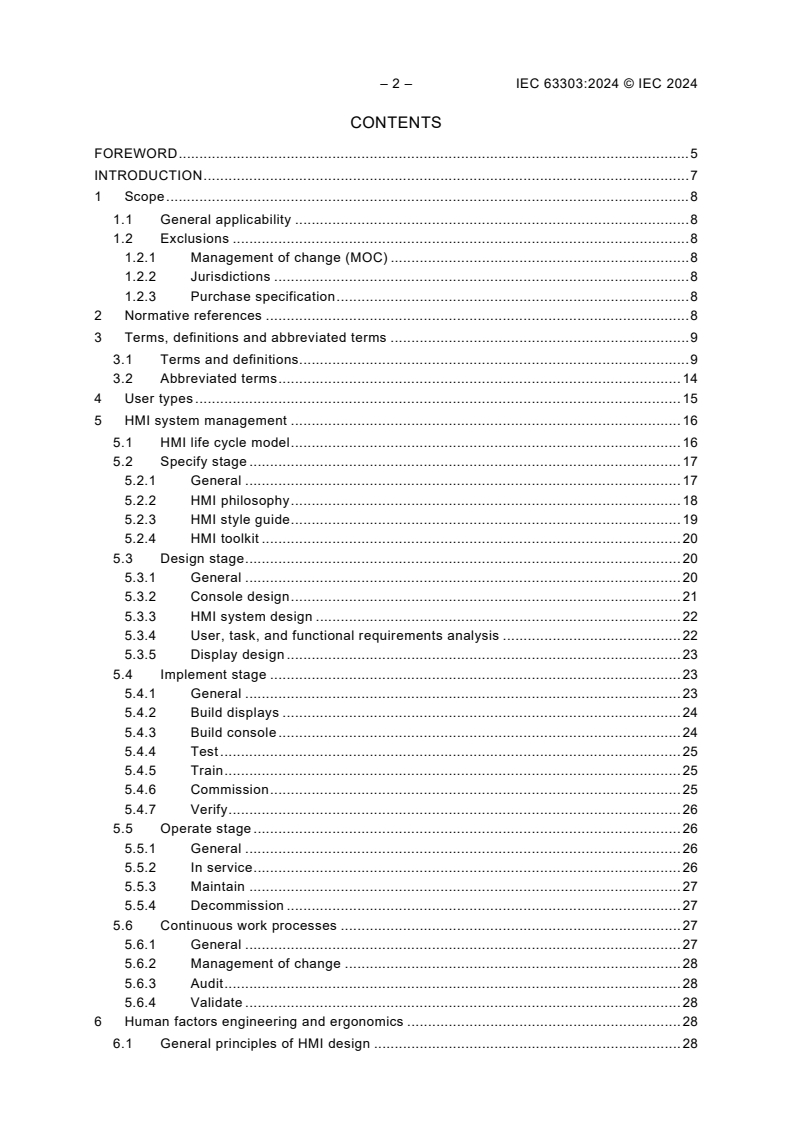
CONTENTS
FOREWORD . 5
INTRODUCTION . 7
1 Scope . 8
1.1 General applicability . 8
1.2 Exclusions . 8
1.2.1 Management of change (MOC) . 8
1.2.2 Jurisdictions . 8
1.2.3 Purchase specification . 8
2 Normative references . 8
3 Terms, definitions and abbreviated terms . 9
3.1 Terms and definitions. 9
3.2 Abbreviated terms . 14
4 User types . 15
5 HMI system management . 16
5.1 HMI life cycle model . 16
5.2 Specify stage . 17
5.2.1 General . 17
5.2.2 HMI philosophy . 18
5.2.3 HMI style guide . 19
5.2.4 HMI toolkit . 20
5.3 Design stage . 20
5.3.1 General . 20
5.3.2 Console design . 21
5.3.3 HMI system design . 22
5.3.4 User, task, and functional requirements analysis . 22
5.3.5 Display design . 23
5.4 Implement stage . 23
5.4.1 General . 23
5.4.2 Build displays . 24
5.4.3 Build console . 24
5.4.4 Test . 25
5.4.5 Train . 25
5.4.6 Commission . 25
5.4.7 Verify . 26
5.5 Operate stage . 26
5.5.1 General . 26
5.5.2 In service . 26
5.5.3 Maintain . 27
5.5.4 Decommission . 27
5.6 Continuous work processes . 27
5.6.1 General . 27
5.6.2 Management of change . 28
5.6.3 Audit . 28
5.6.4 Validate . 28
6 Human factors engineering and ergonomics . 28
6.1 General principles of HMI design . 28
6.1.1 General . 28
6.1.2 Consistency of design . 29
6.1.3 HMI life cycle design stage involvement . 29
6.1.4 General HFE concepts . 29
6.1.5 Situation awareness . 30
6.2 User sensory limits . 30
6.2.1 General . 30
6.2.2 Visual considerations . 30
6.2.3 Auditory considerations . 33
6.2.4 Auditory coding . 33
6.3 User cognitive limits . 34
7 Display types and overall HMI structure . 34
7.1 General . 34
7.2 Display types . 34
7.3 Display hierarchy . 37
7.3.1 General . 37
7.3.2 Level 1 displays . 37
7.3.3 Level 2 displays . 37
7.3.4 Level 3 displays . 38
7.3.5 Level 4 displays . 38
8 User interaction . 39
8.1 Overview . 39
8.2 Software methods for user interaction . 39
8.2.1 General . 39
8.2.2 Data entry methods . 39
8.2.3 Navigation methods . 42
8.2.4 Error avoidance methods . 45
8.2.5 Off-system messaging . 45
8.2.6 User access security . 46
8.3 Hardware interfaces . 46
8.3.1 General . 46
8.3.2 Output devices . 46
8.3.3 Size considerations . 47
8.3.4 User input devices . 47
9 Performance . 48
9.1 General . 48
9.2 HMI duty factors . 48
9.2.1 General . 48
9.2.2 Call up time . 48
9.2.3 Display refresh rate . 48
9.2.4 Write time . 48
9.2.5 Write refresh time . 49
10 User training . 49
10.1 General . 49
10.2 Operations . 49
10.3 Maintenance . 50
10.4 Engineering . 50
10.5 Administrators . 50
– 4 – IEC 63303:2024 © IEC 2024
10.6 Management . 50
Annex A (informative) Selected HMI system terms and their interrelationships . 51
Annex B (informative) Display examples . 52
Bibliography . 69
Figure 1 – Example of HMI life cycle . 16
Figure 2 – Example navigation diagram . 43
Figure A.1 – Selected HMI system terms and their interrelationships . 51
Figure B.1 – Process example . 52
Figure B.2 – Level 1 display, example 1 . 53
Figure B.3 – Level 1 display, example 2 . 54
Figure B.4 – Level 1 display, example 3 . 55
Figure B.5 – Level 1 display, example 4 . 56
Figure B.6 – Level 2 display, example 1 . 57
Figure B.7 – Level 2 display, example 2 . 58
Figure B.8 – Level 2 display, example 3 . 59
Figure B.9 – Level 3 display, example . 60
Figure B.10 – Level 4 display, example . 61
Figure B.11 – Topology example . 62
Figure B.12 – Graph example . 63
Figure B.13 – Group example . 64
Figure B.14 – Logic example. 65
Figure B.15 – Procedure example . 66
Figure B.16 – Health diagnostic . 67
Figure B.17 – Alarm summary example . 68
Table 1 – Example user access credentials . 16
Table 2 – Example specify stage activities . 18
Table 3 – Example design stage activities . 21
Table 4 – Example implement stage activities . 24
Table 5 – Example operate stage activities . 26
Table 6 – Example continuous work processes stage activities . 27
Table 7 – Example display types . 35
Table 8 – Example of numeric decimal formatting . 40
Table 9 – Example navigation performance . 44
INTERNATIONAL ELECTROTECHNICAL COMMISSION
____________
HUMAN MACHINE INTERFACES FOR PROCESS AUTOMATION SYSTEMS
FOREWORD
1) The International Electrotechnical Commission (IEC) is a worldwide organization for standardization comprising
all national electrotechnical committees (IEC National Committees). The object of IEC is to promote international
co-operation on all questions concerning standardization in the electrical and electronic fields. To this end and
in addition to other activities, IEC publishes International Standards, Technical Specifications, Technical Reports,
Publicly Available Specifications (PAS) and Guides (hereafter referred to as "IEC Publication(s)"). Their
preparation is entrusted to technical committees; any IEC National Committee interested in the subject dealt with
may participate in this preparatory work. International, governmental and non-governmental organizations liaising
with the IEC also participate in this preparation. IEC collaborates closely with the International Organization for
Standardization (ISO) in accordance with conditions determined by agreement between the two organizations.
2) The formal decisions or agreements of IEC on technical matters express, as nearly as possible, an international
consensus of opinion on the relevant subjects since each technical committee has representation from all
interested IEC National Committees.
3) IEC Publications have the form of recommendations for international use and are accepted by IEC National
Committees in that sense. While all reasonable efforts are made to ensure that the technical content of IEC
Publications is accurate, IEC cannot be held responsible for the way in which they are used or for any
misinterpretation by any end user.
4) In order to promote international uniformity, IEC National Committees undertake to apply IEC Publications
transparently to the maximum extent possible in their national and regional publications. Any divergence between
any IEC Publication and the corresponding national or regional publication shall be clearly indicated in the latter.
5) IEC itself does not provide any attestation of conformity. Independent certification bodies provide conformity
assessment services and, in some areas, access to IEC marks of conformity. IEC is not responsible for any
services carried out by independent certification bodies.
6) All users should ensure that they have the latest edition of this publication.
7) No liability shall attach to IEC or its directors, employees, servants or agents including individual experts and
members of its technical committees and IEC National Committees for any personal injury, property damage or
other damage of any nature whatsoever, whether direct or indirect, or for costs (including legal fees) and
expenses arising out of the publication, use of, or reliance upon, this IEC Publication or any other IEC
Publications.
8) Attention is drawn to the Normative references cited in this publication. Use of the referenced publications is
indispensable for the correct application of this publication.
9) IEC draws attention to the possibility that the implementation of this document may involve the use of (a)
patent(s). IEC takes no position concerning the evidence, validity or applicability of any claimed patent rights in
respect thereof. As of the date of publication of this document, IEC had not received notice of (a) patent(s), which
may be required to implement this document. However, implementers are cautioned that this may not represent
the latest information, which may be obtained from the patent database available at https://patents.iec.ch. IEC
shall not be held responsible for identifying any or all such patent rights.
IEC 63303 has been prepared by subcommittee 65A: System aspects, of IEC technical
committee 65: Industrial-process measurement, control and automation. It is an International
Standard.
The text of this International Standard is based on the following documents:
Draft Report on voting
65A/1115/FDIS 65A/1128/RVD
Full information on the voting for its approval can be found in the report on voting indicated in
the above table.
The language used for the development of this International Standard is English.
– 6 – IEC 63303:2024 © IEC 2024
This document was drafted in accordance with ISO/IEC Directives, Part 2, and developed in
accordance with ISO/IEC Directives, Part 1 and ISO/IEC Directives, IEC Supplement, available
at www.iec.ch/members_experts/refdocs. The main document types developed by IEC are
described in greater detail at www.iec.ch/publications.
The committee has decided that the contents of this document will remain unchanged until the
stability date indicated on the IEC website under webstore.iec.ch in the data related to the
specific document. At this date, the document will be
• reconfirmed,
• withdrawn, or
• revised.
IMPORTANT – The "colour inside" logo on the cover page of this document indicates
that it contains colours which are considered to be useful for the correct understanding
of its contents. Users should therefore print this document using a colour printer.
INTRODUCTION
The purpose of this document is to address the philosophy, design, implementation, operation,
and maintenance of human machine interfaces (HMIs) for automation systems, including
multiple work processes throughout the HMI life cycle. It is intended to help users to better
understand the style of HMI recommended by this document.
It is assumed that the reader has a fundamental knowledge of basic HMI functionality.
This document was derived from ANSI/ISA-101.01-2015 Human Machine Interfaces for Process
Automation Systems.
This document defines the terminology and models to develop an HMI and the work processes
recommended to effectively maintain the HMI throughout its life cycle. This document can be
used to:
– provide guidance to design, build, operate and maintain HMIs to achieve a safer, more
effective, and more efficient control system under all operating conditions, and
– improve the user's abilities to detect, diagnose, and properly respond to abnormal situations.
The HMI is the collection of hardware and software used to monitor and interact with the control
system and ultimately with the process.
In some cases, the primary user(s) operate equipment from different suppliers that have their
own HMI system standards, and it is impractical to achieve uniformity across these HMI systems
or the ideal adherence to the asset owner's HMI system standards.
In such cases, the asset owner should perform a formal assessment of deviations of each
equipment HMI from the asset owner's HMI philosophy. This assessment should consider
human factors engineering and task analysis.
The outcome of the assessment should determine if any mitigations are required to ensure the
safe and efficient control of the process including start-up, operation, and shutdown, in addition
to early detection, diagnosis, and proper response to abnormal situations.
The proper design and implementation of HMI systems as described in this document will result
in increased efficiencies and reduced stress of the users. Other factors such as ergonomics
and overall design of the control room also contribute to potential stressors that need to be
managed. International Standard series ISO 11064 "Ergonomic design of control centres" has
been developed to address the broader control room environment.
This document is organized into ten clauses. The first three clauses are introductory in nature.
Clause 4 presents user types. Clause 5 introduces the life cycle model for the HMI. Clauses 6
through 10 provide additional details to support the HMI life cycle. The main body of this
document (Clauses 4 to 10) presents mandatory requirements and non-mandatory
recommendations.
– 8 – IEC 63303:2024 © IEC 2024
HUMAN MACHINE INTERFACES FOR PROCESS AUTOMATION SYSTEMS
1 Scope
1.1 General applicability
This document defines general structures and functions of HMI systems.
An HMI life cycle example for HMI systems is included.
This document specifies requirements and recommendations for activities in each stage of the
life cycle including designing, using, and maintaining the HMI system.
It also provides requirements and recommendations for functions and performance of HMI
systems.
The requirements and recommendations in this document are applicable to any controlled
process using an HMI to interface to a control system. There can be differences in
implementation to meet the specific needs based on the application and controlled process type.
1.2 Exclusions
1.2.1 Management of change (MOC)
Some requirements and recommendations to be included in a MOC procedure are included in
this document. However, a specific MOC procedure has not been included in this document.
1.2.2 Jurisdictions
In some jurisdictions, the governing authorities (e.g. national, federal, state, province, county,
city) have established process safety design, process safety management, or other
requirements.
1.2.3 Purchase specification
This document is not intended to be used as a human machine interface system selection or
purchase specification, although at the discretion of the person specifying or requiring it,
suppliers could be requested to provide an HMI system including the features mentioned herein.
This document does not eliminate the need for sound engineering judgment. No HMI platform
or technology is mandated nor implied.
2 Normative references
The following documents are referred to in the text in such a way that some or all of their content
constitutes requirements of this document. For dated references, only the edition cited applies.
For undated references, the latest edition of the referenced document (including any
amendments) applies.
IEC 62381, Automation systems in the process industry – Factory acceptance test (FAT), site
acceptance test (SAT), and site integration test (SIT)
IEC 62443 (all parts), Security for industrial automation and control systems
3 Terms, definitions and abbreviated terms
For the purposes of this document, the following terms and definitions apply.
ISO and IEC maintain terminology databases for use in standardization at the following
addresses:
• IEC Electropedia: available at https://www.electropedia.org/
• ISO Online browsing platform: available at https://www.iso.org/obp
3.1 Terms and definitions
3.1.1
abnormal situation
disturbance in an industrial process during which the control system cannot keep the process
within normal operating parameters
3.1.2
alarm
audible and/or visible means of indicating to the operator an equipment malfunction, process
deviation, or abnormal condition requiring a timely response
[SOURCE: IEC 62682:2022, 3.1.7]
3.1.3
aspect ratio
ratio between the total horizontal and total vertical dimensions on a screen
Note 1 to entry: Displays designed for one aspect ratio screen (e.g. 4:3) can appear distorted when shown on a
screen with a different aspect ratio (e.g. 16:9).
3.1.4
asset owner
role of an organization responsible for one or more industrial automation and control systems
(IACSs)
Note 1 to entry: The term "asset owner" is used in place of the generic term "end user" to provide differentiation.
Note 2 to entry: This definition includes the components that are part of the IACS.
Note 3 to entry: In the context of this document, asset owner also includes the operator of the IACS.
[SOURCE: IEC 62443-3-3:2013, 3.1.2, modified to be role-based.]
3.1.5
auditory coding
use of auditory signals to convey information to operators
3.1.6
auditory signal
particular, unique, recognizable sound used to convey a particular, unique meaning
3.1.7
call up time
lapsed time for all display elements to be refreshed after a display change has been requested
3.1.8
chromatic distortion
colour fringing or smearing caused by unequal focusing of different colours
– 10 – IEC 63303:2024 © IEC 2024
3.1.9
commissioning
procedures prior, or related, to handing over a system for placing into service
Note 1 to entry: These procedures often include acceptance testing (FAT, SAT, and SIT); handing over of drawings
and documentation; delivering instructions for operation, maintenance, and repair; and providing training to personnel.
3.1.10
console
hardware, software, and furniture or enclosure at which users monitor and/or control the
process, which can include multiple stations, communication devices, and other devices
EXAMPLE Cameras, barcode devices and pushbutton stations.
Note 1 to entry: See Figure A.1.
3.1.11
control platform
system comprising a programmable automation controller, programmable logic controller, or a
distributed control system controller
3.1.12
control room
core functional entity, and its associated physical structure, where control room operators are
stationed to carry out centralized control, monitoring and administrative responsibilities
[SOURCE: ISO 11064-1:2000, 3.2, modified – "control room" was added to the definition.]
3.1.13
control system
system that responds to input signals from the equipment under control and/or from an operator
and generates output signals that cause the equipment under control to operate in the desired
manner
[SOURCE: IEC 62682:2022, 3.1.44, modified – Note 1 to entry and Note 2 to entry were
removed.]
3.1.14
controller
hardware which executes functions for monitoring and control of one or more process variables
Note 1 to entry: In some industries, the primary user of the HMI is called the controller.
3.1.15
dashboard
type of display showing summary of various pieces of important information typically used to
give an overview of a process or part of a process
3.1.16
display
visual representation of the process and related information used for monitoring and control
Note 1 to entry: See Figure A.1.
3.1.17
display type
display format
graphic layout
description of the generic layout of a display and its presentation of information without referring
to any particular content
3.1.18
drill-down
method of navigation in which successive displays show increasing detail for smaller subsets
of the system scope
3.1.19
embedded logic
software that is part of the HMI system and performs some of the requirements of that HMI
system
3.1.20
faceplate
display, part of a display, or popup used for monitoring and/or direct operation of a single control
loop, device, sequence, or other entity
Note 1 to entry: A faceplate contains one or more graphic symbols.
Note 2 to entry: A faceplate is used for group display, popup or other displays.
3.1.21
graphic element
component part of a graphic symbol
Note 1 to entry: Graphic elements consist of objects such as a line and/or circle as shown in Figure A.1.
3.1.22
graphic symbol
graphic object
visual representation of a process component, instrument, condition, information, or operation
interaction in a display
Note 1 to entry: Composed of a combination of single graphic elements. See Figure A.1.
3.1.23
HMI application
computer program that is specific to the requirements of the HMI specification
3.1.24
HMI platform
particular family of HMI systems, consoles, or stations capable of using a common HMI toolkit
3.1.25
human factors engineering
scientific discipline concerned with the understanding of interactions between human and other
elements of a system that applies theory, principles, data, and methods to design in order to
optimize human well-being and overall system performance
3.1.26
human machine interface
HMI
HMI system
collection of hardware and software used by the operator and others to monitor and interact
with the control system and with the process via the control system
[SOURCE: IEC 62682:2022, 3.1.56]
– 12 – IEC 63303:2024 © IEC 2024
3.1.27
HMI security model
information used to develop a detailed program for managing the security of an HMI system
Note 1 to entry: HMI security model is needed to identify the security needs and important characteristics of the
environment at a level of detail necessary to address security issues with a common understanding of the framework
and vocabulary.
3.1.28
industrial automation and control system
IACS
collection of personnel, hardware, software, procedures and policies involved in the operation
of the industrial process and that can affect or influence its safe, secure and reliable operation
3.1.29
keyboard
input device that allows the user to type characters, values, or commands to affect the control
system
Note 1 to entry: See Figure A.1.
3.1.30
mobile device
portable device having a display screen with touch, pen and/or keyboard input that utilizes
communication networks
3.1.31
monitor
electronic device for the display of visual information in the form of text and/or graphics
Note 1 to entry: See Figure A.1.
3.1.32
monitor
maintain awareness of the state of a process by observing variables or the change of
variables against limits or other variables, to keep track of operations and enable timely and
appropriate response to abnormal situations
3.1.33
navigation
function which supports users in locating desired information in an HMI-based information
system, and also in guiding the selection of displays, or the act of selecting a display
3.1.34
operator
person who monitors and makes changes to the process
Note 1 to entry: The operator is the user that most frequently interacts with the HMI.
3.1.35
pointing device
input device which translates physical movements to movements of a pointer, cursor, or other
indicator across the screen
EXAMPLE Mouse, trackball, and touchscreen.
Note 1 to entry: See Figure A.1.
3.1.36
popup
popup display
overlay
display that appears in the foreground of the screen, possibly obscuring part or all of other
displays
Note 1 to entry: See Figure A.1.
3.1.37
resolution
screen resolution
size and pixel density of the screen, usually specified by the number of vertical and horizontal
pixels and the diagonal dimension
EXAMPLE 1 024 horizontal × 768 vertical.
Note 1 to entry: The resolution determines the fineness of detail that can be distinguished in an image on a screen.
Alternately, this fineness of detail can be specified in pixels per linear dimension (e.g. 96 DPI – dots per inch).
3.1.38
salience
distinctiveness, prominence, obviousness, or conspicuousness of a graphic symbol or other
part of a display, for the purpose of quickly drawing operator attention
3.1.39
screen
area of the monitor that shows visual information
Note 1 to entry: See Figure A.1.
Note 2 to entry: See resolution (3.1.37), for more information.
Note 3 to entry: Some computer operating systems support a software "screen" (desktop) spanning multiple
monitors, but for the purposes of this document, a screen is the part of a single monitor on which displays are shown.
3.1.40
script
executable software code which performs tasks on the HMI system and is usually invoked by
an operator action or other control system trigger
3.1.41
scripting
feature provided by some HMI platforms to allow the execution of a script
3.1.42
situation awareness
operator's perception and comprehension of the current state of the actual process conditions
and ability to predict future states
Note 1 to entry: Situation awareness allows the operator to respond appropriately and in a timely manner to the
process behaviour both under normal and abnormal conditions.
3.1.43
station
workstation
part of console that can be occupied by a person for monitoring and control of the process and
that has at least one monitor and input device
Note 1 to entry: Examples of input device are keyboard and pointing devices.
Note 2 to entry: A station can have output devices such as printer and speaker.
– 14 – IEC 63303:2024 © IEC 2024
3.1.44
system standards
documents created in the specify stage of the life cycle
Note 1 to entry: System standards includes HMI philosophy, HMI style guides, and HMI toolkits.
3.1.45
task analysis
method of extracting a user's requirements based on a review of tasks performed by the user
3.1.46
trend
feature for displaying real-time and/or historical data in various chart formats, usually with
respect to time
3.1.47
usability
extent to which a system can be used by specified users to achieve specified goals with
effectiveness, efficiency, and satisfaction in a specified context of use
[SOURCE: IEC 60092-504:2016, 3.21]
3.1.48
validation
qualification
process of demonstrating by examination, testing, or other objective evidence that the HMI, as
installed, meets applicable requirements and specifications
Note 1 to entry: Requirements and specifications include HMI philosophy, HMI style guide, and user, task, and
functional requirements.
3.1.49
verification
process of demonstrating by examination, review, testing, or other objective evidence that the
outputs of an HMI life cycle activity meet the objective and requirements defined for the activity
3.1.50
yoking
spawning
linked navigation
method by which specific combinations of related displays and display contents are called up
via a single navigation action commonly used with multiple monitors
3.2 Abbreviated terms
ANSI American National Standards Institute
CCTV closed circuit television
DCS distributed control system
FAT factory acceptance test
HFE human factors engineering
HFES Human Factors and Ergonomics Society
HMI human machine interface
I/O input / output
MOC management of change
PAC programmable automation controller
P&ID piping and instrumentation diagram
PFD process flow diagram
PLC programmable logic controller
RFID radio-frequency identification
SAT site acceptance test
SIF safety instrumented function
SIS safety instrumented system
SIT site integration test
4 User types
Throughout this document, the term "user" refers to the various individuals who will use the
HMI. Primary users are those directly responsible for the operation of the eq
...