

CISPR TR 16-4-4:2025
(Main)Specification for radio disturbance and immunity measuring apparatus and methods - Part 4-4: The CISPR model for the calculation of limits for the protection of radio services
General Information
- Abstract
CISPR TR 16-4-4:2025 which is a Technical Report, establishes the CISPR model for the calculation of limits for the protection of radio services, based on data from the IEC Radio Services Database (RSD) and estimations of the input values for related probabilistic factors. This is part of the process of the derivation of disturbance limits in the radio frequency spectrum for use in publications containing emission requirements Application of this document leads to a frequency dependent limit result for a particular disturbance phenomenon and the considered product or product type establishing the technical basis in the CISPR limit specification procedure.
NOTE Non-technical parameters and terms that can be considered to influence a limit for inclusion in IEC publications are excluded from the modelling (see also Clause 4.6.5.3).
This third edition cancels and replaces the second edition published in 2007, Amendment 1:2017 and Amendment 2:2020. This edition constitutes a technical revision. This edition includes the following significant technical changes with respect to the previous edition:
a) full revision of the limit calculation model;
b) the content on statistics of complaints was taken from this publication and published as separate document (CISPR TR 16-4-6);
c) application cases/rationales were separated from the model and will be handled in another document to be drafted.
- Status
- Published
- Publication Date
- 20-Oct-2025
- Technical Committee
- CIS/H - Limits for the protection of radio services
- Current Stage
- PPUB - Publication issued
- Start Date
- 21-Oct-2025
- Completion Date
- 30-Oct-2025
Buy Documents
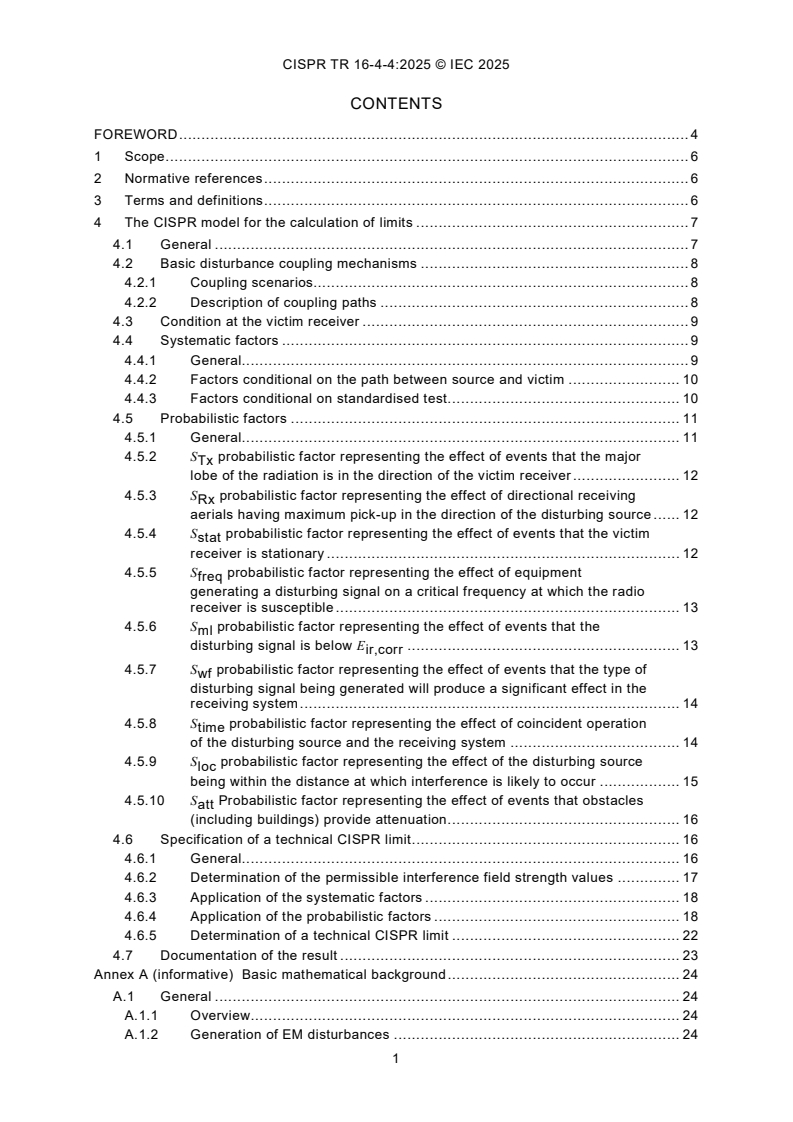
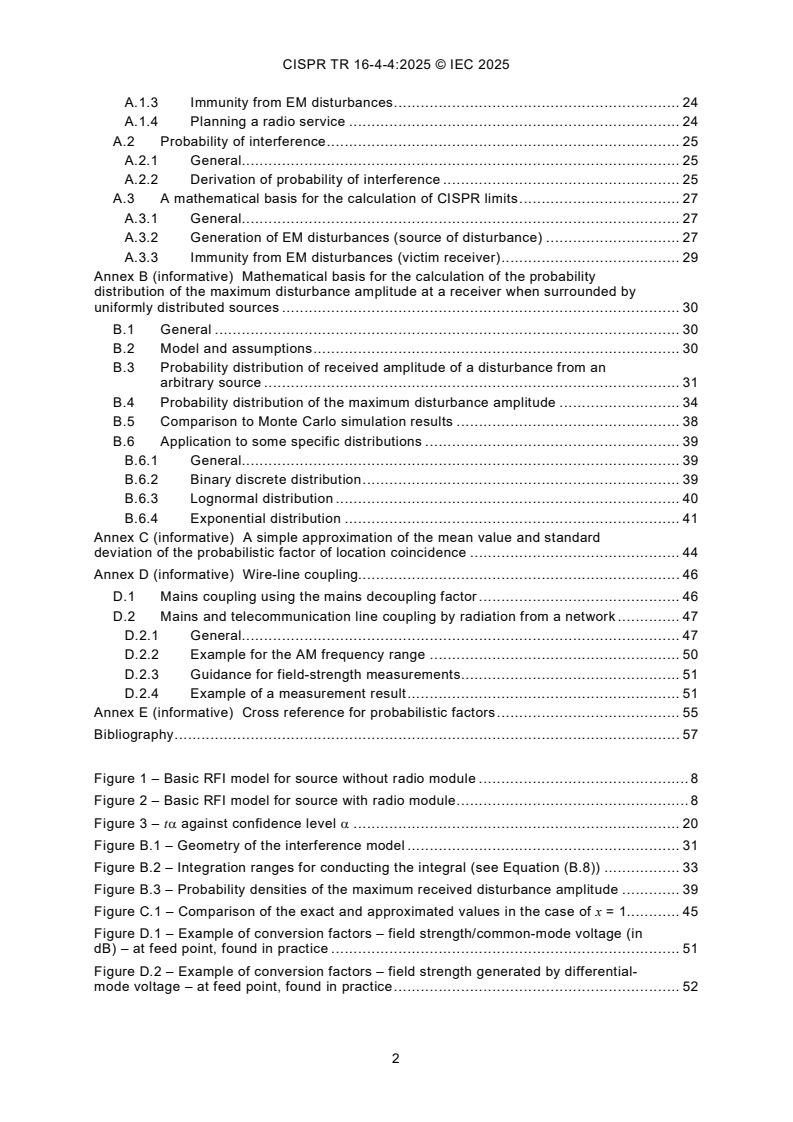
CISPR TR 16-4-4:2025 - Specification for radio disturbance and immunity measuring apparatus and methods - Part 4-4: The CISPR model for the calculation of limits for the protection of radio services Released:10/21/2025
Overview - What CISPR TR 16-4-4:2025 covers
CISPR TR 16-4-4:2025 is a Technical Report from IEC/CISPR that defines the CISPR model for the calculation of limits for the protection of radio services. It specifies a frequency‑dependent, model‑based process for deriving disturbance (emission) limits in the radio‑frequency spectrum using data from the IEC Radio Services Database (RSD) and estimated input values for related probabilistic factors. This third edition (2025) delivers a technical revision including a full update of the limit calculation model; statistical complaint content has been moved to CISPR TR 16-4-6, and application cases/rationales are separated into a future document. Non‑technical parameters that might influence limits are excluded from the CISPR modelling (see Clause 4.6.5.3).
Key technical topics and requirements
- CISPR limit calculation model - a revised, systematic framework to compute frequency‑dependent permissible interference field strengths for specified disturbance phenomena and product types.
- Use of RSD data - inputs and radio service planning data are taken from the IEC Radio Services Database to ensure consistency with real radio services.
- Systematic factors - deterministic elements that affect coupling between source and victim (e.g., coupling paths, receiver condition, standard test conditions).
- Probabilistic factors (S-factors) - quantified probabilities for real‑world variability (directional lobes, receiver orientation, coincidence of operation, obstacles, location coincidence, signal frequency coincidence, waveform significance, etc.).
- Coupling scenarios and path descriptions - models for radiation, conducted and wire‑line coupling (see Clause 4.2 and Annex D).
- Derivation and documentation - procedures to determine permissible field strength values, apply systematic/probabilistic factors and document the technical CISPR limit (Clauses 4.6–4.7).
- Mathematical foundations - informative annexes provide probability theory and modelling background (Annexes A–C, B for distribution modelling).
Practical applications - who uses this standard
- EMC engineers and test laboratories deriving or verifying emission limits for products and equipment.
- Standards developers and CISPR working groups creating or updating CISPR limits and emission publications.
- Spectrum managers, regulators and radio service planners assessing interference protection requirements.
- Product designers and compliance teams using model outputs to set design targets and mitigation measures.
- Certification bodies and conformity assessment entities referencing the technical basis for regulatory limits.
Related standards and resources
- CISPR family documents (other parts of CISPR 16) and the IEC Radio Services Database (RSD).
- CISPR TR 16-4-6 (statistics of complaints) - complementary to the probabilistic/statistical treatment.
- Obtained via the IEC Webstore and CISPR technical committee publications for full normative detail.
Keywords: CISPR TR 16-4-4:2025, CISPR model, calculation of limits, protection of radio services, IEC Radio Services Database, probabilistic factors, disturbance limits, RF spectrum, EMC.
Relations
- Effective Date
- 08-Jul-2024
- Effective Date
- 08-Jul-2024
- Effective Date
- 17-Nov-2023
Buy Documents
CISPR TR 16-4-4:2025 - Specification for radio disturbance and immunity measuring apparatus and methods - Part 4-4: The CISPR model for the calculation of limits for the protection of radio services Released:10/21/2025
Get Certified
Connect with accredited certification bodies for this standard

ANCE
Mexican certification and testing association.

Intertek Slovenia
Intertek testing, inspection, and certification services in Slovenia.

LNE (Laboratoire National de Métrologie et d'Essais)
French national laboratory for metrology and testing.
Sponsored listings
Frequently Asked Questions
CISPR TR 16-4-4:2025 is a technical report published by the International Electrotechnical Commission (IEC). Its full title is "Specification for radio disturbance and immunity measuring apparatus and methods - Part 4-4: The CISPR model for the calculation of limits for the protection of radio services". This standard covers: CISPR TR 16-4-4:2025 which is a Technical Report, establishes the CISPR model for the calculation of limits for the protection of radio services, based on data from the IEC Radio Services Database (RSD) and estimations of the input values for related probabilistic factors. This is part of the process of the derivation of disturbance limits in the radio frequency spectrum for use in publications containing emission requirements Application of this document leads to a frequency dependent limit result for a particular disturbance phenomenon and the considered product or product type establishing the technical basis in the CISPR limit specification procedure. NOTE Non-technical parameters and terms that can be considered to influence a limit for inclusion in IEC publications are excluded from the modelling (see also Clause 4.6.5.3). This third edition cancels and replaces the second edition published in 2007, Amendment 1:2017 and Amendment 2:2020. This edition constitutes a technical revision. This edition includes the following significant technical changes with respect to the previous edition: a) full revision of the limit calculation model; b) the content on statistics of complaints was taken from this publication and published as separate document (CISPR TR 16-4-6); c) application cases/rationales were separated from the model and will be handled in another document to be drafted.
CISPR TR 16-4-4:2025 which is a Technical Report, establishes the CISPR model for the calculation of limits for the protection of radio services, based on data from the IEC Radio Services Database (RSD) and estimations of the input values for related probabilistic factors. This is part of the process of the derivation of disturbance limits in the radio frequency spectrum for use in publications containing emission requirements Application of this document leads to a frequency dependent limit result for a particular disturbance phenomenon and the considered product or product type establishing the technical basis in the CISPR limit specification procedure. NOTE Non-technical parameters and terms that can be considered to influence a limit for inclusion in IEC publications are excluded from the modelling (see also Clause 4.6.5.3). This third edition cancels and replaces the second edition published in 2007, Amendment 1:2017 and Amendment 2:2020. This edition constitutes a technical revision. This edition includes the following significant technical changes with respect to the previous edition: a) full revision of the limit calculation model; b) the content on statistics of complaints was taken from this publication and published as separate document (CISPR TR 16-4-6); c) application cases/rationales were separated from the model and will be handled in another document to be drafted.
CISPR TR 16-4-4:2025 is classified under the following ICS (International Classification for Standards) categories: 33.100.10 - Emission; 33.100.20 - Immunity. The ICS classification helps identify the subject area and facilitates finding related standards.
CISPR TR 16-4-4:2025 has the following relationships with other standards: It is inter standard links to CISPR TR 16-4-4:2007/AMD2:2020, CISPR TR 16-4-4:2007/AMD1:2017, CISPR TR 16-4-4:2007. Understanding these relationships helps ensure you are using the most current and applicable version of the standard.
CISPR TR 16-4-4:2025 is available in PDF format for immediate download after purchase. The document can be added to your cart and obtained through the secure checkout process. Digital delivery ensures instant access to the complete standard document.
Standards Content (Sample)
CISPR TR 16-4-4 ®
Edition 3.0 2025-10
TECHNICAL
REPORT
INTERNATIONAL SPECIAL COMMITTEE ON RADIO INTERFERENCE
Specification for radio disturbance and immunity measuring apparatus and
methods -
Part 4-4: The CISPR model for the calculation of limits for the protection of radio
services
ICS 33.100.10; 33.100.20 ISBN 978-2-8327-0778-4
All rights reserved. Unless otherwise specified, no part of this publication may be reproduced or utilized in any form or
by any means, electronic or mechanical, including photocopying and microfilm, without permission in writing from either
IEC or IEC's member National Committee in the country of the requester. If you have any questions about IEC copyright
or have an enquiry about obtaining additional rights to this publication, please contact the address below or your local
IEC member National Committee for further information.
IEC Secretariat Tel.: +41 22 919 02 11
3, rue de Varembé info@iec.ch
CH-1211 Geneva 20 www.iec.ch
Switzerland
About the IEC
The International Electrotechnical Commission (IEC) is the leading global organization that prepares and publishes
International Standards for all electrical, electronic and related technologies.
About IEC publications
The technical content of IEC publications is kept under constant review by the IEC. Please make sure that you have the
latest edition, a corrigendum or an amendment might have been published.
IEC publications search - IEC Products & Services Portal - products.iec.ch
webstore.iec.ch/advsearchform Discover our powerful search engine and read freely all the
The advanced search enables to find IEC publications by a
publications previews, graphical symbols and the glossary.
variety of criteria (reference number, text, technical With a subscription you will always have access to up to date
committee, …). It also gives information on projects, content tailored to your needs.
replaced and withdrawn publications.
Electropedia - www.electropedia.org
IEC Just Published - webstore.iec.ch/justpublished The world's leading online dictionary on electrotechnology,
Stay up to date on all new IEC publications. Just Published containing more than 22 500 terminological entries in English
details all new publications released. Available online and and French, with equivalent terms in 25 additional languages.
once a month by email. Also known as the International Electrotechnical Vocabulary
(IEV) online.
IEC Customer Service Centre - webstore.iec.ch/csc
If you wish to give us your feedback on this publication or
need further assistance, please contact the Customer
Service Centre: sales@iec.ch.
CONTENTS
FOREWORD . 4
1 Scope . 6
2 Normative references . 6
3 Terms and definitions . 6
4 The CISPR model for the calculation of limits . 7
4.1 General . 7
4.2 Basic disturbance coupling mechanisms . 8
4.2.1 Coupling scenarios. 8
4.2.2 Description of coupling paths . 8
4.3 Condition at the victim receiver . 9
4.4 Systematic factors . 9
4.4.1 General. 9
4.4.2 Factors conditional on the path between source and victim . 10
4.4.3 Factors conditional on standardised test . 10
4.5 Probabilistic factors . 11
4.5.1 General. 11
4.5.2 S probabilistic factor representing the effect of events that the major
Tx
lobe of the radiation is in the direction of the victim receiver . 12
4.5.3 S probabilistic factor representing the effect of directional receiving
Rx
aerials having maximum pick-up in the direction of the disturbing source . 12
4.5.4 S probabilistic factor representing the effect of events that the victim
stat
receiver is stationary . 12
4.5.5 S probabilistic factor representing the effect of equipment
freq
generating a disturbing signal on a critical frequency at which the radio
receiver is susceptible . 13
4.5.6 S probabilistic factor representing the effect of events that the
ml
disturbing signal is below E . 13
ir,corr
4.5.7 S probabilistic factor representing the effect of events that the type of
wf
disturbing signal being generated will produce a significant effect in the
receiving system . 14
4.5.8 S probabilistic factor representing the effect of coincident operation
time
of the disturbing source and the receiving system . 14
4.5.9 S probabilistic factor representing the effect of the disturbing source
loc
being within the distance at which interference is likely to occur . 15
4.5.10 S Probabilistic factor representing the effect of events that obstacles
att
(including buildings) provide attenuation . 16
4.6 Specification of a technical CISPR limit . 16
4.6.1 General. 16
4.6.2 Determination of the permissible interference field strength values . 17
4.6.3 Application of the systematic factors . 18
4.6.4 Application of the probabilistic factors . 18
4.6.5 Determination of a technical CISPR limit . 22
4.7 Documentation of the result . 23
Annex A (informative) Basic mathematical background . 24
A.1 General . 24
A.1.1 Overview . 24
A.1.2 Generation of EM disturbances . 24
A.1.3 Immunity from EM disturbances . 24
A.1.4 Planning a radio service . 24
A.2 Probability of interference . 25
A.2.1 General. 25
A.2.2 Derivation of probability of interference . 25
A.3 A mathematical basis for the calculation of CISPR limits . 27
A.3.1 General. 27
A.3.2 Generation of EM disturbances (source of disturbance) . 27
A.3.3 Immunity from EM disturbances (victim receiver) . 29
Annex B (informative) Mathematical basis for the calculation of the probability
distribution of the maximum disturbance amplitude at a receiver when surrounded by
uniformly distributed sources . 30
B.1 General . 30
B.2 Model and assumptions . 30
B.3 Probability distribution of received amplitude of a disturbance from an
arbitrary source . 31
B.4 Probability distribution of the maximum disturbance amplitude . 34
B.5 Comparison to Monte Carlo simulation results . 38
B.6 Application to some specific distributions . 39
B.6.1 General. 39
B.6.2 Binary discrete distribution . 39
B.6.3 Lognormal distribution . 40
B.6.4 Exponential distribution . 41
Annex C (informative) A simple approximation of the mean value and standard
deviation of the probabilistic factor of location coincidence . 44
Annex D (informative) Wire-line coupling. 46
D.1 Mains coupling using the mains decoupling factor . 46
D.2 Mains and telecommunication line coupling by radiation from a network . 47
D.2.1 General. 47
D.2.2 Example for the AM frequency range . 50
D.2.3 Guidance for field-strength measurements . 51
D.2.4 Example of a measurement result . 51
Annex E (informative) Cross reference for probabilistic factors . 55
Bibliography . 57
Figure 1 – Basic RFI model for source without radio module . 8
Figure 2 – Basic RFI model for source with radio module . 8
Figure 3 – tα against confidence level α . 20
Figure B.1 – Geometry of the interference model . 31
Figure B.2 – Integration ranges for conducting the integral (see Equation (B.8)) . 33
Figure B.3 – Probability densities of the maximum received disturbance amplitude . 39
Figure C.1 – Comparison of the exact and approximated values in the case of x = 1. 45
Figure D.1 – Example of conversion factors – field strength/common-mode voltage (in
dB) – at feed point, found in practice . 51
Figure D.2 – Example of conversion factors – field strength generated by differential-
mode voltage – at feed point, found in practice . 52
Figure D.3 – Example of conversion factors – field strength generated by differential-
mode voltage –outside buildings and electrical substations, found in practice . 53
Figure D.4 – Example of conversion factors – field strength generated by differential-
mode voltage – inside buildings, found in practice. 54
Table 1 – Coupling scenarios and relevant systematic/probabilistic factors . 17
Table E.1 – Cross reference of probabilistic factors in this document and CISPR
TR 16-4-4:2007, CISPR TR 16-4-4:2007/AMD1:2017 and CISPR
TR 16-4-4:2007/AMD2:2020 . 55
INTERNATIONAL ELECTROTECHNICAL COMMISSION
____________
Specification for radio disturbance and immunity measuring apparatus
and methods -
Part 4-4: The CISPR model for the calculation of limits for the protection
of radio services
FOREWORD
1) The International Electrotechnical Commission (IEC) is a worldwide organization for standardization comprising
all national electrotechnical committees (IEC National Committees). The object of IEC is to promote international
co-operation on all questions concerning standardization in the electrical and electronic fields. To this end and
in addition to other activities, IEC publishes International Standards, Technical Specifications, Technical Reports,
Publicly Available Specifications (PAS) and Guides (hereafter referred to as "IEC Publication(s)"). Their
preparation is entrusted to technical committees; any IEC National Committee interested in the subject dealt with
may participate in this preparatory work. International, governmental and non-governmental organizations liaising
with the IEC also participate in this preparation. IEC collaborates closely with the International Organization for
Standardization (ISO) in accordance with conditions determined by agreement between the two organizations.
2) The formal decisions or agreements of IEC on technical matters express, as nearly as possible, an international
consensus of opinion on the relevant subjects since each technical committee has representation from all
interested IEC National Committees.
3) IEC Publications have the form of recommendations for international use and are accepted by IEC National
Committees in that sense. While all reasonable efforts are made to ensure that the technical content of IEC
Publications is accurate, IEC cannot be held responsible for the way in which they are used or for any
misinterpretation by any end user.
4) In order to promote international uniformity, IEC National Committees undertake to apply IEC Publications
transparently to the maximum extent possible in their national and regional publications. Any divergence between
any IEC Publication and the corresponding national or regional publication shall be clearly indicated in the latter.
5) IEC itself does not provide any attestation of conformity. Independent certification bodies provide conformity
assessment services and, in some areas, access to IEC marks of conformity. IEC is not responsible for any
services carried out by independent certification bodies.
6) All users should ensure that they have the latest edition of this publication.
7) No liability shall attach to IEC or its directors, employees, servants or agents including individual experts and
members of its technical committees and IEC National Committees for any personal injury, property damage or
other damage of any nature whatsoever, whether direct or indirect, or for costs (including legal fees) and
expenses arising out of the publication, use of, or reliance upon, this IEC Publication or any other IEC
Publications.
8) Attention is drawn to the Normative references cited in this publication. Use of the referenced publications is
indispensable for the correct application of this publication.
9) IEC draws attention to the possibility that the implementation of this document may involve the use of (a)
patent(s). IEC takes no position concerning the evidence, validity or applicability of any claimed patent rights in
respect thereof. As of the date of publication of this document, IEC had not received notice of (a) patent(s), which
may be required to implement this document. However, implementers are cautioned that this may not represent
the latest information, which may be obtained from the patent database available at https://patents.iec.ch. IEC
shall not be held responsible for identifying any or all such patent rights.
CISPR TR 16-4-4 has been prepared by subcommittee H: Limits for the protection of radio
services, of IEC technical committee CISPR. It is a Technical report.
This third edition cancels and replaces the second edition published in 2007,
Amendment 1:2017 and Amendment 2:2020. This edition constitutes a technical revision.
This edition includes the following significant technical changes with respect to the previous
edition:
a) full revision of the limit calculation model;
b) the content on statistics of complaints was taken from this publication and published as
separate document (CISPR TR 16-4-6);
c) application cases/rationales were separated from the model and will be handled in another
document to be drafted.
The text of this Technical Report is based on the following documents:
Draft Report on voting
CIS/H/524/DTR CIS/H/536A/RVDTR
Full information on the voting for its approval can be found in the report on voting indicated in
the above table.
The language used for the development of this Technical Report is English.
This document was drafted in accordance with ISO/IEC Directives, Part 2, and developed in
accordance with ISO/IEC Directives, Part 1 and ISO/IEC Directives, IEC Supplement, available
at www.iec.ch/members_experts/refdocs. The main document types developed by IEC are
described in greater detail at http://www.iec.ch/standardsdev/publications.
The committee has decided that the contents of this document will remain unchanged until the
stability date indicated on the IEC website under webstore.iec.ch in the data related to the
specific document. At this date, the document will be
– reconfirmed,
– withdrawn, or
– revised.
1 Scope
This Part of CISPR 16-4 establishes the CISPR model for the calculation of limits for the
protection of radio services, based on data from the IEC Radio Services Database (RSD) and
estimations of the input values for related probabilistic factors.
This is part of the process of the derivation of disturbance limits in the radio frequency spectrum
for use in publications containing emission requirements.
Application of this document leads to a frequency dependent limit result for a particular
disturbance phenomenon and the considered product or product type establishing the technical
basis in the CISPR limit specification procedure.
NOTE Non-technical parameters and terms that can be considered to influence a limit for inclusion in IEC
publications are excluded from the modelling (see also 4.6.5.3).
2 Normative references
There are no normative references in this document.
3 Terms and definitions
For the purposes of this document, the following terms and definitions apply.
ISO and IEC maintain terminological databases for use in standardization at the following
addresses:
– IEC Electropedia: available at http://www.electropedia.org/
– ISO Online browsing platform: available at http://www.iso.org/obp
3.1
protection distance
r
PD
distance between the source of a radiated disturbance and the victim receiver at the edge-of-
service area used for the derivation of a specific CISPR disturbance limit
Note 1 to entry: The edge-of-service area is defined by the minimum value of the wanted field strength of a radio
service or application derived from ITU-R specifications.
Note 2 to entry: This definition can vary in other publications, when conducted disturbances are concerned.
Note 3 to entry: Every limit has an associated protection distance; the protection distance can vary with frequency.
Note 4 to entry: The result of the calculation procedure based on a certain value of protection distance does not
ensure protection in all circumstances.
3.2
exclusion distance
r
E
lower bound of the distance from the victim receiver to the nearest disturbance source
Note 1 to entry: Within a distance shorter than this lower bound, emission from a source is not assumed or ignored
for the protection of a radio service.
Note 2 to entry: In special sensitive receiving situations (i.e. radio astronomy observations, military services) an
exclusion distance is defined by the administration.
3.3
worst-case limit
radio disturbance limit equal or equivalent to the field strength e /r , which is applied to the
w p
field strength emitted from a single disturbance source in the situation where there is minimum
decoupling to the victim receiver
Note 1 to entry: When the worst-case limit at the protection distance is converted to a limit value at another
measurement distance or converted to a limit value in terms of a different quantity in a deterministic way (e.g.,
magnetic field strength to equivalent electric field strength), such a new limit value is regarded as an equivalent
worst-case limit.
Note 2 to entry: Decoupling of disturbance between a source and the victim receiver is a random variable in general.
In the case of radiated disturbance, the words "minimum decoupling" means no attenuation other than by distance,
by setting all the probabilistic factors other than the location coincidence to be unity (or 0 dB). Minimum decoupling
to the receiver is often determined by distance attenuation at the protection distance unless an exclusion distance is
used or the purely conducted situation is observed.
Note 3 to entry: If the worst-case limit is applied to a conducted disturbance, the limit is given by the disturbance
voltage that generates disturbance equivalent to the field strength e /r at the victim receiver under the minimum
w p
decoupling condition. Note that the minimum decoupling of a conducted disturbance is usually determined based on
the statistics of measurement results in actual situations.
3.4
permissible interference field strength
E
ir
maximum field strength present at the victim receivers antenna which does not degrade the
reception of the radio receiver
Note 1 to entry: The terms "disturbance" and "interference" are used interchangeably within this document.
4 The CISPR model for the calculation of limits
4.1 General
A harmonized method of calculation is an important precondition for the efficient discussion of
CISPR limits by National Committees and the adoption of CISPR publications.
NOTE 1 The calculation procedure partly takes into account input parameters which are estimated by the user of
the TR. These parameters are described in 4.4 and 4.5.
The CISPR model considers all radio services and applications that have data in the IEC Radio
Services Database [1] . The technical approach taken here is to determine a limit for a given
frequency range to protect radio services and applications operating in that range.
NOTE 2 For those radio services and applications that have no data in the radio services database, the database
can be updated using the process given in CISPR TR 31 [2].
The worst-case levels can be moderated by a series of influencing factors that impact the
probability that interference will occur leading to a probabilistically modified limit value for the
emission at each frequency considered. In a final step of the calculation procedure based on
these frequency-dependent values, a continuous estimated CISPR model limit line is derived
which, however, can have steps at certain frequencies.
NOTE 3 The probabilistic modification process described above will always result in an increase in the probability
of interference. The intention is that the limit determined by this process will not produce a significant increase in the
actual number of interferences.
NOTE 4 See also 4.6.5.3 for subsequently dealing with this calculated limit line.
___________
Numbers in square brackets refer to the Bibliography.
4.2 Basic disturbance coupling mechanisms
4.2.1 Coupling scenarios
The model described in this document is based on electromagnetic disturbance phenomena
that can occur in the typical coupling scenarios depicted in Figure 1 and Figure 2.
NOTE Coupling mechanisms other than those shown in Figure 1 and Figure 2 can exist.
Figure 1 – Basic RFI model for source without radio module
Figure 2 – Basic RFI model for source with radio module
4.2.2 Description of coupling paths
4.2.2.1 Path A
This path covers the coupling between the EUT, via the air, via either ground or water or both
to the radio service or application. Path A covers both the far field and the near field of the
disturbance source. This path is in the scope of this document.
4.2.2.2 Path B
This path covers the coupling from the EUT via a conductor to the radio service or application
equipment. This only occurs when both are connected to each other via a conductor or network
of conductors. This path is in the scope of this document and further information is given in
Annex D.
NOTE 1 Cross talk between cables is also considered in this path.
NOTE 2 The cable representing the conducted path is not necessarily connected to the victim (path B in Figure 1
and Figure 2) as for example in telecommunication lines, where only the radiation coupling (path B ) exists.
4.2.2.3 Path B
This path covers the coupling from the EUT, via an external conductor to the air, ground via
either ground or water or both water and then to the radio service or application. Path B covers
both the far field and the near field of the conductor. This path is in the scope of this document.
NOTE 1 Examples of conductors are AC grid, DC grid, wired network cables, signal or control cables, metal trays
or bars, fibres with metal coating.
NOTE 2 Short conductors are typically covered by radiated tests (e.g. shorter than 3 m) while long conductors are
typically covered by conducted tests.
4.2.2.4 Path C
This path covers the coupling from a radio module in the EUT via the air, via ground or water
or both to the radio receiver's antenna. This coupling path is not in the scope of this document.
NOTE This coupling path is related to radio spectrum requirements.
4.2.2.5 Path D
This path covers the coupling from a radio module in the EUT via the air, via ground or water
or both to the non-radio part of the victim. This coupling path is not in the scope of this document.
NOTE This coupling path is related to immunity requirements.
4.3 Condition at the victim receiver
Considering the technical parameters for reliable reception of the radio service or application
to be protected, the permissible interference field strength E at the victim receiver can be
ir
determined by subtracting the necessary protection ratio R from the minimum wanted field
P
strength E needed for this radio reception (see Equation (1), all quantities expressed in
w
logarithmic units).
E = E – R
(1)
ir w P
NOTE 1 Values for the necessary parameters can be found in the IEC Radio Services database [1]; definition of
the terms is given in CISPR TR 31 [2].
In linear expressions this is
e = e /r
(2)
ir w p
NOTE 2 In this document, small letters are used for linear expressions and capital letters for logarithmic
expressions to remain consistent with the previous version of CISPR TR 16-4-4.
4.4 Systematic factors
4.4.1 General
Systematic factors are those factors that are not probabilistic as they are predetermined by
certain physical source specifics (including positioning restrictions) or by conditions
indispensable to be considered due to characteristics in the measurement in standardised
testing.
NOTE Systematic factors can be frequency dependent.
4.4.2 Factors conditional on the path between source and victim
4.4.2.1 Permanent screening factor
Obstacles (including buildings) can impact the level of the disturbance signal. Where these
obstacles are permanently present this can be considered by a systematic screening factor L .
b
EXAMPLE A situation where the factor is permanently present would be for a radio application that always uses an
antenna external to the building while the interference source is always installed inside a building having a certain
screening effect.
NOTE Where the obstacle is not always present, it is dealt with as probabilistic factor S (see 4.5.10).
att
4.4.2.2 Factor representing a guaranteed minimum distance between source and
victim
Some victims are always physically separated from disturbance sources by an exclusion
distance r . When an exclusion distance for a specific radio service is present, the protection
ex
distance takes the value from the exclusion distance, as noted in 4.5.9.
EXAMPLE Exclusion zones around radio astronomy reception sites.
4.4.3 Factors conditional on standardised test
4.4.3.1 Factor for measurement bandwidth
For broadband EMI the permissible interference field strength is based on a specific
standardised measurement bandwidth for the frequency range in question. If the radio service
or application evaluated uses the same bandwidths, as in some cases of broadcast radio, no
change is applicable. If the bandwidth of the victim radio service or application is different to
the measurement bandwidth, a correction is applied.
b
measurement
C 10×log
(3)
bw
b
victim
The appropriate measurement bandwidth (reference bandwidth) can be found in CISPR 16-1-1
[3].
NOTE If the emissions are evenly spread over frequency within both the measurement bandwidth and the victim
bandwidth, they are considered broadband in this subclause.
In other cases, the correction is 0 dB.
4.4.3.2 Factor for conversion from the protection distance to the measurement
distance
If the product standard for which the limit is derived defines a measurement distance d that
deviates from the protection distance r it is important to introduce an appropriate conversion
PD
factor (L ). This conversion factor can be determined using
L = x × 20 × (log(r /d))
(4)
0 PD
where x is the appropriate propagation factor, which is 1 in free-space propagation in the far
field and somewhat higher (1 to 1,5) for non-free-space propagation.
=
Under near-field conditions, the propagation coefficient x is more complex and dependent on
the magnetic or electric component. Other models can be used, further information is available
in the P series of recommendations from the ITU-R.
For this reason, it is much easier to develop a model for remote coupling conditions than for
close coupling situations and for conduction coupling paths. Such a model is applicable to
derive emission limits for a general interference environment.
4.4.3.3 Factor for conversion into another test measurand (i.e. coupling factor)
If the measurand of the reception parameter happen to be different from the test measurand, a
suitable conversion factor C is determined that reflects the coupling characteristics underlying
the transfer of the disturbance signal.
EXAMPLE In case of coupling mechanism B (combination of the conduction and radiation coupling path) the limit
to be derived is converted to the measuring for conducted disturbance although the conditions on the victim's side
will be given as field strength. In that case the coupling characteristics underlying the transfer from the conducted to
a radiated disturbance are combined with the characteristics of the measurement device (for example the termination
impedance of the AAN) and this combination are considered using a suitable coupling factor.
4.5 Probabilistic factors
4.5.1 General
In 4.4 the maximum permissible disturbance level considering systematic factors has been
described. It represents a maximum permissible field strength level that is calculated to provide
full protection of radio reception against interference from the equipment for which this level is
being derived.
Besides the described systematic factors (4.4) in the derivation of a limit, various probabilistic
factors can be considered either by means of probabilities of coincidence P , or by the mean
i
values µ (see 4.6.4) and their corresponding standard deviations σ .
Pi Pi
The probabilistic factors as described in this document are in many cases equivalent or similar
to those used in the previous editions of this document. A cross-reference table is given in
Annex E (Table E.1).
NOTE 1 In the preceding version of CISPR TR 16-4-4 the term "probability factor" was used. However, in the use
of the model the term "probability factor" was interpreted as either "statistical" or "probabilistic" and caused repeated
misunderstanding. To clearly differentiate between these aspects the name of the factors was changed from
"probability" to "probabilistic". This is intended to stress the forecasting character of the introduced factors, as by
definition probability deals with predicting the likelihood of future events, while statistics encompasses the analysis
of the frequency of past events.
NOTE 2 As far as this document is concerned, coincidence incorporates both factors, those that occur by chance
and also those that occur simultaneously because they are related.
NOTE 3 The basic mathematical background on dealing with probabilities is given in CCIR Report 829. The essence
of the report is included in Annex A.
Some of these can follow a probability distribution that is binary in their nature (either emission
with a probability P or no emission with 1-P depending on the coincidence of time, frequency,
i i
etc.) and hence will be expressed by the probability of coincidence P . And other factors can
i
have a continuous distribution and be represented by the pair of statistical mean value µ and
Pi
standard deviations σ in decibels.
Pi
The applicable probabilistic factors have each to be determined for the situation being analysed,
the factors frequently used are described in the following clauses.
For each of the probabilistic factors (or in some cases a group of combined probabilistic factors)
the known probability function or a mathematical approximation can be used to determine the
mean and standard deviation (µ , σ ) from the probability density function (see Annex B).
Pn Pn
The estimation of the appropriate values for individual factors can be complex and
determination of a particular value for the general case is challenging. When the value of a
probabilistic factor cannot be appropriately assessed the value of 1 can be used.
4.5.2 S probabilistic factor representing the effect of events that the major lobe of
Tx
the radiation is in the direction of the victim receiver
This factor represents the effect of the probabilistic events that the antenna of the radio
reception installation will be exposed to maximum radiation from the disturbance source
emanating in direction of the major lobe in the disturbance source's radiation pattern. When it
can be assumed, the direction of maximum radiation is random relative to the direction of victim
receiver, the disturbance field strength at the victim receiver can be regarded as a probabilistic
factor. If the radiation pattern has a major lobe with a beam width θ , this probabilistic factor is
e
expressed by the probability of coincidence P that is given by θ /2π. If radiation pattern does
Tx e
not have a clear major lobe but has a continuous variation as a function of azimuth angle, the
probabilistic factor is represented by the mean value and standard deviation (µ , σ ) of the
PTx PTx
disturbance strength that is normalized by its peak value. Since the normalized field strength
takes the maximum value of zero dB or negative values otherwise, the µ (positive value) is
PTx
given by the sign inversion of the mean value of the normalized field strength.
NOTE For high frequencies in which considerable antenna gains are expected the radiation pattern is independent
of the distance r ( > protection distance) from the source as the minimum distance from the source to the receiver
i
is in the far field region of the source. For low frequencies, this could not be the case which could make the
applicability of this factor much more complex and is often to be set to unity, especially in indoor receiving situations.
4.5.3 S probabilistic factor representing the effect of directional receiving aerials
Rx
having maximum pick-up in the direction of the disturbing source
This factor describes the effect of the probabilistic events that the axis of the major lobe of the
radio reception installation's directional antenna points to the nearby location of the disturbance
source. This probabilistic factor can be expressed either by the probability of coincidence P
Rx
or the mean value and standard deviation (µ , σ ) similarly to the case of P .
Rx Rx Tx
A directive receiver antenna having a major lobe acts as a spatial filter to effectively reduce the
number of sources that have interference potential.
NOTE For high frequencies in which considerable antenna gains are expected the distance from the receiver
antenna to the nearest source is in the far field region of the receiving antenna. For low frequencies this could not
be the case which could make the applicability of this factor much more complex and is often to be set to unity,
especially in indoor receiving situations.
4.5.4 S probabilistic factor representing the effect of events that the victim
stat
receiver is stationary
S describes the probability that a mobile victim receiver is in a fixed position.
stat
When sources exist only in a limited area, mobile radio reception could reduce the probability
of interference. However, in a situation that multiple disturbance sources are distributed,
mobility of the receiver does not reduce the probability of interference, and hence P is unity.
stat
The mobility of the receiver transforms the variation in the disturbance strength in the space
domain to the variation in time. If a receiver is randomly moved around in an area within which
large number of sources are randomly distributed, the probabilistic properties of the time
variation in the received disturbance strength would be represented with the probabilistic factors
that are respectively nearly same as those for stationary receivers.
EXAMPLE The receiving antenna could be moving, movable or stationary. A fixed antenna could include a roof-top
TV receiving antenna, a movable antenna could be in a portable equipment, a moving antenna could be in a vehicle,
in which case the interference will be only temporary in nature.
4.5.5 S probabilistic factor representing the effect of equipment generating a
freq
disturbing signal on a critical frequency at which the radio receiver is
susceptible
This factor describes the effect of the probabilistic events when the disturbance source emits a
signal on a frequency on which the radio is susceptible. This factor is expressed either by the
in a case of binary distribution of disturbance strength
probability of frequency coincidence P
freq
(i.e., no emission in the signal bandwidth with the probability of 1-P or maximum emission is
freq
found with the probability P ), or by the mean value and standard deviation (µ , σ ) in a
freq freq freq
case that disturbance always exists within the signal bandwidth but has frequency-dependent
variations in the power. This factor is carefully evaluated with the consideration of the following
points:
a) Whether the frequency of the wanted signal is preassigned (fixed) or dynamically assigned
(varying in time).
b) Whether the disturbance spectrum at the frequency band of interest is dominated by discrete
(line) spectrum or by continuous spectrum. Note that the observed spectral characteristics
of a disturbance depend on the resolution bandwidth of the measuring receiver. It is
desirable for the evaluation of this factor that the disturbance spectrum is measured with a
resolution bandwidth that is in the same order of the signal bandwidth (or the sub-channel
bandwidth for a signal using a multicarrier modulation scheme), if possible.
c) When discrete component is dominating the disturbance spectrum, it is important to estimate
the frequency variation range of the major spectral peaks depending on the individual
products. For example, the frequency of clock harmonics of many digital devices is not
strictly the same, nor completely random, but distributed within a certain frequency range.
It is important that any calculations consider the variations in the frequencies used over all
possible products.
NOTE It is essential to consider that the distribution of disturbance spectrum across a frequency band is not
necessarily random and for some products interference will occur at a much higher probability on a limited number
of frequencies. Consider setting this probability to 1 to protect these frequencies.
If the wanted signal band is fixed and the frequency variation of the major peaks in the
disturbance spectrum is estimated to be always within the signal band width, then the
interference is deterministic, i.e., probability of coincidence P = 1. when either the signal
freq
frequency or the frequency of the disturbance spectra or both has variation that is wider than
the signal bandwidth, the probabilistic factor is expressed by the probability of frequency
coincidence P , which will be less than unity. When the disturbance spectrum is dominated
freq
by a continuous spectrum, disturbance power existing within the signal bandwidth will be a
continuous random variable, and the probabilistic factor is expressed by the mean and standard
deviation (µ , σ ) of the disturbance level relative to its peak value in decibels.
freq freq
4.5.6 S probabilistic factor representing the effect of events that the disturbing
ml
signal is below E
ir,corr
S describes the probability that the interference source emits a signal below the level required
ml
to protect radio services (abbreviation "ml" stands for margin to the limit). In many cases
equipment is designed with a margin to the limit.
NOTE Usually, disturbances from a certain source do not just meet the limits but have a certain margin to them.
This factor counts for the estimated average of the minimum margin of the disturbance to the limit.
As this factor can be difficult to be calculated objectively, factors like the various manufacturer
specifications are considered, it is set to unity as long as no evident derivation can be made. If
a derivation is made, documentation of the applied parameters and the procedure applies. In
any case S cannot exceed a value of 2 dB maximum.
ml
4.5.7 S probabilistic factor representing the
...