

IEC PAS 62923-101:2022
(Main)Maritime navigation and radiocommunication equipment and systems - Bridge alert management - Part 101: Guideline on implementation
General Information
- Abstract
IEC PAS 62923-101:2022 primarily provides support to other workgroups to include alert requirements in standards in line with Bridge Alert Management (BAM), and additionally provides support to designers to implement alert properties so that they conform with the BAM requirements. This document is applicable, and is intended to provide guidance, when the intention is to implement BAM according to IMO Resolution MSC.302(87). Based on the IMO decision to adopt the BAM Performance Standard MSC.302(87) as a high level leading umbrella standard for intended implementation of BAM, IMO resolved in MSC.302(87), 3.6, that in case of conflict with alert requirements in existing performance standards, MSC.302(87) takes precedence.
- Status
- Published
- Publication Date
- 14-Sep-2022
- Technical Committee
- TC 80 - Maritime navigation and radiocommunication equipment and systems
- Current Stage
- PPUB - Publication issued
- Start Date
- 15-Sep-2022
- Completion Date
- 26-Sep-2022
Overview
IEC PAS 62923-101:2022 – Maritime navigation and radiocommunication equipment and systems – Bridge alert management – Part 101: Guideline on implementation is a Publicly Available Specification (PAS) developed by the International Electrotechnical Commission (IEC). This document focuses on supporting the integration and implementation of Bridge Alert Management (BAM) requirements in maritime standards and equipment, following the approach and requirements laid out in IMO Resolution MSC.302(87). The guideline assists standard developers and equipment designers in aligning with the harmonized approach for alert management on ship bridges, ensuring operational safety, improved situational awareness, and coherent communication of alerts.
Key Topics
- Harmonization with BAM Standards: IEC PAS 62923-101 is intended to rationalize and guide the implementation of BAM requirements within other IEC and IMO maritime equipment standards, especially where existing specifications may conflict with the overarching BAM performance standard (MSC.302(87)).
- Guidance on Alert Properties: The document outlines principles for defining, categorizing, and prioritizing alerts, introducing the shift from symptomatic (pre-BAM) to functional (BAM-compliant) alerts that focus on operator-centered information.
- Central Alert Management (CAM) Compatibility: While a CAM system is not a mandatory SOLAS carriage requirement, the guideline details key considerations for equipment interoperability and the ability to connect with CAM systems where provided, particularly for Integrated Navigation Systems (INS).
- Implementation Process: Step-by-step guidance is provided for updating existing standards or creating new ones to ensure congruence with BAM requirements, including appropriate referencing, removal of conflicts, and alignment of terminology.
- Alert Handling and Presentation: Recommendations are made for harmonizing audible and visual alert signals, ensuring consistency in the operator’s experience and facilitating rapid, accurate response to operational issues.
- Liaison and Validation: The PAS underscores the importance of working with IEC Technical Committee 80 Working Group 16 (WG16) to assign alert identifiers and validate new or modified alert implementations.
Applications
IEC PAS 62923-101:2022 is a practical resource for a range of maritime stakeholders:
- Standards Development Organizations: Provides a roadmap for incorporating BAM alert requirements into existing and new IEC and IMO standards.
- Equipment Designers and Manufacturers: Offers detailed guidelines for alert system design so that products comply with BAM standards, including examples and best practices for alert generation and management.
- Maritime Vessel Operators and Integrators: Supports the selection and implementation of bridge systems and components that are fully BAM-compliant, enhancing operational safety and crew efficiency.
- Regulatory Authorities and Auditors: Serves as a reference for conformity assessment and regulatory oversight, ensuring alerts are managed consistently across equipment and systems.
The guideline specifically applies to all bridge equipment covered by BAM, aiming to facilitate a uniform and operator-focused alert environment on maritime vessel bridges.
Related Standards
For effective implementation, the following related standards and resolutions are referenced within IEC PAS 62923-101:2022:
- IEC 62923-1:2018 – Bridge alert management – Part 1: Operational and performance requirements, methods of testing, and required test results
- IEC 62923-2:2018 – Bridge alert management – Part 2: Alert and cluster identifiers and additional features
- IEC 61162-1 – Digital interfaces for maritime navigation and radiocommunication systems
- IMO MSC.302(87) – Performance standards for bridge alert management (the umbrella BAM standard referenced throughout)
- IMO A.1021(26) – Code on alerts and indicators
The precedence of MSC.302(87) is noted in cases of overlap or conflict with older standards, ensuring harmonized implementation through this IEC guideline.
Keywords: IEC PAS 62923-101, Bridge Alert Management, maritime navigation equipment, BAM implementation, IMO MSC.302(87), central alert management system, alert harmonization, IEC 62923-1, bridge alert standards, maritime safety, alert system integration.
Get Certified
Connect with accredited certification bodies for this standard

DNV
DNV is an independent assurance and risk management provider.

Lloyd's Register
Lloyd's Register is a global professional services organisation specialising in engineering and technology.

FSC International
Forest Stewardship Council certification.
Sponsored listings
Frequently Asked Questions
IEC PAS 62923-101:2022 is a technical specification published by the International Electrotechnical Commission (IEC). Its full title is "Maritime navigation and radiocommunication equipment and systems - Bridge alert management - Part 101: Guideline on implementation". This standard covers: IEC PAS 62923-101:2022 primarily provides support to other workgroups to include alert requirements in standards in line with Bridge Alert Management (BAM), and additionally provides support to designers to implement alert properties so that they conform with the BAM requirements. This document is applicable, and is intended to provide guidance, when the intention is to implement BAM according to IMO Resolution MSC.302(87). Based on the IMO decision to adopt the BAM Performance Standard MSC.302(87) as a high level leading umbrella standard for intended implementation of BAM, IMO resolved in MSC.302(87), 3.6, that in case of conflict with alert requirements in existing performance standards, MSC.302(87) takes precedence.
IEC PAS 62923-101:2022 primarily provides support to other workgroups to include alert requirements in standards in line with Bridge Alert Management (BAM), and additionally provides support to designers to implement alert properties so that they conform with the BAM requirements. This document is applicable, and is intended to provide guidance, when the intention is to implement BAM according to IMO Resolution MSC.302(87). Based on the IMO decision to adopt the BAM Performance Standard MSC.302(87) as a high level leading umbrella standard for intended implementation of BAM, IMO resolved in MSC.302(87), 3.6, that in case of conflict with alert requirements in existing performance standards, MSC.302(87) takes precedence.
IEC PAS 62923-101:2022 is classified under the following ICS (International Classification for Standards) categories: 47.020 - Shipbuilding and marine structures in general; 47.020.70 - Navigation and control equipment. The ICS classification helps identify the subject area and facilitates finding related standards.
IEC PAS 62923-101:2022 is available in PDF format for immediate download after purchase. The document can be added to your cart and obtained through the secure checkout process. Digital delivery ensures instant access to the complete standard document.
Standards Content (Sample)
IEC PAS 62923-101 ®
Edition 1.0 2022-09
PUBLICLY AVAILABLE
SPECIFICATION
colour
inside
Maritime navigation and radiocommunication equipment and systems – Bridge
alert management
Part 101: Guideline on implementation
All rights reserved. Unless otherwise specified, no part of this publication may be reproduced or utilized in any form
or by any means, electronic or mechanical, including photocopying and microfilm, without permission in writing from
either IEC or IEC's member National Committee in the country of the requester. If you have any questions about IEC
copyright or have an enquiry about obtaining additional rights to this publication, please contact the address below or
your local IEC member National Committee for further information.
IEC Secretariat Tel.: +41 22 919 02 11
3, rue de Varembé info@iec.ch
CH-1211 Geneva 20 www.iec.ch
Switzerland
About the IEC
The International Electrotechnical Commission (IEC) is the leading global organization that prepares and publishes
International Standards for all electrical, electronic and related technologies.
About IEC publications
The technical content of IEC publications is kept under constant review by the IEC. Please make sure that you have the
latest edition, a corrigendum or an amendment might have been published.
IEC publications search - webstore.iec.ch/advsearchform IEC Products & Services Portal - products.iec.ch
The advanced search enables to find IEC publications by a Discover our powerful search engine and read freely all the
variety of criteria (reference number, text, technical publications previews. With a subscription you will always have
committee, …). It also gives information on projects, replaced access to up to date content tailored to your needs.
and withdrawn publications.
Electropedia - www.electropedia.org
IEC Just Published - webstore.iec.ch/justpublished
The world's leading online dictionary on electrotechnology,
Stay up to date on all new IEC publications. Just Published
containing more than 22 300 terminological entries in English
details all new publications released. Available online and once
and French, with equivalent terms in 19 additional languages.
a month by email.
Also known as the International Electrotechnical Vocabulary
(IEV) online.
IEC Customer Service Centre - webstore.iec.ch/csc
If you wish to give us your feedback on this publication or need
further assistance, please contact the Customer Service
Centre: sales@iec.ch.
IEC PAS 62923-101 ®
Edition 1.0 2022-09
PUBLICLY AVAILABLE
SPECIFICATION
colour
inside
Maritime navigation and radiocommunication equipment and systems – Bridge
alert management
Part 101: Guideline on implementation
INTERNATIONAL
ELECTROTECHNICAL
COMMISSION
ICS 47.020; 47.020.70 ISBN 978-2-8322-5618-3
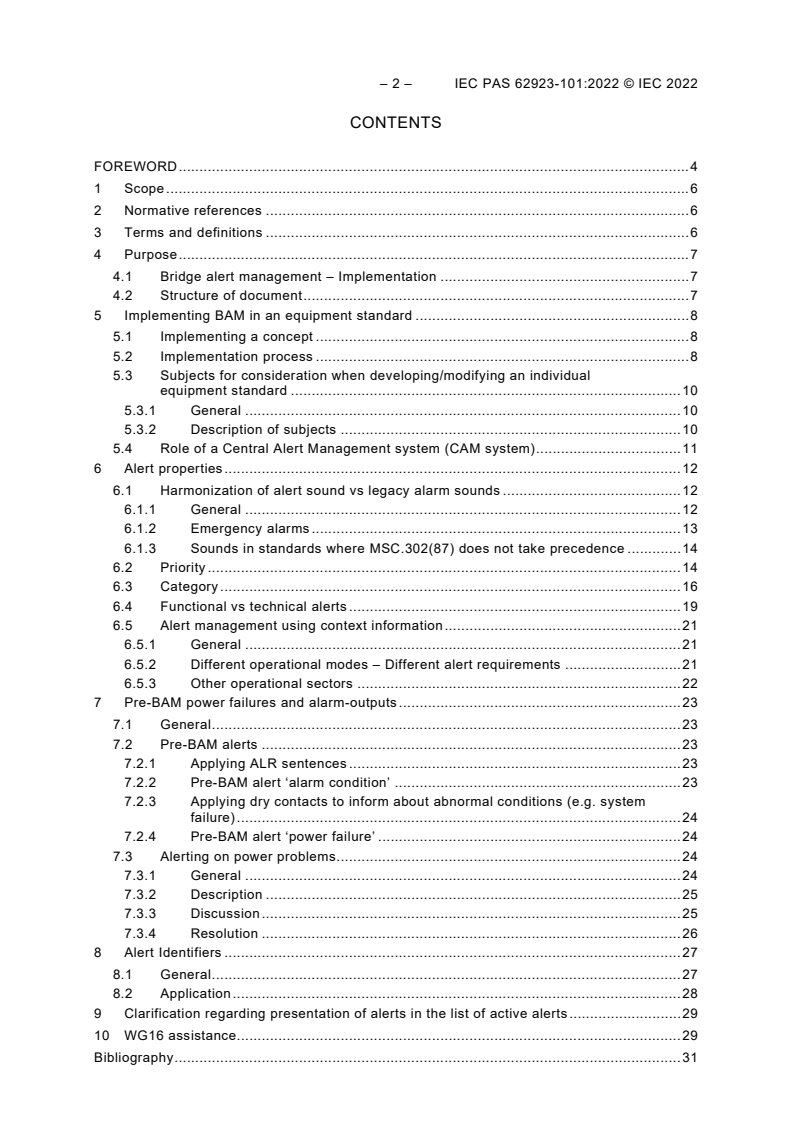
– 2 – IEC PAS 62923-101:2022 © IEC 2022
CONTENTS
FOREWORD . 4
1 Scope . 6
2 Normative references . 6
3 Terms and definitions . 6
4 Purpose . 7
4.1 Bridge alert management – Implementation . 7
4.2 Structure of document . 7
5 Implementing BAM in an equipment standard . 8
5.1 Implementing a concept . 8
5.2 Implementation process . 8
5.3 Subjects for consideration when developing/modifying an individual
equipment standard . 10
5.3.1 General . 10
5.3.2 Description of subjects . 10
5.4 Role of a Central Alert Management system (CAM system) . 11
6 Alert properties . 12
6.1 Harmonization of alert sound vs legacy alarm sounds . 12
6.1.1 General . 12
6.1.2 Emergency alarms . 13
6.1.3 Sounds in standards where MSC.302(87) does not take precedence . 14
6.2 Priority . 14
6.3 Category . 16
6.4 Functional vs technical alerts . 19
6.5 Alert management using context information . 21
6.5.1 General . 21
6.5.2 Different operational modes – Different alert requirements . 21
6.5.3 Other operational sectors . 22
7 Pre-BAM power failures and alarm-outputs . 23
7.1 General . 23
7.2 Pre-BAM alerts . 23
7.2.1 Applying ALR sentences . 23
7.2.2 Pre-BAM alert ‘alarm condition’ . 23
7.2.3 Applying dry contacts to inform about abnormal conditions (e.g. system
failure) . 24
7.2.4 Pre-BAM alert ‘power failure’ . 24
7.3 Alerting on power problems . 24
7.3.1 General . 24
7.3.2 Description . 25
7.3.3 Discussion . 25
7.3.4 Resolution . 26
8 Alert Identifiers . 27
8.1 General . 27
8.2 Application . 28
9 Clarification regarding presentation of alerts in the list of active alerts . 29
10 WG16 assistance. 29
Bibliography . 31
Figure 1 – BAM is a concept applied to equipment rather than a piece of equipment . 8
Figure 2 – Role of a CAM system in Bridge Alert Management . 12
Figure 3 – Typical decision tree for the classification of alert priority . 15
Figure 4 – Typical decision tree for the classification of alert priority after escalation of
a warning . 16
Figure 5 – EUT scope with one or two power inputs with one or two power sources . 26
Table 1 – Blocks of alert identifier end numbers in each 10 consecutive alert
identifiers above 300 . 28
– 4 – IEC PAS 62923-101:2022 © IEC 2022
INTERNATIONAL ELECTROTECHNICAL COMMISSION
____________
MARITIME NAVIGATION AND RADIOCOMMUNICATION EQUIPMENT
AND SYSTEMS – BRIDGE ALERT MANAGEMENT
Part 101: Guideline on implementation
FOREWORD
1) The International Electrotechnical Commission (IEC) is a worldwide organization for standardization comprising
all national electrotechnical committees (IEC National Committees). The object of IEC is to promote international
co-operation on all questions concerning standardization in the electrical and electronic fields. To this end and
in addition to other activities, IEC publishes International Standards, Technical Specifications, Technical Reports,
Publicly Available Specifications (PAS) and Guides (hereafter referred to as “IEC Publication(s)”). Their
preparation is entrusted to technical committees; any IEC National Committee interested in the subject dealt with
may participate in this preparatory work. International, governmental and non-governmental organizations liaising
with the IEC also participate in this preparation. IEC collaborates closely with the International Organization for
Standardization (ISO) in accordance with conditions determined by agreement between the two organizations.
2) The formal decisions or agreements of IEC on technical matters express, as nearly as possible, an international
consensus of opinion on the relevant subjects since each technical committee has representation from all
interested IEC National Committees.
3) IEC Publications have the form of recommendations for international use and are accepted by IEC National
Committees in that sense. While all reasonable efforts are made to ensure that the technical content of IEC
Publications is accurate, IEC cannot be held responsible for the way in which they are used or for any
misinterpretation by any end user.
4) In order to promote international uniformity, IEC National Committees undertake to apply IEC Publications
transparently to the maximum extent possible in their national and regional publications. Any divergence between
any IEC Publication and the corresponding national or regional publication shall be clearly indicated in the latter.
5) IEC itself does not provide any attestation of conformity. Independent certification bodies provide conformity
assessment services and, in some areas, access to IEC marks of conformity. IEC is not responsible for any
services carried out by independent certification bodies.
6) All users should ensure that they have the latest edition of this publication.
7) No liability shall attach to IEC or its directors, employees, servants or agents including individual experts and
members of its technical committees and IEC National Committees for any personal injury, property damage or
other damage of any nature whatsoever, whether direct or indirect, or for costs (including legal fees) and
expenses arising out of the publication, use of, or reliance upon, this IEC Publication or any other IEC
Publications.
8) Attention is drawn to the Normative references cited in this publication. Use of the referenced publications is
indispensable for the correct application of this publication.
9) Attention is drawn to the possibility that some of the elements of this IEC Publication may be the subject of patent
rights. IEC shall not be held responsible for identifying any or all such patent rights.
A PAS is an intermediate specification made available to the public and needing a lower level
of consensus than an International Standard to be approved by vote (simple majority).
IEC PAS 62923-101 has been prepared by IEC technical committee 80: Maritime navigation
and radiocommunication equipment and systems.
The text of this PAS is based on the This PAS was approved for publication
following document: by the P-members of the committee
concerned as indicated in the following
document
Draft PAS Report on voting
80/1041/DPAS 80/1044/RVDPAS
Following publication of this PAS, which is a pre-standard publication, the technical committee
or subcommittee concerned may transform it into an International Standard.
This PAS shall remain valid for an initial maximum period of 2 years starting from the publication
date. The validity may be extended for a single period up to a maximum of 2 years, at the end
of which it shall be published as another type of normative document, or shall be withdrawn.
IMPORTANT – The "colour inside" logo on the cover page of this document indicates that it
contains colours which are considered to be useful for the correct understanding of its
contents. Users should therefore print this document using a colour printer.
– 6 – IEC PAS 62923-101:2022 © IEC 2022
MARITIME NAVIGATION AND RADIOCOMMUNICATION EQUIPMENT
AND SYSTEMS – BRIDGE ALERT MANAGEMENT
Part 101: Guideline on implementation
1 Scope
This document primarily provides support to other workgroups to include alert requirements in
standards in line with Bridge Alert Management (BAM), and additionally provides support to
designers to implement alert properties so that they conform with the BAM requirements.
This document is applicable, and is intended to provide guidance, when the intention is to
implement BAM according to IMO Resolution MSC.302(87).
Based on the IMO decision to adopt the BAM Performance Standard MSC.302(87) as a high
level leading umbrella standard for intended implementation of BAM, IMO resolved in
MSC.302(87), 3.6, that in case of conflict with alert requirements in existing performance
standards, MSC.302(87) takes precedence.
2 Normative references
The following documents are referred to in the text in such a way that some or all of their content
constitutes requirements of this document. For dated references, only the edition cited applies.
For undated references, the latest edition of the referenced document (including any
amendments) applies.
IEC 61162-1, Maritime navigation and radiocommunication equipment and systems – Digital
interfaces – Part 1: Single talker and multiple listeners
IEC 62923-1:2018, Maritime navigation and radiocommunication equipment and systems –
Bridge alert management – Part 1: Operational and performance requirements, methods of
testing and required test results
IEC 62923-2:2018, Maritime navigation and radiocommunication equipment and systems –
Bridge alert management – Part 2: Alert and cluster identifiers and other additional features
IMO A.1021(26), Code on alerts and indicators, 2009
IMO MSC.302(87), Performance standards for Bridge Alert Management (BAM)
3 Terms and definitions
For the purposes of this document, the terms and definitions given in IEC 62923-1 apply.
ISO and IEC maintain terminology databases for use in standardization at the following
addresses:
• IEC Electropedia: available at https://www.electropedia.org/
• ISO Online browsing platform: available at https://www.iso.org/obp
4 Purpose
4.1 Bridge alert management – Implementation
Resolution MSC 302(87) and the resulting testing standards IEC 62923-1 and IEC 62923-2 are
a major step towards the harmonization of the priority, classification, presentation, handling and
distribution of alerts generated by bridge equipment to draw the attention of their operator to
out-of-the-ordinary situations. IMO stated in Resolution MSC.302(87) the intention for improved
operational awareness, reduced unnecessary disturbance of the operator from their task at
hand and improved decision support for the operator. Following this, a main purpose is to help
the operator to decide what task or alert needs their attention first and which alert(s) can wait
given the consequences of the underlaying problem being reported by the alert, thereby
reducing the chance of operator errors and thus enhancing the safe operation of a ship.
The requirements posed in IEC 62923-1 and IEC 62923-2 brought many changes compared to
the previous requirements with respect to generation, propagation and handling of an alert,
changes that have consequences for new bridge equipment and for interfacing with pre-BAM
equipment on board of existing ships. The now following steps are implementation of Bridge
Alert Management in the individual equipment standards and actual application in equipment to
reach the intentions IMO laid down.
This guidance document informs the reader in narrative form about the main components of
BAM, about the differences between symptomatic alerts (pre-BAM) and functional alerts
(conforming to the BAM concept) and about some significant changes with respect to replacing
pre-BAM alerts with functional alerts (in particular the handling of power failures and system
failures).
It should be regarded as an add-on to IEC 62923-1:2018, Annex E. It provides generic guidance
on the concept of Bridge Alert Management (BAM). It is highly recommended to read
IEC 62923-1:2018, Annex E, first, before specifying a BAM implementation in a standard as
well as before designing/realizing such equipment.
Compared to a standard, this PAS is more limited in nature, as its intention is not to specify
what alerts have to be generated in which condition; that is the task of an individual equipment
standard and/or the designer of the equipment. Rather, it will provide characteristic examples
of how an alert implementation can be designed to reach IMO’s BAM goals, such that that
author or that designer is able to use those examples as a guideline for their own alert design
problem.
4.2 Structure of document
Clause 5 discusses a generic guideline to implement the latest version of BAM to realize an
(updated) individual equipment standard.
Clause 6 provides a number of ideas to help understand when and how to specify the properties
of alerts. It describes the difference between symptomatic alerts (pre-BAM) and functional
(BAM) alerts.
Clause 7 provides a number of examples that help understand how legacy specifications of
power failures and system failures should be reported conform BAM.
Clause 8 provides insights on the use of alert identifiers.
Clause 9 provides clarification on presentation of the list of active alerts.
Clause 10 discusses the potential assistance of IEC TC 80 Working Group 16 in the
implementation of BAM in standards.
– 8 – IEC PAS 62923-101:2022 © IEC 2022
5 Implementing BAM in an equipment standard
5.1 Implementing a concept
As specified in IEC 62923-1 and IEC 62923-2, Bridge Alert Management (BAM) is a concept
that has to be implemented in (bridge) equipment to enhance the capability of that equipment
to fulfil the needs of mariners to process, understand and act upon information (alerts) provided
by the equipment on out-of-the-ordinary situations such as errors, failures, dangers, etc. with
potential negative consequences for the safe operation of the vessel. BAM is not a system, not
a ‘box’ that does something if a signal is sent to it (see Figure 1). As such BAM does not replace
any parts of equipment, rather it imposes additional requirements to all alert functions of
(bridge) equipment. Therefore, BAM is a concept applied to any bridge equipment that may
need to inform its operator on out of the ordinary situations.
Figure 1 – BAM is a concept applied to equipment rather than a piece of equipment
BAM has a number of properties (as elaborated in Clause 6) that differ from the pre-BAM era.
In particular, these are:
• an operator focused definition of alerts and prioritization (disturbance level, based on the
level of hazard of a situation for the operation of the ship) of alerts;
• alert Category and audible signal as means to indicate where the operator can handle the
alert;
• harmonization of alert sound; and
• facilities for the optional addition of a means for central presentation of alerts (Central Alert
Management (CAM) system).
5.2 Implementation process
The following steps can be regarded as a rough guideline on how to implement BAM in an
existing standard (it should be noted that many of these steps may not be relevant for the
regarded standard).
– Remove (potentially conflicting) requirements regarding alerts and alert management that
have an equivalent requirement in IEC 62923-1 and IEC 62923-2 and remove any alert-
related references to IEC 61924-2, IEC 61162-1 and IEC 62288.
Where necessary, replace them by a reference to IEC 62923-1 and IEC 62923-2.
– Add a generic requirement for the equipment to comply with IEC 62923-1 and IEC 62923-2.
“The equipment shall comply with IEC 62923-1 and IEC 62923-2.” is sufficient.
– Avoid adding explanation of IEC 62923 – if necessary engage in liaison with IEC TC 80
WG 16.
– Add a generic test to confirm compliance with IEC 62923.
“Confirm by inspection of documented evidence that the EUT complies with IEC 62923-1
and IEC 62923-2.”
– Avoid adding any test already covered by IEC 62923 (ISO/IEC Directives discourage
duplicated work).
– For the purpose of alert management, avoid adding duplicate requirements for the
application of IEC 61162 series interfacing. This is already addressed in IEC 62923 and
gives an undue focus on the technical side. Of course any overview of logical interfaces of
the equipment can be expanded with the applicable BAM-related interfaces conforming to
IEC 62923-1:2018, Annex C.
– Evaluate if the alerting defined in the standard is necessary and useful to the operator:
• which detected abnormal situations have negative consequences for the operation, and
thus need to be brought under the attention of the operator? These may be candidates
for raising an alert;
• which pre-BAM alerts report technical problems that have to be analysed first by the
operator before they know the relevance of the problem and the way to deal with the
situation or to resolve the problem. The alert needs to be replaced by a functional alert
that informs the operator about the consequences for their operation and, where
practicable, advice on how to act to deal with the consequences;
• which pre-BAM alerts have the same consequences and require the same advice on how
to act on the underlying problems: these can be taken together in a functional alert.
– Define the situations in which the equipment should provide alerts. As BAM introduces a
change to operator-centred functional alerts taking into account the consequences of a
situation for the operation, the type of newly defined alerts may be quite different from the
alerts in the pre-BAM era.
With the definition of situations in which an alert is to be provided, it is possible to specify
an alert title and even an alert descriptive text. However, in that case it should be assessed
for each alert if the situation for which an alert is to be provided has sufficiently standard
consequences when taking into account the variety in scope, design and environment of
equipment to allow a standardized alert title and/or alert description text in order to provide
the user in all variations with correct and useful information for situational awareness and
guidance for decision making (see 6.4).
Results of such assessment can be:
• a standard alert title is justified (e.g. when a distress message is received);
• a standard alert title can be of value, but with good reason alternatives can be allowed
when sufficient justification for the alternative is available, given the scope, design and
environment of equipment;
• a standard alert title is not appropriate. In such situation only the situation in which an
alert is to be provided is to be defined, and guidance for an appropriate alert title and
descriptive text can be provided.
– Evaluate requirements for audible indication (see 6.1.1) in order to avoid conflicts with the
purpose of audible alert signals.
– Liaise with IEC TC 80 WG 16 regarding:
• the alerts – to validate if the identified alert purposes are consistent with BAM principles;
and
• the alert identifiers – to assure that there are no identifiers assigned that already are
designed to other types of alerts in other standards and that the mapping on standard
alert identifiers is done consistent with their meaning. New alerts can be assigned a new
alert identifier by WG16 only.
It is important to note that only alert identifiers issued by WG 16 and confirmed after liaison
with WG 16 will be taken on board in future editions of IEC 62923-2.
– 10 – IEC PAS 62923-101:2022 © IEC 2022
It may be necessary to show that original IMO requirements were removed on purpose or even
to retain original IMO requirements that have been identified for removal in a note, to show to
the reader what happened.
EXAMPLE 1 “With regard to alert management, MSC.302(87) supersedes .”
EXAMPLE 2 “Note: Resolution MSC. 302(87) and derived IEC 62923-1 have superseded the requirement:
”
5.3 Subjects for consideration when developing/modifying an individual equipment
standard
5.3.1 General
The concept defined in MSC.302(87) and IEC 62923 requires that, when developing a new or
modifying an existing individual equipment standard, the subjects described in 5.3.2 should be
addressed in that standard.
It is important to note that most of the current IMO standards, and at the time of writing still also
a lot of IEC Standards, are still based on alarm concepts from before the BAM-era. Where
conflicts arise, the alert concept in these pre-BAM standards is superseded by BAM, and the
updated standard needs to be adjusted to conform to IEC 62923, while preventing duplication
of requirements.
Implementation of BAM therefore includes a thorough review to replace similar and conflicting
provisions to BAM by a reference to IEC 62923-1 and IEC 62923-2. Examples of such an
operation can be found in IEC 62288 from Ed.2 to Ed.3 and IEC 61924-2 from Ed.1 to Ed.2.
Finally, there have been standards that refer to preliminary, now superseded, versions of Bridge
Alert Management, like IEC 61924-2 (Ed.2), IEC 62288 (Ed.2) and IEC 61162-1 (Ed.5). Such
standards should be adjusted to have correct references. In this respect, one should remember
the ISO/IEC policy (see Directives) that duplication of requirements in different standards is to
be avoided to prevent inconsistencies and to enhance maintainability.
5.3.2 Description of subjects
The subjects for consideration are:
– correct terminology. It is especially important to realize that the related alert terminology,
such as “alarm”, in the old situation had a different meaning (sometimes even between
standards) than under the BAM concept, and needs alignment with the BAM concept.
Sometimes the meaning of such terms does not even pertain to ‘alerts’ in BAM context at
all. For example in GMDSS-related standards the term ‘alarm’/’alert’ could relate to the
message transmitted over the radio instead of relating to the ‘alert’ to the operator that such
a message is available. Compliance with BAM implies that the use of such terms are brought
in line with the harmonized definitions defined in IEC 62923. Implementation should also
clearly distinguish between similar terms for different matters (e.g. ‘BAM-alert’ and ‘GMDSS-
alert’, which have a different meaning);
– a proper definition of useful (functional) alerts providing a clear message to the operator
• to reflect on the operational consequences of a situation (see 6.4),
• to make alerts sensitive to the context (see 6.5), and
• to provide advice on what the operator should do to deal with the consequences of the
situation;
– a clear separation of operational information from diagnostic information (see also 6.4).
Diagnostic information, e.g. for fault finding, is not part of bridge alert management and
should, as part of the ‘maintainer task’, be addressed through a different (part of the) user
interface. Whereas this is an important user interface for someone responsible for repair
and maintenance of systems, it is not important for the navigator and therefore not to be
addressed by Bridge Alert Management;
– a prioritization such that the alert makes it very clear to the operator whether it heralds an
imminent threat, or that he should address it as soon as he has the time, or whether it can
be dealt with in due course (see 6.2);
– a categorization such that the operator is not unnecessarily forced to leave his current tasks
at his task station and go to another workstation or application (see 6.3);
– optionally: requirements to support the presentation (visually and audibly) of alerts
conforming to IEC 62923. Examples of such requirements are
• more specific requirements for audible signals (e.g. to define ‘short’), or the pitch/colour
or volume of the signals. It is important to take into account that the sound of a warning
should not be more distracting than the sound for an alarm, where practicable;
• optional requirement for speech output;
• optional prohibition of aggregation for specific alerts;
• optional prohibition of functional alert grouping for specific alerts;
• optional user-selectable alert priorities (e.g. IEC 61174);
– optionally: requirements to support the handling of alerts (silencing, acknowledging) in line
with IEC 62923. Examples of such requirements are
• possibility for specific requirements for alert escalation
– escalation mandatory or optional (W to W, W to A)
– escalation prohibited (W to A)
– escalation interval (< 5 min) (W to W)
– time/number of repetitions before escalation (W to A)
– possibility of user-selectable settings (time, escalation or not)
• optional transfer of an unacknowledged alert to BNWAS after a certain period
• optional bypassing of the state ‘rectified – unacknowledged’ (e.g. CPA/TCPA alert)
• optional prohibition of (the number of) silencing of an alert (e.g. IEC 62065)
• optional local temporary silence function at the alert source. This function in the alert
source temporarily silences the alerts raised by that alert source only. As a
consequence, these alerts are silenced at the CAM as well, but other alerts, not raised
by the alert source, will not be affected.
• repetition frequency.
5.4 Role of a Central Alert Management system (CAM system)
A CAM system, including CAM-HMI, is not a mandatory SOLAS carriage requirement, but where
it is provided it has to comply with MSC.302(87) and IEC 62923-1 and IEC 62923-2.
The main purpose of a Central Alert Management system is to realize one single workplace
from which an operator can monitor, handle (under certain restrictions) and analyse (the logged
data of) any alert raised by the connected equipment under the operator’s responsibility.
Compliance with BAM implies that equipment (alert source) has to be designed to handle all
alert related functionality of MSC.302(87) and IEC 62923-1 and IEC 62923-1-2 even without
the presence of a CAM system.
There is one type of system that mandatorily includes a CAM system: the Integrated Navigation
System (INS, from IEC 61924-2 Ed.2 onward). Therefore, a bridge equipped with such an INS
is by default equipped with a CAM system.
All BAM compliant equipment can be connected with a CAM system, either with an already fitted
CAM system when fitting that BAM compliant equipment on board, or when a CAM system is
fitted on board at a later time, see Figure 2.
– 12 – IEC PAS 62923-101:2022 © IEC 2022
Figure 2 – Role of a CAM system in Bridge Alert Management
The main functions of a CAM system (see IEC 62923-1 for further details) are:
– display, sorted by display priority, of all alerts of the connected equipment (in addition to the
display on the individual equipment);
– central temporary silencing of all audible alerts (warnings and alarms) of connected
equipment;
– remote acknowledgement of alerts for which it can present relevant information to provide
a basic understanding of the situation (category B alerts, warning and alarm);
– recording and display of the alert history for analyses;
– presentation of alerts for which the CAM system is the alert source (own alerts).
Standards should be written such that the presence of a CAM may not be assumed, as a CAM
is not a mandatory SOLAS carriage requirement. However, BAM compliancy implies that the
possibility of a connection to a CAM, and thus the possibility of commands from the CAM,
always needs to be taken into account when drafting rules for individual (bridge) equipment. In
the event that a BAM compliant alert source loses its connection with the CAM system (including
possible backup arrangements), or the CAM system experiences a serious failure, the BAM
compliant alert source should continue to provide all alert functionality without any changes in
behaviour, unless the CAM system supports responsibility transfer and a transferred
responsibility was lost due to the failure.
This means that the standard that implements Bridge Alert Management for equipment takes
due account of the fact that, although a CAM can influence the equipment through the interface,
that equipment is the one to implement all aspects of Bridge Alert Management, including for
example alert definition and the alert HMI.
Equipment may be designed in a way that requires the presence of a CAM to provide the alert
HMI. In this case, the equipment will need to be installed with the appropriate backup
arrangements in accordance with the manufacturers installation requirements (see IEC 62923-
1:2018, 6.5).
6 Alert properties
6.1 Harmonization of alert sound vs legacy alarm sounds
6.1.1 General
Also before BAM there have been equipment standards that specified alert sounds and a variety
of sounds of a more functional nature, some even indicating a high sense of urgency. Some of
these standards have been modified to meet IEC 62923, but there are still standards that have
not been adjusted, for instance because they are not issued by IMO or IEC. Sounds for alerts
in such standards should be harmonised with IEC 62923-1 and conflicts between sounds for
alerts and sounds used for other purposes should be removed. IEC 62923-1 harmonizes sounds
by identifying the following three types of sounds:
• Audible signals (related to alerts)
The purposes of an audible alert signal are:
– to attract attention of the operator to alerts of a certain priority;
– to indicate the priority (three short audible signals (e.g. beeps) implies ‘alarm’, two short
audible signals implies ‘warning’);
– to indicate a place (=origin of the sound) where the alert can be handled.
IEC 62923-1 does not pose requirements for frequency and timbre (sound colour). Timing
is regulated, but for some aspects there is leeway for interpretation (e.g. length of and
interval between audible signals). The rationale behind this is that different sounds from
different equipment may help the operator to distinguish between sound sources. Neither is
it prohibited to provide different frequency and timbre per alert for the purpose of recognition
of an alert, although:
a) voice announcement is intended for that purpose; and
b) distinction with respect to frequency or timbre will not in all cases be easy within two or
three ‘short’ audible signals and a low repetition frequency (for warnings); example:
received distress message. Sound definition requirements for a specific alert will be rare;
• (Optional) speech output (related to alerts)
The purpose of using optional speech output to supplement the mandatory audible signals
is to allow the operator to recognize a specific alert without having to move to the alert
source or CAM-HMI and read the alert message.
Speech is not allowed to disturb the mandatory audible signals that indicate priority ‘alarm’
or priority ‘warning’. It is up to the individual equipment standard or to the
manufacturer/designer to specify how often speech will be inserted: only after the first two
or three audible signals or also after repetitions and even for which alert(s) to apply speech
support. However, one has to keep in mind that an important aspect of BAM is to avoid any
sound that may distract from the operator’s main task and the time available for speech
output is limited and subject to e.g. temporary silencing;
• Audible indication (including speech output, not related to an alert)
While Bridge Alert Management, and therefore audible alert signals, is about alerting the
mariner about abnormal system conditions, audible indications are about a system (function)
that has identified some operational condition for which it has been designed to cause a
functional sound (i.e. all sounds not related to alert management, such as feedback from
pressing a button, confirmation of something happening as instructed, message arriving,
reaching a setpoint, operation refused, etc.). As Bridge Alert Management is not about
conditions that warrant a functional sound other than alert signals, IEC 62923 does not
specify such audible indications. While audible alert signals are designed to be clearly
recognisable as a warning or alarm sound, audible indications should preferably also be
designed to be clearly recognisable as belonging to a specific function. Moreover, it is
recommended to specify audible indications such that:
– they are clearly distinguishable from a BAM alert;
– are not startling (except when defined in conjunction with emergency alarms);
– are less disturbing than BAM alerts; and
• are either momentary or temporary without user interaction, or
• stop after a defined user action on the equipment that is not related to alert
management.
Note that IEC 62923 does not specify how to handle a condition with an audible indication.
That is up to the related individual equipment standard (if applicable) or the manufacturer
(otherwise). It only specifies how to handle the accompanying emergency alarm.
6.1.2 Emergency alarms
Emergency alarms are defined in IMO Resolution A.1021(26) Table 7.1.1 and indicate an
immediate danger to human life, the ship or its machinery. These alarms usually make many
persons on board aware of an emergency condition and are accompanied by a BAM emergency
alarm presented on the CAM-HMI. The audible signals for emergency alarms are defined in
– 14 – IEC PAS 62923-101:2022 © IEC 2022
IMO Resolution A.1021(26) and are provided by equipment outside the BAM concept as an
audible indication. Therefore the BAM concept does not assign an audible signal for Emergency
alarms.
6.1.3 Sounds in standards where MSC.302(87) does not take precedence
In some cases, the requirements set by IMO in Resolution MSC.302(87) do not take precedence
over standards issued by other organisations, such as ITU. In these cases, when revising
testing standards derived from such standards, it is necessary to merge these requirements in
a way:
a) not against the BAM rules, and
b) retaining the intention of the non-BAM rules as far as possible.
In general the following two possibilities exist for the provision of sound:
1) Using audible indications; sound not specified by alert management, for which there are the
following variants:
a) not raising an alert at all, only providing an audible indication; or
b) raising a caution and at the same time providing an audible indication (note that no BAM
silence/acknowledge is possible); or
c) raising an emergency alarm and at the same time providing an ‘audible indication’ (e.g.
fire bells).
For such audible indications BAM does not provide any requirements, although there are
the recommendations provided in 6.1.1 “Audible indication (including speech output, not
related to an alert)”.
2) Using an audible alert (warning or alarm) and their properties, where:
a) the requirements can pertain to the character of the sound (within the requirements of
‘two/three short audible signals’ and the requirements for repetition of the audible signal
(alarm) or for escalation (warning)). The character of the sound can for example be used
for recognition of a specific alert or equipment; and/or
b) the requirements can pertain to sound in the scheduled silence period (with optional
speech output), in which another sound could be provided.
During this period it is technically possible to provide a sound, which could be useful for
legacy situations. Although the time for speech output is intended for voice
announcement, the original intention of a specific sound is similar – recognition of a
specific alert.
In these cases:
– it is important to take into account that the sound of a warning should not be more
distracting than the sound for an alarm, where practicable;
– requirements should state that the sound, including speech output, is subject to
temporary silencing also from the CAM-HMI, if fitted; and
– if allowed by the alert category, the alert is subject to acknowledgement of the alert from
the CAM-HMI, if fitted.
6.2 Priority
An alert distracts the operator from other tasks. One should realize that MSC.302(87) caters for
the downsides of having many high-priority alerts.
Apart from the obvious reason that too many high-priority alerts will make those alerts be taken
less seriously, MSC.302(87) recognized that “redundant and superfluous audible and visual
alarm announcements” (i.e. alarms and warnings in the BAM concept) cause “unnecessary
distraction” from the mariner’s task of safe operation of the vessel. Such distraction in turn can
be dangerous as well.
The priority of an alert (emergency alarm, alarm, warning, caution) is introduced to help a
professional mariner to decide which alert to handle first, taking into account the current
navigational tasks and thus helps the mariner to prioritize alert handling compared with other
navigational tasks.
Unfortunately, mariners as well as equipment designers are sometimes so used to the high
number of symptomatic alerts of pre-BAM systems th
...