

IEC 61189-3:1997/AMD1:1999
(Amendment)Amendment 1 - Test methods for electrical materials, interconnection structures and assemblies - Part 3: Test methods for interconnection structures (printed boards)
General Information
- Abstract
- Status
- Published
- Publication Date
- 28-Jul-1999
- Technical Committee
- TC 91 - Electronics assembly technology
- Drafting Committee
- WG 10 - TC 91/WG 10
- Current Stage
- DELPUB - Deleted Publication
- Start Date
- 09-Oct-2007
- Completion Date
- 28-Aug-2026
Buy Documents
IEC 61189-3:1997/AMD1:1999 - Amendment 1 - Test methods for electrical materials, interconnection structures and assemblies - Part 3: Test methods for interconnection structures (printed boards) Released:7/29/1999

IEC 61189-3:1997/AMD1:1999 - Amendment 1 - Test methods for electrical materials, interconnection structures and assemblies - Part 3: Test methods for interconnection structures (printed boards) Released:7/29/1999
Overview
IEC 61189-3:1997/AMD1:1999 is an amendment to the IEC test methods for electrical materials, interconnection structures and assemblies - Part 3: test methods for interconnection structures (printed boards). This Amendment 1 updates and clarifies specific test procedures and normative references used to evaluate printed circuit boards (PCBs), including measurement, flammability, coating hardness and plated-through hole (PTH) performance.
Key topics and requirements
The amendment revises or adds detailed procedures and reporting requirements for several critical PCB tests:
Conductor width and spacing (Test 3D02)
- Procedure for measurement using an illuminated eyepiece/microscope or projector with an ocular micrometer (resolution 0.01 mm or better).
- Random measurements across board (central and corner areas), excluding edge defects.
- Report must include method, date, specimen ID, layer number, number of measurements, max/min/average values and tester name.
Needle-flame flammability test for rigid printed boards (Test 3C03)
- Defines specimen selection, pre-conditioning (125 ±5 °C for 24 h then desiccator stabilization), burner geometry (needle burner with specified orifice and butane gas), mounting angles and application times.
- Observations recorded include ignition, flaming/glowing, burning duration and whether burning particles fall and spread. Safety and edge finish considerations are noted.
Hardness / abrasion of organic surface coatings (Test 3M08)
- Pencil hardness test using a pencil holder and standard pencil set (4B to 8H).
- Force and stroke defined; report includes achieved hardness, pencil supplier and any deviations. Subjectivity is acknowledged; professional-grade pencils recommended.
Plated-through hole resistance change - thermal cycling (Test 3E08)
- Procedure for measuring series-connected PTH resistance with a 4‑point milliohm meter during thermal cycling (specified cycle profiles A or B).
- Preconditioning, tin-lead removal guidance, continuous monitoring, calculation of percent resistance increase and reporting requirements are specified.
Applications and who uses it
This amendment is essential for:
- PCB manufacturers - to verify manufacturability and process control (conductor geometry, coatings, PTH integrity).
- Independent test laboratories - to perform standardized flammability, hardness and thermal cycling tests.
- OEMs and quality engineers - for incoming inspection, supplier qualification and specification compliance.
- Procurement and design teams - to reference agreed test severities and reporting detail in contracts and detail specifications.
Keywords: IEC 61189-3:1997/AMD1:1999, test methods for interconnection structures, printed boards, needle flame test, conductor width and spacing, pencil hardness test, plated-through hole thermal cycling.
Related standards
This amendment adds normative references that support test setup and materials, including:
- IEC 60454-1:1992, IEC 60695-2-2:1991 (needle-flame test), IEC 62326-4 / -4-1:1996, and ISO 4046:1978 (paper/tissue specification).
Relations
- Effective Date
- 05-Sep-2023
- Effective Date
- 05-Sep-2023
Buy Documents
IEC 61189-3:1997/AMD1:1999 - Amendment 1 - Test methods for electrical materials, interconnection structures and assemblies - Part 3: Test methods for interconnection structures (printed boards) Released:7/29/1999
IEC 61189-3:1997/AMD1:1999 - Amendment 1 - Test methods for electrical materials, interconnection structures and assemblies - Part 3: Test methods for interconnection structures (printed boards) Released:7/29/1999
Frequently Asked Questions
IEC 61189-3:1997/AMD1:1999 is a standard published by the International Electrotechnical Commission (IEC). Its full title is "Amendment 1 - Test methods for electrical materials, interconnection structures and assemblies - Part 3: Test methods for interconnection structures (printed boards)". This standard covers: Amendment 1 - Test methods for electrical materials, interconnection structures and assemblies - Part 3: Test methods for interconnection structures (printed boards)
Amendment 1 - Test methods for electrical materials, interconnection structures and assemblies - Part 3: Test methods for interconnection structures (printed boards)
IEC 61189-3:1997/AMD1:1999 is classified under the following ICS (International Classification for Standards) categories: 31.180 - Printed circuits and boards. The ICS classification helps identify the subject area and facilitates finding related standards.
IEC 61189-3:1997/AMD1:1999 has the following relationships with other standards: It is inter standard links to IEC 61189-3:1997, IEC 61189-3:2007. Understanding these relationships helps ensure you are using the most current and applicable version of the standard.
IEC 61189-3:1997/AMD1:1999 is available in PDF format for immediate download after purchase. The document can be added to your cart and obtained through the secure checkout process. Digital delivery ensures instant access to the complete standard document.
Standards Content (Sample)
INTERNATIONAL IEC
STANDARD
61189-3
AMENDMENT 1
1999-07
Amendment 1
Test methods for electrical materials,
interconnection structures and assemblies –
Part 3:
Test methods for interconnection structures
(printed boards)
Amendement 1
Méthodes d'essai pour les matériaux électriques,
les structures d'interconnexion et les ensembles –
Partie 3:
Méthodes d'essai des structures d'interconnexion
(cartes imprimées)
IEC 1999 Copyright - all rights reserved
International Electrotechnical Commission 3, rue de Varembé Geneva, Switzerland
Telefax: +41 22 919 0300 e-mail: inmail@iec.ch IEC web site http://www.iec.ch
Commission Electrotechnique Internationale
PRICE CODE
V
International Electrotechnical Commission
For price, see current catalogue
– 2 – 61189-3 Amend. 1 IEC:1999(E)
FOREWORD
This amendment has been prepared by IEC technical committee 52: Printed circuits.
The text of this amendment is based on the following documents:
FDIS Report on voting
52/805/FDIS 52/825/RVD
Full information on the voting for the approval of this amendment can be found in the report on
voting indicated in the above table.
A bilingual version of this amendment may be issued at a later date.
___________
Page 3
CONTENTS
Add the following figures to the list of figures:
Figure 10 – Needle burner test
Figure 11 – Pencil holder
Figure 12 – Composite test pattern
Figure 13 – Test specimen
Page 9
2 Normative references
Insert, in the existing list, the titles of the following standards:
IEC 60454-1:1992, Specifications for pressure-sensitive adhesive tapes for electrical purposes –
Part 1: General requirements
IEC 60695-2-2:1991, Fire hazard testing – Part 2: Test methods – Section 2: Needle-flame test
IEC 62326-4:1996, Printed boards – Part 4: Rigid multilayer printed boards with interlayer
connections – Sectional specification
IEC 62326-4-1:1996, Printed boards – Part 4: Rigid multilayer printed boards with interlayer
connections – Sectional specification – Section 1: Capability Detail Specification –
Performance levels A, B and C
ISO 4046:1978, Paper, board, pulp and related terms – Vocabulary
61189-3 Amend. 1 IEC:1999(E) – 3 –
Page 17
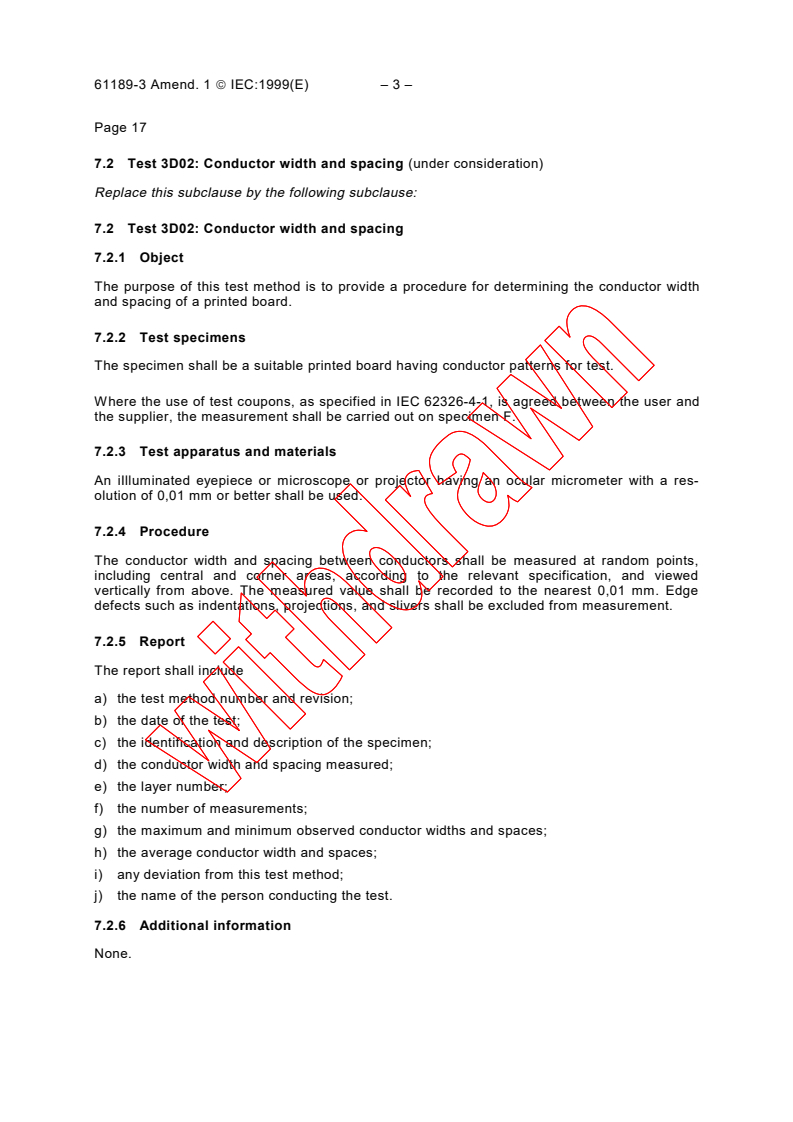
7.2 Test 3D02: Conductor width and spacing (under consideration)
Replace this subclause by the following subclause:
7.2 Test 3D02: Conductor width and spacing
7.2.1 Object
The purpose of this test method is to provide a procedure for determining the conductor width
and spacing of a printed board.
7.2.2 Test specimens
The specimen shall be a suitable printed board having conductor patterns for test.
Where the use of test coupons, as specified in IEC 62326-4-1, is agreed between the user and
the supplier, the measurement shall be carried out on specimen F.
7.2.3 Test apparatus and materials
An iIlluminated eyepiece or microscope or projector having an ocular micrometer with a res-
olution of 0,01 mm or better shall be used.
7.2.4 Procedure
The conductor width and spacing between conductors shall be measured at random points,
including central and corner areas, according to the relevant specification, and viewed
vertically from above. The measured value shall be recorded to the nearest 0,01 mm. Edge
defects such as indentations, projections, and slivers shall be excluded from measurement.
7.2.5 Report
The report shall include
a) the test method number and revision;
b) the date of the test;
c) the identification and description of the specimen;
d) the conductor width and spacing measured;
e) the layer number;
f) the number of measurements;
g) the maximum and minimum observed conductor widths and spaces;
h) the average conductor width and spaces;
i) any deviation from this test method;
j) the name of the person conducting the test.
7.2.6 Additional information
None.
– 4 – 61189-3 Amend. 1 IEC:1999(E)
Page 19
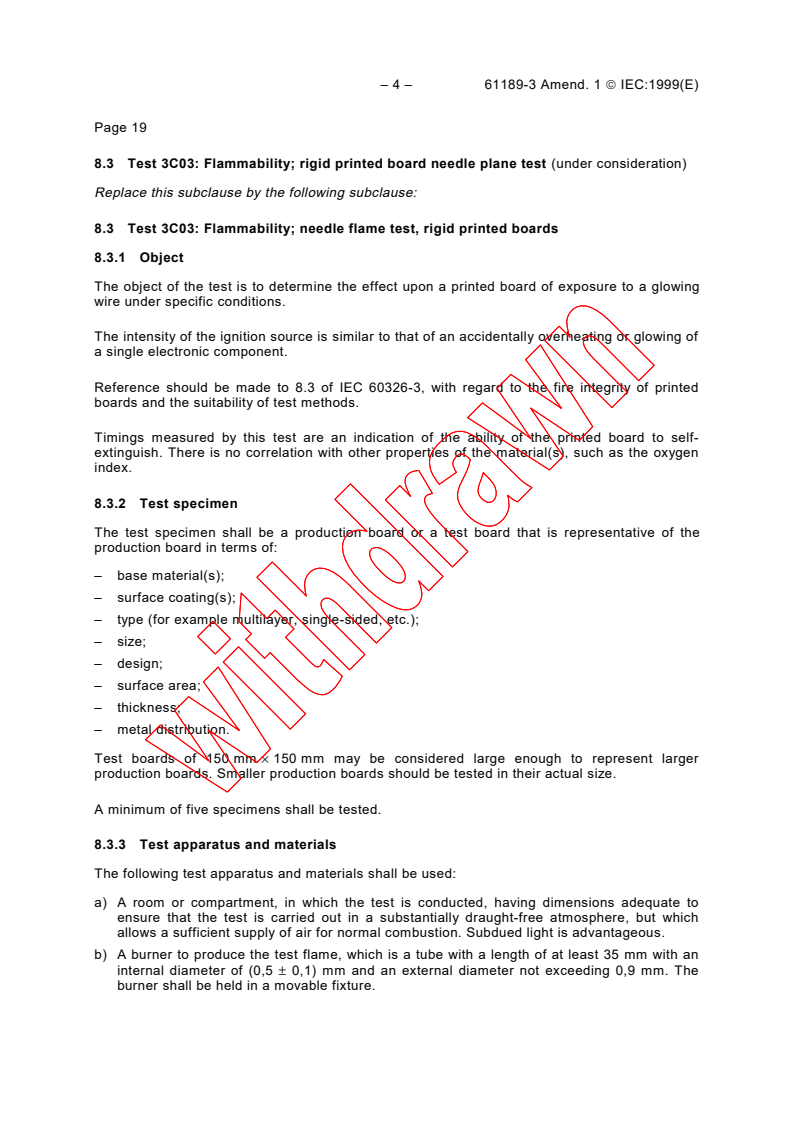
8.3 Test 3C03: Flammability; rigid printed board needle plane test (under consideration)
Replace this subclause by the following subclause:
8.3 Test 3C03: Flammability; needle flame test, rigid printed boards
8.3.1 Object
The object of the test is to determine the effect upon a printed board of exposure to a glowing
wire under specific conditions.
The intensity of the ignition source is similar to that of an accidentally overheating or glowing of
a single electronic component.
Reference should be made to 8.3 of IEC 60326-3, with regard to the fire integrity of printed
boards and the suitability of test methods.
Timings measured by this test are an indication of the ability of the printed board to self-
extinguish. There is no correlation with other properties of the material(s), such as the oxygen
index.
8.3.2 Test specimen
The test specimen shall be a production board or a test board that is representative of the
production board in terms of:
– base material(s);
– surface coating(s);
– type (for example multilayer, single-sided, etc.);
–size;
– design;
– surface area;
– thickness;
– metal distribution.
Test boards of 150 mm × 150 mm may be considered large enough to represent larger
production boards. Smaller production boards should be tested in their actual size.
A minimum of five specimens shall be tested.
8.3.3 Test apparatus and materials
The following test apparatus and materials shall be used:
a) A room or compartment, in which the test is conducted, having dimensions adequate to
ensure that the test is carried out in a substantially draught-free atmosphere, but which
allows a sufficient supply of air for normal combustion. Subdued light is advantageous.
b) A burner to produce the test flame, which is a tube with a length of at least 35 mm with an
internal diameter of (0,5 ± 0,1) mm and an external diameter not exceeding 0,9 mm. The
burner shall be held in a movable fixture.
61189-3 Amend. 1 IEC:1999(E) – 5 –
c) A burner shall be supplied with butane gas having a minimum purity of 95 %. No air may be
admitted to the burner tube. Propane gas may be used, but butane gas shall be the
reference.
The burner shall be adjusted whilst in a vertical axis, in order to produce a flame having a
height of (12 ± 1) mm. See figure 10a.
d) A wooden board to be placed underneath the specimen. The board shall be covered with
tissue paper which complies with 6.86 of ISO 4046. The distance between the lower edge
of the specimen and the tissue paper shall be (200 ± 5) mm.
e) A hand-operated timing device with a resolution of ±0,5 s or better.
f) An air circulating oven capable of maintaining (125 ± 5) °C.
g) A desiccator capable of maintaining 20 % R.H. or less.
8.3.4 Test procedure
The test specimens shall be pre-conditioned for 24 h at (125 ± 5) °C in an air-circulating oven.
The test specimens shall then be allowed to stabilize for 4 h at room temperature in a
desiccator over anhydrous calcium chloride.
The relevant specification shall detail the position of the test specimen and the point of
application of the flame (for example surface, edge). The attitude of the specimen (for example
horizontal or vertical) should mimic the intended mode of operation in the assembled
equipment.
Where surface application is used, the point of application of the flame shall, specimen size
permitting, not be less than 10 mm from the nearest edge, in order to minimize edge effects.
Where edge application is used, the flame shall not, specimen size permitting, be less than
10 mm from the nearest corner.
The burner shall be mounted at an angle of about 45°, so that any drops from the test
specimen can fall freely onto the underlying tissue paper.
If the intended operational attitude of the printed board is not known or is variable, the test
specimens shall be positioned as follows.
Edge application: The lower edge shall be horizontal and the specimen shall be inclined at
approximately 80°. The flame shall be applied to the lower side of the test specimen.
The burner shall be ignited away from the test specimen, and the height of the flame shall be
adjusted to (12 ± 2) mm. The burner shall then be positioned as described, so that the test
specimen penetrates the flame by approximately 2 mm. A vertical distance of between 8 mm
and 10 mm from the tip of the burner and the surface or edge to be tested is adequate for this
purpose. In the case of application to a vertical surface, a horizontal distance of approximately
5 mm is necessary.
The detail specification shall state the severity to be used.
Test flame application times as detailed in clause 5 of IEC 60695-2-2 are preferred. These
severities are: 5 s - 10 s - 20 s - 30 s - 60 s - 120 s.
– 6 – 61189-3 Amend. 1 IEC:1999(E)
8.3.5 Report
The report shall include
a) the test number and revision;
b) the date of the test;
c) the identification and description of the specimen;
d) the number of specimens, if other than five;
e) the position of the test specimens;
f) the point of application of the test flame;
g) the duration of application of the test flame;
h) for each specimen whether flames and/or burning or glowing particles fall from the test
specimen spreading fire to surrounding parts of the test specimen or to the tissue paper
beneath the test specimen;
i) for each specimen whether there is flame or glowing at the end of the application of the test
flame;
j) for each specimen whether the duration of burning is less than 30 s;
k) any deviation from this test method;
l) the name of the person conducting the test.
8.3.6 Additional information
There are obvious hazards associated with flammability testing. Training of test operators and
familiarity with laboratory safety procedures is of paramount importance.
The smoothness of the specimen edges can be critical to the performance of the sample. A
polished finish is recommended. A rough finish (for example blanked) will significantly degrade
performance due to the increase in surface area available to the flame.
Small-scale flammability tests, such as the one described herein, are an indicator of the
behaviour of the material(s) tested. Fire integrity of equipment in which printed boards are used
can only be assessed by equipment level testing.
61189-3 Amend. 1 IEC:1999(E) – 7 –
Detail requirements to be stated in specifications which reference this test method should be
based on clause 11 of IEC 60695-2-2.
10 mm
Specimen
Penetration of flame: approximately 2 mm
Burner
45°
IEC 857/99
Figure 10a – Horizontal specimen – Flame applied to surface
Specimen
Penetration of flame: approximately 2 mm
Burner
45°
IEC 858/99
Figure 10b – Horizontal specimen – Flame applied to edge
– 8 – 61189-3 Amend. 1 IEC:1999(E)
Specimen
Penetration of flame: approximately 2 mm
8 mm
to
10 mm
Burner
45°
IEC 859/99
Figure 10c – Vertical specimen – Lower edge horizontal – Flame applied to edge
Penetration of flame: approximately 2 mm
Specimen
Burner
Approximately
5 mm
45°
IEC 860/99
Figure 10d – Vertical specimen – Lower edge horizontal – Flame applied to surface
61189-3 Amend. 1 IEC:1999(E) – 9 –
Penetration of flame: approximately 2 mm
Specimen
Burner
80°
45°
IEC 861/99
Figure 10e – Needle burner test – Side views of test board and burner
Figure 10 – Needle burner test
Page 27
9.8 Test 3M08: Resistance of abrasion of printed board organic surface coatings
(under consideration)
Replace this subclause by the following subclause:
9.8 Test 3M08: Hardness (resistance to abrasion) of organic surface coatings
of printed circuit boards
9.8.1 Object
This test method details the procedure for the determination of the hardness of permanent
organic surface coatings used on printed boards.
– 10 – 61189-3 Amend. 1 IEC:1999(E)
Organic materials suitable for testing in accordance with this procedure include:
– permanent polymeric coatings;
– conductive inks;
– marking legend inks.
Hardness is determined by comparison with a standard set of pencils with increasing hardness.
9.8.2 Test specimens
The test specimen shall consist of a piece of metal-clad base material
(100 ± 10) mm × (100 ± 10) mm, with the organic surface coating applied and cured as
recommended by the supplier.
Alternatively, a coated portion of a production board may be used as agreed between the
customer and the supplier.
A minimum of three specimens (separate boards) shall be tested.
9.8.3 Test apparatus and materials
The following test apparatus and materials shall be used.
a) Test device (pencil holder, see figure 11).
b) Standard set of pencils of hardness from 4B to 8H.
4B, 3B, 2B, B, HB, F, H, 2H, 3H, 4H, 5H, 6H, 7H, 8H
Soft –––––––––––––––––––––––––––––––––––––––––––––––––– Hard
9.8.4 Procedure
Place the specimen on a firm horizontal surface.
The tips of all pencils shall be sharpened as shown in figure 11.
Starting with the hardest pencil in the carriage, push the carriage in the direction as illustrated
in figure 11 with a uniform forward force in a 20 mm to 30 mm stroke, whereby, because of the
weight of the specimen holder of (750 ± 25) g, a downard directed force of (7,65 ± 0,25) N will
result at the pencil tip. Proceed with the next softest pencil in succession until a pencil is used
which will not cut into or gouge the coating material. Used pencils shall be resharpened after
every test.
The hardness is an attribute, rather than a variable. No statement of uncertainty is required.
9.8.5 Report
The report shall include
a) the test method and revision;
b) the date of the test;
c) the identification and description of the specimen(s);
61189-3 Amend. 1 IEC:1999(E) – 11 –
d) the achieved hardness; i.e. the hardness of the pencil which failed to cut into or gouge the
organic surface coating;
e) the supplier and description of the pencil set;
f) any deviation from this test method;
g) the name of the person conducting the test.
9.8.6 Additional information
It is accepted that the results achieved using this test method are subjective in nature. To limit
this subjectivity, it is recommended that only professional grade draftsman’s pencils are used.
Where disputes between testing agencies result, an agreed single source of pencil should be
used for the test.
Pencil
Direction of motion
F = 7,65 N
Jack screw
45°
Operator
IEC 862/99
Figure 11 – Pencil holder
10.8 Test 3E08: Plated-through hole resistance change, thermo-cycle (under consideration)
Replace this subclause by the following subclause:
10.8 Test 3E08: Plated-through hole (pth) resistance change, thermal cycling
10.8.1 General
The purpose of this test method is to provide a procedure for determining the change in
resistance of plated-through holes that may occur when the holes are subjected to thermal
cycling. An alternative test method is 3E16: Plated-through hole (pth) and interconnection
resistance change, thermal shock.
– 12 – 61189-3 Amend. 1 IEC:1999(E)
10.8.2 Test specimens
The test specimens will have the following considerations.
a) The specimen shall be a suitable printed board, a test coupon or a composite test coupon
having a number of plated-through holes connected in series.
b) Where the use of test coupons, as specified in IEC 62326-4-1, is agreed upon between the
user and the supplier, the test shall be carried out on specimen A or B.
c) The specimen shall preferably not be tin-lead plated. If it is, the plating shall be chemically
removed prior to testing using a remover specified in 7.8.3 d), but care shall be taken to
avoid any detrimental effect on the copper.
10.8.3 Test apparatus and materials
The following test apparatus and materials shall be used.
a) A circulating air chamber capable of maintaining a uniform temperature of (85 ± 2) °C.
b) A thermal cycling chamber capable of cycling between –70 °C and +150 °C with a transfer
time of 1 min or less.
c) A milliohm meter with four-point probe with a measuring range of 1 MΩ to 1 Ω.
d) A tin-lead removal solution consisting of:
– 330 ml nitric acid 60 % (density, 1,36 g/cm at 20 °C);
– 3 ml fluoroboric acid 40 % (density, 1,32 g/cm at 20 °C);
– 670 ml deionized water.
10.8.4 Procedure
The specimen shall be conditioned by drying in the circulating air chamber for 1 h at
(85 ± 2) °C and cooled down to room temperature for testing.
The resistance of the plated-through holes connected in series shall be measured at a constant
current of (100 ± 5) mA using the four-point probe in the standard atmospheric conditions for
measurement and test. The measured resistance (R ) shall be recorded as the initial
resistance.
The resistance shall be monitored continuously during the test. The specimen shall be
connected to the recording device, for example by a suitable edge board connector.
61189-3 Amend. 1 IEC:1999(E) – 13 –
The thermal cycling shall be carried out choosing one of the following conditions according to
the procurement document. The total number of cycles shall be specified.
Condition A (1 cycle):
–65 °C ---------- 30 min.
Transfer ---------- 3 min.
−1
+125 °C ---------- 30 min.
Transfer ---------- 3 min.
−1
Condition B (1 cycle):
–65 °C ---------- 10 min.
Transfer ---------- 1 min. (Max.)
+125 °C ---------- 10 min.
Transfer ---------- 1 min. (Max.)
The resistance value (or the corresponding voltage drop) is plotted on a graph against the
number of cycles.
The increase of resistance in per cent (D) between R and R (the measured resistance at an
0 N
ambient temperature after N cycles) shall be calculated as follows:
R - R
N 0
D = × 100
R
where
R is the measured resistance after N thermal cycles;
N
R is the measured resistance after zero cycles;
D is the resistance increase (in per cent).
The maximum permissible increase in per cent of the resistance between R and R shall be
0 N
specified in the relevant specification.
The increase in resistance shall also be measured at +125 °C and calculated according to the
following formula:
R - R
125 N 0
D = × 100
R
where
R is the measured resistance at 125 °C after N thermal cycles;
125 N
R is the measured resistance after zero cycles;
D is the resistance increase (in per cent) at 125 °C.
10.8.5 Report
The report shall include
a) the test method number and revision;
b) the identification of the material tested;
– 14 – 61189-3 Amend. 1 IEC:1999(E)
c) the thermal cycling condition (A or B);
d) the number of cycles;
e) the maximum increase in per cent of resistance measured;
f) the maximum increase in per cent of resistance measured at 125 °C;
g) the date of the test;
h) any deviation from the test method;
i) the name of the person conducting the test.
10.8.6 Additional information
When using the tin-lead removal solution, it shall be handled with care, avoiding contact with
eyes and skin by wearing protective glasses and chemically resistant gloves respectively.
61189-3 Amend. 1 IEC:1999(E) – 15 –
IEC 862/99
Figure 2a is given to identify the locations of the specimens in the composite test pattern; it does not show the
pattern of layer L1.
Cross-hatched areas shown on specimens A, B, D, G, L are X-layer patterns.
Figure 12a – Location of test specimens
– 16 – 61189-3 Amend. 1 IEC:1999(E)
IEC 863/99
Figure 12b – Location of test specimens
Figure 12 – Composite test pattern
61189-3 Amend. 1 IEC:1999(E) – 17 –
10.9 Test 3E09: Voltage proof, surface layers (under consideration)
Replace this subclause by the following subclause:
10.9 Test 3E09: Voltage proof, surface layers
10.9.1 Object
To determine the ability of printed boards to withstand specified test voltages without any
disruptive discharges as evidenced by flashover (surface discharge), sparkover (air discharge)
or breakdown (puncture discharge). The discharge may be visually observed or indicated by
the test equipment in an appropriate manner.
10.9.2 Test specimens
The test shall be carried out on specified parts of a pattern on the surface of a printed board.
When parts on a surface layer of a multilayer printed board are specified for testing, care shall
be taken to avoid the influence of other parts or layers.
The specimen shall be handled carefully in order to avoid any contamination, for example
fingerprints, dust, etc.
10.9.3 Test apparatus and materials
The following test apparatus and materials shall be used: a d.c. voltage supply or an a.c. peak
voltage supply of approximately sinusoidal waveform and a frequency of 40 Hz to 60 Hz.
The equipment shall be capable of supplying the necessary high voltage. It shall indicate the
occurrence of disruptive discharge and/or specified leakage current in case of the failure not
being visible.
10.9.4 Procedure
10.9.4.1 Conditioning
The specimen shall be stored under standard atmospheric conditions for measurements and
test for 24 h.
10.9.4.2 Testing
Apply the voltage between the specified test points. Increase the voltage gradually from zero
during 5 s up to the specified value. Maintain the value for 1 min.
10.9.5 Report
The report shall include
a) test method number and revision;
b) the identification of the test material;
c) the points of application;
d) the test voltage;
e) the maximum leakage current;
f) the date of the test;
g) any deviation from this test method;
h) the name of the person that conducted the test.
– 18 – 61189-3 Amend. 1 IEC:1999(E)
10.9.6 Additional information
None.
10.10 Test 3E10: Voltage proof, between layers (under consideration)
Replace this subclause by the following subclause:
10.10 Test 3E10: Voltage proof between layers
10.10.1 Object
To determine the ability of a printed board to withstand specified test voltages without any
disruptive discharges as indicated by the test equipment.
10.10.2 Test specimens
The test shall be carried out on specified parts of a pattern on adjacent layers of a printed
board.
The specimen shall be handled carefully in order to avoid any contamination, for example
fingerprints, dust, etc.
10.10.3 Test apparatus and materials
The following test apparatus and materials shall be used: a d.c. voltage supply or an a.c. peak
voltage supply of approximately sinusoidal waveform and a frequency of 40 Hz to 60 Hz.
The equipment shall be capable of supplying the necessary high voltage. It shall indicate the
occurrence of disruptive discharge and/or specified leakage current in case of the failure not
being visible.
10.10.4 Procedure
10.10.4.1 Conditioning
The specimen shall be stored under standard atmospheric conditions for measurement and
tests for 24 h.
10.10.4.2 Testing
Apply the voltage between the specified test points. Increase the voltage gradually during 5 s
up to the specified value. Maintain the value for 1 min.
10.10.5 Report
The report shall include
a) the test method number and revision;
b) the identification of the test material;
c) the points of application;
d) the test voltage;
61189-3 Amend. 1 IEC:1999(E) – 19 –
e) the maximum leakage current;
f) the date of the test;
g) any deviation from this test method;
h) the name of the person conducting the test.
10.10.6 Additional information
None.
Page 31
11.2 Test 3N02: Thermal shock, float, solder 280 °C (under consideration)
Replace this subclause by the following subclause:
11.2 Test 3N02: Thermal shock, floating, solder bath
11.2.1 Object
To determine whether the construction integrity of a printed board has the ability to withstand a
thermal shock delivered through exposure to a molten solder bath. This method is intended to
simulate the assembly process, wave or drag soldering, where the heat exposure is mainly
from one side.
11.2.2 Test specimens
Specimens shall be removed from the printed board, the panel, or test coupon by sawing,
routing, or equivalent method. Allow sufficient clearance to prevent damage to the area to be
tested.
Remove the specimen in such a manner that at least three of the smallest size through-holes
can be viewed in a finished microsection.
11.2.3 Test apparatus and materials
The following test apparatus and materials shall be used:
a) A solder pot of suitable design, electrically heated, thermostatically controlled and
+5
containing at least 1 kg of Sn60, Sn62, or Sn63. The test temperature shall be (260 ) °C.
b) A thermometer for measuring the temperature of the solder at a depth of 25 mm below the
surfaces.
c) A timer with a resolution of ±1 s or better.
d) A low- or non-activated water soluble flux.
11.2.4 Procedure
Coat the surface and the plated through-holes of the specimen with flux.
Remove the oxide from the solder, and float the specimen on the solder in a manner that only
one side is in contact with the solder. The specimens shall be floated for the time specified in
the relevant specification.
– 20 – 61189-3 Amend. 1 IEC:1999(E)
Remove the specimens from the solder pot and allow to cool to ambient temperature.
After cooling, the specimens shall be cleaned with isopropyl alcohol and air dried.
The specimens shall then be microsectioned in accordance with test method 3X09 and
examined for conformance.
11.2.5 Report
The report shall include:
a) the test method number and revision;
b) the date of the test;
c) the identification and description of the specimen(s);
d) the results of the microsectional evaluation;
e) detailed description of test specimen including, but not limited to preparation, size, quantity,
and drying time/temperature;
f) solder composition, and flux type;
g) any deviation from this test method;
h) the name of the person conducting the test.
11.2.6 Additional information
Evaluation criteria include, but are not limited to:
– delamination;
– interconnection separation;
– through-hole cracks;
– lifted lands;
– resin recession.
Page 53
Add the following new subclause:
12.0 Test 3X10: Solderability, rotary dip test
Under consideration.
12.4 Test 3X04: Porosity, electrographic, gold on copper
Replace this subclause by the following subclause:
12.4 Test 3X04: Porosity, electrographic test, gold on copper (under consideration)
12.4.1 Object
To detect discontinuities in certain metal platings on printed boards by an electrographic
method.
61189-3 Amend. 1 IEC:1999(E) – 21 –
The test is suitable for the examination of gold, palladium, and rhodium coating on copper
without an undercoat of nickel.
The test described is known as the electrographic dye transfer method.
12.4.2 Test specimens
A suitable part of a production board with gold, palladium or rhodium coatings on copper.
NOTE – Electrical connection will have to be made to coated areas either via the printed circuit conductors or by
using a conductive tape which is insulated on one side.
The coated areas should be wiped with a lint-free cloth dipped in a neutral organic solvent
(for example acetone) to remove grease, etc.
12.4.3 Test apparatus and materials
The following test apparatus and materials shall be used.
a) An electrographic test machine with high-purity aluminium platen of nominal size
150 mm × 25 mm to act as cathode, capable of exerting pressure up to 200 N/cm and
delivering a smooth ripple-free d.c. current from a source not exceeding 12 V.
b) Dye transfer paper, grade FDW, i.e. high-quality photographic paper coated with a gelatin
layer but not photosensitive, cut to a convenient size.
c) An electrolyte which is 0,01 molar with respect to both sodium chloride and sodium
carbonate, i.e. dissolve 0,59 g of NaCl and 1,06 g of Na CO together in 1 l of distilled
2 3
water.
d) A developing solution of dithio-oxamide (rubeanic acid), 0,25
...
NORME CEI
INTERNATIONALE
IEC
61189-3
INTERNATIONAL
STANDARD
AMENDEMENT 1
AMENDMENT 1
1999-07
Amendement 1
Méthodes d'essai pour les matériaux
électriques, les structures d'interconnexion
et les ensembles –
Partie 3:
Méthodes d'essai des structures
d'interconnexion (cartes imprimées)
Amendment 1
Test methods for electrical materials,
interconnection structures and assemblies –
Part 3:
Test methods for interconnection structures
(printed boards)
IEC 2006 Droits de reproduction réservés Copyright - all rights reserved
International Electrotechnical Commission, 3, rue de Varembé, PO Box 131, CH-1211 Geneva 20, Switzerland
Telephone: +41 22 919 02 11 Telefax: +41 22 919 03 00 E-mail: inmail@iec.ch Web: www.iec.ch
CODE PRIX
V
Commission Electrotechnique Internationale
PRICE CODE
International Electrotechnical Commission
МеждународнаяЭлектротехническаяКомиссия
Pour prix, voir catalogue en vigueur
For price, see current catalogue
– 2 – 61189-3 Amend. 1 CEI:2006
AVANT PROPOS
Le présent amendement a été établi par le comité d'études 52 de la CEI: Circuits imprimés.
Cette version bilingue (2006-08) remplace la version monolingue anglaise.
Le texte anglais de cet amendement est basé sur les documents 52/805/FDIS et 52/825/RVD.
Le rapport de vote 52/825/RVD donne toute information sur le vote ayant abouti à l’approbation
de cet amendement.
La version française n’a pas été soumise au vote.
Le comité a décidé que le contenu de cet amendement et de la publication de base ne sera
pas modifié avant la date de maintenance indiquée sur le site web de la CEI sous
"http://webstore.iec.ch" dans les données relatives à la publication recherchée. A cette date, la
publication sera
• reconduite,
• supprimée,
• remplacée par une édition révisée, ou
• amendée.
___________
Page 2
SOMMAIRE
Ajouter les figures suivantes à la liste des figures:
Figure 10 – Essai du brûleur à aiguille
Figure 11 – Porte-crayon
Figure 12 – Montage d’essai combiné
Figure 13 – Eprouvette d’essai
Page 8
2 Références normatives
Insérer, dans la liste existante, les titres des normes suivantes:
CEI 60454-1:1992, Spécifications pour rubans adhésifs par pression à usages électriques –
Partie 1: Prescriptions générales
CEI 60695-2-2:1991, Essais relatifs aux risques du feu – Partie 2: Méthodes d’essai –
Section 2: Essai au brûleur- aiguille
CEI 62326-4:1996, Cartes imprimées – Partie 4: Cartes imprimées multicouches rigides avec
connexions intercouches – Spécification intermédiaire
CEI 62326-4-1:1996, Cartes imprimées – Partie 4: Cartes imprimées multicouches rigides avec
connexions intercouches – Spécification intermédiaire – Section 1: Spécification particulière
d'agrément – Niveaux de performance A, B et C
ISO 4046:1978, Papier, carton, pâtes et termes connexes – Vocabulaire
61189-3 Amend. 1 IEC:2006 – 3 –
FOREWORD
This amendment has been prepared by IEC technical committee 52: Printed circuits.
This bilingual version (2006-08) replaces the English version.
The text of this amendment is based on the following documents:
FDIS Report on voting
52/805/FDIS 52/825/RVD
Full information on the voting for the approval of this amendment can be found in the report on
voting indicated in the above table.
The French version of this amendment has not been voted upon.
The committee has decided that the contents of this amendment and the base publication will
remain unchanged until the maintenance result date indicated on the IEC web site under
"http://webstore.iec.ch" in the data related to the specific publication. At this date, the
publication will be
• reconfirmed,
• withdrawn,
• replaced by a revised edition, or
• amended.
___________
Page 3
CONTENTS
Add the following figures to the list of figures:
Figure 10 – Needle burner test
Figure 11 – Pencil holder
Figure 12 – Composite test pattern
Figure 13 – Test specimen
Page 9
2 Normative references
Insert, in the existing list, the titles of the following standards:
IEC 60454-1:1992, Specifications for pressure-sensitive adhesive tapes for electrical purposes –
Part 1: General requirements
IEC 60695-2-2:1991, Fire hazard testing – Part 2: Test methods – Section 2: Needle-flame test
IEC 62326-4:1996, Printed boards – Part 4: Rigid multilayer printed boards with interlayer
connections – Sectional specification
IEC 62326-4-1:1996, Printed boards – Part 4: Rigid multilayer printed boards with interlayer
connections – Sectional specification – Section 1: Capability Detail Specification –
Performance levels A, B and C
ISO 4046:1978, Paper, board, pulp and related terms – Vocabulary
– 4 – 61189-3 Amend. 1 CEI:2006
Page 16
7.2 Essai 3D02: Largeur du conducteur et espacement (à l'étude)
Remplacer ce paragraphe par le paragraphe suivant:
7.2 Essai 3D02: Largeur du conducteur et espacement
7.2.1 Objet
L'objet de cette méthode d'essai est de fournir une procédure pour déterminer la largeur du
conducteur et l’espacement d’une carte imprimée.
7.2.2 Eprouvettes d’essai
L’éprouvette doit être une carte imprimée adaptée et possédant des pistes conductrices pour
l’essai.
Lorsque des éprouvettes sont utilisées comme spécifié dans la CEI 62326-4-1 et selon accord
entre l'utilisateur et le fournisseur, la mesure doit être effectuée sur l’éprouvette F.
7.2.3 Appareillage d'essai et matériaux
On doit utiliser, soit un oculaire éclairé, soit un microscope, soit un projecteur possédant un
micromètre oculaire ayant une résolution de 0,01 mm ou supérieure.
7.2.4 Mode opératoire
La largeur du conducteur et l’espacement entre les conducteurs doivent être mesurés en des
points choisis au hasard et incluant des zones centrales et périphériques, selon la spécification
applicable, et observés verticalement depuis le dessus. La valeur mesurée doit être
enregistrée au plus près des 0,01 mm. Les défauts de bord tels que les empreintes, les arêtes
et les éclats doivent être exclus de la mesure.
7.2.5 Rapport
Le rapport doit comporter
a) le numéro de la méthode d’essai et l’indice de révision;
b) la date de l'essai;
c) l’identification et la description de l’éprouvette;
d) la largeur du conducteur et l’espacement mesurés;
e) le nombre de couches;
f) le nombre de mesures;
g) les largeurs minimales et maximales observées du conducteur et les espacements;
h) la largeur moyenne du conducteur et les espacements;
i) tout écart par rapport à la présente méthode d'essai;
j) le nom de la personne qui effectue l’essai.
7.2.6 Information complémentaire
Aucune.
61189-3 Amend. 1 IEC:2006 – 5 –
Page 17
7.2 Test 3D02: Conductor width and spacing (under consideration)
Replace this subclause by the following subclause:
7.2 Test 3D02: Conductor width and spacing
7.2.1 Object
The purpose of this test method is to provide a procedure for determining the conductor width
and spacing of a printed board.
7.2.2 Test specimens
The specimen shall be a suitable printed board having conductor patterns for test.
Where the use of test coupons, as specified in IEC 62326-4-1, is agreed between the user and
the supplier, the measurement shall be carried out on specimen F.
7.2.3 Test apparatus and materials
An iIlluminated eyepiece or microscope or projector having an ocular micrometer with a res-
olution of 0,01 mm or better shall be used.
7.2.4 Procedure
The conductor width and spacing between conductors shall be measured at random points,
including central and corner areas, according to the relevant specification, and viewed
vertically from above. The measured value shall be recorded to the nearest 0,01 mm. Edge
defects such as indentations, projections, and slivers shall be excluded from measurement.
7.2.5 Report
The report shall include
a) the test method number and revision;
b) the date of the test;
c) the identification and description of the specimen;
d) the conductor width and spacing measured;
e) the layer number;
f) the number of measurements;
g) the maximum and minimum observed conductor widths and spaces;
h) the average conductor width and spaces;
i) any deviation from this test method;
j) the name of the person conducting the test.
7.2.6 Additional information
None.
– 6 – 61189-3 Amend. 1 CEI:2006
Page 18
8.3 Essai 3C03: Inflammabilité; essai au brûleur-aiguille sur cartes imprimées rigides
(à l'étude)
Remplacer ce paragraphe par le paragraphe suivant:
8.3 Essai 3C03: Inflammabilité; essai au brûleur-aiguille, cartes imprimées rigides
8.3.1 Objet
L’objet de l’essai est de déterminer l’effet sur une carte imprimée suite à l’exposition d’un fil
incandescent dans des conditions spécifiques.
L’intensité de la source d’inflammation est équivalente à celle d’une surchauffe accidentelle ou
de l’incandescence d’un seul composant électronique.
Il convient de faire référence à 8.3 de la CEI 60326-3, relatif à l’étanchéité au feu des cartes
imprimées et à l’adaptabilité des méthodes d’essai.
Les durées mesurées par cet essai sont une indication de la capacité de la carte imprimée à
s’éteindre toute seule. Il n’y a pas de corrélation avec d’autres propriétés de matériau(x), tel
que l’indice d’oxygène.
8.3.2 Eprouvette d’essai
Le spécimen d'essai doit être une carte de production ou une carte d’essai qui est
représentative d’une carte de production en terme de:
– matériau(x) de base;
– revêtement(s) de surface;
– type (par exemple multicouche, simple face, etc.);
– taille;
– conception;
– superficie;
– épaisseur;
– répartition métallique.
Les cartes d’essai de 150 mm × 150 mm peuvent être considérées suffisamment grandes pour
représenter des cartes de production plus grandes. Il convient que les cartes de production
plus petites soient soumises aux essais dans leurs tailles réelles.
Un minimum de cinq éprouvettes doivent être soumises aux essais.
8.3.3 Appareillage d’essai et matériaux
Les appareillages d’essai et les matériaux suivants doivent être utilisés:
a) Une pièce ou un compartiment, dans lequel l’essai est réalisé, possédant des dimensions
adéquates pour garantir que l’essai soit effectué pratiquement dans une atmosphère sans
courant d’air, mais qui autorise une alimentation en air suffisante afin d’obtenir une
combustion normale. Une lumière tamisée est avantageuse.
61189-3 Amend. 1 IEC:2006 – 7 –
Page 19
8.3 Test 3C03: Flammability; rigid printed board needle flame
test (under consideration)
Replace this subclause by the following subclause:
8.3 Test 3C03: Flammability; needle flame test, rigid printed boards
8.3.1 Object
The object of the test is to determine the effect upon a printed board of exposure to a glowing
wire under specific conditions.
The intensity of the ignition source is similar to that of an accidentally overheating or glowing of
a single electronic component.
Reference should be made to 8.3 of IEC 60326-3, with regard to the fire integrity of printed
boards and the suitability of test methods.
Timings measured by this test are an indication of the ability of the printed board to self-
extinguish. There is no correlation with other properties of the material(s), such as the oxygen
index.
8.3.2 Test specimen
The test specimen shall be a production board or a test board that is representative of the
production board in terms of:
– base material(s);
– surface coating(s);
– type (for example multilayer, single-sided, etc.);
– size;
– design;
– surface area;
– thickness;
– metal distribution.
Test boards of 150 mm × 150 mm may be considered large enough to represent larger
production boards. Smaller production boards should be tested in their actual size.
A minimum of five specimens shall be tested.
8.3.3 Test apparatus and materials
The following test apparatus and materials shall be used:
a) A room or compartment, in which the test is conducted, having dimensions adequate to
ensure that the test is carried out in a substantially draught-free atmosphere, but which
allows a sufficient supply of air for normal combustion. Subdued light is advantageous.
– 8 – 61189-3 Amend. 1 CEI:2006
b) Un brûleur pour fournir la flamme d’essai, qui est un tube d’une longueur d’au moins
35 mm, d’un diamètre intérieur de (0,5 ± 0,1) mm et d’un diamètre extérieur ne dépassant
pas 0,9 mm. Le brûleur doit être maintenu par un dispositif de fixation mobile.
c) Un brûleur doit être alimenté en butane ayant une pureté minimale de 95 %. On ne peut
pas admettre de l’air dans le tube du brûleur. On peut utiliser du propane mais le butane
doit être le gaz de référence.
Le brûleur doit être réglé en étant disposé selon un axe vertical, afin de produire une
flamme possédant une hauteur de (12 ± 1) mm. Voir Figure 10a.
d) Une planche de bois doit être placée en dessous de l’éprouvette. La planche doit être
recouverte d’un papier de soie qui est conforme à 6.86 de l’ISO 4046. La distance entre le
bord le plus bas de l’éprouvette et le papier de soie doit être de (200 ± 5) mm.
e) Un dispositif de chronométrage commandé manuellement avec une résolution de ± 0,5 s ou
supérieure.
f) Un four à circulation d'air capable de maintenir une température de (125 ± 5) °C.
g) Un dessiccateur capable de maintenir une humidité relative de 20 % (R.H) ou inférieur.
8.3.4 Procédure d’essai
Les éprouvettes d’essai doivent être préconditionnées pendant 24 h à (125 ± 5) °C dans un
four à circulation d'air. On doit alors laisser les éprouvettes d’essai se stabiliser pendant 4 h à
température ambiante dans un dessiccateur comportant du chlorure de calcium anhydre.
La spécification applicable doit détailler la position de l’éprouvette d’essai et le point
d’application de la flamme (par exemple la surface, le bord). Il convient que l’orientation de
l’éprouvette (par exemple horizontale ou verticale) corresponde au mode de fonctionnement
prévu dans l’équipement assemblé.
Lorsque l’on utilise une application de surface, le point d’application de la flamme doit, si la
taille de l’éprouvette le permet, ne pas être à moins de 10 mm du bord le plus proche, afin
d’atténuer les effets de bord.
Lorsque l’on utilise une application de bord, la flamme ne doit, si la taille de l’éprouvette le
permet, pas être à moins de 10 mm du coin le plus proche.
Le brûleur doit être monté de manière à présenter un angle d’environ 45°, afin qu’aucune
goutte provenant de l’éprouvette d’essai puisse tomber librement sur le papier de soie sous-
jacent.
Si la position de fonctionnement prévue de la carte imprimée n’est pas connue ou variable, les
éprouvettes d’essai doivent être disposées comme suit.
Application de bord: Le bord le plus bas doit être horizontal et l’éprouvette doit être
approximativement inclinée à 80°. La flamme doit être appliquée sur le côté le plus bas de
l’éprouvette d’essai.
Le brûleur doit être mis à feu loin de l’éprouvette d’essai et la hauteur de la flamme doit être
réglée à (12 ± 2) mm. Le brûleur doit être alors positionné comme décrit, de sorte que
l’éprouvette d’essai pénètre la flamme d’approximativement 2 mm. Une distance verticale
comprise entre 8 mm et 10 mm entre le bec du brûleur et la surface ou le bord à soumettre aux
essais est appropriée pour cet essai. Dans le cas d’une application sur une surface verticale,
une distance horizontale d’approximativement 5 mm est nécessaire.
La spécification particulière doit mentionner la sévérité que l’on doit utiliser.
Les durées d’application de la flamme d’essai, comme cela est indiqué dans l'Article 5 de la
CEI 60695-2-2, sont privilégiées. Ces sévérités sont: 5 s - 10 s - 20 s - 30 s - 60 s - 120 s.
61189-3 Amend. 1 IEC:2006 – 9 –
b) A burner to produce the test flame, which is a tube with a length of at least 35 mm with an
internal diameter of (0,5 ± 0,1) mm and an external diameter not exceeding 0,9 mm. The
burner shall be held in a movable fixture.
c) A burner shall be supplied with butane gas having a minimum purity of 95 %. No air may be
admitted to the burner tube. Propane gas may be used, but butane gas shall be the
reference.
The burner shall be adjusted whilst in a vertical axis, in order to produce a flame having a
height of (12 ± 1) mm. See Figure 10a.
d) A wooden board to be placed underneath the specimen. The board shall be covered with
tissue paper which complies with 6.86 of ISO 4046. The distance between the lower edge
of the specimen and the tissue paper shall be (200 ± 5) mm.
e) A hand-operated timing device with a resolution of ±0,5 s or better.
f) An air circulating oven capable of maintaining (125 ± 5) °C.
g) A desiccator capable of maintaining 20 % R.H. or less.
8.3.4 Test procedure
The test specimens shall be pre-conditioned for 24 h at (125 ± 5) °C in an air-circulating oven.
The test specimens shall then be allowed to stabilize for 4 h at room temperature in a
desiccator over anhydrous calcium chloride.
The relevant specification shall detail the position of the test specimen and the point of
application of the flame (for example surface, edge). The attitude of the specimen (for example
horizontal or vertical) should mimic the intended mode of operation in the assembled
equipment.
Where surface application is used, the point of application of the flame shall, specimen size
permitting, not be less than 10 mm from the nearest edge, in order to minimize edge effects.
Where edge application is used, the flame shall not, specimen size permitting, be less than
10 mm from the nearest corner.
The burner shall be mounted at an angle of about 45°, so that any drops from the test
specimen can fall freely onto the underlying tissue paper.
If the intended operational attitude of the printed board is not known or is variable, the test
specimens shall be positioned as follows.
Edge application: The lower edge shall be horizontal and the specimen shall be inclined at
approximately 80°. The flame shall be applied to the lower side of the test specimen.
The burner shall be ignited away from the test specimen, and the height of the flame shall be
adjusted to (12 ± 2) mm. The burner shall then be positioned as described, so that the test
specimen penetrates the flame by approximately 2 mm. A vertical distance of between 8 mm
and 10 mm from the tip of the burner and the surface or edge to be tested is adequate for this
purpose. In the case of application to a vertical surface, a horizontal distance of approximately
5 mm is necessary.
The detail specification shall state the severity to be used.
Test flame application times as detailed in Clause 5 of IEC 60695-2-2 are preferred. These
severities are: 5 s - 10 s - 20 s - 30 s - 60 s - 120 s.
– 10 – 61189-3 Amend. 1 CEI:2006
8.3.5 Rapport
Le rapport doit comporter
a) le numéro d'essai et l’indice de révision;
b) la date de l'essai;
c) l’identification et la description de l’éprouvette;
d) le nombre d’éprouvettes si différent de cinq;
e) la position des éprouvettes d’essai;
f) le point d'application de la flamme d'essai;
g) la durée de l'application de la flamme d'essai;
h) pour chaque éprouvette si ce sont des flammes et/ou la combustion ou des particules
incandescentes qui tombent de l’éprouvette d’essai en propageant le feu sur les parties aux
alentours de l’éprouvette d’essai ou sur le papier de soie en dessous de l’éprouvette
d’essai;
i) pour chaque éprouvette si à la fin de l’application de la flamme d’essai il y a une flamme ou
une incandescence;
j) pour chaque éprouvette si la durée de combustion est inférieure à 30 s ;
k) tout écart par rapport à la présente méthode d'essai;
l) le nom de la personne qui effectue l’essai.
8.3.6 Information complémentaire
Il existe des risques évidents liés aux essais d‘inflammabilité. La formation des opérateurs
d’essai et leur connaissance des procédures de sécurité des laboratoires est d’une importance
fondamentale.
L’aspect lisse des bords de l’éprouvette peut être critique pour la performance de l'échantillon.
Un lustrage de finition est recommandé. Une finition grossière (par exemple incomplète)
dégradera significativement la performance à cause de l’augmentation de la superficie rendue
disponible pour la flamme.
Des essais d'inflammabilité à petite échelle, tel que celui décrit ici, sont un indicateur du
comportement du ou des matériaux soumis aux essais. L’étanchéité au feu de l’équipement
dans lequel des cartes imprimées sont utilisées ne peut être évalué que par le niveau d’essai
de l’équipement.
Il convient que les exigences particulières qui sont indiquées dans les spécifications faisant
référence à la présente méthode d’essai soient basées sur l’Article 11 de la CEI 60695-2-2.
61189-3 Amend. 1 IEC:2006 – 11 –
8.3.5 Report
The report shall include
a) the test number and revision;
b) the date of the test;
c) the identification and description of the specimen;
d) the number of specimens, if other than five;
e) the position of the test specimens;
f) the point of application of the test flame;
g) the duration of application of the test flame;
h) for each specimen whether flames and/or burning or glowing particles fall from the test
specimen spreading fire to surrounding parts of the test specimen or to the tissue paper
beneath the test specimen;
i) for each specimen whether there is flame or glowing at the end of the application of the test
flame;
j) for each specimen whether the duration of burning is less than 30 s;
k) any deviation from this test method;
l) the name of the person conducting the test.
8.3.6 Additional information
There are obvious hazards associated with flammability testing. Training of test operators and
familiarity with laboratory safety procedures is of paramount importance.
The smoothness of the specimen edges can be critical to the performance of the sample. A
polished finish is recommended. A rough finish (for example blanked) will significantly degrade
performance due to the increase in surface area available to the flame.
Small-scale flammability tests, such as the one described herein, are an indicator of the
behaviour of the material(s) tested. Fire integrity of equipment in which printed boards are used
can only be assessed by equipment level testing.
Detail requirements to be stated in specifications which reference this test method should be
based on Clause 11 of IEC 60695-2-2.
– 12 – 61189-3 Amend. 1 CEI:2006
10 mm
Eprouvette
Pénétration de la flamme: approximativement 2 mm
Brûleur
45°
IEC 857/99
Figure 10a – Éprouvette en position horizontale – Flamme appliquée sur la surface
Eprouvette
Pénétration de la flamme: approximativement 2 mm
Brûleur
45°
IEC 858/99
Figure 10b – Éprouvette en position horizontale – Flamme appliquée sur le bord
61189-3 Amend. 1 IEC:2006 – 13 –
10 mm
Specimen
Penetration of flame: approximately 2 mm
Burner
45°
IEC 857/99
Figure 10a – Horizontal specimen – Flame applied to surface
Specimen
Penetration of flame: approximately 2 mm
Burner
45°
IEC 858/99
Figure 10b – Horizontal specimen – Flame applied to edge
– 14 – 61189-3 Amend. 1 CEI:2006
Eprouvette
Pénétration de la flamme: approximativement 2 mm
8 mm
à
10 mm
Brûleur
45°
IEC 859/99
Figure 10c – Éprouvette en position verticale – Bord horizontal le plus bas –
Flamme appliquée sur le bord
Pénétration de la flamme: approximativement 2 mm
Eprouvette
Brûleur
Approximativement
5 mm
45°
IEC 860/99
Figure 10d – Éprouvette en position verticale – Bord horizontal le plus bas –
Flamme appliquée sur la surface
61189-3 Amend. 1 IEC:2006 – 15 –
Specimen
Penetration of flame: approximately 2 mm
8 mm
to
10 mm
Burner
45°
IEC 859/99
Figure 10c – Vertical specimen – Lower edge horizontal – Flame applied to edge
Penetration of flame: approximately 2 mm
Specimen
Burner
Approximately
5 mm
45°
IEC 860/99
Figure 10d – Vertical specimen – Lower edge horizontal – Flame applied to surface
– 16 – 61189-3 Amend. 1 CEI:2006
Pénétration de la flamme: approximativement 2 mm
Eprouvette
Brûleur
80°
45°
IEC 861/99
Figure 10e – Essai au brûleur-aiguille – Vues latérales de la carte d’essai et du brûleur
Figure 10 – Essai au brûleur-aiguille
Page 26
9.8 Essai 3M08: Résistance à l'abrasion des revêtements organiques de surface de la
carte imprimée (à l'étude)
Remplacer ce paragraphe par le paragraphe suivant:
9.8 Essai 3M08: Dureté (résistance à l'abrasion) des revêtements organiques de surface
des cartes à circuits imprimés
9.8.1 Objet
La présente méthode d’essai détaille la procédure pour déterminer la dureté des revêtements
organiques de surface permanents utilisés sur les cartes imprimées.
Les matériaux organiques adaptés pour les essais conformément à la présente procédure
incluent:
– des revêtements polymères permanents;
– des encres conductrices;
– des encres de marquage pour légende.
La dureté est déterminée par comparaison avec un jeu de crayons normalisés dont la dureté
augmente.
9.8.2 Eprouvettes d’essai
L’éprouvette d’essai doit être constituée d’un morceau de matériau de base métallisé de (100 ±
10) mm × (100 ± 10) mm, dont le revêtement organique de surface est appliqué et traité selon
les recommandations du fournisseur.
61189-3 Amend. 1 IEC:2006 – 17 –
Penetration of flame: approximately 2 mm
Specimen
Burner
80°
45°
IEC 861/99
Figure 10e – Needle burner test – Side views of test board and burner
Figure 10 – Needle burner test
Page 27
9.8 Test 3M08: Resistance of abrasion of printed board organic surface coatings
(under consideration)
Replace this subclause by the following subclause:
9.8 Test 3M08: Hardness (resistance to abrasion) of organic surface coatings
of printed circuit boards
9.8.1 Object
This test method details the procedure for the determination of the hardness of permanent
organic surface coatings used on printed boards.
Organic materials suitable for testing in accordance with this procedure include:
– permanent polymeric coatings;
– conductive inks;
– marking legend inks.
Hardness is determined by comparison with a standard set of pencils with increasing hardness.
9.8.2 Test specimens
The test specimen shall consist of a piece of metal-clad base material (100 ± 10) mm ×
(100 ± 10) mm, with the organic surface coating applied and cured as recommended by the
supplier.
– 18 – 61189-3 Amend. 1 CEI:2006
Sinon, la partie recouverte de la carte de production peut être utilisée si elle fait l'objet d'un
accord entre le fournisseur et le client.
Un minimum de trois éprouvettes (cartes séparées) doivent être soumises aux essais.
9.8.3 Appareillage d’essai et matériaux
Les appareillages d’essai et les matériaux suivants doivent être utilisés.
a) Dispositif d'essai (porte-crayon, voir Figure 11).
b) Jeu de crayons normalisés d’une dureté comprise entre 4B et 8H.
4B, 3B, 2B, B, HB, F, H, 2H, 3H, 4H, 5H, 6H, 7H, 8H
Tendre –––––––––––––––––––––––––––––––––––––––––––––––––– Dur
9.8.4 Mode opératoire
Placer l’éprouvette sur une surface horizontale stable.
Les pointes de tous les crayons doivent être taillées comme indiqué à la Figure 11.
Commencer avec le crayon le plus dur dans le chariot, pousser le chariot dans la direction telle
qu’illustrée à la Figure 11 d’une force uniforme vers l’avant sur une course de 20 mm à 30 mm,
où bien, en raison du poids du support de l’éprouvette de (750 ± 25) g, d’une force dirigée vers
le bas de (7,65 ± 0,25) N qui aboutira sur la pointe du crayon. Poursuivre avec les prochains
crayons d’essai tendres successifs jusqu’à ce que le crayon utilisé n'endommage plus ou
n’entaille plus le revêtement du matériau. Les crayons utilisés doivent être retaillés après
chaque essai.
La dureté est une qualité, plutôt qu’une variable. Aucune indication d’incertitude n’est
nécessaire.
9.8.5 Rapport
Le rapport doit comporter
a) la méthode d'essai et l’indice de révision;
b) la date de l'essai;
c) l’identification et la description de ou des éprouvettes;
d) la dureté obtenue; c’est-à-dire la dureté du crayon qui convient pour endommager ou
entailler le revêtement de surface organique;
e) le fournisseur et la description du jeu de crayons;
f) tout écart par rapport à la présente méthode d'essai;
g) le nom de la personne qui effectue l’essai.
9.8.6 Information complémentaire
Il est admis que les résultats obtenus en utilisant la présente méthode d’essai sont subjectifs
par nature. Pour limiter cette subjectivité, il est recommandé que seulement des crayons de
dessinateur de qualité professionnelle soient utilisés. Lorsque des litiges entre les laboratoires
d’essai apparaissent, il convient qu’après accord une unique source de crayon soit utilisé pour
l’essai.
61189-3 Amend. 1 IEC:2006 – 19 –
Alternatively, a coated portion of a production board may be used as agreed between the
customer and the supplier.
A minimum of three specimens (separate boards) shall be tested.
9.8.3 Test apparatus and materials
The following test apparatus and materials shall be used.
a) Test device (pencil holder, see Figure 11).
b) Standard set of pencils of hardness from 4B to 8H.
4B, 3B, 2B, B, HB, F, H, 2H, 3H, 4H, 5H, 6H, 7H, 8H
Soft –––––––––––––––––––––––––––––––––––––––––––––––––– Hard
9.8.4 Procedure
Place the specimen on a firm horizontal surface.
The tips of all pencils shall be sharpened as shown in Figure 11.
Starting with the hardest pencil in the carriage, push the carriage in the direction as illustrated
in Figure 11 with a uniform forward force in a 20 mm to 30 mm stroke, whereby, because of the
weight of the specimen holder of (750 ± 25) g, a downard directed force of (7,65 ± 0,25) N will
result at the pencil tip. Proceed with the next softest pencil in succession until a pencil is used
which will not cut into or gouge the coating material. Used pencils shall be resharpened after
every test.
The hardness is an attribute, rather than a variable. No statement of uncertainty is required.
9.8.5 Report
The report shall include
a) the test method and revision;
b) the date of the test;
c) the identification and description of the specimen(s);
d) the achieved hardness; i.e. the hardness of the pencil which failed to cut into or gouge the
organic surface coating;
e) the supplier and description of the pencil set;
f) any deviation from this test method;
g) the name of the person conducting the test.
9.8.6 Additional information
It is accepted that the results achieved using this test method are subjective in nature. To limit
this subjectivity, it is recommended that only professional grade draftsman’s pencils are used.
Where disputes between testing agencies result, an agreed single source of pencil should be
used for the test.
– 20 – 61189-3 Amend. 1 CEI:2006
Crayon
Sens du déplacement
F = 7,65 N
Vis de montage
45°
Opérateur
IEC 862/99
Figure 11 – Porte-crayon
10.8 Essai 3E08: Variation de la résistance des trous métallisés, cycle thermique (à l'étude)
Remplacer ce paragraphe par le paragraphe suivant:
10.8 Essai 3E08: Modification de la résistance des trous métallisés (pth), cycle thermique
10.8.1 Généralités
L'objet de cette méthode d'essai est de fournir un procédé pour déterminer la variation de la
résistance des trous métallisés qui peut se produire lorsque les trous sont soumis à un cycle
thermique. En variante, une autre méthode d’essai est la méthode 3E16: Modification de la
résistance d'interconnexion et des trous métallisés (pth), choc thermique.
10.8.2 Eprouvettes d’essai
Les éprouvettes d’essai doivent posséder les caractéristiques suivantes.
a) L’éprouvette doit être une carte imprimée adaptée, une portion de carte imprimée ou une
éprouvette d’essai composée possédant un nombre de trous métallisés reliés en série.
b) Lorsque l’on utilise des éprouvettes comme cela est spécifié dans la CEI 62326-4-1 et
selon accord entre l'utilisateur et le fournisseur, l’essai doit être effectué sur l’éprouvette A
ou B.
c) L’éprouvette, de préférence, ne doit pas être métallisée à l’étain-plomb. Si elle l’est, la
métallisation doit être enlevée chimiquement avant d’être soumise aux essais, en utilisant
un dissolvant qui est spécifié au point d) de 7.8.3, mais on doit veiller à éviter tout effet
négatif sur le cuivre.
10.8.3 Appareillage d’essai et matériaux
Les appareillages d’essai et les matériaux suivants doivent être utilisés.
a) Une chambre à circulation d'air capable de maintenir une température uniforme de (85 ±
2) °C.
b) Une chambre à cycle thermique capable de fonctionner entre –70 °C et +150 °C avec un
temps de transfert de 1 min ou moins.
c) Un milli-ohmmètre possédant une sonde à quatre points et une plage de mesures comprise
entre 1 MΩ et 1 Ω.
61189-3 Amend. 1 IEC:2006 – 21 –
Pencil
Direction of motion
F = 7,65 N
Jack screw
45°
Operator
IEC 862/99
Figure 11 – Pencil holder
10.8 Test 3E08: Plated-through hole resistance change, thermo-cycle (under consideration)
Replace this subclause by the following subclause:
10.8 Test 3E08: Plated-through hole (pth) resistance change, thermal cycling
10.8.1 General
The purpose of this test method is to provide a procedure for determining the change in
resistance of plated-through holes that may occur when the holes are subjected to thermal
cycling. An alternative test method is 3E16: Plated-through hole (pth) and interconnection
resistance change, thermal shock.
10.8.2 Test specimens
The test specimens will have the following considerations.
a) The specimen shall be a suitable printed board, a test coupon or a composite test coupon
having a number of plated-through holes connected in series.
b) Where the use of test coupons, as specified in IEC 62326-4-1, is agreed upon between the
user and the supplier, the test shall be carried out on specimen A or B.
c) The specimen shall preferably not be tin-lead plated. If it is, the plating shall be chemically
removed prior to testing using a remover specified in 7.8.3 d), but care shall be taken to
avoid any detrimental effect on the copper.
10.8.3 Test apparatus and materials
The following test apparatus and materials shall be used.
a) A circulating air chamber capable of maintaining a uniform temperature of (85 ± 2) °C.
b) A thermal cycling chamber capable of cycling between –70 °C and +150 °C with a transfer
time of 1 min or less.
c) A milliohm meter with four-point probe with a measuring range of 1 MΩ to 1 Ω.
– 22 – 61189-3 Amend. 1 CEI:2006
d) Une solution de dissolvant étain-plomb contenant:
– 330 ml d’acide nitrique à 60 % (densité, 1,36 g/cm à 20 °C);
– 3 ml d’acide fluoborique à 40 % (densité, 1,32 g/cm à 20 °C);
– 670 ml d’eau déionisée.
10.8.4 Mode opératoire
L’éprouvette doit être conditionnée en étant séchée dans la chambre à circulation d'air pendant
1 h à (85 ± 2) °C et refroidie jusqu’à atteindre la température ambiante pour la mise à l’essai.
La résistance des trous métallisés reliés en série doit être mesurée à un courant constant de
(100 ± 5) mA en utilisant la sonde à quatre points dans des conditions atmosphériques
normales pour la mesure et l’essai. La résistance mesurée (R ) doit être enregistrée comme la
résistance initiale.
La résistance doit être continuellement contrôlée pendant l'essai. L’éprouvette doit être
connectée au dispositif d’enregistrement, par exemple via un connecteur encartable adapté.
Le cycle thermique doit être réalisé en choisissant l’une des conditions suivantes
conformément au document d’approvisionnement. Le nombre total de cycles doit être spécifié.
Condition A (1 cycle):
–65 °C ---------- 30 min.
Transfert ---------- 3 min.
−1
+125 °C ---------- 30 min.
Transfert ---------- 3 min.
−1
Condition B (1 cycle):
–65 °C ---------- 10 min.
Transfert ---------- 1 min. (Max.)
+125 °C ---------- 10 min.
Transfert ---------- 1 min. (Max.)
La valeur de la résistance (ou la chute de tension correspondante) est représentée sur un
graphique en fonction du nombre de cycles.
L'augmentation de la résistance en pourcentage (D) entre R et R (la résistance est mesurée
0 N
à température ambiante après N cycles) doit être calculée de la façon suivante:
R - R
N 0
D = × 100
R
où
R est la résistance mesurée après N cycles thermiques;
N
R est la résistance mesurée après zéro cycle;
D est l'augmentation de la résistance (en pourcentage).
L’augmentation maximale admissible en pourcentage de la résistance entre R et R doit être
0 N
stipulée dans la spécification applicable.
61189-3 Amend. 1 IEC:2006 – 23 –
d) A tin-lead removal solution consisting of:
– 330 ml nitric acid 60 % (density, 1,36 g/cm at 20 °C);
– 3 ml fluoroboric acid 40 % (density, 1,32 g/cm at 20 °C);
– 670 ml deionized water.
10.8.4 Procedure
The specimen shall be conditioned by drying in the circulating air chamber for 1 h at
(85 ± 2) °C and cooled down to room temperature for testing.
The resistance of the plated-through holes connected in series shall be measured at a constant
current of (100 ± 5) mA using the four-point probe in the standard atmospheric conditions for
measurement and test. The measured resistance (R ) shall be recorded as the initial
resistance.
The resistance shall be monitored continuously during the test. The specimen shall be
connected to the recording device, for example by a suitable edge board connector.
The thermal cycling shall be carried out choosing one of the following conditions according to
the procurement document. The total number of cycles shall be specified.
Condition A (1 cycle):
–65 °C ---------- 30 min.
Transfer ---------- 3 min.
−1
+125 °C ---------- 30 min.
Transfer ---------- 3 min.
−1
Condition B (1 cycle):
–65 °C ---------- 10 min.
Transfer ---------- 1 min. (Max.)
+125 °C ---------- 10 min.
Transfer ---------- 1 min. (Max.)
The resistance value (or the corresponding voltage drop) is plotted on a graph against the
number of cycles.
The increase of resistance in per cent (D) between R and R (the measured resistance at an
0 N
ambient temperature after N cycles) shall be calculated as follows:
R - R
N 0
D = × 100
R
where
R is the measured resistance after N thermal cycles;
N
R is the measured resistance after zero cycles;
D is the resistance increase (in per cent).
The maximum permissible increase in per cent of the resistance between R and R shall be
0 N
specified in the relevant specification.
– 24 – 61189-3 Amend. 1 CEI:2006
L’augmentation en résistance doit également être mesurée à +125 °C et calculée
conformément à la formule suivante:
R - R
125 N 0
D = × 100
R
où
R est la résistance mesurée à 125 °C après N cycles thermiques;
125 N
R est la résistance mesurée après zéro cycle;
D est l'augmentation de la résistance (en pourcentage) à 125 °C.
10.8.5 Rapport
Le rapport doit comporter
a) le numéro de la méthode d’essai et l’indice de révision;
b) l'identification du matériau mis en essai;
c) la condition du cycle thermique (A ou B);
d) le nombre de cycles;
e) l’augmentation maximale en pourcentage de la résistance mesurée;
f) l’augmentation maximale en pourcentage de la résistance mesurée à 125 °C;
g) la date de l'essai;
h) tout écart par rapport à la méthode d'essai;
i) le nom de la personne qui effectue l’essai.
10.8.6 Information complémentaire
Lorsque l’on utilise la solution de dissolvant étain-plomb, elle doit être manipulée avec soin, en
évitant tout contact avec les yeux et la peau, en portant respectivement des lunettes
protectrices et des gants chimiquement résistants.
61189-3 Amend. 1 IEC:2006 – 25 –
The increase in resistance shall also be measured at +125 °C and calculated according to the
following formula:
R - R
125 N 0
D = × 100
R
where
R is the measured resistance at 125 °C after N thermal cycles;
125 N
R is the measured resistance after zero cycles;
D is the resistance increase (in per cent) at 125 °C.
10.8.5 Report
The report shall include
a) the test method number and revision;
b) the identification of the material tested;
c) the thermal cycling condition (A or B);
d) the number of cycles;
e) the maximum increase in per cent of resistance measured;
f) the maximum increase in per cent of resistance measured at 125 °C;
g) the date of the test;
h) any deviation from the test method;
i) the name of the person conducting the test.
10.8.6 Additional information
When using the tin-lead removal solution, it shall be handled with care, avoiding contact with
eyes and skin by wearing protective glasses and chemically resistant gloves respectively.
– 26 – 61189-3 Amend. 1 CEI:2006
IEC 862/99
La Figure 2a est donnée pour déterminer les emplacements des éprouvettes sur le montage d’essai combiné, elle
ne montre pas le schéma de la couche L1.
Les zones hachurées indiquées sur les éprouvettes A, B, D, G, L sont les représentations de la couche X.
Figure 12a – Emplacement des éprouvettes d'essai
61189-3 Amend. 1 IEC:2006 – 27 –
IEC 862/99
Figure 2a is given to identify the locations of the specimens in the composite test pattern; it does not show the
pattern of layer L1.
Cross-hatched areas shown on specimens A, B, D, G, L are X-layer patterns.
Figure 12a – Location of test specimens
– 28 – 61189-3 Amend. 1 CEI:2006
EPROUVETTE A EPROUVETTE B
Couches L1 et L6 Couches L1 et L6
Couches L3, L4 et X
Couches L3, L4 et X
EPROUVETTE D
Couches L1 et L6
Couches L3, L4 et X
IEC 863/99
Figure 12b – Emplacement des éprouvettes d'essai
Figure 12 – Montage d’essai combiné
61189-3 Amend. 1 IEC:2006 – 29 –
IEC 863/99
Figure 12b – Location of test specimens
Figure 12 – Composite test pattern
– 30 – 61189-3 Amend. 1 CEI:2006
10.9 Essai 3E09: Tenue en tension, couches de surface (à l'étude)
Remplacer ce paragraphe par le paragraphe suivant:
10.9 Essai 3E09: Tenue en
...