

IEC 60669-2-1:2002
(Main)Switches for household and similar fixed electrical installations - Part 2-1: Particular requirements - Electronic switches
General Information
- Abstract
Applies to electronic switches and to associated electronic extension units for household and similar fixed electrical installations either indoors or outdoors. The contents of the Interpretation sheet 1 of December 2011 have been included in this copy.
- Status
- Published
- Publication Date
- 29-Mar-2015
- Technical Committee
- SC 23B - Plugs, socket-outlets and switches
- Drafting Committee
- MT 6 - TC 23/SC 23B/MT 6
- Current Stage
- DELPUB - Deleted Publication
- Start Date
- 05-Feb-2021
- Completion Date
- 28-Feb-2017
Buy Documents
IEC 60669-2-1:2002 - Switches for household and similar fixed electrical installations - Part 2-1: Particular requirements - Electronic switches Released:9/17/2002
IEC 60669-2-1:2002+AMD1:2008 CSV - Switches for household and similar fixed electrical installations - Part 2-1: Particular requirements - Electronic switches Released:1/28/2009

IEC 60669-2-1:2002+AMD1:2008+AMD2:2015 CSV - Switches for household and similar fixed electrical installations -Part 2-1: Particular requirements - Electronic switches Released:3/30/2015
Overview
IEC 60669-2-1:2002 specifies the particular requirements for electronic switches and their associated electronic extension units, designed for household and similar fixed electrical installations. This international IEC standard covers electronic switches used indoors and outdoors, providing essential safety, performance, and reliability criteria for products with rated voltage up to 250 V and rated current up to 16 A (and for some switch types, up to 440 V and 25 A). The standard consolidates the amendments and interpretation sheets up to 2015, ensuring its practical relevance and global applicability.
Key Topics
IEC 60669-2-1 addresses important aspects concerning the construction, performance, and safe operation of electronic switches, including:
- Scope of Application: Covers all electronic switches for AC operation, including dimmers, speed controllers, and multifunctional electronic controllers. It also addresses automatic functions based on environmental sensors (light, temperature, humidity, motion, etc.).
- Definitions and Classification: Clarifies terms like electronic switches, remote controlled switches (RCS), time delay switches (TDS), electromechanical mechanisms, and various control units.
- Constructional and Safety Requirements:
- Protection against electric shock, insulation, and earthing provisions
- Mechanical strength, heat resistance, and resistance to rusting and humidity
- Markings and dimensional checks
- Testing Procedures:
- Endurance, operation under normal and abnormal conditions, and mechanical operation
- Electromagnetic compatibility (EMC), including immunity to voltage dips, surges, and conducted disturbances
- Special Notes:
- Independent electronic dimmers designed for loads including incandescent lamps up to 1000 W may be exempted from certain harmonic current emission tests.
- Requirements for testing in countries where tungsten filament lamps are banned, allowing for alternatives such as halogen filament lamps.
Applications
IEC 60669-2-1 is fundamental for manufacturers, system integrators, and installers of electrical accessories aimed at residential and similar environments. Typical applications include:
- Residential Lighting and Dimming Control: Electronic switches and dimmers for the regulation of lamp circuits, including modern LED and CFL technologies.
- Fan and Appliance Control: Speed control of ventilation fans, heating controls, and other motor-driven devices.
- Automation and Sensing: Integrating switches with sensory inputs for intelligent building control-such as presence detection, twilight switches, temperature-based actuation, or time-based controls.
- General-Purpose Switching: Suited for both hand-operated and automated switching tasks in both single- and multi-family homes, office spaces, and similar buildings.
Effective implementation of IEC 60669-2-1 ensures product safety, functional reliability, and regulatory compliance, which are critical for market acceptance and international trade.
Related Standards
IEC 60669-2-1 should be considered alongside several key IEC standards, including:
- IEC 60669-1: General requirements for switches for household and similar fixed electrical installations
- IEC 60669-2-2: Particular requirements for electromagnetic remote-control switches (RCS)
- IEC 60669-2-3: Particular requirements for time-delay switches (TDS)
- IEC 61000 series: Electromagnetic compatibility standards, including emission and immunity requirements relevant to electronic switch operation
- IEC 60730: Automatic electrical controls for household and similar use (devices incorporated in appliances)
- CISPR 15: Radio disturbance requirements for electrical lighting and similar equipment
Adhering to IEC 60669-2-1 and its related standards supports the development of safer, more efficient, and internationally recognized electronic switch products, enhancing quality and end-user confidence in electrical installations.
Relations
- Effective Date
- 05-Sep-2023
- Effective Date
- 05-Sep-2023
- Effective Date
- 05-Sep-2023
- Effective Date
- 05-Sep-2023
- Effective Date
- 05-Sep-2023
- Effective Date
- 05-Sep-2023
- Effective Date
- 05-Sep-2023
- Effective Date
- 05-Sep-2023
Buy Documents
IEC 60669-2-1:2002 - Switches for household and similar fixed electrical installations - Part 2-1: Particular requirements - Electronic switches Released:9/17/2002
IEC 60669-2-1:2002+AMD1:2008 CSV - Switches for household and similar fixed electrical installations - Part 2-1: Particular requirements - Electronic switches Released:1/28/2009
IEC 60669-2-1:2002+AMD1:2008+AMD2:2015 CSV - Switches for household and similar fixed electrical installations -Part 2-1: Particular requirements - Electronic switches Released:3/30/2015
Get Certified
Connect with accredited certification bodies for this standard

IMQ S.p.A. (Certification)
Italian electrical product certification.

SLG Prüf- und Zertifizierungs GmbH
German testing and certification body.

UL Solutions
Global safety science company with testing, inspection and certification.
Sponsored listings
Frequently Asked Questions
IEC 60669-2-1:2002 is a standard published by the International Electrotechnical Commission (IEC). Its full title is "Switches for household and similar fixed electrical installations - Part 2-1: Particular requirements - Electronic switches". This standard covers: Applies to electronic switches and to associated electronic extension units for household and similar fixed electrical installations either indoors or outdoors. The contents of the Interpretation sheet 1 of December 2011 have been included in this copy.
Applies to electronic switches and to associated electronic extension units for household and similar fixed electrical installations either indoors or outdoors. The contents of the Interpretation sheet 1 of December 2011 have been included in this copy.
IEC 60669-2-1:2002 is classified under the following ICS (International Classification for Standards) categories: 29.120.40 - Switches. The ICS classification helps identify the subject area and facilitates finding related standards.
IEC 60669-2-1:2002 has the following relationships with other standards: It is inter standard links to IEC 60669-2-1:2002/AMD1:2008, IEC 60669-2-1:2002/AMD2:2015, IEC 60669-2-1:2002/ISH2:2012, IEC 60669-2-1:2002/ISH1:2011, IEC 60669-2-1:2021, IEC 60669-2-1:1996/AMD1:1997, IEC 60669-2-1:1996, IEC 60669-2-1:1996/AMD2:1999. Understanding these relationships helps ensure you are using the most current and applicable version of the standard.
IEC 60669-2-1:2002 is available in PDF format for immediate download after purchase. The document can be added to your cart and obtained through the secure checkout process. Digital delivery ensures instant access to the complete standard document.
Standards Content (Sample)
NORME CEI
INTERNATIONALE IEC
60669-2-1
INTERNATIONAL
Quatrième édition
STANDARD
Fourth edition
2002-09
Interrupteurs pour installations électriques
fixes domestiques et analogues –
Partie 2-1:
Prescriptions particulières –
Interrupteurs électroniques
Switches for household and similar
fixed electrical installations –
Part 2-1:
Particular requirements –
Electronic switches
Numéro de référence
Reference number
CEI/IEC 60669-2-1:2002
Numérotation des publications Publication numbering
Depuis le 1er janvier 1997, les publications de la CEI As from 1 January 1997 all IEC publications are
sont numérotées à partir de 60000. Ainsi, la CEI 34-1 issued with a designation in the 60000 series. For
devient la CEI 60034-1. example, IEC 34-1 is now referred to as IEC 60034-1.
Editions consolidées Consolidated editions
Les versions consolidées de certaines publications de la The IEC is now publishing consolidated versions of its
CEI incorporant les amendements sont disponibles. Par publications. For example, edition numbers 1.0, 1.1
exemple, les numéros d’édition 1.0, 1.1 et 1.2 indiquent and 1.2 refer, respectively, to the base publication,
respectivement la publication de base, la publication de the base publication incorporating amendment 1 and
base incorporant l’amendement 1, et la publication de the base publication incorporating amendments 1
base incorporant les amendements 1 et 2. and 2.
Informations supplémentaires Further information on IEC publications
sur les publications de la CEI
Le contenu technique des publications de la CEI est The technical content of IEC publications is kept
constamment revu par la CEI afin qu'il reflète l'état under constant review by the IEC, thus ensuring that
actuel de la technique. Des renseignements relatifs à the content reflects current technology. Information
cette publication, y compris sa validité, sont dispo- relating to this publication, including its validity, is
nibles dans le Catalogue des publications de la CEI available in the IEC Catalogue of publications
(voir ci-dessous) en plus des nouvelles éditions, (see below) in addition to new editions, amendments
amendements et corrigenda. Des informations sur les and corrigenda. Information on the subjects under
sujets à l’étude et l’avancement des travaux entrepris consideration and work in progress undertaken by the
par le comité d’études qui a élaboré cette publication, technical committee which has prepared this
ainsi que la liste des publications parues, sont publication, as well as the list of publications issued,
également disponibles par l’intermédiaire de: is also available from the following:
• Site web de la CEI (www.iec.ch) • IEC Web Site (www.iec.ch)
• Catalogue des publications de la CEI • Catalogue of IEC publications
Le catalogue en ligne sur le site web de la CEI The on-line catalogue on the IEC web site
(http://www.iec.ch/searchpub/cur_fut.htm) vous permet (http://www.iec.ch/searchpub/cur_fut.htm) enables
de faire des recherches en utilisant de nombreux you to search by a variety of criteria including text
critères, comprenant des recherches textuelles, par searches, technical committees and date of
comité d’études ou date de publication. Des publication. On-line information is also available
informations en ligne sont également disponibles sur on recently issued publications, withdrawn and
les nouvelles publications, les publications rempla- replaced publications, as well as corrigenda.
cées ou retirées, ainsi que sur les corrigenda.
• IEC Just Published • IEC Just Published
Ce résumé des dernières publications parues This summary of recently issued publications
(http://www.iec.ch/online_news/justpub/jp_entry.htm) (http://www.iec.ch/online_news/justpub/jp_entry.htm)
est aussi disponible par courrier électronique. is also available by email. Please contact the
Veuillez prendre contact avec le Service client Customer Service Centre (see below) for further
(voir ci-dessous) pour plus d’informations. information.
• Service clients • Customer Service Centre
Si vous avez des questions au sujet de cette If you have any questions regarding this
publication ou avez besoin de renseignements publication or need further assistance, please
supplémentaires, prenez contact avec le Service contact the Customer Service Centre:
clients:
Email: custserv@iec.ch Email: custserv@iec.ch
Tél: +41 22 919 02 11 Tel: +41 22 919 02 11
Fax: +41 22 919 03 00 Fax: +41 22 919 03 00
.
NORME CEI
INTERNATIONALE IEC
60669-2-1
INTERNATIONAL
Quatrième édition
STANDARD
Fourth edition
2002-09
Interrupteurs pour installations électriques
fixes domestiques et analogues –
Partie 2-1:
Prescriptions particulières –
Interrupteurs électroniques
Switches for household and similar
fixed electrical installations –
Part 2-1:
Particular requirements –
Electronic switches
IEC 2002 Droits de reproduction réservés Copyright - all rights reserved
Aucune partie de cette publication ne peut être reproduite ni No part of this publication may be reproduced or utilized in any
utilisée sous quelque forme que ce soit et par aucun procédé, form or by any means, electronic or mechanical, including
électronique ou mécanique, y compris la photocopie et les photocopying and microfilm, without permission in writing from
microfilms, sans l'accord écrit de l'éditeur. the publisher.
International Electrotechnical Commission, 3, rue de Varembé, PO Box 131, CH-1211 Geneva 20, Switzerland
Telephone: +41 22 919 02 11 Telefax: +41 22 919 03 00 E-mail: inmail@iec.ch Web: www.iec.ch
CODE PRIX
X
Commission Electrotechnique Internationale PRICE CODE
International Electrotechnical Commission
Международная Электротехническая Комиссия
Pour prix, voir catalogue en vigueur
For price, see current catalogue
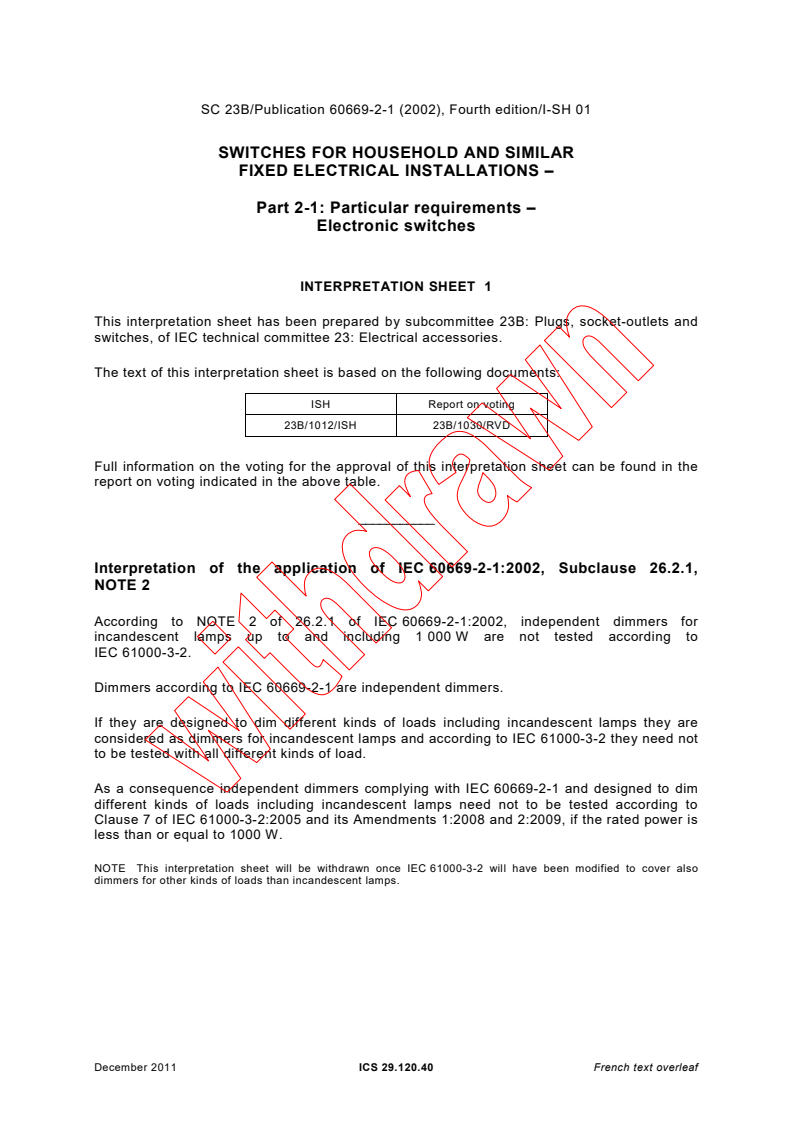
SC 23B/Publication 60669-2-1 (2002), Fourth edition/I-SH 01
SWITCHES FOR HOUSEHOLD AND SIMILAR
FIXED ELECTRICAL INSTALLATIONS –
Part 2-1: Particular requirements –
Electronic switches
INTERPRETATION SHEET 1
This interpretation sheet has been prepared by subcommittee 23B: Plugs, socket-outlets and
switches, of IEC technical committee 23: Electrical accessories.
The text of this interpretation sheet is based on the following documents:
ISH Report on voting
23B/1012/ISH 23B/1030/RVD
Full information on the voting for the approval of this interpretation sheet can be found in the
report on voting indicated in the above table.
___________
Interpretation of the application of IEC 60669-2-1:2002, Subclause 26.2.1,
NOTE 2
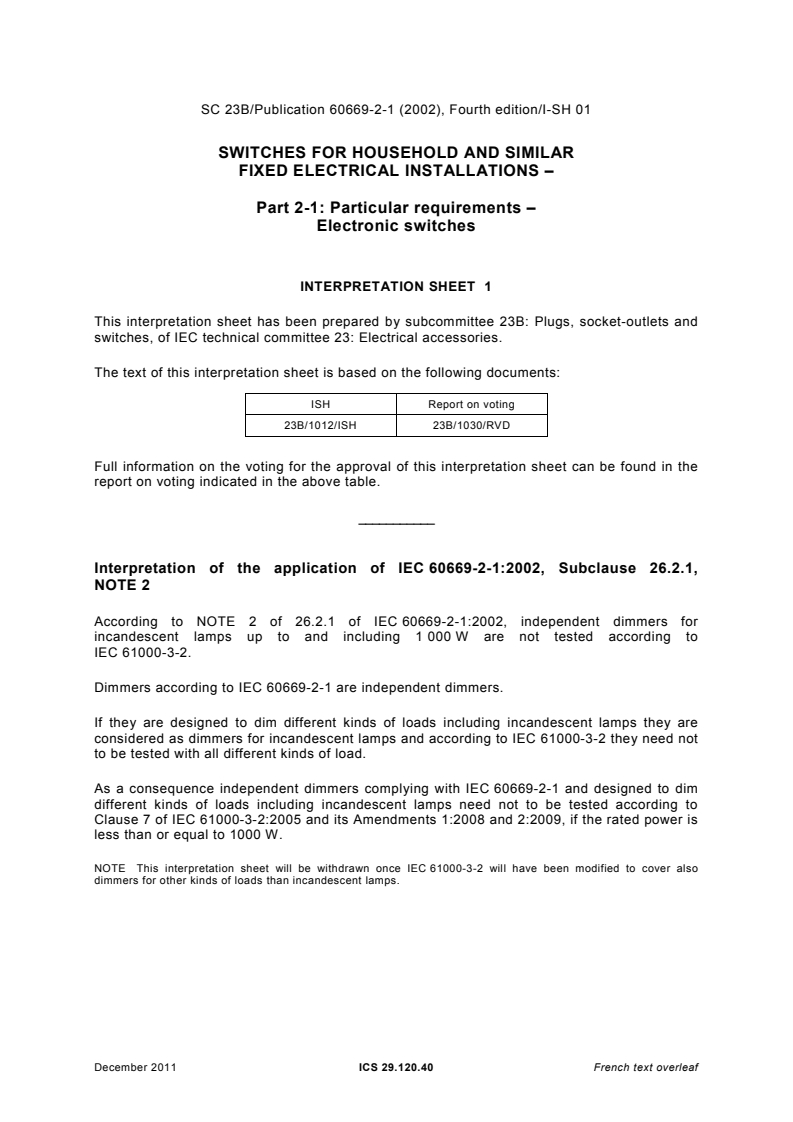
According to NOTE 2 of 26.2.1 of IEC 60669-2-1:2002, independent dimmers for
incandescent lamps up to and including 1 000 W are not tested according to
IEC 61000-3-2.
Dimmers according to IEC 60669-2-1 are independent dimmers.
If they are designed to dim different kinds of loads including incandescent lamps they are
considered as dimmers for incandescent lamps and according to IEC 61000-3-2 they need not
to be tested with all different kinds of load.
As a consequence independent dimmers complying with IEC 60669-2-1 and designed to dim
different kinds of loads including incandescent lamps need not to be tested according to
Clause 7 of IEC 61000-3-2:2005 and its Amendments 1:2008 and 2:2009, if the rated power is
less than or equal to 1000 W.
NOTE This interpretation sheet will be withdrawn once IEC 61000-3-2 will have been modified to cover also
dimmers for other kinds of loads than incandescent lamps.
December 2011 ICS 29.120.40 French text overleaf
SC 23B/Publication 60669-2-1 (2002), Quatrième édition/I-SH 01
INTERRUPTEURS POUR INSTALLATIONS ÉLECTRIQUES
FIXES DOMESTIQUES ET ANALOGUES –
Partie 2-1: Prescriptions particulières –
Interrupteurs électroniques
FEUILLE D'INTERPRÉTATION 1
Cette feuille d’interprétation a été établie par le sous-comité 23B: Prises de courant et
interrupteurs, du comité d'études 23: Petit appareillage, de la CEI.
Le texte de cette feuille d’interprétation est issue des documents suivants:
ISH Rapport de vote
23B/1012/FDIS 23B/1030/RVD
Le rapport de vote indiqué dans le tableau ci-dessus donne toute information sur le vote ayant
abouti à l'approbation de cette feuille d’interprétation.
___________
Interprétation de l’application de la CEI 60669-2-1:2002, Paragraphe 26.2.1,
NOTE 2
Selon la NOTE 2 de 26.2.1 de la CEI 60669-2-1:2002, les variateurs indépendants pour
lampes à incandescence jusqu’à 1 000 W inclus ne sont pas vérifiés selon la CEI 61000-3-2.
Les variateurs selon la CEI 60669-2-1 sont variateurs indépendants.
S’ils sont conçus pour faire varier différentes types de charges inclus des lampes à
incandescence, ils sont considérés comme des variateurs pour lampes à incandescence et
selon la CEI 61000-3-2 ils n'ont pas besoin d'être vérifiés avec toutes les différentes types de
charge.
En conséquence les variateurs indépendants conformes à la CEI 60669-2-1 et conçus pour
faire varier différentes types de charge, lampes à incandescence inclus, n'ont pas besoin
d'être vérifiés selon l'Article 7 de la CEI 61000-3-2:2005 et ses Amendements 1:2008 et
2:2009, si la puissance assignée est moins de ou égale à 1000 W.
NOTE Cette feuille d’interprétation sera retirée une fois que la CEI 61000-3-2 aura été modifiée pour inclure aussi
les variateurs pour les autres types de charge que les lampes à incandescence.
Décembre 2011 ICS 29.120.40 Texte anglais au verso
TC 23/Publication 60669-2-1 (2002), fourth edition/I-SH 02
SWITCHES FOR HOUSEHOLD AND SIMILAR
FIXED ELECTRICAL INSTALLATIONS –
Part 2-1: Particular requirements – Electronic switches
INTERPRETATION SHEET
This interpretation sheet has been prepared by subcommittee 23B: Plugs, socket-outlets and
switches, of IEC technical committee 23: Electrical accessories.
The text of this interpretation sheet is based on the following documents:
ISH Report on voting
23B/1038/ISH 23B/1053/RVD
Full information on the voting for the approval of this interpretation sheet can be found in the
report on voting indicated in the above table.
___________
Due to legislation in different countries the sale of tungsten filament lamps is banned.
According to the above, electronic switches for incandescent lamps are tested by using either
a number of 200 W tungsten filament lamps or a number of halogen filament lamps.
As the characteristics of halogen filament lamps of different power are equivalent, lamps of
any power can be used to reach the rated load.
February 2012 ICS 29.120.40 French text overleaf
CE 23/Publication 60669-2-1 (2002), quatrième édition/I-SH 02
INTERRUPTEURS POUR INSTALLATIONS
ELECTRIQUES FIXES DOMESTIQUES ET ANALOGUES –
Partie 2-1: Prescriptions particulières – Interrupteurs électroniques
FEUILLE D'INTERPRÉTATION
Cette feuille d’interprétation a été établie par le sous-comité 23B: Prises de courant et
interrupteurs, du comité d'études 23 de la CEI : Petit appareillage.
Le texte de cette feuille d’interprétation est issue des documents suivants:
ISH Rapport de vote
23B/1038/ISH 23B/1053/RVD
Le rapport de vote indiqué dans le tableau ci-dessus donne toute information sur le vote ayant
abouti à l'approbation de cette feuille d’interprétation.
___________
En raison de la législation dans différents pays, la vente des lampes à incandescence à
filament en tungstène est interdite.
En conséquence, les interrupteurs électroniques pour lampes à incandescence sont essayés
en utilisant soit un nombre adéquat de lampes à incandescence à filament en tungstène à
200 W soit un nombre adéquat de lampes halogènes à filament.
Comme les caractéristiques des lampes halogènes à filament de puissance différente sont
équivalentes, des lampes de n’importe quelle puissance peuvent être utilisées pour atteindre
la charge assignée.
Février 2012 ICS 29.120.40 Texte anglais au verso
− 2 − 60669-2-1 © CEI:2002
SOMMAIRE
AVANT-PROPOS . 6
1 Domaine d'application .10
2 Références normatives .12
3 Définitions.14
4 Prescriptions générales.16
5 Généralités sur les essais .16
6 Caractéristiques assignées .18
7 Classification .18
8 Marques et indications .20
9 Vérification des dimensions.26
10 Protection contre les chocs électriques.26
11 Dispositions pour assurer la mise à la terre .28
12 Bornes .30
13 Prescriptions constructives.30
14 Mécanisme .34
15 Résistance au vieillissement, protection procurée par les enveloppes des
interrupteurs et résistance à l'humidité .34
16 Résistance d'isolement et rigidité diélectrique.34
17 Echauffement.34
18 Pouvoir de fermeture et de coupure.40
19 Fonctionnement normal.44
20 Résistance mécanique .48
21 Résistance à la chaleur .48
22 Vis, parties transportant le courant et connexions.48
23 Lignes de fuite, distances d'isolement dans l'air et distances à travers la matière de
remplissage .50
24 Résistance de la matière isolante à une chaleur anormale, au feu et aux courants
de cheminement .50
25 Protection contre la rouille.50
26 Prescriptions de compatibilité électromagnétique.50
101 Fonctionnement anormal.62
102 Composants.68
Annexe A (normative) Echantillons nécessaires pour les essais .78
Annexe B (normative) Prescriptions supplémentaires pour les interrupteurs ayant des
dispositifs de sortie et de retenue pour câbles souples.80
Annexe AA (informative) Exemples de types d’interrupteurs électroniques avec leurs
fonctions .82
Bibliographie .84
60669-2-1 © IEC:2002 − 3 −
CONTENTS
FOREWORD . 7
1 Scope .11
2 Normative references.13
3 Definitions.15
4 General requirements.17
5 General notes on tests .17
6 Rating.19
7 Classification .19
8 Marking.21
9 Checking of dimensions .27
10 Protection against electric shock .27
11 Provision for earthing .29
12 Terminals.31
13 Constructional requirements.31
14 Mechanism .35
15 Resistance to ageing, protection provided by enclosures of switches, and resistance
to humidity .35
16 Insulation resistance and electric strength .35
17 Temperature rise .35
18 Making and breaking capacity .41
19 Normal operation .45
20 Mechanical strength .49
21 Resistance to heat .49
22 Screws, current-carrying parts and connections.49
23 Creepage distances, clearances and distances through sealing compound .51
24 Resistance of insulating material to abnormal heat, to fire and to tracking.51
25 Resistance to rusting.51
26 EMC requirements .51
101 Abnormal conditions.63
102 Components .69
Annex A (normative) Survey of specimens needed for tests .79
Annex B (normative) Additional requirements for switches having facilities for the outlet
and retention of flexible cables .81
Annex AA (informative) Examples of types of electronic switches and their functions.83
Bibliography .85
− 4 − 60669-2-1 © CEI:2002
Figure 101 – Broche d'essai pour vérifier la protection contre les chocs électriques.76
Figure 102 – Schéma du circuit pour l'essai des interrupteurs électroniques selon 101.3.76
Tableau 101 − Nombre d'échantillons .18
Tableau 102 − Valeurs d'échauffements admissibles (Ce tableau est basé sur
le tableau 3 de la CEI 60065).38
Tableau 103 − Relations entre valeurs des courants assignés et capacités .46
Tableau 104 − Essais d'immunité.52
Tableau 105 − Valeurs d'essai des creux de tension et des interruptions brèves .54
Tableau 106 − Valeurs pour l'essai des transitoires rapides .56
Tableau 107 – Condensateurs .70
60669-2-1 © IEC:2002 − 5 −
Figure 101 – Test pin for checking the protection against electric shock.77
Figure 102 – Circuit diagram for testing electronic switches according to 101.3 .77
Table 101 – Number of specimens.19
Table 102 – Permissible temperature rise values (This table is based on table 3 of
IEC 60065).39
Table 103 – Relationship between rated current and capacitance.47
Table 104 – Immunity tests.53
Table 105 – Voltage dip and short-interruption test values .55
Table 106 – Fast transient test values.57
Table 107 – Capacitors.71
− 6 − 60669-2-1 © CEI:2002
COMMISSION ÉLECTROTECHNIQUE INTERNATIONALE
_____________
INTERRUPTEURS POUR INSTALLATIONS ÉLECTRIQUES
FIXES DOMESTIQUES ET ANALOGUES –
Partie 2-1: Prescriptions particulières –
Interrupteurs électroniques
AVANT-PROPOS
1) La CEI (Commission Electrotechnique Internationale) est une organisation mondiale de normalisation composée
de l'ensemble des comités électrotechniques nationaux (Comités nationaux de la CEI). La CEI a pour objet de
favoriser la coopération internationale pour toutes les questions de normalisation dans les domaines de
l'électricité et de l'électronique. A cet effet, la CEI, entre autres activités, publie des Normes internationales.
Leur élaboration est confiée à des comités d'études, aux travaux desquels tout Comité national intéressé par le
sujet traité peut participer. Les organisations internationales, gouvernementales et non gouvernementales, en
liaison avec la CEI, participent également aux travaux. La CEI collabore étroitement avec l'Organisation
Internationale de Normalisation (ISO), selon des conditions fixées par accord entre les deux organisations.
2) Les décisions ou accords officiels de la CEI concernant les questions techniques représentent, dans la mesure
du possible, un accord international sur les sujets étudiés, étant donné que les Comités nationaux intéressés
sont représentés dans chaque comité d’études.
3) Les documents produits se présentent sous la forme de recommandations internationales. Ils sont publiés
comme normes, spécifications techniques, rapports techniques ou guides et agréés comme tels par les Comités
nationaux.
4) Dans le but d'encourager l'unification internationale, les Comités nationaux de la CEI s'engagent à appliquer de
façon transparente, dans toute la mesure possible, les Normes internationales de la CEI dans leurs normes
nationales et régionales. Toute divergence entre la norme de la CEI et la norme nationale ou régionale
correspondante doit être indiquée en termes clairs dans cette dernière.
5) La CEI n’a fixé aucune procédure concernant le marquage comme indication d’approbation et sa responsabilité
n’est pas engagée quand un matériel est déclaré conforme à l’une de ses normes.
6) L’attention est attirée sur le fait que certains des éléments de la présente Norme internationale peuvent faire
l’objet de droits de propriété intellectuelle ou de droits analogues. La CEI ne saurait être tenue pour
responsable de ne pas avoir identifié de tels droits de propriété et de ne pas avoir signalé leur existence.
La Norme internationale CEI 60669-2-1 a été établie par le sous-comité 23B: Prises de courant
et interrupteurs, du comité d'études 23 de la CEI: Petit appareillage.
Cette quatrième édition annule et remplace la troisième édition parue en 1996, l’amendement 1
(1997) et l’amendement 2 (1999). Elle constitue une révision technique.
Le texte de cette norme est issu de la troisième édition, de l’amendement 1 et l’amendement 2
ainsi que des documents suivants:
FDIS Rapport de vote
23B/668/FDIS 23B/682/RVD
Le rapport de vote indiqué dans le tableau ci-dessus donne toute information sur le vote ayant
abouti à l'approbation de cette norme.
Cette publication a été rédigée selon les Directives ISO/CEI, Partie 3.
La présente partie de la CEI 60669 doit être utilisée conjointement avec la CEI 60669-1. Elle
contient les modifications à apporter à cette norme pour la transformer en norme particulière pour
les interrupteurs électroniques.
60669-2-1 © IEC:2002 − 7 −
INTERNATIONAL ELECTROTECHNICAL COMMISSION
____________
SWITCHES FOR HOUSEHOLD AND SIMILAR
FIXED ELECTRICAL INSTALLATIONS –
Part 2-1: Particular requirements –
Electronic switches
FOREWORD
1) The IEC (International Electrotechnical Commission) is a worldwide organization for standardization comprising
all national electrotechnical committees (IEC National Committees). The object of the IEC is to promote
international co-operation on all questions concerning standardization in the electrical and electronic fields. To
this end and in addition to other activities, the IEC publishes International Standards. Their preparation is
entrusted to technical committees; any IEC National Committee interested in the subject dealt with may
participate in this preparatory work. International, governmental and non-governmental organizations liaising
with the IEC also participate in this preparation. The IEC collaborates closely with the International Organization
for Standardization (ISO) in accordance with conditions determined by agreement between the two
organizations.
2) The formal decisions or agreements of the IEC on technical matters express, as nearly as possible, an
international consensus of opinion on the relevant subjects since each technical committee has representation
from all interested National Committees.
3) The documents produced have the form of recommendations for international use and are published in the form
of standards, technical specifications, technical reports or guides and they are accepted by the National
Committees in that sense.
4) In order to promote international unification, IEC National Committees undertake to apply IEC International
Standards transparently to the maximum extent possible in their national and regional standards. Any
divergence between the IEC Standard and the corresponding national or regional standard shall be clearly
indicated in the latter.
5) The IEC provides no marking procedure to indicate its approval and cannot be rendered responsible for any
equipment declared to be in conformity with one of its standards.
6) Attention is drawn to the possibility that some of the elements of this International Standard may be the subject
of patent rights. The IEC shall not be held responsible for identifying any or all such patent rights.
International Standard IEC 60669-2-1 has been prepared by subcommittee 23B: Plugs, socket-
outlets and switches, of IEC technical committee 23: Electrical accessories.
This fourth edition cancels and replaces the third edition published in 1996, amendment 1
(1997) and amendment 2 (1999). It constitutes a technical revision.
The text of this standard is based on the third edition, amendments 1 and 2, and on the
following documents:
FDIS Report on voting
23B/668/FDIS 23B/682/RVD
Full information on the voting for the approval of this standard can be found in the report on
voting indicated in the above table.
This publication has been drafted in accordance with the ISO/IEC Directives, Part 3.
This part of IEC 60669-2 shall be used in conjunction with IEC 60669-1. It lists the changes
necessary to convert that standard into a specific standard for electronic switches.
− 8 − 60669-2-1 © CEI:2002
Dans la présente norme, les caractères d’imprimerie suivants sont employés:
− prescriptions proprement dites: caractères romains.
− modalités d’essai: caractères italiques.
− notes: petits caractères romains.
Les paragraphes, figures, tableaux ou notes complémentaires à ceux de la première partie
sont numérotés à partir de 101.
L'annexe AA est donnée uniquement à titre d'information.
Le comité a décidé que le contenu de cette publication ne sera pas modifié avant 2007. A cette
date, la publication sera
• reconduite;
• supprimée;
• remplacée par une édition révisée, ou
• amendée.
60669-2-1 © IEC:2002 − 9 −
In this publication, the following print types are used:
− requirements proper: in roman type.
− test specifications: in italic type.
− notes: in smaller roman type.
Subclauses, figures, tables or notes which are additional to those in part 1 are numbered
starting from 101.
Annex AA is for information only.
The committee has decided that the contents of this publication will remain unchanged until 2007.
At this date, the publication will be
• reconfirmed;
• withdrawn;
• replaced by a revised edition, or
• amended.
− 10 − 60669-2-1 © CEI:2002
INTERRUPTEURS POUR INSTALLATIONS ÉLECTRIQUES
FIXES DOMESTIQUES ET ANALOGUES –
Partie 2-1: Prescriptions particulières –
Interrupteurs électroniques
1 Domaine d'application
L'article de la partie 1 s’applique avec les exceptions suivantes.
Remplacement:
La présente norme s'applique aux interrupteurs électroniques et aux périphériques électro-
niques associés pour installations domestiques et installations électriques fixes analogues, soit
intérieures, soit extérieures.
Elle s'applique aux interrupteurs électroniques pour courant alternatif seulement, pour le
fonctionnement des circuits de lampes et pour la commande de la brillance des lampes
(variateurs) ou de la vitesse des moteurs (par exemple ceux des ventilateurs) ainsi que pour
d'autres utilisations (par exemple commande du chauffage), avec une tension assignée ne
dépassant pas 250 V et un courant assigné ne dépassant pas 16 A.
Le fonctionnement et la commande mentionnés ci-dessus sont effectués par une personne, par
l'intermédiaire d'un organe de manœuvre ou d'une surface sensible ou d'un élément sensible
au toucher, à la proximité, à la rotation, à un phénomène optique, acoustique, thermique ou à
toute autre influence.
La présente norme s'applique aussi aux interrupteurs électroniques dont le fonctionnement ou
la commande sont effectués par un moyen physique, par exemple la lumière, la vitesse du
vent, la présence de personnes, etc.
La présente norme s'applique aussi aux boîtes pour interrupteurs électroniques, à l'exception
des boîtes de montage pour interrupteurs électroniques encastrés.
Les interrupteurs électroniques conformes à la présente norme sont adaptés à une utilisation à
des températures ambiantes ne dépassant habituellement pas 25 °C, mais pouvant
occasionnellement atteindre 35 °C.
Dans les locaux présentant des conditions particulières, par exemple à bord de navires, de
véhicules et autres et dans les lieux dangereux, par exemple lorsqu'il existe un risque
d'explosion, des constructions spéciales peuvent être exigées.
NOTE 1 La présente norme n'est pas destinée à être utilisée par des dispositifs conçus pour être intégrés dans
des applications ou destinés à être délivrés avec une application spécifique et qui sont dans le domaine
d'application de la CEI 60730 ou de la CEI 61058-1.
Des exemples de modèles d'interrupteurs électroniques avec leurs fonctions sont représentés
à l'annexe AA.
NOTE 2 Les interrupteurs électroniques sans interrupteur mécanique dans le circuit principal n'assurent pas une
«coupure galvanique complète». Par conséquent, il est recommandé de considérer le circuit d'utilisation comme
étant sous tension.
60669-2-1 © IEC:2002 − 11 −
SWITCHES FOR HOUSEHOLD AND SIMILAR
FIXED ELECTRICAL INSTALLATIONS –
Part 2-1: Particular requirements –
Electronic switches
1 Scope
This clause of part 1 applies except as follows.
Replacement:
This standard applies to electronic switches and to associated electronic extension units for
household and similar fixed electrical installations either indoors or outdoors.
It applies to electronic switches for a.c. only, for the operation of lamp circuits and the control
of the brightness of lamps (dimmers) as well as the control of the speed of motors (for
example, those used in ventilating fans) and for other purposes (for example, heating controls),
with a rated voltage not exceeding 250 V and a rated current not exceeding 16 A.
The operation and control as mentioned above are performed by a person via an actuating
member, a sensing surface or a sensing unit, by means of touch, proximity, turn, optical,
acoustic, thermal or any other influence.
This standard also applies to electronic switches where the operation or control is made by
physical means, for example, light, wind velocity, presence of persons, etc.
This standard also applies to boxes for electronic switches, with the exception of mounting
boxes for flush-type electronic switches.
Electronic switches complying with this standard are suitable for use at ambient temperature
not normally exceeding 25 °C but occasionally reaching 35 °C.
In locations where special conditions prevail, such as in ships, vehicles and the like and in
hazardous locations, for example, where explosions are liable to occur, special constructions
may be required.
NOTE 1 This standard is not intended to cover devices which are designed to be incorporated in appliances or are
intended to be delivered together with a specific appliance and which are within the scope of IEC 60730 or
IEC 61058-1.
Examples of designs of electronic switches and functions are shown in annex AA.
NOTE 2 Electronic switches without a mechanical switch in the main circuit do not provide a “full off-state”.
Therefore, the circuit on the load side should be considered to be live.
− 12 − 60669-2-1 © CEI:2002
2 Références normatives
L'article de la partie 1 s’applique avec les exceptions suivantes.
Addition:
CEI 60065:2001, Appareils audio, vidéo et appareils électroniques analogues – Exigences
de sécurité
CEI 60085:1984, Evaluation et classification thermiques de l'isolation électrique
CEI 60127 (toutes les parties), Coupe-circuit miniatures
CEI 60227-5:1997, Conducteurs et câbles isolés au polychlorure de vinyle, de tension
1)
nominale au plus égale à 450/750 V – Partie 5: Câbles souples
CEI 60317-0-1:1997, Spécifications pour types particuliers de fils de bobinage – Partie 0:
1)
Prescriptions générales – Section 1: Fil de section circulaire en cuivre émaillé
CEI 60384-14:1993, Condensateurs fixes utilisés dans les équipements électroniques –
Partie 14: Spécification intermédiaire: Condensateurs fixes d'antiparasitage et raccordement
à l'alimentation
CEI 60730 (toutes les parties), Dispositifs de commande électrique automatiques à usage
domestique et analogue
CEI 61000-2-2:2002, Compatibilité électromagnétique (CEM) – Partie 2-2: Environnement –
Niveaux de compatibilité pour les perturbations conduites à basse fréquence et la transmission
de signaux sur les réseaux publics d'alimentation basse tension
CEI 61000-3-2:2000, Compatibilité électromagnétique (CEM) – Partie 3-2: Limites – Limites
pour les émissions de courant harmonique (courant appelé par les appareils ≤ 16 A
1)
par phase)
CEI 61000-3-3:1994, Compatibilité électromagnétique (CEM) – Partie 3: Limites – Section 3:
Limitation des fluctuations de tension et du flicker dans les réseaux basse tension pour les
1)
équipements ayant un courant appelé ≤ 16 A
CEI 61000-4-2:1995, Compatibilité électromagnétique (CEM) – Partie 4: Techniques d'essai et
1)
de mesure – Section 2: Essai d'immunité aux décharges électrostatiques
CEI 61000-4-3:2002, Compatibilité électromagnétique (CEM) – Partie 4-3: Techniques d'essai
et de mesure – Essai d'immunité aux champs électromagnétiques rayonnés aux fréquences
radioélectriques
CEI 61000-4-4:1995, Compatibilité électromagnétique (CEM) – Partie 4: Techniques d'essai
et de mesure – Section 4: Essais d'immunité aux transitoires électriques rapides en salves
CEI 61000-4-5:1995, Compatibilité électromagnétique (CEM) – Partie 4: Techniques d'essai et
1)
de mesure – Section 5: Essai d'immunité aux ondes de choc
___________
1)
Il existe une édition consolidée de cette norme.
60669-2-1 © IEC:2002 − 13 −
2 Normative references
This clause of part 1 applies except as follows.
Addition:
IEC 60065:2001, Audio, video and similar electronic apparatus – Safety requirements
IEC 60085:1984, Thermal evaluation and classification of electrical insulation
IEC 60127 (all parts), Miniature fuses
IEC 60227-5:1997, Polyvinyl chloride insulated cables of rated voltages up to and including
1)
450/750 V – Part 5: Flexible cables (cords)
IEC 60317-0-1:1997, Specifications for particular types of winding wires – Part 0: General
1)
requirements – Section 1: Enamelled round copper wire
IEC 60384-14:1993, Fixed capacitors for use in electronic equipment – Part 14: Sectional
specification: Fixed capacitors for electromagnetic interference suppression and connection to
the supply mains
IEC 60730 (all parts), Automatic electrical controls for household and similar use
IEC 61000-2-2:2002, Electromagnetic compatibility (EMC) – Part 2-2: Environment –
Compatibility levels for low-frequency conducted disturbances and signalling in public low-
voltage power supply systems
IEC 61000-3-2:2000, Electromagnetic compatibility (EMC) – Part 3-2: Limits – Limits for
1)
harmonic current emissions (equipment input current ≤ 16A per phase)
IEC 61000-3-3:1994, Electromagnetic compatibility (EMC) – Part 3: Limits – Section 3:
Limitation of voltage fluctuations and flicker in low-voltage supply systems for equipment with
1)
rated current ≤ 16 A
IEC 61000-4-2:1995, Electromagnetic compatibility (EMC) − Part 4: Testing and measurement
1)
techniques − Section 2: Electrostatic discharge immunity test
IEC 61000-4-3:2002, Electromagnetic compatibility (EMC) − Part 4-3: Testing and measure-
ment techniques − Radiated, radio-frequency, electromagnetic field immunity test
IEC 61000-4-4:1995, Electromagnetic compatibility (EMC) − Part 4: Testing and measurement
techniques − Section 4: Electrical fast transient/burst immunity test
IEC 61000-4-5:1995, Electromagnetic compatibility (EMC) − Part 4: Testing and measurement
1)
techniques − Section 5: Surge immunity test
___________
1)
A consolidated version of this standard exists.
− 14 − 60669-2-1 © CEI:2002
CEI 61000-4-6:1996, Compatibilité électromagnétique (CEM) – Partie 4: Techniques d'essai et
de mesure – Section 6: Immunité aux perturbations conduites, induites par les champs
1)
radioélectriques
CEI 61000-4-8:1993, Compatibilité électromagnétique (CEM) – Partie 4: Techniques d'essai et
1)
de mesure – Section 8: Essai d'immunité au champ magnétique à la fréquence du réseau
CEI 61000-4-11:1994, Compatibilité électromagnétique (CEM) – Partie 4: Techniques d'essai et
de mesure – Section 11: Essais d'immunité aux creux de tension, coupures brèves et
1)
variations de tension
CEI 61032, Protection des personnes et des matériels par les enveloppes – Calibres d'essai
pour la vérification
CISPR 14 (toutes les parties), Compatibilité électromagnétique – Exigences pour les appareils
électrodomestiques, outillages électriques et appareils analogues
CISPR 15:2000, Limites et méthodes de mesure des perturbations radioélectriques produites
par les appareils électriques d'éclairage et les appareils analogues
ISO 306:1994, Plastiques – Matières thermoplastiques – Détermination de la température de
ramollissement Vicat (VST)
3 Définitions
L'article de la partie 1 s'applique avec les additions suivantes.
Addition après le premier alinéa:
Le terme «Interrupteur électronique» est utilisé comme terme général couvrant à la fois les
dispositifs de coupure et de variation.
3.101
charge assignée
charge assignée à l'interrupteur électronique par le fabricant
3.102
charge minimale
charge la plus petite pour laquelle l'interrupteur électronique fonctionne encore correctement
3.103
courant minimal
courant le plus faible pour lequel l'interrupteur électronique fonctionne encore correctement
3.104
mécanisme de contact commandé électromécaniquement
élément constituant qui commande les parties utilisées pour ouvrir et fermer le circuit
électromécaniquement
3.105
dispositif de coupure à semi-conducteur
dispositif d'interruption conçu pour fermer ou couper le courant dans un circuit électrique au
moyen de la conductivité contrôlée d'un semi-conducteur dans ce circuit
NOTE 1 Dans un circuit où le courant passe par zéro (périodiquement ou autrement), le fait de ne pas rétablir le
courant après un tel passage à zéro est équivalent à la coupure de courant.
___________
1)
Il existe une édition consolidée de cette norme.
60669-2-1 © IEC:2002 − 15 −
IEC 61000-4-6:1996, Electromagnetic compatibility (EMC) − Part 4: Testing and measurement
techniques − Section 6: Immunity to conducted disturbances, induced by radio-frequency
1)
fields
IEC 61000-4-8:1993, Electromagnetic compatibility (EMC) – Part 4: Testing and measurement
1)
techniques – Section 8: Power frequency magnetic field immunity test
IEC 61000-4-11:1994, Electromagnetic compatibility (EMC) − Part 4: Testing and measurement
techniques − Section 11: Voltage dips, short interruptions and voltage variations immunity
1)
tests
IEC 61032, Protection of persons and equi
...
IEC 60669-2-1
Edition 4.1 2009-01
INTERNATIONAL
STANDARD
NORME
INTERNATIONALE
Switches for household and similar fixed electrical installations –
Part 2-1: Particular requirements – Electronic switches
Interrupteurs pour installations électriques fixes domestiques et analogues –
Partie 2-1: Prescriptions particulières – Interrupteurs électroniques
All rights reserved. Unless otherwise specified, no part of this publication may be reproduced or utilized in any form or by
any means, electronic or mechanical, including photocopying and microfilm, without permission in writing from either IEC or
IEC's member National Committee in the country of the requester.
If you have any questions about IEC copyright or have an enquiry about obtaining additional rights to this publication,
please contact the address below or your local IEC member National Committee for further information.
Droits de reproduction réservés. Sauf indication contraire, aucune partie de cette publication ne peut être reproduite
ni utilisée sous quelque forme que ce soit et par aucun procédé, électronique ou mécanique, y compris la photocopie
et les microfilms, sans l'accord écrit de la CEI ou du Comité national de la CEI du pays du demandeur.
Si vous avez des questions sur le copyright de la CEI ou si vous désirez obtenir des droits supplémentaires sur cette
publication, utilisez les coordonnées ci-après ou contactez le Comité national de la CEI de votre pays de résidence.
IEC Central Office
3, rue de Varembé
CH-1211 Geneva 20
Switzerland
Email: inmail@iec.ch
Web: www.iec.ch
About the IEC
The International Electrotechnical Commission (IEC) is the leading global organization that prepares and publishes
International Standards for all electrical, electronic and related technologies.
About IEC publications
The technical content of IEC publications is kept under constant review by the IEC. Please make sure that you have the
latest edition, a corrigenda or an amendment might have been published.
ƒ Catalogue of IEC publications: www.iec.ch/searchpub
The IEC on-line Catalogue enables you to search by a variety of criteria (reference number, text, technical committee,…).
It also gives information on projects, withdrawn and replaced publications.
ƒ IEC Just Published: www.iec.ch/online_news/justpub
Stay up to date on all new IEC publications. Just Published details twice a month all new publications released. Available
on-line and also by email.
ƒ Electropedia: www.electropedia.org
The world's leading online dictionary of electronic and electrical terms containing more than 20 000 terms and definitions
in English and French, with equivalent terms in additional languages. Also known as the International Electrotechnical
Vocabulary online.
ƒ Customer Service Centre: www.iec.ch/webstore/custserv
If you wish to give us your feedback on this publication or need further assistance, please visit the Customer Service
Centre FAQ or contact us:
Email: csc@iec.ch
Tel.: +41 22 919 02 11
Fax: +41 22 919 03 00
A propos de la CEI
La Commission Electrotechnique Internationale (CEI) est la première organisation mondiale qui élabore et publie des
normes internationales pour tout ce qui a trait à l'électricité, à l'électronique et aux technologies apparentées.
A propos des publications CEI
Le contenu technique des publications de la CEI est constamment revu. Veuillez vous assurer que vous possédez
l’édition la plus récente, un corrigendum ou amendement peut avoir été publié.
ƒ Catalogue des publications de la CEI: www.iec.ch/searchpub/cur_fut-f.htm
Le Catalogue en-ligne de la CEI vous permet d’effectuer des recherches en utilisant différents critères (numéro de référence,
texte, comité d’études,…). Il donne aussi des informations sur les projets et les publications retirées ou remplacées.
ƒ Just Published CEI: www.iec.ch/online_news/justpub
Restez informé sur les nouvelles publications de la CEI. Just Published détaille deux fois par mois les nouvelles
publications parues. Disponible en-ligne et aussi par email.
ƒ Electropedia: www.electropedia.org
Le premier dictionnaire en ligne au monde de termes électroniques et électriques. Il contient plus de 20 000 termes et
définitions en anglais et en français, ainsi que les termes équivalents dans les langues additionnelles. Egalement appelé
Vocabulaire Electrotechnique International en ligne.
ƒ Service Clients: www.iec.ch/webstore/custserv/custserv_entry-f.htm
Si vous désirez nous donner des commentaires sur cette publication ou si vous avez des questions, visitez le FAQ du
Service clients ou contactez-nous:
Email: csc@iec.ch
Tél.: +41 22 919 02 11
Fax: +41 22 919 03 00
IEC 60669-2-1
Edition 4.1 2009-01
INTERNATIONAL
STANDARD
NORME
INTERNATIONALE
Switches for household and similar fixed electrical installations –
Part 2-1: Particular requirements – Electronic switches
Interrupteurs pour installations électriques fixes domestiques et analogues –
Partie 2-1: Prescriptions particulières – Interrupteurs électroniques
INTERNATIONAL
ELECTROTECHNICAL
COMMISSION
COMMISSION
ELECTROTECHNIQUE
PRICE CODE
INTERNATIONALE
CQ
CODE PRIX
ICS 29.120.40 ISBN 978-2-88910-246-4
SC 23B/Publication 60669-2-1 (2002), Fourth edition/I-SH 01
SWITCHES FOR HOUSEHOLD AND SIMILAR
FIXED ELECTRICAL INSTALLATIONS –
Part 2-1: Particular requirements –
Electronic switches
INTERPRETATION SHEET 1
This interpretation sheet has been prepared by subcommittee 23B: Plugs, socket-outlets and
switches, of IEC technical committee 23: Electrical accessories.
The text of this interpretation sheet is based on the following documents:
ISH Report on voting
23B/1012/ISH 23B/1030/RVD
Full information on the voting for the approval of this interpretation sheet can be found in the
report on voting indicated in the above table.
___________
Interpretation of the application of IEC 60669-2-1:2002, Subclause 26.2.1,
NOTE 2
According to NOTE 2 of 26.2.1 of IEC 60669-2-1:2002, independent dimmers for
incandescent lamps up to and including 1 000 W are not tested according to
IEC 61000-3-2.
Dimmers according to IEC 60669-2-1 are independent dimmers.
If they are designed to dim different kinds of loads including incandescent lamps they are
considered as dimmers for incandescent lamps and according to IEC 61000-3-2 they need not
to be tested with all different kinds of load.
As a consequence independent dimmers complying with IEC 60669-2-1 and designed to dim
different kinds of loads including incandescent lamps need not to be tested according to
Clause 7 of IEC 61000-3-2:2005 and its Amendments 1:2008 and 2:2009, if the rated power is
less than or equal to 1000 W.
NOTE This interpretation sheet will be withdrawn once IEC 61000-3-2 will have been modified to cover also
dimmers for other kinds of loads than incandescent lamps.
December 2011 ICS 29.120.40 French text overleaf
SC 23B/Publication 60669-2-1 (2002), Quatrième édition/I-SH 01
INTERRUPTEURS POUR INSTALLATIONS ÉLECTRIQUES
FIXES DOMESTIQUES ET ANALOGUES –
Partie 2-1: Prescriptions particulières –
Interrupteurs électroniques
FEUILLE D'INTERPRÉTATION 1
Cette feuille d’interprétation a été établie par le sous-comité 23B: Prises de courant et
interrupteurs, du comité d'études 23: Petit appareillage, de la CEI.
Le texte de cette feuille d’interprétation est issue des documents suivants:
ISH Rapport de vote
23B/1012/FDIS 23B/1030/RVD
Le rapport de vote indiqué dans le tableau ci-dessus donne toute information sur le vote ayant
abouti à l'approbation de cette feuille d’interprétation.
___________
Interprétation de l’application de la CEI 60669-2-1:2002, Paragraphe 26.2.1,
NOTE 2
Selon la NOTE 2 de 26.2.1 de la CEI 60669-2-1:2002, les variateurs indépendants pour
lampes à incandescence jusqu’à 1 000 W inclus ne sont pas vérifiés selon la CEI 61000-3-2.
Les variateurs selon la CEI 60669-2-1 sont variateurs indépendants.
S’ils sont conçus pour faire varier différentes types de charges inclus des lampes à
incandescence, ils sont considérés comme des variateurs pour lampes à incandescence et
selon la CEI 61000-3-2 ils n'ont pas besoin d'être vérifiés avec toutes les différentes types de
charge.
En conséquence les variateurs indépendants conformes à la CEI 60669-2-1 et conçus pour
faire varier différentes types de charge, lampes à incandescence inclus, n'ont pas besoin
d'être vérifiés selon l'Article 7 de la CEI 61000-3-2:2005 et ses Amendements 1:2008 et
2:2009, si la puissance assignée est moins de ou égale à 1000 W.
NOTE Cette feuille d’interprétation sera retirée une fois que la CEI 61000-3-2 aura été modifiée pour inclure aussi
les variateurs pour les autres types de charge que les lampes à incandescence.
Décembre 2011 ICS 29.120.40 Texte anglais au verso
− 2 − 60669-2-1 © IEC:2002+A1:2008
CONTENTS
FOREWORD.4
1 Scope.
2 Normative references.7
3 Definitions.8
4 General requirements .11
5 General notes on tests.11
6 Rating.12
7 Classification.12
8 Marking.13
9 Checking of dimensions .16
10 Protection against electric shock.16
11 Provision for earthing.18
12 Terminals.18
13 Constructional requirements .19
14 Mechanism.20
15 Resistance to ageing, protection provided by enclosures of switches,
and resistance to humidity .20
16 Insulation resistance and electric strength.20
17 Temperature rise.21
18 Making and breaking capacity .24
19 Normal operation .26
20 Mechanical strength.29
21 Resistance to heat .29
22 Screws, current-carrying parts and connections .29
23 Creepage distances, clearances and distances through sealing compound.29
24 Resistance of insulating material to abnormal heat, to fire and to tracking .31
25 Resistance to rusting .31
26 EMC requirements.31
101 Abnormal conditions .37
102 Components .39
Annex A (normative) Survey of specimens needed for tests.44
Annex B (normative) Additional requirements for switches having facilities for the
outlet and retention of flexible cables.
Annex AA (informative) Examples of types of electronic switches and their functions .46
Bibliography .47
60669-2-1 © IEC:2002+A1:2008 − 3 −
Figure 101 – Test pin for checking the protection against electric shock .43
Figure 102 – Circuit diagram for testing electronic switches according to 101.3.43
Table 101 – Number of specimens .11
Table 102 – Permissible temperature rise values (This table is based on table 3
of IEC 60065).23
Table 103 – Relationship between rated current and capacitance .28
Table 104 – Immunity tests .32
Table 105 – Voltage dip and short-interruption test values .32
Table 106 – Fast transient test values .33
Table 107 – Capacitors .41
Table B.1 – Maximum current and minimum cross-sectional area .45
− 4 − 60669-2-1 © IEC:2002+A1:2008
INTERNATIONAL ELECTROTECHNICAL COMMISSION
____________
SWITCHES FOR HOUSEHOLD AND SIMILAR
FIXED ELECTRICAL INSTALLATIONS –
Part 2-1: Particular requirements –
Electronic switches
FOREWORD
1) La Commission Electrotechnique Internationale (CEI) est une organisation mondiale de normalisation composée
de l'ensemble des comités électrotechniques nationaux (Comités nationaux de la CEI). La CEI a pour objet de
favoriser la coopération internationale pour toutes les questions de normalisation dans les domaines de
l'électricité et de l'électronique. A cet effet, la CEI – entre autres activités – publie des Normes internationales,
des Spécifications techniques, des Rapports techniques, des Spécifications accessibles au public (PAS) et des
Guides (ci-après dénommés "Publication(s) de la CEI"). Leur élaboration est confiée à des comités d'études,
aux travaux desquels tout Comité national intéressé par le sujet traité peut participer. Les organisations
internationales, gouvernementales et non gouvernementales, en liaison avec la CEI, participent également aux
travaux. La CEI collabore étroitement avec l'Organisation Internationale de Normalisation (ISO), selon des
conditions fixées par accord entre les deux organisations.
2) Les décisions ou accords officiels de la CEI concernant les questions techniques représentent, dans la mesure
du possible, un accord international sur les sujets étudiés, étant donné que les Comités nationaux de la CEI
intéressés sont représentés dans chaque comité d’études.
3) Les Publications de la CEI se présentent sous la forme de recommandations internationales et sont agréées
comme telles par les Comités nationaux de la CEI. Tous les efforts raisonnables sont entrepris afin que la CEI
s'assure de l'exactitude du contenu technique de ses publications; la CEI ne peut pas être tenue responsable de
l'éventuelle mauvaise utilisation ou interprétation qui en est faite par un quelconque utilisateur final.
4) Dans le but d'encourager l'uniformité internationale, les Comités nationaux de la CEI s'engagent, dans toute la
mesure possible, à appliquer de façon transparente les Publications de la CEI dans leurs publications
nationales et régionales. Toutes divergences entre toutes Publications de la CEI et toutes publications
nationales ou régionales correspondantes doivent être indiquées en termes clairs dans ces dernières.
5) La CEI n’a prévu aucune procédure de marquage valant indication d’approbation et n'engage pas sa
responsabilité pour les équipements déclarés conformes à une de ses Publications.
6) Tous les utilisateurs doivent s'assurer qu'ils sont en possession de la dernière édition de cette publication.
7) Aucune responsabilité ne doit être imputée à la CEI, à ses administrateurs, employés, auxiliaires ou
mandataires, y compris ses experts particuliers et les membres de ses comités d'études et des Comités
nationaux de la CEI, pour tout préjudice causé en cas de dommages corporels et matériels, ou de tout autre
dommage de quelque nature que ce soit, directe ou indirecte, ou pour supporter les coûts (y compris les frais
de justice) et les dépenses découlant de la publication ou de l'utilisation de cette Publication de la CEI ou de
toute autre Publication de la CEI, ou au crédit qui lui est accordé.
8) L'attention est attirée sur les références normatives citées dans cette publication. L'utilisation de publications
référencées est obligatoire pour une application correcte de la présente publication.
9) L’attention est attirée sur le fait que certains des éléments de la présente Publication de la CEI peuvent faire
l’objet de droits de propriété intellectuelle ou de droits analogues. La CEI ne saurait être tenue pour
responsable de ne pas avoir identifié de tels droits de propriété et de ne pas avoir signalé leur existence.
International Standard IEC 60669-2-1 has been prepared by subcommittee 23B: Plugs, socket-
outlets and switches, of IEC technical committee 23: Electrical accessories.
This consolidated version of IEC 60669-2-1 consists of the fourth edition (2002) [documents
23B/668/FDIS and 23B/682/RVD] and its amendment 1 (2008) [documents 23B/894/FDIS and
23B/907/RVD].
The technical content is therefore identical to the base edition and its amendment and has
been prepared for user convenience.
It bears the edition number 4.1.
A vertical line in the margin shows where the base publication has been modified by
amendment 1.
60669-2-1 © IEC:2002+A1:2008 − 5 −
This part of IEC 60669-2 shall be used in conjunction with IEC 60669-1. It lists the changes
necessary to convert that standard into a specific standard for electronic switches.
In this publication, the following print types are used:
− requirements proper: in roman type.
− test specifications: in italic type.
− notes: in smaller roman type.
Subclauses, figures, tables or notes which are additional to those in part 1 are numbered
starting from 101.
Annex AA is for information only.
The committee has decided that the contents of the base publication and its amendments will
remain unchanged until the maintenance result date indicated on the IEC web site under
"http://webstore.iec.ch" in the data related to the specific publication. At this date,
the publication will be
• reconfirmed,
• withdrawn,
• replaced by a revised edition, or
• amended.
− 6 − 60669-2-1 © IEC:2002+A1:2008
SWITCHES FOR HOUSEHOLD AND SIMILAR
FIXED ELECTRICAL INSTALLATIONS –
Part 2-1: Particular requirements –
Electronic switches
1 Scope
This clause of part 1 applies except as follows.
Replacement:
This standard applies to electronic switches and to associated electronic extension units for
household and similar fixed electrical installations either indoors or outdoors.
It applies to electronic switches for a.c. only, for the operation of lamp circuits and the control
of the brightness of lamps (dimmers) as well as the control of the speed of motors (for
example, those used in ventilating fans) and for other purposes (for example, heating controls),
with a rated voltage not exceeding 250 V and a rated current not exceeding 16 A.
The operation and/or control as mentioned above are performed by a person via an actuating
member, a sensing surface or a sensing unit, by means of touch, proximity, turn, optical,
acoustic, thermal or any other influence.
This standard also applies to general purpose electronic switches with included automatic
functions where the operation and/or the control is initiated by a change of a physical quantity,
for example light, temperature, humidity, time, wind velocity, presence of persons, etc.
This standard also applies to boxes for electronic switches, with the exception of mounting
boxes for flush-type electronic switches.
This standard also applies to electronic RCS and electronic TDS with a rated voltage not
exceeding 440 V and a rated current not exceeding 25 A, intended for household and similar
fixed electrical installations, either indoors or outdoors.
NOTE 1 Switches including only passive components such as resistors, capacitors, inductors, PTC and NTC
components, varistors, printed wiring boards and connectors are not considered as electronic switches.
NOTE 2 Electronic switches may have control circuits with a.c. or d.c. rated control voltages.
Electronic switches complying with this standard are suitable for use at ambient temperature
not normally exceeding 25 °C but occasionally reaching 35 °C.
In locations where special conditions prevail, such as in ships, vehicles and the like and in
hazardous locations, for example, where explosions are liable to occur, special constructions
may be required.
NOTE 3 This standard is not intended to cover devices which are designed to be incorporated in appliances or are
intended to be delivered together with a specific appliance and which are within the scope of IEC 60730 or
IEC 61058-1.
Examples of designs of electronic switches and functions are shown in annex AA.
NOTE 4 Electronic switches without a mechanical switch in the main circuit do not provide a “full off-state”.
Therefore, the circuit on the load side should be considered to be live.
60669-2-1 © IEC:2002+A1:2008 − 7 −
2 Normative references
This clause of part 1 applies except as follows.
Addition:
IEC 60065:2001, Audio, video and similar electronic apparatus – Safety requirements
IEC 60085:1984, Thermal evaluation and classification of electrical insulation
IEC 60127 (all parts), Miniature fuses
IEC 60227-5:1997, Polyvinyl chloride insulated cables of rated voltages up to and including
1)
450/750 V – Part 5: Flexible cables (cords)
IEC 60317 (all parts), Specifications for particular types of winding wires
IEC 60317-0-1:1997, Specifications for particular types of winding wires – Part 0: General
1)
requirements – Section 1: Enamelled round copper wire
IEC 60384-14:1993, Fixed capacitors for use in electronic equipment – Part 14: Sectional
specification: Fixed capacitors for electromagnetic interference suppression and connection to
the supply mains
IEC 60664-1:2007, Insulation coordination for equipment within low-voltage systems –
Part 1: Principles, requirements and tests
IEC 60664-3, Insulation coordination for equipment within low-voltage systems – Part 3: Use of
coating, potting or moulding for protection against pollution
IEC 60669-2-2:2006, Switches for household and similar fixed electrical installations –
Part 2-2: Particular requirements - Electromagnetic remote-control switches (RCS)
IEC 60669-2-3:2006, Switches for household and similar fixed electrical installations –
Part 2-3: Particular requirements - Time-delay switches (TDS)
IEC 60730 (all parts), Automatic electrical controls for household and similar use
IEC 60998-2-1, Connecting devices for low-voltage circuits for household and similar purposes –
Part 2-1: Particular requirements for connecting devices as separate entities with screw-type
clamping units
IEC 61000-2-2:2002, Electromagnetic compatibility (EMC) – Part 2-2: Environment –
Compatibility levels for low-frequency conducted disturbances and signalling in public low-
voltage power supply systems
IEC 61000-3-2:2000, Electromagnetic compatibility (EMC) – Part 3-2: Limits – Limits for
1)
harmonic current emissions (equipment input current ≤ 16A per phase)
IEC 61000-3-3:1994, Electromagnetic compatibility (EMC) – Part 3: Limits – Section 3:
Limitation of voltage fluctuations and flicker in low-voltage supply systems for equipment with
1)
rated current ≤ 16 A
IEC 61000-4-2:1995, Electromagnetic compatibility (EMC) − Part 4: Testing and measurement
1)
techniques − Section 2: Electrostatic discharge immunity test
IEC 61000-4-3:2002, Electromagnetic compatibility (EMC) − Part 4-3: Testing and measure-
ment techniques − Radiated, radio-frequency, electromagnetic field immunity test
___________
1)
A consolidated version of this standard exists.
− 8 − 60669-2-1 © IEC:2002+A1:2008
IEC 61000-4-4:1995, Electromagnetic compatibility (EMC) − Part 4: Testing and measurement
techniques − Section 4: Electrical fast transient/burst immunity test
IEC 61000-4-5:1995, Electromagnetic compatibility (EMC) − Part 4: Testing and measurement
1)
techniques − Section 5: Surge immunity test
IEC 61000-4-6:1996, Electromagnetic compatibility (EMC) − Part 4: Testing and measurement
1)
techniques − Section 6: Immunity to conducted disturbances, induced by radio-frequency f i el ds
IEC 61000-4-8:1993, Electromagnetic compatibility (EMC) – Part 4: Testing and measurement
1)
techniques – Section 8: Power frequency magnetic field immunity test
IEC 61000-4-11:1994, Electromagnetic compatibility (EMC) − Part 4: Testing and measurement
techniques − Section 11: Voltage dips, short interruptions and voltage variations immunity
1)
tests
IEC 61032, Protection of persons and equipment by enclosures – Probes for verification
IEC 61558-2-6, Safety of power transformers, power supply units and similar –
Part 2: Particular requirements for safety isolating transformers for general use
CISPR 14 (all parts), Electromagnetic compatibility – Requirements for household appliances,
electric tools and similar apparatus
CISPR 15:2000, Limits and methods of measurement of radio disturbance characteristics of
electrical lighting and similar equipment
ISO 306:1994, Plastics – Thermoplastic materials – Determination of Vicat softening
temperature (VST)
3 Definitions
This clause of part 1 applies with the following additions.
Addition, after the first paragraph:
The term “electronic switch” is used as a general term to cover both electronic switching and
control devices.
3.101
rated load
load assigned to the electronic switch by the manufacturer
3.102
minimum load
lowest load at which the electronic switch still operates correctly
3.103
minimum current
lowest current at which the electronic switch still operates correctly
3.104
electromechanically operated contact mechanism
component which operates the parts used to open and close the circuit electromechanically
___________
1)
A consolidated version of this standard exists.
60669-2-1 © IEC:2002+A1:2008 − 9 −
3.105
semiconductor switching device
switching device designed to make or break the current in an electric circuit by means of the
controlled conductivity of a semiconductor in that circuit
NOTE 1 In a circuit where the current passes through zero (periodically or otherwise) the effect of “not making” the
current following such a zero value is equivalent to breaking the current.
NOTE 2 Typical examples of semiconductor switching devices are:
− electronic switching devices using the phase-cut-on principle to control the load by electronic switching on the
current at any phase angle at or after zero crossing in each half-wave, for example, by a thyristor;
− electronic switches using the phase-cut-off principle to control the load by switching off the current at any phase
angle after zero crossing in each half-wave, for example, by a transistor in a diode bridge.
3.106
electronic momentary contact switch
electronic switch with an electromechanical switching mechanism or a semiconductor switching
device which returns automatically to the initial state after operation
3.107
mechanical control unit
unit directly adjustable by mechanical means (for example, potentiometer) which controls the
output via electronic components
3.108
electronic output control unit
unit adjustable by other than mechanical means (for example, sensing unit), containing
electronic components and controlling the output via electronic components
3.109
electronic extension unit
unit permitting the control of an electronic switch from a distance
3.110
protective impedance
impedance connected between live parts and accessible conductive parts, of such value that
the current, in normal use and under likely fault conditions in the electronic switch, is limited to
a safe value, and which is so constructed that the reliability is maintained throughout the life of
the electronic switch.
3.111
external flexible cable
cable, a part of which is external to the electronic output control unit.
NOTE Such cable may either be a supply cable or a connecting cable between separate parts of an accessory.
3.112
RCS
remote controlled switch
switch intended to be operated from a distance
3.112.1
electromagnetic RCS
RCS provided with a coil which is operated by means of impulses or which may be permanently
energized by means of a control circuit
NOTE These devices are covered by IEC 60669-2-2.
− 10 − 60669-2-1 © IEC:2002+A1:2008
3.112.2
electronic RCS
electronic switch providing the function, markings and connection configuration of an RCS
according to IEC 60669-2-2, but containing electronic components and/or a combination of
electronic components and a coil or coils, which is operated by means of an electronic
extension unit or units
NOTE This electronic RCS may for example be used as a look alike replacement for RCS according to
IEC 60669-2-2.
3.113
rated control voltage
the voltage assigned to the external control circuit by the manufacturer
3.114
switching circuit
the circuit which contains the parts which allow the rated current to flow through the RCS or
TDS
3.115
control circuit
the circuit which includes electrical parts to actuate the switching mechanism
3.116
control mechanism
mechanism which includes all the parts which are intended for the operation of the RCS or TDS
3.117
incorporated hand-operated device
device incorporated in the switch which allows the switching circuit to be operated, directly or
indirectly. This device is not intended for the normal operation of the RCS or TDS
3.118
rated control current
current required for the initiation of the electronic RCS assigned to the control circuit by the
manufacturer
3.119
bistable electronic RCS
electronic RCS containing a control mechanism which, when not initiated electrically or
actuated mechanically, remains stable in its operating position and will change its operating
position on initiation or actuation
3.120
monostable electronic RCS
electronic RCS containing a control mechanism which, on electrical initiation or mechanical
actuation, changes the operating position of the switch which remains in this condition while the
electronic RCS is initiated or actuated, and returns to the position prior to initiation or actuation
of the electronic RCS after initiation or actuation is discontinued
3.121
priority electronic RCS
electronic RCS used to operate directly or indirectly a first load circuit or group of load circuits
the use of which at times can be dispensed with, and where the control circuit of the electronic
RCS is influenced by or connected to a second circuit or group of circuits (priority or circuits)
which when energized will thus initiate the control circuit of the electronic RCS to de-energize
the first load circuit or circuits for the time during which the second circuit or group of circuits is
energized
60669-2-1 © IEC:2002+A1:2008 − 11 −
NOTE The electronic RCS may have a means for adjusting the sensitivity of the electronic RCS control circuit to
initiate the electronic RCS depending on the total load or current delivered to any part of the circuits (priority switch
with current coil) or be sensitive to the voltage (priority switch with voltage coil) applied to the second load or group
of loads.
3.122
TDS
time delayed switch
switch provided with a time-delay device which operates for a certain time (the delay time). It
may be either manually actuated and/or remotely electrically initiated
3.123
electronic TDS
electronic switch providing the function, markings and connection configuration of a TDS
according to IEC 60669-2-3, but containing electronic components
NOTE This electronic TDS may for example be used as a look alike replacement for TDS according to IEC 60669-
2-3.
3.124
delay time
period during which the switching circuit(s) is (are) kept closed. Any time taken for the
decreasing of the voltage (e.g. to reduce the light) at the end of the delay period is included
within the delay time
3.125
delay device
all components which have an influence on the delay time. The delay time may be adjustable
4 General requirements
This clause of part 1 applies.
5 General notes on tests
This clause of part 1 applies except as follows.
5.4 Addition
The number of test specimens is shown in table 101.
Table 101 – Number of specimens
Number for Additional specimens for clause or subclause
Type of electronic switch general
18.2 19.101 19.102 24 26 101 and 102
tests
Marked with one rated
current and
c
a a a
3 3 3 3 3 3 3
− one rated voltage
a a a b,c
6 6 6 6 6 6 6
− two rated voltages
a
Only for electronic switches with mechanical and electromechanical switching devices; only the complete
contact mechanism may be submitted.
b
It may be necessary to provide three additional specimens for the test of 101.3.
c
When the tests of Clause 26 have been passed successfully, the specimens can be used for these tests.
− 12 − 60669-2-1 © IEC:2002+A1:2008
5.101 All measurements shall be carried out by methods which are suitable for the purpose,
which do not appreciably affect the values to be measured and which are not affected by
factors such as waveform.
NOTE Care should be taken to use instruments giving true r.m.s. indications.
5.102 If the electronic circuitry is so enclosed that the short-circuiting or disconnecting of
components is impossible or difficult, the manufacturer shall provide one additional test
specimen with leads connected for measurements, short-circuiting, etc.
It is not necessary to connect leads to the interior of hybrid and monolith integrated circuits.
5.103 It may be necessary to disconnect electronic components for tests.
5.104 For electronic switches equipped with cut-outs, it may be necessary to provide three
additional specimens for the test of 102.4.1.
5.105 If an electronic RCS or electronic TDS is provided with an incorporated hand-operated
device, it shall be tested as specified in Clause 19.
NOTE 1 During the making and breaking capacity tests and the normal operation tests, switching at the same
phase angle should be avoided, as this may give misleading results.
NOTE 2 Precautions should be taken when using combinations equipped with synchronous motors and similar
operating devices.
5.106 In the case of an electronic TDS for which the control and the switching circuits have no
common point, the test is made with the circuits supplied with the rated voltages which are
declared by the manufacturer.
6 Rating
This clause of part 1 applies except as follows.
Replacement:
6.1 Preferred rated voltages are 110 V, 120 V, 130 V, 220 V, 230 V and 240 V.
6.2 This subclause of part 1 does not apply.
6.3 The preferred rated supply frequencies are 50 Hz and/or 60 Hz.
Addition:
For electronic RCS, Clause 6 of IEC 60669-2-2 is applicable.
For electronic TDS, Clause 6 of IEC 60669-2-3 is applicable.
7 Classification
7.1 This subclause of part 1 applies except as follows.
60669-2-1 © IEC:2002+A1:2008 − 13 −
7.1.1 Add the following new Addition:
Addition:
For electronic TDS, Subclause 7.1.1 of IEC 60669-2-3 applies.
7.1.5 Addition:
– touch;
– proximity;
– optical;
– acoustic;
– other external influences.
NOTE Actuating the electronic switch includes on/off operation, and/or regulating the brightness of lamps or speed
of motors.
Addition:
For electronic RCS, Subclause 7.1.5 of IEC 60669-2-2 is applicable.
For electronic TDS, Subclause 7.1.5 of IEC 60669-2-3 is applicable.
7.1.6 Addition:
− electronic switches only intended to be mounted at a height greater than 1,7 m.
7.1.101 according to the kind of load intended to be controlled by the electronic switch:
− incandescent lamps;
− fluorescent lamps;
− motors;
− declared load.
7.2 This subclause of part 1 does not apply.
7.101 For electronic RCS, Subclause 7.101 of IEC 60669-2-2 is applicable.
7.102 For electronic RCS, Subclause 7.102 of IEC 60669-2-2 is applicable.
7.103 Electronic RCS or electronic TDS having a SELV- or PELV-circuit.
8 Marking
This clause of part 1 applies except as follows.
8.1 Replacement:
Electronic switches shall be marked with
− rated voltage in volts;
− rated current in amperes or rated load in volt-amperes or watts:
− symbol for nature of supply;
− 14 − 60669-2-1 © IEC:2002+A1:2008
− manufacturer’s or responsible vendor’s name, trade mark or identification mark;
− type reference, which may be a catalogue number;
− symbol for mini-gap construction, if applicable;
− symbol for micro-gap construction, if applicable;
− symbol for semiconductor switching device, if applicable;
− first characteristic numeral for the degree of protection against access to hazardous parts
and against harmful effects due to ingress of solid objects, if declared higher than 2, in
which case the second characteristic numeral shall also be marked;
− second characteristic numeral for the degree of protection against harmful effects due to
ingress of water, if declared higher than 0, in which case the first characteristic numeral
shall also be marked.
NOTE 1 Marking of the pattern number given in 7.1.1 is recommended if the connections are not clear from an
inspection of the electronic switch; this pattern number may be part of the type reference.
NOTE 2 If a base carries two or more electronic switches with separate operating devices, marking with the
pattern numbers is recommended, for example 1+6 or 1+1+1.
NOTE 3 For electronic switches suitable for more than one type of rated load, see 8.3.
In addition, electronic switches shall be marked with
− rated frequency in hertz, unless the electronic switch is designed for both 50 Hz and 60 Hz;
− rating and type of any fuse incorporated in the electronic switch;
− symbols for the kind of load (see 8.2);
− the term “extension unit”, if applicable, or the relevant translation in the official language(s)
of the country in which the product is to be sold, followed by the identifying reference;
− the minimum height for mounting the electronic switch shall be indicated in the installation
instruction of the manufacturer if there is a restriction (see 10.1).
In addition, electronic switches with screwless terminals shall be marked with an indication of
the suitability to accept rigid conductors only, for those electronic switches having this
restriction. This information may be put on the electronic switch and/or on the packaging unit.
For general purpose electronic switches with included automatic function the number of
operations shall be stated in the accompanying instruction sheet when the manufacturer
declares the number of operations is higher than indicated in Subclauses 19.101, 19.102 and
19.104.
In addition,
– for electronic RCS, Subclause 8.1 of IEC 60669-2-2 applies;
– for electronic TDS, Subclause 8.1 of IEC 60669-2-3 applies.
8.2 Addition:
Volt-ampere. VA
Watt . W
Hertz . Hz
Terminal for regulated load .
Type of load:
Incandescent lamps .
Fluorescent lamps.
60669-2-1 © IEC:2002+A1:2008 − 15 −
Motors . M
Electronic step-down converter for extra low-voltage incandescent lamps (for example,
halogen) .
Iron core transformer for extra low-voltage incandescent lamps
(for example, halogen) .
NOTE The rating and type of any fuse may be marked with symbols (see IEC 60127).
If other particular symbols are used, they shall be explained in the installation instructions.
In addition,
– for electronic RCS, Subclause 8.2 of IEC 60669-2-2 applies;
– for electronic TDS, Subclause 8.2 of IEC 60669-2-3 applies.
8.3 Replacement of the first paragraph:
The following marking shall be placed on the main part of the electronic switch:
− the rated current or rated load, rated voltage, symbol for nature of supply, rated frequency
(if required by 8.1), at least one type of load, the rating and type of any incorporated fuse
(this shall be marked on the fuse-holder or in the proximity of the fuse),
− either the name, trade mark or identification mark of the manufacturer or of the responsible
vendor,
− length of insulation to be removed before the insertion of the conductor into the screwless
terminal, if any,
− symbol for mini-gap construc
...
IEC 60669-2-1 ®
Edition 4.2 2015-03
CONSOLIDATED VERSION
INTERNATIONAL
STANDARD
NORME
INTERNATIONALE
colour
inside
Switches for household and similar fixed electrical installations –
Part 2-1: Particular requirements – Electronic switches
Interrupteurs pour installations électriques fixes domestiques et analogues –
Partie 2-1: Prescriptions particulières – Interrupteurs électroniques
All rights reserved. Unless otherwise specified, no part of this publication may be reproduced or utilized in any form
or by any means, electronic or mechanical, including photocopying and microfilm, without permission in writing from
either IEC or IEC's member National Committee in the country of the requester. If you have any questions about IEC
copyright or have an enquiry about obtaining additional rights to this publication, please contact the address below or
your local IEC member National Committee for further information.
Droits de reproduction réservés. Sauf indication contraire, aucune partie de cette publication ne peut être reproduite
ni utilisée sous quelque forme que ce soit et par aucun procédé, électronique ou mécanique, y compris la photocopie
et les microfilms, sans l'accord écrit de l'IEC ou du Comité national de l'IEC du pays du demandeur. Si vous avez des
questions sur le copyright de l'IEC ou si vous désirez obtenir des droits supplémentaires sur cette publication, utilisez
les coordonnées ci-après ou contactez le Comité national de l'IEC de votre pays de résidence.
IEC Central Office Tel.: +41 22 919 02 11
3, rue de Varembé Fax: +41 22 919 03 00
CH-1211 Geneva 20 info@iec.ch
Switzerland www.iec.ch
About the IEC
The International Electrotechnical Commission (IEC) is the leading global organization that prepares and publishes
International Standards for all electrical, electronic and related technologies.
About IEC publications
The technical content of IEC publications is kept under constant review by the IEC. Please make sure that you have the
latest edition, a corrigenda or an amendment might have been published.
IEC Catalogue - webstore.iec.ch/catalogue Electropedia - www.electropedia.org
The stand-alone application for consulting the entire The world's leading online dictionary of electronic and
bibliographical information on IEC International Standards, electrical terms containing more than 30 000 terms and
Technical Specifications, Technical Reports and other definitions in English and French, with equivalent terms in 15
documents. Available for PC, Mac OS, Android Tablets and additional languages. Also known as the International
iPad. Electrotechnical Vocabulary (IEV) online.
IEC publications search - www.iec.ch/searchpub IEC Glossary - std.iec.ch/glossary
The advanced search enables to find IEC publications by a More than 60 000 electrotechnical terminology entries in
variety of criteria (reference number, text, technical English and French extracted from the Terms and Definitions
committee,…). It also gives information on projects, replaced clause of IEC publications issued since 2002. Some entries
and withdrawn publications. have been collected from earlier publications of IEC TC 37,
77, 86 and CISPR.
IEC Just Published - webstore.iec.ch/justpublished
Stay up to date on all new IEC publications. Just Published IEC Customer Service Centre - webstore.iec.ch/csc
details all new publications released. Available online and If you wish to give us your feedback on this publication or
also once a month by email. need further assistance, please contact the Customer Service
Centre: csc@iec.ch.
A propos de l'IEC
La Commission Electrotechnique Internationale (IEC) est la première organisation mondiale qui élabore et publie des
Normes internationales pour tout ce qui a trait à l'électricité, à l'électronique et aux technologies apparentées.
A propos des publications IEC
Le contenu technique des publications IEC est constamment revu. Veuillez vous assurer que vous possédez l’édition la
plus récente, un corrigendum ou amendement peut avoir été publié.
Catalogue IEC - webstore.iec.ch/catalogue Electropedia - www.electropedia.org
Application autonome pour consulter tous les renseignements
Le premier dictionnaire en ligne de termes électroniques et
bibliographiques sur les Normes internationales,
électriques. Il contient plus de 30 000 termes et définitions en
Spécifications techniques, Rapports techniques et autres
anglais et en français, ainsi que les termes équivalents dans
documents de l'IEC. Disponible pour PC, Mac OS, tablettes
15 langues additionnelles. Egalement appelé Vocabulaire
Android et iPad.
Electrotechnique International (IEV) en ligne.
Recherche de publications IEC - www.iec.ch/searchpub
Glossaire IEC - std.iec.ch/glossary
La recherche avancée permet de trouver des publications IEC Plus de 60 000 entrées terminologiques électrotechniques, en
en utilisant différents critères (numéro de référence, texte, anglais et en français, extraites des articles Termes et
comité d’études,…). Elle donne aussi des informations sur les Définitions des publications IEC parues depuis 2002. Plus
projets et les publications remplacées ou retirées. certaines entrées antérieures extraites des publications des
CE 37, 77, 86 et CISPR de l'IEC.
IEC Just Published - webstore.iec.ch/justpublished
Service Clients - webstore.iec.ch/csc
Restez informé sur les nouvelles publications IEC. Just
Published détaille les nouvelles publications parues. Si vous désirez nous donner des commentaires sur cette
Disponible en ligne et aussi une fois par mois par email. publication ou si vous avez des questions contactez-nous:
csc@iec.ch.
IEC 60669-2-1 ®
Edition 4.2 2015-03
CONSOLIDATED VERSION
INTERNATIONAL
STANDARD
NORME
INTERNATIONALE
colour
inside
Switches for household and similar fixed electrical installations –
Part 2-1: Particular requirements – Electronic switches
Interrupteurs pour installations électriques fixes domestiques et analogues –
Partie 2-1: Prescriptions particulières – Interrupteurs électroniques
INTERNATIONAL
ELECTROTECHNICAL
COMMISSION
COMMISSION
ELECTROTECHNIQUE
INTERNATIONALE
ICS 29.120.40 ISBN 978-2-8322-2591-2
IEC 60669-2-1 ®
Edition 4.2 2015-03
CONSOLIDATED VERSION
REDLINE VERSION
VERSION REDLINE
colour
inside
Switches for household and similar fixed electrical installations –
Part 2-1: Particular requirements – Electronic switches
Interrupteurs pour installations électriques fixes domestiques et analogues –
Partie 2-1: Prescriptions particulières – Interrupteurs électroniques
SC 23B/Publication 60669-2-1 (2002), Fourth edition/I-SH 01
SWITCHES FOR HOUSEHOLD AND SIMILAR
FIXED ELECTRICAL INSTALLATIONS –
Part 2-1: Particular requirements –
Electronic switches
INTERPRETATION SHEET 1
This interpretation sheet has been prepared by subcommittee 23B: Plugs, socket-outlets and
switches, of IEC technical committee 23: Electrical accessories.
The text of this interpretation sheet is based on the following documents:
ISH Report on voting
23B/1012/ISH 23B/1030/RVD
Full information on the voting for the approval of this interpretation sheet can be found in the
report on voting indicated in the above table.
___________
Interpretation of the application of IEC 60669-2-1:2002, Subclause 26.2.1,
NOTE 2
According to NOTE 2 of 26.2.1 of IEC 60669-2-1:2002, independent dimmers for
incandescent lamps up to and including 1 000 W are not tested according to
IEC 61000-3-2.
Dimmers according to IEC 60669-2-1 are independent dimmers.
If they are designed to dim different kinds of loads including incandescent lamps they are
considered as dimmers for incandescent lamps and according to IEC 61000-3-2 they need not
to be tested with all different kinds of load.
As a consequence independent dimmers complying with IEC 60669-2-1 and designed to dim
different kinds of loads including incandescent lamps need not to be tested according to
Clause 7 of IEC 61000-3-2:2005 and its Amendments 1:2008 and 2:2009, if the rated power is
less than or equal to 1000 W.
NOTE This interpretation sheet will be withdrawn once IEC 61000-3-2 will have been modified to cover also
dimmers for other kinds of loads than incandescent lamps.
December 2011 ICS 29.120.40 French text overleaf
TC 23/Publication 60669-2-1 (2002), fourth edition/I-SH 02
SWITCHES FOR HOUSEHOLD AND SIMILAR
FIXED ELECTRICAL INSTALLATIONS –
Part 2-1: Particular requirements – Electronic switches
INTERPRETATION SHEET
This interpretation sheet has been prepared by subcommittee 23B: Plugs, socket-outlets and
switches, of IEC technical committee 23: Electrical accessories.
The text of this interpretation sheet is based on the following documents:
ISH Report on voting
23B/1038/ISH 23B/1053/RVD
Full information on the voting for the approval of this interpretation sheet can be found in the
report on voting indicated in the above table.
___________
Due to legislation in different countries the sale of tungsten filament lamps is banned.
According to the above, electronic switches for incandescent lamps are tested by using either
a number of 200 W tungsten filament lamps or a number of halogen filament lamps.
As the characteristics of halogen filament lamps of different power are equivalent, lamps of
any power can be used to reach the rated load.
February 2012 ICS 29.120.40 French text overleaf
– 2 – IEC 60669-2-1:2002
+AMD1:2008+AMD2:2015 CSV IEC 2015
CONTENTS
FOREWORD . 4
1 Scope . 6
2 Normative references. 7
3 Definitions . 8
4 General requirements . 12
5 General notes on tests . 12
6 Rating . 13
7 Classification . 13
8 Marking . 14
9 Checking of dimensions . 17
10 Protection against electric shock . 17
11 Provision for earthing . 18
12 Terminals . 19
13 Constructional requirements . 19
14 Mechanism . 21
15 Resistance to ageing, protection provided by enclosures of switches, and resistance
to humidity . 21
16 Insulation resistance and electric strength . 21
17 Temperature rise . 22
18 Making and breaking capacity . 25
19 Normal operation . 27
20 Mechanical strength . 32
21 Resistance to heat . 32
22 Screws, current-carrying parts and connections . 33
23 Creepage distances, clearances and distances through sealing compound . 33
24 Resistance of insulating material to abnormal heat, to fire and to tracking . 35
25 Resistance to rusting . 35
26 EMC requirements . 35
101 Abnormal conditions . 42
102 Components . 46
Annex A (normative) Survey of specimens needed for tests . 52
Annex B (normative) Additional requirements for switches having facilities for the outlet
and retention of flexible cables . 53
Annex AA (informative) Examples of types of electronic switches and their functions . 54
Annex BB (informative) Circuit development: subclause 19.109 explained. 55
Annex CC (normative) Additional requirements for electronic switches using DLT-
technology according to IEC 62756-1 . 60
Bibliography . 62
Figure 101 – Test pin for checking the protection against electric shock . 50
+AMD1:2008+AMD2:2015 CSV IEC 2015
Figure 102 – Circuit diagram for testing electronic switches according to 101.3 . 50
Figure 103 – Circuit diagrams for testing switches according to subclauses 19.102 and
19.109 . 51
Figure BB1 – 120 V 15 W (LT spice model) . 56
Figure BB.2 – 230 V 15 W (LT spice model) . 57
Figure BB.3 – Model for multiple lamp loads . 58
Figure BB.4 – I and I t for multiple lamp loads . 59
peak
Table 101 – Number of specimens . 12
Table 102 – Permissible temperature rise values (This table is based on table 3 of IEC
60065) . 24
Table 103 – Relationship between rated current and capacitance . 29
Table 104 – Immunity tests (overview) . 36
Table 105 – Voltage dip and short-interruption test values . 37
Table 106 – Fast transient test values . 38
Table 107 – Capacitors . 48
Table 108 – Values for I and I t depending on the type of distribution system . 32
peak
Table 109 – Calculated circuit parameters . 32
Table 110 – Surge immunity test voltages. 37
Table B.1 – Maximum current and minimum cross-sectional area . 53
Table BB.1 – Lamp . 55
– 4 – IEC 60669-2-1:2002
+AMD1:2008+AMD2:2015 CSV IEC 2015
INTERNATIONAL ELECTROTECHNICAL COMMISSION
____________
SWITCHES FOR HOUSEHOLD AND SIMILAR
FIXED ELECTRICAL INSTALLATIONS –
Part 2-1: Particular requirements –
Electronic switches
FOREWORD
1) The International Electrotechnical Commission (IEC) is a worldwide organization for standardization comprising
all national electrotechnical committees (IEC National Committees). The object of IEC is to promote
international co-operation on all questions concerning standardization in the electrical and electronic fields. To
this end and in addition to other activities, IEC publishes International Standards, Technical Specifications,
Technical Reports, Publicly Available Specifications (PAS) and Guides (hereafter referred to as “IEC
Publication(s)”). Their preparation is entrusted to technical committees; any IEC National Committee interested
in the subject dealt with may participate in this preparatory work. International, governmental and non-
governmental organizations liaising with the IEC also participate in this preparation. IEC collaborates closely
with the International Organization for Standardization (ISO) in accordance with conditions determined by
agreement between the two organizations.
2) The formal decisions or agreements of IEC on technical matters express, as nearly as possible, an
international consensus of opinion on the relevant subjects since each technical committee has representation
from all interested IEC National Committees.
3) IEC Publications have the form of recommendations for international use and are accepted by IEC National
Committees in that sense. While all reasonable efforts are made to ensure that the technical content of IEC
Publications is accurate, IEC cannot be held responsible for the way in which they are used or for any
misinterpretation by any end user.
4) In order to promote international uniformity, IEC National Committees undertake to apply IEC Publications
transparently to the maximum extent possible in their national and regional publications. Any divergence
between any IEC Publication and the corresponding national or regional publication shall be clearly indicated in
the latter.
5) IEC itself does not provide any attestation of conformity. Independent certification bodies provide conformity
assessment services and, in some areas, access to IEC marks of conformity. IEC is not responsible for any
services carried out by independent certification bodies.
6) All users should ensure that they have the latest edition of this publication.
7) No liability shall attach to IEC or its directors, employees, servants or agents including individual experts and
members of its technical committees and IEC National Committees for any personal injury, property damage or
other damage of any nature whatsoever, whether direct or indirect, or for costs (including legal fees) and
expenses arising out of the publication, use of, or reliance upon, this IEC Publication or any other IEC
Publications.
8) Attention is drawn to the Normative references cited in this publication. Use of the referenced publications is
indispensable for the correct application of this publication.
9) Attention is drawn to the possibility that some of the elements of this IEC Publication may be the subject of
patent rights. IEC shall not be held responsible for identifying any or all such patent rights.
This consolidated version of the official IEC Standard and its amendment has been
prepared for user convenience.
IEC 60669-2-1 edition 4.2 contains the fourth edition (2002-09) [documents 23B/668/
FDIS and 23B/682/RVD], its amendment 1 (2008-10) [documents 23B/894/FDIS and
23B/907/RVD] and its amendment 2 (2015-03) [documents 23B/1175/FDIS and 23B/1183/
RVD].
In this Redline version, a vertical line in the margin shows where the technical
content is modified by amendments 1 and 2. Additions and deletions are displayed in
red, with deletions being struck through. A separate Final version with all changes
accepted is available in this publication.
+AMD1:2008+AMD2:2015 CSV IEC 2015
International Standard IEC 60669-2-1 has been prepared by subcommittee 23B: Plugs, socket-
outlets and switches, of IEC technical committee 23: Electrical accessories.
This publication has been drafted in accordance with the ISO/IEC Directives, Part 3.
This part of IEC 60669-2 shall be used in conjunction with IEC 60669-1. It lists the changes
necessary to convert that standard into a specific standard for electronic switches.
In this publication, the following print types are used:
− requirements proper: in roman type.
− test specifications: in italic type.
− notes: in smaller roman type.
Subclauses, figures, tables or notes which are additional to those in part 1 are numbered
starting from 101.
Annex AA is for information only.
The committee has decided that the contents of the base publication and its amendments will
remain unchanged until the stability date indicated on the IEC web site under
"http://webstore.iec.ch" in the data related to the specific publication. At this date, the
publication will be
• reconfirmed,
• withdrawn,
• replaced by a revised edition, or
• amended.
IMPORTANT – The 'colour inside' logo on the cover page of this publication indicates
that it contains colours which are considered to be useful for the correct understanding
of its contents. Users should therefore print this document using a colour printer.
– 6 – IEC 60669-2-1:2002
+AMD1:2008+AMD2:2015 CSV IEC 2015
SWITCHES FOR HOUSEHOLD AND SIMILAR
FIXED ELECTRICAL INSTALLATIONS –
Part 2-1: Particular requirements –
Electronic switches
1 Scope
This clause of part 1 applies except as follows.
Replacement:
This standard applies to electronic switches and to associated electronic extension units for
household and similar fixed electrical installations either indoors or outdoors.
It applies to electronic switches for a.c. only, for the operation of lamp circuits and the control
of the brightness of lamps (dimmers) as well as the control of the speed of motors (for
example, those used in ventilating fans) and for other purposes (for example, heating controls),
with a rated voltage not exceeding 250 V and a rated current not exceeding 16 A.
The operation and/or control as mentioned above are performed by a person via an actuating
member, a sensing surface or a sensing unit, by means of touch, proximity, turn, optical,
acoustic, thermal or any other influence.
This standard also applies to general purpose electronic switches with included automatic
functions where the operation and/or the control is made initiated by a change of a physical
means quantity, for example light, temperature, humidity, time, wind velocity, presence of
persons, etc.
This standard also applies to boxes for electronic switches, with the exception of mounting
boxes for flush-type electronic switches.
This standard also applies to electronic RCS and electronic TDS with a rated voltage not
exceeding 440 V and a rated current not exceeding 25 A, intended for household and similar
fixed electrical installations, either indoors or outdoors.
NOTE 1 Switches including only passive components such as resistors, capacitors, inductors, PTC and NTC
components, varistors, printed wiring boards and connectors are not considered as electronic switches.
NOTE 2 Electronic switches may have control circuits with a.c. or d.c. rated control voltages.
Electronic switches complying with this standard are suitable for use at ambient temperature
not normally exceeding 25 °C but occasionally reaching 35 °C.
In locations where special conditions prevail, such as in ships, vehicles and the like and in
hazardous locations, for example, where explosions are liable to occur, special constructions
may be required.
NOTE 1 3 This standard is not intended to cover devices which are designed to be incorporated in appliances or
are intended to be delivered together with a specific appliance and which are within the scope of IEC 60730 or
IEC 61058-1.
Examples of designs of electronic switches and functions are shown in annex AA.
NOTE 2 4 Electronic switches without a mechanical switch in the main circuit do not provide a “full off-state”.
Therefore, the circuit on the load side should be considered to be live.
+AMD1:2008+AMD2:2015 CSV IEC 2015
2 Normative references
This clause of part 1 applies except as follows.
Addition:
IEC 60065:2001, Audio, video and similar electronic apparatus – Safety requirements
IEC 60085:1984, Thermal evaluation and classification of electrical insulation
IEC 60127 (all parts), Miniature fuses
IEC 60227-5:1997, Polyvinyl chloride insulated cables of rated voltages up to and including
1)
450/750 V – Part 5: Flexible cables (cords)
IEC 60317 (all parts), Specifications for particular types of winding wires
IEC 60317-0-1:1997, Specifications for particular types of winding wires – Part 0: General
1)
requirements – Section 1: Enamelled round copper wire
IEC 60384-14:1993, Fixed capacitors for use in electronic equipment – Part 14: Sectional
specification: Fixed capacitors for electromagnetic interference suppression and connection
to the supply mains
IEC 60664-1:2007, Insulation coordination for equipment within low-voltage systems –
Part 1: Principles, requirements and tests
IEC 60664-3, Insulation coordination for equipment within low-voltage systems – Part 3: Use
of coating, potting or moulding for protection against pollution
IEC 60669-2-2:2006, Switches for household and similar fixed electrical installations –
Part 2-2: Particular requirements - Electromagnetic remote-control switches (RCS)
IEC 60669-2-3:2006, Switches for household and similar fixed electrical installations –
Part 2-3: Particular requirements - Time-delay switches (TDS)
IEC 60730 (all parts), Automatic electrical controls for household and similar use
IEC 60998-2-1, Connecting devices for low-voltage circuits for household and similar
purposes - Part 2-1: Particular requirements for connecting devices as separate entities with
screw-type clamping units
IEC 61000-2-2:2002, Electromagnetic compatibility (EMC) – Part 2-2: Environment –
Compatibility levels for low-frequency conducted disturbances and signalling in public low-
voltage power supply systems
IEC 61000-3-2:2000, Electromagnetic compatibility (EMC) – Part 3-2: Limits – Limits for
1)
harmonic current emissions (equipment input current 16A per phase)
IEC 61000-3-3:1994, Electromagnetic compatibility (EMC) – Part 3: Limits – Section 3:
Limitation of voltage fluctuations and flicker in low-voltage supply systems for equipment with
1)
rated current 16 A
___________
1)
A consolidated version of this standard exists.
– 8 – IEC 60669-2-1:2002
+AMD1:2008+AMD2:2015 CSV IEC 2015
IEC 61000-4-2:1995, Electromagnetic compatibility (EMC) − Part 4: Testing and measurement
1)
techniques − Section 2: Electrostatic discharge immunity test
IEC 61000-4-3:2002, Electromagnetic compatibility (EMC) − Part 4-3: Testing and measure-
ment techniques − Radiated, radio-frequency, electromagnetic field immunity test
IEC 61000-4-4:1995, Electromagnetic compatibility (EMC) − Part 4: Testing and measurement
techniques − Section 4: Electrical fast transient/burst immunity test
IEC 61000-4-5:1995, Electromagnetic compatibility (EMC) − Part 4: Testing and measurement
1)
techniques − Section 5: Surge immunity test
IEC 61000-4-6:1996, Electromagnetic compatibility (EMC) − Part 4: Testing and measurement
techniques − Section 6: Immunity to conducted disturbances, induced by radio-frequency
1)
fields
IEC 61000-4-8:1993, Electromagnetic compatibility (EMC) – Part 4: Testing and measurement
1)
techniques – Section 8: Power frequency magnetic field immunity test
IEC 61000-4-11:1994, Electromagnetic compatibility (EMC) − Part 4: Testing and measurement
techniques − Section 11: Voltage dips, short interruptions and voltage variations immunity
1)
tests
IEC 61032, Protection of persons and equipment by enclosures – Probes for verification
IEC 61558-2-6, Safety of power transformers, power supply units and similar –
Part 2: Particular requirements for safety isolating transformers for general use
IEC 62756-1, Digital load side transmission lighting control – Part 1: Basic requirements
CISPR 14 (all parts), Electromagnetic compatibility – Requirements for household appliances,
electric tools and similar apparatus
CISPR 15:2000 2013, Limits and methods of measurement of radio disturbance characteristics
of electrical lighting and similar equipment
ISO 306:1994, Plastics – Thermoplastic materials – Determination of Vicat softening
temperature (VST)
3 Definitions
This clause of part 1 applies with the following additions.
Addition, after the first paragraph:
The term “electronic switch” is used as a general term to cover both electronic switching and
control devices.
3.101
rated load
load assigned to the electronic switch by the manufacturer
___________
1)
A consolidated version of this standard exists.
+AMD1:2008+AMD2:2015 CSV IEC 2015
3.102
minimum load
lowest load at which the electronic switch still operates correctly
3.103
minimum current
lowest current at which the electronic switch still operates correctly
3.104
electromechanically operated contact mechanism
component which operates the parts used to open and close the circuit electromechanically
3.105
semiconductor switching device
switching device designed to make or break the current in an electric circuit by means of the
controlled conductivity of a semiconductor in that circuit
NOTE 1 In a circuit where the current passes through zero (periodically or otherwise) the effect of “not making” the
current following such a zero value is equivalent to breaking the current.
NOTE 2 Typical examples of semiconductor switching devices are:
− electronic switching devices using the phase-cut-on principle to control the load by electronic switching on the
current at any phase angle at or after zero crossing in each half-wave, for example, by a thyristor;
− electronic switches using the phase-cut-off principle to control the load by switching off the current at any phase
angle after zero crossing in each half-wave, for example, by a transistor in a diode bridge.
3.106
electronic momentary contact switch
electronic switch with an electromechanical switching mechanism or a semiconductor switching
device which returns automatically to the initial state after operation
3.107
mechanical control unit
unit directly adjustable by mechanical means (for example, potentiometer) which controls the
output via electronic components
3.108
electronic output control unit
unit adjustable by other than mechanical means (for example, sensing unit), containing
electronic components and controlling the output via electronic components
3.109
electronic extension unit
unit permitting the control of an electronic switch from a distance
3.110
protective impedance
impedance connected between live parts and accessible conductive parts, of such value that
the current, in normal use and under likely fault conditions in the electronic switch, is limited to
a safe value, and which is so constructed that the reliability is maintained throughout the life of
the electronic switch.
3.111
external flexible cable
cable, a part of which is external to the electronic output control unit.
NOTE Such cable may either be a supply cable or a connecting cable between separate parts of an accessory.
– 10 – IEC 60669-2-1:2002
+AMD1:2008+AMD2:2015 CSV IEC 2015
3.112
RCS
remote controlled switch
switch intended to be operated from a distance
3.112.1
electromagnetic RCS
RCS provided with a coil which is operated by means of impulses or which may be permanently
energized by means of a control circuit
NOTE These devices are covered by IEC 60669-2-2.
3.112.2
electronic RCS
electronic switch providing the function, markings and connection configuration of an RCS
according to IEC 60669-2-2, but containing electronic components and/or a combination of
electronic components and a coil or coils, which is operated by means of an electronic
extension unit or units
NOTE This electronic RCS may for example be used as a look alike replacement for RCS according to IEC 60669-
2-2.
3.113
rated control voltage
the voltage assigned to the external control circuit by the manufacturer
3.114
switching circuit
the circuit which contains the parts which allow the rated current to flow through the RCS or
TDS
3.115
control circuit
the circuit which includes electrical parts to actuate the switching mechanism
3.116
control mechanism
mechanism which includes all the parts which are intended for the operation of the RCS or TDS
3.117
incorporated hand-operated device
device incorporated in the switch which allows the switching circuit to be operated, directly or
indirectly. This device is not intended for the normal operation of the RCS or TDS
3.118
rated control current
current required for the initiation of the electronic RCS assigned to the control circuit by the
manufacturer
3.119
bistable electronic RCS
electronic RCS containing a control mechanism which, when not initiated electrically or
actuated mechanically, remains stable in its operating position and will change its operating
position on initiation or actuation
3.120
monostable electronic RCS
electronic RCS containing a control mechanism which, on electrical initiation or mechanical
actuation, changes the operating position of the switch which remains in this condition while the
+AMD1:2008+AMD2:2015 CSV IEC 2015
electronic RCS is initiated or actuated, and returns to the position prior to initiation or actuation
of the electronic RCS after initiation or actuation is discontinued
3.121
priority electronic RCS
electronic RCS used to operate directly or indirectly a first load circuit or group of load circuits
the use of which at times can be dispensed with, and where the control circuit of the electronic
RCS is influenced by or connected to a second circuit or group of circuits (priority or circuits)
which when energized will thus initiate the control circuit of the electronic RCS to de-energize
the first load circuit or circuits for the time during which the second circuit or group of circuits is
energized
NOTE The electronic RCS may have a means for adjusting the sensitivity of the electronic RCS control circuit to
initiate the electronic RCS depending on the total load or current delivered to any part of the circuits (priority switch
with current coil) or be sensitive to the voltage (priority switch with voltage coil) applied to the second load or group
of loads.
3.122
TDS
time delayed switch
switch provided with a time-delay device which operates for a certain time (the delay time). It
may be either manually actuated and/or remotely electrically initiated
3.123
electronic TDS
electronic switch providing the function, markings and connection configuration of a TDS
according to IEC 60669-2-3, but containing electronic components
NOTE This electronic TDS may for example be used as a look alike replacement for TDS according to IEC 60669-
2-3.
3.124
delay time
period during which the switching circuit(s) is (are) kept closed. Any time taken for the
decreasing of the voltage (e.g. to reduce the light) at the end of the delay period is included
within the delay time
3.125
delay device
all components which have an influence on the delay time. The delay time may be adjustable
3.126
self ballasted lamp
unit which cannot be dismantled without being permanently damaged which is provided with a
lamp cap or caps and incorporating a light source and any additional elements necessary for
starting and stable operation of the light source
NOTE In the text self ballasted lamp are also called CFLi or LEDi where “i” means that the control gear is
incorporated in the lamp.
3.127
externally ballasted lamp
lamp other than an incandescent lamp which cannot be dismantled without being permanently
damaged which is provided with a lamp cap and incorporating a light source to be controlled by
a separate lamp control gear
NOTE For lamp control gear, see definitions in IEC 61347-1
3.128
conduction angle
a) for a leading edge (forward phase) dimmer, phase angle measured from the point where
conduction begins to the end of the half wave (zero crossing)
– 12 – IEC 60669-2-1:2002
+AMD1:2008+AMD2:2015 CSV IEC 2015
b) for a trailing edge (reverse phase) dimmer, phase angle measured from the beginning of a
half wave (zero crossing) to the point where conduction is switched off
4 General requirements
This clause of part 1 applies.
5 General notes on tests
This clause of part 1 applies except as follows.
5.4 Addition
The number of test specimens is shown in table 101.
Table 101 – Number of specimens
Number for Additional specimens for clause or subclause
Type of electronic switch general
18.2 19.101 19.102 19.109 24 26 101 and 102
tests
Marked with one rated
current and
a a a a c
one rated voltage 3 3 3 3 3 3 3 1 3
a a a a b,c,d
two rated voltages 6 6 6 6 6 6 6 1 6
a
Only for electronic switches with mechanical and electromechanical switching devices; only the complete contact
mechanism may be submitted.
b
It may be necessary to provide three additional specimens for the test of 101.3.
c
When the tests of Clause 26 have been passed successfully, the specimens can be used for these tests.
d
It may be necessary to provide 3 additional specimens for the test of 101.1.1.2.
5.101 All measurements shall be carried out by methods which are suitable for the purpose,
which do not appreciably affect the values to be measured and which are not affected by
factors such as waveform.
NOTE Care should be taken to use instruments giving true r.m.s. indications.
5.102 If the electronic circuitry is so enclosed that the short-circuiting or disconnecting of
components is impossible or difficult, the manufacturer shall provide one additional test
specimen with leads connected for measurements, short-circuiting, etc.
It is not necessary to connect leads to the interior of hybrid and monolith integrated circuits.
5.103 It may be necessary to disconnect electronic components for tests.
5.104 For electronic switches equipped with cut-outs, it may be necessary to provide three
additional specimens for the test of 102.4.1.
5.105 If an electronic RCS or electronic TDS is provided with an incorporated hand-operated
device, it shall be tested as specified in Clause 19.
NOTE 1 During the making and breaking capacity tests and the normal operation tests, switching at the same
phase angle should be avoided, as this may give misleading results.
NOTE 2 Precautions should be taken when using combinations equipped with synchronous motors and similar
operating devices.
+AMD1:2008+AMD2:2015 CSV IEC 2015
5.106 In the case of an electronic TDS for which the control and the switching circuits have no
common point, the test is made with the circuits supplied with the rated voltages which are
declared by the manufacturer.
6 Rating
This clause of part 1 applies except as follows.
Replacement:
6.1 Preferred rated voltages are 110 V, 120 V, 130 V, 220 V, 230 V and 240 V.
6.2 This subclause of part 1 does not apply.
6.3 The preferred rated supply frequencies are 50 Hz and/or 60 Hz.
Addition:
For electronic RCS, Clause 6 of IEC 60669-2-2 is applicable.
For electronic TDS, Clause 6 of IEC 60669-2-3 is applicable.
7 Classification
7.1 This subclause of part 1 applies except as follows.
7.1.1 Addition:
For electronic TDS, Subclause 7.1.1 of IEC 60669-2-3 applies.
7.1.5 Addition:
– touch;
– proximity;
– optical;
– acoustic;
– other external influences.
NOTE Actuating the electronic switch includes on/off operation, and/or regulating the brightness of lamps or speed
of motors.
Addition:
For electronic RCS, Subclause 7.1.5 of IEC 60669-2-2 is applicable.
For electronic TDS, Subclause 7.1.5 of IEC 60669-2-3 is applicable.
7.1.6 Addition:
− electronic switches only intended to be mounted at a height greater than 1,7 m.
7.1.101 according to the kind of load intended to be controlled by the electronic switch:
– 14 – IEC 60669-2-1:2002
+AMD1:2008+AMD2:2015 CSV IEC 2015
− incandescent lamps;
− externally ballasted lamps (e.g. fluorescent lamps, CFL, LED);
− motors;
− self ballasted lamps (e.g. CFLi, LEDi);
− declared load.
7.2 This subclause of part 1 does not apply.
7.101 For electronic RCS, Subclause 7.101 of IEC 60669-2-2 is applicable.
7.102 For electronic RCS, Subclause 7.102 of IEC 60669-2-2 is applicable.
7.103 Electronic RCS or electronic TDS having a SELV- or PELV-circuit.
8 Marking
This clause of part 1 applies except as follows.
8.1 Replacement:
Electronic switches shall be marked with
− rated voltage in volts;
− rated current in amperes or rated load in volt-amperes or watts:
− symbol for nature of supply;
− manufacturer’s or responsible vendor’s name, trade mark or identification mark;
− type reference, which may be a catalogue number;
− symbol for mini-gap construction, if applicable;
− symbol for micro-gap construction, if applicable;
− symbol for semiconductor switching device, if applicable;
− first characteristic numeral for the degree of protection against access to hazardous parts
and against harmful effects due to ingress of solid objects, if declared higher than 2, in
which case the second characteristic numeral shall also be marked;
− second characteristic numeral for the degree of protection against harmful effects due to
ingress of water, if declared higher than 0, in which case the first characteristic numeral
shall also be marked.
NOTE 1 Marking of the pattern number given in 7.1.1 is recommended if the connections are
...