

IEC 61131-2:2007
(Main)Programmable controllers - Part 2: Equipment requirements and tests
General Information
- Abstract
IEC 61131-2:2007 specifies requirements and related tests for programmable controllers (PLCs) and their associated peripherals (for example, programming and debugging tools (PADTs), human-machine interfaces (HMIs), etc.) which have as their intended use the control and command of machines and industrial processes. It establishes the definitions and identifies the principal characteristics relevant to the selection and application of PLCs and their associated peripherals. It specifies the minimum requirements for functional, electrical, mechanical, environmental and construction characteristics, service conditions, safety, EMC, user programming and tests applicable to PLCs and the associated peripherals. This third edition of IEC 61131-2 cancels and replaces the second edition published in 2003 and constitutes a technical revision. This third edition includes the following technical changes:
- Correction of the tests of Clause 6 and 9;
- Change of EMC requirements in Clause 8;
- New organization of Clause 11. This bilingual version (2012-05) corresponds to the monolingual English version, published in 2007-07.
- Status
- Published
- Publication Date
- 24-Jul-2007
- Technical Committee
- SC 65B - Measurement and control devices
- Drafting Committee
- WG 7 - TC 65/SC 65B/WG 7
- Current Stage
- DELPUB - Deleted Publication
- Start Date
- 23-Aug-2017
- Completion Date
- 28-Aug-2026
Buy Documents
IEC 61131-2:2007 - Programmable controllers - Part 2: Equipment requirements and tests Released:7/25/2007
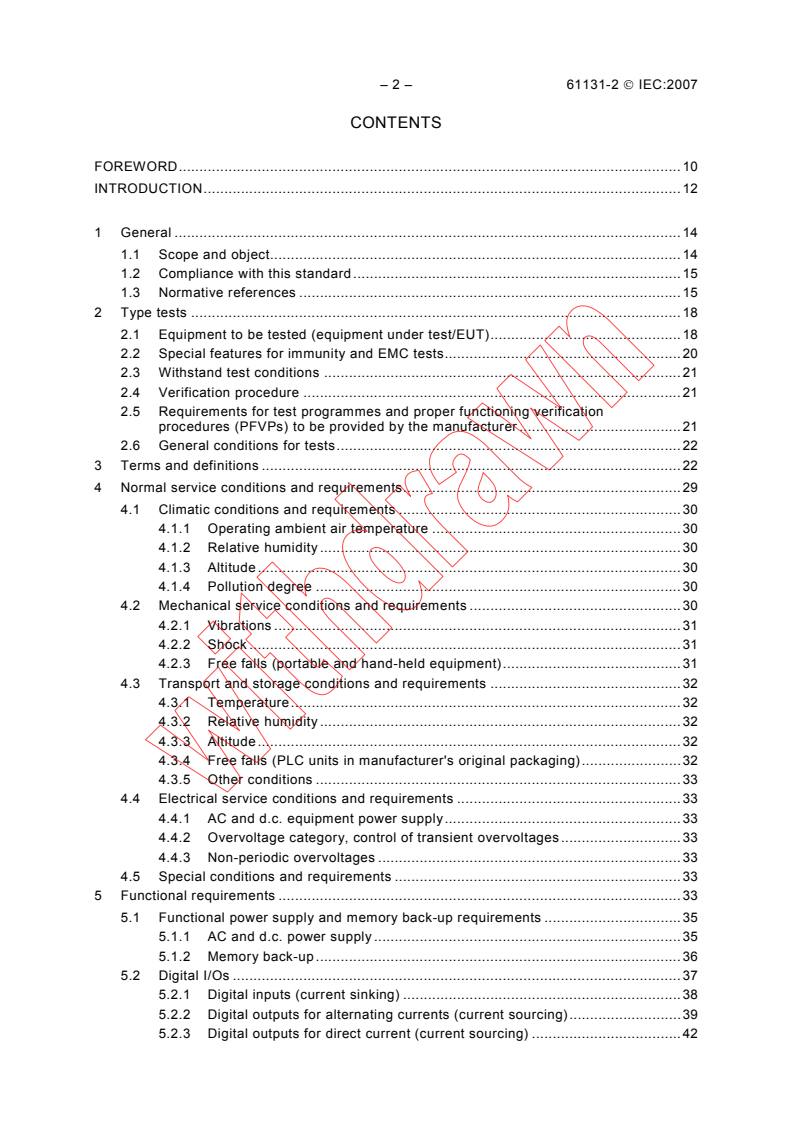
IEC 61131-2:2007 - Programmable controllers - Part 2: Equipment requirements and tests Released:7/25/2007
Overview
IEC 61131-2:2007 - "Programmable controllers - Part 2: Equipment requirements and tests" is an international standard that defines minimum requirements and type tests for programmable logic controllers (PLCs) and their associated peripherals (for example, programming and debugging tools (PADTs), human‑machine interfaces (HMIs), remote I/O stations (RIOSs)). It establishes key definitions and the principal characteristics to be considered when selecting, applying and testing PLC equipment used for machine and industrial process control. This third edition (2007) replaces the 2003 edition and includes corrections to test Clauses (6 and 9), revised EMC requirements (Clause 8) and a reorganized safety Clause (11).
Key topics and requirements
- Scope and definitions - terminology and intended use for PLCs and peripherals.
- Functional requirements - power supplies, memory back‑up, digital and analogue I/Os, communication interfaces, main processing units and remote I/O behavior.
- Type tests and verifications - procedures for climatic, mechanical (vibration, shock, free‑fall), electrical and functional tests to verify performance under specified service conditions.
- Electromagnetic compatibility (EMC) - emission and immunity limits, test methods (radiated/conducted interference, ESD, RF fields, surges, fast transients, voltage dips) and performance criteria.
- Safety requirements - equipment types (open/enclosed), protection against electric shock, dielectric strength, port protection and single‑fault considerations.
- Documentation and marking - manufacturer information requirements, test programs, verification procedures (PFVPs), user manuals and EMC/safety data.
- Self‑tests and diagnostics - requirements for PLC self‑monitoring and diagnostic reporting.
Applications and who uses the standard
IEC 61131-2 is used to:
- Guide design and manufacture of PLC hardware and peripherals to meet minimum safety, EMC and functional performance requirements.
- Inform procurement and acceptance testing for OEMs, system integrators and machine builders who require documented evidence of compliance.
- Serve testing laboratories and certification bodies performing type tests and EMC/safety verifications.
- Support maintenance, safety and quality teams assessing suitability of PLCs for specific environmental and industrial service conditions.
Keywords: IEC 61131-2, PLC standard, programmable controllers, EMC requirements, PLC testing, I/O verification, safety requirements, type tests.
Related standards (if applicable)
IEC 61131‑2 is part of the IEC 61131 family addressing programmable controllers; users commonly consult other parts of the series for programming languages, system architecture and product requirements when implementing complete PLC solutions.
For the official text, obtain IEC 61131-2:2007 from the IEC webstore or your national IEC member committee.
Relations
- Effective Date
- 05-Sep-2023
- Effective Date
- 05-Sep-2023
- Effective Date
- 05-Sep-2023
Buy Documents
IEC 61131-2:2007 - Programmable controllers - Part 2: Equipment requirements and tests Released:7/25/2007
IEC 61131-2:2007 - Programmable controllers - Part 2: Equipment requirements and tests Released:7/25/2007
Get Certified
Connect with accredited certification bodies for this standard

BSI Group
BSI (British Standards Institution) is the business standards company that helps organizations make excellence a habit.

DVS-ZERT GmbH
German welding certification society.
CARES (UK Certification Authority for Reinforcing Steels)
UK certification for reinforcing steels and construction.
Sponsored listings
Frequently Asked Questions
IEC 61131-2:2007 is a standard published by the International Electrotechnical Commission (IEC). Its full title is "Programmable controllers - Part 2: Equipment requirements and tests". This standard covers: IEC 61131-2:2007 specifies requirements and related tests for programmable controllers (PLCs) and their associated peripherals (for example, programming and debugging tools (PADTs), human-machine interfaces (HMIs), etc.) which have as their intended use the control and command of machines and industrial processes. It establishes the definitions and identifies the principal characteristics relevant to the selection and application of PLCs and their associated peripherals. It specifies the minimum requirements for functional, electrical, mechanical, environmental and construction characteristics, service conditions, safety, EMC, user programming and tests applicable to PLCs and the associated peripherals. This third edition of IEC 61131-2 cancels and replaces the second edition published in 2003 and constitutes a technical revision. This third edition includes the following technical changes: - Correction of the tests of Clause 6 and 9; - Change of EMC requirements in Clause 8; - New organization of Clause 11. This bilingual version (2012-05) corresponds to the monolingual English version, published in 2007-07.
IEC 61131-2:2007 specifies requirements and related tests for programmable controllers (PLCs) and their associated peripherals (for example, programming and debugging tools (PADTs), human-machine interfaces (HMIs), etc.) which have as their intended use the control and command of machines and industrial processes. It establishes the definitions and identifies the principal characteristics relevant to the selection and application of PLCs and their associated peripherals. It specifies the minimum requirements for functional, electrical, mechanical, environmental and construction characteristics, service conditions, safety, EMC, user programming and tests applicable to PLCs and the associated peripherals. This third edition of IEC 61131-2 cancels and replaces the second edition published in 2003 and constitutes a technical revision. This third edition includes the following technical changes: - Correction of the tests of Clause 6 and 9; - Change of EMC requirements in Clause 8; - New organization of Clause 11. This bilingual version (2012-05) corresponds to the monolingual English version, published in 2007-07.
IEC 61131-2:2007 is classified under the following ICS (International Classification for Standards) categories: 25.040.40 - Industrial process measurement and control; 35.240.50 - IT applications in industry. The ICS classification helps identify the subject area and facilitates finding related standards.
IEC 61131-2:2007 has the following relationships with other standards: It is inter standard links to IEC 61131-2:2017, IEC 61131-2:2003/COR1:2004, IEC 61131-2:2003. Understanding these relationships helps ensure you are using the most current and applicable version of the standard.
IEC 61131-2:2007 is available in PDF format for immediate download after purchase. The document can be added to your cart and obtained through the secure checkout process. Digital delivery ensures instant access to the complete standard document.
Standards Content (Sample)
INTERNATIONAL IEC
STANDARD 61131-2
Third edition
2007-07
Programmable controllers –
Part 2:
Equipment requirements and tests
Reference number
All rights reserved. Unless otherwise specified, no part of this publication may be reproduced or utilized in any form
or by any means, electronic or mechanical, including photocopying and microfilm, without permission in writing from
either IEC or IEC's member National Committee in the country of the requester.
If you have any questions about IEC copyright or have an enquiry about obtaining additional rights to this publication,
please contact the address below or your local IEC member National Committee for further information.
IEC Central Office
3, rue de Varembé
CH-1211 Geneva 20
Switzerland
Email: inmail@iec.ch
Web: www.iec.ch
About the IEC
The International Electrotechnical Commission (IEC) is the leading global organization that prepares and publishes
International Standards for all electrical, electronic and related technologies.
About IEC publications
The technical content of IEC publications is kept under constant review by the IEC. Please make sure that you have the
latest edition, a corrigenda or an amendment might have been published.
ƒ Catalogue of IEC publications: www.iec.ch/searchpub
The IEC on-line Catalogue enables you to search by a variety of criteria (reference number, text, technical committee,…).
It also gives information on projects, withdrawn and replaced publications.
ƒ IEC Just Published: www.iec.ch/online_news/justpub
Stay up to date on all new IEC publications. Just Published details twice a month all new publications released. Available
on-line and also by email.
ƒ Customer Service Centre: www.iec.ch/webstore/custserv
If you wish to give us your feedback on this publication or need further assistance, please visit the Customer Service
Centre FAQ or contact us:
Email:
csc@iec.ch
Tel.: +41 22 919 02 11
Fax: +41 22 919 03 00
INTERNATIONAL IEC
STANDARD 61131-2
Third edition
2007-07
Programmable controllers –
Part 2:
Equipment requirements and tests
PRICE CODE
Commission Electrotechnique Internationale XF
International Electrotechnical Commission
МеждународнаяЭлектротехническаяКомиссия
For price, see current catalogue
– 2 – 61131-2 © IEC:2007(E)
CONTENTS
FOREWORD.10
INTRODUCTION.12
1 General .13
1.1 Scope and object.13
1.2 Compliance with this standard.14
1.3 Normative references .14
2 Type tests .17
2.1 Equipment to be tested (equipment under test/EUT).17
2.2 Special features for immunity and EMC tests.18
2.3 Withstand test conditions .19
2.4 Verification procedure .19
2.5 Requirements for test programmes and proper functioning verification
procedures (PFVPs) to be provided by the manufacturer .19
2.6 General conditions for tests.20
3 Terms and definitions .20
4 Normal service conditions and requirements.28
4.1 Climatic conditions and requirements .28
4.1.1 Operating ambient air temperature .28
4.1.2 Relative humidity.28
4.1.3 Altitude.28
4.1.4 Pollution degree .29
4.2 Mechanical service conditions and requirements .29
4.2.1 Vibrations .29
4.2.2 Shock .29
4.2.3 Free falls (portable and hand-held equipment).30
4.3 Transport and storage conditions and requirements .30
4.3.1 Temperature.30
4.3.2 Relative humidity.30
4.3.3 Altitude.30
4.3.4 Free falls (PLC units in manufacturer's original packaging).31
4.3.5 Other conditions .31
4.4 Electrical service conditions and requirements .31
4.4.1 AC and d.c. equipment power supply.31
4.4.2 Overvoltage category, control of transient overvoltages.31
4.4.3 Non-periodic overvoltages .31
4.5 Special conditions and requirements .31
5 Functional requirements .31
5.1 Functional power supply and memory back-up requirements .33
5.1.1 AC and d.c. power supply .33
5.1.2 Memory back-up.34
5.2 Digital I/Os .34
5.2.1 Digital inputs (current sinking) .35
5.2.2 Digital outputs for alternating currents (current sourcing).37
5.2.3 Digital outputs for direct current (current sourcing) .40
61131-2 © IEC:2007(E) – 3 –
5.3 Analogue I/Os .41
5.3.1 Analogue inputs.41
5.3.2 Analogue outputs.41
5.4 Communication interface requirements.42
5.5 Main processing unit(s) and memory(ies) of the PLC-system requirements .42
5.6 Remote input/output stations (RIOSs) requirements .42
5.7 Peripherals (PADTs, TEs, HMIs) requirements .42
5.8 PLC-system self-tests and diagnostics requirements .43
5.9 Functional earthing.43
5.10 Mounting requirements .43
5.11 General marking requirements .44
5.11.1 Functional identifications .44
5.11.2 Module location and module identifications.44
5.11.3 Functional earth terminals markings .44
5.12 Requirements for normal service and functional type tests and verifications .44
5.13 Requirements for information on normal service and function .44
6 Normal service and functional type tests and verifications .44
6.1 Climatic tests .44
6.2 Dry-heat and cold withstand tests.45
6.2.1 Variation of temperature .46
6.2.2 Cyclic damp heat withstand test .47
6.3 Mechanical tests .48
6.3.1 Vibration (type test associated with normal service conditions).48
6.3.2 Shock (type test associated with normal service conditions) .48
6.3.3 Free fall (type test associated with normal service conditions) .49
6.3.4 Free fall (type test associated with transport and storage conditions) .49
6.3.5 Plugging/unplugging of removable units.49
6.4 Verification of special functional requirements for power ports and memory
back-up – Special immunity limits for power ports .49
6.4.1 Verification of functional equipment power input port (a.c. or d.c.) .50
6.4.2 External energy supply variation tests (immunity tests).51
6.4.3 Improper equipment power supply connection tests.54
6.4.4 Verification of memory back-up requirements .55
6.5 Verification of input/output requirements .55
6.5.1 General .55
6.5.2 Verification of digital inputs.56
6.5.3 Verification of digital outputs .56
6.5.4 Verification of analogue I/Os.57
6.6 Verification of communication interface requirements .58
6.7 Verification of MPU requirements .58
6.8 Verification of remote I/O stations .59
6.8.1 Response time test.59
6.8.2 Loss of communication test .59
6.8.3 Verification of other requirements .59
6.9 Verification of peripheral (PADTs, TEs, HMIs) requirements.59
6.10 Verification of PLC-system self-tests and diagnostics.59
6.11 Verification of markings and manufacturer's documentation.59
7 General information to be provided by the manufacturer.60
7.1 Information on type and content of documentation.60
– 4 – 61131-2 © IEC:2007(E)
7.1.1 Information on catalogues and datasheets.60
7.1.2 Information on user's manuals .60
7.1.3 Information on technical documentation.60
7.2 Information on compliance with this standard .60
7.3 Information on reliability .61
7.4 Information on other conditions .61
7.5 Information on shipping and storage.61
7.6 Information on a.c. and d.c. power supply .61
7.7 Information on digital inputs (current sinking) .61
7.8 Information on digital outputs for alternating currents (current sourcing).62
7.9 Information on digital outputs for direct current (current sourcing) .63
7.10 Information on analogue inputs .63
7.10.1 Information on analogue input static characteristics.63
7.10.2 Information on analogue input dynamic characteristics .63
7.10.3 Information on analogue input general characteristics .64
7.10.4 Information on analogue input miscellaneous characteristics .64
7.11 Information on analogue outputs .64
7.11.1 Information on analogue output static characteristics.64
7.11.2 Information on analogue output dynamic characteristics .64
7.11.3 Information on analogue output general characteristics .65
7.11.4 Information on analogue output miscellaneous characteristics .65
7.12 Information on communication interfaces.65
7.13 Information on main processing unit(s) and memory(ies) of the PLC-system .65
7.14 Information on remote input/output stations (RIOSs) .66
7.15 Information on peripherals (PADTs, TEs, HMIs) .67
7.16 Information on self-tests and diagnostics.67
8 Electromagnetic compatibility (EMC) requirements .67
8.1 General .67
8.2 Emission requirements .68
8.2.1 General requirements for emission .68
8.2.2 Emission limits in the low-frequency range .68
8.2.3 Emission limits in the high-frequency range .68
8.3 EMC immunity requirements.68
8.3.1 General .69
8.3.2 Performance criteria .70
8.3.3 Immunity levels.71
8.3.4 Voltage dips and interruptions power ports .73
8.4 Requirements for EMC tests and verifications .74
8.5 Requirements for information on EMC .74
9 Electromagnetic compatibility (EMC) type tests and verifications .74
9.1 Electromagnetic compatibility-related tests.74
9.2 Test environment.75
9.3 Measurement of radiated interference .75
9.4 Measurement of conducted interference .75
9.5 Electrostatic discharge .76
9.6 Radiofrequency electromagnetic field – Amplitude modulated .76
9.7 Power-frequency magnetic fields .77
9.8 Fast transient bursts.77
9.9 High-energy surges .78
61131-2 © IEC:2007(E) – 5 –
9.10 Conducted radiofrequency interference .78
9.11 Damped oscillatory wave (for zone C only) .79
9.12 Voltage dips and interruptions .79
10 Electromagnetic compatibility (EMC) information to be provided by the manufacturer .80
11 Safety requirements .80
11.1 Equipment types and protection .80
11.1.1 Open PLC-system equipment .80
11.1.2 Enclosed PLC-system equipment .80
11.2 Protection against electrical shock .82
11.2.1 Permissible limits for accessible parts .82
11.2.2 Dielectric strength .83
11.2.3 Ports requiring protection .83
11.2.4 Protection in normal condition .84
11.2.5 Protection in single-fault condition .85
11.2.6 Secondary circuits which do not pose a risk of electrical shock.86
11.3 Protection against the spread of fire .87
11.3.1 Limited power circuits.87
11.4 Clearance and creepage distances requirements .88
11.4.1 Clearances relating to overvoltage category II .89
11.4.2 Clearances for micro-environment where voltages are known and
controlled .90
11.4.3 Creepage distances for basic and supplementary insulation .91
11.4.4 Creepage distances for double/reinforced insulation.94
11.4.5 Creepage for field-wiring terminals .94
11.5 Flame-retardant requirements for non-metallic materials .94
11.5.1 Non-metallic enclosure material.94
11.5.2 Non-metallic material supporting live parts .94
11.5.3 Non-metallic parts .95
11.5.4 Decorative and labelling materials .95
11.5.5 Internal wiring or interconnection cables.95
11.6 Temperature limits .95
11.7 Enclosures .95
11.7.1 Open equipment .96
11.7.2 Enclosed equipment .96
11.8 Operator-accessible hazardous live field-wiring terminal constructional
requirements .96
11.9 Provisions for protective earthing .96
11.9.1 Protective earthing requirements for enclosed equipment .97
11.9.2 Protective earthing requirements for open equipment .97
11.10 Wiring.98
11.10.1 Internal wiring .98
11.10.2 Interconnection wiring .98
11.10.3 Equipment power input cord .98
11.11 Switching devices .99
11.12 Components related to safety requirements .99
11.13 Battery requirements .99
11.14 Maximum voltage and minimum voltage.99
11.15 Markings and identification .99
11.15.1 External wiring terminals identification .100
– 6 – 61131-2 © IEC:2007(E)
11.15.2 Live parts .100
11.15.3 Protective earth terminals markings.100
11.15.4 Enclosed Class II equipment .100
11.15.5 Equipment supplied by SELV/PELV.101
11.15.6 Rating information .101
11.16 Requirements for safety type tests and verifications . 101
11.17 Requirements for safety routine tests and verifications . 101
11.17.1 Requirement for dielectric strength verification . 101
11.17.2 Requirement for protective earthing verification. 101
11.18 Requirements for information on safety. 101
12 Safety type tests and verifications .102
12.1 Safety-related mechanical tests and verifications . 102
12.1.1 Impact withstand test.102
12.1.2 Operator accessibility tests.103
12.1.3 General examination of openings. 103
12.1.4 Wire flexing test.104
12.1.5 Temperature test .104
12.1.6 Protective coating test .104
12.1.7 Rigidity test .104
12.1.8 Clearance and creepage verification.105
12.1.9 Field-wiring terminals constructional verification .105
12.2 Safety-related electrical tests .105
12.2.1 Dielectric withstand verification test.105
12.2.2 Protective earthing continuity test.107
12.2.3 Stored energy injury risk test .108
12.2.4 Overload test.108
12.2.5 Endurance test .108
12.3 Single-fault condition tests .109
12.3.1 Single-fault condition – General.109
12.3.2 Single-fault condition – Breakdown of components test . 109
12.3.3 Single-fault condition – Protective impedance test . 110
12.3.4 Single-fault condition – isolation transformers test. 110
12.4 Limited power circuits test .110
13 Safety routine tests .110
13.1 Dielectric withstand test .110
13.2 Dielectric withstand verification test.111
13.3 Protective earthing test .111
14 Safety information to be provided by the manufacturer .111
14.1 Information on evaluation of enclosures for open equipment (power
dissipation).112
14.2 Information on mechanical terminal connection .112
Annex A (informative) Illustration of PLC-system hardware definitions . 113
Annex B (informative) Digital input standard operating range equations. 114
Annex C (normative) Test tools.115
Annex D (informative) Zone C – EMC immunity levels .118
Annex E (informative) Overvoltage example. 120
Bibliography.122
61131-2 © IEC:2007(E) – 7 –
Figure 1 – EUT configurations .18
Figure 2 – Typical interface/port diagram of a PLC-system .32
Figure 3 – I/O Parameters.35
Figure 4 – U-I operation regions of current-sinking inputs .36
Figure 5 – Temporary overload waveform for digital a.c. outputs.38
Figure 6 – Temporary overload waveform for digital d.c. outputs.40
Figure 7 – Third harmonic immunity test .51
Figure 8 – Gradual shut-down/start-up test .52
Figure 9 – Fast supply voltage variation test .53
Figure 10 – Slow supply voltage variation test .54
Figure 11 – EMC immunity zones.69
Figure 12 – Impact withstand test procedure.102
Figure 13 – Dielectric withstand test procedures .107
Figure A.1 – Programmable controller system (PLC-system). 113
Figure C.1 – Jointed test finger .115
Figure C.2 – 15 mm × 3 mm test pin .116
Figure C.3 – 100 mm × 4 mm test pin .116
Figure C.4 – 100 mm × 3 mm test pin .117
Figure E.1 – Creepage distances of circuits where recurring peak voltages are
generated .120
Table 1 – General conditions for tests.20
Table 2 – Operating ambient air temperature of PLC-systems.28
Table 3 – Sinusoidal vibrations service conditions for PLC-systems.29
Table 4 – Free fall on concrete floor for portable and hand-held equipment .30
Table 5 – Free fall on concrete floor in manufacturer’s original packaging .31
Table 6 – Rated values and operating ranges of incoming power supply.33
Table 7– Voltage interruptions (functional requirements).34
Table 8 – Standard operating ranges for digital inputs (current sinking) .37
Table 9 – Rated values and operating ranges for current sourcing digital a.c. outputs .38
Table 10 – Rated values and operating ranges (d.c.) for current-sourcing digital d.c.
outputs .40
Table 11 – Rated values and impedance limits for analogue inputs.41
Table 12 – Rated values and impedance limits for analogue outputs.41
Table 13 – Dry-heat and cold withstand tests.45
Table 14 – Change of temperature, withstand and immunity tests .46
Table 15 – Cyclic (12 + 12) damp-heat test.47
Table 16 – Immunity vibration test .48
Table 17 – Immunity shock test.48
Table 18 – Free-fall immunity/withstand tests (portable and hand-held equipment) .49
Table 19 – Free-fall withstand test (units within manufacturer's original packaging) .49
Table 20 – Insertion/withdrawal of removable units .49
Table 21 – Voltage ripple and frequency range immunity test.50
– 8 – 61131-2 © IEC:2007(E)
Table 22 – Third harmonic immunity test.50
Table 23 – Gradual shut-down/start-up test .52
Table 24 – Supply voltage variation tests.53
Table 25 – Voltage interruptions immunity test (Functional tests).54
Table 26 – Back-up duration withstand test.55
Table 27 – Change of energy source test.55
Table 28 – Overload and short-circuit tests for digital outputs .57
Table 29 – Emission limits .68
Table 30 – EMC immunity zones, example regarding surge .70
Table 31 – Criteria to prove the performance of a PLC-system against EMC
disturbances .70
Table 32 – Enclosure port tests, Zones A and B.71
Table 33 – Conducted immunity tests, Zone B .72
Table 34 – Conducted immunity tests, zone A.73
Table 35 – Voltage dips and interruptions (EMC requirements) .74
Table 36 – Radiated emission measurement.75
Table 37 – Conducted emission measurement .75
Table 38 – Electrostatic discharge immunity test.76
Table 39 – Radiated electromagnetic field immunity test.76
Table 40 – Power-frequency magnetic field immunity test .77
Table 41 – Fast transient burst immunity test.77
Table 42 – High-energy surge immunity test .78
Table 43 – Conducted r.f. immunity test.78
Table 44 – Damped oscillatory wave immunity test .79
Table 45 – Voltage dips and interruptions immunity test (EMC tests) .79
Table 46 – Shock protection requirements for open and enclosed equipment.84
Table 47 – Limits of output current and output power for inherently limited power
sources.88
Table 48 – Limits of output current, output power and ratings for over-current
protective devices for non-inherently limited power sources.88
Table 49 – Minimum clearances in air corresponding to overvoltage category II
conditions (except for field wiring terminals) for basic/supplementary insulation.89
Table 50 – Minimum clearances in air corresponding to overvoltage category II
conditions (except for field wiring terminals) for double /reinforced insulation .90
Table 51 – Minimum clearances in air at field-wiring terminals .90
Table 52 – Minimum clearances in air for micro-environment where the voltages are
known and controlled .91
Table 53 – Classification of material group according to comparative tracking index
(CTI).91
Table 54 – Minimum creepage distances for other than printed circuit boards (1).92
Table 55 – Minimum creepage distances for printed circuit boards (1), (6), (9) (basic
and supplementary insulation) .93
Table 56 – Minimum creepage distances related to recurring peak voltages on printed
wiring boards without protective coating (1) (pollution degrees 1 and 2).94
Table 57 – Temperature limits .95
Table 58 – Impact withstand test (1) .102
61131-2 © IEC:2007(E) – 9 –
Table 59 – Operator accessibility tests (1) .103
Table 60 – Dielectric withstand voltages for impulse a.c. power-frequency and d.c.
tests for basic/supplementary insulation (5) .106
Table 61 – Dielectric withstand voltages for impulse a.c. power frequency and d.c.
tests for double/reinforced insulation (5) .107
Table 62 – Overload test circuit values .108
Table 63 – Endurance test circuit values.109
Table 64 – Routine dielectric withstand test (5).111
Table D.1 – Enclosure port tests, Zone C.118
Table D.2 – Conducted immunity tests, Zone C.119
– 10 – 61131-2 © IEC:2007(E)
INTERNATIONAL ELECTROTECHNICAL COMMISSION
___________
PROGRAMMABLE CONTROLLERS –
Part 2: Equipment requirements and tests
FOREWORD
1) The International Electrotechnical Commission (IEC) is a worldwide organization for standardization comprising
all national electrotechnical committees (IEC National Committees). The object of IEC is to promote
international co-operation on all questions concerning standardization in the electrical and electronic fields. To
this end and in addition to other activities, IEC publishes International Standards, Technical Specifications,
Technical Reports, Publicly Available Specifications (PAS) and Guides (hereafter referred to as “IEC
Publication(s)”). Their preparation is entrusted to technical committees; any IEC National Committee interested
in the subject dealt with may participate in this preparatory work. International, governmental and non-
governmental organizations liaising with the IEC also participate in this preparation. IEC collaborates closely
with the International Organization for Standardization (ISO) in accordance with conditions determined by
agreement between the two organizations.
2) The formal decisions or agreements of IEC on technical matters express, as nearly as possible, an international
consensus of opinion on the relevant subjects since each technical committee has representation from all
interested IEC National Committees.
3) IEC Publications have the form of recommendations for international use and are accepted by IEC National
Committees in that sense. While all reasonable efforts are made to ensure that the technical content of IEC
Publications is accurate, IEC cannot be held responsible for the way in which they are used or for any
misinterpretation by any end user.
4) In order to promote international uniformity, IEC National Committees undertake to apply IEC Publications
transparently to the maximum extent possible in their national and regional publications. Any divergence
between any IEC Publication and the corresponding national or regional publication shall be clearly indicated in
the latter.
5) IEC provides no marking procedure to indicate its approval and cannot be rendered responsible for any
equipment declared to be in conformity with an IEC Publication.
6) All users should ensure that they have the latest edition of this publication.
7) No liability shall attach to IEC or its directors, employees, servants or agents including individual experts and
members of its technical committees and IEC National Committees for any personal injury, property damage or
other damage of any nature whatsoever, whether direct or indirect, or for costs (including legal fees) and
expenses arising out of the publication, use of, or reliance upon, this IEC Publication or any other IEC
Publications.
8) Attention is drawn to the Normative references cited in this publication. Use of the referenced publications is
indispensable for the correct application of this publication.
9) Attention is drawn to the possibility that some of the elements of this IEC Publication may be the subject of
patent rights. IEC shall not be held responsible for identifying any or all such patent rights.
International Standard IEC 61131-2 has been prepared by subcommittee 65B: Devices, of IEC
technical committee 65: Industrial-process measurement and control.
This third edition of IEC 61131-2 cancels and replaces the second edition published in 2003
and constitutes a technical revision.
This third edition includes the following significant technical changes with respect to the
previous edition.
a) DC power port requirements have been moved from Clause 8 to Clause 5.
b) Correction of the following tests of Clause 6:
• voltage range test;
• fast supply voltage variation test;
• slow supply voltage variation test;
• gradual shut-down/start-up test.
c) Change of EMC requirements in Clause 8:
61131-2 © IEC:2007(E) – 11 –
● requirements for radiofrequency interference in Table 33 changed from 3 V to 10 V
for Zone B equipment;
● reference to EMC basic standards with the last version;
● reference to generic standards 61000-6-x;
● cable length aligned to generic standards.
d) Correction of the following tests in Clause 9:
• voltage dips and interruptions – power port type tests and verifications.
e) New organization of Clause 11:
● equipment types and protection;
● open PLC-system equipment;
...
IEC 61131-2 ®
Edition 3.0 2007-07
INTERNATIONAL
STANDARD
NORME
INTERNATIONALE
colour
inside
Programmable controllers –
Part 2: Equipment requirements and tests
Automates programmables –
Partie 2: Exigences et essais des équipements
All rights reserved. Unless otherwise specified, no part of this publication may be reproduced or utilized in any form
or by any means, electronic or mechanical, including photocopying and microfilm, without permission in writing from
either IEC or IEC's member National Committee in the country of the requester.
If you have any questions about IEC copyright or have an enquiry about obtaining additional rights to this publication,
please contact the address below or your local IEC member National Committee for further information.
Droits de reproduction réservés. Sauf indication contraire, aucune partie de cette publication ne peut être reproduite ni
utilisée sous quelque forme que ce soit et par aucun procédé, électronique ou mécanique, y compris la photocopie et les
microfilms, sans l'accord écrit de la CEI ou du Comité national de la CEI du pays du demandeur.
Si vous avez des questions sur le copyright de la CEI ou si vous désirez obtenir des droits supplémentaires sur cette
publication, utilisez les coordonnées ci-après ou contactez le Comité national de la CEI de votre pays de résidence.
IEC Central Office Tel.: +41 22 919 02 11
3, rue de Varembé Fax: +41 22 919 03 00
CH-1211 Geneva 20 info@iec.ch
Switzerland www.iec.ch
About the IEC
The International Electrotechnical Commission (IEC) is the leading global organization that prepares and publishes
International Standards for all electrical, electronic and related technologies.
About IEC publications
The technical content of IEC publications is kept under constant review by the IEC. Please make sure that you have the
latest edition, a corrigenda or an amendment might have been published.
Useful links:
IEC publications search - www.iec.ch/searchpub Electropedia - www.electropedia.org
The advanced search enables you to find IEC publications The world's leading online dictionary of electronic and
by a variety of criteria (reference number, text, technical electrical terms containing more than 30 000 terms and
committee,…). definitions in English and French, with equivalent terms in
It also gives information on projects, replaced and additional languages. Also known as the International
withdrawn publications. Electrotechnical Vocabulary (IEV) on-line.
IEC Just Published - webstore.iec.ch/justpublished Customer Service Centre - webstore.iec.ch/csc
Stay up to date on all new IEC publications. Just Published If you wish to give us your feedback on this publication
details all new publications released. Available on-line and or need further assistance, please contact the
also once a month by email. Customer Service Centre: csc@iec.ch.
A propos de la CEI
La Commission Electrotechnique Internationale (CEI) est la première organisation mondiale qui élabore et publie des
Normes internationales pour tout ce qui a trait à l'électricité, à l'électronique et aux technologies apparentées.
A propos des publications CEI
Le contenu technique des publications de la CEI est constamment revu. Veuillez vous assurer que vous possédez
l’édition la plus récente, un corrigendum ou amendement peut avoir été publié.
Liens utiles:
Recherche de publications CEI - www.iec.ch/searchpub Electropedia - www.electropedia.org
La recherche avancée vous permet de trouver des Le premier dictionnaire en ligne au monde de termes
publications CEI en utilisant différents critères (numéro de électroniques et électriques. Il contient plus de 30 000
référence, texte, comité d’études,…). termes et définitions en anglais et en français, ainsi que
Elle donne aussi des informations sur les projets et les les termes équivalents dans les langues additionnelles.
publications remplacées ou retirées. Egalement appelé Vocabulaire Electrotechnique
International (VEI) en ligne.
Just Published CEI - webstore.iec.ch/justpublished
Service Clients - webstore.iec.ch/csc
Restez informé sur les nouvelles publications de la CEI.
Just Published détaille les nouvelles publications parues. Si vous désirez nous donner des commentaires sur
Disponible en ligne et aussi une fois par mois par email. cette publication ou si vous avez des questions
contactez-nous: csc@iec.ch.
IEC 61131-2 ®
Edition 3.0 2007-07
INTERNATIONAL
STANDARD
NORME
INTERNATIONALE
colour
inside
Programmable controllers –
Part 2: Equipment requirements and tests
Automates programmables –
Partie 2: Exigences et essais des équipements
INTERNATIONAL
ELECTROTECHNICAL
COMMISSION
COMMISSION
ELECTROTECHNIQUE
PRICE CODE
INTERNATIONALE
CODE PRIX XF
ICS 25.040.40; 35.240.50 ISBN 978-2-88912-076-5
– 2 – 61131-2 IEC:2007
CONTENTS
FOREWORD . 10
INTRODUCTION . 12
1 General . 14
1.1 Scope and object. 14
1.2 Compliance with this standard . 15
1.3 Normative references . 15
2 Type tests . 18
2.1 Equipment to be tested (equipment under test/EUT) . 18
2.2 Special features for immunity and EMC tests . 20
2.3 Withstand test conditions . 21
2.4 Verification procedure . 21
2.5 Requirements for test programmes and proper functioning verification
procedures (PFVPs) to be provided by the manufacturer . 21
2.6 General conditions for tests . 22
3 Terms and definitions . 22
4 Normal service conditions and requirements . 29
4.1 Climatic conditions and requirements . 30
4.1.1 Operating ambient air temperature . 30
4.1.2 Relative humidity . 30
4.1.3 Altitude . 30
4.1.4 Pollution degree . 30
4.2 Mechanical service conditions and requirements . 30
4.2.1 Vibrations . 31
4.2.2 Shock . 31
4.2.3 Free falls (portable and hand-held equipment) . 31
4.3 Transport and storage conditions and requirements . 32
4.3.1 Temperature . 32
4.3.2 Relative humidity . 32
4.3.3 Altitude . 32
4.3.4 Free falls (PLC units in manufacturer's original packaging) . 32
4.3.5 Other conditions . 33
4.4 Electrical service conditions and requirements . 33
4.4.1 AC and d.c. equipment power supply . 33
4.4.2 Overvoltage category, control of transient overvoltages . 33
4.4.3 Non-periodic overvoltages . 33
4.5 Special conditions and requirements . 33
5 Functional requirements . 33
5.1 Functional power supply and memory back-up requirements . 35
5.1.1 AC and d.c. power supply . 35
5.1.2 Memory back-up . 36
5.2 Digital I/Os . 37
5.2.1 Digital inputs (current sinking) . 38
5.2.2 Digital outputs for alternating currents (current sourcing) . 39
5.2.3 Digital outputs for direct current (current sourcing) . 42
61131-2 IEC:2007 – 3 –
5.3 Analogue I/Os . 43
5.3.1 Analogue inputs . 43
5.3.2 Analogue outputs. 44
5.4 Communication interface requirements . 44
5.5 Main processing unit(s) and memory(ies) of the PLC-system requirements . 44
5.6 Remote input/output stations (RIOSs) requirements . 44
5.7 Peripherals (PADTs, TEs, HMIs) requirements . 45
5.8 PLC-system self-tests and diagnostics requirements . 45
5.9 Functional earthing . 46
5.10 Mounting requirements . 46
5.11 General marking requirements . 46
5.11.1 Functional identifications . 46
5.11.2 Module location and module identifications . 46
5.11.3 Functional earth terminals markings . 46
5.12 Requirements for normal service and functional type tests and verifications . 47
5.13 Requirements for information on normal service and function . 47
6 Normal service and functional type tests and verifications . 47
6.1 Climatic tests . 47
6.2 Dry-heat and cold withstand tests . 47
6.2.1 Variation of temperature . 48
6.2.2 Cyclic damp heat withstand test . 49
6.3 Mechanical tests . 50
6.3.1 Vibration (type test associated with normal service conditions) . 50
6.3.2 Shock (type test associated with normal service conditions) . 50
6.3.3 Free fall (type test associated with normal service conditions) . 51
6.3.4 Free fall (type test associated with transport and storage conditions) . 51
6.3.5 Plugging/unplugging of removable units. 51
6.4 Verification of special functional requirements for power ports and memory
back-up – Special immunity limits for power ports . 51
6.4.1 Verification of functional equipment power input port (a.c. or d.c.) . 52
6.4.2 External energy supply variation tests (immunity tests) . 53
6.4.3 Improper equipment power supply connection tests . 56
6.4.4 Verification of memory back-up requirements . 57
6.5 Verification of input/output requirements . 57
6.5.1 General . 57
6.5.2 Verification of digital inputs . 58
6.5.3 Verification of digital outputs . 58
6.5.4 Verification of analogue I/Os. 59
6.6 Verification of communication interface requirements . 60
6.7 Verification of MPU requirements . 60
6.8 Verification of remote I/O stations . 61
6.8.1 Response time test . 61
6.8.2 Loss of communication test . 61
6.8.3 Verification of other requirements . 61
6.9 Verification of peripheral (PADTs, TEs, HMIs) requirements . 61
6.10 Verification of PLC-system self-tests and diagnostics . 61
6.11 Verification of markings and manufacturer's documentation . 61
7 General information to be provided by the manufacturer . 62
7.1 Information on type and content of documentation . 62
– 4 – 61131-2 IEC:2007
7.1.1 Information on catalogues and datasheets . 62
7.1.2 Information on user's manuals . 62
7.1.3 Information on technical documentation . 62
7.2 Information on compliance with this standard . 62
7.3 Information on reliability . 63
7.4 Information on other conditions . 63
7.5 Information on shipping and storage . 63
7.6 Information on a.c. and d.c. power supply . 63
7.7 Information on digital inputs (current sinking) . 63
7.8 Information on digital outputs for alternating currents (current sourcing) . 64
7.9 Information on digital outputs for direct current (current sourcing) . 65
7.10 Information on analogue inputs . 65
7.10.1 Information on analogue input static characteristics . 65
7.10.2 Information on analogue input dynamic characteristics . 65
7.10.3 Information on analogue input general characteristics . 66
7.10.4 Information on analogue input miscellaneous characteristics . 66
7.11 Information on analogue outputs . 66
7.11.1 Information on analogue output static characteristics . 66
7.11.2 Information on analogue output dynamic characteristics . 66
7.11.3 Information on analogue output general characteristics . 67
7.11.4 Information on analogue output miscellaneous characteristics . 67
7.12 Information on communication interfaces . 67
7.13 Information on main processing unit(s) and memory(ies) of the PLC-system . 67
7.14 Information on remote input/output stations (RIOSs) . 68
7.15 Information on peripherals (PADTs, TEs, HMIs) . 69
7.16 Information on self-tests and diagnostics . 69
8 Electromagnetic compatibility (EMC) requirements . 69
8.1 General . 69
8.2 Emission requirements . 70
8.2.1 General requirements for emission . 70
8.2.2 Emission limits in the low-frequency range . 70
8.2.3 Emission limits in the high-frequency range . 70
8.3 EMC immunity requirements . 70
8.3.1 General . 71
8.3.2 Performance criteria . 72
8.3.3 Immunity levels. 73
8.3.4 Voltage dips and interruptions power ports . 75
8.4 Requirements for EMC tests and verifications . 76
8.5 Requirements for information on EMC . 76
9 Electromagnetic compatibility (EMC) type tests and verifications . 76
9.1 Electromagnetic compatibility-related tests . 76
9.2 Test environment. 77
9.3 Measurement of radiated interference . 77
9.4 Measurement of conducted interference . 77
9.5 Electrostatic discharge . 78
9.6 Radiofrequency electromagnetic field – Amplitude modulated . 78
9.7 Power-frequency magnetic fields . 79
9.8 Fast transient bursts . 79
61131-2 IEC:2007 – 5 –
9.9 High-energy surges . 80
9.10 Conducted radiofrequency interference . 80
9.11 Damped oscillatory wave (for zone C only) . 81
9.12 Voltage dips and interruptions . 81
10 Electromagnetic compatibility (EMC) information to be provided by the manufacturer . 82
11 Safety requirements . 82
11.1 Equipment types and protection . 82
11.1.1 Open PLC-system equipment . 82
11.1.2 Enclosed PLC-system equipment . 82
11.2 Protection against electrical shock . 84
11.2.1 Permissible limits for accessible parts . 84
11.2.2 Dielectric strength . 85
11.2.3 Ports requiring protection . 86
11.2.4 Protection in normal condition . 86
11.2.5 Protection in single-fault condition . 87
11.2.6 Secondary circuits which do not pose a risk of electrical shock . 88
11.3 Protection against the spread of fire . 89
11.3.1 Limited power circuits . 89
11.4 Clearance and creepage distances requirements . 90
11.4.1 Clearances relating to overvoltage category II . 91
11.4.2 Clearances for micro-environment where voltages are known and
controlled . 93
11.4.3 Creepage distances for basic and supplementary insulation . 93
11.4.4 Creepage distances for double/reinforced insulation . 96
11.4.5 Creepage for field-wiring terminals . 96
11.5 Flame-retardant requirements for non-metallic materials . 96
11.5.1 Non-metallic enclosure material . 96
11.5.2 Non-metallic material supporting live parts . 96
11.5.3 Non-metallic parts . 97
11.5.4 Decorative and labelling materials . 97
11.5.5 Internal wiring or interconnection cables . 97
11.6 Temperature limits . 97
11.7 Enclosures . 97
11.7.1 Open equipment . 98
11.7.2 Enclosed equipment . 98
11.8 Operator-accessible hazardous live field-wiring terminal constructional
requirements . 98
11.9 Provisions for protective earthing . 98
11.9.1 Protective earthing requirements for enclosed equipment . 99
11.9.2 Protective earthing requirements for open equipment . 99
11.10 Wiring . 100
11.10.1 Internal wiring . 100
11.10.2 Interconnection wiring . 100
11.10.3 Equipment power input cord . 100
11.11 Switching devices . 101
11.12 Components related to safety requirements . 101
11.13 Battery requirements . 101
11.14 Maximum voltage and minimum voltage . 101
11.15 Markings and identification . 101
– 6 – 61131-2 IEC:2007
11.15.1 External wiring terminals identification . 102
11.15.2 Live parts . 102
11.15.3 Protective earth terminals markings. 102
11.15.4 Enclosed Class II equipment . 102
11.15.5 Equipment supplied by SELV/PELV . 103
11.15.6 Rating information . 103
11.16 Requirements for safety type tests and verifications . 103
11.17 Requirements for safety routine tests and verifications . 103
11.17.1 Requirement for dielectric strength verification . 103
11.17.2 Requirement for protective earthing verification . 103
11.18 Requirements for information on safety . 103
12 Safety type tests and verifications . 104
12.1 Safety-related mechanical tests and verifications . 104
12.1.1 Impact withstand test . 104
12.1.2 Operator accessibility tests . 105
12.1.3 General examination of openings. 105
12.1.4 Wire flexing test . 106
12.1.5 Temperature test . 106
12.1.6 Protective coating test . 106
12.1.7 Rigidity test . 106
12.1.8 Clearance and creepage verification . 107
12.1.9 Field-wiring terminals constructional verification . 107
12.2 Safety-related electrical tests . 107
12.2.1 Dielectric withstand verification test . 107
12.2.2 Protective earthing continuity test . 109
12.2.3 Stored energy injury risk test . 110
12.2.4 Overload test . 110
12.2.5 Endurance test . 110
12.3 Single-fault condition tests . 111
12.3.1 Single-fault condition – General . 111
12.3.2 Single-fault condition – Breakdown of components test . 111
12.3.3 Single-fault condition – Protective impedance test . 112
12.3.4 Single-fault condition – isolation transformers test . 112
12.4 Limited power circuits test . 112
13 Safety routine tests . 112
13.1 Dielectric withstand test . 112
13.2 Dielectric withstand verification test . 113
13.3 Protective earthing test . 113
14 Safety information to be provided by the manufacturer . 113
14.1 Information on evaluation of enclosures for open equipment (power
dissipation) . 114
14.2 Information on mechanical terminal connection . 114
Annex A (informative) Illustration of PLC-system hardware definitions . 115
Annex B (informative) Digital input standard operating range equations . 116
Annex C (normative) Test tools . 117
Annex D (informative) Zone C – EMC immunity levels . 120
Annex E (informative) Overvoltage example. 122
61131-2 IEC:2007 – 7 –
Bibliography . 124
Figure 1 – EUT configurations . 20
Figure 2 – Typical interface/port diagram of a PLC-system . 34
Figure 3 – I/O Parameters. 37
Figure 4 – U-I operation regions of current-sinking inputs . 38
Figure 5 – Temporary overload waveform for digital a.c. outputs . 40
Figure 6 – Temporary overload waveform for digital d.c. outputs . 43
Figure 7 – Third harmonic immunity test . 53
Figure 8 – Gradual shut-down/start-up test . 54
Figure 9 – Fast supply voltage variation test . 55
Figure 10 – Slow supply voltage variation test . 56
Figure 11 – EMC immunity zones . 71
Figure 12 – Impact withstand test procedure . 104
Figure 13 – Dielectric withstand test procedures . 109
Figure A.1 – Programmable controller system (PLC-system) . 115
Figure C.1 – Jointed test finger . 117
Figure C.2 – 15 mm × 3 mm test pin . 118
Figure C.3 – 100 mm × 4 mm test pin . 118
Figure C.4 – 100 mm × 3 mm test pin . 119
Figure E.1 – Creepage distances of circuits where recurring peak voltages are
generated . 122
Table 1 – General conditions for tests . 22
Table 2 – Operating ambient air temperature of PLC-systems . 30
Table 3 – Sinusoidal vibrations service conditions for PLC-systems . 31
Table 4 – Free fall on concrete floor for portable and hand-held equipment . 31
Table 5 – Free fall on concrete floor in manufacturer’s original packaging . 33
Table 6 – Rated values and operating ranges of incoming power supply . 35
Table 7– Voltage interruptions (functional requirements). 36
Table 8 – Standard operating ranges for digital inputs (current sinking) . 39
Table 9 – Rated values and operating ranges for current sourcing digital a.c. outputs . 40
Table 10 – Rated values and operating ranges (d.c.) for current-sourcing digital d.c.
outputs . 42
Table 11 – Rated values and impedance limits for analogue inputs . 43
Table 12 – Rated values and impedance limits for analogue outputs . 44
Table 13 – Dry-heat and cold withstand tests . 47
Table 14 – Change of temperature, withstand and immunity tests . 48
Table 15 – Cyclic (12 + 12) damp-heat test . 49
Table 16 – Immunity vibration test . 50
Table 17 – Immunity shock test . 50
Table 18 – Free-fall immunity/withstand tests (portable and hand-held equipment) . 51
Table 19 – Free-fall withstand test (units within manufacturer's original packaging) . 51
– 8 – 61131-2 IEC:2007
Table 20 – Insertion/withdrawal of removable units . 51
Table 21 – Voltage ripple and frequency range immunity test. 52
Table 22 – Third harmonic immunity test . 52
Table 23 – Gradual shut-down/start-up test . 54
Table 24 – Supply voltage variation tests . 55
Table 25 – Voltage interruptions immunity test (Functional tests) . 56
Table 26 – Back-up duration withstand test . 57
Table 27 – Change of energy source test . 57
Table 28 – Overload and short-circuit tests for digital outputs . 59
Table 29 – Emission limits . 70
Table 30 – EMC immunity zones, example regarding surge . 72
Table 31 – Criteria to prove the performance of a PLC-system against EMC
disturbances . 72
Table 32 – Enclosure port tests, Zones A and B . 73
Table 33 – Conducted immunity tests, Zone B . 74
Table 34 – Conducted immunity tests, zone A . 75
Table 35 – Voltage dips and interruptions (EMC requirements) . 76
Table 36 – Radiated emission measurement . 77
Table 37 – Conducted emission measurement . 77
Table 38 – Electrostatic discharge immunity test . 78
Table 39 – Radiated electromagnetic field immunity test . 78
Table 40 – Power-frequency magnetic field immunity test . 79
Table 41 – Fast transient burst immunity test . 79
Table 42 – High-energy surge immunity test . 80
Table 43 – Conducted r.f. immunity test . 80
Table 44 – Damped oscillatory wave immunity test . 81
Table 45 – Voltage dips and interruptions immunity test (EMC tests) . 81
Table 46 – Shock protection requirements for open and enclosed equipment . 86
Table 47 – Limits of output current and output power for inherently limited power
sources . 90
Table 48 – Limits of output current, output power and ratings for over-current
protective devices for non-inherently limited power sources . 90
Table 49 – Minimum clearances in air corresponding to overvoltage category II
conditions (except for field wiring terminals) for basic/supplementary insulation . 91
Table 50 – Minimum clearances in air corresponding to overvoltage category II
conditions (except for field wiring terminals) for double /reinforced insulation . 92
Table 51 – Minimum clearances in air at field-wiring terminals . 92
Table 52 – Minimum clearances in air for micro-environment where the voltages are
known and controlled . 93
Table 53 – Classification of material group according to comparative tracking index
(CTI) . 94
Table 54 – Minimum creepage distances for other than printed circuit boards (1). 94
Table 55 – Minimum creepage distances for printed circuit boards (1), (6), (9) (basic
and supplementary insulation) . 95
61131-2 IEC:2007 – 9 –
Table 56 – Minimum creepage distances related to recurring peak voltages on printed
wiring boards without protective coating (1) (pollution degrees 1 and 2) . 96
Table 57 – Temperature limits . 97
Table 58 – Impact withstand test (1) . 104
Table 59 – Operator accessibility tests (1) . 105
Table 60 – Dielectric withstand voltages for impulse a.c. power-frequency and d.c.
tests for basic/supplementary insulation (5) . 108
Table 61 – Dielectric withstand voltages for impulse a.c. power frequency and d.c.
tests for double/reinforced insulation (5) . 109
Table 62 – Overload test circuit values . 110
Table 63 – Endurance test circuit values . 111
Table 64 – Routine dielectric withstand test (5) . 113
Table D.1 – Enclosure port tests, Zone C . 120
Table D.2 – Conducted immunity tests, Zone C. 121
– 10 – 61131-2 IEC:2007
INTERNATIONAL ELECTROTECHNICAL COMMISSION
___________
PROGRAMMABLE CONTROLLERS –
Part 2: Equipment requirements and tests
FOREWORD
1) The International Electrotechnical Commission (IEC) is a worldwide organization for standardization comprising
all national electrotechnical committees (IEC National Committees). The object of IEC is to promote
international co-operation on all questions concerning standardization in the electrical and electronic fields. To
this end and in addition to other activities, IEC publishes International Standards, Technical Specifications,
Technical Reports, Publicly Available Specifications (PAS) and Guides (hereafter referred to as “IEC
Publication(s)”). Their preparation is entrusted to technical committees; any IEC National Committee interested
in the subject dealt with may participate in this preparatory work. International, governmental and non-
governmental organizations liaising with the IEC also participate in this preparation. IEC collaborates closely
with the International Organization for Standardization (ISO) in accordance with conditions determined by
agreement
...