

IEC 61753-051-02:2022
(Main)Fibre optic interconnecting devices and passive components - Performance standard - Part 051-02: Plug-receptacle style single-mode fibre fixed optical attenuators for category C - Controlled environments
General Information
- Abstract
IEC 61753-051-02:2022 contains the minimum initial test and measurement requirements and severities which plug-receptacle style single-mode fibre fixed optical attenuators need to satisfy in order to be categorized as meeting the requirements of category C – Controlled environments, as defined in IEC 61753-1:2018, Annex A. This first edition cancels and replaces IEC 61753-051-3 published in 2013. This edition constitutes a technical revision. This edition includes the following significant technical changes with respect to IEC 61753‑051‑3:2013:
change the category from U to C and the test items and their conditions according to IEC 61753-1;
change the requirements reflecting the survey results.
- Status
- Published
- Publication Date
- 12-Jul-2022
- Technical Committee
- SC 86B - Fibre optic interconnecting devices and passive components
- Drafting Committee
- WG 7 - TC 86/SC 86B/WG 7
- Current Stage
- PPUB - Publication issued
- Start Date
- 13-Jul-2022
- Completion Date
- 11-Aug-2022
Buy Documents
IEC 61753-051-02:2022 - Fibre optic interconnecting devices and passive components - Performance standard - Part 051-02: Plug-receptacle style single-mode fibre fixed optical attenuators for category C - Controlled environments Released:7/13/2022
Overview
IEC 61753-051-02:2022 is an international performance standard that specifies the minimum initial testing, measurement requirements, and severity levels for plug-receptacle style single-mode fibre fixed optical attenuators intended for controlled environments (Category C). Prepared by the International Electrotechnical Commission (IEC), this standard ensures that fibre optic attenuators used in data centers, telecommunication systems, and controlled settings meet uniform performance criteria for quality and reliability.
This edition replaces IEC 61753-051-3:2013 and reflects significant revisions. The change of category from uncontrolled (U) to controlled (C) environments, and revised test items and conditions aligned with IEC 61753-1:2018, makes this standard more relevant for manufacturers and users operating in controlled, indoor installations.
Key Topics
Performance Requirements
IEC 61753-051-02:2022 defines performance criteria that single-mode fibre fixed optical attenuators must meet, including initial attenuation, return loss, and polarization dependent loss (PDL). The standard outlines tests for high optical power, durability, tensile strength, environmental stability, and mechanical robustness.Testing and Measurement
The standard provides detailed guidelines for test conditions and methodologies, referencing IEC 61300 series for basic test and measurement procedures. Tests include vibration, cold and dry heat endurance, damp heat performance, temperature cycling, impact, and shock.Sample Size and Reporting
It specifies minimum sample sizes for each test scenario and requires comprehensive test reports for compliance verification. Clear documentation helps ensure product traceability and quality assurance.Product Definition and Applicability
The scope applies exclusively to plug-receptacle style fixed optical attenuators designed for single-mode fibre, characterized by a connector plug interface and a matching optical receptacle.
Applications
Telecommunications Networks
The standard is essential for suppliers and integrators of fibre optic components used in telecommunication networks. By complying with IEC 61753-051-02, manufacturers ensure their attenuators provide stable, precise signal attenuation in environments such as central offices, switching centers, and backbone networks.Data Centers and Controlled Environments
Data centers require optical components that function reliably under well-controlled temperature and humidity. The standard’s focus on category C environments ensures attenuators maintain their properties in such settings, supporting high-speed data transfer and network reliability.Network Testing and Installation
Installers, system integrators, and test laboratories use compliant attenuators for network commissioning and maintenance, benefiting from consistent insertion loss and return loss values as defined by the standard.Optical Fibre Manufacturing
Component manufacturers use this IEC standard as a benchmark for quality control, product development, and certification processes, supporting international market access and interoperability.
Related Standards
- IEC 61753-1:2018: General requirements and guidance for fibre optic interconnecting devices and passive components.
- IEC 61754 series: Fibre optic connector interfaces.
- IEC 61300 series: Basic test and measurement procedures for fibre optic devices.
- IEC 60869-1: Generic specification for fibre optic passive power control devices.
- IEC 60793-2-50: Product specification for class B single-mode optical fibres.
- IEC 61755 series: Connector optical interfaces specifications.
- IEC TS 62627-09: Vocabulary for passive optical devices.
Practical Value
Adhering to IEC 61753-051-02:2022 supports global market access for fibre optic attenuators by providing a clear, internationally accepted set of requirements. It improves network performance, ensures interoperability, reduces the risk of product failure, and simplifies network maintenance in controlled environments. By implementing the testing and documentation processes specified, manufacturers and network operators can guarantee the long-term reliability and efficiency of their fibre optic links.
Understanding and applying this standard is crucial for organizations aiming to deliver robust, high-quality fibre optic solutions in today’s demanding and increasingly interconnected environments.
Relations
- Effective Date
- 05-Sep-2023
Buy Documents
IEC 61753-051-02:2022 - Fibre optic interconnecting devices and passive components - Performance standard - Part 051-02: Plug-receptacle style single-mode fibre fixed optical attenuators for category C - Controlled environments Released:7/13/2022
Get Certified
Connect with accredited certification bodies for this standard

ANCE
Mexican certification and testing association.

Intertek Slovenia
Intertek testing, inspection, and certification services in Slovenia.

LNE (Laboratoire National de Métrologie et d'Essais)
French national laboratory for metrology and testing.
Sponsored listings
Frequently Asked Questions
IEC 61753-051-02:2022 is a standard published by the International Electrotechnical Commission (IEC). Its full title is "Fibre optic interconnecting devices and passive components - Performance standard - Part 051-02: Plug-receptacle style single-mode fibre fixed optical attenuators for category C - Controlled environments". This standard covers: IEC 61753-051-02:2022 contains the minimum initial test and measurement requirements and severities which plug-receptacle style single-mode fibre fixed optical attenuators need to satisfy in order to be categorized as meeting the requirements of category C – Controlled environments, as defined in IEC 61753-1:2018, Annex A. This first edition cancels and replaces IEC 61753-051-3 published in 2013. This edition constitutes a technical revision. This edition includes the following significant technical changes with respect to IEC 61753‑051‑3:2013: change the category from U to C and the test items and their conditions according to IEC 61753-1; change the requirements reflecting the survey results.
IEC 61753-051-02:2022 contains the minimum initial test and measurement requirements and severities which plug-receptacle style single-mode fibre fixed optical attenuators need to satisfy in order to be categorized as meeting the requirements of category C – Controlled environments, as defined in IEC 61753-1:2018, Annex A. This first edition cancels and replaces IEC 61753-051-3 published in 2013. This edition constitutes a technical revision. This edition includes the following significant technical changes with respect to IEC 61753‑051‑3:2013: change the category from U to C and the test items and their conditions according to IEC 61753-1; change the requirements reflecting the survey results.
IEC 61753-051-02:2022 is classified under the following ICS (International Classification for Standards) categories: 33.180.20 - Fibre optic interconnecting devices. The ICS classification helps identify the subject area and facilitates finding related standards.
IEC 61753-051-02:2022 has the following relationships with other standards: It is inter standard links to IEC 61753-051-3:2013. Understanding these relationships helps ensure you are using the most current and applicable version of the standard.
IEC 61753-051-02:2022 is available in PDF format for immediate download after purchase. The document can be added to your cart and obtained through the secure checkout process. Digital delivery ensures instant access to the complete standard document.
Standards Content (Sample)
IEC 61753-051-02 ®
Edition 1.0 2022-07
INTERNATIONAL
STANDARD
NORME
INTERNATIONALE
Fibre optic interconnecting devices and passive components – Performance
standard –
Part 051-02: Plug-receptacle style single-mode fibre fixed optical attenuators for
category C – Controlled environments
Dispositifs d’interconnexion et composants passifs fibroniques – Norme de
performance –
Partie 051-02: Affaiblisseurs optiques fixes à fibres unimodales de type fiche-
embase pour la catégorie C – Environnements contrôlés
All rights reserved. Unless otherwise specified, no part of this publication may be reproduced or utilized in any form
or by any means, electronic or mechanical, including photocopying and microfilm, without permission in writing from
either IEC or IEC's member National Committee in the country of the requester. If you have any questions about IEC
copyright or have an enquiry about obtaining additional rights to this publication, please contact the address below or
your local IEC member National Committee for further information.
Droits de reproduction réservés. Sauf indication contraire, aucune partie de cette publication ne peut être reproduite
ni utilisée sous quelque forme que ce soit et par aucun procédé, électronique ou mécanique, y compris la photocopie
et les microfilms, sans l'accord écrit de l'IEC ou du Comité national de l'IEC du pays du demandeur. Si vous avez des
questions sur le copyright de l'IEC ou si vous désirez obtenir des droits supplémentaires sur cette publication, utilisez
les coordonnées ci-après ou contactez le Comité national de l'IEC de votre pays de résidence.
IEC Secretariat Tel.: +41 22 919 02 11
3, rue de Varembé info@iec.ch
CH-1211 Geneva 20 www.iec.ch
Switzerland
About the IEC
The International Electrotechnical Commission (IEC) is the leading global organization that prepares and publishes
International Standards for all electrical, electronic and related technologies.
About IEC publications
The technical content of IEC publications is kept under constant review by the IEC. Please make sure that you have the
latest edition, a corrigendum or an amendment might have been published.
IEC publications search - webstore.iec.ch/advsearchform IEC Products & Services Portal - products.iec.ch
The advanced search enables to find IEC publications by a Discover our powerful search engine and read freely all the
variety of criteria (reference number, text, technical publications previews. With a subscription you will always
committee, …). It also gives information on projects, replaced have access to up to date content tailored to your needs.
and withdrawn publications.
Electropedia - www.electropedia.org
IEC Just Published - webstore.iec.ch/justpublished
The world's leading online dictionary on electrotechnology,
Stay up to date on all new IEC publications. Just Published
containing more than 22 300 terminological entries in English
details all new publications released. Available online and
and French, with equivalent terms in 19 additional languages.
once a month by email.
Also known as the International Electrotechnical Vocabulary
(IEV) online.
IEC Customer Service Centre - webstore.iec.ch/csc
If you wish to give us your feedback on this publication or
need further assistance, please contact the Customer Service
Centre: sales@iec.ch.
A propos de l'IEC
La Commission Electrotechnique Internationale (IEC) est la première organisation mondiale qui élabore et publie des
Normes internationales pour tout ce qui a trait à l'électricité, à l'électronique et aux technologies apparentées.
A propos des publications IEC
Le contenu technique des publications IEC est constamment revu. Veuillez vous assurer que vous possédez l’édition la
plus récente, un corrigendum ou amendement peut avoir été publié.
Recherche de publications IEC - IEC Products & Services Portal - products.iec.ch
webstore.iec.ch/advsearchform Découvrez notre puissant moteur de recherche et consultez
La recherche avancée permet de trouver des publications IEC gratuitement tous les aperçus des publications. Avec un
en utilisant différents critères (numéro de référence, texte, abonnement, vous aurez toujours accès à un contenu à jour
comité d’études, …). Elle donne aussi des informations sur adapté à vos besoins.
les projets et les publications remplacées ou retirées.
Electropedia - www.electropedia.org
IEC Just Published - webstore.iec.ch/justpublished
Le premier dictionnaire d'électrotechnologie en ligne au
Restez informé sur les nouvelles publications IEC. Just
monde, avec plus de 22 300 articles terminologiques en
Published détaille les nouvelles publications parues.
anglais et en français, ainsi que les termes équivalents dans
Disponible en ligne et une fois par mois par email.
19 langues additionnelles. Egalement appelé Vocabulaire
Electrotechnique International (IEV) en ligne.
Service Clients - webstore.iec.ch/csc
Si vous désirez nous donner des commentaires sur cette
publication ou si vous avez des questions contactez-nous:
sales@iec.ch.
IEC 61753-051-02 ®
Edition 1.0 2022-07
INTERNATIONAL
STANDARD
NORME
INTERNATIONALE
Fibre optic interconnecting devices and passive components – Performance
standard –
Part 051-02: Plug-receptacle style single-mode fibre fixed optical attenuators for
category C – Controlled environments
Dispositifs d’interconnexion et composants passifs fibroniques – Norme de
performance –
Partie 051-02: Affaiblisseurs optiques fixes à fibres unimodales de type fiche-
embase pour la catégorie C – Environnements contrôlés
INTERNATIONAL
ELECTROTECHNICAL
COMMISSION
COMMISSION
ELECTROTECHNIQUE
INTERNATIONALE
ICS 33.180.20 ISBN 978-2-8322-3967-4
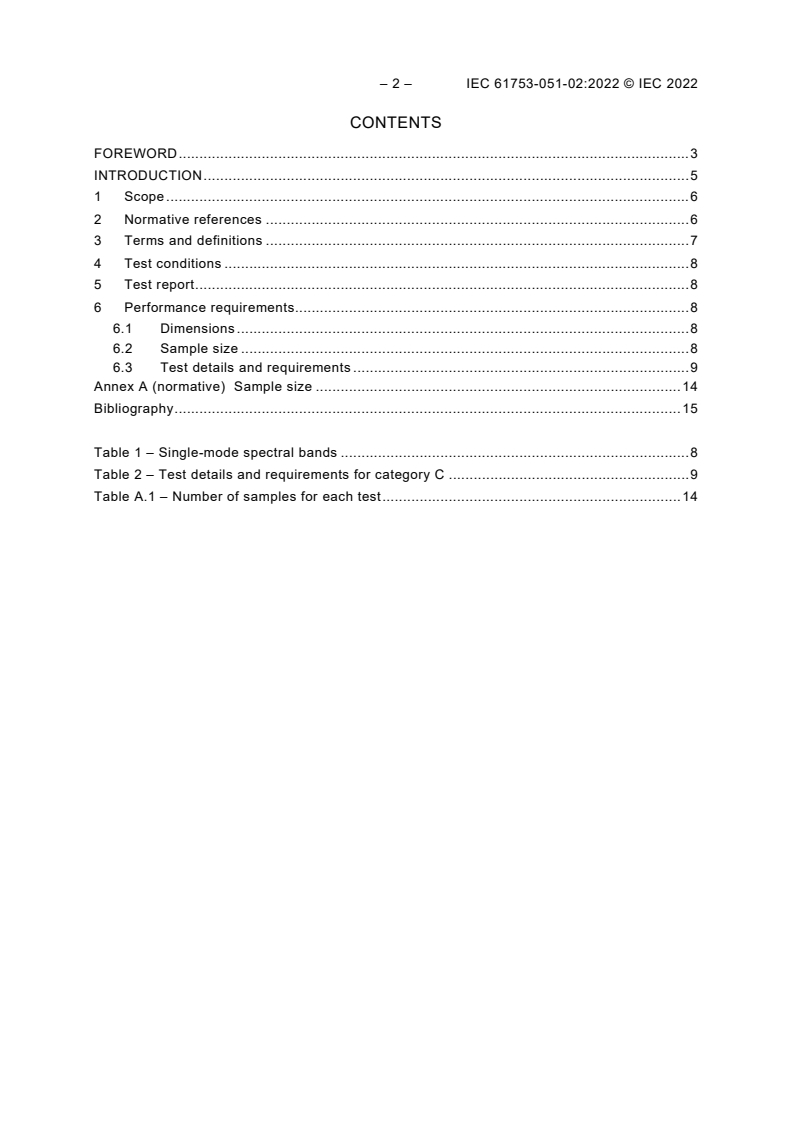
– 2 – IEC 61753-051-02:2022 © IEC 2022
CONTENTS
FOREWORD . 3
INTRODUCTION . 5
1 Scope . 6
2 Normative references . 6
3 Terms and definitions . 7
4 Test conditions . 8
5 Test report . 8
6 Performance requirements. 8
6.1 Dimensions . 8
6.2 Sample size . 8
6.3 Test details and requirements . 9
Annex A (normative) Sample size . 14
Bibliography . 15
Table 1 – Single-mode spectral bands . 8
Table 2 – Test details and requirements for category C . 9
Table A.1 – Number of samples for each test . 14
INTERNATIONAL ELECTROTECHNICAL COMMISSION
____________
FIBRE OPTIC INTERCONNECTING DEVICES AND PASSIVE
COMPONENTS – PERFORMANCE STANDARD –
Part 051-02: Plug-receptacle style single-mode fibre fixed optical
attenuators for category C – Controlled environments
FOREWORD
1) The International Electrotechnical Commission (IEC) is a worldwide organization for standardization comprising
all national electrotechnical committees (IEC National Committees). The object of IEC is to promote international
co-operation on all questions concerning standardization in the electrical and electronic fields. To this end and
in addition to other activities, IEC publishes International Standards, Technical Specifications, Technical Reports,
Publicly Available Specifications (PAS) and Guides (hereafter referred to as “IEC Publication(s)”). Their
preparation is entrusted to technical committees; any IEC National Committee interested in the subject dealt with
may participate in this preparatory work. International, governmental and non-governmental organizations liaising
with the IEC also participate in this preparation. IEC collaborates closely with the International Organization for
Standardization (ISO) in accordance with conditions determined by agreement between the two organizations.
2) The formal decisions or agreements of IEC on technical matters express, as nearly as possible, an international
consensus of opinion on the relevant subjects since each technical committee has representation from all
interested IEC National Committees.
3) IEC Publications have the form of recommendations for international use and are accepted by IEC National
Committees in that sense. While all reasonable efforts are made to ensure that the technical content of IEC
Publications is accurate, IEC cannot be held responsible for the way in which they are used or for any
misinterpretation by any end user.
4) In order to promote international uniformity, IEC National Committees undertake to apply IEC Publications
transparently to the maximum extent possible in their national and regional publications. Any divergence between
any IEC Publication and the corresponding national or regional publication shall be clearly indicated in the latter.
5) IEC itself does not provide any attestation of conformity. Independent certification bodies provide conformity
assessment services and, in some areas, access to IEC marks of conformity. IEC is not responsible for any
services carried out by independent certification bodies.
6) All users should ensure that they have the latest edition of this publication.
7) No liability shall attach to IEC or its directors, employees, servants or agents including individual experts and
members of its technical committees and IEC National Committees for any personal injury, property damage or
other damage of any nature whatsoever, whether direct or indirect, or for costs (including legal fees) and
expenses arising out of the publication, use of, or reliance upon, this IEC Publication or any other IEC
Publications.
8) Attention is drawn to the Normative references cited in this publication. Use of the referenced publications is
indispensable for the correct application of this publication.
9) Attention is drawn to the possibility that some of the elements of this IEC Publication may be the subject of patent
rights. IEC shall not be held responsible for identifying any or all such patent rights.
IEC 61753-051-02 has been prepared by subcommittee 86B: Fibre optic interconnecting
devices and passive components, of IEC technical committee 86: Fibre optics. It is an
International Standard.
This first edition cancels and replaces IEC 61753-051-3 published in 2013. This edition
constitutes a technical revision.
This edition includes the following significant technical changes with respect to
IEC 61753-051-3:2013:
a) change the category from U to C and the test items and their conditions according to
IEC 61753-1;
b) change the requirements reflecting the survey results.
– 4 – IEC 61753-051-02:2022 © IEC 2022
The text of this International Standard is based on the following documents:
Draft Report on voting
86B/4531/CDV 86B/4588A/RVC
Full information on the voting for its approval can be found in the report on voting indicated in
the above table.
The language used for the development of this International Standard is English.
This document was drafted in accordance with ISO/IEC Directives, Part 2, and developed in
accordance with ISO/IEC Directives, Part 1 and ISO/IEC Directives, IEC Supplement, available
at www.iec.ch/members_experts/refdocs. The main document types developed by IEC are
described in greater detail at www.iec.ch/standardsdev/publications.
A list of all parts in the IEC 61753 series, published under the general title Fibre optic
interconnecting devices and passive components – Performance standard, can be found on the
IEC website.
The committee has decided that the contents of this document will remain unchanged until the
stability date indicated on the IEC website under webstore.iec.ch in the data related to the
specific document. At this date, the document will be
• reconfirmed,
• withdrawn,
• replaced by a revised edition, or
• amended.
INTRODUCTION
The performance standard of single-mode plug style optical attenuators has been published in
2001 as IEC 61753-051-3 [1] . After publication of the corrigendum in 2004, the second edition,
in which test details and requirements were reconsidered, has been published in 2013. In 2019,
the market survey of five Japanese suppliers, two Chinese ones and one Swiss has been carried
out. As a result of the survey, it was revealed that some suppliers could not comply to the
category U requirements. It was decided to withdraw IEC 61753-051-3 and establish this
document for category C reflecting the survey result.
___________
Figures in square brackets refer to the Bibliography.
– 6 – IEC 61753-051-02:2022 © IEC 2022
FIBRE OPTIC INTERCONNECTING DEVICES AND PASSIVE
COMPONENTS – PERFORMANCE STANDARD –
Part 051-02: Plug-receptacle style single-mode fibre fixed optical
attenuators for category C – Controlled environments
1 Scope
This part of IEC 61753 contains the minimum initial test and measurement requirements and
severities which plug-receptacle style single-mode fibre fixed optical attenuators need to satisfy
in order to be categorized as meeting the requirements of category C – Controlled environments,
as defined in IEC 61753-1:2018, Annex A.
2 Normative references
The following documents are referred to in the text in such a way that some or all of their content
constitutes requirements of this document. For dated references, only the edition cited applies.
For undated references, the latest edition of the referenced document (including any
amendments) applies.
IEC 60793-2-50, Optical fibres – Part 2-50: Product specifications – Sectional specification for
class B single-mode fibres
IEC 60869-1, Fibre optic interconnecting devices and passive components – Fibre optic passive
power control devices – Part 1: Generic specification
IEC 61300-2-1, Fibre optic interconnecting devices and passive components – Basic test and
measurement procedures – Part 2-1: Tests – Vibration (sinusoidal)
IEC 61300-2-2, Fibre optic interconnecting devices and passive components – Basic test and
measurement procedures – Part 2-2: Tests – Mating durability
IEC 61300-2-6, Fibre optic interconnecting devices and passive components – Basic test and
measurement procedures – Part 2-6: Tests – Tensile strength of coupling mechanism
IEC 61300-2-9, Fibre optic interconnecting devices and passive components – Basic test and
measurement procedures – Part 2-9: Tests – Shock
IEC 61300-2-12, Fibre optic interconnecting devices and passive components – Basic test and
measurement procedures – Part 2-12: Tests – Impact
IEC 61300-2-14, Fibre optic interconnecting devices and passive components – Basic test and
measurement procedures – Part 2-14: Tests – High optical power
IEC 61300-2-17, Fibre optic interconnecting devices and passive components – Basic test and
measurement procedures – Part 2-17: Tests – Cold
IEC 61300-2-18, Fibre optic interconnecting devices and passive components – Basic test and
measurement procedures – Part 2-18: Tests – Dry heat
IEC 61300-2-19, Fibre optic interconnecting devices and passive components – Basic test and
measurement procedures – Part 2-19: Tests – Damp heat (steady state)
IEC 61300-2-22, Fibre optic interconnecting devices and passive components – Basic test and
measurement procedures – Part 2-22: Tests – Change of temperature
IEC 61300-3-2, Fibre optic interconnecting devices and passive components – Basic test and
measurement procedures – Part 3-2: Examination and measurements – Polarization dependent
loss in a single-mode fibre optic device
IEC 61300-3-3, Fibre optic interconnecting devices and passive components – Basic test and
measurement procedures – Part 3-3: Examinations and measurements – Active monitoring of
changes in attenuation and return loss
IEC 61300-3-4, Fibre optic interconnecting devices and passive components – Basic test and
measurement procedures – Part 3-4: Examinations and measurements – Attenuation
IEC 61300-3-6, Fibre optic interconnecting devices and passive components – Basic test and
measurement procedures – Part 3-6: Examinations and measurements – Return loss
IEC 61300-3-28, Fibre optic interconnecting devices and passive components – Basic test and
measurement procedures – Part 3-28: Examinations and measurements – Transient loss
IEC 61753-1:2018, Fibre optic interconnecting devices and passive components – Performance
standard – Part 1: General and guidance
IEC 61754 (all parts), Fibre optic interconnecting devices and passive components – Fibre optic
connector interfaces
IEC 61755-2-4, Fibre optic interconnecting devices and passive components – Connector
optical interfaces – Part 2-4: Connection parameters of non-dispersion shifted single-mode
physically contacting fibres – Non-angled for reference connection applications
IEC 61755-2-5, Fibre optic interconnecting devices and passive components – Connector
optical interfaces – Part 2-5: Connection parameters of non-dispersion shifted single-mode
physically contacting fibres – Angled for reference connection applications
IEC TS 62627-09, Fibre optic interconnecting devices and passive components – Vocabulary
for passive optical devices
3 Terms and definitions
For the purposes of this document, terms and definitions given in IEC 60869-1, IEC TS 62627-
09 and the following apply.
ISO and IEC maintain terminological databases for use in standardization at the following
addresses:
• IEC Electropedia: available at http://www.electropedia.org/
• ISO Online browsing platform: available at http://www.iso.org/obp
3.1
plug-receptacle style single-mode fibre fixed optical attenuator
single-mode fibre fixed optical attenuator which has an optical connector plug interface and an
optical receptacle interface
3.2
attenuation tolerance
allowable attenuation differences from the nominal attenuation for fixed optical attenuators
– 8 – IEC 61753-051-02:2022 © IEC 2022
Note 1 to entry: The attenuation tolerance is expressed in ±x dB.
4 Test conditions
Unless otherwise specified, all test methods are in accordance with the IEC 61300 series. Plug-
receptacle style single-mode fibre fixed optical attenuators used for each test are intended to
be previously unstressed new samples but may also be selected from previously used samples
if desired. All measurements shall be carried out under standard atmospheric conditions, unless
otherwise stated. Before the connection with optical connector plugs and adaptors for the test
and the measurements of the optical performances, all optical connector plug end-faces shall
be cleaned.
NOTE IEC 61300-3-35 [2] defines the visual inspection of the end-face for optical connector plugs. IEC TR 62627-
01 [3] describes the cleaning method of optical connectors.
Table 1 is intended to provide guidance on the wavelength ranges of the various spectral bands.
It is not intended to serve as a specification. Values of operating wavelength used in
performance verification shall be specified between the customer and the supplier or shall be
as defined in the manufacturer’s specification.
Table 1 – Single-mode spectral bands
Range
Band Descriptor
nm
O-band Original 1 260 to 1 360
E-band Extended 1 360 to 1 460
S-band Short wavelength 1 460 to 1 530
C-band Conventional 1 530 to 1 565
L-band Long wavelength 1 565 to 1 625
U-band Ultralong wavelength 1 625 to 1 675
NOTE This table is based on ITU-T G. Supplement 39 [4].
5 Test report
Fully documented test reports and supporting evidence shall be prepared and be available for
inspection as evidence that the tests have been carried out and complied with.
6 Performance requirements
6.1 Dimensions
Dimensions of interfaces of an optical connector plug and an optical receptacle shall comply
with the IEC 61754 series as well as those given in appropriate manufacturers’ drawings. When
implementing this document, be aware that there have been problems when using a rigid
interface component (without spring loaded ferrule) with SC plug style adaptors and plugs. See
IEC TR 62627-02:2010, Clause 6 [5].
6.2 Sample size
Sample sizes shall be accordance with Annex A. Number of samples for each test is described
in Table A.1.
6.3 Test details and requirements
The requirements are given only for plug-receptacle style single-mode fibre fixed optical
attenuators. The test details and requirements for category C are shown in Table 2.
Table 2 – Test details and requirements for category C
No Tests Requirements Details
1 Attenuation Deviation of attenuation from the Launch fibre ≤ 2,0 m
tolerance nominal attenuation shall be: length
IEC 61300-3-4, –0,75 dB ≤ deviation of attenuation
Source 1 310 nm and 1 550 nm
insertion method from the nominal attenuation
wavelength
≤ +0,75 dB for the nominal
attenuation: ≤ 0 dB and ≤ 5 dB.
Measurement ≤ 0,2 dB
uncertainty
–15 % dB of the nominal attenuation
≤ deviation of attenuation from the
Optical connector Fibre shall comply with
nominal attenuation ≤ +15 % dB of
plugs for IEC 60793-2-50, B-652.
the nominal attenuation for the
measurement
nominal attenuation: > 5 dB and
Optical connector plugs
≤ 20 dB.
shall be the reference grade
defined in IEC 61755-2-4
(physical contact; PC) or
IEC 61755-2-5 (angled PC;
APC).
2 Return loss ≤ 60 dB (mated) and ≤ 55 dB Source 1 310 nm and 1 550 nm
(unmated) for grade 1 (APC); wavelength
IEC 61300-3-6,
OCWR method ≤ 45 dB (mated) for grade 2 (PC); Measurement ≤ 1,0 dB
uncertainty
≤ 35 dB (mated) for grade 3 (PC);
Optical connector Fibre shall comply with
≤ 26 dB (mated) for grade 4 (PC).
plugs for IEC 60793-2-50, B-652.
measurement
3 Polarization ≤ 0,3 dB for PC and APC Launch fibre ≤ 2,0 m
dependent loss length
(PDL)
Source 1 310 nm and 1 550 nm
IEC 61300-3-2, wavelength
all polarization
Measurement ≤ 0,1 dB
method
uncertainty
– 10 – IEC 61753-051-02:2022 © IEC 2022
No Tests Requirements Details
4 High optical Before and after the test, the Input power 100 mW for the nominal
power attenuation tolerance in test no.1 attenuation: ≤ 4,0 dB;
and return loss in test no.2 shall be
IEC 61300-2-14 200 mW for the nominal
met.
attenuation: 3,0 dB
During the test, the attenuation
300 mW tor the nominal
change shall be monitored. During
attenuation: 2,0 dB
the test, the attenuation change from
that at the starting to input high
500 mW for the nominal
a
optical power of the test shall be :
attenuation: 1,0 dB
–0,3 dB ≤ attenuation change
Source 1 310 nm and/or 1 550 nm
≤ +0,3 dB for the nominal
wavelength
attenuation of 1 dB;
Duration 30 min
–0,5 dB ≤ attenuation change
≤ +0,5 dB for the nominal
Test temperature 60 °C ± 2 °C
attenuation: > 1 dB and ≤ 2 dB;
Relative humidity
+2
93 % % RH
–1,0 dB ≤ attenuation change −3
≤ +1,0 dB for the nominal
NOTE The internal temperature
attenuation: > 2 dB and ≤ 10 dB;
can increase when high
–2,0 dB ≤ attenuation change
optical power is inserted.
≤ +2,0 dB for the nominal
See IEC TR 62627-03-03
attenuation: > 10 dB and ≤ 20 dB.
[6].
After the test, the attenuation
change from the initial value shall
be:
–0,3 dB ≤ attenuation change
≤ +0,3 dB for the nominal
attenuation of 1 dB;
–0,5 dB ≤ attenuation change
≤ +0,5 dB for the nominal
attenuation: > 1 dB and ≤ 2 dB;
–1,0 dB ≤ attenuation change
≤ +1,0 dB for the nominal
attenuation: > 2 dB and ≤ 10 dB;
–2,0 dB ≤ attenuation change
≤ +2,0 dB for the nominal
attenuation: > 10 dB and ≤ 20 dB.
During the test, the return loss shall
be monitored. During the test, the
return loss in test no.2 shall be met.
During the test, the attenuation and
the return loss shall be monitored by
IEC 61300-3-3.
5 Mating durability Before and after the test, the Mating times 200 times each for plug side
attenuation tolerance in test no.1 and receptacle side
IEC 61300-2-2
and return loss in test no.2 shall be
Source 1 310 nm and/or 1 550 nm
met.
wavelength
During the test, the maximum
allowed change in attenuation shall
be:
–0,5 dB ≤ attenuators change
≤ +0,5 dB for nominal attenuation:
≤ 5 dB;
–10 % dB of the nominal attenuation
≤ attenuation change ≤ +10 % dB of
the nominal attenuation for nominal
attenuation: > 5 dB and ≤ 20 dB.
No Tests Requirements Details
6 Tensile strength Before and after the test, the Force 40 N ± 1 N
of coupling attenuation tolerance in test no.1
Rate of strength 2 N/s
mechanism and return loss in test no.2 shall be
met.
Measurement ≤ 5 s
IEC 61300-2-6
interval
During the test, the maximum
allowed change in attenuation shall
Duration 60 s
be:
Source 1 310 nm and/or 1 550 nm
–0,5 dB ≤ attenuators change
wavelength
≤ +0,5 dB for nominal attenuation:
≤ 5 dB;
–10 % dB of the nominal attenuation
≤ attenuation change ≤ +10 % dB of
the nominal attenuation for nominal
attenuation: > 5 dB and ≤ 20 dB.
During the test, the return loss shall
be monitored. During the test, the
return loss in test no.2 shall be met.
During the test, the attenuation shall
be monitored by IEC 61300-3-3.
7 Cold Before and after the test, the Temperature −10 °C ± 2 °C
attenuation tolerance in test no.1
IEC 61300-2-17
Duration of 96 h
and return loss in test no.2 shall be
exposure
met.
The attenuation change after the
test from the initial value shall be:
–0,3 dB ≤ attenuation change
≤ +0,3 dB.
During the test, the maximum
allowed change in attenuation shall
be:
–0,5 dB ≤ attenuation change
≤ +0,5 dB for nominal attenuation:
≤ 5 dB;
–10 % dB of the nominal attenuation
≤ attenuation change ≤ +10 % dB of
the nominal attenuation for nominal
attenuation: > 5 dB and ≤ 20 dB.
During the test, the attenuation shall
be monitored by IEC 61300-3-3.
8 Dry heat Before and after the test, the Temperature
+60 °C ± 2 °C
attenuation tolerance and return loss
IEC 61300-2-18
Duration of 96 h
of test no.1 and no.2 shall be met.
exposure
The attenuation change after the
test shall be within ±0,3 dB of the
initial value.
During the test, the maximum
allowed change in attenuation shall
be:
–0,5 dB ≤ attenuation change
≤ +0,5 dB for nominal attenuation:
≤ 5 dB;
–10 % dB of the nominal attenuation
≤ attenuation change ≤ +10 % dB of
the nominal attenuation for nominal
attenuation: > 5 dB and ≤ 20 dB.
During the test, the attenuation shall
be monitored by IEC 61300-3-3.
– 12 – IEC 61753-051-02:2022 © IEC 2022
No Tests Requirements Details
9 Damp heat Before and after the test, the Temperature
+40 °C ± 2 °C
(steady state) attenuation tolerance and return loss
Relative humidity
+2
of test no.1 and no.2 shall be met.
93 % % RH
IEC 61300-2-19 −3
During the test, the attenuation
Duration of 96 h
change shall be monitored. The
exposure
attenuation change from that at the
starting time of the test shall be:
Measurement ≤ 1 h
interval
–0,5 dB ≤ attenuation change
≤ +0,5 dB for nominal attenuation:
≤ 5 dB;
–10 % dB of the nominal attenuation
≤ attenuation change ≤ +10 % dB of
the nominal attenuation for nominal
attenuation: > 5 dB and ≤ 20 dB.
During the test, the return loss shall
be monitored. The return loss shall
be met in test no.2.
During the test, the attenuation and
the return loss shall be monitored by
IEC 61300-3-3.
10 Change of Before and after the test, the High temperature
+60 °C ± 2 °C
temperature attenuation tolerance in test no.1
Low temperature −10 °C ± 2 °C
and return loss in test no.2 shall be
IEC 61300-2-22
met.
Number of cycles 5
During and after the test, the
Duration at 60 min
attenuation change from the initial
extreme
value shall be:
temperature
–0,5 dB ≤ attenuation change
Rate of change ≤ 1 °C/min
≤ +0,5 dB for nominal attenuation:
≤ 5 dB;
Measurement ≤ 15 min
interval
–10 % dB of the nominal attenuation
≤ attenuation change ≤ +10 % dB of
the nominal attenuation for nominal
attenuation: > 5 dB and ≤ 20 dB.
During the test, the return loss shall
be monitored. The return loss shall
be met in test no.2.
During the test, the attenuation
change and the return loss shall be
monitored by IEC 61300-3-3.
Vibration Before and after the test, the
11 Frequency range 10 Hz to 55 Hz
(sinusoidal) attenuation tolerance in the test no.1
Number of axes 3 orthogonal axes
and return loss in the test no.2 shall
IEC 61300-2-1
be met.
Number of 15/axis
sweeps
During the test, the maximum
1 sweep: 10 Hz to 55 Hz to
allowed change in attenuation shall
10 Hz
be:
Sweep rate 1 octave/min
–0,5 dB ≤ attenuation change
≤ +0,5 dB for nominal attenuation:
Amplitude 0,75 mm
≤ 5 dB;
–10 % dB of the nominal attenuation
≤ attenuation change ≤ +10 % dB of
the nominal attenuation for nominal
attenuation: > 5 dB and ≤ 20 dB.
During the test, the attenuation
change shall be monitored by
IEC 61300-3-28.
No Tests Requirements Details
12 Shock Before and after the test, the Acceleration
5 000 m/s
attenuation tolerance in test no.1
IEC 61300-2-9
Pulse shape and Half sine and 1 ms
and return loss in test no.2 shall be
duration
met.
Number of axis 3 axes in 2 directions
After the test, the maximum allowed
change in attenuation shall be:
Number of shocks 2 shocks per axis,
–0,5 dB ≤ attenuation change 12 shocks in total
≤ +0,5 dB for nominal attenuation:
Other condition Dust caps may be attached
≤ 5 dB;
on plug and receptacle
interfaces during the test.
–10 % dB of the nominal attenuation
≤ attenuation change ≤ +10 % dB of
the nominal attenuation for nominal
attenuation: > 5 dB and ≤ 20 dB.
13 Impact Before and after the test, the Height 1,5 m
attenuation tolerance in test no.1
Number of 5
IEC 61300-2-12,
and return loss in test no.2 shall be
impacts
method A
met.
(optional)
The attenuation change after the
test from the initial value shall be:
–0,3 dB ≤ attenuation change
≤ +0,3 dB.
a
Before the test, the measurement is at the standard atmospheric condition. The attenuation at the starting time
of input high optical power is different from that of before the test. The attenuation change should be compared
with the one just before inputting high optical power. Therefore, the reference of the attenuation is at the starting
time of input high optical power.
– 14 – IEC 61753-051-02:2022 © IEC 2022
Annex A
(normative)
Sample size
All samples shall be subjected to tests 1 to 3 as shown in Table A.1. All other tests may be
done in any order. Consecutive testing on the same optical sample is allowed, but in case of
failure during the consecutive testing, a new sample shall be prepared and the failed test shall
be redone.
Table A.1 – Number of samples for each test
No. Test Sample size
1 Attenuation tolerance 12
2 Return loss 12
3 PDL 12
4 High optical power 3
5 Mating durability 3
6 Tensile strength of coupling mechanism 3
7 Cold 6
8 Dry heat 6
9 Damp heat (steady state) 6
10 Change of temperature 6
11 Vibration (sinusoidal) 6
12 Shock 6
13 Impact (optional) 6
Bibliography
[1] IEC 61753-051-3:2001, Fibre optic interconnecting devices and passive components
performance standard – Part 051-3: Single-mode fibre, plug style fixed attenuators for
Category U – Uncontrolled environment
[2] IEC 61300-3-35, Fibre optic interconnecting devices and passive components – Basic
test and measurement procedures – Part 3-35: Examinations and measurements –
Visual inspection of fibre optic connectors and fibre-stub transceivers
[3] IEC TR 62627-01, Fibre optic interconnecting devices and passive components –
Part 01: Fibre optic connector cleaning methods
[4] Recommendation ITU-T G.Sup39, Transmission systems and media, digital systems and
networks – Supplement 39, Optical system design and engineering considerations
[5] IEC TR 62627-02:2010, Fibre optic interconnecting devices and passive components –
Part 02: Report of round robin test results on SC plug style fixed attenuators
[6] IEC TR 62627-03-03, Fibre optic interconnecting devices and passive components –
Part 03-03: Reliability – Report on high-power reliability for metal-doped optical fibre
plug-style optical attenuators
[7] IEC 61753-051-3:2013, Fibre optic interconnecting devices and passive components -
Performance standard – Part 051-3: Single-mode fibre, plug style fixed attenuators for
category U – Uncontrolled environment
[8] IEC 60068-2-27, Environmental testing – Part 2-27: Tests – Test Ea and guidance:
Shock
[9] IEC 61300 (all parts), Fibre optic interconnecting devices and passive components –
Basic test and measurement procedures
___________
___________
This publication has been withdrawn.
This publication has been withdrawn.
– 16 – IEC 61753-051-02:2022 © IEC 2022
SOMMAIRE
AVANT-PROPOS . 17
INTRODUCTION . 19
1 Domaine d’application . 20
2 Références normatives . 20
3 Termes et définitions . 21
4 Conditions d'essai . 22
5 Rapport d’essai . 22
6 Exigences de performance . 23
6.1 Dimensions . 23
6.2 Nombre d’échantillons . 23
6.3 Détails et exigences d'essai . 23
Annexe A (normative) Nombre d'échantillons . 29
Bibliographie . 30
Tableau 1 – Bandes spectrales en unimodal . 22
Tableau 2 – Détails et exigences des essais pour la catégorie C . 23
Tableau A.1 – Nombre d’échantillons pour chaque essai . 29
COMMISSION ÉLECTROTECHNIQUE INTERNATIONALE
____________
DISPOSITIFS D’INTERCONNEXION ET COMPOSANTS PASSIFS
FIBRONIQUES – NORME DE PERFORMANCE –
Partie 051-02: Affaiblisseurs optiques fixes à fibres unimodales de type
fiche-embase pour la catégorie C – Environnements contrôlés
AVANT-PROPOS
1) La Commission Electrotechnique Internationale (IEC) est une organisation mondiale de normalisation composée
de l'ensemble des comités électrotechniques nationaux (Comités nationaux de l’IEC). L’IEC a pour objet de
favoriser la coopération internationale pour toutes les questions de normalisation dans les domaines de
l'électricité et de l'électronique. À cet effet, l’IEC – entre autres activités – publie des Normes internationales,
des Spécifications techniques, des Rapports techniques, des Spécifications accessibles au public (PAS) et des
Guides (ci-après dénommés "Publication(s) de l’IEC"). Leur élaboration est confiée à des comités d'études, aux
travaux desquels tout Comité national intéressé par le sujet traité peut participer. Les organisations
internationales, gouvernementales et non gouvernementales, en liaison avec l’IEC, participent également aux
travaux. L’IEC collabore étroitement avec l'Organisation Internationale de Normalisation (ISO), selon des
conditions fixées par accord entre les deux organisations.
2) Les décisions ou accords officiels de l’IEC concernant les questions techniques représentent, dans la mesure du
possible, un accord international sur les sujets étudiés, étant donné que les Comités nationaux de l’IEC intéressés
sont représentés dans chaque comité d’études.
3) Les Publications de l'IEC se présentent sous la forme de recommandations internationales et sont agréées
comme telles par les Comités nationaux de l'IEC. Tous les efforts raisonnables sont entrepris afin que l’IEC
s'assure de l'exactitude du contenu technique de ses publications; l’IEC ne peut pas être tenue responsable de
l'éventuelle mauvaise utilisation ou interprétation qui en est faite par un quelconque utilisateur final.
4) Dans le but d'encourager l'uniformité internationale, les Comités nationaux de l’IEC s'engagent, dans toute la
mesure possible, à appliquer de façon transparente les Publications de l’IEC dans leurs publications nationales
et régionales. Toutes divergences entre toutes Publications de l'IEC et toutes publications nationales ou
régionales correspondantes doivent être indiquées en termes clairs dans ces dernières.
5) L’IEC elle-même ne fournit aucune attestation de conformité. Des organismes de certification indépendants
fournissent des services d'évaluation de conformité et, dans certains secteurs, accèdent aux marques de
conformité de l’IEC. L’IEC n'est responsable d'aucun des services effectués par les organismes de certification
indépendants.
6) Tous les utilisateurs doivent s'assurer qu'ils sont en possession de la dernière édition de cette publication.
7) Aucune responsabilité ne doit être imputée à l’IEC, à ses administrateurs, employés, auxiliaires ou mandataires,
y compris ses experts particuliers et les membres de ses comités d'études et des Comités nationaux de l’IEC,
pour tout préjudice causé en cas de dommages corporels et matériels, ou de tout autre dommage de quelque
nature que ce soit, directe ou indirecte, ou pour supporter les coûts (y compris les frais de justice) et les dépenses
découlant de la publication ou de l'utilisation de cette Publication de l’IEC ou de toute autre Publication de l’IEC,
ou au crédit qui lui est accordé.
8) L'attention est attirée sur les références normatives citées dans cette publication. L'utilisation de publications
référencées est obligatoire pour une application correcte de la présente publication.
9) L’attention est attirée sur le fait que certains des éléments de la présente Publication de l’IEC peuvent faire l’objet
de droits de brevet. L’IEC ne saurait être tenue pour responsable de ne pas avoir identifié de tels droits de
brevets.
L’IEC 61753-051-02 a été établie par le sous-comité 86B: Dispositifs d'interconnexion et
composants passifs à fibres optiques, du comité d'études 86 de l'IEC: Fibres optiques. Il s’agit
d’une Norme internationale.
Cette première édition annule et remplace l'IEC 61753-051-3 parue en 2013. Cette édition
constitue une révision technique.
Cette édition inclut les modifications techniques majeures suivantes par rapport à
l'IEC 61753-051-3:2013:
a) modification de la catégorie qui était U et devient C et des éléments d'essai et de leurs
conditions conformément à l'IEC 61753-1;
– 18 – IEC 61753-051-02:2022 © IEC 2022
b) modification des exigences reflétant les résultats de l'étude.
Le texte de cette Norme internationale est issu des documents suivants:
Projet Rapport de vote
86B/4531/CDV 86B/4588A/RVC
Le rapport de vote indiqué dans le tableau ci-dessus donne toute information sur le vote ayant
abouti à son approbation.
La langue employée pour l'élaboration de cette Norme internationale est l'anglais.
Ce document a été rédigé selon les Directives ISO/IEC, Partie 2, il a été développé selon les
Directives ISO/IEC, Partie 1 et les Directives ISO/IEC, Supplément IEC, disponibles sous
www.iec.ch/members_experts/refdocs. Les principaux types de documents développés par
l'IEC sont décrits plus en détail sous www.iec.ch/standardsdev/publications.
Une liste de toutes les parties de la série IEC 61753, publiées sous le titre général Dispositifs
d’interconnexion et composants passifs fibroniques – Norme de performance, se trouve sur le
site web de l'IEC.
Le comité a décidé que le contenu de ce document ne sera pas modifié avant la date de stabilité
indiquée sur le site web de l’IEC sous webstore.iec.ch dans les données relatives au document
recherché. A cette date, le document sera
• reconduit,
• supprimé,
• remplacé par une édition révisée, ou
• amendé.
INTRODUCTION
La norme de performance applicable aux affaiblisseurs optiques à fibres unimodales de type
fiche a été publiée en 2001 sous la référence: IEC 61753-051-3 [1] . Après la publication du
corrigendum en 2004, la deuxième édition dont les détails et les exigences d’essai avaient été
réexaminés a été publiée en 2013. En 2019, une étude de marché a été réalisée auprès de cinq
fournisseurs japonais, deux fournisseurs chinois et un fournisseur suisse. Cette étude a montré
que certains fournisseurs ne pouvaient pas satisfaire aux exigences de la catégorie U. Il a été
décidé de retirer l’IEC 61753-051-3 et d’élaborer le présent document pour la catégorie C afin
de refléter le résultat de l’étude.
___________
Les chiffres entre crochets renvoient à la Bibliographie.
– 20 – IEC 61753-051-02:2022 ©
...