

IEC TS 62239:2003
(Main)Process management for avionics - Preparation of an electronic components management plan
General Information
- Abstract
Defines the requirements for developing an electronic components management plan to assure customers and regulatory agencies that all of the electronic components in the equipment of the plan owner are selected and applied in controlled processes compatible with the end application and that the technical requirements are accomplished.
- Status
- Published
- Publication Date
- 18-May-2003
- Technical Committee
- TC 107 - Process management for avionics
- Drafting Committee
- WG 1 - TC 107/WG 1
- Current Stage
- DELPUB - Deleted Publication
- Start Date
- 21-Oct-2008
- Completion Date
- 28-Aug-2026
Overview
IEC TS 62239:2003, "Process management for avionics – Preparation of an electronic components management plan," is a technical specification from IEC that defines requirements for developing an Electronic Components Management Plan (ECMP). Its purpose is to assure customers and regulatory agencies that electronic components used in avionics equipment are selected, applied, qualified and controlled in processes compatible with the end application and the applicable technical requirements.
This TS is targeted to aerospace equipment manufacturers and component users and provides objectives and structure for documenting component control processes without mandating specific procedures or data formats.
Key topics and requirements
The standard requires an ECMP to document how the plan owner meets the following technical requirements (Clause 4):
- Component selection - processes for choosing components appropriate to application and environment.
- Component application - ensuring components meet equipment design and usage requirements.
- Component qualification - demonstrating components meet specifications for required conditions.
- Continuous component quality assurance - processes that provide confidence each component meets performance and environmental requirements.
- Component dependability - managing reliability, maintainability, availability and safety, including obsolescence management.
- Compatibility with manufacturing processes - ensuring component attributes suit production and assembly.
- Component data - maintaining traceability, technical data and configuration records.
- Configuration control - controlling changes to components and documented approvals.
Plan administration (Clause 5) topics include plan organization, focal point, applicability, implementation, acceptance, and special cases such as using semiconductors outside manufacturer temperature ranges (see normative reference IEC/PAS 62240).
The ECMP must clearly state what is done, how compliance is demonstrated, and what evidence is available.
Applications and users
Who benefits from using IEC TS 62239:
- Avionics equipment manufacturers (plan owners) preparing company ECMPs
- Subcontractors and suppliers implementing customer ECMP requirements
- Maintenance facilities and sustainment organizations managing component replacements or repairs
- Regulatory reviewers and customers seeking assurance that component selection, qualification and control are in place
Practical uses:
- Creating a single enterprise ECMP or product-specific plans
- Demonstrating controlled processes for audits and certification
- Reducing supply-chain risk through documented obsolescence and quality assurance practices
- Ensuring components are compatible with manufacturing and maintenance processes
Related standards
- IEC/PAS 62240 - Use of semiconductor devices outside manufacturers’ specified temperature ranges (normative reference)
- ISO/IEC Directives - referenced for drafting format and review process
Keywords: IEC TS 62239:2003, ECMP, electronic components management plan, avionics process management, component selection, component qualification, obsolescence management, component quality assurance, configuration control.
Relations
- Effective Date
- 05-Sep-2023
- Effective Date
- 10-Feb-2026
- Effective Date
- 05-Sep-2023
Get Certified
Connect with accredited certification bodies for this standard

BSI Group
BSI (British Standards Institution) is the business standards company that helps organizations make excellence a habit.

Bureau Veritas
Bureau Veritas is a world leader in laboratory testing, inspection and certification services.

DNV
DNV is an independent assurance and risk management provider.
Sponsored listings
Frequently Asked Questions
IEC TS 62239:2003 is a technical specification published by the International Electrotechnical Commission (IEC). Its full title is "Process management for avionics - Preparation of an electronic components management plan". This standard covers: Defines the requirements for developing an electronic components management plan to assure customers and regulatory agencies that all of the electronic components in the equipment of the plan owner are selected and applied in controlled processes compatible with the end application and that the technical requirements are accomplished.
Defines the requirements for developing an electronic components management plan to assure customers and regulatory agencies that all of the electronic components in the equipment of the plan owner are selected and applied in controlled processes compatible with the end application and that the technical requirements are accomplished.
IEC TS 62239:2003 is classified under the following ICS (International Classification for Standards) categories: 03.100.50 - Production. Production management; 31.020 - Electronic components in general; 49.060 - Aerospace electric equipment and systems. The ICS classification helps identify the subject area and facilitates finding related standards.
IEC TS 62239:2003 has the following relationships with other standards: It is inter standard links to IEC PAS 62239:2001, EN 62402:2007, IEC TS 62239:2008. Understanding these relationships helps ensure you are using the most current and applicable version of the standard.
IEC TS 62239:2003 is available in PDF format for immediate download after purchase. The document can be added to your cart and obtained through the secure checkout process. Digital delivery ensures instant access to the complete standard document.
Standards Content (Sample)
TECHNICAL IEC
SPECIFICATION
TS 62239
First edition
2003-05
Process management for avionics –
Preparation of an electronic components
management plan
Gestion des processus pour l'avionique –
Préparation d'un plan de gestion
des composants électroniques
Reference number
IEC/TS 62239:2003(E)
Publication numbering
As from 1 January 1997 all IEC publications are issued with a designation in the
60000 series. For example, IEC 34-1 is now referred to as IEC 60034-1.
Consolidated editions
The IEC is now publishing consolidated versions of its publications. For example,
edition numbers 1.0, 1.1 and 1.2 refer, respectively, to the base publication, the
base publication incorporating amendment 1 and the base publication incorporating
amendments 1 and 2.
Further information on IEC publications
The technical content of IEC publications is kept under constant review by the IEC,
thus ensuring that the content reflects current technology. Information relating to
this publication, including its validity, is available in the IEC Catalogue of
publications (see below) in addition to new editions, amendments and corrigenda.
Information on the subjects under consideration and work in progress undertaken
by the technical committee which has prepared this publication, as well as the list
of publications issued, is also available from the following:
• IEC Web Site (www.iec.ch)
• Catalogue of IEC publications
The on-line catalogue on the IEC web site (http://www.iec.ch/searchpub/cur_fut.htm)
enables you to search by a variety of criteria including text searches, technical
committees and date of publication. On-line information is also available on
recently issued publications, withdrawn and replaced publications, as well as
corrigenda.
• IEC Just Published
This summary of recently issued publications (http://www.iec.ch/online_news/
justpub/jp_entry.htm) is also available by email. Please contact the Customer
Service Centre (see below) for further information.
• Customer Service Centre
If you have any questions regarding this publication or need further assistance,
please contact the Customer Service Centre:
Email: custserv@iec.ch
Tel: +41 22 919 02 11
Fax: +41 22 919 03 00
TECHNICAL IEC
SPECIFICATION
TS 62239
First edition
2003-05
Process management for avionics –
Preparation of an electronic components
management plan
Gestion des processus pour l'avionique –
Préparation d'un plan de gestion
des composants électroniques
IEC 2003 Copyright - all rights reserved
No part of this publication may be reproduced or utilized in any form or by any means, electronic or
mechanical, including photocopying and microfilm, without permission in writing from the publisher.
International Electrotechnical Commission, 3, rue de Varembé, PO Box 131, CH-1211 Geneva 20, Switzerland
Telephone: +41 22 919 02 11 Telefax: +41 22 919 03 00 E-mail: inmail@iec.ch Web: www.iec.ch
PRICE CODE
Commission Electrotechnique Internationale
S
International Electrotechnical Commission
Международная Электротехническая Комиссия
For price, see current catalogue
– 2 – TS 62239 IEC:2003(E)
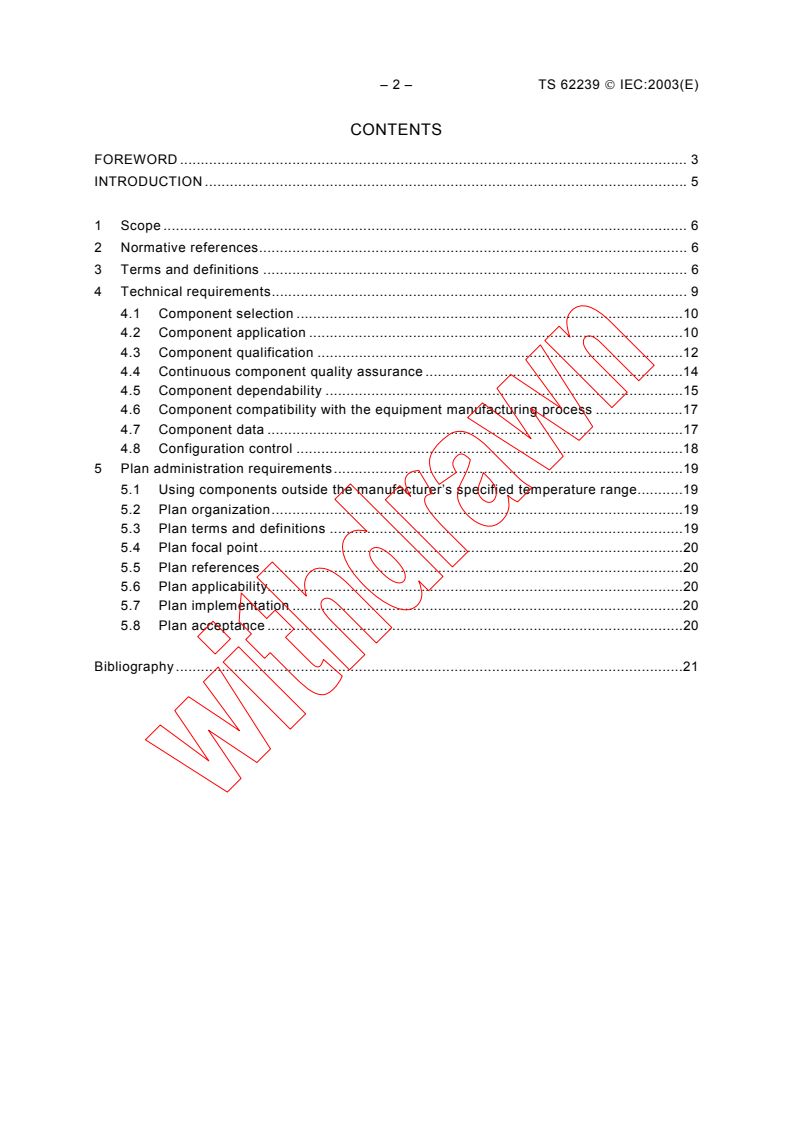
CONTENTS
FOREWORD . 3
INTRODUCTION .5
1 Scope . 6
2 Normative references. 6
3 Terms and definitions . 6
4 Technical requirements. 9
4.1 Component selection .10
4.2 Component application .10
4.3 Component qualification .12
4.4 Continuous component quality assurance .14
4.5 Component dependability .15
4.6 Component compatibility with the equipment manufacturing process .17
4.7 Component data .17
4.8 Configuration control .18
5 Plan administration requirements.19
5.1 Using components outside the manufacturer’s specified temperature range.19
5.2 Plan organization.19
5.3 Plan terms and definitions .19
5.4 Plan focal point.20
5.5 Plan references .20
5.6 Plan applicability.20
5.7 Plan implementation .20
5.8 Plan acceptance .20
Bibliography.21
TS 62239 IEC:2003(E) – 3 –
INTERNATIONAL ELECTROTECHNICAL COMMISSION
____________
PROCESS MANAGEMENT FOR AVIONICS –
Preparation of an electronic components management plan
FOREWORD
1) The IEC (International Electrotechnical Commission) is a worldwide organization for standardization comprising
all national electrotechnical committees (IEC National Committees). The object of the IEC is to promote
international co-operation on all questions concerning standardization in the electrical and electronic fields. To
this end and in addition to other activities, the IEC publishes International Standards. Their preparation is
entrusted to technical committees; any IEC National Committee interested in the subject dealt with may
participate in this preparatory work. International, governmental and non-governmental organizations liasing
with the IEC also participate in this preparation. The IEC collaborates closely with the International
Organization for Standardization (ISO) in accordance with conditions determined by agreement between the
two organizations.
2) The formal decisions or agreements of the IEC on technical matters express, as nearly as possible, an
international consensus of opinion on the relevant subjects since each technical committee has representation
from all interested National Committees.
3) The documents produced have the form of recommendations for international use and are published in the form
of standards, technical specifications, technical reports or guides and they are accepted by the National
Committees in that sense.
4) In order to promote international unification, IEC National Committees undertake to apply IEC International
Standards transparently to the maximum extent possible in their national and regional standards. Any
divergence between the IEC Standard and the corresponding national or regional standard shall be clearly
indicated in the latter.
5) The IEC provides no marking procedure to indicate its approval and cannot be rendered responsible for any
equipment declared to be in conformity with one of its standards.
6) Attention is drawn to the possibility that some of the elements of this International Standard may be the subject
of patent rights. The IEC shall not be held responsible for identifying any or all such patent rights.
The main task of IEC technical committees is to prepare International Standards. In
exceptional circumstances, a technical committee may propose the publication of a technical
specification when
• the required support cannot be obtained for the publication of an International Standard,
despite repeated efforts, or
• The subject is still under technical development or where, for any other reason, there is
the future but no immediate possibility of an agreement on an International Standard.
Technical specifications are subject to review within three years of publication to decide
whether they can be transformed into International Standards.
IEC 62239, which is a technical specification, has been prepared by IEC technical committee
107: Process management for avionics.
The text of this technical specification is based on the following documents:
Enquiry draft Report on voting
107/19, 19A/DTS 107/20/RVC
Full information on the voting for the approval of this technical specification can be found in
the report on voting indicated in the above table.
– 4 – TS 62239 IEC:2003(E)
This technical specification cancels and replaces IEC/PAS 62239 published in 2001. This first
edition constitutes a technical revision.
This publication has been drafted in accordance with the ISO/IEC Directives, Part 2.
The committee has decided that the contents of this publication will remain unchanged until
2006. At this date, the publication will be
• reconfirmed;
• withdrawn;
• replaced by a revised edition, or
• amended.
A bilingual version of this technical specification may be issued at a later date.
TS 62239 IEC:2003(E) – 5 –
INTRODUCTION
This document is intended to help aerospace equipment manufacturers, subcontractors,
maintenance facilities, and other aerospace component users develop their own Electronic
Component Management Plans (ECMPs), hereinafter also referred to as ‘plan’. This
document states objectives to be accomplished; it does not require specific tasks to be
performed, specific data to be collected or reports to be issued. Those who prepare plans in
compliance with this document are encouraged to document processes that are the most
effective and efficient for them in accomplishing the objectives of this document. In order to
allow flexibility in implementing and updating the documented processes, plan authors are
encouraged to refer to their own internal process documents instead of including detailed
process documentation within their plans.
This component management document is intended for aerospace users of electronic
components. This standard is not intended for use by the manufacturers of electronic
components. Components selected and managed according to the requirements of a plan
compliant to this document may be approved by the concerned parties for the proposed
application, and for other applications with equal or less severe requirements.
Organizations that prepare such plans may prepare a single plan, and use it for all relevant
products supplied by the organization, or may prepare a separate plan for each relevant
product or customer.
– 6 – TS 62239 IEC:2003(E)
PROCESS MANAGEMENT FOR AVIONICS –
Preparation of an electronic components management plan
1 Scope
This Technical Specification defines the requirements for developing an Electronic
Components Management Plan (ECMP) to assure customers and regulatory agencies that all
of the electronic components in the equipment of the plan owner are selected and applied in
controlled processes compatible with the end application and that the technical requirements
detailed in Clause 4 are accomplished. In general, the owners of a complete electronic
components management plan are avionics equipment manufacturers.
2 Normative references
The following referenced documents are indispensable for the application of this document.
For dated references, only the edition cited applies. For undated references, the latest edition
of the referenced document (including any amendments) applies.
IEC/PAS 62240, Use of semiconductor devices outside manufacturers’ specified temperature
ranges
3 Terms definitions and abbreviations
3.1 Terms and definitions
For the purposes of this Technical Specification, the following definitions apply.
NOTE Plan owners may use alternative definitions consistent with convention within their company in their plan.
3.1.1
avionics equipment environment
applicable environmental conditions (as described per the equipment specification) that the
equipment shall be able to withstand without loss or degradation in equipment performance
during all of its manufacturing cycle and maintenance life (the length of which is defined by
the equipment manufacturer in conjunction with customers)
3.1.2
capable
term used to indicate that a component can be used successfully in the intended application
3.1.3
certified
indicates assessment and compliance to an applicable third party standard and maintenance
of a certificate and registration (i.e. CECC, JAN, IECQ)
3.1.4
characterization
process of testing a sample of components to determine the key electrical parameter values
that can be expected of all produced components of the type tested
3.1.5
component application
process that assures that the component meets the design requirements of the equipment in
which it is used
TS 62239 IEC:2003(E) – 7 –
3.1.6
component manufacturer
organization responsible for the component specification and its production
3.1.7
component obsolescence management
range of management actions taken to avoid or resolve the effects of components not being
procurable due to the manufacturer(s) ceasing production. Component obsolescence manage-
ment should be considered an element of component dependability
3.1.8
component qualification
process used to demonstrate that the component is capable of meeting its specification for all
the required conditions and environments
3.1.9
component quality assurance
all activities and processes to provide adequate confidence that each individual component
meets the performance and environmental requirements
3.1.10
component selection
process of choosing a specific component for a specific application
3.1.11
dependability
capability of a product enabling it to achieve the specified functional performance at the
appropriate time and for the planned duration, without damage to itself or its environment
NOTE Dependability is generally characterised by the following four parameters: reliability, maintainability,
availability, safety.
3.1.12
distributor
organization contractually authorized by a manufacturer to store, split, repack and distribute
completely finished components which have been declared by the manufacturer as
conforming to their specifications. The distributor is responsible for providing any technical
information and traceability information supplied by the component manufacturer
3.1.13
Electronic Components Management Plan
ECMP
equipment manufacturer's document that defines the processes and practices for applying
components to an equipment or range of equipment. Generally, it addresses all relevant
aspects of controlling components during system design, development, production, and post-
production support
3.1.14
electronic components
electrical or electronic devices that are not subject to disassembly without destruction or
impairment of design use. They are sometimes called electronic parts, or piece parts
EXAMPLES Resistors, capacitors, diodes, integrated circuits, hybrids, application specific integrated circuits,
wound components and relays.
3.1.15
electronic equipment
item produced by the plan owner, which incorporates electronic components
EXAMPLES End items, sub-assemblies, line-replaceable units and shop-replaceable units.
– 8 – TS 62239 IEC:2003(E)
3.1.16
obsolete component
component which is no longer manufactured, and may or may not still be available
3.1.17
package type
generic package family describing the physical outline and lead style
EXAMPLES Plastic quad flat-package, ball grid array, chip scale package, SOIC package, SOT23 etc.
3.1.18
plan owner
original design authority responsible for all aspects of the design, functionality and reliability
of the delivered equipment in the intended application and is responsible for writing and
maintaining their specific ECMP
3.1.19
risk
measure of the potential inability to achieve overall program objectives within defined cost,
schedule, and technical constraints
3.1.20
single event effect
response of a component caused by the impact of galactic cosmic rays, solar enhanced
particles and/or energetic neutrons and protons. The range of responses can include both
non-destructive (for example upset) and destructive (for example latch-up or gate rupture)
phenomena
3.1.21
subcontractor
person or entity to whom the holder of obligations under a contract has delegated part or all of
such obligations
3.1.22
substitute component
component used as a replacement in equipment after the equipment design has been
approved
NOTE In some contexts, the term “alternate component” is used to describe a substitute component that is “equal
to or better than” the original component.
3.1.23
validation
method of qualifying components at the equipment manufacturer, when no in service data
from prior use is available and there is no manufacturer’s qualification data to analyse
3.2 Abbreviations
DSCC – Defence Supply Center Columbus
ECMP – Electronic Components Management Plan
EMC – Electromagnetic Compatibility
ESS – Environmental Stress Screening
NSI – National Supervising Inspectorate
OEM – Original Equipment Manufacturer
TS 62239 IEC:2003(E) – 9 –
4 Technical requirements
The plan shall document the processes used by the plan owner to accomplish the following
requirements. These requirements shall apply to all electronic components, including off-
the-shelf components, which are defined by the component manufacturer data sheet, and
custom components, which are defined by the original equipment manufacturer.
1) Component selection,
2) Component application,
3) Component qualification,
4) Component quality assurance,
5) Component dependability,
6) Component compatibility with the equipment manufacturing process,
7) Component data,
8) Configuration control.
The plan shall state clearly, concisely, and unambiguously:
• what the plan owner does to accomplish each of the requirements;
• how compliance to the plan is demonstrated; and
• the evidence that is available to show that the requirements have been accomplished.
The plan shall document the processes used to address each of the requirements listed
above and described in 4.1 to 4.8. Depending on program or product line requirements, the
plan owner may, with appropriate justification, amend the above list of requirements by adding
or deleting requirements. If this is done, then the plan shall be assessed according to the
amended list of requirements stated in the plan.
The only type of amendment permitted is to add or delete entire requirements (those
designated and described in 4.1 to 4.8). Modification of any of the requirements listed above
and described in this Clause is not permitted.
All the requirements given in this Clause apply to deliverable flight equipment or
subassemblies for the avionics industry as stated in 5.6. The Original Equipment
Manufacturer (OEM plan owner) has the responsibility of satisfying the requirements given in
the list above. These requirements may be accomplished by either the OEM or may be
subcontracted. In either case, the OEM has the responsibility for ensuring all requirements
are met.
NOTE Ground support test equipment, flight demonstrator assemblies, and prototypes are typically exempt from
these requirements, unless the plan owner states otherwise in their plan, see 5.6.
The plan must satisfy the requirements of this Clause, regardless of the source from which
the plan owner obtains components.
– 10 – TS 62239 IEC:2003(E)
4.1 Component selection
All components shall be selected according to documented processes and shall satisfy the
requirements of this Subclause regardless of additional criteria such as standardisation, order
of preference, etc.
NOTE 1 Because of the highly individual nature of most plan owners’ administrative processes, no detail is
included here. It may include the use of a standard component list, provided the requirements of this Subclause are
met when the components are placed onto the standard list. Components should then be selected from the
standard list for use in specific applications. The selection process may include levels of preference. This may
refer to another process document describing how parts are selected. A preference list may be included in a
contract document.
NOTE 2 It is recommended that:
– the number of component types be minimised;
– components be selected from those readily available and produced in large volume;
– components be selected from those in a preferred stage of their lifecycle.
The conditions for use of the component shall be adequately identified, from the component
specification based on the component manufacturer’s data sheet and any additional
requirements to ensure suitability in the end application.
Availability and level of obsolescence risk should be considered as major component
selection criteria.
If additional performance is required (for example upscreening, uprating, additional
parameters defined), then the component shall be considered as a specific one and shall be
uniquely identified.
Each selected component shall be comprehensively identified within the selection process:
• For off-the-shelf components, as a minimum, the component manufacturer data sheet,
component manufacturer technical and application notes, packaging, reliability and
availability data, producibility data (including storage, soldering conditions, etc.) shall be
identified.
• For components specified by the equipment manufacturer, the specific documentation
(including specification, manufacturer data and process, reliability, specific tests and
screening, and associated in-house continuous monitoring) shall be identified.
4.2 Component application
Listed here are some categories of component application processes that may be
documented in a plan. Not all of the categories listed below are relevant to every component
application; therefore, the requirements listed below are applicable only if relevant to the
given application. The plan shall document the processes that are expected to be applicable
to the majority of the plan owner’s products, with the understanding that some of the
documented processes may not be used for specific programs or specific functionality of
products.
In each case, the documented processes shall verify if the equipment containing the
component shall continue to meet its performance requirements and specifications throughout
the manufacturing, full service storage, and operating lifetime. In order to determine design
suitability of equipment, there shall be a formal design review. At the design review,
consideration for each component shall be given to all design aspects including those given in
4.2.1 to 4.2.6. A documented report shall be prepared against each of the following design
aspects:
TS 62239 IEC:2003(E) – 11 –
4.2.1 Electromagnetic compatibility (EMC)
EMC is demonstrated by analysis, testing and simulation to customer requirements. The
component performance shall be capable of EMC compliance at equipment level.
NOTE Certain components, for example high power switching components, may produce more electromagnetic
signal than other types and additionally certain components can be more susceptible to electromagnetic
interference than others. Component level EMC aspects have been addressed in IEC 61967-1.
4.2.2 De-rating and stress analysis
The documented processes shall verify that the component is used within the operating limits
specified by the component manufacturer per a documented set of derating criteria.
When the component manufacturer provides derating criteria and methods, they shall be used
where applicable. If the component manufacturer does not provide this information, or if it is
not applicable, then the plan owner shall develop and document appropriate derating criteria
and methods. All instances in which a component is not used within the limits defined above
shall be documented in the design records. In all such instances, either corrective action shall
be taken, or justification for not satisfying the criteria shall be documented.
4.2.3 Thermal analysis
The documented processes shall verify that the component is used within the temperature
limits specified by the component manufacturer, or by the plan owner.
If components are used outside the temperature ranges specified by the component manu-
facturer, then the supplier shall demonstrate how he controls this process. Recommendations
and guidelines on how to do this are contained in IEC/PAS 62240 and may be used in
addition to the plan prepared according to this document. Equivalent procedures from other
documents may also be acceptable.
NOTE 1 A common maximum temperature for semiconductor devices is the junction temperature. In some
instances, other limiting temperatures may be specified for semiconductor devices, and other types of components.
NOTE 2 In some instances, the manufacturer may not specify the maximum temperature. However the maximum
temperature may be calculated from other information supplied by the component manufacturer.
NOTE 3 Verification processes may include analysis, modelling, thermal survey, simulation, or testing.
4.2.4 Mechanical analysis
The documented processes shall verify that the component is mechanically compatible with
the application. This includes mechanical fit, as well as the ability to withstand vibration,
mechanical shock, and mechanical stresses including those generated by mismatches of
coefficients of thermal expansion of the different materials.
NOTE Verification processes may include analysis, modelling, simulation, or testing.
4.2.5 Testing, testability, and maintainability
The documented processes shall assure testability and maintainability of the equipment by
the plan owner.
NOTE 1 The focus here is on testing and testability with regard to component verification, not on software or
system verification. Examples include board level or sub-assembly level testing, provision for test pins, and that
other equipment level tests will be available to verify component function at the appropriate level. Exhaustive
testing of complex components is not always realistic, but documented processes should assure some level of
evaluation of all components at appropriate points in the production flow.
NOTE 2 This requirement also includes design for maintainability, for example, placement for ease of component
replacement, mounting that minimises the risk of damage during maintenance and assures equipment quality
following maintenance or repair by equipment manufacturer.
– 12 – TS 62239 IEC:2003(E)
4.2.6 Avionics radiation environment
The documented processes shall verify that the component will operate successfully in the
application with regard to the effects of atmospheric radiation. These include single event
upset (SEU), single event latch-up (SEL), single event burnout (SEB) and total dose radiation
for any identified application where it is a concern. If radiation effects are accommodated by
the equipment design, then the method of accommodation shall be documented in the
equipment design records.
4.3 Component qualification
4.3.1 General component qualification requirements
It is desired and expected that the majority of components be obtained from qualified
component manufacturers; in which case the requirements of 4.3.2, 4.3.3, and 4.3.4 shall
apply. In cases where the component manufacturer is not qualified, the requirements of 4.3.5
shall apply.
4.3.2 Component manufacturer quality management
The plan owner shall verify that the component manufacturer has a documented quality
management system.
4.3.2.1 The component manufacturer shall have a quality system assessed to the relevant
parts of the ISO 9000 series or equivalent.
4.3.2.2 Where the component manufacturer is not assessed in accordance with 4.3.2.1
above, then the plan owner shall demonstrate how the quality management system of the
component manufacturer shall be maintained. Where the plan owner conducts or enables an
audit on the component manufacturing facility, then the audit shall be conducted in
accordance with the relevant standards of the ISO 9000 series or equivalent system. Suitably
trained auditors shall conduct that audit.
4.3.3 Component manufacturer process management approval
The plan owner shall verify that the component manufacturer has a manufacturing process
capability utilising manufacturing technologies with demonstrable repeatability.
This may be satisfied by one of the following:
4.3.3.1 Manufacturing approval of the component technologies by a third party (for example
CECC, DSCC, and IECQ) or within an international second party system.
4.3.3.2 Where the component manufacturer is not assessed as in 4.3.3.1, then the plan
owner shall demonstrate how the process management capability of the component
manufacturer is ensured. Where the plan owner conducts or enables an
...