

IEC 62481-3:2013
(Main)Digital living network alliance (DLNA) home networked device interoperability guidelines - Part 3: Link protection
General Information
- Abstract
IEC 62481-3:2013(E) specifies the DLNA link protection guidelines, which are an extension of the DLNA guidelines. DLNA link protection is defined as the protection of a content stream between two devices on a DLNA network from illegitimate observation or interception using the protocols defined within this part of IEC 62481. It references existing technologies for Link Protection and provide mechanisms for interoperability between different implementations as well as integration with the DLNA architecture. This second edition cancels and replaces the first edition published in 2010 and constitutes a technical revision. It includes the following changes:
- includes variable play (trick mode) support;
- includes updates to resolve interoperability issues.
- Status
- Published
- Publication Date
- 22-Oct-2013
- Technical Committee
- TC 100 - Audio, video and multimedia systems and equipment
- Current Stage
- DELPUB - Deleted Publication
- Start Date
- 27-Jul-2017
- Completion Date
- 28-Aug-2026
Buy Documents
IEC 62481-3:2013 - Digital living network alliance (DLNA) home networked device interoperability guidelines - Part 3: Link protection Released:10/23/2013
IEC 62481-3:2013 - Digital living network alliance (DLNA) home networked device interoperability guidelines - Part 3: Link protection Released:10/23/2013
Overview
IEC 62481-3:2013 defines the Digital Living Network Alliance (DLNA) link protection guidelines for home networked device interoperability. This second edition (2013) is a technical revision of the 2010 edition and formally specifies how to protect a content stream between two DLNA devices from illegitimate observation or interception using the protocols and mechanisms described in the document. The standard references existing link protection technologies and provides interoperability and integration rules within the DLNA architecture, including added support for variable play (trick mode) and updates to resolve interoperability issues.
Key topics and technical requirements
- Scope and terminology: Defines DLNA home network architecture, device models and conventions used for link protection.
- Link protection definition: Protection of audio/video content streams between devices to prevent interception or unauthorized access.
- Supported Link Protection Systems: Detailed guidelines for DTCP‑IP and Windows Media DRM for Network Devices (WMDRM‑ND), including registration, revalidation and discovery procedures.
- Media transport and protocols: Requirements and interoperability rules for protected content delivery over HTTP and RTP, including QoS considerations for DTCP‑IP traffic.
- Media management & device control: Rules for device discovery, media metadata handling, mandatory media operations and how protected URIs are represented (DTCP‑IP URI guidelines).
- Variable play (trick mode): Added support for seeking and trick-play operations on protected streams (see Annex A for seek operations).
- Profiling and encapsulation: Profiles and MIME-type definitions for DTCP‑IP and WMDRM‑ND protected content, and rules for protected/unprotected content portions.
- Virtualization & MIU: Guidelines for content conversion device virtualization and Media Interoperability Unit (MIU) handling.
- Interoperability updates: Changes to resolve prior interoperability issues across DLNA implementations.
Practical applications and who uses it
IEC 62481-3 is essential for:
- CE device manufacturers (smart TVs, set-top boxes, media servers/players) implementing DLNA-compatible link protection.
- Firmware and software developers integrating DTCP‑IP or WMDRM‑ND into media stacks.
- System integrators and solution architects designing secure home media distribution systems.
- Test labs and certification bodies validating interoperability and compliance with DLNA link protection rules. Practical uses include protecting streamed movies, music and other AV content on home networks, enabling secure remote playback, and ensuring seamless trick-play and seeking behavior for protected streams.
Related standards
- Other parts of the IEC 62481 (DLNA) series covering general DLNA guidelines, media management and transport.
- Referenced link protection technology specifications (DTCP‑IP and WMDRM‑ND) and relevant networking/DRM industry documents cited in the normative references.
Keywords: IEC 62481-3, DLNA link protection, DTCP-IP, WMDRM-ND, home network security, DLNA interoperability, media streaming protection, variable play (trick mode).
Relations
- Effective Date
- 05-Sep-2023
- Effective Date
- 05-Sep-2023
Buy Documents
IEC 62481-3:2013 - Digital living network alliance (DLNA) home networked device interoperability guidelines - Part 3: Link protection Released:10/23/2013
IEC 62481-3:2013 - Digital living network alliance (DLNA) home networked device interoperability guidelines - Part 3: Link protection Released:10/23/2013
Get Certified
Connect with accredited certification bodies for this standard

BSI Group
BSI (British Standards Institution) is the business standards company that helps organizations make excellence a habit.

NYCE
Mexican standards and certification body.

ANCE
Mexican certification and testing association.
Sponsored listings
Frequently Asked Questions
IEC 62481-3:2013 is a standard published by the International Electrotechnical Commission (IEC). Its full title is "Digital living network alliance (DLNA) home networked device interoperability guidelines - Part 3: Link protection". This standard covers: IEC 62481-3:2013(E) specifies the DLNA link protection guidelines, which are an extension of the DLNA guidelines. DLNA link protection is defined as the protection of a content stream between two devices on a DLNA network from illegitimate observation or interception using the protocols defined within this part of IEC 62481. It references existing technologies for Link Protection and provide mechanisms for interoperability between different implementations as well as integration with the DLNA architecture. This second edition cancels and replaces the first edition published in 2010 and constitutes a technical revision. It includes the following changes: - includes variable play (trick mode) support; - includes updates to resolve interoperability issues.
IEC 62481-3:2013(E) specifies the DLNA link protection guidelines, which are an extension of the DLNA guidelines. DLNA link protection is defined as the protection of a content stream between two devices on a DLNA network from illegitimate observation or interception using the protocols defined within this part of IEC 62481. It references existing technologies for Link Protection and provide mechanisms for interoperability between different implementations as well as integration with the DLNA architecture. This second edition cancels and replaces the first edition published in 2010 and constitutes a technical revision. It includes the following changes: - includes variable play (trick mode) support; - includes updates to resolve interoperability issues.
IEC 62481-3:2013 is classified under the following ICS (International Classification for Standards) categories: 33.160.01 - Audio, video and audiovisual systems in general; 35.100.05 - Multilayer applications; 35.110 - Networking. The ICS classification helps identify the subject area and facilitates finding related standards.
IEC 62481-3:2013 has the following relationships with other standards: It is inter standard links to IEC 62481-3:2017, IEC 62481-3:2010. Understanding these relationships helps ensure you are using the most current and applicable version of the standard.
IEC 62481-3:2013 is available in PDF format for immediate download after purchase. The document can be added to your cart and obtained through the secure checkout process. Digital delivery ensures instant access to the complete standard document.
Standards Content (Sample)
IEC 62481-3 ®
Edition 2.0 2013-10
INTERNATIONAL
STANDARD
colour
inside
Digital living network alliance (DLNA) home networked device interoperability
guidelines –
Part 3: Link protection
All rights reserved. Unless otherwise specified, no part of this publication may be reproduced or utilized in any form
or by any means, electronic or mechanical, including photocopying and microfilm, without permission in writing from
either IEC or IEC's member National Committee in the country of the requester.
If you have any questions about IEC copyright or have an enquiry about obtaining additional rights to this publication,
please contact the address below or your local IEC member National Committee for further information.
IEC Central Office Tel.: +41 22 919 02 11
3, rue de Varembé Fax: +41 22 919 03 00
CH-1211 Geneva 20 info@iec.ch
Switzerland www.iec.ch
About the IEC
The International Electrotechnical Commission (IEC) is the leading global organization that prepares and publishes
International Standards for all electrical, electronic and related technologies.
About IEC publications
The technical content of IEC publications is kept under constant review by the IEC. Please make sure that you have the
latest edition, a corrigenda or an amendment might have been published.
Useful links:
IEC publications search - www.iec.ch/searchpub Electropedia - www.electropedia.org
The advanced search enables you to find IEC publications The world's leading online dictionary of electronic and
by a variety of criteria (reference number, text, technical electrical terms containing more than 30 000 terms and
committee,…). definitions in English and French, with equivalent terms in
It also gives information on projects, replaced and additional languages. Also known as the International
withdrawn publications. Electrotechnical Vocabulary (IEV) on-line.
IEC Just Published - webstore.iec.ch/justpublished Customer Service Centre - webstore.iec.ch/csc
Stay up to date on all new IEC publications. Just Published If you wish to give us your feedback on this publication
details all new publications released. Available on-line and or need further assistance, please contact the
also once a month by email. Customer Service Centre: csc@iec.ch.
IEC 62481-3 ®
Edition 2.0 2013-10
INTERNATIONAL
STANDARD
colour
inside
Digital living network alliance (DLNA) home networked device interoperability
guidelines –
Part 3: Link protection
INTERNATIONAL
ELECTROTECHNICAL
COMMISSION
PRICE CODE
XC
ICS 33.160; 35.100.05; 35.110 ISBN 978-2-8322-1131-1
– 2 – 62481-3 © IEC:2013(E)
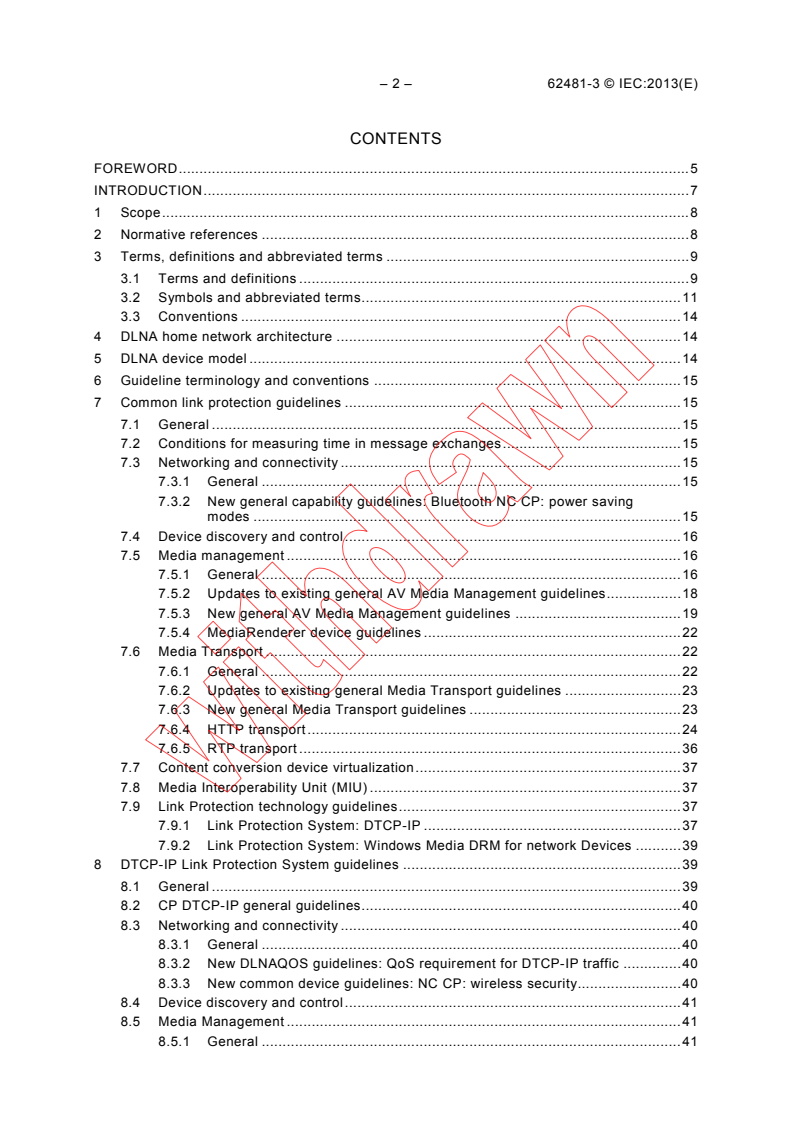
CONTENTS
FOREWORD . 5
INTRODUCTION . 7
1 Scope . 8
2 Normative references . 8
3 Terms, definitions and abbreviated terms . 9
3.1 Terms and definitions . 9
3.2 Symbols and abbreviated terms . 11
3.3 Conventions . 14
4 DLNA home network architecture . 14
5 DLNA device model . 14
6 Guideline terminology and conventions . 15
7 Common link protection guidelines . 15
7.1 General . 15
7.2 Conditions for measuring time in message exchanges . 15
7.3 Networking and connectivity . 15
7.3.1 General . 15
7.3.2 New general capability guidelines: Bluetooth NC CP: power saving
modes . 15
7.4 Device discovery and control . 16
7.5 Media management . 16
7.5.1 General . 16
7.5.2 Updates to existing general AV Media Management guidelines . 18
7.5.3 New general AV Media Management guidelines . 19
7.5.4 MediaRenderer device guidelines . 22
7.6 Media Transport . 22
7.6.1 General . 22
7.6.2 Updates to existing general Media Transport guidelines . 23
7.6.3 New general Media Transport guidelines . 23
7.6.4 HTTP transport . 24
7.6.5 RTP transport . 36
7.7 Content conversion device virtualization . 37
7.8 Media Interoperability Unit (MIU) . 37
7.9 Link Protection technology guidelines . 37
7.9.1 Link Protection System: DTCP-IP . 37
7.9.2 Link Protection System: Windows Media DRM for network Devices . 39
8 DTCP-IP Link Protection System guidelines . 39
8.1 General . 39
8.2 CP DTCP-IP general guidelines . 40
8.3 Networking and connectivity . 40
8.3.1 General . 40
8.3.2 New DLNAQOS guidelines: QoS requirement for DTCP-IP traffic . 40
8.3.3 New common device guidelines: NC CP: wireless security. 40
8.4 Device discovery and control . 41
8.5 Media Management . 41
8.5.1 General . 41
62481-3 © IEC:2013(E) – 3 –
8.5.2 MM CP: DTCP-IP URI . 41
8.5.3 MM CP: mandatory media operations . 41
8.6 Media Transport . 42
8.6.1 HTTP transport . 42
8.6.2 RTP transport . 45
8.7 Content conversion device virtualization . 47
8.8 Media Interoperability Unit (MIU) . 47
8.9 Volume 2: DTCP-IP profiling guidelines . 47
8.9.1 CP DTCP-IP: profile . 47
8.9.2 CP DTCP-IP: profile MIME type definition . 48
8.9.3 CP DTCP-IP: profile protected and unprotected content portions . 49
8.9.4 CP DTCP-IP: profile HTTP encapsulation . 50
8.9.5 DTCP-IP profile encapsulation . 50
9 WMDRM-ND Link Protection System guidelines . 53
9.1 Overview . 53
9.2 General guidelines . 53
9.2.1 CP WMDRM-ND: guidelines . 53
9.2.2 CP WMDRM-ND: support for HTTP . 53
9.2.3 CP WMDRM-ND: support for RTP. 54
9.2.4 CP WMDRM-ND: Registration and Revalidation procedures . 54
9.2.5 CP WMDRM-ND: discovery of Content Receivers . 55
9.3 Networking and connectivity . 56
9.3.1 General . 56
9.3.2 CP WMDRM-ND: QoS guidelines . 56
9.4 Device discovery and control . 56
9.4.1 General . 56
9.4.2 CP WMDRM-ND: additional rules for DMRs . 56
9.5 Media management . 57
9.6 Media Transport . 57
9.6.1 HTTP transport . 57
9.6.2 RTP transport . 62
9.7 Content conversion device virtualization . 65
9.8 Media Interoperability Unit (MIU) . 65
9.9 Volume 2: WMDRM-ND profiling guidelines . 65
9.9.1 General . 65
9.9.2 CP WMDRM-ND: identification of content transferred using
WMDRM-ND . 65
9.9.3 CP WMDRM-ND: Media Format guidelines . 66
9.9.4 CP WMDRM-ND: MIME type . 66
9.9.5 CP WMDRM-ND: Decoder Friendly Alignment Position . 67
9.9.6 CP WMDRM-ND: Media Format Alignment Element . 67
Annex A (informative) An introduction to DLNA seek operations . 68
Bibliography . 76
Figure A.1 – UCDAM definitions for seek operations . 69
Figure A.2 – Full Random Access Data Availability model . 70
Figure A.3 – Limited Random Access Data Availability model Mode 0 . 71
Figure A.4 – Limited Random Access Data Availability model Mode 1 . 72
– 4 – 62481-3 © IEC:2013(E)
Figure A.5 – Content flow unprotected content . 74
Figure A.6 – Content flow link protected content . 74
Table 1 – Summary of Domain Elements for Full Random Access Data Availability
model . 17
Table 2 – Summary of Domain Elements for Limited Random Access Data Availability
model . 17
Table 3 – AV Media Management guideline changes . 18
Table 4 – Recommended metadata properties . 19
Table 5 – Property type and multi value . 20
Table 6 – Updates to existing general Media Transport guidelines . 23
Table 7 – Updates to existing general HTTP Media Transport guidelines . 24
Table 8 – Updates to existing general HTTP Media Transport for Streaming Transfer
guidelines . 32
Table A.1 – DLNA constructs of Full Random Access Data Availability model . 70
Table A.2 – DLNA Constructs of Limited Random Access Data Availability model . 73
62481-3 © IEC:2013(E) – 5 –
INTERNATIONAL ELECTROTECHNICAL COMMISSION
______________
DIGITAL LIVING NETWORK ALLIANCE (DLNA) HOME
NETWORKED DEVICE INTEROPERABILITY GUIDELINES –
Part 3: Link protection
FOREWORD
1) The International Electrotechnical Commission (IEC) is a worldwide organization for standardization comprising
all national electrotechnical committees (IEC National Committees). The object of IEC is to promote international
co-operation on all questions concerning standardization in the electrical and electronic fields. To this end and in
addition to other activities, IEC publishes International Standards, Technical Specifications, Technical Reports,
Publicly Available Specifications (PAS) and Guides (hereafter referred to as “IEC Publication(s)”). Their
preparation is entrusted to technical committees; any IEC National Committee interested in the subject dealt with
may participate in this preparatory work. International, governmental and non-governmental organizations liaising
with the IEC also participate in this preparation. IEC collaborates closely with the International Organization for
Standardization (ISO) in accordance with conditions determined by agreement between the two organizations.
2) The formal decisions or agreements of IEC on technical matters express, as nearly as possible, an international
consensus of opinion on the relevant subjects since each technical committee has representation from all
interested IEC National Committees.
3) IEC Publications have the form of recommendations for international use and are accepted by IEC National
Committees in that sense. While all reasonable efforts are made to ensure that the technical content of IEC
Publications is accurate, IEC cannot be held responsible for the way in which they are used or for any
misinterpretation by any end user.
4) In order to promote international uniformity, IEC National Committees undertake to apply IEC Publications
transparently to the maximum extent possible in their national and regional publications. Any divergence between
any IEC Publication and the corresponding national or regional publication shall be clearly indicated in the latter.
5) IEC itself does not provide any attestation of conformity. Independent certification bodies provide conformity
assessment services and, in some areas, access to IEC marks of conformity. IEC is not responsible for any
services carried out by independent certification bodies.
6) All users should ensure that they have the latest edition of this publication.
7) No liability shall attach to IEC or its directors, employees, servants or agents including individual experts and
members of its technical committees and IEC National Committees for any personal injury, property damage or
other damage of any nature whatsoever, whether direct or indirect, or for costs (including legal fees) and expenses
arising out of the publication, use of, or reliance upon, this IEC Publication or any other IEC Publications.
8) Attention is drawn to the Normative references cited in this publication. Use of the referenced publications is
indispensable for the correct application of this publication.
9) Attention is drawn to the possibility that some of the elements of this IEC Publication may be the subject of patent
rights. IEC shall not be held responsible for identifying any or all such patent rights.
International Standard IEC 62481-3 has been prepared technical area 9: Audio, video and
multimedia applications for end-user network, by IEC technical committee 100: Audio, video and
multimedia systems and equipment.
This second edition cancels and replaces the first edition published in 2010. This edition
constitutes a technical revision.
This edition includes the following significant technical changes with respect to the previous
edition:
a) includes variable play (trick mode) support;
b) includes updates to resolve interoperability issues.
– 6 – 62481-3 © IEC:2013(E)
The text of this standard is based on the following documents:
CDV Report on voting
100/1994/CDV 100/2082/RVC
Full information on the voting for the approval of this standard can be found in the report on
voting indicated in the above table.
This publication has been drafted in accordance with the ISO/IEC Directives, Part 2.
A list of all parts of IEC 62481 series, published under the general title Digital living network
alliance (DLNA) home networked device interoperability guidelines, can be found on the IEC
website.
The committee has decided that the contents of this publication will remain unchanged until the
stability date indicated on the IEC web site under "http://webstore.iec.ch" in the data related to
the specific publication. At this date, the publication will be
• reconfirmed,
• withdrawn,
• replaced by a revised edition, or
• amended.
A bilingual version of this publication may be issued at a later date.
IMPORTANT – The 'colour inside' logo on the cover page of this publication indicates
that it contains colours which are considered to be useful for the correct understanding
of its contents. Users should therefore print this document using a colour printer.
62481-3 © IEC:2013(E) – 7 –
INTRODUCTION
Consumers are acquiring, viewing, and managing an increasing amount of digital media (photos,
music, and video) on devices in the Consumer Electronics (CE), mobile, and Personal Computer
(PC) domains. As such, they want to conveniently enjoy the content, regardless of the source,
across different devices and locations in the home. The digital home vision integrates the
Internet, mobile, and broadcast networks through a seamless, interoperable network, which will
provide a unique opportunity for manufacturers and consumers alike. In order to achieve this
interoperability, a common set of industry design guidelines is needed that allows vendors to
participate in a growing marketplace, leading to more innovation, simplicity, and value for
consumers. This standard serves that purpose and provides vendors with the information
needed to build interoperable networked platforms and devices for the digital home.
This standard is organized to align with the overall structure of IEC 62481-1 and IEC 62481-2.
– 8 – 62481-3 © IEC:2013(E)
DIGITAL LIVING NETWORK ALLIANCE (DLNA) HOME
NETWORKED DEVICE INTEROPERABILITY GUIDELINES –
Part 3: Link protection
1 Scope
This part of IEC 62481 specifies the DLNA link protection guidelines, which are an extension of
the DLNA guidelines. DLNA link protection is defined as the protection of a content stream
between two devices on a DLNA network from illegitimate observation or interception using the
protocols defined within this part of IEC 62481.
Content protection is an important mechanism for ensuring that commercial content is protected
from piracy and illegitimate redistribution. Link Protection is a technique that enables distribution
of protected commercial content on a home network, thus resulting in greater consumer
flexibility while still preserving the rights of copyright holders and content providers.
The guidelines in this part of IEC 62481 reference existing technologies for Link Protection and
provide mechanisms for interoperability between different implementations as well as
integration with the DLNA architecture.
2 Normative references
The following documents, in whole or in part, are normatively referenced in this document and
are indispensable for its application. For dated references, only the edition cited applies. For
undated references, the latest edition of the referenced document (including any amendments)
applies.
IEC 62481-1:2013, Digital Living Network Alliance (DLNA) home networked device
interoperability guidelines – Part 1: Architecture and protocols
IEC 62481-2:2013, Digital Living Network Alliance (DLNA) home networked device
interoperability guidelines – Part 2: DLNA media formats
ISO/IEC 13818-1:2000, Information technology – Generic coding of moving pictures and
associated audio information: Systems
ISO/IEC 14496-2:2004, Information technology – Coding of Audio-Visual Objects – Part 2:
Visual
Amendment 1:2004, Error resilient simple scalable profile
ISO/IEC 29341-3-10, Information technology – UPnP Device Architecture – Part 3-10: Audio
Video Device Control Protocol – Audio Video Transport Service
ISO/IEC 29341-3-11, Information technology – UPnP Device Architecture – Part 3-11: Audio
Video Device Control Protocol – Connection Manager Service
IETF RFC 1191, Path MTU Discovery, J. Mogul, DECWRL, S. Deering, Stanford University,
November 1990
http://www.ietf.org/rfc/rfc1191.txt
62481-3 © IEC:2013(E) – 9 –
IETF RFC 1738, Uniform Resource Locators (URL), T. Berners-Lee, CERN, L. Masinter Xerox
Corposation, M. McCahill, University of Minnesota, December 1994
http://www.ietf.org/rfc/rfc1738.txt
IETF RFC 2616, Hypertext Transfer Protocol – HTTP/1.1, R. Fielding, UC Irvine, J. Gettys,
Compaq/W3C, J. Mogul, Compaq, H. Frystyk, W3C/MIT, L. Masinter, Xerox, P. Leach,
Microsoft*, T. Berners-Lee, June 1999
http://www.ietf.org/rfc/rfc2616.txt?number=2616
IETF RFC 3550, RTP: A Transport Protocol for Real-Time Applications, H. Schulzrinne,
Columbia University, S. Casner, Packet Design, R. Frederick, Blue Coat Systems Inc., V.
Jacobson, Packet Design, July 2003
http://www.ietf.org/rfc/rfc3550.txt
IETF RFC 3551, RTP Profile for Audio and Video Conferences with Minimal Control, H.
Schulzrinne, Columbia University, S. Casner, Packet Design, July 2003
http://www.ietf.org/rfc/rfc3551.txt
DTCP Volume 1 (informational version), Digital Transmission Content Protection Specification
Volume1, Revision 1.4: February 28, 2005
http://www.dtcp.com/data/info 20050228 dtcp vol 1 1p4.pdf
DTCP Volume 1 Supplement E (informational version), DTCP Volume 1 Supplement E
Mapping DTCP to IP, Revision 1.1: February 28, 2005
http://www.dtcp.com/data/info 20050228 dtcp VISE 1p1.pdf
DTCP Audio Compliance Rules EXHIBIT B-2, Compliance Rules For Licensed Products That
Receive Or Transmit Commercial Audio Works, June 2002
http://www.dtcp.com/data/Compliance_Rules_Audio_020610.pdf
IEEE 802.1Q, IEEE standard for information technology – Telecommunications and
information exchange between systems – IEEE standard for local and metropolitan
areanetworks – Common specifications – Virtual Bridged Local Area Networks
IEEE 802.11, IEEE standard for information technology – Telecommunications and information
exchange between systems – Local and metropolitan area networks-specific requirements –
Part 11: Wireless LAN Medium, Access Control (MAC) and Physical Layer(PHY) specifications
DTCP Adopter Agreement, DTCP Adopter Agreement, Digital Transmission Protection
License Agreement, DTLA Digital Transmission Licensing Administrator, May 2005
http://www.dtcp.com/
WMDRM-ND, Windows Media DRM for Network Devices, Windows Media Technologies
http://wmlicense.smdisp.net/licenserequest/default.asp
RTP Payload format for WMV and WMA, RTP Payload Format for Windows Media Audio and
Video, Microsoft Corporation
http://download.microsoft.com/download/5/5/a/55a7b886-b742-4613-8ea8-d8b8b5c27bbc/RTP
PayloadFormat_for_WMAandWMV_v1.doc
3 Terms, definitions and abbreviated terms
3.1 Terms and definitions
For the purposes of this document, the following terms and definitions apply.
– 10 – 62481-3 © IEC:2013(E)
3.1.1
Cleartext
unencrypted content
Note 1 to entry: Within this standard, the content stream after decryption by the upstream content protection system
and before encryption by the Link Protection System.
3.1.2
Cleartext Byte Domain
specification of a byte position in the Cleartext content stream
Note 1 to entry: For a complete explanation of seek operations on link protected content, see Annex A.
3.1.3
Cleartext Byte Seek Request Header
request that a certain position in the Cleartext byte stream be returned
Note 1 to entry: This term is used to signify any of these different transport layer request headers.
Note 2 to entry: When used in a guideline, Cleartext Byte Seek Request Header implies that the guideline applies to
all uses of any of the request headers.
3.1.4
Cleartext Byte Seek Response Header
response that declares the range of bytes returned in the Cleartext byte stream
Note 1 to entry: This term is used to signify any of these different transport layer response headers.
Note 2 to entry: When used in a guideline, this implies that the guideline applies to all uses of any of the request
headers.
3.1.5
Decoder Friendly Alignment Position
position in the bitstream defined for decoder friendly alignment
Note 1 to entry: A Decoder Friendly Alignment Position is always the start of a Media Format Alignment Element.
Generally, the decoder can begin to process data without any other internal state information about the stream. The
decoder can begin processing at that point and create a valid output rendering. This value is defined for the individual
media format profiles that have Decoder Friendly Alignment Positions.
3.1.6
DLNA Link Protection
protection, using DLNA protocol elements as defined in these guidelines, of a content stream
between two devices on a DLNA network from illegitimate observation or interception
3.1.7
Link Protection Alignment Element
unit of content carried within a link protected content stream
Note 1 to entry: This typically starts with a packet header that is defined by the Link Protection System and contains
bytes of the link protected stream.
3.1.8
Link Protection
protection of a content stream between two devices on a DLNA network from illegitimate
observation or interception
3.1.9
Link Protection System
specific collection of technologies with corresponding rules that enable secure content transfer
between two endpoints
62481-3 © IEC:2013(E) – 11 –
3.1.10
Media Format Alignment Element
unit of content carried within an unprotected content stream
Note 1 to entry: This typically starts at a Decoder Friendly Alignment Position for the given media format and
contains an integral number of units of content as defined by the media format in use. This value is defined within the
media format profile specification.
3.1.11
Network Byte Domain
specification of a byte position in the content stream as it is carried on the network transport
Note 1 to entry: For content binaries that use a Link Protection System, this will include encryption and any headers
or padding necessary for the Link Protection System.
3.1.12
Time Domain
specification of a position in the content stream in time units
3.1.13
UPnP
architecture for pervasive peer-to-peer network connectivity of devices of all form factors
Note 1 to entry: UPnP is designed to bring easy-to-use, flexible, standards-based connectivity to ad-hoc or
unmanaged networks whether in the home, in a small business, public spaces, or attached to the Internet.
Note 2 to entry: UPnP is a distributed, open networking architecture that leverages TCP/IP and Web technologies to
enable seamless proximity networking in addition to control and data transfer among networked devices in the home,
office, and public spaces.
3.2 Symbols and abbreviated terms
For the purposes of this document, the following symbols and abbreviated terms apply.
3.2.1
AKE
Authentication and Key Exchange
step in a Link Protection System where the receiving device is authenticated and given the
correct keys for the content
3.2.2
ASF
Advanced System Format
media format encapsulation for the transmission of content
3.2.3
AV
Audio with Video
media content that contains both moving pictures and sound
3.2.4
AVT
Audio Video Transport
UPnP service that provides network-based control for common transport operations such as
play, stop, pause, next, previous, and seek
Note 1 to entry: The AVTransport service specification is a standard UPnP DCP.
3.2.5
CMS
ConnectionManager:1 Service
– 12 – 62481-3 © IEC:2013(E)
UPnP service that provides information about the supported transport protocols and media
formats of a UPnP device
Note 1 to entry: The CMS specification is a standard UPnP DCP.
3.2.6
CSRC
Contributing SouRCe
as used for the RTP Media Transport
3.2.7
DLNA
Digital Living Network Alliance
organization that created this standard
3.2.8
DLNAQOS_UP
DLNA QoS User Priority
DLNA-defined QoS label used to correlate an underlying IEEE 802.1Q user priority and WMM
access category to a DLNA traffic type(s)
3.2.9
DTCP
Digital Transmission Content Protection
Link Protection System
3.2.10
DTCP-IP
Digital Transmission Content Protection over IP networks
DTCP as applied to IP based networks
3.2.11
GOP
Group Of Pictures
defined grouping of information in the MPEG 2 media format
3.2.12
HTTP
Hyper Text Transfer Protocol
protocol for transferring files across the Internet
Note 1 to entry: Requires an HTTP client program on one end, and an HTTP server program on the other end.
3.2.13
MIME
Multipurpose Internet Mail Extension
standard system for identifying the type of data contained in a file
Note 1 to entry: MIME is an internet protocol that allows sending binary files across the internet as attachments to
e-mail messages. This includes graphics, photos, sound, video files, and formatted text documents.
3.2.14
MPEG-2
Moving Picture Experts Group phase 2
3.2.15
NC-PS
Network Connectivity – Power Saving
power saving modes of operations as defined in IEC 62481-1
62481-3 © IEC:2013(E) – 13 –
3.2.16
PCP
Protected Content Packet
packet format for DTCP-IP link protected content as defined in DTCP Volume 1 and DTCP
Volume 1 Supplement E
3.2.17
PS
Program Stream
reference to an MPEG-2 AV stream format
3.2.18
RTP
Real Time Protocol
media transport that provides end-to-end network transport functions for transmitting real-time
data, such as AV
Note 1 to entry: RTP provides services such as payload type identification, sequence numbering, time-stamping,
and delivery monitoring.
3.2.19
RTSP
Real Time Streaming Protocol
protocol within the RTP protocol suite
3.2.20
RTT
Round Trip Time
time between sending a network packet to a remote host and the time that the response is
received
3.2.21
SDP
Session Description Protocol
protocol within the RTP protocol suite
3.2.22
SOAP
Simple Object Access Protocol
XML based messaging protocol used to exchange service requests and responses over a
network
3.2.23
TS
Transport Stream
MPEG-2 AV stream format
3.2.24
UCDAM
Uniform Client Data Availability Model
model for representing which bytes of a content binary are available on a server for seek
operations
Note 1 to entry: See 7.4 of IEC 62481-1:2013 for a full definition.
3.2.25
URI
Uniform Resource Identifier
W3C's codification of the name and address syntax of present and future objects on the internet
– 14 – 62481-3 © IEC:2013(E)
Note 1 to entry: In its most basic form, a URI consists of a scheme name (such as file, http, ftp, news, mailto, gopher)
followed by a colon, followed by a path whose nature is determined by the scheme that precedes it. URI is the umbrella
term for URNs, URLs, and all other Uniform Resource Identifiers.
3.2.26
VOBU
Video OBject Unit
grouping of information in the MPEG 2 media format
3.2.27
WEP
Wired Equivalency Privacy
wireless privacy standard used in conjunction with IEEE 802.11 networks
3.2.28
WMA
Windows Media Audio
audio compression binary format
3.2.29
WMDRM-ND
Windows Media DRM for Network Devices
Link Protection System
3.2.30
WMV
Windows Media Video
AV compression binary format
3.2.31
WPA
WiFi Protected Access
system to secure a wireless IEEE 802.11 network
3.2.32
WPA2
WiFi Protected Access version 2
system to secure a wireless IEEE 802.11 network
3.3 Conventions
In IEC 62481-1 and this International Standard, a number of terms, conditions, mechanisms,
sequences, parameters, events, states, or similar terms are printed with the first letter of each
word in uppercase and the rest lowercase (e.g., Move). Any lowercase uses of these words have
the normal technical English meaning.
4 DLNA home network architecture
See IEC 62481-1:2013, Clause 4, for detailed descriptions of the DLNA home network
architecture.
5 DLNA device model
See IEC 62481-1:2013, Clause 5, for detailed descriptions of the DLNA device model. This
standard extends the existing DLNA devices and system usages to include link protected
content used for the following:
• 2-Box Pull System Usage;
62481-3 © IEC:2013(E) – 15 –
• 2-Box Push System Usage;
• 3-Box System Usage,
for transfer and rendering of content items. These are the only system usages that are currently
in scope for the use of DLNA Link Protection.
6 Guideline terminology and conventions
See IEC 62481-1:2013, Clause 6, for a full description of the DLNA document conventions.
7 Common link protection guidelines
7.1 General
See 7.1.1 in IEC 62481-1:2013, for guideline and attribute table layout descriptions.
7.2 Conditions for measuring time in message exchanges
These guidelines define in certain cases time constraints for the exchange of messages
between two communicating endpoints. These time constraints have been defined as a means
to provide some operational consistency between the two communicating endpoints. However,
in best-effort networks, actual time measurements for exchanging messages show wide
variations depending on perturbations derived from network conditions, traffic, available
bandwidth, and others. Therefore, the following recommendations should be applied when
making time measurements.
• The two communicating endpoints should establish communications under Ideal Network
Conditions.
• Time measurements at a given layer assume that the underlying layers preserve the
communication channel. For example, time measurements at the HTTP layer cannot be valid
if the underlying TCP/IP channel breaks during the measurements.
• Unless specified otherwise, time measurements assume that the communicating devices are
both in active mode. This means that time measurements should not include transitions from
sleep mode to active mode.
7.3 Networking and connectivity
7.3.1 General
This subclause provides guidelines for general and device specific networking capabilities that
are independent of the Link Protection System used. For DTCP-IP specific requirements, see
8.2. For WMDRM-ND specific requirements, see 9.3.
The following guidelines are given in addition to IEC 62481-1 QoS and include the normative
DLNA QoS levels for Link Protection messages.
7.3.2 New general capability guidelines: Bluetooth
NC CP: power saving modes
[GUIDELINE] If the NC-PS bearer level power saving scheme is supported and the network link
is in Standby mode, then the MHD device should request the transition from Standby to Active
NC-PS mode before any required Link Protection communication.
[ATTRIBUTES]
S A n/a M-DMS M-DMP n/a IEC 62481-1 67G8Y
– 16 – 62481-3 © IEC:2013(E)
[COMMENT] This is to ensure that the link is in the highest bandwidth and lowest delay state
before starting a Link Protection exchange that might depend on the timing of individual
messages. For example, DTCP-IP measures the RTT between the Content Source and the
Content Receiver to determine if the endpoints are on the user's home network. If this operation
occurs while the link is in the Standby mode, the delay can be artificially high.
7.4 Device discovery and control
This subclause covers the guidelines for implementing device discovery and control using the
UPnP device architecture. There are no changes to this subclause for the support of DLNA Link
Protection. For detailed information, see IEC 62481-1:2013, 7.3. For DTCP-IP specific
guidelines, see 8.4. For WMDRM-ND specific guidelines, see 9.4.
7.5 Media management
7.5.1 General
This subclause covers the guidelines for implementing media management using the UPnP AV
architecture with DLNA Link Protection. For detailed subclause information see
IEC 62481-1:2013, 7.4. For DTCP-IP specific guidelines, see 8.5. For WMDRM-ND specific
guidelines, see 9.5.
Many of the guidelines for 7.5 as well as 7.6 have to do with the structures necessary to perform
seek operations over the link protected content. IEC 62481-1 defines two models of seek
operations: the Full Data Seek Availability model and the Limited Data Seek Availability model.
These two models continue to operate for content using DLNA Link Protection. However, for this
content, we introduce the concept of the Network Byte Domain (the protected content stream as
it flows over the network) and the Cleartext Byte Domain (representing positions within the
content before encryption by the Link Protection System). This allows the Content Receiver to
seek to byte positions in the content as if no Link Protection had been applied. For content
binaries using DLNA Link Protection, if the Content Receiver performs a byte seek operation in
the Cleartext Byte Domain, it can issue requests for the same byte positions that it would if the
content were sent without any Link Protection. The Content Receiver does not need to convert
between positions in the Cleartext and positions in the encrypted content. For a detailed
explanation of seeking and link protected content, see Annex A.
Table 1 and Table 2 summarize the structures used for each of the domains and seek models.
Table 3 contains the media management guidelines for devices using DLNA Link Protection.
62481-3 © IEC:2013(E) – 17 –
Table 1 – Summary of Domain Elements for
Full Random Access Data Availability model
Function Time Domain Cleartext Byte Domain
Network Byte
Domain
Domain and op-param a-val op-param b-val flags-param Bit 15: CleartextByteSeek-full
model support
SDP indication Range Domain Not Domain Not Available
of domain Available
support
File size res@duration res@size res@dlna:cleartextSize
HTTP request TimeSeekRange.dlna.org Range Cleartext Byte Seek Request Header
header to
DTCP-IP: Range.dtcp.com
execute Seek
WMDRM-ND: Cleartext-Range.dlna.org
operation
HTTP TimeSeekRange.dlna.org Content-Range Cleartext Byte Seek Response Header
response
DTCP-IP: Content-Range.dtcp.com
header for
WMDRM-ND:
Seek operation
Cleartext-Content-Range.dlna.org
RTSP header Range Domain Not Domain Not Available
to execute Available
Seek operation
HTTP message Not defined Content-Length Content-Length HTTP message body size is
body size always specified by the Content-Length
response header
Table 2 – Summary of Domain Elements for
Limited Random Access Data Availability model
Function Time Domain Network Byte Domain Cleartext Byte Domain
Domain and flags-param Bit 30: lop-npt flags-param Bit 29: lop-bytes flags-param Bit 14:
model lop-cleartextbytes
support
SDP Range Domain Not Available Domain Not Available
indication of
domain
support
HTTP TimeSeekRange.dlna.org Range Cleartext Byte Seek Request
request Header
header to
DTCP-IP: Range.dtcp.com
execute Seek
WMDRM-ND:
operation
Cleartext-Range.dlna.org
TimeSeekRange.dlna.org Content-Range
HTTP Cleartext Byte Seek Response
response Header
header for
DTCP-IP:
Seek
Content-Range.dtcp.com
operation
WMDRM-ND:
Cleartext-Content-Range.dlna.
org
RTSP header Range Domain Not Available Domain Not Available
to execute
Seek
operation
HTTP header to request the available range getAvailableSeekRange.dlna.org
HTTP availableSeekRange.dlna.org availableSeekRange.dlna.org availableSeekRange.dlna.org
response
(with npt-range) (with byte-range) (with cleartextbyte-range )
header for
available
range
– 18 – 62481-3 © IEC:2013(E)
Function Time Domain Network Byte Domain Cleartext Byte Domain
RTSP header DESCRIBE Domain Not Available Domain Not Available
to request
the available
range
RTSP header Available-Range.dlna.org Domain Not Available Domain Not Available
for specifying
the available
range
s is increasing flags-param Bit 27: s -increasing
0 0
s is increasing flags-param Bit 26: s -increasing
N N
7.5.2 Updates to existing general AV Media Management guidelines
7.5.2.1 Affected guidelines in IEC 62481-1
Table 3 – AV Media Management guideline changes
Guideline updated Location in
IEC 62481-1:2013
MM flags-param (Flags Parameter) 7.4.1.3.23.2 (GUN 3WJUU)
MM lop-npt, lop-bytes, and lop-cleartextbytes (Limited Operations Flags): Common 7.4.1.3.28.1(GUN OTHY2)
MM lop-npt lop-bytes, and lop-cleartextbytes (Limited Operations Flags): HTTP 7.4.1.3.29 (GUN WJUUP)
MM lop-npt, lop-bytes, and lop-cleartextby
...
IEC 62481-3 ®
Edition 2.0 2013-10
INTERNATIONAL
STANDARD
NORME
INTERNATIONALE
colour
inside
Digital living network alliance (DLNA) home networked device interoperability
guidelines –
Part 3: Link protection
Lignes directrices pour l'interopérabilité des dispositifs domestiques DLNA
(Digital Living Network Alliance) –
Partie 3: Protection des liaisons
All rights reserved. Unless otherwise specified, no part of this publication may be reproduced or utilized in any form
or by any means, electronic or mechanical, including photocopying and microfilm, without permission in writing from
either IEC or IEC's member National Committee in the country of the requester. If you have any questions about IEC
copyright or have an enquiry about obtaining additional rights to this publication, please contact the address below or
your local IEC member National Committee for further information.
Droits de reproduction réservés. Sauf indication contraire, aucune partie de cette publication ne peut être reproduite ni
utilisée sous quelque forme que ce soit et par aucun procédé, électronique ou mécanique, y compris la photocopie et
les microfilms, sans l'accord écrit de l'IEC ou du Comité national de l'IEC du pays du demandeur. Si vous avez des
questions sur le copyright de l'IEC ou si vous désirez obtenir des droits supplémentaires sur cette publication, utilisez
les coordonnées ci-après ou contactez le Comité national de l'IEC de votre pays de résidence.
IEC Secretariat Tel.: +41 22 919 02 11
3, rue de Varembé info@iec.ch
CH-1211 Geneva 20 www.iec.ch
Switzerland
About the IEC
The International Electrotechnical Commission (IEC) is the leading global organization that prepares and publishes
International Standards for all electrical, electronic and related technologies.
About IEC publications
The technical content of IEC publications is kept under constant review by the IEC. Please make sure that you have the
latest edition, a corrigendum or an amendment might have been published.
IEC publications search - webstore.iec.ch/advsearchform IEC Products & Services Portal - products.iec.ch
The advanced search enables to find IEC publications by a Discover our powerful search engine and read freely all the
variety of criteria (reference number, text, technical publications previews. With a subscription you will always have
committee, …). It also gives information on projects, replaced access to up to date content tailored to your needs.
and withdrawn publications.
Electropedia - www.electropedia.org
IEC Just Published - webstore.iec.ch/justpublished
The world's leading online dictionary on electrotechnology,
Stay up to date on all new IEC publications. Just Published
containing more than 22 300 terminological entries in English
details all new publications released. Available online and once
and French, with equivalent terms in 19 additional languages.
a month by email.
Also known as the International Electrotechnical Vocabulary
(IEV) online.
IEC Customer Service Centre - webstore.iec.ch/csc
If you wish to give us your feedback on this publication or need
further assistance, please contact the Customer Service
Centre: sales@iec.ch.
A propos de l'IEC
La Commission Electrotechnique Internationale (IEC) est la première organisation mondiale qui élabore et publie des
Normes internationales pour tout ce qui a trait à l'électricité, à l'électronique et aux technologies apparentées.
A propos des publications IEC
Le contenu technique des publications IEC est constamment revu. Veuillez vous assurer que vous possédez l’édition la
plus récente, un corrigendum ou amendement peut avoir été publié.
Recherche de publications IEC - Découvrez notre puissant moteur de recherche et consultez
webstore.iec.ch/advsearchform gratuitement tous les aperçus des publications. Avec un
La recherche avancée permet de trouver des publications IEC abonnement, vous aurez toujours accès à un contenu à jour
en utilisant différents critères (numéro de référence, texte, adapté à vos besoins.
comité d’études, …). Elle donne aussi des informations sur les
projets et les publications remplacées ou retirées. Electropedia - www.electropedia.org
Le premier dictionnaire d'électrotechnologie en ligne au monde,
IEC Just Published - webstore.iec.ch/justpublished
avec plus de 22 300 articles terminologiques en anglais et en
Restez informé sur les nouvelles publications IEC. Just
français, ainsi que les termes équivalents dans 19 langues
Published détaille les nouvelles publications parues.
additionnelles. Egalement appelé Vocabulaire
Disponible en ligne et une fois par mois par email.
Electrotechnique International (IEV) en ligne.
Service Clients - webstore.iec.ch/csc
Si vous désirez nous donner des commentaires sur cette
publication ou si vous avez des questions contactez-nous:
sales@iec.ch.
IEC Products & Services Portal - products.iec.ch
IEC 62481-3 ®
Edition 2.0 2013-10
INTERNATIONAL
STANDARD
NORME
INTERNATIONALE
colour
inside
Digital living network alliance (DLNA) home networked device interoperability
guidelines –
Part 3: Link protection
Lignes directrices pour l'interopérabilité des dispositifs domestiques DLNA
(Digital Living Network Alliance) –
Partie 3: Protection des liaisons
INTERNATIONAL
ELECTROTECHNICAL
COMMISSION
COMMISSION
ELECTROTECHNIQUE
INTERNATIONALE
ICS 33.160.01; 35.100.05; 35.110 ISBN 978-2-8322-0589-1
– 2 – IEC 62481-3:2013 © IEC 2013
CONTENTS
1 Scope . 8
2 Normative references . 8
3 Terms, definitions and abbreviated terms . 9
3.1 Terms and definitions . 9
3.2 Symbols and abbreviated terms . 11
3.3 Conventions . 14
4 DLNA home network architecture . 14
5 DLNA device model . 14
6 Guideline terminology and conventions . 15
7 Common link protection guidelines . 15
7.1 General . 15
7.2 Conditions for measuring time in message exchanges . 15
7.3 Networking and connectivity . 15
7.3.1 General . 15
7.3.2 New general capability guidelines: Bluetooth NC CP: power saving
modes . 15
7.4 Device discovery and control . 16
7.5 Media management . 16
7.5.1 General . 16
7.5.2 Updates to existing general AV Media Management guidelines . 18
7.5.3 New general AV Media Management guidelines . 19
7.5.4 MediaRenderer device guidelines . 22
7.6 Media Transport . 22
7.6.1 General . 22
7.6.2 Updates to existing general Media Transport guidelines . 23
7.6.3 New general Media Transport guidelines . 23
7.6.4 HTTP transport . 24
7.6.5 RTP transport . 36
7.7 Content conversion device virtualization . 37
7.8 Media Interoperability Unit (MIU) . 37
7.9 Link Protection technology guidelines . 37
7.9.1 Link Protection System: DTCP-IP . 37
7.9.2 Link Protection System: Windows Media DRM for network Devices . 39
8 DTCP-IP Link Protection System guidelines . 39
8.1 General . 39
8.2 CP DTCP-IP general guidelines . 40
8.3 Networking and connectivity . 40
8.3.1 General . 40
8.3.2 New DLNAQOS guidelines: QoS requirement for DTCP-IP traffic . 40
8.3.3 New common device guidelines: NC CP: wireless security. 40
8.4 Device discovery and control . 41
8.5 Media Management . 41
8.5.1 General . 41
8.5.2 MM CP: DTCP-IP URI . 41
8.5.3 MM CP: mandatory media operations . 41
8.6 Media Transport . 42
8.6.1 HTTP transport . 42
8.6.2 RTP transport . 45
8.7 Content conversion device virtualization . 47
8.8 Media Interoperability Unit (MIU) . 47
8.9 Volume 2: DTCP-IP profiling guidelines . 47
8.9.1 CP DTCP-IP: profile . 47
8.9.2 CP DTCP-IP: profile MIME type definition . 48
8.9.3 CP DTCP-IP: profile protected and unprotected content portions . 49
8.9.4 CP DTCP-IP: profile HTTP encapsulation . 50
8.9.5 DTCP-IP profile encapsulation . 50
9 WMDRM-ND Link Protection System guidelines . 53
9.1 Overview . 53
9.2 General guidelines . 53
9.2.1 CP WMDRM-ND: guidelines . 53
9.2.2 CP WMDRM-ND: support for HTTP . 53
9.2.3 CP WMDRM-ND: support for RTP. 54
9.2.4 CP WMDRM-ND: Registration and Revalidation procedures . 54
9.2.5 CP WMDRM-ND: discovery of Content Receivers . 55
9.3 Networking and connectivity . 56
9.3.1 General . 56
9.3.2 CP WMDRM-ND: QoS guidelines . 56
9.4 Device discovery and control . 56
9.4.1 General . 56
9.4.2 CP WMDRM-ND: additional rules for DMRs . 56
9.5 Media management . 57
9.6 Media Transport . 57
9.6.1 HTTP transport . 57
9.6.2 RTP transport . 62
9.7 Content conversion device virtualization . 65
9.8 Media Interoperability Unit (MIU) . 65
9.9 Volume 2: WMDRM-ND profiling guidelines . 65
9.9.1 General . 65
9.9.2 CP WMDRM-ND: identification of content transferred using
WMDRM-ND . 65
9.9.3 CP WMDRM-ND: Media Format guidelines . 66
9.9.4 CP WMDRM-ND: MIME type . 66
9.9.5 CP WMDRM-ND: Decoder Friendly Alignment Position . 66
9.9.6 CP WMDRM-ND: Media Format Alignment Element . 67
Annex A (informative) An introduction to DLNA seek operations . 68
Figure A.1 – UCDAM definitions for seek operations . 69
Figure A.2 – Full Random Access Data Availability model . 70
Figure A.3 – Limited Random Access Data Availability model Mode 0 . 71
Figure A.4 – Limited Random Access Data Availability model Mode 1 . 72
Figure A.5 – Content flow unprotected content . 74
Figure A.6 – Content flow link protected content . 74
– 4 – IEC 62481-3:2013 © IEC 2013
Table 1 – Summary of Domain Elements for Full Random Access Data Availability
model . 17
Table 2 – Summary of Domain Elements for Limited Random Access Data Availability
model . 17
Table 3 – AV Media Management guideline changes . 18
Table 4 – Recommended metadata properties . 19
Table 5 – Property type and multi value . 20
Table 6 – Updates to existing general Media Transport guidelines . 23
Table 7 – Updates to existing general HTTP Media Transport guidelines . 24
Table 8 – Updates to existing general HTTP Media Transport for Streaming Transfer
guidelines . 32
Table A.1 – DLNA constructs of Full Random Access Data Availability model . 70
Table A.2 – DLNA Constructs of Limited Random Access Data Availability model . 73
INTERNATIONAL ELECTROTECHNICAL COMMISSION
______________
DIGITAL LIVING NETWORK ALLIANCE (DLNA) HOME
NETWORKED DEVICE INTEROPERABILITY GUIDELINES –
Part 3: Link protection
FOREWORD
1) The International Electrotechnical Commission (IEC) is a worldwide organization for standardization comprising
all national electrotechnical committees (IEC National Committees). The object of IEC is to promote international
co-operation on all questions concerning standardization in the electrical and electronic fields. To this end and in
addition to other activities, IEC publishes International Standards, Technical Specifications, Technical Reports,
Publicly Available Specifications (PAS) and Guides (hereafter referred to as “IEC Publication(s)”). Their
preparation is entrusted to technical committees; any IEC National Committee interested in the subject dealt with
may participate in this preparatory work. International, governmental and non-governmental organizations liaising
with the IEC also participate in this preparation. IEC collaborates closely with the International Organization for
Standardization (ISO) in accordance with conditions determined by agreement between the two organizations.
2) The formal decisions or agreements of IEC on technical matters express, as nearly as possible, an international
consensus of opinion on the relevant subjects since each technical committee has representation from all
interested IEC National Committees.
3) IEC Publications have the form of recommendations for international use and are accepted by IEC National
Committees in that sense. While all reasonable efforts are made to ensure that the technical content of IEC
Publications is accurate, IEC cannot be held responsible for the way in which they are used or for any
misinterpretation by any end user.
4) In order to promote international uniformity, IEC National Committees undertake to apply IEC Publications
transparently to the maximum extent possible in their national and regional publications. Any divergence between
any IEC Publication and the corresponding national or regional publication shall be clearly indicated in the latter.
5) IEC itself does not provide any attestation of conformity. Independent certification bodies provide conformity
assessment services and, in some areas, access to IEC marks of conformity. IEC is not responsible for any
services carried out by independent certification bodies.
6) All users should ensure that they have the latest edition of this publication.
7) No liability shall attach to IEC or its directors, employees, servants or agents including individual experts and
members of its technical committees and IEC National Committees for any personal injury, property damage or
other damage of any nature whatsoever, whether direct or indirect, or for costs (including legal fees) and expenses
arising out of the publication, use of, or reliance upon, this IEC Publication or any other IEC Publications.
8) Attention is drawn to the Normative references cited in this publication. Use of the referenced publications is
indispensable for the correct application of this publication.
9) Attention is drawn to the possibility that some of the elements of this IEC Publication may be the subject of patent
rights. IEC shall not be held responsible for identifying any or all such patent rights.
International Standard IEC 62481-3 has been prepared technical area 9: Audio, video and
multimedia applications for end-user network, by IEC technical committee 100: Audio, video and
multimedia systems and equipment.
This second edition cancels and replaces the first edition published in 2010. This edition
constitutes a technical revision.
This edition includes the following significant technical changes with respect to the previous
edition:
a) includes variable play (trick mode) support;
b) includes updates to resolve interoperability issues.
– 6 – IEC 62481-3:2013 © IEC 2013
The text of this standard is based on the following documents:
CDV Report on voting
100/1994/CDV 100/2082/RVC
Full information on the voting for the approval of this standard can be found in the report on
voting indicated in the above table.
This publication has been drafted in accordance with the ISO/IEC Directives, Part 2.
A list of all parts of IEC 62481 series, published under the general title Digital living network
alliance (DLNA) home networked device interoperability guidelines, can be found on the IEC
website.
The committee has decided that the contents of this publication will remain unchanged until the
stability date indicated on the IEC web site under "http://webstore.iec.ch" in the data related to
the specific publication. At this date, the publication will be
• reconfirmed,
• withdrawn,
• replaced by a revised edition, or
• amended.
IMPORTANT – The 'colour inside' logo on the cover page of this publication indicates
that it contains colours which are considered to be useful for the correct understanding
of its contents. Users should therefore print this document using a colour printer.
INTRODUCTION
Consumers are acquiring, viewing, and managing an increasing amount of digital media (photos,
music, and video) on devices in the Consumer Electronics (CE), mobile, and Personal Computer
(PC) domains. As such, they want to conveniently enjoy the content, regardless of the source,
across different devices and locations in the home. The digital home vision integrates the
Internet, mobile, and broadcast networks through a seamless, interoperable network, which will
provide a unique opportunity for manufacturers and consumers alike. In order to achieve this
interoperability, a common set of industry design guidelines is needed that allows vendors to
participate in a growing marketplace, leading to more innovation, simplicity, and value for
consumers. This standard serves that purpose and provides vendors with the information
needed to build interoperable networked platforms and devices for the digital home.
This standard is organized to align with the overall structure of IEC 62481-1 and IEC 62481-2.
– 8 – IEC 62481-3:2013 © IEC 2013
DIGITAL LIVING NETWORK ALLIANCE (DLNA) HOME
NETWORKED DEVICE INTEROPERABILITY GUIDELINES –
Part 3: Link protection
1 Scope
This part of IEC 62481 specifies the DLNA link protection guidelines, which are an extension of
the DLNA guidelines. DLNA link protection is defined as the protection of a content stream
between two devices on a DLNA network from illegitimate observation or interception using the
protocols defined within this part of IEC 62481.
Content protection is an important mechanism for ensuring that commercial content is protected
from piracy and illegitimate redistribution. Link Protection is a technique that enables distribution
of protected commercial content on a home network, thus resulting in greater consumer
flexibility while still preserving the rights of copyright holders and content providers.
The guidelines in this part of IEC 62481 reference existing technologies for Link Protection and
provide mechanisms for interoperability between different implementations as well as
integration with the DLNA architecture.
2 Normative references
The following documents, in whole or in part, are normatively referenced in this document and
are indispensable for its application. For dated references, only the edition cited applies. For
undated references, the latest edition of the referenced document (including any amendments)
applies.
IEC 62481-1:2013, Digital Living Network Alliance (DLNA) home networked device
interoperability guidelines – Part 1: Architecture and protocols
IEC 62481-2:2013, Digital Living Network Alliance (DLNA) home networked device
interoperability guidelines – Part 2: DLNA media formats
ISO/IEC 13818-1:2000, Information technology – Generic coding of moving pictures and
associated audio information: Systems
ISO/IEC 14496-2:2004, Information technology – Coding of Audio-Visual Objects – Part 2:
Visual
Amendment 1:2004, Error resilient simple scalable profile
ISO/IEC 29341-3-10, Information technology – UPnP Device Architecture – Part 3-10: Audio
Video Device Control Protocol – Audio Video Transport Service
ISO/IEC 29341-3-11, Information technology – UPnP Device Architecture – Part 3-11: Audio
Video Device Control Protocol – Connection Manager Service
IETF RFC 1191, Path MTU Discovery, J. Mogul, DECWRL, S. Deering, Stanford University,
November 1990
http://www.ietf.org/rfc/rfc1191.txt
IETF RFC 1738, Uniform Resource Locators (URL), T. Berners-Lee, CERN, L. Masinter Xerox
Corposation, M. McCahill, University of Minnesota, December 1994
http://www.ietf.org/rfc/rfc1738.txt
IETF RFC 2616, Hypertext Transfer Protocol – HTTP/1.1, R. Fielding, UC Irvine, J. Gettys,
Compaq/W3C, J. Mogul, Compaq, H. Frystyk, W3C/MIT, L. Masinter, Xerox, P. Leach,
Microsoft*, T. Berners-Lee, June 1999
http://www.ietf.org/rfc/rfc2616.txt?number=2616
IETF RFC 3550, RTP: A Transport Protocol for Real-Time Applications, H. Schulzrinne,
Columbia University, S. Casner, Packet Design, R. Frederick, Blue Coat Systems Inc., V.
Jacobson, Packet Design, July 2003
http://www.ietf.org/rfc/rfc3550.txt
IETF RFC 3551, RTP Profile for Audio and Video Conferences with Minimal Control, H.
Schulzrinne, Columbia University, S. Casner, Packet Design, July 2003
http://www.ietf.org/rfc/rfc3551.txt
DTCP Volume 1 (informational version), Digital Transmission Content Protection Specification
Volume1, Revision 1.4: February 28, 2005
http://www.dtcp.com/data/info 20050228 dtcp vol 1 1p4.pdf
DTCP Volume 1 Supplement E (informational version), DTCP Volume 1 Supplement E
Mapping DTCP to IP, Revision 1.1: February 28, 2005
http://www.dtcp.com/data/info 20050228 dtcp VISE 1p1.pdf
DTCP Audio Compliance Rules EXHIBIT B-2, Compliance Rules For Licensed Products That
Receive Or Transmit Commercial Audio Works, June 2002
http://www.dtcp.com/data/Compliance_Rules_Audio_020610.pdf
IEEE 802.1Q, IEEE standard for information technology – Telecommunications and
information exchange between systems – IEEE standard for local and metropolitan
areanetworks – Common specifications – Virtual Bridged Local Area Networks
IEEE 802.11, IEEE standard for information technology – Telecommunications and information
exchange between systems – Local and metropolitan area networks-specific requirements –
Part 11: Wireless LAN Medium, Access Control (MAC) and Physical Layer(PHY) specifications
DTCP Adopter Agreement, DTCP Adopter Agreement, Digital Transmission Protection
License Agreement, DTLA Digital Transmission Licensing Administrator, May 2005
http://www.dtcp.com/
WMDRM-ND, Windows Media DRM for Network Devices, Windows Media Technologies
http://wmlicense.smdisp.net/licenserequest/default.asp
RTP Payload format for WMV and WMA, RTP Payload Format for Windows Media Audio and
Video, Microsoft Corporation
http://download.microsoft.com/download/5/5/a/55a7b886-b742-4613-8ea8-d8b8b5c27bbc/RTP
PayloadFormat_for_WMAandWMV_v1.doc
3 Terms, definitions and abbreviated terms
3.1 Terms and definitions
For the purposes of this document, the following terms and definitions apply.
– 10 – IEC 62481-3:2013 © IEC 2013
3.1.1
Cleartext
unencrypted content
Note 1 to entry: Within this standard, the content stream after decryption by the upstream content protection system
and before encryption by the Link Protection System.
3.1.2
Cleartext Byte Domain
specification of a byte position in the Cleartext content stream
Note 1 to entry: For a complete explanation of seek operations on link protected content, see Annex A.
3.1.3
Cleartext Byte Seek Request Header
request that a certain position in the Cleartext byte stream be returned
Note 1 to entry: This term is used to signify any of these different transport layer request headers.
Note 2 to entry: When used in a guideline, Cleartext Byte Seek Request Header implies that the guideline applies to
all uses of any of the request headers.
3.1.4
Cleartext Byte Seek Response Header
response that declares the range of bytes returned in the Cleartext byte stream
Note 1 to entry: This term is used to signify any of these different transport layer response headers.
Note 2 to entry: When used in a guideline, this implies that the guideline applies to all uses of any of the request
headers.
3.1.5
Decoder Friendly Alignment Position
position in the bitstream defined for decoder friendly alignment
Note 1 to entry: A Decoder Friendly Alignment Position is always the start of a Media Format Alignment Element.
Generally, the decoder can begin to process data without any other internal state information about the stream. The
decoder can begin processing at that point and create a valid output rendering. This value is defined for the individual
media format profiles that have Decoder Friendly Alignment Positions.
3.1.6
DLNA Link Protection
protection, using DLNA protocol elements as defined in these guidelines, of a content stream
between two devices on a DLNA network from illegitimate observation or interception
3.1.7
Link Protection Alignment Element
unit of content carried within a link protected content stream
Note 1 to entry: This typically starts with a packet header that is defined by the Link Protection System and contains
bytes of the link protected stream.
3.1.8
Link Protection
protection of a content stream between two devices on a DLNA network from illegitimate
observation or interception
3.1.9
Link Protection System
specific collection of technologies with corresponding rules that enable secure content transfer
between two endpoints
3.1.10
Media Format Alignment Element
unit of content carried within an unprotected content stream
Note 1 to entry: This typically starts at a Decoder Friendly Alignment Position for the given media format and
contains an integral number of units of content as defined by the media format in use. This value is defined within the
media format profile specification.
3.1.11
Network Byte Domain
specification of a byte position in the content stream as it is carried on the network transport
Note 1 to entry: For content binaries that use a Link Protection System, this will include encryption and any headers
or padding necessary for the Link Protection System.
3.1.12
Time Domain
specification of a position in the content stream in time units
3.1.13
UPnP
architecture for pervasive peer-to-peer network connectivity of devices of all form factors
Note 1 to entry: UPnP is designed to bring easy-to-use, flexible, standards-based connectivity to ad-hoc or
unmanaged networks whether in the home, in a small business, public spaces, or attached to the Internet.
Note 2 to entry: UPnP is a distributed, open networking architecture that leverages TCP/IP and Web technologies to
enable seamless proximity networking in addition to control and data transfer among networked devices in the home,
office, and public spaces.
3.2 Symbols and abbreviated terms
For the purposes of this document, the following symbols and abbreviated terms apply.
3.2.1
AKE
Authentication and Key Exchange
step in a Link Protection System where the receiving device is authenticated and given the
correct keys for the content
3.2.2
ASF
Advanced System Format
media format encapsulation for the transmission of content
3.2.3
AV
Audio with Video
media content that contains both moving pictures and sound
3.2.4
AVT
Audio Video Transport
UPnP service that provides network-based control for common transport operations such as
play, stop, pause, next, previous, and seek
Note 1 to entry: The AVTransport service specification is a standard UPnP DCP.
3.2.5
CMS
ConnectionManager:1 Service
– 12 – IEC 62481-3:2013 © IEC 2013
UPnP service that provides information about the supported transport protocols and media
formats of a UPnP device
Note 1 to entry: The CMS specification is a standard UPnP DCP.
3.2.6
CSRC
Contributing SouRCe
as used for the RTP Media Transport
3.2.7
DLNA
Digital Living Network Alliance
organization that created this standard
3.2.8
DLNAQOS_UP
DLNA QoS User Priority
DLNA-defined QoS label used to correlate an underlying IEEE 802.1Q user priority and WMM
access category to a DLNA traffic type(s)
3.2.9
DTCP
Digital Transmission Content Protection
Link Protection System
3.2.10
DTCP-IP
Digital Transmission Content Protection over IP networks
DTCP as applied to IP based networks
3.2.11
GOP
Group Of Pictures
defined grouping of information in the MPEG 2 media format
3.2.12
HTTP
Hyper Text Transfer Protocol
protocol for transferring files across the Internet
Note 1 to entry: Requires an HTTP client program on one end, and an HTTP server program on the other end.
3.2.13
MIME
Multipurpose Internet Mail Extension
standard system for identifying the type of data contained in a file
Note 1 to entry: MIME is an internet protocol that allows sending binary files across the internet as attachments to
e-mail messages. This includes graphics, photos, sound, video files, and formatted text documents.
3.2.14
MPEG-2
Moving Picture Experts Group phase 2
3.2.15
NC-PS
Network Connectivity – Power Saving
power saving modes of operations as defined in IEC 62481-1
3.2.16
PCP
Protected Content Packet
packet format for DTCP-IP link protected content as defined in DTCP Volume 1 and DTCP
Volume 1 Supplement E
3.2.17
PS
Program Stream
reference to an MPEG-2 AV stream format
3.2.18
RTP
Real Time Protocol
media transport that provides end-to-end network transport functions for transmitting real-time
data, such as AV
Note 1 to entry: RTP provides services such as payload type identification, sequence numbering, time-stamping,
and delivery monitoring.
3.2.19
RTSP
Real Time Streaming Protocol
protocol within the RTP protocol suite
3.2.20
RTT
Round Trip Time
time between sending a network packet to a remote host and the time that the response is
received
3.2.21
SDP
Session Description Protocol
protocol within the RTP protocol suite
3.2.22
SOAP
Simple Object Access Protocol
XML based messaging protocol used to exchange service requests and responses over a
network
3.2.23
TS
Transport Stream
MPEG-2 AV stream format
3.2.24
UCDAM
Uniform Client Data Availability Model
model for representing which bytes of a content binary are available on a server for seek
operations
Note 1 to entry: See 7.4 of IEC 62481-1:2013 for a full definition.
3.2.25
URI
Uniform Resource Identifier
W3C's codification of the name and address syntax of present and future objects on the internet
– 14 – IEC 62481-3:2013 © IEC 2013
Note 1 to entry: In its most basic form, a URI consists of a scheme name (such as file, http, ftp, news, mailto, gopher)
followed by a colon, followed by a path whose nature is determined by the scheme that precedes it. URI is the umbrella
term for URNs, URLs, and all other Uniform Resource Identifiers.
3.2.26
VOBU
Video OBject Unit
grouping of information in the MPEG 2 media format
3.2.27
WEP
Wired Equivalency Privacy
wireless privacy standard used in conjunction with IEEE 802.11 networks
3.2.28
WMA
Windows Media Audio
audio compression binary format
3.2.29
WMDRM-ND
Windows Media DRM for Network Devices
Link Protection System
3.2.30
WMV
Windows Media Video
AV compression binary format
3.2.31
WPA
WiFi Protected Access
system to secure a wireless IEEE 802.11 network
3.2.32
WPA2
WiFi Protected Access version 2
system to secure a wireless IEEE 802.11 network
3.3 Conventions
In IEC 62481-1 and this International Standard, a number of terms, conditions, mechanisms,
sequences, parameters, events, states, or similar terms are printed with the first letter of each
word in uppercase and the rest lowercase (e.g., Move). Any lowercase uses of these words have
the normal technical English meaning.
4 DLNA home network architecture
See IEC 62481-1:2013, Clause 4, for detailed descriptions of the DLNA home network
architecture.
5 DLNA device model
See IEC 62481-1:2013, Clause 5, for detailed descriptions of the DLNA device model. This
standard extends the existing DLNA devices and system usages to include link protected
content used for the following:
• 2-Box Pull System Usage;
• 2-Box Push System Usage;
• 3-Box System Usage,
for transfer and rendering of content items. These are the only system usages that are currently
in scope for the use of DLNA Link Protection.
6 Guideline terminology and conventions
See IEC 62481-1:2013, Clause 6, for a full description of the DLNA document conventions.
7 Common link protection guidelines
7.1 General
See 7.1.1 in IEC 62481-1:2013, for guideline and attribute table layout descriptions.
7.2 Conditions for measuring time in message exchanges
These guidelines define in certain cases time constraints for the exchange of messages
between two communicating endpoints. These time constraints have been defined as a means
to provide some operational consistency between the two communicating endpoints. However,
in best-effort networks, actual time measurements for exchanging messages show wide
variations depending on perturbations derived from network conditions, traffic, available
bandwidth, and others. Therefore, the following recommendations should be applied when
making time measurements.
• The two communicating endpoints should establish communications under Ideal Network
Conditions.
• Time measurements at a given layer assume that the underlying layers preserve the
communication channel. For example, time measurements at the HTTP layer cannot be valid
if the underlying TCP/IP channel breaks during the measurements.
• Unless specified otherwise, time measurements assume that the communicating devices are
both in active mode. This means that time measurements should not include transitions from
sleep mode to active mode.
7.3 Networking and connectivity
7.3.1 General
This subclause provides guidelines for general and device specific networking capabilities that
are independent of the Link Protection System used. For DTCP-IP specific requirements, see
8.2. For WMDRM-ND specific requirements, see 9.3.
The following guidelines are given in addition to IEC 62481-1 QoS and include the normative
DLNA QoS levels for Link Protection messages.
7.3.2 New general capability guidelines: Bluetooth
NC CP: power saving modes
UIDELINE] If the NC-PS bearer level power saving scheme is supported and the network link
[G
is in Standby mode, then the MHD device should request the transition from Standby to Active
NC-PS mode before any required Link Protection communication.
[ATTRIBUTES]
S A n/a M-DMS M-DMP n/a IEC 62481-1 67G8Y
– 16 – IEC 62481-3:2013 © IEC 2013
[COMMENT] This is to ensure that the link is in the highest bandwidth and lowest delay state
before starting a Link Protection exchange that might depend on the timing of individual
messages. For example, DTCP-IP measures the RTT between the Content Source and the
Content Receiver to determine if the endpoints are on the user's home network. If this operation
occurs while the link is in the Standby mode, the delay can be artificially high.
7.4 Device discovery and control
This subclause covers the guidelines for implementing device discovery and control using the
UPnP device architecture. There are no changes to this subclause for the support of DLNA Link
Protection. For detailed information, see IEC 62481-1:2013, 7.3. For DTCP-IP specific
guidelines, see 8.4. For WMDRM-ND specific guidelines, see 9.4.
7.5 Media management
7.5.1 General
This subclause covers the guidelines for implementing media management using the UPnP AV
architecture with DLNA Link Protection. For detailed subclause information see
IEC 62481-1:2013, 7.4. For DTCP-IP specific guidelines, see 8.5. For WMDRM-ND specific
guidelines, see 9.5.
Many of the guidelines for 7.5 as well as 7.6 have to do with the structures necessary to perform
seek operations over the link protected content. IEC 62481-1 defines two models of seek
operations: the Full Data Seek Availability model and the Limited Data Seek Availability model.
These two models continue to operate for content using DLNA Link Protection. However, for this
content, we introduce the concept of the Network Byte Domain (the protected content stream as
it flows over the network) and the Cleartext Byte Domain (representing positions within the
content before encryption by the Link Protection System). This allows the Content Receiver to
seek to byte positions in the content as if no Link Protection had been applied. For content
binaries using DLNA Link Protection, if the Content Receiver performs a byte seek operation in
the Cleartext Byte Domain, it can issue requests for the same byte positions that it would if the
content were sent without any Link Protection. The Content Receiver does not need to convert
between positions in the Cleartext and positions in the encrypted content. For a detailed
explanation of seeking and link protected content, see Annex A.
Table 1 and Table 2 summarize the structures used for each of the domains and seek models.
Table 3 contains the media management guidelines for devices using DLNA Link Protection.
...