

IEC 60730-2-6:2015
(Main)Automatic electrical controls - Part 2-6: Particular requirements for automatic electrical pressure sensing controls including mechanical requirements
General Information
- Abstract
IEC 60730-2-6:2015 applies to automatic electrical pressure sensing controls with a minimum gauge pressure rating of -60 kPa and a maximum gauge pressure rating of 4,2 MPa, for use in, on or in association with, equipment. The equipment may use electricity, gas, oil, solid fuel, solar thermal energy, etc. or a combination thereof. This standard is also applicable to individual pressure sensing controls utilized as part of a control system or pressure sensing controls which are mechanically integral with multi-functional controls having non-electrical outputs. Automatic electrical pressure sensing controls for equipment used by the public, such as equipment intended to be used by laymen in shops, in light industry and on farms, are within the scope of this standard. This standard does not apply to pressure sensing controls intended exclusively for industrial process applications unless explicitly mentioned in the relevant equipment standard. This standard applies to inherent safety, operating values, operating sequences where such are associated with equipment protection, and to the testing of automatic electrical pressure sensing controls used in, on or in association with equipment. This standard is also applicable to the functional safety of low complexity safety related pressure sensing controls and systems. This standard is also applicable to pressure sensing controls for appliances within the scope of IEC 60335-1. This third edition cancels and replaces the second edition published in 2007. This edition constitutes a technical revision. This edition includes the following significant technical changes with respect to the previous edition:
- aligns the text with IEC 60730-1, Edition 5;
- modifies requirements for Class B control function (H.27.1.2.2);
- modifies requirements for Class C control function (H.27.1.2.3) and
- modifies requirements for faults during lock-out or safety- shut-down. Key words: sensing controls, control systems, pressure sensing
This publication is to be read in conjunction with IEC 60730-1:2013.
- Status
- Published
- Publication Date
- 22-Sep-2019
- Technical Committee
- TC 72 - Automatic electrical controls
- Drafting Committee
- WG 6 - TC 72/WG 6
Buy Documents
IEC 60730-2-6:2015 - Automatic electrical controls - Part 2-6: Particular requirements for automatic electrical pressure sensing controls including mechanical requirements Released:4/22/2015
IEC 60730-2-6:2015 - Automatic electrical controls - Part 2-6: Particular requirements for automatic electrical pressure sensing controls including mechanical requirements Released:1/12/2018

IEC 60730-2-6:2015+AMD1:2019 CSV - Automatic electrical controls - Part 2-6: Particular requirements for automatic electrical pressure sensing controls including mechanical requirements Released:9/23/2019
Overview
IEC 60730-2-6:2015 defines particular requirements for automatic electrical pressure sensing controls, including mechanical requirements, testing and functional safety aspects. The standard covers controls with a gauge pressure rating from −60 kPa to 4.2 MPa and for rated voltages up to 690 V AC / 600 V DC. It applies to pressure sensing devices used in, on or in association with equipment that may use electricity, gas, oil, solid fuel, solar thermal energy or combinations thereof. IEC 60730-2-6 is a Part 2 document and must be read in conjunction with IEC 60730-1:2013 (general requirements).
Key topics and technical requirements
- Scope and applicability
- Covers both independently mounted and equipment-integrated pressure sensing controls.
- Includes mechanical and electrical aspects and low-complexity functional safety for safety-related pressure controls.
- Excludes controls intended exclusively for industrial process applications unless the equipment standard explicitly includes them.
- Mechanical requirements
- Construction, mechanical strength, threaded parts and connections, and material guidance (e.g., bellows/bourdon tube materials in Annex BB).
- Electrical and electronic requirements
- Tests for insulation, electric strength, terminals, EMC emission and immunity, heating and drift.
- Specific provisions for electronic pressure sensing controls (Annex H) and NTC/PTC thermistor usage (Annex J).
- Performance and reliability
- Endurance, environmental stress, moisture/dust resistance, corrosion resistance and deviation/drift testing (Annex CC).
- Safety functions and classes
- Requirements aligned with IEC 60730-1 (Edition 5) and updated rules for Class B and Class C control functions and handling faults during lock-out or safety shut-down.
- Information and marking
- Required documentation, rating and user instructions to ensure correct integration into control systems and equipment.
Practical applications
IEC 60730-2-6 is used for design, testing and certification of pressure sensing controls in:
- HVAC systems (pressure switches, safety cut-outs)
- Boilers and water heaters (gas/oil-fired appliances)
- Pumps, compressors and refrigeration systems
- Safety shut-down and lock-out functions in consumer and light-industrial equipment
- Appliances and equipment covered by IEC 60335-1
Who should use this standard
- Manufacturers of pressure sensing controls and sensors
- Appliance and equipment OEMs integrating pressure-based safety or control systems
- Test laboratories and certification bodies assessing compliance
- Design and safety engineers responsible for control system reliability and functional safety
Related standards
- IEC 60730-1:2013 (General requirements for automatic electrical controls) - mandatory companion document
- IEC 60335-1 (Safety of household and similar electrical appliances) - referenced for appliance-related controls
Keywords: sensing controls, pressure sensing, control systems, pressure sensing controls, IEC 60730-2-6.
Relations
- Effective Date
- 22-Apr-2026
- Effective Date
- 05-Sep-2023
- Effective Date
- 26-Jan-2024
- Effective Date
- 05-Sep-2023
Buy Documents
IEC 60730-2-6:2015 - Automatic electrical controls - Part 2-6: Particular requirements for automatic electrical pressure sensing controls including mechanical requirements Released:4/22/2015
IEC 60730-2-6:2015 - Automatic electrical controls - Part 2-6: Particular requirements for automatic electrical pressure sensing controls including mechanical requirements Released:1/12/2018
IEC 60730-2-6:2015+AMD1:2019 CSV - Automatic electrical controls - Part 2-6: Particular requirements for automatic electrical pressure sensing controls including mechanical requirements Released:9/23/2019
Get Certified
Connect with accredited certification bodies for this standard

IMQ S.p.A. (Certification)
Italian electrical product certification.

SLG Prüf- und Zertifizierungs GmbH
German testing and certification body.

UL Solutions
Global safety science company with testing, inspection and certification.
Sponsored listings
Frequently Asked Questions
IEC 60730-2-6:2015 is a standard published by the International Electrotechnical Commission (IEC). Its full title is "Automatic electrical controls - Part 2-6: Particular requirements for automatic electrical pressure sensing controls including mechanical requirements". This standard covers: IEC 60730-2-6:2015 applies to automatic electrical pressure sensing controls with a minimum gauge pressure rating of -60 kPa and a maximum gauge pressure rating of 4,2 MPa, for use in, on or in association with, equipment. The equipment may use electricity, gas, oil, solid fuel, solar thermal energy, etc. or a combination thereof. This standard is also applicable to individual pressure sensing controls utilized as part of a control system or pressure sensing controls which are mechanically integral with multi-functional controls having non-electrical outputs. Automatic electrical pressure sensing controls for equipment used by the public, such as equipment intended to be used by laymen in shops, in light industry and on farms, are within the scope of this standard. This standard does not apply to pressure sensing controls intended exclusively for industrial process applications unless explicitly mentioned in the relevant equipment standard. This standard applies to inherent safety, operating values, operating sequences where such are associated with equipment protection, and to the testing of automatic electrical pressure sensing controls used in, on or in association with equipment. This standard is also applicable to the functional safety of low complexity safety related pressure sensing controls and systems. This standard is also applicable to pressure sensing controls for appliances within the scope of IEC 60335-1. This third edition cancels and replaces the second edition published in 2007. This edition constitutes a technical revision. This edition includes the following significant technical changes with respect to the previous edition: - aligns the text with IEC 60730-1, Edition 5; - modifies requirements for Class B control function (H.27.1.2.2); - modifies requirements for Class C control function (H.27.1.2.3) and - modifies requirements for faults during lock-out or safety- shut-down. Key words: sensing controls, control systems, pressure sensing This publication is to be read in conjunction with IEC 60730-1:2013.
IEC 60730-2-6:2015 applies to automatic electrical pressure sensing controls with a minimum gauge pressure rating of -60 kPa and a maximum gauge pressure rating of 4,2 MPa, for use in, on or in association with, equipment. The equipment may use electricity, gas, oil, solid fuel, solar thermal energy, etc. or a combination thereof. This standard is also applicable to individual pressure sensing controls utilized as part of a control system or pressure sensing controls which are mechanically integral with multi-functional controls having non-electrical outputs. Automatic electrical pressure sensing controls for equipment used by the public, such as equipment intended to be used by laymen in shops, in light industry and on farms, are within the scope of this standard. This standard does not apply to pressure sensing controls intended exclusively for industrial process applications unless explicitly mentioned in the relevant equipment standard. This standard applies to inherent safety, operating values, operating sequences where such are associated with equipment protection, and to the testing of automatic electrical pressure sensing controls used in, on or in association with equipment. This standard is also applicable to the functional safety of low complexity safety related pressure sensing controls and systems. This standard is also applicable to pressure sensing controls for appliances within the scope of IEC 60335-1. This third edition cancels and replaces the second edition published in 2007. This edition constitutes a technical revision. This edition includes the following significant technical changes with respect to the previous edition: - aligns the text with IEC 60730-1, Edition 5; - modifies requirements for Class B control function (H.27.1.2.2); - modifies requirements for Class C control function (H.27.1.2.3) and - modifies requirements for faults during lock-out or safety- shut-down. Key words: sensing controls, control systems, pressure sensing This publication is to be read in conjunction with IEC 60730-1:2013.
IEC 60730-2-6:2015 is classified under the following ICS (International Classification for Standards) categories: 29.060.10 - Wires; 97.120 - Automatic controls for household use. The ICS classification helps identify the subject area and facilitates finding related standards.
IEC 60730-2-6:2015 has the following relationships with other standards: It is inter standard links to EN ISO 13577-2:2023, IEC 60730-2-6:2015/AMD1:2019, IEC 60730-2-6:2025, IEC 60730-2-6:2007. Understanding these relationships helps ensure you are using the most current and applicable version of the standard.
IEC 60730-2-6:2015 is available in PDF format for immediate download after purchase. The document can be added to your cart and obtained through the secure checkout process. Digital delivery ensures instant access to the complete standard document.
Standards Content (Sample)
IEC 60730-2-6 ®
Edition 3.0 2015-04
INTERNATIONAL
STANDARD
Automatic electrical controls –
Part 2-6: Particular requirements for automatic electrical pressure sensing
controls including mechanical requirements
All rights reserved. Unless otherwise specified, no part of this publication may be reproduced or utilized in any form
or by any means, electronic or mechanical, including photocopying and microfilm, without permission in writing from
either IEC or IEC's member National Committee in the country of the requester. If you have any questions about IEC
copyright or have an enquiry about obtaining additional rights to this publication, please contact the address below or
your local IEC member National Committee for further information.
IEC Central Office Tel.: +41 22 919 02 11
3, rue de Varembé Fax: +41 22 919 03 00
CH-1211 Geneva 20 info@iec.ch
Switzerland www.iec.ch
About the IEC
The International Electrotechnical Commission (IEC) is the leading global organization that prepares and publishes
International Standards for all electrical, electronic and related technologies.
About IEC publications
The technical content of IEC publications is kept under constant review by the IEC. Please make sure that you have the
latest edition, a corrigenda or an amendment might have been published.
IEC Catalogue - webstore.iec.ch/catalogue Electropedia - www.electropedia.org
The stand-alone application for consulting the entire The world's leading online dictionary of electronic and
bibliographical information on IEC International Standards, electrical terms containing more than 30 000 terms and
Technical Specifications, Technical Reports and other definitions in English and French, with equivalent terms in 15
documents. Available for PC, Mac OS, Android Tablets and additional languages. Also known as the International
iPad. Electrotechnical Vocabulary (IEV) online.
IEC publications search - www.iec.ch/searchpub IEC Glossary - std.iec.ch/glossary
The advanced search enables to find IEC publications by a More than 60 000 electrotechnical terminology entries in
variety of criteria (reference number, text, technical English and French extracted from the Terms and Definitions
committee,…). It also gives information on projects, replaced clause of IEC publications issued since 2002. Some entries
and withdrawn publications. have been collected from earlier publications of IEC TC 37,
77, 86 and CISPR.
IEC Just Published - webstore.iec.ch/justpublished
Stay up to date on all new IEC publications. Just Published IEC Customer Service Centre - webstore.iec.ch/csc
details all new publications released. Available online and If you wish to give us your feedback on this publication or
also once a month by email. need further assistance, please contact the Customer Service
Centre: csc@iec.ch.
IEC 60730-2-6 ®
Edition 3.0 2015-04
INTERNATIONAL
STANDARD
Automatic electrical controls –
Part 2-6: Particular requirements for automatic electrical pressure sensing
controls including mechanical requirements
INTERNATIONAL
ELECTROTECHNICAL
COMMISSION
ICS 97.120 ISBN 978-2-8322-2587-5
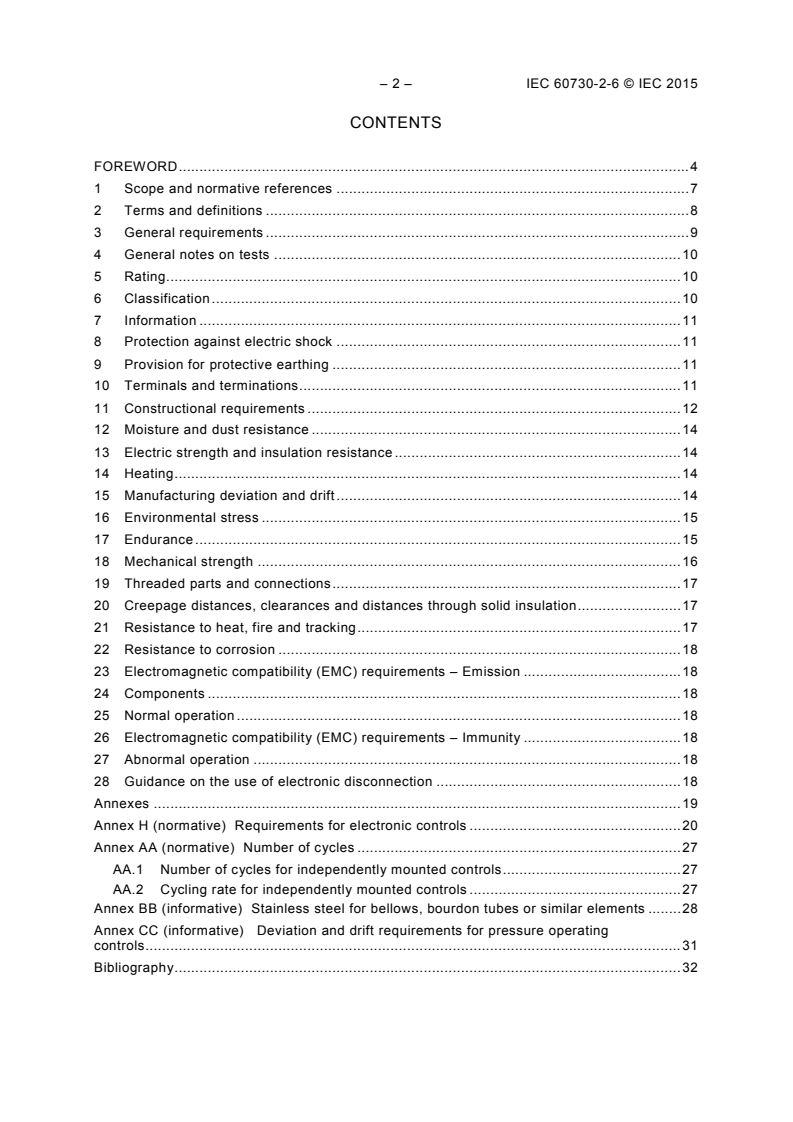
– 2 – IEC 60730-2-6 © IEC 2015
CONTENTS
FOREWORD . 4
1 Scope and normative references . 7
2 Terms and definitions . 8
3 General requirements . 9
4 General notes on tests . 10
5 Rating. 10
6 Classification . 10
7 Information . 11
8 Protection against electric shock . 11
9 Provision for protective earthing . 11
10 Terminals and terminations . 11
11 Constructional requirements . 12
12 Moisture and dust resistance . 14
13 Electric strength and insulation resistance . 14
14 Heating . 14
15 Manufacturing deviation and drift . 14
16 Environmental stress . 15
17 Endurance . 15
18 Mechanical strength . 16
19 Threaded parts and connections . 17
20 Creepage distances, clearances and distances through solid insulation . 17
21 Resistance to heat, fire and tracking . 17
22 Resistance to corrosion . 18
23 Electromagnetic compatibility (EMC) requirements – Emission . 18
24 Components . 18
25 Normal operation . 18
26 Electromagnetic compatibility (EMC) requirements – Immunity . 18
27 Abnormal operation . 18
28 Guidance on the use of electronic disconnection . 18
Annexes . 19
Annex H (normative) Requirements for electronic controls . 20
Annex AA (normative) Number of cycles . 27
AA.1 Number of cycles for independently mounted controls . 27
AA.2 Cycling rate for independently mounted controls . 27
Annex BB (informative) Stainless steel for bellows, bourdon tubes or similar elements . 28
Annex CC (informative) Deviation and drift requirements for pressure operating
controls . 31
Bibliography . 32
IEC 60730-2-6 © IEC 2015 – 3 –
Table 1 (7.2 of edition 3) – Required information and methods of providing information . 11
Table H.101 – Compliance criteria . 22
Table BB.1 – Stainless steel for bellows, bourdon tubes or similar elements (1 of 3) . 28
– 4 – IEC 60730-2-6 © IEC 2015
INTERNATIONAL ELECTROTECHNICAL COMMISSION
____________
AUTOMATIC ELECTRICAL CONTROLS –
Part 2-6: Particular requirements for automatic electrical
pressure sensing controls including mechanical requirements
FOREWORD
1) The International Electrotechnical Commission (IEC) is a worldwide organization for standardization comprising
all national electrotechnical committees (IEC National Committees). The object of IEC is to promote
international co-operation on all questions concerning standardization in the electrical and electronic fields. To
this end and in addition to other activities, IEC publishes International Standards, Technical Specifications,
Technical Reports, Publicly Available Specifications (PAS) and Guides (hereafter referred to as “IEC
Publication(s)”). Their preparation is entrusted to technical committees; any IEC National Committee interested
in the subject dealt with may participate in this preparatory work. International, governmental and non-
governmental organizations liaising with the IEC also participate in this preparation. IEC collaborates closely
with the International Organization for Standardization (ISO) in accordance with conditions determined by
agreement between the two organizations.
2) The formal decisions or agreements of IEC on technical matters express, as nearly as possible, an international
consensus of opinion on the relevant subjects since each technical committee has representation from all
interested IEC National Committees.
3) IEC Publications have the form of recommendations for international use and are accepted by IEC National
Committees in that sense. While all reasonable efforts are made to ensure that the technical content of IEC
Publications is accurate, IEC cannot be held responsible for the way in which they are used or for any
misinterpretation by any end user.
4) In order to promote international uniformity, IEC National Committees undertake to apply IEC Publications
transparently to the maximum extent possible in their national and regional publications. Any divergence
between any IEC Publication and the corresponding national or regional publication shall be clearly indicated in
the latter.
5) IEC itself does not provide any attestation of conformity. Independent certification bodies provide conformity
assessment services and, in some areas, access to IEC marks of conformity. IEC is not responsible for any
services carried out by independent certification bodies.
6) All users should ensure that they have the latest edition of this publication.
7) No liability shall attach to IEC or its directors, employees, servants or agents including individual experts and
members of its technical committees and IEC National Committees for any personal injury, property damage or
other damage of any nature whatsoever, whether direct or indirect, or for costs (including legal fees) and
expenses arising out of the publication, use of, or reliance upon, this IEC Publication or any other IEC
Publications.
8) Attention is drawn to the Normative references cited in this publication. Use of the referenced publications is
indispensable for the correct application of this publication.
9) Attention is drawn to the possibility that some of the elements of this IEC Publication may be the subject of
patent rights. IEC shall not be held responsible for identifying any or all such patent rights.
International Standard IEC 60730-2-6 has been prepared IEC technical committee 72:
Automatic electrical controls.
This third edition cancels and replaces the second edition published in 2007. This edition
constitutes a technical revision. This edition includes the following significant technical
changes with respect to the previous edition:
a) aligns the text with IEC 60730-1, Edition 5;
b) modifies requirements for Class B control function (H.27.1.2.2);
c) modifies requirements for Class C control function (H.27.1.2.3);
d) modifies requirements for faults during lock-out or safety- shut-down.
IEC 60730-2-6 © IEC 2015 – 5 –
The text of this standard is based on the following documents:
FDIS Report on voting
72/980/FDIS 72/992/RVD
Full information on the voting for the approval of this standard can be found in the report on
voting indicated in the above table.
This publication has been drafted in accordance with the ISO/IEC Directives, Part 2.
This part 2 is intended to be used in conjunction with IEC 60730-1. It was established on the
basis of the fifth edition (2013) of that publication. Consideration may be given to future
editions of, or amendments to, IEC 60730-1.
This part 2 supplements or modifies the corresponding clauses in IEC 60730-1 so as to
convert that publication into the IEC standard: Particular requirements for automatic electrical
pressure sensing controls including mechanical requirements.
Where this part 2 states "addition", "modification", or "replacement", the relevant requirement,
test specification or explanatory matter in part 1 should be adapted accordingly.
Where no change is necessary, this part 2 indicates that the relevant clause or subclause
applies.
In the development of a fully international standard, it has been necessary to take into
consideration the differing requirements resulting from practical experience in various parts of
the world and to recognize the variation in national electrical systems and wiring rules.
The “in some countries” notes regarding differing national practices are contained in the
following subclauses:
10.1.4
15.1.101
18.101
Annex CC
In this publication:
1) The following print types are used:
– Requirements proper: in roman type;
– Test specifications: in italic type;
– Notes; in small roman type;
– Words defined in Clause 2: bold.
2) Subclauses, notes, tables and figures which are additional to those in part 1 are numbered
starting from 101, additional annexes are lettered AA, BB, etc.
A list of all parts of the IEC 60730 series, published under the title Automatic electrical
controls can be found on the IEC website.
– 6 – IEC 60730-2-6 © IEC 2015
The committee has decided that the contents of this publication will remain unchanged until
the stability date indicated on the IEC web site under "http://webstore.iec.ch" in the data
related to the specific publication. At this date, the publication will be
• reconfirmed,
• withdrawn,
• replaced by a revised edition, or
• amended.
A bilingual version of this publication may be issued at a later date.
IEC 60730-2-6 © IEC 2015 – 7 –
AUTOMATIC ELECTRICAL CONTROLS –
Part 2-6: Particular requirements for automatic electrical
pressure sensing controls including mechanical requirements
1 Scope and normative references
This clause of Part 1 is applicable except as follows:
1.1 Scope
Replacement:
This part of IEC 60730 applies to automatic electrical pressure sensing controls with a
minimum gauge pressure rating of –60 kPa and a maximum gauge pressure rating of
4,2 MPa, for use in, on or in association with, equipment. The equipment may use electricity,
gas, oil, solid fuel, solar thermal energy, etc. or a combination thereof.
NOTE Throughout this standard, the word “equipment” includes “appliances” and “control system”.
This standard is also applicable to individual pressure sensing controls utilized as part of a
control system or pressure sensing controls which are mechanically integral with multi-
functional controls having non-electrical outputs.
Automatic electrical pressure sensing controls for equipment used by the public, such as
equipment intended to be used by laymen in shops, in light industry and on farms, are within
the scope of this standard.
This standard does not apply to pressure sensing controls intended exclusively for industrial
process applications unless explicitly mentioned in the relevant equipment standard.
1.1.1 Replacement:
This standard applies to inherent safety, operating values, operating sequences where
such are associated with equipment protection, and to the testing of automatic electrical
pressure sensing controls used in, on or in association with equipment.
This standard is also applicable to the functional safety of low complexity safety related
pressure sensing controls and systems.
This standard is also applicable to pressure sensing controls for appliances within the scope
of IEC 60335-1.
See also Annex J.
1.1.2 Addition:
This standard applies to automatic electrical controls, mechanically or electrically operated,
responsive to or controlling a pressure or vacuum.
1.1.3 Not applicable.
– 8 – IEC 60730-2-6 © IEC 2015
1.1.4 Replacement:
This standard applies to manual controls when such are electrically and/or mechanically
integral with pressure sensing controls.
NOTE Requirements for manual switches not forming part of an automatic control are contained in IEC 61058-1.
1.1.5
Replacement:
This standard applies to a.c. or d.c. powered pressure sensing controls with a rated voltage
not exceeding 690 V a.c. or 600 V d.c.
1.1.6
Replacement:
This standard does not take into account the response value of an automatic action of a
pressure sensing control, if such a response value is dependent upon the method of
mounting it in the equipment. Where a response value is of significant purpose for the
protection of the user, or surroundings, the value defined in the appropriate equipment
standard or as determined by the manufacturer shall apply.
1.1.7
Replacement:
This standard applies also to pressure sensing controls incorporating electronic devices,
requirements for which are contained in Annex H.
This standard applies also to pressure sensing controls using NTC or PTC thermistors,
requirements for which are contained in Annex J.
Additional subclauses:
1.1.101 This standard contains requirements for electrical features of pressure sensing
controls and requirements for mechanical features that affect their intended operation.
NOTE Subclause 18.101, as it pertains to gas and/or oil controls, is under consideration pending review or
revision of ISO 22967, ISO 22968 and ISO 23550 series, if applicable.
1.1.102 In general, these pressure sensing controls are integrated or incorporated with the
equipment or are intended to be integrated in, or on the equipment. This standard also covers
these controls when they are independently mounted. In-line cord controls are not covered
by this standard.
2 Terms and definitions
This clause of Part 1 is applicable except as follows:
2.2 Definitions of types of control according to purpose
Additional definitions:
IEC 60730-2-6 © IEC 2015 – 9 –
2.2.101
pressure limiter
pressure sensing control which is intended to keep a pressure below or above a
predetermined value during normal operating conditions and which may have provision for
setting by the user
Note 1 to entry: A pressure limiter may be of the automatic or of the manual reset type. It does not make the
reverse operation during the normal duty cycle of the equipment.
2.2.102
pressure operating control
pressure sensing control set at a high or low pressure, or both, between which limits the
equipment is normally intended to operate
2.2.103
pressure cut-out
pressure sensing control intended to keep a pressure below or above one particular value
during abnormal operating conditions of the equipment and which has no provisions for
setting by the user
Note 1 to entry: A pressure cut-out may be of the automatic or of the manual reset type.
A pressure cut-out will provide a Type 2 action.
A pressure cut-out may have an adjustable stop intended to be set by the control manufacturer, the equipment
manufacturer or the installer.
2.3 Definitions relating to the function of controls
Additional definitions:
2.3.101
pressure medium
medium used to transmit the pressure to the pressure sensing element
Note 1 to entry: Pressure medium as used in this standard refers to either gases or liquids.
2.3.102
differential pressure
difference in a pressure between any two points in a system, between two systems or
between a system and a reference pressure such as atmospheric pressure
Note 1 to entry: An example is the difference in static pressure between the upstream side of an orifice and the
downstream side.
2.8 Definitions relating to component parts of controls
Additional definition:
2.8.101
vent
that opening from the atmospheric side of a diaphragm to the atmosphere through which air is
discharged or drawn in when the control is functioning
3 General requirements
This clause of Part 1 is applicable.
– 10 – IEC 60730-2-6 © IEC 2015
4 General notes on tests
This clause of Part 1 is applicable except as follows:
4.1 Conditions of test
4.1.7 Replacement:
The rates of pressure change declared in Table 1 requirement 37, and used in Clause 17 (i.e.
α β , α , β ) shall have test tolerances as declared by the manufacturer.
,
1 1 2 2
4.3 Instructions for test
4.3.1 According to submission
Additional subclause:
4.3.1.101 The values in Annex AA apply for the testing of independently mounted pressure
sensing controls in Clause 17. Values for integrated and incorporated controls are
specified in the appropriate equipment standard.
5 Rating
This clause of Part 1 is applicable.
6 Classification
This clause of Part 1 is applicable except as follows:
6.3.9 – sensing control;
Additional subclause:
6.3.9.101 – pressure sensing;
6.4.3
Additional subclause:
6.4.3.101 – for sensing actions, no increase in the operating value as a result of any
leakage from the sensing element or from parts connecting the sensing element to the
switch head (Type 2.N).
6.8.3 Replacement:
For an independently mounted control or a control integrated or incorporated in an
assembly utilizing a non-electrical energy source:
IEC 60730-2-6 © IEC 2015 – 11 –
7 Information
This clause of Part 1 is applicable except as follows:
7.2 Methods of providing information
Table 1 (7.2 of edition 3) – Required information and methods of providing information
Information Clause or Method
subclause
Modification:
Replace the following requirements by:
6 Purpose of control 2.2.101 to 2.2.103
4.3.5 D
6.3
26 Number of cycles of actuation (M) for each manual action 6.10, Annex AA X
27 Number of automatic cycles (A) for each automatic action
6.11, Annex AA X
34 Not applicable
44 Not applicable
48 Operating pressure (or pressures) 2.3.11, 15, 18 D
Additional requirements:
101 Pressure medium 2.3.101 X
102 Operating differential 2.3.26 D
103 Maximum working pressure 2.3.29 D
Addition to Note i:
For pressure sensing controls, limits of activating quantity are specified either in the applicable appliance
standard, by the appliance manufacturer or as declared by the pressure sensing control manufacturer (see
17.7 and 17.8).
8 Protection against electric shock
This clause of Part 1 is applicable.
9 Provision for protective earthing
This clause of Part 1 is applicable.
10 Terminals and terminations
This clause of Part 1 is applicable except as follows:
10.1 Terminals and terminations for external copper conductors
10.1.4 Addition:
NOTE In the USA, controls for operation above 50 V shall be provided with suitable wiring terminals or leads for
the connection of fixed wiring conductors having an ampere rating of no less than:
– 1,25 times the ampere rating of a fixed electric space-heating equipment load;
– 1,25 times the full-load motor current rating of a single motor;
– 1,25 times the combination load of a full-load motor current and 1,25 times a fixed electric space-heating
equipment load;
– 12 – IEC 60730-2-6 © IEC 2015
– 1,25 times the full load current of the largest motor plus the full load amperes of the other loads;
– 1,0 times all other loads.
11 Constructional requirements
This clause of Part 1 is applicable except as follows:
11.4 Actions
Additional subclause:
11.4.101 Type 2.N action
A Type 2.N action shall be so designed that in the event of a leak in the sensing element, or
in any other part between the sensing element and the switch head, the declared
disconnection or interruption is provided before the sum of the declared operating pressure
and drift is exceeded.
Compliance is checked by the following test:
The operating pressure of a Type 2.N control shall be measured under the conditions of
Clause 15 of Part 1. If the control has means for setting, it shall be set to the highest value.
After this measurement, a hole is artificially produced in the sensing element and the
measurement of the operating pressure is repeated.
No positive drift is allowed beyond the declared value.
A separate shroud or sleeve may be employed for protection of the sensing element to
achieve conformance with Clause 18.
NOTE The test can be replaced by theoretical computations of the physical mode of operation.
11.11 Requirements during mounting, maintenance and servicing
Additional subclauses:
11.11.101 Parts in contact with a diaphragm shall have no sharp burrs, projections or the
like which might chafe or abrade the diaphragm.
Compliance is checked by inspection before and after the tests of Clause 17.
11.11.102 An operating spring shall be retained and arranged to prevent abrasion, binding,
buckling or interference with its free movement.
Compliance is checked by inspection before and after the tests of Clause 17.
11.11.103 If failure of any part of the control would allow unsafe leakage of a hazardous
fluid, that part shall be made of a material having a melting point (solidus temperature) of not
less than 510 °C and a tensile strength of not less than 68 MPa at 204 °C.
Such parts shall not sag, distort, melt, oxidize or show leakage of fluid during any of the tests
specified herein.
Compliance is checked by inspection and the tests of Clause 17.
IEC 60730-2-6 © IEC 2015 – 13 –
11.11.104 A part including a sheath, capillary tube, bellows or diaphragm shall be resistant
to atmospheric corrosion and attack by the fluid it may normally contact in service, if failure of
the part will permit external fluid leakage of a combustible fluid or cause the control to
malfunction.
NOTE Brass alloys containing less than 81 % copper and more than 9 % zinc are not considered resistant to the
corrosive effects of fuel oils.
11.11.105 A control in which a flexible diaphragm, bellows or similar construction
constitutes the only flammable gas or fluid seal shall have the atmospheric side of the
diaphragm or bellows enclosed in a casing designed to limit external fluid leakage in the event
of a diaphragm or bellows rupture or shall have provisions for connection of a vent pipe or
tubing intended to be routed to the outdoors or other safe location.
11.11.106 A control designed to supervise the pressure of fuel oil of 1,00 mm /s to
600 mm /s viscosity is not required to conform to 18.101 and 18.102, provided three samples
of the control, when subjected to a 100 000 cycle endurance test, show no evidence of
leakage during the test and when subjected to a hydrostatic test of four times the maximum
working pressure, following the endurance test, and the control conforms to one of the
following:
a) the bellows, Bourdon tube, diaphragm or similar element is made of stainless steel or
material of equivalent resistance to corrosion designated material Class A, if leakage from
a ruptured element will be into the control enclosure, in which case such leakage is to be
released to the exterior of the control before entering any opening provided for conduit
connection, or
b) the bellows, Bourdon tube, diaphragm or similar element is made of stainless steel or
material of equivalent resistance to corrosion designated material Class B, if leakage from
a ruptured element will be to the exterior of the control enclosure only.
NOTE 1 Suitable Class A and B materials are shown in Annex BB.
NOTE 2 1 mm /s = 1 centistoke.
Additional subclauses:
11.101 Construction requirements relating to operating mechanism
11.101.1 If screws and nuts serve to attach operating parts to movable members, they shall
be swaged or otherwise locked.
11.101.2 The operating mechanism of a manually operated switch shall not subject parts to
damage.
11.101.3 Operating parts shall be separated by barriers or by their physical location from
conductors
...
IEC 60730-2-6 ®
Edition 3.0 2015-04
INTERNATIONAL
STANDARD
NORME
INTERNATIONALE
Automatic electrical controls –
Part 2-6: Particular requirements for automatic electrical pressure sensing
controls including mechanical requirements
Dispositifs de commande électrique automatiques –
Partie 2-6: Exigences particulières pour les dispositifs de commande électrique
automatiques sensibles à la pression y compris les exigences mécaniques
IEC60730-2-6:2015-04(en-fr)
All rights reserved. Unless otherwise specified, no part of this publication may be reproduced or utilized in any form
or by any means, electronic or mechanical, including photocopying and microfilm, without permission in writing from
either IEC or IEC's member National Committee in the country of the requester. If you have any questions about IEC
copyright or have an enquiry about obtaining additional rights to this publication, please contact the address below or
your local IEC member National Committee for further information.
Droits de reproduction réservés. Sauf indication contraire, aucune partie de cette publication ne peut être reproduite
ni utilisée sous quelque forme que ce soit et par aucun procédé, électronique ou mécanique, y compris la photocopie
et les microfilms, sans l'accord écrit de l'IEC ou du Comité national de l'IEC du pays du demandeur. Si vous avez des
questions sur le copyright de l'IEC ou si vous désirez obtenir des droits supplémentaires sur cette publication, utilisez
les coordonnées ci-après ou contactez le Comité national de l'IEC de votre pays de résidence.
IEC Central Office Tel.: +41 22 919 02 11
3, rue de Varembé info@iec.ch
CH-1211 Geneva 20 www.iec.ch
Switzerland
About the IEC
The International Electrotechnical Commission (IEC) is the leading global organization that prepares and publishes
International Standards for all electrical, electronic and related technologies.
About IEC publications
The technical content of IEC publications is kept under constant review by the IEC. Please make sure that you have the
latest edition, a corrigenda or an amendment might have been published.
IEC Catalogue - webstore.iec.ch/catalogue Electropedia - www.electropedia.org
The stand-alone application for consulting the entire The world's leading online dictionary of electronic and
bibliographical information on IEC International Standards, electrical terms containing 21 000 terms and definitions in
Technical Specifications, Technical Reports and other English and French, with equivalent terms in 16 additional
documents. Available for PC, Mac OS, Android Tablets and languages. Also known as the International Electrotechnical
iPad. Vocabulary (IEV) online.
IEC publications search - webstore.iec.ch/advsearchform IEC Glossary - std.iec.ch/glossary
The advanced search enables to find IEC publications by a 67 000 electrotechnical terminology entries in English and
variety of criteria (reference number, text, technical French extracted from the Terms and Definitions clause of
committee,…). It also gives information on projects, replaced IEC publications issued since 2002. Some entries have been
and withdrawn publications. collected from earlier publications of IEC TC 37, 77, 86 and
CISPR.
IEC Just Published - webstore.iec.ch/justpublished
Stay up to date on all new IEC publications. Just Published IEC Customer Service Centre - webstore.iec.ch/csc
details all new publications released. Available online and If you wish to give us your feedback on this publication or
also once a month by email. need further assistance, please contact the Customer Service
Centre: sales@iec.ch.
A propos de l'IEC
La Commission Electrotechnique Internationale (IEC) est la première organisation mondiale qui élabore et publie des
Normes internationales pour tout ce qui a trait à l'électricité, à l'électronique et aux technologies apparentées.
A propos des publications IEC
Le contenu technique des publications IEC est constamment revu. Veuillez vous assurer que vous possédez l’édition la
plus récente, un corrigendum ou amendement peut avoir été publié.
Catalogue IEC - webstore.iec.ch/catalogue Electropedia - www.electropedia.org
Application autonome pour consulter tous les renseignements
Le premier dictionnaire en ligne de termes électroniques et
bibliographiques sur les Normes internationales,
électriques. Il contient 21 000 termes et définitions en anglais
Spécifications techniques, Rapports techniques et autres
et en français, ainsi que les termes équivalents dans 16
documents de l'IEC. Disponible pour PC, Mac OS, tablettes
langues additionnelles. Egalement appelé Vocabulaire
Android et iPad.
Electrotechnique International (IEV) en ligne.
Recherche de publications IEC -
Glossaire IEC - std.iec.ch/glossary
webstore.iec.ch/advsearchform
67 000 entrées terminologiques électrotechniques, en anglais
La recherche avancée permet de trouver des publications IEC et en français, extraites des articles Termes et Définitions des
en utilisant différents critères (numéro de référence, texte, publications IEC parues depuis 2002. Plus certaines entrées
comité d’études,…). Elle donne aussi des informations sur les antérieures extraites des publications des CE 37, 77, 86 et
projets et les publications remplacées ou retirées. CISPR de l'IEC.
IEC Just Published - webstore.iec.ch/justpublished Service Clients - webstore.iec.ch/csc
Restez informé sur les nouvelles publications IEC. Just Si vous désirez nous donner des commentaires sur cette
Published détaille les nouvelles publications parues. publication ou si vous avez des questions contactez-nous:
Disponible en ligne et aussi une fois par mois par email. sales@iec.ch.
IEC 60730-2-6 ®
Edition 3.0 2015-04
INTERNATIONAL
STANDARD
NORME
INTERNATIONALE
Automatic electrical controls –
Part 2-6: Particular requirements for automatic electrical pressure sensing
controls including mechanical requirements
Dispositifs de commande électrique automatiques –
Partie 2-6: Exigences particulières pour les dispositifs de commande électrique
automatiques sensibles à la pression y compris les exigences mécaniques
INTERNATIONAL
ELECTROTECHNICAL
COMMISSION
COMMISSION
ELECTROTECHNIQUE
INTERNATIONALE
ICS 97.120 ISBN 978-2-8322-5268-0
– 2 – IEC 60730-2-6:2015 © IEC 2015
CONTENTS
FOREWORD . 4
1 Scope and normative references . 7
2 Terms and definitions . 8
3 General requirements . 9
4 General notes on tests . 10
5 Rating. 10
6 Classification . 10
7 Information . 11
8 Protection against electric shock . 11
9 Provision for protective earthing . 11
10 Terminals and terminations . 11
11 Constructional requirements . 12
12 Moisture and dust resistance . 14
13 Electric strength and insulation resistance . 14
14 Heating . 14
15 Manufacturing deviation and drift . 14
16 Environmental stress . 15
17 Endurance . 15
18 Mechanical strength . 16
19 Threaded parts and connections . 17
20 Creepage distances, clearances and distances through solid insulation . 17
21 Resistance to heat, fire and tracking . 17
22 Resistance to corrosion . 18
23 Electromagnetic compatibility (EMC) requirements – Emission . 18
24 Components . 18
25 Normal operation . 18
26 Electromagnetic compatibility (EMC) requirements – Immunity . 18
27 Abnormal operation . 18
28 Guidance on the use of electronic disconnection . 18
Annexes . 19
Annex H (normative) Requirements for electronic controls . 20
Annex AA (normative) Number of cycles . 27
AA.1 Number of cycles for independently mounted controls . 27
AA.2 Cycling rate for independently mounted controls . 27
Annex BB (informative) Stainless steel for bellows, bourdon tubes or similar elements . 28
Annex CC (informative) Deviation and drift requirements for pressure operating
controls . 31
Bibliography . 32
Table 1 (7.2 of edition 3) – Required information and methods of providing information . 11
Table H.101 – Compliance criteria . 22
Table BB.1 – Stainless steel for bellows, bourdon tubes or similar elements . 28
– 4 – IEC 60730-2-6:2015 © IEC 2015
INTERNATIONAL ELECTROTECHNICAL COMMISSION
____________
AUTOMATIC ELECTRICAL CONTROLS –
Part 2-6: Particular requirements for automatic electrical
pressure sensing controls including mechanical requirements
FOREWORD
1) The International Electrotechnical Commission (IEC) is a worldwide organization for standardization comprising
all national electrotechnical committees (IEC National Committees). The object of IEC is to promote
international co-operation on all questions concerning standardization in the electrical and electronic fields. To
this end and in addition to other activities, IEC publishes International Standards, Technical Specifications,
Technical Reports, Publicly Available Specifications (PAS) and Guides (hereafter referred to as “IEC
Publication(s)”). Their preparation is entrusted to technical committees; any IEC National Committee interested
in the subject dealt with may participate in this preparatory work. International, governmental and non-
governmental organizations liaising with the IEC also participate in this preparation. IEC collaborates closely
with the International Organization for Standardization (ISO) in accordance with conditions determined by
agreement between the two organizations.
2) The formal decisions or agreements of IEC on technical matters express, as nearly as possible, an international
consensus of opinion on the relevant subjects since each technical committee has representation from all
interested IEC National Committees.
3) IEC Publications have the form of recommendations for international use and are accepted by IEC National
Committees in that sense. While all reasonable efforts are made to ensure that the technical content of IEC
Publications is accurate, IEC cannot be held responsible for the way in which they are used or for any
misinterpretation by any end user.
4) In order to promote international uniformity, IEC National Committees undertake to apply IEC Publications
transparently to the maximum extent possible in their national and regional publications. Any divergence
between any IEC Publication and the corresponding national or regional publication shall be clearly indicated in
the latter.
5) IEC itself does not provide any attestation of conformity. Independent certification bodies provide conformity
assessment services and, in some areas, access to IEC marks of conformity. IEC is not responsible for any
services carried out by independent certification bodies.
6) All users should ensure that they have the latest edition of this publication.
7) No liability shall attach to IEC or its directors, employees, servants or agents including individual experts and
members of its technical committees and IEC National Committees for any personal injury, property damage or
other damage of any nature whatsoever, whether direct or indirect, or for costs (including legal fees) and
expenses arising out of the publication, use of, or reliance upon, this IEC Publication or any other IEC
Publications.
8) Attention is drawn to the Normative references cited in this publication. Use of the referenced publications is
indispensable for the correct application of this publication.
9) Attention is drawn to the possibility that some of the elements of this IEC Publication may be the subject of
patent rights. IEC shall not be held responsible for identifying any or all such patent rights.
International Standard IEC 60730-2-6 has been prepared IEC technical committee 72:
Automatic electrical controls.
This bilingual version (2018-01) corresponds to the monolingual English version, published in
2015-04.
This third edition cancels and replaces the second edition published in 2007. This edition
constitutes a technical revision. This edition includes the following significant technical
changes with respect to the previous edition:
a) aligns the text with IEC 60730-1, Edition 5;
b) modifies requirements for Class B control function (H.27.1.2.2);
c) modifies requirements for Class C control function (H.27.1.2.3);
d) modifies requirements for faults during lock-out or safety- shut-down.
The text of this standard is based on the following documents:
FDIS Report on voting
72/980/FDIS 72/992/RVD
Full information on the voting for the approval of this standard can be found in the report on
voting indicated in the above table.
The French version of this standard has not been voted upon.
This publication has been drafted in accordance with the ISO/IEC Directives, Part 2.
This part 2 is intended to be used in conjunction with IEC 60730-1. It was established on the
basis of the fifth edition (2013) of that publication. Consideration may be given to future
editions of, or amendments to, IEC 60730-1.
This part 2 supplements or modifies the corresponding clauses in IEC 60730-1 so as to
convert that publication into the IEC standard: Particular requirements for automatic electrical
pressure sensing controls including mechanical requirements.
Where this part 2 states "addition", "modification", or "replacement", the relevant requirement,
test specification or explanatory matter in part 1 should be adapted accordingly.
Where no change is necessary, this part 2 indicates that the relevant clause or subclause
applies.
In the development of a fully international standard, it has been necessary to take into
consideration the differing requirements resulting from practical experience in various parts of
the world and to recognize the variation in national electrical systems and wiring rules.
The “in some countries” notes regarding differing national practices are contained in the
following subclauses:
10.1.4
15.1.101
18.101
Annex CC
In this publication:
1) The following print types are used:
– Requirements proper: in roman type;
– Test specifications: in italic type;
– Notes; in small roman type;
– Words defined in Clause 2: bold.
2) Subclauses, notes, tables and figures which are additional to those in part 1 are numbered
starting from 101, additional annexes are lettered AA, BB, etc.
A list of all parts of the IEC 60730 series, published under the title Automatic electrical
controls can be found on the IEC website.
– 6 – IEC 60730-2-6:2015 © IEC 2015
The committee has decided that the contents of this publication will remain unchanged until
the stability date indicated on the IEC web site under "http://webstore.iec.ch" in the data
related to the specific publication. At this date, the publication will be
• reconfirmed,
• withdrawn,
• replaced by a revised edition, or
• amended.
AUTOMATIC ELECTRICAL CONTROLS –
Part 2-6: Particular requirements for automatic electrical
pressure sensing controls including mechanical requirements
1 Scope and normative references
This clause of Part 1 is applicable except as follows:
1.1 Scope
Replacement:
This part of IEC 60730 applies to automatic electrical pressure sensing controls with a
minimum gauge pressure rating of –60 kPa and a maximum gauge pressure rating of
4,2 MPa, for use in, on or in association with, equipment. The equipment may use electricity,
gas, oil, solid fuel, solar thermal energy, etc. or a combination thereof.
NOTE Throughout this standard, the word “equipment” includes “appliances” and “control system”.
This standard is also applicable to individual pressure sensing controls utilized as part of a
control system or pressure sensing controls which are mechanically integral with multi-
functional controls having non-electrical outputs.
Automatic electrical pressure sensing controls for equipment used by the public, such as
equipment intended to be used by laymen in shops, in light industry and on farms, are within
the scope of this standard.
This standard does not apply to pressure sensing controls intended exclusively for industrial
process applications unless explicitly mentioned in the relevant equipment standard.
1.1.1 Replacement:
This standard applies to inherent safety, operating values, operating sequences where
such are associated with equipment protection, and to the testing of automatic electrical
pressure sensing controls used in, on or in association with equipment.
This standard is also applicable to the functional safety of low complexity safety related
pressure sensing controls and systems.
This standard is also applicable to pressure sensing controls for appliances within the scope
of IEC 60335-1.
See also Annex J.
1.1.2 Addition:
This standard applies to automatic electrical controls, mechanically or electrically operated,
responsive to or controlling a pressure or vacuum.
1.1.3 Not applicable.
– 8 – IEC 60730-2-6:2015 © IEC 2015
1.1.4 Replacement:
This standard applies to manual controls when such are electrically and/or mechanically
integral with pressure sensing controls.
NOTE Requirements for manual switches not forming part of an automatic control are contained in IEC 61058-1.
1.1.5
Replacement:
This standard applies to a.c. or d.c. powered pressure sensing controls with a rated voltage
not exceeding 690 V a.c. or 600 V d.c.
1.1.6
Replacement:
This standard does not take into account the response value of an automatic action of a
pressure sensing control, if such a response value is dependent upon the method of
mounting it in the equipment. Where a response value is of significant purpose for the
protection of the user, or surroundings, the value defined in the appropriate equipment
standard or as determined by the manufacturer shall apply.
1.1.7
Replacement:
This standard applies also to pressure sensing controls incorporating electronic devices,
requirements for which are contained in Annex H.
This standard applies also to pressure sensing controls using NTC or PTC thermistors,
requirements for which are contained in Annex J.
Additional subclauses:
1.1.101 This standard contains requirements for electrical features of pressure sensing
controls and requirements for mechanical features that affect their intended operation.
NOTE Subclause 18.101, as it pertains to gas and/or oil controls, is under consideration pending review or
revision of ISO 22967, ISO 22968 and ISO 23550 series, if applicable.
1.1.102 In general, these pressure sensing controls are integrated or incorporated with the
equipment or are intended to be integrated in, or on the equipment. This standard also covers
these controls when they are independently mounted. In-line cord controls are not covered
by this standard.
2 Terms and definitions
This clause of Part 1 is applicable except as follows:
2.2 Definitions of types of control according to purpose
Additional definitions:
2.2.101
pressure limiter
pressure sensing control which is intended to keep a pressure below or above a
predetermined value during normal operating conditions and which may have provision for
setting by the user
Note 1 to entry: A pressure limiter may be of the automatic or of the manual reset type. It does not make the
reverse operation during the normal duty cycle of the equipment.
2.2.102
pressure operating control
pressure sensing control set at a high or low pressure, or both, between which limits the
equipment is normally intended to operate
2.2.103
pressure cut-out
pressure sensing control intended to keep a pressure below or above one particular value
during abnormal operating conditions of the equipment and which has no provisions for
setting by the user
Note 1 to entry: A pressure cut-out may be of the automatic or of the manual reset type.
A pressure cut-out will provide a Type 2 action.
A pressure cut-out may have an adjustable stop intended to be set by the control manufacturer, the equipment
manufacturer or the installer.
2.3 Definitions relating to the function of controls
Additional definitions:
2.3.101
pressure medium
medium used to transmit the pressure to the pressure sensing element
Note 1 to entry: Pressure medium as used in this standard refers to either gases or liquids.
2.3.102
differential pressure
difference in a pressure between any two points in a system, between two systems or
between a system and a reference pressure such as atmospheric pressure
Note 1 to entry: An example is the difference in static pressure between the upstream side of an orifice and the
downstream side.
2.8 Definitions relating to component parts of controls
Additional definition:
2.8.101
vent
that opening from the atmospheric side of a diaphragm to the atmosphere through which air is
discharged or drawn in when the control is functioning
3 General requirements
This clause of Part 1 is applicable.
– 10 – IEC 60730-2-6:2015 © IEC 2015
4 General notes on tests
This clause of Part 1 is applicable except as follows:
4.1 Conditions of test
4.1.7 Replacement:
The rates of pressure change declared in Table 1 requirement 37, and used in Clause 17 (i.e.
α β , α , β ) shall have test tolerances as declared by the manufacturer.
,
1 1 2 2
4.3 Instructions for test
4.3.1 According to submission
Additional subclause:
4.3.1.101 The values in Annex AA apply for the testing of independently mounted pressure
sensing controls in Clause 17. Values for integrated and incorporated controls are
specified in the appropriate equipment standard.
5 Rating
This clause of Part 1 is applicable.
6 Classification
This clause of Part 1 is applicable except as follows:
6.3.9 – sensing control;
Additional subclause:
6.3.9.101 – pressure sensing;
6.4.3
Additional subclause:
6.4.3.101 – for sensing actions, no increase in the operating value as a result of any
leakage from the sensing element or from parts connecting the sensing element to the
switch head (Type 2.N).
6.8.3 Replacement:
For an independently mounted control or a control integrated or incorporated in an
assembly utilizing a non-electrical energy source:
7 Information
This clause of Part 1 is applicable except as follows:
7.2 Methods of providing information
Table 1 (7.2 of edition 3) – Required information and methods of providing information
Information Clause or Method
subclause
Modification:
Replace the following requirements by:
6 Purpose of control 2.2.101 to 2.2.103
4.3.5 D
6.3
26 Number of cycles of actuation (M) for each manual action 6.10, Annex AA X
27 Number of automatic cycles (A) for each automatic action
6.11, Annex AA X
34 Not applicable
44 Not applicable
48 Operating pressure (or pressures) 2.3.11, 15, 18 D
Additional requirements:
101 Pressure medium 2.3.101 X
102 Operating differential 2.3.26 D
103 Maximum working pressure 2.3.29 D
Addition to Note i:
For pressure sensing controls, limits of activating quantity are specified either in the applicable appliance
standard, by the appliance manufacturer or as declared by the pressure sensing control manufacturer (see
17.7 and 17.8).
8 Protection against electric shock
This clause of Part 1 is applicable.
9 Provision for protective earthing
This clause of Part 1 is applicable.
10 Terminals and terminations
This clause of Part 1 is applicable except as follows:
10.1 Terminals and terminations for external copper conductors
10.1.4 Addition:
NOTE In the USA, controls for operation above 50 V shall be provided with suitable wiring terminals or leads for
the connection of fixed wiring conductors having an ampere rating of no less than:
– 1,25 times the ampere rating of a fixed electric space-heating equipment load;
– 1,25 times the full-load motor current rating of a single motor;
– 1,25 times the combination load of a full-load motor current and 1,25 times a fixed electric space-heating
equipment load;
– 1,25 times the full load current of the largest motor plus the full load amperes of the other loads;
– 1,0 times all other loads.
– 12 – IEC 60730-2-6:2015 © IEC 2015
11 Constructional requirements
This clause of Part 1 is applicable except as follows:
11.4 Actions
Additional subclause:
11.4.101 Type 2.N action
A Type 2.N action shall be so designed that in the event of a leak in the sensing element, or
in any other part between the sensing element and the switch head, the declared
disconnection or interruption is provided before the sum of the declared operating pressure
and drift is exceeded.
Compliance is checked by the following test:
The operating pressure of a Type 2.N control shall be measured under the conditions of
Clause 15 of Part 1. If the control has means for setting, it shall be set to the highest value.
After this measurement, a hole is artificially produced in the sensing element and the
measurement of the operating pressure is repeated.
No positive drift is allowed beyond the declared value.
A separate shroud or sleeve may be employed for protection of the sensing element to
achieve conformance with Clause 18.
NOTE The test can be replaced by theoretical computations of the physical mode of operation.
11.11 Requirements during mounting, maintenance and servicing
Additional subclauses:
11.11.101 Parts in contact with a diaphragm shall have no sharp burrs, projections or the
like which might chafe or abrade the diaphragm.
Compliance is checked by inspection before and after the tests of Clause 17.
11.11.102 An operating spring shall be retained and arranged to prevent abrasion, binding,
buckling or interference with its free movement.
Compliance is checked by inspection before and after the tests of Clause 17.
11.11.103 If failure of any part of the control would allow unsafe leakage of a hazardous
fluid, that part shall be made of a material having a melting point (solidus temperature) of not
less than 510 °C and a tensile strength of not less than 68 MPa at 204 °C.
Such parts shall not sag, distort, melt, oxidize or show leakage of fluid during any of the tests
specified herein.
Compliance is checked by inspection and the tests of Clause 17.
11.11.104 A part including a sheath, capillary tube, bellows or diaphragm shall be resistant
to atmospheric corrosion and attack by the fluid it may normally contact in service, if failure of
the part will permit external fluid leakage of a combustible fluid or cause the control to
malfunction.
NOTE Brass alloys containing less than 81 % copper and more than 9 % zinc are not considered resistant to the
corrosive effects of fuel oils.
11.11.105 A control in which a flexible diaphragm, bellows or similar construction
constitutes the only flammable gas or fluid seal shall have the atmospheric side of the
diaphragm or bellows enclosed in a casing designed to limit external fluid leakage in the event
of a diaphragm or bellows rupture or shall have provisions for connection of a vent pipe or
tubing intended to be routed to the outdoors or other safe location.
11.11.106 A control designed to supervise the pressure of fuel oil of 1,00 mm /s to
600 mm /s viscosity is not required to conform to 18.101 and 18.102, provided three samples
of the control, when subjected to a 100 000 cycle endurance test, show no evidence of
leakage during the test and when subjected to a hydrostatic test of four times the maximum
working pressure, following the endurance test, and the control conforms to one of the
following:
a) the bellows, Bourdon tube, diaphragm or similar element is made of stainless steel or
material of equivalent resistance to corrosion designated material Class A, if leakage from
a ruptured element will be into the control enclosure, in which case such leakage is to be
released to the exterior of the control before entering any opening provided for conduit
connection, or
b) the bellows, Bourdon tube, diaphragm or similar element is made of stainless steel or
material of equivalent resistance to corrosion designated material Class B, if leakage from
a ruptured element will be to the exterior of the control enclosure only.
NOTE 1 Suitable Class A and B materials are shown in Annex BB.
NOTE 2 1 mm /s = 1 centistoke.
Additional subclauses:
11.101 Construction requirements relating to operating mechanism
11.101.1 If screws and nuts serve to attach operating parts to movable members, they shall
be swaged or otherwise locked.
11.101.2 The operating mechanism of a manually operated switch shall not subject parts to
damage.
11.101.3 Operating parts shall be separated by barriers or by their physical location from
conductors to be connected to the control to avoid interference with the movement of such
parts by the conductors.
Compliance with 11.101.1 to 11.101.3 inclusive is checked by inspection.
11.102 A pressure cut-out shall not reset, or be resettable manually or otherwise at a value
above the maximum or below the minimum operating pressure, whichever is declared.
11.103 A pressure cut-out with a manually operated reset device shall be trip-free.
Compliance with 11.102 and 11.103 is checked by inspection.
– 14 – IEC 60730-2-6:2015 © IEC 2015
12 Moisture and dust resistance
This clause of Part 1 is applicable except as follows:
12.1.1 Addition:
The tests in this subclause are not intended to determine the suitability of the seal between
the control and the equipment.
13 Electric strength and insulation resistance
This clause of Part 1 is applicable.
14 Heating
This clause of Part 1 is applicable except as follows:
14.4.3.1 Not applicable.
15 Manufacturing deviation and drift
This clause of Part 1 is applicable except as follows:
15.1 Replace the note:
NOTE For USA and Canada, Annex CC is applicable for general purpose type controls.
15.4 Replacement:
The operating pressure shall be as declared in Table 1. The allowable deviation and drift
shall not be applied for the purpose of deliberately exceeding the maximum operating
pressure.
15.5.5 Additional subclause:
15.5.5.101 For controls which have set points which can be set by the user, the initial
operating pressure shall be determined at the maximum and minimum set points and at a set
point approximately midway between the maximum and minimum. For such controls, the
maximum variations as specified in 15.4 of this standard are applicable to the maximum set
point.
A 5 % scale error, based on the maximum setting, may be applied to the minimum and
midway set points. This scale error may be in addition to the maximum variations.
The control shall be connected to a source of aerostatic or hydrostatic pressure, consistent
with its intended use. A pressure within 25 % of the operating pressure (maximum, minimum
or midway value) is to be established and the pressure is then increased or decreased at a
rate of 10 % of the operating pressure per minute but in no case is the rate of change to
exceed 60 Pa/s.
The test conditions and test apparatus for the initial test and final test, after the endurance
tests of Clause 17, shall be the same.
16 Environmental stress
This clause of Part 1 is applicable.
17 Endurance
This clause of Part 1 is applicable except as follows:
17.1.2.1 Replacement:
Compliance with 17.1.1 and 17.1.2 is checked by the test of 17.16.
17.1.3.2 Addition:
The tests of Clause 17 shall be conducted at the maximum declared working pressure.
17.16 Test for particular purpose controls
Additional subclauses:
17.16.101 Pressure operating controls
17.1 to 17.5 inclusive are applicable.
17.6 is not applicable.
17.7 and 17.8 are applicable.
17.9 is applicable, but only to slow-make, slow-break automatic actions.
17.10 to 17.13 inclusive are applicable but only to those pressure operating controls which
have a manual action (including an actuating means providing setting by the user).
17.14 is applicable.
17.16.102 Pressure limiter
17.1 to 17.5 inclusive are applicable.
17.6 is not applicable.
17.7 and 17.8 are applicable except that, where necessary, the reset operation, if required, is
obtained by actuation. This actuation shall be as specified in 17.4 for accelerated speed, as
soon as permitted by the mechanism, or as declared by the manufacturer in Table 1.
17.9 is applicable, but only to slow-make, slow-break automatic actions, the same conditions
for manual reset for 17.7 and 17.8 being used.
17.10 to 17.13 inclusive are applicable but only to those pressure limiters which have a
manual action (including an actuating means providing setting by the user).
17.10 to 17.13 inclusive are not applicable to the normal reset manual action, which is tested
during the automatic test of 17.7 to 17.9 inclusive. If the pressure limiter has other manual
actions which are not tested during the automatic test, then these subclauses are applicable.
17.14 is applicable.
– 16 – IEC 60730-2-6:2015 © IEC 2015
17.16.103 Pressure cut-out
17.1 to 17.5 inclusive are applicable.
17.6 is applicable to actions classified as Type 1.M or 2.M, the value of "X" being as small as
practicable.
17.7 and 17.8 are applicable except that the reset operation, if required, is obtained by
actuation. This actuation shall be as specified in 17.4 for accelerated speed, as soon as
permitted by the mechanism, or as declared by the manufacturer in Table 1.
17.9 is applicable, but only to slow-make, slow-break automatic actions, the same conditions
for manual reset for 17.7 and 17.8 being used.
17.10 to 17.13 inclusive are not applicable to the normal reset manual action which is tested
during the automatic test of 17.7 to 17.9 inclusive. If the pressure cut-out has other manual
actions which are not tested during the automatic tests, then these subclauses are
applicable.
17.14 is applicable.
18 Mechanical strength
This clause of Part 1 is applicable except as follows:
Additional subclauses:
18.101 Medium leakage
NOTE 1 Under consideration.
Parts of pressure limiters or pressure cut-outs which are subjected to pressure of a fluid to be
supervised shall not leak externally at a rate in excess of 200 cm /h, when tested with air or
nitrogen at a pressure of 1,5 times the maximum working pressure of the control.
To determine compliance, the control is to be connected to a system capable of supplying
clean air or nitrogen at the specified test pressure. Any by-pass or other openings not
essential to the operation of the control during the test are to be sealed. Air or nitrogen is to
be admitted and maintained at the specified test pressure. In the case of a diaphragm
element, which, in normal usage, is subjected to pressure on both sides of the diaphragm, the
test pressure is to be applied to both sides of the diaphragm slowly and without shock to
avoid stressing the diaphragm excessively.
Leakage is to be observed by an apparatus capable of indicating accurately a flow rate of
/h for the test fluid employed. A control with a maximum working pressure of 35 kPa
200 cm
or more may be considered as conforming to the above if, when the fluid-containing parts of
the control are submerged in water to a depth of approximately 25 mm while under the test
pressure, no bubble indicating leakage is observed within 10 s after the parts are submerged.
To conform to 11.11.105, a control shall not allow leakage under conditions of ruptured
diaphragm or bellows from an unthreaded vent opening or around pins, stems or linkages
passing through the housing in excess of the following rate, when the control is tested to its
maximum working pressure:
a) 0,03 m /h of a 0,64 specific gravity gas for a control for use only with fuel gases having
specific gravity less than 1,0;
NOTE 2 In the countries members of CENELEC, the leakage rate is 70 l/h.
b) 0,014 m /h of a 1,53 specific gravity gas for a control for use with liquified petroleum
gases;
NOTE 3 In the countries members of CENELEC, the leakage rate is 70 l/h.
c) 0,001 m /h of water for a control for use with flammable liquids such as gasoline,
kerosene and fuel oils up to 1,2 mm /s;
3 2
d) 0,002 m /h of the lightest grade fuel oil heavier than 1,2 mm /s for which a control is to
be used.
18.102 Strength of parts (hydrostatic)
18.102.1 A pressure sensing control employing a Bourdon tube, a flexible metal bellows, a
diaphragm or the like rated 2 000 kPa or more, which is not contained within an enclosure,
shall withstand for 1 min without bursting a hydraulic pressure equal to four times the
maximum working pressure of the control.
The control under test is to be filled with water to exclude air and is connected to a hydraulic
pump. The pressure is to be raised gradually to the required test pressure.
Leakage at a gasket or fitting during this test is permitted provided the leakage does not occur
below 50 % of the required test pressure and the test can be continued to four times
maximum working pressure.
18.102.2 A pressure sensing control employing a Bourdon tube, a flexible metal bellows, a
diaphragm or the like that is contained within an enclosure shall comply with 18.102.1 or shall
– withstand for 1 min without visible leakage a hydraulic pressure of two times the maximum
working pressure, and
– withstand for 1 min a hydraulic pressure equal to four times the maximum working
pressure or, if this pressure cannot be reached without damage to the equipment, at least
three times maximum working pressure. Also it shall be demonstrated that the enclosure
can either relieve pressure equal to four times maximum working pressure without
rupturing in a manner likely to endanger persons or surroundings, or that it can withstand
the test pressure.
The test is conducted as in 18.102.1.
18.102.3 A pressure limiter or pressure cut-out shall be capable of withstanding for 1 min
without bursting a hydraulic pressure equal to four times the maximum working pressure.
The control under test is to be filled with water to exclude air and connected to a hydraulic
pump. The pressure is to be raised gradually to the required test pressure.
19 Threaded parts and connections
This clause of Part 1 is applicable.
20 Creepage distances, clearances and distances through solid insulation
This clause of Part 1 is applicable.
21 Resistance to heat, fire and tracking
This clause of Part 1 is applicable
– 18 – IEC 60730-2-6:2015 © IEC 2015
22 Resistance to corrosion
This clause of Part 1 is applicable.
23 Electromagnetic compatibility (EMC) requirements – Emission
This clause of Part 1 is applicable.
24 Components
This clause of Part 1 is applicable.
25 Normal operation
This clause of Part 1 is applicable.
26 Electromagnetic compatibility (EMC) requirements – Immunity
This clause of Part 1 is applicable.
27 Abnormal operation
This clause of Part 1 is applicable.
28 Guidance on the use of electronic disconnection
This clause of Part 1 is applicable.
Annexes
The annexes of Part 1 are applicable except as follows:
– 20 – IEC 60730-2-6:2015 © IEC 2015
Annex H
(normative)
Requirements for electronic controls
This annex of Part 1 is applicable except as follows:
H.2 Terms and definitions
Additional definitions:
H.2.101.1
permanent operation
continuous monitoring of the protective function during the operation of the appliance or
system for longer than 24 h
Note 1 to entry: 24 h is considered the typical time interval between a first and a second fault.
H.2.101.2
non-permanent operation
continuous monitoring of the protective function during the operation of the appliance or
system for less than 2
...
IEC 60730-2-6 ®
Edition 3.1 2019-09
CONSOLIDATED VERSION
INTERNATIONAL
STANDARD
NORME
INTERNATIONALE
colour
inside
Automatic electrical controls –
Part 2-6: Particular requirements for automatic electrical pressure sensing
controls including mechanical requirements
Dispositifs de commande électrique automatiques –
Partie 2-6: Exigences particulières pour les dispositifs de commande électrique
automatiques sensibles à la pression y compris les exigences mécaniques
All rights reserved. Unless otherwise specified, no part of this publication may be reproduced or utilized in any form
or by any means, electronic or mechanical, including photocopying and microfilm, without permission in writing from
either IEC or IEC's member National Committee in the country of the requester. If you have any questions about IEC
copyright or have an enquiry about obtaining additional rights to this publication, please contact the address below or
your local IEC member National Committee for further information.
Droits de reproduction réservés. Sauf indication contraire, aucune partie de cette publication ne peut être reproduite
ni utilisée sous quelque forme que ce soit et par aucun procédé, électronique ou mécanique, y compris la photocopie
et les microfilms, sans l'accord écrit de l'IEC ou du Comité national de l'IEC du pays du demandeur. Si vous avez des
questions sur le copyright de l'IEC ou si vous désirez obtenir des droits supplémentaires sur cette publication, utilisez
les coordonnées ci-après ou contactez le Comité national de l'IEC de votre pays de résidence.
IEC Central Office Tel.: +41 22 919 02 11
3, rue de Varembé info@iec.ch
CH-1211 Geneva 20 www.iec.ch
Switzerland
About the IEC
The International Electrotechnical Commission (IEC) is the leading global organization that prepares and publishes
International Standards for all electrical, electronic and related technologies.
About IEC publications
The technical content of IEC publications is kept under constant review by the IEC. Please make sure that you have the
latest edition, a corrigendum or an amendment might have been published.
IEC publications search - webstore.iec.ch/advsearchform Electropedia - www.electropedia.org
The advanced search enables to find IEC publications by a The world's leading online dictionary on electrotechnology,
variety of criteria (reference number, text, technical containing more than 22 000 terminological entries in English
committee,…). It also gives information on projects, replaced and French, with equivalent terms in 16 additional languages.
and withdrawn publications. Also known as the International Electrotechnical Vocabulary
(IEV) online.
IEC Just Published - webstore.iec.ch/justpublished
Stay up to date on all new IEC publications. Just Published IEC Glossary - std.iec.ch/glossary
details all new publications released. Available online and 67 000 electrotechnical terminology entries in English and
once a month by email. French extracted from the Terms and Definitions clause of
IEC publications issued since 2002. Some entries have been
IEC Customer Service Centre - webstore.iec.ch/csc collected from earlier publications of IEC TC 37, 77, 86 and
If you wish to give us your feedback on this publication or CISPR.
need further assistance, please contact the Customer Service
Centre: sales@iec.ch.
A propos de l'IEC
La Commission Electrotechnique Internationale (IEC) est la première organisation mondiale qui élabore et publie des
Normes internationales pour tout ce qui a trait à l'électricité, à l'électronique et aux technologies apparentées.
A propos des publications IEC
Le contenu technique des publications IEC est constamment revu. Veuillez vous assurer que vous possédez l’édition la
plus récente, un corrigendum ou amendement peut avoir été publié.
Recherche de publications IEC - Electropedia - www.electropedia.org
webstore.iec.ch/advsearchform Le premier dictionnaire d'électrotechnologie en ligne au
La recherche avancée permet de trouver des publications IEC monde, avec plus de 22 000 articles terminologiques en
en utilisant différents critères (numéro de référence, texte, anglais et en français, ainsi que les termes équivalents dans
comité d’études,…). Elle donne aussi des informations sur les 16 langues additionnelles. Egalement appelé Vocabulaire
projets et les publications remplacées ou retirées. Electrotechnique International (IEV) en ligne.
IEC Just Published - webstore.iec.ch/justpublished Glossaire IEC - std.iec.ch/glossary
Restez informé sur les nouvelles publications IEC. Just 67 000 entrées terminologiques électrotechniques, en anglais
Published détaille les nouvelles publications parues. et en français, extraites des articles Termes et Définitions des
Disponible en ligne et une fois par mois par email. publications IEC parues depuis 2002. Plus certaines entrées
antérieures extraites des publications des CE 37, 77, 86 et
Service Clients - webstore.iec.ch/csc CISPR de l'IEC.
Si vous désirez nous donner des commentaires sur cette
publication ou si vous avez des questions contactez-nous:
sales@iec.ch.
IEC 60730-2-6 ®
Edition 3.1 2019-09
CONSOLIDATED VERSION
INTERNATIONAL
STANDARD
NORME
INTERNATIONALE
colour
inside
Automatic electrical controls –
Part 2-6: Particular requirements for automatic electrical pressure sensing
controls including mechanical requirements
Dispositifs de commande électrique automatiques –
Partie 2-6: Exigences particulières pour les dispositifs de commande électrique
automatiques sensibles à la pression y compris les exigences mécaniques
INTERNATIONAL
ELECTROTECHNICAL
COMMISSION
COMMISSION
ELECTROTECHNIQUE
INTERNATIONALE
ICS 97.120 ISBN 978-2-8322-7426-2
IEC 60730-2-6 ®
Edition 3.1 2019-09
CONSOLIDATED VERSION
REDLINE VERSION
VERSION REDLINE
colour
inside
Automatic electrical controls –
Part 2-6: Particular requirements for automatic electrical pressure sensing
controls including mechanical requirements
Dispositifs de commande électrique automatiques –
Partie 2-6: Exigences particulières pour les dispositifs de commande électrique
automatiques sensibles à la pression y compris les exigences mécaniques
– 2 – IEC 60730-2-6:2015+AMD1:2019 CSV
© IEC 2019
CONTENTS
FOREWORD . 4
1 Scope and normative references . 7
2 Terms and definitions . 8
3 General requirements . 9
4 General notes on tests . 10
5 Rating. 10
6 Classification . 10
7 Information . 11
8 Protection against electric shock . 11
9 Provision for protective earthing . 11
10 Terminals and terminations . 11
11 Constructional requirements . 12
12 Moisture and dust resistance . 14
13 Electric strength and insulation resistance . 14
14 Heating . 14
15 Manufacturing deviation and drift . 14
16 Environmental stress . 15
17 Endurance . 15
18 Mechanical strength . 16
19 Threaded parts and connections . 17
20 Creepage distances, clearances and distances through solid insulation . 18
21 Resistance to heat, fire and tracking . 18
22 Resistance to corrosion . 18
23 Electromagnetic compatibility (EMC) requirements – Emission . 18
24 Components . 18
25 Normal operation . 18
26 Electromagnetic compatibility (EMC) requirements – Immunity . 18
27 Abnormal operation . 18
28 Guidance on the use of electronic disconnection . 18
Annexes . 19
Annex H (normative) Requirements for electronic controls . 20
Annex AA (normative) Number of cycles . 27
AA.1 Number of cycles for independently mounted controls . 27
AA.2 Cycling rate for independently mounted controls . 27
Annex BB (informative) Stainless steel for bellows, bourdon tubes or similar elements . 28
Annex CC (informative) Deviation and drift requirements for pressure operating
controls . 31
Bibliography . 32
© IEC 2019
Table 1 (7.2 of edition 3) – Required information and methods of providing information . 11
Table H.101 – Compliance criteria . 22
Table BB.1 – Stainless steel for bellows, bourdon tubes or similar elements . 28
– 4 – IEC 60730-2-6:2015+AMD1:2019 CSV
© IEC 2019
INTERNATIONAL ELECTROTECHNICAL COMMISSION
____________
AUTOMATIC ELECTRICAL CONTROLS –
Part 2-6: Particular requirements for automatic electrical
pressure sensing controls including mechanical requirements
FOREWORD
1) The International Electrotechnical Commission (IEC) is a worldwide organization for standardization comprising
all national electrotechnical committees (IEC National Committees). The object of IEC is to promote
international co-operation on all questions concerning standardization in the electrical and electronic fields. To
this end and in addition to other activities, IEC publishes International Standards, Technical Specifications,
Technical Reports, Publicly Available Specifications (PAS) and Guides (hereafter referred to as “IEC
Publication(s)”). Their preparation is entrusted to technical committees; any IEC National Committee interested
in the subject dealt with may participate in this preparatory work. International, governmental and non-
governmental organizations liaising with the IEC also participate in this preparation. IEC collaborates closely
with the International Organization for Standardization (ISO) in accordance with conditions determined by
agreement between the two organizations.
2) The formal decisions or agreements of IEC on technical matters express, as nearly as possible, an international
consensus of opinion on the relevant subjects since each technical committee has representation from all
interested IEC National Committees.
3) IEC Publications have the form of recommendations for international use and are accepted by IEC National
Committees in that sense. While all reasonable efforts are made to ensure that the technical content of IEC
Publications is accurate, IEC cannot be held responsible for the way in which they are used or for any
misinterpretation by any end user.
4) In order to promote international uniformity, IEC National Committees undertake to apply IEC Publications
transparently to the maximum extent possible in their national and regional publications. Any divergence
between any IEC Publication and the corresponding national or regional publication shall be clearly indicated in
the latter.
5) IEC itself does not provide any attestation of conformity. Independent certification bodies provide conformity
assessment services and, in some areas, access to IEC marks of conformity. IEC is not responsible for any
services carried out by independent certification bodies.
6) All users should ensure that they have the latest edition of this publication.
7) No liability shall attach to IEC or its directors, employees, servants or agents including individual experts and
members of its technical committees and IEC National Committees for any personal injury, property damage or
other damage of any nature whatsoever, whether direct or indirect, or for costs (including legal fees) and
expenses arising out of the publication, use of, or reliance upon, this IEC Publication or any other IEC
Publications.
8) Attention is drawn to the Normative references cited in this publication. Use of the referenced publications is
indispensable for the correct application of this publication.
9) Attention is drawn to the possibility that some of the elements of this IEC Publication may be the subject of
patent rights. IEC shall not be held responsible for identifying any or all such patent rights.
This consolidated version of the official IEC Standard and its amendment has been
prepared for user convenience.
IEC 60730-2-6 edition 3.1 contains the third edition (2015-04) [documents 72/980/FDIS
and 72/992/RVD] and its amendment 1 (2019-09) [documents 72/1180/FDIS and 72/1186A/
RVD].
In this Redline version, a vertical line in the margin shows where the technical content
is modified by amendment 1. Additions are in green text, deletions are in strikethrough
red text. A separate Final version with all changes accepted is available in this
publication.
© IEC 2019
International Standard IEC 60730-2-6 has been prepared IEC technical committee 72:
Automatic electrical controls.
This third edition constitutes a technical revision. This edition includes the following significant
technical changes with respect to the previous edition:
a) aligns the text with IEC 60730-1, Edition 5;
b) modifies requirements for Class B control function (H.27.1.2.2);
c) modifies requirements for Class C control function (H.27.1.2.3);
d) modifies requirements for faults during lock-out or safety- shut-down.
The French version of this standard has not been voted upon.
This publication has been drafted in accordance with the ISO/IEC Directives, Part 2.
This part 2 is intended to be used in conjunction with IEC 60730-1. It was established on the
basis of the fifth edition (2013) of that publication. Consideration may be given to future
editions of, or amendments to, IEC 60730-1.
This part 2 supplements or modifies the corresponding clauses in IEC 60730-1 so as to
convert that publication into the IEC standard: Particular requirements for automatic electrical
pressure sensing controls including mechanical requirements.
Where this part 2 states "addition", "modification", or "replacement", the relevant requirement,
test specification or explanatory matter in part 1 should be adapted accordingly.
Where no change is necessary, this part 2 indicates that the relevant clause or subclause
applies.
In the development of a fully international standard, it has been necessary to take into
consideration the differing requirements resulting from practical experience in various parts of
the world and to recognize the variation in national electrical systems and wiring rules.
The “in some countries” notes regarding differing national practices are contained in the
following subclauses:
10.1.4
15.1.101
18.101
Annex CC
In this publication:
1) The following print types are used:
– Requirements proper: in roman type;
– Test specifications: in italic type;
– Notes; in small roman type;
– Words defined in Clause 2: bold.
2) Subclauses, notes, tables and figures which are additional to those in part 1 are numbered
starting from 101, additional annexes are lettered AA, BB, etc.
A list of all parts of the IEC 60730 series, published under the title Automatic electrical
controls can be found on the IEC website.
– 6 – IEC 60730-2-6:2015+AMD1:2019 CSV
© IEC 2019
The committee has decided that the contents of the base publication and its amendment will
remain unchanged until the stability date indicated on the IEC web site under
"http://webstore.iec.ch" in the data related to the specific publication. At this date, the
publication will be
• reconfirmed,
• withdrawn,
• replaced by a revised edition, or
• amended.
IMPORTANT – The 'colour inside' logo on the cover page of this publication indicates
that it contains colours which are considered to be useful for the correct
understanding of its contents. Users should therefore print this document using a
colour printer.
© IEC 2019
AUTOMATIC ELECTRICAL CONTROLS –
Part 2-6: Particular requirements for automatic electrical
pressure sensing controls including mechanical requirements
1 Scope and normative references
This clause of Part 1 is applicable except as follows:
1.1 Scope
Replacement:
This part of IEC 60730 applies to automatic electrical pressure sensing controls with a
minimum gauge pressure rating of –60 kPa and a maximum gauge pressure rating of
4,2 MPa, for use in, on or in association with, equipment. The equipment may use electricity,
gas, oil, solid fuel, solar thermal energy, etc. or a combination thereof.
This part of IEC 60730 applies to automatic electrical pressure sensing controls for use in,
on or in association with, equipment. The equipment may use electricity, gas, oil, solid fuel,
solar thermal energy, etc. or a combination thereof.
NOTE Throughout this standard, the word “equipment” includes “appliances” and “control system”.
This standard is also applicable to individual pressure sensing controls utilized as part of a
control system or pressure sensing controls which are mechanically integral with multi-
functional controls having non-electrical outputs.
Automatic electrical pressure sensing controls for equipment used by the public, such as
equipment intended to be used by laymen in shops, in light industry and on farms, are within
the scope of this standard.
This standard does not apply to pressure sensing controls intended exclusively for industrial
process applications unless explicitly mentioned in the relevant equipment standard.
1.1.1 Replacement:
This standard applies to inherent safety, operating values, operating sequences where
such are associated with equipment protection, and to the testing of automatic electrical
pressure sensing controls used in, on or in association with equipment.
This standard is also applicable to the functional safety of low complexity safety related
pressure sensing controls and systems.
This standard is also applicable to pressure sensing controls for appliances within the scope
of IEC 60335-1.
See also Annex J.
1.1.2 Addition:
This standard applies to automatic electrical controls, mechanically or electrically operated,
responsive to or controlling a pressure or vacuum.
– 8 – IEC 60730-2-6:2015+AMD1:2019 CSV
© IEC 2019
1.1.3 Not applicable.
1.1.4 Replacement:
This standard applies to manual controls when such are electrically and/or mechanically
integral with pressure sensing controls.
NOTE Requirements for manual switches not forming part of an automatic control are contained in IEC 61058-1.
1.1.5
Replacement:
This standard applies to a.c. or d.c. powered pressure sensing controls with a rated voltage
not exceeding 690 V a.c. or 600 V d.c.
1.1.6
Replacement:
This standard does not take into account the response value of an automatic action of a
pressure sensing control, if such a response value is dependent upon the method of
mounting it in the equipment. Where a response value is of significant purpose for the
protection of the user, or surroundings, the value defined in the appropriate equipment
standard or as determined by the manufacturer shall apply.
1.1.7
Replacement:
This standard applies also to pressure sensing controls incorporating electronic devices,
requirements for which are contained in Annex H.
This standard applies also to pressure sensing controls using NTC or PTC thermistors,
requirements for which are contained in Annex J.
Additional subclauses:
1.1.101 This standard contains requirements for electrical features of pressure sensing
controls and requirements for mechanical features that affect their intended operation.
NOTE Subclause 18.101, as it pertains to gas and/or oil controls, is under consideration pending review or
revision of ISO 22967, ISO 22968 and ISO 23550 series, if applicable.
1.1.102 In general, these pressure sensing controls are integrated or incorporated with the
equipment or are intended to be integrated in, or on the equipment. This standard also covers
these controls when they are independently mounted. In-line cord controls are not covered
by this standard.
2 Terms and definitions
This clause of Part 1 is applicable except as follows:
2.2 Definitions of types of control according to purpose
Additional definitions:
© IEC 2019
2.2.101
pressure limiter
pressure sensing control which is intended to keep a pressure below or above a
predetermined value during normal operating conditions and which may have provision for
setting by the user
Note 1 to entry: A pressure limiter may be of the automatic or of the manual reset type. It does not make the
reverse operation during the normal duty cycle of the equipment.
2.2.102
pressure operating control
pressure sensing control set at a high or low pressure, or both, between which limits the
equipment is normally intended to operate
2.2.103
pressure cut-out
pressure sensing control intended to keep a pressure below or above one particular value
during abnormal operating conditions of the equipment and which has no provisions for
setting by the user
Note 1 to entry: A pressure cut-out may be of the automatic or of the manual reset type.
A pressure cut-out will provide a Type 2 action.
A pressure cut-out may have an adjustable stop intended to be set by the control manufacturer, the equipment
manufacturer or the installer.
2.3 Definitions relating to the function of controls
Additional definitions:
2.3.101
pressure medium
medium used to transmit the pressure to the pressure sensing element
Note 1 to entry: Pressure medium as used in this standard refers to either gases or liquids.
2.3.102
differential pressure
difference in a pressure between any two points in a system, between two systems or
between a system and a reference pressure such as atmospheric pressure
Note 1 to entry: An example is the difference in static pressure between the upstream side of an orifice and the
downstream side.
2.8 Definitions relating to component parts of controls
Additional definition:
2.8.101
vent
that opening from the atmospheric side of a diaphragm to the atmosphere through which air is
discharged or drawn in when the control is functioning
3 General requirements
This clause of Part 1 is applicable.
– 10 – IEC 60730-2-6:2015+AMD1:2019 CSV
© IEC 2019
4 General notes on tests
This clause of Part 1 is applicable except as follows:
4.1 Conditions of test
4.1.7 Replacement:
The rates of pressure change declared in Table 1 requirement 37, and used in Clause 17 (i.e.
α β , α , β ) shall have test tolerances as declared by the manufacturer.
,
1 1 2 2
4.3 Instructions for test
4.3.1 According to submission
Additional subclause:
4.3.1.101 The values in Annex AA apply for the testing of independently mounted pressure
sensing controls in Clause 17. Values for integrated and incorporated controls are
specified in the appropriate equipment standard.
5 Rating
This clause of Part 1 is applicable.
6 Classification
This clause of Part 1 is applicable except as follows:
6.3.9 – sensing control;
Additional subclause:
6.3.9.101 – pressure sensing;
6.4.3
Additional subclause:
6.4.3.101 – for sensing actions, no increase in the operating value as a result of any
leakage from the sensing element or from parts connecting the sensing element to the
switch head (Type 2.N).
6.8.3 Replacement:
For an independently mounted control or a control integrated or incorporated in an
assembly utilizing a non-electrical energy source:
© IEC 2019
7 Information
This clause of Part 1 is applicable except as follows:
7.2 Methods of providing information
Table 1 (7.2 of edition 3) – Required information and methods of providing information
Information Clause or Method
subclause
Modification:
Replace the following requirements by:
6 Purpose of control 2.2.101 to 2.2.103
4.3.5 D
6.3
26 Number of cycles of actuation (M) for each manual action 6.10, Annex AA X
27 Number of automatic cycles (A) for each automatic action 6.11, Annex AA X
34 Not applicable
44 Not applicable
48 Operating pressure (or pressures) 2.3.11, 15, 18 D
Additional requirements:
101 Pressure medium 2.3.101, 11.4.101,
X
18.101
102 Operating differential 2.3.26, 15.4 D
103 Maximum working pressure 2.3.29, 11, 17, 18 D
Addition to Note i:
For pressure sensing controls, limits of activating quantity are specified either in the applicable appliance
standard, by the appliance manufacturer or as declared by the pressure sensing control manufacturer (see
17.7 and 17.8).
8 Protection against electric shock
This clause of Part 1 is applicable.
9 Provision for protective earthing
This clause of Part 1 is applicable.
10 Terminals and terminations
This clause of Part 1 is applicable except as follows:
10.1 Terminals and terminations for external copper conductors
10.1.4 Addition:
NOTE In the USA, controls for operation above 50 V shall be provided with suitable wiring terminals or leads for
the connection of fixed wiring conductors having an ampere rating of no less than:
– 1,25 times the ampere rating of a fixed electric space-heating equipment load;
– 1,25 times the full-load motor current rating of a single motor;
– 1,25 times the combination load of a full-load motor current and 1,25 times a fixed electric space-heating
equipment load;
– 1,25 times the full load current of the largest motor plus the full load amperes of the other loads;
– 12 – IEC 60730-2-6:2015+AMD1:2019 CSV
© IEC 2019
– 1,0 times all other loads.
11 Constructional requirements
This clause of Part 1 is applicable except as follows:
11.4 Actions
Additional subclause:
11.4.101 Type 2.N action
A Type 2.N action shall be so designed that in the event of a leak in the sensing element, or
in any other part between the sensing element and the switch head, the declared
disconnection or interruption is provided before the sum of the declared operating pressure
and drift is exceeded.
Compliance is checked by the following test:
The operating pressure of a Type 2.N control shall be measured under the conditions of
Clause 15 of Part 1. If the control has means for setting, it shall be set to the highest value.
After this measurement, a hole is artificially produced in the sensing element and the
measurement of the operating pressure is repeated.
No positive drift is allowed beyond the declared value.
A separate shroud or sleeve may be employed for protection of the sensing element to
achieve conformance with Clause 18.
NOTE The test can be replaced by theoretical computations of the physical mode of operation.
11.11 Requirements during mounting, maintenance and servicing
Additional subclauses:
11.11.101 Parts in contact with a diaphragm shall have no sharp burrs, projections or the
like which might chafe or abrade the diaphragm.
Compliance is checked by inspection before and after the tests of Clause 17.
11.11.102 An operating spring shall be retained and arranged to prevent abrasion, binding,
buckling or interference with its free movement.
Compliance is checked by inspection before and after the tests of Clause 17.
11.11.103 If failure of any part of the control would allow unsafe leakage of a hazardous
fluid, that part shall be made of a material having a melting point (solidus temperature) of not
less than 510 °C and a tensile strength of not less than 68 MPa at 204 °C.
Such parts shall not sag, distort, melt, oxidize or show leakage of fluid during any of the tests
specified herein.
Compliance is checked by inspection and the tests of Clause 17.
© IEC 2019
11.11.104 A part including a sheath, capillary tube, bellows or diaphragm shall be resistant
to atmospheric corrosion and attack by the fluid it may normally contact in service, if failure of
the part will permit external fluid leakage of a combustible fluid or cause the control to
malfunction.
NOTE Brass alloys containing less than 81 % copper and more than 9 % zinc are not considered resistant to the
corrosive effects of fuel oils.
11.11.105 A control in which a flexible diaphragm, bellows or similar construction
constitutes the only flammable gas or fluid seal shall have the atmospheric side of the
diaphragm or bellows enclosed in a casing designed to limit external fluid leakage in the event
of a diaphragm or bellows rupture or shall have provisions for connection of a vent pipe or
tubing intended to be routed to the outdoors or other safe location.
11.11.106 A control designed to supervise the pressure of fuel oil of 1,00 mm /s to
600 mm /s viscosity is not required to conform to 18.101 and 18.102, provided three samples
of the control, when subjected to a 100 000 cycle endurance test, show no evidence of
leakage during the test and when subjected to a hydrostatic test of four times the maximum
working pressure, following the endurance test, and the control conforms to one of the
following:
a) the bellows, Bourdon tube, diaphragm or similar element is made of stainless steel or
material of equivalent resistance to corrosion designated material Class A, if leakage from
a ruptured element will be into the control enclosure, in which case such leakage is to be
released to the exterior of the control before entering any opening provided for conduit
connection, or
b) the bellows, Bourdon tube, diaphragm or similar element is made of stainless steel or
material of equivalent resistance to corrosion designated material Class B, if leakage from
a ruptured element will be to the exterior of the control enclosure only.
NOTE 1 Suitable Class A and B materials are shown in Annex BB.
NOTE 2 1 mm /s = 1 centistoke.
Additional subclauses:
11.101 Construction requirements relating to operating mechanism
11.101.1 If screws and nuts serve to attach operating parts to movable members, they shall
be swaged or otherwise locked.
11.101.2 The operating mechanism of a manually operated switch shall not subject parts to
damage.
11.101.3 Operating parts shall be separated by barriers or by their physical location from
conductors to be connected to the control to avoid interference with the movement of such
parts by the conductors.
Compliance with 11.101.1 to 11.101.3 inclusive is checked by inspection.
11.102 A pressure cut-out shall not reset, or be resettable manually or otherwise at a value
above the maximum or below the minimum operating pressure, whichever is declared.
11.103 A pressure cut-out with a manually operated reset device shall be trip-free.
Compliance with 11.102 and 11.103 is checked by inspection.
– 14 – IEC 60730-2-6:2015+AMD1:2019 CSV
© IEC 2019
12 Moisture and dust resistance
This clause of Part 1 is applicable except as follows:
12.1.1 Addition:
The tests in this subclause are not intended to determine the suitability of the seal between
the control and the equipment.
13 Electric strength and insulation resistance
This clause of Part 1 is applicable.
14 Heating
This clause of Part 1 is applicable except as follows:
14.4.3.1 Not applicable.
15 Manufacturing deviation and drift
This clause of Part 1 is applicable except as follows:
15.1 Replace the note:
NOTE For USA and Canada, Annex CC is applicable for general purpose type controls.
15.4 Replacement:
The operating pressure shall be as declared in Table 1. The allowable deviation and drift
shall not be applied for the purpose of deliberately exceeding the maximum operating
pressure.
The operating pressure and operating differential shall be as declared in Table 1. The
allowable deviation and drift shall not be applied for the purpose of deliberately exceeding
the maximum operating pressure.
15.5.5 Additional subclause:
15.5.5.101 For controls which have set points which can be set by the user, the initial
operating pressure shall be determined at the maximum and minimum set points and at a set
point approximately midway between the maximum and minimum. For such controls, the
maximum variations as specified in 15.4 of this standard are applicable to the maximum set
point.
A 5 % scale error, based on the maximum setting, may be applied to the minimum and
midway set points. This scale error may be in addition to the maximum variations.
The control shall be connected to a source of aerostatic or hydrostatic pressure, consistent
with its intended use. A pressure within 25 % of the operating pressure (maximum, minimum
or midway value) is to be established and the pressure is then increased or decreased at a
rate of 10 % of the operating pressure per minute but in no case is the rate of change to
exceed 60 Pa/s.
© IEC 2019
The test conditions and test apparatus for the initial test and final test, after the endurance
tests of Clause 17, shall be the same.
16 Environmental stress
This clause of Part 1 is applicable.
17 Endurance
This clause of Part 1 is applicable except as follows:
17.1.2.1 Replacement:
Compliance with 17.1.1 and 17.1.2 is checked by the test of 17.16.
17.1.3.2 Addition:
The tests of Clause 17 shall be conducted at the declared maximum declared working
pressure and operating differential.
17.16 Test for particular purpose controls
Additional subclauses:
17.16.101 Pressure operating controls
17.1 to 17.5 inclusive are applicable.
17.6 is not applicable.
17.7 and 17.8 are applicable.
17.9 is applicable, but only to slow-make, slow-break automatic actions.
17.10 to 17.13 inclusive are applicable but only to those pressure operating controls which
have a manual action (including an actuating means providing setting by the user).
17.14 is applicable.
17.16.102 Pressure limiter
17.1 to 17.5 inclusive are applicable.
17.6 is not applicable.
17.7 and 17.8 are applicable except that, where necessary, the reset operation, if required, is
obtained by actuation. This actuation shall be as specified in 17.4 for accelerated speed, as
soon as permitted by the mechanism, or as declared by the manufacturer in Table 1.
17.9 is applicable, but only to slow-make, slow-break automatic actions, the same conditions
for manual reset for 17.7 and 17.8 being used.
17.10 to 17.13 inclusive are applicable but only to those pressure limiters which have a
manual action (including an actuating means providing setting by the user).
– 16 – IEC 60730-2-6:2015+AMD1:2019 CSV
© IEC 2019
17.10 to 17.13 inclusive are not applicable to the normal reset manual action, which is tested
during the automatic test of 17.7 to 17.9 inclusive. If the pressure limiter has other manual
actions which are not tested during the automatic test, then these subclauses are applicable.
17.14 is applicable.
17.16.103 Pressure cut-out
17.1 to 17.5 inclusive are applicable.
17.6 is applicable to actions classified as Type 1.M or 2.M, the value of "X" being as small as
practicable.
17.7 and 17.8 are applicable except that the reset operation, if required, is obtained by
actuation. This actuation shall be as specified in 17.4 for accelerated speed, as soon as
permitted by the mechanism, or as declared by the manufacturer in Table 1.
17.9 is applicable, but only to slow-make, slow-break automatic actions, the same conditions
for manual reset for 17.7 and 17.8 being used.
17.10 to 17.13 inclusive are not applicable to the normal reset manual action which is tested
during the automatic test of 17.7 to 17.9 inclusive. If the pressure cut-out has other manual
actions which are not tested during the automatic tests, then these subclauses are
applicable.
17.14 is applicable.
18 Mechanical strength
This clause of Part 1 is applicable except as follows:
Additional subclauses:
18.101 Medium leakage
NOTE 1 Under consideration.
Parts of pressure limiters or pressure cut-outs which are subjected to pressure of a fluid to be
supervised shall not leak externally at a rate in excess of 200 cm /h, when tested with air or
nitrogen at a pressure of 1,5 times the maximum working pressure of the control.
To determine compliance, the control is to be connected to a system capable of supplying
clean air or nitrogen at the specified test pressure. Any by-pass or other openings not
essential to the operation of the control during the test are to be sealed. Air or nitrogen is to
be admitted and maintained at the specified test pressure. In the case of a diaphragm
element, which, in normal usage, is subjected to pressure on both sides of the diaphragm, the
test pressure is to be applied to both sides of the diaphragm slowly and without shock to
avoid stressing the diaphragm excessively.
Leakage is to be observed by an apparatus capable of indicating accurately a flow rate of
200 cm /h for the test fluid employed. A control with a maximum working pressure of
35 kPa or more may be considered as conforming to the above if, when the fluid-containing
parts of the control are submerged in water to a depth of approximately 25 mm while under
the test pressure, no bubble indicating leakage is observed within 10 s after the parts are
submerged.
To conform to 11.11.105, a control shall not allow leakage under conditions of ruptured
diaphragm or bellows from an unthreaded vent opening or around pins, stems or linkages
© IEC 2019
passing through the housing in excess of the following rate, when the control is tested to its
maximum working pressure:
a) 0,03 m /h of a 0,64 specific gravity gas for a control for use only with fuel gases having
specific gravity less than 1,0;
NOTE 2 In the countries members of CENELEC, the leakage rate is 70 l/h.
b) 0,014 m /h of a 1,53 specific gravity gas for a control for use with liquified petroleum
gases;
NOTE 3 In the countries members of CENELEC, the leakage rate is 70 l/h.
c) 0,001 m /h of water for a control for use with flammable liquids such as gasoline,
kerosene and fuel oils up to 1,2 mm /s;
3 2
d) 0,002 m /h of the lightest grade fuel oil heavier than 1,2 mm /s for which a control is to
be used.
18.102 Strength of parts (hydrostatic)
18.102.1 A pressure sensing control employing a Bourdon tube, a flexible metal bellows, a
diaphragm or the like rated 2 000 kPa or more, which is not contained within an enclosure,
shall withstand for 1 min without bursting a hydraulic pressure equal to four times the
maximum working pressure of the control.
The control under test is to be filled with water to exclude air and is connected to a hydraulic
pump. The pressure is to be raised gradually to the required test pressure.
Leakage at a gasket or fitting during this test is permitted provided the leakage does not occur
below 50 % of the required test pressure and the test can be continued to four times
maximum working pressure.
18.102.2 A pressure sensing control employing a Bourdon tube, a flexible metal bellows, a
diaphragm or the like that is contained within an enclosure shall comply with 18.102.1 or shall
– withstand for 1 min without visible leakage a hydraulic pressure of two times the
maximum working pressure, and
– withstand for 1 min a hydraulic pressure equal to four times the maximum working
pressure or, if this pressure cannot be reached without damage to the equipment, at least
three times maximum working pressure. Also it shall be demonstrated that the enclosure
can either relieve pressure equal to four times maximum working pressure without
rupturing in a manner likely to endanger persons or surroundings, or that it can withstand
the test pressure.
The test is conducted as in 18.102.1.
18.102.3 A pressure limiter or pressure cut-out shall be capable of withstanding for 1 min
without bursting a hydraulic pressure equal to four times the maximum working pressure.
The control under test is to be filled with water to exclude air and connected to a hydraulic
pump. The pressure is to be raised gradually to the required test pressure.
19 Threaded parts and connections
This clause of Part 1 is applicable.
– 18 – IEC 60730-2-6:2015+AMD1:2019 CSV
© IEC 2019
20 Creepage distances, clearances and distances through solid insulation
This clause of Part 1 is applicable.
21 Resistance to heat, fire and tracking
This clause of Part 1 is applicable
22 Resistance to corrosion
This clause of Part 1 is applicable.
...