

IEC 61557-11:2009
(Main)Electrical safety in low voltage distribution systems up to 1000 V a.c. and 1500 V d.c. - Equipment for testing, measuring or monitoring of protective measures - Part 11: Effectiveness of residual current monitors (RCMs) type A and type B in TT, TN and IT systems
General Information
- Abstract
IEC 61557-11:2009 specifies the requirements for testing equipment applied to the testing of the effectiveness of residual current monitors (RCMs) of type A and type B, which are already installed in distribution systems. This test equipment can be used in any kind of network like a TN, TT or IT system. The test equipment may also be used for testing directionally discriminating RCMs in IT-Systems.This part is to be used in conjunction with IEC 61557-1:2007, Part 1: General requirements.
- Status
- Published
- Publication Date
- 11-Jan-2009
- Technical Committee
- TC 85 - Measuring equipment for electrical and electromagnetic quantities
- Drafting Committee
- WG 8 - TC 85/WG 8
- Current Stage
- DELPUB - Deleted Publication
- Start Date
- 23-Jun-2020
- Completion Date
- 29-Dec-2017
Buy Documents
IEC 61557-11:2009 - Electrical safety in low voltage distribution systems up to 1000 V a.c. and 1500 V d.c. - Equipment for testing, measuring or monitoring of protective measures - Part 11: Effectiveness of residual current monitors (RCMs) type A and type B in TT, TN and IT systems Released:1/12/2009
Overview
IEC 61557-11:2009 is an international standard published by the International Electrotechnical Commission (IEC) that focuses on electrical safety within low voltage distribution systems. Specifically, it defines the requirements for equipment used to test the effectiveness of residual current monitors (RCMs) of type A and type B in networks operating up to 1000 V AC and 1500 V DC. These networks include various standard distribution systems such as TT, TN, and IT systems. This part of IEC 61557 is designed to be used alongside Part 1 (IEC 61557-1:2007), which outlines general requirements for testing, measuring, or monitoring equipment in electrical safety.
Residual current monitors (RCMs) are critical components that continuously monitor leakage currents and activate alarms if these residual currents exceed predefined levels, thus preventing electric shock and fire hazards. IEC 61557-11:2009 ensures that the test equipment used to verify RCM functionality meets stringent operational and safety criteria, guaranteeing accurate and reliable testing results.
Key Topics
- Scope and Application: Specifies testing equipment requirements for RCMs already installed in low voltage systems, adaptable to TN, TT, and IT network configurations.
- Residual Current Monitors (RCMs): Differentiates between type A and type B RCMs:
- Type A: Monitors residual sinusoidal alternating currents and pulsating direct currents.
- Type B: Also monitors smooth residual direct currents independent of polarity.
- Testing Requirements: Defines tests to verify:
- Operating residual current levels.
- Non-operating residual current thresholds.
- Actuating times for alarms.
- Operating conditions and prevention of hazards during measurement.
- Safety and Electromagnetic Compatibility (EMC): Ensures test equipment adheres to safety standards to prevent overvoltage and electric shock hazards, including EMC requirements for reliable operation in complex environments.
- Markings and Operating Instructions: Test equipment must come with clear labels, user information, and operational warnings in accordance with the standard.
- Standardized Terminology: Provides precise definitions for terms such as residual current, earth fault current, test current, and actuating time, supporting consistent understanding and usage worldwide.
- Reference to Related Standards: Cross-references related IEC standards like IEC 61557-1 (General requirements), IEC 61557-6 (Effectiveness of residual current devices), and IEC 62020 (Product standard for RCMs).
Applications
IEC 61557-11:2009 is vital for professionals in electrical engineering, safety testing, and equipment manufacturing. Its practical applications include:
- Testing and Verification: Ensuring installed residual current monitors operate within specified limits to maintain electrical safety in residential, commercial, and industrial low voltage distribution systems.
- Safety Audits and Maintenance: Facilitates routine checks of protective devices to comply with safety regulations and prevent hazardous fault conditions.
- Equipment Design and Manufacturing: Provides critical performance benchmarks and testing requirements for manufacturers of residual current monitors and their testing devices.
- Electrical Installation Compliance: Assists electrical contractors and inspectors in verifying compliance with international safety standards for low voltage power distribution.
- Support for Directional RCM Testing: Applicable in IT systems with directionally discriminating monitors, enhancing fault detection and selective tripping capabilities.
Related Standards
IEC 61557-11 works in tandem with several key IEC publications in the domain of electrical safety and protective device testing:
- IEC 61557-1:2007 - General requirements for testing, measuring, or monitoring equipment in low voltage distribution systems.
- IEC 61557-6 - Testing the effectiveness of residual current devices (RCDs) in TT, TN, and IT systems.
- IEC 62020:1998 - Specifies product standards for residual current monitors designed for household and similar uses.
- IEC/TR 60755:2008 - General guidelines on residual current operated protective devices.
- IEC 61010-1:2001 - Safety requirements for electrical testing equipment.
- IEC 61326-2-2 - EMC requirements specifically for portable electrical measurement and monitoring instruments.
Keywords: IEC 61557-11, residual current monitor (RCM), electrical safety, low voltage distribution systems, TT system, TN system, IT system, residual current testing, electrical equipment testing, type A RCM, type B RCM, electrical installation safety, IEC standards, protective device testing, electrical fault detection, actuating time, EMC compliance.
Relations
- Effective Date
- 05-Sep-2023
Buy Documents
IEC 61557-11:2009 - Electrical safety in low voltage distribution systems up to 1000 V a.c. and 1500 V d.c. - Equipment for testing, measuring or monitoring of protective measures - Part 11: Effectiveness of residual current monitors (RCMs) type A and type B in TT, TN and IT systems Released:1/12/2009
Get Certified
Connect with accredited certification bodies for this standard

IMQ S.p.A. (Certification)
Italian electrical product certification.

SLG Prüf- und Zertifizierungs GmbH
German testing and certification body.

UL Solutions
Global safety science company with testing, inspection and certification.
Sponsored listings
Frequently Asked Questions
IEC 61557-11:2009 is a standard published by the International Electrotechnical Commission (IEC). Its full title is "Electrical safety in low voltage distribution systems up to 1000 V a.c. and 1500 V d.c. - Equipment for testing, measuring or monitoring of protective measures - Part 11: Effectiveness of residual current monitors (RCMs) type A and type B in TT, TN and IT systems". This standard covers: IEC 61557-11:2009 specifies the requirements for testing equipment applied to the testing of the effectiveness of residual current monitors (RCMs) of type A and type B, which are already installed in distribution systems. This test equipment can be used in any kind of network like a TN, TT or IT system. The test equipment may also be used for testing directionally discriminating RCMs in IT-Systems.This part is to be used in conjunction with IEC 61557-1:2007, Part 1: General requirements.
IEC 61557-11:2009 specifies the requirements for testing equipment applied to the testing of the effectiveness of residual current monitors (RCMs) of type A and type B, which are already installed in distribution systems. This test equipment can be used in any kind of network like a TN, TT or IT system. The test equipment may also be used for testing directionally discriminating RCMs in IT-Systems.This part is to be used in conjunction with IEC 61557-1:2007, Part 1: General requirements.
IEC 61557-11:2009 is classified under the following ICS (International Classification for Standards) categories: 17.220.20 - Measurement of electrical and magnetic quantities; 29.080.01 - Electrical insulation in general; 29.240.01 - Power transmission and distribution networks in general. The ICS classification helps identify the subject area and facilitates finding related standards.
IEC 61557-11:2009 has the following relationships with other standards: It is inter standard links to IEC 61557-11:2020. Understanding these relationships helps ensure you are using the most current and applicable version of the standard.
IEC 61557-11:2009 is available in PDF format for immediate download after purchase. The document can be added to your cart and obtained through the secure checkout process. Digital delivery ensures instant access to the complete standard document.
Standards Content (Sample)
IEC 61557-11 ®
Edition 1.0 2009-01
INTERNATIONAL
STANDARD
NORME
INTERNATIONALE
Electrical safety in low voltage distribution systems up to 1 000 V a.c. and
1 500 V d.c. – Equipment for testing, measuring or monitoring of protective
measures –
Part 11: Effectiveness of residual current monitors (RCMs) type A and type B in
TT, TN and IT systems
Sécurité électrique dans les réseaux de distribution basse tension de
1 000 V c.a. et 1 500 V c.c. – Dispositifs de contrôle, de mesure ou de
surveillance de mesures de protection –
Partie 11: Efficacité des contrôleurs d'isolement à courant différentiel résiduel
(RCM) de type A et de type B dans les réseaux TT, TN et IT
All rights reserved. Unless otherwise specified, no part of this publication may be reproduced or utilized in any form or by
any means, electronic or mechanical, including photocopying and microfilm, without permission in writing from either IEC or
IEC's member National Committee in the country of the requester.
If you have any questions about IEC copyright or have an enquiry about obtaining additional rights to this publication,
please contact the address below or your local IEC member National Committee for further information.
Droits de reproduction réservés. Sauf indication contraire, aucune partie de cette publication ne peut être reproduite
ni utilisée sous quelque forme que ce soit et par aucun procédé, électronique ou mécanique, y compris la photocopie
et les microfilms, sans l'accord écrit de la CEI ou du Comité national de la CEI du pays du demandeur.
Si vous avez des questions sur le copyright de la CEI ou si vous désirez obtenir des droits supplémentaires sur cette
publication, utilisez les coordonnées ci-après ou contactez le Comité national de la CEI de votre pays de résidence.
IEC Central Office
3, rue de Varembé
CH-1211 Geneva 20
Switzerland
Email: inmail@iec.ch
Web: www.iec.ch
About the IEC
The International Electrotechnical Commission (IEC) is the leading global organization that prepares and publishes
International Standards for all electrical, electronic and related technologies.
About IEC publications
The technical content of IEC publications is kept under constant review by the IEC. Please make sure that you have the
latest edition, a corrigenda or an amendment might have been published.
ƒ Catalogue of IEC publications: www.iec.ch/searchpub
The IEC on-line Catalogue enables you to search by a variety of criteria (reference number, text, technical committee,…).
It also gives information on projects, withdrawn and replaced publications.
ƒ IEC Just Published: www.iec.ch/online_news/justpub
Stay up to date on all new IEC publications. Just Published details twice a month all new publications released. Available
on-line and also by email.
ƒ Electropedia: www.electropedia.org
The world's leading online dictionary of electronic and electrical terms containing more than 20 000 terms and definitions
in English and French, with equivalent terms in additional languages. Also known as the International Electrotechnical
Vocabulary online.
ƒ Customer Service Centre: www.iec.ch/webstore/custserv
If you wish to give us your feedback on this publication or need further assistance, please visit the Customer Service
Centre FAQ or contact us:
Email: csc@iec.ch
Tel.: +41 22 919 02 11
Fax: +41 22 919 03 00
A propos de la CEI
La Commission Electrotechnique Internationale (CEI) est la première organisation mondiale qui élabore et publie des
normes internationales pour tout ce qui a trait à l'électricité, à l'électronique et aux technologies apparentées.
A propos des publications CEI
Le contenu technique des publications de la CEI est constamment revu. Veuillez vous assurer que vous possédez
l’édition la plus récente, un corrigendum ou amendement peut avoir été publié.
ƒ Catalogue des publications de la CEI: www.iec.ch/searchpub/cur_fut-f.htm
Le Catalogue en-ligne de la CEI vous permet d’effectuer des recherches en utilisant différents critères (numéro de référence,
texte, comité d’études,…). Il donne aussi des informations sur les projets et les publications retirées ou remplacées.
ƒ Just Published CEI: www.iec.ch/online_news/justpub
Restez informé sur les nouvelles publications de la CEI. Just Published détaille deux fois par mois les nouvelles
publications parues. Disponible en-ligne et aussi par email.
ƒ Electropedia: www.electropedia.org
Le premier dictionnaire en ligne au monde de termes électroniques et électriques. Il contient plus de 20 000 termes et
définitions en anglais et en français, ainsi que les termes équivalents dans les langues additionnelles. Egalement appelé
Vocabulaire Electrotechnique International en ligne.
ƒ Service Clients: www.iec.ch/webstore/custserv/custserv_entry-f.htm
Si vous désirez nous donner des commentaires sur cette publication ou si vous avez des questions, visitez le FAQ du
Service clients ou contactez-nous:
Email: csc@iec.ch
Tél.: +41 22 919 02 11
Fax: +41 22 919 03 00
IEC 61557-11 ®
Edition 1.0 2009-01
INTERNATIONAL
STANDARD
NORME
INTERNATIONALE
Electrical safety in low voltage distribution systems up to 1 000 V a.c. and
1 500 V d.c. – Equipment for testing, measuring or monitoring of protective
measures –
Part 11: Effectiveness of residual current monitors (RCMs) type A and type B in
TT, TN and IT systems
Sécurité électrique dans les réseaux de distribution basse tension de
1 000 V c.a. et 1 500 V c.c. – Dispositifs de contrôle, de mesure ou de
surveillance de mesures de protection –
Partie 11: Efficacité des contrôleurs d'isolement à courant différentiel résiduel
(RCM) de type A et de type B dans les réseaux TT, TN et IT
INTERNATIONAL
ELECTROTECHNICAL
COMMISSION
COMMISSION
ELECTROTECHNIQUE
PRICE CODE
INTERNATIONALE
S
CODE PRIX
ICS 17.220.20; 29.080.01; 29.240.01 ISBN 978-2-88910-537-3
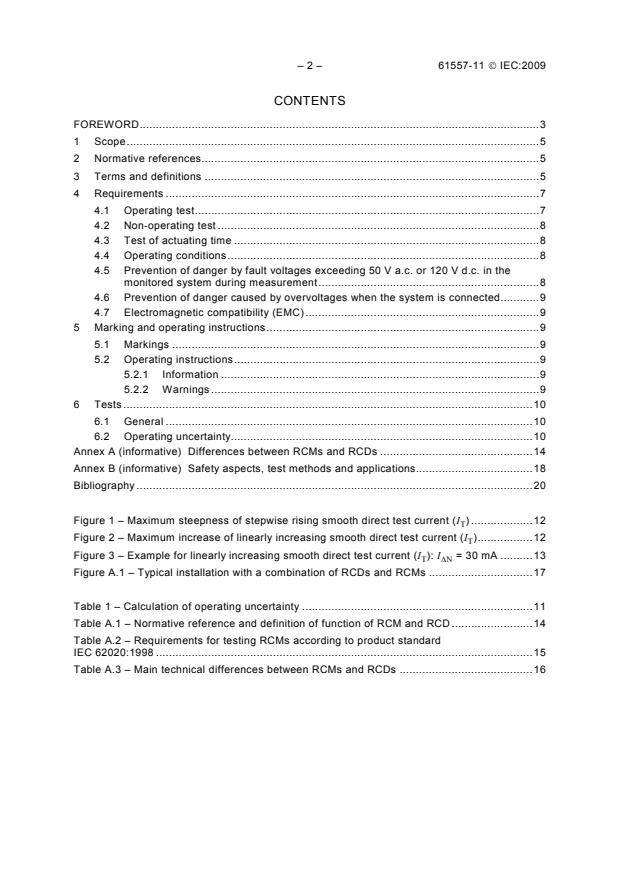
– 2 – 61557-11 © IEC:2009
CONTENTS
FOREWORD.3
1 Scope.5
2 Normative references.5
3 Terms and definitions .5
4 Requirements .7
4.1 Operating test.7
4.2 Non-operating test .8
4.3 Test of actuating time .8
4.4 Operating conditions.8
4.5 Prevention of danger by fault voltages exceeding 50 V a.c. or 120 V d.c. in the
monitored system during measurement.8
4.6 Prevention of danger caused by overvoltages when the system is connected.9
4.7 Electromagnetic compatibility (EMC) .9
5 Marking and operating instructions.9
5.1 Markings .9
5.2 Operating instructions.9
5.2.1 Information .9
5.2.2 Warnings .9
6 Tests .10
6.1 General .10
6.2 Operating uncertainty.10
Annex A (informative) Differences between RCMs and RCDs .14
Annex B (informative) Safety aspects, test methods and applications.18
Bibliography .20
Figure 1 – Maximum steepness of stepwise rising smooth direct test current (I ) .12
T
Figure 2 – Maximum increase of linearly increasing smooth direct test current (I ).12
T
Figure 3 – Example for linearly increasing smooth direct test current (I ): I = 30 mA .13
T ∆N
Figure A.1 – Typical installation with a combination of RCDs and RCMs .17
Table 1 – Calculation of operating uncertainty .11
Table A.1 – Normative reference and definition of function of RCM and RCD .14
Table A.2 – Requirements for testing RCMs according to product standard
IEC 62020:1998 .15
Table A.3 – Main technical differences between RCMs and RCDs .16
61557-11 © IEC:2009 – 3 –
INTERNATIONAL ELECTROTECHNICAL COMMISSION
____________
ELECTRICAL SAFETY IN LOW VOLTAGE DISTRIBUTION
SYSTEMS UP TO 1 000 V a.c. AND 1 500 V d.c. –
EQUIPMENT FOR TESTING, MEASURING OR
MONITORING OF PROTECTIVE MEASURES –
Part 11: Effectiveness of residual current monitors (RCMs)
type A and type B in TT, TN and IT systems
FOREWORD
1) The International Electrotechnical Commission (IEC) is a worldwide organization for standardization comprising
all national electrotechnical committees (IEC National Committees). The object of IEC is to promote
international co-operation on all questions concerning standardization in the electrical and electronic fields. To
this end and in addition to other activities, IEC publishes International Standards, Technical Specifications,
Technical Reports, Publicly Available Specifications (PAS) and Guides (hereafter referred to as “IEC
Publication(s)”). Their preparation is entrusted to technical committees; any IEC National Committee interested
in the subject dealt with may participate in this preparatory work. International, governmental and non-
governmental organizations liaising with the IEC also participate in this preparation. IEC collaborates closely
with the International Organization for Standardization (ISO) in accordance with conditions determined by
agreement between the two organizations.
2) The formal decisions or agreements of IEC on technical matters express, as nearly as possible, an international
consensus of opinion on the relevant subjects since each technical committee has representation from all
interested IEC National Committees.
3) IEC Publications have the form of recommendations for international use and are accepted by IEC National
Committees in that sense. While all reasonable efforts are made to ensure that the technical content of IEC
Publications is accurate, IEC cannot be held responsible for the way in which they are used or for any
misinterpretation by any end user.
4) In order to promote international uniformity, IEC National Committees undertake to apply IEC Publications
transparently to the maximum extent possible in their national and regional publications. Any divergence
between any IEC Publication and the corresponding national or regional publication shall be clearly indicated in
the latter.
5) IEC provides no marking procedure to indicate its approval and cannot be rendered responsible for any
equipment declared to be in conformity with an IEC Publication.
6) All users should ensure that they have the latest edition of this publication.
7) No liability shall attach to IEC or its directors, employees, servants or agents including individual experts and
members of its technical committees and IEC National Committees for any personal injury, property damage or
other damage of any nature whatsoever, whether direct or indirect, or for costs (including legal fees) and
expenses arising out of the publication, use of, or reliance upon, this IEC Publication or any other IEC
Publications.
8) Attention is drawn to the Normative references cited in this publication. Use of the referenced publications is
indispensable for the correct application of this publication.
9) Attention is drawn to the possibility that some of the elements of this IEC Publication may be the subject of
patent rights. IEC shall not be held responsible for identifying any or all such patent rights.
International Standard IEC 61557-11 has been prepared by IEC technical committee 85:
Measuring equipment for electrical and electromagnetic quantities.
The text of this standard is based on the following documents:
FDIS Report on voting
85/338/FDIS 85/343/RVD
Full information on the voting for the approval of this standard can be found in the report on
voting indicated in the above table.
This publication has been drafted in accordance with the ISO/IEC Directives, Part 2.
– 4 – 61557-11 © IEC:2009
This part is to be used in conjunction with IEC 61557-1:2007, Part 1: General requirements.
A list of all parts of the IEC 61557 series, published under the general title Electrical safety in
low voltage distribution systems up to 1 000 V a.c. and 1 500 V d.c. – Equipment for testing,
measuring or monitoring of protective measures, can be found on the IEC website.
The committee has decided that the contents of this publication will remain unchanged until the
maintenance result date indicated on the IEC web site under "http://webstore.iec.ch" in the data
related to the specific publication. At this date, the publication will be
• reconfirmed;
• withdrawn;
• replaced by a revised edition; or
• amended.
61557-11 © IEC:2009 – 5 –
ELECTRICAL SAFETY IN LOW VOLTAGE DISTRIBUTION
SYSTEMS UP TO 1 000 V a.c. AND 1 500 V d.c. –
EQUIPMENT FOR TESTING, MEASURING OR
MONITORING OF PROTECTIVE MEASURES –
Part 11: Effectiveness of residual current monitors (RCMs)
type A and type B in TT, TN and IT systems
1 Scope
This part of IEC 61557 specifies the requirements for testing equipment applied to the testing
of the effectiveness of residual current monitors (RCMs) of type A and type B, which are
already installed in distribution systems.
This test equipment can be used in any kind of network like a TN, TT or IT system. The test
equipment may also be used for testing directionally discriminating RCMs in IT-Systems.
2 Normative references
The following referenced documents are indispensable for the application of this document. For
dated references, only the edition cited applies. For undated references, the latest edition of
the referenced document (including any amendments) applies.
IEC/TR 60755:2008, General requirements for residual current operated protective devices
IEC 61010-1:2001, Safety requirements for electrical equipment for measurement, control, and
laboratory use – Part 1: General requirements
IEC 61326-2-2, Electrical equipment for measurement, control and laboratory use – EMC
requirements – Part 2-2: Particular requirements – Test configurations, operational conditions
and performance criteria for portable test, measuring and monitoring equipment used in low-
voltage distribution systems
IEC 61557-1, Electrical safety in low voltage distribution systems up to 1 000 V a.c. and 1 500
V d.c. – Equipment for testing, measuring or monitoring of protective measures – Part 1: General
requirements
IEC 61557-6, Electrical safety in low voltage distribution systems up to 1 000 V a.c. and 1 500
V d.c. – Equipment for testing, measuring or monitoring of protective measures – Part 6:
Effectiveness of residual current devices (RCD) in TT, TN and IT systems
IEC 62020:1998, Electrical accessories – Residual current monitors for household and similar
uses (RCMs)
3 Terms and definitions
For the purposes of this document, the terms and definitions given in IEC 61557-1, IEC 61557-
6 and the following apply.
– 6 – 61557-11 © IEC:2009
3.1
residual current monitor (RCM)
device or association of devices which monitors the residual current in an electrical installation
and which activates an alarm when the residual current exceeds the operating value of the
device
[IEC 62020, definition 3.3.1]
3.2
earth fault current
I
e
current flowing to earth due to an insulation fault
[IEC 62020, definition 3.1.1]
3.3
test current
I
T
test current superimposed by the test equipment for testing the effectiveness of the RCM
3.4
residual current
I
∆
vector sum of the instantaneous values of the current flowing in the main circuit of the RCM
(expressed as r.m.s. value)
[IEC 62020, definition 3.2.3]
3.5
rated residual operating current
I
∆N
value of residual current assigned by the manufacturer which causes the RCM to operate under
specified conditions
[IEC 62020, definitions 3.2.4 and 3.4.1 combined]
3.6
residual operating current
I
∆o
value of residual current which causes the RCM to operate under specified conditions
[IEC 62020, definition 3.2.4]
3.7
residual non-operating current
I
∆no
value of residual current at which and below which the RCM does not operate under specified
conditions
[IEC 62020, definition 3.2.5]
3.8
actuating time
t
a
time taken for a RCM to change from the non-alarm state to the alarm state in response to the
sudden appearance of a residual current which exceeds the preset level
[IEC 62020, definition 3.3.12]
61557-11 © IEC:2009 – 7 –
3.9
residual current monitor (RCM) type A
RCM for which monitoring is ensured for residual sinusoidal alternating currents and residual
pulsating direct currents, whether suddenly applied or slowly rising
[IEC 62020, definition 3.3.8, modified]
3.10
residual current monitor (RCM) type B
RCM for which monitoring is ensured for residual sinusoidal alternating currents, with residual
pulsating direct currents and smooth residual direct currents independent of polarity, whether
suddenly applied or slowly rising
[IEC/TR 60755, definition 5.2.9.3, modified]
4 Requirements
The following requirements as well as those given in IEC 61557-1 shall apply.
4.1 Operating test
The testing equipment shall be capable of verifying that the residual operating current of a
RCM type A tested with an a.c. test current is lower or equal to the value of the rated residual
operating current.
Testing of RCMs type A shall be conducted with a suddenly applied calibrated a.c. current at
zero crossing.
The tests shall be carried out with a sinusoidal, or mains-derived quasi sinusoidal, test current.
If the test equipment is capable of producing half-wave test currents, testing of residual current
monitors (RCMs) type A may be carried out alternatively with half-wave test currents and/or a.c.
current with superimposed ±6 mA d.c. according to IEC 62020.
In case of pulsed d.c. current, the test equipment shall be capable of testing in both polarities.
When testing RCMs of type B with a d.c. test current, it shall be verified that the residual
operating current is lower or equal to 2 times the value of the rated residual operating current.
Testing of RCMs type B shall be conducted separately with a suddenly applied, calibrated a.c.
current and a continuously rising smooth direct current.
The steepness of the continuous rate of rising shall not be higher than 2 × I / 5 s.
∆N
If the continuous rate of rising is simulated by a stepwise or linearly increasing test current, the
increase shall not be higher than 2 × I / 30 (see Figures 1 to 3).
∆N
In both cases the starting current shall be below 0,2 × I .
∆N
The operating uncertainty of the increasing test current I shall not exceed ±10 % of the rated
T
residual operating current I
.
∆N
The operating uncertainty of the calibrated test current I shall not exceed 0 % to +10 %.
T
The test period shall be adapted to the set actuating time of the RCM and it shall be possible to
extend the test period up to 10 s.
– 8 – 61557-11 © IEC:2009
4.2 Non-operating test
When a test at 50 % or less of the rated residual operating current to test the reliability of the
RCM is included, the minimum test period shall be 10 s. The alarm shall not be activated.
When a non-operating test at 50 % or less of the rated residual operating current is included,
the operating uncertainty of the calibrated test current shall not exceed 0 % to –10 % of the
specified non-operating test current.
NOTE Existing leakage currents downstream can influence the verification.
4.3 Test of actuating time
If the set actuating time of the RCM is being tested with the test equipment, the setting of the
test period on the test device shall have a resolution of minimum 0,5 s ranging up to 10 s. The
setting uncertainty shall not exceed 0 % to –10 % of the set value. The test shall solely be
performed with calibrated a.c. test current.
Other methods for the acquisition of the actuating time via optical recognition or interfacing are
permissible.
NOTE The general function of RCMs is not the disconnecting of the power supply when a residual current above
the value of the rated residual operating current occurs. The RCM indicates the increase of the residual current
above the residual operating current with a signalling device, for example a lamp, buzzer, contact relay or interface-
signal. Thus the response time may only be tested via the visual or additional electrical detection of this signal.
According to IEC 62020 the response time of RCMs may only amount to a maximum of 10 s. The response time
shall be specified by the manufacturer or shall be adjustable on the device.
If the RCM is being used for the purpose of disconnection, the tests covered by IEC 61557-6
shall apply.
4.4 Operating conditions
The operating uncertainty applies according to the test conditions specified in IEC 61557-1 and
additionally
– the protective conductor is free of extraneous voltage,
– the system voltage remains constant during tests,
– the circuit behind the RCM is free of leakage currents,
– sinusoidal half-wave or full-wave current with rated frequency, respectively smooth direct
current (see 4.1),
– the a.c. test current I shall be switched on at a zero crossing,
T
– the test period shall be 10 s for the maximum test current for which the test equipment is
designed,
– the time limit may be omitted when testing with current higher than 500 mA,
– the resistance of the probes is within the limits stated by the manufacturer.
4.5 Prevention of danger by fault voltages exceeding 50 V a.c. or 120 V d.c. in the
monitored system during measurement
This can be achieved by the following:
– automatic disconnection in accordance with IEC 61010-1:2001, Figure 1, if the residual
voltage is above 50 V a.c. or 120 V d.c.;
– application of test current I , gradually or permanently adjustable, where the test starts a
T
maximum current of a.c. 3,5 mA or 15 mA d.c. in accordance with IEC 61010-1:2001, 6.3.2
b), including parallel test circuits, is permitted. The possibility to change the test current I
T
61557-11 © IEC:2009 – 9 –
without generating a dangerous residual voltage shall be clearly identifiable, for instance on
a voltmeter.
In special locations the touch voltage limit is 25 V a.c or 60 V d.c.
The operating uncertainty for the detection of the fault voltage shall not exceed 0 % to –20 % of
the limit.
4.6 Prevention of danger caused by overvoltages when the system is connected
If the system is connected to 120 % of the nominal voltage of the system for which the test
equipment is designed, neither the operator shall be harmed nor the device be damaged.
Protective devices shall not be activated. If the device is intended to be used in IT systems, the
nominal voltage of the test equipment is the phase to phase voltage.
If the test equipment is accidentally connected to 173 % of the nominal voltage in TN or TT
systems for which the test equipment is designed for the duration of 1 min, neither the operator
shall be harmed nor the device be damaged. In this case, protective devices may be activated.
4.7 Electromagnetic compatibility (EMC)
The electromagnetic compatibility shall be in accordance with IEC 61326-2-2.
5 Marking and operating instructions
5.1 Markings
In addition to the marking in accordance with IEC 61557-1, the following information shall be
provided on the measuring equipment.
Rated residual operating current or rated residual operating currents of the RCM for which the
test equipment has been designed for an actuating time of 10 s.
NOTE Other rated residual operating currents for lower actuating times may be marked in addition.
5.2 Operating instructions
The operating instructions shall state the following in addition to the statements given in
IEC 61557-1.
5.2.1 Information
a) Information about special test configurations to avoid unintended tripping of RCDs (see
Annex B);
b) information to avoid unintended influences on the operation of the system;
c) information for recalibration cycles and safety tests of the test equipment after repair and
instructions for periodical tests.
5.2.2 Warnings
a) If the detecting circuit for the fault voltage has no probe and if a possible voltage between
the protective conductor and earth influences the measurements, a warning shall be included.
b) Where the detecting circuit for the fault voltage uses the N-conductor as a probe, a
warning shall be given to test the connection between the neutral point of the distribution
system and earth before the test is started; a possible voltage between the N-conductor and
earth may influence the measurements.
– 10 – 61557-11 © IEC:2009
c) A warning that leakage currents in the circuit following the RCM may influence
measurements and test results.
d) The earth electrode resistance of a detecting circuit for the fault voltage with a probe shall
not exceed the value stated by the manufacturer.
e) A warning that the potential fields of other earthed installations may influence the
determination of the fault voltage.
f) A warning that for special locations the touch voltage is limited to 25 V a.c or 60 V d.c.
6 Tests
6.1 General
The following tests in addition to those required according to IEC 61557-1 shall be executed.
Tests shall be carried out with rated residual operating currents, in addition with the values of
the non-operating test currents I , if applicable.
T
The test circuit shall be adapted to test the function of the fault voltage detection circuit at the
limits of the fault voltage for which the equipment is designed and in addition at the appropriate
R = R for each range.
A Amax
The test circuit shall be adapted to each test method employed. The manufacturer’s
instructions shall be heeded.
U U
L L
NOTE R = × I R =
Amax Δo Amax
I I
ΔN T
where
U is the conventional touch voltage limit;
L
I is the test current superimposed by the test circuit;
T
R is the total earthing resistance (R = R );
A A Amax
I is the rated residual operating current;
∆N
I is the residual operating current.
∆o
6.2 Operating uncertainty
The operating uncertainty shall be determined in accordance with Table 1. In this process, the
intrinsic uncertainty shall be determined under the following reference conditions:
– nominal voltage of the rated range of the device,
– nominal frequency of the rated range of the device,
– reference temperature 23 °C ± 2 °C,
– reference position in accordance with the manufacturer's instructions,
– protective conductor free from extraneous voltages,
– 100 Ω resistance of the auxiliary earth electrode in a TT system.
The operating uncertainty thus evaluated shall not exceed the limits specified in 4.1 to 4.2.
a) Compliance with the permissible operating uncertainty when detecting the fault voltage
shall be tested for measurements with and without a probe.
b) Compliance with the requirements in accordance with 4.5 shall be tested (routine test).
61557-11 © IEC:2009 – 11 –
c) The overload protection in accordance with 4.6 shall be tested (type test).
d) Compliance with the tests in this clause shall be recorded.
Table 1 – Calculation of operating uncertainty
Intrinsic uncertainty Reference conditions or Designation Requirements Type of
or influence quantity specified operating range code or test in test
accordance with
the relevant
parts of series
IEC 61557
Intrinsic uncertainty Reference conditions A Part 11, 6.2 R
Position Reference position ±90° E Part 1, 4.2 R
Supply voltage At the limits stated by the E Part 1, 4.2, 4.3 R
manufacturer
Temperature 0 °C and 35 °C E Part 1, 4.2 T
Resistance of the Within the limits stated by E Part 11, 4.4 T
probes the manufacturer
System voltage 85 % to 110 % of the E Part 11, 4.4, 4.5 T
nominal voltage
Operating uncertainty Part 11, 4.1
2 2 2 2 2
Part 11, 4.2 R
B=± ( A +1,15 E +E +E +E +E )
1 2 3 8
Part 11, 4.3
Part 11, 4.5
A = intrinsic uncertainty
B
B ()% = ± × 100 %
E = variations
n
fiducial value
R = routine test
T = type test
– 12 – 61557-11 © IEC:2009
I
T
∆I
T
∆t
t
IEC 2359/08
I ≤ 2 I / 30 ∆I / ∆t ≤ 2 I / 5 s
∆
T ∆N T ∆N
Key (for Figures 1 to 3)
t time
I rated residual operating current
∆N
I smooth direct test current
T
∆I steepness of continuous rising test current or steps of stepwise rising test current
T
∆t time for one step for stepwise rising test current or time for steepness of continuous rising test current
Figure 1 – Maximum steepness of stepwise rising smooth direct test current (I )
T
I
T
∆I
T
∆t
t
IEC 2360/08
∆I / ∆t ≤ 2 I / 5 s
T ∆N
Figure 2 – Maximum increase of linearly increasing smooth direct test current (I )
T
61557-11 © IEC:2009 – 13 –
I
T
∆I
T
∆t
t
IEC 2361/08
∆I ≤ 2 × 30 mA / 30 ≤ 2 mA
T
Example for ∆I = 2 mA: ∆t ≥ (2 mA × 5 s) / (2 × 30 mA) ≥ 167 ms
T
Example for ∆I = 0,5 mA: ∆t ≥ (0,5 mA × 5 s) / (2 × 30 mA) ≥ 42 ms
T
NOTE 1 Existing leakage currents downstream may influence the verification.
NOTE 2 The actual rise time depends on the system capacitance and the resistive load of the test equipment.
NOTE 3 Smooth d.c. test current refers to direct current with a.c. ripple up to 10 % (peak to peak).
NOTE 4 A slow continuous or stepwise increase of the d.c. test current is required to prevent the a.c. sensitive
part of the RCM type B from operating during the d.c. test.
Figure 3 – Example for linearly increasing smooth direct test current (I ): I = 30 mA
T ∆N
– 14 – 61557-11 © IEC:2009
Annex A
(informative)
Differences between RCMs and RCDs
A.1 Scope
This Annex A gives guidelines for specifying the differences between residual current monitors
(RCMs) and residual current protective devices (RCDs). The understanding is important in the
design of test equipment and for testing RCMs in electrical installations.
A.2 Reference documents and definition of function
Table A.1 shows the differences by definition according to the respective product standard.
Table A.1 – Normative reference and definition of function of RCM and RCD
Product Standard Definition of function
RCM IEC 62020:1998, 3.3.1 A residual current monitor (RCM) is a device or an association of
devices which monitors the residual current in an electrical installation,
and which activates an alarm when the residual current exceeds the
operating value of the device
RCD IEC/TR 60755:2008, 3.3.1 A residual current device (RCD) is a mechanical switching device
or association of devices designed to make, carry and break
currents under normal service conditions and to cause the
opening of the contacts when the residual current attains a given
value under specified conditions
IEC 62020 is the only product standard for RCMs. RCMs covered by this standard are not
intended to be used as protective devices, but may be used in conjunction with protective
devices (see IEC 60364-4-41).
IEC/TR 60755 is the basic product standard for RCDs. Variations of RCDs are covered by
other product standards, for example IEC 61008-1 and IEC 60947-2.
If RCMs are used together with switching devices and this combination fulfils the respective
RCD standards, for example IEC 60947-2 for MRCDs, this combination has to be tested in the
installation with equipment covered by IEC 61557-6.
A.3 Requirements from product standards for testing RCMs
Table A.2 shows the requirements from the product standard IEC 62020:1998 which should
apply when testing RCMs in installations.
61557-11 © IEC:2009 – 15 –
Table A.2 – Requirements for testing RCMs according
to product standard IEC 62020:1998
Requirement Explanation Consequence for testing
Type of RCM Type A (type a.c. is not allowed) Test with the applicable waveforms
Type B existing, but is not covered by IEC 62020
Rated residual Values to be defined by the manufacturer Test with the values defined by the
operating current manufacturer and appropriate device
Preferred values are : 0,006 A, 0,01 A, 0,03 A,
settings for adjustable devices
0,1 A, 0,3 A, 0,5 A
should be considered
Values can be fixed or adjustable
The operating tolerances of the RCM
(residual operating and non-
operating current) are equal to that
of RCDs
Actuating time For RCMs only a maximum actuating time is Defined or adjusted actuating times
defined: 10 s should be considered
The actuation time can be fixed or adjustable
Preferred values of RCMs type A: 50 Hz and/or 60 Hz – manufacturer RCDs type A: preferred value is
rated frequency can define other values, but frequency response 50 Hz
is not defined in the product standard
RCDs type B: frequency response is
RCMs type B: see RCDs type B limited to 1 000 Hz
Indication of the fault RCMs should be provided with means for Different to RCDs, tripping of the
condition indicating the fault condition RCM can not be recognized due to
switching off of the monitored voltage
RCMs may be fitted with a resetting function to
manually reset the RCM to the non-alarm state Recognition of tripping can only be
after removal of the fault. RCMs not fitted with performed by monitoring or
resetting function should reset automatically after controlling the respective alarm
removal of the fault function:
Where an audible alarm is provided in addition, Examples of alarm functions:
the audible alarm should reset automatically after
– visual indicator (required)
removal of the fault
– audible alarm (optional)
– alarm contact (optional)
– alarm via digital interface
(optional)
Disconnection of an If the RCM is equipped with an external residual Disconnection is normally checked
external CT current transformer (CT), the RCM should give a during the operating test of the RCM
warning, if the CT is disconnected
A.4 Main technical differences between RCMs and RCDs
Table A.3 shows the main technical differences between RCMs and RCDs.
– 16 – 61557-11 © IEC:2009
Table A.3 – Main technical differences between RCMs and RCDs
Function RCM RCD
Operation / Tripping (actuating) Operation is indicated on the RCM by Tripping is primarily indicated by
a visual signal on the front of the switching off the voltage
device. Additional signals for
Tripping can be recognized on any
indicating operation may be :
outlet or part of the installation where
– audible alarm, the test is performed
– alarm contacts,
– digital interface.
Operation can not be recognized on
an outlet, where the test is performed
and which is located outside the area
where the alarm on the RCM itself
can be recognized
Actuating time Actuating time can be anywhere The maximum actuating time of
between 0 s and 10 s RCDs is defined in the respective
RCD standards
The set or fixed actuating time
should be respected Actuating time has to follow the time
characteristics of the RCD standards
Actuating time for RCMs relate to 1 ×
for 1 time I ,
ΔN
I only
ΔN
2 times I , 5 times I
ΔN ΔN
Operating / Tripping values Operating values can be fixed or Tripping values are fixed or
adjustable. Adjustment can be in adjustable in steps. The set values
steps or steplessly by switches, are indicated on the front of the
potentiometers or by menu settings device
via displays
The set operating values are visible
on the front of the RCM
Supply voltage dependency RCMs are voltage dependent devices RCDs type A may be voltage-
dependent or voltage-independant.
Standards for voltage-dependent
RCDs are under consideration
RCDs type B are generally voltage
dependant
Indication of the value of the Some RCMs are equipped with RCDs generally have no such
measured residual current functions for the indication of the indication
residual current
Multi-channel devices RCMs can be multi-channel devices. Generally RCDs are single channel
In this case several residual current devices
sensors (CTs) are connected to one
device. Setting operating values and
signalling alarms are performed on
this device
A.5 Special considerations for testing RCMs in the installation
The following points should be considered when testing already installed RCMs:
– operation of the RCM should be recognized by watching the alarm indicator on the front of
the RCM or on a remote indication device;
– the settings of the test equipment should allow stepwise or continuous increase of the test
current;
– for testing the operating value the time for each step or gradual increase of the test current
should respect the setting of the actuating time on the RCM ( 0…10 s).
If other fault-indication is provided, for example audible or remote indications via alarm contact
or digital interface, these indications should be tested as well.
Figure A.1 shows a typical installation where RCMs are installed in addition to RCDs.
61557-11 © IEC:2009 – 17 –
RCM type B
RCM type A
RCD
RCD
Type A
Type B
MDP
M
VFD
Multichannel
RCM type A
RCD RCD RCD
RCD
Type A Type A Type A Type A
SDP
Socket outlets
IEC 2362/08
Key
MDP main distribution panel
SDP sub distribution panel
VFD variable frequency device
M motor
RCD residual current device
RCM residual current monitoring device
Figure A.1 – Typical installation with a combination of RCDs and RCMs
– 18 – 61557-11 © IEC:2009
Annex B
(informative)
Safety aspects, test methods and applications
B.1 Safety aspects
Residual current monitors (RCMs) contribute to the safety of installations by preventive
measuring and monitoring of residual current. In this context the function of the RCM should be
ensured over the lifetime of the RCM by periodic testing.
Periodic verification of the installation including verification of electrical loads and equipment
incorporating RCMs is advised. After verification, appropriate corrective measures should be
taken, e.g. repairing the installation or replacing faulty equipment, etc. (see IEC/TR 62350).
The main reasons for using RCMs are as follows:
– in supply systems, RCMs may be installed to reduce the risk of operating the protective
device (RCD) in event of excessive leakage current in the installation and/or connected
appliances according to IEC 60364-5-53.
– an RCM may be installed for detecting fault currents in order to give an alarm to reduce the
risk of fire [adapted from IEC 60364-5-53].
– in the case of an installation under normal operation which has an effective preventive
maintenance management system, periodic verification may be replaced by adequate
procedures of continuous monitoring and by maintenance of the installation including all
constituent equipment, by skilled persons. Appropriate records should be kept (see
IEC 60364-6).
RCMs are a part of this management system.
– in IT systems, except where a protective device (RCD) is installed to interrupt the supply in
the event of the first insulation fault, an insulation fault location system or an RCM under
specified conditions may be provided to indicate the first fault from a live part to exposed-
conductive-parts or to earth. In accordance with IEC 60364-4-41, this device should initiate
an audible and/or visual signal, which should continue as long as the fault persists.
B.2 Test methods
In general, it is intended to carry out the testing of RCMs without the tripping of protective
devices.
After the visual inspection of the system and components (e.g. type of RCM) the applicable test
method covered by this standard should be chosen.
If an RCM is installed in addition to an RCD, the test equipment may also be used to compare
the tripping characteristics of the RCM and of the RCD. This test is useful in order to determine
that the correctly specified RCD has been installed. For this purpose the test should be
performed for RCMs type A and/or RCMs type B, where applicable.
B.3 Applications of test methods
The following test methods apply.
1) If only an RCM is installed in the system - no RCD - the test equipment may be connected
between line and earth.
61557-11 © IEC:2009 – 19 –
2) If an RCM is installed in combination with an RCD, the following tests may be performed
a) Tripping of RCD is allowed, see B.3 1.
b) Tripping of RCD is not allowed:
i) test equipment is connected between LINE upstream and NEUTRAL downstream.
ii) test equipment is connected between LINE 1 upstream and LINE 2 downstream.
iii) test equipment is connected between LINE and EARTH, if the RCD is installed
downstream.
iv) test equipment is only connected to additional wiring through the current transformer
(CT); this may also apply to testing RCMs with higher rated current.
v) in case of testing directionally discriminating RCMs in IT systems, two tests may be
performed downstream.
3) RCMs installed in combination with electronic equipment, such as motor drives, converters
without galvanic separation, etc.
For testing the effectiveness of RCMs in such applications, in general it is necessary to test
on several points of the installation, for example upstream of the motor drive, in the
intermediate d.c. circuit of the motor drive and downstream in the electronic motor circuit.
Clause A.2 and the bibliography of this part of IEC 61557 offer additional information on
application standards.
IEC/TR 62350 offers more information on potential influences when testing RCMs.
– 20 – 61557-11 © IEC:2009
Bibliography
IEC 60364-4-41, Low-voltage electrical installations – Part 4-41: Protection for safety –
Protection against electric shock
IEC 60364-5-53:2001, Electrical insta
...