

IEC 61968-9:2013
(Main)Application integration at electric utilities - System interfaces for distribution management - Part 9: Interfaces for meter reading and control
General Information
- Abstract
IEC 61968-9:2013 specifies the information content of a set of message types that can be used to support many of the business functions related to meter reading and control. Typical uses of the message types include meter reading, controls, events, customer data synchronization and customer switching. The purpose of IEC 61968-9 is to define a standard for the integration of metering systems (MS), which includes traditional manual systems, and (one or two-way) automated meter reading (AMR) systems, and meter data management (MDM) systems with other enterprise systems and business functions within the scope of IEC 61968. The scope of IEC 61968-9 is the exchange of information between metering systems, MDM systems and other systems within the utility enterprise. This new edition includes the following significant technical changes with respect to the previous edition:
- changes to and addition of new profiles to support PAN and UsagePoints;
- extensions to support PAN devices generically as EndDevices;
- extensions to the MeterReading model and profiles to support richer descriptions of metered quantities and to accommodate coincident readings.
- Status
- Published
- Publication Date
- 15-Oct-2013
- Technical Committee
- TC 57 - Power systems management and associated information exchange
- Drafting Committee
- WG 14 - TC 57/WG 14
- Current Stage
- DELPUB - Deleted Publication
- Start Date
- 18-Jul-2024
- Completion Date
- 15-Apr-2022
Overview
IEC 61968-9:2013 is an essential international standard developed by the International Electrotechnical Commission (IEC) focusing on application integration at electric utilities. Specifically, it addresses system interfaces for distribution management, honing in on interfaces for meter reading and control. This standard defines the information content of message types to support critical business functions like meter reading, control commands, event notifications, customer data synchronization, and customer switching within electrical utility enterprises.
IEC 61968-9 plays a pivotal role in harmonizing the integration between traditional manual metering systems and advanced automated systems, such as Automated Meter Reading (AMR) and Meter Data Management (MDM) systems. By standardizing the exchange of information among these metering systems and other enterprise applications, the standard fosters enhanced interoperability, data accuracy, and streamlined utility operations.
Key Topics
- Message Types and Formats: IEC 61968-9 specifies detailed message structures used for communication between metering systems, covering meter reading schedules, control commands, meter events, firmware upgrades, and customer switching processes.
- Reference and Information Models: The document provides comprehensive models outlining system interfaces, including metering systems, load control devices, Premise Area Networks (PAN), and enterprise systems such as Customer Information Systems (CIS) and Outage Management Systems (OMS).
- Support for PAN Devices and Usage Points: Evolutions in this edition include extended support for PAN devices generically classified as EndDevices, facilitating integration of smart home and distributed energy resources.
- Data Synchronization and Quality: The standard ensures consistent customer data synchronization and richer descriptions of metered quantities, including support for coincident and interval readings.
- Load Management and Demand Response Integration: Interfaces for load control, load management systems (LMS), and Demand Response Management Systems (DRMS) are elaborated, supporting utility demand-side management strategies.
- Master Data and Meter Asset Management: IEC 61968-9 includes provisions for master data management, meter maintenance processes, and meter asset management systems, providing a complete view of meter lifecycle management.
Applications
- Meter Reading Automation: Utilities use IEC 61968-9 to enable seamless communication between AMR systems and enterprise applications, improving the accuracy and timeliness of meter data collection.
- Meter and Device Control: The standard supports sending control commands such as remote disconnects, tariff changes, and firmware updates, enhancing operational agility and customer service.
- Event Notification and Power Quality Monitoring: Enables utilities to detect and respond to meter health events, power quality disturbances, and outage events through standardized message exchanges.
- Customer Data Management: Facilitates customer switching, synchronization between metering systems and billing or customer information systems, ensuring customer data integrity across multiple platforms.
- Integration of IoT and Smart Grid Components: Provides interfaces for Premise Area Networks and EndDevices, allowing integration of smart devices and IoT solutions into utility distribution management systems.
- Billing and Payment Services: Supports messaging related to payment metering services and auxiliary agreements, linking meter data with financial systems for accurate billing.
Related Standards
- IEC 61968 (General): The broader IEC 61968 series covers system interfaces for distribution management at electric utilities, with Part 9 focusing specifically on meter reading and control.
- IEC 61850: While IEC 61968-9 focuses on higher-level business message interfaces, IEC 61850 deals with substation automation and real-time communication protocols, often complementing one another.
- IEC 61970: This standard specifies Energy Management System (EMS) interfaces and can be used alongside IEC 61968 for comprehensive utility system integration.
- IEC 62056: Covers data exchange with meters (DLMS/COSEM), offering communication protocols at the device level, often integrated with IEC 61968-defined system messages.
- ISO/IEC 27000 Series: Though not specific to metering, these standards for information security management may apply to secure implementation of IEC 61968-9 interfaces.
IEC 61968-9:2013 is vital for utilities aiming to modernize metering infrastructure and achieve interoperable, efficient data exchange across their enterprise systems. Its focus on standardized message types and interface models supports the digital transformation and smart grid evolution essential for future-ready electric distribution management. By adopting IEC 61968-9, utilities can improve operational efficiency, data quality, customer engagement, and integration of emerging metering technologies.
Relations
- Effective Date
- 05-Sep-2023
- Effective Date
- 05-Sep-2023
Get Certified
Connect with accredited certification bodies for this standard

IMQ S.p.A. (Certification)
Italian electrical product certification.

SLG Prüf- und Zertifizierungs GmbH
German testing and certification body.

UL Solutions
Global safety science company with testing, inspection and certification.
Sponsored listings
Frequently Asked Questions
IEC 61968-9:2013 is a standard published by the International Electrotechnical Commission (IEC). Its full title is "Application integration at electric utilities - System interfaces for distribution management - Part 9: Interfaces for meter reading and control". This standard covers: IEC 61968-9:2013 specifies the information content of a set of message types that can be used to support many of the business functions related to meter reading and control. Typical uses of the message types include meter reading, controls, events, customer data synchronization and customer switching. The purpose of IEC 61968-9 is to define a standard for the integration of metering systems (MS), which includes traditional manual systems, and (one or two-way) automated meter reading (AMR) systems, and meter data management (MDM) systems with other enterprise systems and business functions within the scope of IEC 61968. The scope of IEC 61968-9 is the exchange of information between metering systems, MDM systems and other systems within the utility enterprise. This new edition includes the following significant technical changes with respect to the previous edition: - changes to and addition of new profiles to support PAN and UsagePoints; - extensions to support PAN devices generically as EndDevices; - extensions to the MeterReading model and profiles to support richer descriptions of metered quantities and to accommodate coincident readings.
IEC 61968-9:2013 specifies the information content of a set of message types that can be used to support many of the business functions related to meter reading and control. Typical uses of the message types include meter reading, controls, events, customer data synchronization and customer switching. The purpose of IEC 61968-9 is to define a standard for the integration of metering systems (MS), which includes traditional manual systems, and (one or two-way) automated meter reading (AMR) systems, and meter data management (MDM) systems with other enterprise systems and business functions within the scope of IEC 61968. The scope of IEC 61968-9 is the exchange of information between metering systems, MDM systems and other systems within the utility enterprise. This new edition includes the following significant technical changes with respect to the previous edition: - changes to and addition of new profiles to support PAN and UsagePoints; - extensions to support PAN devices generically as EndDevices; - extensions to the MeterReading model and profiles to support richer descriptions of metered quantities and to accommodate coincident readings.
IEC 61968-9:2013 is classified under the following ICS (International Classification for Standards) categories: 01 - GENERALITIES. TERMINOLOGY. STANDARDIZATION. DOCUMENTATION; 29.120.40 - Switches; 33.200 - Telecontrol. Telemetering. The ICS classification helps identify the subject area and facilitates finding related standards.
IEC 61968-9:2013 has the following relationships with other standards: It is inter standard links to IEC 61968-9:2009, IEC 61968-9:2024. Understanding these relationships helps ensure you are using the most current and applicable version of the standard.
IEC 61968-9:2013 is available in PDF format for immediate download after purchase. The document can be added to your cart and obtained through the secure checkout process. Digital delivery ensures instant access to the complete standard document.
Standards Content (Sample)
IEC 61968-9 ®
Edition 2.0 2013-10
INTERNATIONAL
STANDARD
NORME
INTERNATIONALE
colour
inside
Application integration at electric utilities – System interfaces for distribution
management –
Part 9: Interfaces for meter reading and control
Intégration d'applications pour les services électriques – Interfaces système
pour la gestion de distribution –
Partie 9: Interfaces pour le relevé et la commande des compteurs
All rights reserved. Unless otherwise specified, no part of this publication may be reproduced or utilized in any form
or by any means, electronic or mechanical, including photocopying and microfilm, without permission in writing from
either IEC or IEC's member National Committee in the country of the requester.
If you have any questions about IEC copyright or have an enquiry about obtaining additional rights to this publication,
please contact the address below or your local IEC member National Committee for further information.
Droits de reproduction réservés. Sauf indication contraire, aucune partie de cette publication ne peut être reproduite ni
utilisée sous quelque forme que ce soit et par aucun procédé, électronique ou mécanique, y compris la photocopie et les
microfilms, sans l'accord écrit de la CEI ou du Comité national de la CEI du pays du demandeur.
Si vous avez des questions sur le copyright de la CEI ou si vous désirez obtenir des droits supplémentaires sur cette
publication, utilisez les coordonnées ci-après ou contactez le Comité national de la CEI de votre pays de résidence.
IEC Central Office Tel.: +41 22 919 02 11
3, rue de Varembé Fax: +41 22 919 03 00
CH-1211 Geneva 20 info@iec.ch
Switzerland www.iec.ch
About the IEC
The International Electrotechnical Commission (IEC) is the leading global organization that prepares and publishes
International Standards for all electrical, electronic and related technologies.
About IEC publications
The technical content of IEC publications is kept under constant review by the IEC. Please make sure that you have the
latest edition, a corrigenda or an amendment might have been published.
Useful links:
IEC publications search - www.iec.ch/searchpub Electropedia - www.electropedia.org
The advanced search enables you to find IEC publications The world's leading online dictionary of electronic and
by a variety of criteria (reference number, text, technical electrical terms containing more than 30 000 terms and
committee,…). definitions in English and French, with equivalent terms in
It also gives information on projects, replaced and additional languages. Also known as the International
withdrawn publications. Electrotechnical Vocabulary (IEV) on-line.
IEC Just Published - webstore.iec.ch/justpublished Customer Service Centre - webstore.iec.ch/csc
Stay up to date on all new IEC publications. Just Published If you wish to give us your feedback on this publication
details all new publications released. Available on-line and or need further assistance, please contact the
also once a month by email. Customer Service Centre: csc@iec.ch.
A propos de la CEI
La Commission Electrotechnique Internationale (CEI) est la première organisation mondiale qui élabore et publie des
Normes internationales pour tout ce qui a trait à l'électricité, à l'électronique et aux technologies apparentées.
A propos des publications CEI
Le contenu technique des publications de la CEI est constamment revu. Veuillez vous assurer que vous possédez
l’édition la plus récente, un corrigendum ou amendement peut avoir été publié.
Liens utiles:
Recherche de publications CEI - www.iec.ch/searchpub Electropedia - www.electropedia.org
La recherche avancée vous permet de trouver des Le premier dictionnaire en ligne au monde de termes
publications CEI en utilisant différents critères (numéro de électroniques et électriques. Il contient plus de 30 000
référence, texte, comité d’études,…). termes et définitions en anglais et en français, ainsi que
Elle donne aussi des informations sur les projets et les les termes équivalents dans les langues additionnelles.
publications remplacées ou retirées. Egalement appelé Vocabulaire Electrotechnique
International (VEI) en ligne.
Just Published CEI - webstore.iec.ch/justpublished
Service Clients - webstore.iec.ch/csc
Restez informé sur les nouvelles publications de la CEI.
Just Published détaille les nouvelles publications parues. Si vous désirez nous donner des commentaires sur
Disponible en ligne et aussi une fois par mois par email. cette publication ou si vous avez des questions
contactez-nous: csc@iec.ch.
IEC 61968-9 ®
Edition 2.0 2013-10
INTERNATIONAL
STANDARD
NORME
INTERNATIONALE
colour
inside
Application integration at electric utilities – System interfaces for distribution
management –
Part 9: Interfaces for meter reading and control
Intégration d'applications pour les services électriques – Interfaces système
pour la gestion de distribution –
Partie 9: Interfaces pour le relevé et la commande des compteurs
INTERNATIONAL
ELECTROTECHNICAL
COMMISSION
COMMISSION
ELECTROTECHNIQUE
PRICE CODE
INTERNATIONALE
CODE PRIX XH
ICS 33.200 ISBN 978-2-8322-1165-6
– 2 – 61968-9 IEC:2013
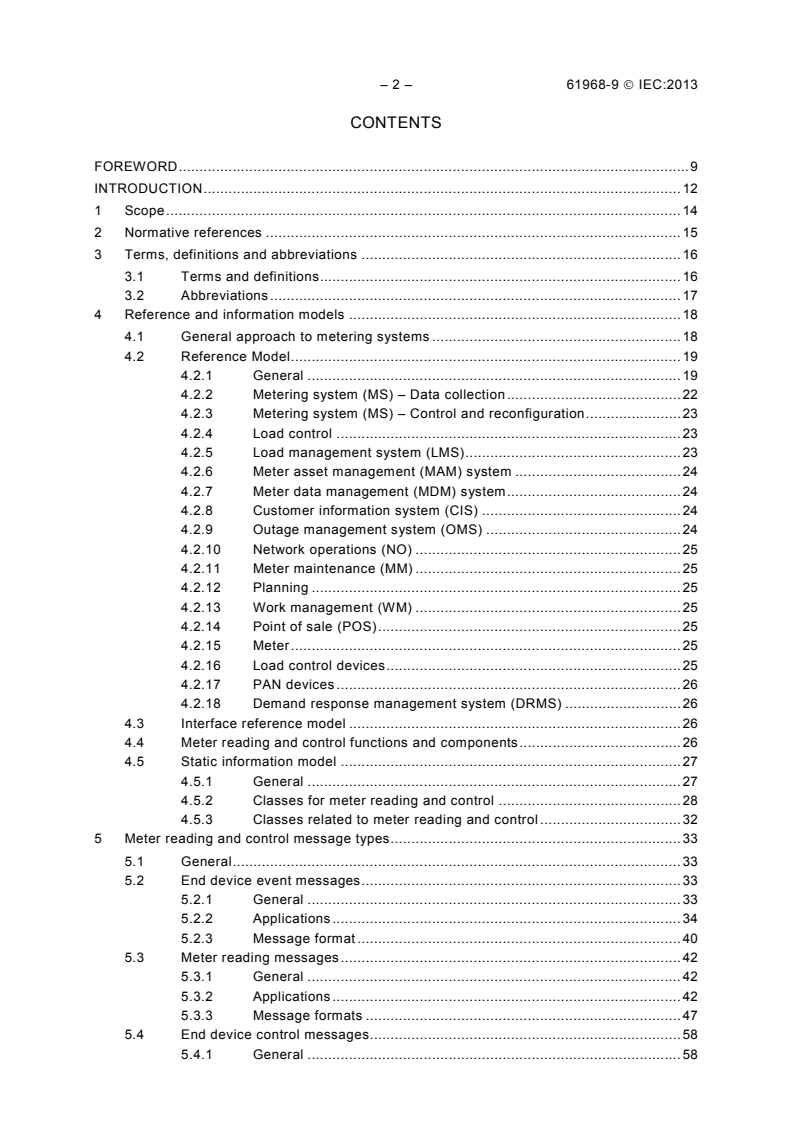
CONTENTS
FOREWORD . 9
INTRODUCTION . 12
1 Scope . 14
2 Normative references . 15
3 Terms, definitions and abbreviations . 16
3.1 Terms and definitions . 16
3.2 Abbreviations . 17
4 Reference and information models . 18
4.1 General approach to metering systems . 18
4.2 Reference Model . 19
4.2.1 General . 19
4.2.2 Metering system (MS) – Data collection . 22
4.2.3 Metering system (MS) – Control and reconfiguration . 23
4.2.4 Load control . 23
4.2.5 Load management system (LMS) . 23
4.2.6 Meter asset management (MAM) system . 24
4.2.7 Meter data management (MDM) system . 24
4.2.8 Customer information system (CIS) . 24
4.2.9 Outage management system (OMS) . 24
4.2.10 Network operations (NO) . 25
4.2.11 Meter maintenance (MM) . 25
4.2.12 Planning . 25
4.2.13 Work management (WM) . 25
4.2.14 Point of sale (POS) . 25
4.2.15 Meter . 25
4.2.16 Load control devices . 25
4.2.17 PAN devices . 26
4.2.18 Demand response management system (DRMS) . 26
4.3 Interface reference model . 26
4.4 Meter reading and control functions and components . 26
4.5 Static information model . 27
4.5.1 General . 27
4.5.2 Classes for meter reading and control . 28
4.5.3 Classes related to meter reading and control . 32
5 Meter reading and control message types . 33
5.1 General . 33
5.2 End device event messages . 33
5.2.1 General . 33
5.2.2 Applications . 34
5.2.3 Message format . 40
5.3 Meter reading messages . 42
5.3.1 General . 42
5.3.2 Applications . 42
5.3.3 Message formats . 47
5.4 End device control messages . 58
5.4.1 General . 58
61968-9 IEC:2013 – 3 –
5.4.2 Applications . 58
5.4.3 Message format . 65
5.5 Meter service requests . 68
5.5.1 General . 68
5.5.2 Applications . 69
5.5.3 Message format . 72
5.6 Metering system events . 73
5.6.1 General . 73
5.6.2 Applications – Firmware upgrade . 74
5.6.3 Message formats . 74
5.7 Customer switching . 74
5.7.1 General . 74
5.7.2 Message formats . 75
5.8 Payment metering service messages . 75
5.8.1 General . 75
5.8.2 Auxiliary agreements . 75
5.8.3 Applications . 76
5.8.4 Message formats . 77
5.9 Premise area networks . 80
5.9.1 General . 80
5.9.2 Applications . 81
5.9.3 Message formats . 83
5.10 Master data management messages . 83
5.10.1 General . 83
5.10.2 Applications . 84
5.10.3 Message formats . 91
6 Document conventions . 104
6.1 UML diagrams. 104
6.2 Message definitions . 105
6.2.1 General . 105
6.2.2 Mandatory vs. optional . 105
6.2.3 Verb tense . 105
6.3 Synchronous versus asynchronous messages . 105
6.4 Depiction of simple acknowledgment messages . 105
Annex A (normative) Description of message type verbs . 106
Annex B (informative) Reply error codes . 108
Annex C (normative) Procedure for the generation of a ReadingType name . 115
Annex D (normative) Quality code enumerations . 170
Annex E (normative) EndDeviceEventType enumerations . 183
Annex F (normative) EndDeviceControlType enumerations . 221
Annex G (normative) Conventions for naming and identifying objects . 224
Annex H (normative) XML schemas for message payloads . 227
Annex I (informative) XML schemas for message payloads . 314
Annex J (normative) Request parameters . 389
Annex K (normative) Master data management transaction processing . 395
Annex L (informative) Master data management use cases and sample XML . 402
Annex M (informative) Notes on extended use of IEC 61968-100 . 438
– 4 – 61968-9 IEC:2013
Bibliography . 440
Figure 1 – IEC 61968-9 scope . 15
Figure 2 – Example of an end device with functions . 20
Figure 3 – IEC 61968-9 reference model . 21
Figure 4 – IEC 61968-9 Reference model with customer information and billing system . 22
Figure 5 – Outage Detection, request/reply message exchange, example 1 . 35
Figure 6 – Outage Detection, request / reply message exchange, Example 2 . 36
Figure 7 – Outage Detection, publish/subscribe exchange, Example 1 . 37
Figure 8 – Outage Detection, publish/subscribe exchange, Example 2 . 37
Figure 9 – Meter Health Event exchange, Example 1 . 38
Figure 10 – Meter Health Event exchange, Example 2 . 39
Figure 11 – Power quality event exchange, Example 1 . 39
Figure 12 – Power quality event exchange, Example 2 . 40
Figure 13 – End device event message format . 41
Figure 14 – Example use of meter read schedule to create subscription . 43
Figure 15 – Example manual meter reading exchange . 44
Figure 16 – Example On-Request meter read . 45
Figure 17 – Historical MeterData exchange . 46
Figure 18 – Example billing inquiry message exchange . 46
Figure 19 – Meter readings message format . 47
Figure 20 – Reading structure . 48
Figure 21 – Timestamps assigned between systems . 49
Figure 22 – Conventions for timeStamp and timePeriod . 49
Figure 23 – IntervalBlock structure . 50
Figure 24 – Interval data timestamp generation . 51
Figure 25 – Time interval conventions . 51
Figure 26 – ReadingType structure . 52
Figure 27 – Meter read schedule message format . 57
Figure 28 – Example load control message exchange . 59
Figure 29 – Example message exchange for LC unit installation . 60
Figure 30 – Example message exchange for change of customer program . 61
Figure 31 – Example message exchange for change of customer program w/o MDM . 61
Figure 32 – Example for change of customer program with meter change out . 62
Figure 33 – Example message exchange for meter connect/disconnect . 63
Figure 34 – Example of remote connect/disconnect directly between CIS and MS . 64
Figure 35 – Example message exchange for real-time price signal . 65
Figure 36 – End device controls message format . 66
Figure 37 – Example meter installation and removal message exchange . 69
Figure 38 – Example end device event message exchange due to meter changeout . 70
Figure 39 – Example message exchange due to CIS alarms . 71
Figure 40 – Example message exchange when meter is changed out for recalibration . 72
Figure 41 – Meter service requests message format . 73
61968-9 IEC:2013 – 5 –
Figure 42 – Example firmware upgrade message exchange . 74
Figure 43 – Example customer switching message exchange . 75
Figure 44 – Message exchange for transferring auxiliary agreement information . 76
Figure 45 – Message exchange for transferring receipt information . 77
Figure 46 – Message exchange for transferring transaction information . 77
Figure 47 – Auxiliary agreement configuration message format. 78
Figure 48 – ReceiptRecord message format . 79
Figure 49 – TransactionRecord message format . 80
Figure 50 – Pairing of a PAN device . 81
Figure 51 – PAN device events . 82
Figure 52 – PAN device controls . 83
Figure 53 – Master data linkages . 85
Figure 54 – Message exchange for transferring supplier information . 86
Figure 55 – Message exchange for transferring customer information . 87
Figure 56 – Message exchange for transferring customer agreement information . 87
Figure 57 – Message exchange for transferring customer account information . 88
Figure 58 – Message exchange for transferring service category information . 88
Figure 59 – Message exchange for transferring usage point information . 89
Figure 60 – Message exchange for transferring meter information . 89
Figure 61 – Message exchange for transferring end device information . 90
Figure 62 – Message exchange for transferring service location information . 91
Figure 63 – Message exchange for transferring pricing structures . 91
Figure 64 – MasterDataLinkageConfig message format . 92
Figure 65 – Service supplier configuration message format . 93
Figure 66 – Customer configuration message . 94
Figure 67 – Customer agreement configuration message . 95
Figure 68 – Customer account configuration message . 96
Figure 69 – ServiceCategoryConfig message format . 96
Figure 70 – UsagePointConfig message format . 97
Figure 71 – UsagePointLocationConfig message format . 99
Figure 72 – End device config message format . 100
Figure 73 – Meter configuration message . 101
Figure 74 – ComModuleConfig message format . 102
Figure 75 – ServiceLocationConfig message format . 103
Figure 76 – PricingStructureConfig message format . 104
Figure B.1 – Reply Message States . 114
Figure C.1 – Typical enumerations for accumulation behaviour . 123
Figure C.2 – Typical enumerations for direction of flow . 130
Figure C.3 – Voltage measurements . 137
Figure E.1 – Event data . 184
Figure G.1 – CIM naming . 224
Figure G.2 – Example XML structure for names . 225
Figure G.3 – Use of names for references. 226
– 6 – 61968-9 IEC:2013
Figure J.1 – Message request structure . 389
Figure J.2 – GetMeterReadings . 390
Figure J.3 – GetEndDeviceConfig . 391
Figure J.4 – GetCustomerMeterDataSet. 392
Figure J.5 – GetMeterServiceRequests . 393
Figure K.1 – Message Envelope Extension . 396
Figure K.2 – OperationSet . 397
Figure K.3 – Pattern 1: Request/response (non-OperationSet) . 398
Figure K.4 – Pattern 2: published event (non-OperationSet) . 399
Figure K.5 – Pattern 3: Request/response (OperationSet) . 400
Figure K.6 – Pattern 4: published event (OperationSet) . 401
Figure M.1 – Get/cancel pattern which is not recommended. 438
Figure M.2 – Get/cancel pattern which is recommended . 439
Table 1 – Document overview for IEC 61968-9 . 13
Table 2 – Business functions and abstract components . 27
Table 3 – Classes for meter reading and control . 28
Table 4 – Classes related to meter reading and control . 32
Table 5 – IEC 61968-9 configuration profiles . 84
Table A.1 – Commonly used verbs . 106
Table B.1 – ReplyCode Categories . 108
Table B.2 – Error-free Enumerations . 109
Table B.3 – Missing-element Enumerations . 109
Table B.4 – Bad-value Enumerations . 109
Table B.5 – Too-many-values enumerations . 110
Table B.6 – Request-timed-out enumerations . 110
Table B.7 – Application-error enumerations . 111
Table B.8 – Business-rule-violation enumerations . 111
Table B.9 – Security issue enumerations . 111
Table B.10 – Common enumerations . 112
Table C.1 – Time-period of interest enumerations . 116
Table C.2 – Data qualifier enumerations . 116
Table C.3 – measuringPeriod enumerations . 117
Table C.4 – Demand normalization scalars . 119
Table C.5 – Accumulation behaviour enumerations . 121
Table C.6 – Customary accumulation behaviour enumerations . 123
Table C.7 – Direction of flow enumeration . 124
Table C.8 – DirectionOfFlow enumeration equivalencies . 130
Table C.9 – Commodity . 131
Table C.10 – measurementKind Index . 132
Table C.11 – Harmonic and Interharmonic enumerations . 138
Table C.12 – Argument enumerations . 138
Table C.13 – Time Of Use Enumerations . 139
61968-9 IEC:2013 – 7 –
Table C.14 – Critical Peak Period Enumerations . 140
Table C.15 – Consumption Tier Enumerations . 141
Table C.16 – Example Combinations of TOU and Consumption Tier Enumerations . 141
Table C.17 – Phase enumerations . 142
Table C.18 – Power of ten enumerations . 146
Table C.19 – Historical concentration multiplier enumerations . 147
Table C.20 – Base SI units of measure . 149
Table C.21 – Derived SI units of measure with special names . 149
Table C.22 – Derived SI Units of Measure without Special Names . 151
Table C.23 – Non-SI Units of Measure accepted for use with the International System
of Units . 154
Table C.24 – Dimensionless and Concentration Units of Measure . 155
Table C.25 – Non-SI units whose values in SI units shall be obtained experimentally . 157
Table C.26 – Other Non-SI Units of Measure . 158
Table C.27 – Non-SI Units Associated with the CGS and the CGS-Gaussian System of
Units . 162
Table C.28 – Currency units of measure (from ISO 4217) . 163
Table C.29 – ReadingType Examples . 165
Table D.1 – System identifier . 171
Table D.2 – Example quality code categories . 171
Table D.3 – Validity related codes . 172
Table D.4 – Diagnostics related codes . 173
Table D.5 – Power quality related codes . 173
Table D.6 – Tamper / revenue protection related codes . 174
Table D.7 – Data collection related codes . 174
Table D.8 – Failed reasonability testing related codes . 176
Table D.9 – Failed validation testing related codes . 176
Table D.10 – Edit related codes . 177
Table D.11 – Estimation related codes . 178
Table D.12 – Questionable related codes. 179
Table D.13 – Derived related codes . 180
Table D.14 – Projected related codes . 181
Table D.15 – Example Quality Codes . 182
Table E.1 – EndDeviceType codes . 185
Table E.2 – EndDeviceDomain Codes . 187
Table E.3 – EndDeviceSubdomain codes . 188
Table E.4 – EndDeviceEventOrAction codes . 193
Table E.5 – Battery events . 200
Table E.6 – Billing events . 200
Table E.7 – Cartridge events . 201
Table E.8 – Clock events . 201
Table E.9 – Communication events . 202
Table E.10 – Configuration events . 203
Table E.11 – Demand events . 204
– 8 – 61968-9 IEC:2013
Table E.12 – Firmware events . 204
Table E.13 – GasSupply events . 206
Table E.14 – Installation events . 206
Table E.15 – LoadControl events . 207
Table E.16 – LoadProfile events . 207
Table E.17 – Logs events . 208
Table E.18 – Memory events . 208
Table E.19 – Metrology events . 209
Table E.20 – MobileSecurity events . 210
Table E.21 – Modem events. 211
Table E.22 – ModuleFirmware events . 211
Table E.23 – Network events . 211
Table E.24 – PAN / HAN events . 212
Table E.25 – Power events . 213
Table E.26 – Pressure events . 216
Table E.27 – RCDSwitch events . 217
Table E.28 – Security events . 217
Table E.29 – Temperature events . 219
Table E.30 – VideoDisplay events . 219
Table E.31 – WaterSupply events . 220
Table F.1 – Demand Controls . 221
Table F.2 – LoadControl Controls . 222
Table F.3 – PAN / HAN Controls . 222
Table F.4 – RCDSwitch Controls . 222
Table L.1 – Exemplary master data management / data synchronization use cases . 403
61968-9 IEC:2013 – 9 –
INTERNATIONAL ELECTROTECHNICAL COMMISSION
_____________
APPLICATION INTEGRATION AT ELECTRIC UTILITIES –
SYSTEM INTERFACES FOR DISTRIBUTION MANAGEMENT –
Part 9: Interfaces for meter reading and control
FOREWORD
1) The International Electrotechnical Commission (IEC) is a worldwide organization for standardization comprising
all national electrotechnical committees (IEC National Committees). The object of IEC is to promote
international co-operation on all questions concerning standardization in the electrical and electronic fields. To
this end and in addition to other activities, IEC publishes International Standards, Technical Specifications,
Technical Reports, Publicly Available Specifications (PAS) and Guides (hereafter referred to as “IEC
Publication(s)”). Their preparation is entrusted to technical committees; any IEC National Committee interested
in the subject dealt with may participate in this preparatory work. International, governmental and non-
governmental organizations liaising with the IEC also participate in this preparation. IEC collaborates closely
with the International Organization for Standardization (ISO) in accordance with conditions determined by
agreement between the two organizations.
2) The formal decisions or agreements of IEC on technical matters express, as nearly as possible, an international
consensus of opinion on the relevant subjects since each technical committee has representation from all
interested IEC National Committees.
3) IEC Publications have the form of recommendations for international use and are accepted by IEC National
Committees in that sense. While all reasonable efforts are made to ensure that the technical content of IEC
Publications is accurate, IEC cannot be held responsible for the way in which they are used or for any
misinterpretation by any end user.
4) In order to promote international uniformity, IEC National Committees undertake to apply IEC Publications
transparently to the maximum extent possible in their national and regional publications. Any divergence
between any IEC Publication and the corresponding national or regional publication shall be clearly indicated in
the latter.
5) IEC itself does not provide any attestation of conformity. Independent certification bodies provide conformity
assessment services and, in some areas, access to IEC marks of conformity. IEC is not responsible for any
services carried out by independent certification bodies.
6) All users should ensure that they have the latest edition of this publication.
7) No liability shall attach to IEC or its directors, employees, servants or agents including individual experts and
members of its technical committees and IEC National Committees for any personal injury, property damage or
other damage of any nature whatsoever, whether direct or indirect, or for costs (including legal fees) and
expenses arising out of the publication, use of, or reliance upon, this IEC Publication or any other IEC
Publications.
8) Attention is drawn to the Normative references cited in this publication. Use of the referenced publications is
indispensable for the correct application of this publication.
9) Attention is drawn to the possibility that some of the elements of this IEC Publication may be the subject of
patent rights. IEC shall not be held responsible for identifying any or all such patent rights.
International Standard IEC 61968-9 has been prepared by IEC technical committee 57: Power
systems management and associated information exchange.
This second edition cancels and replaces the first edition published in 2009. This edition
constitutes a technical revision and includes the following significant technical changes with
respect to the previous edition:
a) changes to and addition of new profiles to support PAN and UsagePoints;
b) extensions to support PAN devices generically as EndDevices;
c) extensions to the MeterReading model and profiles to support richer descriptions of
metered quantities and to accommodate coincident readings;
d) addition of CIM Name class and corresponding revisions to profiles to allow reference by
name instead of by mRID. Where the document may identify the use of mRID values as
references, Name.name values may be alternatively used. This is described in more detail
in Annex G;
– 10 – 61968-9 IEC:2013
e) reference of ReadingTypes, EndDeviceEventTypes and EndDeviceControlTypes using
name references;
f) definition of normative enumerations for ReadingTypes, EndDeviceEventTypes and
EndDeviceControlTypes in annexes;
g) various corrections to example sequence diagrams;
h) Removal of MeterAssetReading profile, where functionality is supported using the
MeterReading profile;
i) MeterAsset class is now named Meter;
j) MeterAssetConfig profile now named MeterConfig;
k) EndDeviceAssets profile now named EndDeviceConfig;
l) removal of EndDeviceFirmware profile, where functionality is supported using the
EndDeviceConfig profile;
m) use of new namespaces to reflect the new edition, where the namespaces is reflective of
the year in which a profile is defined;
n) adoption of UsagePoint as a replacement for and a generalization of ServiceDeliveryPoint;
o)
...