

IEC 60404-3:1992
(Main)Magnetic materials - Part 3: Methods of measurement of the magnetic properties of magnetic sheet and strip by means of a single sheet tester
General Information
- Abstract
Defines the general principles and the technical details of the measurement of the magnetic properties of magnetic sheets, at power frequencies, by means of a single sheet tester. This tester is applicable to flat plate specimens obtained from magnetic sheets and strips of any quality. The magnetic characterictics are determined for a sinusoidal induced voltage, for specified peak values of magnetic polarization and for a specified frequency.
- Status
- Published
- Publication Date
- 20-Apr-2010
- Technical Committee
- TC 68 - Magnetic alloys and steels
- Drafting Committee
- WG 2 - TC 68/WG 2
- Current Stage
- DELPUB - Deleted Publication
- Start Date
- 08-Nov-2022
- Completion Date
- 29-May-2020
Buy Documents
IEC 60404-3:1992+AMD1:2002 CSV - Magnetic materials - Part 3: Methods of measurement of the magnetic properties of magnetic sheet and strip by means of a single sheet tester Released:10/29/2002
IEC 60404-3:1992+AMD1:2002+AMD2:2009 CSV - Magnetic materials - Part 3: Methods of measurement of the magnetic properties of electrical steel strip and sheet by means of a single sheet tester Released:4/21/2010
Overview
IEC 60404-3:1992 is an international standard published by the International Electrotechnical Commission (IEC) that specifies the methods for measuring the magnetic properties of magnetic sheets and strips using a single sheet tester (SST). The SST method is designed for use at power frequencies and is suitable for evaluating both grain-oriented and non-oriented electrical steel sheet and strip materials. These standardized measurement techniques ensure the reliable characterization of magnetic properties, facilitating quality control, material comparison, and international trade in magnetic materials.
Key Topics
IEC 60404-3:1992 addresses several essential aspects related to the measurement of magnetic properties in magnetic sheet and strip:
- General principles of measurement: Details on test setup, specimen preparation, and environmental conditions for accurate measurements.
- Single sheet tester method: Description of test apparatus, including yoke construction, windings, specimen handling, and power supply requirements.
- Magnetic property determination: Procedures for measuring specific total loss, specific apparent power, r.m.s. values of magnetic field strength and excitation current, and peak values of magnetic polarization.
- Specimen preparation: Guidelines for cutting, demagnetizing, and positioning test specimens to ensure accurate and repeatable results.
- Measurement accuracy and reproducibility: Requirements for instrumentation accuracy and repeatability of measurement results.
- Calibration and comparison methods: Information on calibration techniques and the relationship between single sheet tester results and Epstein frame measurements.
Applications
IEC 60404-3:1992 plays a vital role in various industrial and research applications involving magnetic materials:
- Quality control and certification: Manufacturers and laboratories use the SST method to verify the magnetic properties of electrical steel sheets and strips, ensuring compliance with national and international customer requirements.
- Material comparison: Enables standardized comparison between different grades and types of electrical steels, aiding material selection for transformers, motors, and generators.
- Product development: Supports research and development by providing consistent measurement methodologies, which are essential for innovations in magnetic materials for electrical and electronic applications.
- Regulatory compliance: Assists organizations in demonstrating compliance with IEC and related standards for magnetic material testing, which is critical for market access and certification.
- Academic and industrial research: The SST method is used in scientific investigations to study the influence of composition, structure, and processing on the magnetic behavior of steel sheets.
Related Standards
Several other IEC standards complement or reference IEC 60404-3:1992 for the assessment of magnetic materials:
- IEC 60404-2: Methods of measurement of the magnetic properties of electrical steel strip and sheet by means of an Epstein frame.
- IEC 60050-221: International Electrotechnical Vocabulary - Terms related to magnetic materials and components.
- Other IEC 60404 series parts: Addressing direct current measurements, magnetic domain imaging, and digital sampling methods for magnetic property assessment.
Practical Value
Adherence to IEC 60404-3:1992 ensures uniformity and international compatibility in the measurement of the magnetic properties of electrical steel sheet and strip. The single sheet tester method outlined by this standard offers:
- Reliable and reproducible results for both quality assurance and research purposes.
- Standardized comparison and benchmarking of magnetic materials globally.
- Optimized performance of electrical equipment by enabling precise material characterization.
Using this standard is essential for manufacturers, testing laboratories, and researchers working with electromagnetic steel sheets in electrical, electronics, and power engineering industries.
Relations
- Effective Date
- 25-Aug-2026
- Effective Date
- 25-Aug-2026
- Effective Date
- 10-Feb-2026
- Effective Date
- 10-Feb-2026
- Effective Date
- 10-Feb-2026
- Effective Date
- 05-Sep-2023
- Effective Date
- 05-Sep-2023
- Effective Date
- 05-Sep-2023
Buy Documents
IEC 60404-3:1992+AMD1:2002 CSV - Magnetic materials - Part 3: Methods of measurement of the magnetic properties of magnetic sheet and strip by means of a single sheet tester Released:10/29/2002
IEC 60404-3:1992+AMD1:2002+AMD2:2009 CSV - Magnetic materials - Part 3: Methods of measurement of the magnetic properties of electrical steel strip and sheet by means of a single sheet tester Released:4/21/2010
Get Certified
Connect with accredited certification bodies for this standard

IMQ S.p.A. (Certification)
Italian electrical product certification.

SLG Prüf- und Zertifizierungs GmbH
German testing and certification body.

UL Solutions
Global safety science company with testing, inspection and certification.
Sponsored listings
Frequently Asked Questions
IEC 60404-3:1992 is a standard published by the International Electrotechnical Commission (IEC). Its full title is "Magnetic materials - Part 3: Methods of measurement of the magnetic properties of magnetic sheet and strip by means of a single sheet tester". This standard covers: Defines the general principles and the technical details of the measurement of the magnetic properties of magnetic sheets, at power frequencies, by means of a single sheet tester. This tester is applicable to flat plate specimens obtained from magnetic sheets and strips of any quality. The magnetic characterictics are determined for a sinusoidal induced voltage, for specified peak values of magnetic polarization and for a specified frequency.
Defines the general principles and the technical details of the measurement of the magnetic properties of magnetic sheets, at power frequencies, by means of a single sheet tester. This tester is applicable to flat plate specimens obtained from magnetic sheets and strips of any quality. The magnetic characterictics are determined for a sinusoidal induced voltage, for specified peak values of magnetic polarization and for a specified frequency.
IEC 60404-3:1992 is classified under the following ICS (International Classification for Standards) categories: 17.220.20 - Measurement of electrical and magnetic quantities; 29.030 - Magnetic materials. The ICS classification helps identify the subject area and facilitates finding related standards.
IEC 60404-3:1992 has the following relationships with other standards: It is inter standard links to EN 10107:2022, EN 10107:2014, EN 60404-13:2007, EN 60404-1:2017, EN IEC 60404-13:2018, IEC 60404-3:1992/AMD2:2009, IEC 60404-3:1992/AMD1:2002, IEC 60404-3:2022. Understanding these relationships helps ensure you are using the most current and applicable version of the standard.
IEC 60404-3:1992 is available in PDF format for immediate download after purchase. The document can be added to your cart and obtained through the secure checkout process. Digital delivery ensures instant access to the complete standard document.
Standards Content (Sample)
IEC 60404-3
Edition 2.1 2002-10
INTERNATIONAL
STANDARD
NORME
INTERNATIONALE
Magnetic materials –
Part 3: Methods of measurement of the magnetic properties of magnetic sheet
and strip by means of a single sheet tester
Matériaux magnétiques –
Partie 3: Méthodes de mesure des caractéristiques magnétiques des tôles et
feuillards magnétiques à l'aide de l'essai sur tôle unique
All rights reserved. Unless otherwise specified, no part of this publication may be reproduced or utilized in any form or by
any means, electronic or mechanical, including photocopying and microfilm, without permission in writing from either IEC or
IEC's member National Committee in the country of the requester.
If you have any questions about IEC copyright or have an enquiry about obtaining additional rights to this publication,
please contact the address below or your local IEC member National Committee for further information.
Droits de reproduction réservés. Sauf indication contraire, aucune partie de cette publication ne peut être reproduite
ni utilisée sous quelque forme que ce soit et par aucun procédé, électronique ou mécanique, y compris la photocopie
et les microfilms, sans l'accord écrit de la CEI ou du Comité national de la CEI du pays du demandeur.
Si vous avez des questions sur le copyright de la CEI ou si vous désirez obtenir des droits supplémentaires sur cette
publication, utilisez les coordonnées ci-après ou contactez le Comité national de la CEI de votre pays de résidence.
IEC Central Office
3, rue de Varembé
CH-1211 Geneva 20
Switzerland
Email: inmail@iec.ch
Web: www.iec.ch
About the IEC
The International Electrotechnical Commission (IEC) is the leading global organization that prepares and publishes
International Standards for all electrical, electronic and related technologies.
About IEC publications
The technical content of IEC publications is kept under constant review by the IEC. Please make sure that you have the
latest edition, a corrigenda or an amendment might have been published.
ƒ Catalogue of IEC publications: www.iec.ch/searchpub
The IEC on-line Catalogue enables you to search by a variety of criteria (reference number, text, technical committee,…).
It also gives information on projects, withdrawn and replaced publications.
ƒ IEC Just Published: www.iec.ch/online_news/justpub
Stay up to date on all new IEC publications. Just Published details twice a month all new publications released. Available
on-line and also by email.
ƒ Electropedia: www.electropedia.org
The world's leading online dictionary of electronic and electrical terms containing more than 20 000 terms and definitions
in English and French, with equivalent terms in additional languages. Also known as the International Electrotechnical
Vocabulary online.
ƒ Customer Service Centre: www.iec.ch/webstore/custserv
If you wish to give us your feedback on this publication or need further assistance, please visit the Customer Service
Centre FAQ or contact us:
Email: csc@iec.ch
Tel.: +41 22 919 02 11
Fax: +41 22 919 03 00
A propos de la CEI
La Commission Electrotechnique Internationale (CEI) est la première organisation mondiale qui élabore et publie des
normes internationales pour tout ce qui a trait à l'électricité, à l'électronique et aux technologies apparentées.
A propos des publications CEI
Le contenu technique des publications de la CEI est constamment revu. Veuillez vous assurer que vous possédez
l’édition la plus récente, un corrigendum ou amendement peut avoir été publié.
ƒ Catalogue des publications de la CEI: www.iec.ch/searchpub/cur_fut-f.htm
Le Catalogue en-ligne de la CEI vous permet d’effectuer des recherches en utilisant différents critères (numéro de référence,
texte, comité d’études,…). Il donne aussi des informations sur les projets et les publications retirées ou remplacées.
ƒ Just Published CEI: www.iec.ch/online_news/justpub
Restez informé sur les nouvelles publications de la CEI. Just Published détaille deux fois par mois les nouvelles
publications parues. Disponible en-ligne et aussi par email.
ƒ Electropedia: www.electropedia.org
Le premier dictionnaire en ligne au monde de termes électroniques et électriques. Il contient plus de 20 000 termes et
définitions en anglais et en français, ainsi que les termes équivalents dans les langues additionnelles. Egalement appelé
Vocabulaire Electrotechnique International en ligne.
ƒ Service Clients: www.iec.ch/webstore/custserv/custserv_entry-f.htm
Si vous désirez nous donner des commentaires sur cette publication ou si vous avez des questions, visitez le FAQ du
Service clients ou contactez-nous:
Email: csc@iec.ch
Tél.: +41 22 919 02 11
Fax: +41 22 919 03 00
IEC 60404-3
Edition 2.1 2002-10
INTERNATIONAL
STANDARD
NORME
INTERNATIONALE
Magnetic materials –
Part 3: Methods of measurement of the magnetic properties of magnetic sheet
and strip by means of a single sheet tester
Matériaux magnétiques –
Partie 3: Méthodes de mesure des caractéristiques magnétiques des tôles et
feuillards magnétiques à l'aide de l'essai sur tôle unique
INTERNATIONAL
ELECTROTECHNICAL
COMMISSION
COMMISSION
ELECTROTECHNIQUE
PRICE CODE
INTERNATIONALE
CG
CODE PRIX
ICS 17.220.20; 29.030 ISBN 2-8318-6655-3
– 2 – 60404-3 CEI:1992+A1:2002
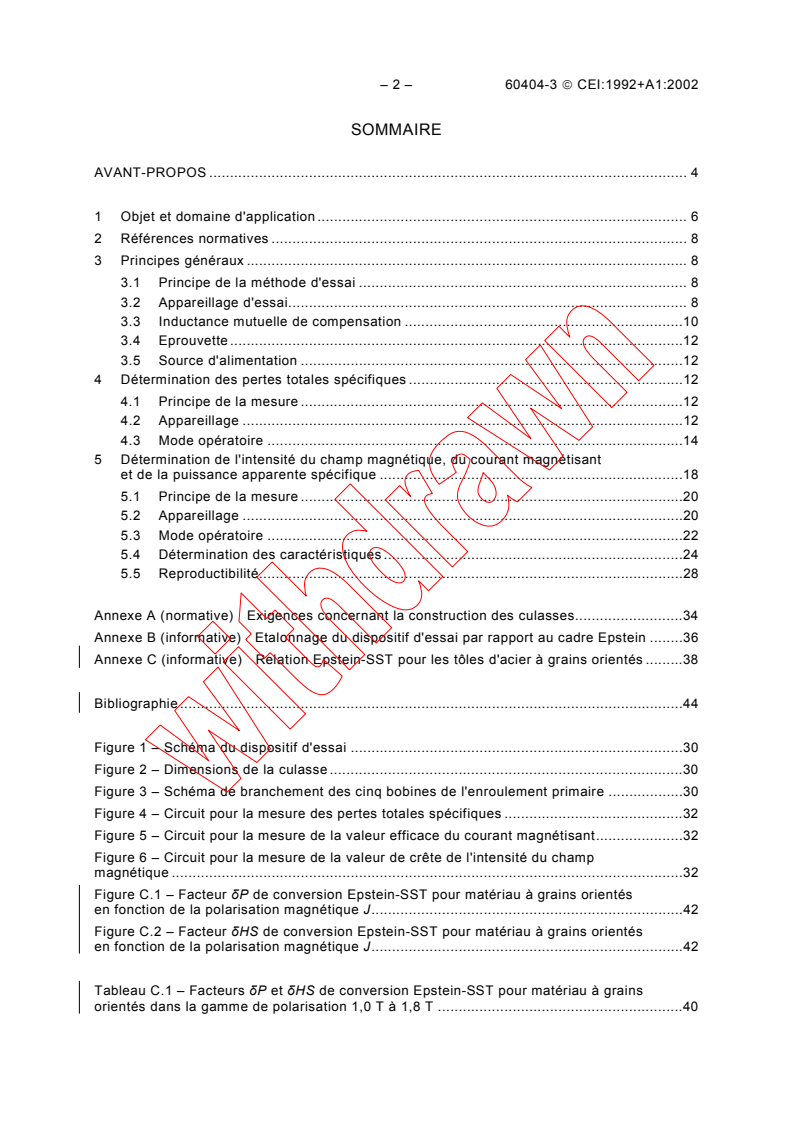
SOMMAIRE
AVANT-PROPOS . 4
1 Objet et domaine d'application. 6
2 Références normatives . 8
3 Principes généraux . 8
3.1 Principe de la méthode d'essai . 8
3.2 Appareillage d'essai. 8
3.3 Inductance mutuelle de compensation .10
3.4 Eprouvette.12
3.5 Source d'alimentation .12
4 Détermination des pertes totales spécifiques .12
4.1 Principe de la mesure .12
4.2 Appareillage .12
4.3 Mode opératoire .14
5 Détermination de l'intensité du champ magnétique, du courant magnétisant
et de la puissance apparente spécifique .18
5.1 Principe de la mesure .20
5.2 Appareillage .20
5.3 Mode opératoire .22
5.4 Détermination des caractéristiques .24
5.5 Reproductibilité.28
Annexe A (normative) Exigences concernant la construction des culasses.34
Annexe B (informative) Etalonnage du dispositif d'essai par rapport au cadre Epstein .36
Annexe C (informative) Relation Epstein-SST pour les tôles d'acier à grains orientés .38
Bibliographie .44
Figure 1 – Schéma du dispositif d'essai .30
Figure 2 – Dimensions de la culasse .30
Figure 3 – Schéma de branchement des cinq bobines de l'enroulement primaire .30
Figure 4 – Circuit pour la mesure des pertes totales spécifiques .32
Figure 5 – Circuit pour la mesure de la valeur efficace du courant magnétisant.32
Figure 6 – Circuit pour la mesure de la valeur de crête de l'intensité du champ
magnétique .32
Figure C.1 – Facteur δP de conversion Epstein-SST pour matériau à grains orientés
en fonction de la polarisation magnétique J.42
Figure C.2 – Facteur δHS de conversion Epstein-SST pour matériau à grains orientés
en fonction de la polarisation magnétique J.42
Tableau C.1 – Facteurs δP et δHS de conversion Epstein-SST pour matériau à grains
orientés dans la gamme de polarisation 1,0 T à 1,8 T .40
60404-3 IEC:1992+A1:2002 – 3 –
CONTENTS
FOREWORD . 5
1 Object and field of application. 7
2 Normative references. 9
3 General principles. 9
3.1 Principle of the method . 9
3.2 Test apparatus . 9
3.3 Air flux compensation .11
3.4 Test specimen .13
3.5 Power supply.13
4 Determination of the specific total loss.13
4.1 Principle of measurement .13
4.2 Apparatus .13
4.3 Measuring procedure .15
5 Determination of magnetic field strength, excitation current
and specific apparent power .19
5.1 Principle of measurement .21
5.2 Apparatus .21
5.3 Measuring procedure .23
5.4 Determination of characteristics.25
5.5 Reproducibility.29
Annex A (normative) Requirements concerning the manufacture of yokes.35
Annex B (informative) Calibration of the test apparatus
with respect to the Epstein frame .37
Annex C (informative) Epstein to SST relationship for grain-oriented sheet steel .39
Bibliography.45
Figure 1 – Diagram of the test apparatus .31
Figure 2 – Yoke dimensions .31
Figure 3 – Diagram of the connections of the five coils of the primary winding .31
Figure 4 – Circuit for the determination of the specific total loss.33
Figure 5 – Circuit for measuring the r.m.s. value of the excitation current.33
Figure 6 – Circuit for measuring the peak value of the magnetic field strength .33
Figure C.1 – Epstein-SST conversion factor δP for grain-oriented material versus
magnetic polarization J .43
Figure C.2 – Epstein-SST conversion factor δHS for grain-oriented material versus
magnetic polarization J .43
Table C.1 – Epstein-SST conversion factors δP and δHS for grain-oriented material in
the polarization range 1,0 T to 1,8 T.41
– 4 – 60404-3 © CEI:1992+A1:2002
COMMISSION ÉLECTROTECHNIQUE INTERNATIONALE
____________
MATÉRIAUX MAGNÉTIQUES –
Partie 3: Méthodes de mesure des caractéristiques magnétiques
des tôles et feuillards magnétiques à l'aide
de l'essai sur tôle unique
AVANT-PROPOS
1) La CEI (Commission Electrotechnique Internationale) est une organisation mondiale de normalisation
composée de l'ensemble des comités électrotechniques nationaux (Comités nationaux de la CEI). La CEI a
pour objet de favoriser la coopération internationale pour toutes les questions de normalisation dans les
domaines de l'électricité et de l'électronique. A cet effet, la CEI, entre autres activités, publie des Normes
internationales. Leur élaboration est confiée à des comités d'études, aux travaux desquels tout Comité national
intéressé par le sujet traité peut participer. Les organisations internationales, gouvernementales et non
gouvernementales, en liaison avec la CEI, participent également aux travaux. La CEI collabore étroitement
avec l'Organisation Internationale de Normalisation (ISO), selon des conditions fixées par accord entre les
deux organisations.
2) Les décisions ou accords officiels de la CEI concernant les questions techniques représentent, dans la mesure
du possible, un accord international sur les sujets étudiés, étant donné que les Comités nationaux intéressés
sont représentés dans chaque comité d’études.
3) Les documents produits se présentent sous la forme de recommandations internationales. Ils sont publiés
comme normes, spécifications techniques, rapports techniques ou guides et agréés comme tels par les
Comités nationaux.
4) Dans le but d'encourager l'unification internationale, les Comités nationaux de la CEI s'engagent à appliquer de
façon transparente, dans toute la mesure possible, les Normes internationales de la CEI dans leurs normes
nationales et régionales. Toute divergence entre la norme de la CEI et la norme nationale ou régionale
correspondante doit être indiquée en termes clairs dans cette dernière.
5) La CEI n’a fixé aucune procédure concernant le marquage comme indication d’approbation et sa responsabilité
n’est pas engagée quand un matériel est déclaré conforme à l’une de ses normes.
6) L’attention est attirée sur le fait que certains des éléments de la présente Norme internationale peuvent faire
l’objet de droits de propriété intellectuelle ou de droits analogues. La CEI ne saurait être tenue pour
responsable de ne pas avoir identifié de tels droits de propriété et de ne pas avoir signalé leur existence.
La Norme internationale CEI 60404-3 a été établie par le comité d'études 68 de la CEI:
Matériaux magnétiques tels qu'alliages et aciers.
La présente version consolidée de la CEI 60404-3 comprend la deuxième édition (1992)
[documents 68(BC)68+75 et 68(BC)77+79] et son amendement 1 (2002) [documents
68/258/FDIS et 68/263/RVD].
Le contenu technique de cette version consolidée est donc identique à celui de l'édition de
base et à son amendement; cette version a été préparée par commodité pour l'utilisateur.
Elle porte le numéro d'édition 2.1.
Une ligne verticale dans la marge indique où la publication de base a été modifiée par
l'amendement 1.
L'annexe A fait partie intégrante de la présente norme.
L'annexe B et C sont données uniquement à titre d'information.
Le comité a décidé que le contenu de la publication de base et de son amendement 1 ne sera
pas modifié avant 2009. A cette date, la publication sera
• reconduite;
• supprimée;
• remplacée par une édition révisée, ou
• amendée.
60404-3 © IEC:1992+A1:2002 – 5 –
INTERNATIONAL ELECTROTECHNICAL COMMISSION
____________
MAGNETIC MATERIALS –
Part 3: Methods of measurement of the magnetic properties
of magnetic sheet and strip by means
of a single sheet tester
FOREWORD
1) The IEC (International Electrotechnical Commission) is a worldwide organization for standardization comprising
all national electrotechnical committees (IEC National Committees). The object of the IEC is to promote
international co-operation on all questions concerning standardization in the electrical and electronic fields. To
this end and in addition to other activities, the IEC publishes International Standards. Their preparation is
entrusted to technical committees; any IEC National Committee interested in the subject dealt with may
participate in this preparatory work. International, governmental and non-governmental organizations liaising
with the IEC also participate in this preparation. The IEC collaborates closely with the International
Organization for Standardization (ISO) in accordance with conditions determined by agreement between the
two organizations.
2) The formal decisions or agreements of the IEC on technical matters express, as nearly as possible, an
international consensus of opinion on the relevant subjects since each technical committee has representation
from all interested National Committees.
3) The documents produced have the form of recommendations for international use and are published in the form
of standards, technical specifications, technical reports or guides and they are accepted by the National
Committees in that sense.
4) In order to promote international unification, IEC National Committees undertake to apply IEC International
Standards transparently to the maximum extent possible in their national and regional standards. Any
divergence between the IEC Standard and the corresponding national or regional standard shall be clearly
indicated in the latter.
5) The IEC provides no marking procedure to indicate its approval and cannot be rendered responsible for any
equipment declared to be in conformity with one of its standards.
6) Attention is drawn to the possibility that some of the elements of this International Standard may be the subject
of patent rights. The IEC shall not be held responsible for identifying any or all such patent rights.
International Standard IEC 60404-3 has been prepared by IEC technical committee 68:
Magnetic alloys and steels.
This consolidated version of IEC 60404-3 consists of the second edition (1992) [documents
68(CO)68+75 and 68(CO)77+79] and its amendment 1 (2002) [documents 68/258/FDIS and
68/263/RVD].
The technical content is therefore identical to the base edition and its amendment and has
been prepared for user convenience.
It bears the edition number 2.1.
A vertical line in the margin shows where the base publication has been modified by
amendment 1.
Annex A forms an integral part of this standard.
Annex B and C are for information only.
The committee has decided that the contents of the base publication and its amendment 1 will
remain unchanged until 2009. At this date, the publication will be
• reconfirmed,
• withdrawn,
• replaced by a revised edition, or
• amended.
– 6 – 60404-3 CEI:1992+A1:2002
MATÉRIAUX MAGNÉTIQUES –
Partie 3: Méthodes de mesure des caractéristiques magnétiques
des tôles et feuillards magnétiques à l'aide
de l'essai sur tôle unique
1 Objet et domaine d'application
La présente partie a pour objet de définir les principes généraux et les détails techniques de
mesure des propriétés magnétiques des tôles magnétiques à l'aide de l'essai sur tôle unique.
La présente partie de la CEI 60404 est applicable, aux fréquences industrielles:
a) aux tôles et feuillards magnétiques à grains orientés:
pour la mesure entre 1,0 T et 1,8 T:
– des pertes totales spécifiques;
– de la puissance apparente spécifique;
– de la valeur efficace du champ magnétique;
pour la mesure, jusqu'à des valeurs de crête de champ magnétique de 1 000 A/m:
– de la valeur de crête de la polarisation magnétique;
– de la valeur de crête du champ magnétique.
b) aux tôles et feuillards magnétiques à grains non orientés:
pour la mesure entre 0,8 T et 1,5 T:
– des pertes totales spécifiques;
– de la puissance apparente spécifique;
– de la valeur efficace du courant d'excitation;
pour la mesure, jusqu'à des valeurs de crête de champ magnétique de 10 000 A/m:
– de la valeur de crête de la polarisation magnétique;
– de la valeur de crête du champ magnétique.
L'essai sur tôle unique est applicable à des échantillons prélevés dans les tôles et feuillards
magnétiques de toute qualité. Les caractéristiques magnétiques sont déterminées pour une
tension induite sinusoïdale, pour des valeurs de crête spécifiées de la polarisation
magnétique et pour une fréquence spécifiée.
Les mesures sont effectuées à la température ambiante de 23 °C ± 5 °C sur des éprou-
vettes qui ont été au préalable désaimantées.
NOTE Dans la présente partie, la grandeur «polarisation magnétique» est utilisée conformément à la définition
figurant dans la CEI 60050(901). Dans certaines normes de la série CEI 60404, on a employé l'expression
«induction magnétique».
60404-3 IEC:1992+A1:2002 – 7 –
MAGNETIC MATERIALS –
Part 3: Methods of measurement of the magnetic properties
of magnetic sheet and strip by means
of a single sheet tester
1 Object and field of application
The object of this part is to define the general principles and the technical details of the
measurement of the magnetic properties of magnetic sheets by means of a single sheet
tester.
This part of IEC 60404 is applicable at power frequencies to:
a) grain oriented magnetic sheet and strip:
for the measurement between 1,0 T and 1,8 T of:
– specific total loss;
– specific apparent power;
– r.m.s. value of the magnetic field strength;
for the measurement up to peak values of magnetic field strength of 1 000 A/m of:
– peak value of the magnetic polarization;
– peak value of the magnetic field strength.
b) non-oriented magnetic sheet and strip:
for the measurement between 0,8 T and 1,5 T of:
– specific total loss;
– specific apparent power;
– r.m.s. value of excitation current;
for the measurement up to peak values of magnetic field strength of 10 000 A/m of:
– peak value of the magnetic polarization;
– peak value of the magnetic field strength.
The single sheet tester is applicable to test specimens obtained from magnetic sheets and
strips of any quality. The magnetic characteristics are determined for a sinusoidal induced
voltage, for specified peak values of magnetic polarization and for a specified frequency.
The measurements are made at an ambient temperature of 23 °C ± 5 °C on test specimens
which have first been demagnetized.
NOTE Throughout this part the quantity "magnetic polarization" is used as defined in IEC 60050(901). In some
standards of the IEC 60404 series, the quantity "magnetic flux density" was used.
– 8 – 60404-3 CEI:1992+A1:2002
2 Références normatives
Les documents de référence suivants sont indispensables pour l'application du présent
document. Pour les références datées, seule l'édition citée s'applique. Pour les références
non datées, la dernière édition du document de référence s'applique (y compris les éventuels
amendements).
CEI 60050(221):1990, Vocabulaire Electrotechnique International – Chapitre 221: Matériaux et
composants magnétiques
CEI 60404-2:1996, Matériaux magnétiques – Partie 2: Méthodes de mesure des propriétés
magnétiques des tôles et bandes magnétiques au moyen d'un cadre Epstein
3 Principes généraux
3.1 Principe de la méthode d'essai
L'éprouvette, constituée par un échantillon de tôle magnétique, est introduite à l'intérieur de
deux enroulements:
– un enroulement primaire extérieur (enroulement d'excitation);
– un enroulement secondaire intérieur (enroulement de tension).
La fermeture du flux est assurée par un circuit magnétique constitué de deux culasses iden-
tiques dont la section est très élevée par rapport à celle de l'éprouvette (voir figure 1).
Afin de minimiser les effets de pression sur l'éprouvette, la culasse supérieure doit être
munie d'un système de suspension permettant de contrebalancer une partie de la masse de
la culasse conformément à 3.2.1.
Des précautions doivent être prises pour s'assurer que les variations de température sont
maintenues à un niveau inférieur à celui susceptible de produire des contraintes dans
l'éprouvette par dilatation ou contraction thermique.
3.2 Appareillage d'essai
3.2.1 Culasses
Chaque culasse en forme de U est composée de tôles isolées en acier au silicium à grains
orientés ou en alliage fer-nickel. Elle doit avoir une faible réluctance et des pertes totales
spécifiques ne dépassant pas 1,0 W/kg à 1,5 T et à 50 Hz. Elle doit être fabriquée selon les
exigences de l'annexe A.
Afin de réduire l'effet des courants de Foucault et d'obtenir une répartition plus homogène
du flux à l'intérieur de la culasse, celle-ci doit être constituée par une paire de culasses
en C ou un assemblage collé de bandes, auquel cas les coins doivent être à joints croisés
(voir figure 1).
Les faces polaires de la culasse doivent avoir une largeur de 25 mm ± 1 mm.
Les deux faces polaires de chaque culasse doivent être coplanaires à mieux que 0,5 mm
près et l'entrefer entre les faces polaires opposées des culasses ne doit dépasser
0,005 mm en aucun point. En outre, les culasses doivent être rigides afin d'éviter toute
contrainte mécanique appliquée à l'éprouvette.
60404-3 IEC:1992+A1:2002 – 9 –
2 Normative references
The following referenced documents are indispensable for the application of this document.
For dated references, only the edition cited applies. For undated references, the latest edition
of the referenced document (including any amendments) applies.
IEC 60050(221):1990, International Electrotechnical Vocabulary – Chapter 221: Magnetic
materials and components
IEC 60404-2:1996, Magnetic materials – Part 2: Methods of measurement of the magnetic
properties of electrical steel sheet and strip by means of an Epstein frame
3 General principles
3.1 Principle of the method
The test specimen comprises a sample of magnetic sheet and is placed inside two windings:
– an exterior primary winding (magnetizing winding);
– an interior secondary winding (voltage winding).
The flux closure is made by a magnetic circuit consisting of two identical yokes, the cross-
section of which is very large compared with that of the test specimen (see figure 1).
To minimize the effects of pressure on the test specimen, the upper yoke shall be provided
with a means of suspension which allows part of its weight to be counterbalanced in
accordance with 3.2.1.
Care shall be taken to ensure that temperature changes are kept below a level likely to
produce stress in the test specimen due to thermal expansion or contraction.
3.2 Test apparatus
3.2.1 Yokes
Each yoke is in the form of a U made up of insulated sheets of grain oriented silicon steel or
nickel iron alloy. It shall have a low reluctance and a specific total loss not greater than
1,0 W/kg at 1,5 T and 50 Hz. It shall be manufactured in accordance with the requirements of
annex A.
In order to reduce the effect of eddy currents and give a more homogeneous distribution of
the flux over the inside of the yokes, the latter shall be made of a pair of C-cores or a glued
stack of laminations in which case the corners shall have staggered butt joints (see figure 1).
The yoke shall have pole faces having a width of 25 mm ± 1 mm.
The two pole faces of each yoke shall be coplanar to within 0,5 mm and the gap between the
opposite pole faces of the yokes shall not exceed 0,005 mm at any point. Also, the yokes
shall be rigid in order to avoid creating mechanical stresses in the test specimen.
– 10 – 60404-3 CEI:1992+A1:2002
La hauteur de chaque culasse doit être comprise entre 90 mm et 150 mm; chaque culasse doit
+5
avoir une largeur de 500 mm et une longueur interne de 450 mm ± 1 mm (voir figure 2).
−5
NOTE Il est reconnu que d'autres dimensions de culasse peuvent être utilisées à condition que la comparabilité
des résultats puisse être démontrée.
Le dispositif doit comporter entre les branches verticales des culasses un support non
magnétique, en matériau isolant, sur lequel on pose l'éprouvette. Ce support doit être
centré et placé dans le même plan que les faces polaires, afin que l'éprouvette soit en
contact direct avec les forces polaires sans entrefer.
La culasse supérieure doit être mobile pour permettre la mise en place de l'éprouvette. Après
insertion, la culasse supérieure doit être réalignée avec précision avec la culasse inférieure.
La suspension de la culasse supérieure doit permettre de contrebalancer une partie de son poids
afin d'obtenir une force sur l'éprouvette comprise entre 100 N et 200 N.
NOTE La forme carrée de la culasse a été retenue afin de permettre l'utilisation d'une seule éprouvette dans le
cas des tôles à grains non orientés. Par rotation de 90° de l'éprouvette, il est possible de déterminer les
caractéristiques dans la direction de laminage et dans le sens perpendiculaire.
3.2.2 Enroulements
Les enroulements primaire et secondaire doivent avoir une longueur d'au moins 440 mm et
être enroulés sur un support en matériau isolant, non magnétique, de forme parallé-
lépipédique. Les dimensions du support doivent être les suivantes:
– longueur: 445 mm ± 2 mm;
– largeur interne: 510 mm ± 1 mm;
– hauteur interne: 5 mm;
−2
– hauteur: ≤15 mm.
L'enroulement primaire peut être constitué:
– soit de cinq bobines ou plus de mêmes dimensions et de même nombre de spires,
réparties sur toute la longueur (voir figure 3) et reliées en parallèle. Par exemple, avec
cinq bobines, chaque bobine peut comporter 400 spires de fil de cuivre de 1 mm de
diamètre, bobinées en cinq couches;
– soit d'un enroulement unique continu et uniformément réparti sur toute la longueur.
Par exemple, cet enroulement peut comporter 400 spires de fil de cuivre de 1 mm de
diamètre, bobinées en une seule ou plusieurs couches.
Le nombre de spires de l'enroulement secondaire dépendra des caractéristiques des
appareils de mesure.
3.3 Inductance mutuelle de compensation
L'effet de flux dans l'air doit être compensé. Cela peut être obtenu, par exemple, à l'aide
d'une inductance mutuelle de compensation. L'enroulement primaire de l'inductance mutuelle
est connecté en série avec l'enroulement primaire du dispositif d'essai, alors que l'enroule-
ment secondaire de l'inductance mutuelle est connecté en opposition avec l'enroulement
secondaire du dispositif d'essai.
La valeur de l'inductance mutuelle doit être réglée de façon que, en l'absence d'éprouvette
dans le dispositif d'essai, lorsqu'on fait circuler un courant alternatif dans les enroulements
primaires, la tension entre les extrémités non reliées entre elles des enroulements
secondaires ne soit pas supérieure à 0,1 % de la tension qui apparaît aux extrémités de
l'enroulement secondaire du dispositif seul.
60404-3 IEC:1992+A1:2002 – 11 –
The height of each yoke shall be between 90 mm and 150 mm. Each yoke shall have a width
+5
of 500 mm and an inside length of 450 mm ± 1 mm (see figure 2).
−5
NOTE It is recognized that other yoke dimensions can be used provided that the comparability of the results can
be demonstrated.
There shall be a non-conducting, non-magnetic support between the vertical limbs of the
yokes on which the test specimen is placed. This support shall be centered and located in the
same plane as the pole faces so that the test specimen is in direct contact with the pole faces
without any gap.
The upper yoke shall be movable upwards to permit insertion of the test specimen.
After insertion the upper yoke shall be realigned accurately with the bottom yoke. The sus-
pension of the upper yoke shall allow part of its weight to be counterbalanced so as to give a
force on the test specimen of between 100 N and 200 N.
NOTE The square shape of the yoke has been chosen in order to have only one test specimen for non-oriented
material. By rotating the test specimen through 90° it is possible to determine the characteristics in the rolling
direction and perpendicular to the rolling direction.
3.2.2 Windings
The primary and secondary windings shall be at least 440 mm in length and shall be wound
on a non-conducting, non-magnetic, rectangular former. The dimensions of the former shall
be as follows:
– length: 445 mm ± 2 mm;
– internal width: 510 mm ± 1 mm;
– internal height: 5 mm;
−2
– height: ≤15 mm.
The primary winding can be made up of:
– either five or more coils having identical dimensions and the same number of turns
connected in parallel and taking up the whole length (see figure 3). For example, with five
coils, each coil can be made up of 400 turns of copper wire 1 mm in diameter, wound in
five layers;
– or a single continuous and uniform winding taking up the whole length. For example this
winding can be made up of 400 turns of copper wire 1 mm in diameter, wound in one or
more layers.
The number of turns on the secondary winding will depend on the characteristics of the
measuring instruments.
3.3 Air flux compensation
Compensation shall be made for the effect of air flux. This can be achieved, for example, by a
mutual inductor. The primary winding of the mutual inductor is connected in series with the
primary winding of the test apparatus, while the secondary winding of the mutual inductor is
connected to the secondary winding of the test apparatus in series opposition.
The adjustment of the value of the mutual inductance shall be made so that, when passing an
alternating current through the primary windings in the absence of the specimen in the
apparatus, the voltage measured between the non-common terminals of the secondary
windings shall be no more than 0,1 % of the voltage appearing across the secondary winding
of the test apparatus alone.
– 12 – 60404-3 CEI:1992+A1:2002
Ainsi, la valeur moyenne de la tension redressée induite dans l'enroulement secondaire
combiné est proportionnelle à la valeur de crête de la polarisation magnétique dans
l'éprouvette.
3.4 Eprouvette
La longueur de l'éprouvette doit être d'au moins 500 mm. Bien que la partie de l'éprouvette
située en dehors des faces polaires n'ait pas grande influence sur la mesure, cette partie ne
doit pas être plus longue que ce qui est nécessaire pour faciliter les opérations de mise en
place et d'enlèvement de l'éprouvette.
La largeur de l'éprouvette doit être aussi grande que possible et au maximum égale à la
largeur de la culasse.
Pour obtenir la précision maximale, la largeur minimale ne doit pas être inférieure à 60 %
de la largeur de la culasse.
Les éprouvettes doivent être découpées sans formation de bavures excessives ou de
distorsions mécaniques. L'éprouvette doit être plane. Lors du découpage, la rive de la tôle
mère est prise comme référence de la direction de laminage. On admettra les tolérances
suivantes pour l'angle entre la direction de laminage et celle du découpage:
±1° pour les tôles à grains orientés;
±5° pour les tôles à grains non orientés.
Pour les tôles à grains non orientés, on doit préparer deux éprouvettes, l'une coupée
parallèlement à la direction de laminage, l'autre perpendiculairement, sauf si l'éprouvette
est carrée, auquel cas une seule éprouvette suffit.
3.5 Source d'alimentation
La source d'alimentation doit avoir une faible impédance interne et une stabilité élevée en
tension et en fréquence. Pendant les mesures, la tension et la fréquence doivent être
maintenues constantes à ±0,2 % près.
En outre, la forme de l'onde de la tension secondaire induite doit être maintenue aussi
sinusoïdale que possible. Il est préférable de maintenir le facteur de forme de la tension
secondaire égal à 1,111 ± 1 %. Cela peut être réalisé de diverses manières, par exemple à
l'aide d'une amplification électronique asservie.
4 Détermination des pertes totales spécifiques
4.1 Principe de la mesure
Le dispositif d'essai avec l'éprouvette constitue un transformateur à vide dont les pertes
totales spécifiques sont mesurées selon le circuit de principe de la figure 4.
4.2 Appareillage
4.2.1 Mesure de la tension
4.2.1.1 Voltmètre de valeur moyenne
La tension secondaire redressée du dispositif d'essai doit être mesurée avec un voltmètre de
valeur moyenne. L'instrument préférable est un voltmètre numérique de ± 0,2 % de précision.
NOTE Des instruments de ce type sont généralement gradués en valeur redressée multipliée par 1,111.
60404-3 IEC:1992+A1:2002 – 13 –
Thus the average value of the rectified voltage induced in the combined secondary windings
is proportional to the peak value of the magnetic polarization in the test specimen.
3.4 Test specimen
The length of the test specimen shall be not less than 500 mm. Although the part of
the specimen situated outside the pole faces has no great influence on the measurement,
this part shall not be longer than is necessary to facilitate insertion and removal of the test
specimen.
The width of the test specimen shall be as large as possible and at its maximum equal to
the width of the yokes.
For maximum accuracy, the minimum width shall be not less than 60 % of the width of
the yokes.
The test specimen shall be cut without the formation of excessive burrs or mechanical
distortion. The test specimen shall be plane. When a test specimen is cut, the edge of
the parent strip is taken as the reference direction. The following tolerances are allowed
for the angle between the direction of rolling and that of cutting:
±1° for grain oriented steel sheet;
±5° for non-oriented steel sheet.
For non-oriented steel sheet, two specimens shall be cut, one parallel to the direction
of rolling and the other perpendicular unless the test specimen is square, in which case one
test specimen only is necessary.
3.5 Power supply
The power supply shall be of low internal impedance and shall be highly stable in terms
of voltage and frequency. During the measurement, the voltage and the frequency shall be
maintained constant within ±0,2 %.
In addition, the waveform of the secondary induced voltage shall be maintained as sinusoidal
as possible. It is preferable to maintain the form factor of the secondary voltage to within ±1 %
of 1,111. This can be achieved by various means, for example by using an electronic
feedback amplifier.
4 Determination of the specific total loss
4.1 Principle of measurement
The single sheet tester with the test specimen represents an unloaded transformer the total
loss of which is measured by the circuit shown in figure 4.
4.2 Apparatus
4.2.1 Voltage measurement
4.2.1.1 Average type voltmeter
The secondary rectified voltage of the test apparatus shall be measured by an average type
voltmeter. The preferred instrument is a digital voltmeter having an accuracy of ±0,2 %.
NOTE Instruments of this type are usually graduated in average rectified value multiplied by 1,111.
– 14 – 60404-3 CEI:1992+A1:2002
La charge du circuit secondaire doit être aussi faible que possible. Par conséquent,
il convient que la résistance interne du voltmètre de valeur moyenne soit au moins égale
à 1 000 Ω/V.
4.2.1.2 Voltmètre de valeur efficace
On doit utiliser un voltmètre de valeur efficace. L'instrument préférable est un voltmètre
numérique de ±0,2 % de précision.
4.2.2 Mesure de la fréquence
On doit utiliser un fréquencemètre de ±0,1 % de précision.
4.2.3 Mesure de la puissance
On doit mesurer la puissance avec un wattmètre d'une précision de ±0,5 % ou meilleure pour
la valeur réelle du facteur de puissance et du facteur de crête.
La résistance du circuit de tension du wattmètre doit être d'au moins 100 Ω/V pour tous les
calibres. Si nécessaire, retrancher des pertes indiquées les pertes supplémentaires
introduites par le wattmètre.
La résistance du circuit de tension du wattmètre doit être au moins égale à 5 000 fois sa
réactance, à moins que le wattmètre ne soit compensé pour celle-ci.
Si un appareillage destiné à la mesure du courant est inclus dans le circuit, il doit être
court-circuité lors de l'ajustement de la tension secondaire ainsi que lors de la mesure des
pertes.
4.3 Mode opératoire
4.3.1 Préparation de la mesure
La longueur de l'éprouvette doit être mesurée à ±0,1 % près et sa masse déterminée
à ±0,1 %. L'éprouvette doit être ensuite mise en place et centrée sur les axes longitudinal et
transversal de la bobine d'essai, et la culasse supérieure, partiellement contrebalancée, doit
être abaissée.
Avant la mesure, l'éprouvette doit être désaimantée par une lente diminution d'un champ
magnétique alternatif à partir d'une valeur nettement supérieure à celle devant être
mesurée.
60404-3 IEC:1992+A1:2002 – 15 –
The load on the secondary circuit shall be as small as possible. Consequently, the internal
resistance of the average type voltmeter should be at least 1 000 Ω/V.
4.2.1.2 R.M.S. voltmeter
A voltmeter responsive to r.m.s. values shall be used. The preferred instrument is a digital
voltmeter having an accuracy of ±0,2 %.
4.2.2 Frequency measurement
A frequency meter having an accuracy of ±0,1 % shall be used.
4.2.3 Power measurement
The power shall be measured by a wattmeter having an accuracy of ±0,5 % or better at the
actual power factor and crest factor.
The resistance of the voltage circuit of the wattmeter shall be at least 100 Ω/V for all ranges.
If necessary, the losses in the secondary circuit shall be subtracted from the indicated loss
value.
The ohmic resistance of the wattmeter voltage circuit shall be at least 5 000 times its
reactance, unless the wattmeter is compensated for its reactance.
If a current-measuring device is included in the circuit, it shall be short-circuited when the
secondary voltage is adjusted and the losses are measured.
4.3 Measuring procedure
4.3.1 Preparation of measurement
The length of the test specimen shall be measured with an accuracy of ±0,1 % and its mass
determined within ±0,1 %. The test specimen shall be loa
...
IEC 60404-3 ®
Edition 2.2 2010-04
CONSOLIDATED VERSION
INTERNATIONAL
STANDARD
NORME
INTERNATIONALE
colour
inside
Magnetic materials –
Part 3: Methods of measurement of the magnetic properties of electrical steel
strip and sheet by means of a single sheet tester
Matériaux magnétiques –
Partie 3: Méthodes de mesure des caractéristiques magnétiques des bandes et
tôles magnétiques en acier à l'aide de l'essai sur tôle unique
All rights reserved. Unless otherwise specified, no part of this publication may be reproduced or utilized in any form
or by any means, electronic or mechanical, including photocopying and microfilm, without permission in writing from
either IEC or IEC's member National Committee in the country of the requester. If you have any questions about IEC
copyright or have an enquiry about obtaining additional rights to this publication, please contact the address below or
your local IEC member National Committee for further information.
Droits de reproduction réservés. Sauf indication contraire, aucune partie de cette publication ne peut être reproduite
ni utilisée sous quelque forme que ce soit et par aucun procédé, électronique ou mécanique, y compris la photocopie
et les microfilms, sans l'accord écrit de l'IEC ou du Comité national de l'IEC du pays du demandeur. Si vous avez des
questions sur le copyright de l'IEC ou si vous désirez obtenir des droits supplémentaires sur cette publication, utilisez
les coordonnées ci-après ou contactez le Comité national de l'IEC de votre pays de résidence.
IEC Central Office Tel.: +41 22 919 02 11
3, rue de Varembé Fax: +41 22 919 03 00
CH-1211 Geneva 20 info@iec.ch
Switzerland www.iec.ch
About the IEC
The International Electrotechnical Commission (IEC) is the leading global organization that prepares and publishes
International Standards for all electrical, electronic and related technologies.
About IEC publications
The technical content of IEC publications is kept under constant review by the IEC. Please make sure that you have the
latest edition, a corrigenda or an amendment might have been published.
IEC Catalogue - webstore.iec.ch/catalogue Electropedia - www.electropedia.org
The stand-alone application for consulting the entire The world's leading online dictionary of electronic and
bibliographical information on IEC International Standards, electrical terms containing 20 000 terms and definitions in
Technical Specifications, Technical Reports and other English and French, with equivalent terms in 15 additional
documents. Available for PC, Mac OS, Android Tablets and languages. Also known as the International Electrotechnical
iPad. Vocabulary (IEV) online.
IEC publications search - www.iec.ch/searchpub IEC Glossary - std.iec.ch/glossary
The advanced search enables to find IEC publications by a 65 000 electrotechnical terminology entries in English and
variety of criteria (reference number, text, technical French extracted from the Terms and Definitions clause of
committee,…). It also gives information on projects, replaced IEC publications issued since 2002. Some entries have been
and withdrawn publications. collected from earlier publications of IEC TC 37, 77, 86 and
CISPR.
IEC Just Published - webstore.iec.ch/justpublished
Stay up to date on all new IEC publications. Just Published IEC Customer Service Centre - webstore.iec.ch/csc
details all new publications released. Available online and If you wish to give us your feedback on this publication or
also once a month by email. need further assistance, please contact the Customer Service
Centre: csc@iec.ch.
A propos de l'IEC
La Commission Electrotechnique Internationale (IEC) est la première organisation mondiale qui élabore et publie des
Normes internationales pour tout ce qui a trait à l'électricité, à l'électronique et aux technologies apparentées.
A propos des publications IEC
Le contenu technique des publications IEC est constamment revu. Veuillez vous assurer que vous possédez l’édition la
plus récente, un corrigendum ou amendement peut avoir été publié.
Catalogue IEC - webstore.iec.ch/catalogue Electropedia - www.electropedia.org
Application autonome pour consulter tous les renseignements
Le premier dictionnaire en ligne de termes électroniques et
bibliographiques sur les Normes internationales,
électriques. Il contient 20 000 termes et définitions en anglais
Spécifications techniques, Rapports techniques et autres
et en français, ainsi que les termes équivalents dans 15
documents de l'IEC. Disponible pour PC, Mac OS, tablettes
langues additionnelles. Egalement appelé Vocabulaire
Android et iPad.
Electrotechnique International (IEV) en ligne.
Recherche de publications IEC - www.iec.ch/searchpub
Glossaire IEC - std.iec.ch/glossary
La recherche avancée permet de trouver des publications IEC
65 000 entrées terminologiques électrotechniques, en anglais
en utilisant différents critères (numéro de référence, texte,
et en français, extraites des articles Termes et Définitions des
comité d’études,…). Elle donne aussi des informations sur les
publications IEC parues depuis 2002. Plus certaines entrées
projets et les publications remplacées ou retirées.
antérieures extraites des publications des CE 37, 77, 86 et
CISPR de l'IEC.
IEC Just Published - webstore.iec.ch/justpublished
Restez informé sur les nouvelles publications IEC. Just Service Clients - webstore.iec.ch/csc
Published détaille les nouvelles publications parues. Si vous désirez nous donner des commentaires sur cette
Disponible en ligne et aussi une fois par mois par email. publication ou si vous avez des questions contactez-nous:
csc@iec.ch.
IEC 60404-3 ®
Edition 2.2 2010-04
CONSOLIDATED VERSION
INTERNATIONAL
STANDARD
NORME
INTERNATIONALE
colour
inside
Magnetic materials –
Part 3: Methods of measurement of the magnetic properties of electrical steel
strip and sheet by means of a single sheet tester
Matériaux magnétiques –
Partie 3: Méthodes de mesure des caractéristiques magnétiques des bandes et
tôles magnétiques en acier à l'aide de l'essai sur tôle unique
INTERNATIONAL
ELECTROTECHNICAL
COMMISSION
COMMISSION
ELECTROTECHNIQUE
INTERNATIONALE
ICS 17.220.20; 29.030 ISBN 978-2-8891-0186-3
– 2 – 60404-3 © IEC:1992+A1:2002+A2:2009
CONTENTS
FOREWORD.3
1 Object and field of application .5
2 Normative references .6
3 General principles .6
3.1 Principle of the method.6
3.2 Test apparatus .6
3.3 Air flux compensation .7
3.4 Test specimen.8
3.5 Power supply.8
4 Determination of the specific total loss .8
4.1 Principle of measurement .8
4.2 Apparatus.8
4.3 Measurement procedure of the specific total loss .9
5 Determination of magnetic field strength, excitation current and specific apparent
power .11
5.1 Principle of measurement .12
5.2 Apparatus.12
5.3 Measuring procedure.13
5.4 Determination of characteristics .14
5.5 Reproducibility .16
Annex A (normative) Requirements concerning the manufacture of yokes .19
Annex B (informative) Calibration of the test apparatus with respect to the Epstein
frame .20
Annex C (informative) Epstein to SST relationship for grain-oriented sheet steel .21
Annex D (informative) Digital sampling methods for the determination of the magnetic
properties .24
Bibliography.27
Figure 1 – Diagram of the test apparatus .17
Figure 2 – Yoke dimensions.17
Figure 3 – Diagram of the connections of the five coils of the primary winding .17
Figure 4 – Circuit for the determination of the specific total loss .18
Figure 5 – Circuit for measuring the r.m.s. value of the excitation current .18
Figure 6 – Circuit for measuring the peak value of the magnetic field strength .18
Figure C.1 – Epstein-SST conversion factor δP for grain-oriented material versus
magnetic polarization J .23
Figure C.2 – Epstein-SST conversion factor δHS for grain-oriented material versus
magnetic polarization J .23
Table C.1 – Epstein-SST conversion factors δP and δHS for grain-oriented material in
the polarization range 1,0 T to 1,8 T .22
60404-3 © IEC:1992+A1:2002+A2:2009 – 3 –
INTERNATIONAL ELECTROTECHNICAL COMMISSION
____________
MAGNETIC MATERIALS –
Part 3: Methods of measurement of the magnetic properties
of electrical steel strip and sheet by means
of a single sheet tester
FOREWORD
1) The International Electrotechnical Commission (IEC) is a worldwide organization for standardization comprising
all national electrotechnical committees (IEC National Committees). The object of IEC is to promote
international co-operation on all questions concerning standardization in the electrical and electronic fields. To
this end and in addition to other activities, IEC publishes International Standards, Technical Specifications,
Technical Reports, Publicly Available Specifications (PAS) and Guides (hereafter referred to as “IEC
Publication(s)”). Their preparation is entrusted to technical committees; any IEC National Committee interested
in the subject dealt with may participate in this preparatory work. International, governmental and non-
governmental organizations liaising with the IEC also participate in this preparation. IEC collaborates closely
with the International Organization for Standardization (ISO) in accordance with conditions determined by
agreement between the two organizations.
2) The formal decisions or agreements of IEC on technical matters express, as nearly as possible, an international
consensus of opinion on the relevant subjects since each technical committee has representation from all
interested IEC National Committees.
3) IEC Publications have the form of recommendations for international use and are accepted by IEC National
Committees in that sense. While all reasonable efforts are made to ensure that the technical content of IEC
Publications is accurate, IEC cannot be held responsible for the way in which they are used or for any
misinterpretation by any end user.
4) In order to promote international uniformity, IEC National Committees undertake to apply IEC Publications
transparently to the maximum extent possible in their national and regional publications. Any divergence
between any IEC Publication and the corresponding national or regional publication shall be clearly indicated in
the latter.
5) IEC itself does not provide any attestation of conformity. Independent certification bodies provide conformity
assessment services and, in some areas, access to IEC marks of conformity. IEC is not responsible for any
services carried out by independent certification bodies.
6) All users should ensure that they have the latest edition of this publication.
7) No liability shall attach to IEC or its directors, employees, servants or agents including individual experts and
members of its technical committees and IEC National Committees for any personal injury, property damage or
other damage of any nature whatsoever, whether direct or indirect, or for costs (including legal fees) and
expenses arising out of the publication, use of, or reliance upon, this IEC Publication or any other IEC
Publications.
8) Attention is drawn to the Normative references cited in this publication. Use of the referenced publications is
indispensable for the correct application of this publication.
9) Attention is drawn to the possibility that some of the elements of this IEC Publication may be the subject of
patent rights. IEC shall not be held responsible for identifying any or all such patent rights.
This consolidated version of the official IEC Standard and its amendments has been
prepared for user convenience.
IEC 60404-3 edition 2.2 contains the second edition (1992) [documents 68(CO)68+75 and
68(CO)77+79], its amendment 1 (2002) [documents 68/258/FDIS and 68/263/RVD], its
amendment 2 (2009) [documents 68/389/CDV and 68/397/RVC] and its corrigendum of
December 2009.
A vertical line in the margin shows where the base publication has been modified by
amendments 1 and 2.
International Standard IEC 60404-3 has been prepared by IEC technical committee 68:
Magnetic alloys and steels.
– 4 – 60404-3 © IEC:1992+A1:2002+A2:2009
Annex A forms an integral part of this standard.
Annex B, C and D are for information only.
The committee has decided that the contents of the base publication and its amendments will
remain unchanged until the maintenance result date indicated on the IEC web site under
"http://webstore.iec.ch" in the data related to the specific publication. At this date,
the publication will be
• reconfirmed,
• withdrawn,
• replaced by a revised edition, or
• amended.
IMPORTANT – The “colour inside” logo on the cover page of this publication indicates
that it contains colours which are considered to be useful for the correct understanding
of its contents. Users should therefore print this publication using a colour printer.
60404-3 © IEC:1992+A1:2002+A2:2009 – 5 –
MAGNETIC MATERIALS –
Part 3: Methods of measurement of the magnetic properties
of electrical steel strip and sheet by means
of a single sheet tester
1 Object and field of application
The object of this part is to define the general principles and the technical details of the
measurement of the magnetic properties of magnetic sheets by means of a single sheet
tester.
This part of IEC 60404 is applicable at power frequencies to:
a) grain oriented magnetic sheet and strip:
for the measurement between 1,0 T and 1,8 T of:
– specific total loss;
– specific apparent power;
– r.m.s. value of the magnetic field strength;
for the measurement up to peak values of magnetic field strength of 1 000 A/m of:
– peak value of the magnetic polarization;
– peak value of the magnetic field strength.
b) non-oriented magnetic sheet and strip:
for the measurement between 0,8 T and 1,5 T of:
– specific total loss;
– specific apparent power;
– r.m.s. value of excitation current;
for the measurement up to peak values of magnetic field strength of 10 000 A/m of:
– peak value of the magnetic polarization;
– peak value of the magnetic field strength.
The single sheet tester is applicable to test specimens obtained from magnetic sheets and
strips of any quality. The magnetic characteristics are determined for a sinusoidal induced
voltage, for specified peak values of magnetic polarization and for a specified frequency.
The measurements are made at an ambient temperature of 23 °C ± 5 °C on test specimens
which have first been demagnetized.
NOTE Throughout this part the quantity "magnetic polarization" is used as defined in IEC 60050(901). In some
standards of the IEC 60404 series, the quantity "magnetic flux density" was used.
– 6 – 60404-3 © IEC:1992+A1:2002+A2:2009
2 Normative references
The following referenced documents are indispensable for the application of this document.
For dated references, only the edition cited applies. For undated references, the latest edition
of the referenced document (including any amendments) applies.
IEC 60050-221, International Electrotechnical Vocabulary – Part 221: Magnetic materials
and components
IEC 60404-2, Magnetic materials – Part 2: Methods of measurement of the magnetic
properties of electrical steel strip and sheet by means of an Epstein frame
3 General principles
3.1 Principle of the method
The test specimen comprises a sample of magnetic sheet and is placed inside two windings:
– an exterior primary winding (magnetizing winding);
– an interior secondary winding (voltage winding).
The flux closure is made by a magnetic circuit consisting of two identical yokes, the cross-
section of which is very large compared with that of the test specimen (see figure 1).
To minimize the effects of pressure on the test specimen, the upper yoke shall be provided
with a means of suspension which allows part of its weight to be counterbalanced in
accordance with 3.2.1.
Care shall be taken to ensure that temperature changes are kept below a level likely to
produce stress in the test specimen due to thermal expansion or contraction.
3.2 Test apparatus
3.2.1 Yokes
Each yoke is in the form of a U made up of insulated sheets of grain oriented silicon steel or
nickel iron alloy. It shall have a low reluctance and a specific total loss not greater than
1,0 W/kg at 1,5 T and 50 Hz. It shall be manufactured in accordance with the requirements of
annex A.
In order to reduce the effect of eddy currents and give a more homogeneous distribution of
the flux over the inside of the yokes, the latter shall be made of a pair of C-cores or a glued
stack of laminations in which case the corners shall have staggered butt joints (see figure 1).
The yoke shall have pole faces having a width of 25 mm ± 1 mm.
The two pole faces of each yoke shall be coplanar to within 0,5 mm and the gap between the
opposite pole faces of the yokes shall not exceed 0,005 mm at any point. Also, the yokes
shall be rigid in order to avoid creating mechanical stresses in the test specimen.
60404-3 © IEC:1992+A1:2002+A2:2009 – 7 –
The height of each yoke shall be between 90 mm and 150 mm. Each yoke shall have a width
+5
of 500 mm and an inside length of 450 mm ± 1 mm (see figure 2).
−5
NOTE It is recognized that other yoke dimensions can be used provided that the comparability of the results can
be demonstrated.
There shall be a non-conducting, non-magnetic support between the vertical limbs of the
yokes on which the test specimen is placed. This support shall be centered and located in the
same plane as the pole faces so that the test specimen is in direct contact with the pole faces
without any gap.
The upper yoke shall be movable upwards to permit insertion of the test specimen.
After insertion the upper yoke shall be realigned accurately with the bottom yoke. The sus-
pension of the upper yoke shall allow part of its weight to be counterbalanced so as to give a
force on the test specimen of between 100 N and 200 N.
NOTE The square shape of the yoke has been chosen in order to have only one test specimen for non-oriented
material. By rotating the test specimen through 90° it is possible to determine the characteristics in the rolling
direction and perpendicular to the rolling direction.
3.2.2 Windings
The primary and secondary windings shall be at least 440 mm in length and shall be wound
on a non-conducting, non-magnetic, rectangular former. The dimensions of the former shall
be as follows:
– length: 445 mm ± 2 mm;
– internal width: 510 mm ± 1 mm;
– internal height: 5 mm;
−2
– height: ≤15 mm.
The primary winding can be made up of:
– either five or more coils having identical dimensions and the same number of turns
connected in parallel and taking up the whole length (see figure 3). For example, with five
coils, each coil can be made up of 400 turns of copper wire 1 mm in diameter, wound in
five layers;
– or a single continuous and uniform winding taking up the whole length. For example this
winding can be made up of 400 turns of copper wire 1 mm in diameter, wound in one or
more layers.
The number of turns on the secondary winding will depend on the characteristics of the
measuring instruments.
3.3 Air flux compensation
Compensation shall be made for the effect of air flux. This can be achieved, for example, by a
mutual inductor. The primary winding of the mutual inductor is connected in series with the
primary winding of the test apparatus, while the secondary winding of the mutual inductor is
connected to the secondary winding of the test apparatus in series opposition.
The adjustment of the value of the mutual inductance shall be made so that, when passing an
alternating current through the primary windings in the absence of the specimen in the
apparatus, the voltage measured between the non-common terminals of the secondary
windings shall be no more than 0,1 % of the voltage appearing across the secondary winding
of the test apparatus alone.
– 8 – 60404-3 © IEC:1992+A1:2002+A2:2009
Thus the average value of the rectified voltage induced in the combined secondary windings
is proportional to the peak value of the magnetic polarization in the test specimen.
3.4 Test specimen
The length of the test specimen shall be not less than 500 mm. Although the part of
the specimen situated outside the pole faces has no great influence on the measurement,
this part shall not be longer than is necessary to facilitate insertion and removal of the test
specimen.
The width of the test specimen shall be as large as possible and at its maximum equal to
the width of the yokes.
For maximum accuracy, the minimum width shall be not less than 60 % of the width of
the yokes.
The test specimen shall be cut without the formation of excessive burrs or mechanical
distortion. The test specimen shall be plane. When a test specimen is cut, the edge of
the parent strip is taken as the reference direction. The following tolerances are allowed
for the angle between the direction of rolling and that of cutting:
±1° for grain oriented steel sheet;
±5° for non-oriented steel sheet.
For non-oriented steel sheet, two specimens shall be cut, one parallel to the direction
of rolling and the other perpendicular unless the test specimen is square, in which case one
test specimen only is necessary.
3.5 Power supply
The power supply shall be of low internal impedance and shall be highly stable in terms
of voltage and frequency. During the measurement, the voltage and the frequency shall be
maintained constant within ±0,2 %.
In addition, the waveform of the secondary induced voltage shall be maintained as sinusoidal
as possible. It is preferable to maintain the form factor of the secondary voltage to within ±1 %
of 1,111. This can be achieved by various means, for example by using an electronic
feedback amplifier.
4 Determination of the specific total loss
4.1 Principle of measurement
The single sheet tester with the test specimen represents an unloaded transformer the total
loss of which is measured by the circuit shown in figure 4.
4.2 Apparatus
4.2.1 Voltage measurement
NOTE For the application of digital sampling methods, see Annex D.
4.2.1.1 Average type voltmeter
The secondary rectified voltage of the test apparatus shall be measured by an average type
voltmeter. The preferred instrument is a digital voltmeter having an accuracy of ±0,2 %.
NOTE Instruments of this type are usually graduated in average rectified value multiplied by 1,111.
60404-3 © IEC:1992+A1:2002+A2:2009 – 9 –
The load on the secondary circuit shall be as small as possible. Consequently, the internal
resistance of the average type voltmeter should be at least 1 000 Ω/V.
4.2.1.2 R.M.S. voltmeter
A voltmeter responsive to r.m.s. values shall be used. The preferred instrument is a digital
voltmeter having an accuracy of ±0,2 %.
4.2.2 Frequency measurement
A frequency meter having an accuracy of ±0,1 % shall be used.
NOTE For the application of digital sampling methods, see Annex D.
4.2.3 Power measurement
The power shall be measured by a wattmeter having an accuracy of ±0,5 % or better at the
actual power factor and crest factor.
NOTE For the application of digital sampling methods, see Annex D.
The resistance of the voltage circuit of the wattmeter shall be at least 100 Ω/V for all ranges.
If necessary, the losses in the secondary circuit shall be subtracted from the indicated loss
value.
The ohmic resistance of the wattmeter voltage circuit shall be at least 5 000 times its
reactance, unless the wattmeter is compensated for its reactance.
If a current-measuring device is included in the circuit, it shall be short-circuited when the
secondary voltage is adjusted and the losses are measured.
4.3 Measurement procedure of the specific total loss
NOTE For the application of digital sampling methods, see Annex D.
4.3.1 Preparation of measurement
The length of the test specimen shall be measured with an accuracy of ±0,1 % and its mass
determined within ±0,1 %. The test specimen shall be loaded and centred on the longitudinal
and transverse axes of the test coil, and the partly counterbalanced upper yoke shall be
lowered.
Before the measurement, the test specimen shall be demagnetized by slowly decreasing an
alternating magnetic field starting from well above the value to be measured.
– 10 – 60404-3 © IEC:1992+A1:2002+A2:2009
4.3.2 Source setting
The source shall be adjusted so that the average value of the secondary rectified voltage is:
R
i
U = 4 f N AĴ (1)
2 2
R + R
i
t
where
U is the average value of the secondary rectified voltage, in volts;
f is the frequency, in hertz;
R is the combined resistance of instruments in the secondary circuit, in ohms;
i
R is the series resistance of the secondary windings of the test apparatus and mutual
t
inductor, in ohms;
N is the number of turns of the secondary winding;
A is the cross-sectional area of the test specimen, in square metres;
Ĵ is the peak value of magnetic polarization, in tesia.
The cross-sectional area A is given by the equation:
m
A = (2)
l ρ
m
where
m is the mass of the test specimen, in kilograms;
l is the length of the test specimen, in metres;
ρ is the density of the test material, in kilograms per cubic metre.
m
4.3.3 Measurements
4.3.3.1 The ammeter, if any, in the primary circuit shall be observed to ensure that the
current circuit of the wattmeter is not overloaded. The ammeter shall then be short-circuited
and the secondary voltage readjusted.
60404-3 © IEC:1992+A1:2002+A2:2009 – 11 –
After checking the waveform of the secondary voltage, the wattmeter shall be read. The value
of the specific total power loss shall then be calculated from the equation:
⎡ ⎤
(1,111 U )
N l
⎢ ⎥
P = P − (3)
s
N R m l
⎢ ⎥
2 i m
⎣ ⎦
where
U is the average value of the secondary rectified voltage, in volts;
P is the specific total power loss of the test specimen, in watts per kilogram;
s
P is the power measured by the wattmeter, in watts;
m is the mass of the test specimen, in kilograms;
l is the conventional magnetic path length, in metres (l = 0,45 m);
m m
l is the length of the test specimen, in metres;
N is the number of turns of the primary winding;
N is the number of turns of the secondary winding;
R is the combined resistance of instruments in the secondary circuit, in ohms.
i
*
NOTE 1 Studies have shown that the inside length of the yokes is an appropriate mean value for the effective
magnetic path length l for different materials and polarization values.
m
NOTE 2 A long established practice in a few countries is to calibrate the test apparatus by determination of the
effective magnetic path length based on specific total power loss measurements made in an Epstein frame.
The details of the calibration procedure are described in annex B. This practice is permitted only for the evaluation
of magnetic sheet and strip intended for consumption in those countries.
4.3.3.2 In the case of non-oriented material, for values of the specific total loss specifid
in the product standards for magnetic materials, the reported value of the specific total loss
shall be calculated as the average of the two measurements made for the directions parallel
and perpendicular to the direction of rolling. For other purposes the values of the specific total
loss parallel and perpendicular to the direction of rolling shall be reported separately.
4.3.4 Reproducibility
The reproducibility of this method using the test apparatus defined above is characterized by
a relative standard deviation of 1 % for grain oriented steel sheet and 2 % for non-oriented
steel sheet.
5 Determination of magnetic field strength, excitation current
and specific apparent power
This clause describes measuring methods for the determination of the following
characteristics:
– r.m.s. value of the excitation current Ĩ ;
ˆ
– peak value of magnetic field strength H
– specific apparent power S .
s
________
*
J. D. Sievert, Determination of AC Magnetic Power Loss of Electrical Steel Sheet: Present Status and
Trends, IEEE Trans. Mag. Vol. 20, No. 5 (1984) 1702-1707.
– 12 – 60404-3 © IEC:1992+A1:2002+A2:2009
5.1 Principle of measurement
5.1.1 Peak value of magnetic polarization
The peak value of magnetic polarization shall be derived from the average value of the
rectified secondary voltage measured as described in 4.2.1.
5.1.2 R.M.S. value of the excitation current
The r.m.s. value of the excitation current shall be measured by an r.m.s. ammeter in the
circuit shown in figure 5.
5.1.3 Peak value of the magnetic field strength
The peak value of the magnetic field strength shall be obtained from the peak value Î of the
primary current. This shall be determined by measuring the voltage drop across a known
precision resistor R using a peak voltmeter as shown in figure 6.
n
5.2 Apparatus
5.2.1 Average type voltmeter
The secondary rectified voltage of the test apparatus shall be measured by an average type
voltmeter. The preferred instrument is a digital voltmeter having an accuracy of ±0,2 %.
NOTE Instruments of this type are usually graduated in average rectified value multiplied by 1,111.
The load on the secondary circuit shall be as small as possible. Consequently, the internal
resistance of the average type voltmeter should be at least 1 000 Ω/V.
5.2.2 Current measurement
The r.m.s. value of the primary current shall be measured either by means of an r.m.s.
ammeter of low impedance of class 0,5 or better (see figure 5), or by using a precision
resistor and r.m.s. electronic voltmeter (see figure 6).
5.2.3 Peak current measurement
The measurement of the peak voltage across resistor R (see figure 6) shall be achieved
n
either by means of an electronic voltmeter of high sensitivity indicating the peak value, or by
means of a calibrated oscilloscope.
The full scale error of the device used shall be ±3 % or better.
5.2.4 Power supply
The power supply shall be in accordance with 3.5.
60404-3 © IEC:1992+A1:2002+A2:2009 – 13 –
5.2.5 Resistor R
n
The method shown in figure 6 requires a precision non-inductive resistor of a value known to
within ±0,5 %.
The resistance value to be chosen depends upon the sensitivity of the peak voltmeter. It shall
not exceed 1 Ω in order to minimize the distortion of the induced voltage waveform.
5.3 Measuring procedure
5.3.1 Preparation for measurement
The length of the test specimen shall be measured with an accuracy of ±0,1 % and its mass
determined within ±0,1 %. The test specimen shall be loaded and centered on the longitudinal
and transverse axes of the test coil, and the partly counterbalanced upper yoke shall be
lowered.
Before the measurement, the test specimen shall be demagnetized by slowly decreasing an
alternating magnetic field starting from well above the value to be measured.
5.3.2 Measurement
In practice, single values or groups of values of magnetic polarization Ĵ and magnetic field
~
ˆ
strength ( H or H ) are determined.
If the magnetic field strength is specified and the magnetic polarization is to be determined,
the primary current shall be set to give the relevant magnetic field strength (see below).
Then the secondary voltage of the single sheet tester shall be read on the average type
voltmeter (see 4.3.2).
Again, if the magnetic polarization is specified and the magnetic field strength is to be
determined, the secondary voltage shall be set to its specified value as described in 4.3.2.
~
For the determination of H , the r.m.s. value of the primary current shall be read on the
ammeter according to the circuit of figure 5 or on the voltmeter according to the circuit of
figure 6.
ˆ
For the determination of H , the peak value of the voltage drop across resistor R shall be
n
read on the peak voltmeter.
5.3.3 Non-oriented material
In the case of non-oriented material, for the peak value of the magnetic polarization Ĵ
specified in the product standards for magnetic materials, the reported value of Ĵ shall be
calculated as the average of the two measurements made for the directions parallel and
perpendicular to the direction of rolling. For values of Ĵ for other purposes and for the
measurement of specific apparent power and the r.m.s. value of excitation current, the values
parallel and perpendicular to the direction of rolling shall be reported separately.
– 14 – 60404-3 © IEC:1992+A1:2002+A2:2009
5.4 Determination of characteristics
5.4.1 Determination of Ĵ
The peak value of the magnetic polarization is given by the equation:
Ĵ = U (4)
4 f N A
To obtain U , the voltmeter reading shall be corrected by the factor:
R + R
v 2
R
v
where
Ĵ is the peak value of the magnetic polarization, in tesia;
f is the frequency, in hertz;
N is the number of turns of the secondary winding;
A is the cross-section of the test specimen, in square metres;
R is the voltmeter internal resistance, in ohms;
v
R is the resistance of the secondary winding, in ohms;
U is the average value of the secondary rectified voltage, in volts.
~
5.4.2 Determination of H
The r.m.s. value of the magnetic field strength shall be calculated from the r.m.s. value of
primary current indicated by the ammeter according to the circuit of figure 5 or by the volt-
meter according to the circuit of figure 6:
N
~
H = Ĩ; (5)
l
m
where
~
H is the r.m.s. value of the magnetic field strength, in amperes per metre;
N is the number of turns of the primary winding;
l is the conventional effective magnetic path length, in metres (l = 0,45 m);
m m
Ĩ is the r.m.s. value of primary current, in amperes.
~
After several groups of corresponding values of Ĵ and H have been determined, the magne-
~
tization curve of Ĵ against H can be drawn.
60404-3 © IEC:1992+A1:2002+A2:2009 – 15 –
ˆ
5.4.3 Determination of H
ˆ
The peak value of the magnetic field strength shall be calculated from the reading U of the
m
peak voltmeter:
N
ˆ ˆ
H = U (6)
m
R l
n m
where
ˆ
H is the peak value of the magnetic field strength, in amperes per metre;
R is the resistance value of the precision resistor in figure 6, in ohms;
n
ˆ
U is the peak voltage drop across R , in volts.
n
m
NOTE The amplitude permeability is expressed as:
ˆ
J
µ = + 1
a
ˆ
μ H
o
5.4.4 Determination of S
s
The apparent power is given by:
N N
1 1
S = Ĩ · Ũ = Ĩ · 1,111 · U ⋅ (7)
1 2 1
N N
2 2
where
S is the apparent power, in voltamperes;
Ũ is the r.m.s. value of secondary voltage of the single sheet tester, in volts.
NOTE The relation Ũ = 1,111 U is valid only for sinusoidal voltage.
2 2
l
m
Division of this quantity by the effective mass m = m gives the specific apparent power:
a
l
~
I ⋅ 1,111 ⋅ U l N
1 2 1
S
S = = (8)
s
m ml N
a m 2
where
S is the specific apparent power, in voltamperes per kilogram;
s
l is the length of the test specimen, in metres;
m is the mass of the test specimen, in kilograms;
U is the average value of the secondary rectified voltage, in volts;
N is the number of turns of the primary winding;
N is the number of turns of the secondary winding;
l is the conventional effective magnetic path length, in metres (l = 0,45 m);
m m
Ĩ is the r.m.s. value of primary current, in amperes.
– 16 – 60404-3 © IEC:1992+A1:2002+A2:2009
5.5 Reproducibility
The reproducibility of this method using the test apparatus defined above is characterized
by a relative standard deviation of 3 % or less.
60404-3 © IEC:1992+A1:2002+A2:2009 – 17 –
IEC 2701/02
Figure 1 – Diagram of the test apparatus
IEC 2702/02
Figure 2 – Yoke dimensions
IEC 2703/02
Figure 3 – Diagram of the connections of the five coils of the primary winding
– 18 – 60404-3 © IEC:1992+A1:2002+A2:2009
IEC 2704/02
V measures average rectified voltage
V measures r.m.s. voltage
M is the mutual inductor
T is the test frame
Figure 4 – Circuit for the determination of the specific total loss
IEC 2705/02
Figure 5 – Circuit for measuring the r.m.s. value
of the excitation current
IEC 2706/02
Figure 6 – Circuit for measuring the peak value
of the magnetic field strength
60404-3 © IEC:1992+A1:2002+A2:2009 – 19 –
Annex A
(normative)
Requirements concerning the manufacture of yokes
It is important to ensure that the loss in the yokes is low and constant. A loss of 1 mW/kg at a
magnetic flux density of 40 mT is typical, measured at a frequency of 50 Hz. One of the ways
in which losses can become high is due to short circuits between laminations in the yoke.
For the measurement of the power loss in the yokes a primary and a secondary winding
wound on the yokes may be used; 25 turns are sufficient for each of these windings.
It is necessary to test the interlaminar resistance between parts of the yoke by use of an
ohmmeter and probes.
During the manufacture of the yokes, a stress relief annealing of the cut strips is required.
After bonding the material to build the yokes (which shall be done without application of high
pressure), the pole faces shall be machined. Parallelism shall be proven with an appropriate
gauge, and the uniformity of the air gap checked using engineers blue. Further grinding in
stages using carborundum and diamond paste will probably be necessary until a uniform
distribution of the engineers blue indicates a sufficiently homogeneous air gap. The grinding
can be carried out by putting the upper yoke in the normal position of use on top of the bottom
yoke and moving it to and fro through a small distance.
The process of grinding causes the metal to flow between laminations and produces short
circuits. It is important to remove this flowed metal by a careful acid etching process using a
non-oxidizing acid (e.g. hydrochloric acid). This consists in rubbing the pole faces with an
acid-soaked cloth until the flowed layer is removed. It is important to carefully wash and
neutralize the steel.
It is helpful to measure the yoke losses before and after grinding and etching to verify that the
loss has been reduced by this treatment.
A final check on interlaminar insulation shall be made after pole face etching and cleaning.
Before use, the yokes shall be carefully demagnetized from a magnetic flux density well
above the highest magnetic flux density which would occur in the yokes during use
– 20 – 60404-3 © IEC:1992+A1:2002+A2:2009
Annex B
(informative)
Calibration of the test apparatus with respect to the Epstein frame
NOTE This annex does not form part of the requirements of the standard. It is included for information for those
who wish to obtain the correlation between measurements taken by this method and the Epstein frame method
(see note 2, page 19).
The calibration of the test apparatus consists in the determination of the effective length of its
magnetic circuit from the measurement of the specific total loss in the Epstein frame.
This determination of the effective length of the magnetic circuit is made for each grade of
material and each magnetic flux density for which the specific total power losses are to be
determined.
Firstly the specific total power losses are measured by means of an Epstein frame in
accordance with IEC 60404-2 (except that, in the case of non-oriented material, all the strips
loaded in the Epstein frame shall be of the same orientation).
Then, at least 12 strips which have already been measured in the Epstein frame shall
be placed side by side in the test apparatus. The losses are measured again by the apparatus
for a magnetic flux dens
...