

IEC 62282-3-200:2011
(Main)Fuel cell technologies - Part 3-200: Stationary fuel cell power systems - Performance test methods
General Information
- Abstract
IEC 62282-3-200:2011 describes how to measure the performance of stationary fuel cell power systems for residential, commercial, agricultural and industrial applications.
- Status
- Published
- Publication Date
- 18-Oct-2011
- Technical Committee
- TC 105 - Fuel cell technologies
- Drafting Committee
- MT 202 - TC 105/MT 202
- Current Stage
- DELPUB - Deleted Publication
- Start Date
- 19-Nov-2015
- Completion Date
- 28-Aug-2026
Overview
IEC 62282-3-200:2011 is an international standard developed by the International Electrotechnical Commission (IEC) that specifies performance test methods for stationary fuel cell power systems. These systems are designed for residential, commercial, agricultural, and industrial applications. The document provides a comprehensive guide on how to accurately measure and analyze the performance characteristics of stationary fuel cell systems, ensuring consistency and reliability across various testing scenarios.
The standard is essential for manufacturers, testers, researchers, and end-users who require validated performance data for stationary fuel cells. By following IEC 62282-3-200, stakeholders can obtain precise measurements that support the efficient and safe operation of fuel cell power systems.
Key Topics
- Performance Test Procedures: Detailed methods for measuring electrical output, thermal power, fuel input, and other key performance indicators.
- Measurement Instruments and Methods: Guidance on selecting and using measurement instruments, including those for electric power, fuel flow, recovered heat, exhaust gases, and more.
- Reference Conditions: Defined parameters such as temperature, pressure, and heating value bases to ensure consistent test environments.
- Test Preparation and Uncertainty Analysis: Procedures to prepare systems for testing, including planning data acquisition and analyzing measurement uncertainties to enhance test accuracy.
- Response Characteristics Tests: Evaluation of start-up, shutdown, and power output response times to determine operational performance.
- Environmental and Safety Testing: Methods to measure exhaust gas emissions, audible noise, vibration levels, and discharge water quality.
- Test Reports: Standardized formats for documenting and communicating test results, including summary, detailed, and full reports.
- Annexes: Normative annexes detail uncertainty analysis, fuel heating value calculations, and reference gas compositions.
Applications
IEC 62282-3-200 plays a critical role in the deployment and development of stationary fuel cell power systems across several sectors:
- Residential Energy: Enabling homeowners and developers to assess fuel cell systems’ efficiency and reliability for residential power generation.
- Commercial Buildings: Assisting facility managers in validating performance claims for fuel cell installations in office buildings and retail environments.
- Agricultural Operations: Supporting the use of fuel cells in farm power systems, providing a clean and efficient stationary energy source.
- Industrial Facilities: Providing manufacturers and operators with test methodologies to ensure the robustness and performance of heavy-duty fuel cell systems.
By standardizing performance testing, IEC 62282-3-200 helps accelerate the adoption of fuel cell power technologies, promoting energy efficiency and lower environmental impact.
Related Standards
The IEC 62282 series addresses various aspects of fuel cell technologies. For a comprehensive understanding and evaluation, relevant complementary standards include:
- IEC 62282-1: Vocabulary for fuel cell technologies - providing standardized terminology.
- IEC 62282-2: Fuel cell modules - covering general requirements.
- IEC 62282-4: Transportation fuel cell power systems - test methods specific to mobile applications.
- ISO/IEC standards on environmental testing and safety - applicable for related aspects of emissions and operational safety.
- Local and regional energy standards - standards governing grid connection, emissions, and energy efficiency might influence the implementation of the performance test methods in specific markets.
By adhering to IEC 62282-3-200:2011, industry stakeholders can ensure consistent, accurate, and internationally recognized assessment of stationary fuel cell power system performance - driving innovation, improving product quality, and supporting the global clean energy transition.
Relations
- Effective Date
- 05-Sep-2023
- Effective Date
- 05-Sep-2023
Get Certified
Connect with accredited certification bodies for this standard

DNV
DNV is an independent assurance and risk management provider.

Lloyd's Register
Lloyd's Register is a global professional services organisation specialising in engineering and technology.
DNV Energy Systems
Energy and renewable energy certification.
Sponsored listings
Frequently Asked Questions
IEC 62282-3-200:2011 is a standard published by the International Electrotechnical Commission (IEC). Its full title is "Fuel cell technologies - Part 3-200: Stationary fuel cell power systems - Performance test methods". This standard covers: IEC 62282-3-200:2011 describes how to measure the performance of stationary fuel cell power systems for residential, commercial, agricultural and industrial applications.
IEC 62282-3-200:2011 describes how to measure the performance of stationary fuel cell power systems for residential, commercial, agricultural and industrial applications.
IEC 62282-3-200:2011 is classified under the following ICS (International Classification for Standards) categories: 27.070 - Fuel cells; 29.030 - Magnetic materials; 29.100.10 - Magnetic components. The ICS classification helps identify the subject area and facilitates finding related standards.
IEC 62282-3-200:2011 has the following relationships with other standards: It is inter standard links to IEC 62282-3-2:2006, IEC 62282-3-200:2015. Understanding these relationships helps ensure you are using the most current and applicable version of the standard.
IEC 62282-3-200:2011 is available in PDF format for immediate download after purchase. The document can be added to your cart and obtained through the secure checkout process. Digital delivery ensures instant access to the complete standard document.
Standards Content (Sample)
IEC 62282-3-200 ®
Edition 1.0 2011-10
INTERNATIONAL
STANDARD
NORME
INTERNATIONALE
colour
inside
Fuel cell technologies –
Part 3-200: Stationary fuel cell power systems – Performance test methods
Technologies des piles à combustible –
Partie 3-200: Systèmes à piles à combustible stationnaires – Méthodes d'essai
des performances
All rights reserved. Unless otherwise specified, no part of this publication may be reproduced or utilized in any form or by
any means, electronic or mechanical, including photocopying and microfilm, without permission in writing from either IEC or
IEC's member National Committee in the country of the requester.
If you have any questions about IEC copyright or have an enquiry about obtaining additional rights to this publication,
please contact the address below or your local IEC member National Committee for further information.
Droits de reproduction réservés. Sauf indication contraire, aucune partie de cette publication ne peut être reproduite
ni utilisée sous quelque forme que ce soit et par aucun procédé, électronique ou mécanique, y compris la photocopie
et les microfilms, sans l'accord écrit de la CEI ou du Comité national de la CEI du pays du demandeur.
Si vous avez des questions sur le copyright de la CEI ou si vous désirez obtenir des droits supplémentaires sur cette
publication, utilisez les coordonnées ci-après ou contactez le Comité national de la CEI de votre pays de résidence.
IEC Central Office
3, rue de Varembé
CH-1211 Geneva 20
Switzerland
Email: inmail@iec.ch
Web: www.iec.ch
About the IEC
The International Electrotechnical Commission (IEC) is the leading global organization that prepares and publishes
International Standards for all electrical, electronic and related technologies.
About IEC publications
The technical content of IEC publications is kept under constant review by the IEC. Please make sure that you have the
latest edition, a corrigenda or an amendment might have been published.
Catalogue of IEC publications: www.iec.ch/searchpub
The IEC on-line Catalogue enables you to search by a variety of criteria (reference number, text, technical committee,…).
It also gives information on projects, withdrawn and replaced publications.
IEC Just Published: www.iec.ch/online_news/justpub
Stay up to date on all new IEC publications. Just Published details twice a month all new publications released. Available
on-line and also by email.
Electropedia: www.electropedia.org
The world's leading online dictionary of electronic and electrical terms containing more than 20 000 terms and definitions
in English and French, with equivalent terms in additional languages. Also known as the International Electrotechnical
Vocabulary online.
Customer Service Centre: www.iec.ch/webstore/custserv
If you wish to give us your feedback on this publication or need further assistance, please visit the Customer Service
Centre FAQ or contact us:
Email: csc@iec.ch
Tel.: +41 22 919 02 11
Fax: +41 22 919 03 00
A propos de la CEI
La Commission Electrotechnique Internationale (CEI) est la première organisation mondiale qui élabore et publie des
normes internationales pour tout ce qui a trait à l'électricité, à l'électronique et aux technologies apparentées.
A propos des publications CEI
Le contenu technique des publications de la CEI est constamment revu. Veuillez vous assurer que vous possédez
l’édition la plus récente, un corrigendum ou amendement peut avoir été publié.
Catalogue des publications de la CEI: www.iec.ch/searchpub/cur_fut-f.htm
Le Catalogue en-ligne de la CEI vous permet d’effectuer des recherches en utilisant différents critères (numéro de référence,
texte, comité d’études,…). Il donne aussi des informations sur les projets et les publications retirées ou remplacées.
Just Published CEI: www.iec.ch/online_news/justpub
Restez informé sur les nouvelles publications de la CEI. Just Published détaille deux fois par mois les nouvelles
publications parues. Disponible en-ligne et aussi par email.
Electropedia: www.electropedia.org
Le premier dictionnaire en ligne au monde de termes électroniques et électriques. Il contient plus de 20 000 termes et
définitions en anglais et en français, ainsi que les termes équivalents dans les langues additionnelles. Egalement appelé
Vocabulaire Electrotechnique International en ligne.
Service Clients: www.iec.ch/webstore/custserv/custserv_entry-f.htm
Si vous désirez nous donner des commentaires sur cette publication ou si vous avez des questions, visitez le FAQ du
Service clients ou contactez-nous:
Email: csc@iec.ch
Tél.: +41 22 919 02 11
Fax: +41 22 919 03 00
IEC 62282-3-200 ®
Edition 1.0 2011-10
INTERNATIONAL
STANDARD
NORME
INTERNATIONALE
colour
inside
Fuel cell technologies –
Part 3-200: Stationary fuel cell power systems – Performance test methods
Technologies des piles à combustible –
Partie 3-200: Systèmes à piles à combustible stationnaires – Méthodes d'essai
des performances
INTERNATIONAL
ELECTROTECHNICAL
COMMISSION
COMMISSION
ELECTROTECHNIQUE
PRICE CODE
INTERNATIONALE
CODE PRIX XC
ICS 27.070 ISBN 978-2-88912-732-0
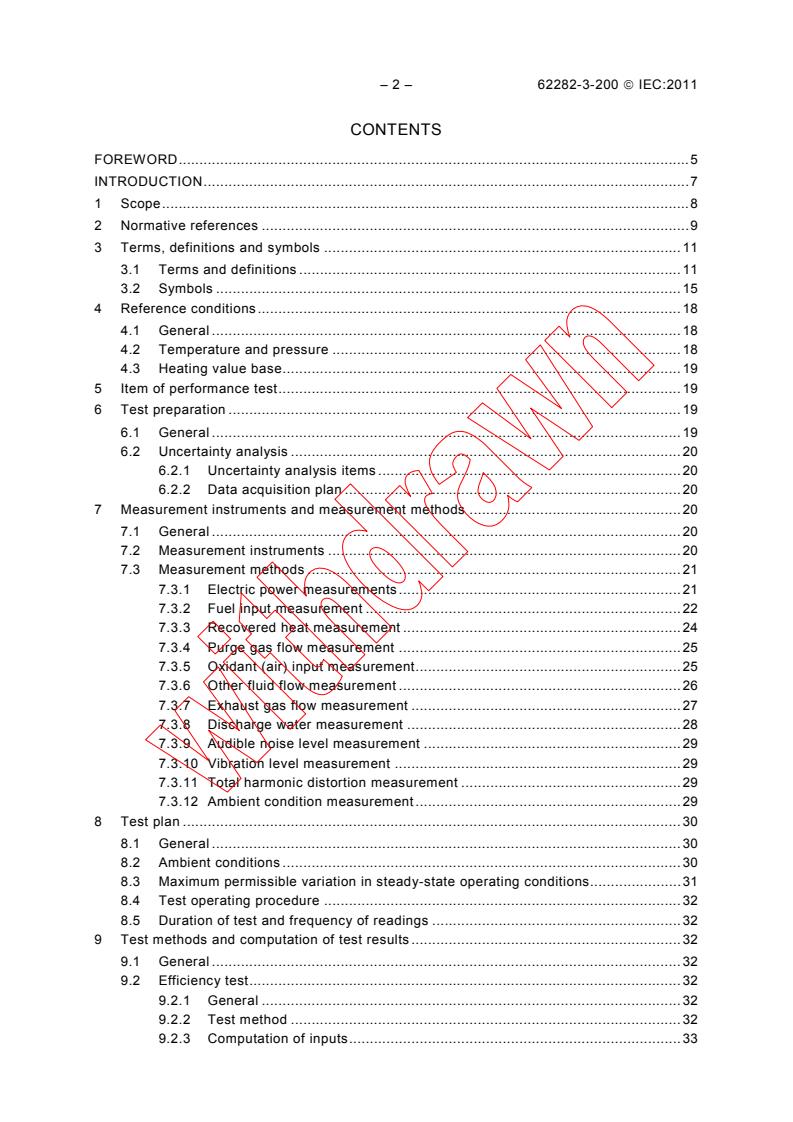
– 2 – 62282-3-200 IEC:2011
CONTENTS
FOREWORD . 5
INTRODUCTION . 7
1 Scope . 8
2 Normative references . 9
3 Terms, definitions and symbols . 11
3.1 Terms and definitions . 11
3.2 Symbols . 15
4 Reference conditions . 18
4.1 General . 18
4.2 Temperature and pressure . 18
4.3 Heating value base . 19
5 Item of performance test . 19
6 Test preparation . 19
6.1 General . 19
6.2 Uncertainty analysis . 20
6.2.1 Uncertainty analysis items . 20
6.2.2 Data acquisition plan . 20
7 Measurement instruments and measurement methods . 20
7.1 General . 20
7.2 Measurement instruments . 20
7.3 Measurement methods . 21
7.3.1 Electric power measurements . 21
7.3.2 Fuel input measurement . 22
7.3.3 Recovered heat measurement . 24
7.3.4 Purge gas flow measurement . 25
7.3.5 Oxidant (air) input measurement . 25
7.3.6 Other fluid flow measurement . 26
7.3.7 Exhaust gas flow measurement . 27
7.3.8 Discharge water measurement . 28
7.3.9 Audible noise level measurement . 29
7.3.10 Vibration level measurement . 29
7.3.11 Total harmonic distortion measurement . 29
7.3.12 Ambient condition measurement . 29
8 Test plan . 30
8.1 General . 30
8.2 Ambient conditions . 30
8.3 Maximum permissible variation in steady-state operating conditions . 31
8.4 Test operating procedure . 32
8.5 Duration of test and frequency of readings . 32
9 Test methods and computation of test results . 32
9.1 General . 32
9.2 Efficiency test . 32
9.2.1 General . 32
9.2.2 Test method . 32
9.2.3 Computation of inputs . 33
62282-3-200 IEC:2011 – 3 –
9.2.4 Computation of output . 42
9.2.5 Computation of efficiencies . 44
9.3 Electric power and thermal power response characteristics test . 44
9.3.1 General . 44
9.3.2 Electric power output response time . 49
9.3.3 Thermal power output response time . 53
9.4 Start-up and shutdown characteristics test . 56
9.5 Purge gas consumption test . 56
9.6 Water consumption test . 57
9.7 Waste heat test . 57
9.8 Exhaust gas emission test . 57
9.8.1 General . 57
9.8.2 Calculation of emissions . 57
9.9 Audible noise level test . 58
9.10 Vibration level test . 58
9.11 Discharge water quality test . 59
10 Test reports . 59
10.1 General . 59
10.2 Title page . 59
10.3 Table of contents . 59
10.4 Summary report . 59
10.5 Detailed report . 60
10.6 Full report . 60
Annex A (normative) Uncertainty analysis . 61
Annex B (normative) Calculation of fuel heating value . 76
Annex C (normative) Reference gas . 79
Bibliography . 82
Figure 1 – Fuel cell power system diagram . 9
Figure 2 – Symbol diagram . 18
Figure 3 – Operating process chart of fuel cell power system . 45
Figure 4 – Net electric and thermal power response time ramp rates . 46
Figure 5 – Example for net electric and thermal power response time ramp rates to
attain stable state . 47
Figure 6 – 90 % response time ramp rates . 48
Table 1 – Symbols . 15
Table 2 – Test classification and test item . 19
Table 3 – Test item and system status . 30
Table 4 – Maximum permissible variations in test operating conditions . 31
Table 5 – Vibration correction factors. 59
Table A.1 – Summary of measurement parameters and their nominal values . 66
Table A.2 – Nominal values of the calculation results. 66
Table A.3 – Elemental error sources for the various parameters . 67
Table A.4 – Absolute systematic uncertainty (B ) and absolute random uncertainty (2S ) . 69
i xi
Table A.5 – Sensitivity coefficients for the parameter P . 71
i
– 4 – 62282-3-200 IEC:2011
Table A.6 – Propagated systematic uncertainty B and random uncertainty 2S . 72
R R
Table A.7 – Total absolute uncertainty of the result U and per cent uncertainty of
R95
U of electric efficiency . 74
R95
Table B.1 – Heating value for component of gaseous fuel . 76
Worksheet 1 – Calculation worksheet for energy of fuel gases . 77
Worksheet 2 – Calculation worksheet for energy of air . 78
Table C.1 – Reference gas for natural gas . 80
Table C.2 – Reference gas for propane gas . 80
62282-3-200 IEC:2011 – 5 –
INTERNATIONAL ELECTROTECHNICAL COMMISSION
____________
FUEL CELL TECHNOLOGIES –
Part 3-200: Stationary fuel cell power systems –
Performance test methods
FOREWORD
1) The International Electrotechnical Commission (IEC) is a worldwide organization for standardization comprising
all national electrotechnical committees (IEC National Committees). The object of IEC is to promote
international co-operation on all questions concerning standardization in the electrical and electronic fields. To
this end and in addition to other activities, IEC publishes International Standards, Technical Specifications,
Technical Reports, Publicly Available Specifications (PAS) and Guides (hereafter referred to as “IEC
Publication(s)”). Their preparation is entrusted to technical committees; any IEC National Committee interested
in the subject dealt with may participate in this preparatory work. International, governmental and non-
governmental organizations liaising with the IEC also participate in this preparation. IEC collaborates closely
with the International Organization for Standardization (ISO) in accordance with conditions determined by
agreement between the two organizations.
2) The formal decisions or agreements of IEC on technical matters express, as nearly as possible, an international
consensus of opinion on the relevant subjects since each technical committee has representation from all
interested IEC National Committees.
3) IEC Publications have the form of recommendations for international use and are accepted by IEC National
Committees in that sense. While all reasonable efforts are made to ensure that the technical content of IEC
Publications is accurate, IEC cannot be held responsible for the way in which they are used or for any
misinterpretation by any end user.
4) In order to promote international uniformity, IEC National Committees undertake to apply IEC Publications
transparently to the maximum extent possible in their national and regional publications. Any divergence
between any IEC Publication and the corresponding national or regional publication shall be clearly indicated in
the latter.
5) IEC itself does not provide any attestation of conformity. Independent certification bodies provide conformity
assessment services and, in some areas, access to IEC marks of conformity. IEC is not responsible for any
services carried out by independent certification bodies.
6) All users should ensure that they have the latest edition of this publication.
7) No liability shall attach to IEC or its directors, employees, servants or agents including individual experts and
members of its technical committees and IEC National Committees for any personal injury, property damage or
other damage of any nature whatsoever, whether direct or indirect, or for costs (including legal fees) and
expenses arising out of the publication, use of, or reliance upon, this IEC Publication or any other IEC
Publications.
8) Attention is drawn to the Normative references cited in this publication. Use of the referenced publications is
indispensable for the correct application of this publication.
9) Attention is drawn to the possibility that some of the elements of this IEC Publication may be the subject of
patent rights. IEC shall not be held responsible for identifying any or all such patent rights.
International Standard IEC 62282-3-200 has been prepared by IEC technical committee 105:
Fuel cell technologies.
This first edition of IEC 62282-3-200 cancels and replaces the first edition of IEC 62282-3-2,
published in 2006, and constitutes a technical as well as a structural revision.
The principal changes in this first edition of IEC 62282-3-200 as compared with the first
edition of IEC 62282-3-2 aim to harmonize with ASME PTC-50. They are as follows:
– the equations for efficiency calculation are changed from power-base to average power-
base, which is obtained by dividing energy by test duration;
– the duration of the test and frequency of reading are changed;
– the efficiency test at partial load is no longer mandatory. Whether or not to conduct the
test at partial load should be determined by the parties conducting the tests;
– 6 – 62282-3-200 IEC:2011
– the flow rate measurement method is modified. Both mass flow rate and volume flow rate
are used for calculations of efficiency;
– the thermal energy input and mechanical energy input are incorporated into efficiency
calculations.
The development of an independent standard on performance test methods of small
stationary fuel cell power systems is currently under way (future IEC 62282-3-201). It will be
harmonized with this standard.
The text of this standard is based on the following documents:
FDIS Report on voting
105/340/FDIS 105/349/RVD
Full information on the voting for the approval of this standard can be found in the report on
voting indicated in the above table.
This publication has been drafted in accordance with the ISO/IEC Directives, Part 2.
A list of all the parts in the IEC 62282 series, published under the general title Fuel cell
technologies, can be found on the IEC website.
The committee has decided that the contents of this publication will remain unchanged until
the stability date indicated on the IEC web site under "http://webstore.iec.ch" in the data
related to the specific publication. At this date, the publication will be
• reconfirmed,
• withdrawn,
• replaced by a revised edition, or
• amended.
IMPORTANT – The 'colour inside' logo on the cover page of this publication indicates
that it contains colours which are considered to be useful for the correct understanding
of its contents. Users should therefore print this document using a colour printer.
62282-3-200 IEC:2011 – 7 –
INTRODUCTION
This part of IEC 62282 describes how to measure the performance of stationary fuel cell
power systems for residential, commercial, agricultural and industrial applications.
The following fuel cell types have been considered:
– alkaline fuel cells (AFC),
– phosphoric acid fuel cells (PAFC),
– polymer electrolyte fuel cells (PEFC),
– molten carbonate fuel cells (MCFC);
– solid oxide fuel cells (SOFC).
– 8 – 62282-3-200 IEC:2011
FUEL CELL TECHNOLOGIES –
Part 3-200: Stationary fuel cell power systems –
Performance test methods
1 Scope
This part of IEC 62282 covers operational and environmental aspects of the stationary fuel
cell power systems performance. The test methods apply as follows:
– power output under specified operating and transient conditions;
– electric and thermal efficiency under specified operating conditions;
– environmental characteristics; for example, gas emissions, noise, etc. under specified
operating and transient conditions.
This standard does not provide coverage for electromagnetic compatibility (EMC).
This standard does not apply to small stationary fuel cell power systems with electric power
output of less than 10 kW which will be dealt with in the future IEC 62282-3-201.
Fuel cell power systems may have different subsystems depending upon types of fuel cell and
applications, and they have different streams of material and energy into and out of them.
However, a common system diagram and boundary has been defined for evaluation of the
fuel cell power system (see Figure 1).
The following conditions are considered in order to determine the test boundary of the fuel
cell power system:
– all energy recovery systems are included within the test boundary;
– all kinds of electric energy storage devices are considered outside the test boundary;
– calculation of the heating value of the input fuel (such as natural gas, propane gas and
pure hydrogen gas, etc.) is based on the conditions of the fuel at the boundary of the fuel
cell power system.
62282-3-200 IEC:2011 – 9 –
Test boundary
Power inputs:
electric, secondary
thermal, shaft work
Recovered heat
Thermal
management
system
Waste heat
Fuel
Fuel
processing
Useable power
Fuel
system
cell electric
Power
module
conditioning
system
Oxidant
Oxidant
processing Water
system treatment
Water Internal power
Discharge
system
needs
water
Inert Gas
Exhaust gases,
ventilation
Automatic
Ventilation
Ventilation
control
system
system
1 EMI
EMD
Noise,
Vibration,
vibration
wind, rain,
temperature
IEC 2330/11
etc.
Key
: Fuel cell power system including subsystems. The interface is defined as a conceptual or
functional one instead of hardware such as a power package.
: Subsystems; fuel cell module, fuel processor, etc. These subsystem configurations depend on
the kind of fuel, type of fuel cell or system.
: The interface points in the boundary to be measured for calculation data.
EMD : electromagnetic disturbance
EMI : electromagnetic interference
Figure 1 – Fuel cell power system diagram
2 Normative references
The following referenced documents are indispensable for the application of this document.
For dated references, only the edition cited applies. For undated references, the latest edition
of the referenced document (including any amendments) applies.
IEC 60051 (all parts), Direct acting indicating analogue electrical measuring instruments and
their accessories
IEC 60359, Electrical and electronic equipment – Expression of performance
IEC 60688, Electrical measuring transducers for converting a.c. electrical quantities to
analogue or digital signals
IEC 61000-4-7, Electromagnetic compatibility (EMC) – Part 4-7: Testing and measurement
techniques – General guide on harmonics and interharmonics measurements and
instrumentation, for power supply systems and equipment connected thereto
– 10 – 62282-3-200 IEC:2011
IEC 61000-4-13, Electromagnetic compatibility (EMC) – Part 4-13: Testing and measurement
techniques – Harmonics and interharmonics including mains signalling at a.c. power port, low
frequency immunity tests
IEC 61028, Electrical measuring instruments – X-Y recorders
IEC 61143 (all parts), Electrical measuring instruments – X-t recorders
IEC 61672-1, Electroacoustics – Sound level meters – Part 1: Specifications
IEC 61672-2, Electroacoustics – Sound level meters – Part 2: Pattern evaluation tests
IEC 62052-11, Electricity metering equipment (AC) – General requirements, tests and test
conditions – Part 11: Metering equipment
IEC 62053-22, Electricity metering equipment (a.c.) – Particular requirements – Part 22: Static
meters for active energy (classes 0,2 S and 0,5 S)
ISO/IEC Guide 98-3, Uncertainty of measurement – Part 3: Guide to the expression of
uncertainty in measurement (GUM:1995)
ISO 3648, Aviation fuels – Estimation of net specific energy
ISO 3744, Acoustics – Determination of sound power levels and sound energy levels of noise
sources using sound pressure – Engineering methods for an essentially free field over a
reflecting plane
ISO 4677-1, Atmospheres for conditioning and testing – Determination of relative humidity –
Part 1: Aspirated psychrometer method
ISO 4677-2, Atmospheres for conditioning and testing – Determination of relative humidity –
Part 2: Whirling psychrometer method
ISO 5167 (all parts), Measurement of fluid flow by means of pressure differential devices
inserted in circular cross-section conduits running full
ISO 5348, Mechanical vibration and shock – Mechanical mounting of accelerometers
ISO 6060, Water quality – Determination of the chemical oxygen demand
ISO 6326 (all parts), Natural gas − Determination of sulfur compounds
ISO 6974 (all parts), Natural gas − Determination of composition with defined uncertainty by
gas chromatography
ISO 6975 (all parts), Natural gas − Extended analysis – Gas chromatographic method
ISO 7934, Stationary source emissions – Determination of the mass concentration of sulfur
dioxide – Hydrogen peroxide/barium perchlorate/Thorin method
ISO 7935, Stationary source emissions – Determination of the mass concentration of sulfur
dioxide – Performance characteristics of automated measuring methods
ISO 8217, Petroleum products – Fuel (class F) − Specifications of marine fuels
62282-3-200 IEC:2011 – 11 –
ISO 9000, Quality management systems – Fundamentals and vocabulary
ISO 9096, Stationary source emissions – Manual determination of mass concentration of
particulate matter
ISO 10101 (all parts), Natural gas − Determination of water by the Karl Fisher method
ISO 10396, Stationary source emissions – Sampling for the automated determination of gas
concentrations for permanently installed monitoring systems
ISO 10523, Water quality – Determination of pH
ISO 10707, Water quality – Evaluation in an aqueous medium of the "ultimate" aerobic
biodegradability of organic compounds – Method by analysis of biochemical oxygen demand
(closed bottle test)
ISO 10780, Stationary source emissions – Measurement of velocity and volume flowrate of
gas streams in ducts
ISO 10849, Stationary source emissions – Determination of the mass concentration of
nitrogen oxides – Performance characteristics of automated measuring systems
ISO 11042-1, Gas turbines – Exhaust gas emission – Part 1: Measurement and evaluation
ISO 11042-2, Gas turbines – Exhaust gas emission – Part 2: Automated emission monitoring
ISO 11541, Natural gas – Determination of water content at high pressure
ISO 11564, Stationary source emissions – Determination of the mass concentration of
nitrogen oxides – Naphthylethylenediamine photometric method
ISO 14687, Hydrogen fuel – Product specification
ISO/TR 15916, Basic consideration for the safety of hydrogen systems
ISO 16622, Meteorology – Sonic anemometer/thermometers – Acceptance test methods for
mean wind measurements
ASTM D4809-00, Standard Test Method for Heat of Combustion of Liquid Hydrocarbon Fuels
by Bomb Calorimeter (Precision Method)
ASTM F2602-08e1, Standard Test Method for Determining the Molar Mass of Chitosan and
Chitosan Salts by Size Exclusion Chromatography with Multi-angle Light Scattering Detection
(SEC-MALS)
ASME PTC 50, Performance Test Code 50 – Fuel Cell Power Systems Performance
3 Terms, definitions and symbols
3.1 Terms and definitions
For the purposes of this document, the following terms and definitions apply.
– 12 – 62282-3-200 IEC:2011
3.1.1
audible noise level
sound pressure level produced by a fuel cell power system measured at a specified distance
in all operation modes
NOTE Expressed in decibels (dB) and measured as described in this standard.
3.1.2
auxiliary electric input power
electric power for a parasitic load (3.1.18) supplied from outside the system
3.1.3
background noise level
sound pressure level of ambient noise at the measurement point
NOTE This measurement is taken as described in this standard with the fuel cell power system in the cold state.
3.1.4
background vibration level
mechanical oscillations caused by the environment that affect vibration level readings
NOTE Background vibration is measured with the fuel cell power system in the cold state.
3.1.5
cold state
condition of a fuel cell power system at ambient temperature with no power input or output
3.1.6
discharge water
water that is discharged from the fuel cell power system
3.1.7
electric efficiency (of a fuel cell power system)
ratio of the net electric-power produced by a fuel cell power system to the total energy flow
supplied to the fuel cell power system
NOTE Any electric power that is supplied to a parasitic load of a fuel cell power system from an external source is
deducted from the electric power output of the fuel cell power system.
3.1.8
emission characteristics
concentrations of total sulfur oxides (SO ), total nitrogen oxides (NO ), carbon dioxide (CO ),
x x 2
carbon monoxide (CO), total hydrocarbon compounds and particulate in the exhaust gas
NOTE Measured at the point of discharge to the environment as described in this standard.
3.1.9
fuel cell module
assembly incorporating one or more fuel cell stacks and other main and, if applicable,
additional components, which is intended to be integrated into a power plant or a vehicle
NOTE A fuel cell module is comprised of the following main components: one or more fuel cell stack(s), a piping
system for conveying fuels, oxidants and exhausts, electric connections for the power delivered by the stack(s) and
means for monitoring and/or control. Additionally, a fuel cell module may comprise: means for conveying additional
fluids (e.g. cooling media, inert gas), means for detecting normal and/or abnormal operating conditions, enclosures
or pressure vessels and module ventilation systems.
3.1.10
fuel cell power system
generator system that uses one or more fuel cell module(s) to generate electric power and
heat
62282-3-200 IEC:2011 – 13 –
NOTE A fuel cell power system is composed of all or some of the following subsystems: one or more fuel cell
modules, a fuel processing system, a power conditioning system, a thermal management system, and other
subsystems as needed. A generic fuel cell power system is shown in Figure 1.
3.1.11
fuel input
amount of natural gas, hydrogen, methanol, liquid petroleum gas, propane, butane, or other
material containing chemical energy consumed by the fuel cell power system during specified
operating conditions
3.1.12
heat recovery efficiency (of a fuel cell power system)
ratio of the average recovered thermal power to the average total power input
3.1.13
interface point
measurement point at the boundary of a fuel cell power system at which material and/or
energy either enters or leaves
NOTE This boundary is intentionally selected to accurately measure the performance of the system. If necessary,
the boundary or the interface points of the fuel cell power system (Figure 1) to be assessed should be determined
by agreement among the parties.
3.1.14
minimum power
minimum net power output at which a fuel cell power system is able to operate continuously in
a stable manner
3.1.15
operating temperature
temperature at which fuel cell power system operates and is specified with a measuring point
by the manufacturer
3.1.16
overall energy efficiency (of fuel cell power system)
ratio of total average useable net power output (electric and thermal power) to the average
total power input
3.1.17
oxidant (air) input
amount of oxygen consumed inside the fuel cell module during specified operating conditions
3.1.18
parasitic load
power consumed by auxiliary machines and equipments such as balance of plant (BOP)
necessary to operate a fuel cell power system
3.1.19
power response time
duration between the instant of initiating a change of electric or thermal power output and
when the electric or thermal output power attains the steady state set value within tolerance
3.1.20
90 % power response time
duration between the instant of initiating a change of electric or thermal power output and
when the electric or thermal output power attains 90 % of the desired value
3.1.21
pressure
pressure of gas or liquid measured in the fuel cell power system
– 14 – 62282-3-200 IEC:2011
NOTE ISO recommends using absolute pressure. If gauge pressure is used, it should be so noted.
3.1.22
purge gas consumption
amount of inert gas or dilution gas supplied to the fuel cell power system during specific
conditions to make it ready for operation or shutdown
3.1.23
recovered heat (of a fuel cell power system)
thermal energy recuperated from the fuel cell power system
NOTE The recovered heat is measured by determining the temperatures and flow rates of heat recovery fluid
(water, steam, air or oil, etc.), entering and leaving the thermal energy recovery subsystem at the interface point of
the fuel cell power system.
3.1.24
reference condition
values of influence quantities prescribed for testing the performance of a measuring
instrument, which in this document are 288,15 K (15 °C) for temperature and 101,325 kPa for
pressure
3.1.25
response time to rated power
duration between the instant when the step load change to rated power is initiated and the
first instant when this value is delivered
3.1.26
secondary thermal power
additional heat inputs to the test boundary which should be accounted for, such as cycle
make-up and process condensate return
3.1.27
shaft work
mechanical energy crossing the power system boundary for accomplishing useful work
3.1.28
shutdown time
duration between the instant when the load is removed at rated power and the instant when
the shutdown is completed as specified by the manufacturer
NOTE The shutdown operation is classified into types: normal shutdown and emergency shutdown.
3.1.29
standby state
idle state
state of a fuel cell power system being at sufficient operating temperature and in such an
operational mode, with zero electric output power, that the fuel cell power system is capable
of being promptly switched to an operational state with substantial electric active output
power
3.1.30
start-up energy
sum of the electric, thermal, and/or chemical (fuel) energy required by a fuel cell power
system during the start-up time
3.1.31
start-up time
(for fuel cell power systems that do not require external power) duration required for
transitioning from cold state to net electric power output to maintain a storage state
62282-3-200 IEC:2011 – 15 –
NOTE For a system that requires external power to maintain a storage state, the start-up time is the duration
required for transitioning from storage state to net electric power output.
3.1.32
storage state
state of a fuel cell power system being non-operational and possibly requiring, under
conditions specified by the manufacturer, the input of thermal and/or electric energy and/or an
inert atmosphere in order to prevent deterioration of the components and/or to energize the
control systems
3.1.33
test run
time interval during which data points required for the computation of test results are recorded
NOTE Recorded results are computed based on these data points.
3.1.34
vibration level
maximum measurement value of mechanical oscillations produced by the fuel cell power
system during operation
NOTE This is a value expressed in decibels (dB) as described in this standard.
3.1.35
waste heat
thermal energy released and not recovered
3.1.36
water consumption
water supplied (from outside the test boundary) to the power system other than initial fill
3.2 Symbols
The symbols and their meanings used in this part of IEC 62282 are given in Table 1, with the
appropriate units.
Table 1 – Symbols
Symbol Definition Unit
q Volumetric flow rate
v
Average volumetric flow rate of fuel at average temperature t and average
f
q m /s
vf
pressure p
f
q Average volumetric flow rate of fuel under reference conditions m /s
vf0
Average volumetric flow rate of oxidant (air) at average temperature t and
a
q m /s
va
average pressure p
a
q Average volumetric flow rate of oxidant (air) under reference conditions m /s
va0
q Volumetric flow rate of heat recovery fluid m /s
vHRr
q Volumetric flow rate of exhaust gas m /s
ve
q Volumetric flow rate of water at process temperature and pressure m /s
vw
–2 3
Reference molar volume of ideal gas (2,364 5 × 10 m /mol) (at reference
M m /mol
o
temperature: t = 288,15 K)
T Measurement interval s
int
q Mass flow rate
m
q Average mass flow rate of fuel kg/s
mf
q Average mass flow rate of oxidant (air) kg/s
ma
q Mass flow rate of specified gas component in the exhaust gas kg/s
me
– 16 – 62282-3-200 IEC:2011
Symbol Definition Unit
q Mass flow rate of heat recovery fluid kg/s
mHR
Mass of heat transfer fluid (steam, air, etc.) into (and out of) the fuel cell power
M kg
htf
system from the source of secondary thermal energy during the test period
M
Molar mass of oxidant (air) kg/mol
m
P Electric power
P Average electric power output (including direct current) kW
out
Average auxiliary electric power input to parasitic loads from external power
P kW
in
source(s) (including direct current)
P
Average net electric power output kW
n
Net electric power output at the low net electric power level representing a
P
decrease corresponding to 90 % of the total downward difference between rated W, kW
electric power and minimum electric power
P Net electric power output at 90 % of rated net electric power output W, kW
P Minimum net electric power output W, kW
min
P Rated net electric power output W, kW
rated
Pressure
p
p Reference pressure kPa
p Average pressure of fuel during the test duration kPa
f
p
Average pressure of oxidant (air) during the test duration kPa
a
t Temperature
t Reference temperature K
t Average temperature of fuel during the test duration K
f
t Average temperature of oxidant (air) during the test duration K
a
t Temperature of heat recovery fluid output K
HR1
t Temperature of heat recovery fluid input K
HR2
ρ Density
ρ Density of raw fuel under reference conditions kg/m
f0
Density of liquid fuel at average temperature t kg/m
ρ
f
f
ρ Density of oxidant (air) under reference conditions kg/m
a0
ρ Mass concentration of specified gas component kg/m
e
Heat recovery fluid density at measured pressure and temperature kg/m
ρ
HR
x Molar ratio of component j, as given in worksheet of Annex B –
j
Q Heating value
Q Heating value of fuel under reference conditions kJ/mol
fo
Q Heating value of liquid fuel at average temperature t kJ/kg
x f
Q Heating value of component j at reference temperature t kJ/mol
f0j 0
Q Waste heat rate kJ/s
WH
S Specific heat of heat recovery fluid kJ/kg×K
HR
S Specific heat of pure component j kJ/kg×K
j
H,h Enthalpy, specific enthalpy
h Specific enthalpy of fuel at average temperature t kJ/mol
f f
h Specific enthalpy of fuel at the reference temperature t
kJ/mol
f0 0
h Specific enthalpy of oxidant (air) at average temperature t kJ/mol
a a
h Specific enthalpy of oxidant (air) at the reference temperature t kJ/mol
ao 0
h Specific enthalpy of component j at average temperature t kJ/mol
fj f
62282-3-200 IEC:2011 – 17 –
Symbol Definition Unit
Average enthalpy of heat transfer fluid (steam, air, etc.) entering the fuel cell
H
kJ/kg
in
power system during the test period
Average enthalpy of heat transfer fluid (steam, air, etc.) exiting the fuel cell
H
kJ/kg
out
power system during the test period
E, Q, W Input energy and power
E
Input energy of fuel per mol, as given in worksheet 1 of Annex B kJ/mol
f
E Input energy of the fuel per unit volume kJ/m
fv
E Input energy of the fuel per unit mas
...