

IEC 63159-2-1:2021
(Main)Household electric instantaneous water heaters - Methods for measuring the performance - Part 2-1: Multifunctional electric instantaneous water heaters
General Information
- Abstract
IEC 63159-2-1:2021 applies to electric instantaneous water heaters designed to operate as multifunctional appliances with an electric rated power > 2 kW.
This document specifies tests for the assessment of the performance.
This International Standard is to be used in conjunction with IEC 63159-1:2021.
- Status
- Published
- Publication Date
- 20-Oct-2021
- Technical Committee
- SC 59C - Electrical heating appliances for household and similar purposes
- Drafting Committee
- WG 3 - TC 59/SC 59C/WG 3
- Current Stage
- PPUB - Publication issued
- Start Date
- 21-Oct-2021
- Completion Date
- 19-Nov-2021
Buy Documents
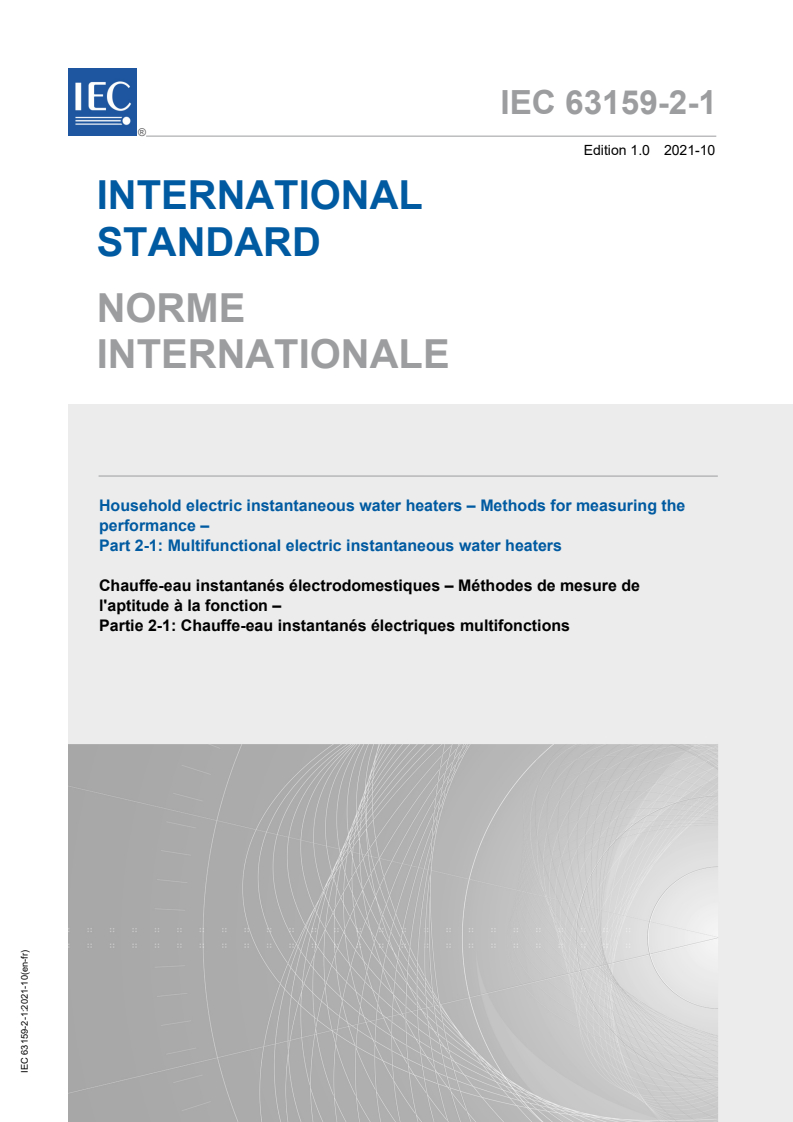
IEC 63159-2-1:2021 - Household electric instantaneous water heaters - Methods for measuring the performance - Part 2-1: Multifunctional electric instantaneous water heaters Released:10/21/2021
Overview
IEC 63159-2-1:2021 is an international standard published by the International Electrotechnical Commission (IEC) that specifies standardized methods for measuring the performance of household electric instantaneous water heaters, specifically those designed as multifunctional appliances with an electric rated power exceeding 2 kW. This document is a crucial reference for manufacturers, testing organizations, and regulatory bodies seeking to ensure consistent, reliable, and comparable performance assessment of electric instantaneous water heaters that serve multiple domestic purposes, such as kitchens, bathrooms, and showers.
IEC 63159-2-1:2021 is intended to be used in conjunction with IEC 63159-1:2021, which establishes general aspects and definitions for household electric instantaneous water heaters.
Key Topics
Scope and Applicability
- Applies to multifunctional electric instantaneous water heaters used in household environments, with a focus on models that supply more than one outlet (e.g., kitchen sinks, showers, hand-washing basins, bathtubs).
- Targets appliances with an electric rated power greater than 2 kW, commonly used in modern residential and similar installation contexts.
Performance Assessment
- Defines a range of performance tests for determining the efficiency, flow rate, response time, and behavior under varying operational conditions.
- Specifies the test setup, including standard water inlet temperature ranges, flow and pressure requirements, and measurement techniques.
- Outlines detailed conditions for setting temperature and power selectors during testing to ensure comparability.
Key Definitions and Metrics
- Introduces terms such as setpoint value, pressure drop, response time, flow rate, and heating-up duration-all critical for proper evaluation and reporting.
- Establishes standardized methods for measuring energy efficiency and consumption, laying out clear formulas and classification factors (CF) to distinguish between types of water heater technology (such as hydraulic vs. electronic control).
- Classifies heaters into H class (hydraulic) and E class (electronic/smart), based on comparative energy performance.
Applications
IEC 63159-2-1:2021 is essential for a variety of stakeholders in the electric water heating sector:
- Manufacturers: Ensures that product claims on energy performance and water flow meet globally recognized standards, aiding in product development and international market entry.
- Testing Laboratories and Certification Bodies: Provides a rigorous, repeatable methodology for certifying and comparing electric instantaneous water heaters, leveling the playing field and supporting regulatory compliance.
- Regulatory Agencies: Supports the creation and enforcement of national energy labeling and ecodesign requirements for household water heaters.
- Installers and Engineers: Assists in selecting appropriate appliances based on credible performance data for multi-outlet, high-demand domestic environments.
- Consumers: Promotes confidence in the appliance's ability to deliver efficient hot water to multiple fixtures simultaneously while ensuring energy savings.
Related Standards
The following international standards are closely related to IEC 63159-2-1:2021 and are often used in conjunction with it:
- IEC 63159-1:2021: General aspects for household electric instantaneous water heaters; forms the foundational base for all subsequent parts, including 2-1.
- IEC 60335 series: Household and similar electrical appliances - Safety; complements performance standards with safety requirements.
- IEC 60730 series: Automatic electrical controls for household and similar use; relevant for electronic control aspects within water heaters.
Practical Value
Adhering to IEC 63159-2-1:2021 ensures that household multifunctional electric instantaneous water heaters are tested in a manner that is consistent, reproducible, and recognized internationally. This supports energy efficiency initiatives, consumer protection, and global trade of compliant water heating appliances. By specifying clear testing conditions, measurement procedures, and classification criteria, this standard empowers all actors in the household appliance sector to deliver, certify, and utilize products that meet modern expectations for performance, safety, and sustainability.
Buy Documents
IEC 63159-2-1:2021 - Household electric instantaneous water heaters - Methods for measuring the performance - Part 2-1: Multifunctional electric instantaneous water heaters Released:10/21/2021
Get Certified
Connect with accredited certification bodies for this standard

DIBt (Deutsches Institut für Bautechnik)
German Institute for Building Technology.
DIN CERTCO
DIN Group product certification.

Aboma Certification B.V.
Specialized in construction, metal, and transport sectors.
Sponsored listings
Frequently Asked Questions
IEC 63159-2-1:2021 is a standard published by the International Electrotechnical Commission (IEC). Its full title is "Household electric instantaneous water heaters - Methods for measuring the performance - Part 2-1: Multifunctional electric instantaneous water heaters". This standard covers: IEC 63159-2-1:2021 applies to electric instantaneous water heaters designed to operate as multifunctional appliances with an electric rated power > 2 kW. This document specifies tests for the assessment of the performance. This International Standard is to be used in conjunction with IEC 63159-1:2021.
IEC 63159-2-1:2021 applies to electric instantaneous water heaters designed to operate as multifunctional appliances with an electric rated power > 2 kW. This document specifies tests for the assessment of the performance. This International Standard is to be used in conjunction with IEC 63159-1:2021.
IEC 63159-2-1:2021 is classified under the following ICS (International Classification for Standards) categories: 91.140.65 - Water heating equipment. The ICS classification helps identify the subject area and facilitates finding related standards.
IEC 63159-2-1:2021 is available in PDF format for immediate download after purchase. The document can be added to your cart and obtained through the secure checkout process. Digital delivery ensures instant access to the complete standard document.
Standards Content (Sample)
IEC 63159-2-1 ®
Edition 1.0 2021-10
INTERNATIONAL
STANDARD
NORME
INTERNATIONALE
Household electric instantaneous water heaters – Methods for measuring the
performance –
Part 2-1: Multifunctional electric instantaneous water heaters
Chauffe-eau instantanés électrodomestiques – Méthodes de mesure de
l'aptitude à la fonction –
Partie 2-1: Chauffe-eau instantanés électriques multifonctions
All rights reserved. Unless otherwise specified, no part of this publication may be reproduced or utilized in any form
or by any means, electronic or mechanical, including photocopying and microfilm, without permission in writing from
either IEC or IEC's member National Committee in the country of the requester. If you have any questions about IEC
copyright or have an enquiry about obtaining additional rights to this publication, please contact the address below or
your local IEC member National Committee for further information.
Droits de reproduction réservés. Sauf indication contraire, aucune partie de cette publication ne peut être reproduite
ni utilisée sous quelque forme que ce soit et par aucun procédé, électronique ou mécanique, y compris la photocopie
et les microfilms, sans l'accord écrit de l'IEC ou du Comité national de l'IEC du pays du demandeur. Si vous avez des
questions sur le copyright de l'IEC ou si vous désirez obtenir des droits supplémentaires sur cette publication, utilisez
les coordonnées ci-après ou contactez le Comité national de l'IEC de votre pays de résidence.
IEC Central Office Tel.: +41 22 919 02 11
3, rue de Varembé info@iec.ch
CH-1211 Geneva 20 www.iec.ch
Switzerland
About the IEC
The International Electrotechnical Commission (IEC) is the leading global organization that prepares and publishes
International Standards for all electrical, electronic and related technologies.
About IEC publications
The technical content of IEC publications is kept under constant review by the IEC. Please make sure that you have the
latest edition, a corrigendum or an amendment might have been published.
IEC publications search - webstore.iec.ch/advsearchform IEC online collection - oc.iec.ch
The advanced search enables to find IEC publications by a Discover our powerful search engine and read freely all the
variety of criteria (reference number, text, technical publications previews. With a subscription you will always
committee, …). It also gives information on projects, replaced have access to up to date content tailored to your needs.
and withdrawn publications.
Electropedia - www.electropedia.org
IEC Just Published - webstore.iec.ch/justpublished
The world's leading online dictionary on electrotechnology,
Stay up to date on all new IEC publications. Just Published
containing more than 22 000 terminological entries in English
details all new publications released. Available online and
and French, with equivalent terms in 18 additional languages.
once a month by email.
Also known as the International Electrotechnical Vocabulary
(IEV) online.
IEC Customer Service Centre - webstore.iec.ch/csc
If you wish to give us your feedback on this publication or
need further assistance, please contact the Customer Service
Centre: sales@iec.ch.
A propos de l'IEC
La Commission Electrotechnique Internationale (IEC) est la première organisation mondiale qui élabore et publie des
Normes internationales pour tout ce qui a trait à l'électricité, à l'électronique et aux technologies apparentées.
A propos des publications IEC
Le contenu technique des publications IEC est constamment revu. Veuillez vous assurer que vous possédez l’édition la
plus récente, un corrigendum ou amendement peut avoir été publié.
Recherche de publications IEC - IEC online collection - oc.iec.ch
webstore.iec.ch/advsearchform Découvrez notre puissant moteur de recherche et consultez
La recherche avancée permet de trouver des publications IEC gratuitement tous les aperçus des publications. Avec un
en utilisant différents critères (numéro de référence, texte, abonnement, vous aurez toujours accès à un contenu à jour
comité d’études, …). Elle donne aussi des informations sur adapté à vos besoins.
les projets et les publications remplacées ou retirées.
Electropedia - www.electropedia.org
IEC Just Published - webstore.iec.ch/justpublished
Le premier dictionnaire d'électrotechnologie en ligne au
Restez informé sur les nouvelles publications IEC. Just
monde, avec plus de 22 000 articles terminologiques en
Published détaille les nouvelles publications parues.
anglais et en français, ainsi que les termes équivalents dans
Disponible en ligne et une fois par mois par email.
16 langues additionnelles. Egalement appelé Vocabulaire
Electrotechnique International (IEV) en ligne.
Service Clients - webstore.iec.ch/csc
Si vous désirez nous donner des commentaires sur cette
publication ou si vous avez des questions contactez-nous:
sales@iec.ch.
IEC 63159-2-1 ®
Edition 1.0 2021-10
INTERNATIONAL
STANDARD
NORME
INTERNATIONALE
Household electric instantaneous water heaters – Methods for measuring the
performance –
Part 2-1: Multifunctional electric instantaneous water heaters
Chauffe-eau instantanés électrodomestiques – Méthodes de mesure de
l'aptitude à la fonction –
Partie 2-1: Chauffe-eau instantanés électriques multifonctions
INTERNATIONAL
ELECTROTECHNICAL
COMMISSION
COMMISSION
ELECTROTECHNIQUE
INTERNATIONALE
ICS 91.140.65 ISBN 978-2-8322-1040-6
– 2 – IEC 63159-2-1:2021 © IEC 2021
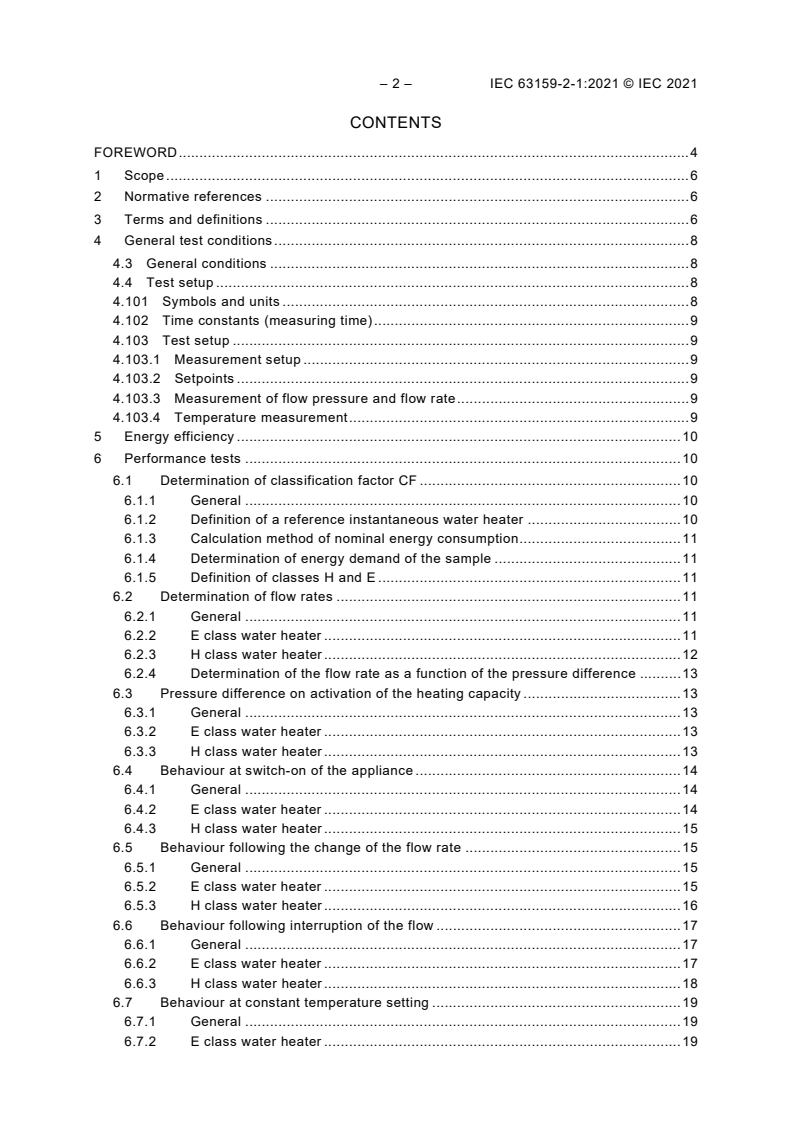
CONTENTS
FOREWORD . 4
1 Scope . 6
2 Normative references . 6
3 Terms and definitions . 6
4 General test conditions . 8
4.3 General conditions . 8
4.4 Test setup . 8
4.101 Symbols and units . 8
4.102 Time constants (measuring time) . 9
4.103 Test setup . 9
4.103.1 Measurement setup . 9
4.103.2 Setpoints . 9
4.103.3 Measurement of flow pressure and flow rate . 9
4.103.4 Temperature measurement . 9
5 Energy efficiency . 10
6 Performance tests . 10
6.1 Determination of classification factor CF . 10
6.1.1 General . 10
6.1.2 Definition of a reference instantaneous water heater . 10
6.1.3 Calculation method of nominal energy consumption . 11
6.1.4 Determination of energy demand of the sample . 11
6.1.5 Definition of classes H and E . 11
6.2 Determination of flow rates . 11
6.2.1 General . 11
6.2.2 E class water heater . 11
6.2.3 H class water heater . 12
6.2.4 Determination of the flow rate as a function of the pressure difference . 13
6.3 Pressure difference on activation of the heating capacity . 13
6.3.1 General . 13
6.3.2 E class water heater . 13
6.3.3 H class water heater . 13
6.4 Behaviour at switch-on of the appliance . 14
6.4.1 General . 14
6.4.2 E class water heater . 14
6.4.3 H class water heater . 15
6.5 Behaviour following the change of the flow rate . 15
6.5.1 General . 15
6.5.2 E class water heater . 15
6.5.3 H class water heater . 16
6.6 Behaviour following interruption of the flow . 17
6.6.1 General . 17
6.6.2 E class water heater . 17
6.6.3 H class water heater . 18
6.7 Behaviour at constant temperature setting . 19
6.7.1 General . 19
6.7.2 E class water heater . 19
6.7.3 H class water heater . 19
6.8 Behaviour following the change of the temperature selector setting . 19
6.8.1 General . 19
6.8.2 Electronically controlled appliances . 19
6.8.3 H class water heater . 20
6.9 Behaviour at voltage limits . 20
6.10 Additional tests for electronic instantaneous water heaters . 21
6.10.1 General . 21
6.10.2 Behaviour of the outlet temperature at decreasing water inlet
temperature . 21
6.10.3 Behaviour of the outlet temperature at changing water inlet temperature . 22
Annex A (normative) Load pattern . 23
Annex B (normative) Test setup . 24
Bibliography . 29
Figure B.101 – Single point (vented) . 24
Figure B.102 – Multi point (unvented) . 25
Figure B.103 – Test setup . 26
Figure B.104 – Damping device (Detail 4) . 27
Figure B.105 – Water connection part (Detail 5) . 27
Figure B.106 – Water connection part (Detail 6) . 28
Table 101 – Symbols and units . 8
Table 102 – Nominal values for E class water heater . 12
Table 103 – Nominal values for H class water heater . 12
Table 104 – Flow pressure and flow rate for multi point appliances . 13
Table 105 – Flow pressure and flow rate for single point appliances . 13
Table 106 – Pressure difference and flow rate . 13
Table 107 – Pressure difference and flow rate . 14
Table 108 – Behaviour at switch on of the appliance at different temperature selector
settings . 15
Table 109 – Behaviour at switch on of the appliance at different settings . 15
Table 110 – Behaviour following the change of the flow rate at different temperature
selector settings . 16
Table 111 – Behaviour following the change of the flow rate at different settings . 17
Table 112 – Behaviour following interruption of the flow . 18
Table 113 – Behaviour following interruption of the flow . 18
Table 114 – Behaviour at constant temperature setting . 19
Table 115 – Behaviour following the change of the temperature selector setting at a
flow rate of 50% . 20
Table 116 – Behaviour following the change of the temperature selector setting at a
flow rate of 100% . 20
Table 117 – Behaviour at voltage limits . 21
Table 118 – Behaviour of the outlet temperature at decreasing water inlet temperature . 22
Table 119 – Behaviour of the outlet temperature following the increase of the water
inlet temperature . 22
– 4 – IEC 63159-2-1:2021 © IEC 2021
INTERNATIONAL ELECTROTECHNICAL COMMISSION
____________
HOUSEHOLD ELECTRIC INSTANTANEOUS WATER HEATERS –
METHODS FOR MEASURING THE PERFORMANCE –
Part 2-1: Multifunctional electric instantaneous water heaters
FOREWORD
1) The International Electrotechnical Commission (IEC) is a worldwide organization for standardization comprising
all national electrotechnical committees (IEC National Committees). The object of IEC is to promote international
co-operation on all questions concerning standardization in the electrical and electronic fields. To this end and
in addition to other activities, IEC publishes International Standards, Technical Specifications, Technical Reports,
Publicly Available Specifications (PAS) and Guides (hereafter referred to as "IEC Publication(s)"). Their
preparation is entrusted to technical committees; any IEC National Committee interested in the subject dealt with
may participate in this preparatory work. International, governmental and non-governmental organizations liaising
with the IEC also participate in this preparation. IEC collaborates closely with the International Organization for
Standardization (ISO) in accordance with conditions determined by agreement between the two organizations.
2) The formal decisions or agreements of IEC on technical matters express, as nearly as possible, an international
consensus of opinion on the relevant subjects since each technical committee has representation from all
interested IEC National Committees.
3) IEC Publications have the form of recommendations for international use and are accepted by IEC National
Committees in that sense. While all reasonable efforts are made to ensure that the technical content of IEC
Publications is accurate, IEC cannot be held responsible for the way in which they are used or for any
misinterpretation by any end user.
4) In order to promote international uniformity, IEC National Committees undertake to apply IEC Publications
transparently to the maximum extent possible in their national and regional publications. Any divergence between
any IEC Publication and the corresponding national or regional publication shall be clearly indicated in the latter.
5) IEC itself does not provide any attestation of conformity. Independent certification bodies provide conformity
assessment services and, in some areas, access to IEC marks of conformity. IEC is not responsible for any
services carried out by independent certification bodies.
6) All users should ensure that they have the latest edition of this publication.
7) No liability shall attach to IEC or its directors, employees, servants or agents including individual experts and
members of its technical committees and IEC National Committees for any personal injury, property damage or
other damage of any nature whatsoever, whether direct or indirect, or for costs (including legal fees) and
expenses arising out of the publication, use of, or reliance upon, this IEC Publication or any other IEC
Publications.
8) Attention is drawn to the Normative references cited in this publication. Use of the referenced publications is
indispensable for the correct application of this publication.
9) Attention is drawn to the possibility that some of the elements of this IEC Publication may be the subject of patent
rights. IEC shall not be held responsible for identifying any or all such patent rights.
International Standard IEC 63159-2-1 has been prepared by subcommittee 59C: Electrical
heating appliances for household and similar purposes, of IEC technical committee 59:
Performance of household and similar electrical appliances.
The text of this International Standard is based on the following documents:
Draft Report on voting
59C/268/FDIS 59C/272/RVD
Full information on the voting for its approval can be found in the report on voting indicated in
the above table.
The language used for the development of this International Standard is English.
This document was drafted in accordance with ISO/IEC Directives, Part 2, and developed in
accordance with ISO/IEC Directives, Part 1 and ISO/IEC Directives, IEC Supplement, available
at www.iec.ch/members_experts/refdocs. The main document types developed by IEC are
described in greater detail at www.iec.ch/standardsdev/publications.
This International Standard is to be used in conjunction with IEC 63159-1:2021.
This standard supplements or modifies the corresponding clauses in IEC 63159-1. When a
particular subclause of IEC 63159-1 is not mentioned in this standard, that subclause is
applicable as far as reasonable. Where this standard states "addition", "modification" or
"replacement", the relevant requirements, test specifications or explanatory matter in
IEC 63159-1 should be adapted accordingly.
Subclauses or figures that are additional to those in IEC 63159-1 are numbered starting from
101. Additional annexes are lettered AA, BB, etc.
A list of all the parts in the IEC 63159 series, published under the general title Household
electric instantaneous water heaters – Methods for measuring the performance, can be found
on the IEC website.
The committee has decided that the contents of this document will remain unchanged until the
stability date indicated on the IEC website under webstore.iec.ch in the data related to the
specific document. At this date, the document will be
• reconfirmed,
• withdrawn,
• replaced by a revised edition, or
• amended.
– 6 – IEC 63159-2-1:2021 © IEC 2021
HOUSEHOLD ELECTRIC INSTANTANEOUS WATER HEATERS –
METHODS FOR MEASURING THE PERFORMANCE –
Part 2-1: Multifunctional electric instantaneous water heaters
1 Scope
This clause of IEC 63159-1:2021 is applicable with the following exception:
Addition:
This document applies to electrical instantaneous water heaters designed to operate as
multifunctional appliances with an electric rated power > 2 kW.
This document specifies tests for the assessment of the performance.
2 Normative references
This clause of IEC 63159-1:2021 is applicable with the following exception:
Addition:
IEC 63159-1:2021, Household electric instantaneous water heaters – Methods for measuring
the performance – Part 1: General aspects
3 Terms and definitions
This clause of IEC 63159-1 is applicable with the following exceptions:
Addition:
3.101
setpoint value
changeable value that is allocated to the appliance or the individual components thereof
3.102
pressure drop on activation of the heating capacity
pressure drop in the instantaneous water heater, at which the heating capacity is, and remains,
activated
3.103
90 % method
stop point of the measurement when 90% of value is reached
Note 1 to entry: Usually, a physical value reaches a final (average) value in an asymptotic manner. To reach a valid
measurement result, a stop point of the measurement has to be defined. The measurement is stopped when the
value finally reaches 90 % of the difference between the (average) starting value and the (average) final value.
3.104
10 %/90 % method
range between the start and stop points
Note 1 to entry: Usually, a physical value changes with a time delay in an asymptotic manner between the start
value and the final value. To reach a valid measurement result, a start point and a stop point have to be defined for
the measurement. The measurement is started when the physical value first reaches 10 % of the difference between
the (average) starting value and the (average) final value. The measurement is stopped when the value finally
reaches 90 % of the difference.
3.105
response time
time interval between the beginning of the changing of a value or parameter and the moment a
steady-state condition is obtained
Note 1 to entry: The 90 % method shall be used.
3.106
flow rate
rate at which water flows, expressed in l/min
3.107
heating-up duration
time interval between the opening of the withdrawal device and the obtainment of the final outlet
temperature
Note 1 to entry: The 90 % method shall be used.
3.108
pressure difference
difference between the pressure at the water inlet and the water outlet of the appliance at a
defined flow rate
– 8 – IEC 63159-2-1:2021 © IEC 2021
3.109
multifunctional appliances
instantaneous water heater that shall supply one or more outlets suitable for several functions,
for instance kitchen sinks, hand-washing sinks, showers and bathtubs
4 General test conditions
This clause of IEC 63159-1:2021 is applicable with the following exceptions:
4.3 General conditions
Modification:
The cold water temperature T shall be 15 °C ± 5 °C for the performance tests.
cold
4.4 Test setup
This subclause of IEC 63159-1:2021 is not applicable.
Addition:
4.101 Symbols and units
For the purposes of this document, the symbols and units of Table 101 apply.
Table 101 – Symbols and units
Symbol Unit Description
T °C The minimum setting of the temperature setting mechanism settable by user at which
min
the appliance heats.
If no user-accessible temperature selector is available, the relevant measurements
with T are not performed.
min
T °C Standard hot water temperature setpoint for various tests: 38 °C. If the temperature
setting mechanism settable by user does not permit an outlet temperature setting of
38 °C, a temperature as close as possible above 38 °C as possible shall be chosen.
This temperature shall be stated in the test report and shall be used for any further
measurements, instead of 38 °C.
The positions of the temperature setting mechanism shall be marked for reproducible
settings, taking into consideration the fact that T settings may depend on the
direction of the rotation of a knob.
If no user-accessible temperature selector is available, the temperature factory
setting is defined to be the T setting.
T °C The maximum setting of the temperature setting mechanism settable by the user.
max
If no user accessible temperature selector is available, the relevant measurements
with T are not performed.
max
T °C Temperature at the minimum permanent setting of the power selector settable by user
Pmin
at which the appliance heats.
If no user-accessible power selector is available, the relevant measurements with
T are not performed.
Pmin
T
°C Temperature at the maximum permanent setting of the power selector settable by
Pmax
user.
If no user-accessible power selector is available, the temperature factory setting is
defined to be the T setting.
Pmax
l/min The flow rate where the power consumption is 90 % of rated power at T and an inlet
V 38
90 % P
temperature of 15 °C.
Factor
K The correction value for V if the inlet temperature differs by more than 1 K from
V 90 % P
15 °C.
Symbol Unit Description
l/min The flow rate related to the outlet temperature of 38 °C.
V
T °C Temperature from which counting of useful energy content starts.
m
T
°C Minimum (peak) temperature to be achieved during tapping.
p
T °C Cold water inlet temperature.
cold
F l/min Minimum flow rate to be reached during tapping.
P kW Minimum required instantaneous heating power to fulfil tapping.
min
T S Tapping duration.
d
P kW Minimum requited heating power of the appliance.
real
P
kW Nominal heating power of the appliance.
nom
Q kWh Nominal daily energy consumption of the appliance.
nom
Q kWh Real daily energy consumption of the appliance.
r
4.102 Time constants (measuring time)
Time constants shall be determined by means of the 10 %/90 % method.
4.103 Test setup
4.103.1 Measurement setup
The appliance shall be fixed in accordance with the installation instructions.
The measurement setup shall correspond to Figure B.101 for open-outlet appliances (single
point) and to Figure B.102 for closed-outlet (multi point) appliances.
4.103.2 Setpoints
Unless no specific setpoints for the individual test are defined, all non-user adjustable set-points
shall be adjusted in accordance with the manufacturer's instructions for a standard setup.
User adjustable selectors have to be set as follows:
– If the appliance has a power selector, the selector shall be adjusted to the highest value.
– If the appliance has a temperature-independent flow selector, it shall be adjusted to the
highest value.
– If the appliance has a flow-independent temperature selector, it shall be adjusted to the
highest value.
– All other selectors shall be set in accordance with the manufacturer's instructions.
4.103.3 Measurement of flow pressure and flow rate
Flow pressure and flow rate shall be measured in accordance with Annex B. Flow pressure shall
be determined by measuring the pressure difference.
4.103.4 Temperature measurement
The inlet and outlet temperatures of the water shall be measured using the setup shown in
Figure B.103.
– 10 – IEC 63159-2-1:2021 © IEC 2021
5 Energy efficiency
This clause of IEC 63159-1:2021 is applicable.
Replacement:
6 Performance tests
6.1 Determination of classification factor CF
6.1.1 General
To test the performance of instantaneous water heaters, it is necessary to specify classes:
"H class" (e.g. hydraulic instantaneous water heaters) and "E class" (e.g. smart electronic
instantaneous water heaters).
The following procedure shall be used to determine the classification. For that, it is necessary
to define a reference instantaneous water heater.
6.1.2 Definition of a reference instantaneous water heater
For each single tapping, the minimum required instantaneous heating power P is calculated
ref,i
as:
P ΔT× f/ 14,3
ref ,i i i
Where
14,3 is the conversion factor between units;
f is the flowrate, in accordance with Annex A
i
ΔTT−T ;
iip, cold
T is the cold water temperature;
cold
T is the temperature, in accordance with Annex A. If not given, T shall be used.
p,i m,i
Every single tapping results in a tapping duration. The time t [s] is calculated as:
d
t 3 600×Q /P
d,i tap,i ref,i
Where
Q is in accordance with Annex A.
tap,i
The reference instantaneous water heater is defined as a typical hydraulic instantaneous water
heater with two power levels of 50 % and 100 % of the nominal power P of the sample.
nom
The assumed power control of the reference instantaneous water heater is defined as follows:
– P = P , if P of a single tapping is larger than 0,5 × P ;
real,i nom ref,i nom
– otherwise P = 0,5 × P .
real,i nom
where
is the maximum rated device power of the sample;
P
nom
=
=
=
P is the defined device power for the reference unit depending on the respective tapping;
real,i
P is the minimum device power for the reference unit needed to fulfill the respective
ref,i
tapping.
6.1.3 Calculation method of nominal energy consumption
For every single daily tapping, a nominal energy consumption Q [kWh] is calculated as
nom,i
follows:
tP×
d,iireal,
Q =
nom,i
3 600
where
P is the defined device power for the reference unit depending on the respective tapping
real,i
6.1.4 Determination of energy demand of the sample
The measuring is carried out in accordance with Annex A for every different single tapping event
of a daily pattern. The flow rate is increased from zero to at least f until the appliance switches
on. If the sample has a user-accessible temperature setpoint, the temperature setpoint of the
appliance is adjusted to reach at least T or T , whichever is higher. The energy consumption
p,i m,i
P [kWh] of the unit is measured at steady-state conditions.
Calculation of real energy demand Q :
r,i
tP×
d,i i
Q =
r,i
3 600
Calculation of classification factor (CF):
The CF is based on the sum of the energy demand of every single tapping during a day, defined
in the load profiles, in comparison with the sum of the energy demand of the nominal unit.
∑Q
r,i
CF 1−
∑Q
nom,i
6.1.5 Definition of classes H and E
The classification of the instantaneous water heater is
– Class H: CF < 5 %;
– Class E: CF ≥ 5 %.
6.2 Determination of flow rates
6.2.1 General
The purpose of this test is to determine reference values for further measurements.
6.2.2 E class water heater
The appliance is operated under the boundary conditions of IEC 63159-1:2021, 4.3.
Set flow rate to V
90 % P
=
– 12 – IEC 63159-2-1:2021 © IEC 2021
– Closed outlet appliances: the water pressure difference shall be increased up to the half of
V
the nominal pressure of the appliance, if necessary. If the flow rate cannot be
90 % P
obtained, the flow rate at pressure difference of half nominal pressure of the appliance is
defined to be 100 %.
– Open outlet appliances: 0,1 MPa is the maximum useable pressure. If the flow rate V
90 % P
cannot be obtained, the flow rate at a pressure difference of 0,1 MPa is defined to be 100 %
If the inlet temperature deviates by more than 1 K from 15 °C, a correction factor K has to be
V
included:
ϑ −T
in,real 38
K = .
V
15 °C−T
The V value will be corrected to
90 % P
V × K ≙ 100 %
90 % P
V
V
Both, the outlet-temperature T and shall be stated in the test report and shall be used
90 % P
for any further measurements.
Table 102 – Nominal values for E class water heater
Rated 90 % Τ T
VK× ≙ 100 %
in,real 38 V . K .
90 % P V 90 % PV
power rated
power
nominal pressure pressure Flow rate ≙ 100 % [l/min]
difference
6.2.3 H class water heater
The flow rate shall be increased until the outlet temperature reaches the value of 38 °C. If a
high enough flow rate cannot be obtained, the water pressure shall be increased until the
pressure difference has reached half the nominal pressure of the appliance. For single-point
appliances, 0,1 Mpa is the maximum by which the pressure can be increased.
Nominal values shall be determined and recorded in the manner shown in Table 103.
The value of the flow rate is taken to be 100 %.
Table 103 – Nominal values for H class water heater
P T T
nom out in V
nominal pressure pressure difference Flow rate ≙ 100% [l/min]
6.2.4 Determination of the flow rate as a function of the pressure difference
The flow rates shall be determined at pressure differences given in Table 104 and in Table 105.
All flow limiting devices shall be fully opened. The measurement shall be carried out without
the supply voltage.
Table 104 – Flow pressure and flow rate for multi point appliances
Pressure difference Flow rate
MPa l/min
0,1
0,2
0,3
Table 105 – Flow pressure and flow rate for single point appliances
Pressure difference Flow rate
MPa l/min
0,025
0,05
0,1
6.3 Pressure difference on activation of the heating capacity
6.3.1 General
The purpose of this test is to measure the minimum pressure difference at the installation site,
to ensure a failure-free continuous operation of the appliance.
6.3.2 E class water heater
The temperature selector shall be set to the temperature setting T .
The flow rate shall be steadily increased until the heating capacity is activated. The required
pressure difference and the associated flow rate shall be given in Table 106.
Table 106 – Pressure difference and flow rate
Outlet temperature Pressure difference Flow rate Power
°C MPa l/min kW
6.3.3 H class water heater
The pressure difference shall be steadily increased until the heating capacity is activated or
switched over and remains permanently activated. The necessary flow pressure and the
corresponding flow rate shall be determined.
These measurements shall be carried out with the minimum (T ) and the maximum (T )
Pmin Pmax
permanent settings of the power and temperature selector which can be set by the user.
The pressure difference and the flow rate shall be given in Table 107.
– 14 – IEC 63159-2-1:2021 © IEC 2021
Table 107 – Pressure difference and flow rate
Outlet temperature Pressure difference Flow rate Power
°C MPa l/min kW
T
Pmin
T
Pmax
6.4 Behaviour at switch-on of the appliance
6.4.1 General
The purpose of this test is to determine the behaviour of the appliance following the opening of
the withdrawal device until stationary temperature values are obtained.
The withdrawal device has to be opened within 0,5 s.
6.4.2 E class water heater
Prior to and between the measurements, a flow rate shall be set at which the appliance does
not switch on. The flow rate shall be maintained until the inlet and the outlet temperatures no
longer differ by more than 2 K. Following this, the flow shall be interrupted.
The hydraulic conditions for a flow rate setting of 50 %, 75 % and 100 % shall be determined
for the temperature selector setting T . These hydraulic conditions shall be also used for
measurements applying T and T . The functioning of devices that automatically limit the
min max
flow rate shall not be interfered with. The actual determined flow rate values are entered into
Table 108.
The heating-up duration starts as soon as the withdrawal device is opened.
If the steady-state condition has been reached, the measurement is continued for at least one
additional minute to determine the respective temperature mean value.
The heating-up duration is considered as complete once the water outlet temperature has
reached the mean value − 1 K.
The values shall be entered into Table 108.
Table 108 – Behaviour at switch on of the appliance at different temperature selector
settings
Temperature Flow rate setting Flow rate Heating-up duration Outlet temperature,
selector setting actual value
% l/min s °C
T
min
T
T
max
6.4.3 H class water heater
Prior to, and between the measurements, a flow rate shall be set at which the appliance does
not switch on. The flow rate shall be maintained until the inlet and the outlet temperatures no
longer differ by more than 2 K. Following this, the flow shall be interrupted.
The heating-up duration starts as soon as the withdrawal device is opened. First of all wait until
the temperature reaches steady state, then measure for at least another minute in order to
determine the mean value.
The response time is determined by using the 10 %/90 % method.
The missing data shall be entered into Table 109.
Table 109 – Behaviour at switch on of the appliance at different settings
Temperature selector Flow rate setting Heating-up duration Outlet temperature,
setting (according to 6.4.2) actual value
l/min s °C
T
Pmin
T
Pmax
6.5 Behaviour following the change of the flow rate
6.5.1 General
The purpose of this test is to determine the behaviour of the appliance at varying flow rates.
The changeover of the flow rates shall be done in less than 0,5 s.
6.5.2 E class water heater
Following the increase or the decrease of the flow rate, the response time and the temperature
deviation of the water outlet temperature shall be determined as a function of the temperature
selector setting.
– 16 – IEC 63159-2-1:2021 © IEC 2021
Both before and after the flow rate is changed, wait until the temperature reaches steady state,
then measure for at least another minute in order to create a mean value of the temperature
before and after changing the flow rate. From the temperature profile occurring after steady
state has been reached, the respective mean value of the outlet temperature shall be
determined. If these mean values of the temperature at both different flow rates differ by more
than 1 K, then no value shall be indicated for the response time. For the maximum temperature
selector setting, the admissible deviation is 2 K.
The hydraulic conditions for a flow rate setting of 50 %, 75 % and 100 % shall be determined
for the temperature selector setting T (automatically operating flow-rate limiting devices
should be in position "fully open"). These hydraulic conditions shall also be used for
measurements applying T . The functioning of automatic flow-rate limiting devices shall not
max
be affected. The actual determined flow rate values are entered into Table 110.
The response time starts if the water outlet temperature leaves the mean value by more than
±1 K (±2 K at maximum temperature selector setting) and ends when this temperature enters
the new mean value with 1 K deviation (±2 K at maximum temperature selector setting).
The temperature deviation shall be given in the form of both the maximum positive and the
maximum negative deviations of the water outlet temperature from the mean value after having
changed the flow rate, occurring during response time.
The data shall be entered into Table 110.
Table 110 – Behaviour following the change of the flow rate
at different temperature selector settings
Temperature Temperature deviation Response time Outlet
Flow rate
selector setting during response time temperature at
K steady state
steady
state
l/min
+ − s °C
100 % - - -
75 %
T
100 %
50 %
100 %
100 % - - -
75 %
T
100 %
max
50 %
100 %
6.5.3 H class water heater
Following the increase or the decrease of the difference in pressure, the response time and the
temperature deviation of the water outlet temperature shall be determined.
Starting at a difference in pressure of half of the nominal pressure (0,1 MPa for open outlet
appliances) of the device (set to 100 %), reduce the flow rate until the difference pressure is
0,375 × nominal pressure (defined to be 75 %), and then 0,25 × nominal pressure (defined to
be 50 %). These values shall be entered into Table 111 to carry out the following tests.
Both before and after the flow rate is changed, wait until the temperature reaches steady state,
then measure for at least another minute in order to create a mean value of the temperature
before and after changing the flow-rate. From the temperature profile occurring after steady
state has been reached, the respective mean value of the outlet temperature shall be
determined.
The temperature deviation shall be given in the form of both the maximum positive and the
maximum negative deviations of the water outlet temperature from the mean value, which occur
during the response time, after having changed the flow rate.
The 10 %/90 % method is used to measure the response time.
The missing data shall be entered into Table 111.
Table 111 – Behaviour following the change of the flow rate at different settings
Power Nominal Difference Temperature Response At steady state
pressure deviation time
selector pressure
during
response time
setting MPa
K
Actual Outlet Flow Power
value temperature rate
l/min + − s °C l/min kW
100 % - - -
75 %
T
100 %
Pmax
...