

IEC 61897:2020
(Main)Overhead lines - Requirements and tests for Aeolian vibration dampers
General Information
- Abstract
IEC 61897:2020 applies to aeolian vibration dampers intended for single conductors or earth wires or conductor bundles where dampers are directly attached to each subconductor. The purchaser may adopt part(s) of this document when specifying requirements for cables different from those mentioned above (e.g. optical ground wires (OPGW), all dielectric self-supporting optical cables (ADSS)). In some cases, test procedures and test values are left to agreement between the purchaser and the supplier and are stated in the procurement contract. Annex A lists the minimum technical details to be agreed between purchaser and supplier. Throughout this document, the word “conductor” is used when the test applies to dampers for conductors or earth wires. This second edition cancels and replaces the first edition published in 1998. This edition constitutes a technical revision. This edition includes the following significant technical changes with respect to the previous edition:
a) Consider, in addition to Stockbridge type aeolian vibration dampers, also spiral aeolian vibration dampers and elastomeric aeolian vibration dampers.
b) Consider the application of dampers on high temperature conductors, specifying additional high temperature tests in clamp slip tests.
c) Simplify the procedure of the damper effectiveness evaluation.
d) Introduce test at low temperature on fastener components such as break away bolts and conical spring washers.
e) Include figures showing the test arrangements for the main mechanical tests.
Key words: Overhead Lines, Aeolian Vibration Dampers
- Status
- Published
- Publication Date
- 02-Mar-2020
- Technical Committee
- TC 11 - Overhead lines
- Drafting Committee
- MT 1 - TC 11/MT 1
- Current Stage
- PPUB - Publication issued
- Start Date
- 03-Mar-2020
- Completion Date
- 31-Jan-2020
Buy Documents
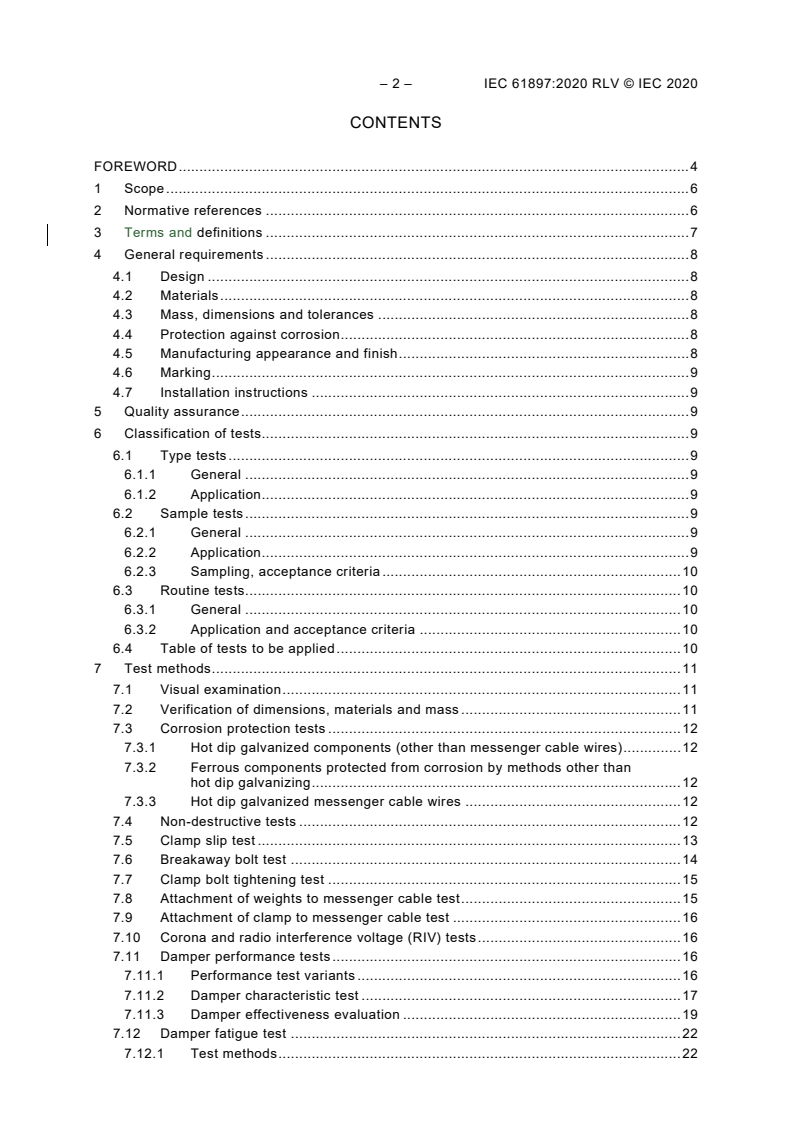
IEC 61897:2020 RLV - Overhead lines - Requirements and tests for Aeolian vibration dampers Released:3/3/2020
IEC 61897:2020 - Overhead lines - Requirements and tests for Aeolian vibration dampers Released:3/3/2020
Overview
IEC 61897:2020 - Overhead lines - Requirements and tests for aeolian vibration dampers - is the second edition (2020) of the IEC standard that specifies design, performance and test requirements for aeolian vibration dampers used on overhead power line conductors and earth wires. While originally aimed at Stockbridge-type dampers, this edition also addresses spiral and elastomeric aeolian vibration dampers and adds provisions for use on high‑temperature (HT) conductors. The standard replaces the 1998 edition and introduces updated mechanical, environmental and performance test procedures.
Key topics and technical requirements
- Scope and applicability: Applies to dampers for single conductors, earth wires, or conductor bundles where dampers attach to each subconductor. Purchasers may adopt parts of the standard for other cables (e.g., OPGW, ADSS).
- Design and materials: Requirements for materials, mass, dimensions, tolerances, corrosion protection and manufacturing finish.
- Classification of tests: Defines type tests, sample tests, and routine tests with sampling and acceptance principles.
- Mechanical and environmental tests:
- Clamp slip tests, with additional high‑temperature clamp slip provisions for HT conductors.
- Breakaway bolt tests and low‑temperature tests for fastener components (breakaway bolts, conical spring washers).
- Clamp bolt tightening, attachment-of-weights and clamp-attachment tests.
- Corrosion protection checks and non‑destructive examination requirements.
- Electrical compatibility: Tests for corona and radio‑interference voltage (RIV) where applicable.
- Damper performance and durability:
- Simplified damper effectiveness evaluation (laboratory and field test methods).
- Damper characteristic tests (resonant frequency/response curves).
- Fatigue tests (swept-frequency and resonant-frequency methods; special method for spiral dampers).
- Procurement details: Annex A lists minimum technical details to be agreed between purchaser and supplier; some test procedures/value selections may be contractually specified.
- Illustrative figures: Includes test arrangement figures for main mechanical tests and performance rigs.
Practical applications and users
IEC 61897:2020 is used by:
- Transmission and distribution utilities specifying aeolian vibration dampers for overhead lines.
- Damper manufacturers designing and qualifying Stockbridge, spiral and elastomeric dampers.
- Testing laboratories performing type, sample and routine tests.
- Procurement engineers and consultants preparing contracts and acceptance criteria for dampers used on standard and high‑temperature conductors, OPGW and ADSS installations.
Practical benefits include improved damper selection, validated fatigue performance, reduced conductor fatigue risk, and standardized procurement/testing to ensure reliability of overhead line vibration mitigation.
Related standards
- IEC 61284 - Overhead lines: requirements and tests for fittings
- IEC 61854 - Overhead lines: requirements and tests for spacers
- IEC 62567 - Methods for testing self‑damping characteristics of conductors
- IEC 60050(466) - Electropedia chapter on overhead lines
- ISO 1461, ISO 2859 series - referenced for coating and sampling procedures
Keywords: IEC 61897:2020, Overhead Lines, Aeolian Vibration Dampers, Stockbridge dampers, spiral dampers, elastomeric dampers, high temperature conductors, damper effectiveness, clamp slip tests, breakaway bolt test.
Relations
- Effective Date
- 05-Sep-2023
Buy Documents
IEC 61897:2020 RLV - Overhead lines - Requirements and tests for Aeolian vibration dampers Released:3/3/2020
IEC 61897:2020 - Overhead lines - Requirements and tests for Aeolian vibration dampers Released:3/3/2020
Get Certified
Connect with accredited certification bodies for this standard

IMQ S.p.A. (Certification)
Italian electrical product certification.

SLG Prüf- und Zertifizierungs GmbH
German testing and certification body.

UL Solutions
Global safety science company with testing, inspection and certification.
Sponsored listings
Frequently Asked Questions
IEC 61897:2020 is a standard published by the International Electrotechnical Commission (IEC). Its full title is "Overhead lines - Requirements and tests for Aeolian vibration dampers". This standard covers: IEC 61897:2020 applies to aeolian vibration dampers intended for single conductors or earth wires or conductor bundles where dampers are directly attached to each subconductor. The purchaser may adopt part(s) of this document when specifying requirements for cables different from those mentioned above (e.g. optical ground wires (OPGW), all dielectric self-supporting optical cables (ADSS)). In some cases, test procedures and test values are left to agreement between the purchaser and the supplier and are stated in the procurement contract. Annex A lists the minimum technical details to be agreed between purchaser and supplier. Throughout this document, the word “conductor” is used when the test applies to dampers for conductors or earth wires. This second edition cancels and replaces the first edition published in 1998. This edition constitutes a technical revision. This edition includes the following significant technical changes with respect to the previous edition: a) Consider, in addition to Stockbridge type aeolian vibration dampers, also spiral aeolian vibration dampers and elastomeric aeolian vibration dampers. b) Consider the application of dampers on high temperature conductors, specifying additional high temperature tests in clamp slip tests. c) Simplify the procedure of the damper effectiveness evaluation. d) Introduce test at low temperature on fastener components such as break away bolts and conical spring washers. e) Include figures showing the test arrangements for the main mechanical tests. Key words: Overhead Lines, Aeolian Vibration Dampers
IEC 61897:2020 applies to aeolian vibration dampers intended for single conductors or earth wires or conductor bundles where dampers are directly attached to each subconductor. The purchaser may adopt part(s) of this document when specifying requirements for cables different from those mentioned above (e.g. optical ground wires (OPGW), all dielectric self-supporting optical cables (ADSS)). In some cases, test procedures and test values are left to agreement between the purchaser and the supplier and are stated in the procurement contract. Annex A lists the minimum technical details to be agreed between purchaser and supplier. Throughout this document, the word “conductor” is used when the test applies to dampers for conductors or earth wires. This second edition cancels and replaces the first edition published in 1998. This edition constitutes a technical revision. This edition includes the following significant technical changes with respect to the previous edition: a) Consider, in addition to Stockbridge type aeolian vibration dampers, also spiral aeolian vibration dampers and elastomeric aeolian vibration dampers. b) Consider the application of dampers on high temperature conductors, specifying additional high temperature tests in clamp slip tests. c) Simplify the procedure of the damper effectiveness evaluation. d) Introduce test at low temperature on fastener components such as break away bolts and conical spring washers. e) Include figures showing the test arrangements for the main mechanical tests. Key words: Overhead Lines, Aeolian Vibration Dampers
IEC 61897:2020 is classified under the following ICS (International Classification for Standards) categories: 29.240.20 - Power transmission and distribution lines; 33.160.40 - Video systems. The ICS classification helps identify the subject area and facilitates finding related standards.
IEC 61897:2020 has the following relationships with other standards: It is inter standard links to IEC 61897:1998. Understanding these relationships helps ensure you are using the most current and applicable version of the standard.
IEC 61897:2020 is available in PDF format for immediate download after purchase. The document can be added to your cart and obtained through the secure checkout process. Digital delivery ensures instant access to the complete standard document.
Standards Content (Sample)
IEC 61897 ®
Edition 2.0 2020-03
REDLINE VERSION
INTERNATIONAL
STANDARD
colour
inside
Overhead lines – Requirements and tests for stockbridge type aeolian vibration
dampers
All rights reserved. Unless otherwise specified, no part of this publication may be reproduced or utilized in any form
or by any means, electronic or mechanical, including photocopying and microfilm, without permission in writing from
either IEC or IEC's member National Committee in the country of the requester. If you have any questions about IEC
copyright or have an enquiry about obtaining additional rights to this publication, please contact the address below or
your local IEC member National Committee for further information.
IEC Central Office Tel.: +41 22 919 02 11
3, rue de Varembé info@iec.ch
CH-1211 Geneva 20 www.iec.ch
Switzerland
About the IEC
The International Electrotechnical Commission (IEC) is the leading global organization that prepares and publishes
International Standards for all electrical, electronic and related technologies.
About IEC publications
The technical content of IEC publications is kept under constant review by the IEC. Please make sure that you have the
latest edition, a corrigendum or an amendment might have been published.
IEC publications search - webstore.iec.ch/advsearchform Electropedia - www.electropedia.org
The advanced search enables to find IEC publications by a The world's leading online dictionary on electrotechnology,
variety of criteria (reference number, text, technical containing more than 22 000 terminological entries in English
committee,…). It also gives information on projects, replaced and French, with equivalent terms in 16 additional languages.
and withdrawn publications. Also known as the International Electrotechnical Vocabulary
(IEV) online.
IEC Just Published - webstore.iec.ch/justpublished
Stay up to date on all new IEC publications. Just Published IEC Glossary - std.iec.ch/glossary
details all new publications released. Available online and 67 000 electrotechnical terminology entries in English and
once a month by email. French extracted from the Terms and Definitions clause of
IEC publications issued since 2002. Some entries have been
IEC Customer Service Centre - webstore.iec.ch/csc collected from earlier publications of IEC TC 37, 77, 86 and
If you wish to give us your feedback on this publication or CISPR.
need further assistance, please contact the Customer Service
Centre: sales@iec.ch.
IEC 61897 ®
Edition 2.0 2020-03
REDLINE VERSION
INTERNATIONAL
STANDARD
colour
inside
Overhead lines – Requirements and tests for stockbridge type aeolian vibration
dampers
INTERNATIONAL
ELECTROTECHNICAL
COMMISSION
ICS 29.240.20 ISBN 978-2-8322-7964-9
– 2 – IEC 61897:2020 RLV © IEC 2020
CONTENTS
FOREWORD . 4
1 Scope . 6
2 Normative references . 6
3 Terms and definitions . 7
4 General requirements . 8
4.1 Design . 8
4.2 Materials . 8
4.3 Mass, dimensions and tolerances . 8
4.4 Protection against corrosion . 8
4.5 Manufacturing appearance and finish . 8
4.6 Marking . 9
4.7 Installation instructions . 9
5 Quality assurance . 9
6 Classification of tests. 9
6.1 Type tests . 9
6.1.1 General . 9
6.1.2 Application . 9
6.2 Sample tests . 9
6.2.1 General . 9
6.2.2 Application . 9
6.2.3 Sampling, acceptance criteria . 10
6.3 Routine tests. 10
6.3.1 General . 10
6.3.2 Application and acceptance criteria . 10
6.4 Table of tests to be applied . 10
7 Test methods . 11
7.1 Visual examination . 11
7.2 Verification of dimensions, materials and mass . 11
7.3 Corrosion protection tests . 12
7.3.1 Hot dip galvanized components (other than messenger cable wires) . 12
7.3.2 Ferrous components protected from corrosion by methods other than
hot dip galvanizing . 12
7.3.3 Hot dip galvanized messenger cable wires . 12
7.4 Non-destructive tests . 12
7.5 Clamp slip test . 13
7.6 Breakaway bolt test . 14
7.7 Clamp bolt tightening test . 15
7.8 Attachment of weights to messenger cable test . 15
7.9 Attachment of clamp to messenger cable test . 16
7.10 Corona and radio interference voltage (RIV) tests . 16
7.11 Damper performance tests . 16
7.11.1 Performance test variants . 16
7.11.2 Damper characteristic test . 17
7.11.3 Damper effectiveness evaluation . 19
7.12 Damper fatigue test . 22
7.12.1 Test methods . 22
7.12.2 Swept frequency method . 23
7.12.3 Resonant frequency method . 23
7.12.4 Acceptance criteria . 23
7.12.5 Fatigue test method – for spiral aeolian vibration dampers (SVD) . 24
Annex A (normative) Minimum technical details to be agreed between purchaser and
supplier . 25
Annex B (informative) Examples of graphs relevant to damper characteristic test . 26
Annex C (normative) Wind power input curve . 27
Annex D (informative) Description of HT conductors as given in
CIGRE TB 695‑2017 [6] . 29
Bibliography . 30
Figure 1 – Test rig for laboratory test of damper effectiveness (see 7.11.3.2) . .
Figure 1 – Test arrangement for longitudinal slip tests . 14
Figure 2 – Test arrangement for attachment of weights to messenger cable test . 16
Figure 3 – Test arrangement for attachment of clamp to messenger cable test . 16
Figure 4 – Test arrangement for damper characteristic test . 19
Figure 5 – Example of test rig for laboratory test of damper effectiveness . 19
Figure B.1 – Examples of graphs relevant to damper characteristic test (damper with
two resonant frequencies) . 26
Figure C.1 – Wind power input curve . 27
Table 1 – Tests on dampers . 11
Table 2 – Load criteria (for standard and high temperature conductors) . 14
Table 2 3 – Acceptance criteria . 18
– 4 – IEC 61897:2020 RLV © IEC 2020
INTERNATIONAL ELECTROTECHNICAL COMMISSION
_____________
OVERHEAD LINES –
REQUIREMENTS AND TESTS FOR AEOLIAN VIBRATION DAMPERS
FOREWORD
1) The International Electrotechnical Commission (IEC) is a worldwide organization for standardization comprising
all national electrotechnical committees (IEC National Committees). The object of IEC is to promote
international co-operation on all questions concerning standardization in the electrical and electronic fields. To
this end and in addition to other activities, IEC publishes International Standards, Technical Specifications,
Technical Reports, Publicly Available Specifications (PAS) and Guides (hereafter referred to as “IEC
Publication(s)”). Their preparation is entrusted to technical committees; any IEC National Committee interested
in the subject dealt with may participate in this preparatory work. International, governmental and non-
governmental organizations liaising with the IEC also participate in this preparation. IEC collaborates closely
with the International Organization for Standardization (ISO) in accordance with conditions determined by
agreement between the two organizations.
2) The formal decisions or agreements of IEC on technical matters express, as nearly as possible, an international
consensus of opinion on the relevant subjects since each technical committee has representation from all
interested IEC National Committees.
3) IEC Publications have the form of recommendations for international use and are accepted by IEC National
Committees in that sense. While all reasonable efforts are made to ensure that the technical content of IEC
Publications is accurate, IEC cannot be held responsible for the way in which they are used or for any
misinterpretation by any end user.
4) In order to promote international uniformity, IEC National Committees undertake to apply IEC Publications
transparently to the maximum extent possible in their national and regional publications. Any divergence
between any IEC Publication and the corresponding national or regional publication shall be clearly indicated in
the latter.
5) IEC itself does not provide any attestation of conformity. Independent certification bodies provide conformity
assessment services and, in some areas, access to IEC marks of conformity. IEC is not responsible for any
services carried out by independent certification bodies.
6) All users should ensure that they have the latest edition of this publication.
7) No liability shall attach to IEC or its directors, employees, servants or agents including individual experts and
members of its technical committees and IEC National Committees for any personal injury, property damage or
other damage of any nature whatsoever, whether direct or indirect, or for costs (including legal fees) and
expenses arising out of the publication, use of, or reliance upon, this IEC Publication or any other IEC
Publications.
8) Attention is drawn to the Normative references cited in this publication. Use of the referenced publications is
indispensable for the correct application of this publication.
9) Attention is drawn to the possibility that some of the elements of this IEC Publication may be the subject of
patent rights. IEC shall not be held responsible for identifying any or all such patent rights.
This redline version of the official IEC Standard allows the user to identify the changes
made to the previous edition. A vertical bar appears in the margin wherever a change
has been made. Additions are in green text, deletions are in strikethrough red text.
International Standard IEC 61897 has been prepared by Technical Committee 11: Overhead
lines.
This second edition cancels and replaces the first edition published in 1998. This edition
constitutes a technical revision.
This edition includes the following significant technical changes with respect to the previous
edition:
a) Consider, in addition to Stockbridge type aeolian vibration dampers, also spiral aeolian
vibration dampers and elastomeric aeolian vibration dampers.
b) Consider the application of dampers on high temperature conductors, specifying additional
high temperature tests in clamp slip tests.
c) Simplify the procedure of the damper effectiveness evaluation.
d) Introduce test at low temperature on fastener components such as break away bolts and
conical spring washers.
e) Include figures showing the test arrangements for the main mechanical tests.
The text of this standard is based on the following documents:
FDIS Report on voting
11/266/FDIS 11/273/RVD
Full information on the voting for the approval of this standard can be found in the report on
voting indicated in the above table.
This document has been drafted in accordance with the ISO/IEC Directives, Part 2.
The committee has decided that the contents of this document will remain unchanged until the
stability date indicated on the IEC website under "http://webstore.iec.ch" in the data related to
the specific document. At this date, the document will be
• reconfirmed,
• withdrawn,
• replaced by a revised edition, or
• amended
IMPORTANT – The 'colour inside' logo on the cover page of this publication indicates
that it contains colours which are considered to be useful for the correct
understanding of its contents. Users should therefore print this document using a
colour printer.
– 6 – IEC 61897:2020 RLV © IEC 2020
OVERHEAD LINES –
REQUIREMENTS AND TESTS
FOR STOCKBRIDGE TYPE AEOLIAN VIBRATION DAMPERS
1 Scope
This document applies to Stockbridge type aeolian vibration dampers intended for single
conductors or earth wires or conductor bundles where dampers are directly attached to each
subconductor.
The purchaser may adopt part(s) of this document when specifying requirements for other
types of aeolian vibration dampers or for Stockbridge dampers used on conductors or cables
different from those mentioned above (e.g. optical ground wires (OPGW), all dielectric self-
supporting optical cables (ADSS)).
In many some cases, test procedures and test values are left to agreement between the
purchaser and the supplier and are stated in the procurement contract.
Annex A lists the minimum technical details to be agreed between purchaser and supplier.
Throughout this document, the word “conductor” is used when the test applies to Stockbridge
dampers for conductors or earth wires.
2 Normative references
The following documents are referred to in the text in such a way that some or all of their
content constitutes requirements of this document. For dated references, only the edition
cited applies. For undated references, the latest edition of the referenced document (including
any amendments) applies.
IEC 60050(466):1990, International Electrotechnical Vocabulary (IEV) – Chapter 466:
Overhead lines
IEC 60888:1987, Zinc-coated steel wires for stranded conductors
IEC 61284:1997, Overhead lines – Requirements and tests for fittings
IEC 61854, Overhead lines – Requirements and tests for spacers
IEC 62567:2013, Overhead lines – Methods for testing self-damping characteristics of
conductors
ISO 1461:2009, Hot dip galvanized coatings on fabricated ferrous products iron and steel
1)
articles – Specifications and test methods
ISO 2859-1:19891999/AMD1:2011, Sampling procedures for inspection by attributes – Part 1:
Sampling plans schemes indexed by acceptable quality level limit (AQL) for lot-by-lot
inspection
___________
1)
To be published.
ISO 2859-2:1985, Sampling procedures for inspection by attributes – Part 2: Sampling plans
indexed by limiting quality level (LQ) for isolated lot inspection
ISO 3951:1989, Sampling procedures and charts for inspection by variables for percent
nonconforming
ISO 3951-1:2013, Sampling procedures for inspection by variables – Part 1: Specification for
single sampling plans indexed by acceptance quality limit (AQL) for lot-by-lot inspection for a
single quality characteristic and a single AQL
ISO 3951-2:2013, Sampling procedures for inspection by variables – Part 2: General
specification for single sampling plans indexed by acceptance quality limit (AQL) for lot-by-lot
inspection of independent quality characteristics
ISO 9001:2015, Quality management systems – Requirements
3 Terms and definitions
For the purposes of this document, the terms and definitions given in IEC 60050-466 apply, as
well as the following.
ISO and IEC maintain terminological databases for use in standardization at the following
addresses:
• IEC Electropedia: available at http://www.electropedia.org/
• ISO Online browsing platform: available at http://www.iso.org/obp
3.1
stockbridge-type aeolian vibration damper
device comprising a messenger steel cable with a weight at each end and one bolted clamp or
a helical rod attachment, attachable to a conductor, for the purpose of damping aeolian
vibration
3.2
spiral aeolian vibration damper
SVD
device made of helical plastic which wraps around the conductor for purposes of damping
aeolian vibration (these are commonly used on earth wires, OPGW and ADSS cables)
3.3
elastomeric aeolian vibration damper
device comprising suspended weights connected to elastomeric articulations and one bolted
clamp or a helical rod attachment, attachable to a conductor for the purpose of damping
aeolian vibration
3.4
high temperature conductors
HTC
conductors which are designed to have a maximum continuous operating temperature
over 95 °C
3.5
maximum continuous operating temperature
conductor temperature specified by the manufacturer and measured at the outer wire layers
– 8 – IEC 61897:2020 RLV © IEC 2020
4 General requirements
4.1 Design
The damper shall be designed so as to
– damp aeolian vibration;
– withstand mechanical loads imposed during installation, maintenance and specified
service conditions;
– avoid damage to the conductor under specified service conditions;
– be capable of being removed and re-installed without damage to the conductor;
– be free from unacceptable levels of corona and radio interference under all service
conditions, when installed on phase conductors;
– be suitable for safe and easy installation. The clamp design shall retain all parts when
opened for attachment to conductor. Furthermore, the clamp design shall be such that the
damper, during installation, can be suspended on the conductor before tightening the
clamp;
– ensure that individual components will not become loose in service;
– maintain its function over the entire service temperature range;
– avoid audible noise;
– prevent water collection.
NOTE Other desirable characteristics which are not essential to the basic functions of the
damper but which may be advantageous include:
– verification of proper installation from the ground;
– easy installation and removal from energized lines.
In the case of vibration dampers for conductors or earth wires containing integral fibre optic
elements (or an externally applied optical cable wrapped around the earth wire) account
should be made of the possible effects of the damper on these fibre optic elements should be
accounted for.
4.2 Materials
The materials shall conform to the requirements of IEC 61284.
4.3 Mass, dimensions and tolerances
Damper mass and significant dimensions, including appropriate tolerances, shall be shown on
contract drawings.
4.4 Protection against corrosion
In addition to the applicable requirements of IEC 61284, the messenger cable (including cut
ends if applicable when exposed) shall be protected against corrosion, e.g. in accordance
with IEC 60888 for hot dip galvanized steel wire.
4.5 Manufacturing appearance and finish
The dampers shall be free of defects and irregularities; they shall have all outside surfaces
smooth and all edges and corners well-rounded.
4.6 Marking
The fitting marking requirements of IEC 61284 shall be applied to all clamp assemblies
including those using breakaway bolts. On spiral dampers, the markings should be on the
plastic rod.
4.7 Installation instructions
The supplier shall provide a clear and complete description of the recommended installation
procedure including in-span positions.
5 Quality assurance
A quality assurance programme taking into account the requirements of this document can be
used by agreement between the purchaser and the supplier to verify the quality of the
vibration dampers during the manufacturing process.
Detailed information on the use of quality assurance is given in ISO 9000-1 [1], ISO 9001 [2],
ISO 9002 [3], ISO 9003 [4] and ISO 9004-1 [5] a system as per ISO 9001 or similar.
It is recommended that test equipment used to verify compliance to this document is routinely
maintained and calibrated in accordance with a relevant quality standard.
6 Classification of tests
6.1 Type tests
6.1.1 General
Type tests are intended to establish design characteristics. They are normally made once and
repeated only when the design or the material of the damper components is changed. The
results of type tests are recorded as evidence of compliance with design requirements.
6.1.2 Application
Dampers shall be subjected to type tests as per Table 1.
Unless otherwise specified, each type test shall be performed on three test samples which are
identical in all essential respects with dampers to be supplied under contract to the purchaser.
All units shall pass the tests.
The dampers used for tests during which no damage occurs to the units or their components
may be used in subsequent tests.
6.2 Sample tests
6.2.1 General
Sample tests are required to verify that the dampers meet the performance specifications of
the type test samples. In addition, they are intended to verify the quality of material and
workmanship.
6.2.2 Application
Dampers shall be subjected to sample tests as per Table 1.
– 10 – IEC 61897:2020 RLV © IEC 2020
The samples to be tested shall be selected at random from the lot offered for acceptance. The
purchaser has the right to make the selection.
The dampers used for tests during which no damage occurs to the units or their components
may be used in subsequent tests.
6.2.3 Sampling, acceptance criteria
The sampling plan procedures according to ISO 2859-1 and ISO 2859-2 (inspection by
attributes) and ISO 3951 (inspection by variables) and the detailed procedures (inspection
level, AQL, single, double or multiple sampling, etc.) shall be agreed between the purchaser
and the supplier for each different attribute or variable.
NOTE Sampling inspection by variables is an acceptance sampling procedure to be used in place of inspection by
attributes when it is appropriate to measure on some continuous scale the characteristic(s) under consideration. In
the case of failure load tests and similar expensive tests, better distinction between acceptable quality and
objective quality is available with acceptance sampling by variables than by attributes for the same sample size.
The purpose of the sampling process may also be important in the choice between a variables or attributes plan.
For example, a purchaser may choose to use an attributes acceptance sampling plan to assure that parts in a
shipment lot are within a required dimensional tolerance; the manufacturer may make measurements under a
variables sampling plan of the same dimensions because he is concerned with gradual trends or changes which
may affect his ability to provide shipment lots which meet the AQL.
6.3 Routine tests
6.3.1 General
Routine tests are intended to prove conformance of vibration dampers to specific
requirements and are made on every damper. The tests shall not damage the dampers.
6.3.2 Application and acceptance criteria
Whole lots of dampers may be subjected to routine tests. Any damper which does not conform
to the requirements shall be discarded.
6.4 Table of tests to be applied
The following Table 1 indicates the tests which shall be performed. These are marked with
an "X" in the table.
However, the purchaser may specify additional tests which are included in the table and
marked with an "O".
Units or components damaged during the test shall be excluded from the delivery to the
customer.
Table 1 – Tests on dampers
Subclause Test Type Sample Routine
test test test
7.1 Visual examination X X O
7.2 Verification of dimensions, materials and mass X X
7.3 Corrosion protection tests X X
7.4 Non-destructive tests O O O
7.5 Clamp slip test X O
1)
7.6 Breakaway bolt test X X
7.7 Clamp bolt tightening test X X
7.8 Attachment of weights to messenger cable X X
7.9 Attachment of clamp to messenger cable test X X
1)
1)
7.10 Corona and radio interference voltage (RIV) tests X
7.11 Damper performance tests
7.11.2 – Damper characteristic test X O
7.11.3 – Damper effectiveness evaluation X
7.12 Damper fatigue test X
1)
Not applicable for earth wire dampers.
NOTE
• The supplier should state in the tender quality plan, or other tender documentation, which testing is already
complete (i.e. which type tests) and which tests (sample or routine) are included in the tender, subject to the
approval or change required by the purchaser.
• If conical washers are used on bolted clamps, embrittlement tests shall be performed in accordance with
clause 7.5.2.2 of IEC 61854:2019.
7 Test methods
7.1 Visual examination
Type tests shall include visual examination to ascertain conformity of the dampers in all
essential respects, with the manufacturing or contract drawings. Deviations from the drawings
shall be subject to the approval of the purchaser and shall be appropriately documented as an
agreed concession.
Sample tests and, if required, routine tests shall include visual examination to ensure
conformity of manufacturing process, shape, coating and surface finish of the damper with the
contract drawings. Particular attention shall be given to markings required and to the finish of
surfaces which come into contact with the conductor. The sample test procedure and
acceptance criteria shall be agreed between the purchaser and the supplier.
For dampers subjected to corona type test, the sample test shall include a comparison of
shape and surface finish with one of the corona type test samples when specified by the
purchaser.
7.2 Verification of dimensions, materials and mass
Type and sample tests shall include verification of dimensions to ensure that dampers are
within the dimensional tolerances stated on contract drawings. The purchaser may choose to
witness the measurement of selected dimensions or may inspect the supplier's documentation
when this is available.
– 12 – IEC 61897:2020 RLV © IEC 2020
Type and sample tests shall also include verification of materials to ensure that they are in
accordance with contract drawings and documents. This verification shall normally be carried
out by the purchaser inspecting the supplier's documentation relating to material
specifications, certificates of conformity or other quality documentation.
The total mass of the damper complete with all its components shall comply with the mass
shown on the contract drawing (within given tolerances).
7.3 Corrosion protection tests
7.3.1 Hot dip galvanized components (other than messenger cable wires)
Hot dip galvanized components other than messenger cable wires shall be tested in
accordance with the requirements specified in ISO 1461.
The coating thicknesses shall conform to Tables 23 and 34 of ISO 1461:2009, unless
otherwise agreed between purchaser and supplier. However, for the purpose of this document,
Tables 23 and 34 in ISO 1461:2009 shall apply to the following categories of items (and not to
the categories specified in ISO 1461).
Table 23: Coating thickness on all samples except
– washers;
– threaded components;
– small parts which are centrifuged (significant surface area <1 000 mm ).
Table 34: Coating thickness on
– washers;
– threaded components;
– small parts which are centrifuged (significant surface area <1 000 mm ).
7.3.2 Ferrous components protected from corrosion by methods other than hot dip
galvanizing
Ferrous components protected from corrosion by methods other than hot dip galvanizing shall
be tested in accordance with the requirements of relevant IEC/ISO standards agreed between
purchaser and supplier.
7.3.3 Hot dip galvanized messenger cable wires
Hot dip galvanized messenger cable wires shall be tested in accordance with the
requirements specified in IEC 60888.
7.4 Non-destructive tests
The purchaser shall specify or agree to relevant test methods (ISO or other) and acceptance
criteria. Examples of non-destructive tests are as follows:
– magnetic test;
– eddy current test;
– radiographic test;
– ultrasonic test;
– proof load test;
– dye penetrant test;
– hardness test.
7.5 Clamp slip test
The test shall be performed using the conductor for which the clamp is intended. The
conductor shall be "as new", i.e. free of any deterioration or damage. The minimum free
length of test conductor between its terminating fittings shall be 2 4 m. The conductor shall be
tensioned to 20 % of its rated tensile strength. Precautions shall be taken to avoid birdcaging
of the conductor.
The clamp shall be installed in accordance with the supplier's instructions on a different
portion of conductor for each test. In the case of breakaway bolts, the installation torque shall
be the design value nominal breakaway torque minus the specified tolerance agreed between
the purchaser and the supplier (see 7.76).
NOTE The use of other conductors, or conductor lengths or tensions may be agreed between
purchaser and supplier.
By means of a suitable device a load coaxial to the conductor shall be applied to the damper
clamp, as indicated in Figure 1. The load shall be gradually increased (not faster than 100 N/s)
until it reaches 2,5 kN (specified minimum slip load) the load given in Table 2 or the load
agreed between purchaser and supplier. This load shall be kept constant for 60 s. Then the
load value shall be gradually increased until slippage of the clamp occurs. The value of slip
load shall be recorded.
For the slip test conducted on High Temperature Conductors (HTC) using Stockbridge and
elastomeric dampers only, the parameters are the same as for standard conductors. After
installing the clamp at ambient temperature, the conductor shall be electrically heated up to
the maximum continuous operating temperature as specified by the conductor manufacturer
and kept constant at this temperature for 0,5 h. The conductor tension load shall be kept
constant at 20 % RTS. Then the slip test shall be performed at maximum continuous
operating temperature as described above.
For the type test, an additional thermal process of the conductor shall be performed.
A new clamp shall be fixed at ambient temperature on the conductor which is tensioned to 20 %
of RTS. It is permitted to fix several clamps on the same setup to reduce expenditure of time.
The distance between the clamps shall be at least 300 mm.
Then the conductor shall be electrically heated up to the maximum continuous operating
temperature as specified by the conductor manufacturer and kept constant at this temperature
for 1h.
Afterwards the temperature shall decrease to at least ambient temperature plus 5 °C. These
cycles shall be carried out four times. At the end of the fourth cycle, after decreasing the
temperature to ambient values the slip load test shall be performed. For the complete test run
the tension shall be kept constant at 20 % of rated tensile strength.
Clamp slip shall be considered as having occurred when a slip distance of 1 mm for bolted
clamps and 2,5 mm for helical attachments is measured.
– 14 – IEC 61897:2020 RLV © IEC 2020
Figure 1 – Test arrangement for longitudinal slip tests
Table 2 – Load criteria (for standard and high temperature conductors)
Specified minimum load/Maximum slip
Damper Conductor diameter Attachment Load Movement
kN mm
Stockbridge or
< 19 mm Bolted 1,25 1,0
Elastomeric
Stockbridge or
≥ 19 mm Bolted 2,5 1,0
Elastomeric
Stockbridge or
All Helical 1,0 2,5
Elastomeric
Spiral damper All Helical 0,1 2,5
Only for standard conductors.
Acceptance criteria
No movement of the clamp relative to the conductor greater than 1 mm shown in Table 2 shall
occur at or before the end of application of 2,5 kN the specified minimum load for 60 s. If both
a minimum and a maximum slip load are stated, the slip shall occur between those values.
Surface flattening of the outer strands of the conductor is acceptable. If armor rods are used
under the clamp, slippage of the armor rods relative to the conductor is considered as clamp
slippage.
7.6 Breakaway bolt test
The breakaway bolts or breakaway cap, if used, shall be tested by applying increasing torque
to the breakaway portion of the bolt or the cap until it breaks away. The test shall be carried
out at ambient temperature.
Precaution shall be taken on a constant continuous circular motion of the torque wrench and a
perpendicular angle between torque wrench and bolt head.
The breakaway torque shall be recorded.
• Acceptance criteria:
The breakaway torque shall be within the tolerance agreed between the purchaser and
specified by the supplier.
If no tolerance is specified, the range shall be nominal installation torque plus/minus 10 %.
For countries where ambient temperature below 0 °C can be expected, it is recommended to
repeat the tests on breakaway bolts and breakaway caps at the temperature corresponding to
the average temperature of the coldest month.
The specimens shall be kept for at least 1 h in an appropriate cooling device prior the test.
During the break away test the temperature should be measured and recorded. The
temperature during the test shall not increase more than 10 °C from initial cooling
temperature.
7.7 Clamp bolt tightening test
The test shall be performed by installing the clamp on a length of the conductor for which the
damper is intended. In case not available, an equivalent conductor or a tube of same diameter
can be used. If the damper is to be used for two or more sizes or types of conductor, then the
clamp shall be tested on each conductor unless the purchaser agrees to test on one
conductor only.
The bolts or nuts shall be tightened to a torque 10 % above the specified installation torque
with a calibrated torque wrench. Clamps with breakaway bolts or breakaway caps shall have
the breakaway portion of the head removed prior to the test and shall be tightened with 10 %
above the specified installation torque value plus the agreed tolerance. The threaded
connection shall remain serviceable for any number of subsequent installations or removals
and all components of the clamp shall be undamaged. No unacceptable damage shall occur to
the conductor inside the clamp. Unacceptable damage shall be agreed between the purchaser
and the supplier.
• Acceptance criteria
The threaded connection shall remain serviceable (by hand) for three subsequent installations
and removals and all components of the clamp shall be without any mechanical deformation
or cracks. No plastic deformation shall occur to the conductor inside the clamp.
Lastly, the torque shall be increased to either twice the specified installation value or the
maximum torque value recommended by the bolt supplier, whichever is lower. This increase
shall not result in any breakage of threaded parts or other components of the clamp or any
cracks. The bolt shall be able to be removed from the clamp without any failure.
Plastic deformation is permitted.
7.8 Attachment of weights to messenger cable test
On an assembled damper a tensile load shall be applied between the weights coaxial with the
messenger cable, as indicated in Figure 2. The load shall be gradually increased (100 N/s
maximum) until it reaches 5 kN (specified minimum slip load). This load shall be kept constant
for 60 s.
The load shall then be increased slowly until one weight has been pulled free of the
messenger cable. The maximum load obtained during this process shall be recorded, for
information purposes only.
• Acceptance criteria
No relative movement greater than 1 mm between each weight and the messenger cable shall
occur at or before the end of the application of 5 kN for 60 s.
NOTE It may be necessary to remove the load before measuring the distance between the
weights, i.e. when the elastic stretch of the messenger cable results in an apparent movement
of the weights along the messenger cable.
– 16 – IEC 61897:2020 RLV © IEC 2020
Figure 2 – Test arrangement for attachment of weights to messenger cable test
7.9 Attachment of clamp to messenger cable test
A tensile load shall be applied between the messenger cable and the clamp body, coaxial with
the messenger cable, as indicated in Figure 3. The load shall be gradually increased (100 N/s
maximum) until it reaches 1,5 kN (specified minimum slip load). This load shall be kept
constant for 60 s.
The load shall then be increased slowly until the clamp has been pulled free of the messenger
cable. The maximum load obtained during this process shall be recorded, for information
purposes only.
• Acceptance criteria
No movement of the clamp relative to the messenger cable greater than 1 mm shall occur at
or before the end of the application of 1,5 kN for 60 s.
Figure 3 – Test arrangement for attachment of clamp to messenger cable test
7.10 Corona and radio interference voltage (RIV) tests
The tests shall be performed in accordance with Clause 14 of IEC 61284:1997.
7.11 Damper performance tests
7.11.1 Performance test variants
Two performance test variants are specified in conjunction with their respective acceptance
criteria. The purchaser shall specify or agree to the variant to be applied.
a) Variant A
During type and sample tests, the damper characteristic test (see 7.11.2) is executed and the
results are compared with the acceptance criteria and limits established by the purchaser.
NOTE This variant does not require the damping effectiveness evaluation (see 7.11.3)
because this was taken into account when establishing the lower and upper limits.
b) Variant B
During type tests the damper characteristic test (see 7.11.2) is performed on three samples.
The damper effectiveness of the type test samples is then checked by one of the three
methods described in 7.11.3 (damper effectiveness evaluation). If these three samples meet
the acceptance criteria as per 7.11.3, their characteristics may be used as a reference for the
future checking of the characteristics of the same damper type, e.g. in sample tests.
For sample testing, the damper characteristic test (see 7.11.2) shall be performed and the
results compared with the characteristics obtained during “type tests” (see Table 23 –
Acceptance criteria in 7.11.2).
7.11.2 Damper characteristic test
7.11.2.1 Stockbridge or elastomeric dampers only
The damper shall be attached via its clamp to a shaker controlled by a sinusoidal oscillator,
as shown in Figure 4, the output signal of which is variable in frequency and amplitude. A
frequency range of 0,18/d to 1,4/d – where d is the conductor diameter in metres – shall be
covered unless a narrower frequency range is agreed between the purchaser and the supplier.
Any automatic sweep rate not exceeding 0,2 decade/min in the case of logarithmic sweep,
and 0,5 Hz/s in the case of linear sweep, may be used. Alternatively, the frequency range may
be covered step by step (maximum step intervals of 0,5 Hz below 10 Hz, 1 Hz between 10 Hz
and 100 Hz and 2 Hz above 100 Hz) with stability of result being checked at each frequency.
The clamp velocity shall be held constant at 0,1 m/s (single peak 0-p).
NOTE Some difficulties may arise during the test for frequencies below 5 Hz because the oscillations of the
shaker may not be truly sinusoid
...
IEC 61897 ®
Edition 2.0 2020-03
INTERNATIONAL
STANDARD
NORME
INTERNATIONALE
Overhead lines – Requirements and tests for aeolian vibration dampers
Lignes aériennes – Exigences et essais applicables aux amortisseurs
de vibrations éoliennes
All rights reserved. Unless otherwise specified, no part of this publication may be reproduced or utilized in any form
or by any means, electronic or mechanical, including photocopying and microfilm, without permission in writing from
either IEC or IEC's member National Committee in the country of the requester. If you have any questions about IEC
copyright or have an enquiry about obtaining additional rights to this publication, please contact the address below or
your local IEC member National Committee for further information.
Droits de reproduction réservés. Sauf indication contraire, aucune partie de cette publication ne peut être reproduite
ni utilisée sous quelque forme que ce soit et par aucun procédé, électronique ou mécanique, y compris la photocopie
et les microfilms, sans l'accord écrit de l'IEC ou du Comité national de l'IEC du pays du demandeur. Si vous avez des
questions sur le copyright de l'IEC ou si vous désirez obtenir des droits supplémentaires sur cette publication, utilisez
les coordonnées ci-après ou contactez le Comité national de l'IEC de votre pays de résidence.
IEC Central Office Tel.: +41 22 919 02 11
3, rue de Varembé info@iec.ch
CH-1211 Geneva 20 www.iec.ch
Switzerland
About the IEC
The International Electrotechnical Commission (IEC) is the leading global organization that prepares and publishes
International Standards for all electrical, electronic and related technologies.
About IEC publications
The technical content of IEC publications is kept under constant review by the IEC. Please make sure that you have the
latest edition, a corrigendum or an amendment might have been published.
IEC publications search - webstore.iec.ch/advsearchform Electropedia - www.electropedia.org
The advanced search enables to find IEC publications by a The world's leading online dictionary on electrotechnology,
variety of criteria (reference number, text, technical containing more than 22 000 terminological entries in English
committee,…). It also gives information on projects, replaced and French, with equivalent terms in 16 additional languages.
and withdrawn publications. Also known as the International Electrotechnical Vocabulary
(IEV) online.
IEC Just Published - webstore.iec.ch/justpublished
Stay up to date on all new IEC publications. Just Published IEC Glossary - std.iec.ch/glossary
details all new publications released. Available online and 67 000 electrotechnical terminology entries in English and
once a month by email. French extracted from the Terms and Definitions clause of
IEC publications issued since 2002. Some entries have been
IEC Customer Service Centre - webstore.iec.ch/csc collected from earlier publications of IEC TC 37, 77, 86 and
If you wish to give us your feedback on this publication or CISPR.
need further assistance, please contact the Customer Service
Centre: sales@iec.ch.
A propos de l'IEC
La Commission Electrotechnique Internationale (IEC) est la première organisation mondiale qui élabore et publie des
Normes internationales pour tout ce qui a trait à l'électricité, à l'électronique et aux technologies apparentées.
A propos des publications IEC
Le contenu technique des publications IEC est constamment revu. Veuillez vous assurer que vous possédez l’édition la
plus récente, un corrigendum ou amendement peut avoir été publié.
Recherche de publications IEC - Electropedia - www.electropedia.org
webstore.iec.ch/advsearchform Le premier dictionnaire d'électrotechnologie en ligne au
La recherche avancée permet de trouver des publications IEC monde, avec plus de 22 000 articles terminologiques en
en utilisant différents critères (numéro de référence, texte, anglais et en français, ainsi que les termes équivalents dans
comité d’études,…). Elle donne aussi des informations sur les 16 langues additionnelles. Egalement appelé Vocabulaire
projets et les publications remplacées ou retirées. Electrotechnique International (IEV) en ligne.
IEC Just Published - webstore.iec.ch/justpublished Glossaire IEC - std.iec.ch/glossary
Restez informé sur les nouvelles publications IEC. Just 67 000 entrées terminologiques électrotechniques, en anglais
Published détaille les nouvelles publications parues. et en français, extraites des articles Termes et Définitions des
Disponible en ligne et une fois par mois par email. publications IEC parues depuis 2002. Plus certaines entrées
antérieures extraites des publications des CE 37, 77, 86 et
Service Clients - webstore.iec.ch/csc CISPR de l'IEC.
Si vous désirez nous donner des commentaires sur cette
publication ou si vous avez des questions contactez-nous:
sales@iec.ch.
IEC 61897 ®
Edition 2.0 2020-03
INTERNATIONAL
STANDARD
NORME
INTERNATIONALE
Overhead lines – Requirements and tests for aeolian vibration dampers
Lignes aériennes – Exigences et essais applicables aux amortisseurs
de vibrations éoliennes
INTERNATIONAL
ELECTROTECHNICAL
COMMISSION
COMMISSION
ELECTROTECHNIQUE
INTERNATIONALE
ICS 29.240.20 ISBN 978-2-8322-7800-0
– 2 – IEC 61897:2020 © IEC 2020
CONTENTS
FOREWORD . 4
1 Scope . 6
2 Normative references . 6
3 Terms and definitions . 7
4 General requirements . 7
4.1 Design . 7
4.2 Materials . 8
4.3 Mass, dimensions and tolerances . 8
4.4 Protection against corrosion . 8
4.5 Manufacturing appearance and finish . 8
4.6 Marking . 8
4.7 Installation instructions . 8
5 Quality assurance . 8
6 Classification of tests. 9
6.1 Type tests . 9
6.1.1 General . 9
6.1.2 Application . 9
6.2 Sample tests . 9
6.2.1 General . 9
6.2.2 Application . 9
6.2.3 Sampling, acceptance criteria . 9
6.3 Routine tests. 10
6.3.1 General . 10
6.3.2 Application and acceptance criteria . 10
6.4 Table of tests to be applied . 10
7 Test methods . 11
7.1 Visual examination . 11
7.2 Verification of dimensions, materials and mass . 11
7.3 Corrosion protection tests . 11
7.3.1 Hot dip galvanized components (other than messenger cable wires) . 11
7.3.2 Ferrous components protected from corrosion by methods other than
hot dip galvanizing . 12
7.3.3 Hot dip galvanized messenger cable wires . 12
7.4 Non-destructive tests . 12
7.5 Clamp slip test . 12
7.6 Breakaway bolt test . 13
7.7 Clamp bolt tightening test . 14
7.8 Attachment of weights to messenger cable test . 14
7.9 Attachment of clamp to messenger cable test . 15
7.10 Corona and radio interference voltage (RIV) tests . 15
7.11 Damper performance tests . 15
7.11.1 Performance test variants . 15
7.11.2 Damper characteristic test . 16
7.11.3 Damper effectiveness evaluation . 18
7.12 Damper fatigue test . 21
7.12.1 Test methods . 21
7.12.2 Swept frequency method . 21
7.12.3 Resonant frequency method . 21
7.12.4 Acceptance criteria . 22
7.12.5 Fatigue test method – for spiral aeolian vibration dampers (SVD) . 22
Annex A (normative) Minimum technical details to be agreed between purchaser and
supplier . 23
Annex B (informative) Examples of graphs relevant to damper characteristic test . 24
Annex C (normative) Wind power input curve . 25
Annex D (informative) Description of HT conductors as given in
CIGRE TB 695‑2017 [6] . 27
Bibliography . 28
Figure 1 – Test arrangement for longitudinal slip tests . 13
Figure 2 – Test arrangement for attachment of weights to messenger cable test . 15
Figure 3 – Test arrangement for attachment of clamp to messenger cable test . 15
Figure 4 – Test arrangement for damper characteristic test . 18
Figure 5 – Example of test rig for laboratory test of damper effectiveness . 18
Figure B.1 – Examples of graphs relevant to damper characteristic test (damper with
two resonant frequencies) . 24
Figure C.1 – Wind power input curve . 25
Table 1 – Tests on dampers . 10
Table 2 – Load criteria (for standard and high temperature conductors) . 13
Table 3 – Acceptance criteria . 17
– 4 – IEC 61897:2020 © IEC 2020
INTERNATIONAL ELECTROTECHNICAL COMMISSION
_____________
OVERHEAD LINES –
REQUIREMENTS AND TESTS FOR AEOLIAN VIBRATION DAMPERS
FOREWORD
1) The International Electrotechnical Commission (IEC) is a worldwide organization for standardization comprising
all national electrotechnical committees (IEC National Committees). The object of IEC is to promote
international co-operation on all questions concerning standardization in the electrical and electronic fields. To
this end and in addition to other activities, IEC publishes International Standards, Technical Specifications,
Technical Reports, Publicly Available Specifications (PAS) and Guides (hereafter referred to as “IEC
Publication(s)”). Their preparation is entrusted to technical committees; any IEC National Committee interested
in the subject dealt with may participate in this preparatory work. International, governmental and non-
governmental organizations liaising with the IEC also participate in this preparation. IEC collaborates closely
with the International Organization for Standardization (ISO) in accordance with conditions determined by
agreement between the two organizations.
2) The formal decisions or agreements of IEC on technical matters express, as nearly as possible, an international
consensus of opinion on the relevant subjects since each technical committee has representation from all
interested IEC National Committees.
3) IEC Publications have the form of recommendations for international use and are accepted by IEC National
Committees in that sense. While all reasonable efforts are made to ensure that the technical content of IEC
Publications is accurate, IEC cannot be held responsible for the way in which they are used or for any
misinterpretation by any end user.
4) In order to promote international uniformity, IEC National Committees undertake to apply IEC Publications
transparently to the maximum extent possible in their national and regional publications. Any divergence
between any IEC Publication and the corresponding national or regional publication shall be clearly indicated in
the latter.
5) IEC itself does not provide any attestation of conformity. Independent certification bodies provide conformity
assessment services and, in some areas, access to IEC marks of conformity. IEC is not responsible for any
services carried out by independent certification bodies.
6) All users should ensure that they have the latest edition of this publication.
7) No liability shall attach to IEC or its directors, employees, servants or agents including individual experts and
members of its technical committees and IEC National Committees for any personal injury, property damage or
other damage of any nature whatsoever, whether direct or indirect, or for costs (including legal fees) and
expenses arising out of the publication, use of, or reliance upon, this IEC Publication or any other IEC
Publications.
8) Attention is drawn to the Normative references cited in this publication. Use of the referenced publications is
indispensable for the correct application of this publication.
9) Attention is drawn to the possibility that some of the elements of this IEC Publication may be the subject of
patent rights. IEC shall not be held responsible for identifying any or all such patent rights.
International Standard IEC 61897 has been prepared by Technical Committee 11: Overhead
lines.
This second edition cancels and replaces the first edition published in 1998. This edition
constitutes a technical revision.
This edition includes the following significant technical changes with respect to the previous
edition:
a) Consider, in addition to Stockbridge type aeolian vibration dampers, also spiral aeolian
vibration dampers and elastomeric aeolian vibration dampers.
b) Consider the application of dampers on high temperature conductors, specifying additional
high temperature tests in clamp slip tests.
c) Simplify the procedure of the damper effectiveness evaluation.
d) Introduce test at low temperature on fastener components such as break away bolts and
conical spring washers.
e) Include figures showing the test arrangements for the main mechanical tests.
The text of this standard is based on the following documents:
FDIS Report on voting
11/266/FDIS 11/273/RVD
Full information on the voting for the approval of this standard can be found in the report on
voting indicated in the above table.
This document has been drafted in accordance with the ISO/IEC Directives, Part 2.
The committee has decided that the contents of this document will remain unchanged until the
stability date indicated on the IEC website under "http://webstore.iec.ch" in the data related to
the specific document. At this date, the document will be
• reconfirmed,
• withdrawn,
• replaced by a revised edition, or
• amended
– 6 – IEC 61897:2020 © IEC 2020
OVERHEAD LINES –
REQUIREMENTS AND TESTS FOR AEOLIAN VIBRATION DAMPERS
1 Scope
This document applies to aeolian vibration dampers intended for single conductors or earth
wires or conductor bundles where dampers are directly attached to each subconductor.
The purchaser may adopt part(s) of this document when specifying requirements for cables
different from those mentioned above (e.g. optical ground wires (OPGW), all dielectric self-
supporting optical cables (ADSS)).
In some cases, test procedures and test values are left to agreement between the purchaser
and the supplier and are stated in the procurement contract.
Annex A lists the minimum technical details to be agreed between purchaser and supplier.
Throughout this document, the word “conductor” is used when the test applies to dampers for
conductors or earth wires.
2 Normative references
The following documents are referred to in the text in such a way that some or all of their
content constitutes requirements of this document. For dated references, only the edition
cited applies. For undated references, the latest edition of the referenced document (including
any amendments) applies.
IEC 60050(466):1990, International Electrotechnical Vocabulary (IEV) – Chapter 466:
Overhead lines
IEC 60888:1987, Zinc-coated steel wires for stranded conductors
IEC 61284:1997, Overhead lines – Requirements and tests for fittings
IEC 61854, Overhead lines – Requirements and tests for spacers
IEC 62567:2013, Overhead lines – Methods for testing self-damping characteristics of
conductors
ISO 1461:2009, Hot dip galvanized coatings on fabricated iron and steel articles –
Specifications and test methods
ISO 2859-1:1999/AMD1:2011, Sampling procedures for inspection by attributes – Part 1:
Sampling schemes indexed by acceptable quality limit (AQL) for lot-by-lot inspection
ISO 2859-2:1985, Sampling procedures for inspection by attributes – Part 2: Sampling plans
indexed by limiting quality level (LQ) for isolated lot inspection
ISO 3951-1:2013, Sampling procedures for inspection by variables – Part 1: Specification for
single sampling plans indexed by acceptance quality limit (AQL) for lot-by-lot inspection for a
single quality characteristic and a single AQL
ISO 3951-2:2013, Sampling procedures for inspection by variables – Part 2: General
specification for single sampling plans indexed by acceptance quality limit (AQL) for lot-by-lot
inspection of independent quality characteristics
ISO 9001:2015, Quality management systems – Requirements
3 Terms and definitions
For the purposes of this document, the terms and definitions given in IEC 60050-466 apply, as
well as the following.
ISO and IEC maintain terminological databases for use in standardization at the following
addresses:
• IEC Electropedia: available at http://www.electropedia.org/
• ISO Online browsing platform: available at http://www.iso.org/obp
3.1
stockbridge-type aeolian vibration damper
device comprising a steel cable with a weight at each end and one bolted clamp or a helical rod
attachment, attachable to a conductor, for the purpose of damping aeolian vibration
3.2
spiral aeolian vibration damper
SVD
device made of helical plastic which wraps around the conductor for purposes of damping
aeolian vibration (these are commonly used on earth wires, OPGW and ADSS cables)
3.3
elastomeric aeolian vibration damper
device comprising suspended weights connected to elastomeric articulations and one bolted
clamp or a helical rod attachment, attachable to a conductor for the purpose of damping
aeolian vibration
3.4
high temperature conductors
HTC
conductors which are designed to have a maximum continuous operating temperature
over 95 °C
3.5
maximum continuous operating temperature
conductor temperature specified by the manufacturer and measured at the outer wire layers
4 General requirements
4.1 Design
The damper shall be designed so as to
– damp aeolian vibration;
– withstand mechanical loads imposed during installation, maintenance and specified
service conditions;
– avoid damage to the conductor under specified service conditions;
– be capable of being removed and re-installed without damage to the conductor;
– 8 – IEC 61897:2020 © IEC 2020
– be free from unacceptable levels of corona and radio interference under all service
conditions, when installed on phase conductors;
– be suitable for safe and easy installation. The clamp design shall retain all parts when
opened for attachment to conductor. Furthermore, the clamp design shall be such that the
damper, during installation, can be suspended on the conductor before tightening the
clamp;
– ensure that individual components will not become loose in service;
– maintain its function over the entire service temperature range;
– avoid audible noise;
– prevent water collection.
Other desirable characteristics which are not essential to the basic functions of the damper
but which may be advantageous include:
– verification of proper installation from the ground;
– easy installation and removal from energized lines.
In the case of vibration dampers for conductors or earth wires containing integral fibre optic
elements (or an externally applied optical cable wrapped around the earth wire) the possible
effects of the damper on these fibre optic elements should be accounted for.
4.2 Materials
The materials shall conform to the requirements of IEC 61284.
4.3 Mass, dimensions and tolerances
Damper mass and significant dimensions, including appropriate tolerances, shall be shown on
contract drawings.
4.4 Protection against corrosion
In addition to the applicable requirements of IEC 61284, the messenger cable (including cut
ends when exposed) shall be protected against corrosion, e.g. in accordance with IEC 60888
for hot dip galvanized steel wire.
4.5 Manufacturing appearance and finish
The dampers shall be free of defects and irregularities; they shall have all outside surfaces
smooth and all edges and corners well-rounded.
4.6 Marking
The fitting marking requirements of IEC 61284 shall be applied to all clamp assemblies
including those using breakaway bolts. On spiral dampers, the markings should be on the
plastic rod.
4.7 Installation instructions
The supplier shall provide a clear and complete description of the recommended installation
procedure including in-span positions.
5 Quality assurance
A quality assurance programme taking into account the requirements of this document can be
used by agreement between the purchaser and the supplier to verify the quality of the
vibration dampers during the manufacturing process.
Detailed information on the use of quality assurance is given in a system as per ISO 9001 or
similar.
It is recommended that test equipment used to verify compliance to this document is routinely
maintained and calibrated in accordance with a relevant quality standard.
6 Classification of tests
6.1 Type tests
6.1.1 General
Type tests are intended to establish design characteristics. They are normally made once and
repeated only when the design or the material of the damper components is changed. The
results of type tests are recorded as evidence of compliance with design requirements.
6.1.2 Application
Dampers shall be subjected to type tests as per Table 1.
Unless otherwise specified, each type test shall be performed on three test samples which are
identical in all essential respects with dampers to be supplied under contract to the purchaser.
All units shall pass the tests.
The dampers used for tests during which no damage occurs to the units or their components
may be used in subsequent tests.
6.2 Sample tests
6.2.1 General
Sample tests are required to verify that the dampers meet the performance specifications of
the type test samples. In addition, they are intended to verify the quality of material and
workmanship.
6.2.2 Application
Dampers shall be subjected to sample tests as per Table 1.
The samples to be tested shall be selected at random from the lot offered for acceptance. The
purchaser has the right to make the selection.
The dampers used for tests during which no damage occurs to the units or their components
may be used in subsequent tests.
6.2.3 Sampling, acceptance criteria
The sampling plan procedures according to ISO 2859-1 and ISO 2859-2 (inspection by
attributes) and ISO 3951 (inspection by variables) and the detailed procedures (inspection
level, AQL, single, double or multiple sampling, etc.) shall be agreed between the purchaser
and the supplier for each different attribute or variable.
NOTE Sampling inspection by variables is an acceptance sampling procedure to be used in place of inspection by
attributes when it is appropriate to measure on some continuous scale the characteristic(s) under consideration. In
the case of failure load tests and similar expensive tests, better distinction between acceptable quality and
objective quality is available with acceptance sampling by variables than by attributes for the same sample size.
– 10 – IEC 61897:2020 © IEC 2020
The purpose of the sampling process may also be important in the choice between a variables or attributes plan.
For example, a purchaser may choose to use an attributes acceptance sampling plan to assure that parts in a
shipment lot are within a required dimensional tolerance; the manufacturer may make measurements under a
variables sampling plan of the same dimensions because he is concerned with gradual trends or changes which
may affect his ability to provide shipment lots which meet the AQL.
6.3 Routine tests
6.3.1 General
Routine tests are intended to prove conformance of vibration dampers to specific
requirements and are made on every damper. The tests shall not damage the dampers.
6.3.2 Application and acceptance criteria
Whole lots of dampers may be subjected to routine tests. Any damper which does not conform
to the requirements shall be discarded.
6.4 Table of tests to be applied
The following Table 1 indicates the tests which shall be performed. These are marked with
an "X" in the table.
However, the purchaser may specify additional tests which are included in the table and
marked with an "O".
Units or components damaged during the test shall be excluded from the delivery to the
customer.
Table 1 – Tests on dampers
Subclause Test Type Sample Routine
test test test
7.1 Visual examination X X O
7.2 Verification of dimensions, materials and mass X X
7.3 Corrosion protection tests X X
7.4 Non-destructive tests O O O
7.5 Clamp slip test X O
7.6 Breakaway bolt test X X
7.7 Clamp bolt tightening test X X
7.8 Attachment of weights to messenger cable X X
7.9 Attachment of clamp to messenger cable test X X
1)
7.10 Corona and radio interference voltage (RIV) tests X
7.11 Damper performance tests
7.11.2 – Damper characteristic test X O
7.11.3 – Damper effectiveness evaluation X
7.12 Damper fatigue test X
1)
Not applicable for earth wire dampers.
• The supplier should state in the tender quality plan, or other tender documentation, which testing is
already complete (i.e. which type tests) and which tests (sample or routine) are included in the tender,
subject to the approval or change required by the purchaser.
• If conical washers are used on bolted clamps, embrittlement tests shall be performed in accordance with
clause 7.5.2.2 of IEC 61854:2019.
7 Test methods
7.1 Visual examination
Type tests shall include visual examination to ascertain conformity of the dampers in all
essential respects, with the manufacturing or contract drawings. Deviations from the drawings
shall be subject to the approval of the purchaser and shall be appropriately documented as an
agreed concession.
Sample tests and, if required, routine tests shall include visual examination to ensure
conformity of manufacturing process, shape, coating and surface finish of the damper with the
contract drawings. Particular attention shall be given to markings required and to the finish of
surfaces which come into contact with the conductor. The sample test procedure and
acceptance criteria shall be agreed between the purchaser and the supplier.
For dampers subjected to corona type test, the sample test shall include a comparison of
shape and surface finish with one of the corona type test samples when specified by the
purchaser.
7.2 Verification of dimensions, materials and mass
Type and sample tests shall include verification of dimensions to ensure that dampers are
within the dimensional tolerances stated on contract drawings. The purchaser may choose to
witness the measurement of selected dimensions or may inspect the supplier's documentation
when this is available.
Type and sample tests shall also include verification of materials to ensure that they are in
accordance with contract drawings and documents. This verification shall normally be carried
out by the purchaser inspecting the supplier's documentation relating to material
specifications, certificates of conformity or other quality documentation.
The total mass of the damper complete with all its components shall comply with the mass
shown on the contract drawing (within given tolerances).
7.3 Corrosion protection tests
7.3.1 Hot dip galvanized components (other than messenger cable wires)
Hot dip galvanized components other than messenger cable wires shall be tested in
accordance with the requirements specified in ISO 1461.
The coating thicknesses shall conform to Tables 3 and 4 of ISO 1461:2009, unless otherwise
agreed between purchaser and supplier. However, for the purpose of this document, Tables 3
and 4 in ISO 1461:2009 shall apply to the following categories of items (and not to the
categories specified in ISO 1461).
Table 3: Coating thickness on all samples except
– washers;
– threaded components;
– small parts which are centrifuged (significant surface area <1 000 mm ).
Table 4: Coating thickness on
– washers;
– threaded components;
– small parts which are centrifuged (significant surface area <1 000 mm ).
– 12 – IEC 61897:2020 © IEC 2020
7.3.2 Ferrous components protected from corrosion by methods other than hot dip
galvanizing
Ferrous components protected from corrosion by methods other than hot dip galvanizing shall
be tested in accordance with the requirements of relevant IEC/ISO standards agreed between
purchaser and supplier.
7.3.3 Hot dip galvanized messenger cable wires
Hot dip galvanized messenger cable wires shall be tested in accordance with the
requirements specified in IEC 60888.
7.4 Non-destructive tests
The purchaser shall specify or agree to relevant test methods (ISO or other) and acceptance
criteria. Examples of non-destructive tests are as follows:
– magnetic test;
– eddy current test;
– radiographic test;
– ultrasonic test;
– proof load test;
– dye penetrant test;
– hardness test.
7.5 Clamp slip test
The test shall be performed using the conductor for which the clamp is intended. The
conductor shall be "as new", i.e. free of any deterioration or damage. The minimum free
length of test conductor between its terminating fittings shall be 4 m. The conductor shall be
tensioned to 20 % of its rated tensile strength. Precautions shall be taken to avoid birdcaging
of the conductor.
The clamp shall be installed in accordance with the supplier's instructions on a different
portion of conductor for each test. In the case of breakaway bolts, the installation torque shall
be the nominal breakaway torque minus the specified tolerance (see 7.6).
The use of other conductors, or conductor lengths or tensions may be agreed between
purchaser and supplier.
By means of a suitable device a load coaxial to the conductor shall be applied to the damper
clamp, as indicated in Figure 1. The load shall be gradually increased (not faster than 100 N/s)
until it reaches the load given in Table 2 or the load agreed between purchaser and supplier.
This load shall be kept constant for 60 s. Then the load shall be gradually increased until
slippage of the clamp occurs. The value of slip load shall be recorded.
For the slip test conducted on High Temperature Conductors (HTC) using Stockbridge and
elastomeric dampers only, the parameters are the same as for standard conductors. After
installing the clamp at ambient temperature, the conductor shall be electrically heated up to
the maximum continuous operating temperature as specified by the conductor manufacturer
and kept constant at this temperature for 0,5 h. The conductor tension load shall be kept
constant at 20 % RTS. Then the slip test shall be performed at maximum continuous
operating temperature as described above.
For the type test, an additional thermal process of the conductor shall be performed.
A new clamp shall be fixed at ambient temperature on the conductor which is tensioned to 20 %
of RTS. It is permitted to fix several clamps on the same setup to reduce expenditure of time.
The distance between the clamps shall be at least 300 mm.
Then the conductor shall be electrically heated up to the maximum continuous operating
temperature as specified by the conductor manufacturer and kept constant at this temperature
for 1h.
Afterwards the temperature shall decrease to at least ambient temperature plus 5 °C. These
cycles shall be carried out four times. At the end of the fourth cycle, after decreasing the
temperature to ambient values the slip load test shall be performed. For the complete test run
the tension shall be kept constant at 20 % of rated tensile strength.
Clamp slip shall be considered as having occurred when a slip distance of 1 mm for bolted
clamps and 2,5 mm for helical attachments is measured.
Figure 1 – Test arrangement for longitudinal slip tests
Table 2 – Load criteria (for standard and high temperature conductors)
Specified minimum load/Maximum slip
Damper Conductor diameter Attachment Load Movement
kN mm
Stockbridge or
< 19 mm Bolted 1,25 1,0
Elastomeric
Stockbridge or
≥ 19 mm Bolted 2,5 1,0
Elastomeric
Stockbridge or
All Helical 1,0 2,5
Elastomeric
Spiral damper All Helical 0,1 2,5
Only for standard conductors.
Acceptance criteria
No movement of the clamp relative to the conductor greater than shown in Table 2 shall occur
at or before the end of the specified minimum load for 60 s. Surface flattening of the outer
strands of the conductor is acceptable. If armor rods are used under the clamp, slippage of
the armor rods relative to the conductor is considered as clamp slippage.
7.6 Breakaway bolt test
The breakaway bolt or breakaway cap, if used, shall be tested by applying increasing torque
to the breakaway portion of the bolt or the cap until it breaks away. The test shall be carried
out at ambient temperature.
Precaution shall be taken on a constant continuous circular motion of the torque wrench and a
perpendicular angle between torque wrench and bolt head.
– 14 – IEC 61897:2020 © IEC 2020
The breakaway torque shall be recorded.
• Acceptance criteria:
The breakaway torque shall be within the tolerance specified by the supplier.
If no tolerance is specified, the range shall be nominal installation torque plus/minus 10 %.
For countries where ambient temperature below 0 °C can be expected, it is recommended to
repeat the tests on breakaway bolts and breakaway caps at the temperature corresponding to
the average temperature of the coldest month.
The specimens shall be kept for at least 1 h in an appropriate cooling device prior the test.
During the break away test the temperature should be measured and recorded. The
temperature during the test shall not increase more than 10 °C from initial cooling
temperature.
7.7 Clamp bolt tightening test
The test shall be performed by installing the clamp on a length of the conductor for which the
damper is intended. In case not available, an equivalent conductor or a tube of same diameter
can be used. If the damper is to be used for two or more sizes or types of conductor, then the
clamp shall be tested on each conductor unless the purchaser agrees to test on one
conductor only.
The bolts or nuts shall be tightened to a torque 10 % above the specified installation torque
with a calibrated torque wrench. Clamps with breakaway bolts or breakaway caps shall have
the breakaway portion of the head removed prior to the test and shall be tightened 10 %
above the specified installation torque.
• Acceptance criteria
The threaded connection shall remain serviceable (by hand) for three subsequent installations
and removals and all components of the clamp shall be without any mechanical deformation
or cracks. No plastic deformation shall occur to the conductor inside the clamp.
Lastly, the torque shall be increased to either twice the specified installation value or the
maximum torque value recommended by the bolt supplier, whichever is lower. This increase
shall not result in any breakage of threaded parts or other components of the clamp or any
cracks. The bolt shall be able to be removed from the clamp without any failure.
Plastic deformation is permitted.
7.8 Attachment of weights to messenger cable test
On an assembled damper a tensile load shall be applied between the weights coaxial with the
messenger cable, as indicated in Figure 2. The load shall be gradually increased (100 N/s
maximum) until it reaches 5 kN (specified minimum slip load). This load shall be kept constant
for 60 s.
The load shall then be increased slowly until one weight has been pulled free of the
messenger cable. The maximum load obtained during this process shall be recorded, for
information purposes only.
• Acceptance criteria
No relative movement greater than 1 mm between each weight and the messenger cable shall
occur at or before the end of the application of 5 kN for 60 s.
It may be necessary to remove the load before measuring the distance between the weights,
i.e. when the elastic stretch of the messenger cable results in an apparent movement of the
weights along the messenger cable.
Figure 2 – Test arrangement for attachment of weights to messenger cable test
7.9 Attachment of clamp to messenger cable test
A tensile load shall be applied between the messenger cable and the clamp body, coaxial with
the messenger cable, as indicated in Figure 3. The load shall be gradually increased (100 N/s
maximum) until it reaches 1,5 kN (specified minimum slip load). This load shall be kept
constant for 60 s.
The load shall then be increased slowly until the clamp has been pulled free of the messenger
cable. The maximum load obtained during this process shall be recorded, for information
purposes only.
• Acceptance criteria
No movement of the clamp relative to the messenger cable greater than 1 mm shall occur at
or before the end of the application of 1,5 kN for 60 s.
Figure 3 – Test arrangement for attachment of clamp to messenger cable test
7.10 Corona and radio interference voltage (RIV) tests
The tests shall be performed in accordance with Clause 14 of IEC 61284:1997.
7.11 Damper performance tests
7.11.1 Performance test variants
Two performance test variants are specified in conjunction with their respective acceptance
criteria. The purchaser shall specify or agree to the variant to be applied.
a) Variant A
During type and sample tests, the damper characteristic test (see 7.11.2) is executed and the
results are compared with the acceptance criteria and limits established by the purchaser.
This variant does not require the damping effectiveness evaluation (see 7.11.3) because this
was taken into account when establishing the lower and upper limits.
b) Variant B
During type tests the damper characteristic test (see 7.11.2) is performed on three samples.
– 16 – IEC 61897:2020 © IEC 2020
The damper effectiveness of the type test samples is then checked by one of the three
methods described in 7.11.3 (damper effectiveness evaluation). If these three samples meet
the acceptance criteria as per 7.11.3, their characteristics may be used as a reference for the
future checking of the characteristics of the same damper type, e.g. in sample tests.
For sample testing, the damper characteristic test (see 7.11.2) shall be performed and the
results compared with the characteristics obtained during “type tests” (see Table 3).
7.11.2 Damper characteristic test
7.11.2.1 Stockbridge or elastomeric dampers only
The damper shall be attached via its clamp to a shaker controlled by a sinusoidal oscillator,
as shown in Figure 4, the output signal of which is variable in frequency and amplitude. A
fre
...