

IEC 62506:2023
(Main)Methods for product accelerated testing
General Information
- Abstract
IEC 62506:2023 provides guidance on the application of various accelerated test techniques for measurement or improvement of item reliability. Identification of potential failure modes that can be experienced in the use of an item and their mitigation is instrumental to ensure dependability of an item. The object of the methods is to either identify potential design weakness or provide information on item reliability, or to achieve necessary reliability and availability improvement, all within a compressed or accelerated period of time. This document addresses accelerated testing of non-repairable and repairable systems. It can be used for probability ratio sequential tests, fixed duration tests and reliability improvement/growth tests, where the measure of reliability can differ from the standard probability of failure occurrence. This document also extends to present accelerated testing or production screening methods that would identify weakness introduced into the item by manufacturing error, which can compromise item reliability. Services and people are however not covered by this document.
- Status
- Published
- Publication Date
- 06-Nov-2023
- Technical Committee
- TC 56 - Dependability
- Drafting Committee
- MT 32 - TC 56/MT 32
- Current Stage
- PPUB - Publication issued
- Start Date
- 07-Nov-2023
- Completion Date
- 24-Nov-2023
Buy Documents
REDLINE IEC 62506:2023 CMV - Methods for product accelerated testing Released:11/7/2023
IEC 62506:2023 - Methods for product accelerated testing Released:11/7/2023
Overview - IEC 62506:2023 (Methods for product accelerated testing)
IEC 62506:2023 provides guidance on applying accelerated test techniques to measure or improve product reliability within a compressed time frame. The standard covers accelerated testing of non‑repairable and repairable systems, including qualitative and quantitative methods used to identify design weaknesses, estimate reliability, support reliability growth, and perform production screening for manufacturing-introduced weaknesses. Services and people are explicitly excluded.
Key topics and technical coverage
- Classification of accelerated tests - Type A (qualitative), Type B (quantitative), and Type C (time‑ and event‑compression) approaches.
- Common qualitative methods - Highly Accelerated Limit Test (HALT), Highly Accelerated Stress Test (HAST), and Highly Accelerated Stress Screening/Audit (HASS/HASA).
- Quantitative accelerated testing - Methods for probability ratio sequential tests, fixed‑duration tests, and reliability growth/compliance tests where reliability measures can vary from simple failure probability.
- Failure mechanisms and stress modelling - Guidance on identifying potential failure modes, determining stress levels/profiles, and linking stresses to physical failure mechanisms (thermal, humidity, vibration, fatigue, etc.).
- Acceleration models and analysis - Use of Arrhenius-type approaches, fatigue/stress‑cycle models, Weibull-based life analysis, estimation of activation energy, and determination of acceleration factors by testing to failure.
- Test planning and sampling - Strategies for test sampling plans, test duration multipliers, and combining multiple stresses for realistic acceleration.
- Annexes and informative guidance - Practical HALT procedures, examples of accelerated reliability compliance and growth test designs, Calibrated Accelerated Life Testing (CALT), empirical factor estimation, and median rank tables.
Practical applications and who uses IEC 62506
IEC 62506 is practical for organizations that need reliable, time‑efficient verification of product dependability:
- Reliability engineers and test lab managers specifying accelerated life tests and HALT/HASS programs.
- Product development teams seeking early detection of design margins and weaknesses.
- Quality and manufacturing engineers implementing production screening to catch assembly/manufacturing defects.
- Program managers and procurement evaluating supplier reliability claims and planning reliability growth programs.
- R&D and regulatory compliance teams that require structured methods for demonstrating reliability targets within limited schedules.
Benefits include faster identification of failure modes, informed design improvements, and data‑driven reliability estimates that support availability and compliance objectives.
Related standards and further reading
For implementation and cross‑reference, consult other IEC reliability and testing publications (available via the IEC webstore) and standard statistical life‑data methods (Weibull, Arrhenius) commonly used alongside IEC 62506. For up‑to‑date texts and corrigenda, obtain the latest edition from IEC.
Relations
- Effective Date
- 05-Sep-2023
Buy Documents
REDLINE IEC 62506:2023 CMV - Methods for product accelerated testing Released:11/7/2023
IEC 62506:2023 - Methods for product accelerated testing Released:11/7/2023
Get Certified
Connect with accredited certification bodies for this standard

BSI Group
BSI (British Standards Institution) is the business standards company that helps organizations make excellence a habit.

Bureau Veritas
Bureau Veritas is a world leader in laboratory testing, inspection and certification services.

DNV
DNV is an independent assurance and risk management provider.
Sponsored listings
Frequently Asked Questions
IEC 62506:2023 is a standard published by the International Electrotechnical Commission (IEC). Its full title is "Methods for product accelerated testing". This standard covers: IEC 62506:2023 provides guidance on the application of various accelerated test techniques for measurement or improvement of item reliability. Identification of potential failure modes that can be experienced in the use of an item and their mitigation is instrumental to ensure dependability of an item. The object of the methods is to either identify potential design weakness or provide information on item reliability, or to achieve necessary reliability and availability improvement, all within a compressed or accelerated period of time. This document addresses accelerated testing of non-repairable and repairable systems. It can be used for probability ratio sequential tests, fixed duration tests and reliability improvement/growth tests, where the measure of reliability can differ from the standard probability of failure occurrence. This document also extends to present accelerated testing or production screening methods that would identify weakness introduced into the item by manufacturing error, which can compromise item reliability. Services and people are however not covered by this document.
IEC 62506:2023 provides guidance on the application of various accelerated test techniques for measurement or improvement of item reliability. Identification of potential failure modes that can be experienced in the use of an item and their mitigation is instrumental to ensure dependability of an item. The object of the methods is to either identify potential design weakness or provide information on item reliability, or to achieve necessary reliability and availability improvement, all within a compressed or accelerated period of time. This document addresses accelerated testing of non-repairable and repairable systems. It can be used for probability ratio sequential tests, fixed duration tests and reliability improvement/growth tests, where the measure of reliability can differ from the standard probability of failure occurrence. This document also extends to present accelerated testing or production screening methods that would identify weakness introduced into the item by manufacturing error, which can compromise item reliability. Services and people are however not covered by this document.
IEC 62506:2023 is classified under the following ICS (International Classification for Standards) categories: 03.120.01 - Quality in general; 21.020 - Characteristics and design of machines, apparatus, equipment. The ICS classification helps identify the subject area and facilitates finding related standards.
IEC 62506:2023 has the following relationships with other standards: It is inter standard links to IEC 62506:2013. Understanding these relationships helps ensure you are using the most current and applicable version of the standard.
IEC 62506:2023 is available in PDF format for immediate download after purchase. The document can be added to your cart and obtained through the secure checkout process. Digital delivery ensures instant access to the complete standard document.
Standards Content (Sample)
IEC 62506 ®
Edition 2.0 2023-11
COMMENTED VERSION
INTERNATIONAL
STANDARD
colour
inside
Methods for product accelerated testing
All rights reserved. Unless otherwise specified, no part of this publication may be reproduced or utilized in any form
or by any means, electronic or mechanical, including photocopying and microfilm, without permission in writing from
either IEC or IEC's member National Committee in the country of the requester. If you have any questions about IEC
copyright or have an enquiry about obtaining additional rights to this publication, please contact the address below or
your local IEC member National Committee for further information.
IEC Secretariat Tel.: +41 22 919 02 11
3, rue de Varembé info@iec.ch
CH-1211 Geneva 20 www.iec.ch
Switzerland
About the IEC
The International Electrotechnical Commission (IEC) is the leading global organization that prepares and publishes
International Standards for all electrical, electronic and related technologies.
About IEC publications
The technical content of IEC publications is kept under constant review by the IEC. Please make sure that you have the
latest edition, a corrigendum or an amendment might have been published.
IEC publications search - webstore.iec.ch/advsearchform IEC Products & Services Portal - products.iec.ch
The advanced search enables to find IEC publications by a
Discover our powerful search engine and read freely all the
variety of criteria (reference number, text, technical publications previews. With a subscription you will always
committee, …). It also gives information on projects, replaced have access to up to date content tailored to your needs.
and withdrawn publications.
Electropedia - www.electropedia.org
IEC Just Published - webstore.iec.ch/justpublished
The world's leading online dictionary on electrotechnology,
Stay up to date on all new IEC publications. Just Published
containing more than 22 300 terminological entries in English
details all new publications released. Available online and
and French, with equivalent terms in 19 additional languages.
once a month by email.
Also known as the International Electrotechnical Vocabulary
(IEV) online.
IEC Customer Service Centre - webstore.iec.ch/csc
If you wish to give us your feedback on this publication or
need further assistance, please contact the Customer Service
Centre: sales@iec.ch.
IEC 62506 ®
Edition 2.0 2023-11
COMMENTED VERSION
INTERNATIONAL
STANDARD
colour
inside
Methods for product accelerated testing
INTERNATIONAL
ELECTROTECHNICAL
COMMISSION
ICS 03.120.01, 21.020 ISBN 978-2-8322-7828-4
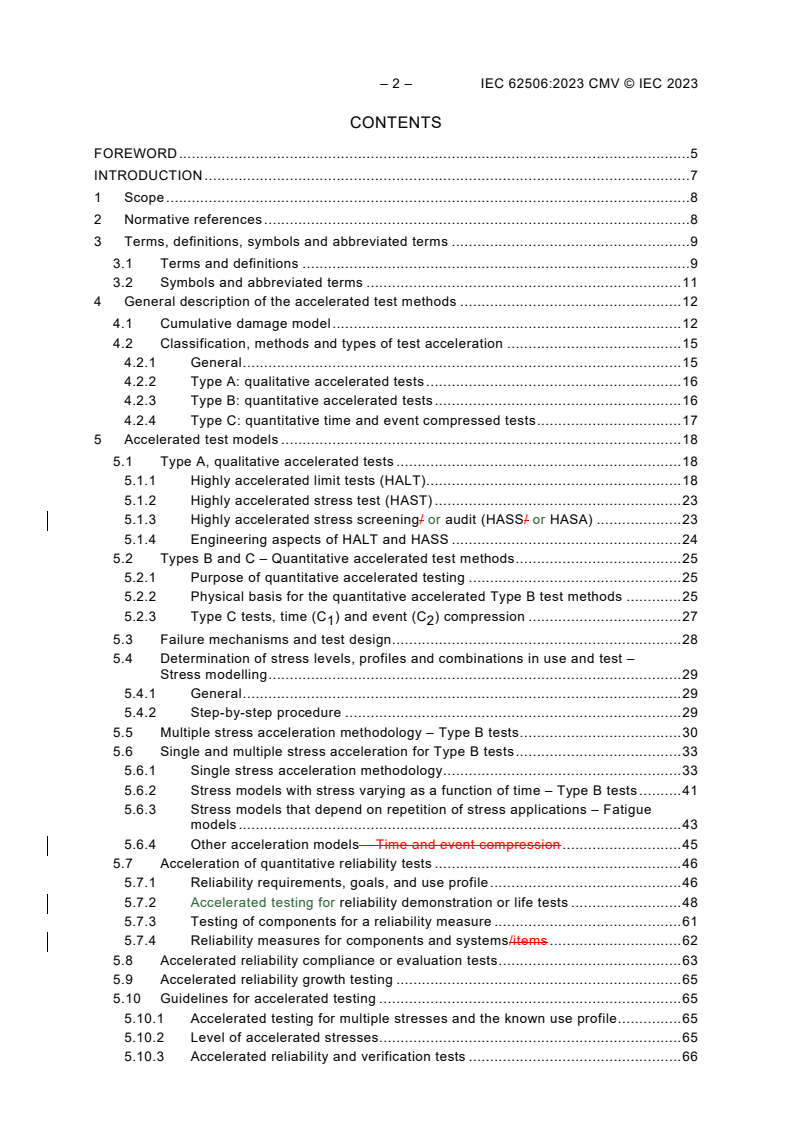
– 2 – IEC 62506:2023 CMV © IEC 2023
CONTENTS
FOREWORD .5
INTRODUCTION .7
1 Scope .8
2 Normative references .8
3 Terms, definitions, symbols and abbreviated terms .9
3.1 Terms and definitions .9
3.2 Symbols and abbreviated terms . 11
4 General description of the accelerated test methods . 12
4.1 Cumulative damage model . 12
4.2 Classification, methods and types of test acceleration . 15
4.2.1 General . 15
4.2.2 Type A: qualitative accelerated tests . 16
4.2.3 Type B: quantitative accelerated tests . 16
4.2.4 Type C: quantitative time and event compressed tests . 17
5 Accelerated test models . 18
5.1 Type A, qualitative accelerated tests . 18
5.1.1 Highly accelerated limit tests (HALT) . 18
5.1.2 Highly accelerated stress test (HAST) . 23
5.1.3 Highly accelerated stress screening/ or audit (HASS/ or HASA) . 23
5.1.4 Engineering aspects of HALT and HASS . 24
5.2 Types B and C – Quantitative accelerated test methods . 25
5.2.1 Purpose of quantitative accelerated testing . 25
5.2.2 Physical basis for the quantitative accelerated Type B test methods . 25
5.2.3 Type C tests, time (C ) and event (C ) compression . 27
1 2
5.3 Failure mechanisms and test design . 28
5.4 Determination of stress levels, profiles and combinations in use and test –
Stress modelling . 29
5.4.1 General . 29
5.4.2 Step-by-step procedure . 29
5.5 Multiple stress acceleration methodology – Type B tests . 30
5.6 Single and multiple stress acceleration for Type B tests . 33
5.6.1 Single stress acceleration methodology . 33
5.6.2 Stress models with stress varying as a function of time – Type B tests . 41
5.6.3 Stress models that depend on repetition of stress applications – Fatigue
models . 43
5.6.4 Other acceleration models – Time and event compression . 45
5.7 Acceleration of quantitative reliability tests . 46
5.7.1 Reliability requirements, goals, and use profile . 46
5.7.2 Accelerated testing for reliability demonstration or life tests . 48
5.7.3 Testing of components for a reliability measure . 61
5.7.4 Reliability measures for components and systems/items . 62
5.8 Accelerated reliability compliance or evaluation tests . 63
5.9 Accelerated reliability growth testing . 65
5.10 Guidelines for accelerated testing . 65
5.10.1 Accelerated testing for multiple stresses and the known use profile . 65
5.10.2 Level of accelerated stresses . 65
5.10.3 Accelerated reliability and verification tests . 66
6 Accelerated testing strategy in product development . 66
6.1 Accelerated testing sampling plan . 66
6.2 General discussion about test stresses and durations . 67
6.3 Testing components for multiple stresses . 67
6.4 Accelerated testing of assemblies . 68
6.5 Accelerated testing of systems . 68
6.6 Analysis of test results . 68
7 Limitations of accelerated testing methodology . 68
Annex A (informative) Highly accelerated limit test (HALT) . 70
A.1 HALT procedure . 70
A.2 HALT step-by-step procedure. 70
A.3 Example 1 – HALT test results for a DC/DC converter . 72
A.4 Example 2 – HALT test results for a medical product item . 73
A.5 HALT test results for a Hi-Fi equipment . 74
Annex B (informative) Accelerated reliability compliance and growth test design . 75
B.1 Use environment and test acceleration . 75
B.2 Determination of stresses and stress duration . 75
B.3 Overall acceleration of a reliability test . 77
B.4 Example of reliability compliance test design assuming constant failure rate
or failure intensity . 79
B.4.1 General . 79
B.4.2 Thermal cycling . 81
B.4.3 Thermal exposure, thermal dwell . 82
B.4.4 Humidity . 83
B.4.5 Vibration test . 84
B.4.6 Accelerations summary and overall acceleration . 85
B.5 Example of accelerated reliability growth test data analysis .
B.5 Example of reliability compliance test design assuming non-constant failure
rate or failure intensity (wear-out). 96
Annex C (informative) Comparison between HALT and conventional accelerated
testing .
Annex C (informative) Estimating the activation energy, Ea . 98
Annex D (informative) Calibrated accelerated life testing (CALT) . 100
D.1 Purpose of test . 100
D.2 Test execution . 100
Annex E (informative) Example of how to estimate empirical factors . 102
Annex F (informative) Determination of acceleration factors by testing to failure . 109
F.1 Failure modes and acceleration factors . 109
F.2 Example of determination of acceleration factor . 109
Annex G (informative) Median rank tables 95 % rank. 113
Bibliography . 115
List of comments . 118
Figure 1 – Probability density functions (PDF) for cumulative damage, degradation,
and test types . 14
Figure 2 – Relationship of PDFs of the product item strength versus load in use . 19
Figure 3 – How uncertainty of load and strength affects the test policy .
Figure 3 – How HALT tests detect the design margin . 21
– 4 – IEC 62506:2023 CMV © IEC 2023
Figure 4 – PDFs of operating and destruct limits as a function of applied stress . 22
Figure 5 – Line plot for Arrhenius reaction model . 38
Figure 6 – Plot for determination of the activation energy . 39
Figure 7 – Multiplier of the test stress duration for demonstration of required reliability
for compliance or reliability growth testing .
Figure 7 – Bathtub curve . 53
Figure 8 – Multiplier of the duration of the load application for the desired reliability .
Figure 8 – Test planning with a Weibull distribution . 56
Figure 9 – Example of a test based on the Weibull distribution. 57
Figure 10 – Life time and "tail" of the failure rate or failure intensity . 58
Figure 11 – Reliability as a function of life time ratio L and number of test items . 59
v
Figure 12 – Nomogram for test planning . 60
Figure A.1 – How FMEA and HALT supplement each other . 70
Figure B.1 – Reliability as a function of multiplier k and for combinations of parameters
a and b .
Figure B.2 – Determination of the multiplier k .
Figure B.3 – Determination of the growth rate .
Figure C.1 – Plotting failures to estimate the activation energy E . 99
a
Figure E.1 – Weibull graphical data analysis . 104
Figure F.1 – Weibull plot of the three data sets . 110
Figure F.2 – Scale parameter as a function of the temperature range.
Figure F.3 – Probability of failure as a function of number of cycles ∆T = 50 °C .
Figure G.2 – Scale parameters’ values fitted with a power line.
Table 1 – Test types mapped to the product item development cycle . 15
Table A.1 – Comparison between classical accelerated tests and HALT tests . 70
Table A.2 – Summary of HALT test results for a DC/DC converter . 72
Table A.3 – Summary of HALT results for a medical system . 73
Table A.4 – Summary of HALT results for a Hi-Fi equipment . 74
Table B.1 – Environmental stress conditions of an automotive electronic device. 80
Table B.2 – Product use parameters .
Table B.3 – Assumed product use profile .
Table B.4 – Worksheet for determination of use times to failures
Table B.5 – Data for reliability growth plotting .
Table C.1 – Comparison between HALT and conventional accelerated testing .
Table E.1 – Probability of failure of test samples A and B . 103
Table F.1 – Voltage test failure data for Weibull distribution . 109
Table F.2 – Data transformation for Weibull plotting .
Table G.1 – Median rank tables 95 % rank . 113
INTERNATIONAL ELECTROTECHNICAL COMMISSION
____________
METHODS FOR PRODUCT ACCELERATED TESTING
FOREWORD
1) The International Electrotechnical Commission (IEC) is a worldwide organization for standardization comprising
all national electrotechnical committees (IEC National Committees). The object of IEC is to promote international
co-operation on all questions concerning standardization in the electrical and electronic fields. To this end and
in addition to other activities, IEC publishes International Standards, Technical Specifications, Technical Reports,
Publicly Available Specifications (PAS) and Guides (hereafter referred to as “IEC Publication(s)”). Their
preparation is entrusted to technical committees; any IEC National Committee interested in the subject dealt with
may participate in this preparatory work. International, governmental and non-governmental organizations liaising
with the IEC also participate in this preparation. IEC collaborates closely with the International Organization for
Standardization (ISO) in accordance with conditions determined by agreement between the two organizations.
2) The formal decisions or agreements of IEC on technical matters express, as nearly as possible, an international
consensus of opinion on the relevant subjects since each technical committee has representation from all
interested IEC National Committees.
3) IEC Publications have the form of recommendations for international use and are accepted by IEC National
Committees in that sense. While all reasonable efforts are made to ensure that the technical content of IEC
Publications is accurate, IEC cannot be held responsible for the way in which they are used or for any
misinterpretation by any end user.
4) In order to promote international uniformity, IEC National Committees undertake to apply IEC Publications
transparently to the maximum extent possible in their national and regional publications. Any divergence between
any IEC Publication and the corresponding national or regional publication shall be clearly indicated in the latter.
5) IEC itself does not provide any attestation of conformity. Independent certification bodies provide conformity
assessment services and, in some areas, access to IEC marks of conformity. IEC is not responsible for any
services carried out by independent certification bodies.
6) All users should ensure that they have the latest edition of this publication.
7) No liability shall attach to IEC or its directors, employees, servants or agents including individual experts and
members of its technical committees and IEC National Committees for any personal injury, property damage or
other damage of any nature whatsoever, whether direct or indirect, or for costs (including legal fees) and
expenses arising out of the publication, use of, or reliance upon, this IEC Publication or any other IEC
Publications.
8) Attention is drawn to the Normative references cited in this publication. Use of the referenced publications is
indispensable for the correct application of this publication.
9) IEC draws attention to the possibility that the implementation of this document may involve the use of (a)
patent(s). IEC takes no position concerning the evidence, validity or applicability of any claimed patent rights in
respect thereof. As of the date of publication of this document, IEC had not received notice of (a) patent(s), which
may be required to implement this document. However, implementers are cautioned that this may not represent
the latest information, which may be obtained from the patent database available at https://patents.iec.ch. IEC
shall not be held responsible for identifying any or all such patent rights.
This commented version (CMV) of the official standard IEC 62506:2023 edition 2.0
allows the user to identify the changes made to the previous IEC 62506:2013
edition 1.0. Furthermore, comments from IEC TC 56 experts are provided to explain the
reasons of the most relevant changes, or to clarify any part of the content.
A vertical bar appears in the margin wherever a change has been made. Additions are in
green text, deletions are in strikethrough red text. Experts' comments are identified by a
blue-background number. Mouse over a number to display a pop-up note with the
comment.
This publication contains the CMV and the official standard. The full list of comments is
available at the end of the CMV.
– 6 – IEC 62506:2023 CMV © IEC 2023
IEC 62506 has been prepared by IEC technical committee 56: Dependability. It is an
International Standard.
This second edition cancels and replaces the first edition published in 2013. This edition
constitutes a technical revision.
This edition includes the following significant technical changes with respect to the previous
edition:
a) references have been updated;
b) symbols have been revised;
c) errors in 5.7.2.3 and Annex B, mainly, have been corrected;
d) calculation errors in the examples of Annex B and Annex F have been corrected.
The text of this International Standard is based on the following documents:
Draft Report on voting
56/2000/FDIS 56/2016/RVD
Full information on the voting for its approval can be found in the report on voting indicated in
the above table.
The language used for the development of this International Standard is English.
This document was drafted in accordance with ISO/IEC Directives, Part 2, and developed in
accordance with ISO/IEC Directives, Part 1 and ISO/IEC Directives, IEC Supplement, available
at www.iec.ch/members_experts/refdocs. The main document types developed by IEC are
described in greater detail at www.iec.ch/publications.
The committee has decided that the contents of this document will remain unchanged until the
stability date indicated on the IEC website under webstore.iec.ch in the data related to the
specific document. At this date, the document will be
• reconfirmed,
• withdrawn, or
• revised.
IMPORTANT – The "colour inside" logo on the cover page of this document indicates
that it contains colours which are considered to be useful for the correct understanding
of its contents. Users should therefore print this document using a colour printer.
INTRODUCTION
Many reliability or failure investigation test methods have been developed and most of them are
currently in use. These methods are used to either determine product reliability or to identify
potential product failure modes, and have been considered effective as demonstrations of
reliability:
• fixed duration,
• sequential probability ratio,
• reliability growth tests,
• tests to failure, etc.
Such tests, although very useful, are usually lengthy, especially when the product reliability that
has to be demonstrated is high. The reduction in time-to-market periods as well as competitive
product cost, increase the need for efficient and effective accelerated testing. Here, the tests
are shortened through the application of increased stress levels or by increasing the speed of
application of repetitive stresses, thus facilitating a quicker assessment and growth of product
reliability through failure mode discovery and mitigation.
There are two distinctly different approaches to reliability activities:
• the first approach verifies, through analysis and testing, that there are no potential failure
modes in the product that are likely to be activated during the expected life time of the
product under the expected operating conditions and usage profile;
• the second approach estimates how many failures can be expected after a given time under
the expected operating conditions and usage profile.
Accelerated testing is a method appropriate for both cases, but used quite differently. The first
approach is associated with qualitative accelerated testing, where the goal is identification of
potential faults that eventually might can result in product field failures. The second approach
is associated with quantitative accelerated testing where the product reliability may be
estimated based on the results of accelerated simulation testing that can be related back to the
use of the environment and usage profile.
Accelerated testing can be applied to multiple levels of items containing hardware or and
software. Different types of reliability testing, such as fixed duration, sequential test-to-failure,
success test, reliability demonstration, or reliability growth/ or improvement tests can be
candidates for accelerated methods. This document provides guidance on selected, commonly
used accelerated test types. This document should be used in conjunction with statistical test
plan standards such as IEC 61123, IEC 61124, IEC 61649 and IEC 61710.
The relative merits of various methods and their individual or combined applicability in
evaluating a given system or item, should be reviewed by the product design team (including
dependability reliability engineering) prior to selection of a specific test method or a combination
of methods. For each method, consideration should also be given to the test time, results
produced, credibility of the results, data required to perform meaningful analysis, life cycle cost
impact, complexity of analysis and other identified factors.
In this document the term "item" is used as defined in IEC 60050-192 covering physical products
as well as software. Services and people are however not covered by this document.
– 8 – IEC 62506:2023 CMV © IEC 2023
METHODS FOR PRODUCT ACCELERATED TESTING
1 Scope
This document provides guidance on the application of various accelerated test techniques for
measurement or improvement of product item reliability. Identification of potential failure modes
that could can be experienced in the use of a product/ an item and their mitigation is
instrumental to ensure dependability of an item.
The object of the methods is to either identify potential design weakness or provide information
on item dependability reliability, or to achieve necessary reliability/ and availability
improvement, all within a compressed or accelerated period of time. This document addresses
accelerated testing of non-repairable and repairable systems. It can be used for probability ratio
sequential tests, fixed duration tests and reliability improvement/growth tests, where the
measure of reliability may can differ from the standard probability of failure occurrence.
This document also extends to present accelerated testing or production screening methods
that would identify weakness introduced into the product item by manufacturing error, which
could can compromise product dependability item reliability. Services and people are however
not covered by this document.
2 Normative references
The following documents are referred to in the text in such a way that some or all of their content
constitutes requirements of this document. For dated references, only the edition cited applies.
For undated references, the latest edition of the referenced document (including any
amendments) applies.
IEC 60050-192 – International Electrotechnical Vocabulary (IEV) – Part 192: Dependability,
available at http://www.electropedia.org
IEC 60068 (all parts), Environmental testing
IEC 60300-3-1:2003, Dependability management – Part 3-1: Application guide – Analysis
techniques for dependability – Guide on methodology
IEC 60300-3-5, Dependability management – Part 3-5: Application guide – Reliability test
conditions and statistical test principles
IEC 60605-2, Equipment reliability testing – Part 2: Design of test cycles
IEC 60721 (all parts), Classification of environmental conditions
IEC 61014:2003, Programmes for reliability growth
IEC 61123:2019, Reliability testing – Compliance test plans for success ratio
IEC 61124:20122023, Reliability testing – Compliance tests for constant failure rate and
constant failure intensity
IEC 61163-2, Reliability stress screening – Part 2: Electronic components
IEC 61164:2004, Reliability growth – Statistical test and estimation methods
IEC 61649:2008, Weibull analysis
IEC 61709, Electronic Electric components – Reliability – Reference conditions for failure rates
and stress models for conversion
IEC 61710, Power law model – Goodness-of-fit tests and estimation methods
IEC 62303, Radiation protection instrumentation – Equipment for monitoring airborne tritium
IEC/TR 62380, Reliability data handbook – Universal model for reliability prediction of
electronics components, PCBs and equipment
IEC 62429, Reliability growth – Stress testing for early failures in unique complex systems
3 Terms, definitions, symbols and abbreviated terms
3.1 Terms and definitions
For the purposes of this document, the terms and definitions given in IEC 60050-191:____
IEC 60050-192 and the following, apply.
ISO and IEC maintain terminology databases for use in standardization at the following
addresses:
• IEC Electropedia: available at https://www.electropedia.org/
• ISO Online browsing platform: available at https://www.iso.org/obp
NOTE Symbols for reliability, availability and maintainability and safety measures follow those of
IEC 50060-191:1990 IEC 60050-192, where available.
3.1.1
activation energy
E
a
empirical factor for estimating the acceleration caused by a change in absolute temperature
Note 1 to entry: Activation energy is usually measured in electron volts per degree Kelvin.
3.1.2
detection screen
low stress level exposure to detect intermittent faults
3.1.3
event compression
increasing stress repetition frequency to be at considerably higher levels than it is in the field
3.1.4
highly accelerated limit test
HALT
test or sequence of tests intended to identify the most likely failure modes of the product in a
defined stress environment
Note 1 to entry: HALT is sometimes spelt out as the highly accelerated life test (as it was originally named in error).
However, as a non-measurable accelerated test, it does not provide information on life duration, but on the magnitude
of stress which represents the limit of the design.
– 10 – IEC 62506:2023 CMV © IEC 2023
3.1.5
highly accelerated stress audit
HASA
process monitoring tool where a sample from a production lot is tested to detect potential
weaknesses in a product caused by manufacturing
3.1.6
highly accelerated stress screening
HASS
screening intended to identify latent defects in a product caused by manufacturing process or
control errors
3.1.7
item
subject being considered
Note 1 to entry: The item may be an individual part, component, device, functional unit, equipment, subsystem, or
system.
Note 2 to entry: The item may consist of hardware, software, people or any combination thereof.
Note 3 to entry: The item is often comprised of elements that may each be individually considered. See "sub-item",
definition 191-41-02 (IEV 192-01-02) and "indenture level", definition 191-41-05 (IEV 192-01-05).
Note 4 to entry: IEC 60050-191:1990 (now withdrawn; replaced by IEC 60050-192:2015) identified the term "entity"
as an English synonym, which is not true for all applications.
Note 5 to entry: The definition for "item" given in the first edition in IEC 60050-191:1990 (now withdrawn; replaced
by IEC 60050-192:2015) is a description rather than a definition. This new definition provides meaningful substitution
throughout this document. The words of the former definition form the new Note 1 to entry.
Note 6 to entry: In this document people and services are excluded.
[SOURCE: IEC 60050-191:—, definition 191-41-01] [1] IEC 60050-192:2015, 192-01-01,
modified – Note 6 to entry has been added.]
3.1.8
life time
time interval from first use until user requirements are no longer met
Note 1 to entry: The end of life time is usually called failure of the component.
Note 2 to entry: The end of life is often defined as the time where a specified percentage of the components have
failed, for example stated as a B or L value for 10 % accumulated failures.
10 10
3.1.9
precipitation screen
screening profile to precipitate, through failure, conversion of latent faults into permanent
revealed faults
3.1.10
step stress
step-stress test
test in which the applied stress is increased, after each specified interval, until failure occurs or
a predetermined stress level is reached
Note 1 to entry: The ‘interval’ could be specified in terms of number of stress applications, durations, or test
sequences.
Note 2 to entry: The test should not alter the basic failure modes, failure mechanisms, or their relative prevalence.
[SOURCE: IEC 60050-191:—, definition 191-49-10 IEC 60050-192:2015,192-09-10]
3.1.11
test acceleration factor
ratio between the item failure distribution characteristics or reliability measures (e.g. failure
intensities) of an item when it is subject to stresses in expected use and those the item acquires
when the higher level stresses are applied for achieving a shorter test duration
Note 1 to entry: For a test to be effectively accelerated, the acceleration factor is >1.
Note 2 to entry: When the failure distribution Poisson is assumed with constant failure rate, then the acceleration
factor corresponds to the ratio of time under stress in use vs. time under increased stress in test.
ratio of the stress response rate of the test specimen under the accelerated conditions, to the
stress response rate under specified operational conditions
Note 1 to entry: Both stress response rates refer to the same time interval in the life of the tested items.
Note 2 to entry: Measures of stress response rate are, for example, operating time to failure, failure intensity, and
rate of wear.
[SOURCE: IEC 60050-192:2015,192-09-09]
3.1.12
time compression
removal of exposure time at low or deemed non damaging stress levels from a test for the
purpose of acceleration
3.1.5
highly accelerated stress test
HAST
test where applied stresses are considerably increased in order to reduce duration of their
application
3.2 Symbols and abbreviated terms
ADT accelerated degradation testing
ADT accelerated degradation test(ing)
AF acceleration, acceleration factor
AF overall acceleration in a test
Test
AF acceleration factor
CALT calibrated accelerated life testing
B life time, the time where 10 % of the items have failed
C confidence
CD compact disc player in a HiFi equipment
DL destruct limit
DSL design specification limit
FIT failure to in time (failure per 10 hours)
HALT highly accelerated limit test
HASA highly accelerated stress audit
HASS highly accelerated stress screening test
HAST highly accelerated stress test
L load
L life time ratio
v
LDL lower destruct limit
LDT lower destruct temperature
– 12 – IEC 62506:2023 CMV © IEC 2023
LOL lower operating limit
LOT lower operating temperature
LRTL lower reliability test limit
MTBF mean operating time between failures
MTTF mean operating time to failure
OL operating limit
OVL operation vibration limit
P acceptance probability
A
PDF probability density functions
PWB printed wiring board
RG reliability growth
R(t) reliability as a function of time; probability of survival to the time t
NOTE 1 IEC 60050-191:1990, definition 191-12-01 uses the general symbol ( ). Time may be substituted by
R t ,t
1 2
cycles, measure of distance, etc.
NOTE 2 In reliability growth testing, the same symbol normally used for the instantaneous failure rate can be used
for variable failure intensity.
RTL reliability test level
S strength
SL specification limit
SPRT sequential probability ratio test
SPRT sequential probability ratio tests
t start of a period of in determination of product destruct life rest
t time denoted time 0
t duration of a predetermined a specified time, e.g. life
L
THB temperature humidity bias test
TTF time to failure
UDL upper destruct limit
UDT upper destruct temperature
UOL upper operating limit
UOT upper operating temperature
URTL upper reliability test limit
UUT unit under test
VDL vibration destruct limit
λ(S) failure rate as a function of a stress
λ(t) failure rate as a function of time
4 General description of the accelerated test methods
4.1 Cumulative damage model
Accelerated testing of any type is based on the cumulative damage principle. The stresses of
the product item in its life cause progressive damage that accumulates throughout the product
item life. This damage may can, or may not, result in a product’s an item’s failure in the field.
The strategy of any type of accelerated testing is to produce, by increasing stress levels during
testing, cumulative damage equivalent to that expected in the product’s item’s life for the type
of expected stress. The determination of product item destruct limits, without reliability
estimation, provides information on whether there exists a sufficient margin between those
destruct limits and product item specification limits, thus providing assurance that the product
item will survive its predetermined life period without failure related to that specific stress type.
This technique may or may can, but not necessarily, quantify a probability of product item
survival for its life, and just provides assurance that the necessary adjustments in product item
strength would help eliminate such failure in product item use. Where sufficient margins are
determined unrelated to the probability of survival, the type of test is qualitative. In tests where
this probability of survival is determined, the magnitude of the stress is correlated to the
probability that the product item would survive that stress type beyond the predetermined life,
and this test type is quantitative.
Figure 1 depicts the principle of cumulative damage in both qualitative and quantitative
accelerated tests.
In Figure 1, for simplicity, all stresses, operating limits, destruct limits, etc. are shown as
absolute values. The specification values for an item are usually given in both extremes, upper
and lower, thus the upper and lower (or low) specification limit, USL and LSL with the
corresponding design limits (DSL), UDL and LDL, the upper and lower operating limits, UOL
and LOL, and also the reliability test limits, URTL and LRTL. The rationale is that the opposite
(negative stresses), may can also cause cumulative damage probably with a different failure
mechanism, thus the relationship between the expected and specified limits can be illustrated
in the same manner as for the high or positive stress. As an example, cold temperature
extremes might can produce the same or different failure modes in a product an item. To avoid
clutter, the positive and the negative thermal or any other stresses are not separately shown in
Figure 1, thus the magnitudes of stresses are either positive or negative, and thus represented
as absolute values only as upper or lower limits.
– 14 – IEC 62506:2023 CMV © IEC 2023
Figure 1 – Probability density functions (PDF) for
cumulative damage, degradation, and test types
The graph in Figure 1 shows the required strength of a product an item regarding a stress for
the duration of its life time, from beginning of life (e.g. time when the product item is made), t ,
through the end of life, t . The strength and stresses in tests are also assumed to have a
L
Gaussian distribution.
The different types of accelerated tests can now be illustrated using Figure 1 as a conceptual
model.
Functional testing is carried out within the range of the requirement specification and at the
level of the specification. In this area no failures should occur during the test; design is validated
to allow operation within the upper and lower specification limits. Accelerated testing of Types
B and C (4.2.3 and 4.2.4), i.e. accelerated degradation testing (ADT) or cumulative damage
testing can be illustrated as the distance between the design specification level limit (DSL) and
the level where the reliability demonstration test should be performed (RTL). When the
degradation reduces the performance below the requirement specifications, the product item
can be declared as failed, if this behaviour is defined as a failure. When testing the product
item at time t no failures should be expected for stress levels up to and including the design
specification level limit (DSL).
The product item design specification should take into consideration certain degradation during
the product’s item’s life which is resultant from the cumulative damage of the stresses expected
in life, thus its limit is the design specification limit (DSL) which is higher than the requirement
limit (RL) in order to provide the necessary margin. After product item degradation resultant
from the cumulative damage caused by expected stresses, the reliability test provides
information on the existing margin between the test level (the remaining strength) and the
requirement. This margin is a measure of reliability at the end of required period, t .
L
The ultimate strength of the design is considerably higher than the design specifications and
this is the level determined in the qualitative accelerated test where the goal is to identify design
weaknesses which could can compromise product item reliability, i.e. the weaknesses that could
can occur in the product’s item’s life span, as the product item degrades. Thus, the strength in
the qualitative test is demonstrated at operating limit (OL).
The destruct limit is above (beyond) the operating limit, and is denoted as DL. This is where a
permanent failure is observed. If the OL or DL are close to the DSL or the standard deviation
of the OL or DL distributions are high, then the test will indicate a potential weakness in the
design as indicated in Figure 1.
Product Item reliability is a function of time, usually predetermined life time, t .
L
The cumulative normal distribution of the margin (difference of stress means
...
IEC 62506 ®
Edition 2.0 2023-11
INTERNATIONAL
STANDARD
NORME
INTERNATIONALE
colour
inside
Methods for product accelerated testing
Méthodes d'essais accélérés de produits
All rights reserved. Unless otherwise specified, no part of this publication may be reproduced or utilized in any form
or by any means, electronic or mechanical, including photocopying and microfilm, without permission in writing from
either IEC or IEC's member National Committee in the country of the requester. If you have any questions about IEC
copyright or have an enquiry about obtaining additional rights to this publication, please contact the address below or
your local IEC member National Committee for further information.
Droits de reproduction réservés. Sauf indication contraire, aucune partie de cette publication ne peut être reproduite ni
utilisée sous quelque forme que ce soit et par aucun procédé, électronique ou mécanique, y compris la photocopie et
les microfilms, sans l'accord écrit de l'IEC ou du Comité national de l'IEC du pays du demandeur. Si vous avez des
questions sur le copyright de l'IEC ou si vous désirez obtenir des droits supplémentaires sur cette publication, utilisez
les coordonnées ci-après ou contactez le Comité national de l'IEC de votre pays de résidence.
IEC Secretariat Tel.: +41 22 919 02 11
3, rue de Varembé info@iec.ch
CH-1211 Geneva 20 www.iec.ch
Switzerland
About the IEC
The International Electrotechnical Commission (IEC) is the leading global organization that prepares and publishes
International Standards for all electrical, electronic and related technologies.
About IEC publications
The technical content of IEC publications is kept under constant review by the IEC. Please make sure that you have the
latest edition, a corrigendum or an amendment might have been published.
IEC publications search - webstore.iec.ch/advsearchform IEC Products & Services Portal - products.iec.ch
The advanced search enables to find IEC publications by a Discover our powerful search engine and read freely all the
variety of criteria (reference number, text, technical publications previews. With a subscription you will always have
committee, …). It also gives information on projects, replaced access to up to date content tailored to your needs.
and withdrawn publications.
Electropedia - www.electropedia.org
IEC Just Published - webstore.iec.ch/justpublished
The world's leading online dictionary on electrotechnology,
Stay up to date on all new IEC publications. Just Published
containing more than 22 300 terminological entries in English
details all new publications released. Available online and once
and French, with equivalent terms in 19 additional languages.
a month by email.
Also known as the International Electrotechnical Vocabulary
(IEV) online.
IEC Customer Service Centre - webstore.iec.ch/csc
If you wish to give us your feedback on this publication or need
further assistance, please contact the Customer Service
Centre: sales@iec.ch.
A propos de l'IEC
La Commission Electrotechnique Internationale (IEC) est la première organisation mondiale qui élabore et publie des
Normes internationales pour tout ce qui a trait à l'électricité, à l'électronique et aux technologies apparentées.
A propos des publications IEC
Le contenu technique des publications IEC est constamment revu. Veuillez vous assurer que vous possédez l’édition la
plus récente, un corrigendum ou amendement peut avoir été publié.
Recherche de publications IEC - IEC Products & Services Portal - products.iec.ch
webstore.iec.ch/advsearchform Découvrez notre puissant moteur de recherche et consultez
La recherche avancée permet de trouver des publications IEC gratuitement tous les aperçus des publications. Avec un
en utilisant différents critères (numéro de référence, texte, abonnement, vous aurez toujours accès à un contenu à jour
comité d’études, …). Elle donne aussi des informations sur les adapté à vos besoins.
projets et les publications remplacées ou retirées.
Electropedia - www.electropedia.org
IEC Just Published - webstore.iec.ch/justpublished
Le premier dictionnaire d'électrotechnologie en ligne au monde,
Restez informé sur les nouvelles publications IEC. Just
avec plus de 22 300 articles terminologiques en anglais et en
Published détaille les nouvelles publications parues.
français, ainsi que les termes équivalents dans 19 langues
Disponible en ligne et une fois par mois par email.
additionnelles. Egalement appelé Vocabulaire
Electrotechnique International (IEV) en ligne.
Service Clients - webstore.iec.ch/csc
Si vous désirez nous donner des commentaires sur cette
publication ou si vous avez des questions contactez-nous:
sales@iec.ch.
IEC 62506 ®
Edition 2.0 2023-11
INTERNATIONAL
STANDARD
NORME
INTERNATIONALE
colour
inside
Methods for product accelerated testing
Méthodes d'essais accélérés de produits
INTERNATIONAL
ELECTROTECHNICAL
COMMISSION
COMMISSION
ELECTROTECHNIQUE
INTERNATIONALE
ICS 03.120.01, 21.020 ISBN 978-2-8322-7727-0
– 2 – IEC 62506:2023 © IEC 2023
CONTENTS
FOREWORD . 5
INTRODUCTION . 7
1 Scope . 8
2 Normative references . 8
3 Terms, definitions, symbols and abbreviated terms . 9
3.1 Terms and definitions . 9
3.2 Symbols and abbreviated terms . 11
4 General description of the accelerated test methods . 12
4.1 Cumulative damage model . 12
4.2 Classification, methods and types of test acceleration . 14
4.2.1 General . 14
4.2.2 Type A: qualitative accelerated tests . 15
4.2.3 Type B: quantitative accelerated tests . 15
4.2.4 Type C: quantitative time and event compressed tests . 16
5 Accelerated test models . 17
5.1 Type A, qualitative accelerated tests . 17
5.1.1 Highly accelerated limit tests (HALT) . 17
5.1.2 Highly accelerated stress test (HAST) . 21
5.1.3 Highly accelerated stress screening or audit (HASS or HASA) . 22
5.1.4 Engineering aspects of HALT and HASS . 23
5.2 Types B and C – Quantitative accelerated test methods. 23
5.2.1 Purpose of quantitative accelerated testing . 23
5.2.2 Physical basis for the quantitative accelerated Type B test methods . 23
5.2.3 Type C tests, time (C ) and event (C ) compression . 25
1 2
5.3 Failure mechanisms and test design . 27
5.4 Determination of stress levels, profiles and combinations in use and test –
Stress modelling . 27
5.4.1 General . 27
5.4.2 Step-by-step procedure . 28
5.5 Multiple stress acceleration methodology – Type B tests . 28
5.6 Single and multiple stress acceleration for Type B tests . 31
5.6.1 Single stress acceleration methodology . 31
5.6.2 Stress models with stress varying as a function of time – Type B tests . 38
5.6.3 Stress models that depend on repetition of stress applications – Fatigue
models. 40
5.6.4 Other acceleration models . 41
5.7 Acceleration of quantitative reliability tests. 42
5.7.1 Reliability requirements, goals, and use profile . 42
5.7.2 Accelerated testing for reliability demonstration or life tests . 44
5.7.3 Testing of components for a reliability measure . 55
5.7.4 Reliability measures for components and systems . 56
5.8 Accelerated reliability compliance or evaluation tests . 57
5.9 Accelerated reliability growth testing . 58
5.10 Guidelines for accelerated testing . 59
5.10.1 Accelerated testing for multiple stresses and the known use profile . 59
5.10.2 Level of accelerated stresses . 59
5.10.3 Accelerated reliability and verification tests . 59
6 Accelerated testing strategy in product development . 60
6.1 Accelerated testing sampling plan . 60
6.2 General discussion about test stresses and durations . 60
6.3 Testing components for multiple stresses. 61
6.4 Accelerated testing of assemblies . 61
6.5 Accelerated testing of systems . 61
6.6 Analysis of test results . 62
7 Limitations of accelerated testing methodology . 62
Annex A (informative) Highly accelerated limit test (HALT) . 63
A.1 HALT procedure . 63
A.2 HALT step-by-step procedure . 63
A.3 Example 1 – HALT test results for a DC/DC converter. 65
A.4 Example 2 – HALT test results for a medical item . 65
A.5 HALT test results for a Hi-Fi equipment . 67
Annex B (informative) Accelerated reliability compliance and growth test design . 68
B.1 Use environment and test acceleration . 68
B.2 Determination of stresses and stress duration . 68
B.3 Overall acceleration of a reliability test . 69
B.4 Example of reliability compliance test design assuming constant failure rate
or failure intensity . 70
B.4.1 General . 70
B.4.2 Thermal cycling . 71
B.4.3 Thermal exposure, thermal dwell . 72
B.4.4 Humidity . 72
B.4.5 Vibration test . 73
B.4.6 Accelerations summary and overall acceleration . 73
B.5 Example of reliability compliance test design assuming non-constant failure
rate or failure intensity (wear-out) . 75
Annex C (informative) Estimating the activation energy, E . 76
a
Annex D (informative) Calibrated accelerated life testing (CALT) . 78
D.1 Purpose of test . 78
D.2 Test execution . 78
Annex E (informative) Example of how to estimate empirical factors . 80
Annex F (informative) Determination of acceleration factors by testing to failure . 83
F.1 Failure modes and acceleration factors . 83
F.2 Example of determination of acceleration factor . 83
Annex G (informative) Median rank tables 95 % rank . 87
Bibliography . 89
Figure 1 – Probability density functions (PDF) for cumulative damage, degradation,
and test types . 13
Figure 2 – Relationship of PDFs of the item strength versus load in use . 18
Figure 3 – How HALT tests detect the design margin . 19
Figure 4 – PDFs of operating and destruct limits as a function of applied stress . 20
Figure 5 – Line plot for Arrhenius reaction model . 35
Figure 6 – Plot for determination of the activation energy . 36
Figure 7 – Bathtub curve . 47
– 4 – IEC 62506:2023 © IEC 2023
Figure 8 – Test planning with a Weibull distribution. 50
Figure 9 – Example of a test based on the Weibull distribution . 51
Figure 10 – Life time and "tail" of the failure rate or failure intensity . 52
Figure 11 – Reliability as a function of life time ratio L and number of test items . 53
v
Figure 12 – Nomogram for test planning . 54
Figure A.1 – How FMEA and HALT supplement each other . 63
Figure C.1 – Plotting failures to estimate the activation energy E . 77
a
Figure E.1 – Weibull graphical data analysis . 81
Figure F.1 – Weibull plot of the three data sets . 84
Table 1 – Test types mapped to the item development cycle . 14
Table A.1 – Comparison between classical accelerated tests and HALT tests . 63
Table A.2 – Summary of HALT results for a DC/DC converter . 65
Table A.3 – Summary of HALT results for a medical system . 66
Table A.4 – Summary of HALT results for a Hi-Fi equipment . 67
Table B.1 – Environmental stress conditions of an automotive electronic device . 70
Table E.1 – Probability of failure of test samples A and B . 81
Table F.1 – Voltage test failure data for Weibull distribution . 83
Table G.1 – Median rank tables 95 % rank . 87
INTERNATIONAL ELECTROTECHNICAL COMMISSION
____________
METHODS FOR PRODUCT ACCELERATED TESTING
FOREWORD
1) The International Electrotechnical Commission (IEC) is a worldwide organization for standardization comprising
all national electrotechnical committees (IEC National Committees). The object of IEC is to promote international
co-operation on all questions concerning standardization in the electrical and electronic fields. To this end and
in addition to other activities, IEC publishes International Standards, Technical Specifications, Technical Reports,
Publicly Available Specifications (PAS) and Guides (hereafter referred to as “IEC Publication(s)”). Their
preparation is entrusted to technical committees; any IEC National Committee interested in the subject dealt with
may participate in this preparatory work. International, governmental and non-governmental organizations liaising
with the IEC also participate in this preparation. IEC collaborates closely with the International Organization for
Standardization (ISO) in accordance with conditions determined by agreement between the two organizations.
2) The formal decisions or agreements of IEC on technical matters express, as nearly as possible, an international
consensus of opinion on the relevant subjects since each technical committee has representation from all
interested IEC National Committees.
3) IEC Publications have the form of recommendations for international use and are accepted by IEC National
Committees in that sense. While all reasonable efforts are made to ensure that the technical content of IEC
Publications is accurate, IEC cannot be held responsible for the way in which they are used or for any
misinterpretation by any end user.
4) In order to promote international uniformity, IEC National Committees undertake to apply IEC Publications
transparently to the maximum extent possible in their national and regional publications. Any divergence between
any IEC Publication and the corresponding national or regional publication shall be clearly indicated in the latter.
5) IEC itself does not provide any attestation of conformity. Independent certification bodies provide conformity
assessment services and, in some areas, access to IEC marks of conformity. IEC is not responsible for any
services carried out by independent certification bodies.
6) All users should ensure that they have the latest edition of this publication.
7) No liability shall attach to IEC or its directors, employees, servants or agents including individual experts and
members of its technical committees and IEC National Committees for any personal injury, property damage or
other damage of any nature whatsoever, whether direct or indirect, or for costs (including legal fees) and
expenses arising out of the publication, use of, or reliance upon, this IEC Publication or any other IEC
Publications.
8) Attention is drawn to the Normative references cited in this publication. Use of the referenced publications is
indispensable for the correct application of this publication.
9) IEC draws attention to the possibility that the implementation of this document may involve the use of (a)
patent(s). IEC takes no position concerning the evidence, validity or applicability of any claimed patent rights in
respect thereof. As of the date of publication of this document, IEC had not received notice of (a) patent(s), which
may be required to implement this document. However, implementers are cautioned that this may not represent
the latest information, which may be obtained from the patent database available at https://patents.iec.ch. IEC
shall not be held responsible for identifying any or all such patent rights.
IEC 62506 has been prepared by IEC technical committee 56: Dependability. It is an
International Standard.
This second edition cancels and replaces the first edition published in 2013. This edition
constitutes a technical revision.
This edition includes the following significant technical changes with respect to the previous
edition:
a) references have been updated;
b) symbols have been revised;
c) errors in 5.7.2.3 and Annex B, mainly, have been corrected;
d) calculation errors in the examples of Annex B and Annex F have been corrected.
– 6 – IEC 62506:2023 © IEC 2023
The text of this International Standard is based on the following documents:
Draft Report on voting
56/2000/FDIS 56/2016/RVD
Full information on the voting for its approval can be found in the report on voting indicated in
the above table.
The language used for the development of this International Standard is English.
This document was drafted in accordance with ISO/IEC Directives, Part 2, and developed in
accordance with ISO/IEC Directives, Part 1 and ISO/IEC Directives, IEC Supplement, available
at www.iec.ch/members_experts/refdocs. The main document types developed by IEC are
described in greater detail at www.iec.ch/publications.
The committee has decided that the contents of this document will remain unchanged until the
stability date indicated on the IEC website under webstore.iec.ch in the data related to the
specific document. At this date, the document will be
• reconfirmed,
• withdrawn, or
• revised.
IMPORTANT – The "colour inside" logo on the cover page of this document indicates
that it contains colours which are considered to be useful for the correct understanding
of its contents. Users should therefore print this document using a colour printer.
INTRODUCTION
Many reliability or failure investigation test methods have been developed and most of them are
currently in use. These methods are used to either determine product reliability or to identify
potential product failure modes, and have been considered effective as demonstrations of
reliability:
• fixed duration,
• sequential probability ratio,
• reliability growth tests,
• tests to failure, etc.
Such tests, although very useful, are usually lengthy, especially when the product reliability that
has to be demonstrated is high. The reduction in time-to-market periods as well as competitive
product cost, increase the need for efficient and effective accelerated testing. Here, the tests
are shortened through the application of increased stress levels or by increasing the speed of
application of repetitive stresses, thus facilitating a quicker assessment and growth of product
reliability through failure mode discovery and mitigation.
There are two distinctly different approaches to reliability activities:
• the first approach verifies, through analysis and testing, that there are no potential failure
modes in the product that are likely to be activated during the expected life time of the
product under the expected operating conditions and usage profile;
• the second approach estimates how many failures can be expected after a given time under
the expected operating conditions and usage profile.
Accelerated testing is a method appropriate for both cases, but used quite differently. The first
approach is associated with qualitative accelerated testing, where the goal is identification of
potential faults that eventually can result in product field failures. The second approach is
associated with quantitative accelerated testing where the product reliability may be estimated
based on the results of accelerated simulation testing that can be related back to the use of the
environment and usage profile.
Accelerated testing can be applied to multiple levels of items containing hardware and software.
Different types of reliability testing, such as fixed duration, sequential test-to-failure, success
test, reliability demonstration, or reliability growth or improvement tests can be candidates for
accelerated methods. This document provides guidance on selected, commonly used
accelerated test types. This document should be used in conjunction with statistical test plan
standards such as IEC 61123, IEC 61124, IEC 61649 and IEC 61710.
The relative merits of various methods and their individual or combined applicability in
evaluating a given system or item, should be reviewed by the product design team (including
reliability engineering) prior to selection of a specific test method or a combination of methods.
For each method, consideration should also be given to the test time, results produced,
credibility of the results, data required to perform meaningful analysis, life cycle cost impact,
complexity of analysis and other identified factors.
In this document the term "item" is used as defined in IEC 60050-192 covering physical products
as well as software. Services and people are however not covered by this document.
– 8 – IEC 62506:2023 © IEC 2023
METHODS FOR PRODUCT ACCELERATED TESTING
1 Scope
This document provides guidance on the application of various accelerated test techniques for
measurement or improvement of item reliability. Identification of potential failure modes that
can be experienced in the use of an item and their mitigation is instrumental to ensure
dependability of an item.
The object of the methods is to either identify potential design weakness or provide information
on item reliability, or to achieve necessary reliability and availability improvement, all within a
compressed or accelerated period of time. This document addresses accelerated testing of non-
repairable and repairable systems. It can be used for probability ratio sequential tests, fixed
duration tests and reliability improvement/growth tests, where the measure of reliability can
differ from the standard probability of failure occurrence.
This document also extends to present accelerated testing or production screening methods
that would identify weakness introduced into the item by manufacturing error, which can
compromise item reliability. Services and people are however not covered by this document.
2 Normative references
The following documents are referred to in the text in such a way that some or all of their content
constitutes requirements of this document. For dated references, only the edition cited applies.
For undated references, the latest edition of the referenced document (including any
amendments) applies.
IEC 60050-192 – International Electrotechnical Vocabulary (IEV) – Part 192: Dependability,
available at http://www.electropedia.org
IEC 60300-3-5, Dependability management – Part 3-5: Application guide – Reliability test
conditions and statistical test principles
IEC 60605-2, Equipment reliability testing – Part 2: Design of test cycles
IEC 60721 (all parts), Classification of environmental conditions
IEC 61123:2019, Reliability testing – Compliance test plans for success ratio
IEC 61124:2023, Reliability testing – Compliance tests for constant failure rate and constant
failure intensity
IEC 61649:2008, Weibull analysis
IEC 61709, Electric components – Reliability – Reference conditions for failure rates and stress
models for conversion
IEC 61710, Power law model – Goodness-of-fit tests and estimation methods
IEC 62429, Reliability growth – Stress testing for early failures in unique complex systems
3 Terms, definitions, symbols and abbreviated terms
3.1 Terms and definitions
For the purposes of this document, the terms and definitions given in IEC 60050-192 and the
following apply.
ISO and IEC maintain terminology databases for use in standardization at the following
addresses:
• IEC Electropedia: available at https://www.electropedia.org/
• ISO Online browsing platform: available at https://www.iso.org/obp
NOTE Symbols for reliability, availability and maintainability measures follow those of IEC 60050-192, where
available.
3.1.1
activation energy
E
a
empirical factor for estimating the acceleration caused by a change in absolute temperature
Note 1 to entry: Activation energy is usually measured in electron volts per degree Kelvin.
3.1.2
detection screen
low stress level exposure to detect intermittent faults
3.1.3
event compression
increasing stress repetition frequency to be at considerably higher levels than it is in the field
3.1.4
highly accelerated limit test
HALT
test or sequence of tests intended to identify the most likely failure modes of the product in a
defined stress environment
Note 1 to entry: HALT is sometimes spelt out as the highly accelerated life test (as it was originally named in error).
However, as a non-measurable accelerated test, it does not provide information on life duration, but on the magnitude
of stress which represents the limit of the design.
3.1.5
highly accelerated stress audit
HASA
process monitoring tool where a sample from a production lot is tested to detect potential
weaknesses in a product caused by manufacturing
3.1.6
highly accelerated stress screening
HASS
screening intended to identify latent defects in a product caused by manufacturing process or
control errors
– 10 – IEC 62506:2023 © IEC 2023
3.1.7
item
subject being considered
Note 1 to entry: The item may be an individual part, component, device, functional unit, equipment, subsystem, or
system.
Note 2 to entry: The item may consist of hardware, software, people or any combination thereof.
Note 3 to entry: The item is often comprised of elements that may each be individually considered. See "sub-item"
(IEV 192-01-02) and "indenture level" (IEV 192-01-05).
Note 4 to entry: IEC 60050-191:1990 (now withdrawn; replaced by IEC 60050-192:2015) identified the term "entity"
as an English synonym, which is not true for all applications.
Note 5 to entry: The definition for "item" in IEC 60050-191:1990 (now withdrawn; replaced by IEC 60050-192:2015)
is a description rather than a definition. This new definition provides meaningful substitution throughout this
document. The words of the former definition form the new Note 1 to entry.
Note 6 to entry: In this document people and services are excluded.
[SOURCE: IEC 60050-192:2015, 192-01-01, modified – Note 6 to entry has been added.]
3.1.8
life time
time interval from first use until user requirements are no longer met
Note 1 to entry: The end of life time is usually called failure of the component.
Note 2 to entry: The end of life is often defined as the time where a specified percentage of the components have
failed, for example stated as a B or L value for 10 % accumulated failures.
10 10
3.1.9
precipitation screen
screening profile to precipitate, through failure, conversion of latent faults into revealed faults
3.1.10
step-stress test
test in which the applied stress is increased, after each specified interval, until failure occurs or
a predetermined stress level is reached
Note 1 to entry: The ‘interval’ could be specified in terms of number of stress applications, durations, or test
sequences.
Note 2 to entry: The test should not alter the basic failure modes, failure mechanisms, or their relative prevalence.
[SOURCE: IEC 60050-192:2015,192-09-10]
3.1.11
test acceleration factor
ratio of the stress response rate of the test specimen under the accelerated conditions, to the
stress response rate under specified operational conditions
Note 1 to entry: Both stress response rates refer to the same time interval in the life of the tested items.
Note 2 to entry: Measures of stress response rate are, for example, operating time to failure, failure intensity, and
rate of wear.
[SOURCE: IEC 60050-192:2015,192-09-09]
3.1.12
time compression
removal of exposure time at low or deemed non damaging stress levels from a test for the
purpose of acceleration
3.2 Symbols and abbreviated terms
ADT accelerated degradation test(ing)
AF acceleration, acceleration factor
AF overall acceleration in a test
Test
CALT calibrated accelerated life testing
B life time, the time where 10 % of the items have failed
C confidence
CD compact disc player in a HiFi equipment
DL destruct limit
DSL design specification limit
FIT failure in time (failure per 10 hours)
HALT highly accelerated limit test
HASA highly accelerated stress audit
HASS highly accelerated stress screening test
HAST highly accelerated stress test
L load
L life time ratio
v
LDL lower destruct limit
LDT lower destruct temperature
LOL lower operating limit
LOT lower operating temperature
LRTL lower reliability test limit
MTBF mean operating time between failures
MTTF mean operating time to failure
OL operating limit
OVL operation vibration limit
P acceptance probability
A
PDF probability density functions
PWB printed wiring board
R(t) reliability as a function of time; probability of survival to the time t
RTL reliability test level
S strength
SL specification limit
SPRT sequential probability ratio test
t time denoted time 0
t a specified time, e.g. life
L
THB temperature humidity bias test
TTF time to failure
UDL upper destruct limit
UDT upper destruct temperature
UOL upper operating limit
UOT upper operating temperature
– 12 – IEC 62506:2023 © IEC 2023
URTL upper reliability test limit
UUT unit under test
VDL vibration destruct limit
λ(S) failure rate as a function of a stress
λ(t) failure rate as a function of time
4 General description of the accelerated test methods
4.1 Cumulative damage model
Accelerated testing of any type is based on the cumulative damage principle. The stresses of
the item in its life cause progressive damage that accumulates throughout the item life. This
damage can, or not, result in an item’s failure in the field.
The strategy of any type of accelerated testing is to produce, by increasing stress levels during
testing, cumulative damage equivalent to that expected in the item’s life for the type of expected
stress. The determination of item destruct limits, without reliability estimation, provides
information on whether there exists a sufficient margin between those destruct limits and item
specification limits, thus providing assurance that the item will survive its predetermined life
period without failure related to that specific stress type. This technique can, but not
necessarily, quantify a probability of item survival for its life, and just provides assurance that
the necessary adjustments in item strength would help eliminate such failure in item use. Where
sufficient margins are determined unrelated to the probability of survival, the type of test is
qualitative. In tests where this probability of survival is determined, the magnitude of the stress
is correlated to the probability that the item would survive that stress type beyond the
predetermined life, and this test type is quantitative.
Figure 1 depicts the principle of cumulative damage in both qualitative and quantitative
accelerated tests.
In Figure 1, for simplicity, all stresses, operating limits, destruct limits, etc. are shown as
absolute values. The specification values for an item are usually given in both extremes, upper
and lower, thus the upper and lower (or low) specification limit, USL and LSL with the
corresponding design limits (DSL), UDL and LDL, the upper and lower operating limits, UOL
and LOL, and also the reliability test limits, URTL and LRTL. The rationale is that the opposite
(negative stresses), can also cause cumulative damage probably with a different failure
mechanism, thus the relationship between the expected and specified limits can be illustrated
in the same manner as for the high or positive stress. As an example, cold temperature
extremes can produce the same or different failure modes in an item. To avoid clutter, the
positive and the negative thermal or any other stresses are not separately shown in Figure 1,
thus the magnitudes of stresses are either positive or negative, and thus represented as
absolute values only as upper or lower limits.
Figure 1 – Probability density functions (PDF) for
cumulative damage, degradation, and test types
The graph in Figure 1 shows the required strength of an item regarding a stress for the duration
, through the end of
of its life time, from beginning of life (e.g. time when the item is made), t
life, t . The strength and stresses in tests are also assumed to have a Gaussian distribution.
L
The different types of accelerated tests can now be illustrated using Figure 1 as a conceptual
model.
Functional testing is carried out within the range of the requirement specification and at the
level of the specification. In this area no failures should occur during the test; design is validated
to allow operation within the upper and lower specification limits. Accelerated testing of Types
B and C (4.2.3 and 4.2.4), i.e. accelerated degradation testing (ADT) or cumulative damage
testing can be illustrated as the distance between the design specification limit (DSL) and the
level where the reliability demonstration test should be performed (RTL). When the degradation
reduces the performance below the requirement specifications, the item can be declared as
failed, if this behaviour is defined as a failure. When testing the item at time t no failures should
be expected for stress levels up to and including the design specification limit (DSL).
The item design specification should take into consideration certain degradation during the
item’s life which is resultant from the cumulative damage of the stresses expected in life, thus
its limit is the design specification limit (DSL) which is higher than the requirement limit (RL) in
order to provide the necessary margin. After item degradation resultant from the cumulative
damage caused by expected stresses, the reliability test provides information on the existing
margin between the test level (the remaining strength) and the requirement. This margin is a
measure of reliability at the end of required period, t .
L
– 14 – IEC 62506:2023 © IEC 2023
The ultimate strength of the design is considerably higher than the design specifications and
this is the level determined in the qualitative accelerated test where the goal is to identify design
weaknesses which can compromise item reliability, i.e. the weaknesses that can occur in the
item’s life span, as the item degrades. Thus, the strength in the qualitative test is demonstrated
at operating limit (OL).
The destruct limit is above (beyond) the operating limit, and is denoted as DL. This is where a
permanent failure is observed. If the OL or DL are close to the DSL or the standard deviation
of the OL or DL distributions are high, then the test will indicate a potential weakness in the
design as indicated in Figure 1.
Item reliability is a function of time, usually predetermined life time, t .
L
The cumulative normal distribution of the margin (difference of stress means divided by their
common standard deviation) between the specified strength (use conditions) which is
represented by the requirement and the reliability test level (RTL) determines item reliability.
The test level and its duration are chosen so as to cause cumulative damage during testing
corresponding to the degradation due to cumulative damage in the item’s life span. The
calculated value produces the item required reliability, which is then a quantitative measure.
A summary of listed tests and the mapping of their applications to the item life cycle is presented
in Table 1.
Table 1 – Test types mapped to the item development cycle
TTypypee DDesesiiggnn IIntnteegrgraattiionon VVaalidlidaattioionn AAccepccepttananccee MMaanufnufaaccttururiingng SSerervviicceses
FFMEMECCAA
HHALALTT HHAASS/SS/HHAASSAA
AA
QQuualaliittatatiiveve
Maturity Building Maturity Confirmation
RReleliiaabibilliittyy G Grrowowtth h RReelialiabbililitityy RReleliiaabibilliittyy P Prroduoduccttiion on
TeTesstt QQualualiiffiiccaattiioon Tn Tesestt AAccecceppttaanncece T Teestst
B & CB & C
Maturity Assessment
QQuuananttatatiiveve
TTyyppee B B/C/C : :
CComompoponennentt
PPrroodduucctt
BBrreakdeakdoowwnn
TTyyppee A A : : A Assessembmbllyy
ststrruuctctuurre e
TTyype Ape A:: C Comompoponentnent
an/an/oror S Sububssyysstteemm
OOppppoorrttuunniittyy
TTyyppee B B/C/C : :
TTyyppee B B/C/C : S : Syysstetemm
AAssessembmbllyy
Table 1 provides the users of this document a synthesis in order to get a better understanding
of the different methods as and when required during the whole life cycle of the item.
4.2 Classification, methods and types of test acceleration
4.2.1 General
Based on the cumulative damage model, the information expected from the test and the item
use assumptions, the accelerated test methods may be divided into three groups:
• Type A: qualitative accelerated tests: for detection of failure mode or phenomenon;
• Type B quantitative accelerated tests: for prediction of failure distribution in normal use;
• Type C: quantitative time and event compression tests: for prediction of failure distribution
in normal use.
4.2.2 Type A: qualitative accelerated tests
Type A accelerated tests are designed to identify potential design weaknesses and also
weaknesses caused by the manufacturing process. They can therefore be induced at levels
considerably higher than OL, as shown in Figure 1. The goal of this type of test is not to quantify
item reliability, but to induce or precipitate, during the test, the item’s overall performance issues
which are likely to take place in the field some time during the item’s life time and result in an
item failure. Improvement of the item design or manufacturing processes is executed to
preclude those failures, producing a stronger or more robust item, expect
...