

IEC 60358-1:2025
(Main)Coupling capacitors and capacitor dividers - Part 1: General rules
General Information
- Abstract
IEC 60358-1:2025 This part of IEC 60358 applies to:
Coupling capacitors and capacitor dividers, with rated voltage > 1 000 V, connected line to ground with the low-voltage terminal either permanently earthed or connected to devices, for applications listed hereunder and other similar uses.
This document serves as a basic standard for the coupling capacitors and capacitor dividers.
- Status
- Published
- Publication Date
- 22-Dec-2025
- Technical Committee
- TC 33 - Power capacitors and their applications
- Drafting Committee
- MT 20 - TC 33/MT 20
- Current Stage
- PPUB - Publication issued
- Start Date
- 23-Dec-2025
- Completion Date
- 26-Dec-2025
Buy Documents
IEC 60358-1:2025 - Coupling capacitors and capacitor dividers - Part 1: General rules Released:12/23/2025
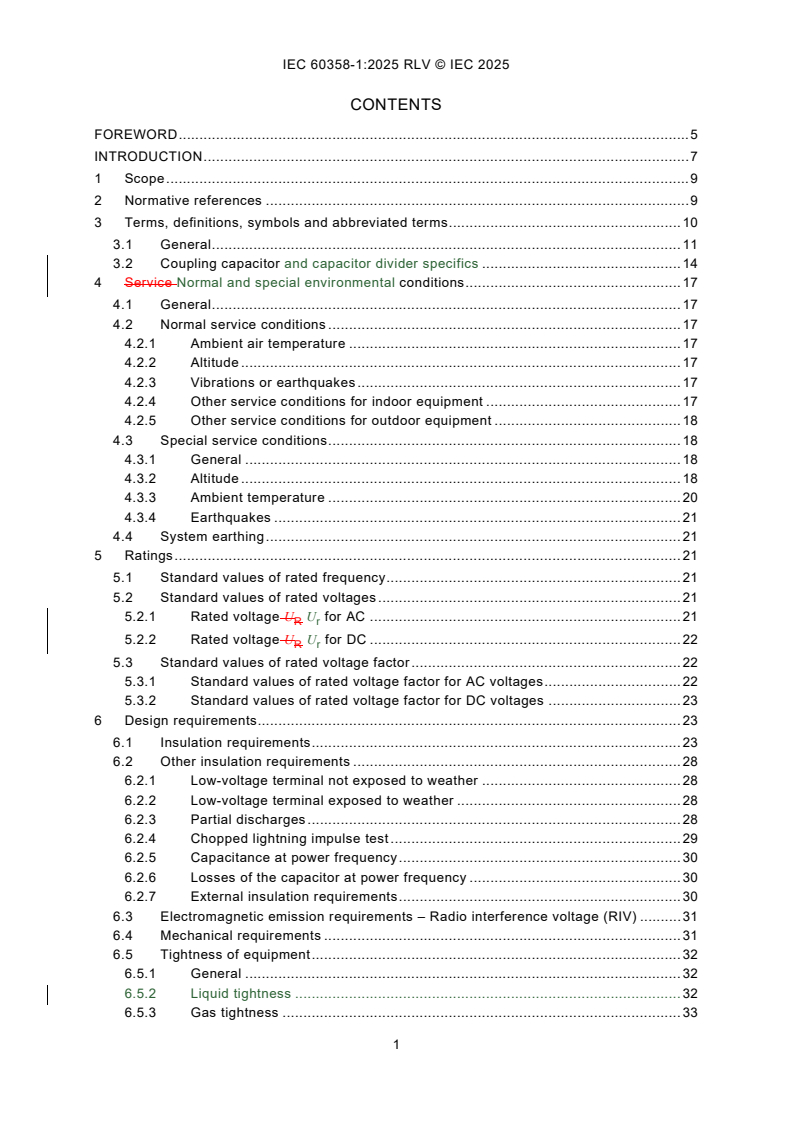
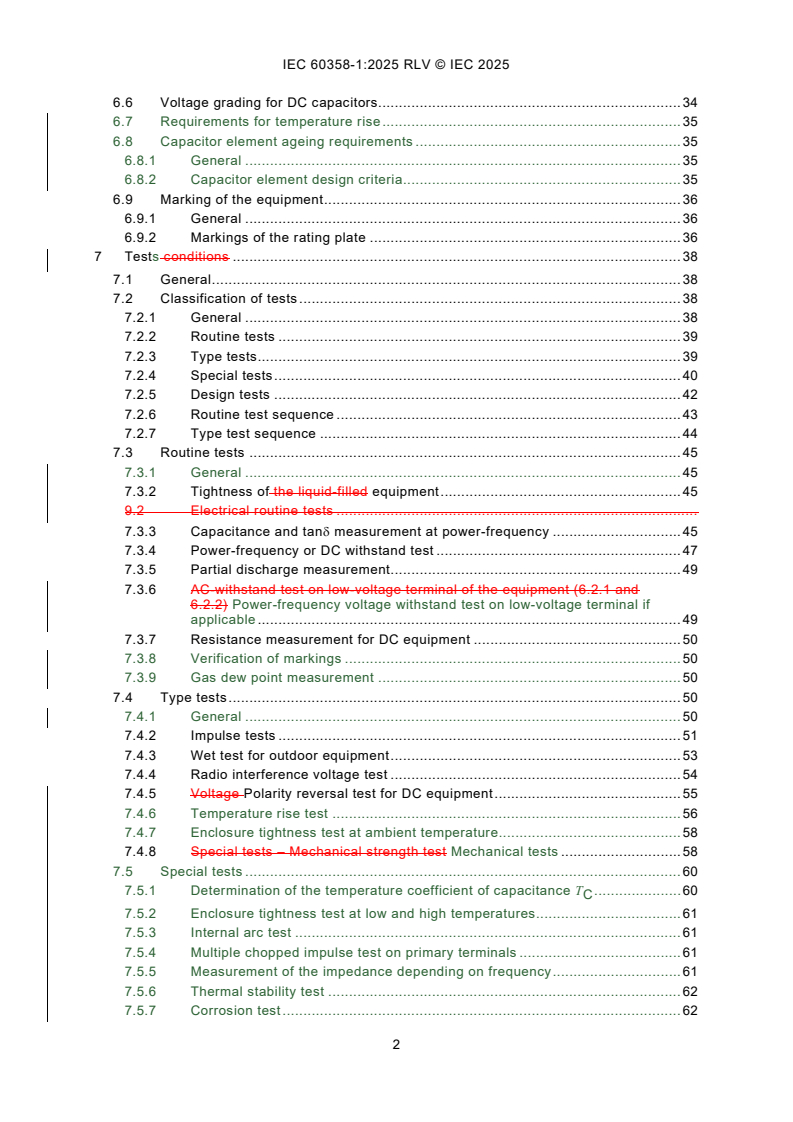
REDLINE IEC 60358-1:2025 RLV - Coupling capacitors and capacitor dividers - Part 1: General rules/23/2025
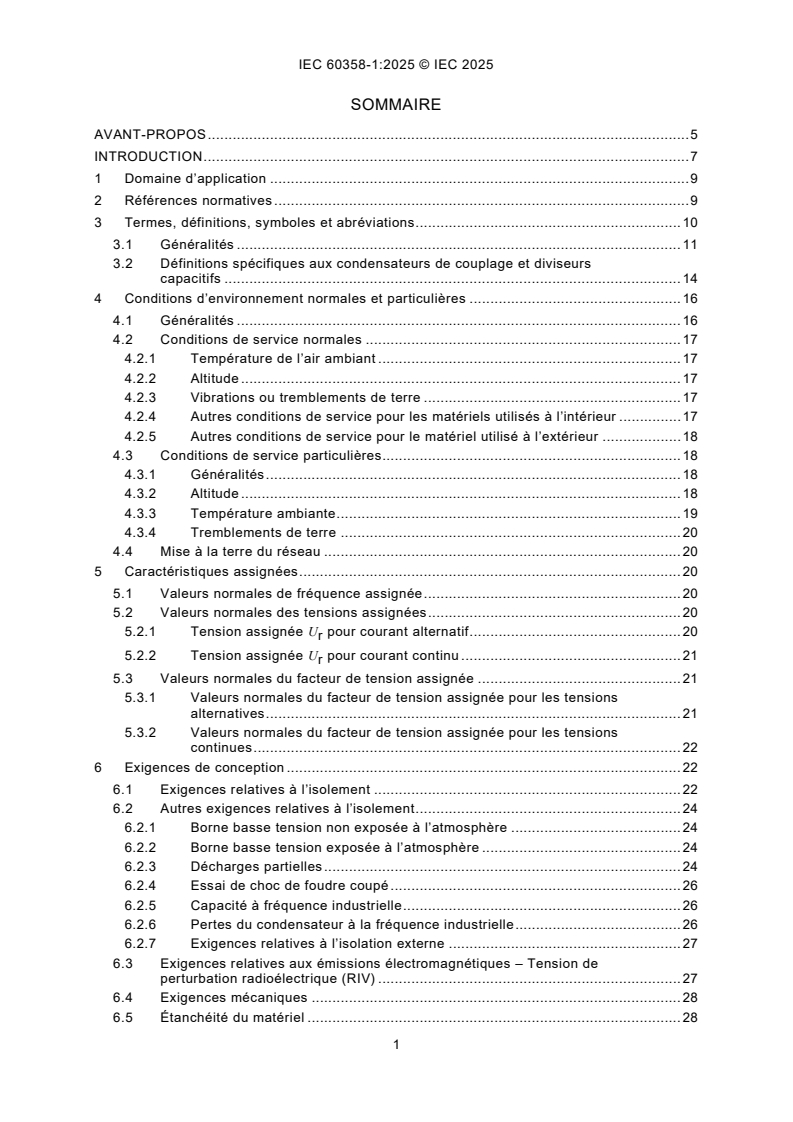
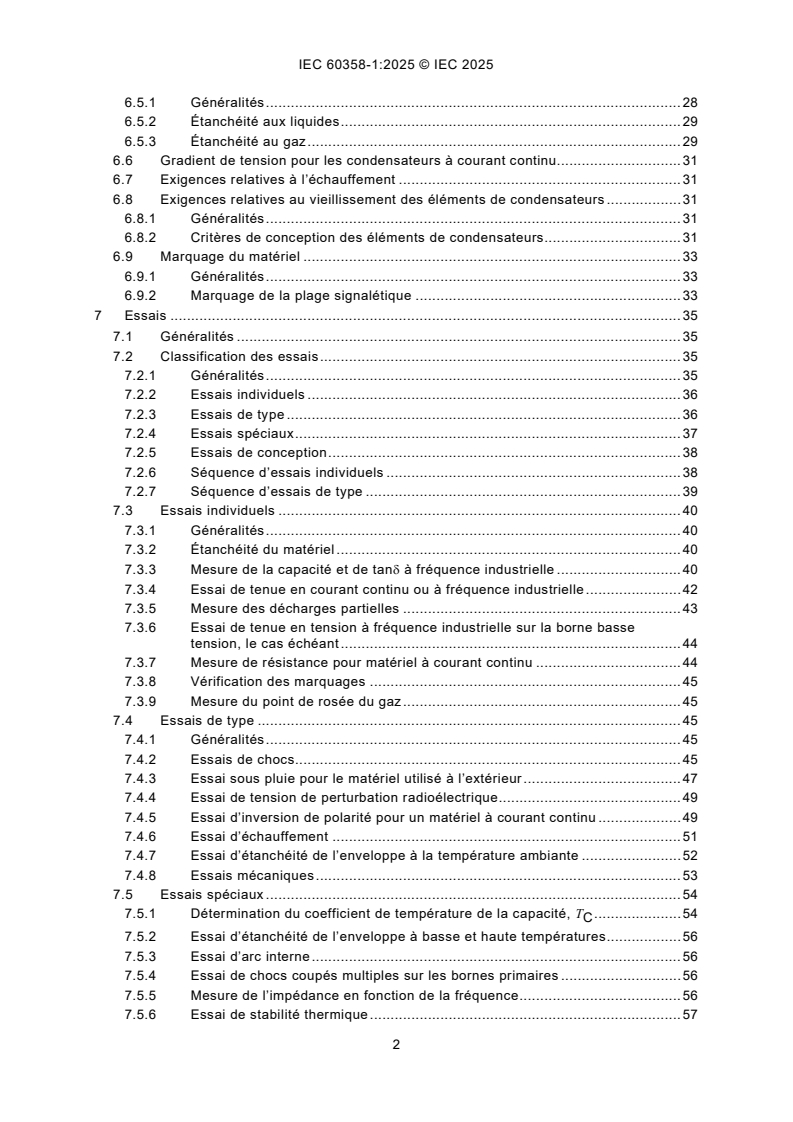
IEC 60358-1:2025 - Condensateurs de couplage et diviseurs capacitifs - Partie 1: Regles générales Released:12/23/2025
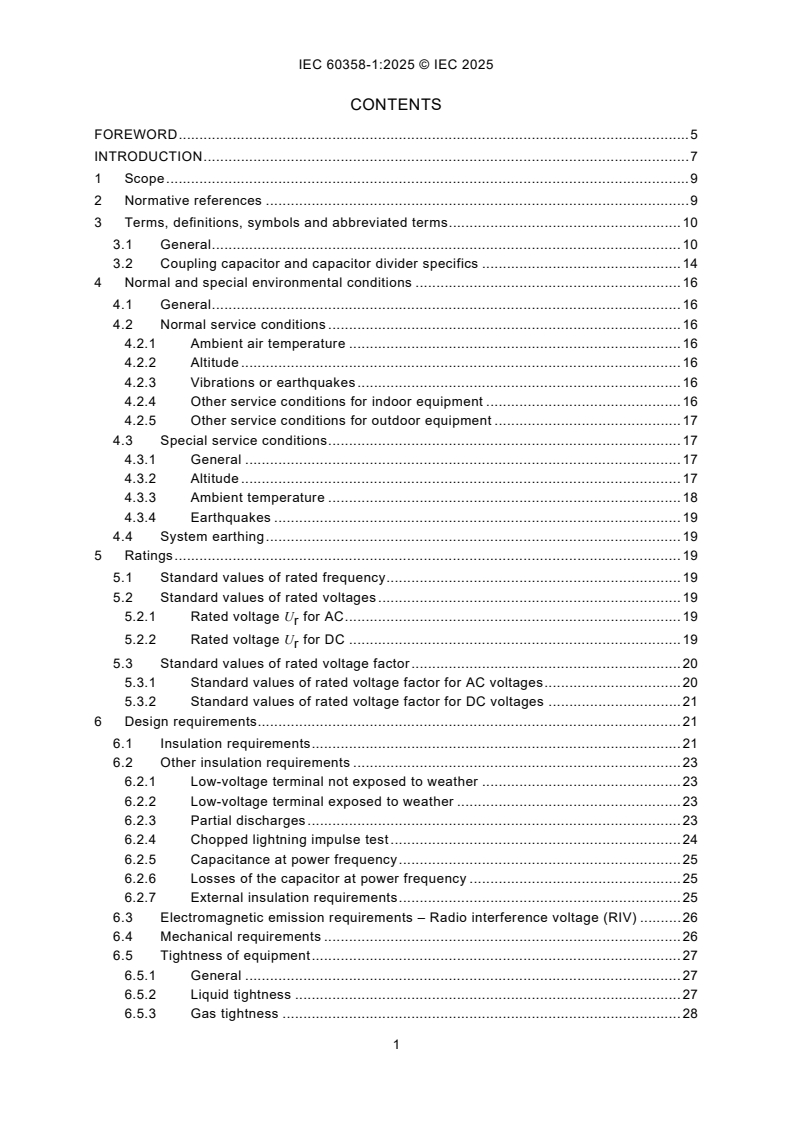
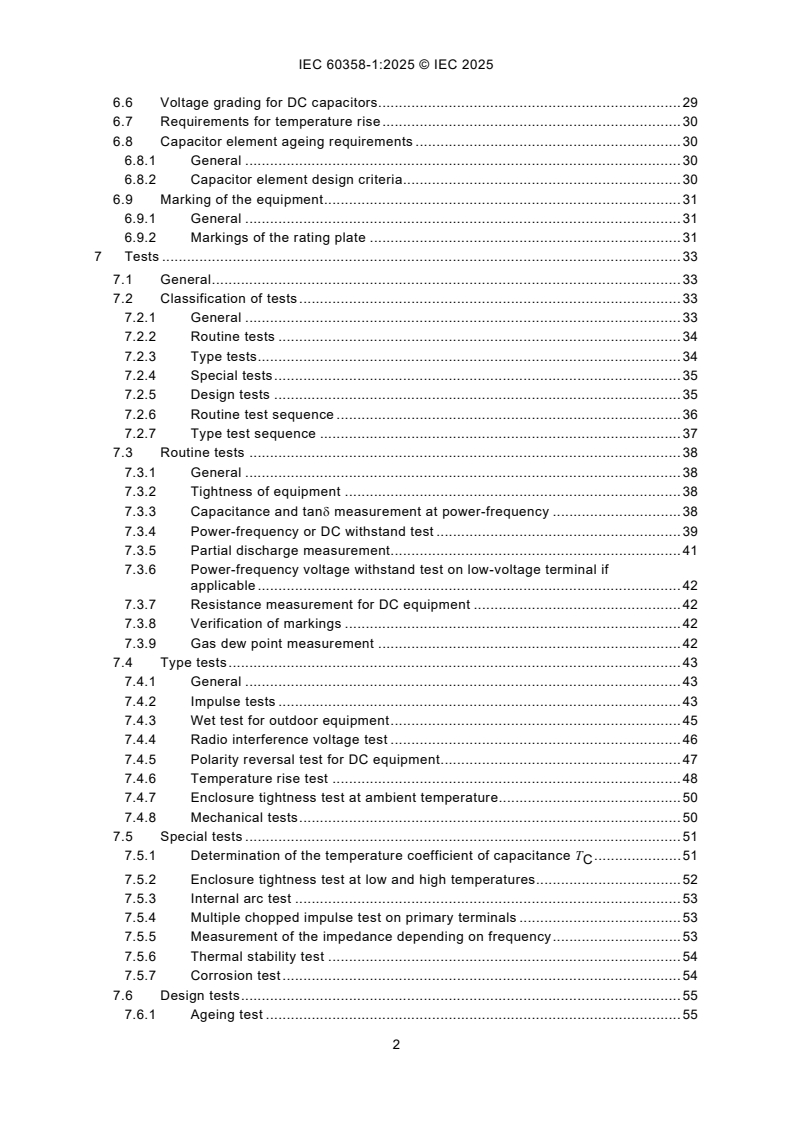
IEC 60358-1:2025 - Coupling capacitors and capacitor dividers - Part 1: General rules Released:12/23/2025
Overview
IEC 60358-1:2025 - Coupling capacitors and capacitor dividers - Part 1: General rules - is the 2025 basic international standard that defines general rules for coupling capacitors and capacitor dividers with rated voltage > 1 000 V. Published as Edition 2.0 and available as an RLV (redline) version, the document includes the full text and a redline showing technical changes from the previous edition. The standard covers equipment connected line-to-ground where the low-voltage terminal is permanently earthed or connected to ancillary devices.
Key topics and technical requirements
IEC 60358-1:2025 sets out core design, testing and operational rules, including:
- Scope and ratings - rated voltages, rated frequency and voltage factors for AC and DC use.
- Design requirements - insulation levels, external insulation, voltage grading for DC, temperature-rise limits and capacitor element ageing criteria.
- Electrical performance - capacitance at power frequency, losses (tanδ), partial discharge limits and chopped lightning impulse considerations.
- Electromagnetic emissions - requirements and measurement of radio interference voltage (RIV).
- Mechanical and enclosure requirements - mechanical strength, liquid/gas tightness, marking and temperature coefficient of capacitance.
- Testing framework - classification and sequences for routine tests, type tests, special tests and design/ageing tests. Notable test methods include impulse tests, wet tests for outdoor equipment, polarity reversal for DC units, RIV tests and high-frequency characteristic measurements.
- Installation, transport and maintenance - rules for storage, handling, final inspection and periodic maintenance.
- Safety and environmental aspects - basic safety provisions and influence on the natural environment.
- Informative and normative annexes - test circuits, superimposed impulse procedures, HF measurements and voltage definitions.
Practical applications and users
IEC 60358-1:2025 is essential for anyone involved with high-voltage capacitive equipment, including:
- Manufacturers of coupling capacitors and capacitor dividers designing products to meet international safety and performance criteria.
- Test laboratories performing routine, type and special tests (partial discharge, impulse, RIV, temperature rise).
- Utilities and OEMs applying capacitive devices in high-voltage substations, measurement and protection circuits, and power transmission systems.
- Specifiers, installers and maintenance teams needing guidance on transport, installation, testing and lifecycle checks.
- Regulators and certification bodies assessing conformity to international high-voltage capacitor standards.
Related guidance
Refer to other IEC documents covering specific capacitor technologies, high-voltage testing methods and electromagnetic compatibility when developing or validating detailed designs and test programs. For the authoritative text and redline changes download IEC 60358-1:2025 RLV from the IEC webstore.
Relations
- Effective Date
- 17-Nov-2023
- Effective Date
- 05-Sep-2023
Buy Documents
IEC 60358-1:2025 - Coupling capacitors and capacitor dividers - Part 1: General rules Released:12/23/2025
REDLINE IEC 60358-1:2025 RLV - Coupling capacitors and capacitor dividers - Part 1: General rules/23/2025
IEC 60358-1:2025 - Condensateurs de couplage et diviseurs capacitifs - Partie 1: Regles générales Released:12/23/2025
IEC 60358-1:2025 - Coupling capacitors and capacitor dividers - Part 1: General rules Released:12/23/2025
Get Certified
Connect with accredited certification bodies for this standard

IMQ S.p.A. (Certification)
Italian electrical product certification.

SLG Prüf- und Zertifizierungs GmbH
German testing and certification body.

UL Solutions
Global safety science company with testing, inspection and certification.
Sponsored listings
Frequently Asked Questions
IEC 60358-1:2025 is a standard published by the International Electrotechnical Commission (IEC). Its full title is "Coupling capacitors and capacitor dividers - Part 1: General rules". This standard covers: IEC 60358-1:2025 This part of IEC 60358 applies to: Coupling capacitors and capacitor dividers, with rated voltage > 1 000 V, connected line to ground with the low-voltage terminal either permanently earthed or connected to devices, for applications listed hereunder and other similar uses. This document serves as a basic standard for the coupling capacitors and capacitor dividers.
IEC 60358-1:2025 This part of IEC 60358 applies to: Coupling capacitors and capacitor dividers, with rated voltage > 1 000 V, connected line to ground with the low-voltage terminal either permanently earthed or connected to devices, for applications listed hereunder and other similar uses. This document serves as a basic standard for the coupling capacitors and capacitor dividers.
IEC 60358-1:2025 is classified under the following ICS (International Classification for Standards) categories: 29.120.99 - Other electrical accessories; 29.240.99 - Other equipment related to power transmission and distribution networks; 31.060.70 - Power capacitors. The ICS classification helps identify the subject area and facilitates finding related standards.
IEC 60358-1:2025 has the following relationships with other standards: It is inter standard links to IEC 60358-1:2012/COR1:2013, IEC 60358-1:2012. Understanding these relationships helps ensure you are using the most current and applicable version of the standard.
IEC 60358-1:2025 is available in PDF format for immediate download after purchase. The document can be added to your cart and obtained through the secure checkout process. Digital delivery ensures instant access to the complete standard document.
Standards Content (Sample)
IEC 60358-1 ®
Edition 2.0 2025-12
INTERNATIONAL
STANDARD
Coupling capacitors and capacitor dividers -
Part 1: General rules
ICS 29.120.99; 29.240.99; 31.060.70 ISBN 978-2-8327-0893-4
All rights reserved. Unless otherwise specified, no part of this publication may be reproduced or utilized in any form or
by any means, electronic or mechanical, including photocopying and microfilm, without permission in writing from either
IEC or IEC's member National Committee in the country of the requester. If you have any questions about IEC copyright
or have an enquiry about obtaining additional rights to this publication, please contact the address below or your local
IEC member National Committee for further information.
IEC Secretariat Tel.: +41 22 919 02 11
3, rue de Varembé info@iec.ch
CH-1211 Geneva 20 www.iec.ch
Switzerland
About the IEC
The International Electrotechnical Commission (IEC) is the leading global organization that prepares and publishes
International Standards for all electrical, electronic and related technologies.
About IEC publications
The technical content of IEC publications is kept under constant review by the IEC. Please make sure that you have the
latest edition, a corrigendum or an amendment might have been published.
IEC publications search - IEC Products & Services Portal - products.iec.ch
webstore.iec.ch/advsearchform Discover our powerful search engine and read freely all the
The advanced search enables to find IEC publications by a publications previews, graphical symbols and the glossary.
variety of criteria (reference number, text, technical With a subscription you will always have access to up to date
committee, …). It also gives information on projects, content tailored to your needs.
replaced and withdrawn publications.
Electropedia - www.electropedia.org
The world's leading online dictionary on electrotechnology,
IEC Just Published - webstore.iec.ch/justpublished
Stay up to date on all new IEC publications. Just Published containing more than 22 500 terminological entries in English
details all new publications released. Available online and and French, with equivalent terms in 25 additional languages.
once a month by email. Also known as the International Electrotechnical Vocabulary
(IEV) online.
IEC Customer Service Centre - webstore.iec.ch/csc
If you wish to give us your feedback on this publication or
need further assistance, please contact the Customer
Service Centre: sales@iec.ch.
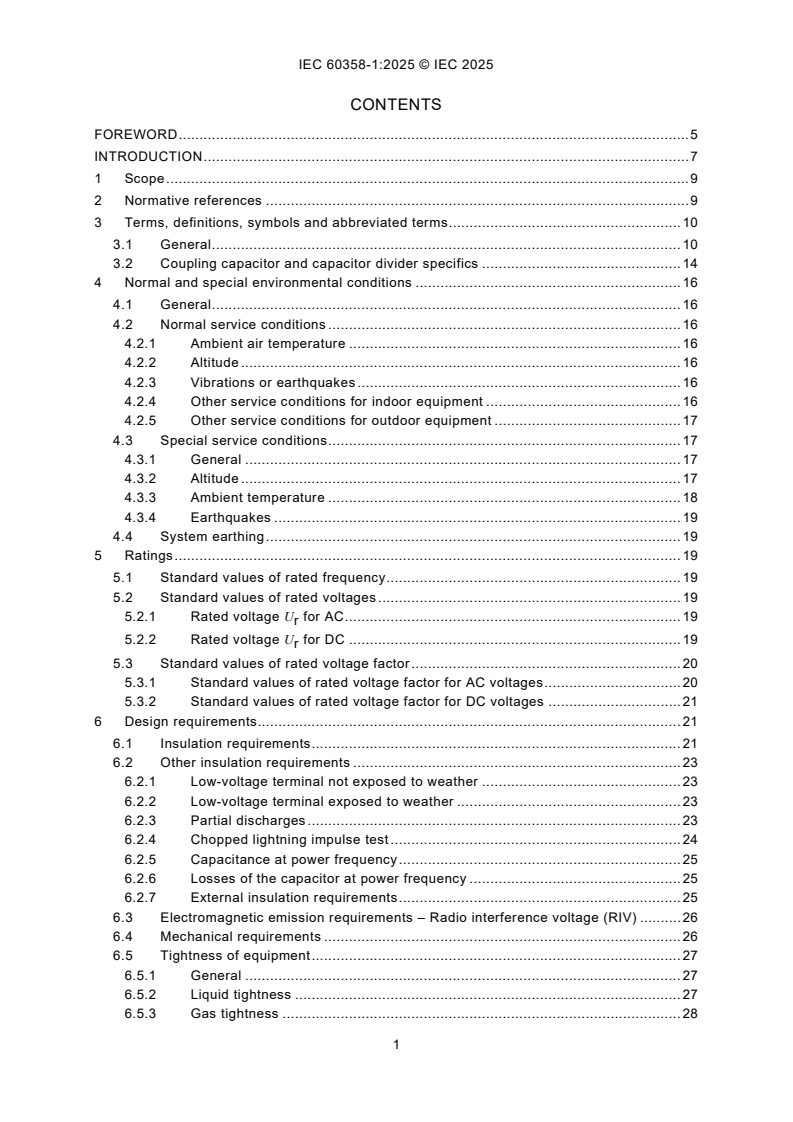
CONTENTS
FOREWORD . 5
INTRODUCTION . 7
1 Scope . 9
2 Normative references . 9
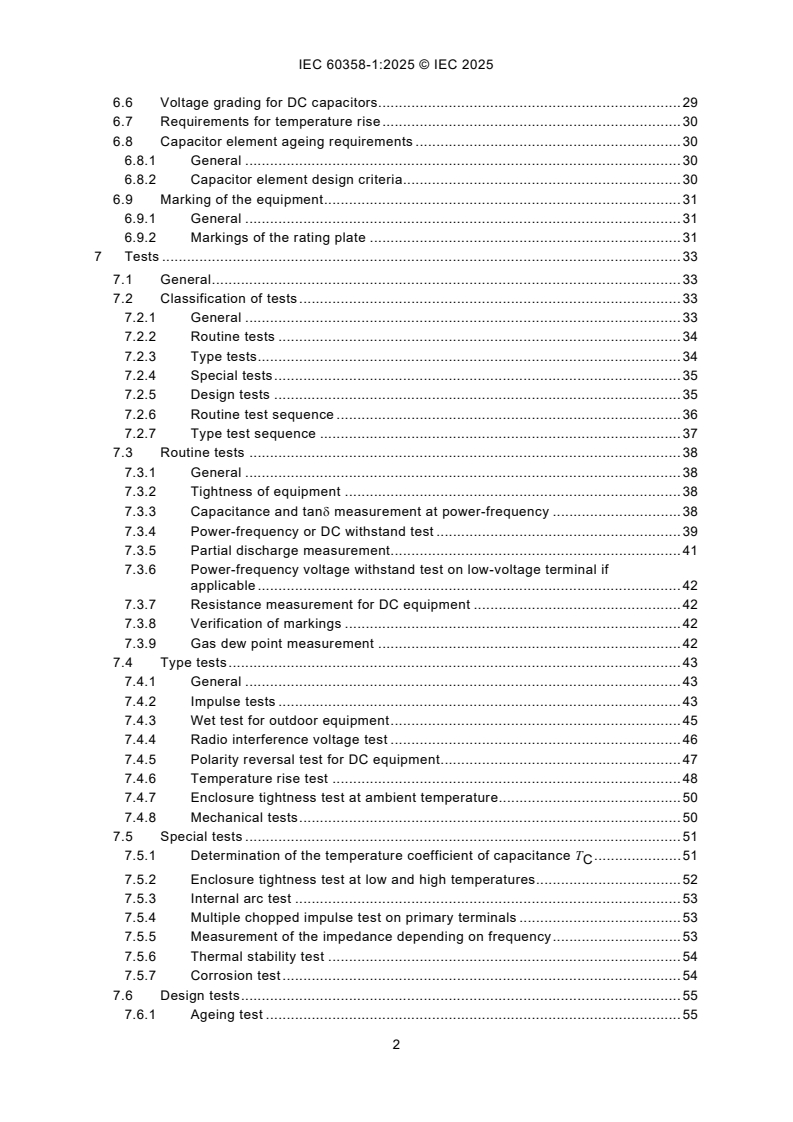
3 Terms, definitions, symbols and abbreviated terms . 10
3.1 General . 10
3.2 Coupling capacitor and capacitor divider specifics . 14
4 Normal and special environmental conditions . 16
4.1 General . 16
4.2 Normal service conditions . 16
4.2.1 Ambient air temperature . 16
4.2.2 Altitude . 16
4.2.3 Vibrations or earthquakes . 16
4.2.4 Other service conditions for indoor equipment . 16
4.2.5 Other service conditions for outdoor equipment . 17
4.3 Special service conditions . 17
4.3.1 General . 17
4.3.2 Altitude . 17
4.3.3 Ambient temperature . 18
4.3.4 Earthquakes . 19
4.4 System earthing . 19
5 Ratings . 19
5.1 Standard values of rated frequency . 19
5.2 Standard values of rated voltages . 19
5.2.1 Rated voltage U for AC . 19
r
5.2.2 Rated voltage U for DC . 19
r
5.3 Standard values of rated voltage factor . 20
5.3.1 Standard values of rated voltage factor for AC voltages . 20
5.3.2 Standard values of rated voltage factor for DC voltages . 21
6 Design requirements. 21
6.1 Insulation requirements . 21
6.2 Other insulation requirements . 23
6.2.1 Low-voltage terminal not exposed to weather . 23
6.2.2 Low-voltage terminal exposed to weather . 23
6.2.3 Partial discharges . 23
6.2.4 Chopped lightning impulse test . 24
6.2.5 Capacitance at power frequency . 25
6.2.6 Losses of the capacitor at power frequency . 25
6.2.7 External insulation requirements . 25
6.3 Electromagnetic emission requirements – Radio interference voltage (RIV) . 26
6.4 Mechanical requirements . 26
6.5 Tightness of equipment . 27
6.5.1 General . 27
6.5.2 Liquid tightness . 27
6.5.3 Gas tightness . 28
6.6 Voltage grading for DC capacitors. 29
6.7 Requirements for temperature rise . 30
6.8 Capacitor element ageing requirements . 30
6.8.1 General . 30
6.8.2 Capacitor element design criteria. 30
6.9 Marking of the equipment . 31
6.9.1 General . 31
6.9.2 Markings of the rating plate . 31
7 Tests . 33
7.1 General . 33
7.2 Classification of tests . 33
7.2.1 General . 33
7.2.2 Routine tests . 34
7.2.3 Type tests. 34
7.2.4 Special tests . 35
7.2.5 Design tests . 35
7.2.6 Routine test sequence . 36
7.2.7 Type test sequence . 37
7.3 Routine tests . 38
7.3.1 General . 38
7.3.2 Tightness of equipment . 38
7.3.3 Capacitance and tanδ measurement at power-frequency . 38
7.3.4 Power-frequency or DC withstand test . 39
7.3.5 Partial discharge measurement. 41
7.3.6 Power-frequency voltage withstand test on low-voltage terminal if
applicable . 42
7.3.7 Resistance measurement for DC equipment . 42
7.3.8 Verification of markings . 42
7.3.9 Gas dew point measurement . 42
7.4 Type tests . 43
7.4.1 General . 43
7.4.2 Impulse tests . 43
7.4.3 Wet test for outdoor equipment . 45
7.4.4 Radio interference voltage test . 46
7.4.5 Polarity reversal test for DC equipment . 47
7.4.6 Temperature rise test . 48
7.4.7 Enclosure tightness test at ambient temperature. 50
7.4.8 Mechanical tests . 50
7.5 Special tests . 51
7.5.1 Determination of the temperature coefficient of capacitance T . 51
C
7.5.2 Enclosure tightness test at low and high temperatures . 52
7.5.3 Internal arc test . 53
7.5.4 Multiple chopped impulse test on primary terminals . 53
7.5.5 Measurement of the impedance depending on frequency . 53
7.5.6 Thermal stability test . 54
7.5.7 Corrosion test . 54
7.6 Design tests . 55
7.6.1 Ageing test . 55
8 Rules for transport, storage, erection, operation and maintenance. 56
8.1 General . 56
8.2 Conditions during transport, storage and installation . 56
8.3 Installation . 57
8.3.1 General . 57
8.3.2 Unpacking and lifting . 57
8.3.3 Assembly . 57
8.3.4 Mounting . 57
8.3.5 Connections . 57
8.3.6 Final installation inspection and tests . 57
8.4 Maintenance . 58
8.4.1 General . 58
8.4.2 Responsibilities for the manufacturer . 58
9 Safety . 58
10 Influence of products on the natural environment . 59
Annex A (informative) Typical diagram of an equipment . 60
Annex B (informative) Partial discharge test circuit and instrumentation . 61
Annex C (normative) Radio interference voltage – Measurement circuit . 63
Annex D (informative) Superimposed impulse voltage test . 65
D.1 Overview . 65
D.2 Test description . 65
D.3 Criteria to pass the test . 66
Annex E (informative) Test circuit for superimposed impulse voltage tests . 67
E.1 General . 67
E.2 Test circuit using blocking capacitor . 67
E.3 Test circuit using sphere gap . 67
Annex F (informative) High-frequency characteristic measurements . 69
Annex G (informative) Composite AC/DC voltages . 70
G.1 Composite AC/DC voltage descriptions . 70
G.2 Example 1 – without 3PWM . 71
G.3 Example 2 – with 3PWM . 72
G.4 Conclusion . 74
Annex H (informative) Voltage definitions . 75
Bibliography . 76
Figure 1 – Factor m for the switching impulse withstand test . 18
Figure 2 – Reduced scale model capacitor element geometry . 31
Figure 3 – Flow charts test sequence to be applied when performing the routine test. 36
Figure 4 – Flow charts test sequence to be applied when performing the type test . 37
Figure 5 – Test sequence for polarity reversal tests . 48
Figure 6 – Flow chart for temperature rise test . 48
Figure A.1 – Example of a diagram for a coupling capacitor (with and without low-
voltage terminal) . 60
Figure A.2 – Example of a diagram for a capacitor divider (with and without low-voltage
terminal) . 60
Figure B.1 – Test circuit . 61
Figure B.2 – Alternative circuit . 61
Figure B.3 – Example of balanced test circuit . 62
Figure B.4 – Example of calibration circuit . 62
Figure C.1 – Measuring circuit . 64
Figure D.1 – Schematic representation of superimposed impulse voltage tests . 65
Figure E.1 – Test circuit for superimposed impulse tests using blocking capacitor . 67
Figure E.2 – Test circuit for superimposed impulse tests using sphere gap . 68
Figure F.1 – Wiring diagram of the measuring circuit for the high-frequency
capacitance and equivalent series resistance of a coupling capacitor . 69
Figure G.1 – Example of an unsymmetrically VSC converter . 71
Figure G.2 – Maximum peak voltage without 3PWM . 72
Figure G.3 – Both individual AC voltage curves with 3PWM . 73
Figure G.4 – Superimposed voltage curve with 3PWM, based on Figure G.3 . 73
Figure H.1 – Voltage overview and definitions. 75
Table 1 – Rated ambient temperature categories . 16
Table 2 – Standard values of rated voltage factors . 20
Table 3 – Standard insulation levels for AC voltages . 21
Table 4 – Partial discharge test voltages and permissible levels . 24
Table 5 – Creepage distance for AC . 26
Table 6 – Static withstand test loads for insulators . 27
Table 7 – Permissible temporary leakage rates for gas systems . 29
Table 8 – Marking of the rating plate . 32
Table 9 – List of Routine tests . 34
Table 10 – List of Type tests . 34
Table 11 – List of Special tests . 35
Table 12 – List of Design tests . 35
Table 13 – Test voltages for units, stacks and complete equipment . 40
Table 14 – Modalities of application of the test loads to the line primary terminals . 51
Table H.1 – Voltage definitions for DC application . 75
INTERNATIONAL ELECTROTECHNICAL COMMISSION
___________
Coupling capacitors and capacitor dividers -
Part 1: General rules
FOREWORD
1) The International Electrotechnical Commission (IEC) is a worldwide organization for standardization comprising
all national electrotechnical committees (IEC National Committees). The object of IEC is to promote international
co-operation on all questions concerning standardization in the electrical and electronic fields. To this end and
in addition to other activities, IEC publishes International Standards, Technical Specifications, Technical Reports,
Publicly Available Specifications (PAS) and Guides (hereafter referred to as “IEC Publication(s)”). Their
preparation is entrusted to technical committees; any IEC National Committee interested in the subject dealt with
may participate in this preparatory work. International, governmental and non-governmental organizations liaising
with the IEC also participate in this preparation. IEC collaborates closely with the International Organization for
Standardization (ISO) in accordance with conditions determined by agreement between the two organizations.
2) The formal decisions or agreements of IEC on technical matters express, as nearly as possible, an international
consensus of opinion on the relevant subjects since each technical committee has representation from all
interested IEC National Committees.
3) IEC Publications have the form of recommendations for international use and are accepted by IEC National
Committees in that sense. While all reasonable efforts are made to ensure that the technical content of IEC
Publications is accurate, IEC cannot be held responsible for the way in which they are used or for any
misinterpretation by any end user.
4) In order to promote international uniformity, IEC National Committees undertake to apply IEC Publications
transparently to the maximum extent possible in their national and regional publications. Any divergence between
any IEC Publication and the corresponding national or regional publication shall be clearly indicated in the latter.
5) IEC itself does not provide any attestation of conformity. Independent certification bodies provide conformity
assessment services and, in some areas, access to IEC marks of conformity. IEC is not responsible for any
services carried out by independent certification bodies.
6) All users should ensure that they have the latest edition of this publication.
7) No liability shall attach to IEC or its directors, employees, servants or agents including individual experts and
members of its technical committees and IEC National Committees for any personal injury, property damage or
other damage of any nature whatsoever, whether direct or indirect, or for costs (including legal fees) and
expenses arising out of the publication, use of, or reliance upon, this IEC Publication or any other IEC
Publications.
8) Attention is drawn to the Normative references cited in this publication. Use of the referenced publications is
indispensable for the correct application of this publication.
9) IEC draws attention to the possibility that the implementation of this document may involve the use of (a)
patent(s). IEC takes no position concerning the evidence, validity or applicability of any claimed patent rights in
respect thereof. As of the date of publication of this document, IEC had not received notice of (a) patent(s), which
may be required to implement this document. However, implementers are cautioned that this may not represent
the latest information, which may be obtained from the patent database available at https://patents.iec.ch. IEC
shall not be held responsible for identifying any or all such patent rights.
IEC 60358-1 has been prepared by IEC Technical Committee 33: Power capacitors and their
applications. It is an International Standard.
This second edition cancels and replaces the first edition published in 2012. This edition
constitutes a technical revision.
This edition of IEC 60358-1 includes the following significant technical changes with respect to
the previous edition:
a) new terms and definitions are presented in Clause 3;
b) new definitions in Clause 4 and Clause 5;
c) gas-insulated coupling capacitors and capacitor dividers are integrated in Clause 6;
d) new tests in routine, type, special and design test sections are introduced, see Clause 7;
e) new Clause 8, Clause 9 and Clause 10;
f) new Annex D, Annex E, Annex F, Annex G and Annex H.
The text of this International Standard is based on the following documents:
Draft Report on voting
33/732/FDIS 33/737/RVD
Full information on the voting for its approval can be found in the report on voting indicated in
the above table.
The language used for the development of this International Standard is English.
This document was drafted in accordance with ISO/IEC Directives, Part 2, and developed in
accordance with ISO/IEC Directives, Part 1 and ISO/IEC Directives, IEC Supplement, available
at www.iec.ch/members_experts/refdocs. The main document types developed by IEC are
described in greater detail at www.iec.ch/publications.
A list of all parts in the IEC 60358 series, published under the general title Coupling capacitors
and capacitor dividers, can be found on the IEC website.
IEC 60358-1, Coupling capacitors and capacitor dividers - Part 1: General rules
IEC 60358-2, Coupling capacitors and capacitor dividers - Part 2: AC or DC single-phase
coupling capacitor connected between line and ground for power line carrier-
frequency (PLC) application
IEC 60358-3, Coupling capacitors and capacitor dividers - Part 3: AC or DC single-phase
coupling capacitor for harmonic-filters applications
IEC 60358-4, Coupling capacitors and capacitor dividers - Part 4: DC or AC single-phase
capacitor dividers
The committee has decided that the contents of this document will remain unchanged until the
stability date indicated on the IEC website under webstore.iec.ch in the data related to the
specific document. At this date, the document will be
– reconfirmed,
– withdrawn, or
– revised.
INTRODUCTION
This document is the first revision of IEC 60358-1, defining general rules for coupling capacitors
and capacitor dividers.
The main modifications of this revision are listed below:
– terms and definitions:
• new terms and definitions are presented in Clause 3;
– normal and special environmental conditions:
• new definitions in Clause 4 are introduced;
– ratings:
• addition of HV insulation levels above 800 kV;
• new definition on rated voltage U for AC and DC applications;
r
• Clause 5, new definitions for DC application are integrated;
• new standard values of rated voltages are defined;
– design and construction:
• clarification of the altitude correction for external insulation and dielectric tests;
• external insulation requirements for DC application;
• gas-insulated coupling capacitors and capacitor dividers are integrated in Clause 6;
• new test with its requirements on capacitor element ageing is defined;
– type tests:
• temperature rise test: more accurate definition of the test duration;
• lightning impulse test: new test procedure (15 impulses) for U ≥ 300 kV;
m
• mechanical test: moved from special test to type test;
• new enclosure tightness test for gas-insulated coupling capacitors and dividers;
– routine tests:
• tightness tests for gas-insulated equipment;
• gas dew point measurements;
• new flowchart of routine tests presented in Figure 3;
– special tests:
• determination of temperature coefficient of the capacitor element;
• new enclosure tightness test on low and hot temperature;
• information about internal arc tests;
• information about multiple chopped impulse tests;
• new test on impedance measurements depending on frequency;
• new test on thermal stability;
• new test on corrosion;
• new flowchart of type tests presented in Figure 4;
– design tests (new clause):
• ageing tests of capacitor elements;
– commissioning tests (new clause):
• new installation inspection;
• gas dew point test moved from special test to commissioning tests;
– rules for transport, storage, erection, operation and maintenance:
• new mandatory rules for user and manufacturer;
• new conditions for transportation and storage;
– new annexes:
• Annex D (informative): provide information about superimposed impulse voltages;
• Annex E (informative): provide information on test setups for superimposed impulse
voltage tests;
• Annex F (informative): is introduced on high-frequency characteristic measurements;
• Annex G (informative): provide information about composite AC/DC voltages;
• Annex H (informative): present a summary of all voltages used in DC application.
1 Scope
This part of IEC 60358 applies to:
– Coupling capacitors and capacitor dividers, with rated voltage > 1 000 V, connected line to
ground with the low-voltage terminal either permanently earthed or connected to devices,
for applications listed hereunder and other similar uses.
This document serves as a basic standard for the coupling capacitors and capacitor dividers.
The different parts of this standard series will present the supplementary specifications and
tests, for example IEC 60358-2, IEC 60358-3 or IEC 60358-4.
Diagrams of coupling capacitor and capacitor divider to which this standard series applies are
given in Figure A.1 and Figure A.2 (see Annex A).
2 Normative references
The following documents are referred to in the text in such a way that some or all of their content
constitutes requirements of this document. For dated references, only the edition cited applies.
For undated references, the latest edition of the referenced document (including any
amendments) applies.
IEC 60038, IEC standard voltages
IEC 60060-1, High-voltage test techniques - Part 1: General definitions and test requirements
IEC 60068-2-11:2021, Environmental testing - Part 2-11: Tests - Test Ka: Salt mist
IEC 60068-2-17, Environmental testing - Part 2-17: Tests - Test Q: Sealing
IEC 60071-1, Insulation co-ordination - Part 1: Definitions, principles and rules
IEC 60071-2, Insulation co-ordination - Part 2: Application guidelines
IEC 60071-11, Insulation co-ordination - Part 11:Definitions, principles and rules for HVDC
system
IEC 60270, High-voltage test techniques - Charge-based measurement of partial discharges
IEC 60296, Fluids for electrotechnical applications - Mineral insulating oils for electrical
equipment
IEC 60376, Specification of technical grade sulphur hexafluoride (SF ) and complementary
gases to be used in its mixtures for use in electrical equipment
IEC 60480, Specifications for the re-use of sulphur hexafluoride (SF ) and its mixtures in
electrical equipment
IEC 60721 (all parts), Classification of environmental conditions
IEC TS 60815-1:2008, Selection and dimensioning of high-voltage insulators intended for use
in polluted conditions - Part 1: Definitions, information and general principles
IEC TS 60815-2:2008, Selection and dimensioning of high-voltage insulators intended for use
in polluted conditions - Part 2: Ceramic and glass insulators for a.c. systems
IEC TS 60815-3:2008, Selection and dimensioning of high-voltage insulators intended for use
in polluted conditions - Part 3: Polymer insulators for a.c. systems
IEC 60867, Insulating liquids - Specifications for unused liquids based on synthetic aromatic
hydrocarbons
IEC 61099, Insulating liquids - Specifications for unused synthetic organic esters for electrical
purposes
IEC 62271-4:2022, High-voltage switchgear and controlgear - Part 4: Handling procedures for
gases for insulation and/or switching
IEC 62770, Fluids for electrotechnical applications - Unused natural esters for transformers and
similar electrical equipment
IEC 63012, Insulating liquids - Unused modified or blended esters for electrotechnical
applications
ISO 4628-3, Paints and varnishes - Evaluation of quantity and size of defects, and of intensity
of uniform changes in appearance - Part 3: Assessment of degree of rusting
ISO 22479, Corrosion of metals and alloys - Sulfur dioxide test in a humid atmosphere (fixed
gas method)
CISPR/TR 18-2, Radio interference characteristics of overhead power lines and high-voltage
equipment - Part 2: Methods of measurement and procedure for determining limits
3 Terms, definitions, symbols and abbreviated terms
For the purposes of this document, the following terms and definitions apply.
ISO and IEC maintain terminology databases for use in standardization at the following
addresses:
– IEC Electropedia: available at https://www.electropedia.org/;
– ISO Online browsing platform: available at https://www.iso.org/obp.
NOTE Some of these terms and definitions are identical to or are similar to those of IEC 60050-321:1986,
IEC 60050-436:1990, IEC 60050-601:1985 and IEC 60050-604:1987. These are indicated by the relevant reference
in brackets.
3.1 General
3.1.1
rated frequency of equipment
f
r
frequency for which the coupling capacitor has been designed
3.1.2
rated voltage
U
r
voltage based on the maximum voltage U including superimposed harmonic and sub-
m
harmonic voltages between phase to ground
3.1.3
rated voltage
highest value of line to ground voltage, including harmonics and commutation overshoots,
for which the equipment is designed and may be used in respect of its insulation
3.1.4
highest voltage for equipment
U
m
highest RMS value of phase-to-phase voltage for which the equipment is designed and
may be used in respect of its insulation
[SOURCE: IEC 60050-614:2016, 614-03-01, modified – Symbol added, "(RMS value)" deleted,
"service" replaced with "operating" and "greatest" replaced with "highest"]
3.1.5
creepage distance voltage
U
cd
voltage which is needed to calculate the creepage distance based on IEC TS 60815-4
3.1.6
DC system voltage
U
DC
highest mean or average operating voltage to earth, excluding harmonics and commutation
overshoots
[SOURCE: IEC 60071-5:2014, Annex A]
3.1.7
maximum DC system voltage
U
DCmax
almost a pure DC voltage with a magnitude dependent on voltage control and measuring
tolerance excluding harmonics and commutation overshoots
3.1.8
rated lightning impulse withstand voltage
U
LIWV
highest peak value of the lightning impulse voltage which does not cause breakdown of
insulation under specified conditions
[SOURCE: IEC 60050-442:2002, 442-09-18, modified – "rated lightning" added to term,
"lightning" added to definition, "of prescribed form and polarity" removed from definition]
3.1.9
rated switching impulse withstand voltage
U
SIWV
highest peak value of the switching impulse voltage which does not cause breakdown of
insulation under specified conditions
[SOURCE: IEC 60050-442:2002, 442-09-18, modified – "rated switching" added to term,
"switching" added to definition]
3.1.10
maximum voltage across a capacitor
U
C
maximum composite AC/DC voltage across a capacitor placed between the converter
transformer and the VSC converter.
3.1.11
rated insulation level
combination of voltage values which characterises the insulation of the equipment with regard
to its capability to withstand dielectric stresses
3.1.12
isolated neutral system
system where the neutral point is not intentionally connected to earth, except for high
impedance connections for protection or measurement purposes
[SOURCE: IEC 60050-601:1985, 601-02-24]
3.1.13
solidly earthed (neutral) system
system whose neutral point(s) is (are) earthed directly
[SOURCE: IEC 60050-601:1985, 601-02-25]
3.1.14
impedance earthed (neutral) system
system whose neutral point(s) is (are) earthed through impedances to limit earth fault currents
[SOURCE: IEC 60050-601:1985, 601-02-26]
3.1.15
resonant earthed (neutral) system
system in which one or more neutral points are connected to earth through reactances which
approximately compensate the capacitive component of a single-phase-to-earth fault current
Note 1 to entry: With resonant earthing of a system, the residual current in the fault is limited to such an extent that
an arcing fault in air is self-extinguishing.
[SOURCE: IEC 60050-601:1985, 601-02-27]
3.1.16
earth fault factor
at a given location of a three-phase system, and for a given system configuration, the ratio of
the highest RMS phase-to-earth power frequency voltage on a healthy phase during a fault to
earth affecting one or more phases at any point on the system to the RMS value of phase-to-
earth power frequency voltage which would be obtained at the given location in the absence of
any such fault
[SOURCE: IEC 60050-604:1987, 604-03-06]
3.1.17
earthed neutral system
system in which the neutral is connected to earth either solidly or through a resistance or
reactance of sufficiently low value to reduce transient oscillations and to give a current sufficient
for selective earth fault protection
Note 1 to entry: A three-phase system with effectively earthed neutral at a given location is a system characterized
by an earth fault factor at this point which does not exceed 1,4.
This condition is obtained approximately when, for all system configurations, the ratio of zero-sequence reactance
to the positive-sequence reactance is less than 3 and the ratio of zero-sequence resistance to positive-sequence
reactance is less than one.
Note 2 to entry: A three-phase system with non-effectively earthed neutral at a given location is a system
characterized by an earth fault factor at this point that may exceed 1,4.
3.1.18
exposed installation
installation in which the apparatus is subject to overvoltages of atmospheric origin
Note 1 to entry: Such installations are usually connected to overhead transmission lines either directly or through
a short length of cable.
3.1.19
non-exposed installation
installation in which the apparatus is not subject to overvoltages of atmospheric origin
Note 1 to entry: Such installations are usually connected to underground cable networks.
3.1.20
rated voltage factor
F
V
multiplying factor to be applied to the rated voltage U to determine the maximum voltage at
r
which equipment must comply with relevant thermal requirements for a specified time
3.1.21
line terminal
terminal intended for connection to a line conductor of a network
[SOURCE: IEC 60050-436:1990, 436-03-01]
3.1.22
mechanical stress
stresses on different parts of the equipment as a function of four main forces:
– forces on the terminals due to the line connections,
– forces due to the wind on the cross-section of the equipment with and without line trap
mounted on the top of a coupling/filter capacitor,
– seismic forces, and
– electrodynamic forces due to short circuit current
3.1.23
voltage-connected equipment
equipment which has only one connection to the high-voltage line
Note 1 to entry: Under normal conditions the top connection carries only the current of the equipment.
3.1.24
current-connected equipment
equipment which has two connections to the high-avoltage line
Note 1 to entry: The terminals and the top connection are designed to carry the line current under normal conditions.
3.1.25
line trap-connected coupling/filter capacitor
coupling/filter capacitor which supports a line trap on its top
Note 1 to entry: In this case, the two connections to the line trap carry the HV line current and one connection from
the line trap to the capacitor carries the current of the capacitor.
Note 2 to entry: The pedestal-mounting line traps in two phases generate additional forces during a short circuit in
more than one phase.
3.2 Coupling capacitor and capacitor divider specifics
3.2.1
capacitor
general term used when it is not necessary to state whether reference is made to a capacitor
unit or to a capacitor stack
3.2.2
equipment
general term used for this standard series, for complete capacitor, capacitor divider, RC divider
3.2.3
coupling capacitor
capacitor used for the transmission of signals in a power system
[SOURCE: IEC 60050-436:1990, 436-02-11]
3.2.4
capacitor divider
capacitor stack forming a capacitor divider by providing a voltage tap
3.2.5
(capacitor) element
device consisting essentially of two electrodes separated by a dielectric
3.2.6
(capacitor) unit
assembly of one or more capacitor elements in the same container with terminals brought out
[SOURCE: IEC 60050-436:1990, 436-01-04]
3.2.7
(capacitor) stack
assembly of capacitor units connected in series
[SOURCE: IEC 60050-436:1990, 436-01-05]
3.2.8
rated capacitance of a capacitor or capacitor divider
C
r
capacitance value for which the capacitor has been designed
Note 1 to entry: This definition applies:
– for a capacitor unit, to the capacitance between the terminals of the unit;
– for a capacitor stack, to the capacitance between line and low voltage terminals or between line and earth
terminals of the stack.
3.2.9
low-voltage terminal of a coupling capacitor
terminal (N ) intended for connection to earth either directly or via a drain coil of negligible
HF
value of impedance, at rated frequency, for power line carrier (PLC
...
IEC 60358-1 ®
Edition 2.0 2025-12
INTERNATIONAL
STANDARD
REDLINE VERSION
Coupling capacitors and capacitor dividers -
Part 1: General rules
ICS 29.120.99; 29.240.99; 31.060.70 ISBN 978-2-8327-0975-7
All rights reserved. Unless otherwise specified, no part of this publication may be reproduced or utilized in any form or
by any means, electronic or mechanical, including photocopying and microfilm, without permission in writing from either
IEC or IEC's member National Committee in the country of the requester. If you have any questions about IEC copyright
or have an enquiry about obtaining additional rights to this publication, please contact the address below or your local
IEC member National Committee for further information.
IEC Secretariat Tel.: +41 22 919 02 11
3, rue de Varembé info@iec.ch
CH-1211 Geneva 20 www.iec.ch
Switzerland
About the IEC
The International Electrotechnical Commission (IEC) is the leading global organization that prepares and publishes
International Standards for all electrical, electronic and related technologies.
About IEC publications
The technical content of IEC publications is kept under constant review by the IEC. Please make sure that you have the
latest edition, a corrigendum or an amendment might have been published.
IEC publications search - IEC Products & Services Portal - products.iec.ch
webstore.iec.ch/advsearchform Discover our powerful search engine and read freely all the
The advanced search enables to find IEC publications by a publications previews, graphical symbols and the glossary.
variety of criteria (reference number, text, technical With a subscription you will always have access to up to date
committee, …). It also gives information on projects, content tailored to your needs.
replaced and withdrawn publications.
Electropedia - www.electropedia.org
The world's leading online dictionary on electrotechnology,
IEC Just Published - webstore.iec.ch/justpublished
Stay up to date on all new IEC publications. Just Published containing more than 22 500 terminological entries in English
details all new publications released. Available online and and French, with equivalent terms in 25 additional languages.
once a month by email. Also known as the International Electrotechnical Vocabulary
(IEV) online.
IEC Customer Service Centre - webstore.iec.ch/csc
If you wish to give us your feedback on this publication or
need further assistance, please contact the Customer
Service Centre: sales@iec.ch.
CONTENTS
FOREWORD . 5
INTRODUCTION . 7
1 Scope . 9
2 Normative references . 9
3 Terms, definitions, symbols and abbreviated terms . 10
3.1 General . 11
3.2 Coupling capacitor and capacitor divider specifics . 14
4 Service Normal and special environmental conditions . 17
4.1 General . 17
4.2 Normal service conditions . 17
4.2.1 Ambient air temperature . 17
4.2.2 Altitude . 17
4.2.3 Vibrations or earthquakes . 17
4.2.4 Other service conditions for indoor equipment . 17
4.2.5 Other service conditions for outdoor equipment . 18
4.3 Special service conditions . 18
4.3.1 General . 18
4.3.2 Altitude . 18
4.3.3 Ambient temperature . 20
4.3.4 Earthquakes . 21
4.4 System earthing . 21
5 Ratings . 21
5.1 Standard values of rated frequency . 21
5.2 Standard values of rated voltages . 21
5.2.1 Rated voltage U U for AC . 21
R r
5.2.2 Rated voltage U U for DC . 22
R r
5.3 Standard values of rated voltage factor . 22
5.3.1 Standard values of rated voltage factor for AC voltages . 22
5.3.2 Standard values of rated voltage factor for DC voltages . 23
6 Design requirements. 23
6.1 Insulation requirements . 23
6.2 Other insulation requirements . 28
6.2.1 Low-voltage terminal not exposed to weather . 28
6.2.2 Low-voltage terminal exposed to weather . 28
6.2.3 Partial discharges . 28
6.2.4 Chopped lightning impulse test . 29
6.2.5 Capacitance at power frequency . 30
6.2.6 Losses of the capacitor at power frequency . 30
6.2.7 External insulation requirements . 30
6.3 Electromagnetic emission requirements – Radio interference voltage (RIV) . 31
6.4 Mechanical requirements . 31
6.5 Tightness of equipment . 32
6.5.1 General . 32
6.5.2 Liquid tightness . 32
6.5.3 Gas tightness . 33
6.6 Voltage grading for DC capacitors. 34
6.7 Requirements for temperature rise . 35
6.8 Capacitor element ageing requirements . 35
6.8.1 General . 35
6.8.2 Capacitor element design criteria. 35
6.9 Marking of the equipment . 36
6.9.1 General . 36
6.9.2 Markings of the rating plate . 36
7 Tests conditions . 38
7.1 General . 38
7.2 Classification of tests . 38
7.2.1 General . 38
7.2.2 Routine tests . 39
7.2.3 Type tests. 39
7.2.4 Special tests . 40
7.2.5 Design tests . 42
7.2.6 Routine test sequence . 43
7.2.7 Type test sequence . 44
7.3 Routine tests . 45
7.3.1 General . 45
7.3.2 Tightness of the liquid-filled equipment . 45
9.2 Electrical routine tests .
7.3.3 Capacitance and tanδ measurement at power-frequency . 45
7.3.4 Power-frequency or DC withstand test . 47
7.3.5 Partial discharge measurement. 49
7.3.6 AC-withstand test on low-voltage terminal of the equipment (6.2.1 and
6.2.2) Power-frequency voltage withstand test on low-voltage terminal if
applicable . 49
7.3.7 Resistance measurement for DC equipment . 50
7.3.8 Verification of markings . 50
7.3.9 Gas dew point measurement . 50
7.4 Type tests . 50
7.4.1 General . 50
7.4.2 Impulse tests . 51
7.4.3 Wet test for outdoor equipment . 53
7.4.4 Radio interference voltage test . 54
7.4.5 Voltage Polarity reversal test for DC equipment . 55
7.4.6 Temperature rise test . 56
7.4.7 Enclosure tightness test at ambient temperature. 58
7.4.8 Special tests – Mechanical strength test Mechanical tests . 58
7.5 Special tests . 60
7.5.1 Determination of the temperature coefficient of capacitance T . 60
C
7.5.2 Enclosure tightness test at low and high temperatures . 61
7.5.3 Internal arc test . 61
7.5.4 Multiple chopped impulse test on primary terminals . 61
7.5.5 Measurement of the impedance depending on frequency . 61
7.5.6 Thermal stability test . 62
7.5.7 Corrosion test . 62
7.6 Design tests . 63
7.6.1 Ageing test . 63
8 Rules for transport, storage, erection, operation and maintenance. 64
8.1 General . 64
8.2 Conditions during transport, storage and installation . 64
8.3 Installation . 65
8.3.1 General . 65
8.3.2 Unpacking and lifting . 65
8.3.3 Assembly . 65
8.3.4 Mounting . 65
8.3.5 Connections . 65
8.3.6 Final installation inspection and tests . 65
8.4 Maintenance . 66
8.4.1 General . 66
8.4.2 Responsibilities for the manufacturer . 66
9 Safety . 66
10 Influence of products on the natural environment . 67
Annex A (informative) Typical diagram of an equipment . 68
Annex B (informative) Partial discharge test circuit and instrumentation . 70
Annex C (normative) Radio interference voltage – Measurement circuit . 72
Annex D (informative) Superimposed impulse voltage test . 74
D.1 Overview . 74
D.2 Test description . 74
D.3 Criteria to pass the test . 75
Annex E (informative) Test circuit for superimposed impulse voltage tests . 76
E.1 General . 76
E.2 Test circuit using blocking capacitor . 76
E.3 Test circuit using sphere gap . 76
Annex F (informative) High-frequency characteristic measurements . 78
Annex G (informative) Composite AC/DC voltages . 79
G.1 Composite AC/DC voltage descriptions . 79
G.2 Example 1 – without 3PWM . 80
G.3 Example 2 – with 3PWM . 81
G.4 Conclusion . 83
Annex H (informative) Voltage definitions . 84
Bibliography . 85
Figure 1 – Altitude correction factor for insulation .
Figure 1 – Factor m for the switching impulse withstand test . 20
Figure 2 – Reduced scale model capacitor element geometry . 36
Figure 2 – Flow charts test sequence to be applied when performing
the type test (Figure 2a) and routine test (Figure 2b) .
Figure 3 – Flow charts test sequence to be applied when performing the routine test. 43
Figure 4 – Flow charts test sequence to be applied when performing the type test . 44
Figure 5 – Test sequence for polarity reversal tests . 56
Figure 6 – Flow chart for temperature rise test . 56
Figure A.1 – Example of a diagram for a coupling capacitor (with and without low-
voltage terminal) . 68
Figure A.2 – Example of a diagram for a capacitor divider (with and without low-voltage
terminal) . 69
Figure B.1 – Test circuit . 70
Figure B.2 – Alternative circuit . 70
Figure B.3 – Example of balanced test circuit . 71
Figure B.4 – Example of calibration circuit . 71
Figure C.1 – Measuring circuit . 73
Figure D.1 – Schematic representation of superimposed impulse voltage tests . 74
Figure E.1 – Test circuit for superimposed impulse tests using blocking capacitor . 76
Figure E.2 – Test circuit for superimposed impulse tests using sphere gap . 77
Figure F.1 – Wiring diagram of the measuring circuit for the high-frequency
capacitance and equivalent series resistance of a coupling capacitor . 78
Figure G.1 – Example of an unsymmetrically VSC converter . 80
Figure G.2 – Maximum peak voltage without 3PWM . 81
Figure G.3 – Both individual AC voltage curves with 3PWM . 82
Figure G.4 – Superimposed voltage curve with 3PWM, based on Figure G.3 . 82
Figure H.1 – Voltage overview and definitions. 84
Table 1 – Rated ambient temperature categories . 17
Table 2 – Standard values of rated voltage factors . 23
Table 3 – Standard insulation levels for AC voltages . 24
Table 4 – Partial discharge test voltages and permissible levels . 28
Table 5 – Creepage distance for AC . 31
Table 6 – Static withstand test loads for insulators . 32
Table 7 – Permissible temporary leakage rates for gas systems . 34
Table 8 – Marking of the rating plate . 37
Table 9 – List of Routine tests . 39
Table 10 – List of Type tests . 40
Table 11 – List of Special tests . 42
Table 12 – List of Design tests . 42
Table 13 – Test voltages for units, stacks and complete equipment . 48
Table 14 – Modalities of application of the test loads to the line primary terminals . 59
Table H.1 – Voltage definitions for DC application . 84
INTERNATIONAL ELECTROTECHNICAL COMMISSION
___________
Coupling capacitors and capacitor dividers -
Part 1: General rules
FOREWORD
1) The International Electrotechnical Commission (IEC) is a worldwide organization for standardization comprising
all national electrotechnical committees (IEC National Committees). The object of IEC is to promote international
co-operation on all questions concerning standardization in the electrical and electronic fields. To this end and
in addition to other activities, IEC publishes International Standards, Technical Specifications, Technical Reports,
Publicly Available Specifications (PAS) and Guides (hereafter referred to as “IEC Publication(s)”). Their
preparation is entrusted to technical committees; any IEC National Committee interested in the subject dealt with
may participate in this preparatory work. International, governmental and non-governmental organizations liaising
with the IEC also participate in this preparation. IEC collaborates closely with the International Organization for
Standardization (ISO) in accordance with conditions determined by agreement between the two organizations.
2) The formal decisions or agreements of IEC on technical matters express, as nearly as possible, an international
consensus of opinion on the relevant subjects since each technical committee has representation from all
interested IEC National Committees.
3) IEC Publications have the form of recommendations for international use and are accepted by IEC National
Committees in that sense. While all reasonable efforts are made to ensure that the technical content of IEC
Publications is accurate, IEC cannot be held responsible for the way in which they are used or for any
misinterpretation by any end user.
4) In order to promote international uniformity, IEC National Committees undertake to apply IEC Publications
transparently to the maximum extent possible in their national and regional publications. Any divergence between
any IEC Publication and the corresponding national or regional publication shall be clearly indicated in the latter.
5) IEC itself does not provide any attestation of conformity. Independent certification bodies provide conformity
assessment services and, in some areas, access to IEC marks of conformity. IEC is not responsible for any
services carried out by independent certification bodies.
6) All users should ensure that they have the latest edition of this publication.
7) No liability shall attach to IEC or its directors, employees, servants or agents including individual experts and
members of its technical committees and IEC National Committees for any personal injury, property damage or
other damage of any nature whatsoever, whether direct or indirect, or for costs (including legal fees) and
expenses arising out of the publication, use of, or reliance upon, this IEC Publication or any other IEC
Publications.
8) Attention is drawn to the Normative references cited in this publication. Use of the referenced publications is
indispensable for the correct application of this publication.
9) IEC draws attention to the possibility that the implementation of this document may involve the use of (a)
patent(s). IEC takes no position concerning the evidence, validity or applicability of any claimed patent rights in
respect thereof. As of the date of publication of this document, IEC had not received notice of (a) patent(s), which
may be required to implement this document. However, implementers are cautioned that this may not represent
the latest information, which may be obtained from the patent database available at https://patents.iec.ch. IEC
shall not be held responsible for identifying any or all such patent rights.
This redline version of the official IEC Standard allows the user to identify the changes made
to the previous edition IEC 60358-1:2012. A vertical bar appears in the margin wherever a
change has been made. Additions are in green text, deletions are in strikethrough red text.
IEC 60358-1 has been prepared by IEC Technical Committee 33: Power capacitors and their
applications. It is an International Standard.
This second edition cancels and replaces the first edition published in 2012. This edition
constitutes a technical revision.
This edition of IEC 60358-1 includes the following significant technical changes with respect to
the previous edition:
a) new terms and definitions are presented in Clause 3;
b) new definitions in Clause 4 and Clause 5;
c) gas-insulated coupling capacitors and capacitor dividers are integrated in Clause 6;
d) new tests in routine, type, special and design test sections are introduced, see Clause 7;
e) new Clause 8, Clause 9 and Clause 10;
f) new Annex D, Annex E, Annex F, Annex G and Annex H.
The text of this International Standard is based on the following documents:
Draft Report on voting
33/732/FDIS 33/737/RVD
Full information on the voting for its approval can be found in the report on voting indicated in
the above table.
The language used for the development of this International Standard is English.
This document was drafted in accordance with ISO/IEC Directives, Part 2, and developed in
accordance with ISO/IEC Directives, Part 1 and ISO/IEC Directives, IEC Supplement, available
at www.iec.ch/members_experts/refdocs. The main document types developed by IEC are
described in greater detail at www.iec.ch/publications.
A list of all parts in the IEC 60358 series, published under the general title Coupling capacitors
and capacitor dividers, can be found on the IEC website.
IEC 60358-1, Coupling capacitors and capacitor dividers - Part 1: General rules
IEC 60358-2, Coupling capacitors and capacitor dividers - Part 2: AC or DC single-phase
coupling capacitor connected between line and ground for power line carrier-
frequency (PLC) application
IEC 60358-3, Coupling capacitors and capacitor dividers - Part 3: AC or DC single-phase
coupling capacitor for harmonic-filters applications
IEC 60358-4, Coupling capacitors and capacitor dividers - Part 4: DC or AC single-phase
capacitor dividers
The committee has decided that the contents of this document will remain unchanged until the
stability date indicated on the IEC website under webstore.iec.ch in the data related to the
specific document. At this date, the document will be
– reconfirmed,
– withdrawn, or
– revised.
INTRODUCTION
For the new re-structured IEC 60358 series, the following parts are envisaged:
IEC 60358-1 , Coupling capacitors and capacitor dividers – Part 1: General rules
IEC 60358-2 , Coupling capacitor and capacitor dividers – Part 2: AC or DC single-phase
coupling capacitor connected between line and ground for power line carrier-
frequency (PLC) application
IEC 60358-3 , Coupling capacitors and capacitor dividers – Part 3: AC or DC single-phase
coupling capacitor for harmonic-filters applications
IEC 60358-4 , Coupling capacitor and capacitor dividers – Part 4: AC or DC single-phase
capacitor-divider and RC-divider connected between line and ground (except
for CVT’s which belong to IEC 61869-5)
This document is the first revision of IEC 60358-1, defining general rules for coupling capacitors
and capacitor dividers.
The main modifications of this revision are listed below:
– terms and definitions:
• new terms and definitions are presented in Clause 3;
– normal and special environmental conditions:
• new definitions in Clause 4 are introduced;
– ratings:
• addition of HV insulation levels above 800 kV;
• new definition on rated voltage U for AC and DC applications;
r
• Clause 5, new definitions for DC application are integrated;
• new standard values of rated voltages are defined;
– design and construction:
• clarification of the altitude correction for external insulation and dielectric tests;
• external insulation requirements for DC application;
• gas-insulated coupling capacitors and capacitor dividers are integrated in Clause 6;
• new test with its requirements on capacitor element ageing is defined;
– type tests:
• temperature rise test: more accurate definition of the test duration;
• lightning impulse test: new test procedure (15 impulses) for U ≥ 300 kV;
m
• mechanical test: moved from special test to type test;
• new enclosure tightness test for gas-insulated coupling capacitors and dividers;
To be published.
To be published.
Under consideration.
Under consideration.
– routine tests:
• tightness tests for gas-insulated equipment;
• gas dew point measurements;
• new flowchart of routine tests presented in Figure 3;
– special tests:
• determination of temperature coefficient of the capacitor element;
• new enclosure tightness test on low and hot temperature;
• information about internal arc tests;
• information about multiple chopped impulse tests;
• new test on impedance measurements depending on frequency;
• new test on thermal stability;
• new test on corrosion;
• new flowchart of type tests presented in Figure 4;
– design tests (new clause):
• ageing tests of capacitor elements;
– commissioning tests (new clause):
• new installation inspection;
• gas dew point test moved from special test to commissioning tests;
– rules for transport, storage, erection, operation and maintenance:
• new mandatory rules for user and manufacturer;
• new conditions for transportation and storage;
– new annexes:
• Annex D (informative): provide information about superimposed impulse voltages;
• Annex E (informative): provide information on test setups for superimposed impulse
voltage tests;
• Annex F (informative): is introduced on high-frequency characteristic measurements;
• Annex G (informative): provide information about composite AC/DC voltages;
• Annex H (informative): present a summary of all voltages used in DC application.
1 Scope
This part of IEC 60358 applies to:
– Coupling capacitors and capacitor dividers, with rated voltage > 1 000 V, connected line to
ground with the low-voltage terminal either permanently earthed or connected to devices, for
applications listed hereunder and other similar uses.
This document serves as a basic standard for the coupling capacitors and capacitor, dividers.
The different parts of this standard series will present the supplementary specifications and
tests, for example IEC 60358-2, IEC 60358-3 or IEC 60358-4.
NOTE Diagrams of coupling capacitor and capacitor divider to which this standard series
applies are given in Figure A.1 and Figure A.2 (see Annex A).
2 Normative references
The following documents are referred to in the text in such a way that some or all of their content
constitutes requirements of this document. For dated references, only the edition cited applies.
For undated references, the latest edition of the referenced document (including any
amendments) applies.
IEC 60038, IEC standard voltages
IEC 60050-321:1986, International Electrotechnical Vocabulary – Chapter 321: Instrument
transformers
IEC 60050-436:1990, International Electrotechnical Vocabulary – Chapter 436: Power
capacitors
IEC 60050-601:1985, International Electrotechnical Vocabulary – Chapter 601: Generation,
transmission and distribution of electricity – General
IEC 60050-604:1987, International Electrotechnical Vocabulary – Chapter 604: Generation,
transmission and distribution of electricity – Operation
IEC 60060-1, High-voltage test techniques - Part 1: General definitions and test requirements
IEC 60068-2-11:2021, Environmental testing - Part 2-11: Tests - Test Ka: Salt mist
IEC 60068-2-17, Basic Environmental testing procedures Environmental testing - Part 2-17:
Tests - Test Q: Sealing
IEC 60071-1, Insulation co-ordination - Part 1: Definitions, principles and rules
IEC 60071-2, Insulation co-ordination - Part 2: Application guidelines
IEC 60071-11, Insulation co-ordination - Part 11:Definitions, principles and rules for HVDC
system
IEC 60270, High-voltage test techniques - Partial discharge measurements Charge-based
measurement of partial discharges
IEC 60296, Fluids for electrotechnical applications - Mineral insulating oils for electrical
equipment
IEC 60376, Specification of technical grade sulphur hexafluoride (SF ) and complementary
gases to be used in its mixtures for use in electrical equipment
IEC 60480, Specifications for the re-use of sulphur hexafluoride (SF ) and its mixtures in
electrical equipment
IEC 60721 (all parts), Classification of environmental conditions
IEC TS 60815-1:2008, Selection and dimensioning of high-voltage insulators intended for use
in polluted conditions - Part 1: Definitions, information and general principles
IEC TS 60815-2:2008, Selection and dimensioning of high-voltage insulators intended for use
in polluted conditions - Part 2: Ceramic and glass insulators for a.c. systems
IEC TS 60815-3:2008, Selection and dimensioning of high-voltage insulators intended for use
in polluted conditions - Part 3: Polymer insulators for a.c. systems
IEC 60867, Insulating liquids - Specifications for unused liquids based on synthetic aromatic
hydrocarbons
IEC 61099, Insulating liquids - Specifications for unused synthetic organic esters for electrical
purposes
IEC 61462, Composite hollow insulators – Pressurized and unpressurized insulators for use in
electrical equipment with rated voltage greater than 1 000 V – Definitions, test methods,
acceptance criteria and design recommendations
IEC 62271-4:2022, High-voltage switchgear and controlgear - Part 4: Handling procedures for
gases for insulation and/or switching
IEC 62770, Fluids for electrotechnical applications - Unused natural esters for transformers and
similar electrical equipment
IEC 63012, Insulating liquids - Unused modified or blended esters for electrotechnical
applications
ISO 4628-3, Paints and varnishes - Evaluation of quantity and size of defects, and of intensity
of uniform changes in appearance - Part 3: Assessment of degree of rusting
ISO 22479, Corrosion of metals and alloys - Sulfur dioxide test in a humid atmosphere (fixed
gas method)
CISPR/TR 18-2, Radio interference characteristics of overhead power lines and high-voltage
equipment - Part 2: Methods of measurement and procedure for determining limits
3 Terms, definitions, symbols and abbreviated terms
For the purposes of this document, the following terms and definitions apply.
ISO and IEC maintain terminology databases for use in standardization at the following
addresses:
– IEC Electropedia: available at https://www.electropedia.org/;
– ISO Online browsing platform: available at https://www.iso.org/obp.
NOTE Some of these terms and definitions are identical to or are similar to those of IEC 60050-321:1986,
IEC 60050-436:1990, IEC 60050-601:1985 and IEC 60050-604:1987. These are indicated by the relevant reference
in brackets.
3.1 General
3.1.1
rated frequency of equipment
f
r
frequency for which the coupling capacitor has been designed
3.1.2
rated voltage
U
r
voltage based on the maximum voltage U including superimposed harmonic and sub-
m
harmonic voltages between phase to ground
3.1.3
rated voltage
highest value of line to ground voltage, including harmonics and commutation overshoots,
for which the equipment is designed and may be used in respect of its insulation
3.1.4
standard reference range of frequency
range of frequency which is applicable for the equipment.
3.1.5
rated voltage
U
R
value of the voltage which appears in the designation of the equipment and on which its
performance is based
[SOURCE: IEC 60050-321:1986, 321-01-12]
3.1.4
highest voltage for equipment
U
m
highest RMS value of phase-to-phase voltage for which the equipment is designed and
may be used in respect of its insulation
d.c.: the highest value of line to ground voltage for which the equipment is designed and may
be used in respect of its insulation
[SOURCE: IEC 60050-614:2016, 614-03-01, modified – Symbol added, "(RMS value)" deleted,
"service" replaced with "operating" and "greatest" replaced with "highest"]
3.1.5
creepage distance voltage
U
cd
voltage which is needed to calculate the creepage distance based on IEC TS 60815-4
3.1.6
DC system voltage
U
DC
highest mean or average operating voltage to earth, excluding harmonics and commutation
overshoots
[SOURCE: IEC 60071-5:2014, Annex A]
3.1.7
maximum DC system voltage
U
DCmax
almost a pure DC voltage with a magnitude dependent on voltage control and measuring
tolerance excluding harmonics and commutation overshoots
3.1.8
rated lightning impulse withstand voltage
U
LIWV
highest peak value of the lightning impulse voltage which does not cause breakdown of
insulation under specified conditions
[SOURCE: IEC 60050-442:2002, 442-09-18, modified – "rated lightning" added to term,
"lightning" added to definition, "of prescribed form and polarity" removed from definition]
3.1.9
rated switching impulse withstand voltage
U
SIWV
highest peak value of the switching impulse voltage which does not cause breakdown of
insulation under specified conditions
[SOURCE: IEC 60050-442:2002, 442-09-18, modified – "rated switching" added to term,
"switching" added to definition]
3.1.10
maximum voltage across a capacitor
U
C
maximum composite AC/DC voltage across a capacitor placed between the converter
transformer and the VSC converter.
3.1.11
rated insulation level
combination of voltage values which characterises the insulation of the equipment with regard
to its capability to withstand dielectric stresses
3.1.12
isolated neutral system
system where the neutral point is not intentionally connected to earth, except for high
impedance connections for protection or measurement purposes
[SOURCE: IEC 60050-601:1985, 601-02-24]
3.1.13
solidly earthed (neutral) system
system whose neutral point(s) is (are) earthed directly
[SOURCE: IEC 60050-601:1985, 601-02-25]
3.1.14
impedance earthed (neutral) system
system whose neutral point(s) is (are) earthed through impedances to limit earth fault currents
[SOURCE: IEC 60050-601:1985, 601-02-26]
3.1.15
resonant earthed (neutral) system
system in which one or more neutral points are connected to earth through reactances which
approximately compensate the capacitive component of a single-phase-to-earth fault current
Note 1 to entry: With resonant earthing of a system, the residual current in the fault is limited to such an extent that
an arcing fault in air is self-extinguishing.
[SOURCE: IEC 60050-601:1985, 601-02-27]
3.1.16
earth fault factor
at a given location of a three-phase system, and for a given system configuration, the ratio of
the highest RMS phase-to-earth power frequency voltage on a healthy phase during a fault to
earth affecting one or more phases at any point on the system to the RMS value of phase-to-
earth power frequency voltage which would be obtained at the given location in the absence of
any such fault
[SOURCE: IEC 60050-604:1987, 604-03-06]
3.1.17
earthed neutral system
system in which the neutral is connected to earth either solidly or through a resistance or
reactance of sufficiently low value to reduce transient oscillations and to give a current sufficient
for selective earth fault protection
Note 1 to entry: A three-phase system with effectively earthed neutral at a given location is a system characterized
by an earth fault factor at this point which does not exceed 1,4.
Note 1 to entry: This condition is obtained approximately when, for all system configurations, the ratio of zero-
sequence reactance to the positive-sequence reactance is less than 3 and the ratio of zero-sequence resistance to
positive-sequence reactance is less than one.
Note 2 to entry: A three-phase system with non-effectively earthed neutral at a given location is a system
characterized by an earth fault factor at this point that may exceed 1,4.
3.1.16
unified specific creepage distance USCD
creepage distance of an insulator divider by the r.m.s value of the highest operating voltage
across the insulator
Note 1 to entry: This definition differs from that of specific creepage distance where the line-line value of the highest
voltage for the equipment is used (for a.c. systems usually U /√3). For line-to-earth insulation, this definition will
m
result in a value that √3 times that given by the definition of specific creepage distance in IEC/TR 60815 (1986).
Note 2 to entry: For Um see IEC 60050-604:1987, 604-03-01.
Note 3 to entry: It is generally expressed in mm/KV and usually expressed as a minimum.
3.1.18
exposed installation
installation in which the apparatus is subject to overvoltages of atmospheric origin
Note 1 to entry: Such installations are usually connect
...
IEC 60358-1 ®
Edition 2.0 2025-12
NORME
INTERNATIONALE
Condensateurs de couplage et diviseurs capacitifs -
Partie 1: Règles générales
ICS 29.120.99; 29.240.99; 31.060.70 ISBN 978-2-8327-0893-4
Droits de reproduction réservés. Sauf indication contraire, aucune partie de cette publication ne peut être reproduite ni
utilisée sous quelque forme que ce soit et par aucun procédé, électronique ou mécanique, y compris la photocopie et
les microfilms, sans l'accord écrit de l'IEC ou du Comité national de l'IEC du pays du demandeur. Si vous avez des
questions sur le copyright de l'IEC ou si vous désirez obtenir des droits supplémentaires sur cette publication, utilisez
les coordonnées ci-après ou contactez le Comité national de l'IEC de votre pays de résidence.
IEC Secretariat Tel.: +41 22 919 02 11
3, rue de Varembé info@iec.ch
CH-1211 Geneva 20 www.iec.ch
Switzerland
A propos de l'IEC
La Commission Electrotechnique Internationale (IEC) est la première organisation mondiale qui élabore et publie des
Normes internationales pour tout ce qui a trait à l'électricité, à l'électronique et aux technologies apparentées.
A propos des publications IEC
Le contenu technique des publications IEC est constamment revu. Veuillez vous assurer que vous possédez l’édition la
plus récente, un corrigendum ou amendement peut avoir été publié.
Recherche de publications IEC - IEC Products & Services Portal - products.iec.ch
webstore.iec.ch/advsearchform Découvrez notre puissant moteur de recherche et consultez
La recherche avancée permet de trouver des publications gratuitement tous les aperçus des publications, symboles
IEC en utilisant différents critères (numéro de référence, graphiques et le glossaire. Avec un abonnement, vous aurez
texte, comité d’études, …). Elle donne aussi des toujours accès à un contenu à jour adapté à vos besoins.
informations sur les projets et les publications remplacées
ou retirées. Electropedia - www.electropedia.org
Le premier dictionnaire d'électrotechnologie en ligne au
IEC Just Published - webstore.iec.ch/justpublished monde, avec plus de 22 500 articles terminologiques en
Restez informé sur les nouvelles publications IEC. Just anglais et en français, ainsi que les termes équivalents
dans 25 langues additionnelles. Egalement appelé
Published détaille les nouvelles publications parues.
Disponible en ligne et une fois par mois par email. Vocabulaire Electrotechnique International (IEV) en ligne.
Service Clients - webstore.iec.ch/csc
Si vous désirez nous donner des commentaires sur cette
publication ou si vous avez des questions contactez-
nous: sales@iec.ch.
SOMMAIRE
AVANT-PROPOS . 5
INTRODUCTION . 7
1 Domaine d’application . 9
2 Références normatives . 9
3 Termes, définitions, symboles et abréviations . 10
3.1 Généralités . 11
3.2 Définitions spécifiques aux condensateurs de couplage et diviseurs
capacitifs . 14
4 Conditions d’environnement normales et particulières . 16
4.1 Généralités . 16
4.2 Conditions de service normales . 17
4.2.1 Température de l’air ambiant . 17
4.2.2 Altitude . 17
4.2.3 Vibrations ou tremblements de terre . 17
4.2.4 Autres conditions de service pour les matériels utilisés à l’intérieur . 17
4.2.5 Autres conditions de service pour le matériel utilisé à l’extérieur . 18
4.3 Conditions de service particulières . 18
4.3.1 Généralités . 18
4.3.2 Altitude . 18
4.3.3 Température ambiante . 19
4.3.4 Tremblements de terre . 20
4.4 Mise à la terre du réseau . 20
5 Caractéristiques assignées . 20
5.1 Valeurs normales de fréquence assignée . 20
5.2 Valeurs normales des tensions assignées . 20
5.2.1 Tension assignée U pour courant alternatif . 20
r
5.2.2 Tension assignée U pour courant continu . 21
r
5.3 Valeurs normales du facteur de tension assignée . 21
5.3.1 Valeurs normales du facteur de tension assignée pour les tensions
alternatives . 21
5.3.2 Valeurs normales du facteur de tension assignée pour les tensions
continues . 22
6 Exigences de conception . 22
6.1 Exigences relatives à l’isolement . 22
6.2 Autres exigences relatives à l’isolement . 24
6.2.1 Borne basse tension non exposée à l’atmosphère . 24
6.2.2 Borne basse tension exposée à l’atmosphère . 24
6.2.3 Décharges partielles . 24
6.2.4 Essai de choc de foudre coupé . 26
6.2.5 Capacité à fréquence industrielle . 26
6.2.6 Pertes du condensateur à la fréquence industrielle . 26
6.2.7 Exigences relatives à l’isolation externe . 27
6.3 Exigences relatives aux émissions électromagnétiques – Tension de
perturbation radioélectrique (RIV) . 27
6.4 Exigences mécaniques . 28
6.5 Étanchéité du matériel . 28
6.5.1 Généralités . 28
6.5.2 Étanchéité aux liquides . 29
6.5.3 Étanchéité au gaz . 29
6.6 Gradient de tension pour les condensateurs à courant continu. 31
6.7 Exigences relatives à l’échauffement . 31
6.8 Exigences relatives au vieillissement des éléments de condensateurs . 31
6.8.1 Généralités . 31
6.8.2 Critères de conception des éléments de condensateurs. 31
6.9 Marquage du matériel . 33
6.9.1 Généralités . 33
6.9.2 Marquage de la plage signalétique . 33
7 Essais . 35
7.1 Généralités . 35
7.2 Classification des essais . 35
7.2.1 Généralités . 35
7.2.2 Essais individuels . 36
7.2.3 Essais de type . 36
7.2.4 Essais spéciaux . 37
7.2.5 Essais de conception . 38
7.2.6 Séquence d’essais individuels . 38
7.2.7 Séquence d’essais de type . 39
7.3 Essais individuels . 40
7.3.1 Généralités . 40
7.3.2 Étanchéité du matériel . 40
7.3.3 Mesure de la capacité et de tanδ à fréquence industrielle . 40
7.3.4 Essai de tenue en courant continu ou à fréquence industrielle . 42
7.3.5 Mesure des décharges partielles . 43
7.3.6 Essai de tenue en tension à fréquence industrielle sur la borne basse
tension, le cas échéant . 44
7.3.7 Mesure de résistance pour matériel à courant continu . 44
7.3.8 Vérification des marquages . 45
7.3.9 Mesure du point de rosée du gaz . 45
7.4 Essais de type . 45
7.4.1 Généralités . 45
7.4.2 Essais de chocs. 45
7.4.3 Essai sous pluie pour le matériel utilisé à l’extérieur . 47
7.4.4 Essai de tension de perturbation radioélectrique . 49
7.4.5 Essai d’inversion de polarité pour un matériel à courant continu . 49
7.4.6 Essai d’échauffement . 51
7.4.7 Essai d’étanchéité de l’enveloppe à la température ambiante . 52
7.4.8 Essais mécaniques . 53
7.5 Essais spéciaux . 54
7.5.1 Détermination du coefficient de température de la capacité, T . 54
C
7.5.2 Essai d’étanchéité de l’enveloppe à basse et haute températures . 56
7.5.3 Essai d’arc interne . 56
7.5.4 Essai de chocs coupés multiples sur les bornes primaires . 56
7.5.5 Mesure de l’impédance en fonction de la fréquence . 56
7.5.6 Essai de stabilité thermique . 57
7.5.7 Essai de corrosion . 57
7.6 Essais de conception . 58
7.6.1 Essai de vieillissement . 58
8 Règles concernant le transport, le stockage, le montage, le fonctionnement et la
maintenance . 59
8.1 Généralités . 59
8.2 Conditions applicables au transport, au stockage et à l’installation . 59
8.3 Installation . 60
8.3.1 Généralités . 60
8.3.2 Déballage et levage . 60
8.3.3 Assemblage . 60
8.3.4 Montage . 60
8.3.5 Raccordements . 61
8.3.6 Inspection et essais finaux de l’installation . 61
8.4 Maintenance . 61
8.4.1 Généralités . 61
8.4.2 Responsabilités du fabricant . 61
9 Sécurité . 62
10 Influence des produits sur l’environnement naturel . 62
Annexe A (informative) Schéma type d’un matériel . 63
Annexe B (informative) Circuit d’essai de décharge partielle et instruments . 64
Annexe C (normative) Tension de perturbation radioélectrique – Circuit de mesure . 66
Annexe D (informative) Essai de tension de choc superposée . 68
D.1 Vue d’ensemble . 68
D.2 Description de l’essai . 68
D.3 Critères de réussite de l’essai . 69
Annexe E (informative) Circuit d’essai pour les essais de tension de choc superposée . 70
E.1 Généralités . 70
E.2 Circuit d’essai utilisant un condensateur de blocage . 70
E.3 Circuit d’essai utilisant un éclateur à boule . 70
Annexe F (informative) Mesure des caractéristiques à haute fréquence . 72
Annexe G (informative) Tensions composites alternatives/continues . 73
G.1 Description des tensions composites alternatives/continues. 73
G.2 Exemple 1 – Sans modulation 3PWM . 74
G.3 Exemple 2 – Avec modulation 3PWM . 75
G.4 Conclusion . 77
Annexe H (informative) Définitions des tensions . 78
Bibliographie . 79
Figure 1 – Facteur m pour l’essai de tenue aux chocs de manœuvre . 19
Figure 2 – Géométrie d’un modèle d’élément de condensateur à échelle réduite . 32
Figure 3 – Organigramme de la séquence d’essais à appliquer lors de la réalisation de
l’essai individuel . 38
Figure 4 – Organigramme de la séquence d’essais à appliquer lors de la réalisation de
l’essai de type . 39
Figure 5 – Séquence d’essais pour les essais d’inversion de polarité. 50
Figure 6 – Logigramme de l’essai d’échauffement . 51
Figure A.1 – Exemple de schéma pour un condensateur de couplage (avec et sans
borne basse tension) . 63
Figure A.2 – Exemple de schéma pour un diviseur capacitif (avec et sans borne basse
tension) . 63
Figure B.1 – Circuit d’essai . 64
Figure B.2 – Circuit alternatif . 64
Figure B.3 – Exemple de circuit d’essai équilibré . 65
Figure B.4 – Exemple de circuit d’étalonnage . 65
Figure C.1 – Circuit de mesure . 67
Figure D.1 – Représentation schématique des essais de tension de choc superposée . 68
Figure E.1 – Circuit d’essai pour les essais de tension de choc superposée, utilisant un
condensateur de blocage . 70
Figure E.2 – Circuit d’essai pour les essais de tension de choc superposée, utilisant un
éclateur à boule . 71
Figure F.1 – Schéma de câblage du circuit de mesure pour la capacité haute
fréquence et la résistance série équivalente d’un condensateur de couplage . 72
Figure G.1 – Exemple de convertisseur VSC asymétrique . 74
Figure G.2 – Tension de crête maximale sans modulation 3PWM . 75
Figure G.3 – Courbes de tension alternative individuelles avec modulation 3PWM . 76
Figure G.4 – Courbe de tension superposée avec 3PWM, basée sur la Figure G.3 . 76
Figure H.1 – Vue d’ensemble et définitions des tensions . 78
Tableau 1 – Catégories de températures ambiantes assignées . 17
Tableau 2 – Valeurs normales des facteurs de tension assignée . 21
Tableau 3 – Niveaux d’isolement normaux pour les tensions alternatives. 22
Tableau 4 – Tensions d’essai de décharge partielle et niveaux admis . 25
Tableau 5 – Ligne de fuite pour les applications en courant alternatif . 27
Tableau 6 – Charges d’essai de tenue statiques pour des isolateurs . 28
Tableau 7 – Taux de fuite temporairement admis pour les systèmes au gaz . 30
Tableau 8 – Marquage de la plage signalétique . 34
Tableau 9 – Liste des essais individuels . 36
Tableau 10 – Liste des essais de type . 37
Tableau 11 – Liste des essais spéciaux . 37
Tableau 12 – Liste des essais de conception . 38
Tableau 13 – Tensions d’essai pour des unités, des empilages et un matériel complet . 43
Tableau 14 – Modalités d’application des charges d’essai sur les bornes primaires
de ligne. 54
Tableau H.1 – Définitions des tensions pour une application en courant continu . 78
COMMISSION ÉLECTROTECHNIQUE INTERNATIONALE
___________
Condensateurs de couplage et diviseurs capacitifs -
Partie 1: Règles générales
AVANT-PROPOS
1) La Commission Électrotechnique Internationale (IEC) est une organisation mondiale de normalisation composée
de l’ensemble des comités électrotechniques nationaux (Comités nationaux de l’IEC). L’IEC a pour objet de
favoriser la coopération internationale pour toutes les questions de normalisation dans les domaines de
l’électricité et de l’électronique. À cet effet, l’IEC – entre autres activités – publie des Normes internationales,
des Spécifications techniques, des Rapports techniques, des Spécifications accessibles au public (PAS) et des
Guides (ci-après dénommés "Publication(s) de l’IEC"). Leur élaboration est confiée à des comités d’études,
aux travaux desquels tout Comité national intéressé par le sujet traité peut participer. Les organisations
internationales, gouvernementales et non gouvernementales, en liaison avec l’IEC, participent également aux
travaux. L’IEC collabore étroitement avec l’Organisation Internationale de Normalisation (ISO), selon des
conditions fixées par accord entre les deux organisations.
2) Les décisions ou accords officiels de l’IEC concernant les questions techniques représentent, dans la mesure du
possible, un accord international sur les sujets étudiés, étant donné que les Comités nationaux de l’IEC intéressés
sont représentés dans chaque comité d’études.
3) Les Publications de l’IEC se présentent sous la forme de recommandations internationales et sont agréées
comme telles par les Comités nationaux de l’IEC. Tous les efforts raisonnables sont entrepris afin que l’IEC
s’assure de l’exactitude du contenu technique de ses publications; l’IEC ne peut pas être tenue responsable de
l’éventuelle mauvaise utilisation ou interprétation qui en est faite par un quelconque utilisateur final.
4) Dans le but d’encourager l’uniformité internationale, les Comités nationaux de l’IEC s’engagent, dans toute la
mesure possible, à appliquer de façon transparente les Publications de l’IEC dans leurs publications nationales
et régionales. Toutes divergences entre toutes Publications de l’IEC et toutes publications nationales ou
régionales correspondantes doivent être indiquées en termes clairs dans ces dernières.
5) L’IEC elle-même ne fournit aucune attestation de conformité. Des organismes de certification indépendants
fournissent des services d’évaluation de conformité et, dans certains secteurs, accèdent aux marques de
conformité de l’IEC. L’IEC n’est responsable d’aucun des services effectués par les organismes de certification
indépendants.
6) Tous les utilisateurs doivent s’assurer qu’ils sont en possession de la dernière édition de cette publication.
7) Aucune responsabilité ne doit être imputée à l’IEC, à ses administrateurs, employés, auxiliaires ou mandataires,
y compris ses experts particuliers et les membres de ses comités d’études et des Comités nationaux de l’IEC,
pour tout préjudice causé en cas de dommages corporels et matériels, ou de tout autre dommage de quelque
nature que ce soit, directe ou indirecte, ou pour supporter les coûts (y compris les frais de justice) et les dépenses
découlant de la publication ou de l’utilisation de cette Publication de l’IEC ou de toute autre Publication de l’IEC,
ou au crédit qui lui est accordé.
8) L’attention est attirée sur les références normatives citées dans cette publication. L’utilisation de publications
référencées est obligatoire pour une application correcte de la présente publication.
9) L’IEC attire l’attention sur le fait que la mise en application du présent document peut entraîner l’utilisation d’un
ou de plusieurs brevets. L’IEC ne prend pas position quant à la preuve, à la validité et à l’applicabilité de tout
droit de brevet revendiqué à cet égard. À la date de publication du présent document, l’IEC n’avait pas reçu
notification qu’un ou plusieurs brevets pouvaient être nécessaires à sa mise en application. Toutefois, il y a lieu
d’avertir les responsables de la mise en application du présent document que des informations plus récentes
sont susceptibles de figurer dans la base de données de brevets, disponible à l’adresse https://patents.iec.ch.
L’IEC ne saurait être tenue pour responsable de ne pas avoir identifié de tels droits de brevet.
L’IEC 60358-1 a été établie par le comité d’études 33 de l’IEC: Condensateurs de puissance et
leurs applications. Il s’agit d’une Norme internationale.
Cette deuxième édition annule et remplace la première édition parue en 2012. Cette édition
constitue une révision technique.
Cette édition de l’IEC 60358-1 inclut les modifications techniques majeures suivantes par
rapport à l’édition précédente:
a) de nouveaux termes et définitions sont présentés à l’Article 3;
b) nouvelles définitions à l’Article 4 et l’Article 5;
c) intégration des condensateurs de couplage et diviseurs capacitifs à isolation gazeuse à
l’Article 6;
d) introduction de nouveaux essais dans les articles réservés aux essais individuels de série,
aux essais de type, aux essais spéciaux et aux essais de conception, voir l’Article 7;
e) nouvel Article 8, nouvel Article 9 et nouvel Article 10;
f) nouvelle Annexe D, nouvelle Annexe E, nouvelle Annexe F, nouvelle Annexe G et nouvelle
Annexe H.
Le texte de cette Norme internationale est issu des documents suivants:
Projet Rapport de vote
33/732/FDIS 33/737/RVD
Le rapport de vote indiqué dans le tableau ci-dessus donne toute information sur le vote ayant
abouti à son approbation.
La langue employée pour l’élaboration de cette Norme internationale est l’anglais.
Ce document a été rédigé selon les Directives ISO/IEC, Partie 2, il a été développé selon les
Directives ISO/IEC, Partie 1 et les Directives ISO/IEC, Supplément IEC, disponibles sous
www.iec.ch/members_experts/refdocs. Les principaux types de documents développés par
l’IEC sont décrits plus en détail sous www.iec.ch/publications.
Une liste de toutes les parties de la série IEC 60358, publiées sous le titre général
Condensateurs de couplage et diviseurs capacitifs, peut être consultée sur le site web de l’IEC.
IEC 60358-1 Condensateurs de couplage et diviseurs capacitifs - Partie 1: Règles générales
IEC 60358-2 Condensateurs de couplage et diviseurs capacitifs - Partie 2: Condensateur de
couplage monophasé à courant alternatif ou à courant continu connecté entre la
ligne et la terre pour application aux liaisons à courant porteur sur lignes
d’énergie (CPL)
IEC 60358-3 Condensateurs de couplage et diviseurs capacitifs - Partie 3: Condensateur de
couplage à courant alternatif ou à courant continu pour des applications à filtres
harmoniques
IEC 60358-4 Condensateurs de couplage et diviseurs capacitifs - Partie 4:
Diviseurs capacitifs monophasés pour courant alternatif ou pour courant continu
Le comité a décidé que le contenu de ce document ne sera pas modifié avant la date de stabilité
indiquée sur le site web de l’IEC sous webstore.iec.ch dans les données relatives au document
recherché. À cette date, le document sera
– reconduit,
– supprimé, ou
– révisé.
INTRODUCTION
Le présent document constitue la première révision de l’IEC 60358-1, qui définit les règles
générales applicables aux condensateurs de couplage et aux diviseurs capacitifs.
La liste suivante indique les principales modifications de la présente révision:
– termes et définitions:
• de nouveaux termes et définitions sont présentés à l’Article 3;
– conditions d’environnement normales et particulières:
• introduction de nouvelles définitions à l’Article 4;
– caractéristiques assignées:
• ajout des niveaux d’isolement HT au-dessus de 800 kV;
• nouvelle définition concernant la tension assignée U , pour les applications en courant
r
alternatif et en courant continu;
• intégration de nouvelles définitions pour les applications en courant continu à l’Article 5;
• définition de nouvelles valeurs normales de tensions assignées;
– conception et construction:
• clarification de la correction d’altitude pour l’isolation externe et les essais diélectriques;
• exigences relatives à l’isolement externe pour les applications en courant continu;
• intégration des condensateurs de couplage et diviseurs capacitifs à isolation gazeuse à
l’Article 6;
• définition d’un nouvel essai avec ses exigences concernant le vieillissement de l’élément
de condensateur;
– essais de type:
• essai d’échauffement: définition plus précise de la durée de l’essai;
• essai de chocs de foudre: nouvelle procédure d’essai (15 chocs) avec U ≥ 300 kV;
m
• essai mécanique: transféré de l’essai spécial à l’essai de type;
• nouvel essai d’étanchéité de l’enveloppe pour les condensateurs de couplage et les
diviseurs capacitifs à isolation gazeuse;
– essais individuels de série:
• essais d’étanchéité pour le matériel à isolation gazeuse;
• mesures du point de rosée du gaz:
• nouvel organigramme des essais individuels de série présenté à la Figure 3;
– essais spéciaux:
• détermination du coefficient de température de l’élément de condensateur;
• nouvel essai d’étanchéité de l’enveloppe à basse et température et à haute température;
• informations concernant les essais d’arc interne;
• informations concernant les essais de chocs coupés multiples;
• nouvel essai relatif aux mesures d’impédance dépendantes de la fréquence;
• nouvel essai relatif à la stabilité thermique;
• nouvel essai relatif à la corrosion;
• nouvel organigramme des essais de type présenté à la Figure 4;
– essais de conception (nouvel article):
• essais de vieillissement des éléments de condensateurs;
– essais de mise en service (nouvel article):
• inspection d’une nouvelle installation;
• transfert de l’essai au point de rosée du gaz depuis l’essai spécial vers les essais de
mise en service;
– règles concernant le transport, le stockage, le montage, le fonctionnement et la
maintenance:
• nouvelles règles obligatoires pour l’utilisateur et le fabricant;
• nouvelles conditions de transport et de stockage;
– nouvelles annexes:
• Annexe D (informative): donne des informations sur les tensions de choc superposées;
• Annexe E (informative): donne des informations sur les montages d’essai applicables
aux essais de tension de choc superposée;
• Annexe F (informative): présente les mesures des caractéristiques à haute fréquence;
• Annexe G (informative): donne des informations sur les tensions alternatives/continues
composites;
• Annexe H (informative): présente un résumé de l’ensemble des tensions utilisées dans
les applications en courant continu.
1 Domaine d’application
La présente partie de l’IEC 60358 s’applique:
– aux condensateurs de couplage et aux diviseurs capacitifs, avec une tension assignée
> 1 000 V, connectés entre la ligne et la terre avec la borne basse tension connectée de
manière permanente à la terre ou connectée à des dispositifs, pour les applications
énumérées ci-dessous et d’autres utilisations semblables.
Le présent document constitue une norme de base pour les condensateurs de couplage et les
diviseurs capacitifs. Les différentes parties de la présente série de normes présentent les
essais et les spécifications supplémentaires, par exemple l’IEC 60358-2, l’IEC 60358-3 ou
l’IEC 60358-4.
La Figure A.1 et la Figure A.2 (voir l’Annexe A) donnent les schémas des condensateurs de
couplage et des diviseurs capacitifs auxquels s’applique la présente série de normes.
2 Références normatives
Les documents suivants sont cités dans le texte de sorte qu’ils constituent, pour tout ou partie
de leur contenu, des exigences du présent document. Pour les références datées,
seule l’édition citée s’applique. Pour les références non datées, la dernière édition du document
de référence s’applique (y compris les éventuels amendements).
IEC 60038, Tensions normales de l’IEC
IEC 60060-1, Techniques des essais à haute tension - Partie 1: Définitions et exigences
générales
IEC 60068-2-11:2021, Essais d’environnement - Partie 2-11: Essais - Essai Ka: Brouillard salin
IEC 60068-2-17, Essais d’environnement - Partie 2-17: Essais - Essai Q: Étanchéité
IEC 60071-1, Coordination de l’isolement - Partie 1: Définitions, principes et règles
IEC 60071-2, Coordination de l’isolement - Partie 2: Lignes directrices en matière d’application
IEC 60071-11, Coordination de l’isolement - Partie 11: Définitions, principes et règles relatifs
au réseau CCHT
IEC 60270, Techniques des essais à haute tension - Mesurages des décharges partielles
fondés sur les charges
IEC 60296, Fluides pour applications électrotechniques - Huiles minérales isolantes pour
matériel électrique
IEC 60376, Spécification de la qualité technique de l’hexafluorure de soufre (SF ) et des gaz
complémentaires à employer dans les mélanges de SF pour utilisation dans les matériels
électriques
IEC 60480, Spécifications pour la réutilisation de l’hexafluorure de soufre (SF ) et des
mélanges contenant du SF dans le matériel électrique
IEC 60721 (toutes les parties), Classification des conditions d’environnement
IEC TS 60815-1:2008, Selection and dimensioning of high-voltage insulators intended for use
in polluted conditions - Part 1: Definitions, information and general principles (disponible en
anglais seulement)
IEC TS 60815-2:2008, Selection and dimensioning of high-voltage insulators intended for use
in polluted conditions - Part 2: Ceramic and glass insulators for a.c. systems (disponible en
anglais seulement)
IEC TS 60815-3:2008, Selection and dimensioning of high-voltage insulators intended for use
in polluted conditions - Part 3: Polymer insulators for a.c. systems (disponible en anglais
seulement)
IEC 60867, Isolants liquides - Spécifications pour les liquides neufs à base d’hydrocarbures
aromatiques de synthèse
IEC 61099, Liquides isolants - Spécifications relatives aux esters organiques de synthèse neufs
destinés aux matériels électriques
IEC 62271-4:2022, Appareillage à haute tension - Partie 4: Procédures de manipulation des
gaz pour l’isolation et/ou la commutation
IEC 62770, Fluides pour applications électrotechniques - Esters naturels neufs pour
transformateurs et matériels électriques analogues
IEC 63012, Isolants liquides - Esters neufs modifiés ou mélangés pour applications
électrotechniques
ISO 4628-3, Peintures et vernis - Évaluation de la quantité et de la dimension des défauts, et
de l’intensité des changements uniformes d’aspect - Partie 3: Évaluation du degré
d’enrouillement
ISO 22479, Corrosion des métaux et alliages - Essai au dioxyde de soufre en atmosphère
humide (méthode avec volume fixe de gaz)
CISPR/TR 18-2, Radio interference characteristics of overhead power lines and high-voltage
equipment - Part 2: Methods of measurement and procedure for determining limits
(disponible en anglais seulement)
3 Termes, définitions, symboles et abréviations
Pour les besoins du présent document, les termes et définitions suivants s’appliquent.
L’ISO et l’IEC tiennent à jour des bases de données terminologiques destinées à être utilisées
en normalisation, consultables aux adresses suivantes:
– IEC Electropedia: disponible à l’adresse https://www.electropedia.org/;
– ISO Online browsing platform: disponible à l’adresse https://www.iso.org/obp.
NOTE Certains de ces termes et définitions sont identiques ou similaires à ceux de l’IEC 60050-321:1986,
de l’IEC 60050-436:1990, de l’IEC 60050-601:1985 et de l’IEC 60050-604:1987. Ils sont indiqués par la référence
applicable entre crochets.
3.1 Généralités
3.1.1
fréquence assignée d’un matériel
f
r
fréquence pour laquelle le condensateur de couplage a été conçu
3.1.2
tension assignée
U
r
tension basée sur la tension maximale, U , incluant les tensions
m
harmoniques et sous-harmoniques superposées, présentes entre la phase et la terre
3.1.3
tension assignée
valeur la plus haute de tension entre ligne et terre, incluant les
harmoniques et les dépassements de commutation, pour laquelle le matériel est conçu et peut
être utilisé compte tenu de son isolation
3.1.4
tension la plus élevée pour le matériel
U
m
valeur efficace la plus haute de la tension entre phases pour laquelle le
matériel est spécifié et peut être utilisé en ce qui concerne son isolement
[SOURCE: IEC 60050-614:2016, 614-03-01, modifié – Le symbole a été ajouté, la mention
"(valeur efficace)" a été supprimée et "la plus élevée" a été remplacé par "la plus haute"]
3.1.5
tension de ligne de fuite
U
cd
tension nécessaire pour calculer la ligne de fuite, en se basant sur l’IEC TS 60815-4
3.1.6
tension du réseau à courant continu
U
DC
tension moyenne ou tension moyenne la plus élevée de fonctionnement par rapport à la terre,
à l’exclusion des harmoniques et des dépassements de commutation
[SOURCE: IEC 60071-5:2014, Annexe A]
3.1.7
tension maximale du réseau à courant continu
U
DCmax
tension continue quasiment pure dont l’amplitude dépend de la commande de la tension et des
tolérances de mesure, à l’exclusion des harmoniques et des dépassements de commutation
3.1.8
tension assignée de tenue aux chocs de foudre
U
LIWV
valeur de crête la plus élevée d’une tension de choc de foudre, qui ne provoque pas de claquage
dans des conditions d’essai spécifiées
[SOURCE: IEC 60050-442:2002, 442-09-18, modifié – "assignée" et "de foudre" ont été ajoutés
au terme, "de foudre" a été ajouté à la définition, "de forme et de polarité prescrites" a été
enlevé de la définition]
3.1.9
tension assignée de tenue aux chocs de manœuvre
U
SIWV
valeur de crête la plus élevée d’une tension de choc de manœuvre, qui ne provoque pas de
claquage dans des conditions d’essai spécifiées
[SOURCE: IEC 60050-442:2002, 442-09-18, modifié – "assignée" et "de manœuvre" ont été
ajoutés au terme, "de manœuvre" a été ajouté à la définition, "de forme et de polarité prescrites"
a été enlevé de la définition]
3.1.10
tension maximale aux bornes d’un condensateur
U
C
valeur maximale de tension alternative/continue composite aux bornes d’un condensateur placé
entre le transformateur du convertisseur et le convertisseur à source de tension
(VSC, Voltage Sourced Converter)
3.1.11
niveau d’isolement assigné
combinaison des valeurs de tension qui caractérise l’isolation du matériel en ce qui concerne
sa capacité à supporter des contraintes diélectriques
3.1.12
réseau à neutre isolé
réseau dont aucun point neutre n’a de connexion intentionnelle avec la terre, à l’exception des
liaisons à haute impédance destinées à des dispositifs de protection ou de mesure
[SOURCE: IEC 60050-601:1985, 601-02-24]
3.1.13
réseau à neutre directement à la terre
réseau dont le ou les points neutres sont reliés directement à la terre
[SOURCE: IEC 60050-601:1985, 601-02-25]
3.1.14
réseau à neutre non directement à la terre
réseau dont le ou les points neutres sont reliés à la terre par l’intermédiaire d’impédances
destinées à limiter les courants de défaut à la terre
[SOURCE: IEC 60050-601:1985, 601-02-26]
3.1.15
réseau compensé par bobine d’extinction
réseau dont un ou plusieurs points neutres sont reliés à la terre par des réactances compensant
approximativement la composante capacitive du courant de défaut monophasé à la terre
Note 1 à l’article: Pour un réseau compensé par bobine d’extinction, le courant résiduel dans le défaut est limité à
tel point qu’un défaut d’arc dans l’air s’éteint généralement automatiquement.
[SOURCE: IEC 60050-601:1985, 601-02-27]
3.1.16
facteur de défaut à la terre
au niveau d’un emplacement donné d’un réseau triphasé, et pour un schéma d’exploitation
donné de ce réseau, rapport entre, d’une part, la tension efficace la plus élevée, à la fréquence
du réseau, entre une phase saine et la terre pendant un défaut à la terre affectant une phase
quelconque ou plusieurs phases en un point quelconque du réseau, et d’autre part la valeur
efficace de la tension entre phase et terre à la fréquence du réseau qui serait obtenue à
l’emplacement considéré en l’absence du défaut
[SOURCE: IEC 60050-604:1987, 604-03-06]
3.1.17
réseau à neutre mis à la terre
réseau dont le neutre est connecté à la terre, soit directement, soit à travers une résistance ou
une réactance suffisamment faible pour réduire les oscillations transitoires et laisser passer un
courant suffisant pour la protection par courant de terre
Note 1 à l’article: Un réseau triphasé à neutre effectivement à la terre en un emplacement déterminé est un réseau
caractérisé par un facteur de défaut à la terre en cet emplacement qui ne dépasse pas 1,4.
Cette condition est approximativement réalisée qu
...
IEC 60358-1 ®
Edition 2.0 2025-12
INTERNATIONAL
STANDARD
NORME
INTERNATIONALE
Coupling capacitors and capacitor dividers -
Part 1: General rules
Condensateurs de couplage et diviseurs capacitifs -
Partie 1: Règles générales
ICS 29.120.99, 29.240.99, 31.060.70 ISBN 978-2-8327-0893-4
All rights reserved. Unless otherwise specified, no part of this publication may be reproduced or utilized in any form or
by any means, electronic or mechanical, including photocopying and microfilm, without permission in writing from either
IEC or IEC's member National Committee in the country of the requester. If you have any questions about IEC copyright
or have an enquiry about obtaining additional rights to this publication, please contact the address below or your local
IEC member National Committee for further information.
Droits de reproduction réservés. Sauf indication contraire, aucune partie de cette publication ne peut être reproduite ni
utilisée sous quelque forme que ce soit et par aucun procédé, électronique ou mécanique, y compris la photocopie et
les microfilms, sans l'accord écrit de l'IEC ou du Comité national de l'IEC du pays du demandeur. Si vous avez des
questions sur le copyright de l'IEC ou si vous désirez obtenir des droits supplémentaires sur cette publication, utilisez
les coordonnées ci-après ou contactez le Comité national de l'IEC de votre pays de résidence.
IEC Secretariat Tel.: +41 22 919 02 11
3, rue de Varembé info@iec.ch
CH-1211 Geneva 20 www.iec.ch
Switzerland
About the IEC
The International Electrotechnical Commission (IEC) is the leading global organization that prepares and publishes
International Standards for all electrical, electronic and related technologies.
About IEC publications
The technical content of IEC publications is kept under constant review by the IEC. Please make sure that you have the
latest edition, a corrigendum or an amendment might have been published.
IEC publications search - IEC Products & Services Portal - products.iec.ch
webstore.iec.ch/advsearchform Discover our powerful search engine and read freely all the
The advanced search enables to find IEC publications by a publications previews, graphical symbols and the glossary.
variety of criteria (reference number, text, technical With a subscription you will always have access to up to date
committee, …). It also gives information on projects, content tailored to your needs.
replaced and withdrawn publications.
Electropedia - www.electropedia.org
IEC Just Published - webstore.iec.ch/justpublished The world's leading online dictionary on electrotechnology,
Stay up to date on all new IEC publications. Just Published containing more than 22 500 terminological entries in English
details all new publications released. Available online and and French, with equivalent terms in 25 additional languages.
once a month by email. Also known as the International Electrotechnical Vocabulary
(IEV) online.
IEC Customer Service Centre - webstore.iec.ch/csc
If you wish to give us your feedback on this publication or
need further assistance, please contact the Customer
Service Centre: sales@iec.ch.
A propos de l'IEC
La Commission Electrotechnique Internationale (IEC) est la première organisation mondiale qui élabore et publie des
Normes internationales pour tout ce qui a trait à l'électricité, à l'électronique et aux technologies apparentées.
A propos des publications IEC
Le contenu technique des publications IEC est constamment revu. Veuillez vous assurer que vous possédez l’édition la
plus récente, un corrigendum ou amendement peut avoir été publié.
Recherche de publications IEC - IEC Products & Services Portal - products.iec.ch
webstore.iec.ch/advsearchform Découvrez notre puissant moteur de recherche et consultez
La recherche avancée permet de trouver des publications gratuitement tous les aperçus des publications, symboles
IEC en utilisant différents critères (numéro de référence, graphiques et le glossaire. Avec un abonnement, vous aurez
texte, comité d’études, …). Elle donne aussi des toujours accès à un contenu à jour adapté à vos besoins.
informations sur les projets et les publications remplacées
ou retirées. Electropedia - www.electropedia.org
Le premier dictionnaire d'électrotechnologie en ligne au
IEC Just Published - webstore.iec.ch/justpublished monde, avec plus de 22 500 articles terminologiques en
Restez informé sur les nouvelles publications IEC. Just anglais et en français, ainsi que les termes équivalents
Published détaille les nouvelles publications parues. dans 25 langues additionnelles. Egalement appelé
Disponible en ligne et une fois par mois par email. Vocabulaire Electrotechnique International (IEV) en ligne.
Service Clients - webstore.iec.ch/csc
Si vous désirez nous donner des commentaires sur cette
publication ou si vous avez des questions contactez-
nous: sales@iec.ch.
CONTENTS
FOREWORD . 5
INTRODUCTION . 7
1 Scope . 9
2 Normative references . 9
3 Terms, definitions, symbols and abbreviated terms . 10
3.1 General . 10
3.2 Coupling capacitor and capacitor divider specifics . 14
4 Normal and special environmental conditions . 16
4.1 General . 16
4.2 Normal service conditions . 16
4.2.1 Ambient air temperature . 16
4.2.2 Altitude . 16
4.2.3 Vibrations or earthquakes . 16
4.2.4 Other service conditions for indoor equipment . 16
4.2.5 Other service conditions for outdoor equipment . 17
4.3 Special service conditions . 17
4.3.1 General . 17
4.3.2 Altitude . 17
4.3.3 Ambient temperature . 18
4.3.4 Earthquakes . 19
4.4 System earthing . 19
5 Ratings . 19
5.1 Standard values of rated frequency . 19
5.2 Standard values of rated voltages . 19
5.2.1 Rated voltage U for AC . 19
r
5.2.2 Rated voltage U for DC . 19
r
5.3 Standard values of rated voltage factor . 20
5.3.1 Standard values of rated voltage factor for AC voltages . 20
5.3.2 Standard values of rated voltage factor for DC voltages . 21
6 Design requirements. 21
6.1 Insulation requirements . 21
6.2 Other insulation requirements . 23
6.2.1 Low-voltage terminal not exposed to weather . 23
6.2.2 Low-voltage terminal exposed to weather . 23
6.2.3 Partial discharges . 23
6.2.4 Chopped lightning impulse test . 24
6.2.5 Capacitance at power frequency . 25
6.2.6 Losses of the capacitor at power frequency . 25
6.2.7 External insulation requirements . 25
6.3 Electromagnetic emission requirements – Radio interference voltage (RIV) . 26
6.4 Mechanical requirements . 26
6.5 Tightness of equipment . 27
6.5.1 General . 27
6.5.2 Liquid tightness . 27
6.5.3 Gas tightness . 28
6.6 Voltage grading for DC capacitors. 29
6.7 Requirements for temperature rise . 30
6.8 Capacitor element ageing requirements . 30
6.8.1 General . 30
6.8.2 Capacitor element design criteria. 30
6.9 Marking of the equipment . 31
6.9.1 General . 31
6.9.2 Markings of the rating plate . 31
7 Tests . 33
7.1 General . 33
7.2 Classification of tests . 33
7.2.1 General . 33
7.2.2 Routine tests . 34
7.2.3 Type tests. 34
7.2.4 Special tests . 35
7.2.5 Design tests . 35
7.2.6 Routine test sequence . 36
7.2.7 Type test sequence . 37
7.3 Routine tests . 38
7.3.1 General . 38
7.3.2 Tightness of equipment . 38
7.3.3 Capacitance and tanδ measurement at power-frequency . 38
7.3.4 Power-frequency or DC withstand test . 39
7.3.5 Partial discharge measurement. 41
7.3.6 Power-frequency voltage withstand test on low-voltage terminal if
applicable . 42
7.3.7 Resistance measurement for DC equipment . 42
7.3.8 Verification of markings . 42
7.3.9 Gas dew point measurement . 42
7.4 Type tests . 43
7.4.1 General . 43
7.4.2 Impulse tests . 43
7.4.3 Wet test for outdoor equipment . 45
7.4.4 Radio interference voltage test . 46
7.4.5 Polarity reversal test for DC equipment . 47
7.4.6 Temperature rise test . 48
7.4.7 Enclosure tightness test at ambient temperature. 50
7.4.8 Mechanical tests . 50
7.5 Special tests . 51
7.5.1 Determination of the temperature coefficient of capacitance T . 51
C
7.5.2 Enclosure tightness test at low and high temperatures . 52
7.5.3 Internal arc test . 53
7.5.4 Multiple chopped impulse test on primary terminals . 53
7.5.5 Measurement of the impedance depending on frequency . 53
7.5.6 Thermal stability test . 54
7.5.7 Corrosion test . 54
7.6 Design tests . 55
7.6.1 Ageing test . 55
8 Rules for transport, storage, erection, operation and maintenance. 56
8.1 General . 56
8.2 Conditions during transport, storage and installation . 56
8.3 Installation . 57
8.3.1 General . 57
8.3.2 Unpacking and lifting . 57
8.3.3 Assembly . 57
8.3.4 Mounting . 57
8.3.5 Connections . 57
8.3.6 Final installation inspection and tests . 57
8.4 Maintenance . 58
8.4.1 General . 58
8.4.2 Responsibilities for the manufacturer . 58
9 Safety . 58
10 Influence of products on the natural environment . 59
Annex A (informative) Typical diagram of an equipment . 60
Annex B (informative) Partial discharge test circuit and instrumentation . 61
Annex C (normative) Radio interference voltage – Measurement circuit . 63
Annex D (informative) Superimposed impulse voltage test . 65
D.1 Overview . 65
D.2 Test description . 65
D.3 Criteria to pass the test . 66
Annex E (informative) Test circuit for superimposed impulse voltage tests . 67
E.1 General . 67
E.2 Test circuit using blocking capacitor . 67
E.3 Test circuit using sphere gap . 67
Annex F (informative) High-frequency characteristic measurements . 69
Annex G (informative) Composite AC/DC voltages . 70
G.1 Composite AC/DC voltage descriptions . 70
G.2 Example 1 – without 3PWM . 71
G.3 Example 2 – with 3PWM . 72
G.4 Conclusion . 74
Annex H (informative) Voltage definitions . 75
Bibliography . 76
Figure 1 – Factor m for the switching impulse withstand test . 18
Figure 2 – Reduced scale model capacitor element geometry . 31
Figure 3 – Flow charts test sequence to be applied when performing the routine test. 36
Figure 4 – Flow charts test sequence to be applied when performing the type test . 37
Figure 5 – Test sequence for polarity reversal tests . 48
Figure 6 – Flow chart for temperature rise test . 48
Figure A.1 – Example of a diagram for a coupling capacitor (with and without low-
voltage terminal) . 60
Figure A.2 – Example of a diagram for a capacitor divider (with and without low-voltage
terminal) . 60
Figure B.1 – Test circuit . 61
Figure B.2 – Alternative circuit . 61
Figure B.3 – Example of balanced test circuit . 62
Figure B.4 – Example of calibration circuit . 62
Figure C.1 – Measuring circuit . 64
Figure D.1 – Schematic representation of superimposed impulse voltage tests . 65
Figure E.1 – Test circuit for superimposed impulse tests using blocking capacitor . 67
Figure E.2 – Test circuit for superimposed impulse tests using sphere gap . 68
Figure F.1 – Wiring diagram of the measuring circuit for the high-frequency
capacitance and equivalent series resistance of a coupling capacitor . 69
Figure G.1 – Example of an unsymmetrically VSC converter . 71
Figure G.2 – Maximum peak voltage without 3PWM . 72
Figure G.3 – Both individual AC voltage curves with 3PWM . 73
Figure G.4 – Superimposed voltage curve with 3PWM, based on Figure G.3 . 73
Figure H.1 – Voltage overview and definitions. 75
Table 1 – Rated ambient temperature categories . 16
Table 2 – Standard values of rated voltage factors . 20
Table 3 – Standard insulation levels for AC voltages . 21
Table 4 – Partial discharge test voltages and permissible levels . 24
Table 5 – Creepage distance for AC . 26
Table 6 – Static withstand test loads for insulators . 27
Table 7 – Permissible temporary leakage rates for gas systems . 29
Table 8 – Marking of the rating plate . 32
Table 9 – List of Routine tests . 34
Table 10 – List of Type tests . 34
Table 11 – List of Special tests . 35
Table 12 – List of Design tests . 35
Table 13 – Test voltages for units, stacks and complete equipment . 40
Table 14 – Modalities of application of the test loads to the line primary terminals . 51
Table H.1 – Voltage definitions for DC application . 75
INTERNATIONAL ELECTROTECHNICAL COMMISSION
___________
Coupling capacitors and capacitor dividers -
Part 1: General rules
FOREWORD
1) The International Electrotechnical Commission (IEC) is a worldwide organization for standardization comprising
all national electrotechnical committees (IEC National Committees). The object of IEC is to promote international
co-operation on all questions concerning standardization in the electrical and electronic fields. To this end and
in addition to other activities, IEC publishes International Standards, Technical Specifications, Technical Reports,
Publicly Available Specifications (PAS) and Guides (hereafter referred to as “IEC Publication(s)”). Their
preparation is entrusted to technical committees; any IEC National Committee interested in the subject dealt with
may participate in this preparatory work. International, governmental and non-governmental organizations liaising
with the IEC also participate in this preparation. IEC collaborates closely with the International Organization for
Standardization (ISO) in accordance with conditions determined by agreement between the two organizations.
2) The formal decisions or agreements of IEC on technical matters express, as nearly as possible, an international
consensus of opinion on the relevant subjects since each technical committee has representation from all
interested IEC National Committees.
3) IEC Publications have the form of recommendations for international use and are accepted by IEC National
Committees in that sense. While all reasonable efforts are made to ensure that the technical content of IEC
Publications is accurate, IEC cannot be held responsible for the way in which they are used or for any
misinterpretation by any end user.
4) In order to promote international uniformity, IEC National Committees undertake to apply IEC Publications
transparently to the maximum extent possible in their national and regional publications. Any divergence between
any IEC Publication and the corresponding national or regional publication shall be clearly indicated in the latter.
5) IEC itself does not provide any attestation of conformity. Independent certification bodies provide conformity
assessment services and, in some areas, access to IEC marks of conformity. IEC is not responsible for any
services carried out by independent certification bodies.
6) All users should ensure that they have the latest edition of this publication.
7) No liability shall attach to IEC or its directors, employees, servants or agents including individual experts and
members of its technical committees and IEC National Committees for any personal injury, property damage or
other damage of any nature whatsoever, whether direct or indirect, or for costs (including legal fees) and
expenses arising out of the publication, use of, or reliance upon, this IEC Publication or any other IEC
Publications.
8) Attention is drawn to the Normative references cited in this publication. Use of the referenced publications is
indispensable for the correct application of this publication.
9) IEC draws attention to the possibility that the implementation of this document may involve the use of (a)
patent(s). IEC takes no position concerning the evidence, validity or applicability of any claimed patent rights in
respect thereof. As of the date of publication of this document, IEC had not received notice of (a) patent(s), which
may be required to implement this document. However, implementers are cautioned that this may not represent
the latest information, which may be obtained from the patent database available at https://patents.iec.ch. IEC
shall not be held responsible for identifying any or all such patent rights.
IEC 60358-1 has been prepared by IEC Technical Committee 33: Power capacitors and their
applications. It is an International Standard.
This second edition cancels and replaces the first edition published in 2012. This edition
constitutes a technical revision.
This edition of IEC 60358-1 includes the following significant technical changes with respect to
the previous edition:
a) new terms and definitions are presented in Clause 3;
b) new definitions in Clause 4 and Clause 5;
c) gas-insulated coupling capacitors and capacitor dividers are integrated in Clause 6;
d) new tests in routine, type, special and design test sections are introduced, see Clause 7;
e) new Clause 8, Clause 9 and Clause 10;
f) new Annex D, Annex E, Annex F, Annex G and Annex H.
The text of this International Standard is based on the following documents:
Draft Report on voting
33/732/FDIS 33/737/RVD
Full information on the voting for its approval can be found in the report on voting indicated in
the above table.
The language used for the development of this International Standard is English.
This document was drafted in accordance with ISO/IEC Directives, Part 2, and developed in
accordance with ISO/IEC Directives, Part 1 and ISO/IEC Directives, IEC Supplement, available
at www.iec.ch/members_experts/refdocs. The main document types developed by IEC are
described in greater detail at www.iec.ch/publications.
A list of all parts in the IEC 60358 series, published under the general title Coupling capacitors
and capacitor dividers, can be found on the IEC website.
IEC 60358-1, Coupling capacitors and capacitor dividers - Part 1: General rules
IEC 60358-2, Coupling capacitors and capacitor dividers - Part 2: AC or DC single-phase
coupling capacitor connected between line and ground for power line carrier-
frequency (PLC) application
IEC 60358-3, Coupling capacitors and capacitor dividers - Part 3: AC or DC single-phase
coupling capacitor for harmonic-filters applications
IEC 60358-4, Coupling capacitors and capacitor dividers - Part 4: DC or AC single-phase
capacitor dividers
The committee has decided that the contents of this document will remain unchanged until the
stability date indicated on the IEC website under webstore.iec.ch in the data related to the
specific document. At this date, the document will be
– reconfirmed,
– withdrawn, or
– revised.
INTRODUCTION
This document is the first revision of IEC 60358-1, defining general rules for coupling capacitors
and capacitor dividers.
The main modifications of this revision are listed below:
– terms and definitions:
• new terms and definitions are presented in Clause 3;
– normal and special environmental conditions:
• new definitions in Clause 4 are introduced;
– ratings:
• addition of HV insulation levels above 800 kV;
• new definition on rated voltage U for AC and DC applications;
r
• Clause 5, new definitions for DC application are integrated;
• new standard values of rated voltages are defined;
– design and construction:
• clarification of the altitude correction for external insulation and dielectric tests;
• external insulation requirements for DC application;
• gas-insulated coupling capacitors and capacitor dividers are integrated in Clause 6;
• new test with its requirements on capacitor element ageing is defined;
– type tests:
• temperature rise test: more accurate definition of the test duration;
• lightning impulse test: new test procedure (15 impulses) for U ≥ 300 kV;
m
• mechanical test: moved from special test to type test;
• new enclosure tightness test for gas-insulated coupling capacitors and dividers;
– routine tests:
• tightness tests for gas-insulated equipment;
• gas dew point measurements;
• new flowchart of routine tests presented in Figure 3;
– special tests:
• determination of temperature coefficient of the capacitor element;
• new enclosure tightness test on low and hot temperature;
• information about internal arc tests;
• information about multiple chopped impulse tests;
• new test on impedance measurements depending on frequency;
• new test on thermal stability;
• new test on corrosion;
• new flowchart of type tests presented in Figure 4;
– design tests (new clause):
• ageing tests of capacitor elements;
– commissioning tests (new clause):
• new installation inspection;
• gas dew point test moved from special test to commissioning tests;
– rules for transport, storage, erection, operation and maintenance:
• new mandatory rules for user and manufacturer;
• new conditions for transportation and storage;
– new annexes:
• Annex D (informative): provide information about superimposed impulse voltages;
• Annex E (informative): provide information on test setups for superimposed impulse
voltage tests;
• Annex F (informative): is introduced on high-frequency characteristic measurements;
• Annex G (informative): provide information about composite AC/DC voltages;
• Annex H (informative): present a summary of all voltages used in DC application.
1 Scope
This part of IEC 60358 applies to:
– Coupling capacitors and capacitor dividers, with rated voltage > 1 000 V, connected line to
ground with the low-voltage terminal either permanently earthed or connected to devices,
for applications listed hereunder and other similar uses.
This document serves as a basic standard for the coupling capacitors and capacitor dividers.
The different parts of this standard series will present the supplementary specifications and
tests, for example IEC 60358-2, IEC 60358-3 or IEC 60358-4.
Diagrams of coupling capacitor and capacitor divider to which this standard series applies are
given in Figure A.1 and Figure A.2 (see Annex A).
2 Normative references
The following documents are referred to in the text in such a way that some or all of their content
constitutes requirements of this document. For dated references, only the edition cited applies.
For undated references, the latest edition of the referenced document (including any
amendments) applies.
IEC 60038, IEC standard voltages
IEC 60060-1, High-voltage test techniques - Part 1: General definitions and test requirements
IEC 60068-2-11:2021, Environmental testing - Part 2-11: Tests - Test Ka: Salt mist
IEC 60068-2-17, Environmental testing - Part 2-17: Tests - Test Q: Sealing
IEC 60071-1, Insulation co-ordination - Part 1: Definitions, principles and rules
IEC 60071-2, Insulation co-ordination - Part 2: Application guidelines
IEC 60071-11, Insulation co-ordination - Part 11:Definitions, principles and rules for HVDC
system
IEC 60270, High-voltage test techniques - Charge-based measurement of partial discharges
IEC 60296, Fluids for electrotechnical applications - Mineral insulating oils for electrical
equipment
IEC 60376, Specification of technical grade sulphur hexafluoride (SF ) and complementary
gases to be used in its mixtures for use in electrical equipment
IEC 60480, Specifications for the re-use of sulphur hexafluoride (SF ) and its mixtures in
electrical equipment
IEC 60721 (all parts), Classification of environmental conditions
IEC TS 60815-1:2008, Selection and dimensioning of high-voltage insulators intended for use
in polluted conditions - Part 1: Definitions, information and general principles
IEC TS 60815-2:2008, Selection and dimensioning of high-voltage insulators intended for use
in polluted conditions - Part 2: Ceramic and glass insulators for a.c. systems
IEC TS 60815-3:2008, Selection and dimensioning of high-voltage insulators intended for use
in polluted conditions - Part 3: Polymer insulators for a.c. systems
IEC 60867, Insulating liquids - Specifications for unused liquids based on synthetic aromatic
hydrocarbons
IEC 61099, Insulating liquids - Specifications for unused synthetic organic esters for electrical
purposes
IEC 62271-4:2022, High-voltage switchgear and controlgear - Part 4: Handling procedures for
gases for insulation and/or switching
IEC 62770, Fluids for electrotechnical applications - Unused natural esters for transformers and
similar electrical equipment
IEC 63012, Insulating liquids - Unused modified or blended esters for electrotechnical
applications
ISO 4628-3, Paints and varnishes - Evaluation of quantity and size of defects, and of intensity
of uniform changes in appearance - Part 3: Assessment of degree of rusting
ISO 22479, Corrosion of metals and alloys - Sulfur dioxide test in a humid atmosphere (fixed
gas method)
CISPR/TR 18-2, Radio interference characteristics of overhead power lines and high-voltage
equipment - Part 2: Methods of measurement and procedure for determining limits
3 Terms, definitions, symbols and abbreviated terms
For the purposes of this document, the following terms and definitions apply.
ISO and IEC maintain terminology databases for use in standardization at the following
addresses:
– IEC Electropedia: available at https://www.electropedia.org/;
– ISO Online browsing platform: available at https://www.iso.org/obp.
NOTE Some of these terms and definitions are identical to or are similar to those of IEC 60050-321:1986,
IEC 60050-436:1990, IEC 60050-601:1985 and IEC 60050-604:1987. These are indicated by the relevant reference
in brackets.
3.1 General
3.1.1
rated frequency of equipment
f
r
frequency for which the coupling capacitor has been designed
3.1.2
rated voltage
U
r
voltage based on the maximum voltage U including superimposed harmonic and sub-
m
harmonic voltages between phase to ground
3.1.3
rated voltage
highest value of line to ground voltage, including harmonics and commutation overshoots,
for which the equipment is designed and may be used in respect of its insulation
3.1.4
highest voltage for equipment
U
m
highest RMS value of phase-to-phase voltage for which the equipment is designed and
may be used in respect of its insulation
[SOURCE: IEC 60050-614:2016, 614-03-01, modified – Symbol added, "(RMS value)" deleted,
"service" replaced with "operating" and "greatest" replaced with "highest"]
3.1.5
creepage distance voltage
U
cd
voltage which is needed to calculate the creepage distance based on IEC TS 60815-4
3.1.6
DC system voltage
U
DC
highest mean or average operating voltage to earth, excluding harmonics and commutation
overshoots
[SOURCE: IEC 60071-5:2014, Annex A]
3.1.7
maximum DC system voltage
U
DCmax
almost a pure DC voltage with a magnitude dependent on voltage control and measuring
tolerance excluding harmonics and commutation overshoots
3.1.8
rated lightning impulse withstand voltage
U
LIWV
highest peak value of the lightning impulse voltage which does not cause breakdown of
insulation under specified conditions
[SOURCE: IEC 60050-442:2002, 442-09-18, modified – "rated lightning" added to term,
"lightning" added to definition, "of prescribed form and polarity" removed from definition]
3.1.9
rated switching impulse withstand voltage
U
SIWV
highest peak value of the switching impulse voltage which does not cause breakdown of
insulation under specified conditions
[SOURCE: IEC 60050-442:2002, 442-09-18, modified – "rated switching" added to term,
"switching" added to definition]
3.1.10
maximum voltage across a capacitor
U
C
maximum composite AC/DC voltage across a capacitor placed between the converter
transformer and the VSC converter.
3.1.11
rated insulation level
combination of voltage values which characterises the insulation of the equipment with regard
to its capability to withstand dielectric stresses
3.1.12
isolated neutral system
system where the neutral point is not intentionally connected to earth, except for high
impedance connections for protection or measurement purposes
[SOURCE: IEC 60050-601:1985, 601-02-24]
3.1.13
solidly earthed (neutral) system
system whose neutral point(s) is (are) earthed directly
[SOURCE: IEC 60050-601:1985, 601-02-25]
3.1.14
impedance earthed (neutral) system
system whose neutral point(s) is (are) earthed through impedances to limit earth fault currents
[SOURCE: IEC 60050-601:1985, 601-02-26]
3.1.15
resonant earthed (neutral) system
system in which one or more neutral points are connected to earth through reactances which
approximately compensate the capacitive component of a single-phase-to-earth fault current
Note 1 to entry: With resonant earthing of a system, the residual current in the fault is limited to such an extent that
an arcing fault in air is self-extinguishing.
[SOURCE: IEC 60050-601:1985, 601-02-27]
3.1.16
earth fault factor
at a given location of a three-phase system, and for a given system configuration, the ratio of
the highest RMS phase-to-earth power frequency voltage on a healthy phase during a fault to
earth affecting one or more phases at any point on the system to the RMS value of phase-to-
earth power frequency voltage which would be obtained at the given location in the absence of
any such fault
[SOURCE: IEC 60050-604:1987, 604-03-06]
3.1.17
earthed neutral system
system in which the neutral is connected to earth either solidly or through a resistance or
reactance of sufficiently low value to reduce transient oscillations and to give a current sufficient
for selective earth fault protection
Note 1 to entry: A three-phase system with effectively earthed neutral at a given location is a system characterized
by an earth fault factor at this point which does not exceed 1,4.
This condition is obtained approximately when, for all system configurations, the ratio of zero-sequence reactance
to the positive-sequence reactance is less than 3 and the ratio of zero-sequence resistance to positive-sequence
reactance is less than one.
Note 2 to entry: A three-phase system with non-effectively earthed neutral at a given location is a system
characterized by an earth fault factor at this point that may exceed 1,4.
3.1.18
exposed installation
installation in which the apparatus is subject to overvoltages of atmospheric origin
Note 1 to entry: Such installations are usually connected to overhead transmission lines either directly or through
a short length of cable.
3.1.19
non-exposed installation
installation in which the apparatus is not subject to overvoltages of atmospheric origin
Note 1 to entry: Such installations are usually connected to underground cable networks.
3.1.20
rated voltage factor
F
V
multiplying factor to be applied to the rated voltage U to determine the maximum voltage at
r
which equipment must comply with relevant thermal requirements for a specified time
3.1.21
line terminal
terminal intended for connection to a line conductor of a network
[SOURCE: IEC 60050-436:1990, 436-03-01]
3.1.22
mechanical stress
stresses on different parts of the equipment as a function of four main forces:
– forces on the terminals due to the line connections,
– forces due to the wind on the cross-section of the equipment with and without line trap
mounted on the top of a coupling/filter capacitor,
– seismic forces, and
– electrodynamic fo
...