

IEC TR 63127:2019
(Main)Guideline for the system design of HVDC converter stations with line-commutated converters
General Information
- Abstract
IEC TR 63127:2019(E) focuses on the system design of converter stations. It is applicable to point-to-point and back-to-back HVDC systems based on line-commutated converter (LCC) technology. This document provides guidance and supporting information on the procedure for system design and the technical issues involved in the system design of HVDC transmission projects for both purchaser and potential suppliers. It can be used as the basis for drafting a procurement specification and as a guide during project implementation.
- Status
- Published
- Publication Date
- 10-Apr-2024
- Technical Committee
- TC 115 - High Voltage Direct Current (HVDC) transmission for DC voltages above 100 kV
- Drafting Committee
- WG 5 - TC 115/WG 5
- Current Stage
- PPUB - Publication issued
- Start Date
- 26-Jun-2019
- Completion Date
- 15-Jul-2019
Buy Documents
IEC TR 63127:2019 - Guideline for the system design of HVDC converter stations with line-commutated converters Released:6/26/2019
IEC TR 63127:2019+AMD1:2024 CSV - Guideline for the system design of HVDC converter stations with line-commutated converters Released:4/11/2024
Overview
IEC TR 63127:2019 - "Guideline for the system design of HVDC converter stations with line‑commutated converters" - is a technical report from the International Electrotechnical Commission (IEC) that provides practical guidance for the system design of HVDC converter stations using line‑commutated converter (LCC) technology. Applicable to both point‑to‑point and back‑to‑back HVDC systems, it is intended for use by purchasers and suppliers and can serve as the basis for drafting a procurement specification and for guiding project implementation.
Key Topics and Technical Requirements
The report covers end‑to‑end system design topics and essential technical requirements, including:
- System design framework: formulation of design, ratings (power, voltage, current), and configuration choices for poles, return paths and DC switchyards.
- AC/DC interaction and control: control strategies, AC bus voltage and frequency conditions, and modelling for dynamic/transient studies.
- Reactive power compensation and control: calculation of reactive consumption, sizing of reactive power equipment and control/voltage exchange methods.
- Insulation coordination: procedures and considerations to ensure reliable dielectric performance.
- Harmonic filtering and RFI/PLC filters: AC and DC filter design, power‑line carrier (PLC) filter considerations, and mitigation of radio‑frequency interference.
- Main equipment parameters: guidance on converter valves, converter transformers, smoothing reactors, bushings, and filter equipment ratings, losses and testing needs.
- System studies and simulations: AC system equivalents, harmonic resonance studies, transient and dynamic modelling for design validation.
- DC transmission elements: parameters for overhead DC lines, DC cables, electrode lines and ground electrodes.
- Project implementation support: annexes with typical manufacturing tolerances and technical parameters for equipment specification (Annex A & B).
Practical Applications
IEC TR 63127:2019 is used to:
- Prepare detailed procurement specifications for HVDC converter stations based on LCC technology.
- Guide system studies, simulations and validation of AC/DC interactions during project design.
- Size and specify reactive compensation, filters, smoothing reactors and transformer ratings.
- Inform insulation coordination, harmonic mitigation and EMC/RFI planning.
- Support engineering, testing and commissioning activities during implementation.
Who Should Use This Standard
- HVDC system designers and principal engineers
- Utilities and transmission system operators procuring HVDC links
- Converter and equipment manufacturers (transformers, valves, filters)
- Consulting engineers, protection and control specialists
- Project managers and procurement teams developing technical specifications
Related Standards
IEC TR 63127:2019 complements other IEC publications on HVDC and electrotechnical equipment. It is best used alongside applicable IEC standards and national regulations when preparing specifications and performing system studies.
Keywords: IEC TR 63127:2019, HVDC converter stations, line‑commutated converters, LCC, system design, procurement specification, reactive power, harmonic filtering, insulation coordination, converter transformer, smoothing reactor.
Relations
- Effective Date
- 05-Sep-2023
Buy Documents
IEC TR 63127:2019 - Guideline for the system design of HVDC converter stations with line-commutated converters Released:6/26/2019
IEC TR 63127:2019+AMD1:2024 CSV - Guideline for the system design of HVDC converter stations with line-commutated converters Released:4/11/2024
Get Certified
Connect with accredited certification bodies for this standard

IMQ S.p.A. (Certification)
Italian electrical product certification.

SLG Prüf- und Zertifizierungs GmbH
German testing and certification body.

UL Solutions
Global safety science company with testing, inspection and certification.
Sponsored listings
Frequently Asked Questions
IEC TR 63127:2019 is a technical report published by the International Electrotechnical Commission (IEC). Its full title is "Guideline for the system design of HVDC converter stations with line-commutated converters". This standard covers: IEC TR 63127:2019(E) focuses on the system design of converter stations. It is applicable to point-to-point and back-to-back HVDC systems based on line-commutated converter (LCC) technology. This document provides guidance and supporting information on the procedure for system design and the technical issues involved in the system design of HVDC transmission projects for both purchaser and potential suppliers. It can be used as the basis for drafting a procurement specification and as a guide during project implementation.
IEC TR 63127:2019(E) focuses on the system design of converter stations. It is applicable to point-to-point and back-to-back HVDC systems based on line-commutated converter (LCC) technology. This document provides guidance and supporting information on the procedure for system design and the technical issues involved in the system design of HVDC transmission projects for both purchaser and potential suppliers. It can be used as the basis for drafting a procurement specification and as a guide during project implementation.
IEC TR 63127:2019 is classified under the following ICS (International Classification for Standards) categories: 29.240.01 - Power transmission and distribution networks in general; 29.240.10 - Substations. Surge arresters. The ICS classification helps identify the subject area and facilitates finding related standards.
IEC TR 63127:2019 has the following relationships with other standards: It is inter standard links to IEC TR 63127:2019/AMD1:2024. Understanding these relationships helps ensure you are using the most current and applicable version of the standard.
IEC TR 63127:2019 is available in PDF format for immediate download after purchase. The document can be added to your cart and obtained through the secure checkout process. Digital delivery ensures instant access to the complete standard document.
Standards Content (Sample)
IEC TR 63127 ®
Edition 1.0 2019-06
TECHNICAL
REPORT
Guideline for the system design of HVDC converter stations with line-
commutated converters
All rights reserved. Unless otherwise specified, no part of this publication may be reproduced or utilized in any form
or by any means, electronic or mechanical, including photocopying and microfilm, without permission in writing from
either IEC or IEC's member National Committee in the country of the requester. If you have any questions about IEC
copyright or have an enquiry about obtaining additional rights to this publication, please contact the address below or
your local IEC member National Committee for further information.
IEC Central Office Tel.: +41 22 919 02 11
3, rue de Varembé info@iec.ch
CH-1211 Geneva 20 www.iec.ch
Switzerland
About the IEC
The International Electrotechnical Commission (IEC) is the leading global organization that prepares and publishes
International Standards for all electrical, electronic and related technologies.
About IEC publications
The technical content of IEC publications is kept under constant review by the IEC. Please make sure that you have the
latest edition, a corrigendum or an amendment might have been published.
IEC publications search - webstore.iec.ch/advsearchform Electropedia - www.electropedia.org
The advanced search enables to find IEC publications by a The world's leading online dictionary on electrotechnology,
variety of criteria (reference number, text, technical containing more than 22 000 terminological entries in English
committee,…). It also gives information on projects, replaced and French, with equivalent terms in 16 additional languages.
and withdrawn publications. Also known as the International Electrotechnical Vocabulary
(IEV) online.
IEC Just Published - webstore.iec.ch/justpublished
Stay up to date on all new IEC publications. Just Published IEC Glossary - std.iec.ch/glossary
details all new publications released. Available online and 67 000 electrotechnical terminology entries in English and
once a month by email. French extracted from the Terms and Definitions clause of
IEC publications issued since 2002. Some entries have been
IEC Customer Service Centre - webstore.iec.ch/csc collected from earlier publications of IEC TC 37, 77, 86 and
If you wish to give us your feedback on this publication or CISPR.
need further assistance, please contact the Customer Service
Centre: sales@iec.ch.
IEC TR 63127 ®
Edition 1.0 2019-06
TECHNICAL
REPORT
Guideline for the system design of HVDC converter stations with line-
commutated converters
INTERNATIONAL
ELECTROTECHNICAL
COMMISSION
ICS 29.240.01; 29.240.10 ISBN 978-2-8322-7068-4
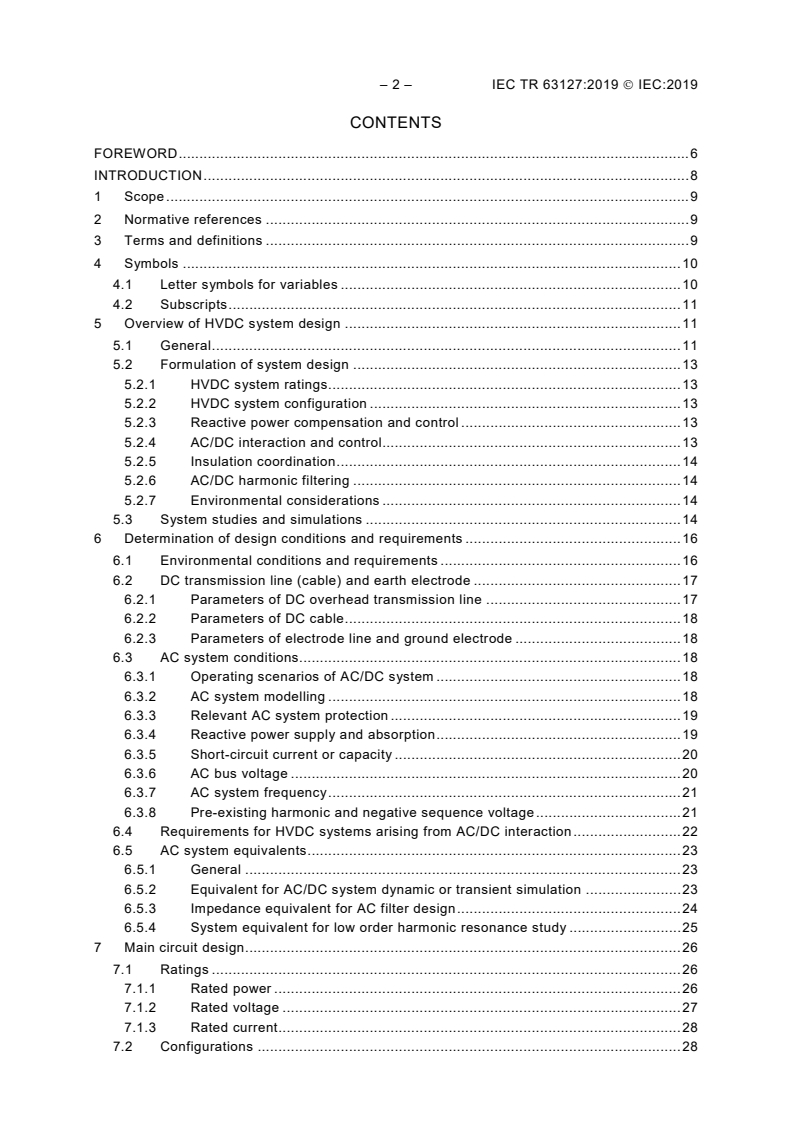
– 2 – IEC TR 63127:2019 IEC:2019
CONTENTS
FOREWORD . 6
INTRODUCTION . 8
1 Scope . 9
2 Normative references . 9
3 Terms and definitions . 9
4 Symbols . 10
4.1 Letter symbols for variables . 10
4.2 Subscripts . 11
5 Overview of HVDC system design . 11
5.1 General . 11
5.2 Formulation of system design . 13
5.2.1 HVDC system ratings . 13
5.2.2 HVDC system configuration . 13
5.2.3 Reactive power compensation and control . 13
5.2.4 AC/DC interaction and control. 13
5.2.5 Insulation coordination . 14
5.2.6 AC/DC harmonic filtering . 14
5.2.7 Environmental considerations . 14
5.3 System studies and simulations . 14
6 Determination of design conditions and requirements . 16
6.1 Environmental conditions and requirements . 16
6.2 DC transmission line (cable) and earth electrode . 17
6.2.1 Parameters of DC overhead transmission line . 17
6.2.2 Parameters of DC cable . 18
6.2.3 Parameters of electrode line and ground electrode . 18
6.3 AC system conditions. 18
6.3.1 Operating scenarios of AC/DC system . 18
6.3.2 AC system modelling . 18
6.3.3 Relevant AC system protection . 19
6.3.4 Reactive power supply and absorption . 19
6.3.5 Short-circuit current or capacity . 20
6.3.6 AC bus voltage . 20
6.3.7 AC system frequency . 21
6.3.8 Pre-existing harmonic and negative sequence voltage . 21
6.4 Requirements for HVDC systems arising from AC/DC interaction . 22
6.5 AC system equivalents . 23
6.5.1 General . 23
6.5.2 Equivalent for AC/DC system dynamic or transient simulation . 23
6.5.3 Impedance equivalent for AC filter design . 24
6.5.4 System equivalent for low order harmonic resonance study . 25
7 Main circuit design . 26
7.1 Ratings . 26
7.1.1 Rated power . 26
7.1.2 Rated voltage . 27
7.1.3 Rated current . 28
7.2 Configurations . 28
7.2.1 Pole and return path . 28
7.2.2 Converter topology . 29
7.2.3 DC switchyard configuration . 30
7.2.4 Reactive power equipment . 38
7.3 Determination of main circuit parameters . 38
7.3.1 General . 38
7.3.2 Control strategy . 39
7.3.3 Tolerances and errors . 40
7.3.4 Determination of converter transformer impedance . 40
7.3.5 Relative inductive voltage drop (d ) and relative resistive voltage drop
xN
(d ) . 40
rN
7.3.6 Ideal no-load DC voltage . 41
7.3.7 DC voltage and DC current . 41
7.3.8 Rated capacity of converter transformer . 42
7.3.9 Converter transformer taps . 43
7.3.10 Inductance of smoothing reactor . 44
8 Insulation coordination. 44
9 Filter design . 45
9.1 General . 45
9.2 AC filter design . 45
9.3 DC filter design . 45
9.4 Power line carrier (PLC) filters . 46
9.5 Radio frequency interference (RFI) . 46
10 Reactive power compensation and control . 47
10.1 General . 47
10.2 Reactive power consumption . 47
10.2.1 Reactive power consumption calculation . 47
10.2.2 Maximum reactive power consumption . 48
10.2.3 Minimum reactive power consumption . 48
10.3 Determination of reactive power equipment capacity . 48
10.3.1 General . 48
10.3.2 Capacity of reactive power supply equipment . 48
10.3.3 Capacity of reactive power absorption equipment . 48
10.3.4 Sizing of reactive power sub-bank . 49
10.3.5 Sizing of reactive power bank . 49
10.4 Reactive power control . 49
10.4.1 General . 49
10.4.2 Reactive power exchange control/voltage control . 50
10.4.3 Voltage limitation . 50
10.5 Temporary overvoltage control . 51
11 Basic parameters of main equipment . 51
11.1 General . 51
11.2 Converter valves . 51
11.2.1 General . 51
11.2.2 Valve hall environment . 51
11.2.3 Current rating . 52
11.2.4 Voltage rating . 52
11.2.5 Losses of converter valves . 53
11.2.6 Testing requirements . 53
– 4 – IEC TR 63127:2019 IEC:2019
11.3 Converter transformers . 53
11.3.1 General . 53
11.3.2 Current rating . 54
11.3.3 Voltage rating . 54
11.3.4 Other rating . 54
11.3.5 Rated loss . 54
11.3.6 Test requirements . 55
11.4 Smoothing reactor. 55
11.4.1 General . 55
11.4.2 Current ratings. 55
11.4.3 Voltage rating . 56
11.4.4 Other ratings . 56
11.4.5 Losses . 56
11.4.6 Test requirements . 56
11.5 Wall bushings . 56
11.5.1 General . 56
11.5.2 Current rating . 56
11.5.3 Voltage rating . 56
11.5.4 Testing requirement . 56
11.6 AC and DC filter equipment . 57
11.7 PLC filter equipment . 57
11.8 Other equipment in DC yard . 57
Annex A (informative) Typical control, measurement and equipment manufacturing
tolerance in HVDC systems . 58
Annex B (informative) Technical parameters for equipment specification . 59
B.1 Converter valve. 59
B.2 Converter transformer . 61
B.3 Smoothing reactor. 62
Bibliography . 63
Figure 1 – System design in an HVDC project . 12
Figure 2 – Example of schematic diagram of AC system frequency variation range . 21
Figure 3 – Sector diagram of system harmonic impedance . 24
Figure 4 – Circle diagram of system harmonic impedance . 25
Figure 5 – Structure of equivalent network for low order harmonic resonance study . 26
Figure 6 – Converter transformer connection topology . 30
Figure 7 – Sketch maps of the DC yard switches of HVDC system . 33
Figure 8 – Schematic diagram of converter parallel connection . 33
Figure 9 – Schematic diagram of pole line parallel connection . 34
Figure 10 – Procedure of NBS disconnecting DC fault . 34
Figure 11 – Current transfer path of the MRTS. 35
Figure 12 – Current transfer path of ERTS . 35
Figure 13 – Connection and function of the NBES . 36
Figure 14 – Commutating process of NBES in case of DMR . 36
Figure 15 – High speed bypass switch . 37
Figure 16 – Converter paralleling switches . 37
Table 1 – Studies and simulations in HVDC system design . 15
Table 2 – Preferred rated voltages for overhead line HVDC power transmission . 27
Table 3 – Preferred rated voltages for submarine HVDC power transmission . 27
Table A.1 – Tolerance for main circuit calculation . 58
Table A.2 – Control parameters for main circuit calculation . 58
– 6 – IEC TR 63127:2019 IEC:2019
INTERNATIONAL ELECTROTECHNICAL COMMISSION
____________
GUIDELINE FOR THE SYSTEM DESIGN OF HVDC CONVERTER
STATIONS WITH LINE-COMMUTATED CONVERTERS
FOREWORD
1) The International Electrotechnical Commission (IEC) is a worldwide organization for standardization comprising
all national electrotechnical committees (IEC National Committees). The object of IEC is to promote
international co-operation on all questions concerning standardization in the electrical and electronic fields. To
this end and in addition to other activities, IEC publishes International Standards, Technical Specifications,
Technical Reports, Publicly Available Specifications (PAS) and Guides (hereafter referred to as “IEC
Publication(s)”). Their preparation is entrusted to technical committees; any IEC National Committee interested
in the subject dealt with may participate in this preparatory work. International, governmental and non-
governmental organizations liaising with the IEC also participate in this preparation. IEC collaborates closely
with the International Organization for Standardization (ISO) in accordance with conditions determined by
agreement between the two organizations.
2) The formal decisions or agreements of IEC on technical matters express, as nearly as possible, an international
consensus of opinion on the relevant subjects since each technical committee has representation from all
interested IEC National Committees.
3) IEC Publications have the form of recommendations for international use and are accepted by IEC National
Committees in that sense. While all reasonable efforts are made to ensure that the technical content of IEC
Publications is accurate, IEC cannot be held responsible for the way in which they are used or for any
misinterpretation by any end user.
4) In order to promote international uniformity, IEC National Committees undertake to apply IEC Publications
transparently to the maximum extent possible in their national and regional publications. Any divergence
between any IEC Publication and the corresponding national or regional publication shall be clearly indicated in
the latter.
5) IEC itself does not provide any attestation of conformity. Independent certification bodies provide conformity
assessment services and, in some areas, access to IEC marks of conformity. IEC is not responsible for any
services carried out by independent certification bodies.
6) All users should ensure that they have the latest edition of this publication.
7) No liability shall attach to IEC or its directors, employees, servants or agents including individual experts and
members of its technical committees and IEC National Committees for any personal injury, property damage or
other damage of any nature whatsoever, whether direct or indirect, or for costs (including legal fees) and
expenses arising out of the publication, use of, or reliance upon, this IEC Publication or any other IEC
Publications.
8) Attention is drawn to the Normative references cited in this publication. Use of the referenced publications is
indispensable for the correct application of this publication.
9) Attention is drawn to the possibility that some of the elements of this IEC Publication may be the subject of
patent rights. IEC shall not be held responsible for identifying any or all such patent rights.
The main task of IEC technical committees is to prepare International Standards. However, a
technical committee may propose the publication of a technical report when it has collected
data of a different kind from that which is normally published as an International Standard, for
example "state of the art".
IEC TR 63127, which is a Technical Report, has been prepared by IEC technical
committee 115: High Voltage Direct Current (HVDC) transmission for DC voltages above
100 kV.
The text of this Technical Report is based on the following documents:
Enquiry draft Report on voting
115/195/DTR 115/203/RVDTR
Full information on the voting for the approval of this Technical Report can be found in the
report on voting indicated in the above table.
This document has been drafted in accordance with the ISO/IEC Directives, Part 2.
The committee has decided that the contents of this document will remain unchanged until the
stability date indicated on the IEC website under "http://webstore.iec.ch" in the data related to
the specific document. At this date, the document will be
• reconfirmed,
• withdrawn,
• replaced by a revised edition, or
• amended.
A bilingual version of this publication may be issued at a later date.
– 8 – IEC TR 63127:2019 IEC:2019
INTRODUCTION
HVDC is an established technology that has been in commercial use for more than 60 years.
With the changes in demands due to evolving environmental needs, installation of HVDC
systems has increased dramatically in the last 30 years and almost half of HVDC projects
were commissioned after the year 2000. HVDC has become a common tool in the design of
future global transmission systems.
HVDC systems transmit more electrical power over longer distances than a similar alternating
current (AC) transmission system, which means fewer transmission lines are needed, saving
both money and land and simplifying permissions. In addition to significantly lowering
electrical losses over long distances, HVDC transmission is also very stable and easily
controlled, and can stabilize and interconnect AC power networks that are otherwise
incompatible. Typically HVDC systems provide unique or superior capabilities in the following
aspects:
• long distance bulk power transmission;
• asynchronous interconnections;
• long distance cable;
• controllability;
• lower losses;
• environmental concerns;
• limitation of short-circuit currents.
Simply due to these technical merits, the market demand for HVDC transmission technology
is spreading widely over the world. There are many HVDC power transmission systems with a
DC voltage from 50 kV up to 660 kV in different countries. In addition, there are several
±800 kV HVDC power transmission systems which have been built or operated or which are
under construction in China, India and Brazil. In 2016, one ±1 100 kV HVDC power
transmission system project was started in China.
The fast development of the HVDC power transmission and distribution industry has been
accompanied by IEC standardization work. More than 40 IEC documents, from DC equipment
to DC systems, have been published. Among these, the IEC TR 60919 series, IEC 60633,
IEC 60071-5, the IEC TR 62001 series and the IEC 60700 series provide essential information
for the design and operation of HVDC power transmission systems.
However, this document provides only a basic guide and refers to typical numbers and
examples. Other points and values may also be valid in particular cases and should also be
considered accordingly.
GUIDELINE FOR THE SYSTEM DESIGN OF HVDC CONVERTER
STATIONS WITH LINE-COMMUTATED CONVERTERS
1 Scope
System design is the basis of construction and operation of HVDC systems. It defines the
overall philosophy for the HVDC transmission system and enables the ratings and
specifications for the equipment integrated in the project.
This document focuses on the system design of converter stations. It is applicable to point-to-
point and back-to-back HVDC systems based on line-commutated converter (LCC) technology.
This document provides guidance and supporting information on the procedure for system
design and the technical issues involved in the system design of HVDC transmission projects
for both purchaser and potential suppliers. It can be used as the basis for drafting a
procurement specification and as a guide during project implementation.
2 Normative references
The following documents are referred to in the text in such a way that some or all of their
content constitutes requirements of this document. For dated references, only the edition
cited applies. For undated references, the latest edition of the referenced document (including
any amendments) applies.
IEC 60633, High-voltage direct current (HVDC) transmission – Vocabulary
3 Terms and definitions
For the purposes of this document, the terms and definitions given in IEC 60633 apply.
ISO and IEC maintain terminological databases for use in standardization at the following
addresses:
• IEC Electropedia: available at http://www.electropedia.org/
• ISO Online browsing platform: available at http://www.iso.org/obp
– 10 – IEC TR 63127:2019 IEC:2019
4 Symbols
4.1 Letter symbols for variables
U DC voltage between the pole and the neutral bus at the line side of the smoothing
d
reactor
U DC voltage of pole line to ground at the measuring point
dL
I DC current
d
U measured DC voltage
dmeas
P power setting at the line side of the smoothing reactor in the rectifier station
ref
X commutation reactance, including converter transformer reactance and other
t
reactance in the commutation circuit that will affect the commutation process
P on-load losses of converter transformer and smoothing reactor when a six-pulse
u
converter is operating at rated capacity
R equivalent resistance of the voltage drop of the thyristor valve (current dependent
th
resistance of the thyristors)
U ideal no-load DC voltage of six-pulse converter
dio
U relative converter transformer inductive voltage drop (short-circuit reactance)
k
U relative voltage drop of AC PLC filter reactors
plc
d relative inductive DC voltage drop of converter
x
d relative resistance DC voltage drop of converter
r
U forward voltage drop of converter valve under conducting state
T
d total relative inductive DC voltage drop of converter – contains both commutation
xtotR
circuit reactance and the system impedance converted onto valve side
P active power of converters
dc
Q reactive power consumption of individual converter
conv
Q reactive power supplied by filters
f
S short-circuit capacity of AC bus
SC
R total resistance of DC transmission line at each pole
d
R resistance of electrode
e
R resistance of electrode line
g
S rated capacity of a three-phase converter transformer connected to a six-pulse
n
valve group
S rated capacity of a single-phase three-winding converter transformer connected
n3w
to a 12-pulse valve group
S rated capacity of a single-phase two-winding converter transformer connected to
n2w
a 12-pulse valve group
U valve side line voltage of converter transformer
v
I valve side line current of converter transformer
v
U line voltage of line side of converter transformer
l
n rated ratio of converter transformer at normal tap position
nom
ɳ needed OLTC range of converter transformer
∆ɳ step size of converter transformer OLTC
L total inductance from DC side
d
L smoothing reactor inductance
dr
L converter transformer inductance per phase
tr
µ overlap angle
α delay angle
γ extinction angle
Q total reactive power supplied by AC filters and shunt capacitors at normal voltage
total
Q reactive power supplied by the largest AC filter or shunt capacitor sub-bank at
sb
normal voltage
reactive power supplied by AC system (negative value means the capability to
Q
ac
supply reactive power by AC system)
Q reactive power consumption of converters
dc
K voltage correction factor, normally 0,95 to 1,05
v
Q total reactive power absorbed by the shunt reactors of converter station at normal
r
AC voltage
Q capacity of the minimum filter combination which shall be switched in to meet the
fmin
harmonic performance requirement at normal AC voltage
∆U dynamic voltage change because of sub-bank switching
AC
Q reactive power capacity of the filter or shunt capacitor sub-bank to be switched
filter
∑Q reactive power capacity of the filter or shunt capacitor sub-banks in operation
filter
after switching
∆Q change of reactive power consumption of converters due to sub-bank switching,
dc
which sometimes can be ignored
4.2 Subscripts
N normal value of the variables
R value of rectifier side
I value of inverter side
max maximum value of the variable
min minimum value of the variable
5 Overview of HVDC system design
5.1 General
In implementing HVDC projects, the purchaser or the supplier will do preliminary system
design work to prepare the various required documents needed by the project. Specific
studies and simulations are conducted during the system design to find the optimal project
schemes and to demonstrate performance. As a minimum, the following main system features
should be determined:
• HVDC system ratings;
• HVDC system operation configurations and control modes;
• reactive power compensation and control;
• harmonic filtering;
• AC/DC interaction and control;
• insulation coordination;
• environmental impacts, such as audible noise, electromagnetic fields, etc.
The system design may be conducted in several phases by different parties, such as
purchaser or supplier, during planning, bidding, detailed design stages, for example, as
shown in Figure 1. Different tools and models may be introduced in the system design
because of different targets or designs at each stage. One should be very careful to adopt the
tools and models in a coordinated manner.
– 12 – IEC TR 63127:2019 IEC:2019
A functional specification for the project is usually prepared by the purchaser before the
detailed design. It may consist of project objectives and conditions, grid codes, targeted
system performance requirements and operation regulations, etc. This functional specification
should be treated as both providing inputs and the guide for the system design of an HVDC
project. Because the final technology solution is undefined before the detail design stage, it is
always necessary to reserve adequate space in the functional specification for further
optimization. The owner will issue the specification as a document for bidding if this is a turn-
key project. After evaluation of bidding for the specific technology solution, especially for
HVDC control, the owner may choose the appropriate solution. Thus, the system features
listed above will be studied in more detail based on the chosen technology solution and some
additional studies and surveys usually need to be performed to finalize the system design.
Finally, all the equipment ratings and specifications will be prepared.
The flowchart of an HVDC system design is summarized in Figure 1.
Figure 1 – System design in an HVDC project
5.2 Formulation of system design
5.2.1 HVDC system ratings
HVDC system ratings are defined by transmission capacity, DC voltage and DC current.
These ratings are evaluated and selected according to considerations such as the exploitation
and the market of energy, the conditions and requirements of power grids, the grid code, the
transmission distance, the transportation of bulk equipment, the amount and payback of
investment together with the environmental conditions, etc.
The capacity is the first item which the purchaser decides on in the planning stage as well as
the DC voltage for a long-distance transmission project. Other ratings can be optimized and
finalized in the following design stages.
5.2.2 HVDC system configuration
The HVDC system configuration is normally chosen according to the function and rating of the
HVDC system, the environmental requirements, the reliability and availability requirements
and other similar high-level functional requirements. A preliminary configuration will be
suggested prior to other system design work and the final single line diagram of the converter
station will be finalized by the detail design.
5.2.3 Reactive power compensation and control
The converter consumes reactive power in operation. It is necessary to design the reactive
power compensation scheme along with the HVDC equipment and control strategy to align
with the AC system conditions and requirements. This compensation scheme will be
estimated and proposed during planning and then formulated and verified during the detail
design together with the related control strategy.
Although most of the reactive power to be compensated is inside the converter station, there
will still be some reactive power exchange with the AC system. The capability of the AC
system to exchange reactive power needs to be specified in the planning.
5.2.4 AC/DC interaction and control
The AC/DC interaction study should be conducted in different phases to demonstrate stable
operation and performance of the power grid after integrating the HVDC link. The power flow
and stability study should include at least
• starting and stopping of HVDC system,
• steady-state operation,
• AC system faults, and
• DC system faults.
Especially when the short-circuit ratio (SCR) is low, the commutation failure and recovery
procedure of the HVDC system after faults should also be carefully studied. The use of
capacitor commutated converters (CCC) or controlled series compensated capacitors (CSCC)
may be considered as an option for improvement of HVDC operational performance under low
SCR condition. For multi-infeed systems, those converters which will impact the study result
should be represented in the studies.
AC/DC interaction is normally studied by digital simulation. In the planning stage a simplified
HVDC model may be used when the detailed model is unavailable. This simplified model
should have enough precision and the study result should cover all the possible situations in
practice. The stable operation and performance of the power grid will be demonstrated and
proved by detailed modelling with the actual control in the detailed design. The IEC TR 60919
series provides guidance on specifying the requirements.
– 14 – IEC TR 63127:2019 IEC:2019
Besides the normal power flow and stability study, some special studies may be needed such
as a sub-synchronous resonance study, frequency control study, low frequency oscillation
damping control study and other such studies. In most cases, mitigation of these resonances
or oscillations can be achieved by HVDC control and no extra cost added. Therefore, in the
planning stage, some scanning studies may be conducted to check the necessity for further
study and solution formulation in the detailed design.
5.2.5 Insulation coordination
Insulation coordination is closely related to the safety and cost of HVDC projects. Thus, it is
necessary to predict the insulation level for a HVDC system even in the planning stage. The
detail design will formulate the final arrester protection scheme and verify that the predicted
insulation level can be achieved by simulations such as
• fundamental frequency overvoltage,
• overvoltage caused by resonance,
• temporary overvoltage, and
• transient overvoltage.
5.2.6 AC/DC harmonic filtering
The converter will produce harmonics on both the AC and the DC sides during operation.
These harmonics vary in different operation modes, including different configurations, control
modes and transmission powers, etc. AC side harmonics should be mitigated to levels agreed
with the connected utilities. DC side harmonics should also be mitigated to levels agreed with
the affected telecommunication companies.
The complete filtering solution and component specifications will be provided by AC/DC
harmonic filtering study and design. For further information, refer to IEC TR 60919-1 and the
IEC TR 62001 series.
5.2.7 Environmental considerations
The HVDC system can impact the environment and vice versa. Audible noise, electromagnetic
field, earth current (in some operation configurations) and radio interference are major
environmental impacts from the HVDC system. Pollution, earthquake, temperature, etc. are
major impacts from the environment. Surveys on environmental effects should be conducted
before the system design.
5.3 System studies and simulations
In order to evaluate and determine the system characteristics, applicable quantitative
specification and system performances, various kinds of system study and simulation are
required during the system design.
A summary of studies and simulations is listed in Table 1.
Table 1 – Studies and simulations in HVDC system design
No. Study/Simulation Input Output
1 Main Circuit Parameter Capacity and topology of HVDC system, Steady state characteristics
calculation and ratings
Basic control strategy,
DC transmission line and cable parameters,
Electrode and electrode line parameters (as
applicable),
Normal voltage and its steady-state range of
AC bus
2 Reactive Power Main circuit parameter calculation, Total amount of compensation,
Compensation
AC network condition Permissible reactive units and
their capacity
3 AC system equivalent AC network data Equivalents for relevant
simulations such as AC/DC
transient/dynamic simulation
and fundamental overvoltage
study, etc.
4 Temporary overvoltage Main circuit parameters, Overvoltage and depression
and ferro-resonance strategy
Reactive power compensation,
HVDC equipment characteristics,
Control & Protection characteristics,
AC network data or equivalent
5 DC Resonance Study Main circuit parameters, Evidence to determine:
Reactive power compensation, size of smoothing reactors,
AC/DC parallel line interaction, size of DC filters,
HVDC equipment characteristics, equipment ratings
Control & Protection characteristics,
AC network data or equivalent
6 Insulation Coordination Main circuit parameters, Arrester protection scheme,
LIPL/LIWV and SIPL/SIWV
Reactive power compensation,
AC/DC harmonic filtering,
HVDC equipment characteristics,
Control & Protection characteristics
AC system equivalent
7 AC system harmonic AC network data AC system harmonic
impedance scan impedance
8 AC/DC Harmonic AC system harmonic impedance, AC/DC filter scheme,
Filtering
Main circuit parameters, Component ratings
Reactive power compensation,
HVDC equipment characteristics,
Control & Protection characteristics
9 Dynamic performance AC system equivalent, Control & Protection
simulation and characteristics
Main circuit parameters,
verification
Reactive power compensation,
Control & Protection characteristics
10 Power flow and AC network data, Power flow and stability,
stability study
Main circuit parameters, Required additional control
function, such as frequency
Reactive power compensation,
control, damping control, etc.
Control & Protection characteristics
– 16 – IEC TR 63127:2019 IEC:2019
No. Study/Simulation Input Output
11 Subsynchronous Main circuit parameters, Confirmation of
Torsional Interaction subsynchronous oscillation
Reactive power compensation,
between HVDC & (SSO),
Generator
Control & Protection characteristics,
Subsynchronous damping
a
control (SSDC) specifications
AC network data,
Detailed generator characteristics
12 AC/DC parallel line AC and DC line parameters, Induced fundamental frequency
interaction study, if voltage and current on the DC
Main circuit parameters,
applicable side and influence on the
converter transformers
DC harmonic filtering
13 Transient current Main circuit parameters, Transient current ratings
Reactive power compensation
14 AC Breaker /DC Main circuit parameters, Ratings of breaker
Switch study
Reactive power compensation,
AC/DC harmonic filtering,
HVDC equipment characteristics,
Control
...
IEC TR 63127 ®
Edition 1.1 2024-04
CONSOLIDATED VERSION
TECHNICAL
REPORT
colour
inside
Guideline for the system design of HVDC converter stations with line-
commutated converters
All rights reserved. Unless otherwise specified, no part of this publication may be reproduced or utilized in any form
or by any means, electronic or mechanical, including photocopying and microfilm, without permission in writing from
either IEC or IEC's member National Committee in the country of the requester. If you have any questions about IEC
copyright or have an enquiry about obtaining additional rights to this publication, please contact the address below or
your local IEC member National Committee for further information.
IEC Secretariat Tel.: +41 22 919 02 11
3, rue de Varembé info@iec.ch
CH-1211 Geneva 20 www.iec.ch
Switzerland
About the IEC
The International Electrotechnical Commission (IEC) is the leading global organization that prepares and publishes
International Standards for all electrical, electronic and related technologies.
About IEC publications
The technical content of IEC publications is kept under constant review by the IEC. Please make sure that you have the
latest edition, a corrigendum or an amendment might have been published.
IEC publications search - webstore.iec.ch/advsearchform IEC Products & Services Portal - products.iec.ch
The advanced search enables to find IEC publications by a Discover our powerful search engine and read freely all the
variety of criteria (reference number, text, technical publications previews, graphical symbols and the glossary.
committee, …). It also gives information on projects, replaced With a subscription you will always have access to up to date
and withdrawn publications. content tailored to your needs.
IEC Just Published - webstore.iec.ch/justpublished
Electropedia - www.electropedia.org
Stay up to date on all new IEC publications. Just Published
The world's leading online dictionary on electrotechnology,
details all new publications released. Available online and once
containing more than 22 500 terminological entries in English
a month by email.
and French, with equivalent terms in 25 additional languages.
Also known as the International Electrotechnical Vocabulary
IEC Customer Service Centre - webstore.iec.ch/csc
(IEV) online.
If you wish to give us your feedback on this publication or need
further assistance, please contact the Customer Service
Centre: sales@iec.ch.
IEC TR 63127 ®
Edition 1.1 2024-04
CONSOLIDATED VERSION
TECHNICAL
REPORT
colour
inside
Guideline for the system design of HVDC converter stations with line-
commutated converters
INTERNATIONAL
ELECTROTECHNICAL
COMMISSION
ICS 29.240.01; 29.240.10 ISBN 978-2-8322-8767-5
REDLINE VERSION – 2 – IEC TR 63127:2019+AMD1:2024 CSV
IEC 2024
CONTENTS
FOREWORD . 6
INTRODUCTION . 8
1 Scope . 9
2 Normative references . 9
3 Terms and definitions . 9
4 Symbols . 10
4.1 Letter symbols for variables . 10
4.2 Subscripts . 11
5 Overview of HVDC system design . 11
5.1 General . 11
5.2 Formulation of system design . 13
5.2.1 HVDC system ratings . 13
5.2.2 HVDC system configuration . 13
5.2.3 Reactive power compensation and control . 13
5.2.4 AC/DC interaction and control. 13
5.2.5 Insulation coordination . 14
5.2.6 AC/DC harmonic filtering . 14
5.2.7 Environmental considerations . 14
5.3 System studies and simulations . 14
6 Determination of design conditions and requirements . 16
6.1 Environmental conditions and requirements . 16
6.2 DC transmission line (cable) and earth electrode . 17
6.2.1 Parameters of DC overhead transmission line . 17
6.2.2 Parameters of DC cable . 18
6.2.3 Parameters of electrode line and ground electrode . 18
6.3 AC system conditions. 18
6.3.1 Operating scenarios of AC/DC system . 18
6.3.2 AC system modelling . 18
6.3.3 Relevant AC system protection . 19
6.3.4 Reactive power supply and absorption . 19
6.3.5 Short-circuit current or capacity . 20
6.3.6 AC bus voltage . 21
6.3.7 AC system frequency . 21
6.3.8 Pre-existing harmonic and negative sequence voltage . 22
6.4 Requirements for HVDC systems arising from AC/DC interaction . 22
6.5 AC system equivalents . 23
6.5.1 General . 23
6.5.2 Equivalent for AC/DC system dynamic or transient simulation . 23
6.5.3 Impedance equivalent for AC filter design . 24
6.5.4 System equivalent for low order harmonic resonance study . 26
7 Main circuit design . 26
7.1 Ratings . 26
7.1.1 Rated power . 26
7.1.2 Rated voltage . 27
7.1.3 Rated current . 28
7.2 Configurations . 28
IEC 2024
7.2.1 Pole and return path . 28
7.2.2 Converter topology . 29
7.2.3 DC switchyard configuration . 30
7.2.4 Reactive power equipment . 38
7.3 Determination of main circuit parameters . 38
7.3.1 General . 38
7.3.2 Control strategy . 39
7.3.3 Tolerances and errors . 40
7.3.4 Determination of converter transformer impedance . 40
7.3.5 Relative inductive voltage drop (d ) and relative resistive voltage drop
xN
(d ) . 40
rN
7.3.6 Ideal no-load DC voltage . 41
7.3.7 DC voltage and DC current . 41
7.3.8 Rated capacity of converter transformer . 42
7.3.9 Converter transformer taps . 43
7.3.10 Inductance of smoothing reactor . 44
8 Insulation coordination. 44
9 Filter design . 45
9.1 General . 45
9.2 AC filter design . 45
9.3 DC filter design . 45
9.4 Power line carrier (PLC) filters . 46
9.5 Radio frequency interference (RFI) . 46
10 Reactive power compensation and control . 47
10.1 General . 47
10.2 Reactive power consumption . 47
10.2.1 Reactive power consumption calculation . 47
10.2.2 Maximum reactive power consumption . 48
10.2.3 Minimum reactive power consumption . 48
10.3 Determination of reactive power equipment capacity . 48
10.3.1 General . 48
10.3.2 Capacity of reactive power supply equipment . 48
10.3.3 Capacity of reactive power absorption equipment . 48
10.3.4 Sizing of reactive power sub-bank . 49
10.3.5 Sizing of reactive power bank . 49
10.4 Reactive power control . 49
10.4.1 General . 49
10.4.2 Reactive power exchange control/voltage control . 50
10.4.3 Voltage limitation . 50
10.5 Temporary overvoltage control . 51
11 Basic parameters of main equipment . 51
11.1 General . 51
11.2 Converter valves . 51
11.2.1 General . 51
11.2.2 Valve hall environment . 51
11.2.3 Current rating . 52
11.2.4 Voltage rating . 52
11.2.5 Losses of converter valves . 53
11.2.6 Testing requirements . 53
REDLINE VERSION – 4 – IEC TR 63127:2019+AMD1:2024 CSV
IEC 2024
11.3 Converter transformers . 53
11.3.1 General . 53
11.3.2 Current rating . 54
11.3.3 Voltage rating . 54
11.3.4 Other rating . 54
11.3.5 Rated loss . 54
11.3.6 Test requirements . 55
11.4 Smoothing reactor. 55
11.4.1 General . 55
11.4.2 Current ratings. 55
11.4.3 Voltage rating . 56
11.4.4 Other ratings . 56
11.4.5 Losses . 56
11.4.6 Test requirements . 56
11.5 Wall bushings . 56
11.5.1 General . 56
11.5.2 Current rating . 56
11.5.3 Voltage rating . 56
11.5.4 Testing requirement . 56
11.6 AC and DC filter equipment . 57
11.7 PLC filter equipment . 57
11.8 Other equipment in DC yard . 57
Annex A (informative) Typical control, measurement and equipment manufacturing
tolerance in HVDC systems . 58
Annex B (informative) Technical parameters for equipment specification . 59
B.1 Converter valve. 59
B.2 Converter transformer . 61
B.3 Smoothing reactor. 62
Bibliography . 63
Figure 1 – System design in an HVDC project . 12
Figure 2 – Example of schematic diagram of AC system frequency variation range . 22
Figure 3 – Sector diagram of system harmonic impedance . 25
Figure 4 – Circle diagram of system harmonic impedance . 25
Figure 5 – Structure of equivalent network for low order harmonic resonance study . 26
Figure 6 – Converter transformer connection topology . 30
Figure 7 – Sketch maps of the DC yard switches of HVDC system . 33
Figure 8 – Schematic diagram of converter parallel connection . 33
Figure 9 – Schematic diagram of pole line parallel connection . 34
Figure 10 – Procedure of NBS disconnecting DC fault . 34
Figure 11 – Current transfer path of the MRTS. 35
Figure 12 – Current transfer path of ERTS . 35
Figure 13 – Connection and function of the NBES . 36
Figure 14 – Commutating process of NBES in case of DMR . 36
Figure 15 – High speed bypass switch . 37
Figure 16 – Converter paralleling switches . 37
IEC 2024
Table 1 – Studies and simulations in HVDC system design . 15
Table 2 – Preferred rated voltages for overhead line HVDC power transmission . 27
Table 3 – Preferred rated voltages for submarine HVDC power transmission . 28
Table A.1 – Tolerance for main circuit calculation . 58
Table A.2 – Control parameters for main circuit calculation . 58
REDLINE VERSION – 6 – IEC TR 63127:2019+AMD1:2024 CSV
IEC 2024
INTERNATIONAL ELECTROTECHNICAL COMMISSION
____________
GUIDELINE FOR THE SYSTEM DESIGN OF HVDC CONVERTER
STATIONS WITH LINE-COMMUTATED CONVERTERS
FOREWORD
1) The International Electrotechnical Commission (IEC) is a worldwide organization for standardization comprising
all national electrotechnical committees (IEC National Committees). The object of IEC is to promote
international co-operation on all questions concerning standardization in the electrical and electronic fields. To
this end and in addition to other activities, IEC publishes International Standards, Technical Specifications,
Technical Reports, Publicly Available Specifications (PAS) and Guides (hereafter referred to as "IEC
Publication(s)"). Their preparation is entrusted to technical committees; any IEC National Committee interested
in the subject dealt with may participate in this preparatory work. International, governmental and non-
governmental organizations liaising with the IEC also participate in this preparation. IEC collaborates closely
with the International Organization for Standardization (ISO) in accordance with conditions determined by
agreement between the two organizations.
2) The formal decisions or agreements of IEC on technical matters express, as nearly as possible, an international
consensus of opinion on the relevant subjects since each technical committee has representation from all
interested IEC National Committees.
3) IEC Publications have the form of recommendations for international use and are accepted by IEC National
Committees in that sense. While all reasonable efforts are made to ensure that the technical content of IEC
Publications is accurate, IEC cannot be held responsible for the way in which they are used or for any
misinterpretation by any end user.
4) In order to promote international uniformity, IEC National Committees undertake to apply IEC Publications
transparently to the maximum extent possible in their national and regional publications. Any divergence
between any IEC Publication and the corresponding national or regional publication shall be clearly indicated in
the latter.
5) IEC itself does not provide any attestation of conformity. Independent certification bodies provide conformity
assessment services and, in some areas, access to IEC marks of conformity. IEC is not responsible for any
services carried out by independent certification bodies.
6) All users should ensure that they have the latest edition of this publication.
7) No liability shall attach to IEC or its directors, employees, servants or agents including individual experts and
members of its technical committees and IEC National Committees for any personal injury, property damage or
other damage of any nature whatsoever, whether direct or indirect, or for costs (including legal fees) and
expenses arising out of the publication, use of, or reliance upon, this IEC Publication or any other IEC
Publications.
8) Attention is drawn to the Normative references cited in this publication. Use of the referenced publications is
indispensable for the correct application of this publication.
9) IEC draws attention to the possibility that the implementation of this document may involve the use of (a)
patent(s). IEC takes no position concerning the evidence, validity or applicability of any claimed patent rights in
respect thereof. As of the date of publication of this document, IEC had not received notice of (a) patent(s),
which may be required to implement this document. However, implementers are cautioned that this may not
represent the latest information, which may be obtained from the patent database available at
https://patents.iec.ch. IEC shall not be held responsible for identifying any or all such patent rights.
This consolidated version of the official IEC Standard and its amendment has been
prepared for user convenience.
IEC TR 63127 edition 1.1 contains the first edition (2019-06) [documents 115/195/DTR
and 115/203/RVDTR] and its amendment 1 (2024-04) [documents 115/361/DTR and
115/364/RVDTR].
In this Redline version, a vertical line in the margin shows where the technical content
is modified by amendment 1. Additions are in green text, deletions are in strikethrough
red text. A separate Final version with all changes accepted is available in this
publication.
IEC 2024
The main task of IEC technical committees is to prepare International Standards. However, a
technical committee may propose the publication of a technical report when it has collected
data of a different kind from that which is normally published as an International Standard, for
example "state of the art".
IEC TR 63127, which is a Technical Report, has been prepared by IEC technical
committee 115: High Voltage Direct Current (HVDC) transmission for DC voltages above
100 kV.
This document has been drafted in accordance with the ISO/IEC Directives, Part 2.
The committee has decided that the contents of this document and its amendment will remain
unchanged until the stability date indicated on the IEC website under webstore.iec.ch in the
data related to the specific document. At this date, the document will be
• reconfirmed,
• withdrawn, or
• revised.
IMPORTANT – The 'colour inside' logo on the cover page of this publication indicates
that it contains colours which are considered to be useful for the correct
understanding of its contents. Users should therefore print this document using a
colour printer.
REDLINE VERSION – 8 – IEC TR 63127:2019+AMD1:2024 CSV
IEC 2024
INTRODUCTION
HVDC is an established technology that has been in commercial use for more than 60 years.
With the changes in demands due to evolving environmental needs, installation of HVDC
systems has increased dramatically in the last 30 years and almost more than half of HVDC
projects were commissioned after the year 2000. HVDC has become a common tool in the
design of future global transmission systems.
HVDC systems transmit more electrical power over longer distances than a similar alternating
current (AC) transmission system, which means fewer transmission lines are needed, saving
both money and land and simplifying permissions. In addition to significantly lowering
electrical losses over long distances, HVDC transmission is also very stable and easily
controlled, and can stabilize and interconnect AC power networks that are otherwise
incompatible. Typically line-commutated converter (LCC) HVDC systems provide unique or
superior capabilities in the following aspects:
• long distance bulk power transmission;
• asynchronous interconnections;
• long distance cable;
• controllability;
• lower losses;
• environmental concerns;
• limitation of short-circuit currents.
Simply due to these technical merits, the market demand for HVDC transmission technology
is spreading widely over the world. There are many HVDC power transmission systems with a
DC voltage from 50 kV up to 660 1 100 kV in different countries. In addition, there are several
±800 kV HVDC power transmission systems which have been built or operated or which are
under construction in China, India and Brazil. In 2016, one ±1 100 kV HVDC power
transmission system project was started in China.
The fast development of the HVDC power transmission and distribution industry has been
accompanied by IEC standardization work. More than 40 IEC documents, from DC equipment
to DC systems, have been published. Among these, the IEC TR 60919 series, IEC 60633,
IEC 60071-5, the IEC TR 62001 series and the IEC 60700 series provide essential information
for the design and operation of HVDC power transmission systems.
However, this document provides only a basic guide and refers to typical numbers and
examples. Other points and values may also be valid in particular cases and should also be
considered accordingly.
IEC 2024
GUIDELINE FOR THE SYSTEM DESIGN OF HVDC CONVERTER
STATIONS WITH LINE-COMMUTATED CONVERTERS
1 Scope
System design is the basis of construction and operation of HVDC systems. It defines the
overall philosophy for the HVDC transmission system and enables the ratings and
specifications for the equipment integrated in the project.
This document focuses on the system design of converter stations. It is applicable to point-to-
point and back-to-back HVDC systems based on line-commutated converter (LCC) technology.
This document provides guidance and supporting information on the procedure for system
design and the technical issues involved in the system design of HVDC transmission projects
for both purchaser and potential suppliers. It can be used as the basis for drafting a
procurement specification and as a guide during project implementation.
2 Normative references
The following documents are referred to in the text in such a way that some or all of their
content constitutes requirements of this document. For dated references, only the edition
cited applies. For undated references, the latest edition of the referenced document (including
any amendments) applies.
IEC 60633, High-voltage direct current (HVDC) transmission – Vocabulary
3 Terms and definitions
For the purposes of this document, the terms and definitions given in IEC 60633 apply.
ISO and IEC maintain terminological databases for use in standardization at the following
addresses:
• IEC Electropedia: available at http://www.electropedia.org/
• ISO Online browsing platform: available at http://www.iso.org/obp
REDLINE VERSION – 10 – IEC TR 63127:2019+AMD1:2024 CSV
IEC 2024
4 Symbols
4.1 Letter symbols for variables
U DC voltage between the pole and the neutral bus at the line side of the smoothing
d
reactor
U DC voltage of pole line to ground at the measuring point
dL
I DC current
d
U measured DC voltage
dmeas
P power setting at the line side of the smoothing reactor in the rectifier station
ref
X commutation reactance, including converter transformer reactance and other
t
reactance in the commutation circuit that will affect the commutation process
P on-load losses of converter transformer and smoothing reactor when a six-pulse
u
converter is operating at rated capacity
R equivalent resistance of the voltage drop of the thyristor valve (current dependent
th
resistance of the thyristors)
U ideal no-load DC voltage of six-pulse converter
dio
U relative converter transformer inductive voltage drop (short-circuit reactance)
k
U relative voltage drop of AC PLC filter reactors
plc
d relative inductive DC voltage drop of converter
x
d relative resistance DC voltage drop of converter
r
U forward voltage drop of converter valve under conducting state
T
d total relative inductive DC voltage drop of converter – contains both commutation
xtotR
circuit reactance and the system impedance converted onto valve side
P active power of converters
dc
Q reactive power consumption of individual converter
conv
Q reactive power supplied by filters
f
S short-circuit capacity of AC bus
SC
R total resistance of DC transmission line at each pole
d
R resistance of electrode
e
R resistance of electrode line
g
S rated capacity of a three-phase converter transformer connected to a six-pulse
n
valve group
S rated capacity of a single-phase three-winding converter transformer connected
n3w
to a 12-pulse valve group
S rated capacity of a single-phase two-winding converter transformer connected to
n2w
a 12-pulse valve group
U valve side line voltage of converter transformer
v
I valve side line current of converter transformer
v
U line voltage of line side of converter transformer
l
n rated ratio of converter transformer at normal tap position
nom
ɳ needed OLTC range of converter transformer
∆ɳ step size of converter transformer OLTC
L total inductance from DC side
d
L smoothing reactor inductance
dr
L converter transformer inductance per phase
tr
µ overlap angle
IEC 2024
α delay angle
γ extinction angle
Q total reactive power supplied by AC filters and shunt capacitors at normal voltage
total
Q reactive power supplied by the largest AC filter or shunt capacitor sub-bank at
sb
normal voltage
reactive power supplied by AC system (negative value means the capability to
Q
ac
supply reactive power by AC system)
Q reactive power consumption of converters
dc
K voltage correction factor, normally 0,95 to 1,05
v
Q total reactive power absorbed by the shunt reactors of converter station at normal
r
AC voltage
Q capacity of the minimum filter combination which shall be switched in to meet the
fmin
harmonic performance requirement at normal AC voltage
∆U dynamic voltage change because of sub-bank switching
AC
Q reactive power capacity of the filter or shunt capacitor sub-bank to be switched
filter
∑Q reactive power capacity of the filter or shunt capacitor sub-banks in operation
filter
after switching
∆Q change of reactive power consumption of converters due to sub-bank switching,
dc
which sometimes can be ignored
4.2 Subscripts
N normal value of the variables
R value of rectifier side
I value of inverter side
max maximum value of the variable
min minimum value of the variable
5 Overview of HVDC system design
5.1 General
In implementing HVDC projects, the purchaser or the supplier will do preliminary system
design work to prepare the various required documents needed by the project. Specific
studies and simulations are conducted during the system design to find the optimal project
schemes and to demonstrate performance. As a minimum, the following main system features
should be determined:
• HVDC system ratings;
• HVDC system operation configurations and control modes;
• reactive power compensation and control;
• harmonic filtering;
• AC/DC interaction and control;
• insulation coordination;
• environmental impacts, such as audible noise, electromagnetic fields, etc.
The system design may be conducted in several phases by different parties, such as
purchaser or supplier, during planning, bidding, detailed design stages, for example, as
shown in Figure 1. Different tools and models may be introduced in the system design
because of different targets or designs at each stage. One should be very careful to adopt the
tools and models in a coordinated manner.
REDLINE VERSION – 12 – IEC TR 63127:2019+AMD1:2024 CSV
IEC 2024
A functional specification for the project is usually prepared by the purchaser before the
detailed design. It may consist of project objectives and conditions, grid codes, targeted
system performance requirements and operation regulations, etc. This functional specification
should be treated as both providing inputs and the guide for the system design of an HVDC
project. Because the final technology solution is undefined before the detail design stage, it is
always necessary to reserve adequate space in the functional specification for further
optimization. The owner will issue the specification as a document for bidding if this is a turn-
key project. After evaluation of bidding for the specific technology solution, especially for
HVDC control, the owner may choose the appropriate solution. Thus, the system features
listed above will be studied in more detail based on the chosen technology solution and some
additional studies and surveys usually need to be performed to finalize the system design.
Finally, all the equipment ratings and specifications will be prepared.
The flowchart of an HVDC system design is summarized in Figure 1.
Figure 1 – System design in an HVDC project
IEC 2024
5.2 Formulation of system design
5.2.1 HVDC system ratings
HVDC system ratings are defined by transmission capacity, DC voltage and DC current.
These ratings are evaluated and selected according to considerations such as the exploitation
and the market of energy, the conditions and requirements of power grids, the grid code, the
transmission distance, the transportation of bulk equipment, the amount and payback of
investment together with the environmental conditions, etc.
The capacity is the first item which the purchaser decides on in the planning stage as well as
the DC voltage for a long-distance transmission project. Other ratings can be optimized and
finalized in the following design stages.
5.2.2 HVDC system configuration
The HVDC system configuration is normally chosen according to the function and rating of the
HVDC system, the environmental requirements, the reliability and availability requirements
and other similar high-level functional requirements. A preliminary configuration will be
suggested prior to other system design work and the final single line diagram of the converter
station will be finalized by the detail design.
5.2.3 Reactive power compensation and control
The converter consumes reactive power in operation. It is necessary to design the reactive
power compensation scheme along with the HVDC equipment and control strategy to align
with the AC system conditions and requirements. This compensation scheme will be
estimated and proposed during planning and then formulated and verified during the detail
design together with the related control strategy.
Although most of the reactive power to be compensated is inside the converter station, there
will still be some reactive power exchange with the AC system. The capability of the AC
system to exchange reactive power needs to be specified in the planning.
5.2.4 AC/DC interaction and control
The AC/DC interaction study should be conducted in different phases to demonstrate stable
operation and performance of the power grid after integrating the HVDC link. The power flow
and stability study should include at least
• starting and stopping of HVDC system,
• steady-state operation,
• AC system faults, and
• DC system faults.
Especially when the short-circuit ratio (SCR) is low, the commutation failure and recovery
procedure of the HVDC system after faults should also be carefully studied. The use of
capacitor commutated converters (CCC) or controlled series compensated capacitors (CSCC)
may be considered as an option for improvement of HVDC operational performance under low
SCR condition. For multi-infeed systems, those converters which will impact the study result
should be represented in the studies.
AC/DC interaction is normally studied by digital simulation. In the planning stage a simplified
HVDC model may be used when the detailed model is unavailable. This simplified model
should have enough precision and the study result should cover all the possible situations in
practice. The stable operation and performance of the power grid will be demonstrated and
proved by detailed modelling with the actual control in the detailed design. The IEC TR 60919
series provides guidance on specifying the requirements.
REDLINE VERSION – 14 – IEC TR 63127:2019+AMD1:2024 CSV
IEC 2024
Besides the normal power flow and stability study, some special studies may be needed such
as a sub-synchronous resonance study, frequency control study, low frequency oscillation
damping control study and other such studies. In most cases, mitigation of these resonances
or oscillations can be achieved by HVDC control and no extra cost added. Therefore, in the
planning stage, some scanning studies may be conducted to check the necessity for further
study and solution formulation in the detailed design.
5.2.5 Insulation coordination
Insulation coordination is closely related to the safety and cost of HVDC projects. Thus, it is
necessary to predict the insulation level for a HVDC system even in the planning stage. The
detail design will formulate the final arrester protection scheme and verify that the predicted
insulation level can be achieved by simulations such as
• fundamental frequency overvoltage,
• overvoltage caused by resonance,
• temporary overvoltage, and
• transient overvoltage.
5.2.6 AC/DC harmonic filtering
The converter will produce harmonics on both the AC and the DC sides during operation.
These harmonics vary in different operation modes, including different configurations, control
modes and transmission powers, etc. AC side harmonics should be mitigated to levels agreed
with the connected utilities. DC side harmonics should also be mitigated to levels agreed with
the affected telecommunication companies.
The complete filtering solution and component specifications will be provided by AC/DC
harmonic filtering study and design. For further information, refer to IEC TR 60919-1 and the
IEC TR 62001 series.
5.2.7 Environmental considerations
The HVDC system can impact the environment and vice versa. Audible noise, electromagnetic
field, earth current (in some operation configurations) and radio interference are major
environmental impacts from the HVDC system. Pollution, earthquake, temperature, etc. are
major impacts from the environment. Surveys on environmental effects should be conducted
before the system design.
5.3 System studies and simulations
In order to evaluate and determine the system characteristics, applicable quantitative
specification and system performances, various kinds of system study and simulation are
required during the system design.
A summary of studies and simulations is listed in Table 1.
IEC 2024
Table 1 – Studies and simulations in HVDC system design
No. Study/Simulation Input Output
1 Main Circuit Parameter Capacity and topology of HVDC system, Steady state characteristics
calculation and ratings
Basic control strategy,
DC transmission line and cable parameters,
Electrode and electrode line parameters (as
applicable),
Normal voltage and its steady-state range of
AC bus
2 Reactive Power Main circuit parameter calculation, Total amount of compensation,
Compensation
AC network condition Permissible reactive units and
their capacity
3 AC system equivalent AC network data Equivalents for relevant
simulations such as AC/DC
transient/dynamic simulation
and fundamental overvoltage
study, etc.
4 Temporary overvoltage Main circuit parameters, Overvoltage and depression
and ferro-resonance strategy
Reactive power compensation,
HVDC equipment characteristics,
Control & Protection characteristics,
AC network data or equivalent
5 DC Resonance Study Main circuit parameters, Evidence to determine:
Reactive power compensation, size of smoothing reactors,
AC/DC parallel line interaction, size of DC filters,
HVDC equipment characteristics, equipment ratings
Control & Protection characteristics,
AC network data or equivalent
6 Insulation Coordination Main circuit parameters, Arrester protection scheme,
LIPL/LIWV and SIPL/SIWV
Reactive power compensation,
AC/DC harmonic filtering,
HVDC equipment characteristics,
Control & Protection characteristics
AC system equivalent
7 AC system harmonic AC network data AC system harmonic
impedance scan impedance
8 AC/DC Harmonic AC system harmonic impedance, AC/DC filter scheme,
Filtering
Main circuit parameters, Component ratings
Reactive power compensation,
HVDC equipment characteristics,
Control & Protection characteristics
9 Dynamic performance AC system equivalent, Control & Protection
simulation and characteristics
Main circuit
...