

IEC TS 61936-0:2023
(Main)Power installations exceeding 1 kV AC and 1,5 kV DC - Part 0: Principles to be observed in the design and erection of high voltage installations - Safety of high voltage installations
General Information
- Abstract
IEC TS 61936-0:2023 provides principles to ensure the coherence amongst HV publications to be observed necessary for the coordination of the design, selection of equipment, operation, and maintenance activities for erection of electrical HV installations to ensure the safety of such systems.
In the context of this document, "safety" relates to the safety of persons, domestic animals, livestock and property.
This Technical Specification is intended for use by technical committees in the preparation of standards with safety aspects which can be a part of an electrical high voltage installation
- Status
- Published
- Publication Date
- 03-May-2023
- Technical Committee
- TC 99 - Insulation co-ordination and system engineering of high voltage electrical power installations above 1,0 kV AC and 1,5 kV DC
- Drafting Committee
- WG 12 - TC 99/WG 12
- Current Stage
- PPUB - Publication issued
- Start Date
- 04-May-2023
- Completion Date
- 05-Jun-2023
Buy Documents
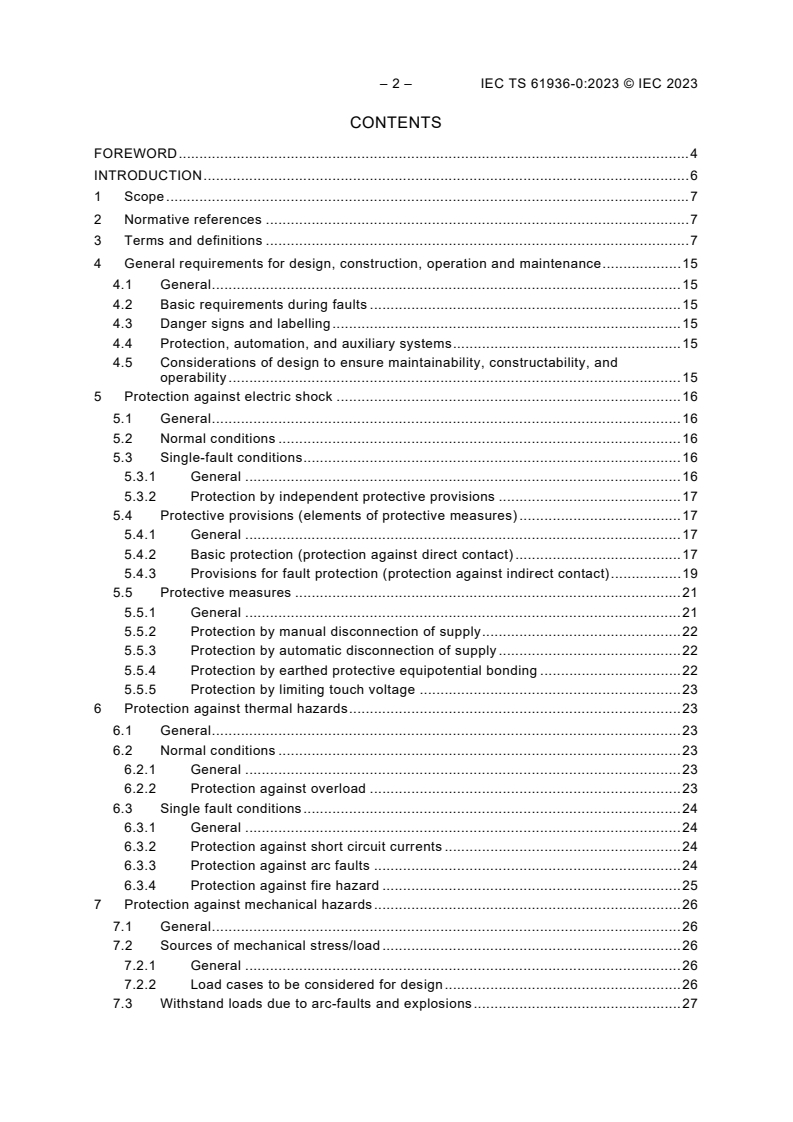
IEC TS 61936-0:2023 - Power installations exceeding 1 kV AC and 1,5 kV DC - Part 0: Principles to be observed in the design and erection of high voltage installations - Safety of high voltage installations Released:5/4/2023
Overview
IEC TS 61936-0:2023 - "Power installations exceeding 1 kV AC and 1,5 kV DC - Part 0" sets out high‑level principles to be observed in the design and erection of high‑voltage (HV) installations. Its primary aim is to ensure coherence across HV publications and to guide the coordination of design, equipment selection, operation and maintenance so that the safety of persons, domestic animals, livestock and property is maintained. This Technical Specification is intended mainly for technical committees preparing standards with safety aspects for HV installations.
Key topics and technical requirements
The document defines principles and topics that technical standards and practitioners should address, including:
- General requirements for design, construction, operation and maintenance to ensure safe HV systems and coherent application across standards.
- Protection against electric shock
- Basic protection (direct contact) and fault protection (indirect contact)
- Protective provisions: manual and automatic disconnection, independent protective provisions, and equipotential bonding
- Measures to limit touch voltage and provide safe access (arm’s reach considerations)
- Protection against thermal hazards
- Overload and short‑circuit protection
- Arc‑fault recognition and mitigation
- Fire hazard considerations for HV equipment and cabling
- Protection against mechanical hazards
- Design loads, sources of mechanical stress, and withstanding arc‑fault/explosion effects
- Voltage and frequency deviation protection
- Overvoltage withstand and protective measures, undervoltage and frequency abnormality handling
- Interactions with other infrastructure
- Induced potentials to telecommunications and other nearby systems
- Considerations for electric and magnetic fields
- Marking, labelling and maintainability
- Danger signs, terminal identification and provisions to ensure safe operation and maintenance
Practical applications and users
IEC TS 61936-0:2023 is used to:
- Provide a framework for technical committees (IEC/ISO and national bodies) when drafting HV equipment and installation standards.
- Guide system engineers, HV designers and consultants in establishing coherent safety principles across projects.
- Inform utilities, substation designers, EPC contractors, asset owners and safety assessors about the safety principles to be reflected in detailed design and operational procedures.
- Support manufacturers and testing bodies by clarifying expectations for protection, labelling and maintainability in the wider HV standards ecosystem.
Related standards (examples)
The Technical Specification references and complements other IEC documents such as:
- IEC 60071 (insulation coordination)
- IEC 60445 (marking and identification)
- IEC 60529 (IP Codes)
- IEC TR 60479-5 (touch voltage effects)
- Other parts of the IEC 61936 series
Keywords: IEC TS 61936-0:2023, high voltage installations, HV safety, insulation coordination, protection against electric shock, arc fault, equipotential bonding, high‑voltage design.
Buy Documents
IEC TS 61936-0:2023 - Power installations exceeding 1 kV AC and 1,5 kV DC - Part 0: Principles to be observed in the design and erection of high voltage installations - Safety of high voltage installations Released:5/4/2023
Get Certified
Connect with accredited certification bodies for this standard

IMQ S.p.A. (Certification)
Italian electrical product certification.

SLG Prüf- und Zertifizierungs GmbH
German testing and certification body.

UL Solutions
Global safety science company with testing, inspection and certification.
Sponsored listings
Frequently Asked Questions
IEC TS 61936-0:2023 is a technical specification published by the International Electrotechnical Commission (IEC). Its full title is "Power installations exceeding 1 kV AC and 1,5 kV DC - Part 0: Principles to be observed in the design and erection of high voltage installations - Safety of high voltage installations". This standard covers: IEC TS 61936-0:2023 provides principles to ensure the coherence amongst HV publications to be observed necessary for the coordination of the design, selection of equipment, operation, and maintenance activities for erection of electrical HV installations to ensure the safety of such systems. In the context of this document, "safety" relates to the safety of persons, domestic animals, livestock and property. This Technical Specification is intended for use by technical committees in the preparation of standards with safety aspects which can be a part of an electrical high voltage installation
IEC TS 61936-0:2023 provides principles to ensure the coherence amongst HV publications to be observed necessary for the coordination of the design, selection of equipment, operation, and maintenance activities for erection of electrical HV installations to ensure the safety of such systems. In the context of this document, "safety" relates to the safety of persons, domestic animals, livestock and property. This Technical Specification is intended for use by technical committees in the preparation of standards with safety aspects which can be a part of an electrical high voltage installation
IEC TS 61936-0:2023 is classified under the following ICS (International Classification for Standards) categories: 29.020 - Electrical engineering in general; 29.080.01 - Electrical insulation in general. The ICS classification helps identify the subject area and facilitates finding related standards.
IEC TS 61936-0:2023 is available in PDF format for immediate download after purchase. The document can be added to your cart and obtained through the secure checkout process. Digital delivery ensures instant access to the complete standard document.
Standards Content (Sample)
IEC TS 61936-0 ®
Edition 1.0 2023-05
TECHNICAL
SPECIFICATION
Power installations exceeding 1 kV AC and 1,5 kV DC –
Part 0: Principles to be observed in the design and erection of high voltage
installations – Safety of high voltage installations
All rights reserved. Unless otherwise specified, no part of this publication may be reproduced or utilized in any form
or by any means, electronic or mechanical, including photocopying and microfilm, without permission in writing from
either IEC or IEC's member National Committee in the country of the requester. If you have any questions about IEC
copyright or have an enquiry about obtaining additional rights to this publication, please contact the address below or
your local IEC member National Committee for further information.
IEC Secretariat Tel.: +41 22 919 02 11
3, rue de Varembé info@iec.ch
CH-1211 Geneva 20 www.iec.ch
Switzerland
About the IEC
The International Electrotechnical Commission (IEC) is the leading global organization that prepares and publishes
International Standards for all electrical, electronic and related technologies.
About IEC publications
The technical content of IEC publications is kept under constant review by the IEC. Please make sure that you have the
latest edition, a corrigendum or an amendment might have been published.
IEC publications search - webstore.iec.ch/advsearchform IEC Products & Services Portal - products.iec.ch
The advanced search enables to find IEC publications by a Discover our powerful search engine and read freely all the
variety of criteria (reference number, text, technical publications previews. With a subscription you will always have
committee, …). It also gives information on projects, replaced access to up to date content tailored to your needs.
and withdrawn publications.
Electropedia - www.electropedia.org
IEC Just Published - webstore.iec.ch/justpublished
The world's leading online dictionary on electrotechnology,
Stay up to date on all new IEC publications. Just Published
containing more than 22 300 terminological entries in English
details all new publications released. Available online and once
and French, with equivalent terms in 19 additional languages.
a month by email.
Also known as the International Electrotechnical Vocabulary
(IEV) online.
IEC Customer Service Centre - webstore.iec.ch/csc
If you wish to give us your feedback on this publication or need
further assistance, please contact the Customer Service
Centre: sales@iec.ch.
IEC TS 61936-0 ®
Edition 1.0 2023-05
TECHNICAL
SPECIFICATION
Power installations exceeding 1 kV AC and 1,5 kV DC –
Part 0: Principles to be observed in the design and erection of high voltage
installations – Safety of high voltage installations
INTERNATIONAL
ELECTROTECHNICAL
COMMISSION
ICS 29.020; 29.080.01 ISBN 978-2-8322-6946-6
– 2 – IEC TS 61936-0:2023 © IEC 2023
CONTENTS
FOREWORD . 4
INTRODUCTION . 6
1 Scope . 7
2 Normative references . 7
3 Terms and definitions . 7
4 General requirements for design, construction, operation and maintenance . 15
4.1 General . 15
4.2 Basic requirements during faults . 15
4.3 Danger signs and labelling . 15
4.4 Protection, automation, and auxiliary systems . 15
4.5 Considerations of design to ensure maintainability, constructability, and
operability . 15
5 Protection against electric shock . 16
5.1 General . 16
5.2 Normal conditions . 16
5.3 Single-fault conditions . 16
5.3.1 General . 16
5.3.2 Protection by independent protective provisions . 17
5.4 Protective provisions (elements of protective measures) . 17
5.4.1 General . 17
5.4.2 Basic protection (protection against direct contact) . 17
5.4.3 Provisions for fault protection (protection against indirect contact) . 19
5.5 Protective measures . 21
5.5.1 General . 21
5.5.2 Protection by manual disconnection of supply . 22
5.5.3 Protection by automatic disconnection of supply . 22
5.5.4 Protection by earthed protective equipotential bonding . 22
5.5.5 Protection by limiting touch voltage . 23
6 Protection against thermal hazards . 23
6.1 General . 23
6.2 Normal conditions . 23
6.2.1 General . 23
6.2.2 Protection against overload . 23
6.3 Single fault conditions . 24
6.3.1 General . 24
6.3.2 Protection against short circuit currents . 24
6.3.3 Protection against arc faults . 24
6.3.4 Protection against fire hazard . 25
7 Protection against mechanical hazards . 26
7.1 General . 26
7.2 Sources of mechanical stress/load . 26
7.2.1 General . 26
7.2.2 Load cases to be considered for design . 26
7.3 Withstand loads due to arc-faults and explosions . 27
8 Protection against voltage and frequency deviations hazards . 27
8.1 Overvoltage withstand and protection . 27
8.2 Undervoltage protection . 28
8.3 Over- and underfrequency . 28
9 Induced potentials to telecommunication and other infrastructure . 28
10 Electric and magnetic fields . 28
Bibliography . 29
Figure 1 – Relationship of IEC 61936-0 to other IEC standards . 6
– 4 – IEC TS 61936-0:2023 © IEC 2023
INTERNATIONAL ELECTROTECHNICAL COMMISSION
____________
POWER INSTALLATIONS EXCEEDING 1 kV AC AND 1,5 kV DC –
Part 0: Principles to be observed in the design and erection of high
voltage installations – Safety of high voltage installations
FOREWORD
1) The International Electrotechnical Commission (IEC) is a worldwide organization for standardization comprising
all national electrotechnical committees (IEC National Committees). The object of IEC is to promote international
co-operation on all questions concerning standardization in the electrical and electronic fields. To this end and
in addition to other activities, IEC publishes International Standards, Technical Specifications, Technical Reports,
Publicly Available Specifications (PAS) and Guides (hereafter referred to as “IEC Publication(s)”). Their
preparation is entrusted to technical committees; any IEC National Committee interested in the subject dealt with
may participate in this preparatory work. International, governmental and non-governmental organizations liaising
with the IEC also participate in this preparation. IEC collaborates closely with the International Organization for
Standardization (ISO) in accordance with conditions determined by agreement between the two organizations.
2) The formal decisions or agreements of IEC on technical matters express, as nearly as possible, an international
consensus of opinion on the relevant subjects since each technical committee has representation from all
interested IEC National Committees.
3) IEC Publications have the form of recommendations for international use and are accepted by IEC National
Committees in that sense. While all reasonable efforts are made to ensure that the technical content of IEC
Publications is accurate, IEC cannot be held responsible for the way in which they are used or for any
misinterpretation by any end user.
4) In order to promote international uniformity, IEC National Committees undertake to apply IEC Publications
transparently to the maximum extent possible in their national and regional publications. Any divergence between
any IEC Publication and the corresponding national or regional publication should be clearly indicated in the
latter.
5) IEC itself does not provide any attestation of conformity. Independent certification bodies provide conformity
assessment services and, in some areas, access to IEC marks of conformity. IEC is not responsible for any
services carried out by independent certification bodies.
6) All users should ensure that they have the latest edition of this publication.
7) No liability shall attach to IEC or its directors, employees, servants or agents including individual experts and
members of its technical committees and IEC National Committees for any personal injury, property damage or
other damage of any nature whatsoever, whether direct or indirect, or for costs (including legal fees) and
expenses arising out of the publication, use of, or reliance upon, this IEC Publication or any other IEC
Publications.
8) Attention is drawn to the Normative references cited in this publication. Use of the referenced publications is
indispensable for the correct application of this publication.
9) Attention is drawn to the possibility that some of the elements of this IEC Publication may be the subject of patent
rights. IEC shall not be held responsible for identifying any or all such patent rights.
IEC TS 61936-0 has been prepared by technical committee 99: Insulation co-ordination and
system engineering of high voltage electrical power installations above 1,0 kV AC and
1,5 kV DC. It is a Technical Specification.
The text of this Technical Specification is based on the following documents:
Draft Report on voting
99/375/DTS 99/404/RVDTS
Full information on the voting for its approval can be found in the report on voting indicated in
the above table.
The language used for the development of this Technical Specification is English.
This document was drafted in accordance with ISO/IEC Directives, Part 2, and developed in
accordance with ISO/IEC Directives, Part 1 and ISO/IEC Directives, IEC Supplement, available
at https://www.iec.ch/members_experts/refdocs. The main document types developed by IEC
are described in greater detail at https://www.iec.ch/standardsdev/publications.
A list of all parts in the IEC 61936 series, published under the general title Power installations
exceeding 1 kV AC and 1,5 kV DC, can be found on the IEC website.
The committee has decided that the contents of this document will remain unchanged until the
stability date indicated on the IEC website under webstore.iec.ch in the data related to the
specific document. At this date, the document will be
• reconfirmed,
• withdrawn,
• replaced by a revised edition, or
• amended.
– 6 – IEC TS 61936-0:2023 © IEC 2023
INTRODUCTION
The scope of TC 99 is the standardisation of insulation co-ordination for high voltage systems
and common rules and particular requirements for system engineering and erection of high
voltage electrical power installations for power generation, transmission, distribution, and
consumer premises, in both indoor and outdoor situations, with particular consideration of
safety aspects.
With the increasing development of electric power systems and renewable energy devices,
there is an increasing demand for Technical Committees to define installations, systems and
equipment at voltages above 1,0 kV AC and 1,5 kV DC. This requirement became evident during
the activities of TC 99 AhG6's discussions with TC 18 and TC 88 where a review of documents
prepared by these TCs showed that there was a need for a document which defines principles
to be observed in design and the erection of HV installations.
The objective of this document is to give the principles for TCs in how to define requirements
with respect to HV installations to ensure that safety of such systems is maintained and that a
consistent approach is taken by all TCs involved with HV installations with respect to design,
operation and maintenance of installation at voltages above 1,0 kV AC and 1,5 kV DC.
Figure 1 below describes the relationship of this document to other IEC standards:
Figure 1 – Relationship of IEC 61936-0 to other IEC standards
POWER INSTALLATIONS EXCEEDING 1 kV AC AND 1,5 kV DC –
Part 0: Principles to be observed in the design and erection of high
voltage installations – Safety of high voltage installations
1 Scope
This part of IEC 61936 provides principles to ensure the coherence amongst HV publications
to be observed necessary for the coordination of the design, selection of equipment, operation,
and maintenance activities for erection of electrical HV installations to ensure the safety of such
systems.
In the context of this document, "safety" relates to the safety of persons, domestic animals,
livestock and property.
This Technical Specification is intended for use by technical committees in the preparation of
standards with safety aspects which can be a part of an electrical high voltage installation.
2 Normative references
The following documents are referred to in the text in such a way that some or all of their content
constitutes requirements of this document. For dated references, only the edition cited applies.
For undated references, the latest edition of the referenced document (including any
amendments) applies.
ISO/lEC Guide 51:2014, Safety aspects – Guidelines for their inclusion in standards
IEC 60068 (all parts), Environmental testing
IEC 60071 (all parts), Insulation co-ordination
IEC 60445, Basic and safety principles for man-machine interface, marking and identification –
Identification of equipment terminals, conductor terminations and conductors
IEC TR 60479-5, Effects of current on human beings and livestock – Part 5: Touch voltage
threshold values for physiological effects
IEC 60529, Degrees of protection provided by enclosure (IP Code)
IEC 60721 (all parts), Classification of environmental conditions
3 Terms and definitions
For the purposes of this document, the following terms and definitions apply.
ISO and IEC maintain terminology databases for use in standardization at the following
addresses:
• ISO Online browsing platform: available at https://www.iso.org/obp
• IEC Electropedia: available at https://www.electropedia.org/
– 8 – IEC TS 61936-0:2023 © IEC 2023
3.1
arc
arcing
luminous discharge of electricity across an insulating medium, usually accompanied by the
partial volatilization of the electrodes
Note 1 to entry: A complete sinusoidal current half-cycle is not considered to be an arcing half-cycle.
[SOURCE: IEC 60050-442:1998/AMD3:2019, 442-05-65]
3.2
arc fault
arcing fault
dangerous unintentional arc
[SOURCE: IEC 60050-442:1998/AMD3:2019, 442-05-66]
3.3
arm's reach
zone of accessibility to touch extending from any point on a surface where persons usually
stand or move about to the limits which a person can reach with the hand, in any direction,
without assistance
[SOURCE: IEC 60050-195:2021, 195-06-12, modified – The note has been removed.]
3.4
automatic disconnection of supply
interruption of one or more of the line conductors effected by the automatic operation of a
protective device in the event of a fault
Note 1 to entry: This does not necessarily mean an interruption in all conductors of the supply system.
[SOURCE: IEC 60050-195:2021, 195-04-10, modified – “in the event of a fault” replaces “in
case of a fault” and Note 1 to entry added]
3.5
basic insulation
insulation that provides basic protection
Note 1 to entry: This concept does not apply to insulation used exclusively for functional purposes.
[SOURCE: IEC 60050-195:2021, 195-06-06]
3.6
conditions
3.6.1
normal condition
condition in which all means of protection are intact
[SOURCE: IEC 60050-903:2013, 903-02-07, modified – “
has been added.]
3.6.2
single fault condition
condition in which there is a fault of a single protection (but
not a reinforced protection) or of a single component or a device
Note 1 to entry: If a single fault condition results in one or more other fault conditions, all are considered as one
single fault condition.
[SOURCE: IEC 60050-903:2013, 903-01-15 modified – “”
has been added.]
3.6.3
environmental condition
characteristic of the environment which may affect performance of a component, device or
equipment
Note 1 to entry: Examples of environmental conditions are external influences, characteristics of the power supply,
duty cycle or duty type.
[SOURCE: IEC 60050-151:2001, 151-16-01 modified – The term “operating conditions” has
been replaced by “environmental condition”. It has also been replaced by “environmental
conditions” in Note 1 to entry.]
3.6.4
normal environmental condition
characteristic of the environment which may affect performance of a device or system, and
which is standardized as normal
Note 1 to entry: Examples of environmental conditions are pressure, temperature, humidity, radiation, vibration.
Note 2 to entry: Conditions which are normal as described in IEC Guide 111.
[SOURCE: IEC 60050-151:2001, 151-16-03, modified – The words “and which is standardized
as normal” have been added.]
3.6.5
special environmental condition
characteristic of the environment which may affect performance of a device or system, and
which is standardized as special
Note 1 to entry: Examples of environmental conditions are pressure, temperature, humidity, radiation, vibration.
Note 2 to entry: Conditions which is special as described in IEC Guide 111.
Note 3 to entry: See 5.3 of IEC Guide 111:2004 for more information on special environmental conditions.
3.6.6
operating condition
state of a component, device, equipment or system characterized by one or more properties
3.6.7
normal operating condition
operating condition representing the range of intended use
[SOURCE: IEC 60050-903:2013/AMD1:2014, 903-01-21 modified – “as closely as possible” has
been removed, as well as ““that can reasonably be expected” and “normal use” has been
replaced by “intended use”.]
– 10 – IEC TS 61936-0:2023 © IEC 2023
3.6.8
abnormal operating condition
operating condition that is not a normal operating condition and is not a single fault condition
of the equipment itself
[SOURCE: IEC 60050-903/AMD1:2014:2013, 903-01-22]
3.6.9
intended use
use of a product, process or service in accordance with the information for use
[SOURCE: IEC 60050-903:2014, 903-01-13, modified – The words “provided by the supplier”
have been removed.]
3.7
danger zone
in the case of HV, area limited by the minimum clearance around live-parts without complete
protection
Note 1 to entry: Entering the danger zone is considered the same as touching live-parts.
[SOURCE: IEC 61140:2016, 3.35, modified – In Note 1 to entry, “hazardous-live-parts” has
been replaced by “live-parts”.]
3.8
minimum clearance of danger zone
N
clearance which describes the area of danger zone around live-parts without complete
protection
[SOURCE: IEC 61936-1:2021, 3.5.6, modified – “hazardous” and “against direct contact” have
been removed, as well as the two notes]
3.9
vicinity zone
limited space outside the live working zone where specific precautions are taken to avoid
encroaching into the live working zone
Note 1 to entry: Encroaching into the live working zone will create an electrical hazard.
Note 2 to entry: The outer boundary of the vicinity zone and the specific precautions that apply are generally defined
by national or company regulations.
Note 3 to entry: This entry was numbered 651-01-07 in IEC 60050-651:1999. It has been modified as follows:
Greater detail is provided regarding the precautions to be taken when in the vicinity zone.
[SOURCE: IEC 60050-651:2014, 651-21-04]
3.10
reference earth
reference ground, US
part of the Earth considered as conductive, the electric potential of which is conventionally
taken as zero, being outside the zone of influence of any earthing arrangement
Note 1 to entry: The concept “Earth” means the planet and all its physical matter.
[SOURCE: IEC 60050-195:2021, 195-01-01]
3.11
earth, verb
ground, verb (US)
to make an electrical connection between a conductive part and a local earth
Note 1 to entry: The connection to local earth can be:
– intentional; or
– unintentional or accidental
and can be permanent or temporary.
[SOURCE: IEC 60050-195:2021, 195-01-08]
3.12
local earth
local ground (US)
part of the Earth which is in electric contact with an earth electrode and the electric potential of
not necessarily equal to zero
[SOURCE: IEC 60050-195:2021, 195-01-03]
3.13
earthing arrangement
grounding arrangement (US)
all the electrical means involved in the earthing of a system, installation or equipment
Note 1 to entry: Electric connection and devices used for earthing are examples of electrical means.
[SOURCE: IEC 60050-195:2021, 195-02-20]
3.14
earthing conductor
grounding conductor (US)
conductor which forming a conductive path between a conductive part and an earth electrode
EXAMPLE A conductor connected between a main earthing terminal or busbar and an earth electrode.
[SOURCE: IEC 60050-195:2021, 195-02-03]
3.15
earth electrode
ground electrode (US)
conductive part that is in electric contact with local earth, directly or through an intermediate
conductive medium
[SOURCE: IEC 60050-195:2021, 195-02-01]
3.16
earthed protective-equipotential-bonding
protective-equipotential-bonding connected to local earth
3.17
equipotential bonding
set of electric connections intended to achieve equipotentiality between conductive parts
Note 1 to entry: The effectiveness of the equipotential bonding may depend on the frequency of the current in the
bonding.
[SOURCE: IEC 60050-195:2021, 195-01-10, modified – Note 1 to entry added]
– 12 – IEC TS 61936-0:2023 © IEC 2023
3.18
exposed-conductive-part
conductive part of equipment that can be touched and which is not live under normal conditions,
but that can become live when basic insulation fails
Note 1 to entry: A conductive part of electrical equipment which can become live only through contact with an
exposed-conductive-part which has become live, is not considered to be an exposed-conductive-part itself.
[SOURCE: IEC 60050-195:2021, 195-06-10 modified – Note 1 to entry added]
3.19
extraneous-conductive-part
conductive part not forming part of the electrical installation and that is likely to introduce an
electric potential, generally the electric potential of a local earth
[SOURCE: IEC 60050-195:2021, 195-06-11
3.20
instructed person
electrically instructed person
person adequately advised or supervised by electrically skilled persons to enable him or her to
perceive risks and to avoid hazards which electricity can create
[SOURCE: IEC 60050-195:2021, 195-04-02]
3.21
insulation
set of properties which characterize the ability of an insulation to provide its function
Note 1 to entry: Examples of relevant properties are: resistance, breakdown voltage.
Note 2 to entry: Insulation can be a solid, a liquid or a gas (e.g. air), or any combination.
[SOURCE: IEC 60050-151:2001, 151-15-42, modified – Note 2 to entry has been added]
3.22
insulation coordination
selection of the dielectric strength of equipment in relation to the operating voltages and
overvoltages which can appear on the system for which the equipment is intended, and taking
into account the service environment and the characteristics of the available preventing and
protective devices
[SOURCE: IEC 60050-614:2016, 614-03-08]
3.23
live part
conductive part intended to be energized in normal operating conditions, including a neutral
conductor or mid-point conductor
Note 1 to entry: This concept does not necessarily imply a risk of electric shock.
[SOURCE: IEC 60050-195:2021, 195-02-19, modified – “under normal operating conditions,
including the neutral conductor and mid-point conductor, but excluding the PEN conductor, PEM
conductor and PEL conductor” has been replaced with “normal operating conditions, including
a neutral conductor or mid-point conductor”. Note 1 to entry has been added.]”
3.24
main contact
contact included in the main circuit of a mechanical switching device, intended to carry, in the
closed position, the current of the main circuit
[SOURCE: IEC 60050-441:1984, 441-15-07]
3.25
manual disconnection of supply
interruption of one or more of the line conductors effected by the manual operation of an
operating person in the event of a fault
3.26
ordinary person
person who is neither a skilled person nor an instructed person
[SOURCE: IEC 60050-195:2021, 195-04-03]
3.27
overvoltage
voltage:
– between one phase conductor and earth or across a longitudinal insulation having a peak
value exceeding the peak of the highest voltage of the AC-system divided by 3 or;
– between phase conductors having a peak value exceeding the amplitude of the highest
voltage of the AC-system
– voltage having a value exceeding the corresponding highest steady state voltage of the DC-
system
[SOURCE: IEC 60050-614:2016, 614-03-10, modified – The specific use
system> has been removed. In the first dash, “line” has been replaced with “phase” and “of the
AC-system” has been added; in the second dash: “of the AC-system” has been added and the
last dash has been added.]
3.28
potential grading
control of the local earth potential, especially the earth surface potential,
by means of earth electrodes
3.29
protective barrier
part providing protection against contact by a human being or livestock with a live
part from any usual direction of access
[SOURCE: IEC 60050-195:2021, 195-06-15, modified – "human being or livestock with
hazardous-live-parts" has been replaced with "human or livestock with a live part"]
3.30
protective-equipotential-bonding
equipotential bonding for the purposes of electrical safety
[SOURCE: IEC 60050-195:2021, 195-01-15]
– 14 – IEC TS 61936-0:2023 © IEC 2023
3.31
protective obstacle
part preventing unintentional contact by a human or livestock with a live part, but
not preventing such contact by deliberate action
[SOURCE: IEC 60050-195:2021, 195-06-16, modified – “with hazardous-live-parts” has been
replaced by “with a live part”.]
3.32
protective measure
appropriate combination of protective provisions
[SOURCE: IEC 60050-195:2021, 195-06-26]
3.33
protective provision
independent provision intended to protect against electric shock under specified conditions
Note 1 to entry: The provision may be a means or technique or device or process.
[SOURCE: IEC 60050-195:2021, 195-06-25, modified – Note 1 to entry has been added.]
3.34
short-circuit current
current flowing at a given point of a network resulting from a short circuit at another point of this
network
[SOURCE: IEC 60050-603:1986, 603-02-26]
3.35
skilled person
electrically skilled person
person with relevant education and experience to enable him or her to perceive risks and to
avoid hazards which electricity can create
[SOURCE: IEC 60050-195:2021, 195-04-01]
3.36
step voltage
voltage between two points on the Earth's surface
Note 1 to entry: Typically, a distance of 1 m between the two points is considered to be the stride length of a person.
[SOURCE: IEC 60050-195:2021, 195-05-12, modified – The term “human being” has been
replaced by “person”.]
3.37
thermal hazard
harm caused by high or low temperatures in, near or on electrical equipment
3.38
touch voltage
voltage between conductive parts when touched simultaneously by a human being
or livestock
Note 1 to entry: The value of the effective touch voltage is influenced by the impedance of the human being or the
livestock in electric contact with these conductive parts.
[SOURCE: IEC 60050-195:2021, 195-05-11]
3.39
undervoltage
voltage between phase conductors having a value below the lowest voltage of the installation
for correct operation or preventing damage to equipment
4 General requirements for design, construction, operation and maintenance
4.1 General
Electrical HV installations shall be designed, constructed and be able to be operated and
maintained such that they fulfil their intended function with necessary protection against electric
shock, burns and thermal effects of persons, livestock and property when used according to the
intended use and for reasonably foreseeable misuse.
Installations shall be constructed and secured such that operations and maintenance can be
performed in a manner that do not cause harm to persons, the public and the surroundings.
Necessary safety equipment should be accessible.
Installations and their equipment shall be suitable for the stresses to which they may be
exposed and for the surrounding in which they shall operate.
The requirements regarding risk management in ISO/IEC Guide 51 shall be met in the process
for establishing the requirements in HV-standards.
NOTE The ISO/IEC 31000 series and the ISO/IEC 31010 series give guidelines for risk management for the user
of the standards.
Clause 5 to Clause 10 of this document give principles to be adopted for the safe design of HV
installations.
4.2 Basic requirements during faults
Electrical installations shall be designed, constructed such that protection against hazards is
ensured under normal conditions and under credible single fault conditions or a single
erroneous operation. Faults shall be managed or corrected.
4.3 Danger signs and labelling
Installations shall have danger signs, labelling and identification, such that erroneous operation
and accidents are prevented. Danger signs, labelling and identification shall be durable, clear,
readily visible.
4.4 Protection, automation, and auxiliary systems
Installations should have the auxiliary systems and equipment for monitoring, automation and
protection which are necessary for carrying out operations and maintenance.
4.5 Considerations of design to ensure maintainability, constructability, and
operability
The design of electrical power installations should take into account the work activities that may
be undertaken to ensure maintainability in addition to constructability and operability of
electrical power installations.
The methods of working in the live working zone, in the vicinity zone or dead working shall be
able to be performed in a proper manner.
– 16 – IEC TS 61936-0:2023 © IEC 2023
The values for the minimum clearance of danger zone in AC installations are given in Tables 2
and 3 (N) in IEC 61936-1:2021. These values can be used to define clearances in the design
of installations and for working. It describes the area of danger zone around live parts without
complete protection against direct contact.
Working distances may be determined based upon minimum clearance of danger zone, taking
into consideration overvoltage conditions and ergonomic factors (e.g. considerations of
inadvertent movements (full or expected reach) of persons, tools, equipment, vehicles and
conductors).
NOTE Requirements for DC installations are under consideration.
5 Protection against electric shock
5.1 General
This Clause 5 is limited to installations up 1 000 Hz.
Electric shock is defined as the physiological effect resulting from an electric current passing
through a human body or livestock. The physiological effect can be harmful (such as ventricular
fibrillation, burns, asphyxiation), or non-harmful (such as muscular reaction, perception).
Live-parts shall not be accessible and accessible conductive parts shall not become hazardous,
either:
– under normal conditions (under intended use, see 3.6 of ISO/IEC Guide 51:2014, and
absence of a fault); or
– under single-fault conditions.
NOTE The accessibility rules for ordinary persons can differ from those for skilled or instructed persons and can
also vary for different products and locations.
Protection under normal conditions is provided by basic protection.
Protection under single-fault conditions is provided by fault protection.
5.2 Normal conditions
To meet the fundamental rule for protection against electric shock under normal conditions,
basic protection, as specified in this document, is necessary.
The requirements for provisions for basic protection are given in 5.4.2.
5.3 Single-fault conditions
5.3.1 General
Single faults shall be considered, if they would:
– cause an accessible conductive part which is not energized under normal conditions to
become energized (e.g. due to failure of basic insulation to exposed-conductive-parts or
extraneous-conductive-parts).
To meet the fundamental rule under single-fault conditions, fault protection is necessary. This
protection shall be achieved by a further protective provision, independent of that for basic
protection.
___________
This Clause 5 is based on the horizontal standard IEC 61140:2016.
5.3.2 Protection by independent protective provisions
Each of the independent protective provisions shall be designed so that a failure is unlikely
under conditions specified by the relevant technical committee.
The independent protective provisions shall have no influence on each other such that a failure
of one of the protective provisions could impair another.
Simultaneous failure of independent protective provisions is unlikely and need not normally be
taken into consideration. Reliance is placed on the unaffected protective provisions remaining
effective.
5.4 Protective provisions (elements of protective measures)
5.4.1 General
Subclauses 5.4.1 to 5.4.2.9 give an overview of the different protective provisions. Protective
measures result from a suitable combination of them. The structure of typical protective
measures is described in 5.5.
All protective provisions shall be designed and constructed to be effective during the anticipated
lifetime of the installation, of the system or of the equipment when used as intended and properly
maintained.
The environment shall be taken into account by use of the classification of external influences
as described in the IEC 60721 series and for testing in the IEC 60068 series. Attention is
particularly drawn to the ambient temperature, climatic conditions, presence of water,
mechanical stresses, capability of persons and area of contact of persons or livestock with local
earth potential.
Technical committees shall take account of the requirements for insulation coordination. For
high-voltage installations, systems and equipment, the requirements are found in the IEC 60071
series.
5.4.2 Basic protection (protection against direct contact)
5.4.2.1 General
Installations shall be such that they prevent unintentional infringement of the danger zone and
prevent structures/accessible parts to be energized due to capacitive or inductive coupling, or
high earth currents under normal conditions.
The following provisions for basic protection are recognized:
– protection by basic insulation;
– protection by enclosure;
– protection by barrier;
– protection by obstacle;
– protection by placing out of arms reach;
– bonding extraneous-conductive-parts to each other, and/or to the earthing arrangement
(capacitive or inductive coupling); or
– potential grading.
– 18 – IEC TS 61936-0:2023 © IEC 2023
5.4.2.2 Basic insulation
Where solid basic insulation is used, it shall prevent contact with live parts.
In case of high-voltage installations and equipment, further precautions shall be considered to
avoid voltage to be present on the surface of solid insulation.
Where basic insulation is provided by air, access to live parts or entering the danger zone shall
be prevented by obstacles, protective barriers or enclosures as specified in 5.4.2.3 and 5.4.2.4
or by placing out of arm's reach as specified in 5.4.2.5.
5.4.2.3 Protective barriers or enclosures
Protective barriers or enclosures shall prevent entering the danger zone by providing a degree
of protection according to the principles of IEC 60529. The requirements shall give distances
which are related to danger zone and additional distances. These additional distances shall be
defined in the applicable standards. Special considerations shall be given to providing a degree
of protection for readily accessible horizontal top surfaces of protective barriers or enclosures.
NOTE The IP code applies to the enclosures of electrical equipment of rated voltage not exceeding 72,5 kV.
Protective barriers or enclosures shall have sufficient mechanical strength, stability and
durability to maintain the specified degree of protection, taking account of all relevant influences
from the environment and from inside the enclosure. They shall be firmly secured in place.
Where the design or construction allows for the removal of protective barriers, the opening of
enclosures or the removal of parts of enclosures, access to live parts or entering the danger
zone shall be possible only:
– by the use of a key or tool, or
– after isolation of live parts from the supply circuit, and if necessary, earthing. Restoration of
the supply shall become possible only after replacement of protective barriers or parts of
enclosures or after the closing of doors.
NOTE See also Clause 8.
5.4.2.4 Obstacles
Obstacles are intended to protect skilled or instructed persons but their use is not permitted for
the protection of ordinary persons.
During the operation of the installation, system or equipment under special operating and
servicing conditions, obstacles shall prevent unintentional entering the danger zone.
Obstacles may be removable without using a key or tool but shall be so secured as to make
unintentional removal unlikely.
Where a conductive obstacle is separated from live parts by basic insulation only, it is
considered to be an exposed-conductive-part, and measures for fault protection (see 5.4.3)
shall also be applied.
5.4.2.5 Placing out of arm's reach
Where provisions specified in the previous paragraphs are found to be not applicable, placing
out of arm's reach may be appropriate to prevent unintentional entering into the danger zone.
Details shall be specified by technical committees.
For high-voltage installations, parts that are separated by a distance of more than 2,5 m are
normally considered not to be simultaneously accessible. Where access is restricted to skilled
or instructed persons, reduced distances may be specified.
Where a distance is expected to be reduced by objects which a person uses or holds in the
hand, such as a tool or a ladder, technical committees shall specify relevant restrictions, or an
appropriate distance between conductive parts between which a hazardous voltage can exist.
5.4.2.6 Metal structures bonded to each other, and/or to the earthing arrangement
Where capacitive or inductive coupling can make metal structures have a potential, they shall
be bonded to each other, and/or to the earthing arrangement.
5.4.2.7 Potential grading
Where surrounding local earth can have a potential because of voltage gradients, potential
grading shall be applied to minimalize step voltage. Potential grading shall prevent persons or
livestock from hazardous step and touch voltages under normal conditions by providing a
potential grading earth electrode.
NOTE Potential grading is typically used for electrical ra
...