

IEC 62217:2012
(Main)Polymeric HV insulators for indoor and outdoor use - General definitions, test methods and acceptance criteria
General Information
- Abstract
IEC 62217:2012 is applicable to polymeric insulators whose insulating body consists of one or various organic materials. Polymeric insulators covered by this standard include both solid core and hollow insulators. They are intended for use on HV overhead lines and in indoor and outdoor equipment. The object of this standard is:
- to define the common terms used for polymeric insulators;
- to prescribe common test methods for design tests on polymeric insulators;
- to prescribe acceptance or failure criteria, if applicable.
These tests, criteria and recommendations are intended to ensure a satisfactory life-time under normal operating and environmental conditions. This standard shall only be applied in conjunction with the relevant product standard. This second edition cancels and replaces the first edition published in 2005. This edition constitutes a technical revision. This edition includes a significant technical change with respect to the previous edition. The first edition of IEC 62217 (2005) included two other alternative tracking and erosion tests (a 5 000 hour multi-stress test and a tracking wheel test) which were based on tests developed by CIGRE and utilities. These tests are no longer given as normative alternatives following the results of a study/questionnaire by TC 36 on the relative merits of all three tracking and erosion tests. The 5 000 hour multi-stress test and a tracking wheel test are described in IEC/TR 62730 (2012).
- Status
- Published
- Publication Date
- 26-Sep-2012
- Technical Committee
- TC 36 - Insulators
- Drafting Committee
- MT 19 - TC 36/MT 19
Overview
IEC 62217:2012 is an international standard developed by the International Electrotechnical Commission (IEC) that focuses on polymeric high-voltage (HV) insulators intended for both indoor and outdoor use. This standard specifies general definitions, test methods, and acceptance criteria to ensure the reliable performance and durability of polymeric insulators under normal operating and environmental conditions. It applies to insulators with insulating bodies made of one or multiple organic materials and covers both solid core and hollow types. IEC 62217:2012 provides a comprehensive framework for manufacturers, testing laboratories, and utility companies to validate the design and quality of polymeric HV insulators.
Key Topics
Scope and Applicability
The standard targets polymeric HV insulators used on high-voltage overhead lines and in indoor/outdoor electrical equipment. It defines common terminology and test procedures relevant to various polymeric insulator constructions.General Definitions
Provides a unified language and classification system for polymeric insulators, aiding consistent communication and documentation in testing and product design.Design and Test Methods
IEC 62217 details standardized test methods including:- Mechanical and electrical design tests
- Tests on interfaces and end fittings
- Hardness and materials testing for sheds and housings
- Accelerated weathering and 1,000-hour salt fog tracking and erosion test
- Porosity and water diffusion tests on core materials
- Flammability testing according to specific criteria
Acceptance and Failure Criteria
Clear criteria are prescribed for test acceptance or rejection to ensure insulator reliability over its operational life. This helps manufacturers avoid designs or materials that may fail prematurely.Technical Updates
The 2012 edition is a technical revision that replaces the first edition from 2005. It withdraws older tracking and erosion test alternatives (5,000-hour multi-stress and tracking wheel tests) based on findings from IEC Technical Committee 36. These alternatives are now described in IEC/TR 62730.
Applications
IEC 62217:2012 is fundamental for ensuring the quality and durability of polymeric HV insulators used in:
High-Voltage Overhead Transmission Lines
The standard guarantees that insulators will withstand the environmental stresses associated with outdoor electrical transmission systems.Indoor HV Equipment
Polymeric insulators within switchgear, transformers, and other indoor high-voltage apparatus benefit from standardized testing to confirm performance under different indoor conditions.Utilities and Energy Providers
Provides a reliable benchmark for performance during procurement, maintenance, and quality assurance processes.Insulator Manufacturers and Test Laboratories
Ensures consistent production quality, facilitates international market access, and underpins innovation of polymeric insulator materials and designs.
Related Standards
IEC 60507 and IEC 61245
Standards on pollution testing of insulators which are referenced but noted as requiring further study for polymeric materials.IEC/TR 62730:2012
Technical report describing the 5,000-hour multi-stress test and tracking wheel test methods that were once normative alternatives but now serve as complementary testing resources.IEC Guide 111
Provides guidelines for reliability testing and lifetime prediction, which influenced the development and structure of IEC 62217.
Practical Value
Adopting IEC 62217:2012 enables enhanced reliability and safety of high-voltage electrical systems by:
- Enforcing consistent, internationally recognized test protocols that confirm material and design integrity.
- Supporting lifetime performance assessment under realistic environmental conditions.
- Facilitating interoperability and acceptance of polymeric insulators across global markets.
- Reducing operational risks by identifying unsuitable insulator designs early through rigorous screening tests.
- Providing a framework for ongoing innovation in polymeric insulator technology aligned with evolving industry needs.
By following the IEC 62217:2012 standard, manufacturers and users of polymeric HV insulators ensure durability, safety, and optimal performance of critical power transmission and distribution infrastructure in demanding applications.
Relations
- Effective Date
- 05-Sep-2023
- Effective Date
- 05-Sep-2023
Get Certified
Connect with accredited certification bodies for this standard

IMQ S.p.A. (Certification)
Italian electrical product certification.

SLG Prüf- und Zertifizierungs GmbH
German testing and certification body.

UL Solutions
Global safety science company with testing, inspection and certification.
Sponsored listings
Frequently Asked Questions
IEC 62217:2012 is a standard published by the International Electrotechnical Commission (IEC). Its full title is "Polymeric HV insulators for indoor and outdoor use - General definitions, test methods and acceptance criteria". This standard covers: IEC 62217:2012 is applicable to polymeric insulators whose insulating body consists of one or various organic materials. Polymeric insulators covered by this standard include both solid core and hollow insulators. They are intended for use on HV overhead lines and in indoor and outdoor equipment. The object of this standard is: - to define the common terms used for polymeric insulators; - to prescribe common test methods for design tests on polymeric insulators; - to prescribe acceptance or failure criteria, if applicable. These tests, criteria and recommendations are intended to ensure a satisfactory life-time under normal operating and environmental conditions. This standard shall only be applied in conjunction with the relevant product standard. This second edition cancels and replaces the first edition published in 2005. This edition constitutes a technical revision. This edition includes a significant technical change with respect to the previous edition. The first edition of IEC 62217 (2005) included two other alternative tracking and erosion tests (a 5 000 hour multi-stress test and a tracking wheel test) which were based on tests developed by CIGRE and utilities. These tests are no longer given as normative alternatives following the results of a study/questionnaire by TC 36 on the relative merits of all three tracking and erosion tests. The 5 000 hour multi-stress test and a tracking wheel test are described in IEC/TR 62730 (2012).
IEC 62217:2012 is applicable to polymeric insulators whose insulating body consists of one or various organic materials. Polymeric insulators covered by this standard include both solid core and hollow insulators. They are intended for use on HV overhead lines and in indoor and outdoor equipment. The object of this standard is: - to define the common terms used for polymeric insulators; - to prescribe common test methods for design tests on polymeric insulators; - to prescribe acceptance or failure criteria, if applicable. These tests, criteria and recommendations are intended to ensure a satisfactory life-time under normal operating and environmental conditions. This standard shall only be applied in conjunction with the relevant product standard. This second edition cancels and replaces the first edition published in 2005. This edition constitutes a technical revision. This edition includes a significant technical change with respect to the previous edition. The first edition of IEC 62217 (2005) included two other alternative tracking and erosion tests (a 5 000 hour multi-stress test and a tracking wheel test) which were based on tests developed by CIGRE and utilities. These tests are no longer given as normative alternatives following the results of a study/questionnaire by TC 36 on the relative merits of all three tracking and erosion tests. The 5 000 hour multi-stress test and a tracking wheel test are described in IEC/TR 62730 (2012).
IEC 62217:2012 is classified under the following ICS (International Classification for Standards) categories: 29.080.10 - Insulators; 29.140.40 - Luminaires; 37.040.99 - Other standards related to photography; 37.060.99 - Other standards related to cinematography. The ICS classification helps identify the subject area and facilitates finding related standards.
IEC 62217:2012 has the following relationships with other standards: It is inter standard links to IEC 62217:2025, IEC 62217:2005. Understanding these relationships helps ensure you are using the most current and applicable version of the standard.
IEC 62217:2012 is available in PDF format for immediate download after purchase. The document can be added to your cart and obtained through the secure checkout process. Digital delivery ensures instant access to the complete standard document.
Standards Content (Sample)
IEC 62217 ®
Edition 2.0 2012-09
INTERNATIONAL
STANDARD
NORME
INTERNATIONALE
Polymeric HV insulators for indoor and outdoor use – General definitions, test
methods and acceptance criteria
Isolateurs polymériques à haute tension pour utilisation à l'intérieur ou à
l'extérieur – Définitions générales, méthodes d’essai et critères d’acceptation
All rights reserved. Unless otherwise specified, no part of this publication may be reproduced or utilized in any form
or by any means, electronic or mechanical, including photocopying and microfilm, without permission in writing from
either IEC or IEC's member National Committee in the country of the requester.
If you have any questions about IEC copyright or have an enquiry about obtaining additional rights to this publication,
please contact the address below or your local IEC member National Committee for further information.
Droits de reproduction réservés. Sauf indication contraire, aucune partie de cette publication ne peut être reproduite ni
utilisée sous quelque forme que ce soit et par aucun procédé, électronique ou mécanique, y compris la photocopie et les
microfilms, sans l'accord écrit de la CEI ou du Comité national de la CEI du pays du demandeur.
Si vous avez des questions sur le copyright de la CEI ou si vous désirez obtenir des droits supplémentaires sur cette
publication, utilisez les coordonnées ci-après ou contactez le Comité national de la CEI de votre pays de résidence.
IEC Central Office Tel.: +41 22 919 02 11
3, rue de Varembé Fax: +41 22 919 03 00
CH-1211 Geneva 20 info@iec.ch
Switzerland www.iec.ch
About the IEC
The International Electrotechnical Commission (IEC) is the leading global organization that prepares and publishes
International Standards for all electrical, electronic and related technologies.
About IEC publications
The technical content of IEC publications is kept under constant review by the IEC. Please make sure that you have the
latest edition, a corrigenda or an amendment might have been published.
Useful links:
IEC publications search - www.iec.ch/searchpub Electropedia - www.electropedia.org
The advanced search enables you to find IEC publications The world's leading online dictionary of electronic and
by a variety of criteria (reference number, text, technical electrical terms containing more than 30 000 terms and
committee,…). definitions in English and French, with equivalent terms in
It also gives information on projects, replaced and additional languages. Also known as the International
withdrawn publications. Electrotechnical Vocabulary (IEV) on-line.
IEC Just Published - webstore.iec.ch/justpublished Customer Service Centre - webstore.iec.ch/csc
Stay up to date on all new IEC publications. Just Published If you wish to give us your feedback on this publication
details all new publications released. Available on-line and or need further assistance, please contact the
also once a month by email. Customer Service Centre: csc@iec.ch.
A propos de la CEI
La Commission Electrotechnique Internationale (CEI) est la première organisation mondiale qui élabore et publie des
Normes internationales pour tout ce qui a trait à l'électricité, à l'électronique et aux technologies apparentées.
A propos des publications CEI
Le contenu technique des publications de la CEI est constamment revu. Veuillez vous assurer que vous possédez
l’édition la plus récente, un corrigendum ou amendement peut avoir été publié.
Liens utiles:
Recherche de publications CEI - www.iec.ch/searchpub Electropedia - www.electropedia.org
La recherche avancée vous permet de trouver des Le premier dictionnaire en ligne au monde de termes
publications CEI en utilisant différents critères (numéro de électroniques et électriques. Il contient plus de 30 000
référence, texte, comité d’études,…). termes et définitions en anglais et en français, ainsi que
Elle donne aussi des informations sur les projets et les les termes équivalents dans les langues additionnelles.
publications remplacées ou retirées. Egalement appelé Vocabulaire Electrotechnique
International (VEI) en ligne.
Just Published CEI - webstore.iec.ch/justpublished
Service Clients - webstore.iec.ch/csc
Restez informé sur les nouvelles publications de la CEI.
Just Published détaille les nouvelles publications parues. Si vous désirez nous donner des commentaires sur
Disponible en ligne et aussi une fois par mois par email. cette publication ou si vous avez des questions
contactez-nous: csc@iec.ch.
IEC 62217 ®
Edition 2.0 2012-09
INTERNATIONAL
STANDARD
NORME
INTERNATIONALE
Polymeric HV insulators for indoor and outdoor use – General definitions, test
methods and acceptance criteria
Isolateurs polymériques à haute tension pour utilisation à l'intérieur ou à
l'extérieur – Définitions générales, méthodes d’essai et critères d’acceptation
INTERNATIONAL
ELECTROTECHNICAL
COMMISSION
COMMISSION
ELECTROTECHNIQUE
PRICE CODE
INTERNATIONALE
U
CODE PRIX
ICS 29.080.10 ISBN 978-2-83220-338-5
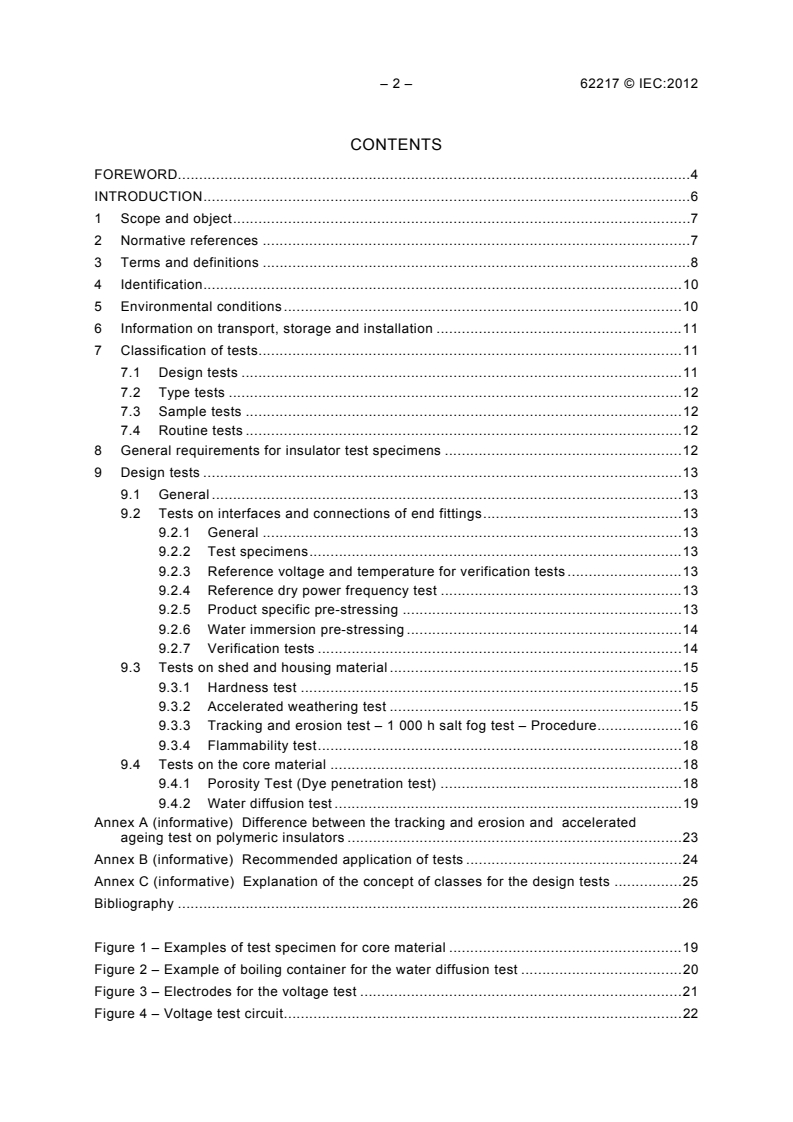
– 2 – 62217 © IEC:2012
CONTENTS
FOREWORD. 4
INTRODUCTION . 6
1 Scope and object . 7
2 Normative references . 7
3 Terms and definitions . 8
4 Identification . 10
5 Environmental conditions . 10
6 Information on transport, storage and installation . 11
7 Classification of tests . 11
7.1 Design tests . 11
7.2 Type tests . 12
7.3 Sample tests . 12
7.4 Routine tests . 12
8 General requirements for insulator test specimens . 12
9 Design tests . 13
9.1 General . 13
9.2 Tests on interfaces and connections of end fittings . 13
9.2.1 General . 13
9.2.2 Tes t spec imens . 13
9.2.3 Reference voltage and temperature for verification tests . 13
9.2.4 Reference dry power frequency test . 13
9.2.5 Product specific pre-stressing . 13
9.2.6 Water immersion pre-stressing . 14
9.2.7 Verification tests . 14
9.3 Tests on shed and housing material . 15
9.3.1 Hardness test . 15
9.3.2 Accelerated weathering test . 15
9.3.3 Tracking and erosion test – 1 000 h salt fog test – Procedure . 16
9.3.4 Flammability test . 18
9.4 Tests on the core material . 18
9.4.1 Porosity Test (Dye penetration test) . 18
9.4.2 Water diffusion test . 19
Annex A (informative) Difference between the tracking and erosion and accelerated
ageing test on polymeric insulators . 23
Annex B (informative) Recommended application of tests . 24
Annex C (informative) Explanation of the concept of classes for the design tests . 25
Bibliography . . 26
Figure 1 – Examples of test specimen for core material . 19
Figure 2 – Example of boiling container for the water diffusion test . 20
Figure 3 – Electrodes for the voltage test . 21
Figure 4 – Voltage test circuit . 22
62217 © IEC:2012 – 3 –
Table 1 – Normal environmental conditions . 11
Table 2 – Initial NaCl content of the water as a function of the specimen dimensions. 17
Table 3 – Flammability requirements . 18
– 4 – 62217 © IEC:2012
INTERNATIONAL ELECTROTECHNICAL COMMISSION
____________
POLYMERIC HV INSULATORS
FOR INDOOR AND OUTDOOR USE –
GENERAL DEFINITIONS, TEST METHODS
AND ACCEPTANCE CRITERIA
FOREWORD
1) The International Electrotechnical Commission (IEC) is a worldwide organization for standardization comprising
all national electrotechnical committees (IEC National Committees). The object of IEC is to promote
international co-operation on all questions concerning standardization in the electrical and electronic fields. To
this end and in addition to other activities, IEC publishes International Standards, Technical Specifications,
Technical Reports, Publicly Available Specifications (PAS) and Guides (hereafter referred to as “IEC
Publication(s)”). Their preparation is entrusted to technical committees; any IEC National Committee interested
in the subject dealt with may participate in this preparatory work. International, governmental and non-
governmental organizations liaising with the IEC also participate in this preparation. IEC collaborates closely
with the International Organization for Standardization (ISO) in accordance with conditions determined by
agreement between the two organizations.
2) The formal decisions or agreements of IEC on technical matters express, as nearly as possible, an international
consensus of opinion on the relevant subjects since each technical committee has representation from all
interested IEC National Committees.
3) IEC Publications have the form of recommendations for international use and are accepted by IEC National
Committees in that sense. While all reasonable efforts are made to ensure that the technical content of IEC
Publications is accurate, IEC cannot be held responsible for the way in which they are used or for any
misinterpretation by any end user.
4) In order to promote international uniformity, IEC National Committees undertake to apply IEC Publications
transparently to the maximum extent possible in their national and regional publications. Any divergence
between any IEC Publication and the corresponding national or regional publication shall be clearly indicated in
the latter.
5) IEC itself does not provide any attestation of conformity. Independent certification bodies provide conformity
assessment services and, in some areas, access to IEC marks of conformity. IEC is not responsible for any
services carried out by independent certification bodies.
6) All users should ensure that they have the latest edition of this publication.
7) No liability shall attach to IEC or its directors, employees, servants or agents including individual experts and
members of its technical committees and IEC National Committees for any personal injury, property damage or
other damage of any nature whatsoever, whether direct or indirect, or for costs (including legal fees) and
expenses arising out of the publication, use of, or reliance upon, this IEC Publication or any other IEC
Publications.
8) Attention is drawn to the Normative references cited in this publication. Use of the referenced publications is
indispensable for the correct application of this publication.
9) Attention is drawn to the possibility that some of the elements of this IEC Publication may be the subject of
patent rights. IEC shall not be held responsible for identifying any or all such patent rights.
International Standard IEC 62217 has been prepared by IEC technical committee 36:
Insulators.
This second edition cancels and replaces the first edition published in 2005. This edition
constitutes a technical revision.
This edition includes a significant technical change with respect to the previous edition.
The first edition of IEC 62217 (2005) included two other alternative tracking and erosion tests
(a 5 000 hour multi-stress test and a tracking wheel test) which were based on tests
developed by CIGRE and utilities. These tests are no longer given as normative alternatives
following the results of a study/questionnaire by TC 36 on the relative merits of all three
tracking and erosion tests. The 5 000 hour multi-stress test and a tracking wheel test are
described in IEC/TR 62730 (2012).
62217 © IEC:2012 – 5 –
The text of this standard is based on the following documents:
FDIS Report on voting
36/321/FDIS 36/324/RVD
Full information on the voting for the approval of this standard can be found in the report on
voting indicated in the above table.
This publication has been drafted in accordance with the ISO/IEC Directives, Part 2.
The committee has decided that the contents of this publication will remain unchanged until
the stability date indicated on the IEC web site under "http://webstore.iec.ch" in the data
related to the specific publication. At this date, the publication will be
• reconfirmed,
• withdrawn,
• replaced by a revised edition, or
• amended.
– 6 – 62217 © IEC:2012
INTRODUCTION
Polymeric insulators consist either of one insulating material (resin insulators) or two or
several insulating materials (composite insulators). The insulating materials are generally
cross-linked organic materials synthesised from carbon or silicon chemistry and form the
insulating body. Insulating materials can be composed from organic materials containing
various inorganic and organic ingredients, such as fillers and extenders. End fittings are often
used at the ends of the insulating body to transmit mechanical loads. Despite these common
features, the materials used and the construction details employed by different manufacturers
may be widely different.
The tests given in this standard are those which are, in general, common to a great majority
of insulator designs and materials, whatever their final application. They have been regrouped
in this standard to avoid repetition in the relevant product standards and drift between
procedures as the various product standards are drafted or revised.
The majority of these tests have been grouped together as "Design tests", to be performed
only once for insulators of the same design. The design tests are intended to eliminate
insulator designs, materials or manufacturing technologies which are not suitable for high-
voltage applications. The influence of time on the electrical properties of the complete
polymeric insulator and its components (core material, housing, interfaces etc.) has been
considered in specifying the design tests in order to ensure a satisfactory lifetime under
normal operating and environmental conditions.
Pollution tests, according to IEC 60507 or IEC 61245, are not included in this document, the
applicability of their methodology to composite insulators not having been proven and still
requiring study by CIGRE. The results of such pollution tests performed on insulators made of
polymeric materials do not correlate with experience obtained from service. Specific pollution
tests for polymeric insulators are still under consideration.
The 1 000 hour salt-fog tracking and erosion test given in this second edition of IEC 62217 is
considered as a screening test intended to reject materials or designs which are inadequate.
This test is not intended to predict long term performance for insulator designs under
cumulative service stresses. For more information, see Annex C. The first edition of
IEC 62217 (2005) included two other alternative tracking and erosion tests (a 5 000 hour
multi-stress test and a tracking wheel test) which were based on tests developed by CIGRE
and utilities. These tests are no longer given as normative alternatives following the results of
a study/questionnaire by TC 36 on the relative merits of all three tracking and erosion tests.
The 5 000 hour multi-stress test and a tracking wheel test are described in IEC/TR 62730
(2012).
Composite insulators are used in both a.c. and d.c. applications. In spite of this fact a specific
tracking and erosion test procedure for d.c. applications as a design test has not yet been
defined and accepted. The 1 000 hour a.c. tracking and erosion test described in this
standard is used to establish a minimum requirement for the tracking resistance of the
housing material.
IEC Guide 111 has been followed wherever possible during the preparation of this standard.
62217 © IEC:2012 – 7 –
POLYMERIC HV INSULATORS
FOR INDOOR AND OUTDOOR USE –
GENERAL DEFINITIONS, TEST METHODS
AND ACCEPTANCE CRITERIA
1 Scope and object
This International Standard is applicable to polymeric insulators whose insulating body
consists of one or various organic materials. Polymeric insulators covered by this standard
include both solid core and hollow insulators. They are intended for use on HV overhead lines
and in indoor and outdoor equipment.
The object of this standard is
– to define the common terms used for polymeric insulators;
– to prescribe common test methods for design tests on polymeric insulators;
– to prescribe acceptance or failure criteria, if applicable;
These tests, criteria and recommendations are intended to ensure a satisfactory life-time
under normal operating and environmental conditions (see Clause 5). This standard shall only
be applied in conjunction with the relevant product standard.
2 Normative references
The following documents, in whole or in part, are normatively referenced in this document and
are indispensable for its application. For dated references, only the edition cited applies. For
undated references, the latest edition of the referenced document (including any
amendments) applies.
IEC 60050-471:2007, International Electrotechnical Vocabulary – Part 471: Insulators
IEC 60060-1, High-voltage test techniques – Part 1: General definitions and test requirements
IEC 60068-2-11, Environmental testing – Part 2: Tests. Test KA: Salt mist
IEC 60507, Artificial pollution tests on high-voltage insulators to be used on a.c. systems
IEC 60695-11-10, Fire hazard testing – Part 11-10: Test flames – 50 W horizontal and vertical
flame test methods
IEC 60721-1, Classification of environmental conditions – Part 1: Environmental parameters
and their severities
IEC 60815-1, Selection and dimensioning of high-voltage insulators intended for use in
polluted conditions – Part 1: Definitions, information and general principles
ISO 868, Plastics and ebonite – Determination of indentation hardness by means of a
durometer (Shore hardness)
– 8 – 62217 © IEC:2012
ISO 4287, Geometrical Product Specifications (GPS) – Surface Texture: Profile method –
Terms, definitions and surface texture parameters
ISO 4892-1, Plastics – Methods of exposure to laboratory light sources – Part 1: General
Guidance
ISO 4892-2, Plastics – Methods of exposure to laboratory light sources – Part 2: Xenon-arc
sources
3 Terms and definitions
For the purposes of this document the terms and definitions given in IEC 60050-471:2007 and
the following apply:
3.1
high voltage (HV)
voltage over 1 000 V a.c. or over 1 500 V d.c. or over 1 500 V peak value
3.2
polymeric insulator
insulator whose insulating body consists of at least one organic based material
Note 1 to entry: Polymeric insulators are also known as non-ceramic insulators.
Note 2 to entry: Coupling devices may be attached to the ends of the insulating body.
[SOURCE: IEC 60050-471:2007, 471-01-13]
3.3
resin insulator
polymeric insulator whose insulating body consists of a solid shank and sheds protruding from
the shank made from only one organic based housing material (e.g. cycloaliphatic epoxy)
3.4
composite insulator
insulator made of at least two insulating parts, namely a core and a housing equipped with
metal fittings
Note 1 to entry: Composite insulators, for example, can consist either of individual sheds mounted on the core, with
or without an intermediate sheath, or alternatively, of a housing directly moulded or cast in one or several pieces
on to the core.
[SOURCE: IEC 60050-471:2007, 471-01-02]
3.5
core
central insulating part of an insulator which provides the mechanical characteristics
Note 1 to entry: The housing and sheds are not part of the core.
[SOURCE: IEC 60050-471:2007, 471-01-03]
3.6
insulator trunk
central insulating part of an insulator from which the sheds project
Note 1 to entry: Also known as shank on smaller insulators.
[SOURCE: IEC 60050-471:2007, 471-01-11]
62217 © IEC:2012 – 9 –
3.7
housing
external insulating part of a composite insulator providing the necessary creepage distance
and protecting core from environment
Note 1 to entry: An intermediate sheath made of insulating material may be part of the housing.
[SOURCE: IEC 60050-471:2007, 471-01-09]
3.8
Shed (of an insulator)
insulating part, projecting from the insulator trunk, intended to increase the creepage distance
Note 1 to entry: The shed can be with or without ribs.
[SOURCE: IEC 60050-471:2007, 471-01-15]
3.9
creepage distance
shortest distance or the sum of the shortest distances along the surface on an insulator
between two conductive parts which normally have the operating voltage between them
Note 1 to entry: The surface of cement or of any other non-insulating jointing material is not considered as forming
part of the creepage distance.
Note 2 to entry: If a high resistance coating is applied to parts of the insulating part of an insulator, such parts are
considered to be effective insulating surfaces and the distance over them is included in the creepage distance.
[SOURCE: IEC 60050-471:2007, 471-01-04]
3.10
arcing distance
shortest distance in air external to the insulator between the metallic parts which normally
have the operating voltage between them
[SOURCE: IEC 60050-471:2007, 471-01-01]
3.11
interfaces
surface between the different materials
Note 1 to entry: Various interfaces occur in most composite insulators, e.g.:
– between housing and fixing devices;
– between various parts of the housing; e.g. between sheds, or between sheath and sheds;
– between core and housing.
3.12
end fitting
fixing device
integral component or formed part of an insulator, intended to connect it to a supporting
structure, or to a conductor, or to an item of equipment, or to another insulator
Note 1 to entry: Where the end fitting is metallic, the term “metal fitting” is normally used.
[SOURCE: IEC 60050-471:2007, 471-01-06, modified by the addition of a synonym]
3.13
connection zone
zone where the mechanical load is transmitted between the insulating body and the fixing
device
– 10 – 62217 © IEC:2012
3.14
coupling
part of the fixing device which transmits load to the hardware external to the insulator
3.15
tracking
process which forms irreversible degradation by formation of conductive paths (tracks)
starting and developing on the surface of an insulating material.
Note 1 to entry: Tracking paths are conductive even under dry conditions.
3.16
erosion
irreversible and non-conducting degradation of the surface of the insulator that occurs by loss
of material. This can be uniform, localized or tree-shaped
Note 1 to entry: Light surface traces, commonly tree-shaped, can occur on composite insulators as on ceramic
insulators, after partial flashover. These traces are not considered to be objectionable as long as they are non-
conductive. When they are conductive they are classified as tracking.
3.17
crack
any internal fracture or surface fissure of depth greater than 0,1 mm
3.18
puncture
permanent loss of dielectric strength due to a disruptive discharge passing through the solid
insulating material of an insulator
[SOURCE: IEC 60050-471:2007, 471-01-14, modified to define puncture as the result of a
discharge, rather than the discharge itself]
4 Identification
The manufacturer’s drawing shall show the relevant dimensions and information necessary for
identifying and testing the insulator in accordance with this International Standard and the
applicable IEC product standard(s). The drawing shall also show applicable manufacturing
tolerances.
Each insulator shall be marked with the name or trademark of the manufacturer and the year
of manufacture. In addition, each insulator shall be marked with the rated characteristics
specified in the relevant IEC product standards. These markings shall be legible, indelible and
their fixings (if any) weather- and corrosion-proof.
5 Environmental conditions
The normal environmental conditions to which insulators are submitted in service are defined
according to Table 1.
When special environmental conditions prevail at the location where insulators are to be put
in service, they shall be specified by the user by reference to IEC 60721-1.
62217 © IEC:2012 – 11 –
Table 1 – Normal environmental conditions
Indoor insulation Outdoor insulation
does not exceed 40 °C and its average value measured over a period of
Maximum ambient air temperature
24 h does not exceed 35 °C
Minimum ambient air temperature –25 °C –40 °C
Negligible vibration due to causes external to the insulators or to earth
Vibration a
tremors .
b
Solar radiation To be neglected Up to a level of 1 000 W/m
Pollution by dust, smoke, corrosive
No significant pollution by dust,
gases, vapours or salt may occur.
Pollution of the ambient air smoke, corrosive and/or flammable
Pollution does not exceed “heavy” as
gases, vapours, or salt.
defined in IEC 60815-1.
The average value of the relative
humidity, measured over a period of
24 h, does not exceed 95 % and
Humidity measured over a period of one
month, does not exceed 95 %. For
these conditions, condensation may
occasionally occur.
a
Vibration due to external causes can be dealt with in accordance to IEC 60721-1.
b
Details of solar radiation are given in IEC 60721-1.
6 Information on transport, storage and installation
Manufacturers of insulators shall provide appropriate instructions and information covering
general conditions during transport, storage and installation of the insulators. These
instructions can include recommendations for cleaning or maintenance.
7 Classification of tests
The tests are divided into four groups as follows:
7.1 Design tests
The design tests are intended to verify the suitability of the design, materials and method
of manufacture (technology).
A polymeric insulator design is generally defined by:
– materials of the core, housing and manufacturing method;
– material of the end fittings, their design, and method of attachment;
– layer thickness of the housing over the core (including a sheath where used).
Additional parameters defining design may be given in the relevant product standard.
When changes in the design of a polymeric insulator occur, re-qualification shall be
carried out according to the prescriptions of the relevant product standard. Typically, only
part of the tests is repeated. A survey of the tests is given in Annex C.
When a polymeric insulator is submitted to the design tests, it becomes a parent insulator
for a design class and the results shall be considered valid for the whole class. This tested
parent insulator defines a design class of insulators which have the following
characteristics:
a) same materials for the core and housing and same manufacturing method;
b) same material of the end fittings, the same design and the same method of
attachment;
– 12 – 62217 © IEC:2012
c) same or greater minimum layer thickness of the housing over the core (including a
sheath where used).
Additional parameters defining a class of design may be given in the relevant product
standard.
7.2 Type tests
The type tests are intended to verify the main characteristics of a polymeric insulator,
which depend mainly on its shape and size. Type tests shall be applied to polymeric
insulators belonging to an already qualified design class. The type tests shall be repeated
only when the type of the polymeric insulator is changed. The parameters defining a type
of polymeric insulator are given in the relevant product standard.
The applicable type tests are given in the relevant product standard.
7.3 Sample tests
The sample tests are intended to verify the characteristics of polymeric insulators which
depend on the quality of manufacture and on the materials used. They are made on
insulators taken at random from lots offered for acceptance.
The applicable sample tests are given in the relevant product standard.
7.4 Routine tests
These tests are intended to eliminate polymeric insulators with manufacturing defects.
They are carried out on every insulator to be supplied.
The applicable routine tests are given in the relevant product standard.
8 General requirements for insulator test specimens
Insulator test specimens for tests of polymeric insulators shall be checked prior to tests:
• for correct assembly, for example by applying the mechanical routine test specified in the
relevant product standard,
• by visual examination according to the relevant product standard;
• for conformance of dimensions with the actual drawing.
For dimensions d without tolerances the following tolerances are acceptable:
• ± (0,04 × d + 1,5) mm when d ≤ 300 mm;
• ± (0,025 × d + 6) mm when d > 300 mm with a maximum tolerance of ±50 mm.
The measurement of creepage distances shall be related to the design dimensions and
tolerances as determined from the insulator drawing, even if this dimension is greater than the
value originally specified. When a minimum creepage is specified, the negative tolerance is
also limited by this value.
In the case of insulators with creepage distance exceeding 3 m, it is allowed to measure a
short section around 1 m long of the insulator and to extrapolate.
The housing colour of the test specimens shall be approximately as specified in the drawing.
The number of test specimens, their selection and dimensions are specified in the relevant
clauses of this standard or in the relevant test standards.
62217 © IEC:2012 – 13 –
9 Design tests
9.1 General
The following tests are normally classified as design tests, unless otherwise specified in the
relevant product standard.
The design tests shall be performed only once according to the relevant product standard and
the results shall be recorded in a test report.
Each test (9.2, 9.3and 9.4) can be performed independently on new test specimens where
appropriate, according to the test sequence given in the relevant test standard. The polymeric
insulator of a particular design shall be deemed qualified only when all insulators or test
specimens pass all the design tests specified in the relevant product standard.
9.2 Tests on interfaces and connections of end fittings
9.2.1 General
The test sequence consists of:
• reference dry power frequency test
• pre-stressing
• verification test
9.2.2 Test specimens
For this series of tests insulators assembled on the production line shall be selected. The
number of specimens and their dimensions shall be according to the relevant product
standard. They shall be checked and tested as indicated in Clause 8.
If the manufacturer only has facilities to produce insulators with one or more dimensions
smaller than indicated in the relevant product standard, the design tests may be performed on
insulators of those dimensions available to him, however the results are only valid for other
insulators of the same design class up to the dimensions tested.
9.2.3 Reference voltage and temperature for verification tests
For time or economic reasons the reference power frequency test in 9.2.4 at the beginning of
the test sequence may be omitted if an additional reference test specimen conforming to 9.2.2
is used. The power frequency voltages after pre-stressing according to 9.2.7.4 and the shank
temperature shall be compared either with the values of the reference test specimen or with
the voltages determined prior to pre-stressing. It is clearly understood that the reference test
specimen shall be not submitted to pre-stressing.
9.2.4 Reference dry power frequency test
The reference dry power frequency external flashover voltage shall be determined by
averaging five flashover voltages determined according to IEC 60060-1 on the test specimens
or on the reference test specimen. This average flashover voltage shall be corrected to
standard conditions in accordance with IEC 60060-1. The flashover voltage shall be obtained
by increasing the voltage linearly from zero to flashover within 1 min.
9.2.5 Product specific pre-stressing
The test specimens shall be subjected to pre-stressing (e.g. thermal-mechanical) according to
the relevant product standard.
– 14 – 62217 © IEC:2012
9.2.6 Water immersion pre-stressing
The specimens shall be kept immersed in a vessel, in boiling de-ionized water with 0,1 % by
weight of NaCl, for 42 h. Alternatively, tap water may be used with salt added to obtain a
conductivity of 1 750 µS/cm ± 80 µS/cm at 20 °C. For a different water temperature, the
conductivity correction as given in IEC 60507:1991, Clause 7 shall be applied.
At the end of boiling, the specimens are allowed to cool and shall remain in water until the
verification tests start in the following sequence. If transport is necessary in this period, the
wet insulators may be put in sealed plastic bags or another suitable container for a maximum
of 12 h.
9.2.7 Verification tests
9.2.7.1 General
The time interval between the following individual tests shall be such that the verification tests
are completed within 48 h.
9.2.7.2 Visual examination
The housing of each specimen is inspected visually. No cracks are permissible.
9.2.7.3 Steep-front impulse voltage test
9.2.7.3.1 Procedure
The test specimens shall be fitted with sharp-edged electrodes (consisting of clips, e.g. made
of a copper strip approximately 20 mm wide and less than 1 mm thick). These electrodes are
fitted firmly around the housing between sheds so positioned to form sections of axial length
of about 500 mm or smaller. The voltage shall be applied to the original metal fittings in case
of insulators with a distance between end fittings smaller than, or equal to, 500 mm.
An impulse voltage with a steepness of at least 1 000 kV/µs shall be applied between two
neighbouring electrodes or between the metal fitting and the neighbouring electrode
respectively. Each section shall be stressed individually with 25 impulses of positive and
25 impulses of negative polarity. Means shall be employed to prevent internal flashover of
hollow insulators.
9.2.7.3.2 Acceptance criteria
Each impulse shall cause external flashover between the electrodes. No puncture of any part
of the insulator shall occur.
9.2.7.4 Dry power frequency voltage test
9.2.7.4.1 Procedure
Before commencing the flashover test, the shank temperature on all test specimens shall be
determined (reference temperature).
The dry power frequency voltage shall be determined by averaging five flashover voltages on
each specimen. The average flashover voltage shall be corrected to normal standard
atmospheric conditions in accordance with IEC 60060-1. The flashover voltage shall be
obtained by increasing the voltage linearly from zero within 1 min.
The test specimens and the reference test specimen, if applicable, shall then be continuously
subjected for 30 min to 80 % of the reference flashover voltage.
62217 © IEC:2012 – 15 –
The temperature of the housing between the sheds of each test specimen and of the
reference insulator, if applicable, shall be measured at three places along or around the
insulator immediately after the removal of the test voltage.
9.2.7.4.2 Acceptance criteria
The flashover voltage of each of the test specimen shall be greater than or equal to 90 % of
the reference flashover voltage.
No puncture of any part of the insulator shall occur and the maximum temperature rise of
each insulator housing between the sheds with respect to the temperature of the reference
test specimen shall be less than 10 K. In cases where there is no reference test specimen
then the maximum temperature rise shall be less than 20 K compared to the reference
temperature determined prior to the power frequency tests.
9.3 Tests on shed and housing material
9.3.1 Hardness test
9.3.1.1 Procedure
Two specimens of the housing material of a size, shape and thickness appropriate for the
hardness measurement method given in ISO 868 shall be taken from the housing of two
insulators. If the shed shape or thickness is inappropriate, then samples may be made
separately using the same manufacturing process and parameters.
Measure and record the ambient temperature and the hardness of the two samples in
accordance with ISO 868 with a Shore A or D durometer, as appropriate.
The samples shall then be kept immersed in boiling water as defined in 9.2.6 for 42 h. The
boiling container shown in Figure 2 is suitable for this boiling.
At the end of the boiling period, the samples shall be allowed to cool and, within 3 h, their
hardness shall be measured again at the same temperature as that of the pre-boiling
measurements ± 5 K.
9.3.1.2 Acceptance criteria
The hardness of each specimen shall not change from the pre-boiled value by more
than ± 20 %.
9.3.2 Accelerated weathering test
9.3.2.1 Procedure
Select three specimens of shed and housing materials for this test (with markings included, if
applicable).
The insulator housing material shall be subjected to a 1 000 h UV light test using the following
test method. Markings on the housing, if any, shall be directly exposed to UV light:
• Xenon-arc methods: ISO 4892-2, using cycle 1 with a dark period of 8 h
NOTE More information on accelerated weathering tests can be found in CIGRE Technical Brochure No. 488.
9.3.2.2 Acceptance criteria
After the test markings on shed or housing material shall be legible; surface degradations
such as cracks and raised areas are not permitted.
– 16 – 62217 © IEC:2012
In case of doubt concerning such degradation, two surface roughness measurements shall be
made on each of the three specimens. The roughness, Rz as defined in ISO 4287, shall be
measured along a sampling length of at least 2,5 mm. Rz shall not exceed 0,1 mm.
NOTE ISO 3274 give details of surface roughness measurement instruments.
9.3.3 Tracking and erosion test – 1 000 h salt fog test – Procedure
9.3.3.1 General
The test is a time-limited continuous test in salt fog at constant power-frequency voltage. It is
not considered to be an accelerated aging test (see Annex A).
9.3.3.2 Test chamber
The test is carried out in a moisture-sealed corrosion-proof chamber, the volume of which
3 2
shall not exceed 15 m . An aperture of not more than 80 cm shall be provided for the natural
exhaust air.
9.3.3.3 Fog generation
A turbo sprayer (room humidifier) of constant spraying capacity shall be used as a water
atomiser forming water droplets of a size of 5 µm to 10 µm. Alternatively, nozzles producing
water droplets of the same size may be used. The IEC 60507 salt fog spray nozzles are not
suitable for this test. The sprayer or nozzles are mounted close to the bottom of the chamber
and spray upwards towards the roof of the chamber. The fog shall fill up the chamber and not
be directly sprayed on to the test specimen. Salt water prepared from NaCl and de-ionised
water shall be supplied to the sprayer (see Table 2). The fog intensity and uniformity shall be
maintained in the specimen’s exposure zone.
9.3.3.4 Fog calibration
The calibration shall be carried out at the start of the test.
2 2
At least two clean collecting receptacles with a collecting area of 8 000 mm ± 2 000 mm and
a maximum height of 100 mm each are placed as close as practical to the position of the ends
of the test object. The receptacles shall be positioned in such a way that they are not shielded
by the test specimens and to avoid dripping from the construction elements of the chamber or
another source.
They shall collect between 1,5 ml and 2,0 ml of precipitation per hour (corrected to 8 000 mm
collecting area) averaged over a minimum period of 16 h according to IEC 60068-2-11.
NOTE The flow rate necessary to obtain such precipitation (typically of the order of 0,3 l/m h) should be noted.
(The water flow rate is defined in litres per hour and per cubic meter of the test chamber volume.) Subsequently
during the test, the flow rate should be checked at least every 100 h and shall remain within ± 25 % of the initial
value.
It is not permitted to re-circulate the water.
9.3.3.5 Test specimens
Two test insulators of identical design with a creepage distance between 500 mm and 800 mm
shall be taken from the production line. If such insulators cannot be taken from the production
line, special test specimens shall be made from other insulators so that the creepage distance
falls between the given values
...