

IEC 63203-402-3:2024
(Main)Wearable electronic devices and technologies - Part 402-3: Performance measurement of fitness wearables - Test methods for the determination of the accuracy of heart rate
General Information
- Abstract
IEC 63203-402-3:2024 specifies terms, a measurement protocol, and a test to evaluate the accuracy of wearables that measure heart rate with a photoplethysmography (PPG) sensor. While this document can be used to measure a variety of different devices claiming to report heart rate, care will be taken when testing in countries that differentiate between heart rate and pulse rate. This measurement protocol is not intended to evaluate medical devices associated with the IEC 60601 series or ISO 80601 series.
- Status
- Published
- Publication Date
- 08-Jan-2024
- Technical Committee
- TC 124 - Wearable electronic devices and technologies
- Drafting Committee
- WG 4 - TC 124/WG 4
- Current Stage
- PPUB - Publication issued
- Start Date
- 09-Jan-2024
- Completion Date
- 12-Jan-2024
Buy Documents
IEC 63203-402-3:2024 - Wearable electronic devices and technologies - Part 402-3: Performance measurement of fitness wearables - Test methods for the determination of the accuracy of heart rate Released:1/9/2024
Overview
IEC 63203-402-3:2024 sets an international standard for evaluating the performance and accuracy of fitness wearables that measure heart rate via photoplethysmography (PPG) sensors. Developed by the International Electrotechnical Commission (IEC), this standard defines terms, establishes a comprehensive measurement protocol, and prescribes test methods designed to ensure that heart rate monitoring devices (HRMDs) deliver reliable and consistent results. The document is applicable to various wearable devices that claim to report heart rate but does not address medical devices governed by the IEC 60601 or ISO 80601 series.
Key Topics
- Scope and Definitions: Clarifies essential concepts such as heart rate, pulse rate, body mass index (BMI), and photoplethysmogram. Emphasizes the common interchangeability yet distinction between heart rate (cardiac contractions) and pulse rate (arterial pressure sensed by pulse).
- Test Methods and Protocols:
- PPG Simulator Testing: Outlines the use of a PPG simulator to replicate physiological conditions, allowing for systematic evaluation of device accuracy at set frequencies.
- Comparative Testing: Participants wear both a PPG-based wearable and a certified reference ECG device to compare readings during various physical activities (e.g., sedentary, walking, jogging, running).
- Participant Criteria: Stipulates participant diversity in skin tone, BMI range, age, and gender to assess device performance across a realistic spectrum of users. Ensures test validity and inclusivity.
- Testing Environments: Requires that devices be tested in environments with representative ambient light, temperature, and potential interference to simulate real-world use.
- Accuracy Determination: Accuracy is evaluated using the mean absolute percentage error (MAPE), with a requirement that readings fall within ±10% of reference measurements for passing.
Applications
- Product Development & Quality Assurance: Provides wearable tech manufacturers with standardized protocols to assess and improve heart rate measurement accuracy during product design, development, or quality control processes.
- Regulatory Compliance: Enables industry stakeholders to demonstrate compliance with globally recognized standards, supporting international market access and consumer trust.
- Performance Benchmarking: Facilitates comparative analysis across various wearable devices, establishing a basis for product claims and marketing.
- Research & Clinical Studies: Offers a reliable framework for evaluating devices in academic or non-clinical health research, where consistency in heart rate data is critical.
- Consumer Assurance: Assures end-users and organizations that products tested according to IEC 63203-402-3:2024 meet established accuracy benchmarks for fitness and wellness purposes.
Related Standards
- IEC 63203 Series: This standard is part of the broader IEC 63203 series, which covers various aspects of wearable electronic devices and technologies.
- IEC 60601 Series: Pertains to the medical-grade electrical equipment standards; devices intended for clinical or diagnostic use should refer to this series.
- ISO 80601 Series: Focuses on medical devices used for assessing physiological functions.
- IEC Electropedia: For terminology consistency, refer to the IEC's online electrotechnology dictionary.
Keywords: IEC 63203-402-3:2024, fitness wearables, heart rate measurement, PPG sensor, wearable electronic devices, test methods, accuracy protocols, international standard, HRMD, photoplethysmography, regulatory compliance.
By adhering to IEC 63203-402-3:2024, manufacturers, testers, and stakeholders can ensure the accuracy and reliability of heart rate measurement in modern wearable devices, promoting trust, safety, and consistency across the rapidly evolving wearables industry.
Buy Documents
IEC 63203-402-3:2024 - Wearable electronic devices and technologies - Part 402-3: Performance measurement of fitness wearables - Test methods for the determination of the accuracy of heart rate Released:1/9/2024
Frequently Asked Questions
IEC 63203-402-3:2024 is a standard published by the International Electrotechnical Commission (IEC). Its full title is "Wearable electronic devices and technologies - Part 402-3: Performance measurement of fitness wearables - Test methods for the determination of the accuracy of heart rate". This standard covers: IEC 63203-402-3:2024 specifies terms, a measurement protocol, and a test to evaluate the accuracy of wearables that measure heart rate with a photoplethysmography (PPG) sensor. While this document can be used to measure a variety of different devices claiming to report heart rate, care will be taken when testing in countries that differentiate between heart rate and pulse rate. This measurement protocol is not intended to evaluate medical devices associated with the IEC 60601 series or ISO 80601 series.
IEC 63203-402-3:2024 specifies terms, a measurement protocol, and a test to evaluate the accuracy of wearables that measure heart rate with a photoplethysmography (PPG) sensor. While this document can be used to measure a variety of different devices claiming to report heart rate, care will be taken when testing in countries that differentiate between heart rate and pulse rate. This measurement protocol is not intended to evaluate medical devices associated with the IEC 60601 series or ISO 80601 series.
IEC 63203-402-3:2024 is classified under the following ICS (International Classification for Standards) categories: 31.020 - Electronic components in general. The ICS classification helps identify the subject area and facilitates finding related standards.
IEC 63203-402-3:2024 is available in PDF format for immediate download after purchase. The document can be added to your cart and obtained through the secure checkout process. Digital delivery ensures instant access to the complete standard document.
Standards Content (Sample)
IEC 63203-402-3 ®
Edition 1.0 2024-01
INTERNATIONAL
STANDARD
NORME
INTERNATIONALE
colour
inside
Wearable electronic devices and technologies –
Part 402-3: Performance measurement of fitness wearables – Test methods for
the determination of the accuracy of heart rate
Technologies et dispositifs électroniques prêts-à-porter –
Partie 402-3: Mesurage de l'aptitude à la fonction des dispositifs prêts-à-porter
pour les activités de mise en forme – Méthodes d'essai pour déterminer
l'exactitude des mesures de la fréquence cardiaque
All rights reserved. Unless otherwise specified, no part of this publication may be reproduced or utilized in any form
or by any means, electronic or mechanical, including photocopying and microfilm, without permission in writing from
either IEC or IEC's member National Committee in the country of the requester. If you have any questions about IEC
copyright or have an enquiry about obtaining additional rights to this publication, please contact the address below or
your local IEC member National Committee for further information.
Droits de reproduction réservés. Sauf indication contraire, aucune partie de cette publication ne peut être reproduite ni
utilisée sous quelque forme que ce soit et par aucun procédé, électronique ou mécanique, y compris la photocopie et
les microfilms, sans l'accord écrit de l'IEC ou du Comité national de l'IEC du pays du demandeur. Si vous avez des
questions sur le copyright de l'IEC ou si vous désirez obtenir des droits supplémentaires sur cette publication, utilisez
les coordonnées ci-après ou contactez le Comité national de l'IEC de votre pays de résidence.
IEC Secretariat Tel.: +41 22 919 02 11
3, rue de Varembé info@iec.ch
CH-1211 Geneva 20 www.iec.ch
Switzerland
About the IEC
The International Electrotechnical Commission (IEC) is the leading global organization that prepares and publishes
International Standards for all electrical, electronic and related technologies.
About IEC publications
The technical content of IEC publications is kept under constant review by the IEC. Please make sure that you have the
latest edition, a corrigendum or an amendment might have been published.
IEC publications search - webstore.iec.ch/advsearchform IEC Products & Services Portal - products.iec.ch
The advanced search enables to find IEC publications by a Discover our powerful search engine and read freely all the
variety of criteria (reference number, text, technical publications previews. With a subscription you will always have
committee, …). It also gives information on projects, replaced access to up to date content tailored to your needs.
and withdrawn publications.
Electropedia - www.electropedia.org
IEC Just Published - webstore.iec.ch/justpublished
The world's leading online dictionary on electrotechnology,
Stay up to date on all new IEC publications. Just Published
containing more than 22 500 terminological entries in English
details all new publications released. Available online and once
and French, with equivalent terms in 25 additional languages.
a month by email.
Also known as the International Electrotechnical Vocabulary
(IEV) online.
IEC Customer Service Centre - webstore.iec.ch/csc
If you wish to give us your feedback on this publication or need
further assistance, please contact the Customer Service
Centre: sales@iec.ch.
A propos de l'IEC
La Commission Electrotechnique Internationale (IEC) est la première organisation mondiale qui élabore et publie des
Normes internationales pour tout ce qui a trait à l'électricité, à l'électronique et aux technologies apparentées.
A propos des publications IEC
Le contenu technique des publications IEC est constamment revu. Veuillez vous assurer que vous possédez l’édition la
plus récente, un corrigendum ou amendement peut avoir été publié.
Recherche de publications IEC - IEC Products & Services Portal - products.iec.ch
webstore.iec.ch/advsearchform Découvrez notre puissant moteur de recherche et consultez
La recherche avancée permet de trouver des publications IEC gratuitement tous les aperçus des publications. Avec un
en utilisant différents critères (numéro de référence, texte, abonnement, vous aurez toujours accès à un contenu à jour
comité d’études, …). Elle donne aussi des informations sur les adapté à vos besoins.
projets et les publications remplacées ou retirées.
Electropedia - www.electropedia.org
IEC Just Published - webstore.iec.ch/justpublished
Le premier dictionnaire d'électrotechnologie en ligne au monde,
Restez informé sur les nouvelles publications IEC. Just
avec plus de 22 500 articles terminologiques en anglais et en
Published détaille les nouvelles publications parues.
français, ainsi que les termes équivalents dans 25 langues
Disponible en ligne et une fois par mois par email.
additionnelles. Egalement appelé Vocabulaire
Electrotechnique International (IEV) en ligne.
Service Clients - webstore.iec.ch/csc
Si vous désirez nous donner des commentaires sur cette
publication ou si vous avez des questions contactez-nous:
sales@iec.ch.
IEC 63203-402-3 ®
Edition 1.0 2024-01
INTERNATIONAL
STANDARD
NORME
INTERNATIONALE
colour
inside
Wearable electronic devices and technologies –
Part 402-3: Performance measurement of fitness wearables – Test methods for
the determination of the accuracy of heart rate
Technologies et dispositifs électroniques prêts-à-porter –
Partie 402-3: Mesurage de l'aptitude à la fonction des dispositifs prêts-à-porter
pour les activités de mise en forme – Méthodes d'essai pour déterminer
l'exactitude des mesures de la fréquence cardiaque
INTERNATIONAL
ELECTROTECHNICAL
COMMISSION
COMMISSION
ELECTROTECHNIQUE
INTERNATIONALE
ICS 31.020 ISBN 978-2-8322-7962-5
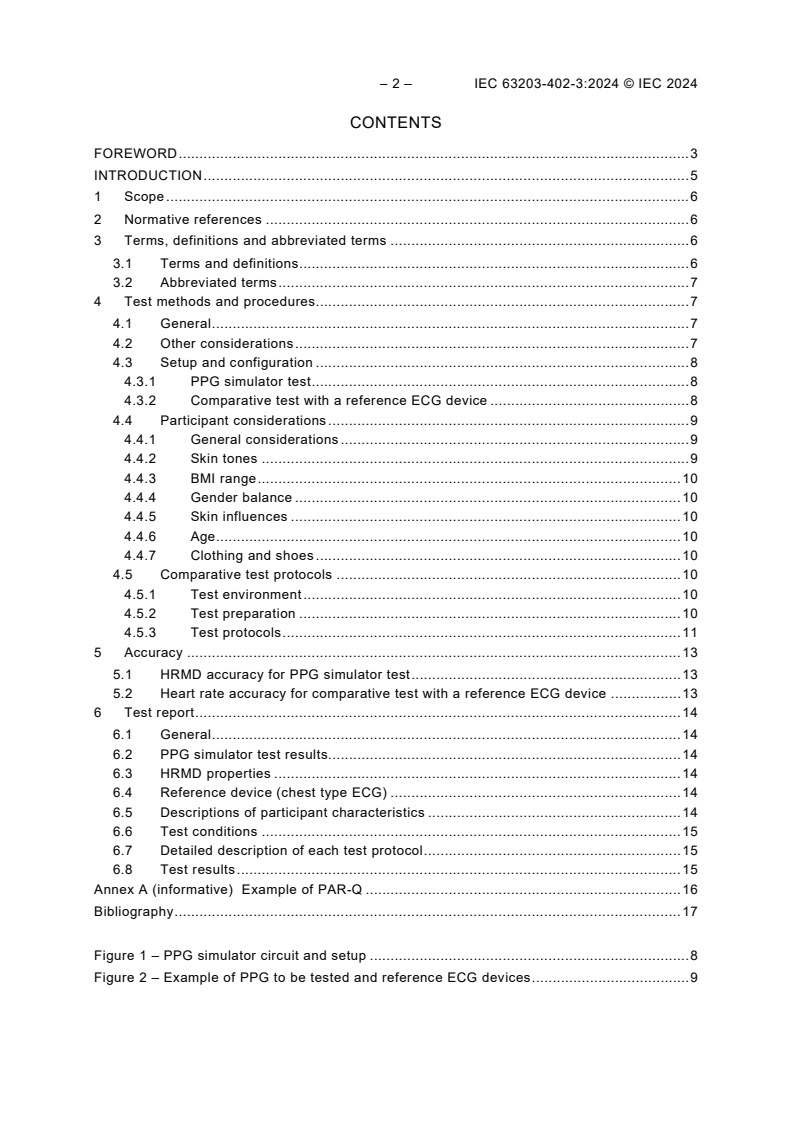
– 2 – IEC 63203-402-3:2024 © IEC 2024
CONTENTS
FOREWORD . 3
INTRODUCTION . 5
1 Scope . 6
2 Normative references . 6
3 Terms, definitions and abbreviated terms . 6
3.1 Terms and definitions . 6
3.2 Abbreviated terms . 7
4 Test methods and procedures. 7
4.1 General . 7
4.2 Other considerations . 7
4.3 Setup and configuration . 8
4.3.1 PPG simulator test . 8
4.3.2 Comparative test with a reference ECG device . 8
4.4 Participant considerations . 9
4.4.1 General considerations . 9
4.4.2 Skin tones . 9
4.4.3 BMI range . 10
4.4.4 Gender balance . 10
4.4.5 Skin influences . 10
4.4.6 Age . 10
4.4.7 Clothing and shoes . 10
4.5 Comparative test protocols . 10
4.5.1 Test environment . 10
4.5.2 Test preparation . 10
4.5.3 Test protocols . 11
5 Accuracy . 13
5.1 HRMD accuracy for PPG simulator test . 13
5.2 Heart rate accuracy for comparative test with a reference ECG device . 13
6 Test report . 14
6.1 General . 14
6.2 PPG simulator test results. 14
6.3 HRMD properties . 14
6.4 Reference device (chest type ECG) . 14
6.5 Descriptions of participant characteristics . 14
6.6 Test conditions . 15
6.7 Detailed description of each test protocol . 15
6.8 Test results . 15
Annex A (informative) Example of PAR-Q . 16
Bibliography . 17
Figure 1 – PPG simulator circuit and setup . 8
Figure 2 – Example of PPG to be tested and reference ECG devices . 9
INTERNATIONAL ELECTROTECHNICAL COMMISSION
____________
WEARABLE ELECTRONIC DEVICES AND TECHNOLOGIES –
Part 402-3: Performance measurement of fitness wearables –
Test methods for the determination of the accuracy of heart rate
FOREWORD
1) The International Electrotechnical Commission (IEC) is a worldwide organization for standardization comprising
all national electrotechnical committees (IEC National Committees). The object of IEC is to promote international
co-operation on all questions concerning standardization in the electrical and electronic fields. To this end and
in addition to other activities, IEC publishes International Standards, Technical Specifications, Technical Reports,
Publicly Available Specifications (PAS) and Guides (hereafter referred to as “IEC Publication(s)”). Their
preparation is entrusted to technical committees; any IEC National Committee interested in the subject dealt with
may participate in this preparatory work. International, governmental and non-governmental organizations liaising
with the IEC also participate in this preparation. IEC collaborates closely with the International Organization for
Standardization (ISO) in accordance with conditions determined by agreement between the two organizations.
2) The formal decisions or agreements of IEC on technical matters express, as nearly as possible, an international
consensus of opinion on the relevant subjects since each technical committee has representation from all
interested IEC National Committees.
3) IEC Publications have the form of recommendations for international use and are accepted by IEC National
Committees in that sense. While all reasonable efforts are made to ensure that the technical content of IEC
Publications is accurate, IEC cannot be held responsible for the way in which they are used or for any
misinterpretation by any end user.
4) In order to promote international uniformity, IEC National Committees undertake to apply IEC Publications
transparently to the maximum extent possible in their national and regional publications. Any divergence between
any IEC Publication and the corresponding national or regional publication shall be clearly indicated in the latter.
5) IEC itself does not provide any attestation of conformity. Independent certification bodies provide conformity
assessment services and, in some areas, access to IEC marks of conformity. IEC is not responsible for any
services carried out by independent certification bodies.
6) All users should ensure that they have the latest edition of this publication.
7) No liability shall attach to IEC or its directors, employees, servants or agents including individual experts and
members of its technical committees and IEC National Committees for any personal injury, property damage or
other damage of any nature whatsoever, whether direct or indirect, or for costs (including legal fees) and
expenses arising out of the publication, use of, or reliance upon, this IEC Publication or any other IEC
Publications.
8) Attention is drawn to the Normative references cited in this publication. Use of the referenced publications is
indispensable for the correct application of this publication.
9) IEC draws attention to the possibility that the implementation of this document may involve the use of (a)
patent(s). IEC takes no position concerning the evidence, validity or applicability of any claimed patent rights in
respect thereof. As of the date of publication of this document, IEC had not received notice of (a) patent(s), which
may be required to implement this document. However, implementers are cautioned that this may not represent
the latest information, which may be obtained from the patent database available at https://patents.iec.ch. IEC
shall not be held responsible for identifying any or all such patent rights.
IEC 63203-402-3 has been prepared by IEC technical committee 124: Wearable electronic
devices and technologies. It is an International Standard.
The text of this International Standard is based on the following documents:
Draft Report on voting
124/247/FDIS 124/259/RVD
Full information on the voting for its approval can be found in the report on voting indicated in
the above table.
The language used for the development of this International Standard is English.
– 4 – IEC 63203-402-3:2024 © IEC 2024
This document was drafted in accordance with ISO/IEC Directives, Part 2, and developed in
accordance with ISO/IEC Directives, Part 1 and ISO/IEC Directives, IEC Supplement, available
at www.iec.ch/members_experts/refdocs. The main document types developed by IEC are
described in greater detail at www.iec.ch/publications.
A list of all parts in the IEC 63203 series, published under the general title Wearable electronic
devices and technologies, can be found on the IEC website.
The committee has decided that the contents of this document will remain unchanged until the
stability date indicated on the IEC website under webstore.iec.ch in the data related to the
specific document. At this date, the document will be
• reconfirmed,
• withdrawn, or
• revised.
IMPORTANT – The "colour inside" logo on the cover page of this document indicates
that it contains colours which are considered to be useful for the correct understanding
of its contents. Users should therefore print this document using a colour printer.
INTRODUCTION
The intent of this document is to evaluate the accuracy of wearables that measure heart rate
with a photoplethysmogram (PPG) sensor.
Heart rate is a widely used physiological variable that non-invasively assesses the cardiac
autonomic nervous system by measuring changes in the cardiac rhythm through time. Heart
rate can be measured from an electrocardiographic signal (ECG). However, the use of
physiological signals other than ECG to extract heart rate information is common. The term
“pulse rate” has been used in literature to reference heart rate obtained through PPG.
Researchers have been using PPG to extract as much information as possible given its
widespread use in clinical and everyday activities. PPG is a simple, non-invasive, optical
measurement technique used for the detection of blood volume changes in peripheral tissue.
Pulse rate has been treated as a synonym to heart rate and these two terms are often used
interchangeably by manufacturers in describing device features to consumers. However, it is
possible that the relationship or differences between heart rate and pulse rate will not be clear
based on intent. Because some countries and manufacturers can use the term pulse rate rather
than heart rate, the reader is encouraged to clarify preferential term, if the term is being used
as a synonym, and testing expectations.
Heart rate measures the rate of contractions or heartbeats whereas pulse rate measures
changes in blood pressure. For an unhealthy person, these two factors could be different. The
reader is reminded that according to 4.4.1 of this document, test participants are asked to fill
out the Physical Activity Readiness Questionnaire (PAR-Q) to determine their eligibility for the
comparative test. Anyone deemed unhealthy per the PAR-Q will be disqualified from testing.
– 6 – IEC 63203-402-3:2024 © IEC 2024
WEARABLE ELECTRONIC DEVICES AND TECHNOLOGIES –
Part 402-3: Performance measurement of fitness wearables –
Test methods for the determination of the accuracy of heart rate
1 Scope
This part of IEC 63203 specifies terms, a measurement protocol, and a test to evaluate the
accuracy of wearables that measure heart rate with a photoplethysmogram (PPG) sensor. While
this document can be used to measure a variety of different devices claiming to report heart
rate, care will be taken when testing in countries that differentiate between heart rate and pulse
rate. This measurement protocol is not intended to evaluate medical devices associated with
the IEC 60601 series or ISO 80601 series.
2 Normative references
There are no normative references in this document.
3 Terms, definitions and abbreviated terms
3.1 Terms and definitions
For the purposes of this document, the following terms and definitions apply.
ISO and IEC maintain terminology databases for use in standardization at the following
addresses:
• IEC Electropedia: available at https://www.electropedia.org/
• ISO Online browsing platform: available at https://www.iso.org/obp
3.1.1
heart rate
HR
speed of the heartbeat measured by the number of contractions of the heart per unit time
(typically per minute), or frequency of contractions of the ventricles
3.1.2
body mass index
BMI
person’s weight divided by their height in meters squared
Note 1 to entry: It is expressed in kilograms per square meter.
3.1.3
heart rate monitoring device
HRMD
device that captures pulsation signals and calculates the pulse rate at regular intervals
Note 1 to entry: HRMD is used in this document for PPG wearable devices under test only.
3.1.4
plethysmograph
device which produces a plethysmogram
3.1.5
photoplethysmogram
PPG
graphic record of the variation with time of an optically measured volume of blood circulation at
the skin’s surface
3.1.6
pulse rate
PR
increase in arterial pressure that can be felt and measured by a pulse (typically measured per
minute)
Note 1 to entry: Pulse rate is used interchangeably with the term heart rate by many manufacturers describing
features of wearables. However, some countries use the term pulse rate differently than heart rate.
3.2 Abbreviated terms
BMI body mass index
ECG electrocardiogram
HR heart rate
HRMD heart rate monitoring device
LED light emitting diode
MAPE mean absolute percentage error
PPG photoplethysmogram
PR pulse rate
4 Test methods and procedures
4.1 General
A wearable device with heart rate monitoring based on a photoplethysmogram (PPG) is tested
with a PPG simulator at various frequencies A chest type electrocardiogram (ECG) is used for
comparative test. A participant wearing both a PPG wearable device and a chest type ECG
wearable device performs various physical activities including walking, jogging, and running as
well as no physical activity (being sedentary).
4.2 Other considerations
Manufacturers should consider the following factors that can impact testing.
Test conditions:
– variable ambient light (e.g., direct, indirect, and sun or shadow transitions);
– wide ranging temperatures (cold and warm);
– wide range of ambient noises;
– use of clothing that can have the potential to interfere with devices (e.g., tightness,
thickness, or clothing which restricts the ideal wearing of the device);
– body or wrist positions during certain protocols (e.g., for cycling applications: bent wrist or
straight arms);
– position of PPG wearable device on the body;
– electrical interference from outside sources;
– potential for signal loss between the measurement device and data repository (e.g., mobile
app or other).
– 8 – IEC 63203-402-3:2024 © IEC 2024
4.3 Setup and configuration
4.3.1 PPG simulator test
– A PPG simulator is prepared as shown in Figure 1. A light emitting diode (LED) is connected
with a current limiting resistor in series and powered with a function generator. The
wavelength (or colour) of the LED shall match that of the PPG wearable device under test.
The value of the current limiting resistor is determined considering the LED forward voltage
and current found in the LED data sheet. A PPG wearable device manufacturer can use a
commercially available simulator.
– A PPG wearable device is placed over a PPG simulator that is located in a chamber or room
wherein humidity, temperature, and light intensity are measured and recorded.
– By using the function generator, the frequency is configured to 0,5 Hz, 1,0 Hz, 1,5 Hz,
2,0 Hz, 2,5 Hz, 3,0 Hz, and 3,5 Hz, sequentially. At each frequency, a sinusoidal wave
between 0 V and 5 V is supplied to the PPG simulator circuit to make the LED blink.
– Between 5 s to 10 s after the PPG simulator starts to operate at a frequency and the PPG
function of the PPG wearable device is on, the heart rate readout on the PPG wearable
device is recorded for 1 min.
– The accuracy of the PPG wearable device is analysed by comparing the measured heart
rate and the frequency setting in the simulator. Results shall be reported in accordance with
Clause 6.
Key
1 PPG wearable device;
2 jig for the PPG simulator;
3 light emitting diode;
4 current limiting resistor (100 Ω to 500 Ω);
5 function generator (sine wave with 5 V and 2,5 V );
p-p offset
Figure 1 – PPG simulator circuit and setup
4.3.2 Comparative test with a reference ECG device
– A participant wears both a PPG wearable device and a chest type ECG wearable device as
shown in Figure 2 and following the manufacturer’s instruction manual for both the PPG and
ECG wearable devices. The chest type ECG wearable device used as a control device shall
have a certified, approved or verified accuracy as a base reference device for comparison.
– For physical activities, humidity, temperature, and light intensity are measured and recorded
in accordance with Clause 6.
– The participant performs a described physical activity in accordance with the test protocols
defined in 4.5.3.
– While performing the physical activity, the heart rates displayed in the PPG wearable device
under test and the reference ECG device are simultaneously recorded.
– The accuracy in the heart rate measurement of the PPG wearable device is analysed by
comparing the measured heart rates from the PPG wearable device under test and the
reference ECG device.
Key
1 Reference ECG wearable device (a chest belt type as shown in this example is recommended but other types
having an ECG module mounted on the chest can be used).
2 PPG wearable device (wrist type shown but not limited to that type).
Figure 2 – Example of PPG to be tested and reference ECG devices
4.4 Participant considerations
4.4.1 General considerations
Participants shall be in good health, with no medical conditions, especially heart related
diseases. Participants are asked to fill out the Physical Activity Readiness Questionnaire
(PAR-Q) to determine their eligibilities for the comparative test (an example is shown in
Annex A). Testing shall be done with at least 20 participants representative of the
characteristics identified in 4.4.2 to 4.4.7. If the number of participants in the participant test
group is greater than 150 % of this minimum, a good faith effort shall be made to maintain a
similar ratio of participants with the specified characteristics.
4.4.2 Skin tones
Using the Fitzpatrick Scale, at minimum the following number of participants should have skin
tones in the range specified:
– at least 25 % of participants with a lighter skin range (1 to 3 on the Fitzpatrick Scale); and
– at least 25 % of participants with a darker skin range (4 to 6 on the Fitzpatrick Scale).
It is recommended to try and meet the range on the Fitzpatrick Scale but exceptions to the
Fitzpatrick Scale are allowed in some countries and regions.
– 10 – IEC 63203-402-3:2024 © IEC 2024
4.4.3 BMI range
Prior to the test, the height and weight of each participant are measured with light clothing and
without shoes. At a minimum, participants should be within the BMI ranges as follows:
– at least 10 % of participants less than 20 kg/m ; and
– at least 25 % of participants greater than 25 kg/m .
Exceptions to the BMI range are allowed in some countries and regions.
4.4.4 Gender balance
At least 40 % of participants shall be male. At least 40 % of the participants shall be female.
4.4.5 Skin influences
All participants shall have clean skin and no wounds at the location of the skin where sensors
from the HRMD are placed. No participant shall have tattoos or any other applied colouring to
the skin at the location where sensors from the HRMD are placed.
4.4.6 Age
All participants shall be at least 18 years old and physically capable of performing the described
tests. It is recommended that the participant group be age balanced. The participants PAR-Q
shall be used as exclusion criterion.
4.4.7 Clothing and shoes
For the test, all participants shall wear clothing or shoes that will not obstruct the ability to
measure the heart rate. Standard exercise clothing and shoes (e.g., sneakers, hiking shoes,
shorts, sweatpants, yoga pants, t-shirt, sweatshirt) are recommended.
When walking, jogging, or running activities are performed indoor using a treadmill, participants
should maintain minimal interaction with handrails or other support mechanisms and freely
swing their arms in a natural way as they would outdoors. Both indoor and outdoor tests should
be consistent for comparison. For outdoor tests, variability of conditions and light sensitivity of
PPG wearable devices should be considered.
4.5 Comparative test protocols
4.5.1 Test environment
The ambient light levels in the testing area shall consist of typical lighting conditions for indoor
(500 lx to 1 000 lx) and outdoor (10 000 lx) environments. Test conditions should be the same
as much as possible.
The ambient temperature of the testing area should be typical of indoor environments.
4.5.2 Test preparation
Prior to testing, the participant should receive instructions for the test. The instructions should
include the following considerations with respect to the test being conducted.
– The participant should refrain from any movement prior to and following the test protocol.
– The participant should refrain from any external stimuli that could cause deviation from the
test protocol (e.g., tablet, computer, mobile device, book).
– The participant should use natural hand and leg movements during the test session.
– The instructor will describe the duration and characteristics of the test protocol to the
participant. The instructor will inform the participant of the start and completion of the test.
Otherwise, the instructor should refrain from engaging the participant in any way.
– If necessary, only the instructor shall be responsible for changing the speeds on the
treadmill.
– Prior to any test involving a treadmill, the participant should stand with feet on the treadmill
at his or her best and arms to the side of the body. Once the participant achieves a
comfortable start position, the instructor should begin collecting data.
– The instructor will operate the data collection (button pushes) on or from the HRMD and the
reference ECG device to minimize extraneous movement from the participant.
4.5.3 Test protocols
4.5.3.1 General
Test protocols provided below for walking, jogging and running either on a treadmill or on an
athletic field have been separated as the test setup, test conditions, and the protocols are
different. It is not required that a test be conducted on both a treadmill and an athletic field.
However, if a treadmill or an athletic field is chosen as the preferred test protocol for walking,
jogging and running, then the prerequisite and protocol for either the treadmill or the athletic
field shall be followed. If the HRMD has different settings, the test shall be performed with all
settings.
4.5.3.2 Sedentary (no physical activity)
4.5.3.2.1 Prerequisite
The participant shall assume the sedentary position chosen by the test instructor. This can
include sitting on a chair or on the ground, lie supine, or stand, at a chosen posture. The
participant is encouraged to minimize hand and finger movement. The participant shall refrain
from talking during the test.
4.5.3.2.2 Protocol
– 1 min in the chosen sedentary posture;
– 5 min data recording in the chosen sedentary posture;
– after 6 min have elapsed, data collection should end.
4.5.3.3 Walking: Treadmill
4.5.3.3.1 Prerequisite
The walking activity is performed indoor using a treadmill. The speed should be a comfortable
pace, between 1,1 m/s to 1,8 m/s. The incline should be minimal but not less than 0 %.
4.5.3.3.2 Protocol
– 1 min of standing still on the treadmill;
– 5 min of walking on the treadmill:
At the start and end of the 5 min of walking, the test instructor shall change the speed from
zero to the chosen speed, then the chosen speed to zero, while the participant remains on
the treadmill belt. During this transition, the participant should continue to move in a natural
manner with minimal interaction of handrails or other support mechanisms;
– 1 min of standing still on the treadmill;
– after 7 min have elapsed, data collection should end.
– 12 – IEC 63203-402-3:2024 © IEC 2024
4.5.3.4 Walking: Athletic field
4.5.3.4.1 Prerequisite
The walking activity is performed outdoors on an athletic field or track. The cumulative distance
during the activity is used to give the average speed. All participants involved in a test
performed on an athletic field shall use the same athletic field for testing.
4.5.3.4.2 Protocol
– 1 min of standing still on the athletic field;
– 5 min of walking on the athletic field at a comfortable pace;
– 1 min of standing still on the athletic field;
– after 7 min have elapsed, data collection should end.
4.5.3.5 Jogging: Treadmill
4.5.3.5.1 Prerequisite
The jogging activity is performed indoor using a treadmill. The speed should be a comfortable
pace for jogging, between 2,2 m/s to 5,41 m/s, based on a participant’s physical readiness. The
incline should be minimal but not less than 0 %.
4.5.3.5.2 Protocol
– 1 min of standing still on the treadmill;
– 5 min of jogging on the treadmill:
At the start and end of the 5 min of jogging, the test instructor shall change the speed from
zero to the chosen speed, then the chosen speed to zero, while the participant remains on
the treadmill belt. During this transition, the participant should continue to move in a natural
manner with minimal interaction of handrails or other support mechanisms;
– 1 min of standing still on the treadmill;
– after 7 min have elapsed, data collection should end.
4.5.3.6 Jogging: Athletic field
4.5.3.6.1 Prerequisite
The jogging activity is performed outdoors on an athletic field or track. The cumulative distance
during the activity is used to give the average speed. All participants involved in a test
performed on an athletic field shall use the same athletic field for testing.
4.5.3.6.2 Protocol
– 1 min of standing still on the athletic field;
– 5 min of jogging on the athletic field at a comfortable pace;
– 1 min of standing still on the athletic field;
– after 7 min have elapsed, data collection should end.
4.5.3.7 Running: Treadmill
4.5.3.7.1 Prerequisite
The running activity is performed indoor using a treadmill. The speed should be a comfortable
pace for running, between 2,2 m/s to 5,41 m/s, based on a participant’s physical readiness. A
running pace should be a more vigorous intensity than jogging. The incline should be minimal
but not less than 0 %.
4.5.3.7.2 Protocol
– 1 min of standing still on the treadmill;
– 5 min of running on the treadmill:
At the start and end of the 5 min of running, the test instructor shall change the speed from
zero to the chosen speed, then the chosen speed to zero, while the participant remains on
the treadmill belt. During this transition, the participant should continue to move in a natural
manner with minimal interaction of handrails or other support mechanisms;
– 1 min of standing still on the treadmill;
– after 7 min have elapsed, data collection should end.
4.5.3.8 Running: Athletic field
4.5.3.8.1 Prerequisite
The running activity is performed outdoors on an athletic field or track. The cumulative distance
during the activity is used to give the average speed. All participants involved in a test
performed on an athletic field shall use the same athletic field for testing.
4.5.3.8.2 Protocol
– 1 min of standing still on the athletic field;
– 5 min of running on the athletic field at a comfortable pace, but of a more vigorous intensity
than jogging;
– 1 min of standing still on the athletic field;
– after 7 min have elapsed, data collection should end.
5 Accuracy
5.1 HRMD accuracy for PPG simulator test
The accuracy of the PPG wearable device under test is represented with the mean absolute
percentage error (MAPE) by using Formula (1). A MAPE of less than ± 10 % is necessary to
successfully pass the test.
n
100 hf− 60×
i s
E ×
(1)
MAP ∑
n 60× f
s
i=1
where
E is the mean absolute percentage error (MAPE);
MAP
n is the total iteration number of the PPG simulation;
h is the heart rate readout from the HRMD, expressed in count per minute (/min);
i
f is the frequency setting in the PPG simulator, expressed in hertz (Hz).
s
5.2 Heart rate accuracy for comparative test with a reference ECG device
The accuracy in the heart rate measurement of the PPG wearable device under test is
represented with the mean absolute percentage error (MAPE) by using Formula (2). A MAPE
of less than ± 10 % is necessary to successfully pass the test.
=
– 14 – IEC 63203-402-3:2024 © IEC 2024
n
hh−
iir,
E ×
(2)
MAP ∑
nh
r,i
i=1
where
i is the time index of each measurement pooled across participants;
n is the total number of time points pooled across participants;
h is the heart rate readout from the reference ECG device, expressed in count per minute
r,i
(/min).
If an abnormal value including “dash”, “zero” or “other characters” is found, the test should be
retried or the data should be excluded for the MAPE calculation.
6 Test report
6.1 General
The test report shall include the following test results.
6.2 PPG simulator test results
1) Mean and standard deviation of the heart rate for the PPG simulator test.
2) Accuracy of the PPG wearable device from the PPG simulator test (MAPE values).
3) Mean and standard deviation of the heart rate measured with the PPG wearable device for
each physical activity.
6.3 HRMD properties
1) Manufacturer.
2) Model number.
3) Firmware version.
4) Update rate.
5) Sensitivity setting.
6.4 Reference device (chest type ECG)
1) Manufacturer.
2) Model number.
3) Firmware version.
4) Update rate.
5) Sensitivity setting.
6.5 Descriptions of participant characteristics
1) Gender.
2) Age.
3) Weight.
4) Height.
5) BMI.
6) Skin tone based on the Fitzpatrick Scale.
7) Artifacts or other salient features (any factor that could impact testing such as tattoos,
birthmarks, freckles, burns, etc.).
=
8) Indication that the PAR-Q was completed (Y/N). Participants who do not completely pass
the PAR-Q shall be excluded in the test results.
6.6 Test conditions
1) Humidity.
2) Temperature.
3) Light intensity.
6.7 Detailed description of each test protocol
1) Equipment used for each test condition, if any.
2) Participant activity within each test condition (sedentary, walking, running, etc.).
3) Setting of testing equipment (e.g., incline and speed of treadmill).
4) If the HRMD has multiple wearability settings (for example a strap with multiple holes to
vary tightness on an HRMD) a description of how the HRMD was properly fitted to the
participants under test should be included. The HRMD device shall be worn in accordance
with the manufacturer’s instructions.
5) Treadmill manufacturer and model number, speed, slope (if applicable).
6) Athletic field cumulative distance, average speed (if applicable).
7) Clothing of each participant.
6.8 Test results
1) Data output from both the HRMD and reference ECG device.
2) Description and justification of any data excluded from the analysis.
3) Mean and standard deviation of HR for each participant from the HRMD.
4) Mean and standard deviation of HR for each participant from the reference ECG device.
5) Mean and standard deviation of HR for all participants.
6) Percent of data availability for each participant from the HRMD.
7) Percent of data availability for all participants from the HRMD.
8) MAPE for each test protocol.
– 16 – IEC 63203-402-3:2024 © IEC 2024
Annex A
(informative)
Example of PAR-Q
Data Collection Sheet
NAME: __________________________ DATE: ___________
Height: ___________ cm, Weight: ____________ kg, Age: ___________
Investigator Name: _________________ Phone: _________________
PHYSICAL ACTIVITY READINESS QUESTIONNAIRE (PAR-Q)
Questions Yes No
1 Has your doctor ever diagnosed a heart condition and indicated that you should only
perform physical activity recommended by a doctor?
2 Do you feel pain in your chest when you perform a physical activity?
3 In the past month, have you had chest pain when you were not performing any physical
activity?
4 Do you lose your balance because of dizziness or have you ever lost consciousness?
5 Do you have a bone or joint problem that could be made worse by a change in your
physical activity?
6 Is your doctor currently prescribing any medication for your blood pressure or for a heart
condition?
7 Do you know of any other reason why you should not engage in physical activity?
Bibliography
IEC 60601 (all parts), Medical electrical equipment
ISO 80601 (all parts), Medical electrical equipment
ANSI/CTA-2065 Physical Activity Monitoring for Heart Rate
Brage, S., Brage, N., Franks, P. W., Ekelund, U., and Wareham, N. J., “Reliability and validity
of the combined heart rate and movement sensor Actiheart”, European Journal of Clinical
Nutrition, 59, 561-570 (2005)
Garber, C. E., Blissmer, B., Deschenes, M. R., Franklin, B. A., Lamonte, M. J., Lee, I., Nieman,
D. C., &Swain, D. P. (2011). Quantity and Quality of Exercise for Developing and Maintaining
Cardiorespiratory, Musculoskeletal, and Neuromotor Fitness in Apparently Healthy Adults:
Guidance for Prescribing Exercise. 43 (7), 1334-1359.: July 2011 – Volume 43 – Issue 7 – pp
1334-1359. http://journals.lww.com/acsm-
msse/Fulltext/2011/07000/Quantity_and_Quality_of_Exercise_for_Developing.26.aspx
Fitzpatrick Scale: Fitzpatrick, T. B. (1975). "Soleil et peau" [Sun and skin]. Journal de Médecine
Esthétique (in French) 2, 33–34
Physical activity readiness questionnaire (Par-Q): Thomas, S., Reading, J., Shephard, R.J.,
(1992). Revision of the Physical Activity Readiness Questionnaire (PAR-Q). Can J Sport Sci.,
17(4), 338-45
Stahl, S. E., An, H., Dinkel, D. M., Noble, J. M., and Lee, J., “How accurate the wrist-based
heart rate monitors during walking and running activities? Are they accurate enough?”, BMJ
Open Sport & Exercise Medicine, 2:e000106, doi: 10.1136/bmjsem-2015-000106 (2016)
Wallot, S., Fusaroli, R., Tylen, K., and Jegindo, E., “Using complexity metrics with R-R intervals
and BPM heart rate measures”, Frontiers in Physiology, 4, 211, doi: 10.3389/fphys.2013.00211
(2013)
World Health Organization. What is Moderate-intensity and Vigorous-intensity Physical Activity?
Retrieved from http://www.who.int/dietphysicalactivity/physical_activity_intensity/en/
___________
– 18 – IEC 63203-402-3:2024 © IEC 2024
SOMMAIRE
AVANT-PROPOS . 19
INTRODUCTION . 21
1 Domaine d'application . 22
2 Références normatives . 22
3 Termes, définitions et abréviations . 22
3.1 Termes et définitions . 22
3.2 Abréviations .
...