

IEC 62541-8:2025
(Main)OPC unified architecture - Part 8: Data access
General Information
- Abstract
IEC 62541-8:2025 defines the information model associated with Data Access (DA). It particularly includes additional VariableTypes and complementary descriptions of the NodeClasses and Attributes needed for Data Access, additional Properties, and other information and behaviour. The complete address space model, including all NodeClasses and Attributes is specified in IEC 62541‑3. The services to detect and access data are specified in IEC 62541‑4. Annex A specifies how the information received from OPC COM Data Access (DA) Servers is mapped to the Data Access model. This fourth edition cancels and replaces the third edition published in 2020. This edition constitutes a technical revision.
This edition includes the following significant technical changes with respect to the previous edition:
a) addition of a "Quantity Model" which can be referenced from EngineeringUnit Properties. The model defines quantities and assigned units. In addition it provides alternative units and the conversion to them.
b) addition of rules for ValuePrecision Property:
- can also be used for other subtypes like Duration and Decimal.
- rules have been added when ValuePrecision has negative values.
- Status
- Published
- Publication Date
- 11-Jan-2026
- Technical Committee
- SC 65E - Devices and integration in enterprise systems
- Drafting Committee
- WG 8 - TC 65/SC 65E/WG 8
- Current Stage
- PPUB - Publication issued
- Start Date
- 23-Dec-2025
- Completion Date
- 10-Dec-2025
Buy Documents
IEC 62541-8:2025 - OPC unified architecture - Part 8: Data access Released:12/23/2025
IEC 62541-8:2026 RLV - OPC unified architecture - Part 8: Data access Released:1/12/2026
IEC 62541-8:2025 - Architecture unifiée OPC - Partie 8: Acces aux données Released:12/23/2025
IEC 62541-8:2025 - OPC unified architecture - Part 8: Data access Released:12/23/2025
Overview
IEC 62541-8:2025 - "OPC unified architecture - Part 8: Data access" defines the information model for OPC UA Data Access (DA). It specifies additional VariableTypes, Properties, NodeClass/Attribute descriptions and behavior needed to represent real-time automation data in an OPC UA address space. This fourth edition (2025) is a technical revision that adds a Quantity Model for engineering units and extends rules for the ValuePrecision property. Annex A provides normative guidance for mapping legacy OPC COM DA servers to the OPC UA DA model.
Key topics and technical requirements
- DataItem and VariableTypes: Detailed VariableType hierarchy for DataItemType, AnalogItem, DiscreteItem, ArrayItem (including XY/Y arrays, image and N-dimensional arrays), and related subtypes used to expose measured and calculated values.
- Attributes & Properties: Definitions and semantics for DA-specific Attributes (e.g., EUInformation, Range, ValuePrecision, PercentDeadband) and how they affect read/write and subscription behavior.
- Quantities and Units model: New reusable QuantityType/UnitType model that can be referenced from EngineeringUnit properties. Supports alternative units and conversions (including MathML examples and external syntax references like UCUM/QUDT).
- ValuePrecision rules: Expanded usage to additional data subtypes (Duration, Decimal) and clarified behavior for negative precision values.
- DataTypes: Structures such as Range, EUInformation, ComplexNumber/DoubleComplexNumber, AxisInformation, XVType for advanced numeric and multi-axis data.
- Service usage & status codes: Guidance for percent deadband, DA-specific status codes and limit bits to support efficient subscriptions and reliable operation.
- OPC COM DA mapping: Normative Annex A describing information model, data/error mapping and wrapper/proxy patterns for interoperability with legacy OPC COM DA systems.
Applications and users
IEC 62541-8:2025 is essential for:
- OPC UA server implementers (industrial device vendors, PLC/RTU suppliers) exposing process and telemetry data.
- OPC UA client developers (SCADA/HMI, historian, analytics, IIoT platforms) consuming DA data.
- System integrators and automation engineers designing interoperable control systems.
- Software architects and test labs validating DA behavior, unit conversions, and legacy OPC COM DA migration. Practical benefits include interoperable real-time data exchange, consistent engineering unit handling, deterministic precision semantics, and straightforward migration paths from OPC COM DA.
Related standards
- IEC 62541-3 - Address Space Model (complete NodeClasses & Attributes)
- IEC 62541-4 - Services (discovery, read/write, subscriptions)
- OPC COM DA - legacy mapping covered in Annex A
- UCUM/QUDT syntax references included for unit semantics
Keywords: IEC 62541-8:2025, OPC UA Data Access, OPC Unified Architecture, Quantity Model, ValuePrecision, EUInformation, OPC COM DA to UA mapping, engineering units, industrial interoperability.
Relations
- Effective Date
- 05-Sep-2023
Buy Documents
IEC 62541-8:2025 - OPC unified architecture - Part 8: Data access Released:12/23/2025
IEC 62541-8:2026 RLV - OPC unified architecture - Part 8: Data access Released:1/12/2026
IEC 62541-8:2025 - Architecture unifiée OPC - Partie 8: Acces aux données Released:12/23/2025
IEC 62541-8:2025 - OPC unified architecture - Part 8: Data access Released:12/23/2025
Get Certified
Connect with accredited certification bodies for this standard

BSI Group
BSI (British Standards Institution) is the business standards company that helps organizations make excellence a habit.

DVS-ZERT GmbH
German welding certification society.
CARES (UK Certification Authority for Reinforcing Steels)
UK certification for reinforcing steels and construction.
Sponsored listings
Frequently Asked Questions
IEC 62541-8:2025 is a standard published by the International Electrotechnical Commission (IEC). Its full title is "OPC unified architecture - Part 8: Data access". This standard covers: IEC 62541-8:2025 defines the information model associated with Data Access (DA). It particularly includes additional VariableTypes and complementary descriptions of the NodeClasses and Attributes needed for Data Access, additional Properties, and other information and behaviour. The complete address space model, including all NodeClasses and Attributes is specified in IEC 62541‑3. The services to detect and access data are specified in IEC 62541‑4. Annex A specifies how the information received from OPC COM Data Access (DA) Servers is mapped to the Data Access model. This fourth edition cancels and replaces the third edition published in 2020. This edition constitutes a technical revision. This edition includes the following significant technical changes with respect to the previous edition: a) addition of a "Quantity Model" which can be referenced from EngineeringUnit Properties. The model defines quantities and assigned units. In addition it provides alternative units and the conversion to them. b) addition of rules for ValuePrecision Property: - can also be used for other subtypes like Duration and Decimal. - rules have been added when ValuePrecision has negative values.
IEC 62541-8:2025 defines the information model associated with Data Access (DA). It particularly includes additional VariableTypes and complementary descriptions of the NodeClasses and Attributes needed for Data Access, additional Properties, and other information and behaviour. The complete address space model, including all NodeClasses and Attributes is specified in IEC 62541‑3. The services to detect and access data are specified in IEC 62541‑4. Annex A specifies how the information received from OPC COM Data Access (DA) Servers is mapped to the Data Access model. This fourth edition cancels and replaces the third edition published in 2020. This edition constitutes a technical revision. This edition includes the following significant technical changes with respect to the previous edition: a) addition of a "Quantity Model" which can be referenced from EngineeringUnit Properties. The model defines quantities and assigned units. In addition it provides alternative units and the conversion to them. b) addition of rules for ValuePrecision Property: - can also be used for other subtypes like Duration and Decimal. - rules have been added when ValuePrecision has negative values.
IEC 62541-8:2025 is classified under the following ICS (International Classification for Standards) categories: 25.040.40 - Industrial process measurement and control; 35.100.05 - Multilayer applications. The ICS classification helps identify the subject area and facilitates finding related standards.
IEC 62541-8:2025 has the following relationships with other standards: It is inter standard links to IEC 62541-8:2020. Understanding these relationships helps ensure you are using the most current and applicable version of the standard.
IEC 62541-8:2025 is available in PDF format for immediate download after purchase. The document can be added to your cart and obtained through the secure checkout process. Digital delivery ensures instant access to the complete standard document.
Standards Content (Sample)
IEC 62541-8 ®
Edition 4.0 2025-12
INTERNATIONAL
STANDARD
OPC unified architecture -
Part 8: Data access
ICS 25.040.40; 35.100.05 ISBN 978-2-8327-0849-1
All rights reserved. Unless otherwise specified, no part of this publication may be reproduced or utilized in any form or
by any means, electronic or mechanical, including photocopying and microfilm, without permission in writing from either
IEC or IEC's member National Committee in the country of the requester. If you have any questions about IEC copyright
or have an enquiry about obtaining additional rights to this publication, please contact the address below or your local
IEC member National Committee for further information.
IEC Secretariat Tel.: +41 22 919 02 11
3, rue de Varembé info@iec.ch
CH-1211 Geneva 20 www.iec.ch
Switzerland
About the IEC
The International Electrotechnical Commission (IEC) is the leading global organization that prepares and publishes
International Standards for all electrical, electronic and related technologies.
About IEC publications
The technical content of IEC publications is kept under constant review by the IEC. Please make sure that you have the
latest edition, a corrigendum or an amendment might have been published.
IEC publications search - IEC Products & Services Portal - products.iec.ch
webstore.iec.ch/advsearchform Discover our powerful search engine and read freely all the
The advanced search enables to find IEC publications by a publications previews, graphical symbols and the glossary.
variety of criteria (reference number, text, technical With a subscription you will always have access to up to date
committee, …). It also gives information on projects, content tailored to your needs.
replaced and withdrawn publications.
Electropedia - www.electropedia.org
The world's leading online dictionary on electrotechnology,
IEC Just Published - webstore.iec.ch/justpublished
Stay up to date on all new IEC publications. Just Published containing more than 22 500 terminological entries in English
details all new publications released. Available online and and French, with equivalent terms in 25 additional languages.
once a month by email. Also known as the International Electrotechnical Vocabulary
(IEV) online.
IEC Customer Service Centre - webstore.iec.ch/csc
If you wish to give us your feedback on this publication or
need further assistance, please contact the Customer
Service Centre: sales@iec.ch.
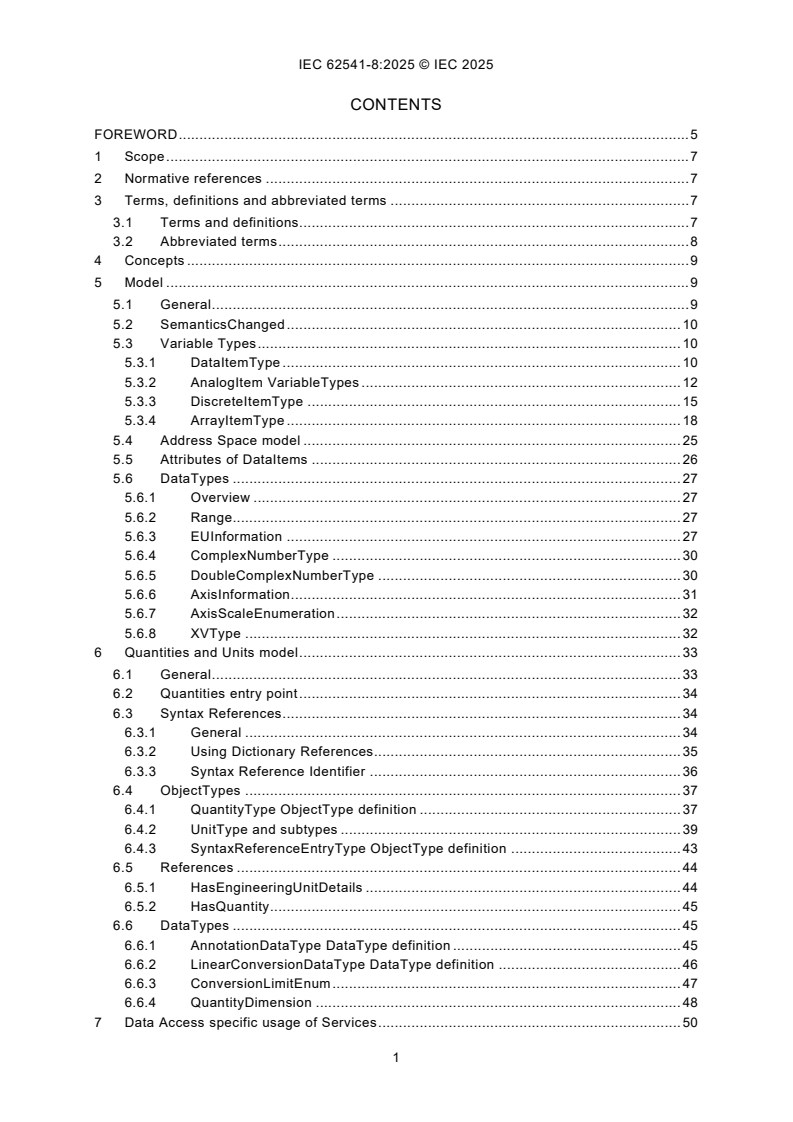
CONTENTS
FOREWORD . 5
1 Scope . 7
2 Normative references . 7
3 Terms, definitions and abbreviated terms . 7
3.1 Terms and definitions. 7
3.2 Abbreviated terms . 8
4 Concepts . 9
5 Model . 9
5.1 General . 9
5.2 SemanticsChanged . 10
5.3 Variable Types . 10
5.3.1 DataItemType . 10
5.3.2 AnalogItem VariableTypes . 12
5.3.3 DiscreteItemType . 15
5.3.4 ArrayItemType . 18
5.4 Address Space model . 25
5.5 Attributes of DataItems . 26
5.6 DataTypes . 27
5.6.1 Overview . 27
5.6.2 Range. 27
5.6.3 EUInformation . 27
5.6.4 ComplexNumberType . 30
5.6.5 DoubleComplexNumberType . 30
5.6.6 AxisInformation . 31
5.6.7 AxisScaleEnumeration . 32
5.6.8 XVType . 32
6 Quantities and Units model . 33
6.1 General . 33
6.2 Quantities entry point . 34
6.3 Syntax References . 34
6.3.1 General . 34
6.3.2 Using Dictionary References. 35
6.3.3 Syntax Reference Identifier . 36
6.4 ObjectTypes . 37
6.4.1 QuantityType ObjectType definition . 37
6.4.2 UnitType and subtypes . 39
6.4.3 SyntaxReferenceEntryType ObjectType definition . 43
6.5 References . 44
6.5.1 HasEngineeringUnitDetails . 44
6.5.2 HasQuantity . 45
6.6 DataTypes . 45
6.6.1 AnnotationDataType DataType definition . 45
6.6.2 LinearConversionDataType DataType definition . 46
6.6.3 ConversionLimitEnum . 47
6.6.4 QuantityDimension . 48
7 Data Access specific usage of Services . 50
7.1 General . 50
7.2 PercentDeadband . 50
7.3 Data Access status codes . 51
7.3.1 Overview . 51
7.3.2 Operation level result codes . 51
7.3.3 LimitBits . 52
Annex A (normative) OPC COM DA to UA mapping . 53
A.1 Introduction . 53
A.2 Security Considerations . 53
A.3 COM UA wrapper for OPC DA Server . 53
A.3.1 Information Model mapping . 53
A.3.2 Data and error mapping . 58
A.3.3 Read data . 60
A.3.4 Write Data . 61
A.3.5 Subscriptions . 62
A.4 COM UA proxy for DA Client . 62
A.4.1 Guidelines . 62
A.4.2 Information Model and Address Space mapping . 63
A.4.3 Data and error mapping . 67
A.4.4 Read data . 70
A.4.5 Write data . 71
A.4.6 Subscriptions . 72
Annex B (normative) UCUM Symbols . 73
B.1 Introduction – License . 73
B.2 Representation . 73
B.3 Tables of terminal symbols . 74
B.3.1 General . 74
B.3.2 Prefixes . 74
B.3.3 Base units . 75
B.3.4 Derived unit atoms . 76
B.3.5 Customary unit atoms . 79
B.3.6 Other legacy units . 83
Annex C (informative) Outline of syntax references . 88
C.1 UCUM syntax reference . 88
C.2 QUDT syntax reference. 88
C.3 UNECE syntax reference . 89
C.4 IEC CDD Syntax Reference . 90
C.5 LATEX_SIUNITX Syntax Reference . 91
Bibliography . 92
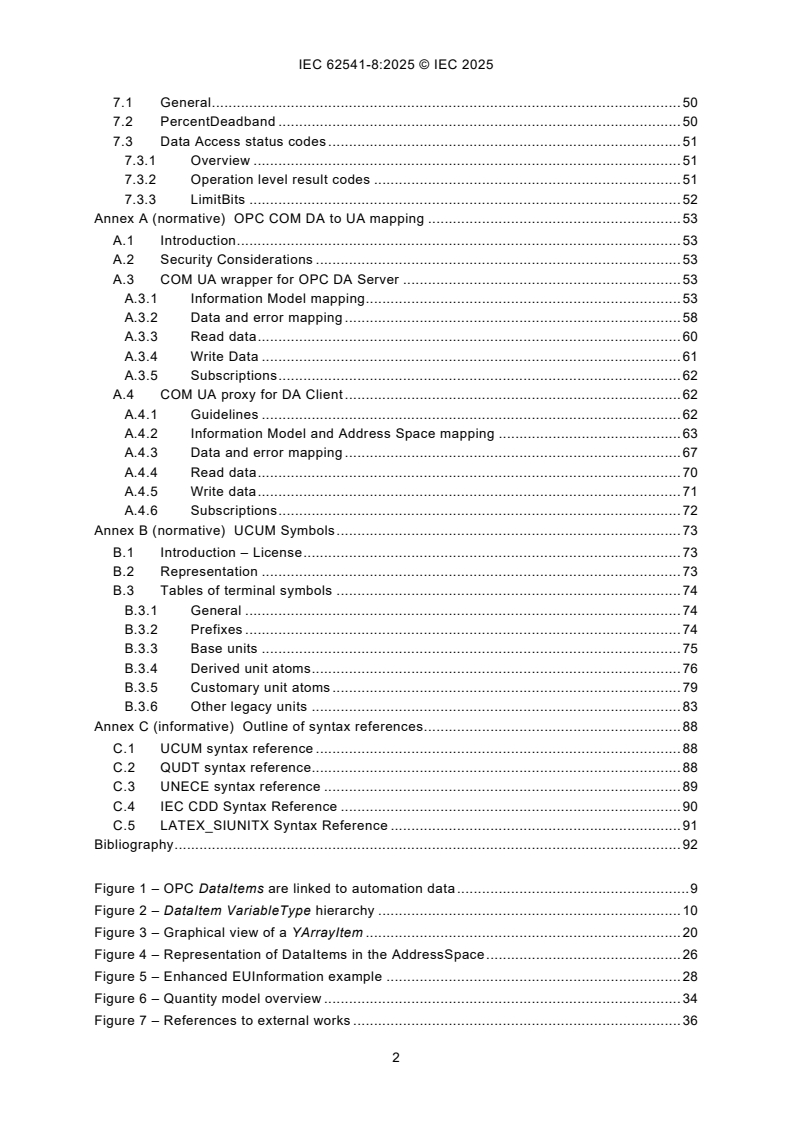
Figure 1 – OPC DataItems are linked to automation data . 9
Figure 2 – DataItem VariableType hierarchy . 10
Figure 3 – Graphical view of a YArrayItem . 20
Figure 4 – Representation of DataItems in the AddressSpace . 26
Figure 5 – Enhanced EUInformation example . 28
Figure 6 – Quantity model overview . 34
Figure 7 – References to external works . 36
Figure 8 – QuantityType . 37
Figure 9 – Units model . 39
Figure 10 – MathML example linear conversion . 43
Figure 11 – MathML example inverse linear conversion . 43
Figure A.1 – Sample OPC UA Information Model for OPC DA . 54
Figure A.2 – OPC COM DA to OPC UA data and error mapping . 58
Figure A.3 – Status Code mapping . 59
Figure A.4 – Sample OPC DA mapping of OPC UA Information Model and Address
Space . 64
Figure A.5 – OPC UA to OPC DA data & error mapping . 68
Figure A.6 – OPC UA Status Code to OPC DA quality mapping . 69
Table 1 – DataItemType definition . 11
Table 2 – BaseAnalogType definition . 12
Table 3 – AnalogItemType definition . 14
Table 4 – AnalogUnitType definition. 14
Table 5 – AnalogUnitRangeType definition . 15
Table 6 – DiscreteItemType definition . 15
Table 7 – TwoStateDiscreteType definition . 16
Table 8 – MultiStateDiscreteType definition . 16
Table 9 – MultiStateValueDiscreteType definition . 17
Table 10 – ArrayItemType definition. 18
Table 11 – YArrayItemType definition . 19
Table 12 – YArrayItem item description . 21
Table 13 – XYArrayItemType definition . 22
Table 14 – ImageItemType definition . 23
Table 15 – CubeItemType definition . 24
Table 16 – NDimensionArrayItemType definition . 25
Table 17 – Range DataType structure . 27
Table 18 – Range definition . 27
Table 19 – EUInformation DataType structure . 28
Table 20 – EUInformation definition . 29
Table 21 – Examples from the UNECE Recommendation . 29
Table 22 – ComplexNumberType DataType structure . 30
Table 23 – ComplexNumberType definition . 30
Table 24 – DoubleComplexNumberType DataType structure. 31
Table 25 – DoubleComplexNumberType definition . 31
Table 26 – AxisInformation DataType structure . 31
Table 27 – AxisInformation definition . 32
Table 28 – AxisScaleEnumeration values . 32
Table 29 – AxisScaleEnumeration definition . 32
Table 30 – XVType DataType structure . 33
Table 31 – XVType definition . 33
Table 32 – Quantities definition . 34
Table 33 – List of Syntax References . 35
Table 34 – Definition of NodeId for instances of the SyntaxReferenceEntryType . 35
Table 35 – List of Syntax Reference Identifiers . 36
Table 36 – QuantityType definition . 38
Table 37 – QuantityType Additional Subcomponents. 39
Table 38 – UnitType definition . 40
Table 39 – Non-exhaustive list of well-known systems of units . 40
Table 40 – ServerUnitType definition . 41
Table 41 – ServerUnitType Additional Subcomponents . 41
Table 42 – AlternativeUnitType definition . 42
Table 43 – SyntaxReferenceEntryType Definition . 44
Table 44 – HasEngineeringUnitDetails definition . 44
Table 45 – HasQuantity definition . 45
Table 46 – AnnotationDataType Structure . 45
Table 47 – AnnotationDataType examples . 46
Table 48 – AnnotationDataType definition . 46
Table 49 – LinearConversionDataType Structure . 47
Table 50 – LinearConversionDataType Definition . 47
Table 51 – ConversionLimitEnum Items . 47
Table 52 – ConversionLimitEnum Definition . 48
Table 53 – QuantityDimension DataType structure. 48
Table 54 – QuantityDimension definition . 49
Table 55 – QuantityDimension examples . 49
Table 56 – Operation level result codes for BAD data quality . 51
Table 57 – Operation level result codes for UNCERTAIN data quality . 52
Table 58 – Operation level result codes for GOOD data quality . 52
Table A.1 – OPC COM DA to OPC UA Properties mapping . 57
Table A.2 – DataTypes and mapping . 59
Table A.3 – Quality mapping . 60
Table A.4 – OPC DA Read error mapping . 61
Table A.5 – OPC DA Write error code mapping . 62
Table A.6 – DataTypes and Mapping . 69
Table A.7 – Quality mapping . 70
Table A.8 – OPC UA Read error mapping . 71
Table A.9 – OPC UA Write error code mapping . 71
INTERNATIONAL ELECTROTECHNICAL COMMISSION
____________
OPC unified architecture -
Part 8: Data access
FOREWORD
1) The International Electrotechnical Commission (IEC) is a worldwide organization for standardization comprising
all national electrotechnical committees (IEC National Committees). The object of IEC is to promote international
co-operation on all questions concerning standardization in the electrical and electronic fields. To this end and
in addition to other activities, IEC publishes International Standards, Technical Specifications, Technical Reports,
Publicly Available Specifications (PAS) and Guides (hereafter referred to as "IEC Publication(s)"). Their
preparation is entrusted to technical committees; any IEC National Committee interested in the subject dealt with
may participate in this preparatory work. International, governmental and non-governmental organizations liaising
with the IEC also participate in this preparation. IEC collaborates closely with the International Organization for
Standardization (ISO) in accordance with conditions determined by agreement between the two organizations.
2) The formal decisions or agreements of IEC on technical matters express, as nearly as possible, an international
consensus of opinion on the relevant subjects since each technical committee has representation from all
interested IEC National Committees.
3) IEC Publications have the form of recommendations for international use and are accepted by IEC National
Committees in that sense. While all reasonable efforts are made to ensure that the technical content of IEC
Publications is accurate, IEC cannot be held responsible for the way in which they are used or for any
misinterpretation by any end user.
4) In order to promote international uniformity, IEC National Committees undertake to apply IEC Publications
transparently to the maximum extent possible in their national and regional publications. Any divergence between
any IEC Publication and the corresponding national or regional publication shall be clearly indicated in the latter.
5) IEC itself does not provide any attestation of conformity. Independent certification bodies provide conformity
assessment services and, in some areas, access to IEC marks of conformity. IEC is not responsible for any
services carried out by independent certification bodies.
6) All users should ensure that they have the latest edition of this publication.
7) No liability shall attach to IEC or its directors, employees, servants or agents including individual experts and
members of its technical committees and IEC National Committees for any personal injury, property damage or
other damage of any nature whatsoever, whether direct or indirect, or for costs (including legal fees) and
expenses arising out of the publication, use of, or reliance upon, this IEC Publication or any other IEC
Publications.
8) Attention is drawn to the Normative references cited in this publication. Use of the referenced publications is
indispensable for the correct application of this publication.
9) IEC draws attention to the possibility that the implementation of this document may involve the use of (a)
patent(s). IEC takes no position concerning the evidence, validity or applicability of any claimed patent rights in
respect thereof. As of the date of publication of this document, IEC had not received notice of (a) patent(s), which
may be required to implement this document. However, implementers are cautioned that this may not represent
the latest information, which may be obtained from the patent database available at https://patents.iec.ch. IEC
shall not be held responsible for identifying any or all such patent rights.
IEC 62541-8 has been prepared by subcommittee 65E: Devices and integration in enterprise
systems, of IEC technical committee 65: Industrial-process measurement, control and
automation. It is an International Standard.
This fourth edition cancels and replaces the third edition published in 2020. This edition
constitutes a technical revision.
This edition includes the following significant technical changes with respect to the previous
edition:
a) addition of a "Quantity Model" which can be referenced from EngineeringUnit Properties.
The model defines quantities and assigned units. In addition it provides alternative units
and the conversion to them.
b) addition of rules for ValuePrecision Property:
• can also be used for other subtypes like Duration and Decimal.
• rules have been added when ValuePrecision has negative values.
The text of this International Standard is based on the following documents:
Draft Report on voting
65E/1055/CDV 65E/1108/RVC
Full information on the voting for its approval can be found in the report on voting indicated in
the above table.
The language used for the development of this International Standard is English.
This document was drafted in accordance with ISO/IEC Directives, Part 2, and developed in
accordance with ISO/IEC Directives, Part 1 and ISO/IEC Directives, IEC Supplement, available
at www.iec.ch/members_experts/refdocs. The main document types developed by IEC are
described in greater detail at www.iec.ch/publications.
Throughout this document and the other parts of the IEC 62541 series, certain document
conventions are used:
Italics are used to denote a defined term or definition that appears in the "Terms and definitions"
clause in one of the parts of the IEC 62541 series.
Italics are also used to denote the name of a service input or output parameter or the name of
a structure or element of a structure that are usually defined in tables.
The italicized terms and names are, with a few exceptions, written in camel-case (the practice
of writing compound words or phrases in which the elements are joined without spaces, with
each element's initial letter capitalized within the compound). For example, the defined term is
AddressSpace instead of Address Space. This makes it easier to understand that there is a
single definition for AddressSpace, not separate definitions for Address and Space.
A list of all parts in the IEC 62541 series, published under the general title OPC Unified
Architecture, can be found on the IEC website.
The committee has decided that the contents of this document will remain unchanged until the
stability date indicated on the IEC website under webstore.iec.ch in the data related to the
specific document. At this date, the document will be
– reconfirmed,
– withdrawn, or
– revised.
1 Scope
This part of IEC 62541 is part of the overall OPC Unified Architecture (OPC UA) standard series
and defines the information model associated with Data Access (DA). It particularly includes
additional VariableTypes and complementary descriptions of the NodeClasses and Attributes
needed for Data Access, additional Properties, and other information and behaviour.
The complete address space model, including all NodeClasses and Attributes is specified in
IEC 62541-3. The services to detect and access data are specified in IEC 62541-4.
Annex A specifies how the information received from OPC COM Data Access (DA) Servers is
mapped to the Data Access model.
2 Normative references
The following documents are referred to in the text in such a way that some or all of their content
constitutes requirements of this document. For dated references, only the edition cited applies.
For undated references, the latest edition of the referenced document (including any
amendments) applies.
IEC 62541-1, OPC Unified Architecture - Part 1: Overview and Concepts
IEC 62541-3, OPC Unified Architecture - Part 3: Address Space Model
IEC 62541-4, OPC Unified Architecture - Part 4: Services
IEC 62541-5, OPC Unified Architecture - Part 5: Information Model
IEC 62541-19, OPC Unified Architecture - Part 19: Dictionary References
UN/CEFACT: UNECE Recommendation N°20, Codes for Units of Measure Used in International
Trade
https://www.unece.org/cefact/codesfortrade/codes_index.html
3 Terms, definitions and abbreviated terms
3.1 Terms and definitions
For the purposes of this document, the terms and definitions given in IEC 62541-1,
IEC 62541-3, and IEC 62541-4 and the following apply.
ISO and IEC maintain terminology databases for use in standardization at the following
addresses:
– IEC Electropedia: available at https://www.electropedia.org/
– ISO Online browsing platform: available at https://www.iso.org/obp
3.1.1
DataItem
link to arbitrary, live automation data, that is, data that represents currently valid information
Note 1 to entry: Examples of such data are
• device data (such as temperature sensors),
• calculated data,
• status information (open/closed, moving),
• dynamically-changing system data (such as stock quotes),
• diagnostic data.
3.1.2
AnalogItem
DataItem that represents continuously-variable physical quantities (e.g., length, temperature),
in contrast to the digital representation of data in discrete items
Note 1 to entry: Typical examples are the values provided by temperature sensors or pressure sensors. OPC UA
defines specific VariableTypes to identify an AnalogItem. Properties describe the possible ranges of AnalogItems.
3.1.3
DiscreteItem
DataItem that represents data that can take on only a certain number of possible values (e.g.,
OPENING, OPEN, CLOSING, CLOSED)
Note 1 to entry: Specific VariableTypes are used to identify DiscreteItems with two states or with multiple states.
Properties specify the string values for these states.
3.1.4
ArrayItem
DataItem that represents continuously-variable physical quantities and where each individual
data point consists of multiple values represented by an array (e.g., the spectral response of a
digital filter)
Note 1 to entry: Typical examples are the data provided by analyser devices. Specific VariableTypes are used to
identify ArrayItem variants.
3.1.5
EngineeringUnits
units of measurement for AnalogItems that represent continuously-variable physical quantities
(e.g., length, mass, time, temperature)
Note 1 to entry: This standard defines Properties to inform about the unit used for the DataItem value and about
the highest and lowest value likely to be obtained in normal operation.
3.2 Abbreviated terms
DA Data Access
EU Engineering Unit
NaN Not a Number" defined in IEEE 754
UA Unified Architecture
4 Concepts
Data Access deals with the representation and use of automation data in Servers.
Automation data can be located inside the Server or on I/O cards directly connected to the
Server. It can also be located in sub-servers or on other devices such as controllers and
input/output modules, connected by serial links via field buses or other communication links.
OPC UA Data Access Servers provide one or more OPC UA Data Access Clients with
transparent access to their automation data.
The links to automation data instances are called DataItems. Which categories of automation
data are provided is completely vendor-specific. Figure 1 illustrates how the AddressSpace of
a Server can contain a broad range of different DataItems.
Figure 1 – OPC DataItems are linked to automation data
Clients can read or write DataItems or monitor them for value changes. The Services needed
for these operations are specified in IEC 62541-4. Changes are defined as a change in status
(quality) or a change in value that exceeds a client-defined range called a Deadband. To detect
the value change, the difference between the current value and the last reported value is
compared to the Deadband.
5 Model
5.1 General
The DataAccess model extends the variable model by defining VariableTypes. The
DataItemType is the base type. ArrayItemType, BaseAnalogType and DiscreteItemType are
specializations. See Figure 2. Each of these VariableTypes can be further extended to form
domain or server specific DataItems.
Figure 2 – DataItem VariableType hierarchy
5.2 SemanticsChanged
The StatusCode also contains an informational bit called SemanticsChanged.
Servers that implement Data Access shall set this Bit in notifications if certain Property values
defined in this standard change. The corresponding Properties are specified individually for
each VariableType.
Clients that use any of these Properties should re-read them before they process the data value.
5.3 Variable Types
5.3.1 DataItemType
This VariableType defines the general characteristics of a DataItem. All other DataItem Types
derive from it. The DataItemType derives from the BaseDataVariableType and therefore shares
the variable model as described in IEC 62541-3 and IEC 62541-5. It is formally defined in
Table 1.
Table 1 – DataItemType definition
Attribute Value
BrowseName DataItemType
IsAbstract False
ValueRank −2 (−2 = 'Any')
DataType BaseDataType
References NodeClass BrowseName DataType TypeDefinition ModellingRule
Subtype of the BaseDataVariableType defined in IEC 62541-5; i.e the Properties of that type are inherited.
HasSubtype VariableType BaseAnalogType Defined in 5.3.2.2
HasSubtype VariableType DiscreteItemType Defined in 5.3.3
HasSubtype VariableType ArrayItemType Defined in 5.3.4
HasProperty Variable Definition String PropertyType Optional
HasProperty Variable ValuePrecision Double PropertyType Optional
Conformance Units
Data Access DataItems
Definition is a vendor-specific, human readable string that specifies how the value of this
DataItem is calculated. Definition is non-localized and will often contain an equation that can
be parsed by certain clients.
Example: Definition: = "(TempA – 25) + TempB"
ValuePrecision specifies the maximum precision that the Server can maintain for the item based
on restrictions in the target environment.
ValuePrecision can be used for the following DataTypes:
• For Float, Double, and Decimal values it specifies the number of digits after the decimal
place when it is a positive number. When it is a negative number, it specifies the number of
insignificant digits to the left of the decimal place. For example, a ValuePrecision of −2
specifies that the precision of the Value is to the nearest 100. The ValuePrecision should
always be a whole number and it shall always be interpreted as a whole number by rounding
it to the nearest whole number.
• For DateTime values it shall always be a positive number which indicates the minimum time
difference in nanoseconds. For example, a ValuePrecision of 20 000 000 defines a precision
of 20 ms. The ValuePrecision should always be a whole number and it shall always be
interpreted as a whole number by rounding it to the nearest whole number.
• ValuePrecision can also be used for other subtypes of Double (like Duration) and other
Number subtypes that can be represented by a Double.
The ValuePrecision Property is an approximation that is intended to provide guidance to a
Client. A Server is expected to silently round any value with more precision that it supports.
This implies that a Client can encounter cases where the value read back from a Server differs
from the value that it wrote to the Server. This difference shall be no more than the difference
suggested by this Property.
The algorithm for rounding should follow the so-called "Banker's rounding" (aka Round half to
even), in which numbers which are equidistant from the two nearest integers are rounded to the
nearest even integer. Thus, 0.5 rounds down to 0; 1.5 rounds up to 2.
Other decimal fractions round as you would expect: 0.4 to 0, 0.6 to 1, 1.4 to 1, 1.6 to 2, etc.
Only x.5 numbers get the "special" treatment.
5.3.2 AnalogItem VariableTypes
5.3.2.1 General
The VariableTypes in 5.3.2.2 to 5.3.2.5 define the characteristics of AnalogItems. The types
have identical semantics and Properties but with diverging ModellingRules for individual
Properties.
The Properties are only described once – in 5.3.2.2. The descriptions apply to the Properties
for the other VariableTypes as well.
5.3.2.2 BaseAnalogType
This VariableType is the base type for analog items. All Properties are optional. Subtypes of
this base type will mandate some of the Properties. The BaseAnalogType derives from the
DataItemType. It is formally defined in Table 2.
Table 2 – BaseAnalogType definition
Attribute Value
BrowseName BaseAnalogType
IsAbstract False
ValueRank −2 (−2 = 'Any')
DataType Number
References NodeClass BrowseName DataType TypeDefinition ModellingRule
Subtype of the DataItemType defined in 5.3.1; i.e. the Properties of that type are inherited.
HasSubtype VariableType AnalogItemType Defined in 5.3.2.3
HasSubtype VariableType AnalogUnitType Defined in 5.3.2.4
HasProperty Variable InstrumentRange Range PropertyType Optional
HasProperty Variable EURange Range PropertyType Optional
HasProperty Variable EngineeringUnits EUInformation PropertyType Optional
Conformance Units
Data Access BaseAnalogType
The following paragraphs describe the Properties of this VariableType. If the analog item's
Value contains an array, the Properties shall apply to all elements in the array.
InstrumentRange defines the value range that can be returned by the instrument.
EXAMPLE 1 InstrumentRange:= {-9999.9, 9999.9}
Although defined as optional, it is strongly recommended for Servers to support this Property.
Without an InstrumentRange being provided, Clients will commonly assume the full range
according to the DataType.
The InstrumentRange Property can also be used to restrict a Built-in DataType such as Byte or
Int16) to a smaller range of values.
EXAMPLE 2
UInt4: InstrumentRange::= {0, 15}
Int6: InstrumentRange::= {-32, 31}
The Range DataType is specified in 5.6.2.
EURange defines the value range likely to be obtained in normal operation. It is intended for
such use as automatically scaling a bar graph display.
Sensor or instrument failure or deactivation can result in a returned item value which is actually
outside of this range. Client software shall be prepared to deal with this possibility. Similarly, a
Client can attempt to write a value that is outside of this range back to the server. The exact
behaviour (accept, reject, clamp, etc.) in this case is Server-dependent. However, in general
Servers shall be prepared to handle this.
EXAMPLE 3 EURange::= {-200.0,1400.0}
See also 7.2 for a special monitoring filter (PercentDeadband) which is based on the
engineering unit range.
NOTE If EURange is not provided on an instance, the PercentDeadband filter cannot be used for that instance (see
7.2).
EngineeringUnits specifies the units for the DataItem's value (e.g., DEGC, hertz, seconds). The
EUInformation type is specified in 5.6.3. The NonHierarchical References HasQuantity (see
6.5.2) and HasEngineeringUnitDetail (see 6.5.1) can be used to expose further information for
the unit.
It is important to note that understanding the units of a measurement value is essential for a
uniform system. In an open system in particular where Servers from different cultures can be
used, it is essential to know what the units of measurement are. Based on such knowledge,
values can be converted if necessary before being used. Therefore, although defined as
optional, support of the EngineeringUnits Property is strongly advised.
OPC UA recommends using the "Codes for Units of Measurement" (see UN/CEFACT: UNECE
Recommendation N° 20). The mapping to the EngineeringUnits Property is specified in 5.6.3.
EXAMPLE 4 Examples for unit mixup: In 1999, the Mars Climate Orbiter crashed into the surface of Mars. The
main reason was a discrepancy over the units used. The navigation software expected data in newton second; the
company who built the orbiter provided data in pound-force seconds. Another, less expensive, disappointment occurs
when people used to British pints order a pint in the USA, only to be served what they consider a short measure.
The StatusCode SemanticsChanged bit shall be set if any of the EURange (could change the
behaviour of a Subscription if a PercentDeadband filter is used) or EngineeringUnits (could
create problems if the Client uses the value to perform calculations) Properties are changed
(see 5.2 for additional information).
5.3.2.3 AnalogItemType
This VariableType requires the EURange Property. The AnalogItemType derives from the
BaseAnalogType. It is formally defined in Table 3.
Table 3 – AnalogIte
...
IEC 62541-8 ®
Edition 4.0 2026-01
INTERNATIONAL
STANDARD
REDLINE VERSION
OPC unified architecture -
Part 8: Data access
ICS 25.040.40; 35.100.05 ISBN 978-2-8327-0999-3
IEC 62541-8:2026-01 RLV(en)
All rights reserved. Unless otherwise specified, no part of this publication may be reproduced or utilized in any form or
by any means, electronic or mechanical, including photocopying and microfilm, without permission in writing from either
IEC or IEC's member National Committee in the country of the requester. If you have any questions about IEC copyright
or have an enquiry about obtaining additional rights to this publication, please contact the address below or your local
IEC member National Committee for further information.
IEC Secretariat Tel.: +41 22 919 02 11
3, rue de Varembé info@iec.ch
CH-1211 Geneva 20 www.iec.ch
Switzerland
About the IEC
The International Electrotechnical Commission (IEC) is the leading global organization that prepares and publishes
International Standards for all electrical, electronic and related technologies.
About IEC publications
The technical content of IEC publications is kept under constant review by the IEC. Please make sure that you have the
latest edition, a corrigendum or an amendment might have been published.
IEC publications search - IEC Products & Services Portal - products.iec.ch
webstore.iec.ch/advsearchform Discover our powerful search engine and read freely all the
The advanced search enables to find IEC publications by a publications previews, graphical symbols and the glossary.
variety of criteria (reference number, text, technical With a subscription you will always have access to up to date
committee, …). It also gives information on projects, content tailored to your needs.
replaced and withdrawn publications.
Electropedia - www.electropedia.org
The world's leading online dictionary on electrotechnology,
IEC Just Published - webstore.iec.ch/justpublished
Stay up to date on all new IEC publications. Just Published containing more than 22 500 terminological entries in English
details all new publications released. Available online and and French, with equivalent terms in 25 additional languages.
once a month by email. Also known as the International Electrotechnical Vocabulary
(IEV) online.
IEC Customer Service Centre - webstore.iec.ch/csc
If you wish to give us your feedback on this publication or
need further assistance, please contact the Customer
Service Centre: sales@iec.ch.
CONTENTS
FOREWORD . 5
1 Scope . 8
2 Normative references . 8
3 Terms, definitions and abbreviated terms . 8
3.1 Terms and definitions. 8
3.2 Abbreviated terms . 9
4 Concepts . 10
5 Model . 10
5.1 General . 10
5.2 SemanticsChanged . 11
5.3 Variable Types . 12
5.3.1 DataItemType . 12
5.3.2 AnalogItem VariableTypes . 13
5.3.3 DiscreteItemType . 16
5.3.4 ArrayItemType . 19
5.4 Address Space model . 26
5.5 Attributes of DataItems . 27
5.6 DataTypes . 28
5.6.1 Overview . 28
5.6.2 Range. 28
5.6.3 EUInformation . 28
5.6.4 ComplexNumberType . 32
5.6.5 DoubleComplexNumberType . 33
5.6.6 AxisInformation . 33
5.6.7 AxisScaleEnumeration . 34
5.6.8 XVType . 35
6 Quantities and Units model . 35
6.1 General . 35
6.2 Quantities entry point . 36
6.3 Syntax References . 36
6.3.1 General . 36
6.3.2 Using Dictionary References. 37
6.3.3 Syntax Reference Identifier . 38
6.4 ObjectTypes . 39
6.4.1 QuantityType ObjectType definition . 39
6.4.2 UnitType and subtypes . 41
6.4.3 SyntaxReferenceEntryType ObjectType definition . 45
6.5 References . 46
6.5.1 HasEngineeringUnitDetails . 46
6.5.2 HasQuantity . 47
6.6 DataTypes . 47
6.6.1 AnnotationDataType DataType definition . 47
6.6.2 LinearConversionDataType DataType definition . 48
6.6.3 ConversionLimitEnum . 49
6.6.4 QuantityDimension . 50
7 Data Access specific usage of Services . 52
7.1 General . 52
7.2 PercentDeadband . 52
7.3 Data Access status codes . 53
7.3.1 Overview . 53
7.3.2 Operation level result codes . 53
7.3.3 LimitBits . 54
Annex A (informativenormative) OPC COM DA to UA mapping . 55
A.1 OverviewIntroduction . 55
A.2 Security Considerations . 55
A.3 COM UA wrapper for OPC DA Server . 55
A.3.1 Information Model mapping . 55
A.3.2 Data and error mapping . 60
A.3.3 Read data . 63
A.3.4 Write Data . 64
A.3.5 Subscriptions . 65
A.4 COM UA proxy for DA Client . 65
A.4.1 Guidelines . 65
A.4.2 Information Model and Address Space mapping . 66
A.4.3 Data and error mapping . 70
A.4.4 Read data . 73
A.4.5 Write data . 74
A.4.6 Subscriptions . 75
Annex B (normative) UCUM Symbols . 76
B.1 Introduction – License . 76
B.2 Representation . 76
B.3 Tables of terminal symbols . 77
B.3.1 General . 77
B.3.2 Prefixes . 77
B.3.3 Base units . 78
B.3.4 Derived unit atoms . 79
B.3.5 Customary unit atoms . 82
B.3.6 Other legacy units . 86
Annex C (informative) Outline of syntax references . 91
C.1 UCUM syntax reference . 91
C.2 QUDT syntax reference. 91
C.3 UNECE syntax reference . 92
C.4 IEC CDD Syntax Reference . 93
C.5 LATEX_SIUNITX Syntax Reference . 94
Bibliography . 95
Figure 1 – OPC DataItems are linked to automation data . 10
Figure 2 – DataItem VariableType hierarchy . 11
Figure 3 – Graphical view of a YArrayItem . 21
Figure 4 – Representation of DataItems in the AddressSpace . 27
Figure 5 – Enhanced EUInformation example . 29
Figure 6 – Quantity model overview . 36
Figure 7 – References to external works . 38
Figure 8 – QuantityType . 39
Figure 9 – Units model . 41
Figure 10 – MathML example linear conversion . 45
Figure 11 – MathML example inverse linear conversion . 45
Figure A.1 – Sample OPC UA Information Model for OPC DA . 56
Figure A.2 – OPC COM DA to OPC UA data and error mapping . 61
Figure A.3 – Status Code mapping . 62
Figure A.4 – Sample OPC DA mapping of OPC UA Information Model and Address
Space . 67
Figure A.5 – OPC UA to OPC DA data & error mapping . 71
Figure A.6 – OPC UA Status Code to OPC DA quality mapping . 72
Table 1 – DataItemType definition . 12
Table 2 – BaseAnalogType definition . 13
Table 3 – AnalogItemType definition . 15
Table 4 – AnalogUnitType definition. 15
Table 5 – AnalogUnitRangeType definition . 16
Table 6 – DiscreteItemType definition . 16
Table 7 – TwoStateDiscreteType definition . 17
Table 8 – MultiStateDiscreteType definition . 17
Table 9 – MultiStateValueDiscreteType definition . 18
Table 10 – ArrayItemType definition. 19
Table 11 – YArrayItemType definition . 20
Table 12 – YArrayItem item description . 22
Table 13 – XYArrayItemType definition . 23
Table 14 – ImageItemType definition . 24
Table 15 – CubeItemType definition . 25
Table 16 – NDimensionArrayItemType definition . 26
Table 17 – Range DataType structure . 28
Table 18 – Range definition . 28
Table 19 – EUInformation DataType structure . 29
Table 20 – EUInformation definition . 30
Table 21 – Examples from the UNECE Recommendation N° 20 . 31
Table 22 – ComplexNumberType DataType structure . 32
Table 23 – ComplexNumberType definition . 33
Table 24 – DoubleComplexNumberType DataType structure. 33
Table 25 – DoubleComplexNumberType definition . 33
Table 26 – AxisInformation DataType structure . 34
Table 27 – AxisInformation definition . 34
Table 28 – AxisScaleEnumeration values . 34
Table 29 – AxisScaleEnumeration definition . 35
Table 30 – XVType DataType structure . 35
Table 31 – XVType definition . 35
Table 32 – Quantities definition . 36
Table 33 – List of Syntax References . 37
Table 34 – Definition of NodeId for instances of the SyntaxReferenceEntryType . 37
Table 35 – List of Syntax Reference Identifiers . 38
Table 36 – QuantityType definition . 40
Table 37 – QuantityType Additional Subcomponents. 41
Table 38 – UnitType definition . 42
Table 39 – Non-exhaustive list of well-known systems of units . 42
Table 40 – ServerUnitType definition . 43
Table 41 – ServerUnitType Additional Subcomponents . 43
Table 42 – AlternativeUnitType definition . 44
Table 43 – SyntaxReferenceEntryType Definition . 46
Table 44 – HasEngineeringUnitDetails definition . 46
Table 45 – HasQuantity definition . 47
Table 46 – AnnotationDataType Structure . 47
Table 47 – AnnotationDataType examples . 48
Table 48 – AnnotationDataType definition . 48
Table 49 – LinearConversionDataType Structure . 49
Table 50 – LinearConversionDataType Definition . 49
Table 51 – ConversionLimitEnum Items . 49
Table 52 – ConversionLimitEnum Definition . 50
Table 53 – QuantityDimension DataType structure. 50
Table 54 – QuantityDimension definition . 51
Table 55 – QuantityDimension examples . 51
Table 56 – Operation level result codes for BAD data quality . 53
Table 57 – Operation level result codes for UNCERTAIN data quality . 54
Table 58 – Operation level result codes for GOOD data quality . 54
Table A.1 – OPC COM DA to OPC UA Properties mapping . 59
Table A.2 – DataTypes and mapping . 62
Table A.3 – Quality mapping . 63
Table A.4 – OPC DA Read error mapping . 64
Table A.5 – OPC DA Write error code mapping . 65
Table A.6 – DataTypes and Mapping . 72
Table A.7 – Quality mapping . 73
Table A.8 – OPC UA Read error mapping . 74
Table A.9 – OPC UA Write error code mapping . 74
INTERNATIONAL ELECTROTECHNICAL COMMISSION
____________
OPC unified architecture -
Part 8: Data access
FOREWORD
1) The International Electrotechnical Commission (IEC) is a worldwide organization for standardization comprising
all national electrotechnical committees (IEC National Committees). The object of IEC is to promote international
co-operation on all questions concerning standardization in the electrical and electronic fields. To this end and
in addition to other activities, IEC publishes International Standards, Technical Specifications, Technical Reports,
Publicly Available Specifications (PAS) and Guides (hereafter referred to as "IEC Publication(s)"). Their
preparation is entrusted to technical committees; any IEC National Committee interested in the subject dealt with
may participate in this preparatory work. International, governmental and non-governmental organizations liaising
with the IEC also participate in this preparation. IEC collaborates closely with the International Organization for
Standardization (ISO) in accordance with conditions determined by agreement between the two organizations.
2) The formal decisions or agreements of IEC on technical matters express, as nearly as possible, an international
consensus of opinion on the relevant subjects since each technical committee has representation from all
interested IEC National Committees.
3) IEC Publications have the form of recommendations for international use and are accepted by IEC National
Committees in that sense. While all reasonable efforts are made to ensure that the technical content of IEC
Publications is accurate, IEC cannot be held responsible for the way in which they are used or for any
misinterpretation by any end user.
4) In order to promote international uniformity, IEC National Committees undertake to apply IEC Publications
transparently to the maximum extent possible in their national and regional publications. Any divergence between
any IEC Publication and the corresponding national or regional publication shall be clearly indicated in the latter.
5) IEC itself does not provide any attestation of conformity. Independent certification bodies provide conformity
assessment services and, in some areas, access to IEC marks of conformity. IEC is not responsible for any
services carried out by independent certification bodies.
6) All users should ensure that they have the latest edition of this publication.
7) No liability shall attach to IEC or its directors, employees, servants or agents including individual experts and
members of its technical committees and IEC National Committees for any personal injury, property damage or
other damage of any nature whatsoever, whether direct or indirect, or for costs (including legal fees) and
expenses arising out of the publication, use of, or reliance upon, this IEC Publication or any other IEC
Publications.
8) Attention is drawn to the Normative references cited in this publication. Use of the referenced publications is
indispensable for the correct application of this publication.
9) IEC draws attention to the possibility that the implementation of this document may involve the use of (a)
patent(s). IEC takes no position concerning the evidence, validity or applicability of any claimed patent rights in
respect thereof. As of the date of publication of this document, IEC had not received notice of (a) patent(s), which
may be required to implement this document. However, implementers are cautioned that this may not represent
the latest information, which may be obtained from the patent database available at https://patents.iec.ch. IEC
shall not be held responsible for identifying any or all such patent rights.
This redline version of the official IEC Standard allows the user to identify the changes made
to the previous edition IEC 62541-8:2020. A vertical bar appears in the margin wherever a
change has been made. Additions are in green text, deletions are in strikethrough red text.
IEC 62541-8 has been prepared by subcommittee 65E: Devices and integration in enterprise
systems, of IEC technical committee 65: Industrial-process measurement, control and
automation. It is an International Standard.
This fourth edition cancels and replaces the third edition published in 2020. This edition
constitutes a technical revision.
This edition includes the following significant technical changes with respect to the previous
edition:
a) addition of a "Quantity Model" which can be referenced from EngineeringUnit Properties.
The model defines quantities and assigned units. In addition it provides alternative units
and the conversion to them.
b) addition of rules for ValuePrecision Property:
• can also be used for other subtypes like Duration and Decimal.
• rules have been added when ValuePrecision has negative values.
The text of this International Standard is based on the following documents:
Draft Report on voting
65E/1055/CDV 65E/1108/RVC
Full information on the voting for its approval can be found in the report on voting indicated in
the above table.
The language used for the development of this International Standard is English.
This document was drafted in accordance with ISO/IEC Directives, Part 2, and developed in
accordance with ISO/IEC Directives, Part 1 and ISO/IEC Directives, IEC Supplement, available
at www.iec.ch/members_experts/refdocs. The main document types developed by IEC are
described in greater detail at www.iec.ch/publications.
Throughout this document and the other parts of the IEC 62541 series, certain document
conventions are used:
Italics are used to denote a defined term or definition that appears in the "Terms and definitions"
clause in one of the parts of the IEC 62541 series.
Italics are also used to denote the name of a service input or output parameter or the name of
a structure or element of a structure that are usually defined in tables.
The italicized terms and names are, with a few exceptions, written in camel-case (the practice
of writing compound words or phrases in which the elements are joined without spaces, with
each element's initial letter capitalized within the compound). For example, the defined term is
AddressSpace instead of Address Space. This makes it easier to understand that there is a
single definition for AddressSpace, not separate definitions for Address and Space.
A list of all parts in the IEC 62541 series, published under the general title OPC Unified
Architecture, can be found on the IEC website.
The committee has decided that the contents of this document will remain unchanged until the
stability date indicated on the IEC website under webstore.iec.ch in the data related to the
specific document. At this date, the document will be
– reconfirmed,
– withdrawn, or
– revised.
1 Scope
This part of IEC 62541 is part of the overall OPC Unified Architecture (OPC UA) standard series
and defines the information model associated with Data Access (DA). It particularly includes
additional VariableTypes and complementary descriptions of the NodeClasses and Attributes
needed for Data Access, additional Properties, and other information and behaviour.
The complete address space model, including all NodeClasses and Attributes is specified in
IEC 62541-3. The services to detect and access data are specified in IEC 62541-4.
Annex A specifies how the information received from OPC COM Data Access (DA) Servers is
mapped to the Data Access model.
2 Normative references
The following documents are referred to in the text in such a way that some or all of their content
constitutes requirements of this document. For dated references, only the edition cited applies.
For undated references, the latest edition of the referenced document (including any
amendments) applies.
IEC TR 62541-1, OPC Unified Architecture - Part 1: Overview and Concepts
IEC 62541-3, OPC Unified Architecture - Part 3: Address Space Model
IEC 62541-4, OPC Unified Architecture - Part 4: Services
IEC 62541-5, OPC Unified Architecture - Part 5: Information Model
IEC 62541-19, OPC Unified Architecture - Part 19: Dictionary References
UN/CEFACT: UNECE Recommendation N°20, Codes for Units of Measure Used in International
Trade
https://www.unece.org/cefact/codesfortrade/codes_index.html
3 Terms, definitions and abbreviated terms
3.1 Terms and definitions
For the purposes of this document, the terms and definitions given in IEC TR 62541-1,
IEC 62541-3, and IEC 62541-4 and the following apply.
ISO and IEC maintain terminology databases for use in standardization at the following
addresses:
– IEC Electropedia: available at https://www.electropedia.org/
– ISO Online browsing platform: available at https://www.iso.org/obp
3.1.1
DataItem
link to arbitrary, live automation data, that is, data that represents currently valid information
Note 1 to entry: Examples of such data are
• device data (such as temperature sensors),
• calculated data,
• status information (open/closed, moving),
• dynamically-changing system data (such as stock quotes),
• diagnostic data.
3.1.2
AnalogItem
DataItem that represents continuously-variable physical quantities (e.g., length, temperature),
in contrast to the digital representation of data in discrete items
Note 1 to entry: Typical examples are the values provided by temperature sensors or pressure sensors. OPC UA
defines specific VariableTypes to identify an AnalogItem. Properties describe the possible ranges of AnalogItems.
3.1.3
DiscreteItem
DataItem that represents data that may can take on only a certain number of possible values
(e.g., OPENING, OPEN, CLOSING, CLOSED)
Note 1 to entry: Specific VariableTypes are used to identify DiscreteItems with two states or with multiple states.
Properties specify the string values for these states.
3.1.4
ArrayItem
DataItem that represents continuously-variable physical quantities and where each individual
data point consists of multiple values represented by an array (e.g., the spectral response of a
digital filter)
Note 1 to entry: Typical examples are the data provided by analyser devices. Specific VariableTypes are used to
identify ArrayItem variants.
3.1.5
EngineeringUnits
units of measurement for AnalogItems that represent continuously-variable physical quantities
(e.g., length, mass, time, temperature)
Note 1 to entry: This standard defines Properties to inform about the unit used for the DataItem value and about
the highest and lowest value likely to be obtained in normal operation.
3.2 Abbreviated terms
DA Data Access
EU Engineering Unit
NaN Not a Number" defined in IEEE 754
UA Unified Architecture
4 Concepts
Data Access deals with the representation and use of automation data in Servers.
Automation data can be located inside the Server or on I/O cards directly connected to the
Server. It can also be located in sub-servers or on other devices such as controllers and
input/output modules, connected by serial links via field buses or other communication links.
OPC UA Data Access Servers provide one or more OPC UA Data Access Clients with
transparent access to their automation data.
The links to automation data instances are called DataItems. Which categories of automation
data are provided is completely vendor-specific. Figure 1 illustrates how the AddressSpace of
a Server may consist of can contain a broad range of different DataItems.
Figure 1 – OPC DataItems are linked to automation data
Clients may can read or write DataItems or monitor them for value changes. The Services
needed for these operations are specified in IEC 62541-4. Changes are defined as a change in
status (quality) or a change in value that exceeds a client-defined range called a Deadband. To
detect the value change, the difference between the current value and the last reported value
is compared to the Deadband.
5 Model
5.1 General
The DataAccess model extends the variable model by defining VariableTypes. The
DataItemType is the base type. ArrayItemType, BaseAnalogType and DiscreteItemType are
specializations. See Figure 2. Each of these VariableTypes can be further extended to form
domain or server specific DataItems.
Annex A specifies the recommended way for mapping the information received from OPC COM
Data Access (DA) Servers to the model in this document.
BaseDataVariableType
Defined in
IEC 62541-5
Type
DataItemType
DiscreteItemType
ArrayItem
EUItemType
Type
AnalogItem
TwoStateDiscreteType
Type AnalogUnit
ItemType
MultiState MultiStateValue
DiscreteType DiscreteType
IEC
Figure 2 – DataItem VariableType hierarchy
5.2 SemanticsChanged
The StatusCode also contains an informational bit called SemanticsChanged.
Servers that implement Data Access shall set this Bit in notifications if certain
PropertiesProperty values defined in this standard change. The corresponding Properties are
specified individually for each VariableType.
Clients that use any of these Properties should re-read them before they process the data value.
5.3 Variable Types
5.3.1 DataItemType
This VariableType defines the general characteristics of a DataItem. All other DataItem Types
derive from it. The DataItemType derives from the BaseDataVariableType and therefore shares
the variable model as described in IEC 62541-3 and IEC 62541-5. It is formally defined in
Table 1.
Table 1 – DataItemType definition
Attribute Value
BrowseName DataItemType
IsAbstract False
ValueRank −2 (−2 = 'Any')
DataType BaseDataType
References NodeClass BrowseName DataType TypeDefinition ModellingRule
Subtype of the BaseDataVariableType defined in IEC 62541-5; i.e the Properties of that type are inherited.
HasSubtype VariableType AnalogItemType Defined in 5.3.2.2
BaseAnalogType
HasSubtype VariableType DiscreteItemType Defined in 5.3.3
HasSubtype VariableType ArrayItemType Defined in 5.3.4
HasProperty Variable Definition String PropertyType Optional
HasProperty Variable ValuePrecision Double PropertyType Optional
Conformance Units
Data Access DataItems
Definition is a vendor-specific, human readable string that specifies how the value of this
DataItem is calculated. Definition is non-localized and will often contain an equation that can
be parsed by certain clients.
Example: Definition: = "(TempA – 25) + TempB"
ValuePrecision specifies the maximum precision that the Server can maintain for the item based
on restrictions in the target environment.
ValuePrecision can be used for the following DataTypes:
• For Float, Double, and Decimal values it specifies the number of digits after the decimal
place when it is a positive number. When it is a negative number, it specifies the number of
insignificant digits to the left of the decimal place. For example, a ValuePrecision of −2
specifies that the precision of the Value is to the nearest 100. The ValuePrecision should
always be a whole number and it shall always be interpreted as a whole number by rounding
it to the nearest whole number.
• For DateTime values it shall always be a positive number which indicates the minimum time
difference in nanoseconds. For example, a ValuePrecision of 20 000 000 defines a precision
of 20 ms. The ValuePrecision should always be a whole number and it shall always be
interpreted as a whole number by rounding it to the nearest whole number.
• ValuePrecision can also be used for other subtypes of Double (like Duration) and other
Number subtypes that can be represented by a Double.
The ValuePrecision Property is an approximation that is intended to provide guidance to a
Client. A Server is expected to silently round any value with more precision that it supports.
This implies that a Client may can encounter cases where the value read back from a Server
differs from the value that it wrote to the Server. This difference shall be no more than the
difference suggested by this Property.
The algorithm for rounding should follow the so-called "Banker's rounding" (aka Round half to
even), in which numbers which are equidistant from the two nearest integers are rounded to the
nearest even integer. Thus, 0.5 rounds down to 0; 1.5 rounds up to 2.
Other decimal fractions round as you would expect: 0.4 to 0, 0.6 to 1, 1.4 to 1, 1.6 to 2, etc.
Only x.5 numbers get the "special" treatment.
5.3.2 AnalogItem VariableTypes
5.3.2.1 General
The VariableTypes in 5.3.2.2 to 5.3.2.5 define the characteristics of AnalogItems. The types
have identical semantics and Properties but with diverging ModellingRules for individual
Properties.
The Properties are only described once – in 5.3.2.2. The descriptions apply to the Properties
for the other VariableTypes as well.
5.3.2.2 BaseAnalogType
This VariableType is the base type for analog items. All Properties are optional. Subtypes of
this base type will mandate some of the Properties. The BaseAnalogType derives from the
DataItemType. It is formally defined in Table 2.
Table 2 – BaseAnalogType definition
Attribute Value
BrowseName BaseAnalogType
IsAbstract False
ValueRank −2 (−2 = 'Any')
DataType Number
References NodeClass BrowseName DataType TypeDefinition ModellingRule
Subtype of the DataItemType defined in 5.3.1; i.e. the Properties of that type are inherited.
HasSubtype VariableType AnalogItemType Defined in 5.3.2.3
HasSubtype VariableType AnalogUnitType Defined in 5.3.2.4
HasProperty Variable InstrumentRange Range PropertyType Optional
HasProperty Variable EURange Range PropertyType Optional
HasProperty Variable EngineeringUnits EUInformation PropertyType Optional
Conformance Units
Data Access BaseAnalogType
The following paragraphs describe the Properties of this VariableType. If the analog item's
Value contains an array, the Properties shall apply to all elements in the array.
InstrumentRange defines the value range that can be returned by the instrument.
EXAMPLE 1 InstrumentRange:= {-9999.9, 9999.9}
Although defined as optional, it is strongly recommended for Servers to support this Property.
Without an InstrumentRange being provided, Clients will commonly assume the full range
according to the DataType.
The InstrumentRange Property may can also be used to restrict a Built-in DataType such as
Byte or Int16) to a smaller range of values.
EXAMPLE 2
UInt4: InstrumentRange::= {0, 15}
Int6: InstrumentRange::= {-32, 31}
The Range DataType is specified in 5.6.2.
EURange defines the value range likely to be obtained in normal operation. It is intended for
such use as automatically scaling a bar graph display.
Sensor or instrument failure or deactivation can result in a returned item value which is actually
outside of this range. Client software shall be prepared to deal with this possibility. Similarly, a
Client may can attempt to write a value that is outside of this range back to the server. The
exact behaviour (accept, reject, clamp, etc.) in this case is Server-dependent. However, in
general Servers shall be prepared to handle this.
EXAMPLE 3 EURange::= {-200.0,1400.0}
See also 7.2 for a special monitoring filter (PercentDeadband) which is based on the
engineering unit range.
NOTE If EURange is not provided on an instance, the PercentDeadband filter cannot be used for that instance (see
7.2).
EngineeringUnits specifies the units for the DataItem's value (e.g., DEGC, hertz, seconds). The
EUInformation type is specified in 5.6.3. The NonHierarchical References HasQuantity (see
6.5.2) and HasEngineeringUnitDetail (see 6.5.1) can be used to expose further information for
the unit.
It is important to note that understanding the units of a measurement value is essential for a
uniform system. In an open system in particular where Servers from different cultures might can
be used, it is essential to know what the units of measurement are. Based on such knowledge,
values can be converted if necessary before being used. Therefore, although defined as
optional, support of the EngineeringUnits Property is strongly advised.
OPC UA recommends using the "Codes for Units of Measurement" (see UN/CEFACT: UNECE
Recommendation N° 20). The mapping to the EngineeringUnits Property is specified in 5.6.3.
NOTE 2 EXAMPLE 4 Examples for unit mixup: In 1999, the Mars Climate Orbiter crashed into the surface of
Mars. The main reason was a discrepancy over the units use
...
IEC 62541-8 ®
Edition 4.0 2025-12
NORME
INTERNATIONALE
Architecture unifiée OPC -
Partie 8: Accès aux données
ICS 25.040.40; 35.100.05 ISBN 978-2-8327-0849-1
Droits de reproduction réservés. Sauf indication contraire, aucune partie de cette publication ne peut être reproduite ni
utilisée sous quelque forme que ce soit et par aucun procédé, électronique ou mécanique, y compris la photocopie et
les microfilms, sans l'accord écrit de l'IEC ou du Comité national de l'IEC du pays du demandeur. Si vous avez des
questions sur le copyright de l'IEC ou si vous désirez obtenir des droits supplémentaires sur cette publication, utilisez
les coordonnées ci-après ou contactez le Comité national de l'IEC de votre pays de résidence.
IEC Secretariat Tel.: +41 22 919 02 11
3, rue de Varembé info@iec.ch
CH-1211 Geneva 20 www.iec.ch
Switzerland
A propos de l'IEC
La Commission Electrotechnique Internationale (IEC) est la première organisation mondiale qui élabore et publie des
Normes internationales pour tout ce qui a trait à l'électricité, à l'électronique et aux technologies apparentées.
A propos des publications IEC
Le contenu technique des publications IEC est constamment revu. Veuillez vous assurer que vous possédez l’édition la
plus récente, un corrigendum ou amendement peut avoir été publié.
Recherche de publications IEC - IEC Products & Services Portal - products.iec.ch
webstore.iec.ch/advsearchform Découvrez notre puissant moteur de recherche et consultez
La recherche avancée permet de trouver des publications gratuitement tous les aperçus des publications, symboles
IEC en utilisant différents critères (numéro de référence, graphiques et le glossaire. Avec un abonnement, vous aurez
texte, comité d’études, …). Elle donne aussi des toujours accès à un contenu à jour adapté à vos besoins.
informations sur les projets et les publications remplacées
ou retirées. Electropedia - www.electropedia.org
Le premier dictionnaire d'électrotechnologie en ligne au
IEC Just Published - webstore.iec.ch/justpublished monde, avec plus de 22 500 articles terminologiques en
Restez informé sur les nouvelles publications IEC. Just anglais et en français, ainsi que les termes équivalents
dans 25 langues additionnelles. Egalement appelé
Published détaille les nouvelles publications parues.
Disponible en ligne et une fois par mois par email. Vocabulaire Electrotechnique International (IEV) en ligne.
Service Clients - webstore.iec.ch/csc
Si vous désirez nous donner des commentaires sur cette
publication ou si vous avez des questions contactez-
nous: sales@iec.ch.
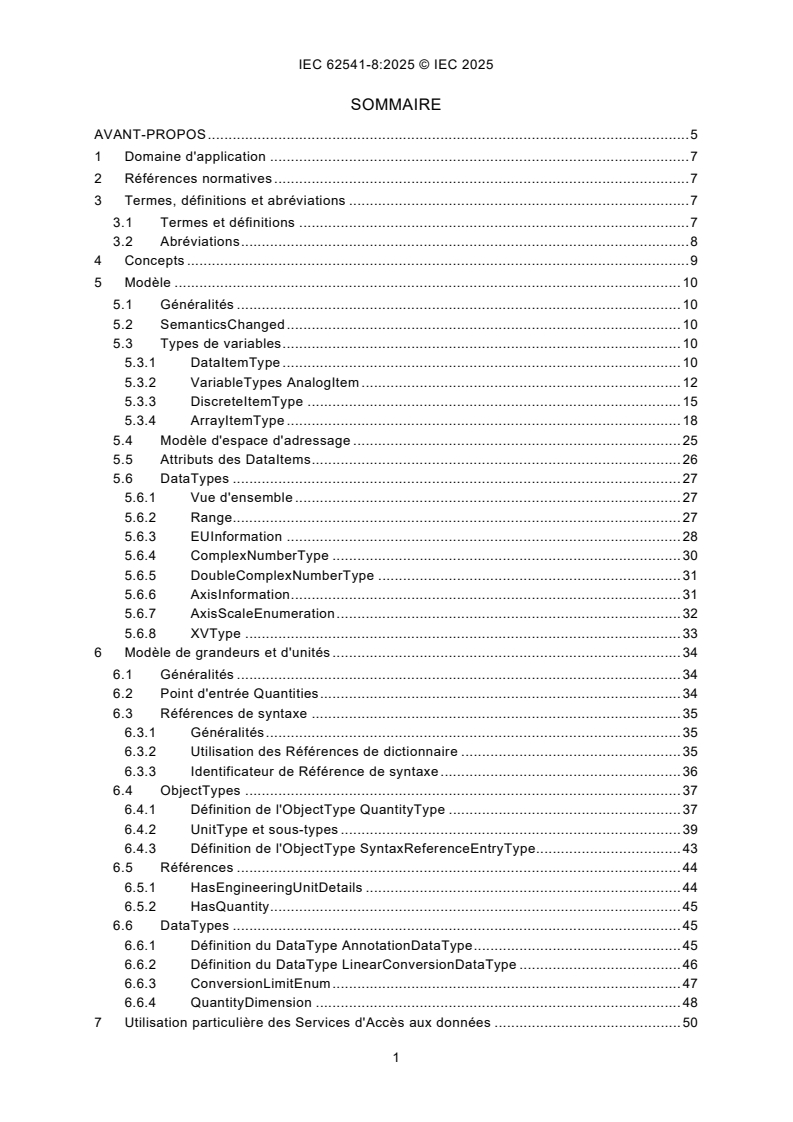
SOMMAIRE
AVANT-PROPOS . 5
1 Domaine d'application . 7
2 Références normatives . 7
3 Termes, définitions et abréviations . 7
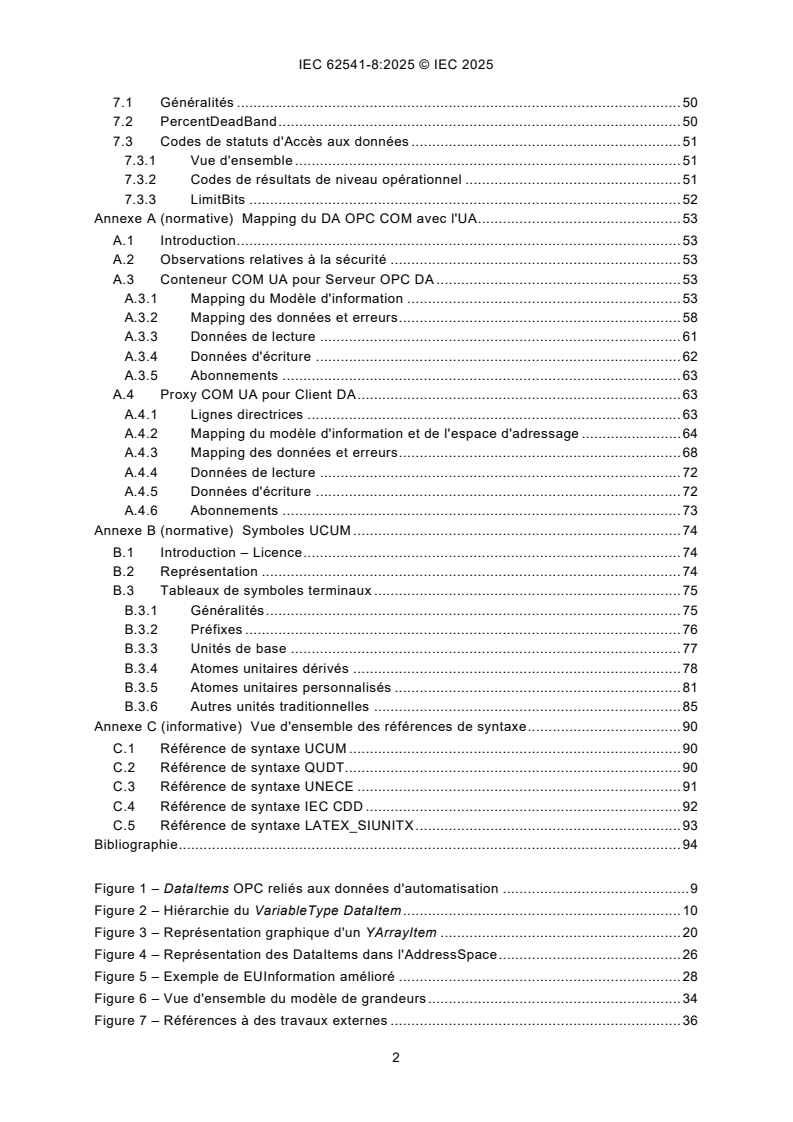
3.1 Termes et définitions . 7
3.2 Abréviations . 8
4 Concepts . 9
5 Modèle . 10
5.1 Généralités . 10
5.2 SemanticsChanged . 10
5.3 Types de variables . 10
5.3.1 DataItemType . 10
5.3.2 VariableTypes AnalogItem . 12
5.3.3 DiscreteItemType . 15
5.3.4 ArrayItemType . 18
5.4 Modèle d'espace d'adressage . 25
5.5 Attributs des DataItems . 26
5.6 DataTypes . 27
5.6.1 Vue d'ensemble . 27
5.6.2 Range. 27
5.6.3 EUInformation . 28
5.6.4 ComplexNumberType . 30
5.6.5 DoubleComplexNumberType . 31
5.6.6 AxisInformation . 31
5.6.7 AxisScaleEnumeration . 32
5.6.8 XVType . 33
6 Modèle de grandeurs et d'unités . 34
6.1 Généralités . 34
6.2 Point d'entrée Quantities . 34
6.3 Références de syntaxe . 35
6.3.1 Généralités . 35
6.3.2 Utilisation des Références de dictionnaire . 35
6.3.3 Identificateur de Référence de syntaxe . 36
6.4 ObjectTypes . 37
6.4.1 Définition de l'ObjectType QuantityType . 37
6.4.2 UnitType et sous-types . 39
6.4.3 Définition de l'ObjectType SyntaxReferenceEntryType. 43
6.5 Références . 44
6.5.1 HasEngineeringUnitDetails . 44
6.5.2 HasQuantity . 45
6.6 DataTypes . 45
6.6.1 Définition du DataType AnnotationDataType . 45
6.6.2 Définition du DataType LinearConversionDataType . 46
6.6.3 ConversionLimitEnum . 47
6.6.4 QuantityDimension . 48
7 Utilisation particulière des Services d'Accès aux données . 50
7.1 Généralités . 50
7.2 PercentDeadBand . 50
7.3 Codes de statuts d'Accès aux données . 51
7.3.1 Vue d'ensemble . 51
7.3.2 Codes de résultats de niveau opérationnel . 51
7.3.3 LimitBits . 52
Annexe A (normative) Mapping du DA OPC COM avec l'UA . 53
A.1 Introduction . 53
A.2 Observations relatives à la sécurité . 53
A.3 Conteneur COM UA pour Serveur OPC DA . 53
A.3.1 Mapping du Modèle d'information . 53
A.3.2 Mapping des données et erreurs . 58
A.3.3 Données de lecture . 61
A.3.4 Données d'écriture . 62
A.3.5 Abonnements . 63
A.4 Proxy COM UA pour Client DA . 63
A.4.1 Lignes directrices . 63
A.4.2 Mapping du modèle d'information et de l'espace d'adressage . 64
A.4.3 Mapping des données et erreurs . 68
A.4.4 Données de lecture . 72
A.4.5 Données d'écriture . 72
A.4.6 Abonnements . 73
Annexe B (normative) Symboles UCUM . 74
B.1 Introduction – Licence . 74
B.2 Représentation . 74
B.3 Tableaux de symboles terminaux . 75
B.3.1 Généralités . 75
B.3.2 Préfixes . 76
B.3.3 Unités de base . 77
B.3.4 Atomes unitaires dérivés . 78
B.3.5 Atomes unitaires personnalisés . 81
B.3.6 Autres unités traditionnelles . 85
Annexe C (informative) Vue d'ensemble des références de syntaxe . 90
C.1 Référence de syntaxe UCUM . 90
C.2 Référence de syntaxe QUDT. 90
C.3 Référence de syntaxe UNECE . 91
C.4 Référence de syntaxe IEC CDD . 92
C.5 Référence de syntaxe LATEX_SIUNITX . 93
Bibliographie . 94
Figure 1 – DataItems OPC reliés aux données d'automatisation . 9
Figure 2 – Hiérarchie du VariableType DataItem . 10
Figure 3 – Représentation graphique d'un YArrayItem . 20
Figure 4 – Représentation des DataItems dans l'AddressSpace . 26
Figure 5 – Exemple de EUInformation amélioré . 28
Figure 6 – Vue d'ensemble du modèle de grandeurs . 34
Figure 7 – Références à des travaux externes . 36
Figure 8 – QuantityType . 37
Figure 9 – Modèle d'Unités . 39
Figure 10 – Exemple de conversion linéaire MathML . 43
Figure 11 – Exemple de conversion linéaire inverse MathML . 43
Figure A.1 – Échantillon de Modèle d'information OPC UA pour OPC DA. 54
Figure A.2 – Mapping des données et erreurs OPC COM DA avec les données et
erreurs OPC UA . 59
Figure A.3 – Mapping du code de statut . 60
Figure A.4 – Échantillon de mapping OPC DA du modèle d'information et de l'espace
d'adressage OPC UA . 65
Figure A.5 – Mapping des données et erreurs OPC UA avec les données et erreurs
OPC DA . 69
Figure A.6 – Mapping du Code de statut OPC UA avec la qualité OPC DA . 71
Tableau 1 – Définition de DataItemType . 11
Tableau 2 – Définition de BaseAnalogType . 12
Tableau 3 – Définition d'AnalogItemType . 14
Tableau 4 – Définition d'AnalogUnitType . 14
Tableau 5 – Définition d'AnalogUnitRangeType . 15
Tableau 6 – Définition de DiscreteItemType . 15
Tableau 7 – Définition de TwoStateDiscreteType . 16
Tableau 8 – Définition de MultiStateDiscreteType . 16
Tableau 9 – Définition de MultiStateValueDiscreteType . 17
Tableau 10 – Définition d'ArrayItemType. 18
Tableau 11 – Définition de YArrayItemType . 19
Tableau 12 – Description de l'élément YArrayItem . 21
Tableau 13 – Définition de XYArrayItemType . 22
Tableau 14 – Définition d'ImageItemType . 23
Tableau 15 – Définition de CubeItemType . 24
Tableau 16 – Définition de NDimensionArrayItemType . 25
Tableau 17 – Structure du DataType Range . 27
Tableau 18 – Définition de Range . 27
Tableau 19 – Structure du DataType EUInformation . 29
Tableau 20 – Définition de EUInformation . 29
Tableau 21 – Exemples issus de la recommandation de la CEE-ONU . 29
Tableau 22 – Structure du DataType ComplexNumberType . 30
Tableau 23 – Définition de ComplexNumberType . 31
Tableau 24 – Structure du DataType DoubleComplexNumberType . 31
Tableau 25 – Définition de DoubleComplexNumberType . 31
Tableau 26 – Structure du DataType AxisInformation . 32
Tableau 27 – Définition d'AxisInformation . 32
Tableau 28 – Valeurs d'AxisScaleEnumeration . 32
Tableau 29 – Définition d'AxisScaleEnumeration . 33
Tableau 30 – Structure du DataType XVType . 33
Tableau 31 – Définition de XVType . 33
Tableau 32 – Définition de Quantities . 34
Tableau 33 – Liste de Références de syntaxe . 35
Tableau 34 – Définition de NodeId pour les instances de SyntaxReferenceEntryType . 35
Tableau 35 – Liste des identificateurs de Référence de syntaxe . 36
Tableau 36 – Définition de QuantityType . 38
Tableau 37 – Sous-composants supplémentaires de QuantityType . 39
Tableau 38 – Définition de UnitType . 40
Tableau 39 – Liste non exhaustive de systèmes d'unités bien connus . 40
Tableau 40 – Définition de ServerUnitType . 41
Tableau 41 – Sous-composants supplémentaires de ServerUnitType . 41
Tableau 42 – Définition d'AlternativeUnitType . 42
Tableau 43 – Définition de SyntaxReferenceEntryType . 44
Tableau 44 – Définition de HasEngineeringUnitDetails. 44
Tableau 45 – Définition de HasQuantity . 45
Tableau 46 – Structure d'AnnotationDataType . 45
Tableau 47 – Exemples d'AnnotationDataType . 46
Tableau 48 – Définition d'AnnotationDataType . 46
Tableau 49 – Structure de LinearConversionDataType . 47
Tableau 50 – Définition de LinearConversionDataType . 47
Tableau 51 – Éléments ConversionLimitEnum . 47
Tableau 52 – Définition de ConversionLimitEnum . 48
Tableau 53 – Structure du DataType QuantityDimension . 48
Tableau 54 – Définition de QuantityDimension . 49
Tableau 55 – Exemples de QuantityDimension . 49
Tableau 56 – Codes de résultats de niveau opérationnel pour une qualité de
données BAD . 51
Tableau 57 – Codes de résultats de niveau opérationnel pour une qualité de données
UNCERTAIN . 52
Tableau 58 – Codes de résultats de niveau opérationnel pour une qualité de données
GOOD . 52
Tableau A.1 – Mapping des propriétés OPC COM DA avec les propriétés OPC UA . 57
Tableau A.2 – DataTypes et mapping . 60
Tableau A.3 – Mapping des qualités . 61
Tableau A.4 – Mapping des erreurs de lecture OPC DA . 62
Tableau A.5 – Mapping du code d'erreurs d'écriture OPC DA . 63
Tableau A.6 – DataTypes et mapping . 70
Tableau A.7 – Mapping des qualités . 71
Tableau A.8 – Mapping des erreurs de lecture OPC UA . 72
Tableau A.9 – Mapping du code d'erreurs d'écriture OPC UA . 73
COMMISSION ÉLECTROTECHNIQUE INTERNATIONALE
____________
Architecture unifiée OPC -
Partie 8: Accès aux données
AVANT-PROPOS
1) La Commission Électrotechnique Internationale (IEC) est une organisation mondiale de normalisation composée
de l'ensemble des comités électrotechniques nationaux (Comités nationaux de l'IEC). L'IEC a pour objet de
favoriser la coopération internationale pour toutes les questions de normalisation dans les domaines de
l'électricité et de l'électronique. À cet effet, l'IEC – entre autres activités – publie des Normes internationales,
des Spécifications techniques, des Rapports techniques, des Spécifications accessibles au public (PAS) et des
Guides (ci-après dénommés "Publication(s) de l'IEC"). Leur élaboration est confiée à des comités d'études, aux
travaux desquels tout Comité national intéressé par le sujet traité peut participer. Les organisations
internationales, gouvernementales et non gouvernementales, en liaison avec l'IEC, participent également aux
travaux. L'IEC collabore étroitement avec l'Organisation Internationale de Normalisation (ISO), selon des
conditions fixées par accord entre les deux organisations.
2) Les décisions ou accords officiels de l'IEC concernant les questions techniques représentent, dans la mesure du
possible, un accord international sur les sujets étudiés, étant donné que les Comités nationaux de l'IEC intéressés
sont représentés dans chaque comité d'études.
3) Les Publications de l'IEC se présentent sous la forme de recommandations internationales et sont agréées
comme telles par les Comités nationaux de l'IEC. Tous les efforts raisonnables sont entrepris afin que l'IEC
s'assure de l'exactitude du contenu technique de ses publications; l'IEC ne peut pas être tenue responsable de
l'éventuelle mauvaise utilisation ou interprétation qui en est faite par un quelconque utilisateur final.
4) Dans le but d'encourager l'uniformité internationale, les Comités nationaux de l'IEC s'engagent, dans toute la
mesure possible, à appliquer de façon transparente les Publications de l'IEC dans leurs publications nationales
et régionales. Toutes divergences entre toutes Publications de l'IEC et toutes publications nationales ou
régionales correspondantes doivent être indiquées en termes clairs dans ces dernières.
5) L'IEC elle-même ne fournit aucune attestation de conformité. Des organismes de certification indépendants
fournissent des services d'évaluation de conformité et, dans certains secteurs, accèdent aux marques de
conformité de l'IEC. L'IEC n'est responsable d'aucun des services effectués par les organismes de certification
indépendants.
6) Tous les utilisateurs doivent s'assurer qu'ils sont en possession de la dernière édition de cette publication.
7) Aucune responsabilité ne doit être imputée à l'IEC, à ses administrateurs, employés, auxiliaires ou mandataires,
y compris ses experts particuliers et les membres de ses comités d'études et des Comités nationaux de l'IEC,
pour tout préjudice causé en cas de dommages corporels et matériels, ou de tout autre dommage de quelque
nature que ce soit, directe ou indirecte, ou pour supporter les coûts (y compris les frais de justice) et les dépenses
découlant de la publication ou de l'utilisation de cette Publication de l'IEC ou de toute autre Publication de l'IEC,
ou au crédit qui lui est accordé.
8) L'attention est attirée sur les références normatives citées dans cette publication. L'utilisation de publications
référencées est obligatoire pour une application correcte de la présente publication.
9) L'IEC attire l'attention sur le fait que la mise en application du présent document peut entraîner l'utilisation d'un
ou de plusieurs brevets. L'IEC ne prend pas position quant à la preuve, à la validité et à l'applicabilité de tout
droit de brevet revendiqué à cet égard. À la date de publication du présent document, l'IEC n'avait pas reçu
notification qu'un ou plusieurs brevets pouvaient être nécessaires à sa mise en application. Toutefois, il y a lieu
d'avertir les responsables de la mise en application du présent document que des informations plus récentes
sont susceptibles de figurer dans la base de données de brevets, disponible à l'adresse https://patents.iec.ch.
L'IEC ne saurait être tenue pour responsable de ne pas avoir identifié tout ou partie de tels droits de brevet.
L'IEC 62541-8 a été établie par le sous-comité 65E: Les dispositifs et leur intégration dans les
systèmes de l'entreprise, du comité d'études 65 de l'IEC: Mesure, commande et automation
dans les processus industriels. Il s'agit d'une Norme internationale.
Cette quatrième édition annule et remplace la troisième édition parue en 2020. Cette édition
constitue une révision technique.
Cette édition inclut les modifications techniques majeures suivantes par rapport à l'édition
précédente:
a) ajout d'un "Modèle de quantité" qui peut être référencé à partir des Propriétés
EngineeringUnit. Le modèle définit les grandeurs et les unités attribuées. En outre, il fournit
des unités alternatives et la conversion vers elles;
b) ajout de règles pour la Propriété ValuePrecision:
• peut également être utilisée pour d'autres sous-types tels que Duration et Decimal;
• ajout de règles lorsque ValuePrecision a des valeurs négatives.
Le texte de cette Norme internationale est issu des documents suivants:
Projet Rapport de vote
65E/1055/CDV 65E/1108/RVC
Le rapport de vote indiqué dans le tableau ci-dessus donne toute information sur le vote ayant
abouti à son approbation.
La langue employée pour l'élaboration de cette Norme internationale est l'anglais.
Ce document a été rédigé selon les Directives ISO/IEC, Partie 2, il a été développé selon les
Directives ISO/IEC, Partie 1 et les Directives ISO/IEC, Supplément IEC, disponibles sous
www.iec.ch/members_experts/refdocs. Les principaux types de documents développés par
l'IEC sont décrits plus en détail sous www.iec.ch/publications.
Dans l'ensemble du présent document et dans les autres parties de la série IEC 62541,
certaines conventions de document sont utilisées:
Le format italique est utilisé pour mettre en évidence un terme défini ou une définition qui
apparaît à l'article "Termes et définitions" dans l'une des parties de la série IEC 62541.
Le format italique est également utilisé pour mettre en évidence le nom d'un paramètre d'entrée
ou de sortie de service, ou le nom d'une structure ou d'un élément de structure habituellement
défini dans les tableaux.
Les termes et noms en italique sont, à quelques exceptions près, écrits en camel-case (pratique
qui consiste à joindre, sans espace, les éléments des mots ou expressions composés, la
première lettre de chaque élément étant en majuscule). Par exemple, le terme défini est
AddressSpace et non Espace d'Adressage. Cela permet de mieux comprendre qu'il existe une
définition unique pour AddressSpace, et non deux définitions distinctes pour Espace et pour
Adressage.
Une liste de toutes les parties de la série IEC 62541, publiées sous le titre général Architecture
unifiée OPC, se trouve sur le site web de l'IEC.
Le comité a décidé que le contenu de ce document ne sera pas modifié avant la date de stabilité
indiquée sur le site web de l'IEC sous webstore.iec.ch dans les données relatives au document
recherché. À cette date, le document sera
– reconduit,
– supprimé, ou
– révisé.
1 Domaine d'application
La présente partie de l'IEC 62541 fait partie intégrante de la série de normes générales sur
l'Architecture unifiée OPC (OPC UA). Elle définit le modèle d'information associé à l'Accès aux
données (DA). Elle spécifie notamment des VariableTypes supplémentaires et fournit des
descriptions complémentaires concernant les NodeClasses et Attributs nécessaires pour
l'Accès aux données, ainsi que des Propriétés supplémentaires et d'autres paramètres relatifs
aux informations et au comportement.
Le modèle d'espace d'adressage complet, comprenant toutes les NodeClasses et tous les
Attributs, est spécifié dans l'IEC 62541-3. Les services de détection et d'accès aux données
sont spécifiés dans l'IEC 62541-4.
L'Annexe A spécifie la méthode de mapping des informations reçues des Serveurs d'Accès aux
données (DA, Data Access) OPC COM avec le modèle d'Accès aux données.
2 Références normatives
Les documents suivants sont cités dans le texte de sorte qu'ils constituent, pour tout ou partie
de leur contenu, des exigences du présent document. Pour les références datées, seule
l’édition citée s’applique. Pour les références non datées, la dernière édition du document de
référence s'applique (y compris les éventuels amendements).
IEC 62541-1, Architecture unifiée OPC - Partie 1: Vue d'ensemble et concepts
IEC 62541-3, Architecture unifiée OPC - Partie 3: Modèle d'espace d'adressage
IEC 62541-4, Architecture unifiée OPC - Partie 4: Services
IEC 62541-5, Architecture unifiée OPC - Partie 5: Modèle d'information
IEC 62541-19, Architecture unifiée OPC - Partie 19: Références de dictionnaire
CEFACT/ONU: Recommandation n°20 de la CEE-ONU, Codes des unités de mesure utilisées
dans le commerce international
https://www.unece.org/cefact/codesfortrade/codes_index.html
3 Termes, définitions et abréviations
3.1 Termes et définitions
Pour les besoins du présent document, les termes et définitions de l'IEC 62541-1, l'IEC 62541-3
et l'IEC 62541-4 ainsi que les suivants s'appliquent.
L'ISO et l'IEC tiennent à jour des bases de données terminologiques destinées à être utilisées
en normalisation, consultables aux adresses suivantes:
– IEC Electropedia: disponible à l'adresse https://www.electropedia.org/
– ISO Online browsing platform: disponible à l'adresse https://www.iso.org/obp
3.1.1
DataItem
liaison à des données arbitraires et réelles d'automatisation, c'est-à-dire des données qui
représentent des informations en cours de validité
Note 1 à l'article: Exemples de données:
• données relatives aux appareils (tels que des capteurs de température);
• données calculées;
• informations d'état (ouvert/fermé, en déplacement);
• données du système à variation dynamique (telles que les cours en Bourse);
• données de diagnostic.
3.1.2
AnalogItem
DataItem qui représente des grandeurs physiques continuellement variables (par exemple,
longueur, température), par opposition à la représentation numérique des données des
éléments discrets
Note 1 à l'article: Des exemples types sont les valeurs fournies par des capteurs de température ou de pression.
L'OPC UA définit des VariableTypes particuliers permettant d'identifier un AnalogItem. Les Propriétés décrivent les
plages possibles des AnalogItems.
3.1.3
DiscreteItem
DataItem qui représente des données qui ne peuvent avoir qu'un certain nombre de valeurs
possibles (par exemple, OPENING, OPEN, CLOSING, CLOSED)
Note 1 à l'article: Des VariableTypes particuliers sont utilisés pour identifier les DiscreteItems à deux états ou plus.
Les Propriétés spécifient les valeurs de chaîne de ces états.
3.1.4
ArrayItem
DataItem qui représente des grandeurs physiques continuellement variables et où chaque point
de données distinct comprend plusieurs valeurs représentées par une matrice (par exemple, la
réponse spectrale d'un filtre numérique)
Note 1 à l'article: Des exemples types sont les données fournies par les appareils d'analyse. Des VariableTypes
particuliers sont utilisés pour identifier les variantes d'ArrayItems.
3.1.5
EngineeringUnits
unités de mesure des AnalogItems qui représentent des grandeurs physiques continuellement
variables (par exemple, longueur, masse, temps, température)
Note 1 à l'article: La présente norme définit des Propriétés qui indiquent l'unité utilisée pour la valeur du DataItem,
ainsi que la valeur la plus élevée et la plus basse susceptibles d'être rencontrées en fonctionnement normal.
3.2 Abréviations
DA (Data Access) Accès aux données
EU (Engineering Unit) Unité technique
NaN "Not a Number", défini dans l'IEEE 754
UA (Unified Architecture) Architecture unifiée
4 Concepts
L'Accès aux données désigne la représentation et l'utilisation des données d'automatisation
dans les Serveurs.
Les données d'automatisation peuvent résider dans le Serveur ou sur des cartes E/S
directement connectées au Serveur. Elles peuvent également résider dans des sous-serveurs
ou sur d'autres appareils tels que des contrôleurs et des modules d'entrée/sortie, connectés
par des liaisons série par l'intermédiaire de bus de terrain ou d'autres liaisons de
communication. Les Serveurs OPC UA d'Accès aux données fournissent aux Clients OPC UA
un ou plusieurs Accès aux données en offrant un accès transparent à leurs données
d'automatisation.
Les liaisons aux instances de données d'automatisation sont appelées DataItems. Les
catégories de données d'automatisation fournies sont spécifiques au fournisseur. La Figure 1
montre comment l'AddressSpace d'un Serveur peut contenir une vaste plage de DataItems.
Figure 1 – DataItems OPC reliés aux données d'automatisation
Les Clients peuvent lire ou écrire les DataItems ou surveiller la modification des valeurs. Les
Services nécessaires à ces opérations sont spécifiés dans l'IEC 62541-4. Les modifications
sont définies comme une modification d'état (qualité) ou une modification de valeur qui dépasse
une plage définie par le client, appelée Bande morte. Afin de détecter la modification de valeur,
la différence entre la valeur actuelle et la dernière valeur récupérée est comparée à la Bande
morte.
5 Modèle
5.1 Généralités
Le modèle DataAccess étend le modèle de variable en définissant des VariableTypes. Le
DataItemType est le type de base. ArrayItemType, BaseAnalogType et DiscreteItemType sont
des spécialisations. Voir la Figure 2. Chacun de ces VariableTypes peut être étendu pour
former des DataItems spécifiques à un domaine ou à un serveur.
Figure 2 – Hiérarchie du VariableType DataItem
5.2 SemanticsChanged
Le StatusCode contient également un bit d'information appelé SemanticsChanged.
Les Serveurs qui mettent en œuvre l'Accès aux données doivent définir ce Bit dans les
notifications en cas de modification de certaines valeurs de Propriété définies dans la présente
norme. Les Propriétés correspondantes sont spécifiées de manière individuelle pour chaque
VariableType.
Il convient que les Clients qui utilisent l'une de ces Propriétés les relisent avant de traiter la
valeur de données.
5.3 Types de variables
5.3.1 DataItemType
Ce VariableType définit les caractéristiques générales d'un DataItem. Tous les autres types de
DataItems sont issus de ce type de variable. Le DataItemType est dérivé du
BaseDataVariableType et partage par conséquent le modèle de variable, comme cela est décrit
dans l'IEC 62541-3 et l'IEC 62541-5. Il est défini de manière formelle dans le Tableau 1.
Tableau 1 – Définition de DataItemType
Attribut Valeur
BrowseName DataItemType
IsAbstract False
ValueRank −2 (−2 = 'Any')
DataType BaseDataType
Références NodeClass BrowseName DataType TypeDefinition ModellingRule
Sous-type du BaseDataVariableType défini dans l'IEC 62541-5; c'est-à-dire que les Propriétés de ce type sont
héritées.
HasSubtype VariableType BaseAnalogType Défini en 5.3.2.2
HasSubtype VariableType DiscreteItemType Défini en 5.3.3
HasSubtype VariableType ArrayItemType Défini en 5.3.4
HasProperty Variable Definition String PropertyType Facultative
HasProperty Variable ValuePrecision Double PropertyType Facultative
Unités de conformité
Accès aux données DataItems
Definition est une chaîne interprétable par l'utilisateur et spécifique au fournisseur qui définit le
mode de calcul de la valeur de ce DataItem. Definition n'est pas localisée et contient le plus
souvent une équation qui peut être analysée par certains clients.
Exemple: Definition: = "(TempA – 25) + TempB"
ValuePrecision spécifie la précision maximale que le Serveur peut procurer pour l'élément en
fonction des restrictions qui existent dans l'environnement cible.
ValuePrecision peut être utilisée pour les DataTypes suivants:
• pour les valeurs de "Float", "Double" et "Decimal", elle spécifie le nombre de chiffres après
la virgule lorsqu'il s'agit d'un nombre positif. Lorsqu'il s'agit d'un nombre négatif, il spécifie
le nombre de chiffres non significatifs à gauche de la virgule. Par exemple, une
ValuePrecision de −2 spécifie que la précision de la Valeur est à la centaine la plus proche.
Il convient que la ValuePrecision soit toujours un nombre entier et qu'elle soit toujours
interprétée comme un nombre entier en l'arrondissant au nombre entier le plus proche;
• pour les valeurs de DateTime, elle doit toujours être un nombre positif qui indique l'intervalle
minimal en nanosecondes. Par exemple, une ValuePrecision de 20 000 000 définit une
précision de 20 ms. Il convient que la ValuePrecision soit toujours un nombre entier et
qu'elle soit toujours interprétée comme un nombre entier en l'arrondissant au nombre entier
le plus proche;
• la ValuePrecision peut également être utilisée pour d'autres sous-types de "Double" (comme
"Duration") et d'autres sous-types de "Number" qui peuvent être représentés par un
"Double".
La Propriété ValuePrecision est une approximation dont l'objet est de fournir une
recommandation pour le Client. Le Serveur est supposé arrondir les valeurs discrètement avec
plus de précision. Autrement dit, un Client peut être confronté à une situation où la valeur relue
et renvoyée par le Serveur est différente de celle qu'il a écrite et envoyée au Serveur. Cette
différence ne doit pas être supérieure à celle spécifiée par cette Propriété.
Il convient que l'algorithme d'arrondi suive l'arrondi dit "bancaire" (également appelé arrondi au
pair le plus proche), dans lequel les nombres qui sont équidistants des deux entiers les plus
proches sont arrondis à l'entier pair le plus proche. Ainsi, 0,5 s'arrondit à 0; 1,5 s'arrondit à 2.
Les autres fractions décimales sont arrondies comme attendu: 0,4 à 0, 0,6 à 1, 1,4 à 1, 1,6 à
2, etc. Seuls les nombres de type x.5 reçoivent ce traitement "spécial".
5.3.2 VariableTypes AnalogItem
5.3.2.1 Généralités
Les VariableTypes définis dans les 5.3.2.2 à 5.3.2.5 définissent les caractéristiques des
AnalogItems. Ces types ont une sémantique et des Propriétés identiques, mais possèdent des
ModellingRules différentes pour chaque Propriété.
Les Propriétés ne sont décrites qu'une seule fois (au 5.3.2.2). Les descriptions s'appliquent aux
Propriétés des autres VariableTypes également.
5.3.2.2 BaseAnalogType
Ce VariableType est le type de base des éléments analogiques. Toutes les Propriétés sont
facultatives. Les sous-types de ce type de base exigent certaines Propriétés. Le
BaseAnalogType est dérivé du DataItemType. Il est défini de manière formelle dans le
Tableau 2.
Tableau 2 – Définition de BaseAnalogType
Attribut Valeur
BrowseName BaseAnalogType
IsAbstract False
ValueRank −2 (−2 = 'Any')
DataType Number
Références NodeClass BrowseName DataType TypeDefinition ModellingRule
Sous-type du DataItemType défini au 5.3.1, c'est-à-dire que les Propriétés de ce type sont héritées.
HasSubtype VariableType AnalogItemType Défini en 5.3.2.3
HasSubtype VariableType AnalogUnitType Défini en 5.3.2.4
HasProperty Variable InstrumentRange Range PropertyType Facultative
HasProperty Variable EURange Range PropertyType Facultative
HasProperty Variable EngineeringUnits EUInformation PropertyType Facultative
Unités de conformité
Accès aux données BaseAnalogType
Les alinéas suivants décrivent les Propriétés de ce VariableType. Si la Valeur de l'élément
analogique contient une matrice, les Propriétés doivent s'appliquer à tous les éléments de la
matrice.
InstrumentRange définit la plage de valeurs que l'instrument peut renvoyer.
EXEMPLE 1: InstrumentRange:= {-9999.9, 9999.9}
Bien qu'elle soit définie comme facultative, il est fortement recommandé que les Serveurs
prennent en charge cette Propriété. En l'absence d'InstrumentRange, les Clients utilisent
généralement la plage complète selon le DataType.
La Propriété InstrumentRange peut également être utilisée pour restreindre un DataType
intégré (comme Byte ou Int16) à une plage de valeurs plus étroites.
EXEMPLE 2
UInt4: InstrumentRange::= {0, 15}
Int6: InstrumentRange::= {-32, 31}
Le DataType Range est spécifié
...
IEC 62541-8 ®
Edition 4.0 2025-12
INTERNATIONAL
STANDARD
NORME
INTERNATIONALE
OPC unified architecture -
Part 8: Data access
Architecture unifiée OPC -
Partie 8: Accès aux données
ICS 25.040.40, 35.100.05 ISBN 978-2-8327-0849-1
All rights reserved. Unless otherwise specified, no part of this publication may be reproduced or utilized in any form or
by any means, electronic or mechanical, including photocopying and microfilm, without permission in writing from either
IEC or IEC's member National Committee in the country of the requester. If you have any questions about IEC copyright
or have an enquiry about obtaining additional rights to this publication, please contact the address below or your local
IEC member National Committee for further information.
Droits de reproduction réservés. Sauf indication contraire, aucune partie de cette publication ne peut être reproduite ni
utilisée sous quelque forme que ce soit et par aucun procédé, électronique ou mécanique, y compris la photocopie et
les microfilms, sans l'accord écrit de l'IEC ou du Comité national de l'IEC du pays du demandeur. Si vous avez des
questions sur le copyright de l'IEC ou si vous désirez obtenir des droits supplémentaires sur cette publication, utilisez
les coordonnées ci-après ou contactez le Comité national de l'IEC de votre pays de résidence.
IEC Secretariat Tel.: +41 22 919 02 11
3, rue de Varembé info@iec.ch
CH-1211 Geneva 20 www.iec.ch
Switzerland
About the IEC
The International Electrotechnical Commission (IEC) is the leading global organization that prepares and publishes
International Standards for all electrical, electronic and related technologies.
About IEC publications
The technical content of IEC publications is kept under constant review by the IEC. Please make sure that you have the
latest edition, a corrigendum or an amendment might have been published.
IEC publications search - IEC Products & Services Portal - products.iec.ch
webstore.iec.ch/advsearchform Discover our powerful search engine and read freely all the
The advanced search enables to find IEC publications by a publications previews, graphical symbols and the glossary.
variety of criteria (reference number, text, technical With a subscription you will always have access to up to date
committee, …). It also gives information on projects, content tailored to your needs.
replaced and withdrawn publications.
Electropedia - www.electropedia.org
IEC Just Published - webstore.iec.ch/justpublished The world's leading online dictionary on electrotechnology,
Stay up to date on all new IEC publications. Just Published containing more than 22 500 terminological entries in English
details all new publications released. Available online and and French, with equivalent terms in 25 additional languages.
once a month by email. Also known as the International Electrotechnical Vocabulary
(IEV) online.
IEC Customer Service Centre - webstore.iec.ch/csc
If you wish to give us your feedback on this publication or
need further assistance, please contact the Customer
Service Centre: sales@iec.ch.
A propos de l'IEC
La Commission Electrotechnique Internationale (IEC) est la première organisation mondiale qui élabore et publie des
Normes internationales pour tout ce qui a trait à l'électricité, à l'électronique et aux technologies apparentées.
A propos des publications IEC
Le contenu technique des publications IEC est constamment revu. Veuillez vous assurer que vous possédez l’édition la
plus récente, un corrigendum ou amendement peut avoir été publié.
Recherche de publications IEC - IEC Products & Services Portal - products.iec.ch
webstore.iec.ch/advsearchform Découvrez notre puissant moteur de recherche et consultez
La recherche avancée permet de trouver des publications gratuitement tous les aperçus des publications, symboles
IEC en utilisant différents critères (numéro de référence, graphiques et le glossaire. Avec un abonnement, vous aurez
texte, comité d’études, …). Elle donne aussi des toujours accès à un contenu à jour adapté à vos besoins.
informations sur les projets et les publications remplacées
ou retirées. Electropedia - www.electropedia.org
Le premier dictionnaire d'électrotechnologie en ligne au
IEC Just Published - webstore.iec.ch/justpublished monde, avec plus de 22 500 articles terminologiques en
Restez informé sur les nouvelles publications IEC. Just anglais et en français, ainsi que les termes équivalents
Published détaille les nouvelles publications parues. dans 25 langues additionnelles. Egalement appelé
Disponible en ligne et une fois par mois par email. Vocabulaire Electrotechnique International (IEV) en ligne.
Service Clients - webstore.iec.ch/csc
Si vous désirez nous donner des commentaires sur cette
publication ou si vous avez des questions contactez-
nous: sales@iec.ch.
CONTENTS
FOREWORD . 5
1 Scope . 7
2 Normative references . 7
3 Terms, definitions and abbreviated terms . 7
3.1 Terms and definitions. 7
3.2 Abbreviated terms . 8
4 Concepts . 9
5 Model . 9
5.1 General . 9
5.2 SemanticsChanged . 10
5.3 Variable Types . 10
5.3.1 DataItemType . 10
5.3.2 AnalogItem VariableTypes . 12
5.3.3 DiscreteItemType . 15
5.3.4 ArrayItemType . 18
5.4 Address Space model . 25
5.5 Attributes of DataItems . 26
5.6 DataTypes . 27
5.6.1 Overview . 27
5.6.2 Range. 27
5.6.3 EUInformation . 27
5.6.4 ComplexNumberType . 30
5.6.5 DoubleComplexNumberType . 30
5.6.6 AxisInformation . 31
5.6.7 AxisScaleEnumeration . 32
5.6.8 XVType . 32
6 Quantities and Units model . 33
6.1 General . 33
6.2 Quantities entry point . 34
6.3 Syntax References . 34
6.3.1 General . 34
6.3.2 Using Dictionary References. 35
6.3.3 Syntax Reference Identifier . 36
6.4 ObjectTypes . 37
6.4.1 QuantityType ObjectType definition . 37
6.4.2 UnitType and subtypes . 39
6.4.3 SyntaxReferenceEntryType ObjectType definition . 43
6.5 References . 44
6.5.1 HasEngineeringUnitDetails . 44
6.5.2 HasQuantity . 45
6.6 DataTypes . 45
6.6.1 AnnotationDataType DataType definition . 45
6.6.2 LinearConversionDataType DataType definition . 46
6.6.3 ConversionLimitEnum . 47
6.6.4 QuantityDimension . 48
7 Data Access specific usage of Services . 50
7.1 General . 50
7.2 PercentDeadband . 50
7.3 Data Access status codes . 51
7.3.1 Overview . 51
7.3.2 Operation level result codes . 51
7.3.3 LimitBits . 52
Annex A (normative) OPC COM DA to UA mapping . 53
A.1 Introduction . 53
A.2 Security Considerations . 53
A.3 COM UA wrapper for OPC DA Server . 53
A.3.1 Information Model mapping . 53
A.3.2 Data and error mapping . 58
A.3.3 Read data . 60
A.3.4 Write Data . 61
A.3.5 Subscriptions . 62
A.4 COM UA proxy for DA Client . 62
A.4.1 Guidelines . 62
A.4.2 Information Model and Address Space mapping . 63
A.4.3 Data and error mapping . 67
A.4.4 Read data . 70
A.4.5 Write data . 71
A.4.6 Subscriptions . 72
Annex B (normative) UCUM Symbols . 73
B.1 Introduction – License . 73
B.2 Representation . 73
B.3 Tables of terminal symbols . 74
B.3.1 General . 74
B.3.2 Prefixes . 74
B.3.3 Base units . 75
B.3.4 Derived unit atoms . 76
B.3.5 Customary unit atoms . 79
B.3.6 Other legacy units . 83
Annex C (informative) Outline of syntax references . 88
C.1 UCUM syntax reference . 88
C.2 QUDT syntax reference. 88
C.3 UNECE syntax reference . 89
C.4 IEC CDD Syntax Reference . 90
C.5 LATEX_SIUNITX Syntax Reference . 91
Bibliography . 92
Figure 1 – OPC DataItems are linked to automation data . 9
Figure 2 – DataItem VariableType hierarchy . 10
Figure 3 – Graphical view of a YArrayItem . 20
Figure 4 – Representation of DataItems in the AddressSpace . 26
Figure 5 – Enhanced EUInformation example . 28
Figure 6 – Quantity model overview . 34
Figure 7 – References to external works . 36
Figure 8 – QuantityType . 37
Figure 9 – Units model . 39
Figure 10 – MathML example linear conversion . 43
Figure 11 – MathML example inverse linear conversion . 43
Figure A.1 – Sample OPC UA Information Model for OPC DA . 54
Figure A.2 – OPC COM DA to OPC UA data and error mapping . 58
Figure A.3 – Status Code mapping . 59
Figure A.4 – Sample OPC DA mapping of OPC UA Information Model and Address
Space . 64
Figure A.5 – OPC UA to OPC DA data & error mapping . 68
Figure A.6 – OPC UA Status Code to OPC DA quality mapping . 69
Table 1 – DataItemType definition . 11
Table 2 – BaseAnalogType definition . 12
Table 3 – AnalogItemType definition . 14
Table 4 – AnalogUnitType definition. 14
Table 5 – AnalogUnitRangeType definition . 15
Table 6 – DiscreteItemType definition . 15
Table 7 – TwoStateDiscreteType definition . 16
Table 8 – MultiStateDiscreteType definition . 16
Table 9 – MultiStateValueDiscreteType definition . 17
Table 10 – ArrayItemType definition. 18
Table 11 – YArrayItemType definition . 19
Table 12 – YArrayItem item description . 21
Table 13 – XYArrayItemType definition . 22
Table 14 – ImageItemType definition . 23
Table 15 – CubeItemType definition . 24
Table 16 – NDimensionArrayItemType definition . 25
Table 17 – Range DataType structure . 27
Table 18 – Range definition . 27
Table 19 – EUInformation DataType structure . 28
Table 20 – EUInformation definition . 29
Table 21 – Examples from the UNECE Recommendation . 29
Table 22 – ComplexNumberType DataType structure . 30
Table 23 – ComplexNumberType definition . 30
Table 24 – DoubleComplexNumberType DataType structure. 31
Table 25 – DoubleComplexNumberType definition . 31
Table 26 – AxisInformation DataType structure . 31
Table 27 – AxisInformation definition . 32
Table 28 – AxisScaleEnumeration values . 32
Table 29 – AxisScaleEnumeration definition . 32
Table 30 – XVType DataType structure . 33
Table 31 – XVType definition . 33
Table 32 – Quantities definition . 34
Table 33 – List of Syntax References . 35
Table 34 – Definition of NodeId for instances of the SyntaxReferenceEntryType . 35
Table 35 – List of Syntax Reference Identifiers . 36
Table 36 – QuantityType definition . 38
Table 37 – QuantityType Additional Subcomponents. 39
Table 38 – UnitType definition . 40
Table 39 – Non-exhaustive list of well-known systems of units . 40
Table 40 – ServerUnitType definition . 41
Table 41 – ServerUnitType Additional Subcomponents . 41
Table 42 – AlternativeUnitType definition . 42
Table 43 – SyntaxReferenceEntryType Definition . 44
Table 44 – HasEngineeringUnitDetails definition . 44
Table 45 – HasQuantity definition . 45
Table 46 – AnnotationDataType Structure . 45
Table 47 – AnnotationDataType examples . 46
Table 48 – AnnotationDataType definition . 46
Table 49 – LinearConversionDataType Structure . 47
Table 50 – LinearConversionDataType Definition . 47
Table 51 – ConversionLimitEnum Items . 47
Table 52 – ConversionLimitEnum Definition . 48
Table 53 – QuantityDimension DataType structure. 48
Table 54 – QuantityDimension definition . 49
Table 55 – QuantityDimension examples . 49
Table 56 – Operation level result codes for BAD data quality . 51
Table 57 – Operation level result codes for UNCERTAIN data quality . 52
Table 58 – Operation level result codes for GOOD data quality . 52
Table A.1 – OPC COM DA to OPC UA Properties mapping . 57
Table A.2 – DataTypes and mapping . 59
Table A.3 – Quality mapping . 60
Table A.4 – OPC DA Read error mapping . 61
Table A.5 – OPC DA Write error code mapping . 62
Table A.6 – DataTypes and Mapping . 69
Table A.7 – Quality mapping . 70
Table A.8 – OPC UA Read error mapping . 71
Table A.9 – OPC UA Write error code mapping . 71
INTERNATIONAL ELECTROTECHNICAL COMMISSION
____________
OPC unified architecture -
Part 8: Data access
FOREWORD
1) The International Electrotechnical Commission (IEC) is a worldwide organization for standardization comprising
all national electrotechnical committees (IEC National Committees). The object of IEC is to promote international
co-operation on all questions concerning standardization in the electrical and electronic fields. To this end and
in addition to other activities, IEC publishes International Standards, Technical Specifications, Technical Reports,
Publicly Available Specifications (PAS) and Guides (hereafter referred to as "IEC Publication(s)"). Their
preparation is entrusted to technical committees; any IEC National Committee interested in the subject dealt with
may participate in this preparatory work. International, governmental and non-governmental organizations liaising
with the IEC also participate in this preparation. IEC collaborates closely with the International Organization for
Standardization (ISO) in accordance with conditions determined by agreement between the two organizations.
2) The formal decisions or agreements of IEC on technical matters express, as nearly as possible, an international
consensus of opinion on the relevant subjects since each technical committee has representation from all
interested IEC National Committees.
3) IEC Publications have the form of recommendations for international use and are accepted by IEC National
Committees in that sense. While all reasonable efforts are made to ensure that the technical content of IEC
Publications is accurate, IEC cannot be held responsible for the way in which they are used or for any
misinterpretation by any end user.
4) In order to promote international uniformity, IEC National Committees undertake to apply IEC Publications
transparently to the maximum extent possible in their national and regional publications. Any divergence between
any IEC Publication and the corresponding national or regional publication shall be clearly indicated in the latter.
5) IEC itself does not provide any attestation of conformity. Independent certification bodies provide conformity
assessment services and, in some areas, access to IEC marks of conformity. IEC is not responsible for any
services carried out by independent certification bodies.
6) All users should ensure that they have the latest edition of this publication.
7) No liability shall attach to IEC or its directors, employees, servants or agents including individual experts and
members of its technical committees and IEC National Committees for any personal injury, property damage or
other damage of any nature whatsoever, whether direct or indirect, or for costs (including legal fees) and
expenses arising out of the publication, use of, or reliance upon, this IEC Publication or any other IEC
Publications.
8) Attention is drawn to the Normative references cited in this publication. Use of the referenced publications is
indispensable for the correct application of this publication.
9) IEC draws attention to the possibility that the implementation of this document may involve the use of (a)
patent(s). IEC takes no position concerning the evidence, validity or applicability of any claimed patent rights in
respect thereof. As of the date of publication of this document, IEC had not received notice of (a) patent(s), which
may be required to implement this document. However, implementers are cautioned that this may not represent
the latest information, which may be obtained from the patent database available at https://patents.iec.ch. IEC
shall not be held responsible for identifying any or all such patent rights.
IEC 62541-8 has been prepared by subcommittee 65E: Devices and integration in enterprise
systems, of IEC technical committee 65: Industrial-process measurement, control and
automation. It is an International Standard.
This fourth edition cancels and replaces the third edition published in 2020. This edition
constitutes a technical revision.
This edition includes the following significant technical changes with respect to the previous
edition:
a) addition of a "Quantity Model" which can be referenced from EngineeringUnit Properties.
The model defines quantities and assigned units. In addition it provides alternative units
and the conversion to them.
b) addition of rules for ValuePrecision Property:
• can also be used for other subtypes like Duration and Decimal.
• rules have been added when ValuePrecision has negative values.
The text of this International Standard is based on the following documents:
Draft Report on voting
65E/1055/CDV 65E/1108/RVC
Full information on the voting for its approval can be found in the report on voting indicated in
the above table.
The language used for the development of this International Standard is English.
This document was drafted in accordance with ISO/IEC Directives, Part 2, and developed in
accordance with ISO/IEC Directives, Part 1 and ISO/IEC Directives, IEC Supplement, available
at www.iec.ch/members_experts/refdocs. The main document types developed by IEC are
described in greater detail at www.iec.ch/publications.
Throughout this document and the other parts of the IEC 62541 series, certain document
conventions are used:
Italics are used to denote a defined term or definition that appears in the "Terms and definitions"
clause in one of the parts of the IEC 62541 series.
Italics are also used to denote the name of a service input or output parameter or the name of
a structure or element of a structure that are usually defined in tables.
The italicized terms and names are, with a few exceptions, written in camel-case (the practice
of writing compound words or phrases in which the elements are joined without spaces, with
each element's initial letter capitalized within the compound). For example, the defined term is
AddressSpace instead of Address Space. This makes it easier to understand that there is a
single definition for AddressSpace, not separate definitions for Address and Space.
A list of all parts in the IEC 62541 series, published under the general title OPC Unified
Architecture, can be found on the IEC website.
The committee has decided that the contents of this document will remain unchanged until the
stability date indicated on the IEC website under webstore.iec.ch in the data related to the
specific document. At this date, the document will be
– reconfirmed,
– withdrawn, or
– revised.
1 Scope
This part of IEC 62541 is part of the overall OPC Unified Architecture (OPC UA) standard series
and defines the information model associated with Data Access (DA). It particularly includes
additional VariableTypes and complementary descriptions of the NodeClasses and Attributes
needed for Data Access, additional Properties, and other information and behaviour.
The complete address space model, including all NodeClasses and Attributes is specified in
IEC 62541-3. The services to detect and access data are specified in IEC 62541-4.
Annex A specifies how the information received from OPC COM Data Access (DA) Servers is
mapped to the Data Access model.
2 Normative references
The following documents are referred to in the text in such a way that some or all of their content
constitutes requirements of this document. For dated references, only the edition cited applies.
For undated references, the latest edition of the referenced document (including any
amendments) applies.
IEC 62541-1, OPC Unified Architecture - Part 1: Overview and Concepts
IEC 62541-3, OPC Unified Architecture - Part 3: Address Space Model
IEC 62541-4, OPC Unified Architecture - Part 4: Services
IEC 62541-5, OPC Unified Architecture - Part 5: Information Model
IEC 62541-19, OPC Unified Architecture - Part 19: Dictionary References
UN/CEFACT: UNECE Recommendation N°20, Codes for Units of Measure Used in International
Trade
https://www.unece.org/cefact/codesfortrade/codes_index.html
3 Terms, definitions and abbreviated terms
3.1 Terms and definitions
For the purposes of this document, the terms and definitions given in IEC 62541-1,
IEC 62541-3, and IEC 62541-4 and the following apply.
ISO and IEC maintain terminology databases for use in standardization at the following
addresses:
– IEC Electropedia: available at https://www.electropedia.org/
– ISO Online browsing platform: available at https://www.iso.org/obp
3.1.1
DataItem
link to arbitrary, live automation data, that is, data that represents currently valid information
Note 1 to entry: Examples of such data are
• device data (such as temperature sensors),
• calculated data,
• status information (open/closed, moving),
• dynamically-changing system data (such as stock quotes),
• diagnostic data.
3.1.2
AnalogItem
DataItem that represents continuously-variable physical quantities (e.g., length, temperature),
in contrast to the digital representation of data in discrete items
Note 1 to entry: Typical examples are the values provided by temperature sensors or pressure sensors. OPC UA
defines specific VariableTypes to identify an AnalogItem. Properties describe the possible ranges of AnalogItems.
3.1.3
DiscreteItem
DataItem that represents data that can take on only a certain number of possible values (e.g.,
OPENING, OPEN, CLOSING, CLOSED)
Note 1 to entry: Specific VariableTypes are used to identify DiscreteItems with two states or with multiple states.
Properties specify the string values for these states.
3.1.4
ArrayItem
DataItem that represents continuously-variable physical quantities and where each individual
data point consists of multiple values represented by an array (e.g., the spectral response of a
digital filter)
Note 1 to entry: Typical examples are the data provided by analyser devices. Specific VariableTypes are used to
identify ArrayItem variants.
3.1.5
EngineeringUnits
units of measurement for AnalogItems that represent continuously-variable physical quantities
(e.g., length, mass, time, temperature)
Note 1 to entry: This standard defines Properties to inform about the unit used for the DataItem value and about
the highest and lowest value likely to be obtained in normal operation.
3.2 Abbreviated terms
DA Data Access
EU Engineering Unit
NaN Not a Number" defined in IEEE 754
UA Unified Architecture
4 Concepts
Data Access deals with the representation and use of automation data in Servers.
Automation data can be located inside the Server or on I/O cards directly connected to the
Server. It can also be located in sub-servers or on other devices such as controllers and
input/output modules, connected by serial links via field buses or other communication links.
OPC UA Data Access Servers provide one or more OPC UA Data Access Clients with
transparent access to their automation data.
The links to automation data instances are called DataItems. Which categories of automation
data are provided is completely vendor-specific. Figure 1 illustrates how the AddressSpace of
a Server can contain a broad range of different DataItems.
Figure 1 – OPC DataItems are linked to automation data
Clients can read or write DataItems or monitor them for value changes. The Services needed
for these operations are specified in IEC 62541-4. Changes are defined as a change in status
(quality) or a change in value that exceeds a client-defined range called a Deadband. To detect
the value change, the difference between the current value and the last reported value is
compared to the Deadband.
5 Model
5.1 General
The DataAccess model extends the variable model by defining VariableTypes. The
DataItemType is the base type. ArrayItemType, BaseAnalogType and DiscreteItemType are
specializations. See Figure 2. Each of these VariableTypes can be further extended to form
domain or server specific DataItems.
Figure 2 – DataItem VariableType hierarchy
5.2 SemanticsChanged
The StatusCode also contains an informational bit called SemanticsChanged.
Servers that implement Data Access shall set this Bit in notifications if certain Property values
defined in this standard change. The corresponding Properties are specified individually for
each VariableType.
Clients that use any of these Properties should re-read them before they process the data value.
5.3 Variable Types
5.3.1 DataItemType
This VariableType defines the general characteristics of a DataItem. All other DataItem Types
derive from it. The DataItemType derives from the BaseDataVariableType and therefore shares
the variable model as described in IEC 62541-3 and IEC 62541-5. It is formally defined in
Table 1.
Table 1 – DataItemType definition
Attribute Value
BrowseName DataItemType
IsAbstract False
ValueRank −2 (−2 = 'Any')
DataType BaseDataType
References NodeClass BrowseName DataType TypeDefinition ModellingRule
Subtype of the BaseDataVariableType defined in IEC 62541-5; i.e the Properties of that type are inherited.
HasSubtype VariableType BaseAnalogType Defined in 5.3.2.2
HasSubtype VariableType DiscreteItemType Defined in 5.3.3
HasSubtype VariableType ArrayItemType Defined in 5.3.4
HasProperty Variable Definition String PropertyType Optional
HasProperty Variable ValuePrecision Double PropertyType Optional
Conformance Units
Data Access DataItems
Definition is a vendor-specific, human readable string that specifies how the value of this
DataItem is calculated. Definition is non-localized and will often contain an equation that can
be parsed by certain clients.
Example: Definition: = "(TempA – 25) + TempB"
ValuePrecision specifies the maximum precision that the Server can maintain for the item based
on restrictions in the target environment.
ValuePrecision can be used for the following DataTypes:
• For Float, Double, and Decimal values it specifies the number of digits after the decimal
place when it is a positive number. When it is a negative number, it specifies the number of
insignificant digits to the left of the decimal place. For example, a ValuePrecision of −2
specifies that the precision of the Value is to the nearest 100. The ValuePrecision should
always be a whole number and it shall always be interpreted as a whole number by rounding
it to the nearest whole number.
• For DateTime values it shall always be a positive number which indicates the minimum time
difference in nanoseconds. For example, a ValuePrecision of 20 000 000 defines a precision
of 20 ms. The ValuePrecision should always be a whole number and it shall always be
interpreted as a whole number by rounding it to the nearest whole number.
• ValuePrecision can also be used for other subtypes of Double (like Duration) and other
Number subtypes that can be represented by a Double.
The ValuePrecision Property is an approximation that is intended to provide guidance to a
Client. A Server is expected to silently round any value with more precision that it supports.
This implies that a Client can encounter cases where the value read back from a Server differs
from the value that it wrote to the Server. This difference shall be no more than the difference
suggested by this Property.
The algorithm for rounding should follow the so-called "Banker's rounding" (aka Round half to
even), in which numbers which are equidistant from the two nearest integers are rounded to the
nearest even integer. Thus, 0.5 rounds down to 0; 1.5 rounds up to 2.
Other decimal fractions round as you would expect: 0.4 to 0, 0.6 to 1, 1.4 to 1, 1.6 to 2, etc.
Only x.5 numbers get the "special" treatment.
5.3.2 AnalogItem VariableTypes
5.3.2.1 General
The VariableTypes in 5.3.2.2 to 5.3.2.5 define the characteristics of AnalogItems. The types
have identical semantics and Properties but with diverging ModellingRules for individual
Properties.
The Properties are only described once – in 5.3.2.2. The descriptions apply to the Properties
for the other VariableTypes as well.
5.3.2.2 BaseAnalogType
This VariableType is the base type for analog items. All Properties are optional. Subtypes of
this base type will mandate some of the Properties. The BaseAnalogType derives from the
DataItemType. It is formally defined in Table 2.
Table 2 – BaseAnalogType definition
Attribute Value
BrowseName BaseAnalogType
IsAbstract False
ValueRank −2 (−2 = 'Any')
DataType Number
References NodeClass BrowseName DataType TypeDefinition ModellingRule
Subtype of the DataItemType defined in 5.3.1; i.e. the Properties of that type are inherited.
HasSubtype VariableType AnalogItemType Defined in 5.3.2.3
HasSubtype VariableType AnalogUnitType Defined in 5.3.2.4
HasProperty Variable InstrumentRange Range PropertyType Optional
HasProperty Variable EURange Range PropertyType Optional
HasProperty Variable EngineeringUnits EUInformation PropertyType Optional
Conformance Units
Data Access BaseAnalogType
The following paragraphs describe the Properties of this VariableType. If the analog item's
Value contains an array, the Properties shall apply to all elements in the array.
InstrumentRange defines the value range that can be returned by the instrument.
EXAMPLE 1 InstrumentRange:= {-9999.9, 9999.9}
Although defined as optional, it is strongly recommended for Servers to support this Property.
Without an InstrumentRange being provided, Clients will commonly assume the full range
according to the DataType.
The InstrumentRange Property can also be used to restrict a Built-in DataType such as Byte or
Int16) to a smaller range of values.
EXAMPLE 2
UInt4: InstrumentRange::= {0, 15}
Int6: InstrumentRange::= {-32, 31}
The Range DataType is specified in 5.6.2.
EURange defines the value range likely to be obtained in normal operation. It is intended for
such use as automatically scaling a bar graph display.
Sensor or instrument failure or deactivation can result in a returned item value which is actually
outside of this range. Client sof
...