

IEC 62920:2017
(Main)Photovoltaic power generating systems - EMC requirements and test methods for power conversion equipment
General Information
- Abstract
IEC 62920:2017 specifies electromagnetic compatibility (EMC) requirements for DC to AC power conversion equipment (PCE) for use in photovoltaic (PV) power systems. The PCE covered by this document can be grid-interactive or stand-alone. It can be supplied by single or multiple photovoltaic modules grouped in various array configurations, and can be intended for use in conjunction with batteries or other forms of energy storage. This document covers not only PCE connected to a public low voltage AC mains network or other low voltage AC mains installation, but also PCE connected to a medium or high voltage AC network with or without step-down power transformers.
- Status
- Published
- Publication Date
- 05-Apr-2021
- Technical Committee
- TC 82 - Solar photovoltaic energy systems
- Drafting Committee
- WG 6 - TC 82/WG 6
- Current Stage
- PPUB - Publication issued
- Start Date
- 26-Jul-2017
- Completion Date
- 11-Aug-2017
Buy Documents
IEC 62920:2017 - Photovoltaic power generating systems - EMC requirements and test methods for power conversion equipment Released:7/26/2017

IEC 62920:2017+AMD1:2021 CSV - Photovoltaic power generating systems - EMC requirements and test methods for power conversion equipment Released:4/6/2021
Overview
IEC 62920:2017 is an international standard published by the International Electrotechnical Commission (IEC) that defines the electromagnetic compatibility (EMC) requirements and test methods for power conversion equipment (PCE) used in photovoltaic (PV) power generating systems. This standard applies to DC to AC power converters that can be either grid-interactive or stand-alone devices. It covers equipment connected to various voltage levels including public low voltage AC mains, medium voltage, or high voltage AC networks, with or without step-down transformers.
IEC 62920:2017 is vital for ensuring that PV power conversion equipment operates reliably without causing or being affected by electromagnetic disturbances. It includes detailed test setups, operating conditions, immunity requirements, emission limits, and reporting guidelines designed to maintain compatibility with other electrical and electronic systems.
Key Topics
Scope and Applicability
Covers power conversion equipment for photovoltaic systems, including various configurations of PV modules and integration with energy storage. Applies to grid-connected and off-grid systems, as well as different AC network voltage levels.Classification of PCE
Defines environmental categories and equipment classes to tailor EMC requirements depending on installation context and system design.Test Setups for Type Testing
Provides configurations for immunity and emission testing focused on:- Electrostatic discharge (ESD)
- Radiated disturbances
- Electrical fast transients (EFT) and bursts
- Surge immunity
- Conducted disturbances induced by radio-frequency fields
- Voltage dips and interruptions
Operating Conditions During Testing
Specifies simulation conditions for accurate and repeatable tests reflecting real-world operation.Immunity Requirements and Performance Criteria
Details immunity thresholds to electromagnetic disturbances ensuring PCE robustness against electrical noise and transient events, including voltage variations.Emission Limits
Defines maximum allowable conducted and radiated emissions from the power conversion equipment to minimize interference with other devices.Detailed Test Reporting
Specifies how test data should be recorded and interpreted to demonstrate EMC compliance.Annexes With Practical Examples
Supplementary materials provide multiple test setup examples and alternative methods for high-power conversion equipment, enhancing practical application of the standard.
Applications
IEC 62920:2017 is essential for manufacturers, testing laboratories, and installers involved with photovoltaic power conversion equipment. Its applications include:
Design and Development
Guiding designers in integrating EMC features early in the development of inverters and converters to meet regulatory requirements.Type Testing and Certification
Assisting certification bodies and manufacturers in performing standardized EMC tests to validate equipment compliance before market release.Installation Practices
Informing installation engineers on equipment classification and environment considerations to maintain EMC during deployment.Quality Assurance
Supporting ongoing compliance verification and product improvement by providing detailed testing protocols and performance benchmarks.Grid Stability and Safety
Ensuring that PV inverters and related equipment do not contribute to electromagnetic interference that could affect grid operation or other electronic systems.
Related Standards
When implementing or assessing compliance with IEC 62920:2017, it is beneficial to consider related IEC standards such as:
IEC 61000 Series
Generic EMC standards covering immunity and emission testing practices applicable to electrical and electronic equipment.IEC 61727
Guidelines on the interface of photovoltaic systems with utility grids, relevant for grid-interactive inverters covered under IEC 62920.IEC 62116
Testing procedures for islanding prevention methods in grid-connected PV inverters, complementary to EMC requirements.IEC 61215 and IEC 61646
Standards for PV module performance and reliability that align with system-level EMC considerations.
Incorporating IEC 62920:2017 ensures electromagnetic compatibility is effectively managed for photovoltaic power generating systems, facilitating wider adoption of safe, reliable solar energy technologies worldwide.
Relations
- Effective Date
- 05-Sep-2023
Buy Documents
IEC 62920:2017 - Photovoltaic power generating systems - EMC requirements and test methods for power conversion equipment Released:7/26/2017
IEC 62920:2017+AMD1:2021 CSV - Photovoltaic power generating systems - EMC requirements and test methods for power conversion equipment Released:4/6/2021
Get Certified
Connect with accredited certification bodies for this standard

DNV
DNV is an independent assurance and risk management provider.

Lloyd's Register
Lloyd's Register is a global professional services organisation specialising in engineering and technology.
DNV Energy Systems
Energy and renewable energy certification.
Sponsored listings
Frequently Asked Questions
IEC 62920:2017 is a standard published by the International Electrotechnical Commission (IEC). Its full title is "Photovoltaic power generating systems - EMC requirements and test methods for power conversion equipment". This standard covers: IEC 62920:2017 specifies electromagnetic compatibility (EMC) requirements for DC to AC power conversion equipment (PCE) for use in photovoltaic (PV) power systems. The PCE covered by this document can be grid-interactive or stand-alone. It can be supplied by single or multiple photovoltaic modules grouped in various array configurations, and can be intended for use in conjunction with batteries or other forms of energy storage. This document covers not only PCE connected to a public low voltage AC mains network or other low voltage AC mains installation, but also PCE connected to a medium or high voltage AC network with or without step-down power transformers.
IEC 62920:2017 specifies electromagnetic compatibility (EMC) requirements for DC to AC power conversion equipment (PCE) for use in photovoltaic (PV) power systems. The PCE covered by this document can be grid-interactive or stand-alone. It can be supplied by single or multiple photovoltaic modules grouped in various array configurations, and can be intended for use in conjunction with batteries or other forms of energy storage. This document covers not only PCE connected to a public low voltage AC mains network or other low voltage AC mains installation, but also PCE connected to a medium or high voltage AC network with or without step-down power transformers.
IEC 62920:2017 is classified under the following ICS (International Classification for Standards) categories: 27.160 - Solar energy engineering. The ICS classification helps identify the subject area and facilitates finding related standards.
IEC 62920:2017 has the following relationships with other standards: It is inter standard links to IEC 62920:2017/AMD1:2021. Understanding these relationships helps ensure you are using the most current and applicable version of the standard.
IEC 62920:2017 is available in PDF format for immediate download after purchase. The document can be added to your cart and obtained through the secure checkout process. Digital delivery ensures instant access to the complete standard document.
Standards Content (Sample)
IEC 62920 ®
Edition 1.0 2017-07
INTERNATIONAL
STANDARD
NORME
INTERNATIONALE
colour
inside
Photovoltaic power generating systems – EMC requirements and test methods
for power conversion equipment
Systèmes de production d’énergie photovoltaïque – Exigences de CEM et
méthodes d’essai pour les équipements de conversion de puissance
All rights reserved. Unless otherwise specified, no part of this publication may be reproduced or utilized in any form
or by any means, electronic or mechanical, including photocopying and microfilm, without permission in writing from
either IEC or IEC's member National Committee in the country of the requester. If you have any questions about IEC
copyright or have an enquiry about obtaining additional rights to this publication, please contact the address below or
your local IEC member National Committee for further information.
Droits de reproduction réservés. Sauf indication contraire, aucune partie de cette publication ne peut être reproduite
ni utilisée sous quelque forme que ce soit et par aucun procédé, électronique ou mécanique, y compris la photocopie
et les microfilms, sans l'accord écrit de l'IEC ou du Comité national de l'IEC du pays du demandeur. Si vous avez des
questions sur le copyright de l'IEC ou si vous désirez obtenir des droits supplémentaires sur cette publication, utilisez
les coordonnées ci-après ou contactez le Comité national de l'IEC de votre pays de résidence.
IEC Central Office Tel.: +41 22 919 02 11
3, rue de Varembé Fax: +41 22 919 03 00
CH-1211 Geneva 20 info@iec.ch
Switzerland www.iec.ch
About the IEC
The International Electrotechnical Commission (IEC) is the leading global organization that prepares and publishes
International Standards for all electrical, electronic and related technologies.
About IEC publications
The technical content of IEC publications is kept under constant review by the IEC. Please make sure that you have the
latest edition, a corrigenda or an amendment might have been published.
IEC Catalogue - webstore.iec.ch/catalogue Electropedia - www.electropedia.org
The stand-alone application for consulting the entire The world's leading online dictionary of electronic and
bibliographical information on IEC International Standards, electrical terms containing 20 000 terms and definitions in
Technical Specifications, Technical Reports and other English and French, with equivalent terms in 16 additional
documents. Available for PC, Mac OS, Android Tablets and languages. Also known as the International Electrotechnical
iPad. Vocabulary (IEV) online.
IEC publications search - www.iec.ch/searchpub IEC Glossary - std.iec.ch/glossary
The advanced search enables to find IEC publications by a 65 000 electrotechnical terminology entries in English and
variety of criteria (reference number, text, technical French extracted from the Terms and Definitions clause of
committee,…). It also gives information on projects, replaced IEC publications issued since 2002. Some entries have been
and withdrawn publications. collected from earlier publications of IEC TC 37, 77, 86 and
CISPR.
IEC Just Published - webstore.iec.ch/justpublished
Stay up to date on all new IEC publications. Just Published IEC Customer Service Centre - webstore.iec.ch/csc
details all new publications released. Available online and If you wish to give us your feedback on this publication or
also once a month by email. need further assistance, please contact the Customer Service
Centre: csc@iec.ch.
A propos de l'IEC
La Commission Electrotechnique Internationale (IEC) est la première organisation mondiale qui élabore et publie des
Normes internationales pour tout ce qui a trait à l'électricité, à l'électronique et aux technologies apparentées.
A propos des publications IEC
Le contenu technique des publications IEC est constamment revu. Veuillez vous assurer que vous possédez l’édition la
plus récente, un corrigendum ou amendement peut avoir été publié.
Catalogue IEC - webstore.iec.ch/catalogue Electropedia - www.electropedia.org
Application autonome pour consulter tous les renseignements
Le premier dictionnaire en ligne de termes électroniques et
bibliographiques sur les Normes internationales,
électriques. Il contient 20 000 termes et définitions en anglais
Spécifications techniques, Rapports techniques et autres
et en français, ainsi que les termes équivalents dans 16
documents de l'IEC. Disponible pour PC, Mac OS, tablettes
langues additionnelles. Egalement appelé Vocabulaire
Android et iPad.
Electrotechnique International (IEV) en ligne.
Recherche de publications IEC - www.iec.ch/searchpub
Glossaire IEC - std.iec.ch/glossary
65 000 entrées terminologiques électrotechniques, en anglais
La recherche avancée permet de trouver des publications IEC
en utilisant différents critères (numéro de référence, texte, et en français, extraites des articles Termes et Définitions des
comité d’études,…). Elle donne aussi des informations sur les publications IEC parues depuis 2002. Plus certaines entrées
projets et les publications remplacées ou retirées. antérieures extraites des publications des CE 37, 77, 86 et
CISPR de l'IEC.
IEC Just Published - webstore.iec.ch/justpublished
Service Clients - webstore.iec.ch/csc
Restez informé sur les nouvelles publications IEC. Just
Published détaille les nouvelles publications parues. Si vous désirez nous donner des commentaires sur cette
Disponible en ligne et aussi une fois par mois par email. publication ou si vous avez des questions contactez-nous:
csc@iec.ch.
IEC 62920 ®
Edition 1.0 2017-07
INTERNATIONAL
STANDARD
NORME
INTERNATIONALE
colour
inside
Photovoltaic power generating systems – EMC requirements and test methods
for power conversion equipment
Systèmes de production d’énergie photovoltaïque – Exigences de CEM et
méthodes d’essai pour les équipements de conversion de puissance
INTERNATIONAL
ELECTROTECHNICAL
COMMISSION
COMMISSION
ELECTROTECHNIQUE
INTERNATIONALE
ICS 27.160 ISBN 978-2-8322-4603-0
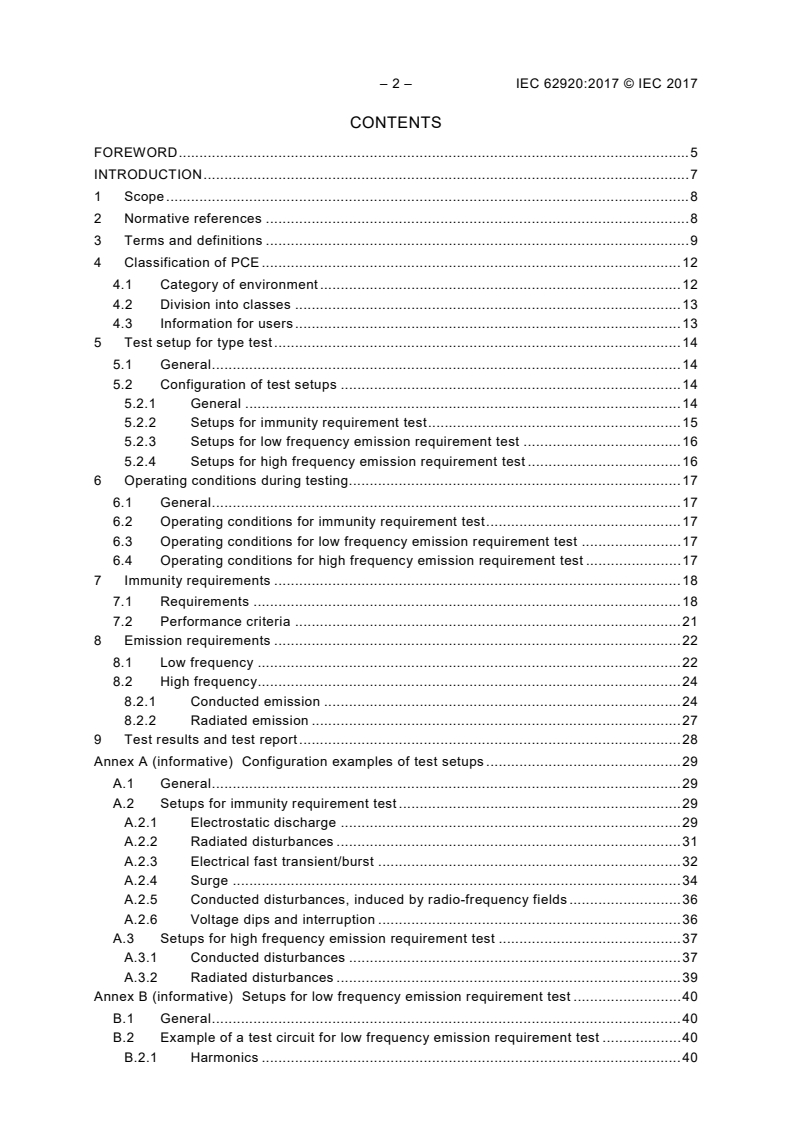
– 2 – IEC 62920:2017 © IEC 2017
CONTENTS
FOREWORD . 5
INTRODUCTION . 7
1 Scope . 8
2 Normative references . 8
3 Terms and definitions . 9
4 Classification of PCE . 12
4.1 Category of environment . 12
4.2 Division into classes . 13
4.3 Information for users . 13
5 Test setup for type test . 14
5.1 General . 14
5.2 Configuration of test setups . 14
5.2.1 General . 14
5.2.2 Setups for immunity requirement test . 15
5.2.3 Setups for low frequency emission requirement test . 16
5.2.4 Setups for high frequency emission requirement test . 16
6 Operating conditions during testing. 17
6.1 General . 17
6.2 Operating conditions for immunity requirement test . 17
6.3 Operating conditions for low frequency emission requirement test . 17
6.4 Operating conditions for high frequency emission requirement test . 17
7 Immunity requirements . 18
7.1 Requirements . 18
7.2 Performance criteria . 21
8 Emission requirements . 22
8.1 Low frequency . 22
8.2 High frequency . 24
8.2.1 Conducted emission . 24
8.2.2 Radiated emission . 27
9 Test results and test report . 28
Annex A (informative) Configuration examples of test setups . 29
A.1 General . 29
A.2 Setups for immunity requirement test . 29
A.2.1 Electrostatic discharge . 29
A.2.2 Radiated disturbances . 31
A.2.3 Electrical fast transient/burst . 32
A.2.4 Surge . 34
A.2.5 Conducted disturbances, induced by radio-frequency fields . 36
A.2.6 Voltage dips and interruption . 36
A.3 Setups for high frequency emission requirement test . 37
A.3.1 Conducted disturbances . 37
A.3.2 Radiated disturbances . 39
Annex B (informative) Setups for low frequency emission requirement test . 40
B.1 General . 40
B.2 Example of a test circuit for low frequency emission requirement test . 40
B.2.1 Harmonics . 40
B.2.2 Voltage fluctuations and flicker . 42
Annex C (informative) Test setup for conducted disturbance measurement . 44
C.1 General . 44
C.2 Examples of a test setup . 44
Annex D (informative) Alternative test methods for high-power PCE . 47
D.1 General . 47
D.2 Alternative method for immunity requirement test . 47
D.2.1 Alternative method for EFT/burst immunity test . 47
D.2.2 Alternative method for surge test . 47
D.2.3 Alternative test method for conducted disturbances, induced by radio-
frequency fields . 48
D.2.4 Conducted disturbances measurement . 49
Bibliography . 51
Figure 1 – Example of ports . 10
Figure 2 – Examples of installation of PV systems in both environments . 13
Figure 3 – Overview of harmonic requirements up to 75 A . 23
Figure 4 – Overview of voltage change requirements up to 75 A . 24
Figure A.1 – Example of a test setup for direct application of discharges to PCE . 30
Figure A.2 – Example of a test setup for indirect application of discharges to PCE . 30
Figure A.3 – Example of a test setup for wall-mounted PCE . 32
Figure A.4 – Example of a test setup for direct coupling of the test voltage to AC
mains power ports . 33
Figure A.5 – Example of a test setup for application of the test voltage with a
capacitive coupling clamp . 34
Figure A.6 – Example of a test setup for AC mains power ports . 35
Figure A.7 – Example of a test setup for DC power ports . 35
Figure A.8 – Example of a setup of conducted disturbances immunity test applied for
wall-mounted PCE . 36
Figure A.9 – Example of a test setup using a generator for voltage dips and short
interruptions. 37
Figure A.10 – Example of a test setup of conducted disturbances measurement
applied for wall-mounted PCE . 38
Figure A.11 – Example of a test setup of conducted disturbances measurement
applied for wall-mounted PCE with power circulation . 38
Figure A.12 – Example of a test setup of conducted disturbances measurement
applied for wall-mounted PCE with direct connection to AC mains . 39
Figure A.13 – Example of a test setup of radiated disturbances measurement applied
for wall-mounted PCE . 39
Figure B.1 – Measurement circuit for single-phase two-wire PCE . 40
Figure B.2 – Measurement circuit for single-phase three-wire PCE . 41
Figure B.3 – Measurement circuit for three-phase three-wire PCE . 41
Figure B.4 – Measurement circuit for three-phase four-wire PCE . 41
Figure B.5 – Measurement circuit for single-phase two-wire PCE . 42
Figure B.6 – Measurement circuit for single-phase three-wire PCE . 42
Figure B.7 – Measurement circuit for three-phase three-wire PCE . 43
Figure B.8 – Measurement circuit for three-phase four-wire PCE . 43
– 4 – IEC 62920:2017 © IEC 2017
Figure C.1 – Example of a standardized test setup for conducted disturbances
measurement with AC mains power supply . 45
Figure C.2 – Example of a standardized test setup for conducted disturbances
measurement with a laboratory AC power source . 46
Figure D.1 – Example of an alternative method for EFT/Burst immunity test . 47
Figure D.2 – Example of an alternative coupling/decoupling network for AC mains
power ports . 48
Figure D.3 – Example of a test setup applying clamp injection method to AC mains
power ports . 49
Figure D.4 – Alternative test method of conduced disturbances measurement using
artificial networks as voltage probes . 50
Table 1 – Immunity requirements for class B PCE . 19
Table 2 – Immunity requirements for class A PCE . 20
Table 3 – Voltage dips and interruption immunity requirements for class B PCE . 21
Table 4 – Voltage dips and interruption immunity requirements for class A PCE . 21
Table 5 – Performance criteria for immunity tests . 22
Table 6 – Disturbance voltage limits at the AC mains power port for class A PCE
measured on a test site . 25
Table 7 – Disturbance voltage limits at the AC mains power port for class B PCE
measured on a test site . 25
Table 8 – Disturbance limits at the DC power port for class A PCE measured on a test site . 26
Table 9 – Disturbance limits at the DC power port for class B PCE measured on a test site . 26
Table 10 – Limits of conducted common mode (asymmetric mode) disturbance at the
wired port for class A PCE . 27
Table 11 – Limits of conducted common mode (asymmetric mode) disturbance at the
wired port for class B PCE . 27
Table 12 – Electromagnetic radiation disturbance limits for class A PCE measured on a
test site . 27
Table 13 – Electromagnetic radiation disturbance limits for class B PCE measured on a
test site . 28
INTERNATIONAL ELECTROTECHNICAL COMMISSION
____________
PHOTOVOLTAIC POWER GENERATING SYSTEMS –
EMC REQUIREMENTS AND TEST METHODS FOR
POWER CONVERSION EQUIPMENT
FOREWORD
1) The International Electrotechnical Commission (IEC) is a worldwide organization for standardization comprising
all national electrotechnical committees (IEC National Committees). The object of IEC is to promote
international co-operation on all questions concerning standardization in the electrical and electronic fields. To
this end and in addition to other activities, IEC publishes International Standards, Technical Specifications,
Technical Reports, Publicly Available Specifications (PAS) and Guides (hereafter referred to as “IEC
Publication(s)”). Their preparation is entrusted to technical committees; any IEC National Committee interested
in the subject dealt with may participate in this preparatory work. International, governmental and non-
governmental organizations liaising with the IEC also participate in this preparation. IEC collaborates closely
with the International Organization for Standardization (ISO) in accordance with conditions determined by
agreement between the two organizations.
2) The formal decisions or agreements of IEC on technical matters express, as nearly as possible, an international
consensus of opinion on the relevant subjects since each technical committee has representation from all
interested IEC National Committees.
3) IEC Publications have the form of recommendations for international use and are accepted by IEC National
Committees in that sense. While all reasonable efforts are made to ensure that the technical content of IEC
Publications is accurate, IEC cannot be held responsible for the way in which they are used or for any
misinterpretation by any end user.
4) In order to promote international uniformity, IEC National Committees undertake to apply IEC Publications
transparently to the maximum extent possible in their national and regional publications. Any divergence
between any IEC Publication and the corresponding national or regional publication shall be clearly indicated in
the latter.
5) IEC itself does not provide any attestation of conformity. Independent certification bodies provide conformity
assessment services and, in some areas, access to IEC marks of conformity. IEC is not responsible for any
services carried out by independent certification bodies.
6) All users should ensure that they have the latest edition of this publication.
7) No liability shall attach to IEC or its directors, employees, servants or agents including individual experts and
members of its technical committees and IEC National Committees for any personal injury, property damage or
other damage of any nature whatsoever, whether direct or indirect, or for costs (including legal fees) and
expenses arising out of the publication, use of, or reliance upon, this IEC Publication or any other IEC
Publications.
8) Attention is drawn to the Normative references cited in this publication. Use of the referenced publications is
indispensable for the correct application of this publication.
9) Attention is drawn to the possibility that some of the elements of this IEC Publication may be the subject of
patent rights. IEC shall not be held responsible for identifying any or all such patent rights.
International Standard IEC 62920 has been prepared by IEC technical committee 82: Solar
photovoltaic energy systems.
The text of this International Standard is based on the following documents:
FDIS Report on voting
82/1288/FDIS 82/1313/RVD
Full information on the voting for the approval of this International Standard can be found in
the report on voting indicated in the above table.
This document has been drafted in accordance with the ISO/IEC Directives, Part 2.
– 6 – IEC 62920:2017 © IEC 2017
The committee has decided that the contents of this document will remain unchanged until the
stability date indicated on the IEC website under "http://webstore.iec.ch" in the data related to
the specific document. At this date, the document will be
• reconfirmed,
• withdrawn,
• replaced by a revised edition, or
• amended.
IMPORTANT – The 'colour inside' logo on the cover page of this publication indicates
that it contains colours which are considered to be useful for the correct
understanding of its contents. Users should therefore print this document using a
colour printer.
INTRODUCTION
Background
Power conversion equipment (PCE) is indispensable for solar photovoltaic power energy
systems in order to convert the DC electric power energy generated by solar photovoltaic
panels into AC electric power, and to feed the AC power energy into the AC mains network or
loads.
In recent years, standardization of EMC requirements for PCE has become more active. For
example, CISPR/B has been considering the limits and measurement method for conducted
disturbances at DC power ports of grid connected power converters since 2008. These
proposed limits and measurement methods form the basis of the instructions for
supplementing CISPR 11 in order to cover the set of EMC requirements for the PCE applying
to the solar photovoltaic power energy systems. EMC requirements for PCE were added in
CISPR 11 Ed.6.0 which was published in 2015. Some product committees, which consider
products utilizing PCE, have their own product standards on EMC requirements. SC 22G has
developed IEC 61800-3 to define the limits and test methods for power drive systems. SC 22H
has IEC 62040-2 for uninterrupted power supplies, and TC 26 has IEC 60974-10 for arc
welding. TC 9 sets the emission limits with IEC 62236 (all parts). Moreover, TC 69 will have
IEC 61851-21-2 covering EMC requirements for conducted charging stations for electric
vehicles.
Purpose of the development of a product EMC standard
IEC Guide 107 specifies that TC 77 and CISPR have responsibility for developing the basic
and generic standards for EMC requirements of products. Therefore, product committees are
not free to set their own emission limits. If product committees intend to require immunity to
particular disturbances, they shall refer to these basic EMC immunity standards.
However, when the EMC standards which are developed by TC 77 and CISPR are not
considered suitable for a particular product or electromagnetic environment, product
committees shall seek their assistance and advice for any change in the emission limits
and/or measurement requirements.
Product committees are responsible for selecting the appropriate immunity test items and
levels for their products as well as for defining the relevant performance criteria for the
evaluation of the immunity test results. Consequently, product committees, such as TC 22,
TC 26, TC 9, and TC 69, have their own EMC standard to define EMC limits and test methods
for their products.
On the other hand, TC 82 does not have its own product EMC standards. Therefore, TC 82
has to refer to the generic standards. Nevertheless, TC 82 has the responsibility to consider
EMC requirements for PCE applying to the solar photovoltaic power energy systems, and
TC 82 can take action as follows to develop its own product EMC standards:
a) select the immunity test items in accordance with EMC environments for the solar
photovoltaic power energy systems;
b) supplement generic standards with a detailed description of test conditions and test set up;
c) propose the conditional limits and alternative test methods in terms of installation
environmental and operational conditions;
d) develop appropriate requirements and test method for high power equipment.
This document presents the minimum EMC requirements for PCE applying to solar
photovoltaic power energy systems.
___________
Under preparation. Stage at the time of publication: IEC AFDIS 61851-21-2:2017.
– 8 – IEC 62920:2017 © IEC 2017
PHOTOVOLTAIC POWER GENERATING SYSTEMS –
EMC REQUIREMENTS AND TEST METHODS FOR
POWER CONVERSION EQUIPMENT
1 Scope
This document specifies electromagnetic compatibility (EMC) requirements for DC to AC
power conversion equipment (PCE) for use in photovoltaic (PV) power systems.
The PCE covered by this document can be grid-interactive, which is termed as a grid
connected power converter (GCPC), or stand-alone. It can be supplied by single or multiple
photovoltaic modules grouped in various array configurations, and can be intended for use in
conjunction with batteries or other forms of energy storage.
NOTE A micro inverter is an example of a GCPC supplied by a single photovoltaic module.
This document covers not only PCE connected to a public low voltage AC mains network or
other low voltage AC mains installation, but also PCE connected to a medium or high voltage
AC network with or without step-down power transformers. Requirements for the PCE
connected to a medium or high voltage AC network are specified in this document. However,
some requirements relevant to grid interconnection are addressed with other standards
specifying power quality or their own grid codes in some countries.
NOTE DC/DC converters used for PV systems are not yet covered in this document. They can cause
electromagnetic interference due to conducted disturbances at DC ports.
PCE is assessed with EMC requirements as a type test at a test site. This document provides
test methods and test conditions for PCE as well as emission and immunity requirements, but
not for photovoltaic modules and other balance of system components.
When compliance with EMC requirements at the test site cannot be shown due to technical
reasons of the test site, PCE can be assessed in situ, such as at the manufacturer’s premises
or in the field where the PCE is assembled into a PV power system. However, only high
frequency emission requirements for in situ assessment are specified in CISPR 11.
2 Normative references
The following documents are referred to in the text in such a way that some or all of their
content constitutes requirements of this document. For dated references, only the edition
cited applies. For undated references, the latest edition of the referenced document (including
any amendments) applies.
IEC 61000-3-2:2014, Electromagnetic compatibility (EMC) – Part 3-2: Limits – Limits for
harmonic current emissions (equipment with input current ≤ 16 A per phase)
IEC 61000-3-3:2013, Electromagnetic compatibility (EMC) – Part 3-3: Limits – Limitation of
voltage changes, voltage fluctuations and flicker in public low-voltage supply systems, for
equipment with rated current ≤ 16 A per phase and not subject to conditional connection
IEC TR 61000-3-6:2008, Electromagnetic compatibility (EMC) – Part 3-6: Limits – Assessment
of emission limits for the connection of distorting installations to MV, HV and EHV power
systems
IEC 61000-3-11:2000, Electromagnetic compatibility (EMC) – Part 3-11: Limits – Limitation of
voltage changes, voltage fluctuations and flicker in public low-voltage supply systems –
Equipment with rated current ≤ 75 A and subject to conditional connection
IEC 61000-3-12:2011, Electromagnetic compatibility (EMC) – Part 3-12: Limits – Limits for
harmonic currents produced by equipment connected to public low-voltage systems with input
current > 16 A and ≤ 75 A per phase
IEC TR 61000-3-14:2011, Electromagnetic compatibility (EMC) – Part 3-14: Assessment of
emission limits for harmonics, interharmonics, voltage fluctuations and unbalance for the
connection of disturbing installations to LV power systems
IEC 61000-4-2:2008, Electromagnetic compatibility (EMC) – Part 4-2: Testing and
measurement techniques – Electrostatic discharge immunity test
IEC 61000-4-3:2006, Electromagnetic compatibility (EMC) – Part 4-3: Testing and measure-
ment techniques – Radiated, radio-frequency, electromagnetic field immunity test
IEC 61000-4-3:2006/AMD1:2007
IEC 61000-4-3:2006/AMD2:2010
IEC 61000-4-4:2012, Electromagnetic compatibility (EMC) – Part 4-4: Testing and
measurement techniques – Electrical fast transient/burst immunity test
IEC 61000-4-5:2014, Electromagnetic compatibility (EMC) – Part 4-5: Testing and
measurement techniques – Surge immunity test
IEC 61000-4-6:2013, Electromagnetic compatibility (EMC) – Part 4-6: Testing and measure-
ment techniques – Immunity to conducted disturbances, induced by radio-frequency fields
IEC 61000-4-7:2002, Electromagnetic compatibility (EMC) – Part 4-7: Testing and
measurement techniques – General guide on harmonics and interharmonics measurements
and instrumentation, for power supply systems and equipment connected thereto
IEC 61000-4-7:2002/AMD1:2008
IEC 61000-4-11:2004, Electromagnetic compatibility (EMC) – Part 4-11: Testing and
measurement techniques – Voltage dips, short interruptions and voltage variations immunity
tests
IEC 61000-4-34:2005, Electromagnetic compatibility (EMC) – Part 4-34: Testing and
measurement techniques – Voltage dips, short interruptions and voltage variations immunity
tests for equipment with input current more than 16 A per phase
CISPR 11:2015, Industrial, scientific and medical equipment – Radio-frequency disturbance
characteristics – Limits and methods of measurement
CISPR 11:2015/AMD1:2016
CISPR 16-1-2:2014, Specification for radio disturbance and immunity measuring apparatus
and methods – Part 1-2: Radio disturbance and immunity measuring apparatus – Coupling
devices for conducted disturbance measurements
CISPR 32:2015, Electromagnetic compatibility of multimedia equipment – Emission
requirements
3 Terms and definitions
For the purposes of this document, the following terms and definitions apply.
– 10 – IEC 62920:2017 © IEC 2017
ISO and IEC maintain terminological databases for use in standardization at the following
addresses:
• IEC Electropedia: available at http://www.electropedia.org/
• ISO Online browsing platform: available at http://www.iso.org/obp
3.1
photovoltaic power generating system
PV system
electric power generating system which uses the photovoltaic effect to convert solar power
into electricity
3.2
balance of system component
BOS
parts of a PV system other than the PV array field, including switches, controls, meters, power
conditioning equipment, PV array support structure, and electricity storage components, if any
Note 1 to entry: This note only applies to the French language.
[SOURCE: IEC TS 61836:2016, 3.3.8, modified – The word "component" has been added to
the term, as well as the note to entry.]
3.3
power conversion equipment
PCE
electrical device converting one form of electrical power to another form of electrical power
with respect to voltage, current, frequency, phase and the number of phases
Note 1 to entry: This note only applies to the French language.
[SOURCE: IEC 62109-1:2010, 3.66 – The definition has been rephrased, and the note has
been replaced.]
3.4
port
particular interface of the PCE with the external electromagnetic environment
Note 1 to entry: See Figure 1 for examples of ports.
DC power port
AC mains power port
Auxiliary DC power port
Auxiliary AC power port
PCE
Signal and control port
Wired network port
Earth port
Enclosure port
IEC
Figure 1 – Example of ports
3.5
enclosure port
physical boundary of the PCE product which electromagnetic fields may radiate through or
impinge on
3.6
AC mains power port
port used to connect to a public low voltage AC mains power distribution network or other low
voltage AC mains installation
3.7
auxiliary AC power port
additional AC power port for purposes other than feeding in AC power
3.8
DC power port
port used to connect a local low voltage DC power generating system
3.9
auxiliary DC power port
additional DC power port for purposes other than supplying DC power for the DC to AC
conversion
3.10
signal and control port
port intended for the interconnection of components of PCE, or between PCE and local
auxiliary equipment, and used in accordance with relevant functional specifications
Note 1 to entry: Examples include RS-232, Universal Serial Bus (USB), High-Definition Multimedia Interface
(HDMI), IEEE standard 1394 (“Fire Wire”) and control pilot.
3.11
wired network port
point to connection for voice, data and signalling transfers intended to interconnect widely
dispersed systems by direct connection to a single-user or multi-user communication network
Note 1 to entry: Example include CATV, PSTN, ISDN, xDSL, LAN and similar networks. These ports can support
screened or unscreened cables and can also carry AC or DC power where this is an integral part of the
telecommunication specification.
3.12
high power electronic equipment and system
one or more power conversion equipment with a combined rated power greater than 75 kVA,
or a system containing such equipment
3.13
low voltage
LV
set of voltage levels used for the distribution of electricity and whose upper limit is generally
accepted to be 1 000 V AC or 1 500 V DC
3.14
high voltage
HV
1) in a general sense, the set of voltage levels in excess of low voltage
2) in a restrictive sense, the set of upper voltage levels used in power system for bulk
transmission of electricity
[SOURCE: IEC 60050-601:1985, 601-01-27]
3.15
medium voltage
MV
any set of voltage levels lying between low and high voltage
– 12 – IEC 62920:2017 © IEC 2017
[SOURCE: IEC 60050-601:1985, 601-01-28, modified – The note has been deleted.]
3.16
small size equipment
equipment including its cables fits in an imaginary cylindrical test volume of 1,2 m in diameter
and 1,5 m in height (to ground plane)
3.17
type test
test of one or more equipment made to a certain design to show that the design meets certain
specifications
3.18
residential environment
environment characterized by the fact that the product is directly (not via external transformer)
connected to a public low voltage AC mains power distribution network or other low voltage
AC mains installation
3.19
non-residential environment
environment characterized by a separate power network, supplied from dedicated power
transformer or a high- or medium-voltage transformer
3.20
PCE-MV
PCE including a medium voltage transformer
3.21
artificial mains network
AMN
network that provides a defined impedance to the equipment under test (EUT) at radio
frequencies, couples the disturbance voltage to the measuring receiver and decouples the
test circuit from the low voltage AC mains supply
3.22
DC artificial network
artificial DC network
DC-AN
artificial network used for defined termination of the EUT’s port under test also providing the
necessary decoupling from conducted disturbances originating from the laboratory low voltage
DC power source
4 Classification of PCE
4.1 Category of environment
In consideration of the intended use of PCE in environments and the definition of environment
in the generic EMC standards, for simplicity only two categories are defined in this document
for both emission and immunity requirements; these are residential and non-residential
environments.
Figure 2 shows examples of installation of PV systems in both environments. The appropriate
category of environment should be confirmed according to the definition of each environment.
HV
Dedicated
Internal
step-down
step-down
HV/MV power
transformers
transformers
transformer
MV
MV/LV power MV/LV power MV/LV power
transformer transformer transformer
LV LV
LV
AC AC
DC DC
AC
AC
DC
DC
AC
PV modules
DC
PV modules
PV modules are
mostly installed
on the roof
Industrial area
PV modules
Domestic area Commercial area
PV modules
Light industrial area
Residential environment Non-residential environment
IEC
Figure 2 – Examples of installation of PV systems
in both environments
4.2 Division into classes
In order to harmonize with basic, generic and product family standards, this document defines
two classes of equipment in accordance with the category of environment, class A and
class B as follows.
• Class A PCE is suitable for use in non-residential environments.
• Class A PCE shall meet class A requirements.
• Class B PCE is suitable for use in the residential environments.
• Class B PCE shall meet class B requirements.
PCE may fulfil the requirement of both classes. Such PCE can be classified as A and B and is
suitable for use in both environments.
4.3 Information for users
The manufacturer and/or supplier of PCE shall ensure that the user is informed of the class
either by labelling or by the accompanying documentation.
PCE not suitable for residential environments shall include the following caution in an
instruction manual.
Caution: This PCE is not intended for use in a residential environment, and this PCE may
cause radio interference, in which case the user may be required to take additional mitigation
measures against electromagnetic interference.
– 14 – IEC 62920:2017 © IEC 2017
5 Test setup for type test
5.1 General
Emission and immunity testing of PCE can be conducted with or without solar photovoltaic
modules. However, only the PCE is subject to testing, and therefore the test may be
conducted without solar photovoltaic modules. In order to realize reproducibility, an
appropriate alternative DC power source to the solar photovoltaic modules is required so that
continuous and stable DC voltage and power for the PCE can be supplied during testing. In
addition, the alternative DC sources shall be designed in such a manner that harmonics and
electromagnetic disturbance from the DC sources do not influence test results.
Similarly, an appropriate alternative AC power source should be used so that continuous and
stable AC voltage and frequency for the PCE can be supplied during testing. Harmonics and
electromagnetic disturbance generated by the AC power source shall not influence test results.
The alternative DC power source and AC power source are connected to the DC power port
and the AC mains power port. Auxiliary power ports, if any, and if necessary to operate the
PCE as intended, shall be connected to each power source during testing.
5.2 Configuration of test setups
5.2.1 General
The PCE shall be placed under a condition close to an actual installation condition during
testing for immunity and emission requirements. Cable arrangement shall be conducted by
following installation manuals provided by manufacturers. Except at manufacturer’s
designation which specifies mounting of covers and access panels during testing, those
covers and access panels shall be mounted under a condition close to an actual mounting
condition. This does not apply when power to PCE is not applied.
The basic standards define test setups. Hence, this document supplements the basic
standards and provides descriptions regarding testing arrangement for wall-mounted PCE in
Annex A.
Micro inverters can be dealt with as wall-mounted PCE for EMC requirements only.
Configuration examples of test setup for wall-mounted PCE can be applied to a type test for
micro inverters.
The DC power ports of the PCE shall be connected to a suitable DC power source. The DC
voltage of this power source shall be adjustable to provide a voltage level within
...
IEC 62920 ®
Edition 1.1 2021-04
CONSOLIDATED VERSION
INTERNATIONAL
STANDARD
NORME
INTERNATIONALE
colour
inside
Photovoltaic power generating systems – EMC requirements and test methods
for power conversion equipment
Systèmes de production d'énergie photovoltaïque – Exigences de CEM et
méthodes d'essai pour les équipements de conversion de puissance
All rights reserved. Unless otherwise specified, no part of this publication may be reproduced or utilized in any form
or by any means, electronic or mechanical, including photocopying and microfilm, without permission in writing from
either IEC or IEC's member National Committee in the country of the requester. If you have any questions about IEC
copyright or have an enquiry about obtaining additional rights to this publication, please contact the address below or
your local IEC member National Committee for further information.
Droits de reproduction réservés. Sauf indication contraire, aucune partie de cette publication ne peut être reproduite
ni utilisée sous quelque forme que ce soit et par aucun procédé, électronique ou mécanique, y compris la photocopie
et les microfilms, sans l'accord écrit de l'IEC ou du Comité national de l'IEC du pays du demandeur. Si vous avez des
questions sur le copyright de l'IEC ou si vous désirez obtenir des droits supplémentaires sur cette publication, utilisez
les coordonnées ci-après ou contactez le Comité national de l'IEC de votre pays de résidence.
IEC Central Office Tel.: +41 22 919 02 11
3, rue de Varembé info@iec.ch
CH-1211 Geneva 20 www.iec.ch
Switzerland
About the IEC
The International Electrotechnical Commission (IEC) is the leading global organization that prepares and publishes
International Standards for all electrical, electronic and related technologies.
About IEC publications
The technical content of IEC publications is kept under constant review by the IEC. Please make sure that you have the
latest edition, a corrigendum or an amendment might have been published.
IEC publications search - webstore.iec.ch/advsearchform IEC online collection - oc.iec.ch
The advanced search enables to find IEC publications by a Discover our powerful search engine and read freely all the
variety of criteria (reference number, text, technical publications previews. With a subscription you will always
committee, …). It also gives information on projects, replaced have access to up to date content tailored to your needs.
and withdrawn publications.
Electropedia - www.electropedia.org
IEC Just Published - webstore.iec.ch/justpublished
The world's leading online dictionary on electrotechnology,
Stay up to date on all new IEC publications. Just Published
containing more than 22 000 terminological entries in English
details all new publications released. Available online and
and French, with equivalent terms in 18 additional languages.
once a month by email.
Also known as the International Electrotechnical Vocabulary
(IEV) online.
IEC Customer Service Centre - webstore.iec.ch/csc
If you wish to give us your feedback on this publication or
need further assistance, please contact the Customer Service
Centre: sales@iec.ch.
A propos de l'IEC
La Commission Electrotechnique Internationale (IEC) est la première organisation mondiale qui élabore et publie des
Normes internationales pour tout ce qui a trait à l'électricité, à l'électronique et aux technologies apparentées.
A propos des publications IEC
Le contenu technique des publications IEC est constamment revu. Veuillez vous assurer que vous possédez l’édition la
plus récente, un corrigendum ou amendement peut avoir été publié.
Recherche de publications IEC - IEC online collection - oc.iec.ch
webstore.iec.ch/advsearchform Découvrez notre puissant moteur de recherche et consultez
La recherche avancée permet de trouver des publications IEC gratuitement tous les aperçus des publications. Avec un
en utilisant différents critères (numéro de référence, texte, abonnement, vous aurez toujours accès à un contenu à jour
comité d’études, …). Elle donne aussi des informations sur adapté à vos besoins.
les projets et les publications remplacées ou retirées.
Electropedia - www.electropedia.org
IEC Just Published - webstore.iec.ch/justpublished
Le premier dictionnaire d'électrotechnologie en ligne au
Restez informé sur les nouvelles publications IEC. Just
monde, avec plus de 22 000 articles terminologiques en
Published détaille les nouvelles publications parues.
anglais et en français, ainsi que les termes équivalents dans
Disponible en ligne et une fois par mois par email.
16 langues additionnelles. Egalement appelé Vocabulaire
Electrotechnique International (IEV) en ligne.
Service Clients - webstore.iec.ch/csc
Si vous désirez nous donner des commentaires sur cette
publication ou si vous avez des questions contactez-nous:
sales@iec.ch.
IEC 62920 ®
Edition 1.1 2021-04
CONSOLIDATED VERSION
INTERNATIONAL
STANDARD
NORME
INTERNATIONALE
colour
inside
Photovoltaic power generating systems – EMC requirements and test methods
for power conversion equipment
Systèmes de production d'énergie photovoltaïque – Exigences de CEM et
méthodes d'essai pour les équipements de conversion de puissance
INTERNATIONAL
ELECTROTECHNICAL
COMMISSION
COMMISSION
ELECTROTECHNIQUE
INTERNATIONALE
ICS 27.160 ISBN 978-2-8322-9687-5
IEC 62920 ®
Edition 1.1 2021-04
CONSOLIDATED VERSION
REDLINE VERSION
VERSION REDLINE
colour
inside
Photovoltaic power generating systems – EMC requirements and test methods
for power conversion equipment
Systèmes de production d'énergie photovoltaïque – Exigences de CEM et
méthodes d'essai pour les équipements de conversion de puissance
– 2 – IEC 62920:2017+AMD1:2021 CSV
© IEC 2021
CONTENTS
FOREWORD . 5
INTRODUCTION . 7
1 Scope . 9
2 Normative references . 9
3 Terms and definitions . 10
4 Classification of PCE . 14
4.1 Category of environment . 14
4.2 Division into classes . 16
4.3 Information for users . 16
5 Test setup for type test . 16
5.1 General . 16
5.2 Configuration of test setups . 17
5.2.1 General . 17
5.2.2 Setups for immunity requirement test . 18
5.2.3 Setups for low frequency emission requirement test . 19
5.2.4 Setups for high frequency emission requirement test . 19
6 Operating conditions during testing. 20
6.1 General . 20
6.2 Operating conditions for immunity requirement test . 20
6.3 Operating conditions for low frequency emission requirement test . 20
6.4 Operating conditions for high frequency emission requirement test . 21
7 Immunity requirements . 21
7.1 Requirements . 21
7.2 Performance criteria . 24
8 Emission requirements . 25
8.1 Low frequency . 25
8.2 High frequency . 27
8.2.1 Conducted emission . 27
8.2.2 Radiated emission . 30
9 Test results and test report Test procedures, results and report . 31
Annex A (informative) Configuration examples of test setups . 33
A.1 General . 33
A.2 Setups for immunity requirement test . 33
A.2.1 Electrostatic discharge . 33
A.2.2 Radiated disturbances . 35
A.2.3 Electrical fast transient/burst . 36
A.2.4 Surge . 38
A.2.5 Conducted disturbances, induced by radio-frequency fields . 40
A.2.6 Voltage dips and interruption . 40
A.3 Setups for high frequency emission requirement test . 41
A.3.1 Conducted disturbances . 41
A.3.2 Radiated disturbances . 44
Annex B (informative) Setups for low frequency emission requirement test . 45
B.1 General . 45
B.2 Example of a test circuit for low frequency emission requirement test . 45
© IEC 2021
B.2.1 Harmonics . 45
B.2.2 Voltage fluctuations and flicker . 47
Annex C (informative) Test setup for conducted disturbance measurement . 49
C.1 General . 49
C.2 Examples of a test setup . 49
Annex D (informative) Alternative test methods for high-power PCE . 52
D.1 General . 52
D.2 Alternative method for immunity requirement test . 52
D.2.1 Alternative method for EFT/burst immunity test . 52
D.2.2 Alternative method for surge test . 52
D.2.3 Alternative test method for conducted disturbances, induced by radio-
frequency fields . 53
D.2.4 Conducted disturbances measurement . 54
Bibliography . 56
Figure 1 – Example of ports . 12
Figure 2 – Examples of installation of PV systems in both environments . 15
Figure 3 – Overview of harmonic requirements up to 75 A . 26
Figure 4 – Overview of voltage change requirements up to 75 A . 27
Figure A.1 – Example of a test setup for direct application of discharges to PCE . 34
Figure A.2 – Example of a test setup for indirect application of discharges to PCE . 34
Figure A.3 – Example of a test setup for wall-mounted PCE . 36
Figure A.4 – Example of a test setup for direct coupling of the test voltage to AC
mains power ports . 37
Figure A.5 – Example of a test setup for application of the test voltage with a
capacitive coupling clamp . 38
Figure A.6 – Example of a test setup for AC mains power ports . 39
Figure A.7 – Example of a test setup for DC power ports . 39
Figure A.8 – Example of a setup of conducted disturbances immunity test applied for
wall-mounted PCE . 40
Figure A.9 – Example of a test setup using a generator for voltage dips and short
interruptions. 41
Figure A.10 – Example of a test setup of conducted disturbances measurement
applied for wall-mounted PCE . 42
Figure A.11 – Example of a test setup of conducted disturbances measurement
applied for wall-mounted PCE with power circulation . 43
Figure A.12 – Example of a test setup of conducted disturbances measurement
applied for wall-mounted PCE with direct connection to AC mains . 43
Figure A.13 – Example of a test setup of radiated disturbances measurement applied
for wall-mounted PCE . 44
Figure B.1 – Measurement circuit for single-phase two-wire PCE . 45
Figure B.2 – Measurement circuit for single-phase three-wire PCE . 46
Figure B.3 – Measurement circuit for three-phase three-wire PCE . 46
Figure B.4 – Measurement circuit for three-phase four-wire PCE . 46
Figure B.5 – Measurement circuit for single-phase two-wire PCE . 47
Figure B.6 – Measurement circuit for single-phase three-wire PCE . 47
Figure B.7 – Measurement circuit for three-phase three-wire PCE . 48
– 4 – IEC 62920:2017+AMD1:2021 CSV
© IEC 2021
Figure B.8 – Measurement circuit for three-phase four-wire PCE . 48
Figure C.1 – Example of a standardized test setup for conducted disturbances
measurement with AC mains power supply . 50
Figure C.2 – Example of a standardized test setup for conducted disturbances
measurement with a laboratory AC power source . 51
Figure D.1 – Example of an alternative method for EFT/Burst immunity test . 52
Figure D.2 – Example of an alternative coupling/decoupling network for AC mains
power ports . 53
Figure D.3 – Example of a test setup applying clamp injection method to AC mains
power ports . 54
Figure D.4 – Alternative test method of conduced disturbances measurement using
artificial networks as voltage probes . 55
Table 1 – Immunity requirements for class B PCE . 22
Table 2 – Immunity requirements for class A PCE . 23
Table 3 – Voltage dips and interruption immunity requirements for class B PCE . 24
Table 4 – Voltage dips and interruption immunity requirements for class A PCE . 24
Table 5 – Performance criteria for immunity tests . 25
Table 6 – Disturbance voltage limits at the AC mains power port for class A PCE
measured on a test site . 28
Table 7 – Disturbance voltage limits at the AC mains power port for class B PCE
measured on a test site . 28
Table 8 – Disturbance limits at the DC power port for class A PCE measured
on a test site . 29
Table 9 – Disturbance limits at the DC power port for class B PCE measured
on a test site . 29
Table 10 – Limits of conducted common mode (asymmetric mode) disturbance at the
wired port for class A PCE . 30
Table 11 – Limits of conducted common mode (asymmetric mode) disturbance at the
wired port for class B PCE . 30
Table 12 – Electromagnetic radiation disturbance limits for class A PCE measured on a
test site . 31
Table 13 – Electromagnetic radiation disturbance limits for class B PCE measured on a
test site . 31
Table 14 – Applicability of measurements at DC power ports . 30
© IEC 2021
INTERNATIONAL ELECTROTECHNICAL COMMISSION
____________
PHOTOVOLTAIC POWER GENERATING SYSTEMS –
EMC REQUIREMENTS AND TEST METHODS FOR
POWER CONVERSION EQUIPMENT
FOREWORD
1) The International Electrotechnical Commission (IEC) is a worldwide organization for standardization comprising
all national electrotechnical committees (IEC National Committees). The object of IEC is to promote
international co-operation on all questions concerning standardization in the electrical and electronic fields. To
this end and in addition to other activities, IEC publishes International Standards, Technical Specifications,
Technical Reports, Publicly Available Specifications (PAS) and Guides (hereafter referred to as “IEC
Publication(s)”). Their preparation is entrusted to technical committees; any IEC National Committee interested
in the subject dealt with may participate in this preparatory work. International, governmental and non-
governmental organizations liaising with the IEC also participate in this preparation. IEC collaborates closely
with the International Organization for Standardization (ISO) in accordance with conditions determined by
agreement between the two organizations.
2) The formal decisions or agreements of IEC on technical matters express, as nearly as possible, an international
consensus of opinion on the relevant subjects since each technical committee has representation from all
interested IEC National Committees.
3) IEC Publications have the form of recommendations for international use and are accepted by IEC National
Committees in that sense. While all reasonable efforts are made to ensure that the technical content of IEC
Publications is accurate, IEC cannot be held responsible for the way in which they are used or for any
misinterpretation by any end user.
4) In order to promote international uniformity, IEC National Committees undertake to apply IEC Publications
transparently to the maximum extent possible in their national and regional publications. Any divergence
between any IEC Publication and the corresponding national or regional publication shall be clearly indicated in
the latter.
5) IEC itself does not provide any attestation of conformity. Independent certification bodies provide conformity
assessment services and, in some areas, access to IEC marks of conformity. IEC is not responsible for any
services carried out by independent certification bodies.
6) All users should ensure that they have the latest edition of this publication.
7) No liability shall attach to IEC or its directors, employees, servants or agents including individual experts and
members of its technical committees and IEC National Committees for any personal injury, property damage or
other damage of any nature whatsoever, whether direct or indirect, or for costs (including legal fees) and
expenses arising out of the publication, use of, or reliance upon, this IEC Publication or any other IEC
Publications.
8) Attention is drawn to the Normative references cited in this publication. Use of the referenced publications is
indispensable for the correct application of this publication.
9) Attention is drawn to the possibility that some of the elements of this IEC Publication may be the subject of
patent rights. IEC shall not be held responsible for identifying any or all such patent rights.
This consolidated version of the official IEC Standard and its amendment has been
prepared for user convenience.
IEC 62920 edition 1.1 contains the first edition (2017-07) [documents 82/1288/FDIS and
82/1313/RVD] and its amendment 1 (2021-04) [documents 82/1835/FDIS and
82/1874/RVD].
In this Redline version, a vertical line in the margin shows where the technical content
is modified by amendment 1. Additions are in green text, deletions are in strikethrough
red text. A separate Final version with all changes accepted is available in this
publication.
– 6 – IEC 62920:2017+AMD1:2021 CSV
© IEC 2021
International Standard IEC 62920 has been prepared by IEC technical committee 82: Solar
photovoltaic energy systems.
This document has been drafted in accordance with the ISO/IEC Directives, Part 2.
The committee has decided that the contents of the base publication and its amendment will
remain unchanged until the stability date indicated on the IEC web site under
"http://webstore.iec.ch" in the data related to the specific publication. At this date, the
publication will be
• reconfirmed,
• withdrawn,
• replaced by a revised edition, or
• amended.
IMPORTANT – The 'colour inside' logo on the cover page of this publication indicates
that it contains colours which are considered to be useful for the correct
understanding of its contents. Users should therefore print this document using a
colour printer.
© IEC 2021
INTRODUCTION
Background
Power conversion equipment (PCE) is indispensable for solar photovoltaic power energy
systems in order to convert the DC electric power energy generated by solar photovoltaic
panels into AC electric power, and to feed the AC power energy into the AC mains network or
loads.
In recent years, standardization of EMC requirements for PCE has become more active. For
example, CISPR/B has been considering the limits and measurement method for conducted
disturbances at DC power ports of grid connected power converters since 2008. These
proposed limits and measurement methods form the basis of the instructions for
supplementing CISPR 11 in order to cover the set of EMC requirements for the PCE applying
to the solar photovoltaic power energy systems. EMC requirements for PCE were added in
CISPR 11 Ed.6.0 which was published in 2015. Some product committees, which consider
products utilizing PCE, have their own product standards on EMC requirements. SC 22G has
developed IEC 61800-3 to define the limits and test methods for power drive systems. SC 22H
has IEC 62040-2 for uninterrupted power supplies, and TC 26 has IEC 60974-10 for arc
welding. TC 9 sets the emission limits with IEC 62236 (all parts). Moreover, TC 69 will have
IEC 61851-21-2 covering EMC requirements for conducted charging stations for electric
vehicles.
Purpose of the development of a product EMC standard
IEC Guide 107 specifies that TC 77 and CISPR have responsibility for developing the basic
and generic standards for EMC requirements of products. Therefore, product committees are
not free to set their own emission limits. If product committees intend to require immunity to
particular disturbances, they shall refer to these basic EMC immunity standards.
However, when the EMC standards which are developed by TC 77 and CISPR are not
considered suitable for a particular product or electromagnetic environment, product
committees shall seek their assistance and advice for any change in the emission limits
and/or measurement requirements.
Product committees are responsible for selecting the appropriate immunity test items and
levels for their products as well as for defining the relevant performance criteria for the
evaluation of the immunity test results. Consequently, product committees, such as TC 22,
TC 26, TC 9, and TC 69, have their own EMC standard to define EMC limits and test methods
for their products.
On the other hand, TC 82 does not have its own product EMC standards. Therefore, TC 82
has to refer to the generic standards. Nevertheless, TC 82 has the responsibility to consider
EMC requirements for PCE applying to the solar photovoltaic power energy systems, and
TC 82 can take action as follows to develop its own product EMC standards:
a) select the immunity test items in accordance with EMC environments for the solar
photovoltaic power energy systems;
b) supplement generic standards with a detailed description of test conditions and test set up;
c) propose the conditional limits and alternative test methods in terms of installation
environmental and operational conditions;
d) develop appropriate requirements and test method for high power equipment.
This document presents the minimum EMC requirements for PCE applying to solar
photovoltaic power energy systems.
___________
Under preparation. Stage at the time of publication: IEC AFDIS 61851-21-2:2017.
– 8 – IEC 62920:2017+AMD1:2021 CSV
© IEC 2021
Background
Power conversion equipment (PCE) is indispensable for solar photovoltaic power energy
systems in order to convert the DC electric power energy generated by solar photovoltaic
panels into AC or DC electric power, and to feed the AC power energy into the AC mains
network or loads. PCE consists of DC to DC, DC to AC or AC to DC converters and forms
systems with or without DC-coupled electrical energy storage devices.
Manufacturers of PCE ensure the performance and reliability of PCE. Electromagnetic
compatibility (EMC) is one aspect of performance which must be ensured wherever PCE is
used in or exposed to an electromagnetic environment.
IEC Guide 107 specifies that TC 77 and CISPR, which are called EMC committees, have
responsibility for the development of basic, product family and generic standards on EMC
requirements, and product committees must use the emission limits developed by EMC
committees and must refer to basic immunity standards for the specification of test techniques.
However, when the EMC standards which are developed by TC 77 and CISPR are not
considered suitable for a particular product or electromagnetic environment, product
committees must seek their assistance and advice for any change in the emission limits
and/or measurement requirements. Product committees are responsible for selecting the
appropriate immunity test items and levels for their products as well as for defining the
relevant performance criteria for the evaluation of the immunity test results. Consequently,
product committees, such as TC 22, TC 26, TC 9, and TC 69, have their own EMC standard to
define EMC requirements and test methods for their particular types of products.
TC 82 also has the responsibility to consider EMC requirements for PCE applying to the solar
photovoltaic power energy systems, and TC 82 has taken action as follows to develop its own
product EMC standards:
a) selection of the immunity test items in accordance with EMC environments for the solar
photovoltaic power energy systems,
b) supplement of generic standards with a detailed description of test conditions and test set
up,
c) development of the conditional limits and alternative test methods in terms of installation
environmental and operational conditions, and
d) development of appropriate requirements and test method for high power equipment.
In 2017, TC82 published IEC 62920 (Ed.1.0). By taking into account the latest market needs,
EMC requirements for PCE applying to solar photovoltaic power energy systems.
Purpose of the maintenance of a product EMC standard
Following the state of the art technology as well as the latest market needs, users of
standards recognize the improvement of product EMC standards. The maintenance of product
standards is also one of important activities for product committees.
taking into account the following technical items.
– DC to DC power conversion equipment used in photovoltaic power energy systems.
– Electrical energy storage devices connected to DC power ports of PCE used in
photovoltaic power energy systems.
Furthermore, IEC 62920:2017 (Ed.1.0) is amended to cover the latest options of measurement
distance of radiated disturbances by taking the latest updates of CISPR 16-1-4 and CISPR
16-2-3 into consideration to adapt it to different sizes of products.
© IEC 2021
PHOTOVOLTAIC POWER GENERATING SYSTEMS –
EMC REQUIREMENTS AND TEST METHODS FOR
POWER CONVERSION EQUIPMENT
1 Scope
This document specifies electromagnetic compatibility (EMC) requirements for DC to AC
power conversion equipment (PCE) (e.g. DC to DC, DC to AC and AC to DC) for use in
photovoltaic (PV) power systems with or without DC-coupled electrical energy storage devices.
The PCE covered by this document can be grid-interactive, which is termed as a grid
connected power converter (GCPC), or stand-alone. It can be supplied by single or multiple
photovoltaic modules grouped in various array configurations, and can be intended for use in
conjunction with batteries or other forms of energy storage.
NOTE A micro inverter is an example of a GCPC supplied by a single photovoltaic module.
This document covers not only PCE connected to a public low voltage AC mains network or
other low voltage AC mains installation, but also PCE connected to a medium or high voltage
AC network with or without step-down power transformers. Requirements for the PCE
connected to a medium or high voltage AC network are specified in this document. However,
some requirements relevant to grid interconnection are addressed with other standards
specifying power quality or their own grid codes in some countries.
NOTE DC/DC converters used for PV systems are not yet covered in this document. They can cause
electromagnetic interference due to conducted disturbances at DC ports.
PCE is assessed with EMC requirements as a type test at a test site. This document provides
test methods and test conditions for PCE as well as emission and immunity requirements, but
not for photovoltaic modules and other balance of system components.
When compliance with EMC requirements at the test site cannot be shown due to technical
reasons of the test site, PCE can be assessed in situ, such as at the manufacturer’s premises
or in the field where the PCE is assembled into a PV power system. However, only high
frequency emission requirements for in situ assessment are specified in CISPR 11.
2 Normative references
The following documents are referred to in the text in such a way that some or all of their
content constitutes requirements of this document. For dated references, only the edition
cited applies. For undated references, the latest edition of the referenced document (including
any amendments) applies.
IEC 61000-3-2:2014, Electromagnetic compatibility (EMC) – Part 3-2: Limits – Limits for
harmonic current emissions (equipment with input current ≤ 16 A per phase)
IEC 61000-3-3:2013, Electromagnetic compatibility (EMC) – Part 3-3: Limits – Limitation of
voltage changes, voltage fluctuations and flicker in public low-voltage supply systems, for
equipment with rated current ≤ 16 A per phase and not subject to conditional connection
IEC TR 61000-3-6:2008, Electromagnetic compatibility (EMC) – Part 3-6: Limits – Assessment
of emission limits for the connection of distorting installations to MV, HV and EHV power
systems
– 10 – IEC 62920:2017+AMD1:2021 CSV
© IEC 2021
IEC 61000-3-11:2000, Electromagnetic compatibility (EMC) – Part 3-11: Limits – Limitation of
voltage changes, voltage fluctuations and flicker in public low-voltage supply systems –
Equipment with rated current ≤ 75 A and subject to conditional connection
IEC 61000-3-12:2011, Electromagnetic compatibility (EMC) – Part 3-12: Limits – Limits for
harmonic currents produced by equipment connected to public low-voltage systems with input
current > 16 A and ≤ 75 A per phase
IEC TR 61000-3-14:2011, Electromagnetic compatibility (EMC) – Part 3-14: Assessment of
emission limits for harmonics, interharmonics, voltage fluctuations and unbalance for the
connection of disturbing installations to LV power systems
IEC 61000-4-2:2008, Electromagnetic compatibility (EMC) – Part 4-2: Testing and
measurement techniques – Electrostatic discharge immunity test
IEC 61000-4-3:2006, Electromagnetic compatibility (EMC) – Part 4-3: Testing and measure-
ment techniques – Radiated, radio-frequency, electromagnetic field immunity test
IEC 61000-4-3:2006/AMD1:2007
IEC 61000-4-3:2006/AMD2:2010
IEC 61000-4-4:2012, Electromagnetic compatibility (EMC) – Part 4-4: Testing and
measurement techniques – Electrical fast transient/burst immunity test
IEC 61000-4-5:2014, Electromagnetic compatibility (EMC) – Part 4-5: Testing and
measurement techniques – Surge immunity test
IEC 61000-4-6:2013, Electromagnetic compatibility (EMC) – Part 4-6: Testing and measure-
ment techniques – Immunity to conducted disturbances, induced by radio-frequency fields
IEC 61000-4-7:2002, Electromagnetic compatibility (EMC) – Part 4-7: Testing and
measurement techniques – General guide on harmonics and interharmonics measurements
and instrumentation, for power supply systems and equipment connected thereto
IEC 61000-4-7:2002/AMD1:2008
IEC 61000-4-11:2004, Electromagnetic compatibility (EMC) – Part 4-11: Testing and
measurement techniques – Voltage dips, short interruptions and voltage variations immunity
tests
IEC 61000-4-34:2005, Electromagnetic compatibility (EMC) – Part 4-34: Testing and
measurement techniques – Voltage dips, short interruptions and voltage variations immunity
tests for equipment with input current more than 16 A per phase
CISPR 11:2015, Industrial, scientific and medical equipment – Radio-frequency disturbance
characteristics – Limits and methods of measurement
CISPR 11:2015/AMD1:2016
CISPR 16-1-2:2014, Specification for radio disturbance and immunity measuring apparatus
and methods – Part 1-2: Radio disturbance and immunity measuring apparatus – Coupling
devices for conducted disturbance measurements
CISPR 32:2015, Electromagnetic compatibility of multimedia equipment – Emission
requirements
3 Terms and definitions
For the purposes of this document, the following terms and definitions apply.
© IEC 2021
ISO and IEC maintain terminological databases for use in standardization at the following
addresses:
• IEC Electropedia: available at http://www.electropedia.org/
• ISO Online browsing platform: available at http://www.iso.org/obp
3.1
photovoltaic power generating system
PV system
electric power generating system which uses the photovoltaic effect to convert solar power
into electricity
3.2
balance of system component
BOS
parts of a PV system other than the PV array field, including switches, controls, meters, power
conditioning equipment, PV array support structure, and electricity storage components, if any
Note 1 to entry: This note only applies to the French language.
[SOURCE: IEC TS 61836:2016, 3.3.8, modified – The word "component" has been added to
the term, as well as the note to entry.]
3.33.2
power conversion equipment
PCE
electrical device converting one form of electrical power to another form of electrical power
with respect to voltage, current, frequency, phase and the number of phases
Note 1 to entry: This note only applies to the French language.
[SOURCE: IEC 62109-1:2010, 3.66, modified – The definition has been rephrased, and the
note has been replaced deleted.]
3.3
photovoltaic module
PV modules
complete and environmentally protected assembly of interconnected photovoltaic cells
[SOURCE: IEC TS 61836:2016, 3.1.48.7, modified – The note has been deleted.]
3.4
electrical energy storage devices
ESS
devices that are able to absorb electrical energy, to store it for a certain amount of time and to
release electrical energy during which energy conversion processes may be included
[SOURCE: IEC 62933-1:2018, 3.1, modified – The example and the note have been deleted.]
3.43.5
port
particular interface of the PCE with the external electromagnetic environment
Note 1 to entry: See Figure 1 for examples of ports.
– 12 – IEC 62920:2017+AMD1:2021 CSV
© IEC 2021
Figure 1 – Example of ports
3.53.6
enclosure port
physical boundary of the PCE product which electromagnetic fields may radiate through or
impinge on
3.63.7
AC mains power port
port used to connect to a public low voltage AC mains power distribution network or other low
voltage AC mains installation
3.73.8
auxiliary AC power port
additional low voltage AC power port for purposes other than feeding in AC power
3.83.9
DC power port
port used to connect a local low voltage DC power generating system or electrical energy
storage devices
3.93.10
auxiliary DC power port
additional low voltage DC power port for purposes other than supplying DC power for the DC
to AC conversion or electrical energy storage devices
3.103.11
signal and control port
port intended for the interconnection of components of PCE, or between PCE and local
auxiliary equipment, and used in accordance with relevant functional specifications
Note 1 to entry: Examples include RS-232, Universal Serial Bus (USB), High-Definition Multimedia Interface
(HDMI), IEEE standard 1394 (“Fire Wire”) and control pilot.
3.113.12
wired network port
point to connection for voice, data and signalling transfers intended to interconnect widely
dispersed systems by direct connection to a single-user or multi-user communication network
Note 1 to entry: Examples include CATV, PSTN, ISDN, xDSL, LAN and similar networks. These ports can support
screened or unscreened cables and can also carry AC or DC power where this is an integral part of the
telecommunication specification.
3.123.13
high power electronic equipment and system
one or more power conversion equipment with a combined rated power greater than 75 kVA,
or a system containing such equipment
© IEC 2021
3.133.14
low voltage
LV
set of voltage levels used for the distribution of electricity and whose upper limit is generally
accepted to be 1 000 V AC or 1 500 V DC
3.143.15
high voltage
HV
1) in a general sense, the set of voltage levels in excess of low voltage
2) in a restrictive sense, the set of upper voltage levels used in power system for bulk
transmission of electricity
[SOURCE: IEC 60050-601:1985, 601-01-27]
3.153.16
medium voltage
MV
any set of voltage levels lying between low and high voltage
[SOURCE: IEC 60050-601:1985, 601-01-28, modified – The note has been deleted.]
3.163.17
small size equipment
equipment including its cables fits in an imaginary cylindrical test volume of 1,2 1,5 m in
diameter and 1,5 m in height (to ground plane) to be measured at a measurement distance of
3 m at an OATS/SAC
3.18
medium equipment
equipment including its cables fits in an imaginary cylindrical test volume of 2 m in diameter
and 2 m in height (to ground plane) to be measured at a measurement distance of 5 m at an
OATS/SAC
3.173.19
type test
test of one or more equipment made to a certain design to show that the design meets certain
specifications
3.183.20
residential environment
environment characterized by the fact that the product is directly (not via external transformer)
connected to a public low voltage AC mains power distribution network or other low voltage
AC mains installation
3.193.21
non-residential environment
environment characterized by a separate power network, supplied from a dedicated power
transformer or a high- or medium-voltage transformer
3.203.22
PCE-MV
PCE including a medi
...