

IEC 61822:2002
(Main)Electrical installations for lighting and beaconing of aerodromes - Constant current regulators
General Information
- Abstract
This International Standard specifies the requirements for a Constant Current Regulator (CCR) having a nominal output of 6,6 A for use in an aeronautical ground lighting constant current series circuit. However CCRs may be manufactured which have a different power rating (kVA) and current steps than those specified in this standard in order to be used on existing circuits. This standard shall be applied where appropriate for these CCRs.
- Status
- Published
- Publication Date
- 20-Jun-2002
- Technical Committee
- TC 97 - Electrical installations for lighting and beaconing of aerodromes
- Drafting Committee
- WG 2 - TC 97/WG 2
- Current Stage
- DELPUB - Deleted Publication
- Start Date
- 26-May-2009
- Completion Date
- 28-Aug-2026
Overview
IEC 61822:2002 defines safety, performance and design requirements for Constant Current Regulators (CCR) used in aeronautical ground lighting (AGL) series circuits. The standard is intended primarily for CCRs with a nominal output of 6.6 A, but it also applies where CCRs of different kVA ratings or current-step configurations are manufactured to match existing aerodrome circuits.
Key topics and technical requirements
- Output and classification
- Nominal output: 6.6 A (maximum rated r.m.s.); minimum rated r.m.s. 1.8 A.
- CCR styles: Style 1 (3 current steps) and Style 2 (5 current steps). Each step has a single adjustment across the specified range.
- Standard output power ratings: 1, 2.5, 5, 7.5, 10, 15, 20, 25, 30 kVA (larger ratings permitted when required).
- Performance
- Regulation maintained within tight tolerances for resistive and inductive loads (inductive power factor 0.60).
- Efficiency ≥ 80% and power factor ≥ 0.90 at rated input into full resistive load.
- Input-voltage operation: 90%–110% of nominal; withstand momentary excursions to 80%–120% (50 ms within 1 min) and resume normal operation automatically.
- Load matching from 50%–100% of rated load.
- Output stabilization time ≤ 500 ms when changing steps; switching between steps must not interrupt series circuit current.
- Environmental & EMC
- Continuous indoor operation: 0 °C to +50 °C, relative humidity 10%–95% (no dewing), altitude up to 1 000 m.
- EMC requirements referenced to IEC 61000 series (industrial / power-station immunity and emissions).
- Control & monitoring
- Local and remote control capability; remote interfaces provide on/off, local/remote selection, current-step selection and monitoring signals (e.g., step obtained, CCR on, CCR out of range).
- Safety and testing
- Protection against electric shock per IEC 61140; enclosure protection per IEC 60529 (IP rating).
- Qualification includes type tests and routine tests: visual inspection, dielectric, enclosure temperature, leakage, protective-device testing, operation/performance and environmental tests.
Practical applications and users
- Intended for airport electrical engineers, AGL equipment manufacturers, procurement/specification teams, installers, maintenance crews, and regulatory authorities responsible for aerodrome lighting systems.
- Typical uses:
- Supplying regulated current to runway, taxiway and beacon lighting in series AGL circuits.
- Replacing or upgrading CCRs to meet interoperability, safety and EMC performance on existing aerodrome circuits.
- Defining acceptance and test criteria in procurement contracts and commissioning procedures.
Related standards
- IEC 60038 (standard voltages)
- IEC 60529 (IP code)
- IEC 61140 (protection against electric shock)
- IEC 61000-6-2 / 6-4 / TS 61000-6-5 (EMC)
- IEC 60439-1 (low-voltage assemblies)
- CISPR 11, CISPR 22 (emission measurement standards)
Keywords: IEC 61822, constant current regulator, CCR, aerodrome lighting, aeronautical ground lighting, AGL, regulation, EMC, input voltage, current steps, kVA, airport lighting standards.
Relations
- Effective Date
- 05-Sep-2023
Get Certified
Connect with accredited certification bodies for this standard

IMQ S.p.A. (Certification)
Italian electrical product certification.

SLG Prüf- und Zertifizierungs GmbH
German testing and certification body.

UL Solutions
Global safety science company with testing, inspection and certification.
Sponsored listings
Frequently Asked Questions
IEC 61822:2002 is a standard published by the International Electrotechnical Commission (IEC). Its full title is "Electrical installations for lighting and beaconing of aerodromes - Constant current regulators". This standard covers: This International Standard specifies the requirements for a Constant Current Regulator (CCR) having a nominal output of 6,6 A for use in an aeronautical ground lighting constant current series circuit. However CCRs may be manufactured which have a different power rating (kVA) and current steps than those specified in this standard in order to be used on existing circuits. This standard shall be applied where appropriate for these CCRs.
This International Standard specifies the requirements for a Constant Current Regulator (CCR) having a nominal output of 6,6 A for use in an aeronautical ground lighting constant current series circuit. However CCRs may be manufactured which have a different power rating (kVA) and current steps than those specified in this standard in order to be used on existing circuits. This standard shall be applied where appropriate for these CCRs.
IEC 61822:2002 is classified under the following ICS (International Classification for Standards) categories: 29.140.50 - Lighting installation systems; 93.120 - Construction of airports. The ICS classification helps identify the subject area and facilitates finding related standards.
IEC 61822:2002 has the following relationships with other standards: It is inter standard links to IEC 61822:2009. Understanding these relationships helps ensure you are using the most current and applicable version of the standard.
IEC 61822:2002 is available in PDF format for immediate download after purchase. The document can be added to your cart and obtained through the secure checkout process. Digital delivery ensures instant access to the complete standard document.
Standards Content (Sample)
INTERNATIONAL IEC
STANDARD
First edition
2002-06
Electrical installations for lighting
and beaconing of aerodromes –
Constant current regulators
Installations électriques pour l'éclairage
et le balisage des aérodromes –
Régulateurs du courant constant
Reference number
Publication numbering
As from 1 January 1997 all IEC publications are issued with a designation in the
60000 series. For example, IEC 34-1 is now referred to as IEC 60034-1.
Consolidated editions
The IEC is now publishing consolidated versions of its publications. For example,
edition numbers 1.0, 1.1 and 1.2 refer, respectively, to the base publication, the
base publication incorporating amendment 1 and the base publication incorporating
amendments 1 and 2.
Further information on IEC publications
The technical content of IEC publications is kept under constant review by the IEC,
thus ensuring that the content reflects current technology. Information relating to
this publication, including its validity, is available in the IEC Catalogue of
publications (see below) in addition to new editions, amendments and corrigenda.
Information on the subjects under consideration and work in progress undertaken
by the technical committee which has prepared this publication, as well as the list
of publications issued, is also available from the following:
• IEC Web Site (www.iec.ch)
• Catalogue of IEC publications
The on-line catalogue on the IEC web site (www.iec.ch/catlg-e.htm) enables
you to search by a variety of criteria including text searches, technical
committees and date of publication. On-line information is also available on
recently issued publications, withdrawn and replaced publications, as well as
corrigenda.
• IEC Just Published
This summary of recently issued publications (www.iec.ch/JP.htm) is also
available by email. Please contact the Customer Service Centre (see below) for
further information.
• Customer Service Centre
If you have any questions regarding this publication or need further assistance,
please contact the Customer Service Centre:
Email: custserv@iec.ch
Tel: +41 22 919 02 11
Fax: +41 22 919 03 00
INTERNATIONAL IEC
STANDARD
First edition
2002-06
Electrical installations for lighting
and beaconing of aerodromes –
Constant current regulators
Installations électriques pour l'éclairage
et le balisage des aérodromes –
Régulateurs de courant constant
IEC 2002 Copyright - all rights reserved
No part of this publication may be reproduced or utilized in any form or by any means, electronic or
mechanical, including photocopying and microfilm, without permission in writing from the publisher.
International Electrotechnical Commission, 3, rue de Varembé, PO Box 131, CH-1211 Geneva 20, Switzerland
Telephone: +41 22 919 02 11 Telefax: +41 22 919 03 00 E-mail: inmail@iec.ch Web: www.iec.ch
PRICE CODE
Commission Electrotechnique Internationale
S
International Electrotechnical Commission
Международная Электротехническая Комиссия
For price, see current catalogue
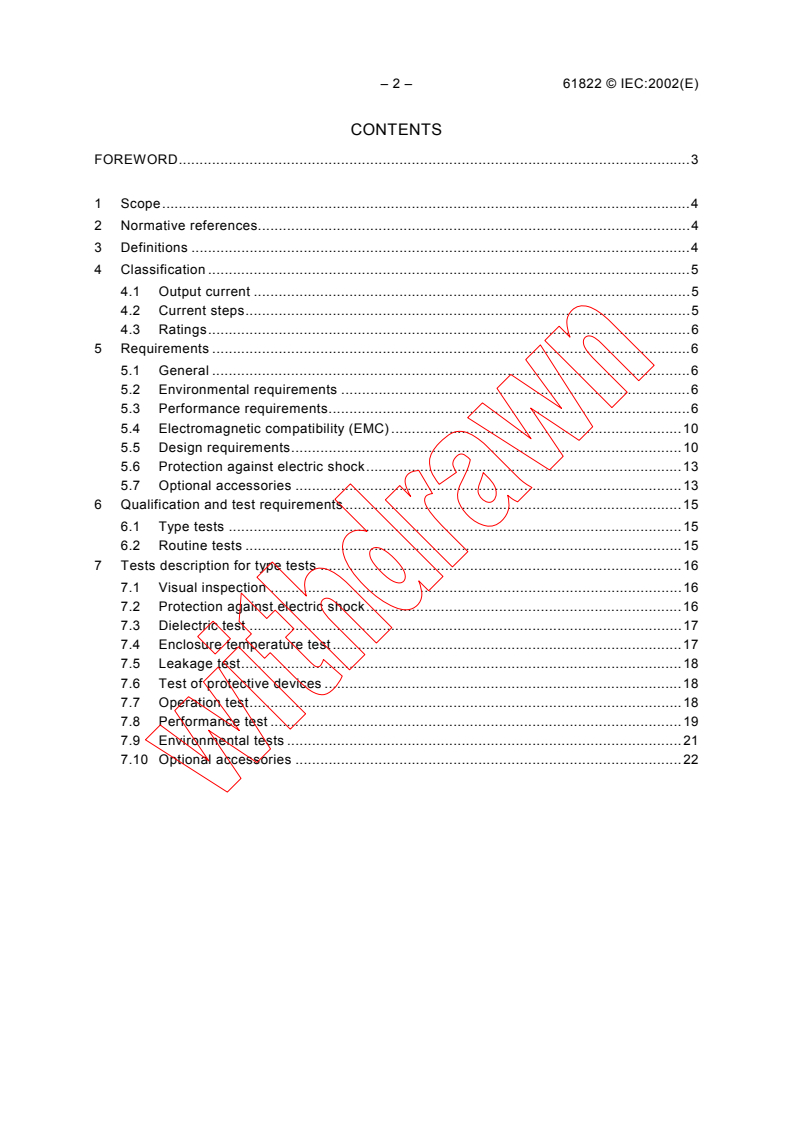
– 2 – 61822 © IEC:2002(E)
CONTENTS
FOREWORD.3
1 Scope.4
2 Normative references.4
3 Definitions .4
4 Classification .5
4.1 Output current .5
4.2 Current steps.5
4.3 Ratings.6
5 Requirements .6
5.1 General .6
5.2 Environmental requirements .6
5.3 Performance requirements.6
5.4 Electromagnetic compatibility (EMC) .10
5.5 Design requirements.10
5.6 Protection against electric shock.13
5.7 Optional accessories .13
6 Qualification and test requirements .15
6.1 Type tests .15
6.2 Routine tests .15
7 Tests description for type tests .16
7.1 Visual inspection .16
7.2 Protection against electric shock.16
7.3 Dielectric test .17
7.4 Enclosure temperature test .17
7.5 Leakage test.18
7.6 Test of protective devices .18
7.7 Operation test.18
7.8 Performance test .19
7.9 Environmental tests .21
7.10 Optional accessories .22
61822 © IEC:2002(E) – 3 –
INTERNATIONAL ELECTROTECHNICAL COMMISSION
____________
ELECTRICAL INSTALLATIONS FOR LIGHTING
AND BEACONING OF AERODROMES –
CONSTANT CURRENT REGULATORS
FOREWORD
1) The IEC (International Electrotechnical Commission) is a worldwide organization for standardization comprising
all national electrotechnical committees (IEC National Committees). The object of the IEC is to promote
international co-operation on all questions concerning standardization in the electrical and electronic fields. To
this end and in addition to other activities, the IEC publishes International Standards. Their preparation is
entrusted to technical committees; any IEC National Committee interested in the subject dealt with may
participate in this preparatory work. International, governmental and non-governmental organizations liasing with
the IEC also participate in this preparation. The IEC collaborates closely with the International Organization for
Standardization (ISO) in accordance with conditions determined by agreement between the two organizations.
2) The formal decisions or agreements of the IEC on technical matters express, as nearly as possible, an
international consensus of opinion on the relevant subjects since each technical committee has representation
from all interested National Committees.
3) The documents produced have the form of recommendations for international use and are published in the form
of standards, technical specifications, technical reports or guides and they are accepted by the National
Committees in that sense.
4) In order to promote international unification, IEC National Committees undertake to apply IEC International
Standards transparently to the maximum extent possible in their national and regional standards. Any
divergence between the IEC Standard and the corresponding national or regional standard shall be clearly
indicated in the latter.
5) The IEC provides no marking procedure to indicate its approval and cannot be rendered responsible for any
equipment declared to be in conformity with one of its standards.
6) Attention is drawn to the possibility that some of the elements of this International Standard may be the subject
of patent rights. The IEC shall not be held responsible for identifying any or all such patent rights.
International Standard IEC 61822 has been prepared by IEC Technical Committee 97:
Electrical installations for lighting and beaconing of aerodromes.
The text of this standard is based on the following documents:
FDIS Report on voting
97/86/FDIS 97/90/RVD
Full information on the voting for the approval of this standard can be found in the report on
voting indicated in the above table.
This publication has been drafted in accordance with the ISO/IEC Directives, Part 3.
The committee has decided that the contents of this publication will remain unchanged until
2006. At this date, the publication will be
• reconfirmed;
• withdrawn;
• replaced by a revised edition, or
• amended.
– 4 – 61822 © IEC:2002(E)
ELECTRICAL INSTALLATIONS FOR LIGHTING
AND BEACONING OF AERODROMES –
CONSTANT CURRENT REGULATORS
1 Scope
This International Standard specifies the requirements for a Constant Current Regulator (CCR)
having a nominal output of 6,6 A for use in an aeronautical ground lighting constant current
series circuit. However CCRs may be manufactured which have a different power rating (kVA)
and current steps than those specified in this standard in order to be used on existing circuits.
This standard shall be applied where appropriate for these CCRs.
2 Normative references
The following referenced documents are indispensable for the application of this document. For
dated references, only the edition cited applies. For undated references, the latest edition of
the referenced document (including any amendments) applies.
IEC 60038, IEC standard voltages
IEC 60439-1:1991, Low-voltage switchgear and controlgear assemblies – Part 1: Type-tested
and partially type-tested assemblies
IEC 60529, Degrees of protection provided by enclosures (IP Code)
IEC 61000-6-2, Electromagnetic compatibility (EMC) – Part 6-2: Generic standards – Immunity
for industrial environments
IEC 61000-6-4, Electromagnetic compatibility (EMC) – Part 6: Generic standards – Section 4:
Emission standard for industrial environments
IEC/TS 61000-6-5, Electromagnetic compatibility (EMC) – Part 6-5: Generic standards –
Immunity for power station and substation environments
IEC 61140, Protection against electric shock – Common aspects for installation of equipment
CISPR 11, Industrial, scientific and medical (ISM) radio-frequency equipment – Electromagnetic
disturbance characteristics – Limits and methods of measurement
CISPR 22, Information technology equipment – Radio disturbance characteristics – Limits and
methods of measurement
3 Terms and definitions
For the purposes of this International Standard, the following definitions developed to be
included in international standards relating to airport/aerodrome visual aids apply
3.1
aeronautical ground lighting (AGL) constant current series circuit
apparatus configured as an electrical circuit designed to produce and operate with a constant
current, independent of variations in the load, in order to provide a specified light for aero-
nautical purposes
61822 © IEC:2002(E) – 5 –
3.2
constant current regulator (CCR)
apparatus which produces a current output at a constant r.m.s. value independent of variations
in the constant current series circuit load, input voltage and service conditions as specified
3.3
contractor
organisation or person(s) given a written order to provide a service or undertake specified work
3.4
earthed
connected to the ground in such a manner as to ensure at all times an immediate discharge of
electrical energy to reduce the danger of equipment damage or personnel injury
3.5
electrical equipment
anything used, intended to be used or installed for use, to generate, provide, transmit,
transform, rectify, convert, conduct, distribute, control, store, measure or use electrical energy
3.6
injury
death or personnel injury from electric shock, electric burn, electrical explosion or arcing, or
from fire or explosion initiated by electrical energy, where any such death or injury is
associated with the generation, provision, transmission, transformation, rectification,
conversion, conduction, distribution, control, storage, measurement or use of electrical energy
3.7
isolate
to disconnect and separate electrical equipment from the normal source(s) of electrical energy
in such a way that the disconnection and separation is secure
3.8
live
electrically connected to a source of electricity or having acquired a charge by other means
3.9
work/working (on electrical equipment)
installing, dismantling, assembling, maintaining or repairing of electrical equipment
4 Classification
4.1 Output current
The CCR shall produce a maximum rated r.m.s. current output of 6,6 A and a minimum rated
r.m.s. current output of 1,8 A.
4.2 Current steps
CCRs shall be classified according to the number of output current steps available, as follows:
style 1 3 current steps;
style 2 5 current steps.
Each step shall have a single adjustment over the full range specified in 4.1.
NOTE An additional low current step(s) for non-illumination purposes may be offered as an option (see5.7.6).
Each style CCR can be configured to operate with a reduced number of current steps.
– 6 – 61822 © IEC:2002(E)
4.3 Ratings
CCRs shall be manufactured in the following output power ratings:
1; 2,5; 5; 7,5; 10; 15; 20; 25; and 30 kVA.
NOTE 1 There may be situations where greater power rating is required than that specified in this International
Standard to meet existing circuit requirements. In this case, the CCR should meet the applicable performance,
qualification and safety requirements contained in this International Standard.
The standard input voltage to the CCR (see 5.3.5) shall be a single-phase or three-phase value
in accordance with IEC 60038.
NOTE 2 Input voltage configured between two phases of a three-phase system is defined as single-phase.
The operating frequency shall be 50 Hz ± 7,5 % or 60 Hz ± 7,5 %.
NOTE 3 The CCR may be designed to operate from a d.c. power source.
5 Requirements
5.1 General
The following requirements are grouped into six categories: environmental, performance, EMC,
design, protection against electric shock and optional accessories.
5.2 Environmental requirements
The equipment shall be designed for continuous indoor operation without derating, under the
following conditions:
– temperature range from 0 °C to +50 °C;
– relative humidity from 10 % to 95 % without dewing;
– altitude from sea-level to 1 000 m;
– electromagnetic compatibility – as per IEC 61000-6-2.
5.3 Performance requirements
5.3.1 Regulation – resistive loading
The CCR shall maintain the output current within the limits of table 1 while powering any
resistive load between no load (short circuit) and full load. CCRs shall provide regulation over
the full range of environmental conditions specified in 5.2 and the input voltage range of 90 %
to 110 %.
When current steps different than those shown below are used, the tolerances (± 0,1 A) used
in table 1 shall be maintained.
61822 © IEC:2002(E) – 7 –
Table 1 – Nominal CCR output current range
Nominal output Allowable range
Style Current step
(A r.m.s.) (A r.m.s.)
3 6,60 6,50 – 6,70
1 2 5,50 5,40 – 5,60
1 4,80 4,70 – 4,90
5 6,60 6,50 – 6,70
4 5,20 5,10 – 5,30
2 3 4,10 4,00 – 4,20
2 3,40 3,30 – 3,50
1 2,80 2,70 – 2,90
5.3.2 Regulation – reactive loading
The CCR shall maintain the current within the limits of table 1 for all current steps when the
load has an inductive power factor of 0,60.
5.3.3 Efficiency
At all current steps, the average efficiency of the CCR, operating at rated input voltage into a
full nominal resistive load shall not be less than 80 %.
5.3.4 Power factor
The power factor of the CCR, operating at rated input voltage into a full nominal resistive load
shall not be less than 0,90.
5.3.5 Input voltage
Input voltage shall be as stated in 4.3. The CCR shall operate as required in 5.3.1 when the
input voltage is anywhere between 90 % and 110 % of the nominal input.
The CCR shall be designed to withstand momentary increases of voltage up to 120 % and
momentary decreases of voltage down to 80 % of the nominal input voltage without being de-
energized or damaged by such voltages. The CCR shall withstand such voltage excursions for
up to 50 ms within a period of 1 min. The CCR shall automatically resume normal operation
(table 1) when the input voltage returns to 90 % to 110 % of the nominal value.
5.3.6 Load matching
CCRs shall match connected loads from 50 % to 100 % of the rated load.
For resistive loads in the range of 50 % to 100 % of the rated load, at the rated input voltage,
and with an output current at 100 %, the efficiency and power factor shall not be less than the
values specified in 5.3.3 and 5.3.4. If required, additional output load taps may be provided to
allow a more precise adjustment.
5.3.7 Operation
The CCR shall stabilize the output current at any selected current step within 500 ms, and shall
hold the output current stable within the limits of table 1. There shall not be any interruption of
output current to the series circuit when switching from one current step to another.
– 8 – 61822 © IEC:2002(E)
5.3.8 Control/Monitoring System
5.3.8.1 Functions
The CCR shall be capable of being controlled locally and from a remote location. Information
on the selected current step and remote/local status shall be provided at the CCR regardless of
whether the CCR is in local or remote control.
The local control system shall be integral to the CCR and shall not be supplied from a source
located outside the CCR package. The CCR shall be capable of being controlled remotely for
any current level by parallel wiring or serial interface. The design of the remote control
interface shall provide, at least, the inputs and outputs described in table 2:
Table 2 – CCR remote control/monitoring functions
Remote control Remote monitoring
Standard Option Standard Option
a On/Off selection a CCR on
b Local/Remote
b Current step selection c Step 1 selected c1 Step 1 obtained
d Step 2 selected d1 Step 2 obtained
e Step 3 selected e1 Step 3 obtained
f Step 4 selected f1 Step 4 obtained
g Step 5 selected g1 Step 5 obtained
h CCR out of range
I Open circuit trip
J Over current trip
c CCR Non-illumination k CCR non-illumination
step step
d Circuit Selector Switch l Circuit selector fault
m Lamp fault warning
n Lamp fault alarm
o Earth fault warning
p Earth fault alarm
NOTE For the monitoring section, if (c1) to (g1) is implemented, (c) to (g) can be omitted
5.3.8.2 Control interface
The standard source voltage for controlling and monitoring the CCR shall be +48 V d.c.,
+24 V d.c. or +60 V d.c. nominal, with the negative pole being common. Remote control power
shall be provided from a source either external or internal to the CCR. If internal, a dedicated
power supply shall be for remote control only.
Relays or other isolating devices shall be provided for switching on and setting the current
steps of the CCR.
Monitoring of the CCR data output shall be provided by relay contacts or another isolating
device rated at minimum 60 V d.c. and 50 mA. Where a common pole is used, it shall be
negative.
61822 © IEC:2002(E) – 9 –
Terminal blocks or connectors having a minimum voltage rating of 300 V shall be installed in
the control cabinet for connection of external wiring associated with monitoring and remote
2 2
control. Terminal blocks or connectors shall accommodate 0,250 mm to 2,500 mm cable with
a minimum insulation rating of 300 V. Space for spare positions shall be provided to accom-
modate optional devices.
5.3.8.3 Monitoring terminals
One terminal for each of the functions listed in 5.3.8.1 shall be provided.
5.3.8.4 Serial wiring
All controls and output functions may be optionally available using a serial interface. Output
functions may alone be optionally available through a serial interface using a protocol that
allows the use of at least layers one and two of the ISO/OSI reference model.
5.3.9 Output current surge limitation
The CCR shall be designed with a controlled feature, so that switching the CCR on and off,
changing current steps, or shorting the load, shall not damage the CCR, trip a protective
device, nor produce output current surges (transients) that will damage series incandescent
lamps. Changes of intensity due to switching of current steps in local or remote control shall
occur without over-shoots exceeding 6,7 A r.m.s.
5.3.10 Dynamic response
For sudden load variations exceeding 10 % of the load, the duration of the possible over
current condition shall be limited to one half-cycle. If the peak current reaches twice the
maximum peak current while in normal operation, (i.e. peak current in short circuit at maximum
current and maximum input voltage) or the current reaches 125 % of the maximum r.m.s.
value, the current shall be limited under 2,0 A r.m.s. after the half sine wave in progress. The
suppression shall remain for one to four cycles and then the current limits of table 1 shall be
achieved in 500 ms or less.
5.3.11 Output voltage limitation
With the open circuit protection disabled, the peak output voltage of an open-circuited CCR
shall not exceed twice the rated r.m.s. output kVA divided by the rated r.m.s. output current.
5.3.12 Protective devices
5.3.12.1 Open circuit protection
The CCR shall include an open-circuit protective device to de-energize the CCR output within
1 s after an open circuit condition (less than 1,5 A r.m.s.) occurs in the primary series circuit.
The protective device shall be reset manually from the local position only. The CCR shall not
trip out due to the switching of load circuits or other transients.
5.3.12.2 Overcurrent protection
The CCR shall include an overcurrent protective device to de-energize the CCR output
between 3 s and 5 s when the output current exceeds 6,75 A r.m.s. The CCR shall de-energize
the output within 300 ms when the output current exceeds 8,30 A r.m.s. The protective device
shall be reset manually from the local position only.
5.3.12.3 Primary switching
The CCR shall have an electro-mechanical isolating device that interrupts the input power
before it reaches the main power transformer and shall not interrupt internal control power.
– 10 – 61822 © IEC:2002(E)
5.3.12.4 Short circuit protection
The CCR shall have short-circuit protection on the primary side of the power transformer
appropriate to the fault current level.
5.3.12.5 Input power loss
In the event of an input power loss for up to 1 min, the CCR shall resume operation on the
selected current setting within 500 ms after the restoration of input power.
5.3.12.6 Output series circuit switching
When the CCR is used with a circuit selector, the CCR shall not lock-out or produce surges
that would damage the connected series circuits.
Means shall be provided for interlocking the CCR and circuit selector switch. A breaking switch
in the circuit selector switch shall force the CCR output current to zero while the circuit selector
switch is operating.
5.4 Electromagnetic compatibility (EMC)
5.4.1 Limits for emission
CCRs shall comply with IEC 61000-6-4, the EMC generic emission standard for industrial
environments. Radiated emission limits shall be in accordance with CISPR 11, class B.
5.4.2 Output current waveform
The CCR shall provide an output current waveform with a crest factor of less than 3,2 at all
current steps at the nominal input voltage and with 10 % resistive load.
5.4.3 Limits for immunity
CCRs shall comply with the generic immunity standards for industrial environments
IEC 61000-6-2, supplemented by applicable parts of IEC/TS 61000-6-5 containing EMC
immunity requirements for power station and substation environments (locations where
apparatus for electricity utilities are installed). CCRs shall comply with requirements for
apparatus installed in type G locations (power stations and medium voltage substations) as
defined in IEC/TS 61000-6-5.
5.5 Design requirements
5.5.1 Local control and indication
The CCR shall be capable of being locally controlled to provide the following functions:
– on/off;
– local/remote control;
– current steps.
The CCR shall indicate the following conditions on the front of the unit:
– an alarm indication that an open-circuit trip-out has occurred;
– an alarm indication that an over current trip-out has occurred;
– an indication that the CCR input voltage is present;
– an indication of local/remote control;
– the selected current step;
– an indication that the output current is present.
61822 © IEC:2002(E) – 11 –
5.5.2 Output current indication
An indication of output current shall be installed on the front panel of the CCR.
5.5.3 Power transformer
The temperature rise of the power transformer windings shall remain within the limits of the
class of insulation utilized, taking into consideration an elevated ambient temperature of 50 °C
resulting in an 80 % derating factor for components.
5.5.4 Wiring diagram
A wiring diagram showing all customer connection points shall be permanently readable, and
located in a visible place in the CCR.
5.5.5 Mechanical design
The CCR shall be constructed only of materials capable of withstanding the mechanical,
electrical, and thermal stresses as well as the effects of humidity, which are likely to be
encountered in normal service.
Protection against corrosion shall be ensured by the use of suitable materials or by the
application of equivalent protective coatings to the exposed surface, taking account of the
intended conditions of use and maintenance.
All enclosures and partitions shall be of a mechanical strength sufficient to withstand the
stresses to which they may be subjected in normal service.
The CCR cabinet shall be designed for ease of installation movement of the unit (e.g. rollers,
lifting rings, etc.).
The apparatus and circuits in the CCR shall be so arranged as to facilitate their operation and
maintenance and at the same time to ensure the necessary degree of safety.
The CCR shall be designed
...