

IEC 62841-4-1:2017
(Main)Electric motor-operated hand-held tools, transportable tools and lawn and garden machinery - Safety - Part 4-1: Particular requirements for chain saws
General Information
- Abstract
IEC 62841-4-1:2017 applies to chain saws for cutting wood and designed for use by one person. This standard does not cover chain saws designed for use in conjunction with a guide-plate and riving knife or in any other way such as with a support or as a stationary or transportable machine.
This standard does not apply to chain saws for tree service as defined in ISO 11681-2; or pole-mounted pruners.
Pole-mounted pruners will be covered by a future part of IEC 62841.
The chain saws covered by this standard are designed only to be operated with the right hand on the rear handle and the left hand on the front handle.
This Part 4-1 is to be used in conjunction with the first edition of IEC 62841-1:2014.
The attention of National Committees is drawn to the fact that equipment manufacturers and testing organizations may need a transitional period following publication of a new, amended or revised IEC publication in which to make products in accordance with the new requirements and to equip themselves for conducting new or revised tests.
It is the recommendation of the committee that the content of this publication be adopted for implementation nationally not earlier than 36 months from the date of publication.
- Status
- Published
- Publication Date
- 21-Oct-2024
- Technical Committee
- TC 116 - Safety of motor-operated electric tools
- Drafting Committee
- WG 10 - TC 116/WG 10
- Current Stage
- PPUB - Publication issued
- Start Date
- 11-Oct-2017
- Completion Date
- 23-Sep-2017
Buy Documents
IEC 62841-4-1:2017+AMD1:2024 CSV - Electric motor-operated hand-held tools, transportable tools and lawn and garden machinery - Safety - Part 4-1: Particular requirements for chain saws

IEC 62841-4-1:2017 - Electric motor-operated hand-held tools, transportable tools and lawn and garden machinery - Safety - Part 4-1: Particular requirements for chain saws Released:10/11/2017
Overview
IEC 62841-4-1:2017 (consolidated edition 1.1 with AMD1:2024) is the international safety standard that defines particular requirements for chain saws driven by electric motors (hand‑held and transportable). It applies to single‑operator chain saws designed for cutting wood where the operator holds the rear handle with the right hand and the front handle with the left. The document supplements and modifies general requirements in IEC 62841-1:2014 and is intended for use by manufacturers, testing bodies and regulators involved in chain saw design, testing and conformity assessment.
Key topics and requirements
This Part 4-1 covers a comprehensive set of safety and test topics, including:
- Scope and classification of chain saw types and excluded equipment (e.g., chain saws for tree service per ISO 11681-2 and pole‑mounted pruners).
- Marking, user instructions and safety signs, including informative annexes with example instructions for felling, limbing and cross‑cutting.
- Mechanical hazards and strength requirements (chain guarding, kickback mitigation, guards and structural integrity).
- Electrical safety: protection against access to live parts, starting controls, input/current limits, insulation, creepage distances and earthing provisions.
- Environmental resistance: moisture resistance, resistance to heat/fire and corrosion, with annexes on moisture classifications for chain saws and battery packs.
- Endurance and abnormal operation tests, overload protection, leakage current measurement and component requirements.
- Noise and vibration measurement procedures (informative annex) for user exposure information.
- Battery tool specifics: normative annexes address battery packs, tools with integrated battery or mains connection and terminal/contact requirements.
- Testing guidance and test assemblies, including figures and tables for nomenclature, balance, chain geometry and test probes.
Practical applications
- Guides product design: ensures chain saws include required safety features (electrical insulation, chain brakes, guards, labeling).
- Supports conformity assessment: provides test procedures used by laboratories and certification bodies to verify compliance.
- Informs user documentation: defines required markings and instruction contents to improve safe operation and maintenance.
- Affects battery and corded chain saw models: annexes detail requirements specific to battery-powered chain saws and hybrid configurations.
Who uses this standard
- Chain saw manufacturers and designers
- Independent testing laboratories and certification bodies
- Product safety and compliance engineers
- National standards committees and regulatory agencies
- Technical writers preparing user manuals and safety labels
Related standards
- IEC 62841-1:2014 (general safety for motor‑operated hand‑held tools) - this Part 4‑1 is to be used in conjunction with Part 1.
- ISO 11681-2 (tree service chain saws) - referenced as excluded in scope.
Keywords: IEC 62841-4-1, chain saw safety standard, chain saw testing, battery chain saw, IEC chain saw standard, motor‑operated hand‑held tools.
Relations
- Effective Date
- 04-Sep-2026
- Effective Date
- 04-Sep-2026
- Effective Date
- 05-Sep-2023
Buy Documents
IEC 62841-4-1:2017+AMD1:2024 CSV - Electric motor-operated hand-held tools, transportable tools and lawn and garden machinery - Safety - Part 4-1: Particular requirements for chain saws
IEC 62841-4-1:2017 - Electric motor-operated hand-held tools, transportable tools and lawn and garden machinery - Safety - Part 4-1: Particular requirements for chain saws Released:10/11/2017
Get Certified
Connect with accredited certification bodies for this standard

DVS-ZERT GmbH
German welding certification society.

ANCE
Mexican certification and testing association.
CARES (UK Certification Authority for Reinforcing Steels)
UK certification for reinforcing steels and construction.
Sponsored listings
Frequently Asked Questions
IEC 62841-4-1:2017 is a standard published by the International Electrotechnical Commission (IEC). Its full title is "Electric motor-operated hand-held tools, transportable tools and lawn and garden machinery - Safety - Part 4-1: Particular requirements for chain saws". This standard covers: IEC 62841-4-1:2017 applies to chain saws for cutting wood and designed for use by one person. This standard does not cover chain saws designed for use in conjunction with a guide-plate and riving knife or in any other way such as with a support or as a stationary or transportable machine. This standard does not apply to chain saws for tree service as defined in ISO 11681-2; or pole-mounted pruners. Pole-mounted pruners will be covered by a future part of IEC 62841. The chain saws covered by this standard are designed only to be operated with the right hand on the rear handle and the left hand on the front handle. This Part 4-1 is to be used in conjunction with the first edition of IEC 62841-1:2014. The attention of National Committees is drawn to the fact that equipment manufacturers and testing organizations may need a transitional period following publication of a new, amended or revised IEC publication in which to make products in accordance with the new requirements and to equip themselves for conducting new or revised tests. It is the recommendation of the committee that the content of this publication be adopted for implementation nationally not earlier than 36 months from the date of publication.
IEC 62841-4-1:2017 applies to chain saws for cutting wood and designed for use by one person. This standard does not cover chain saws designed for use in conjunction with a guide-plate and riving knife or in any other way such as with a support or as a stationary or transportable machine. This standard does not apply to chain saws for tree service as defined in ISO 11681-2; or pole-mounted pruners. Pole-mounted pruners will be covered by a future part of IEC 62841. The chain saws covered by this standard are designed only to be operated with the right hand on the rear handle and the left hand on the front handle. This Part 4-1 is to be used in conjunction with the first edition of IEC 62841-1:2014. The attention of National Committees is drawn to the fact that equipment manufacturers and testing organizations may need a transitional period following publication of a new, amended or revised IEC publication in which to make products in accordance with the new requirements and to equip themselves for conducting new or revised tests. It is the recommendation of the committee that the content of this publication be adopted for implementation nationally not earlier than 36 months from the date of publication.
IEC 62841-4-1:2017 is classified under the following ICS (International Classification for Standards) categories: 25.140.20 - Electric tools; 33.100.20 - Immunity. The ICS classification helps identify the subject area and facilitates finding related standards.
IEC 62841-4-1:2017 has the following relationships with other standards: It is inter standard links to IEC 60745-2-13:2006/AMD1:2009, IEC 60745-2-13:2006, IEC 62841-4-1:2017/AMD1:2024. Understanding these relationships helps ensure you are using the most current and applicable version of the standard.
IEC 62841-4-1:2017 is available in PDF format for immediate download after purchase. The document can be added to your cart and obtained through the secure checkout process. Digital delivery ensures instant access to the complete standard document.
Standards Content (Sample)
IEC 62841-4-1 ®
Edition 1.1 2024-10
CONSOLIDATED VERSION
INTERNATIONAL
STANDARD
colour
inside
Electric motor-operated hand-held tools, transportable tools and lawn and
garden machinery – Safety –
Part 4-1: Particular requirements for chain saws
All rights reserved. Unless otherwise specified, no part of this publication may be reproduced or utilized in any form
or by any means, electronic or mechanical, including photocopying and microfilm, without permission in writing from
either IEC or IEC's member National Committee in the country of the requester. If you have any questions about IEC
copyright or have an enquiry about obtaining additional rights to this publication, please contact the address below or
your local IEC member National Committee for further information.
IEC Secretariat Tel.: +41 22 919 02 11
3, rue de Varembé info@iec.ch
CH-1211 Geneva 20 www.iec.ch
Switzerland
About the IEC
The International Electrotechnical Commission (IEC) is the leading global organization that prepares and publishes
International Standards for all electrical, electronic and related technologies.
About IEC publications
The technical content of IEC publications is kept under constant review by the IEC. Please make sure that you have the
latest edition, a corrigendum or an amendment might have been published.
IEC publications search - webstore.iec.ch/advsearchform IEC Products & Services Portal - products.iec.ch
The advanced search enables to find IEC publications by a Discover our powerful search engine and read freely all the
variety of criteria (reference number, text, technical publications previews, graphical symbols and the glossary.
committee, …). It also gives information on projects, replaced With a subscription you will always have access to up to date
and withdrawn publications. content tailored to your needs.
IEC Just Published - webstore.iec.ch/justpublished
Electropedia - www.electropedia.org
Stay up to date on all new IEC publications. Just Published
The world's leading online dictionary on electrotechnology,
details all new publications released. Available online and once
containing more than 22 500 terminological entries in English
a month by email.
and French, with equivalent terms in 25 additional languages.
Also known as the International Electrotechnical Vocabulary
IEC Customer Service Centre - webstore.iec.ch/csc
(IEV) online.
If you wish to give us your feedback on this publication or need
further assistance, please contact the Customer Service
Centre: sales@iec.ch.
IEC 62841-4-1 ®
Edition 1.1 2024-10
CONSOLIDATED VERSION
INTERNATIONAL
STANDARD
colour
inside
Electric motor-operated hand-held tools, transportable tools and lawn and
garden machinery – Safety –
Part 4-1: Particular requirements for chain saws
INTERNATIONAL
ELECTROTECHNICAL
COMMISSION
ICS 25.140.20 ISBN 978-2-8322-9948-7
REDLINE VERSION – 2 – IEC 62841-4-1:2017+AMD1:2024 CSV
© IEC 2024
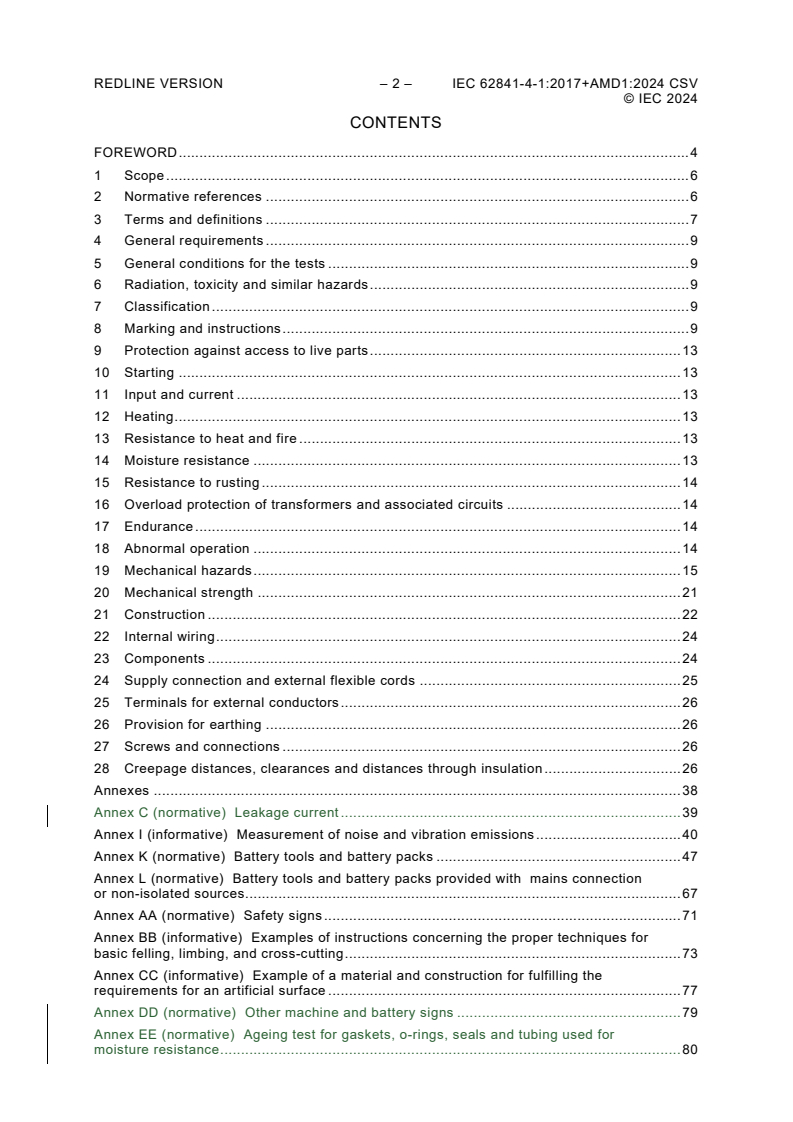
CONTENTS
FOREWORD . 4
1 Scope . 6
2 Normative references . 6
3 Terms and definitions . 7
4 General requirements . 9
5 General conditions for the tests . 9
6 Radiation, toxicity and similar hazards . 9
7 Classification . 9
8 Marking and instructions . 9
9 Protection against access to live parts . 13
10 Starting . 13
11 Input and current . 13
12 Heating . 13
13 Resistance to heat and fire . 13
14 Moisture resistance . 13
15 Resistance to rusting . 14
16 Overload protection of transformers and associated circuits . 14
17 Endurance . 14
18 Abnormal operation . 14
19 Mechanical hazards . 15
20 Mechanical strength . 21
21 Construction . 22
22 Internal wiring . 24
23 Components . 24
24 Supply connection and external flexible cords . 25
25 Terminals for external conductors . 26
26 Provision for earthing . 26
27 Screws and connections . 26
28 Creepage distances, clearances and distances through insulation . 26
Annexes . 38
Annex C (normative) Leakage current . 39
Annex I (informative) Measurement of noise and vibration emissions . 40
Annex K (normative) Battery tools and battery packs . 47
Annex L (normative) Battery tools and battery packs provided with mains connection
or non-isolated sources . 67
Annex AA (normative) Safety signs . 71
Annex BB (informative) Examples of instructions concerning the proper techniques for
basic felling, limbing, and cross-cutting . 73
Annex CC (informative) Example of a material and construction for fulfilling the
requirements for an artificial surface . 77
Annex DD (normative) Other machine and battery signs . 79
Annex EE (normative) Ageing test for gaskets, o-rings, seals and tubing used for
moisture resistance . 80
© IEC 2024
Bibliography . 81
Figure 101 – Chain saw nomenclature . 31
Figure 102 – Cutting length . 32
Figure 103 – Holding the chain saw . 33
Figure 104 – Minimum rear hand guard dimensions . 33
Figure 105 – Straight test probe . 34
Figure 106 – Measuring direction of static activation force F . 34
Figure 107 – Impact direction and pendulum . 35
Figure 108 – Saw chain drive link spacing . 35
Figure 109 – Chain saw balance . 36
Figure 110 – Test assembly for accessibility of attachment plug blades . 36
Figure 111 – Application of steel rod when rotated around the rear handle . 37
Figure 112 – Application of steel rod when applied in the direction perpendicular to the
rear handle axis . 37
Figure I.101 – Microphone positions on the hemisphere (see Table I.101) . 45
Figure I.102 – Positions of transducers for chain saws . 46
Figure BB.101 – Description of felling: escape routes . 74
Figure BB.102 – Description of felling: undercutting . 75
Figure BB.103 – Tree limbing . 75
Figure BB.104 – Log supported along the entire length . 75
Figure BB.105 – Log supported one end . 76
Figure BB.106 – Log supported both ends . 76
Figure BB.107 – Cross-cutting/bucking a log . 76
Figure CC.1 – Sketch of the measurement surface covered with an artificial surface
(not to scale). 78
Table 4 – Required performance levels . 15
Table 12 – Minimum creepage distances and clearances . 28
Table I.101 – Co-ordinates of microphone positions . 42
Table I.102 – Absorption coefficients . 42
Table I.103 – Test conditions . 45
Table K.301 – Chain saw moisture resistance classification and marking . 49
Table K.302 – Battery pack moisture resistance classification and marking. 51
Table K.303 – Permissible contact area for terminals . 54
Table K.1 – Minimum creepage distances and clearances between parts of different
potential . 65
Table K.2 – Minimum total sum of creepage distances and clearances to accessible
surfaces . 66
Table EE.1 – Accelerated ageing test . 80
REDLINE VERSION – 4 – IEC 62841-4-1:2017+AMD1:2024 CSV
© IEC 2024
INTERNATIONAL ELECTROTECHNICAL COMMISSION
____________
ELECTRIC MOTOR-OPERATED HAND-HELD TOOLS, TRANSPORTABLE
TOOLS AND LAWN AND GARDEN MACHINERY – SAFETY –
Part 4-1: Particular requirements for chain saws
FOREWORD
1) The International Electrotechnical Commission (IEC) is a worldwide organization for standardization comprising
all national electrotechnical committees (IEC National Committees). The object of IEC is to promote
international co-operation on all questions concerning standardization in the electrical and electronic fields. To
this end and in addition to other activities, IEC publishes International Standards, Technical Specifications,
Technical Reports, Publicly Available Specifications (PAS) and Guides (hereafter referred to as “IEC
Publication(s)”). Their preparation is entrusted to technical committees; any IEC National Committee interested
in the subject dealt with may participate in this preparatory work. International, governmental and non-
governmental organizations liaising with the IEC also participate in this preparation. IEC collaborates closely
with the International Organization for Standardization (ISO) in accordance with conditions determined by
agreement between the two organizations.
2) The formal decisions or agreements of IEC on technical matters express, as nearly as possible, an international
consensus of opinion on the relevant subjects since each technical committee has representation from all
interested IEC National Committees.
3) IEC Publications have the form of recommendations for international use and are accepted by IEC National
Committees in that sense. While all reasonable efforts are made to ensure that the technical content of IEC
Publications is accurate, IEC cannot be held responsible for the way in which they are used or for any
misinterpretation by any end user.
4) In order to promote international uniformity, IEC National Committees undertake to apply IEC Publications
transparently to the maximum extent possible in their national and regional publications. Any divergence
between any IEC Publication and the corresponding national or regional publication shall be clearly indicated in
the latter.
5) IEC itself does not provide any attestation of conformity. Independent certification bodies provide conformity
assessment services and, in some areas, access to IEC marks of conformity. IEC is not responsible for any
services carried out by independent certification bodies.
6) All users should ensure that they have the latest edition of this publication.
7) No liability shall attach to IEC or its directors, employees, servants or agents including individual experts and
members of its technical committees and IEC National Committees for any personal injury, property damage or
other damage of any nature whatsoever, whether direct or indirect, or for costs (including legal fees) and
expenses arising out of the publication, use of, or reliance upon, this IEC Publication or any other IEC
Publications.
8) Attention is drawn to the Normative references cited in this publication. Use of the referenced publications is
indispensable for the correct application of this publication.
9) IEC draws attention to the possibility that the implementation of this document may involve the use of (a)
patent(s). IEC takes no position concerning the evidence, validity or applicability of any claimed patent rights in
respect thereof. As of the date of publication of this document, IEC had received notice of (a) patent(s), which
may be required to implement this document. However, implementers are cautioned that this may not represent
the latest information, which may be obtained from the patent database available at https://patents.iec.ch. IEC
shall not be held responsible for identifying any or all such patent rights.
This consolidated version of the official IEC Standard and its amendment has been
prepared for user convenience.
IEC 62841-4-1 edition 1.1 contains the first edition (2017-10) [documents 116/339/FDIS
and 116/344/RVD] and its amendment 1 (2024-10) [documents 116/816/FDIS and
116/837/RVD].
In this Redline version, a vertical line in the margin shows where the technical content
is modified by amendment 1. Additions are in green text, deletions are in strikethrough
red text. A separate Final version with all changes accepted is available in this
publication.
© IEC 2024
International Standard IEC 62841-4-1 has been prepared by IEC technical committee 116:
Safety of motor-operated electric tools.
This document has been drafted in accordance with the ISO/IEC Directives, Part 2.
This Part 4-1 is to be used in conjunction with the first edition of IEC 62841-1 (2014).
This Part 4-1 supplements or modifies the corresponding clauses in IEC 62841-1, so as to
convert it into the IEC Standard: Particular requirements for chain saws.
Where a particular subclause of Part 1 is not mentioned in this Part 4-1, that subclause
applies as far as relevant. Where this standard states “addition”, “modification” or
“replacement”, the relevant text in Part 1 is to be adapted accordingly.
The following print types are used:
– requirements: in roman type;
– test specifications: in italic type;
– notes: in small roman type;
– terms defined in Clause 3: in bold typeface.
Subclauses, notes, tables and figures which are additional to those in Part 1, except as
described for Annex K and Annex L below, are numbered starting from 101.
Subclauses, notes, tables and figures in Annex K and Annex L which are additional to those in
the main body of this Part 4-1 as well as Annex K and Annex L of Part 1 are numbered
starting from 301.
A list of all parts of the IEC 62841 series, under the general title: Electric motor-operated
hand-held tools, transportable tools and lawn and garden machinery – Safety, can be found
on the IEC website.
The committee has decided that the contents of this document and its amendment will remain
unchanged until the stability date indicated on the IEC website under webstore.iec.ch in the
data related to the specific document. At this date, the document will be
• reconfirmed,
• withdrawn, or
• revised.
NOTE The attention of National Committees is drawn to the fact that equipment manufacturers and testing
organizations may need a transitional period following publication of a new, amended or revised IEC publication in
which to make products in accordance with the new requirements and to equip themselves for conducting new or
revised tests.
It is the recommendation of the committee that the content of this publication be adopted for implementation
nationally not earlier than 36 months from the date of publication.
IMPORTANT – The 'colour inside' logo on the cover page of this publication indicates
that it contains colours which are considered to be useful for the correct
understanding of its contents. Users should therefore print this document using a
colour printer.
REDLINE VERSION – 6 – IEC 62841-4-1:2017+AMD1:2024 CSV
© IEC 2024
ELECTRIC MOTOR-OPERATED HAND-HELD TOOLS, TRANSPORTABLE
TOOLS AND LAWN AND GARDEN MACHINERY – SAFETY –
Part 4-1: Particular requirements for chain saws
1 Scope
This clause of Part 1 is applicable, except as follows:
Addition:
This standard applies to chain saws for cutting wood and designed for use by one person.
This standard does not cover chain saws designed for use in conjunction with a guide-plate
and riving knife or in any other way such as with a support or as a stationary or transportable
machine.
This standard does not apply to
– chain saws for tree service as defined in ISO 11681-2; or
– pole-mounted pruners.
NOTE 101 Pole-mounted pruners will be covered by a future part of IEC 62841.
The chain saws covered by this standard are designed only to be operated with the right
hand on the rear handle and the left hand on the front handle.
2 Normative references
This clause of Part 1 is applicable, except as follows:
Addition:
IEC 60664-3:2016, Insulation coordination for equipment within low-voltage systems – Part 3:
Use of coating, potting or moulding for protection against pollution
IEC 61672-1, Electroacoustics – Sound level meters – Part 1: Specifications
ISO 37:2017, Rubber, vulcanized or thermoplastic – Determination of tensile stress-strain
properties
ISO 354:2003, Acoustics – Measurement of sound absorption in a reverberation room
ISO 3744:2010, Acoustics – Determination of sound power levels and sound energy levels of
noise sources using sound pressure – Engineering methods for an essentially free field over a
reflecting plane
ISO 6533:20122020, Forestry machinery – Portable chain-saw front hand-guard – Dimensions
and clearances
ISO 6534:2007, Forestry machinery – Portable chain-saw hand-guards – Mechanical strength
© IEC 2024
ISO 7914:2002, Forestry machinery – Portable chain-saws – Minimum handle clearance and
sizes
ISO 7915:19912021, Forestry machinery – Portable chain-saws – Determination of handle
strength
ISO 9518:2018, Forestry machinery – Portable chain-saws – Kickback test
ISO 10726:1992, Portable chain-saws – Chain catcher – Dimensions and mechanical strength
ISO 11681-2:2011, Machinery for forestry – Portable chain-saw safety requirements and
testing – Part 2: Chain-saws for tree service
ISO 13772:2009, Forestry machinery – Portable chain saws – Non-manually actuated chain
brake performance
ISO 17080:2005, Manually portable agricultural and forestry machines and powered lawn and
garden equipment – Design principles for single-panel product safety labels
ISO 22868:2011, Forestry and gardening machinery – Noise test code for portable hand-held
machines with internal combustion engine – Engineering method (Grade 2 accuracy)
3 Terms and definitions
This clause of Part 1 is applicable, except as follows:
3.101
bar tip guard
shield that prevents contact with the saw chain at the tip of the guide bar
3.102
chain brake
function or device for stopping the saw chain activated manually or non-manually when
kickback occurs
3.102.1
manually activated chain brake
braking function triggered by the hand of the operator
3.102.2
non-manually activated chain brake
braking function triggered by kickback motion independent of operator activation
3.103
chain catcher
device for restraining the saw chain if it breaks or derails (see Figure 101)
3.104
chain saw
machine designed to cut wood with a saw chain and consisting of an integrated unit of
handles, motor, guide bar and saw chain, designed to be supported with two hands (see
Figure 101)
3.105
cutting length
approximate effective length of cut of the chain saw
REDLINE VERSION – 8 – IEC 62841-4-1:2017+AMD1:2024 CSV
© IEC 2024
Note 1 to entry: The method for determining cutting length is specified in 21.101.
3.106
drive sprocket
chain drive wheel with teeth
3.107
front hand guard
guard between the front handle and the saw chain for protecting the hand from injuries if the
hand slips off the handle (see Figure 101)
3.108
front handle
support handle located at or towards the front of the machine (see Figure 101)
3.109
guide bar
attachment that supports and guides the saw chain (see Figure 101)
3.110
kickback
rapid upward and/or backward motion of the chain saw which can occur when the moving
saw chain contacts an object such as a log or branch near the tip of the guide bar or when
the wood closes in and pinches the moving saw chain
3.111
maximum speed
highest steady-state saw chain speed attainable under all conditions of normal use,
including no-load, when adjusted in accordance with the manufacturer’s specifications and/or
instructions
Note 101 to entry: The steady-state saw chain speed excludes transients such as overshoot that can occur
before attaining a steady-state condition.
3.112
operator presence sensor
device to detect the presence of an operator’s hand
3.113
rear hand guard
extension on the lower part of the rear handle for protecting the hand from the saw chain if it
breaks or derails (see Figure 101)
3.114
rear handle
support handle located towards the rear of the machine (see Figure 101)
3.115
saw chain
attachment, serving as a cutting tool, consisting of drive links and cutters (see Figure 101
and Figure 108)
3.116
spiked bumper
device, fitted in front of the guide bar mounting point, acting as a pivot when in contact with a
tree or log (see Figure 101 and Figure 102)
© IEC 2024
4 General requirements
This clause of Part 1 is applicable.
5 General conditions for the tests
This clause of Part 1 is applicable, except as follows:
5.14 Addition:
For tests carried out at any percentage of rated input or rated current, except for no-load,
the saw chain and the guide bar may be removed and the chain saw loaded by means of a
brake.
5.15 Addition:
For tests carried out at any percentage of rated input or rated current, except for no-load,
the saw chain and the guide bar may be removed and the chain saw loaded by means of a
brake.
5.17 Addition:
The mass of the machine includes the heaviest guide bar and saw chain combination in
accordance with 8.14.2 c) 101) as well as the lubrication tank, if any, filled to the maximum
specified level, but excludes the guide bar cover.
5.101 For tests that are performed at maximum speed and no-load, the manufacturer may
need to provide special hardware and/or software.
6 Radiation, toxicity and similar hazards
This clause of Part 1 is applicable.
7 Classification
This clause of Part 1 is applicable, except as follows:
7.2 Replacement:
Chain saws shall not be classified with a degree of protection against harmful ingress of
water higher than IPX0 according to IEC 60529:1989, IEC 60529:1989/AMD1:1999 and
IEC 60529:1989/AMD2:2013.
Compliance is checked by inspection.
8 Marking and instructions
This clause of Part 1 is applicable, except as follows:
REDLINE VERSION – 10 – IEC 62841-4-1:2017+AMD1:2024 CSV
© IEC 2024
8.1 Replacement:
Chain saws shall be marked with rating information as follows:
– rated voltage(s) or rated voltage range, in volts. Machines for star-delta connection shall
be clearly marked with the two rated voltages (for example 230 Δ/ 400 Y). A machine that
complies with this standard for a voltage range, may also be marked with any single
voltage or smaller voltage range within that range;
– symbol for nature of supply, unless the rated frequency(ies) or rated frequency range is
marked. The symbol for nature of supply shall be placed next to the marking for rated
voltage;
– rated input, in watts or rated current, in amperes. The rated input or rated current to
be marked on the machine is the total maximum input or current that can be drawn from
external circuit at the same time. If a machine has alternative components which can be
selected by a control device, the rated input or rated current is that corresponding to
the highest loading possible;
– symbol for class II construction, for class II tools (machines) only.
8.1.101 Chain saws shall not be marked with an IP rating for the degree of protection
against harmful ingress of water higher than IPX0 in accordance with IEC 60529:1989,
IEC 60529:1989/AMD1:1999 and IEC 60529:1989/AMD2:2013. Chain saws may be marked
with an IP rating for the degree of protection against solid foreign objects and access to
hazardous parts in accordance with IEC 60529:1989, IEC 60529:1989/AMD1:1999 and
IEC 60529:1989/AMD2:2013.
Compliance is checked by inspection.
8.2 Addition:
Chain saws shall be marked with safety information which shall be written in one of the
official languages of the country in which the machine is to be sold or marked with the
appropriate symbol:
– “Wear eye protection” or a relevant safety sign of ISO 7010 or the safety sign specified in
Annex AA;
– “Wear ear protection”, a relevant safety sign of ISO 7010 or the safety sign specified in
Annex AA. This marking may be omitted if the measured sound pressure level at the
operator’s ear in accordance with Annex I does not exceed 85 dB(A).
A combination of ISO safety signs, such as eye, ear, dust and head protection, is allowed. In
addition, a combination of safety signs as specified in Annex AA is allowed.
– “Do not expose to rain” or the safety sign specified in Annex AA, unless the chain saw
has a degree of protection of at least IPX4.
– "Beware of chain saw kickback and avoid contact with bar tip”, or A.1.3 of
ISO 17080:2005.
– “Always use chain saw two-handed” or A.3.1 of ISO 17080:2005.
For mains supplied machines:
“Remove plug from the mains immediately if the cable is damaged or cut” or the safety sign
specified in Annex AA.
8.3 Addition:
Chain saws shall be marked with the following:
– specified nominal guide bar size or size range;
© IEC 2024
NOTE 101 The nominal guide bar size is not necessarily the same as the cutting length.
– identification of the direction of rotation of the saw chain by a legible and durable mark on
the body of the machine. This may be located under the drive sprocket cover.
8.14.1 Addition:
The additional safety instructions as specified in 8.14.1.101 shall be given. This part may be
printed separately from the “General Machine Safety Warnings”.
8.14.1.101 Safety instructions for chain saws
1) General chain saw safety warnings:
a) Keep all parts of the body away from the saw chain when the chain saw is
operating. Before you start the chain saw, make sure the saw chain is not
contacting anything. A moment of inattention while operating chain saws may cause
entanglement of your clothing or body with the saw chain.
b) Always hold the chain saw with your right hand on the rear handle and your left
hand on the front handle. Holding the chain saw with a reversed hand configuration
increases the risk of personal injury and should never be done.
c) Hold the chain saw by insulated gripping surfaces only, because the saw chain
may contact hidden wiring or its own cord. Saw chains contacting a "live" wire may
make exposed metal parts of the chain saw "live" and could give the operator an
electric shock.
d) Wear eye protection. Further protective equipment for hearing, head, hands, legs
and feet is recommended. Adequate protective equipment will reduce personal injury
from flying debris or accidental contact with the saw chain.
e) Do not operate a chain saw in a tree, on a ladder, from a rooftop, or any unstable
support. Operation of a chain saw in this manner could result in serious personal
injury.
f) Always keep proper footing and operate the chain saw only when standing on
fixed, secure and level surface. Slippery or unstable surfaces may cause a loss of
balance or control of the chain saw.
g) When cutting a limb that is under tension, be alert for spring back. When the
tension in the wood fibres is released, the spring loaded limb may strike the operator
and/or throw the chain saw out of control.
h) Use extreme caution when cutting brush and saplings. The slender material may
catch the saw chain and be whipped toward you or pull you off balance.
i) Carry the chain saw by the front handle with the chain saw switched off and away
from your body. When transporting or storing the chain saw, always fit the guide
bar cover. Proper handling of the chain saw will reduce the likelihood of accidental
contact with the moving saw chain.
j) Follow instructions for lubricating, chain tensioning and changing the bar and
chain. Improperly tensioned or lubricated chain may either break or increase the
chance for kickback.
k) Cut wood only. Do not use chain saw for purposes not intended. For example: do
not use chain saw for cutting metal, plastic, masonry or non-wood building
materials. Use of the chain saw for operations different than intended could result in a
hazardous situation.
l) Do not attempt to fell a tree until you have an understanding of the risks and how
to avoid them. Serious injury could occur to the operator or bystanders while felling a
tree.
NOTE The above warning is omitted for chain saws that are not suitable for tree felling as specified by
the manufacturer. See 8.14.2 b) 104).
m) This chain saw is not intended for tree felling. Use of the chain saw for operations
different than intended could result in serious injury to the operator or bystanders.
REDLINE VERSION – 12 – IEC 62841-4-1:2017+AMD1:2024 CSV
© IEC 2024
NOTE The above warning is omitted for chain saws that are suitable for tree felling.
2) Causes and operator prevention of kickback:
Kickback may occur when the nose or tip of the guide bar touches an object, or when the
wood closes in and pinches the saw chain in the cut.
Tip contact in some cases may cause a sudden reverse reaction, kicking the guide bar up
and back towards the operator.
Pinching the saw chain along the top of the guide bar may push the guide bar rapidly back
towards the operator.
Either of these reactions may cause you to lose control of the saw which could result in
serious personal injury. Do not rely exclusively upon the safety devices built into your saw.
As a chain saw user, you should take several steps to keep your cutting jobs free from
accident or injury.
Kickback is the result of chain saw misuse and/or incorrect operating procedures or
conditions and can be avoided by taking proper precautions as given below:
a) Maintain a firm grip, with thumbs and fingers encircling the chain saw handles,
with both hands on the saw and position your body and arm to allow you to
resist kickback forces. Kickback forces can be controlled by the operator, if proper
precautions are taken. Do not let go of the chain saw.
NOTE Figure 103 may be used as an illustration in the instruction manual for holding the machine
properly.
b) Do not overreach and do not cut above shoulder height. This helps prevent
unintended tip contact and enables better control of the chain saw in unexpected
situations.
c) Only use replacement guide bars and saw chains specified by the manufacturer.
Incorrect replacement guide bars and saw chains may cause chain breakage and/or
kickback.
d) Follow the manufacturer’s sharpening and maintenance instructions for the saw
chain. Decreasing the depth gauge height can lead to increased kickback.
8.14.2 a) Addition:
101) Explanation of chain saw safety devices;
102) Instructions for properly installing and adjusting the guide bar and saw chain;
103) Instruction for selection and use of protective equipment for eyes, ears, head,
hands, legs and feet, as applicable.
8.14.2 b) Addition:
101) Recommendation for the use of a residual current device with a tripping current
of 30 mA or less;
102) Statement to position the cord so that it will not be caught on branches and the
like, during cutting;
103) Recommendation that the first-time user should, as a minimum, practise cutting
logs on a saw-horse or cradle;
104) Information that the chain saw is not suitable for tree felling, if applicable;
105) Instructions to explain the proper techniques for basic felling, limbing, and cross-
cutting. Examples for the required instructions are given in Clause BB.1 to BB.5. If
the chain saw is not suitable for tree felling as specified by the manufacturer,
then instructions for felling techniques may be omitted;
106) If applicable, instruction on the use of a manual lubrication control;
107) If applicable, instruction not to operate the chain saw without lubrication and to
replenish it in due time before the container is empty;
108) Instruction to use only recommended lubricants;
© IEC 2024
109) Information on the maximum speed of the saw chain, or if the maximum speed
of the saw chain is less than 20 m/s, this may be stated.
8.14.2 c) Addition:
101) Information on recommended guide bar and saw chain combination(s) that can
be used and that maintains compliance with this standard;
102) Instructions on sharpening and maintenance of the saw chain and/or a
recommendation to have sharpening and maintenance of the saw chain
performed by authorised service centres.
8.14.3 Replacement:
If information about the mass or weight of the machine is provided, it shall be the mass of the
machine without the saw chain, guide bar, guide bar cover, oil and optional accessories.
Compliance is checked by inspection.
9 Protection against access to live parts
This clause of Part 1 is applicable.
10 Starting
This clause of Part 1 is applicable.
11 Input and current
This clause of Part 1 is applicable.
12 Heating
This clause of Part 1 is applicable, except as follows:
12.2.1 Replacement:
The load conditions for the heating test of 12.2 are as follows:
The machine is operated with a torque load applied such that rated input or rated current is
drawn. The machine is operated for 30 min. During this period, the torque load is adjusted as
necessary to maintain rated input or rated current.
13 Resistance to heat and fire
This clause of Part 1 is applicable.
14 Moisture resistance
This clause of Part 1 is applicable, except as follows:
Addition:
NOTE 101 Saw chain lubrication tanks and lubrication systems intended for use with oil as specified in 8.14.2 are
not considered to be liquid systems.
REDLINE VERSION – 14 – IEC 62841-4-1:2017+AMD1:2024 CSV
© IEC 2024
14.2 This subclause of Part 1 is not applicable.
14.2.1 Replacement:
The machine is not connected to the supply.
The machine is placed in its normal rest position on a perforated turntable. The turntable is
then turned continuously at approximately 1 rev/min during the test.
Electrical components, covers and other detachable parts are removed and subjected, if
necessary, to the relevant treatment with the main part. Movable covers that are non-
detachable parts and are not self-restoring are placed in the most unfavourable position.
NOTE Examples of self-restoring covers include those that are spring loaded or close by gravity.
This subclause of Part 1 is not applicable.
14.2.2 This subclause of Part 1 is not applicable.
14.3 to 14.5 ThisThese subclauses of Part 1 is are not applicable for saw chain lubrication
tanks and lubrication systems intended for use with oil as specified in 8.14.2.
15 Resistance to rusting
This clause of Part 1 is applicable.
16 Overload protection of transformers and associated circuits
This clause of Part 1 is applicable.
17 Endurance
This clause of Part 1 is applicable, except as follows:
17.2 Modification:
This subclause is applicable as for hand-held tools. The saw chain is removed for the
endurance test.
18 Abnormal operation
This clause of Part 1 is applicable, except as follows:
18.3 Replacement:
Machines incorporating a series motor are operated without the saw chain at a voltage equal
to 1,3 times rated voltage for 1 min at no-load.
During the test, parts shall not be ejected from the machine. After this test, the machine need
not be capable of further use.
An additional device incorporated in the machine to limit the speed may operate during the
test.
© IEC 2024
18.5 Modification:
The requirements for tools other than lawn and garden machinery are applicable.
18.6.1 Addition:
Components intended to discharge capacitors to comply with 21.21 and K.21.21 are only
subjected to the fault conditions a) to f) whilst connected to the mains or battery, as
applicable, and no evaluation for compliance is conducted whilst disconnected from the mains
or battery, as applicable.
18.8.1 Replacement of Table 4 by the following:
Table 4 – Required performance levels
Type and purpose of SCF Minimum Performance
Level (PL)
Power switch – prevent unwanted switch-on Shall be evaluated using the
fault conditions of 18.6.1
without the loss of this SCF
c
Power switch – provide desired switch-off Shall be evaluated using the
fault conditions of 18.6.1
without the loss of this SCF
c
a
Provide desired direction of rotation for cutting lengths ≤ 300 mm
Provide desired direction of rotation for cutting lengths > 300 mm b
Starting current limitation as in 10.2 Not an SCF
Prevent exceeding thermal limits as in Clause 18.4 and 18.5.3 a
Manually activated chain brake function if required in 19.107.1 for chain
b
saws
Overspeed prevention Prevent saw chain speed from exceeding 6 m/s for a
chain saws with no chain brake, if such overspeed would cause non-
compliance with 19.107.1
Overspeed prevention if such overspeed would cause non-compliance with a
19.107.1.2
Prevent exceeding the required average braking time and the maximum a
braking time in 19.107.1.2 by more than 0,03 s
Overspeed prevention for chain saws without a non-manually activated a
chain brake to prevent saw chain speed above 1518 m/s as in 19.107.2
Non-manually activated chain brake function as in 19.107.2 b
Overspeed prevention if such overspeed would cause non-compliance with a
19.107.4
Provide automatic lubrication of the saw chain as in 19.110 Not an SCF
Prevent exceeding the maximum run-down time in 19.112 by more than 1 s a
Operator presence sensor as in 21.18.102 a
Lock-off function as required by 21.18.102 b
Visual or audible indicator as referenced in 21.18.102 Not an SCF
Function to fulfil the requirements of 21.21 or K.21.21 Not an SCF
Prevent self-resetting as required in 23.3 a
19 Mechanical hazards
This clause of Part 1 is applicable, except as follows:
REDLINE VERSION – 16 – IEC 62841-4-1:2017+AMD1:2024 CSV
© IEC 2024
19.1 Modification:
The requirements of this subclause do not apply to those moving parts and guards which are
separately covered by 19.102, 19.103 and 19.104.
19.6 This subclause of Part 1 is not applicable.
19.7 This subclause of Part 1 is not applicable.
19.8 This subclause of Part 1 is not applicable.
19.9 Replacement:
If, in accordance with 8.14.2, the user is instructed to remove a drive sprocket cover, such
as for maintenance, to change the saw chain or guide bar, then the fastenings shall remain
attached to the drive sprocket cover or to the machinery, unless the drive sprocket cover
fastenings are the only means for retaining the guide bar. If a fastening is not removed for
removing the drive sprocket cover, it is
...
IEC 62841-4-1 ®
Edition 1.0 2017-10
INTERNATIONAL
STANDARD
NORME
INTERNATIONALE
colour
inside
Electric motor-operated hand-held tools, transportable tools and lawn and
garden machinery – Safety –
Part 4-1: Particular requirements for chain saws
Outils électroportatifs à moteur, outils portables et machines pour jardins et
pelouses – Sécurité –
Partie 4-1: Exigences particulières pour les scies à chaîne
All rights reserved. Unless otherwise specified, no part of this publication may be reproduced or utilized in any form
or by any means, electronic or mechanical, including photocopying and microfilm, without permission in writing from
either IEC or IEC's member National Committee in the country of the requester. If you have any questions about IEC
copyright or have an enquiry about obtaining additional rights to this publication, please contact the address below or
your local IEC member National Committee for further information.
Droits de reproduction réservés. Sauf indication contraire, aucune partie de cette publication ne peut être reproduite
ni utilisée sous quelque forme que ce soit et par aucun procédé, électronique ou mécanique, y compris la photocopie
et les microfilms, sans l'accord écrit de l'IEC ou du Comité national de l'IEC du pays du demandeur. Si vous avez des
questions sur le copyright de l'IEC ou si vous désirez obtenir des droits supplémentaires sur cette publication, utilisez
les coordonnées ci-après ou contactez le Comité national de l'IEC de votre pays de résidence.
IEC Central Office Tel.: +41 22 919 02 11
3, rue de Varembé Fax: +41 22 919 03 00
CH-1211 Geneva 20 info@iec.ch
Switzerland www.iec.ch
About the IEC
The International Electrotechnical Commission (IEC) is the leading global organization that prepares and publishes
International Standards for all electrical, electronic and related technologies.
About IEC publications
The technical content of IEC publications is kept under constant review by the IEC. Please make sure that you have the
latest edition, a corrigenda or an amendment might have been published.
IEC Catalogue - webstore.iec.ch/catalogue Electropedia - www.electropedia.org
The stand-alone application for consulting the entire The world's leading online dictionary of electronic and
bibliographical information on IEC International Standards, electrical terms containing 20 000 terms and definitions in
Technical Specifications, Technical Reports and other English and French, with equivalent terms in 16 additional
documents. Available for PC, Mac OS, Android Tablets and languages. Also known as the International Electrotechnical
iPad. Vocabulary (IEV) online.
IEC publications search - www.iec.ch/searchpub IEC Glossary - std.iec.ch/glossary
The advanced search enables to find IEC publications by a 65 000 electrotechnical terminology entries in English and
variety of criteria (reference number, text, technical French extracted from the Terms and Definitions clause of
committee,…). It also gives information on projects, replaced IEC publications issued since 2002. Some entries have been
and withdrawn publications. collected from earlier publications of IEC TC 37, 77, 86 and
CISPR.
IEC Just Published - webstore.iec.ch/justpublished
Stay up to date on all new IEC publications. Just Published IEC Customer Service Centre - webstore.iec.ch/csc
details all new publications released. Available online and If you wish to give us your feedback on this publication or
also once a month by email. need further assistance, please contact the Customer Service
Centre: csc@iec.ch.
A propos de l'IEC
La Commission Electrotechnique Internationale (IEC) est la première organisation mondiale qui élabore et publie des
Normes internationales pour tout ce qui a trait à l'électricité, à l'électronique et aux technologies apparentées.
A propos des publications IEC
Le contenu technique des publications IEC est constamment revu. Veuillez vous assurer que vous possédez l’édition la
plus récente, un corrigendum ou amendement peut avoir été publié.
Catalogue IEC - webstore.iec.ch/catalogue Electropedia - www.electropedia.org
Application autonome pour consulter tous les renseignements
Le premier dictionnaire en ligne de termes électroniques et
bibliographiques sur les Normes internationales,
électriques. Il contient 20 000 termes et définitions en anglais
Spécifications techniques, Rapports techniques et autres
et en français, ainsi que les termes équivalents dans 16
documents de l'IEC. Disponible pour PC, Mac OS, tablettes
langues additionnelles. Egalement appelé Vocabulaire
Android et iPad.
Electrotechnique International (IEV) en ligne.
Recherche de publications IEC - www.iec.ch/searchpub
Glossaire IEC - std.iec.ch/glossary
65 000 entrées terminologiques électrotechniques, en anglais
La recherche avancée permet de trouver des publications IEC
en utilisant différents critères (numéro de référence, texte, et en français, extraites des articles Termes et Définitions des
comité d’études,…). Elle donne aussi des informations sur les publications IEC parues depuis 2002. Plus certaines entrées
projets et les publications remplacées ou retirées. antérieures extraites des publications des CE 37, 77, 86 et
CISPR de l'IEC.
IEC Just Published - webstore.iec.ch/justpublished
Service Clients - webstore.iec.ch/csc
Restez informé sur les nouvelles publications IEC. Just
Published détaille les nouvelles publications parues. Si vous désirez nous donner des commentaires sur cette
Disponible en ligne et aussi une fois par mois par email. publication ou si vous avez des questions contactez-nous:
csc@iec.ch.
IEC 62841-4-1 ®
Edition 1.0 2017-10
INTERNATIONAL
STANDARD
NORME
INTERNATIONALE
colour
inside
Electric motor-operated hand-held tools, transportable tools and lawn and
garden machinery – Safety –
Part 4-1: Particular requirements for chain saws
Outils électroportatifs à moteur, outils portables et machines pour jardins et
pelouses – Sécurité –
Partie 4-1: Exigences particulières pour les scies à chaîne
INTERNATIONAL
ELECTROTECHNICAL
COMMISSION
COMMISSION
ELECTROTECHNIQUE
INTERNATIONALE
ICS 25.140.20 ISBN 978-2-8322-4754-9
– 2 – IEC 62841-4-1:2017 © IEC 2017
CONTENTS
FOREWORD . 4
1 Scope . 6
2 Normative references . 6
3 Terms and definitions . 7
4 General requirements . 8
5 General conditions for the tests . 8
6 Radiation, toxicity and similar hazards . 9
7 Classification . 9
8 Marking and instructions . 9
9 Protection against access to live parts . 12
10 Starting . 12
11 Input and current . 12
12 Heating . 12
13 Resistance to heat and fire . 12
14 Moisture resistance . 12
15 Resistance to rusting . 13
16 Overload protection of transformers and associated circuits . 13
17 Endurance . 13
18 Abnormal operation . 13
19 Mechanical hazards . 14
20 Mechanical strength . 19
21 Construction . 20
22 Internal wiring . 22
23 Components . 22
24 Supply connection and external flexible cords . 23
25 Terminals for external conductors . 24
26 Provision for earthing . 24
27 Screws and connections . 24
28 Creepage distances, clearances and distances through insulation . 24
Annexes . 30
Annex I (informative) Measurement of noise and vibration emissions . 30
Annex K (normative) Battery tools and battery packs . 37
Annex L (normative) Battery tools and battery packs provided with mains connection
or non-isolated sources . 42
Annex AA (normative) Safety signs . 46
Annex BB (informative) Examples of instructions concerning the proper techniques for
basic felling, limbing, and cross-cutting . 48
Annex CC (informative) Example of a material and construction for fulfilling the
requirements for an artificial surface . 52
Bibliography . 54
Figure 101 – Chain saw nomenclature . 24
Figure 102 – Cutting length . 25
Figure 103 – Holding the chain saw . 26
Figure 104 – Minimum rear hand guard dimensions . 26
Figure 105 – Straight test probe . 27
Figure 106 – Measuring direction of static activation force F . 27
Figure 107 – Impact direction and pendulum . 28
Figure 108 – Saw chain drive link spacing . 28
Figure 109 – Chain saw balance . 29
Figure 110 – Test assembly for accessibility of attachment plug blades . 29
Figure I.101 – Microphone positions on the hemisphere (see Table I.101) . 35
Figure I.102 – Positions of transducers for chain saws . 36
Figure BB.101 – Description of felling: escape routes . 49
Figure BB.102 – Description of felling: undercutting . 50
Figure BB.103 – Tree limbing . 50
Figure BB.104 – Log supported along the entire length . 50
Figure BB.105 – Log supported one end . 51
Figure BB.106 – Log supported both ends . 51
Figure BB.107 – Cross-cutting/bucking a log . 51
Figure CC.1 – Sketch of the measurement surface covered with an artificial surface
(not to scale). 53
Table 4 – Required performance levels . 14
Table I.101 – Co-ordinates of microphone positions . 32
Table I.102 – Absorption coefficients . 32
Table I.103 – Test conditions . 35
– 4 – IEC 62841-4-1:2017 © IEC 2017
INTERNATIONAL ELECTROTECHNICAL COMMISSION
____________
ELECTRIC MOTOR-OPERATED HAND-HELD TOOLS, TRANSPORTABLE
TOOLS AND LAWN AND GARDEN MACHINERY – SAFETY –
Part 4-1: Particular requirements for chain saws
FOREWORD
1) The International Electrotechnical Commission (IEC) is a worldwide organization for standardization comprising
all national electrotechnical committees (IEC National Committees). The object of IEC is to promote
international co-operation on all questions concerning standardization in the electrical and electronic fields. To
this end and in addition to other activities, IEC publishes International Standards, Technical Specifications,
Technical Reports, Publicly Available Specifications (PAS) and Guides (hereafter referred to as “IEC
Publication(s)”). Their preparation is entrusted to technical committees; any IEC National Committee interested
in the subject dealt with may participate in this preparatory work. International, governmental and non-
governmental organizations liaising with the IEC also participate in this preparation. IEC collaborates closely
with the International Organization for Standardization (ISO) in accordance with conditions determined by
agreement between the two organizations.
2) The formal decisions or agreements of IEC on technical matters express, as nearly as possible, an international
consensus of opinion on the relevant subjects since each technical committee has representation from all
interested IEC National Committees.
3) IEC Publications have the form of recommendations for international use and are accepted by IEC National
Committees in that sense. While all reasonable efforts are made to ensure that the technical content of IEC
Publications is accurate, IEC cannot be held responsible for the way in which they are used or for any
misinterpretation by any end user.
4) In order to promote international uniformity, IEC National Committees undertake to apply IEC Publications
transparently to the maximum extent possible in their national and regional publications. Any divergence
between any IEC Publication and the corresponding national or regional publication shall be clearly indicated in
the latter.
5) IEC itself does not provide any attestation of conformity. Independent certification bodies provide conformity
assessment services and, in some areas, access to IEC marks of conformity. IEC is not responsible for any
services carried out by independent certification bodies.
6) All users should ensure that they have the latest edition of this publication.
7) No liability shall attach to IEC or its directors, employees, servants or agents including individual experts and
members of its technical committees and IEC National Committees for any personal injury, property damage or
other damage of any nature whatsoever, whether direct or indirect, or for costs (including legal fees) and
expenses arising out of the publication, use of, or reliance upon, this IEC Publication or any other IEC
Publications.
8) Attention is drawn to the Normative references cited in this publication. Use of the referenced publications is
indispensable for the correct application of this publication.
9) Attention is drawn to the possibility that some of the elements of this IEC Publication may be the subject of
patent rights. IEC shall not be held responsible for identifying any or all such patent rights.
International Standard IEC 62841-4-1 has been prepared by IEC technical committee 116:
Safety of motor-operated electric tools.
The text of this International Standard is based on the following documents:
FDIS Report on voting
116/339/FDIS 116/344/RVD
Full information on the voting for the approval of this International Standard can be found in
the report on voting indicated in the above table.
This document has been drafted in accordance with the ISO/IEC Directives, Part 2.
This Part 4-1 is to be used in conjunction with the first edition of IEC 62841-1 (2014).
This Part 4-1 supplements or modifies the corresponding clauses in IEC 62841-1, so as to
convert it into the IEC Standard: Particular requirements for chain saws.
Where a particular subclause of Part 1 is not mentioned in this Part 4-1, that subclause
applies as far as relevant. Where this standard states “addition”, “modification” or
“replacement”, the relevant text in Part 1 is to be adapted accordingly.
The following print types are used:
– requirements: in roman type;
– test specifications: in italic type;
– notes: in small roman type;
– terms defined in Clause 3: in bold typeface.
Subclauses, notes, tables and figures which are additional to those in Part 1, except as
described for Annex K and Annex L below, are numbered starting from 101.
Subclauses, notes, tables and figures in Annex K and Annex L which are additional to those in
the main body of this Part 4-1 as well as Annex K and Annex L of Part 1 are numbered
starting from 301.
A list of all parts of the IEC 62841 series, under the general title: Electric motor-operated
hand-held tools, transportable tools and lawn and garden machinery – Safety, can be found
on the IEC website.
The committee has decided that the contents of this document will remain unchanged until the
stability date indicated on the IEC website under "http://webstore.iec.ch" in the data related to
the specific document. At this date, the document will be
• reconfirmed,
• withdrawn,
• replaced by a revised edition, or
• amended.
NOTE The attention of National Committees is drawn to the fact that equipment manufacturers and testing
organizations may need a transitional period following publication of a new, amended or revised IEC publication in
which to make products in accordance with the new requirements and to equip themselves for conducting new or
revised tests.
It is the recommendation of the committee that the content of this publication be adopted for implementation
nationally not earlier than 36 months from the date of publication.
IMPORTANT – The 'colour inside' logo on the cover page of this publication indicates
that it contains colours which are considered to be useful for the correct
understanding of its contents. Users should therefore print this document using a
colour printer.
– 6 – IEC 62841-4-1:2017 © IEC 2017
ELECTRIC MOTOR-OPERATED HAND-HELD TOOLS, TRANSPORTABLE
TOOLS AND LAWN AND GARDEN MACHINERY – SAFETY –
Part 4-1: Particular requirements for chain saws
1 Scope
This clause of Part 1 is applicable, except as follows:
Addition:
This standard applies to chain saws for cutting wood and designed for use by one person.
This standard does not cover chain saws designed for use in conjunction with a guide-plate
and riving knife or in any other way such as with a support or as a stationary or transportable
machine.
This standard does not apply to
– chain saws for tree service as defined in ISO 11681-2; or
– pole-mounted pruners.
NOTE 101 Pole-mounted pruners will be covered by a future part of IEC 62841.
The chain saws covered by this standard are designed only to be operated with the right
hand on the rear handle and the left hand on the front handle.
2 Normative references
This clause of Part 1 is applicable, except as follows:
Addition:
IEC 61672-1, Electroacoustics – Sound level meters – Part 1: Specifications
ISO 354:2003, Acoustics – Measurement of sound absorption in a reverberation room
ISO 3744:2010, Acoustics – Determination of sound power levels and sound energy levels of
noise sources using sound pressure – Engineering methods for an essentially free field over a
reflecting plane
ISO 6533:2012, Forestry machinery – Portable chain-saw front hand-guard – Dimensions and
clearances
ISO 6534:2007, Forestry machinery – Portable chain-saw hand-guards – Mechanical strength
ISO 7914:2002, Forestry machinery – Portable chain-saws – Minimum handle clearance and
sizes
ISO 7915:1991, Forestry machinery – Portable chain-saws – Determination of handle strength
ISO 9518, Forestry machinery – Portable chain-saws – Kickback test
ISO 10726:1992, Portable chain-saws – Chain catcher – Dimensions and mechanical strength
ISO 11681-2:2011, Machinery for forestry – Portable chain-saw safety requirements and
testing – Part 2: Chain-saws for tree service
ISO 13772:2009, Forestry machinery – Portable chain saws – Non-manually actuated chain
brake performance
ISO 17080:2005, Manually portable agricultural and forestry machines and powered lawn and
garden equipment – Design principles for single-panel product safety labels
ISO 22868:2011, Forestry and gardening machinery – Noise test code for portable hand-held
machines with internal combustion engine – Engineering method (Grade 2 accuracy)
3 Terms and definitions
This clause of Part 1 is applicable, except as follows:
3.101
bar tip guard
shield that prevents contact with the saw chain at the tip of the guide bar
3.102
chain brake
function or device for stopping the saw chain activated manually or non-manually when
kickback occurs
3.102.1
manually activated chain brake
braking function triggered by the hand of the operator
3.102.2
non-manually activated chain brake
braking function triggered by kickback motion independent of operator activation
3.103
chain catcher
device for restraining the saw chain if it breaks or derails (see Figure 101)
3.104
chain saw
machine designed to cut wood with a saw chain and consisting of an integrated unit of
handles, motor, guide bar and saw chain, designed to be supported with two hands (see
Figure 101)
3.105
cutting length
approximate effective length of cut of the chain saw
Note 1 to entry: The method for determining cutting length is specified in 21.101.
3.106
drive sprocket
chain drive wheel with teeth
– 8 – IEC 62841-4-1:2017 © IEC 2017
3.107
front hand guard
guard between the front handle and the saw chain for protecting the hand from injuries if the
hand slips off the handle (see Figure 101)
3.108
front handle
support handle located at or towards the front of the machine (see Figure 101)
3.109
guide bar
attachment that supports and guides the saw chain (see Figure 101)
3.110
kickback
rapid upward and/or backward motion of the chain saw which can occur when the moving
saw chain contacts an object such as a log or branch near the tip of the guide bar or when
the wood closes in and pinches the moving saw chain
3.111
maximum speed
highest saw chain speed attainable under all conditions of normal use, including no-load
3.112
operator presence sensor
device to detect the presence of an operator’s hand
3.113
rear hand guard
extension on the lower part of the rear handle for protecting the hand from the saw chain if it
breaks or derails (see Figure 101)
3.114
rear handle
support handle located towards the rear of the machine (see Figure 101)
3.115
saw chain
attachment, serving as a cutting tool, consisting of drive links and cutters (see Figure 101
and Figure 108)
3.116
spiked bumper
device, fitted in front of the guide bar mounting point, acting as a pivot when in contact with a
tree or log (see Figure 101 and Figure 102)
4 General requirements
This clause of Part 1 is applicable.
5 General conditions for the tests
This clause of Part 1 is applicable, except as follows:
5.14 Addition:
For tests carried out at any percentage of rated input or rated current, except for no-load,
the saw chain and the guide bar may be removed and the chain saw loaded by means of a
brake.
5.17 Addition:
The mass of the machine includes the heaviest guide bar and saw chain combination in
accordance with 8.14.2 c) 101) as well as the lubrication tank, if any, filled to the maximum
specified level, but excludes the guide bar cover.
5.101 For tests that are performed at maximum speed and no-load, the manufacturer may
need to provide special hardware and/or software.
6 Radiation, toxicity and similar hazards
This clause of Part 1 is applicable.
7 Classification
This clause of Part 1 is applicable.
8 Marking and instructions
This clause of Part 1 is applicable, except as follows:
8.2 Addition:
Chain saws shall be marked with safety information which shall be written in one of the
official languages of the country in which the machine is to be sold or marked with the
appropriate symbol:
– “Wear eye protection” or a relevant safety sign of ISO 7010 or the safety sign specified in
Annex AA;
– “Wear ear protection”, a relevant safety sign of ISO 7010 or the safety sign specified in
Annex AA. This marking may be omitted if the measured sound pressure level at the
operator’s ear in accordance with Annex I does not exceed 85 dB(A).
A combination of ISO safety signs, such as eye, ear, dust and head protection, is allowed. In
addition, a combination of safety signs as specified in Annex AA is allowed.
– “Do not expose to rain” or the safety sign specified in Annex AA, unless the chain saw
has a degree of protection of at least IPX4.
– "Beware of chain saw kickback and avoid contact with bar tip”, or A.1.3 of
ISO 17080:2005.
– “Always use chain saw two-handed” or A.3.1 of ISO 17080:2005.
For mains supplied machines:
“Remove plug from the mains immediately if the cable is damaged or cut” or the safety sign
specified in Annex AA.
8.3 Addition:
Chain saws shall be marked with the following:
– 10 – IEC 62841-4-1:2017 © IEC 2017
– specified nominal guide bar size or size range;
NOTE 101 The nominal guide bar size is not necessarily the same as the cutting length.
– identification of the direction of rotation of the saw chain by a legible and durable mark on
the body of the machine. This may be located under the drive sprocket cover.
8.14.1 Addition:
The additional safety instructions as specified in 8.14.1.101 shall be given. This part may be
printed separately from the “General Machine Safety Warnings”.
8.14.1.101 Safety instructions for chain saws
1) General chain saw safety warnings:
a) Keep all parts of the body away from the saw chain when the chain saw is
operating. Before you start the chain saw, make sure the saw chain is not
contacting anything. A moment of inattention while operating chain saws may cause
entanglement of your clothing or body with the saw chain.
b) Always hold the chain saw with your right hand on the rear handle and your left
hand on the front handle. Holding the chain saw with a reversed hand configuration
increases the risk of personal injury and should never be done.
c) Hold the chain saw by insulated gripping surfaces only, because the saw chain
may contact hidden wiring or its own cord. Saw chains contacting a "live" wire may
make exposed metal parts of the chain saw "live" and could give the operator an
electric shock.
d) Wear eye protection. Further protective equipment for hearing, head, hands, legs
and feet is recommended. Adequate protective equipment will reduce personal injury
from flying debris or accidental contact with the saw chain.
e) Do not operate a chain saw in a tree, on a ladder, from a rooftop, or any unstable
support. Operation of a chain saw in this manner could result in serious personal
injury.
f) Always keep proper footing and operate the chain saw only when standing on
fixed, secure and level surface. Slippery or unstable surfaces may cause a loss of
balance or control of the chain saw.
g) When cutting a limb that is under tension, be alert for spring back. When the
tension in the wood fibres is released, the spring loaded limb may strike the operator
and/or throw the chain saw out of control.
h) Use extreme caution when cutting brush and saplings. The slender material may
catch the saw chain and be whipped toward you or pull you off balance.
i) Carry the chain saw by the front handle with the chain saw switched off and away
from your body. When transporting or storing the chain saw, always fit the guide
bar cover. Proper handling of the chain saw will reduce the likelihood of accidental
contact with the moving saw chain.
j) Follow instructions for lubricating, chain tensioning and changing the bar and
chain. Improperly tensioned or lubricated chain may either break or increase the
chance for kickback.
k) Cut wood only. Do not use chain saw for purposes not intended. For example: do
not use chain saw for cutting metal, plastic, masonry or non-wood building
materials. Use of the chain saw for operations different than intended could result in a
hazardous situation.
l) Do not attempt to fell a tree until you have an understanding of the risks and how
to avoid them. Serious injury could occur to the operator or bystanders while felling a
tree.
NOTE The above warning is omitted for chain saws that are not suitable for tree felling as specified by
the manufacturer. See 8.14.2 b) 104).
m) This chain saw is not intended for tree felling. Use of the chain saw for operations
different than intended could result in serious injury to the operator or bystanders.
NOTE The above warning is omitted for chain saws that are suitable for tree felling.
2) Causes and operator prevention of kickback:
Kickback may occur when the nose or tip of the guide bar touches an object, or when the
wood closes in and pinches the saw chain in the cut.
Tip contact in some cases may cause a sudden reverse reaction, kicking the guide bar up
and back towards the operator.
Pinching the saw chain along the top of the guide bar may push the guide bar rapidly back
towards the operator.
Either of these reactions may cause you to lose control of the saw which could result in
serious personal injury. Do not rely exclusively upon the safety devices built into your saw.
As a chain saw user, you should take several steps to keep your cutting jobs free from
accident or injury.
Kickback is the result of chain saw misuse and/or incorrect operating procedures or
conditions and can be avoided by taking proper precautions as given below:
a) Maintain a firm grip, with thumbs and fingers encircling the chain saw handles,
with both hands on the saw and position your body and arm to allow you to
resist kickback forces. Kickback forces can be controlled by the operator, if proper
precautions are taken. Do not let go of the chain saw.
NOTE Figure 103 may be used as an illustration in the instruction manual for holding the machine
properly.
b) Do not overreach and do not cut above shoulder height. This helps prevent
unintended tip contact and enables better control of the chain saw in unexpected
situations.
c) Only use replacement guide bars and saw chains specified by the manufacturer.
Incorrect replacement guide bars and saw chains may cause chain breakage and/or
kickback.
d) Follow the manufacturer’s sharpening and maintenance instructions for the saw
chain. Decreasing the depth gauge height can lead to increased kickback.
8.14.2 a) Addition:
101) Explanation of chain saw safety devices;
102) Instructions for properly installing and adjusting the guide bar and saw chain;
103) Instruction for selection and use of protective equipment for eyes, ears, head,
hands, legs and feet, as applicable.
8.14.2 b) Addition:
101) Recommendation for the use of a residual current device with a tripping current
of 30 mA or less;
102) Statement to position the cord so that it will not be caught on branches and the
like, during cutting;
103) Recommendation that the first-time user should, as a minimum, practise cutting
logs on a saw-horse or cradle;
104) Information that the chain saw is not suitable for tree felling, if applicable;
105) Instructions to explain the proper techniques for basic felling, limbing, and cross-
cutting. Examples for the required instructions are given in Clause BB.1 to BB.5. If
the chain saw is not suitable for tree felling as specified by the manufacturer,
then instructions for felling techniques may be omitted;
106) If applicable, instruction on the use of a manual lubrication control;
107) If applicable, instruction not to operate the chain saw without lubrication and to
replenish it in due time before the container is empty;
– 12 – IEC 62841-4-1:2017 © IEC 2017
108) Instruction to use only recommended lubricants;
109) Information on the maximum speed of the saw chain, or if the maximum speed
of the saw chain is less than 20 m/s, this may be stated.
8.14.2 c) Addition:
101) Information on recommended guide bar and saw chain combination(s) that can
be used and that maintains compliance with this standard;
102) Instructions on sharpening and maintenance of the saw chain and/or a
recommendation to have sharpening and maintenance of the saw chain
performed by authorised service centres.
8.14.3 Replacement:
If information about the mass or weight of the machine is provided, it shall be the mass of the
machine without the saw chain, guide bar, guide bar cover, oil and optional accessories.
Compliance is checked by inspection.
9 Protection against access to live parts
This clause of Part 1 is applicable.
10 Starting
This clause of Part 1 is applicable.
11 Input and current
This clause of Part 1 is applicable.
12 Heating
This clause of Part 1 is applicable, except as follows:
12.2.1 Replacement:
The load conditions for the heating test of 12.2 are as follows:
The machine is operated with a torque load applied such that rated input or rated current is
drawn. The machine is operated for 30 min. During this period, the torque load is adjusted as
necessary to maintain rated input or rated current.
13 Resistance to heat and fire
This clause of Part 1 is applicable.
14 Moisture resistance
This clause of Part 1 is applicable, except as follows:
Addition:
NOTE 101 Saw chain lubrication tanks and lubrication systems intended for use with oil as specified in 8.14.2 are
not considered to be liquid systems.
14.2.1 Replacement:
The machine is not connected to the supply.
The machine is placed in its normal rest position on a perforated turntable. The turntable is
then turned continuously at approximately 1 rev/min during the test.
Electrical components, covers and other detachable parts are removed and subjected, if
necessary, to the relevant treatment with the main part. Movable covers that are non-
detachable parts and are not self-restoring are placed in the most unfavourable position.
NOTE Examples of self-restoring covers include those that are spring loaded or close by gravity.
14.3 This subclause of Part 1 is not applicable for saw chain lubrication tanks and
lubrication systems intended for use with oil as specified in 8.14.2.
15 Resistance to rusting
This clause of Part 1 is applicable.
16 Overload protection of transformers and associated circuits
This clause of Part 1 is applicable.
17 Endurance
This clause of Part 1 is applicable, except as follows:
17.2 Modification:
This subclause is applicable as for hand-held tools. The saw chain is removed for the
endurance test.
18 Abnormal operation
This clause of Part 1 is applicable, except as follows:
18.3 Replacement:
Machines incorporating a series motor are operated without the saw chain at a voltage equal
to 1,3 times rated voltage for 1 min at no-load.
During the test, parts shall not be ejected from the machine. After this test, the machine need
not be capable of further use.
An additional device incorporated in the machine to limit the speed may operate during the
test.
18.5 Modification:
The requirements for tools other than lawn and garden machinery are applicable.
– 14 – IEC 62841-4-1:2017 © IEC 2017
18.8.1 Replacement of Table 4 by the following:
Table 4 – Required performance levels
Type and purpose of SCF Minimum performance level (PL)
Power switch – prevent unwanted switch-on Shall be evaluated using the fault
conditions of 18.6.1 without the
loss of this SCF
Power switch – provide desired switch-off Shall be evaluated using the fault
conditions of 18.6.1 without the
loss of this SCF
a
Provide desired direction of rotation for cutting lengths ≤ 300 mm.
b
Provide desired direction of rotation for cutting lengths > 300 mm.
Starting current limitation as in 10.2 Not an SCF
Prevent exceeding thermal limits as in Clause 18 a
Manually activated chain brake function if required in 19.107.1 for b
chain saws
Overspeed prevention for chain saws with no chain brake if such a
overspeed would cause non-compliance with 19.107.1
Overspeed prevention if such overspeed would cause non-compliance a
with 19.107.1.2
Prevent exceeding the maximum braking time in 19.107.1.2 a
Overspeed prevention for chain saws without a non-manually activated
a
chain brake to prevent chain speed above 15 m/s as in 19.107.2
Non-manually activated chain brake function as in 19.107.2 b
Overspeed prevention if such overspeed would cause non-compliance a
with 19.107.4
Provide automatic lubrication of the saw chain as in 19.110 Not an SCF
Prevent exceeding the maximum run down time in 19.112 a
Operator presence sensor as in 21.18.102 a
Lock-off function as required by 21.18.102 b
Visual or audible indicator as referenced in 21.18.102 Not an SCF
Prevent self-resetting as required in 23.3 a
19 Mechanical hazards
This clause of Part 1 is applicable, except as follows:
19.1 Modification:
The requirements of this subclause do not apply to those moving parts and guards which are
separately covered by 19.102, 19.103 and 19.104.
19.6 This subclause of Part 1 is not applicable.
19.7 This subclause of Part 1 is not applicable.
19.8 This subclause of Part 1 is not applicable.
19.9 Replacement:
If, in accordance with 8.14.2, the user is instructed to remove a drive sprocket cover, such
as for maintenance, to change the saw chain or guide bar, then the fastenings shall remain
attached to the drive sprocket cover or to the machinery, unless the drive sprocket cover
fastenings are the only means for retaining the guide bar. If a fastening is not removed for
removing the drive sprocket cover, it is considered as still attached.
Compliance is checked by inspection and by manual test.
19.101 Handles
Chain saws shall be fitted with at least two handles to provide safe control. The length of the
grip area of the front handle shall be at least 100 mm. The handle surfaces shall be so
designed and shaped that firm grip may be applied. Minimum clearances and sizes of the
handles shall be in accordance with ISO 7914 for forest work chain saws, except for the
determination of dimension D. Dimension D shall be the straight line distance from the rear
side of the power switch to a point on the axis of the front handle, 50 mm to the left of X ,
where X is determined in accordance with ISO 6533. For chain saws with a maximum
speed of the saw chain not exceeding 8 m/s and a maximum cutting length not exceeding
300 mm, however, the dimension D in Table 1 of ISO 7914:2002 may be reduced to a
minimum of 125 mm.
Compliance is checked by inspection and by measurement.
19.102 Front hand guard
A guard shall be fitted in the vicinity of the front handle to protect the operator’s fingers from
injury by contact with the saw chain. The dimensions and clearances of this front hand
guard and the prevention of access from the front handle to the saw chain shall comply with
ISO 6533.
Compliance is checked by inspection and by measurement.
19.103 Rear hand guard
A rear hand guard shall be provided along the length of the right side of the bottom of the
rear handle to protect the operator’s hand from contact in case the saw chain breaks or
derails.
The rear hand guard shall extend from the right edge of the rear handle for at least 30 mm
on the guide bar side (see Figure 104) and
– at least 100 mm lengthwise from the inner rear part of the chain saw body (see
Figure 104); or
– at least three times the diameter of 25 mm behind the power switch, as defined by three
cylinders pressed against the rear handle and the power switch;
whichever of these options is further back.
This requirement may also be fulfilled by parts of the machine.
Compliance is checked by inspection and by measurement.
19.104 Drive sprocket cover
The drive sprocket and saw chain shall be covered within the area of the body of the chain
saw. This cover shall not be removable without the aid of a tool unless the drive sprocket
cover fastenings are the only means for retaining the guide bar.
There may be openings at the front, the front upper section and the bottom section to allow
the ejection of wood chips and to allow passage of the guide bar and saw chain.
– 16 – IEC 62841-4-1:2017 © IEC 2017
Compliance is checked by inspect
...