

IEC 60216-1:2025
(Main)Electrical insulating materials - Thermal endurance properties - Part 1: Ageing procedures and evaluation of test results
General Information
- Abstract
IEC 60216-1:2025 specifies the general ageing conditions and procedures to be used for deriving thermal endurance characteristics and gives guidance in using the detailed instructions and guidelines in the other parts of IEC 60216. Although originally developed for use with electrical insulating materials and simple combinations of such materials, the procedures are considered to be of more general applicability and are widely used in the assessment of materials not intended for use as electrical insulation. In the application of this document, it is assumed that a practically linear relationship exists between the logarithm of the time required to cause the predetermined property change and the reciprocal of the corresponding absolute temperature (Arrhenius relationship). For the valid application of this document, no transition, in particular no first-order transition, is expected to occur in the temperature range under study.
This edition includes the following significant technical changes with respect to the previous edition:
a) the definition for temperature index (TI) has been updated;
b) requirements for selection of related materials used, e.g. in different colours (5.1.2), have been added;
c) test procedure for thickness sensitivity (5.5 et 6.6) has been added;
d) Annex C "Concepts in earlier editions" has been deleted.
- Status
- Published
- Publication Date
- 11-Dec-2025
- Technical Committee
- TC 112 - Evaluation and qualification of electrical insulating materials and systems
- Drafting Committee
- WG 1 - TC 112/WG 1
- Current Stage
- PPUB - Publication issued
- Start Date
- 12-Dec-2025
- Completion Date
- 09-Jan-2026
Buy Documents
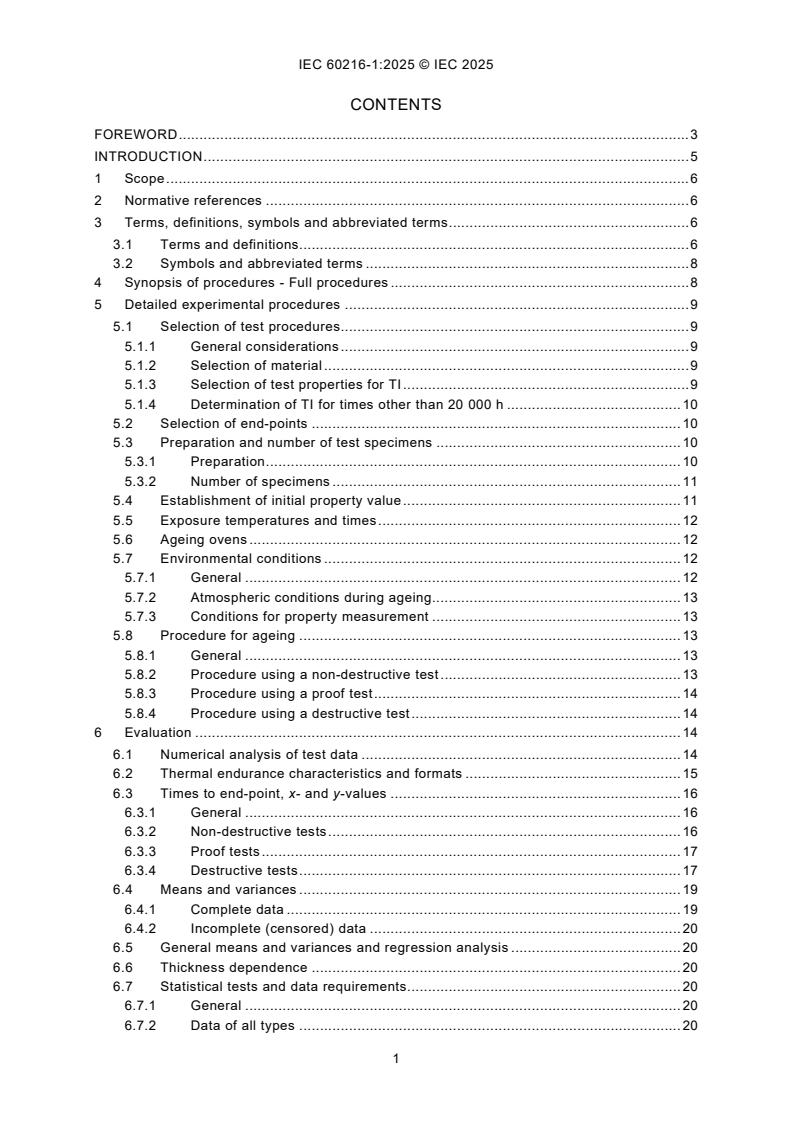
IEC 60216-1:2025 - Electrical insulating materials - Thermal endurance properties - Part 1: Ageing procedures and evaluation of test results Released:12/12/2025
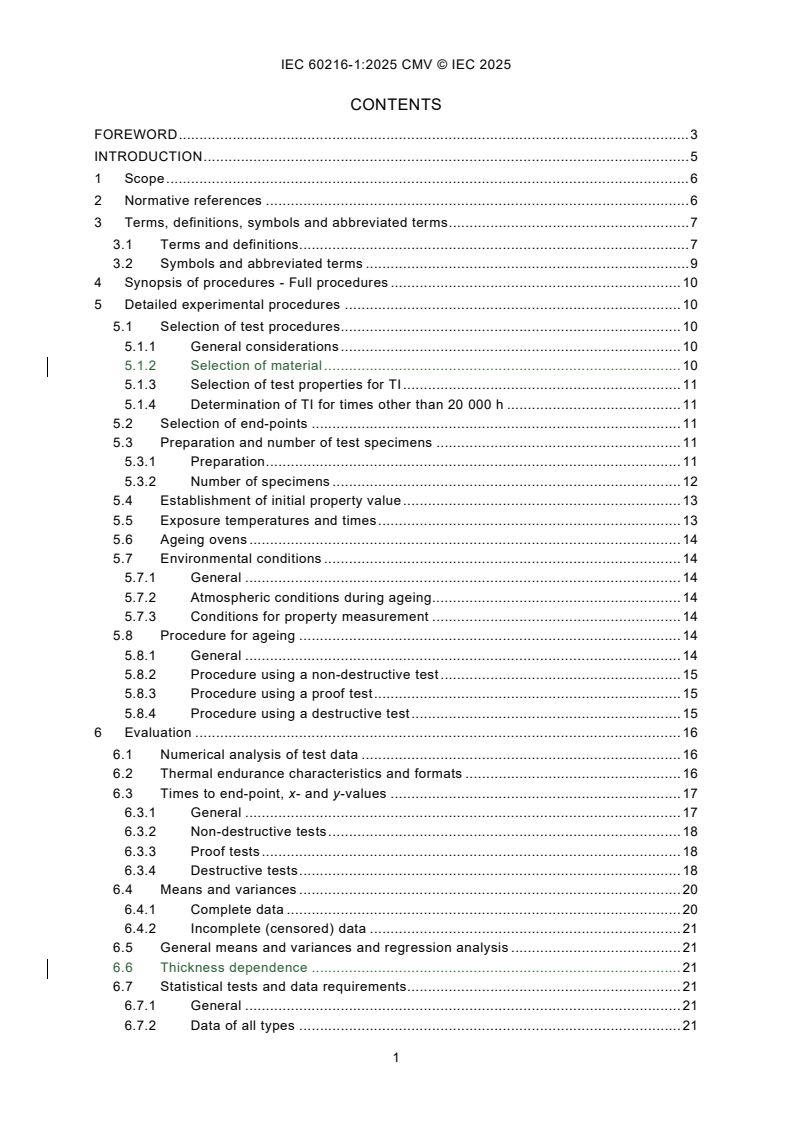
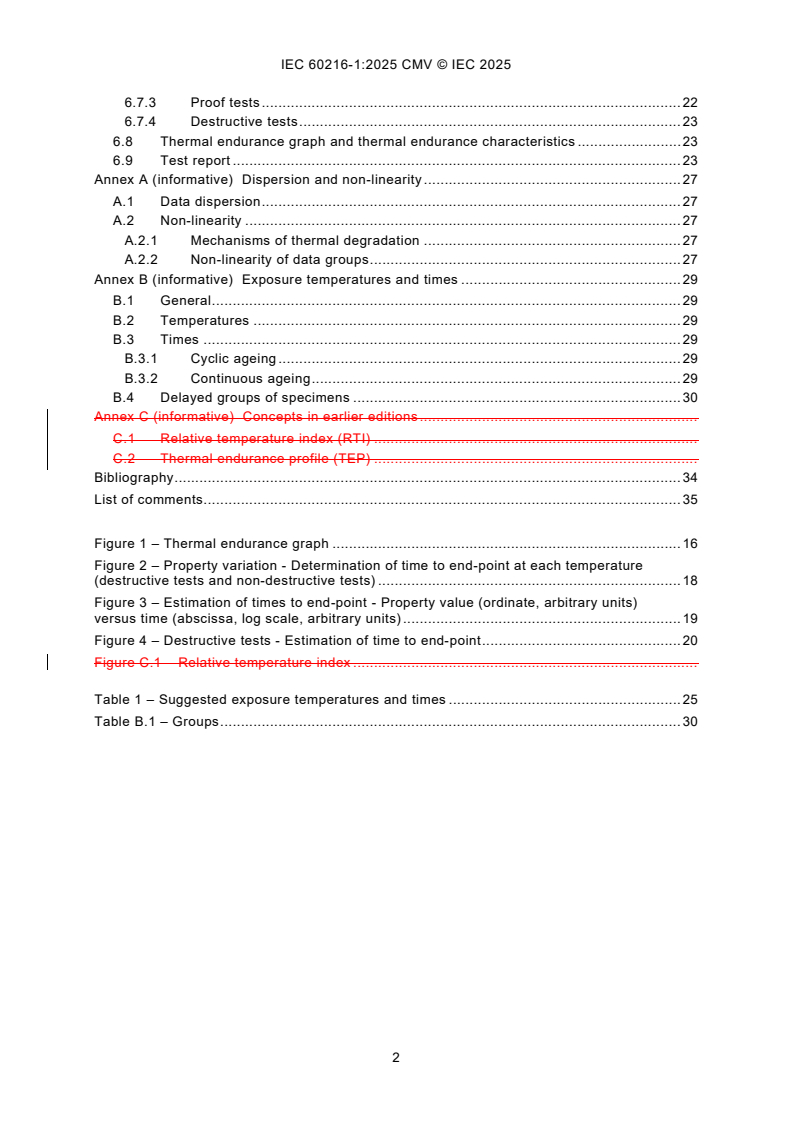
REDLINE IEC 60216-1:2025 CMV - Electrical insulating materials - Thermal endurance properties - Part 1: Ageing procedures and evaluation of test results/12/2025
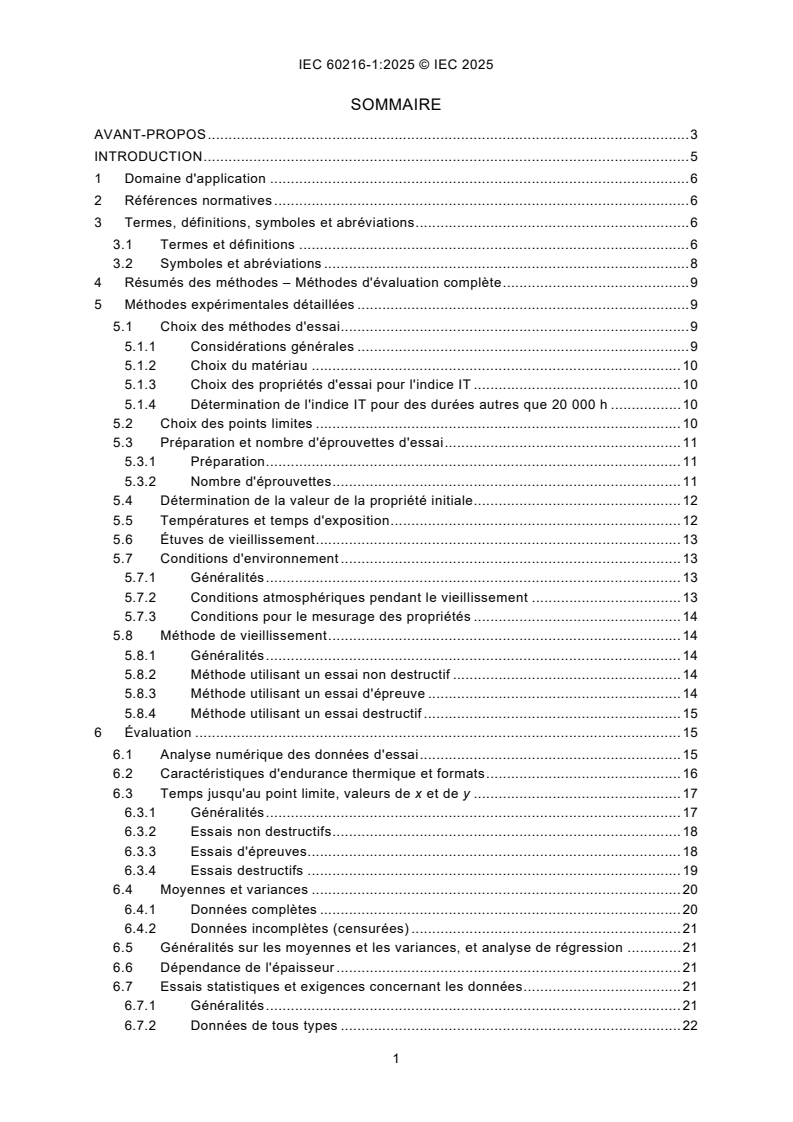
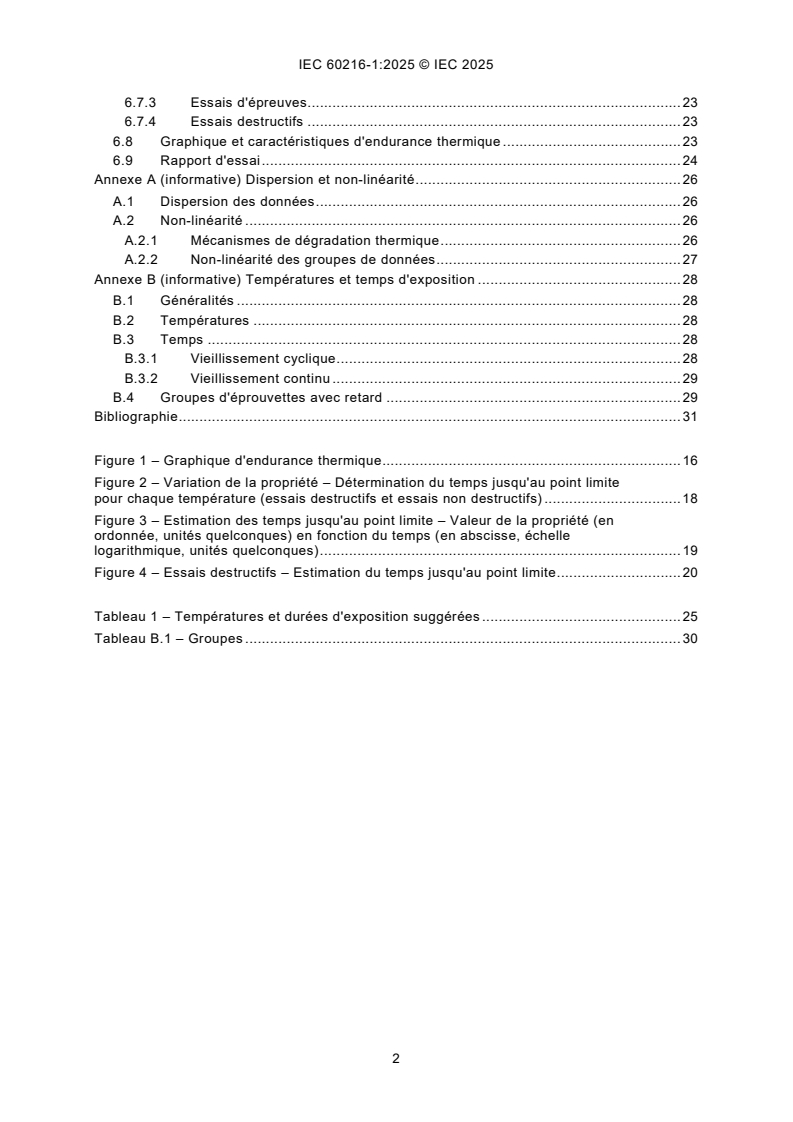
IEC 60216-1:2025 - Matériaux isolants électriques - Propriétés d'endurance thermique - Partie 1: Méthodes de vieillissement et évaluation des résultats d'essai Released:12/12/2025
IEC 60216-1:2025 - Electrical insulating materials - Thermal endurance properties - Part 1: Ageing procedures and evaluation of test results Released:12/12/2025
Overview
IEC 60216-1:2025 - "Electrical insulating materials - Thermal endurance properties - Part 1: Ageing procedures and evaluation of test results" specifies general ageing conditions and evaluation procedures for deriving thermal endurance characteristics of materials. Originally developed for electrical insulating materials and simple combinations, the procedures are widely used for materials not intended as electrical insulation. The standard assumes an Arrhenius-type relationship (log(time) versus 1/absolute temperature) and requires that no first-order thermal transition occurs in the tested temperature range. This part also gives guidance for using the more detailed instructions in other parts of the IEC 60216 series.
Key topics and requirements
- Ageing procedures and data evaluation: Defines experimental procedures, specimen preparation, exposure temperatures/times, ovens, environmental conditions and methods for establishing initial property values and times-to-endpoint.
- Arrhenius assumption: Assumes a practically linear relationship between log(time) and reciprocal absolute temperature for valid TI (Temperature Index) determination.
- Temperature Index (TI): Updated definition in the 2025 edition; TI remains a single-point characteristic (commonly the temperature in °C at which a selected property reaches a specified end-point at a reference time, e.g., 20 000 h).
- Selection of materials: New requirements for selecting related materials (for example, different colours) to ensure representative test data (clause 5.1.2).
- Thickness sensitivity test: A new test procedure for thickness dependence has been added (clauses 5.5 and 6.6).
- Data analysis and statistics: Methods for numerical analysis, regression, handling censored/incomplete data, dispersion/non-linearity assessment and generation of the thermal endurance graph/TEP.
- Documentation: Specifies required content for test reports and acceptance criteria for data validity (statistical tests and data requirements).
Applications and users
IEC 60216-1:2025 is used for:
- Accelerated ageing and thermal endurance assessment of polymers, varnishes, tapes and other insulating materials.
- Establishing Temperature Index (TI) and Thermal Endurance Profiles (TEP) for material selection and lifetime prediction.
- Material qualification in electrical equipment design, insulation system development, component selection and reliability testing. Primary users:
- Materials scientists and polymer engineers
- Test and certification laboratories
- Product designers and reliability engineers in electrical and electronic industries
- Standards and compliance officers
Related standards
- IEC 60216 series (other parts provide detailed test methods)
- IEC 60493-1:2011 (statistical methods referenced for confidence limits and data handling)
Keywords: IEC 60216-1:2025, thermal endurance, electrical insulating materials, ageing procedures, Temperature Index, TI, Arrhenius, thickness sensitivity, accelerated ageing, thermal endurance profile (TEP).
Relations
- Effective Date
- 05-Sep-2023
Buy Documents
IEC 60216-1:2025 - Electrical insulating materials - Thermal endurance properties - Part 1: Ageing procedures and evaluation of test results Released:12/12/2025
REDLINE IEC 60216-1:2025 CMV - Electrical insulating materials - Thermal endurance properties - Part 1: Ageing procedures and evaluation of test results/12/2025
IEC 60216-1:2025 - Matériaux isolants électriques - Propriétés d'endurance thermique - Partie 1: Méthodes de vieillissement et évaluation des résultats d'essai Released:12/12/2025
IEC 60216-1:2025 - Electrical insulating materials - Thermal endurance properties - Part 1: Ageing procedures and evaluation of test results Released:12/12/2025
Get Certified
Connect with accredited certification bodies for this standard

IMQ S.p.A. (Certification)
Italian electrical product certification.

SLG Prüf- und Zertifizierungs GmbH
German testing and certification body.

UL Solutions
Global safety science company with testing, inspection and certification.
Sponsored listings
Frequently Asked Questions
IEC 60216-1:2025 is a standard published by the International Electrotechnical Commission (IEC). Its full title is "Electrical insulating materials - Thermal endurance properties - Part 1: Ageing procedures and evaluation of test results". This standard covers: IEC 60216-1:2025 specifies the general ageing conditions and procedures to be used for deriving thermal endurance characteristics and gives guidance in using the detailed instructions and guidelines in the other parts of IEC 60216. Although originally developed for use with electrical insulating materials and simple combinations of such materials, the procedures are considered to be of more general applicability and are widely used in the assessment of materials not intended for use as electrical insulation. In the application of this document, it is assumed that a practically linear relationship exists between the logarithm of the time required to cause the predetermined property change and the reciprocal of the corresponding absolute temperature (Arrhenius relationship). For the valid application of this document, no transition, in particular no first-order transition, is expected to occur in the temperature range under study. This edition includes the following significant technical changes with respect to the previous edition: a) the definition for temperature index (TI) has been updated; b) requirements for selection of related materials used, e.g. in different colours (5.1.2), have been added; c) test procedure for thickness sensitivity (5.5 et 6.6) has been added; d) Annex C "Concepts in earlier editions" has been deleted.
IEC 60216-1:2025 specifies the general ageing conditions and procedures to be used for deriving thermal endurance characteristics and gives guidance in using the detailed instructions and guidelines in the other parts of IEC 60216. Although originally developed for use with electrical insulating materials and simple combinations of such materials, the procedures are considered to be of more general applicability and are widely used in the assessment of materials not intended for use as electrical insulation. In the application of this document, it is assumed that a practically linear relationship exists between the logarithm of the time required to cause the predetermined property change and the reciprocal of the corresponding absolute temperature (Arrhenius relationship). For the valid application of this document, no transition, in particular no first-order transition, is expected to occur in the temperature range under study. This edition includes the following significant technical changes with respect to the previous edition: a) the definition for temperature index (TI) has been updated; b) requirements for selection of related materials used, e.g. in different colours (5.1.2), have been added; c) test procedure for thickness sensitivity (5.5 et 6.6) has been added; d) Annex C "Concepts in earlier editions" has been deleted.
IEC 60216-1:2025 is classified under the following ICS (International Classification for Standards) categories: 17.220.99 - Other standards related to electricity and magnetism; 29.035.01 - Insulating materials in general. The ICS classification helps identify the subject area and facilitates finding related standards.
IEC 60216-1:2025 has the following relationships with other standards: It is inter standard links to IEC 60216-1:2013. Understanding these relationships helps ensure you are using the most current and applicable version of the standard.
IEC 60216-1:2025 is available in PDF format for immediate download after purchase. The document can be added to your cart and obtained through the secure checkout process. Digital delivery ensures instant access to the complete standard document.
Standards Content (Sample)
IEC 60216-1 ®
Edition 7.0 2025-12
INTERNATIONAL
STANDARD
Electrical insulating materials - Thermal endurance properties -
Part 1: Ageing procedures and evaluation of test results
ICS 17.220.99; 29.035.01 ISBN 978-2-8327-0931-3
All rights reserved. Unless otherwise specified, no part of this publication may be reproduced or utilized in any form or
by any means, electronic or mechanical, including photocopying and microfilm, without permission in writing from either
IEC or IEC's member National Committee in the country of the requester. If you have any questions about IEC copyright
or have an enquiry about obtaining additional rights to this publication, please contact the address below or your local
IEC member National Committee for further information.
IEC Secretariat Tel.: +41 22 919 02 11
3, rue de Varembé info@iec.ch
CH-1211 Geneva 20 www.iec.ch
Switzerland
About the IEC
The International Electrotechnical Commission (IEC) is the leading global organization that prepares and publishes
International Standards for all electrical, electronic and related technologies.
About IEC publications
The technical content of IEC publications is kept under constant review by the IEC. Please make sure that you have the
latest edition, a corrigendum or an amendment might have been published.
IEC publications search - IEC Products & Services Portal - products.iec.ch
webstore.iec.ch/advsearchform Discover our powerful search engine and read freely all the
The advanced search enables to find IEC publications by a publications previews, graphical symbols and the glossary.
variety of criteria (reference number, text, technical With a subscription you will always have access to up to date
committee, …). It also gives information on projects, content tailored to your needs.
replaced and withdrawn publications.
Electropedia - www.electropedia.org
The world's leading online dictionary on electrotechnology,
IEC Just Published - webstore.iec.ch/justpublished
Stay up to date on all new IEC publications. Just Published containing more than 22 500 terminological entries in English
details all new publications released. Available online and and French, with equivalent terms in 25 additional languages.
once a month by email. Also known as the International Electrotechnical Vocabulary
(IEV) online.
IEC Customer Service Centre - webstore.iec.ch/csc
If you wish to give us your feedback on this publication or
need further assistance, please contact the Customer
Service Centre: sales@iec.ch.
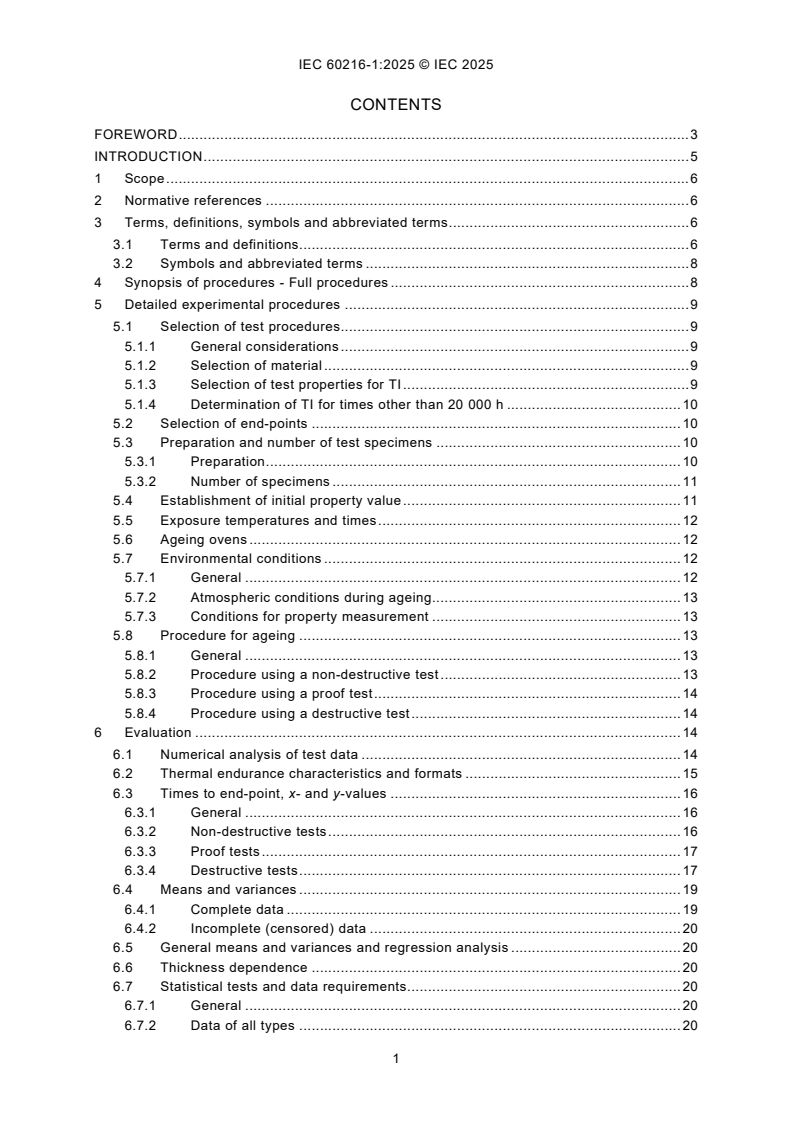
CONTENTS
FOREWORD . 3
INTRODUCTION . 5
1 Scope . 6
2 Normative references . 6
3 Terms, definitions, symbols and abbreviated terms . 6
3.1 Terms and definitions. 6
3.2 Symbols and abbreviated terms . 8
4 Synopsis of procedures - Full procedures . 8
5 Detailed experimental procedures . 9
5.1 Selection of test procedures. 9
5.1.1 General considerations . 9
5.1.2 Selection of material . 9
5.1.3 Selection of test properties for TI . 9
5.1.4 Determination of TI for times other than 20 000 h . 10
5.2 Selection of end-points . 10
5.3 Preparation and number of test specimens . 10
5.3.1 Preparation . 10
5.3.2 Number of specimens . 11
5.4 Establishment of initial property value . 11
5.5 Exposure temperatures and times . 12
5.6 Ageing ovens . 12
5.7 Environmental conditions . 12
5.7.1 General . 12
5.7.2 Atmospheric conditions during ageing. 13
5.7.3 Conditions for property measurement . 13
5.8 Procedure for ageing . 13
5.8.1 General . 13
5.8.2 Procedure using a non-destructive test . 13
5.8.3 Procedure using a proof test . 14
5.8.4 Procedure using a destructive test . 14
6 Evaluation . 14
6.1 Numerical analysis of test data . 14
6.2 Thermal endurance characteristics and formats . 15
6.3 Times to end-point, x- and y-values . 16
6.3.1 General . 16
6.3.2 Non-destructive tests . 16
6.3.3 Proof tests . 17
6.3.4 Destructive tests . 17
6.4 Means and variances . 19
6.4.1 Complete data . 19
6.4.2 Incomplete (censored) data . 20
6.5 General means and variances and regression analysis . 20
6.6 Thickness dependence . 20
6.7 Statistical tests and data requirements . 20
6.7.1 General . 20
6.7.2 Data of all types . 20
6.7.3 Proof tests . 21
6.7.4 Destructive tests . 22
6.8 Thermal endurance graph and thermal endurance characteristics . 22
6.9 Test report . 22
Annex A (informative) Dispersion and non-linearity . 25
A.1 Data dispersion . 25
A.2 Non-linearity . 25
A.2.1 Mechanisms of thermal degradation . 25
A.2.2 Non-linearity of data groups . 25
Annex B (informative) Exposure temperatures and times . 27
B.1 General . 27
B.2 Temperatures . 27
B.3 Times . 27
B.3.1 Cyclic ageing . 27
B.3.2 Continuous ageing . 27
B.4 Delayed groups of specimens . 28
Bibliography . 30
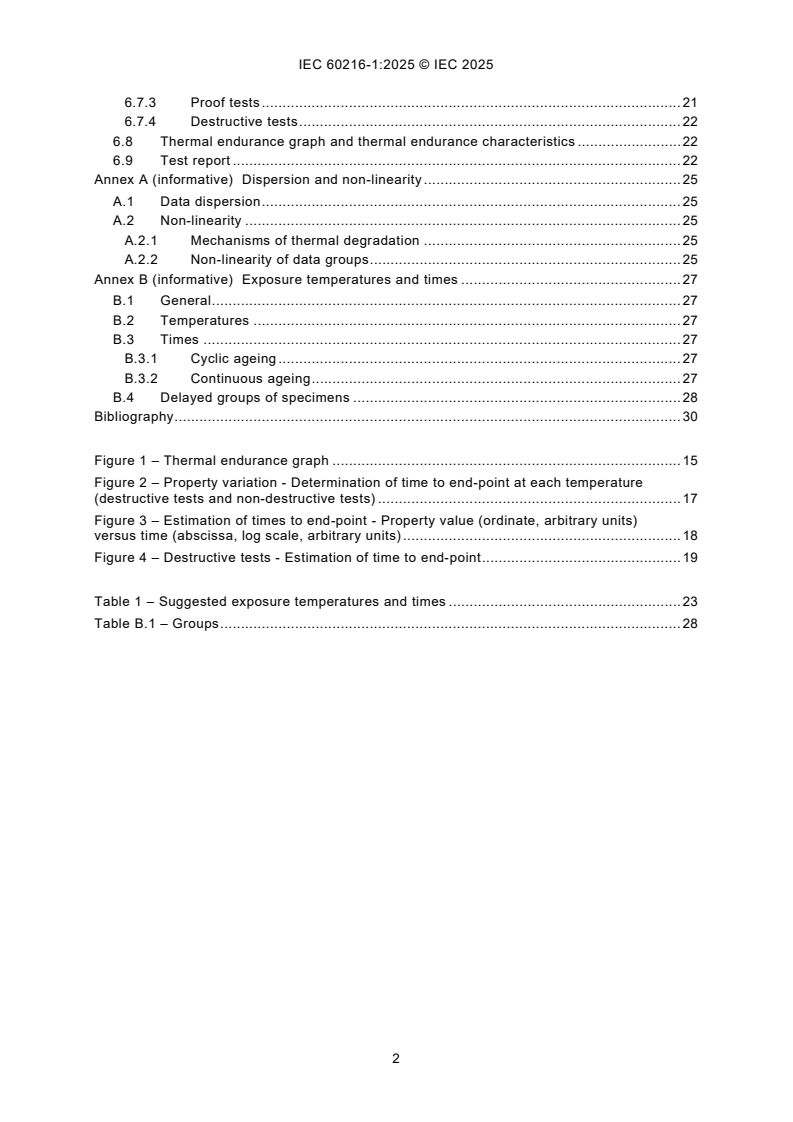
Figure 1 – Thermal endurance graph . 15
Figure 2 – Property variation - Determination of time to end-point at each temperature
(destructive tests and non-destructive tests) . 17
Figure 3 – Estimation of times to end-point - Property value (ordinate, arbitrary units)
versus time (abscissa, log scale, arbitrary units) . 18
Figure 4 – Destructive tests - Estimation of time to end-point . 19
Table 1 – Suggested exposure temperatures and times . 23
Table B.1 – Groups . 28
INTERNATIONAL ELECTROTECHNICAL COMMISSION
____________
Electrical insulating materials - Thermal endurance properties -
Part 1: Ageing procedures and evaluation of test results
FOREWORD
1) The International Electrotechnical Commission (IEC) is a worldwide organization for standardization comprising
all national electrotechnical committees (IEC National Committees). The object of IEC is to promote international
co-operation on all questions concerning standardization in the electrical and electronic fields. To this end and
in addition to other activities, IEC publishes International Standards, Technical Specifications, Technical Reports,
Publicly Available Specifications (PAS) and Guides (hereafter referred to as "IEC Publication(s)"). Their
preparation is entrusted to technical committees; any IEC National Committee interested in the subject dealt with
may participate in this preparatory work. International, governmental and non-governmental organizations liaising
with the IEC also participate in this preparation. IEC collaborates closely with the International Organization for
Standardization (ISO) in accordance with conditions determined by agreement between the two organizations.
2) The formal decisions or agreements of IEC on technical matters express, as nearly as possible, an international
consensus of opinion on the relevant subjects since each technical committee has representation from all
interested IEC National Committees.
3) IEC Publications have the form of recommendations for international use and are accepted by IEC National
Committees in that sense. While all reasonable efforts are made to ensure that the technical content of IEC
Publications is accurate, IEC cannot be held responsible for the way in which they are used or for any
misinterpretation by any end user.
4) In order to promote international uniformity, IEC National Committees undertake to apply IEC Publications
transparently to the maximum extent possible in their national and regional publications. Any divergence between
any IEC Publication and the corresponding national or regional publication shall be clearly indicated in the latter.
5) IEC itself does not provide any attestation of conformity. Independent certification bodies provide conformity
assessment services and, in some areas, access to IEC marks of conformity. IEC is not responsible for any
services carried out by independent certification bodies.
6) All users should ensure that they have the latest edition of this publication.
7) No liability shall attach to IEC or its directors, employees, servants or agents including individual experts and
members of its technical committees and IEC National Committees for any personal injury, property damage or
other damage of any nature whatsoever, whether direct or indirect, or for costs (including legal fees) and
expenses arising out of the publication, use of, or reliance upon, this IEC Publication or any other IEC
Publications.
8) Attention is drawn to the Normative references cited in this publication. Use of the referenced publications is
indispensable for the correct application of this publication.
9) IEC draws attention to the possibility that the implementation of this document may involve the use of (a)
patent(s). IEC takes no position concerning the evidence, validity or applicability of any claimed patent rights in
respect thereof. As of the date of publication of this document, IEC had not received notice of (a) patent(s), which
may be required to implement this document. However, implementers are cautioned that this may not represent
the latest information, which may be obtained from the patent database available at https://patents.iec.ch. IEC
shall not be held responsible for identifying any or all such patent rights.
IEC 60216-1 has been prepared by IEC technical committee 112: Evaluation and qualification
of electrical insulating materials and systems. It is an International Standard.
This seventh edition cancels and replaces the sixth edition published in 2013. This edition
constitutes a technical revision.
This edition includes the following significant technical changes with respect to the previous
edition:
a) the definition for temperature index (TI) has been updated;
b) requirements for selection of related materials used, e.g. in different colours (5.1.2), have
been added;
c) test procedure for thickness sensitivity (5.5 and 6.6) has been added;
d) Annex C "Concepts in earlier editions" has been deleted.
The text of this International Standard is based on the following documents:
Draft Report on voting
112/698/FDIS 112/706/RVD
Full information on the voting for its approval can be found in the report on voting indicated in
the above table.
The language used for the development of this International Standard is English.
A list of all parts in the IEC 60216 series [1], published under the general title Electrical
insulating materials – Thermal endurance properties, can be found on the IEC website.
This document was drafted in accordance with ISO/IEC Directives, Part 2, and developed in
accordance with ISO/IEC Directives, Part 1 and ISO/IEC Directives, IEC Supplement, available
at www.iec.ch/members_experts/refdocs. The main document types developed by IEC are
described in greater detail at www.iec.ch/publications.
The committee has decided that the contents of this document will remain unchanged until the
stability date indicated on the IEC website under webstore.iec.ch in the data related to the
specific document. At this date, the document will be
– reconfirmed,
– withdrawn, or
– revised.
INTRODUCTION
The listing of the thermal capabilities of electrical insulating materials, based on service
experience, was found to be impractical, owing to the rapid development of polymer and
insulation technologies and the long time necessary to acquire appropriate service experience.
Accelerated ageing and test procedures were therefore needed to obtain the necessary
information. The IEC 60216 series [1] has been developed to formalize these procedures and
the interpretation of their results.
Physico-chemical models postulated for the ageing processes led to the almost universal
assumption of the Arrhenius equations to describe the rate of ageing. Out of this arose the
concept of the temperature index (TI) as a single-point characteristic based upon accelerated
ageing data. This is the numerical value of the temperature in degrees Celsius at which the
time taken for deterioration of a selected property to reach an accepted end-point is that
specified (usually 20 000 h).
NOTE The term Arrhenius is widely used (and understood) to indicate a linear relationship between the logarithm
of a time and the reciprocal of the thermodynamic (absolute or kelvin) temperature. The correct usage is restricted
to such a relationship between a reaction rate constant and the thermodynamic temperature. The common usage is
employed throughout this document.
The large statistical scatter of test data which was found, together with the frequent occurrence
of substantial deviations from the ideal behaviour, demonstrated the need for tests to assess
the validity of the basic physico-chemical model. The application of conventional statistical
tests, as set out in IEC 60493-1:2011 [2], fulfilled this requirement, resulting in the confidence
limit (TC) of TI, but the simple, single-point TI was found inadequate to describe the capabilities
of materials. This led to the concept of the thermal endurance profile (TEP), incorporating the
temperature index, its variation with specified ageing time, and a confidence limit.
A complicating factor is that the properties of a material subjected to thermal ageing possibly
do not all deteriorate at the same rate, and different end-points can be relevant for different
applications. Consequently, a material can be assigned more than one temperature index,
derived, for example, from the measurement of different properties and the use of different end-
point times.
It was subsequently found that the statistical confidence index included in the TEP was not
widely understood or used. However, the statistical tests were considered essential, particularly
after minor modifications to make them relate better to practical circumstances: the concept of
the halving interval (HIC) was introduced to indicate the rate of change of ageing time with
temperature. TEP was then abandoned, with the TI and HIC being reported in a way which
indicated whether or not the statistical tests had been fully satisfied. At the same time, the
calculation procedures were made more comprehensive, enabling full statistical testing of data
obtained using a diagnostic property of any type, including the particular case of partially
incomplete data. Simultaneously with the development of the IEC 60216 series [1], other
standards were being developed in ISO, intended to satisfy a similar requirement for plastics
and rubber materials. These are ISO 2578:1993 [3] and ISO 11346 [4], respectively, which use
less rigorous statistical procedures and more restricted experimental techniques. A simplified
calculation procedure is defined in IEC 60216-8 [5].
1 Scope
This part of IEC 60216 specifies the general ageing conditions and procedures to be used for
deriving thermal endurance characteristics and gives guidance in using the detailed instructions
and guidelines in the other parts of IEC 60216.
Although originally developed for use with electrical insulating materials and simple
combinations of such materials, the procedures are considered to be of more general
applicability and are widely used in the assessment of materials not intended for use as
electrical insulation.
In the application of this document, it is assumed that a practically linear relationship exists
between the logarithm of the time required to cause the predetermined property change and
the reciprocal of the corresponding absolute temperature (Arrhenius relationship).
For the valid application of this document, no transition, in particular no first-order transition, is
expected to occur in the temperature range under study.
2 Normative references
The following documents are referred to in the text in such a way that some or all of their content
constitutes requirements of this document. For dated references, only the edition cited applies.
For undated references, the latest edition of the referenced document (including any
amendments) applies.
IEC 60212, Standard conditions for use prior to and during the testing of solid electrical
insulating materials
IEC 60216-3:2021, Electrical insulating materials - Thermal endurance properties - Part 3:
Instructions for calculating thermal endurance characteristics
IEC 60216-3, Electrical insulating materials - Thermal endurance properties - Part 3:
Instructions for calculating thermal endurance characteristics
IEC 60216-4-1, Electrical insulating materials - Thermal endurance properties - Part 4-1: Ageing
ovens - Single-chamber ovens
IEC 60493-1:2011, Guide for the statistical analysis of ageing test data - Part 1: Methods based
on mean values of normally distributed test results
IEC 60216-4 series, Electrical insulating materials – Thermal endurance properties – Part 4:
Ageing ovens
3 Terms, definitions, symbols and abbreviated terms
3.1 Terms and definitions
For the purposes of this document, the following terms and definitions apply.
ISO and IEC maintain terminology databases for use in standardization at the following
addresses:
– IEC Electropedia: available at https://www.electropedia.org/
– ISO Online browsing platform: available at https://www.iso.org/obp
3.1.1
temperature index
TI
numerical value of the temperature in degrees Celsius determined by test by itself
Note 1 to entry: This rating is based on 20 000 h life, unless otherwise specified, based on one of the end-of-life
criteria listed in IEC 60216-2 [6].
3.1.2
halving interval
HIC
numerical value of the temperature interval in kelvin which expresses the halving of the time to
end-point (3.1.12) taken at the temperature equal to TI (3.1.1)
[SOURCE: IEC 60050-212:2010 [7], 212-12-13, modified – In the definition, "equal to TI"
replaces "corresponding to the temperature index or the relative temperature index".]
3.1.3
thermal endurance graph
graph in which the logarithm of the time to reach a specified end-point (3.1.12) in a thermal
endurance test is plotted against the reciprocal thermodynamic (absolute) test temperature
[SOURCE: IEC 60050-212:2010 [7], 212-12-10, modified – In the definition, the word
"(absolute)" has been added.]
3.1.4
thermal endurance graph paper
graph paper having a logarithmic time scale as the ordinate, graduated in powers of ten
Note 1 to entry: 10 h to 100 000 h is often a convenient range for the ordinate.
Note 2 to entry: Values of the abscissa are proportional to the reciprocal of the thermodynamic (absolute)
temperature. The abscissa is usually graduated in a non-linear (Celsius) temperature scale oriented with temperature
increasing from left to right.
3.1.5
regression analysis
process of deducing the best-fit line expressing the relation of corresponding members of two
data groups by minimizing the sum of squares of deviations of members of one of the groups
from the line
Note 1 to entry: The parameters are referred to as the regression coefficients.
3.1.6
confidence limit
TC
statistical parameter, calculated from the test data, which with 95 % confidence constitutes a
lower limit for the true value of the temperature index estimated by TI (3.1.1)
Note 1 to entry: 95 % confidence implies that there is only 5 % probability that the true value of the temperature
index is actually smaller than TC.
Note 2 to entry: In other connections, confidence values other than 95 % can sometimes be used; for example, in
the linearity test for destructive test (3.1.7) data.
3.1.7
destructive test
diagnostic property test where the test specimen is irreversibly changed by the property
measurement in a way which precludes a repeated measurement on the same specimen
3.1.8
non-destructive test
diagnostic property test where the properties of the test specimen are not permanently changed
by the measurement, so that a further measurement on the same specimen can be made after
appropriate treatment
3.1.9
proof test
diagnostic property test where each test specimen is, at the end of each ageing cycle, subjected
to a specified stress, further ageing cycles being conducted until the specimen fails on testing
3.1.10
temperature group
test group of specimens
number of specimens being exposed together to the same temperature ageing in the same oven
Note 1 to entry: Where there is no risk of ambiguity, either temperature groups or test groups (3.1.11) may be
referred to simply as groups.
3.1.11
test group
test group of specimens
number of specimens removed together from a temperature group (3.1.10) for destructive
testing
3.1.12
end-point
property level that is effected by practical application to the equipment in the thermal endurance
test
3.2 Symbols and abbreviated terms
a, b regression coefficients
n numbers of specimens for destructive tests
a,b,c,d
n number of y-values
N total number of test specimens
m number of specimens in temperature group i (censored data)
i
F Fisher distributed stochastic variable
x reciprocal thermodynamic temperature (1/Θ)
y logarithm of time to end-point
ϑ temperature, °C
Θ temperature, thermodynamic (kelvin)
Θ value in kelvin (0 °C = 273,15 K)
τ time (to end-point)
2 2
χ χ -distributed stochastic variable
TI temperature index
TC lower 95 % confidence limit of TI
HIC halving interval at temperature equal to TI
4 Synopsis of procedures - Full procedures
The standardized procedure for the evaluation of thermal properties of a material consists of a
sequence of steps, as follows.
It is recommended that the full evaluation procedure, as described below and in 5.1 to 5.8, be
used.
a) Prepare suitable specimens appropriate for the intended property measurements (see 5.3).
b) Subject groups of specimens to ageing at several fixed levels of elevated temperature,
either continuously, or cyclically for a number of periods between which the specimens are
normally returned to room temperature or another standard temperature (see 5.5).
c) Subject specimens to a diagnostic procedure in order to reveal the degree of ageing.
Diagnostic procedures may be non-destructive or destructive determinations of a property
or potentially destructive proof tests (see 5.1 and 5.2).
d) Extend the continuous heat exposure or the thermal cycling until the specified end-point,
i.e. failure of specimens or a specified degree of change in the measured property, is
reached (see 5.1, 5.2 and 5.5).
e) Report the test results, showing the kind of ageing procedure (continuous or cyclic) and
diagnostic procedure (see Clause 4, list item c); the ageing curves, or time or number of
cycles to reach the end-point, for each specimen.
f) Evaluate these data numerically and present them graphically, as explained in 6.1 and 6.9.
g) Express the complete information in abbreviated numerical form, as described in 6.2 by
means of the temperature index and halving interval.
The full experimental and evaluation procedures are given in Clause 5 and Clause 6.
A simplified procedure is given in IEC 60216-8 [5].
5 Detailed experimental procedures
5.1 Selection of test procedures
5.1.1 General considerations
Each test procedure should specify the shape, dimensions and number of the test specimens,
the temperatures and times of exposure, the property to which TI is related, the methods of its
determination, the end-point, and the derivation of the thermal endurance characteristics from
the experimental data.
The chosen property should reflect, in a significant fashion if possible, a function of the material
in practical use. A choice of properties is given in IEC 60216-2 [6].
To provide uniform conditions, specification of the conditioning of specimens after removal from
the oven and before measurement will possibly be required.
5.1.2 Selection of material
Commercially available brands of insulating materials are usually obtainable in different
molecular weights and colours, and with differing types and quantities of fillers and additives.
A separate analysis of each of these variations is not necessary to an evaluation in a thermal-
endurance programme. The least favourable performance of the unfilled and maximum-level
filled or reinforced material shall be considered representative of intermediate levels of filler or
reinforcement without additional testing.
5.1.3 Selection of test properties for TI
If IEC material specifications are available, property requirements in terms of acceptable lower
limits of TI values are usually given. If such material specifications are not available, a selection
of properties and methods for the evaluation of thermal endurance is given in IEC 60216-2 [6].
(If such a method cannot be found, an international, national, or institution standard, or a
specially devised method should be used, and in that order of preference.)
5.1.4 Determination of TI for times other than 20 000 h
In the majority of cases, the required thermal endurance characteristics are for a projected
duration of 20 000 h. However, there is often a need for such information related to other longer
or shorter times. In cases of longer times, for example, the times given as requirements or
recommendations in the text of this document (for example, 5 000 h for the minimum value of
the longest time to end-point) shall be increased in the ratio of the actual specification time to
20 000 h. In the same way, the ageing cycle durations should be changed in approximately the
same ratio. The temperature extrapolation again shall not exceed 25 K. In cases of shorter
specification times, the related times may be decreased in the same ratio if necessary.
Particular care will be needed for very short specification times, since the higher ageing
temperatures can lead into temperature regions which include transition points, for example,
glass transition temperature or partial melting, with consequent non-linearity. Very long
specification times can also lead to non-linearity (see also Annex A).
5.2 Selection of end-points
The thermal endurance of materials can be characterized by different endurance data (derived
using different properties or different end-points or both), in order to facilitate the adequate
selection of the material in respect of its particular application in an insulation system. See IEC
60216-2 [6].
There are two alternative ways in which the end-point can be defined.
a) As a percentage increase or decrease in the measured value of the property from the
original level. This approach will provide comparisons among materials but bears a poorer
relationship than 5.2, list item b) to the property values required in normal service. For the
determination of the initial value, see 5.4.
b) As a fixed value of the property. This value can be selected with respect to usual service
requirements. End-points of proof tests are predominantly given in the form of fixed values
of the property.
The end-point should be selected to indicate a degree of deterioration of the insulating material
which has reduced its ability to withstand a stress encountered in actual service in an insulation
system. The degree of degradation indicated as the end-point of the test should be related to
the allowable safe value for the material property which is desired in practice.
5.3 Preparation and number of test specimens
5.3.1 Preparation
The specimens used for the ageing test should constitute a random sample from the population
investigated and shall be treated uniformly.
The material specifications or the test standards will contain all necessary instructions for the
preparation of specimens.
The thickness of specimens is in some cases specified in the list of property measurements for
the determination of thermal endurance. See IEC 60216-2 [6]. If not, the thickness shall be
reported. Some physical properties are sensitive even to minor variations of specimen
thickness. In such cases, it is important that the thickness after each ageing period is
determined and reported if required in the relevant specification.
Consequently, a material may be assigned more than one thermal endurance characteristic
derived from the measurement of properties at different thicknesses.
The tolerances of specimen dimensions should be the same as those normally used for general
testing; where specimen dimensions need smaller tolerances than those normally used, these
special tolerances should be given. Screening measurements ensure that specimens are of
uniform quality and typical of the material to be tested.
Since processing conditions can significantly affect the ageing characteristics of some
materials, it shall be ensured that, for example, sampling, cutting sheet from the supply roll,
cutting of anisotropic material in a given direction, moulding, curing and pre-conditioning are
performed in the same manner for all specimens.
5.3.2 Number of specimens
5.3.2.1 General
The accuracy of endurance test results depends largely on the number of specimens aged at
each temperature. Instructions for an adequate number of specimens are given in IEC 60216-
3 [8].Generally, the following instructions (5.3.2.1 to 5.3.2.3), which influence the testing
procedure given in 5.8, shall apply.
It is good practice to prepare additional specimens, or at least to provide a reserve of the original
material batch from which such specimens may subsequently be prepared. In this way, any
required ageing of additional specimens in case of unforeseen complications will introduce a
minimum risk of producing systematic differences between groups of specimens. Such
complications can arise, for example, if the thermal endurance relationship turns out to be non-
linear, or if specimens are lost due to thermal runaway of an oven.
Where the test criterion for non-destructive tests or proof tests is based upon the initial value
of the property, this should be determined from a group of specimens of at least twice the
number of specimens in each temperature group. For destructive tests, see 5.3.2.4.
5.3.2.2 Number of specimens for non-destructive tests
For each exposure temperature, in most cases a group of five specimens will be adequate.
However, further guidance will be found in IEC 60216-3 [8].
5.3.2.3 Number of specimens for proof tests
In most cases, a group of at least 11 specimens for each exposure temperature will be required.
For graphical derivation and in some other cases, the treatment of data can be simpler if the
number of specimens in each group is odd. Further guidance will be found in IEC 60216-3 [8].
5.3.2.4 Number of specimens for destructive tests
×𝑛𝑛 ×𝑛𝑛 +𝑛𝑛
This number (N) is derived as follows: 𝑁𝑁 =𝑛𝑛
a b c d
is the number of specimens in a test group undergoing identical treatment at one temperature and
n
a
discarded after determination of the property (usually five);
n is the number of treatments, i.e. total number of exposure times, at one temperature;
b
is the number of ageing temperature levels;
n
c
is the number of specimens in the group used to establish the initial value of the property. Normal practice
n
d
is to select n = 2n when the diagnostic criterion is a percentage change of the property from its initial
d a
level. When the criterion is an absolute property level, n is usually given the value of zero, unless
d
reporting of the initial value is required.
5.4 Establishment of initial property value
Select the specimens for the determination of the initial value of the property to constitute a
random subset of those prepared for ageing. Before determining the property value, these
specimens shall be conditioned by exposure to the lowest level of ageing temperature of the
test (see 5.5) for two days (48 h ± 6 h).
In some cases (for example, very thick specimens), times greater than two days can be required
in order to establish a stable value.
Unless otherwise stated in the method for determining the diagnostic property (for example,
parts of material specifications dealing with methods of test, or a method listed in IEC 60216-2
[6]), the initial value is the arithmetic mean of the test results.
5.5 Exposure temperatures and times
For TI determinations, test specimens should be exposed to not less than three, preferably at
least four, temperatures covering a sufficient range to demonstrate a linear relationship
between time to end-point and reciprocal thermodynamic (absolute) temperature.
To reduce the uncertainties in calculating the appropriate thermal endurance characteristic, it
is important that the overall temperature range of thermal exposure is carefully selected,
observing the following requirements (if the required thermal endurance characteristics are for
a projected duration of 20 000 h, see also 5.1.3):
a) the lowest exposure temperature shall be one which will result in a mean or median time to
end-point of more than 5 000 h when determining TI (see also 5.1.3);
b) the extrapolation necessary to establish TI shall not be more than 25 K;
c) the highest exposure temperature shall be one which will result in a mean or median time
to end-point of more than 100 h (if possible, less than 500 h).
For some materials, it is not possible to achieve a time to end-point of less than 500 h while
retaining satisfactory linearity. However, it is important to note that a smaller range of mean
times to end-point will lead to a larger confidence interval of the result for the same data
dispersion.
If the sensitivity to thickness is the subject of evaluation, additional test specimens of reduced
thickness shall be exposed to at least two temperatures. Requirement 5.5, list item c) applies
as well.
Relevant and detailed instructions on how to proceed using non-destructive test, proof test or
destructive test criteria are provided in 5.8.
Table 1 gives guidance on making initial selections.
A number of recommendations and suggestions, useful in establishing times and temperatures,
are given in Annex B.
5.6 Ageing ovens
Throughout the heat ageing period, ageing ovens shall maintain, in that part of the working
space where specimens are placed, a temperature with tolerances as given in the IEC 60216-
4 series. Unless otherwise specified, IEC 60216-4-1 shall apply.
The circulation of the air within the oven and the exchange of the air content should be adequate
to ensure that the rate of thermal degradation is not influenced by accumulation of
decomposition products or oxygen depletion (see 5.7).
5.7 Environmental conditions
5.7.1 General
The effects of special environmental conditions such as extreme humidity, chemical
contamination or vibration in many cases can be more appropriately evaluated by insulation
systems tests. Although environmental conditioning, the influence of atmospheres other than
air and immersion in liquids such as oil can be important, these are not within the scope of this
document.
5.7.2 Atmospheric conditions during ageing
Unless otherwise specified, ageing shall be carried out in ovens operating in the normal
laboratory atmosphere. However, for some materials very sensitive to the humidity in the ovens,
more reliable results are obtained when the absolute humidity in the ageing oven room is
controlled and equal to the absolute humidity corresponding to standard atmosphere B
according to IEC 60212 [9]. This, or other specified conditions, shall then be reported.
5.7.3 Conditions for property measurement
Unless otherwise specified, the specimens shall be conditioned before measurement and
measured under conditions as specified in the material standard specification.
5.8 Procedure for ageing
5.8.1 General
This subclause 5.8.1 relates to the basic procedures for using
a) a non-destructive test,
b) a proof test,
c) a destructive test.
Prepare a number of specimens following the instructions in 5.3. If necessary, determine the
initial value of the property as specified in 5.4. Divide the specimens by random selection into
as many groups as there are exposure temperatures.
Establish the exposure temperatures and times in accordance with the instructions of 5.5 (see
also Annex B).
Place one group for exposure in each of the ovens complying with 5.6, maintained as closely
as possible to the temperatures selected from Table 1.
NOTE 1 It is suggested that individual specimens be identified to simplify their return to the correct oven after each
test.
NOTE 2 Subclause 5.3 recommends to prepare an extra group of reserve specimens for the purposes stated in
Annex B, in particular, to be able to initiate early the ageing of new specimens at an additional level of temperature.
5.8.2 Procedure using a non-destructive test
At the end of each cycle, remove the group of specimens from the respective oven and allow
them to cool to room temperature unless otherwise specified (see 5.7). Some test properties
can require measurement at the oven temperature, in which case the ageing is continuous.
Apply the appropriate test to each specimen and then return the group of specimens to the oven
from which they came, at the same temperature as before, and expose for a further cycle.
Continue the cycles of temperature exposure, cooling and application of the test until the
average measured value for the specimens in the group has reached the end-point specified
and provided at least one point beyond the end-point.
Evaluate the results as listed in 6.1 and detailed in IEC 60216-3 and report them as specified
in 6.9.
5.8.3 Procedure using a proof test
Specimens for testing by a proof-test procedure shall be drawn at random from specimens
which have successfully withstood screening by the proof test.
At the end of each cycle, remove all specimens from the oven. After each removal, al
...
IEC 60216-1 ®
Edition 7.0 2025-12
INTERNATIONAL
STANDARD
COMMENTED VERSION
Electrical insulating materials - Thermal endurance properties -
Part 1: Ageing procedures and evaluation of test results
ICS 17.220.99; 29.035.01 ISBN 978-2-8327-0949-8
All rights reserved. Unless otherwise specified, no part of this publication may be reproduced or utilized in any form or
by any means, electronic or mechanical, including photocopying and microfilm, without permission in writing from either
IEC or IEC's member National Committee in the country of the requester. If you have any questions about IEC copyright
or have an enquiry about obtaining additional rights to this publication, please contact the address below or your local
IEC member National Committee for further information.
IEC Secretariat Tel.: +41 22 919 02 11
3, rue de Varembé info@iec.ch
CH-1211 Geneva 20 www.iec.ch
Switzerland
About the IEC
The International Electrotechnical Commission (IEC) is the leading global organization that prepares and publishes
International Standards for all electrical, electronic and related technologies.
About IEC publications
The technical content of IEC publications is kept under constant review by the IEC. Please make sure that you have the
latest edition, a corrigendum or an amendment might have been published.
IEC publications search - IEC Products & Services Portal - products.iec.ch
webstore.iec.ch/advsearchform Discover our powerful search engine and read freely all the
The advanced search enables to find IEC publications by a publications previews, graphical symbols and the glossary.
variety of criteria (reference number, text, technical With a subscription you will always have access to up to date
committee, …). It also gives information on projects, content tailored to your needs.
replaced and withdrawn publications.
Electropedia - www.electropedia.org
The world's leading online dictionary on electrotechnology,
IEC Just Published - webstore.iec.ch/justpublished
Stay up to date on all new IEC publications. Just Published containing more than 22 500 terminological entries in English
details all new publications released. Available online and and French, with equivalent terms in 25 additional languages.
once a month by email. Also known as the International Electrotechnical Vocabulary
(IEV) online.
IEC Customer Service Centre - webstore.iec.ch/csc
If you wish to give us your feedback on this publication or
need further assistance, please contact the Customer
Service Centre: sales@iec.ch.
CONTENTS
FOREWORD . 3
INTRODUCTION . 5
1 Scope . 6
2 Normative references . 6
3 Terms, definitions, symbols and abbreviated terms . 7
3.1 Terms and definitions. 7
3.2 Symbols and abbreviated terms . 9
4 Synopsis of procedures - Full procedures . 10
5 Detailed experimental procedures . 10
5.1 Selection of test procedures. 10
5.1.1 General considerations . 10
5.1.2 Selection of material . 10
5.1.3 Selection of test properties for TI . 11
5.1.4 Determination of TI for times other than 20 000 h . 11
5.2 Selection of end-points . 11
5.3 Preparation and number of test specimens . 11
5.3.1 Preparation . 11
5.3.2 Number of specimens . 12
5.4 Establishment of initial property value . 13
5.5 Exposure temperatures and times . 13
5.6 Ageing ovens . 14
5.7 Environmental conditions . 14
5.7.1 General . 14
5.7.2 Atmospheric conditions during ageing. 14
5.7.3 Conditions for property measurement . 14
5.8 Procedure for ageing . 14
5.8.1 General . 14
5.8.2 Procedure using a non-destructive test . 15
5.8.3 Procedure using a proof test . 15
5.8.4 Procedure using a destructive test . 15
6 Evaluation . 16
6.1 Numerical analysis of test data . 16
6.2 Thermal endurance characteristics and formats . 16
6.3 Times to end-point, x- and y-values . 17
6.3.1 General . 17
6.3.2 Non-destructive tests . 18
6.3.3 Proof tests . 18
6.3.4 Destructive tests . 18
6.4 Means and variances . 20
6.4.1 Complete data . 20
6.4.2 Incomplete (censored) data . 21
6.5 General means and variances and regression analysis . 21
6.6 Thickness dependence . 21
6.7 Statistical tests and data requirements . 21
6.7.1 General . 21
6.7.2 Data of all types . 21
6.7.3 Proof tests . 22
6.7.4 Destructive tests . 23
6.8 Thermal endurance graph and thermal endurance characteristics . 23
6.9 Test report . 23
Annex A (informative) Dispersion and non-linearity . 27
A.1 Data dispersion . 27
A.2 Non-linearity . 27
A.2.1 Mechanisms of thermal degradation . 27
A.2.2 Non-linearity of data groups . 27
Annex B (informative) Exposure temperatures and times . 29
B.1 General . 29
B.2 Temperatures . 29
B.3 Times . 29
B.3.1 Cyclic ageing . 29
B.3.2 Continuous ageing . 29
B.4 Delayed groups of specimens . 30
Annex C (informative) Concepts in earlier editions .
C.1 Relative temperature index (RTI) .
C.2 Thermal endurance profile (TEP) .
Bibliography . 34
List of comments. 35
Figure 1 – Thermal endurance graph . 16
Figure 2 – Property variation - Determination of time to end-point at each temperature
(destructive tests and non-destructive tests) . 18
Figure 3 – Estimation of times to end-point - Property value (ordinate, arbitrary units)
versus time (abscissa, log scale, arbitrary units) . 19
Figure 4 – Destructive tests - Estimation of time to end-point . 20
Figure C.1 – Relative temperature index .
Table 1 – Suggested exposure temperatures and times . 25
Table B.1 – Groups . 30
INTERNATIONAL ELECTROTECHNICAL COMMISSION
____________
Electrical insulating materials - Thermal endurance properties -
Part 1: Ageing procedures and evaluation of test results
FOREWORD
1) The International Electrotechnical Commission (IEC) is a worldwide organization for standardization comprising
all national electrotechnical committees (IEC National Committees). The object of IEC is to promote international
co-operation on all questions concerning standardization in the electrical and electronic fields. To this end and
in addition to other activities, IEC publishes International Standards, Technical Specifications, Technical Reports,
Publicly Available Specifications (PAS) and Guides (hereafter referred to as "IEC Publication(s)"). Their
preparation is entrusted to technical committees; any IEC National Committee interested in the subject dealt with
may participate in this preparatory work. International, governmental and non-governmental organizations liaising
with the IEC also participate in this preparation. IEC collaborates closely with the International Organization for
Standardization (ISO) in accordance with conditions determined by agreement between the two organizations.
2) The formal decisions or agreements of IEC on technical matters express, as nearly as possible, an international
consensus of opinion on the relevant subjects since each technical committee has representation from all
interested IEC National Committees.
3) IEC Publications have the form of recommendations for international use and are accepted by IEC National
Committees in that sense. While all reasonable efforts are made to ensure that the technical content of IEC
Publications is accurate, IEC cannot be held responsible for the way in which they are used or for any
misinterpretation by any end user.
4) In order to promote international uniformity, IEC National Committees undertake to apply IEC Publications
transparently to the maximum extent possible in their national and regional publications. Any divergence between
any IEC Publication and the corresponding national or regional publication shall be clearly indicated in the latter.
5) IEC itself does not provide any attestation of conformity. Independent certification bodies provide conformity
assessment services and, in some areas, access to IEC marks of conformity. IEC is not responsible for any
services carried out by independent certification bodies.
6) All users should ensure that they have the latest edition of this publication.
7) No liability shall attach to IEC or its directors, employees, servants or agents including individual experts and
members of its technical committees and IEC National Committees for any personal injury, property damage or
other damage of any nature whatsoever, whether direct or indirect, or for costs (including legal fees) and
expenses arising out of the publication, use of, or reliance upon, this IEC Publication or any other IEC
Publications.
8) Attention is drawn to the Normative references cited in this publication. Use of the referenced publications is
indispensable for the correct application of this publication.
9) IEC draws attention to the possibility that the implementation of this document may involve the use of (a)
patent(s). IEC takes no position concerning the evidence, validity or applicability of any claimed patent rights in
respect thereof. As of the date of publication of this document, IEC had not received notice of (a) patent(s), which
may be required to implement this document. However, implementers are cautioned that this may not represent
the latest information, which may be obtained from the patent database available at https://patents.iec.ch. IEC
shall not be held responsible for identifying any or all such patent rights.
This commented version (CMV) of the official standard IEC 60216-1:2025 edition 7.0 allows the
user to identify the changes made to the previous IEC 60216-1:2013 edition 6.0. Furthermore,
comments from IEC TC 112 experts are provided to explain the reasons of the most relevant
changes, or to clarify any part of the content.
A vertical bar appears in the margin wherever a change has been made. Additions are in green
text, deletions are in strikethrough red text. Experts' comments are identified by a blue-
background number. Mouse over a number to display a pop-up note with the comment.
This publication contains the CMV and the official standard. The full list of comments is available
at the end of the CMV.
IEC 60216-1 has been prepared by IEC technical committee 112: Evaluation and qualification
of electrical insulating materials and systems. It is an International Standard.
This seventh edition cancels and replaces the sixth edition published in 2013. This edition
constitutes a technical revision.
This edition includes the following significant technical changes with respect to the previous
edition:
a) the definition for temperature index (TI) has been updated;
b) requirements for selection of related materials used, e.g. in different colours (5.1.2), have
been added;
c) test procedure for thickness sensitivity (5.5 and 6.6) has been added;
d) Annex C "Concepts in earlier editions" has been deleted.
The text of this International Standard is based on the following documents:
Draft Report on voting
112/698/FDIS 112/706/RVD
Full information on the voting for its approval can be found in the report on voting indicated in
the above table.
The language used for the development of this International Standard is English.
A list of all parts in the IEC 60216 series [1], published under the general title Electrical
insulating materials – Thermal endurance properties, can be found on the IEC website.
This document was drafted in accordance with ISO/IEC Directives, Part 2, and developed in
accordance with ISO/IEC Directives, Part 1 and ISO/IEC Directives, IEC Supplement, available
at www.iec.ch/members_experts/refdocs. The main document types developed by IEC are
described in greater detail at www.iec.ch/publications.
The committee has decided that the contents of this document will remain unchanged until the
stability date indicated on the IEC website under webstore.iec.ch in the data related to the
specific document. At this date, the document will be
– reconfirmed,
– withdrawn, or
– revised.
INTRODUCTION
The listing of the thermal capabilities of electrical insulating materials, based on service
experience, was found to be impractical, owing to the rapid development of polymer and
insulation technologies and the long time necessary to acquire appropriate service experience.
Accelerated ageing and test procedures were therefore required needed to obtain the necessary
information. The IEC 60216 series [1] has been developed to formalize these procedures and
the interpretation of their results.
Physico-chemical models postulated for the ageing processes led to the almost universal
assumption of the Arrhenius equations to describe the rate of ageing. Out of this arose the
concept of the temperature index (TI) as a single-point characteristic based upon accelerated
ageing data. This is the numerical value of the temperature in degrees Celsius at which the
time taken for deterioration of a selected property to reach an accepted end-point is that
specified (usually 20 000 h).
NOTE The term Arrhenius is widely used (and understood) to indicate a linear relationship between the logarithm
of a time and the reciprocal of the thermodynamic (absolute or kelvin) temperature. The correct usage is restricted
to such a relationship between a reaction rate constant and the thermodynamic temperature. The common usage is
employed throughout this document.
The large statistical scatter of test data which was found, together with the frequent occurrence
of substantial deviations from the ideal behaviour, demonstrated the need for tests to assess
the validity of the basic physico-chemical model. The application of conventional statistical
tests, as set out in IEC 60493-1:2011 [2], fulfilled this requirement, resulting in the confidence
limit (TC) of TI, but the simple, single-point TI was found inadequate to describe the capabilities
of materials. This led to the concept of the thermal endurance profile (TEP), incorporating the
temperature index, its variation with specified ageing time, and a confidence limit.
A complicating factor is that the properties of a material subjected to thermal ageing may
possibly do not all deteriorate at the same rate, and different end-points may can be relevant
for different applications. Consequently, a material may can be assigned more than one
temperature index, derived, for example, from the measurement of different properties and the
use of different end-point times.
It was subsequently found that the statistical confidence index included in the TEP was not
widely understood or used. However, the statistical tests were considered essential, particularly
after minor modifications to make them relate better to practical circumstances: the concept of
the halving interval (HIC) was introduced to indicate the rate of change of ageing time with
temperature. TEP was then abandoned, with the TI and HIC being reported in a way which
indicated whether or not the statistical tests had been fully satisfied. At the same time, the
calculation procedures were made more comprehensive, enabling full statistical testing of data
obtained using a diagnostic property of any type, including the particular case of partially
incomplete data. Simultaneously with the development of the IEC 60216 series [1], other
standards were being developed in ISO, intended to satisfy a similar requirement for plastics
and rubber materials. These are ISO 2578:1993 [3] and ISO 11346 [4], respectively, which use
less rigorous statistical procedures and more restricted experimental techniques. A simplified
calculation procedure is defined in IEC 60216-8 [5].
1 Scope
This part of IEC 60216 specifies the general ageing conditions and procedures to be used for
deriving thermal endurance characteristics and gives guidance in using the detailed instructions
and guidelines in the other parts of IEC 60216.
Although originally developed for use with electrical insulating materials and simple
combinations of such materials, the procedures are considered to be of more general
applicability and are widely used in the assessment of materials not intended for use as
electrical insulation.
In the application of this document, it is assumed that a practically linear relationship exists
between the logarithm of the time required to cause the predetermined property change and
the reciprocal of the corresponding absolute temperature (Arrhenius relationship).
For the valid application of this document, no transition, in particular no first-order transition
should, is expected to occur in the temperature range under study.
Throughout the rest of this standard the term "insulating materials" is always taken to mean
"insulating materials and simple combinations of such materials".
2 Normative references
The following documents are referred to in the text in such a way that some or all of their content
constitutes requirements of this document. For dated references, only the edition cited applies.
For undated references, the latest edition of the referenced document (including any
amendments) applies.
IEC 60212, Standard conditions for use prior to and during the testing of solid electrical
insulating materials
IEC 60216-2, Electrical insulating materials – Thermal endurance properties – Part 2:
Determination of thermal endurance properties of electrical insulating materials – Choice of test
criteria
IEC 60216-3:20062021, Electrical insulating materials - Thermal endurance properties - Part 3:
Instructions for calculating thermal endurance characteristics
IEC 60216-3, Electrical insulating materials - Thermal endurance properties - Part 3:
Instructions for calculating thermal endurance characteristics
IEC 60216-4 (all Parts 4), Electrical insulating materials – Thermal endurance properties – Part
4: Ageing ovens
IEC 60216-4-1, Electrical insulating materials - Thermal endurance properties - Part 4-1: Ageing
ovens - Single-chamber ovens
IEC 60216-8, Electrical insulating materials – Thermal endurance properties – Part 8:
Instructions for calculating thermal endurance characteristics using simplified procedures
IEC 60493-1:2011, Guide for the statistical analysis of ageing test data - Part 1: Methods based
on mean values of normally distributed test results
___________
To be published.
IEC 60216-4 series, Electrical insulating materials – Thermal endurance properties – Part 4:
Ageing ovens
3 Terms, definitions, symbols and abbreviated terms
3.1 Terms and definitions
For the purposes of this document, the following terms and definitions apply.
ISO and IEC maintain terminology databases for use in standardization at the following
addresses:
– IEC Electropedia: available at https://www.electropedia.org/
– ISO Online browsing platform: available at https://www.iso.org/obp
3.1.1
temperature index 1
TI
numerical value of the temperature in degrees Celsius derived from the thermal endurance
relationship at a time of 20 000 h (or other specified time)
numerical value of the temperature in degrees Celsius determined by test by itself
Note 1 to entry: This rating is based on 20 000 h life, unless otherwise specified, based on one of the end-of-life
criteria listed in IEC 60216-2 [6].
3.1.2
halving interval
HIC
numerical value of the temperature interval in kelvin which expresses the halving of the time to
end-point (3.1.12) taken at the temperature equal to TI (3.1.1)
[SOURCE: IEC 60050-212:2010 [7], 212-12-13, modified – In the definition, "equal to TI"
replaces "corresponding to the temperature index or the relative temperature index".]
3.1.3
thermal endurance graph
graph in which the logarithm of the time to reach a specified end-point (3.1.12) in a thermal
endurance test is plotted against the reciprocal thermodynamic (absolute) test temperature
[SOURCE: IEC 60050-212:2010 [7], 212-12-10, modified – In the definition, the word
"(absolute)" has been added.]
3.1.4
thermal endurance graph paper
graph paper having a logarithmic time scale as the ordinate, graduated in powers of ten
Note 1 to entry: 10 h to 100 000 h is often a convenient range for the ordinate.
Note 2 to entry: Values of the abscissa are proportional to the reciprocal of the thermodynamic (absolute)
temperature. The abscissa is usually graduated in a non-linear (Celsius) temperature scale oriented with temperature
increasing from left to right.
3.1.5 2
ordered data
set of data arranged in sequence so that, in the appropriate direction through the sequence,
each member is greater than, or equal to, its predecessor
Note 1 to entry: Ascending order in this standard implies that the data is ordered in this way, the first order-statistic
being the smallest.
3.1.6
order-statistics
each individual value in a set of ordered data is referred to as an order-statistics identified by
its numerical position in the sequence
3.1.7
incomplete data
ordered data, where the values above and/or below defined points are not known
3.1.8
censored data
incomplete data, where the number of unknown values is known
Note 1 to entry: If the censoring is begun above/below a specified numerical value, the censoring is of type 1.
If above/below a specified order-statistic, it is of type 2. This standard is concerned only with type 2.
3.1.9
degrees of freedom
number of data values minus the number of parameter values
3.1.10
variance of a data set
sum of the squares of the deviations of the data from a reference level defined by one or more
parameters, divided by the number of degrees of freedom
Note 1 to entry: The reference level may for example, be a mean value (one parameter) or a line (two parameters,
slope and intercept).
3.1.11
covariance of data sets
for two sets of data with equal numbers of elements where each element in one set corresponds
to one in the other, the sum of the products of the deviations of the corresponding members
from their set means, divided by the number of degrees of freedom
3.1.5
regression analysis
process of deducing the best-fit line expressing the relation of corresponding members of two
data groups by minimizing the sum of squares of deviations of members of one of the groups
from the line
Note 1 to entry: The parameters are referred to as the regression coefficients.
3.1.13
correlation coefficient
number expressing the completeness of the relation between members of two data sets, equal
to the covariance divided by the square root of the product of the variances of the sets
Note 1 to entry: The value of its square is between 0 (no correlation) and 1 (complete correlation).
3.1.6
confidence limit
TC
statistical parameter, calculated from the test data, which with 95 % confidence constitutes a
lower limit for the true value of the temperature index estimated by TI (3.1.1)
Note 1 to entry: 95 % confidence implies that there is only 5 % probability that the true value of the temperature
index is actually smaller than TC.
Note 2 to entry: In other connections, confidence values other than 95% may can sometimes be used; for example,
in the linearity test for destructive test (3.1.7) data.
3.1.7
destructive test
diagnostic property test where the test specimen is irreversibly changed by the property
measurement in a way which precludes a repeated measurement on the same specimen
3.1.8
non-destructive test
diagnostic property test where the properties of the test specimen are not permanently changed
by the measurement, so that a further measurement on the same specimen may can be made
after appropriate treatment
3.1.9
proof test
diagnostic property test where each test specimen is, at the end of each ageing cycle, subjected
to a specified stress, further ageing cycles being conducted until the specimen fails on testing
3.1.10
temperature group
test group of specimens
number of specimens being exposed together to the same temperature ageing in the same oven
Note 1 to entry: Where there is no risk of ambiguity, either temperature groups or test groups (3.1.11) may be
referred to simply as groups.
3.1.11
test group
test group of specimens
number of specimens removed together from a temperature group (3.1.10) for destructive
testing
3.1.12
end-point
property level that is effected by practical application to the equipment in the thermal endurance
test
3.2 Symbols and abbreviated terms
a, b regression coefficients
n numbers of specimens for destructive tests
a,b,c,d
n number of y-values
N total number of test specimens
M number of specimens in temperature group i (censored data)
i
Correlation coefficient
r
F Fisher distributed stochastic variable
x reciprocal thermodynamic temperature (1/Θ)
y logarithm of time to end-point
ϑ temperature, °C
Θ temperature, thermodynamic (kelvin)
Θ value in kelvin (0 °C = 273,15 K)
τ time (to end-point)
2 2
χ χ -distributed stochastic variable
TI temperature index
TC lower 95 % confidence limit of TI
HIC halving interval at temperature equal to TI
RTI Relative temperature index
4 Synopsis of procedures - Full procedures
The standardized procedure for the evaluation of thermal properties of a material consists of a
sequence of steps, as follows.
It is strongly recommended that the full evaluation procedure, as described below and in 5.1 to
5.8, be used.
a) Prepare suitable specimens appropriate for the intended property measurements (see 5.3).
b) Subject groups of specimens to ageing at several fixed levels of elevated temperature,
either continuously, or cyclically for a number of periods between which the specimens are
normally returned to room temperature or another standard temperature (see 5.5).
c) Subject specimens to a diagnostic procedure in order to reveal the degree of ageing.
Diagnostic procedures may be non-destructive or destructive determinations of a property
or potentially destructive proof tests (see 5.1 and 5.2).
d) Extend the continuous heat exposure or the thermal cycling until the specified end-point,
i.e. failure of specimens or a specified degree of change in the measured property, is
reached (see 5.1, 5.2 and 5.5).
e) Report the test results, showing the kind of ageing procedure (continuous or cyclic) and
diagnostic procedure (see Clause 4, list item c); the ageing curves, or time or number of
cycles to reach the end-point, for each specimen.
f) Evaluate these data numerically and present them graphically, as explained in 6.1 and 6.9.
g) Express the complete information in abbreviated numerical form, as described in 6.2 by
means of the temperature index and halving interval.
The full experimental and evaluation procedures are given in Clause 5 and Clause 6.
A simplified procedure is given in IEC 60216-8 [5].
5 Detailed experimental procedures
5.1 Selection of test procedures
5.1.1 General considerations
Each test procedure should specify the shape, dimensions and number of the test specimens,
the temperatures and times of exposure, the property to which TI is related, the methods of its
determination, the end-point, and the derivation of the thermal endurance characteristics from
the experimental data.
The chosen property should reflect, in a significant fashion if possible, a function of the material
in practical use. A choice of properties is given in IEC 60216-2 [6].
To provide uniform conditions, specification of the conditioning of specimens after removal from
the oven and before measurement may need to will possibly be specified required.
5.1.2 Selection of material 3
Commercially available brands of insulating materials are usually obtainable in different
molecular weights and colours, and with differing types and quantities of fillers and additives.
A separate analysis of each of these variations is not necessary to an evaluation in a thermal-
endurance programme. The least favourable performance of the unfilled and maximum-level
filled or reinforced material shall be considered representative of intermediate levels of filler or
reinforcement without additional testing.
5.1.3 Selection of test properties for TI
If IEC material specifications are available, property requirements in terms of acceptable lower
limits of TI values are usually given. If such material specifications are not available, a selection
of properties and methods for the evaluation of thermal endurance is given in IEC 60216-2 [6].
(If such a method cannot be found, an international, national, or institution standard, or a
specially devised method should be used, and in that order of preference.)
5.1.4 Determination of TI for times other than 20 000 h
In the majority of cases, the required thermal endurance characteristics are for a projected
duration of 20 000 h. However, there is often a need for such information related to other longer
or shorter times. In cases of longer times, for example, the times given as requirements or
recommendations in the text of this document (for example, 5 000 h for the minimum value of
the longest time to end-point) shall be increased in the ratio of the actual specification time to
20 000 h. In the same way, the ageing cycle durations should be changed in approximately the
same ratio. The temperature extrapolation again shall not exceed 25 K. In cases of shorter
specification times, the related times may be decreased in the same ratio if necessary.
Particular care will be needed for very short specification times, since the higher ageing
temperatures may can lead into temperature regions which include transition points, for
example, glass transition temperature or partial melting, with consequent non-linearity. Very
long specification times may can also lead to non-linearity (see also Annex A).
5.2 Selection of end-points
The thermal endurance of materials may need to can be characterized by different endurance
data (derived using different properties and/or different end-points or both), in order to facilitate
the adequate selection of the material in respect of its particular application in an insulation
system. See IEC 60216-2 [6].
There are two alternative ways in which the end-point may can be defined.
a) As a percentage increase or decrease in the measured value of the property from the
original level. This approach will provide comparisons among materials but bears a poorer
relationship than 5.2, list item b) to the property values required in normal service. For the
determination of the initial value, see 5.4.
b) As a fixed value of the property. This value might can be selected with respect to usual
service requirements. End-points of proof tests are predominantly given in the form of fixed
values of the property.
The end-point should be selected to indicate a degree of deterioration of the insulating material
which has reduced its ability to withstand a stress encountered in actual service in an insulation
system. The degree of degradation indicated as the end-point of the test should be related to
the allowable safe value for the material property which is desired in practice.
5.3 Preparation and number of test specimens
5.3.1 Preparation
The specimens used for the ageing test should constitute a random sample from the population
investigated and are to shall be treated uniformly.
The material specifications or the test standards will contain all necessary instructions for the
preparation of specimens.
The thickness of specimens is in some cases specified in the list of property measurements for
the determination of thermal endurance. See IEC 60216-2 [6]. If not, the thickness shall be
reported. Some physical properties are sensitive even to minor variations of specimen
thickness. In such cases, it is important that the thickness after each ageing period may need
to be is determined and reported if required in the relevant specification.
The thickness is also important because the rate of ageing may vary with thickness. Ageing
data of materials with different thicknesses are not always comparable. Consequently, a
material may be assigned more than one thermal endurance characteristic derived from the
measurement of properties at different thicknesses.
The tolerances of specimen dimensions should be the same as those normally used for general
testing; where specimen dimensions need smaller tolerances than those normally used, these
special tolerances should be given. Screening measurements ensure that specimens are of
uniform quality and typical of the material to be tested.
Since processing conditions may can significantly affect the ageing characteristics of some
materials, it shall be ensured that, for example, sampling, cutting sheet from the supply roll,
cutting of anisotropic material in a given direction, moulding, curing and pre-conditioning are
performed in the same manner for all specimens.
5.3.2 Number of specimens
5.3.2.1 General
The accuracy of endurance test results depends largely on the number of specimens aged at
each temperature. Instructions for an adequate number of specimens are given in IEC 60216-
3 [8].Generally, the following instructions (5.3.2.1 to 5.3.2.3), which influence the testing
procedure given in 5.8, shall apply.
It is good practice to prepare additional specimens, or at least to provide a reserve of the original
material batch from which such specimens may subsequently be prepared. In this way, any
required ageing of additional specimens in case of unforeseen complications will introduce a
minimum risk of producing systematic differences between groups of specimens. Such
complications may can arise, for example, if the thermal endurance relationship turns out to be
non-linear, or if specimens are lost due to thermal runaway of an oven.
Where the test criterion for non-destructive tests or proof tests is based upon the initial value
of the property, this should be determined from a group of specimens of at least twice the
number of specimens in each temperature group. For destructive tests, see 5.3.2.4.
5.3.2.2 Number of specimens for non-destructive tests
For each exposure temperature, in most cases a group of five specimens will be adequate.
However, further guidance will be found in IEC 60216-3 [8].
5.3.2.3 Number of specimens for proof tests
In most cases, a group of at least 11 specimens for each exposure temperature will be required.
For graphical derivation and in some other cases, the treatment of data may can be simpler if
the number of specimens in each group is odd. Further guidance will be found in IEC 60216-3
[8].
5.3.2.4 Number of specimens for destructive tests
×𝑛𝑛 ×𝑛𝑛 +𝑛𝑛
This number (N) is derived as follows: 𝑁𝑁 =𝑛𝑛
a b c d
n is the number of specimens in a test group undergoing identical treatment at one temperature and
a
discarded after determination of the property (usually five);
is the number of treatments, i.e. total number of exposure times, at one temperature;
n
b
n is the number of ageing temperature levels;
c
is the number of specimens in the group used to establish the initial value of the property. Normal practice
n
d
is to select n = 2n when the diagnostic criterion is a percentage change of the property from its initial
d a
level. When the criterion is an absolute property level, n is usually given the value of zero, unless
d
reporting of the initial value is required.
5.4 Establishment of initial property value
Select the specimens for the determination of the initial value of the property to constitute a
random subset of those prepared for ageing. Before determining the property value, these
specimens shall be conditioned by exposure to the lowest level of ageing temperature of the
test (see 5.5) for two days (48 h ± 6 h).
In some cases (for example, very thick specimens), times greater than two days may can be
necessary required in order to establish a stable value.
Unless otherwise stated in the method for determining the diagnostic property (for example,
parts of material specifications dealing with methods of test, or a method listed in IEC 60216-2
[6]), the initial value is the arithmetic mean of the test results.
5.5 Exposure temperatures and times
For TI determinations, test specimens should be exposed to not less than three, preferably at
least four, temperatures covering a sufficient range to demonstrate a linear relationship
between time to end-point and reciprocal thermodynamic (absolute) temperature.
To reduce the uncertainties in calculating the appropriate thermal endurance characteristic, it
is important that the overall temperature range of thermal exposure needs to be is carefully
selected, observing the following requirements (if the required thermal endurance
characteristics are for a projected duration of 20 000 h, see also 5.1.3):
a) the lowest exposure temperature shall be one which will result in a mean or median time to
end-point of more than 5 000 h when determining TI (see also 5.1.3);
b) the extrapolation necessary to establish TI shall not be more than 25 K;
c) the highest exposure temperature shall be one which will result in a mean or median time
to end-point of more than 100 h (if possible, less than 500 h).
For some materials, it is not possible to achieve a time to end-point of less than 500 h while
retaining satisfactory linearity. However, it is im
...
IEC 60216-1 ®
Edition 7.0 2025-12
NORME
INTERNATIONALE
Matériaux isolants électriques - Propriétés d'endurance thermique -
Partie 1: Méthodes de vieillissement et évaluation des résultats d'essai
ICS 17.220.99; 29.035.01 ISBN 978-2-8327-0931-3
Droits de reproduction réservés. Sauf indication contraire, aucune partie de cette publication ne peut être reproduite ni
utilisée sous quelque forme que ce soit et par aucun procédé, électronique ou mécanique, y compris la photocopie et
les microfilms, sans l'accord écrit de l'IEC ou du Comité national de l'IEC du pays du demandeur. Si vous avez des
questions sur le copyright de l'IEC ou si vous désirez obtenir des droits supplémentaires sur cette publication, utilisez
les coordonnées ci-après ou contactez le Comité national de l'IEC de votre pays de résidence.
IEC Secretariat Tel.: +41 22 919 02 11
3, rue de Varembé info@iec.ch
CH-1211 Geneva 20 www.iec.ch
Switzerland
A propos de l'IEC
La Commission Electrotechnique Internationale (IEC) est la première organisation mondiale qui élabore et publie des
Normes internationales pour tout ce qui a trait à l'électricité, à l'électronique et aux technologies apparentées.
A propos des publications IEC
Le contenu technique des publications IEC est constamment revu. Veuillez vous assurer que vous possédez l’édition la
plus récente, un corrigendum ou amendement peut avoir été publié.
Recherche de publications IEC - IEC Products & Services Portal - products.iec.ch
webstore.iec.ch/advsearchform Découvrez notre puissant moteur de recherche et consultez
La recherche avancée permet de trouver des publications gratuitement tous les aperçus des publications, symboles
IEC en utilisant différents critères (numéro de référence, graphiques et le glossaire. Avec un abonnement, vous aurez
texte, comité d’études, …). Elle donne aussi des toujours accès à un contenu à jour adapté à vos besoins.
informations sur les projets et les publications remplacées
ou retirées. Electropedia - www.electropedia.org
Le premier dictionnaire d'électrotechnologie en ligne au
IEC Just Published - webstore.iec.ch/justpublished monde, avec plus de 22 500 articles terminologiques en
Restez informé sur les nouvelles publications IEC. Just anglais et en français, ainsi que les termes équivalents
dans 25 langues additionnelles. Egalement appelé
Published détaille les nouvelles publications parues.
Disponible en ligne et une fois par mois par email. Vocabulaire Electrotechnique International (IEV) en ligne.
Service Clients - webstore.iec.ch/csc
Si vous désirez nous donner des commentaires sur cette
publication ou si vous avez des questions contactez-
nous: sales@iec.ch.
SOMMAIRE
AVANT-PROPOS . 3
INTRODUCTION . 5
1 Domaine d'application . 6
2 Références normatives . 6
3 Termes, définitions, symboles et abréviations . 6
3.1 Termes et définitions . 6
3.2 Symboles et abréviations . 8
4 Résumés des méthodes – Méthodes d'évaluation complète . 9
5 Méthodes expérimentales détaillées . 9
5.1 Choix des méthodes d'essai. 9
5.1.1 Considérations générales . 9
5.1.2 Choix du matériau . 10
5.1.3 Choix des propriétés d'essai pour l'indice IT . 10
5.1.4 Détermination de l'indice IT pour des durées autres que 20 000 h . 10
5.2 Choix des points limites . 10
5.3 Préparation et nombre d'éprouvettes d'essai . 11
5.3.1 Préparation . 11
5.3.2 Nombre d'éprouvettes . 11
5.4 Détermination de la valeur de la propriété initiale . 12
5.5 Températures et temps d'exposition . 12
5.6 Étuves de vieillissement . 13
5.7 Conditions d'environnement . 13
5.7.1 Généralités . 13
5.7.2 Conditions atmosphériques pendant le vieillissement . 13
5.7.3 Conditions pour le mesurage des propriétés . 14
5.8 Méthode de vieillissement . 14
5.8.1 Généralités . 14
5.8.2 Méthode utilisant un essai non destructif . 14
5.8.3 Méthode utilisant un essai d'épreuve . 14
5.8.4 Méthode utilisant un essai destructif . 15
6 Évaluation . 15
6.1 Analyse numérique des données d'essai . 15
6.2 Caractéristiques d'endurance thermique et formats . 16
6.3 Temps jusqu'au point limite, valeurs de x et de y . 17
6.3.1 Généralités . 17
6.3.2 Essais non destructifs . 18
6.3.3 Essais d'épreuves. 18
6.3.4 Essais destructifs . 19
6.4 Moyennes et variances . 20
6.4.1 Données complètes . 20
6.4.2 Données incomplètes (censurées) . 21
6.5 Généralités sur les moyennes et les variances, et analyse de régression . 21
6.6 Dépendance de l'épaisseur . 21
6.7 Essais statistiques et exigences concernant les données . 21
6.7.1 Généralités . 21
6.7.2 Données de tous types . 22
6.7.3 Essais d'épreuves. 23
6.7.4 Essais destructifs . 23
6.8 Graphique et caractéristiques d'endurance thermique . 23
6.9 Rapport d'essai . 24
Annexe A (informative) Dispersion et non-linéarité . 26
A.1 Dispersion des données . 26
A.2 Non-linéarité . 26
A.2.1 Mécanismes de dégradation thermique . 26
A.2.2 Non-linéarité des groupes de données . 27
Annexe B (informative) Températures et temps d'exposition . 28
B.1 Généralités . 28
B.2 Températures . 28
B.3 Temps . 28
B.3.1 Vieillissement cyclique . 28
B.3.2 Vieillissement continu . 29
B.4 Groupes d'éprouvettes avec retard . 29
Bibliographie . 31
Figure 1 – Graphique d'endurance thermique . 16
Figure 2 – Variation de la propriété – Détermination du temps jusqu'au point limite
pour chaque température (essais destructifs et essais non destructifs) . 18
Figure 3 – Estimation des temps jusqu'au point limite – Valeur de la propriété (en
ordonnée, unités quelconques) en fonction du temps (en abscisse, échelle
logarithmique, unités quelconques) . 19
Figure 4 – Essais destructifs – Estimation du temps jusqu'au point limite . 20
Tableau 1 – Températures et durées d'exposition suggérées . 25
Tableau B.1 – Groupes . 30
COMMISSION ÉLECTROTECHNIQUE INTERNATIONALE
____________
Matériaux isolants électriques –
Propriétés d'endurance thermique –
Partie 1: Méthodes de vieillissement et évaluation des résultats d'essai
AVANT-PROPOS
1) La Commission Électrotechnique Internationale (IEC) est une organisation mondiale de
normalisation composée de l'ensemble des comités électrotechniques nationaux (Comités
nationaux de l'IEC). L'IEC a pour objet de favoriser la coopération internationale pour toutes
les questions de normalisation dans les domaines de l'électricité et de l'électronique. À cet
effet, l'IEC – entre autres activités – publie des Normes internationales, des Spécifications
techniques, des Rapports techniques, des Spécifications accessibles au public (PAS) et des
Guides (ci-après dénommés "Publication(s) de l'IEC"). Leur élaboration est confiée à des
comités d'études, aux travaux desquels tout Comité national intéressé par le sujet traité peut
participer. Les organisations internationales, gouvernementales et non gouvernementales, en
liaison avec l'IEC, participent également aux travaux. L'IEC collabore étroitement avec
l'Organisation Internationale de Normalisation (ISO), selon des conditions fixées par accord
entre les deux organisations.
2) Les décisions ou accords officiels de l'IEC concernant les questions techniques représentent,
dans la mesure du possible, un accord international sur les sujets étudiés, étant donné que les
Comités nationaux de l'IEC intéressés sont représentés dans chaque comité d'études.
3) Les Publications de l'IEC se présentent sous la forme de recommandations internationales
et sont agréées comme telles par les Comités nationaux de l'IEC. Tous les efforts raisonnables
sont entrepris afin que l'IEC s'assure de l'exactitude du contenu technique de ses Publications;
l'IEC ne peut pas être tenue responsable de l'éventuelle mauvaise utilisation ou interprétation
qui en est faite par un quelconque utilisateur final.
4) Dans le but d'encourager l'uniformité internationale, les Comités nationaux de l'IEC
s'engagent, dans toute la mesure possible, à appliquer de façon transparente les Publications
de l'IEC dans leurs publications nationales et régionales. Toutes divergences entre toutes
Publications de l'IEC et toutes publications nationales ou régionales correspondantes doivent
être indiquées en termes clairs dans ces dernières.
5) L'IEC elle-même ne fournit aucune attestation de conformité. Des organismes de certification
indépendants fournissent des services d'évaluation de conformité et, dans certains secteurs,
accèdent aux marques de conformité de l'IEC. L'IEC n'est responsable d'aucun des services
effectués par les organismes de certification indépendants.
6) Tous les utilisateurs doivent s'assurer qu'ils sont en possession de la dernière édition de
cette publication.
7) Aucune responsabilité ne doit être imputée à l'IEC, à ses administrateurs, employés,
auxiliaires ou mandataires, y compris ses experts particuliers et les membres de ses comités
d'études et des Comités nationaux de l'IEC, pour tout préjudice causé en cas de dommages
corporels et matériels, ou de tout autre dommage de quelque nature que ce soit, directe ou
indirecte, ou pour supporter les coûts (y compris les frais de justice) et les dépenses découlant
de la publication ou de l'utilisation de cette Publication de l'IEC ou de toute autre Publication
de l'IEC, ou au crédit qui lui est accordé.
8) L'attention est attirée sur les références normatives citées dans cette publication. L'utilisation
de publications référencées est obligatoire pour une application correcte de la présente
publication.
9) L'IEC attire l'attention sur le fait que la mise en application du présent document peut
entraîner l'utilisation d'un ou de plusieurs brevets. L'IEC ne prend pas position quant à la
preuve, à la validité et à l'applicabilité de tout droit de brevet revendiqué à cet égard. À la date
de publication du présent document, l'IEC n'avait pas reçu notification qu'un ou plusieurs
brevets pouvaient être nécessaires à sa mise en application. Toutefois, il y a lieu d'avertir les
responsables de la mise en application du présent document que des informations plus
récentes sont susceptibles de figurer dans la base de données de brevets, disponible à
l'adresse https://patents.iec.ch. L'IEC ne saurait être tenue pour responsable de ne pas avoir
identifié de tels droits de brevets.
L'IEC 60216-1 a été établie par le comité d'études 112 de l'IEC: Évaluation et qualification des
systèmes et matériaux d'isolement électrique. Il s'agit d'une Norme internationale.
Cette septième édition annule et remplace la sixième édition parue en 2013. Cette édition
constitue une révision technique.
Cette édition inclut les modifications techniques majeures suivantes par rapport à l'édition
précédente:
a) la définition de l'indice de température (IT) a été mise à jour;
b) des exigences pour le choix des matériaux connexes utilisés, par exemple, en différentes
couleurs (5.1.2), ont été ajoutées;
c) des méthodes d'essai pour la sensibilité à l'épaisseur (5.5 et 6.6) ont été ajoutées;
d) l'Annexe C "Concepts existant dans les éditions précédentes" a été supprimée.
Le texte de cette Norme internationale est issu des documents suivants:
Projet Rapport de vote
112/698/FDIS 112/706/RVD
Le rapport de vote indiqué dans le tableau ci-dessus donne toute information sur le vote ayant
abouti à son approbation.
La langue employée pour l'élaboration de cette Norme internationale est l'anglais.
Une liste de toutes les parties de la série IEC 60216 [1], publiées sous le titre général Matériaux
isolants électriques – Propriétés d'endurance thermique, se trouve sur le site web de l'IEC.
Ce document a été rédigé selon les Directives ISO/IEC, Partie 2, il a été développé selon les
Directives ISO/IEC, Partie 1 et les Directives ISO/IEC, Supplément IEC, disponibles sous
www.iec.ch/members_experts/refdocs. Les principaux types de documents développés par
l'IEC sont décrits plus en détail sous www.iec.ch/publications.
Le comité a décidé que le contenu de ce document ne sera pas modifié avant la date de stabilité
indiquée sur le site web de l'IEC sous webstore.iec.ch dans les données relatives au document
recherché. À cette date, le document sera
– reconduit,
– supprimé, ou
– révisé.
INTRODUCTION
Le relevé des propriétés thermiques des matériaux isolants électriques, fondé sur l'expérience
en service, s'est révélé irréaliste en raison de l'évolution rapide de la technologie des polymères
et de l'isolation électrique, et du temps nécessaire pour acquérir l'expérience en service
appropriée. Des méthodes de vieillissement accéléré et d'essai sont par conséquent
nécessaires afin d'obtenir les informations nécessaires. La série IEC 60216 [1] a été élaborée
pour formaliser ces méthodes et l'interprétation de leurs résultats.
Les processus de vieillissement proposés comme relevant de modèles physico-chimiques ont
conduit à décrire la vitesse de vieillissement selon les hypothèses presque universelles des
équations d'Arrhenius. Il en est ressorti le concept de l'indice de température (IT) comme point
caractéristique unique fondé sur des données de vieillissement accéléré. Cet indice est une
valeur numérique de la température en degrés Celsius pour laquelle le temps mis pour que la
détérioration d'une propriété sélectionnée atteigne un point limite accepté est défini
(généralement 20 000 h).
NOTE Le terme "Arrhenius" est largement utilisé (et compris) pour indiquer qu'il existe une relation linéaire entre
le logarithme d'un temps et l'inverse de la température thermodynamique (absolue ou en kelvins). L'utilisation
correcte se limite à une telle relation existant entre une constante de vitesse de réaction et la température
thermodynamique. L'utilisation habituelle est celle qui est retenue tout au long du présent document.
La grande dispersion statistique des données d'essai qui a été constatée, en même temps que
la fréquente apparition d'écarts substantiels par rapport au comportement idéal, a démontré
qu'il est nécessaire d'effectuer des essais pour établir la validité du modèle physico-chimique
de base. L'application des essais statistiques conventionnels, comme ceux qui sont établis
dans l'IEC 60493-1:2011 [2], a satisfait à cette exigence, conduisant à la limite de confiance
(TC) de l'indice IT. Il est toutefois considéré qu'un seul point unique IT est inadapté pour la
description des propriétés des matériaux. Ces constatations ont conduit au concept du profil
d'endurance thermique (PET), intégrant l'indice de température, ses variations selon la durée
de vieillissement spécifiée, ainsi qu'une limite de confiance.
Un facteur de complication réside dans le fait qu'il est possible que les propriétés d'un matériau
soumis au vieillissement thermique ne se détériorent pas toutes à la même vitesse, et que
différents points limites peuvent être pertinents pour différentes applications. Par conséquent,
un matériau peut correspondre à plus d'un indice de température résultant, par exemple, des
mesurages de différentes propriétés et de l'utilisation de différents temps pour les points limites.
Il a été constaté par la suite que l'indice statistique de confiance inclus dans le PET n'est pas
largement compris ou utilisé. Cependant, les essais statistiques sont considérés comme
essentiels, en particulier après quelques modifications mineures destinées à les rendre mieux
adaptés à la pratique. Le concept de l'intervalle de division par deux (IDC) a été introduit pour
indiquer la vitesse de variation de la durée de vieillissement en fonction de la température. Le
profil PET a alors été abandonné, tandis que l'indice IT et l'intervalle IDC sont pris en compte,
de façon à indiquer si les essais statistiques sont pleinement réussis ou non. En même temps,
les méthodes de calcul ont été rendues plus exhaustives, permettant des essais statistiques
complets sur les données obtenues à partir de propriétés de diagnostic de n'importe quel type,
y compris le cas particulier des données partiellement incomplètes. Parallèlement à
l'élaboration de la série IEC 60216 [1], d'autres normes ont été développées à l'ISO. Elles sont
destinées à satisfaire à une exigence similaire pour les matériaux en plastique et en
caoutchouc. Ces normes sont respectivement l'ISO 2578:1993 [3] et l'ISO 11346 [4], qui
utilisent des méthodes statistiques moins rigoureuses et des techniques expérimentales plus
limitées. Une méthode de calcul simplifiée est définie dans l'IEC 60216-8 [5].
1 Domaine d'application
La présente partie de l'IEC 60216 spécifie les conditions générales de vieillissement et les
méthodes à utiliser pour en extraire les caractéristiques d'endurance thermique, et donne des
recommandations pour l'utilisation des instructions détaillées et des lignes directrices dans les
autres parties de l'IEC 60216.
Même si à l'origine elles ont été développées pour être utilisées sur les matériaux isolants
électriques et des combinaisons simples de tels matériaux, ces méthodes sont considérées
comme étant applicables plus généralement et sont largement utilisées pour vérifier des
matériaux non destinés à être utilisés comme isolants électriques.
Dans l'application du présent document, il est estimé qu'une relation pratiquement linéaire
existe entre le logarithme du temps exigé pour provoquer la modification prédéterminée de la
propriété, et l'inverse de la température absolue correspondante (relation d'Arrhenius).
Pour que le présent document soit valable, il est prévu qu'il n'y ait pas de transition, en
particulier de transition du premier ordre, dans la plage de températures à l'étude.
2 Références normatives
Les documents suivants sont cités dans le texte de sorte qu'ils constituent, pour tout ou partie
de leur contenu, des exigences du présent document. Pour les références datées, seule
l'édition citée s'applique. Pour les références non datées, la dernière édition du document de
référence s'applique (y compris les éventuels amendements).
IEC 60212, Conditions normales à observer avant et pendant les essais de matériaux isolants
électriques solides
IEC 60216-3:2021, Matériaux isolants électriques – Propriétés d'endurance thermique –
Partie 3: Instructions pour le calcul des caractéristiques d'endurance thermique
IEC 60216-3, Matériaux isolants électriques – Propriétés d'endurance thermique –
Partie 3: Instructions pour le calcul des caractéristiques d'endurance thermique
IEC 60216-4-1, Electrical insulating materials – Thermal endurance properties –
Part 4-1: Ageing ovens – Single-chamber ovens (disponible en anglais seulement)
IEC 60493-1: 2011, Guide pour l'analyse statistique de données d'essais de vieillissement –
Partie 1: Méthodes basées sur les valeurs moyennes de résultats d'essais normalement
distribués
Série IEC 60216-4, Matériaux isolants électriques – Propriétés d'endurance thermique –
Partie 4:Étuves de vieillissement
3 Termes, définitions, symboles et abréviations
3.1 Termes et définitions
Pour les besoins du présent document, les termes et définitions suivants s'appliquent.
L'ISO et l'IEC tiennent à jour des bases de données terminologiques destinées à être utilisées
en normalisation, consultables aux adresses suivantes :
– IEC Electropedia: disponible à l'adresse https://www.electropedia.org/
– ISO Online browsing platform: disponible à l'adresse https://www.iso.org/obp
3.1.1
indice de température
IT
valeur numérique de la température, en degrés Celsius, déterminée par l'essai lui-même
Note 1 à l'article: Cette caractéristique assignée repose sur une durée de vie de 20 000 h, sauf spécification
contraire, fondée sur l'un des critères de fin de vie énumérés dans l'IEC 60216-2 [6].
3.1.2
intervalle de division par deux
IDC
valeur numérique de l'intervalle de température, en kelvins, qui exprime la division par deux du
temps jusqu'au point limite (3.1.12), pris à la température de l'indice IT (3.1.1)
[SOURCE: IEC 60050-212:2010 [7], 212-12-13, modifié – Dans la définition, "de l'indice IT"
remplace "correspondant à l'indice de température ou à l'indice relatif de température"]
3.1.3
graphique d'endurance thermique
graphique sur lequel le logarithme du temps pour atteindre un point limite (3.1.12) spécifié, lors
d'un essai d'endurance thermique, est porté en fonction de l'inverse de la température
thermodynamique (absolue) d'essai
[SOURCE: IEC 60050-212:2010 [7], 212-12-10, modifié – Dans la définition, le terme
"(absolue)" a été ajouté.]
3.1.4
papier pour graphique d'endurance thermique
papier graphique disposant d'une échelle de temps logarithmique en ordonnée, gradué en
puissances de dix
Note 1 à l'article: La plage utile pour l'ordonnée est souvent de 10 h à 100 000 h.
Note 2 à l'article: Les valeurs en abscisse sont proportionnelles à l'inverse de la température thermodynamique
(absolue). Les abscisses sont habituellement graduées dans une échelle de température non linéaire (degrés
Celsius), classée selon des températures croissantes, augmentant de la gauche vers la droite.
3.1.5
analyse de régression
procédé pour déduire la droite du meilleur ajustement, exprimant la relation liant les membres
correspondants des deux groupes de données, en réduisant le plus possible la somme des
carrés des écarts des membres de l'un des groupes par rapport à la droite
Note 1 à l'article: Les paramètres sont appelés coefficients de régression.
3.1.6
limite de confiance
TC
paramètre statistique calculé à partir des données d'essai, pour lequel une confiance de 95 %
constitue une limite inférieure de la valeur vraie de l'indice de température estimé par l'indice IT
(3.1.1)
Note 1 à l'article: Une confiance de 95 % implique qu'il y a uniquement 5 % de probabilité pour que la valeur vraie
de l'indice de température soit réellement inférieure à TC.
Note 2 à l'article: En d'autres termes, des valeurs de confiance autres que 95 % peuvent parfois être utilisées, par
exemple dans l'essai de linéarité pour les données d'essai destructif (3.1.7).
3.1.7
essai destructif
essai d'une propriété pour réaliser un diagnostic au cours duquel l'éprouvette d'essai est
modifiée de manière irréversible par le mesurage de la propriété de telle manière que cela
interdise une mesure répétée sur la même éprouvette
3.1.8
essai non destructif
essai d'une propriété pour réaliser un diagnostic au cours duquel les propriétés de l'éprouvette
d'essai ne sont pas irrémédiablement modifiées par le mesurage, de façon qu'un autre
mesurage puisse être réalisé sur la même éprouvette après un traitement approprié
3.1.9
essai d'épreuve
essai d'une propriété pour réaliser un diagnostic au cours duquel chaque éprouvette d'essai
est, à la fin de chaque cycle de vieillissement, soumise à une contrainte spécifiée, d'autres
cycles de vieillissement étant réalisés jusqu'au claquage de l'éprouvette en essai
3.1.10
groupe de températures
groupe d'essai des éprouvettes
nombre d'éprouvettes exposées en même temps au même vieillissement en température, dans
la même étuve
Note 1 à l'article: S'il n'y a pas de risque d'ambiguïté, les groupes de températures ou les groupes d'essai (3.1.11)
peuvent être désignés simplement par le terme "groupes".
3.1.11
groupe d'essai
groupe d'essai des éprouvettes
nombre d'éprouvettes retirées en même temps d'un groupe de températures (3.1.10) pour
effectuer un essai destructif
3.1.12
point limite
niveau de propriété atteint par application pratique à l'équipement au cours de l'essai
d'endurance thermique
3.2 Symboles et abréviations
a, b coefficients de régression
n nombre d'éprouvettes pour les essais destructifs
a,b,c,d
n nombre de valeurs de y
N nombre total d'éprouvettes d'essai
m nombre d'éprouvettes dans le groupe de températures i (données censurées)
i
F variable stochastique distribuée selon la loi de Fisher
x inverse de la température thermodynamique (1/Θ)
y logarithme du temps jusqu'au point limite
ϑ température, °C
Θ température, thermodynamique (en kelvins)
Θ valeur en kelvins (0 °C = 273,15 K)
τ temps (jusqu'au point limite)
2 2
χ variable stochastique distribuée suivant χ
IT indice de température
TC limite de confiance inférieure à 95 % d'IT
IDC intervalle de division par deux pour une température égale à IT
4 Résumés des méthodes – Méthodes d'évaluation complète
La méthode normalisée d'évaluation des propriétés thermiques d'un matériau comprend une
série d'étapes décrites ci-dessous.
Il est fortement recommandé d'utiliser la méthode d'évaluation complète, comme celle décrite
ci-après et du 5.1 au 5.8.
a) Préparer des éprouvettes convenables et appropriées aux mesurages des propriétés
envisagés (voir le 5.3).
b) Soumettre les groupes d'éprouvettes au vieillissement, pour plusieurs niveaux fixés de
température élevée, soit de manière continue, soit cycliquement pendant un certain nombre
de périodes entre lesquelles les éprouvettes reviennent naturellement à la température
ambiante ou à une autre température normalisée (voir le 5.5).
c) Soumettre les éprouvettes à une méthode de diagnostic afin de déterminer le degré de
vieillissement. Les méthodes de diagnostic peuvent être des déterminations non
destructives ou destructives d'une propriété, ou des essais d'épreuves potentiellement
destructifs (voir les 5.1 et 5.2).
d) Poursuivre l'exposition continue en température ou le cycle thermique jusqu'à atteindre le
point limite spécifié, c'est-à-dire la défaillance des éprouvettes, ou jusqu'à atteindre le
niveau spécifié de modification de la propriété en cours de mesurage (voir les 5.1, 5.2 et
5.5).
e) Consigner les résultats d'essai en indiquant pour chaque éprouvette le type de méthode de
vieillissement (continue ou cyclique), le type de méthode de diagnostic (voir l'Article 4,
point c) de la liste); les courbes de vieillissement, ou le temps écoulé ou le nombre de cycles
pour atteindre le point limite.
f) Évaluer ces données numériquement et les présenter graphiquement, comme cela est
expliqué aux 6.1 et 6.9.
g) Présenter les informations complètes sous forme numérique abrégée, comme cela est
indiqué au 6.2, à l'aide de l'indice de température et de l'intervalle de division par deux.
La méthode expérimentale complète et les méthodes d'évaluation sont indiquées à l'Article 5
et à l'Article 6.
Une méthode simplifiée est indiquée dans l'IEC 60216-8 [5].
5 Méthodes expérimentales détaillées
5.1 Choix des méthodes d'essai
5.1.1 Considérations générales
Pour chaque méthode d'essai, il convient de spécifier la forme, les dimensions et le nombre
d'éprouvettes d'essai, ainsi que les températures et les temps d'exposition, la propriété à
laquelle l'indice IT est lié, les méthodes de détermination correspondantes, le point limite, et la
détermination des caractéristiques d'endurance thermique à partir des données
expérimentales.
Il convient que la propriété choisie reflète si possible de manière significative une fonction du
matériau dans son utilisation pratique. L'IEC 60216-2 [6] indique un choix de propriétés.
Pour obtenir des conditions uniformes, la spécification du conditionnement des éprouvettes
après leur sortie de l'étuve et avant d'effectuer les mesurages est éventuellement exigée.
5.1.2 Choix du matériau
Dans le commerce, les marques de matériaux isolants sont généralement disponibles en
différentes masses moléculaires et couleurs, et avec différents types et quantités de
remplissages et d'additifs. Pour une évaluation dans un programme d'endurance thermique,
une analyse séparée de chacune de ces variations n'est pas nécessaire. La performance la
moins favorable du matériau non rempli et du matériau rempli ou renforcé au niveau maximal
doit être considérée comme représentative des niveaux intermédiaires de remplissage ou de
renforcement sans essais supplémentaires.
5.1.3 Choix des propriétés d'essai pour l'indice IT
Si des spécifications IEC du matériau sont disponibles, les exigences relatives à la propriété
en matière de limites inférieures acceptables des valeurs d'indice IT sont habituellement
fournies. Si ces spécifications du matériau ne sont pas disponibles, un choix de propriétés et
de méthodes pour effectuer l'évaluation de l'endurance thermique est indiqué dans
l'IEC 60216-2 [6]. (Si une telle méthode ne peut pas être trouvée, il convient d'utiliser une norme
internationale, nationale ou d'un institut de normalisation ou une méthode spécialement conçue,
de préférence dans cet ordre.)
5.1.4 Détermination de l'indice IT pour des durées autres que 20 000 h
Dans la majorité des cas, les caractéristiques d'endurance thermique exigées correspondent à
une durée projetée de 20 000 h. Cependant, ces informations sont souvent nécessaires pour
d'autres durées, plus longues ou plus courtes. Dans le cas de durées plus longues, par
exemple, les durées indiquées comme exigences ou recommandations dans le texte du présent
document (par exemple, 5 000 h comme valeur minimale du temps le plus long pour le point
limite) doivent être augmentées dans la même proportion par rapport à la durée de 20 000 h.
De la même manière, il convient de modifier approximativement dans les mêmes proportions
la durée des cycles de vieillissement. Encore une fois, l'extrapolation de la température ne doit
pas excéder 25 K. Dans le cas de spécifications de durées plus courtes, les temps
correspondants peuvent être diminués dans les mêmes proportions, si nécessaire.
Il est nécessaire d'être particulièrement attentif aux spécifications temporelles de très courte
durée, car les températures de vieillissement plus élevées peuvent conduire à des zones de
température contenant des points de transition, par exemple la température de transition
vitreuse ou de la fusion partielle, avec pour conséquence une non-linéarité. Des spécifications
temporelles très longues peuvent également conduire à la non-linéarité (voir également
l'Annexe A).
5.2 Choix des points limites
L'endurance thermique des matériaux peut être caractérisée par des données d'endurance
différentes (déduites de l'utilisation de propriétés différentes ou de points limites différents, ou
les deux), afin de faciliter le choix adéquat du matériau en fonction de son utilisation particulière
dans un système d'isolation. Voir l'IEC 60216-2 [6].
Deux méthodes alternatives peuvent être utilisées pour définir le point limite.
a) Sous forme de pourcentage d'augmentation ou de diminution de la valeur mesurée de la
propriété par rapport à un niveau d'origine. Cette approche permet des comparaisons entre
les matériaux, mais offre une moins bonne relation, par rapport à la méthode du 5.2, point b)
de la liste, pour ce qui concerne les valeurs de la propriété exigées en service normal. Pour
la détermination de la valeur initiale, voir le 5.4.
b) Sous forme d'une valeur fixe de la propriété. Cette valeur peut être choisie en fonction des
exigences correspondant à une utilisation normale. Les points limites correspondant aux
essais d'épreuves sont majoritairement donnés sous forme de valeurs fixes de la propriété.
Il convient de choisir le point limite pour indiquer un degré de détérioration du matériau isolant
qui a réduit son aptitude à supporter une contrainte rencontrée en service normal dans un
système d'isolation. Il convient que le degré de détérioration indiqué sous forme de point limite
pour l'essai corresponde à une valeur du matériau permettant d'assurer la sécurité souhaitée
dans la pratique.
5.3 Préparation et nombre d'éprouvettes d'essai
5.3.1 Préparation
Il convient que les éprouvettes utilisées pour l'essai de vieillissement constituent un échantillon
aléatoire, extrait de la population étudiée, et elles doivent être traitées uniformément.
Les spécifications du matériau ou les normes d'essai contiennent toutes les instructions
nécessaires à la préparation des éprouvettes.
Dans certains cas, l'épaisseur des éprouvettes est spécifiée dans la liste des mesurages de
propriétés visant à déterminer l'endurance thermique. Voir l'IEC 60216-2 [6]. Si ce n'est pas le
cas, l'épaisseur doit être consignée. Certaines propriétés physiques sont sensibles à des
variations même mineures d'épaisseur de l'éprouvette. Dans ces cas, il est important de
déterminer l'épaisseur après chaque période de vieillissement et de la consigner, le cas
échéant, dans la spécification particulière.
Par conséquent, il se peut qu'un matériau se voie attribuer plus d'une caractéristique
d'endurance thermique, déduite des mesurages de propriétés pour différentes épaisseurs.
Il convient que les tolérances sur les dimensions des éprouvettes soient les mêmes que celles
normalement utilisées pour les essais généraux. S'il est nécessaire d'avoir des dimensions
d'éprouvette avec des tolérances plus faibles que celles normalement utilisées, il convient que
ces tolérances particulières soient données. Les mesurages de vérification assurent que les
éprouvettes sont de qualité uniforme et caractéristiques du matériau à soumettre à l'essai.
Comme les conditions de traitement peuvent altérer de manière significative les
caractéristiques de vieillissement de certains matériaux, on doit s'assurer que, par exemple,
l'échantillonnage, le découpage d'une feuille dans un rouleau support, le découpage d'un
matériau anisotropique dans une direction donnée, le moulage, le durcissement et le
préconditionnement sont réalisés de manière identique pour toutes les éprouvettes.
5.3.2 Nombre d'éprouvettes
5.3.2.1 Généralités
L'exactitude des résultats de l'essai d'endurance dépend largement du nombre d'éprouvettes
vieillies à chaque température. Des instructions sur le nombre adéquat d'éprouvettes sont
données dans l'IEC 60216-3 [8]. En général, les instructions suivantes (données du 5.3.2.1 au
5.3.2.3) doivent s'appliquer. Elles influencent la méthode d'essai donnée au 5.8.
Une bonne pratique consiste à préparer des éprouvettes supplémentaires, ou au moins à
constituer un lot de réserve de matériaux d'origine à partir duquel ces éprouvettes peuvent être
préparées par la suite. De cette manière, tout vieillissement à partir d'éprouvettes
supplémentaires exigé en cas de complications imprévisibles introduit un risque minimal de
production de différences systématiques entre groupes d'éprouvettes. Ces complications
peuvent survenir, par exemple, si la relation d'endurance thermique s'avère non linéaire, ou si
les éprouvettes sont perdues à la suite d'une dérive thermique dans une étuve.
Si le critère d'essai pour les essais non destructifs ou les essais d'épreuves est fondé sur la
valeur initiale de la propriété, il convient qu'elle soit déterminée à partir d'un groupe
d'éprouvettes dont le nombre est au moins deux fois supérieur au nombre d'éprouvettes dans
chaque groupe de températures. Pour les essais destructifs, voir le 5.3.2.4.
5.3.2.2 Nombre d'éprouvettes pour les essais non destructifs
Pour chaque température d'exposition, dans la plupart des cas, un groupe de cinq éprouvettes
est adéquat. Cependant, d'autres recommandations sont indiquées dans l'IEC 60216-3 [8].
5.3.2.3 Nombre d'éprouvettes pour les essais d'épreuves
Dans la plupart des cas, un groupe d'au moins 11 éprouvettes pour chaque température
d'exposition est exigé. Pour les résultats obtenus graphiquement et dans plusieurs autres cas,
le traitement des données peut être plus simple si le nombre d'éprouvettes dans chaque groupe
est impair. D'autres recommandations sont indiquées dans l'IEC 60216-3 [8].
5.3.2.4 Nombre d'éprouvettes pour les essais destructifs
Le nombre (N) est obtenu comme suit: Nn= ×n××n n
a b cd
n est le nombre d'éprouvettes dans un groupe d'essai subissant un traitement identique, pour une
a
température donnée, et écartées après détermination de la propriété (habituellement cinq);
n est le nombre de traitements, c'est-à-dire le nombre total de temps d'exposition, pour une température
b
donnée;
n est le nombre de niveaux de température de vieillissement;
c
n est le nombre d'éprouvettes dans le groupe utilisé pour établir la valeur initiale de la propriété. La pratique
d
normale est de choisir n = 2n si le critère de diagnostic est une variation exprimée en pour cent de la
d a
propriété en fonction de son niveau initial. Si le critère est un niveau absolu de propriété, la valeur zéro est
généralement attribuée à n , sauf en cas de nécessité de consigner la valeur initiale.
d
5.4 Détermination de la valeur de la propriété initiale
Choisir les éprouvettes pour déterminer la valeur initiale de la propriété afin de constituer un
sous-ensemble aléatoire d'éprouvettes préparées pour le vieillissement. Avant de déterminer
la valeur de la propriété, ces éprouvettes doivent être conditionnées, pendant deux jours
(48 h ± 6 h), par une exposition au niveau le plus bas de température de vieillissement prévu
pour l'essai (voir le 5.5).
Dans certains cas (par exemple, pour des éprouvettes très épaisses), des durées supérieures
à deux jours peuvent être exigées pour fixer une valeur stable.
Sauf indication contraire dans la méthode de détermination de la propriété de diagnostic (par
exemple, parties relatives aux spécifications du matériau traitant des méthodes d'essai, ou une
méthode indiquée dans l'IEC 60216-2 [6]), la valeur initiale est la moyenne arithmétique des
résultats d'essai.
5.5 Températures et temps d'exposition
Pour la détermination des indices IT, il convient que les éprouvettes d'essai soient exposées à
pas moins de trois, de préférence au moins quatre, températures couvrant une plage
suffisamment large pour démontrer une relation linéaire entre le temps jusqu'au point limite et
l'inverse de la température (absolue) thermodynamique.
Pour réduire les incertitudes dans le calcul de la caractéristique appropriée d'endurance
thermique, il est important de choisir la plage totale de températures d'exposition thermique
avec soin, en respectant les exigences suivantes (si les caractéristiques d'endurance thermique
exigées correspondent à une durée projetée de 20 000 h, voir également le 5.1.3):
a) la température d'exposition la plus basse doit permettre d'obtenir un temps moyen ou
médian jusqu'au point limite de plus de 5 000 h lors de la déterm
...
IEC 60216-1 ®
Edition 7.0 2025-12
INTERNATIONAL
STANDARD
NORME
INTERNATIONALE
Electrical insulating materials - Thermal endurance properties -
Part 1: Ageing procedures and evaluation of test results
Matériaux isolants électriques - Propriétés d'endurance thermique -
Partie 1: Méthodes de vieillissement et évaluation des résultats d'essai
ICS 17.220.99, 29.035.01 ISBN 978-2-8327-0931-3
All rights reserved. Unless otherwise specified, no part of this publication may be reproduced or utilized in any form or
by any means, electronic or mechanical, including photocopying and microfilm, without permission in writing from either
IEC or IEC's member National Committee in the country of the requester. If you have any questions about IEC copyright
or have an enquiry about obtaining additional rights to this publication, please contact the address below or your local
IEC member National Committee for further information.
Droits de reproduction réservés. Sauf indication contraire, aucune partie de cette publication ne peut être reproduite ni
utilisée sous quelque forme que ce soit et par aucun procédé, électronique ou mécanique, y compris la photocopie et
les microfilms, sans l'accord écrit de l'IEC ou du Comité national de l'IEC du pays du demandeur. Si vous avez des
questions sur le copyright de l'IEC ou si vous désirez obtenir des droits supplémentaires sur cette publication, utilisez
les coordonnées ci-après ou contactez le Comité national de l'IEC de votre pays de résidence.
IEC Secretariat Tel.: +41 22 919 02 11
3, rue de Varembé info@iec.ch
CH-1211 Geneva 20 www.iec.ch
Switzerland
About the IEC
The International Electrotechnical Commission (IEC) is the leading global organization that prepares and publishes
International Standards for all electrical, electronic and related technologies.
About IEC publications
The technical content of IEC publications is kept under constant review by the IEC. Please make sure that you have the
latest edition, a corrigendum or an amendment might have been published.
IEC publications search - IEC Products & Services Portal - products.iec.ch
webstore.iec.ch/advsearchform Discover our powerful search engine and read freely all the
The advanced search enables to find IEC publications by a publications previews, graphical symbols and the glossary.
variety of criteria (reference number, text, technical With a subscription you will always have access to up to date
committee, …). It also gives information on projects, content tailored to your needs.
replaced and withdrawn publications.
Electropedia - www.electropedia.org
IEC Just Published - webstore.iec.ch/justpublished The world's leading online dictionary on electrotechnology,
Stay up to date on all new IEC publications. Just Published containing more than 22 500 terminological entries in English
details all new publications released. Available online and and French, with equivalent terms in 25 additional languages.
once a month by email. Also known as the International Electrotechnical Vocabulary
(IEV) online.
IEC Customer Service Centre - webstore.iec.ch/csc
If you wish to give us your feedback on this publication or
need further assistance, please contact the Customer
Service Centre: sales@iec.ch.
A propos de l'IEC
La Commission Electrotechnique Internationale (IEC) est la première organisation mondiale qui élabore et publie des
Normes internationales pour tout ce qui a trait à l'électricité, à l'électronique et aux technologies apparentées.
A propos des publications IEC
Le contenu technique des publications IEC est constamment revu. Veuillez vous assurer que vous possédez l’édition la
plus récente, un corrigendum ou amendement peut avoir été publié.
Recherche de publications IEC - IEC Products & Services Portal - products.iec.ch
webstore.iec.ch/advsearchform Découvrez notre puissant moteur de recherche et consultez
La recherche avancée permet de trouver des publications gratuitement tous les aperçus des publications, symboles
IEC en utilisant différents critères (numéro de référence, graphiques et le glossaire. Avec un abonnement, vous aurez
texte, comité d’études, …). Elle donne aussi des toujours accès à un contenu à jour adapté à vos besoins.
informations sur les projets et les publications remplacées
ou retirées. Electropedia - www.electropedia.org
Le premier dictionnaire d'électrotechnologie en ligne au
IEC Just Published - webstore.iec.ch/justpublished monde, avec plus de 22 500 articles terminologiques en
Restez informé sur les nouvelles publications IEC. Just anglais et en français, ainsi que les termes équivalents
Published détaille les nouvelles publications parues. dans 25 langues additionnelles. Egalement appelé
Disponible en ligne et une fois par mois par email. Vocabulaire Electrotechnique International (IEV) en ligne.
Service Clients - webstore.iec.ch/csc
Si vous désirez nous donner des commentaires sur cette
publication ou si vous avez des questions contactez-
nous: sales@iec.ch.
CONTENTS
FOREWORD . 3
INTRODUCTION . 5
1 Scope . 6
2 Normative references . 6
3 Terms, definitions, symbols and abbreviated terms . 6
3.1 Terms and definitions. 6
3.2 Symbols and abbreviated terms . 8
4 Synopsis of procedures - Full procedures . 8
5 Detailed experimental procedures . 9
5.1 Selection of test procedures. 9
5.1.1 General considerations . 9
5.1.2 Selection of material . 9
5.1.3 Selection of test properties for TI . 9
5.1.4 Determination of TI for times other than 20 000 h . 10
5.2 Selection of end-points . 10
5.3 Preparation and number of test specimens . 10
5.3.1 Preparation . 10
5.3.2 Number of specimens . 11
5.4 Establishment of initial property value . 11
5.5 Exposure temperatures and times . 12
5.6 Ageing ovens . 12
5.7 Environmental conditions . 12
5.7.1 General . 12
5.7.2 Atmospheric conditions during ageing. 13
5.7.3 Conditions for property measurement . 13
5.8 Procedure for ageing . 13
5.8.1 General . 13
5.8.2 Procedure using a non-destructive test . 13
5.8.3 Procedure using a proof test . 14
5.8.4 Procedure using a destructive test . 14
6 Evaluation . 14
6.1 Numerical analysis of test data . 14
6.2 Thermal endurance characteristics and formats . 15
6.3 Times to end-point, x- and y-values . 16
6.3.1 General . 16
6.3.2 Non-destructive tests . 16
6.3.3 Proof tests . 17
6.3.4 Destructive tests . 17
6.4 Means and variances . 19
6.4.1 Complete data . 19
6.4.2 Incomplete (censored) data . 20
6.5 General means and variances and regression analysis . 20
6.6 Thickness dependence . 20
6.7 Statistical tests and data requirements . 20
6.7.1 General . 20
6.7.2 Data of all types . 20
6.7.3 Proof tests . 21
6.7.4 Destructive tests . 22
6.8 Thermal endurance graph and thermal endurance characteristics . 22
6.9 Test report . 22
Annex A (informative) Dispersion and non-linearity . 25
A.1 Data dispersion . 25
A.2 Non-linearity . 25
A.2.1 Mechanisms of thermal degradation . 25
A.2.2 Non-linearity of data groups . 25
Annex B (informative) Exposure temperatures and times . 27
B.1 General . 27
B.2 Temperatures . 27
B.3 Times . 27
B.3.1 Cyclic ageing . 27
B.3.2 Continuous ageing . 27
B.4 Delayed groups of specimens . 28
Bibliography . 30
Figure 1 – Thermal endurance graph . 15
Figure 2 – Property variation - Determination of time to end-point at each temperature
(destructive tests and non-destructive tests) . 17
Figure 3 – Estimation of times to end-point - Property value (ordinate, arbitrary units)
versus time (abscissa, log scale, arbitrary units) . 18
Figure 4 – Destructive tests - Estimation of time to end-point . 19
Table 1 – Suggested exposure temperatures and times . 23
Table B.1 – Groups . 28
INTERNATIONAL ELECTROTECHNICAL COMMISSION
____________
Electrical insulating materials - Thermal endurance properties -
Part 1: Ageing procedures and evaluation of test results
FOREWORD
1) The International Electrotechnical Commission (IEC) is a worldwide organization for standardization comprising
all national electrotechnical committees (IEC National Committees). The object of IEC is to promote international
co-operation on all questions concerning standardization in the electrical and electronic fields. To this end and
in addition to other activities, IEC publishes International Standards, Technical Specifications, Technical Reports,
Publicly Available Specifications (PAS) and Guides (hereafter referred to as "IEC Publication(s)"). Their
preparation is entrusted to technical committees; any IEC National Committee interested in the subject dealt with
may participate in this preparatory work. International, governmental and non-governmental organizations liaising
with the IEC also participate in this preparation. IEC collaborates closely with the International Organization for
Standardization (ISO) in accordance with conditions determined by agreement between the two organizations.
2) The formal decisions or agreements of IEC on technical matters express, as nearly as possible, an international
consensus of opinion on the relevant subjects since each technical committee has representation from all
interested IEC National Committees.
3) IEC Publications have the form of recommendations for international use and are accepted by IEC National
Committees in that sense. While all reasonable efforts are made to ensure that the technical content of IEC
Publications is accurate, IEC cannot be held responsible for the way in which they are used or for any
misinterpretation by any end user.
4) In order to promote international uniformity, IEC National Committees undertake to apply IEC Publications
transparently to the maximum extent possible in their national and regional publications. Any divergence between
any IEC Publication and the corresponding national or regional publication shall be clearly indicated in the latter.
5) IEC itself does not provide any attestation of conformity. Independent certification bodies provide conformity
assessment services and, in some areas, access to IEC marks of conformity. IEC is not responsible for any
services carried out by independent certification bodies.
6) All users should ensure that they have the latest edition of this publication.
7) No liability shall attach to IEC or its directors, employees, servants or agents including individual experts and
members of its technical committees and IEC National Committees for any personal injury, property damage or
other damage of any nature whatsoever, whether direct or indirect, or for costs (including legal fees) and
expenses arising out of the publication, use of, or reliance upon, this IEC Publication or any other IEC
Publications.
8) Attention is drawn to the Normative references cited in this publication. Use of the referenced publications is
indispensable for the correct application of this publication.
9) IEC draws attention to the possibility that the implementation of this document may involve the use of (a)
patent(s). IEC takes no position concerning the evidence, validity or applicability of any claimed patent rights in
respect thereof. As of the date of publication of this document, IEC had not received notice of (a) patent(s), which
may be required to implement this document. However, implementers are cautioned that this may not represent
the latest information, which may be obtained from the patent database available at https://patents.iec.ch. IEC
shall not be held responsible for identifying any or all such patent rights.
IEC 60216-1 has been prepared by IEC technical committee 112: Evaluation and qualification
of electrical insulating materials and systems. It is an International Standard.
This seventh edition cancels and replaces the sixth edition published in 2013. This edition
constitutes a technical revision.
This edition includes the following significant technical changes with respect to the previous
edition:
a) the definition for temperature index (TI) has been updated;
b) requirements for selection of related materials used, e.g. in different colours (5.1.2), have
been added;
c) test procedure for thickness sensitivity (5.5 and 6.6) has been added;
d) Annex C "Concepts in earlier editions" has been deleted.
The text of this International Standard is based on the following documents:
Draft Report on voting
112/698/FDIS 112/706/RVD
Full information on the voting for its approval can be found in the report on voting indicated in
the above table.
The language used for the development of this International Standard is English.
A list of all parts in the IEC 60216 series [1], published under the general title Electrical
insulating materials – Thermal endurance properties, can be found on the IEC website.
This document was drafted in accordance with ISO/IEC Directives, Part 2, and developed in
accordance with ISO/IEC Directives, Part 1 and ISO/IEC Directives, IEC Supplement, available
at www.iec.ch/members_experts/refdocs. The main document types developed by IEC are
described in greater detail at www.iec.ch/publications.
The committee has decided that the contents of this document will remain unchanged until the
stability date indicated on the IEC website under webstore.iec.ch in the data related to the
specific document. At this date, the document will be
– reconfirmed,
– withdrawn, or
– revised.
INTRODUCTION
The listing of the thermal capabilities of electrical insulating materials, based on service
experience, was found to be impractical, owing to the rapid development of polymer and
insulation technologies and the long time necessary to acquire appropriate service experience.
Accelerated ageing and test procedures were therefore needed to obtain the necessary
information. The IEC 60216 series [1] has been developed to formalize these procedures and
the interpretation of their results.
Physico-chemical models postulated for the ageing processes led to the almost universal
assumption of the Arrhenius equations to describe the rate of ageing. Out of this arose the
concept of the temperature index (TI) as a single-point characteristic based upon accelerated
ageing data. This is the numerical value of the temperature in degrees Celsius at which the
time taken for deterioration of a selected property to reach an accepted end-point is that
specified (usually 20 000 h).
NOTE The term Arrhenius is widely used (and understood) to indicate a linear relationship between the logarithm
of a time and the reciprocal of the thermodynamic (absolute or kelvin) temperature. The correct usage is restricted
to such a relationship between a reaction rate constant and the thermodynamic temperature. The common usage is
employed throughout this document.
The large statistical scatter of test data which was found, together with the frequent occurrence
of substantial deviations from the ideal behaviour, demonstrated the need for tests to assess
the validity of the basic physico-chemical model. The application of conventional statistical
tests, as set out in IEC 60493-1:2011 [2], fulfilled this requirement, resulting in the confidence
limit (TC) of TI, but the simple, single-point TI was found inadequate to describe the capabilities
of materials. This led to the concept of the thermal endurance profile (TEP), incorporating the
temperature index, its variation with specified ageing time, and a confidence limit.
A complicating factor is that the properties of a material subjected to thermal ageing possibly
do not all deteriorate at the same rate, and different end-points can be relevant for different
applications. Consequently, a material can be assigned more than one temperature index,
derived, for example, from the measurement of different properties and the use of different end-
point times.
It was subsequently found that the statistical confidence index included in the TEP was not
widely understood or used. However, the statistical tests were considered essential, particularly
after minor modifications to make them relate better to practical circumstances: the concept of
the halving interval (HIC) was introduced to indicate the rate of change of ageing time with
temperature. TEP was then abandoned, with the TI and HIC being reported in a way which
indicated whether or not the statistical tests had been fully satisfied. At the same time, the
calculation procedures were made more comprehensive, enabling full statistical testing of data
obtained using a diagnostic property of any type, including the particular case of partially
incomplete data. Simultaneously with the development of the IEC 60216 series [1], other
standards were being developed in ISO, intended to satisfy a similar requirement for plastics
and rubber materials. These are ISO 2578:1993 [3] and ISO 11346 [4], respectively, which use
less rigorous statistical procedures and more restricted experimental techniques. A simplified
calculation procedure is defined in IEC 60216-8 [5].
1 Scope
This part of IEC 60216 specifies the general ageing conditions and procedures to be used for
deriving thermal endurance characteristics and gives guidance in using the detailed instructions
and guidelines in the other parts of IEC 60216.
Although originally developed for use with electrical insulating materials and simple
combinations of such materials, the procedures are considered to be of more general
applicability and are widely used in the assessment of materials not intended for use as
electrical insulation.
In the application of this document, it is assumed that a practically linear relationship exists
between the logarithm of the time required to cause the predetermined property change and
the reciprocal of the corresponding absolute temperature (Arrhenius relationship).
For the valid application of this document, no transition, in particular no first-order transition, is
expected to occur in the temperature range under study.
2 Normative references
The following documents are referred to in the text in such a way that some or all of their content
constitutes requirements of this document. For dated references, only the edition cited applies.
For undated references, the latest edition of the referenced document (including any
amendments) applies.
IEC 60212, Standard conditions for use prior to and during the testing of solid electrical
insulating materials
IEC 60216-3:2021, Electrical insulating materials - Thermal endurance properties - Part 3:
Instructions for calculating thermal endurance characteristics
IEC 60216-3, Electrical insulating materials - Thermal endurance properties - Part 3:
Instructions for calculating thermal endurance characteristics
IEC 60216-4-1, Electrical insulating materials - Thermal endurance properties - Part 4-1: Ageing
ovens - Single-chamber ovens
IEC 60493-1:2011, Guide for the statistical analysis of ageing test data - Part 1: Methods based
on mean values of normally distributed test results
IEC 60216-4 series, Electrical insulating materials – Thermal endurance properties – Part 4:
Ageing ovens
3 Terms, definitions, symbols and abbreviated terms
3.1 Terms and definitions
For the purposes of this document, the following terms and definitions apply.
ISO and IEC maintain terminology databases for use in standardization at the following
addresses:
– IEC Electropedia: available at https://www.electropedia.org/
– ISO Online browsing platform: available at https://www.iso.org/obp
3.1.1
temperature index
TI
numerical value of the temperature in degrees Celsius determined by test by itself
Note 1 to entry: This rating is based on 20 000 h life, unless otherwise specified, based on one of the end-of-life
criteria listed in IEC 60216-2 [6].
3.1.2
halving interval
HIC
numerical value of the temperature interval in kelvin which expresses the halving of the time to
end-point (3.1.12) taken at the temperature equal to TI (3.1.1)
[SOURCE: IEC 60050-212:2010 [7], 212-12-13, modified – In the definition, "equal to TI"
replaces "corresponding to the temperature index or the relative temperature index".]
3.1.3
thermal endurance graph
graph in which the logarithm of the time to reach a specified end-point (3.1.12) in a thermal
endurance test is plotted against the reciprocal thermodynamic (absolute) test temperature
[SOURCE: IEC 60050-212:2010 [7], 212-12-10, modified – In the definition, the word
"(absolute)" has been added.]
3.1.4
thermal endurance graph paper
graph paper having a logarithmic time scale as the ordinate, graduated in powers of ten
Note 1 to entry: 10 h to 100 000 h is often a convenient range for the ordinate.
Note 2 to entry: Values of the abscissa are proportional to the reciprocal of the thermodynamic (absolute)
temperature. The abscissa is usually graduated in a non-linear (Celsius) temperature scale oriented with temperature
increasing from left to right.
3.1.5
regression analysis
process of deducing the best-fit line expressing the relation of corresponding members of two
data groups by minimizing the sum of squares of deviations of members of one of the groups
from the line
Note 1 to entry: The parameters are referred to as the regression coefficients.
3.1.6
confidence limit
TC
statistical parameter, calculated from the test data, which with 95 % confidence constitutes a
lower limit for the true value of the temperature index estimated by TI (3.1.1)
Note 1 to entry: 95 % confidence implies that there is only 5 % probability that the true value of the temperature
index is actually smaller than TC.
Note 2 to entry: In other connections, confidence values other than 95 % can sometimes be used; for example, in
the linearity test for destructive test (3.1.7) data.
3.1.7
destructive test
diagnostic property test where the test specimen is irreversibly changed by the property
measurement in a way which precludes a repeated measurement on the same specimen
3.1.8
non-destructive test
diagnostic property test where the properties of the test specimen are not permanently changed
by the measurement, so that a further measurement on the same specimen can be made after
appropriate treatment
3.1.9
proof test
diagnostic property test where each test specimen is, at the end of each ageing cycle, subjected
to a specified stress, further ageing cycles being conducted until the specimen fails on testing
3.1.10
temperature group
test group of specimens
number of specimens being exposed together to the same temperature ageing in the same oven
Note 1 to entry: Where there is no risk of ambiguity, either temperature groups or test groups (3.1.11) may be
referred to simply as groups.
3.1.11
test group
test group of specimens
number of specimens removed together from a temperature group (3.1.10) for destructive
testing
3.1.12
end-point
property level that is effected by practical application to the equipment in the thermal endurance
test
3.2 Symbols and abbreviated terms
a, b regression coefficients
n numbers of specimens for destructive tests
a,b,c,d
n number of y-values
N total number of test specimens
m number of specimens in temperature group i (censored data)
i
F Fisher distributed stochastic variable
x reciprocal thermodynamic temperature (1/Θ)
y logarithm of time to end-point
ϑ temperature, °C
Θ temperature, thermodynamic (kelvin)
Θ value in kelvin (0 °C = 273,15 K)
τ time (to end-point)
2 2
χ χ -distributed stochastic variable
TI temperature index
TC lower 95 % confidence limit of TI
HIC halving interval at temperature equal to TI
4 Synopsis of procedures - Full procedures
The standardized procedure for the evaluation of thermal properties of a material consists of a
sequence of steps, as follows.
It is recommended that the full evaluation procedure, as described below and in 5.1 to 5.8, be
used.
a) Prepare suitable specimens appropriate for the intended property measurements (see 5.3).
b) Subject groups of specimens to ageing at several fixed levels of elevated temperature,
either continuously, or cyclically for a number of periods between which the specimens are
normally returned to room temperature or another standard temperature (see 5.5).
c) Subject specimens to a diagnostic procedure in order to reveal the degree of ageing.
Diagnostic procedures may be non-destructive or destructive determinations of a property
or potentially destructive proof tests (see 5.1 and 5.2).
d) Extend the continuous heat exposure or the thermal cycling until the specified end-point,
i.e. failure of specimens or a specified degree of change in the measured property, is
reached (see 5.1, 5.2 and 5.5).
e) Report the test results, showing the kind of ageing procedure (continuous or cyclic) and
diagnostic procedure (see Clause 4, list item c); the ageing curves, or time or number of
cycles to reach the end-point, for each specimen.
f) Evaluate these data numerically and present them graphically, as explained in 6.1 and 6.9.
g) Express the complete information in abbreviated numerical form, as described in 6.2 by
means of the temperature index and halving interval.
The full experimental and evaluation procedures are given in Clause 5 and Clause 6.
A simplified procedure is given in IEC 60216-8 [5].
5 Detailed experimental procedures
5.1 Selection of test procedures
5.1.1 General considerations
Each test procedure should specify the shape, dimensions and number of the test specimens,
the temperatures and times of exposure, the property to which TI is related, the methods of its
determination, the end-point, and the derivation of the thermal endurance characteristics from
the experimental data.
The chosen property should reflect, in a significant fashion if possible, a function of the material
in practical use. A choice of properties is given in IEC 60216-2 [6].
To provide uniform conditions, specification of the conditioning of specimens after removal from
the oven and before measurement will possibly be required.
5.1.2 Selection of material
Commercially available brands of insulating materials are usually obtainable in different
molecular weights and colours, and with differing types and quantities of fillers and additives.
A separate analysis of each of these variations is not necessary to an evaluation in a thermal-
endurance programme. The least favourable performance of the unfilled and maximum-level
filled or reinforced material shall be considered representative of intermediate levels of filler or
reinforcement without additional testing.
5.1.3 Selection of test properties for TI
If IEC material specifications are available, property requirements in terms of acceptable lower
limits of TI values are usually given. If such material specifications are not available, a selection
of properties and methods for the evaluation of thermal endurance is given in IEC 60216-2 [6].
(If such a method cannot be found, an international, national, or institution standard, or a
specially devised method should be used, and in that order of preference.)
5.1.4 Determination of TI for times other than 20 000 h
In the majority of cases, the required thermal endurance characteristics are for a projected
duration of 20 000 h. However, there is often a need for such information related to other longer
or shorter times. In cases of longer times, for example, the times given as requirements or
recommendations in the text of this document (for example, 5 000 h for the minimum value of
the longest time to end-point) shall be increased in the ratio of the actual specification time to
20 000 h. In the same way, the ageing cycle durations should be changed in approximately the
same ratio. The temperature extrapolation again shall not exceed 25 K. In cases of shorter
specification times, the related times may be decreased in the same ratio if necessary.
Particular care will be needed for very short specification times, since the higher ageing
temperatures can lead into temperature regions which include transition points, for example,
glass transition temperature or partial melting, with consequent non-linearity. Very long
specification times can also lead to non-linearity (see also Annex A).
5.2 Selection of end-points
The thermal endurance of materials can be characterized by different endurance data (derived
using different properties or different end-points or both), in order to facilitate the adequate
selection of the material in respect of its particular application in an insulation system. See IEC
60216-2 [6].
There are two alternative ways in which the end-point can be defined.
a) As a percentage increase or decrease in the measured value of the property from the
original level. This approach will provide comparisons among materials but bears a poorer
relationship than 5.2, list item b) to the property values required in normal service. For the
determination of the initial value, see 5.4.
b) As a fixed value of the property. This value can be selected with respect to usual service
requirements. End-points of proof tests are predominantly given in the form of fixed values
of the property.
The end-point should be selected to indicate a degree of deterioration of the insulating material
which has reduced its ability to withstand a stress encountered in actual service in an insulation
system. The degree of degradation indicated as the end-point of the test should be related to
the allowable safe value for the material property which is desired in practice.
5.3 Preparation and number of test specimens
5.3.1 Preparation
The specimens used for the ageing test should constitute a random sample from the population
investigated and shall be treated uniformly.
The material specifications or the test standards will contain all necessary instructions for the
preparation of specimens.
The thickness of specimens is in some cases specified in the list of property measurements for
the determination of thermal endurance. See IEC 60216-2 [6]. If not, the thickness shall be
reported. Some physical properties are sensitive even to minor variations of specimen
thickness. In such cases, it is important that the thickness after each ageing period is
determined and reported if required in the relevant specification.
Consequently, a material may be assigned more than one thermal endurance characteristic
derived from the measurement of properties at different thicknesses.
The tolerances of specimen dimensions should be the same as those normally used for general
testing; where specimen dimensions need smaller tolerances than those normally used, these
special tolerances should be given. Screening measurements ensure that specimens are of
uniform quality and typical of the material to be tested.
Since processing conditions can significantly affect the ageing characteristics of some
materials, it shall be ensured that, for example, sampling, cutting sheet from the supply roll,
cutting of anisotropic material in a given direction, moulding, curing and pre-conditioning are
performed in the same manner for all specimens.
5.3.2 Number of specimens
5.3.2.1 General
The accuracy of endurance test results depends largely on the number of specimens aged at
each temperature. Instructions for an adequate number of specimens are given in IEC 60216-
3 [8].Generally, the following instructions (5.3.2.1 to 5.3.2.3), which influence the testing
procedure given in 5.8, shall apply.
It is good practice to prepare additional specimens, or at least to provide a reserve of the original
material batch from which such specimens may subsequently be prepared. In this way, any
required ageing of additional specimens in case of unforeseen complications will introduce a
minimum risk of producing systematic differences between groups of specimens. Such
complications can arise, for example, if the thermal endurance relationship turns out to be non-
linear, or if specimens are lost due to thermal runaway of an oven.
Where the test criterion for non-destructive tests or proof tests is based upon the initial value
of the property, this should be determined from a group of specimens of at least twice the
number of specimens in each temperature group. For destructive tests, see 5.3.2.4.
5.3.2.2 Number of specimens for non-destructive tests
For each exposure temperature, in most cases a group of five specimens will be adequate.
However, further guidance will be found in IEC 60216-3 [8].
5.3.2.3 Number of specimens for proof tests
In most cases, a group of at least 11 specimens for each exposure temperature will be required.
For graphical derivation and in some other cases, the treatment of data can be simpler if the
number of specimens in each group is odd. Further guidance will be found in IEC 60216-3 [8].
5.3.2.4 Number of specimens for destructive tests
×𝑛𝑛 ×𝑛𝑛 +𝑛𝑛
This number (N) is derived as follows: 𝑁𝑁 =𝑛𝑛
a b c d
is the number of specimens in a test group undergoing identical treatment at one temperature and
n
a
discarded after determination of the property (usually five);
n is the number of treatments, i.e. total number of exposure times, at one temperature;
b
is the number of ageing temperature levels;
n
c
is the number of specimens in the group used to establish the initial value of the property. Normal practice
n
d
is to select n = 2n when the diagnostic criterion is a percentage change of the property from its initial
d a
level. When the criterion is an absolute property level, n is usually given the value of zero, unless
d
reporting of the initial value is required.
5.4 Establishment of initial property value
Select the specimens for the determination of the initial value of the property to constitute a
random subset of those prepared for ageing. Before determining the property value, these
specimens shall be conditioned by exposure to the lowest level of ageing temperature of the
test (see 5.5) for two days (48 h ± 6 h).
In some cases (for example, very thick specimens), times greater than two days can be required
in order to establish a stable value.
Unless otherwise stated in the method for determining the diagnostic property (for example,
parts of material specifications dealing with methods of test, or a method listed in IEC 60216-2
[6]), the initial value is the arithmetic mean of the test results.
5.5 Exposure temperatures and times
For TI determinations, test specimens should be exposed to not less than three, preferably at
least four, temperatures covering a sufficient range to demonstrate a linear relationship
between time to end-point and reciprocal thermodynamic (absolute) temperature.
To reduce the uncertainties in calculating the appropriate thermal endurance characteristic, it
is important that the overall temperature range of thermal exposure is carefully selected,
observing the following requirements (if the required thermal endurance characteristics are for
a projected duration of 20 000 h, see also 5.1.3):
a) the lowest exposure temperature shall be one which will result in a mean or median time to
end-point of more than 5 000 h when determining TI (see also 5.1.3);
b) the extrapolation necessary to establish TI shall not be more than 25 K;
c) the highest exposure temperature shall be one which will result in a mean or median time
to end-point of more than 100 h (if possible, less than 500 h).
For some materials, it is not possible to achieve a time to end-point of less than 500 h while
retaining satisfactory linearity. However, it is important to note that a smaller range of mean
times to end-point will lead to a larger confidence interval of the result for the same data
dispersion.
If the sensitivity to thickness is the subject of evaluation, additional test specimens of reduced
thickness shall be exposed to at least two temperatures. Requirement 5.5, list item c) applies
as well.
Relevant and detailed instructions on how to proceed using non-destructive test, proof test or
destructive test criteria are provided in 5.8.
Table 1 gives guidance on making initial selections.
A number of recommendations and suggestions, useful in establishing times and temperatures,
are given in Annex B.
5.6 Ageing ovens
Throughout the heat ageing period, ageing ovens shall maintain, in that part of the working
space where specimens are placed, a temperature with tolerances as given in the IEC 60216-
4 series. Unless otherwise specified, IEC 60216-4-1 shall apply.
The circulation of the air within the oven and the exchange of the air content should be adequate
to ensure that the rate of thermal degradation is not influenced by accumulation of
decomposition products or oxygen depletion (see 5.7).
5.7 Environmental conditions
5.7.1 General
The effects of special environmental conditions such as extreme humidity, chemical
contamination or vibration in many cases can be more appropriately evaluated by insulation
systems tests. Although environmental conditioning, the influence of atmospheres other than
air and immersion in liquids such as oil can be important, these are not within the scope of this
document.
5.7.2 Atmospheric conditions during ageing
Unless otherwise specified, ageing shall be carried out in ovens operating in the normal
laboratory atmosphere. However, for some materials very sensitive to the humidity in the ovens,
more reliable results are obtained when the absolute humidity in the ageing oven room is
controlled and equal to the
...