

IEC/IEEE 62395-2:2024
(Main)Electrical resistance trace heating systems for industrial and commercial applications - Part 2: Application guide for system design, installation and maintenance
General Information
- Abstract
IEC/IEEE 62395-2:2024 provides detailed recommendations for the system design, installation, maintenance and repair of electrical resistance trace heating systems in industrial and commercial applications. This document does not include or provide for any applications in potentially explosive atmospheres.
This standard cancels and replaces IEC 62395-2:2013. This edition constitutes a technical revision.
This standard includes the following significant technical changes with respect to IEC 62395-2:2013:
a) Design considerations for trace heating on sprinkler systems have been expanded and a figure has been added to illustrate how to avoid undue shadowing of spray patterns from insulated sprigs close to sprinkler heads;
b) Specific details of design considerations for trace heating for emergency eyewash units and safety showers have been added.
This document is published as an IEC/IEEE Dual Logo standard.
- Status
- Published
- Publication Date
- 26-Jun-2024
- Technical Committee
- TC 27 - Industrial electroheating and electromagnetic processing
- Drafting Committee
- JWG 34 - TC 27/JWG 34
- Current Stage
- PPUB - Publication issued
- Start Date
- 27-Jun-2024
- Completion Date
- 17-May-2024
Buy Documents
IEC/IEEE 62395-2:2024 - Electrical resistance trace heating systems for industrial and commercial applications - Part 2: Application guide for system design, installation and maintenance Released:6/27/2024
iecieee62395-2{ed1.0}fr - Systèmes de traçage par résistance électrique pour applications industrielles et commerciales - Partie 2: Guide d'application pour la conception, l'installation et la maintenance des systèmes
Overview
IEC/IEEE 62395-2:2024 - Electrical resistance trace heating systems for industrial and commercial applications - Part 2: Application guide for system design, installation and maintenance - is an IEC/IEEE dual-logo technical revision that supersedes IEC 62395-2:2013. The standard gives detailed, practical recommendations for system design, installation, maintenance and repair of electrical resistance trace heating systems used in industrial and commercial settings. It explicitly excludes applications in potentially explosive atmospheres.
This 2024 edition adds important guidance, notably expanded design considerations for trace heating on sprinkler systems (including avoidance of spray-pattern shadowing) and new design details for emergency eyewash units and safety showers.
Key topics and technical requirements
- System design fundamentals: thermal and electrical design inputs, heat-loss determination, insulation selection, and design safety factors.
- Trace heater selection: criteria for choosing fixed-power and self-regulating trace heaters for metallic and non‑metallic pipework.
- Thermal calculations: theoretical sheath temperature methods and heat-up considerations for long circuits.
- Control and monitoring: recommendations for mechanical and electronic controllers, sensor placement, alarm strategy, integrated control, and special monitoring for fire sprinkler systems.
- Installation practices: preparatory work, pre-installation insulation-resistance testing, component mounting, power installation, and commissioning procedures.
- Maintenance and repair: inspection frequency, electrical and visual evaluation, fault location and repair techniques, and training requirements for maintenance personnel.
- Special applications: expanded guidance for sprinkler systems, safety showers/eyewash, roof and gutter deicing, rail heating, and snow-melting systems. Also addresses issues such as chimney effect, dead-leg control and long circuit behavior.
Applications
IEC/IEEE 62395-2:2024 supports the design and operation of trace heating solutions for:
- Freeze protection of piping, valves and vessels
- Preservation of process temperatures in industrial and commercial plants
- Fire‑protection systems (heated sprinkler piping)
- Emergency safety equipment (heated eyewash/safety showers)
- Roof/gutter deicing, snow-melting, and rail-switch heating
These recommendations help ensure reliability, personnel safety, regulatory compliance and efficient energy use.
Who should use this standard
- Electrical, mechanical and HVAC engineers designing trace heating systems
- Installation contractors and commissioning teams
- Facility managers and maintenance personnel responsible for inspection and repair
- Specifiers and procurement professionals selecting trace-heating products and control systems
Related guidance
This document is Part 2 of the IEC/IEEE 62395 series and is published as a joint IEC/IEEE standard. Users should consult other applicable national and international electrical and building codes when implementing trace heating systems.
Relations
- Effective Date
- 05-Sep-2023
Buy Documents
IEC/IEEE 62395-2:2024 - Electrical resistance trace heating systems for industrial and commercial applications - Part 2: Application guide for system design, installation and maintenance Released:6/27/2024
iecieee62395-2{ed1.0}fr - Systèmes de traçage par résistance électrique pour applications industrielles et commerciales - Partie 2: Guide d'application pour la conception, l'installation et la maintenance des systèmes
Get Certified
Connect with accredited certification bodies for this standard

DVS-ZERT GmbH
German welding certification society.
CARES (UK Certification Authority for Reinforcing Steels)
UK certification for reinforcing steels and construction.
EWF/IIW (European/International Welding Federation)
International welding personnel certification.
Sponsored listings
Frequently Asked Questions
IEC/IEEE 62395-2:2024 is a standard published by the International Electrotechnical Commission (IEC). Its full title is "Electrical resistance trace heating systems for industrial and commercial applications - Part 2: Application guide for system design, installation and maintenance". This standard covers: IEC/IEEE 62395-2:2024 provides detailed recommendations for the system design, installation, maintenance and repair of electrical resistance trace heating systems in industrial and commercial applications. This document does not include or provide for any applications in potentially explosive atmospheres. This standard cancels and replaces IEC 62395-2:2013. This edition constitutes a technical revision. This standard includes the following significant technical changes with respect to IEC 62395-2:2013: a) Design considerations for trace heating on sprinkler systems have been expanded and a figure has been added to illustrate how to avoid undue shadowing of spray patterns from insulated sprigs close to sprinkler heads; b) Specific details of design considerations for trace heating for emergency eyewash units and safety showers have been added. This document is published as an IEC/IEEE Dual Logo standard.
IEC/IEEE 62395-2:2024 provides detailed recommendations for the system design, installation, maintenance and repair of electrical resistance trace heating systems in industrial and commercial applications. This document does not include or provide for any applications in potentially explosive atmospheres. This standard cancels and replaces IEC 62395-2:2013. This edition constitutes a technical revision. This standard includes the following significant technical changes with respect to IEC 62395-2:2013: a) Design considerations for trace heating on sprinkler systems have been expanded and a figure has been added to illustrate how to avoid undue shadowing of spray patterns from insulated sprigs close to sprinkler heads; b) Specific details of design considerations for trace heating for emergency eyewash units and safety showers have been added. This document is published as an IEC/IEEE Dual Logo standard.
IEC/IEEE 62395-2:2024 is classified under the following ICS (International Classification for Standards) categories: 25.180.10 - Electric furnaces. The ICS classification helps identify the subject area and facilitates finding related standards.
IEC/IEEE 62395-2:2024 has the following relationships with other standards: It is inter standard links to IEC 62395-2:2013. Understanding these relationships helps ensure you are using the most current and applicable version of the standard.
IEC/IEEE 62395-2:2024 is available in PDF format for immediate download after purchase. The document can be added to your cart and obtained through the secure checkout process. Digital delivery ensures instant access to the complete standard document.
Standards Content (Sample)
IEC/IEEE 62395-2 ®
Edition 1.0 2024-06
INTERNATIONAL
STANDARD
colour
inside
Electrical resistance trace heating systems for industrial and commercial
applications –
Part 2: Application guide for system design, installation and maintenance
All rights reserved. Unless otherwise specified, no part of this publication may be reproduced or utilized in any form or
by any means, electronic or mechanical, including photocopying and microfilm, without permission in writing being
secured. Requests for permission to reproduce should be addressed to either IEC at the address below or IEC’s
member National Committee in the country of the requester or from IEEE.
IEC Secretariat Institute of Electrical and Electronics Engineers, Inc.
3, rue de Varembé 3 Park Avenue
CH-1211 Geneva 20 New York, NY 10016-5997
Switzerland United States of America
Tel.: +41 22 919 02 11 stds.ipr@ieee.org
info@iec.ch www.ieee.org
www.iec.ch
About the IEC
The International Electrotechnical Commission (IEC) is the leading global organization that prepares and publishes
International Standards for all electrical, electronic and related technologies.
About the IEEE
IEEE is the world’s largest professional association dedicated to advancing technological innovation and excellence for the
benefit of humanity. IEEE and its members inspire a global community through its highly cited publications, conferences,
technology standards, and professional and educational activities.
About IEC/IEEE publications
The technical content of IEC/IEEE publications is kept under constant review by the IEC and IEEE. Please make sure that
you have the latest edition, a corrigendum or an amendment might have been published.
IEC publications search - webstore.iec.ch/advsearchform IEC Products & Services Portal - products.iec.ch
The advanced search enables to find IEC publications by a Discover our powerful search engine and read freely all the
variety of criteria (reference number, text, technical publications previews, graphical symbols and the glossary.
committee, …). It also gives information on projects, replaced With a subscription you will always have access to up to date
and withdrawn publications. content tailored to your needs.
IEC Just Published - webstore.iec.ch/justpublished
Electropedia - www.electropedia.org
Stay up to date on all new IEC publications. Just Published
The world's leading online dictionary on electrotechnology,
details all new publications released. Available online and once
containing more than 22 500 terminological entries in English
a month by email.
and French, with equivalent terms in 25 additional languages.
Also known as the International Electrotechnical Vocabulary
IEC Customer Service Centre - webstore.iec.ch/csc
(IEV) online.
If you wish to give us your feedback on this publication or need
further assistance, please contact the Customer Service
Centre: sales@iec.ch.
IEC/IEEE 62395-2 ®
Edition 1.0 2024-06
INTERNATIONAL
STANDARD
colour
inside
Electrical resistance trace heating systems for industrial and commercial
applications –
Part 2: Application guide for system design, installation and maintenance
INTERNATIONAL
ELECTROTECHNICAL
COMMISSION
ICS 25.180.10 ISBN 978-2-8322-8826-9
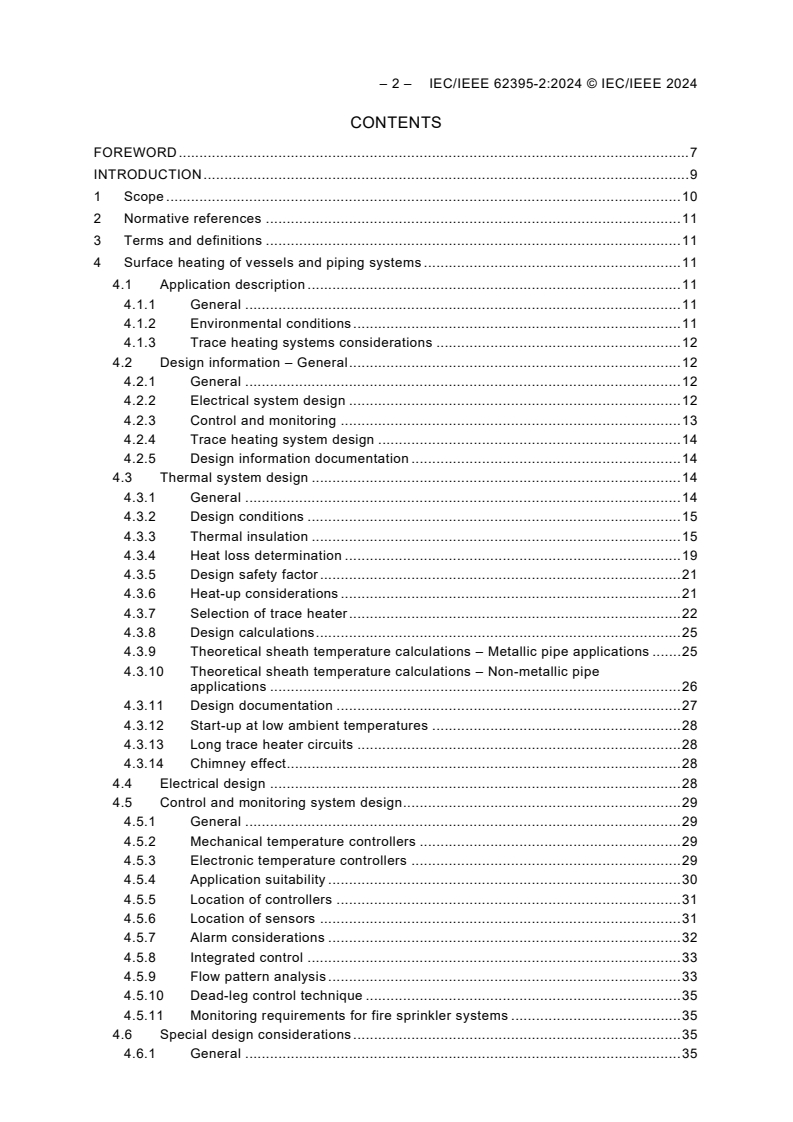
– 2 – IEC/IEEE 62395-2:2024 © IEC/IEEE 2024
CONTENTS
FOREWORD . 7
INTRODUCTION . 9
1 Scope . 10
2 Normative references . 11
3 Terms and definitions . 11
4 Surface heating of vessels and piping systems . 11
4.1 Application description . 11
4.1.1 General . 11
4.1.2 Environmental conditions . 11
4.1.3 Trace heating systems considerations . 12
4.2 Design information – General . 12
4.2.1 General . 12
4.2.2 Electrical system design . 12
4.2.3 Control and monitoring . 13
4.2.4 Trace heating system design . 14
4.2.5 Design information documentation . 14
4.3 Thermal system design . 14
4.3.1 General . 14
4.3.2 Design conditions . 15
4.3.3 Thermal insulation . 15
4.3.4 Heat loss determination . 19
4.3.5 Design safety factor . 21
4.3.6 Heat-up considerations . 21
4.3.7 Selection of trace heater . 22
4.3.8 Design calculations . 25
4.3.9 Theoretical sheath temperature calculations – Metallic pipe applications . 25
4.3.10 Theoretical sheath temperature calculations – Non-metallic pipe
applications . 26
4.3.11 Design documentation . 27
4.3.12 Start-up at low ambient temperatures . 28
4.3.13 Long trace heater circuits . 28
4.3.14 Chimney effect . 28
4.4 Electrical design . 28
4.5 Control and monitoring system design . 29
4.5.1 General . 29
4.5.2 Mechanical temperature controllers . 29
4.5.3 Electronic temperature controllers . 29
4.5.4 Application suitability . 30
4.5.5 Location of controllers . 31
4.5.6 Location of sensors . 31
4.5.7 Alarm considerations . 32
4.5.8 Integrated control . 33
4.5.9 Flow pattern analysis . 33
4.5.10 Dead-leg control technique . 35
4.5.11 Monitoring requirements for fire sprinkler systems . 35
4.6 Special design considerations . 35
4.6.1 General . 35
4.6.2 Freeze protection systems . 35
4.6.3 Sprinkler systems, fire suppression. 36
4.6.4 Hot water services/tempered water . 37
4.6.5 Safety shower design requirements . 38
4.6.6 Specialty lines . 38
4.7 Installation . 40
4.7.1 General . 40
4.7.2 Personnel aspects . 40
4.7.3 Preparatory work . 41
4.7.4 Preliminary installation of trace heating circuits . 41
4.7.5 Pre-installation insulation resistance test . 41
4.7.6 Installation of trace heater systems . 42
4.7.7 Installation of control and monitoring equipment . 44
4.7.8 Necessary modifications . 45
4.7.9 Installation of the thermal insulation system . 45
4.7.10 Installation of electrical power . 47
4.7.11 Commissioning . 47
4.8 Maintenance . 48
4.8.1 General . 48
4.8.2 Training of maintenance personnel . 49
4.8.3 Frequency of inspection . 49
4.8.4 Maintenance program documentation . 49
4.8.5 Visual evaluation . 49
4.8.6 Electrical evaluation. 50
4.8.7 Review of the electrical protection system . 50
4.9 Repair . 50
4.9.1 General . 50
4.9.2 Fault location . 50
4.9.3 Practicability of repair to electric trace heaters . 51
4.9.4 Repair techniques for electrical trace heaters . 51
5 Roof and gutter deicing . 52
5.1 Application description . 52
5.2 Design information – General . 52
5.3 Thermal design . 53
5.4 Electrical design . 53
5.5 Control and monitoring system design . 53
5.6 Special design considerations . 54
5.7 Installation . 54
5.7.1 General . 54
5.7.2 Trace heaters and component mounting . 54
5.8 Maintenance . 57
5.9 Repair . 57
6 Rail heating . 57
6.1 Application description . 57
6.1.1 General . 57
6.1.2 Switch point heating9 . 58
6.1.3 Contact/live rail heating . 58
6.1.4 Track heating . 58
6.1.5 Catenary/pantograph shoe heating . 58
– 4 – IEC/IEEE 62395-2:2024 © IEC/IEEE 2024
6.2 Design information . 59
6.2.1 General . 59
6.2.2 Weather data . 59
6.2.3 Rail system description . 59
6.2.4 System design . 59
6.3 Thermal design . 60
6.3.1 Heating load determination . 60
6.3.2 Typical heating load . 60
6.4 Electrical design . 60
6.5 Control and monitoring system design . 60
6.6 Special design considerations . 61
6.6.1 Electrical considerations . 61
6.6.2 Finite element analysis . 61
6.7 Installation . 61
6.7.1 General . 61
6.7.2 Point heating . 62
6.7.3 Swing nose crossing . 62
6.7.4 Clamp lock heating . 63
6.7.5 Contact/live rail heating and track heating . 63
6.7.6 Catenary/pantograph shoe heating . 64
6.8 Maintenance . 64
6.9 Repair . 64
7 Snow melting . 64
7.1 Application description . 64
7.2 Design information . 65
7.2.1 General . 65
7.2.2 Weather data . 65
7.2.3 Construction details of workpiece . 65
7.2.4 Electrical considerations . 65
7.2.5 System performance level . 65
7.2.6 Trace heater layout and component mounting . 66
7.3 Thermal design – Power output (heat load) determination . 69
7.4 Electrical design . 70
7.5 Control and monitoring system design . 70
7.6 Special design considerations . 70
7.7 Installation . 71
7.8 Maintenance . 71
7.9 Repair . 71
8 Floor warming . 72
8.1 Application description . 72
8.2 Design information . 72
8.2.1 General . 72
8.2.2 Environmental data . 72
8.2.3 Construction details of workpiece . 72
8.2.4 Electrical considerations . 72
8.2.5 Trace heater layout and component mounting . 72
8.3 Thermal design – Heat load determination . 74
8.4 Electrical design . 75
8.5 Control and monitoring system design . 75
8.6 Special design consideration . 75
8.7 Installation . 76
8.8 Maintenance . 76
8.9 Repair . 76
9 Frost heave prevention . 76
9.1 Application description . 76
9.2 Design information . 77
9.2.1 General . 77
9.2.2 Construction details of the floor . 77
9.2.3 Electrical considerations . 77
9.3 Heat load determination . 77
9.3.1 General . 77
9.3.2 Trace heater layout and component mounting . 79
9.4 Electrical design . 79
9.5 Control and monitoring system design . 79
9.5.1 Control options . 79
9.5.2 Monitoring . 79
9.6 Special design considerations . 79
9.7 Installation . 80
9.8 Maintenance . 80
9.9 Repair . 80
10 Underground thermal energy storage systems . 80
10.1 Application description . 80
10.2 Design information . 81
10.2.1 General . 81
10.2.2 Environmental data . 81
10.2.3 Construction details of building . 81
10.2.4 Electrical considerations . 81
10.2.5 Trace heater layout and component mounting . 81
10.3 Thermal design – Heat-loss determination . 82
10.4 Electrical design . 82
10.5 Control and monitoring system design . 82
10.6 Special design considerations when trace heaters are located in sand layer . 83
10.7 Installation . 83
10.7.1 General . 83
10.7.2 Installation in sand . 83
10.7.3 Installation in concrete . 83
10.8 Maintenance . 84
10.9 Repair . 84
Annex A (informative) Pre-installation checks . 85
Annex B (informative) Trace heater commissioning record . 86
Annex C (informative) Maintenance schedule and log record . 87
Bibliography . 88
Figure 1 – Thermal insulation – Weather-barrier installation . 17
Figure 2 – Typical temperature profile . 19
Figure 3 – Equilibrium conditions for workpiece maintenance . 24
– 6 – IEC/IEEE 62395-2:2024 © IEC/IEEE 2024
Figure 4 – Equilibrium conditions for upper limit evaluation . 24
Figure 5 – Heated tank example . 34
Figure 6 – Bypass example . 34
Figure 7 – Fire sprinkler sprig: tapered thermal insulation . 37
Figure 8 – Double containment system . 39
Figure 9 – Gravity flow piping systems . 40
Figure 10 – Ice dam formation . 52
Figure 11 – Downspout to underground drain . 53
Figure 12 – Roof and gutter trace heater arrangement . 55
Figure 13 – Gutter detail . 55
Figure 14 – Typical roof mounting methods . 56
Figure 15 – Drain detail for flat roof. 57
Figure 16 – Typical positioning of point trace heater on stock rail and switch rail . 62
Figure 17 – Typical positioning of trace heater on swing nose crossing . 62
Figure 18 – Typical clamp lock trace heater . 63
Figure 19 – Typical positioning of trace heater on steel and aluminium clad contact rails . 63
Figure 20 – Typical positioning of trace heater in pantograph shoe . 64
Figure 21 – Snow melting trace heater embedded in concrete. 67
Figure 22 – Snow melting trace heater located in conduit . 68
Figure 23 – Expansion joint detail . 69
Figure 24 – Snow melting junction box location . 69
Figure 25 – Typical floor warming trace heater mounting . 74
Figure 26 – Typical floor heating power requirements . 75
Figure 27 – Typical frost heave prevention substructure . 77
Figure 28 – Frost heave prevention power requirements . 78
Figure 29 – Typical underground thermal energy storage system installation . 82
Table 1 – Trace heater and surface heater types and related attributes . 10
Table 2 – Application types . 13
Table 3 – Recommendations for monitoring and control – Type II and III control . 31
Table 4 – Recommendations for hot water services and tempered water temperatures . 37
Table 5 – Minimum values of Insulation resistance. 42
Table 6 – Typical snow melting heat loads . 66
ELECTRICAL RESISTANCE TRACE HEATING SYSTEMS
FOR INDUSTRIAL AND COMMERCIAL APPLICATIONS –
Part 2: Application guide for system design, installation and maintenance
FOREWORD
1) The International Electrotechnical Commission (IEC) is a worldwide organization for standardization comprising
all national electrotechnical committees (IEC National Committees). The object of IEC is to promote international
co-operation on all questions concerning standardization in the electrical and electronic fields. To this end and in
addition to other activities, IEC publishes International Standards, Technical Specifications, Technical Reports,
Publicly Available Specifications (PAS) and Guides (hereafter referred to as "IEC document(s)"). Their
preparation is entrusted to technical committees; any IEC National Committee interested in the subject dealt with
may participate in this preparatory work. International, governmental and non-governmental organizations liaising
with the IEC also participate in this preparation.
IEEE Standards documents are developed within IEEE Societies and Standards Coordinating Committees of the
IEEE Standards Association (IEEE SA) Standards Board. IEEE develops its standards through a consensus
development process, approved by the American National Standards Institute, which brings together volunteers
representing varied viewpoints and interests to achieve the final product. Volunteers are not necessarily members
of IEEE and serve without compensation. While IEEE administers the process and establishes rules to promote
fairness in the consensus development process, IEEE does not independently evaluate, test, or verify the
accuracy of any of the information contained in its standards. Use of IEEE Standards documents is wholly
voluntary. IEEE documents are made available for use subject to important notices and legal disclaimers (see
https://standards.ieee.org/ipr/disclaimers.html for more information).
IEC collaborates closely with IEEE in accordance with conditions determined by agreement between the two
organizations. This Dual Logo International Standard was jointly developed by the IEC and IEEE under the terms
of that agreement.
2) The formal decisions of IEC on technical matters express, as nearly as possible, an international consensus of
opinion on the relevant subjects since each technical committee has representation from all interested IEC
National Committees. The formal decisions of IEEE on technical matters, once consensus within IEEE Societies
and Standards Coordinating Committees has been reached, is determined by a balanced ballot of materially
interested parties who indicate interest in reviewing the proposed standard. Final approval of the IEEE standards
document is given by the IEEE Standards Association (IEEE SA) Standards Board.
3) IEC/IEEE Publications have the form of recommendations for international use and are accepted by IEC National
Committees/IEEE Societies in that sense. While all reasonable efforts are made to ensure that the technical
content of IEC/IEEE Publications is accurate, IEC or IEEE cannot be held responsible for the way in which they
are used or for any misinterpretation by any end user.
4) In order to promote international uniformity, IEC National Committees undertake to apply IEC Publications
(including IEC/IEEE Publications) transparently to the maximum extent possible in their national and regional
publications. Any divergence between any IEC/IEEE Publication and the corresponding national or regional
publication shall be clearly indicated in the latter.
5) IEC and IEEE do not provide any attestation of conformity. Independent certification bodies provide conformity
assessment services and, in some areas, access to IEC marks of conformity. IEC and IEEE are not responsible
for any services carried out by independent certification bodies.
6) All users should ensure that they have the latest edition of this publication.
7) No liability shall attach to IEC or IEEE or their directors, employees, servants or agents including individual
experts and members of technical committees and IEC National Committees, or volunteers of IEEE Societies and
the Standards Coordinating Committees of the IEEE Standards Association (IEEE SA) Standards Board, for any
personal injury, property damage or other damage of any nature whatsoever, whether direct or indirect, or for
costs (including legal fees) and expenses arising out of the publication, use of, or reliance upon, this IEC/IEEE
Publication or any other IEC or IEEE Publications.
8) Attention is drawn to the normative references cited in this publication. Use of the referenced publications is
indispensable for the correct application of this publication.
9) Attention is drawn to the possibility that implementation of this IEC/IEEE Publication may require use of material
covered by patent rights. By publication of this standard, no position is taken with respect to the existence or
validity of any patent rights in connection therewith. IEC or IEEE shall not be held responsible for identifying
Essential Patent Claims for which a license may be required, for conducting inquiries into the legal validity or
scope of Patent Claims or determining whether any licensing terms or conditions provided in connection with
submission of a Letter of Assurance, if any, or in any licensing agreements are reasonable or non-discriminatory.
Users of this standard are expressly advised that determination of the validity of any patent rights, and the risk
of infringement of such rights, is entirely their own responsibility.
IEC/IEEE 62395-2 was prepared by IEC technical committee 27: Industrial electroheating and
electromagnetic, in cooperation with the Petroleum & Chemical Industry Committee of the IEEE
Industrial Applications Society, under the IEC/IEEE Dual Logo Agreement between IEC and
IEEE. It is an International Standard.
– 8 – IEC/IEEE 62395-2:2024 © IEC/IEEE 2024
This document is published as an IEC/IEEE Dual Logo standard.
This standard cancels and replaces IEC 62395-2:2013. This edition constitutes a technical
revision.
This standard includes the following significant technical changes with respect to
IEC 62395-2:2013:
a) Design considerations for trace heating on sprinkler systems have been expanded and a
figure has been added to illustrate how to avoid undue shadowing of spray patterns from
insulated sprigs close to sprinkler heads;
b) Specific details of design considerations for trace heating for emergency eyewash units and
safety showers have been added.
The text of this International Standard is based on the following IEC documents:
Draft Report on voting
27/1183/FDIS 27/1185/RVD
Full information on the voting for its approval can be found in the report on voting indicated in
the above table.
The language used for the development of this International Standard is English.
This document was drafted in accordance with the rules given in the ISO/IEC Directives, Part 2,
available at www.iec.ch/members_experts/refdocs. The main document types developed by IEC
are described in greater detail at www.iec.ch/publications/.
This standard is intended to be used in conjunction with IEC/IEEE 62395-1.
A list of all parts in the IEC 62395 series, under the general title Electrical resistance trace
heating systems for industrial and commercial applications, can be found on the IEC website.
The IEC Technical Committee and IEEE Technical Committee have decided that the contents
of this document will remain unchanged until the stability date indicated on the IEC website
under webstore.iec.ch in the data related to the specific document. At this date, the document
will be
• reconfirmed,
• withdrawn, or
• revised.
IMPORTANT – The "colour inside" logo on the cover page of this document indicates
that it contains colours which are considered to be useful for the correct understanding
of its contents. Users should therefore print this document using a colour printer.
INTRODUCTION
IEC/IEEE 62395-1 provides the essential requirements and testing appropriate to electrical
resistance trace heating equipment used in industrial and commercial applications. While some
of this work already exists in national or international standards, this document has collated
much of this existing work and added considerably to it.
IEC/IEEE 62395-2 provides detailed recommendations for the system design, installation,
maintenance and repair of electrical resistance trace heating systems in industrial and
commercial applications which can include piping, vessels, roofs and concrete slab heating
applications.
It is the objective of the IEC/IEEE 62395 series that, when in normal use, electrical trace heating
systems operate safely under their defined conditions of use, by
a) employing heaters of the appropriate construction so as to meet the test criteria and
requirements detailed in IEC/IEEE 62395-1. The construction includes a metallic sheath,
braid, screen or equivalent electrically conductive covering;
b) operating at safe temperatures when designed, installed, and maintained in accordance with
IEC/IEEE 62395-2;
c) having at least the minimum levels of overcurrent and earth-fault protection required in
IEC/IEEE 62395-1 and IEC/IEEE 62395-2.
– 10 – IEC/IEEE 62395-2:2024 © IEC/IEEE 2024
ELECTRICAL RESISTANCE TRACE HEATING SYSTEMS
FOR INDUSTRIAL AND COMMERCIAL APPLICATIONS –
Part 2: Application guide for system design, installation and maintenance
1 Scope
This part of IEC/IEEE 62395 provides detailed recommendations for the system design,
installation, maintenance and repair of electrical resistance trace heating systems in industrial
and commercial applications. This document does not include or provide for any applications in
potentially explosive atmospheres.
This document pertains to trace heating systems that can comprise either factory fabricated or
field-assembled (work-site) units, and which can be series or parallel trace heaters, or surface
heaters (heater pads or heater panels) that have been assembled and/or terminated in
accordance with the manufacturer's instructions.
The products covered by this document are intended to be installed by persons who are suitably
trained in the techniques required and that only trained personnel carry out especially critical
work, such as the installation of connections and terminations. Installations are intended to be
carried out under the supervision of a qualified person who has undergone supplementary
training in electric trace heating systems.
This document does not cover induction, impedance or skin effect heating.
Trace heating systems and surface heating systems can be grouped into different types of
installations. These are characterized by different requirements for testing and are usually
certified for a specific type of installation or application. Typical applications for the different
types of installation are shown in Table 1.
Table 1 – Trace heater and surface heater types and related attributes
Trace heater type Intended installations Examples of installations Required attributes
A Insulated surfaces Hot water lines Dielectric, thermal,
(including pipe) Freeze protection mechanical, moisture
Grease lines exclusion, and performance
Fuel oil lines characteristics verification
Pre-insulated pipe
Sprinkler system verification
Below grade trace heating
(if specified for use)
Sprinkler systems
B Outdoor exposed areas Roof deicing Dielectric, thermal,
Gutter and downspouts deicing mechanical, moisture
Catch basins and drains exclusion, and performance
Rail heating systems characteristics verification
Increased moisture
resistance
UV and condensation
resistance
Resistance to cutting
Abrasion resistance
Tension test
Rail system tests (if specified
for use)
Trace heater type Intended installations Examples of installations Required attributes
C Installations with Embedded snow melting Dielectric, thermal,
embedded trace heating Embedded frost heave protection mechanical, moisture
Embedded floor warming exclusion, and performance
Embedded energy storage characteristics verification
systems
Resistance to cutting
Embedded door frames
Resistance to crushing
D Installations with trace Embedded snow melting Dielectric, thermal,
heater inside conduit or Embedded frost heave protection mechanical, moisture
piping Embedded floor warming exclusion, and performance
Embedded energy storage characteristics verification
systems
Increased moisture
Embedded door frames
resistance (pressurized or
Internal trace heating for freeze
non-pressurized)
protection of potable water lines
Enclosed drains and culverts
Pull-strength evaluation
NOTE Trace heating systems intended for use in explosive atmospheres are the subject of IEC/IEEE 60079-30-1
and IEC/IEEE 60079-30-2.
2 Normative references
The following documents are referred to in the text in such a way that some or all of their content
constitutes requirements of this document. For dated references, only the edition cited applies.
For undated references, the latest edition of the referenced document (including any
amendments) applies.
IEC/IEEE 62395-1:2024, Electrical resistance trace heating systems for industrial and
commercial applications – Part 1: General and testing requirements
3 Terms and definitions
For the purposes of this document, the terms and definitions given in IEC/IEEE 62395-1 apply.
ISO, IEC and IEEE maintain terminology databases for use in standardization at the following
addresses:
IEC Electrope
...
IEC/IEEE 62395-2 ®
Edition 1.0 2024-06
NORME
INTERNATIONALE
Systèmes de traçage par résistance électrique pour applications industrielles et
commerciales -
Partie 2: Guide d'application pour la conception, l'installation et la maintenance
des systèmes
ICS 25.180.10 ISBN 978-2-8327-1538-3
Droits de reproduction réservés. Sauf indication contraire, aucune partie de cette publication ne peut être reproduite ni
utilisée sous quelque forme que ce soit et par aucun procédé, électronique ou mécanique, y compris la photocopie et
les microfilms, sans l'accord écrit de l'IEC ou du Comité national de l'IEC du pays du demandeur. Si vous avez des
questions sur le copyright de l'IEC ou si vous désirez obtenir des droits supplémentaires sur cette publication, utilisez
les coordonnées ci-après ou contactez le Comité national de l'IEC de votre pays de résidence.
IEC Secretariat Institute of Electrical and Electronics Engineers, Inc.
3, rue de Varembé 3 Park Avenue
CH-1211 Geneva 20 New York, NY 10016-5997
Switzerland United States of America
Tel.: +41 22 919 02 11 stds.ipr@ieee.org
info@iec.ch www.ieee.org
www.iec.ch
A propos de l'IEC
La Commission Electrotechnique Internationale (IEC) est la première organisation mondiale qui élabore et publie des
Normes internationales pour tout ce qui a trait à l'électricité, à l'électronique et aux technologies apparentées.
A propos des publications IEC
Le contenu technique des publications IEC est constamment revu. Veuillez vous assurer que vous possédez l’édition la
plus récente, un corrigendum ou amendement peut avoir été publié
Recherche de publications IEC - IEC Products & Services Portal - products.iec.ch
webstore.iec.ch/advsearchform Découvrez notre puissant moteur de recherche et consultez
La recherche avancée permet de trouver des publications IEC gratuitement tous les aperçus des publications, symboles
en utilisant différents critères (numéro de référence, texte, graphiques et le glossaire. Avec un abonnement, vous aurez
comité d’études, …). Elle donne aussi des informations sur les toujours accès à un contenu à jour adapté à vos besoins.
projets et les publications remplacées ou retirées.
Electropedia - www.electropedia.org
IEC Just Published - webstore.iec.ch/justpublished Le premier dictionnaire d'électrotechnologie en ligne au
Restez informé sur les nouvelles publications IEC. Just monde, avec plus de 22 500 articles terminologiques en
Published détaille les nouvelles publications parues. anglais et en français, ainsi que les termes équivalents dans
Disponible en ligne et une fois par mois par email. 25 langues additionnelles. Egalement appelé Vocabulaire
Electrotechnique International (IEV) en ligne.
Service Clients - webstore.iec.ch/csc
Si vous désirez nous donner des commentaires sur cette
publication ou si vous avez des questions contactez-nous:
sales@iec.ch.
– 90 – IEC/IEEE 62395-2:2024 © IEC/IEEE 2024
SOMMAIRE
AVANT-PROPOS . 95
INTRODUCTION . 97
1 Domaine d'application . 98
2 Références normatives . 99
3 Termes et définitions . 100
4 Chauffage de surface des systèmes de cuves et de tuyauteries . 100
4.1 Description de l'application . 100
4.1.1 Généralités . 100
4.1.2 Conditions d'environnement . 100
4.1.3 Aspects des systèmes de chauffage par traçage . 101
4.2 Informations concernant la conception – Généralités . 101
4.2.1 Généralités . 101
4.2.2 Conception électrique du système . 101
4.2.3 Régulation et surveillance . 101
4.2.4 Conception du système de chauffage par traçage . 103
4.2.5 Documentation concernant les informations de conception . 103
4.3 Conception thermique du système . 103
4.3.1 Généralités . 103
4.3.2 Conditions de conception. 104
4.3.3 Isolation thermique . 104
4.3.4 Détermination des pertes de chaleur . 110
4.3.5 Coefficient de sécurité de conception . 111
4.3.6 Aspects concernant le réchauffage . 111
4.3.7 Choix de la résistance de traçage . 112
4.3.8 Calculs de conception . 115
4.3.9 Calculs de la température théorique de la gaine – Applications utilisant
des tuyaux métalliques . 116
4.3.10 Calculs de la température théorique de la gaine – Applications utilisant
des tuyaux non métalliques . 117
4.3.11 Documentation de conception . 118
4.3.12 Démarrage à températures ambiantes faibles . 119
4.3.13 Circuits de résistance de traçage de grande longueur . 119
4.3.14 Effet de cheminée . 119
4.4 Conception électrique . 120
4.5 Conception du système de régulation et de surveillance . 120
4.5.1 Généralités . 120
4.5.2 Régulateurs de température mécaniques . 121
4.5.3 Régulateurs de température électroniques . 121
4.5.4 Bonne adaptation à l'application . 121
4.5.5 Emplacement des régulateurs . 122
4.5.6 Emplacement des capteurs . 122
4.5.7 Aspects liés aux alarmes . 123
4.5.8 Régulation intégrée . 124
4.5.9 Analyse du modèle de circulation . 124
4.5.10 Technique de régulation de tronçon mort . 126
4.5.11 Exigences de surveillance pour les systèmes pulvérisateurs de lutte
contre les incendies . 126
4.6 Considérations particulières de conception . 126
4.6.1 Généralités . 126
4.6.2 Systèmes de protection contre le gel . 127
4.6.3 Systèmes pulvérisateurs de lutte incendie . 127
4.6.4 Services d'eau chaude/d'eau tiède . 128
4.6.5 Exigences de conception des douches de sécurité . 129
4.6.6 Conduites spécialisées . 130
4.7 Installation . 132
4.7.1 Généralités . 132
4.7.2 Aspects touchant au personnel . 132
4.7.3 Travaux préparatoires . 132
4.7.4 Installation préliminaire des circuits de traçage . 133
4.7.5 Essai de résistance d'isolement avant installation . 133
4.7.6 Installation des systèmes de résistances de traçage . 133
4.7.7 Installation du matériel de régulation et de surveillance . 136
4.7.8 Modifications nécessaires . 137
4.7.9 Installation du système d'isolation thermique . 138
4.7.10 Installation électrique. 139
4.7.11 Mise en service . 140
4.8 Maintenance . 141
4.8.1 Généralités . 141
4.8.2 Formation du personnel de maintenance . 141
4.8.3 Fréquence d'inspection . 142
4.8.4 Documentation du programme de maintenance . 142
4.8.5 Évaluation visuelle . 142
4.8.6 Évaluation électrique . 142
4.8.7 Revue du système de protection électrique . 143
4.9 Réparation . 143
4.9.1 Généralités . 143
4.9.2 Localisation de défaut . 143
4.9.3 Faisabilité des réparations des résistances de traçage . 144
4.9.4 Techniques de réparation pour les résistances de traçage électrique . 144
5 Dégivrage des toits et des gouttières . 145
5.1 Description de l'application . 145
5.2 Informations concernant la conception – Généralités . 145
5.3 Conception thermique . 146
5.4 Conception électrique . 146
5.5 Conception du système de régulation et de surveillance . 146
5.6 Considérations particulières de conception . 147
5.7 Installation . 147
5.7.1 Généralités . 147
5.7.2 Montage des résistances de traçage et des composants . 147
5.8 Maintenance . 151
5.9 Réparation . 151
6 Chauffage des rails . 152
6.1 Description de l'application . 152
6.1.1 Généralités . 152
6.1.2 Chauffage du point de commutation . 152
6.1.3 Chauffage du rail de contact/rail conducteur . 152
– 92 – IEC/IEEE 62395-2:2024 © IEC/IEEE 2024
6.1.4 Chauffage de la voie . 153
6.1.5 Chauffage des caténaires/sabots de pantographe . 153
6.2 Informations de conception . 153
6.2.1 Généralités . 153
6.2.2 Données météorologiques . 153
6.2.3 Description du système ferroviaire . 153
6.2.4 Conception du système . 154
6.3 Conception thermique . 154
6.3.1 Détermination de la charge thermique . 154
6.3.2 Charge thermique type . 154
6.4 Conception électrique . 155
6.5 Conception du système de régulation et de surveillance . 155
6.6 Considérations particulières de conception . 155
6.6.1 Considérations électriques . 155
6.6.2 Analyse limitée d'éléments . 155
6.7 Installation . 156
6.7.1 Généralités . 156
6.7.2 Chauffage par points . 156
6.7.3 Croisement à cœur mobile . 157
6.7.4 Chauffage des verrouillages de serrage . 157
6.7.5 Chauffage du rail de contact/du rail conducteur et chauffage de la voie . 157
6.7.6 Chauffage des caténaires/sabots de pantographe . 158
6.8 Maintenance . 158
6.9 Réparation . 158
7 Dispositifs destinés à faire fondre la neige. 159
7.1 Description de l'application . 159
7.2 Informations de conception . 159
7.2.1 Généralités . 159
7.2.2 Données météorologiques . 159
7.2.3 Détails de construction de la pièce à traiter . 159
7.2.4 Considérations électriques . 159
7.2.5 Niveau de performance du système . 160
7.2.6 Montage des résistances de traçage et des composants . 160
7.3 Conception thermique – Détermination de la puissance de sortie (charge
thermique) . 164
7.4 Conception électrique . 165
7.5 Conception du système de régulation et de surveillance . 165
7.6 Considérations particulières de conception . 165
7.7 Installation . 166
7.8 Maintenance . 167
7.9 Réparation . 167
8 Chauffage des sols . 167
8.1 Description de l'application . 167
8.2 Informations de conception . 167
8.2.1 Généralités . 167
8.2.2 Données d'environnement . 167
8.2.3 Détails de construction de la pièce à traiter . 167
8.2.4 Considérations électriques . 168
8.2.5 Montage des résistances de traçage et des composants . 168
8.3 Conception thermique – Détermination de la charge thermique . 169
8.4 Conception électrique . 170
8.5 Conception du système de régulation et de surveillance . 171
8.6 Considération particulière de conception . 171
8.7 Installation . 171
8.8 Maintenance . 171
8.9 Réparation . 171
9 Protection contre le soulèvement par le gel . 172
9.1 Description de l'application . 172
9.2 Informations de conception . 172
9.2.1 Généralités . 172
9.2.2 Détails de construction du sol . 172
9.2.3 Considérations électriques . 173
9.3 Détermination de la charge thermique . 173
9.3.1 Généralités . 173
9.3.2 Montage des résistances de traçage et des composants . 175
9.4 Conception électrique . 175
9.5 Conception du système de régulation et de surveillance . 175
9.5.1 Options de commande . 175
9.5.2 Surveillance . 175
9.6 Considérations particulières de conception . 176
9.7 Installation . 176
9.8 Maintenance . 176
9.9 Réparation . 176
10 Systèmes de stockage de l'énergie thermique en souterrain . 177
10.1 Description de l'application . 177
10.2 Informations de conception . 177
10.2.1 Généralités . 177
10.2.2 Données d'environnement . 177
10.2.3 Détails de construction du bâtiment . 177
10.2.4 Considérations électriques . 177
10.2.5 Montage des résistances de traçage et des composants . 177
10.3 Conception thermique – Détermination des pertes de chaleur . 178
10.4 Conception électrique . 179
10.5 Conception du système de régulation et de surveillance . 179
10.6 Considérations de conception particulières pour des résistances de
chauffage placées dans des couches de sable . 179
10.7 Installation . 179
10.7.1 Généralités . 179
10.7.2 Installation dans le sable . 179
10.7.3 Installation dans le béton . 180
10.8 Maintenance . 180
10.9 Réparation . 181
Annexe A (informative) Vérifications avant l'installation . 182
Annexe B (informative) Enregistrement de mise en service d'une résistance de
traçage . 183
Annexe C (informative) Programme et journal de maintenance . 184
Bibliographie . 185
– 94 – IEC/IEEE 62395-2:2024 © IEC/IEEE 2024
Figure 1 – Isolation thermique – Installation d'une barrière d'étanchéité . 107
Figure 2 – Profil type de température . 109
Figure 3 – Conditions d'équilibre pour la maintenance de la pièce à traiter . 114
Figure 4 – Conditions d'équilibre pour l'évaluation des limites supérieures. 115
Figure 5 – Exemple de réservoir chauffé . 125
Figure 6 – Exemple de dérivation . 125
Figure 7 – Cheville de pulvérisateur de lutte contre les incendies: isolation thermique
oblique . 128
Figure 8 – Système de double confinement. 131
Figure 9 – Systèmes de tuyauteries à flux de gravité . 131
Figure 10 – Formation de barrières de glace . 145
Figure 11 – Tuyau de descente vers évacuation souterraine . 146
Figure 12 – Montage d'une résistance de traçage de toit et de gouttière . 148
Figure 13 – Détail d'une gouttière . 149
Figure 14 – Méthodes types de montage des toits . 150
Figure 15 – Détail des tuyaux d'évacuation pour toit plat . 151
Figure 16 – Positionnement type par point de la résistance de traçage sur la contre-
aiguille et le rail d'aiguillage . 156
Figure 17 – Positionnement type de la résistance de traçage sur le croisement à cœur
mobile . 157
Figure 18 – Résistance de traçage type des verrouillages de serrage . 157
Figure 19 – Positionnement type de la résistance de traçage sur les rails de contact
plaqués en aluminium et acier . 158
Figure 20 – Positionnement type de la résistance de traçage dans le sabot du
pantographe . 158
Figure 21 – Résistance de traçage pour faire fondre la neige enfouie dans le béton . 162
Figure 22 – Résistance de traçage pour faire fondre la neige à l'intérieur d'un conduit . 163
Figure 23 – Détail de joint de dilatation . 164
Figure 24 – Emplacement de la boîte de jonction pour fonte de la neige . 164
Figure 25 – Montage type des résistances de traçage pour le chauffage des sols . 169
Figure 26 – Exigences types pour la puissance de chauffage des sols . 170
Figure 27 – Sous-structure type de prévention du soulèvement par le gel . 172
Figure 28 – Exigences de puissance pour la prévention du soulèvement par le gel . 174
Figure 29 – Installation type d'un système de stockage de l'énergie thermique en
souterrain . 178
Tableau 1 – Types de résistance de traçage et de résistance en surface et attributs
associés . 99
Tableau 2 – Types d'applications . 102
Tableau 3 – Recommandations pour la surveillance et la commande – Commandes
Types II et III . 122
Tableau 4 – Recommandations pour les services d'eau chaude et les températures
d'eau tiède . 129
Tableau 5 – Valeurs minimales de résistance d'isolement . 133
Tableau 6 – Charges thermiques types pour faire fondre la neige . 160
SYSTÈMES DE TRAÇAGE PAR RÉSISTANCE ÉLECTRIQUE
POUR APPLICATIONS INDUSTRIELLES ET COMMERCIALES –
Partie 2: Guide d'application pour la conception, l'installation
et la maintenance des systèmes
AVANT-PROPOS
1) La Commission Électrotechnique Internationale (IEC) est une organisation mondiale de normalisation composée
de l'ensemble des comités électrotechniques nationaux (Comités nationaux de l'IEC). L'IEC a pour objet de
favoriser la coopération internationale pour toutes les questions de normalisation dans les domaines de
l'électricité et de l'électronique. À cet effet, l'IEC – entre autres activités – publie des Normes internationales,
des Spécifications techniques, des Rapports techniques, des Spécifications accessibles au public (PAS) et des
Guides (ci-après dénommés "Document(s) de l'IEC"). Leur élaboration est confiée à des comités d'études, aux
travaux desquels tout Comité national intéressé par le sujet traité peut participer. Les organisations
internationales, gouvernementales et non gouvernementales, en liaison avec l'IEC, participent également aux
travaux.
Les normes de l'IEEE sont élaborées par les Sociétés de l'IEEE, ainsi que par les Comités de coordination des
normes du Conseil de normalisation de l'IEEE Standards Association (IEEE-SA). Ces normes sont
l'aboutissement d'un consensus, soumis à l'approbation de l'Institut national américain de normalisation, qui
rassemble des bénévoles représentant divers points de vue et intérêts. Les participants bénévoles ne sont pas
nécessairement membres de l'IEEE et leur intervention n'est pas rétribuée. Si l'IEEE administre le déroulement
de cette procédure et définit les règles destinées à favoriser l'équité du consensus, l'IEEE lui-même n'évalue
pas, ne teste pas et ne vérifie pas l'exactitude de toute information contenue dans ses normes. L'utilisation de
normes de l'IEEE est entièrement volontaire. Les documents de l'IEEE sont disponibles à des fins d'utilisation, à
condition d'être assortis d'avis importants et de clauses de non-responsabilité (voir
http://standards.ieee.org/IPR/disclaimers.html pour de plus amples informations).
L'IEC travaille en étroite collaboration avec l'IEEE, selon des conditions fixées par accord entre les deux
organisations. Cette norme internationale double logo a été élaborée conjointement par l'IEC et l'IEEE,
conformément aux dispositions de cet accord.
2) Les décisions officielles de l'IEC concernant les questions techniques représentent, dans la mesure du possible,
un accord international sur les sujets étudiés, étant donné que les Comités nationaux de l'IEC intéressés sont
représentés dans chaque comité d'études. Une fois le consensus établi entre les Sociétés de l'IEEE et les
Comités de coordination des normes, les décisions officielles de l'IEEE relatives aux questions techniques sont
déterminées en fonction du vote exprimé par un groupe à la composition équilibrée, composé de parties
intéressées qui manifestent leur intérêt pour la révision des normes proposées. L'approbation finale de la norme
de l'IEEE est soumise au Conseil de normalisation de l'IEEE Standards Association (IEEE-SA).
3) Les Publications IEC/IEEE se présentent sous la forme de recommandations internationales et sont agréées
comme telles par les Comités nationaux de l'IEC/Sociétés de l'IEEE. Tous les efforts raisonnables sont entrepris
afin de s'assurer de l'exactitude du contenu technique des Publications IEC/IEEE; l'IEC ou l'IEEE ne peuvent pas
être tenus responsables de l'éventuelle mauvaise utilisation ou interprétation qui en est faite par un quelconque
utilisateur final.
4) Dans le but d'encourager l'uniformité internationale, les Comités nationaux de l'IEC s'engagent, dans toute la
mesure possible, à appliquer de façon transparente les Publications de l'IEC (y compris les Publications
IEC/IEEE) dans leurs publications nationales et régionales. Toutes divergences entre toutes Publications
IEC/IEEE et toutes publications nationales ou régionales correspondantes doivent être indiquées en termes clairs
dans ces dernières.
5) L'IEC et l'IEEE eux-mêmes ne fournissent aucune attestation de conformité. Des organismes de certification
indépendants fournissent des services d'évaluation de conformité et, dans certains secteurs, accèdent aux
marques de conformité de l'IEC. L'IEC et l'IEEE ne sont responsables d'aucun des services effectués par les
organismes de certification indépendants.
6) Tous les utilisateurs doivent s'assurer qu'ils sont en possession de la dernière édition de cette publication.
7) Aucune responsabilité ne doit être imputée à l'IEC ou à l'IEEE, à ses administrateurs, employés, auxiliaires ou
mandataires, y compris ses experts particuliers et les membres de ses comités d'études et des Comités nationaux
de l'IEC, ou les bénévoles des Sociétés de l'IEEE et des Comités de coordination des normes du Conseil de
normalisation de l'IEEE Standards Association (IEEE-SA), pour tout préjudice causé en cas de dommages
corporels et matériels, ou de tout autre dommage de quelque nature que ce soit, directe ou indirecte, ou pour
supporter les coûts (y compris les frais de justice) et les dépenses découlant de la publication ou de l'utilisation
de cette Publication IEC/IEEE ou toute autre publication de l'IEC ou de l'IEEE, ou au crédit qui lui est accordé.
8) L'attention est attirée sur les références normatives citées dans cette publication. L'utilisation de publications
référencées est obligatoire pour une application correcte de la présente publication.
– 96 – IEC/IEEE 62395-2:2024 © IEC/IEEE 2024
9) L'attention est attirée sur le fait que la mise en application de cette Publication IEC/IEEE peut requérir l'utilisation
de matériels protégés par des droits de brevet. En publiant cette norme, aucun parti n'est pris concernant
l'existence ou la validité de droits de brevet y afférents. Ni l'IEC ni l'IEEE ne peuvent être tenus d'identifier les
revendications de brevet essentielles pour lesquelles une autorisation peut s'avérer nécessaire, d'effectuer des
recherches sur la validité juridique ou l'étendue des revendications des brevets, ou de déterminer le caractère
raisonnable ou non discriminatoire des termes ou conditions d'autorisation énoncés dans le cadre d'un Certificat
d'assurance, lorsque la demande d'un tel certificat a été formulée, ou contenus dans tout accord d'autorisation.
Les utilisateurs de cette norme sont expressément informés du fait que la détermination de la validité de tous
droits de propriété industrielle, ainsi que les risques qu'implique la violation de ces droits, relèvent entièrement
de leur seule responsabilité.
L'IEC/IEEE 62395-2 a été établie par le comité d'études 27 de l'IEC: Chauffage électrique
industriel et traitement électromagnétique, en coopération avec le Petroleum & Chemical
Industry Committee de l'IEEE Industrial Applications Society, dans le cadre de l'accord double
logo IEC/IEEE conclu entre l'IEC et l'IEEE. Il s'agit d'une Norme internationale.
Le présent document est publié sous la forme d'une norme double logo IEC/IEEE.
La présente norme annule et remplace l'IEC 62395-2:2013. Cette édition constitue une révision
technique.
La présente norme inclut les modifications techniques majeures suivantes par rapport à
l'IEC 62395-2:2013:
a) les considérations de conception pour le traçage sur les systèmes pulvérisateurs ont été
étendues et une figure a été ajoutée pour montrer comment faire pour éviter l'ombrage
imprévu des pulvérisations des chevilles d'isolation adjacentes aux têtes d'arrosage;
b) des détails spécifiques aux considérations de conception pour le traçage des unités de lave-
yeux d'urgence et des douches de sécurité ont été ajoutés.
La présente version bilingue (2026-09) correspond à la version anglaise monolingue publiée en
2024-06.
La version française de cette norme n'a pas été soumise au vote.
La langue employée pour l'élaboration de cette Norme internationale est l'anglais.
Le présent document a été rédigé conformément aux règles données dans les Directives
ISO/IEC, Partie 2, disponibles sous www.iec.ch/members_experts/refdocs. Les principaux
types de documents développés par l'IEC sont décrits plus en détail sous
www.iec.ch/publications.
La présente norme est destinée à être utilisée conjointement avec l'IEC/IEEE 62395-1.
Une liste de toutes les parties de la série IEC 62395, publiées sous le titre général Systèmes
de traçage par résistance électrique pour applications industrielles et commerciales, se trouve
sur le site web de l'IEC.
Le comité technique de l'IEC et le comité technique de l'IEEE ont décidé que le contenu de ce
document ne sera pas modifié avant la date de stabilité indiquée sur le site web de l'IEC sous
webstore.iec.ch dans les données relatives au document recherché. À cette date, le document
sera
• reconduit,
• supprimé, ou
• révisé.
INTRODUCTION
L'IEC/IEEE 62395-1 fournit les exigences essentielles et les essais appropriés au matériel de
traçage par résistance électrique utilisé dans des applications industrielles et commerciales.
Alors qu'une partie de ce travail existe déjà sous forme de normes nationales ou internationales,
le présent document a collationné la plupart des travaux existants tout en y introduisant un
apport considérable.
L'IEC/IEEE 62395-2 fournit des recommandations détaillées concernant la conception,
l'installation, la maintenance et la réparation des systèmes de traçage par résistance électrique
dans les installations industrielles et commerciales qui peuvent intégrer des applications de
chauffage des tuyauteries, des cuves, des toits et des dalles en béton.
L'objectif de la série IEC/IEEE 62395 consiste en ce qu'en utilisation normale, les systèmes de
traçage électrique fonctionnent en toute sécurité dans les conditions d'utilisation définies:
a) en employant des résistances de traçage de construction appropriée et en satisfaisant aux
critères et aux exigences d'essai décrits dans l'IEC/IEEE 62395-1. La construction
comprend une gaine métallique, une tresse de métal, un écran métallique ou un revêtement
électriquement conducteur équivalent;
b) en fonctionnant à des valeurs de températures sûres quand ils sont conçus, installés et
entretenus conformément à l'IEC/IEEE 62395-2;
c) en possédant au moins les niveaux minimaux de protection contre les surintensités et les
défauts à la terre exigés dans l'IEC/IEEE 62395-1 et l'IEC/IEEE 62395-2.
– 98 – IEC/IEEE 62395-2:2024 © IEC/IEEE 2024
SYSTÈMES DE TRAÇAGE PAR RÉSISTANCE ÉLECTRIQUE
POUR APPLICATIONS INDUSTRIELLES ET COMMERCIALES –
Partie 2: Guide d'application pour la conception, l'installation
et la maintenance des systèmes
1 Domaine d'application
La présente partie de l'IEC/IEEE 62395 fournit des recommandations détaillées pour la
conception, l'installation, la maintenance et la réparation des systèmes de traçage par
résistance électrique dans les applications industrielles et commerciales. Le présent document
ne comprend ni ne prévoit d'applications dans des atmosphères potentiellement explosives.
Le présent document traite de systèmes de traçage qui peuvent comprendre soit des unités
fabriquées en usine, soit des unités assemblées sur site (chantier), et qui peuvent être des
résistances de traçage en série ou en parallèle, ou des résistances en surface (bandes de
traçage ou panneaux de traçage) qui ont été assemblées et/ou équipées de terminaisons
conformément aux instructions du fabricant.
Les produits couverts par le présent document sont destinés à être installés par des personnes
convenablement formées aux techniques nécessaires. Seul ce personnel formé réalise les
travaux particulièrement critiques tels que l'installation de connexions et de terminaisons. Les
installations sont destinées à être réalisées sous le contrôle d'une personne qualifiée ayant
suivi une formation supplémentaire sur les systèmes de traçage électrique.
Le présent document ne couvre pas le chauffage par induction, impédance ou effet de peau.
Les systèmes de traçage et les systèmes de chauffage de surface peuvent être regroupés en
différents types d'installations. Ces types sont caractérisés par des exigences d'essai
différentes et ils sont généralement certifiés pour un type particulier d'installation ou
d'application. Les applications types pour les différents types d'installations sont représentées
dans le Tableau 1.
Tableau 1 – Types de résistance de traçage et de résistance en surface
et attributs associés
Type de Installations prévues Exemples d'installations Attributs exigés
résistance de
traçage
A Surfaces isolées (y compris Conduites d'eau chaude Diélectrique, thermique,
les tuyaux) Protection contre le gel mécanique, exclusion de
Conduites de graisse l'humidité et vérification des
Conduites de fioul caractéristiques de
Tuyau pré-isolé performance
Résistance de traçage au-dessous
Vérification de l'installation
du niveau du sol
d'arrosage (si spécifié pour
Installations d'arrosage
l'utilisation)
B Zones exposées à Dégivrage des toits Diélectrique, thermique,
l'extérieur Dégivrage des gouttières et des mécanique, exclusion de
tuyaux de descente des eaux l'humidité et vérification des
pluviales caractéristiques de
Puisards et drains performance
Systèmes de chauffage des rails
Résistance à l'humidité
accrue
Résistance aux UV et à la
condensation
Résistance à la coupe
Résistance à l'abrasion
Essai de traction
Essais du système ferroviaire
(s'ils sont spécifiés pour
l'utilisation)
C Installations avec système Fonte de la neige intégrée Diélectrique, thermique,
Protection des chaussées contre mécanique, exclusion de
de traçage intégré
le gel intégrée l'humidité et vérification des
Chauffage des sols intégré caractéristiques de
Systèmes de stockage de l'énergie performance
intégrés
Résistance à la coupe
Encadrements de portes intégrés
Résistance à l'écrasement
Installations avec Fonte de la neige intégrée Diélectrique, thermiqu
...