

IEC 61010-2-061:2015
(Main)Safety requirements for electrical equipment for measurement, control and laboratory use - Part 2-061: Particular requirements for laboratory atomic spectrometers with thermal atomization and ionization
General Information
- Abstract
IEC 61010-2-061:2015 applies to electrically powered laboratory atomic spectrometers with thermal atomization. It has the status of a group safety publication in accordance with IEC Guide 104. This third edition cancels and replaces the second edition published in 2003. It constitutes a technical revision and includes the following change from the second edition:
- exclusion of equipment, whose size and weight make unintentional movement unlikely, from the drop test in Clause 8.
- notes have been re-phrased according to ISO/IEC Directives.
This publication is to be read in conjunction with IEC 61010-1:2010.
- Status
- Published
- Publication Date
- 09-Mar-2015
- Technical Committee
- TC 66 - Safety of measuring, control and laboratory equipment
- Drafting Committee
- MT 10 - TC 66/MT 10
- Current Stage
- DELPUB - Deleted Publication
- Start Date
- 21-Sep-2018
- Completion Date
- 30-Jun-2017
Buy Documents
IEC 61010-2-061:2015 - Safety requirements for electrical equipment for measurement, control and laboratory use - Part 2-061: Particular requirements for laboratory atomic spectrometers with thermal atomization and ionization Released:3/10/2015
Overview
IEC 61010-2-061:2015 is an international standard published by the International Electrotechnical Commission (IEC) that specifies particular safety requirements for laboratory atomic spectrometers using thermal atomization and ionization. This third edition updates the 2003 version and is a key part of the IEC 61010 series covering safety for electrical equipment used in measurement, control, and laboratory environments. It is to be applied alongside IEC 61010-1:2010, which covers general requirements.
This standard serves as a group safety publication under IEC Guide 104 and targets electrical equipment including atomic absorption spectrometers, emission flame photometers, atomic fluorescence spectrophotometers, inductively coupled plasma spectrometers, microwave coupled plasma spectrometers, and mass spectrometers that incorporate thermal atomization techniques.
Key updates from the 2015 edition include excluding heavy equipment unlikely to move unintentionally from drop tests and rephrasing notes in line with ISO/IEC directives.
Key Topics
Scope of Equipment: The standard covers laboratory atomic spectrometers with thermal atomization and ionization, including the necessary tubing and connectors supplied by manufacturers. Equipment such as thermal atomization detectors used in gas chromatography are explicitly excluded.
Safety Testing: Detailed test requirements address mechanical stresses, electrical shocks, fire hazards, temperature limits, and protection against radiation (optical, sonic, ultrasonic). Special tests cover:
- Resistance to mechanical stresses (e.g., drop tests, except for large, stable equipment)
- Marking and documentation requirements for safe operation and maintenance
- Sampling probe tip safety mechanisms to minimize operator exposure
- Handling of mains power failures to ensure safe equipment shutdown or operation
Mechanical and Electrical Protection: Requirements set forth include protection against electrical shock, mechanical hazards, fire spread, and hazards arising from liberated gases, radiation, or fluids.
Risk Assessment and Interlocks: Guidelines for evaluating risks inherent to atomic spectrometer operation and implementing safety interlocks to prevent hazards during misuse or fault conditions.
Terminology: Definitions critical for correct interpretation, such as spray chamber (droplet separation), gas lock (device preventing gas escape through drains), and flash-back (backflow ignition of flame inside burner).
Applications
IEC 61010-2-061:2015 is essential for manufacturers, testing laboratories, safety inspectors, and users of laboratory atomic spectrometers that employ thermal atomization or ionization methods. Its practical value lies in:
- Ensuring safe design and operation of electrical laboratory spectrometers by addressing unique risks associated with thermal atomization processes.
- Standardizing safety testing and compliance criteria, facilitating international trade and regulatory approval.
- Reducing hazards to operators by mandating mechanical stability, temperature controls, appropriate markings, and fail-safe mechanisms.
- Improving reliability through clear guidance on protection against electrical faults, mechanical impacts, and chemical or radiation hazards.
This standard supports applications in chemical analysis, environmental monitoring, pharmaceutical development, and industrial quality control, where atomic spectrometry with thermal atomization is employed.
Related Standards
IEC 61010-1:2010 – General safety requirements for electrical equipment for measurement, control, and laboratory use. IEC 61010-2-061 supplements this core standard with particular provisions for atomic spectrometers.
Other IEC 61010 Part 2 series standards – Cover safety requirements for various types of laboratory and control equipment, which may overlap in scope and need to be considered alongside IEC 61010-2-061.
ISO/IEC Directives – Framework documents referenced for drafting and phrasing normative text within the standard.
Summary
IEC 61010-2-061:2015 provides a comprehensive safety framework specifically tailored for laboratory atomic spectrometers with thermal atomization and ionization. It enhances operator safety, equipment reliability, and consistency in compliance testing. Understanding and applying this standard is critical for stakeholders involved with atomic spectrometry equipment in laboratories around the world.
Keywords: IEC 61010-2-061, thermal atomization, atomic spectrometers, laboratory safety standards, electrical equipment safety, IEC 61010-1, ionization, mechanical stress tests, operator safety, electrical hazards, atomic absorption spectrometry, international safety standard.
Relations
- Effective Date
- 05-Sep-2023
- Effective Date
- 05-Sep-2023
Buy Documents
IEC 61010-2-061:2015 - Safety requirements for electrical equipment for measurement, control and laboratory use - Part 2-061: Particular requirements for laboratory atomic spectrometers with thermal atomization and ionization Released:3/10/2015
Get Certified
Connect with accredited certification bodies for this standard

ECOCERT
Organic and sustainability certification.

Eurofins Food Testing Global
Global leader in food, environment, and pharmaceutical product testing.

IMP NDT d.o.o.
Non-destructive testing services. Radiography, ultrasonic, magnetic particle, penetrant, visual inspection.
Sponsored listings
Frequently Asked Questions
IEC 61010-2-061:2015 is a standard published by the International Electrotechnical Commission (IEC). Its full title is "Safety requirements for electrical equipment for measurement, control and laboratory use - Part 2-061: Particular requirements for laboratory atomic spectrometers with thermal atomization and ionization". This standard covers: IEC 61010-2-061:2015 applies to electrically powered laboratory atomic spectrometers with thermal atomization. It has the status of a group safety publication in accordance with IEC Guide 104. This third edition cancels and replaces the second edition published in 2003. It constitutes a technical revision and includes the following change from the second edition: - exclusion of equipment, whose size and weight make unintentional movement unlikely, from the drop test in Clause 8. - notes have been re-phrased according to ISO/IEC Directives. This publication is to be read in conjunction with IEC 61010-1:2010.
IEC 61010-2-061:2015 applies to electrically powered laboratory atomic spectrometers with thermal atomization. It has the status of a group safety publication in accordance with IEC Guide 104. This third edition cancels and replaces the second edition published in 2003. It constitutes a technical revision and includes the following change from the second edition: - exclusion of equipment, whose size and weight make unintentional movement unlikely, from the drop test in Clause 8. - notes have been re-phrased according to ISO/IEC Directives. This publication is to be read in conjunction with IEC 61010-1:2010.
IEC 61010-2-061:2015 is classified under the following ICS (International Classification for Standards) categories: 19.080 - Electrical and electronic testing; 71.040.20 - Laboratory ware and related apparatus. The ICS classification helps identify the subject area and facilitates finding related standards.
IEC 61010-2-061:2015 has the following relationships with other standards: It is inter standard links to IEC 61010-2-061:2018, IEC 61010-2-061:2003. Understanding these relationships helps ensure you are using the most current and applicable version of the standard.
IEC 61010-2-061:2015 is available in PDF format for immediate download after purchase. The document can be added to your cart and obtained through the secure checkout process. Digital delivery ensures instant access to the complete standard document.
Standards Content (Sample)
IEC 61010-2-061 ®
Edition 3.0 2015-03
INTERNATIONAL
STANDARD
NORME
INTERNATIONALE
GROUP SAFETY PUBLICATION
PUBLICATION GROUPÉE DE SÉCURITÉ
Safety requirements for electrical equipment for measurement, control, and
laboratory use –
Part 2-061: Particular requirements for laboratory atomic spectrometers with
thermal atomization and ionization
Règles de sécurité pour appareils électriques de mesurage, de régulation et de
laboratoire –
Partie 2-061: Exigences particulières pour spectromètres atomiques de
laboratoire avec vaporisation et ionisation thermique
All rights reserved. Unless otherwise specified, no part of this publication may be reproduced or utilized in any form
or by any means, electronic or mechanical, including photocopying and microfilm, without permission in writing from
either IEC or IEC's member National Committee in the country of the requester. If you have any questions about IEC
copyright or have an enquiry about obtaining additional rights to this publication, please contact the address below or
your local IEC member National Committee for further information.
Droits de reproduction réservés. Sauf indication contraire, aucune partie de cette publication ne peut être reproduite
ni utilisée sous quelque forme que ce soit et par aucun procédé, électronique ou mécanique, y compris la photocopie
et les microfilms, sans l'accord écrit de l'IEC ou du Comité national de l'IEC du pays du demandeur. Si vous avez des
questions sur le copyright de l'IEC ou si vous désirez obtenir des droits supplémentaires sur cette publication, utilisez
les coordonnées ci-après ou contactez le Comité national de l'IEC de votre pays de résidence.
IEC Central Office Tel.: +41 22 919 02 11
3, rue de Varembé Fax: +41 22 919 03 00
CH-1211 Geneva 20 info@iec.ch
Switzerland www.iec.ch
About the IEC
The International Electrotechnical Commission (IEC) is the leading global organization that prepares and publishes
International Standards for all electrical, electronic and related technologies.
About IEC publications
The technical content of IEC publications is kept under constant review by the IEC. Please make sure that you have the
latest edition, a corrigenda or an amendment might have been published.
IEC Catalogue - webstore.iec.ch/catalogue Electropedia - www.electropedia.org
The stand-alone application for consulting the entire The world's leading online dictionary of electronic and
bibliographical information on IEC International Standards, electrical terms containing more than 30 000 terms and
Technical Specifications, Technical Reports and other definitions in English and French, with equivalent terms in 15
documents. Available for PC, Mac OS, Android Tablets and additional languages. Also known as the International
iPad. Electrotechnical Vocabulary (IEV) online.
IEC publications search - www.iec.ch/searchpub IEC Glossary - std.iec.ch/glossary
The advanced search enables to find IEC publications by a More than 60 000 electrotechnical terminology entries in
variety of criteria (reference number, text, technical English and French extracted from the Terms and Definitions
committee,…). It also gives information on projects, replaced clause of IEC publications issued since 2002. Some entries
and withdrawn publications. have been collected from earlier publications of IEC TC 37,
77, 86 and CISPR.
IEC Just Published - webstore.iec.ch/justpublished
Stay up to date on all new IEC publications. Just Published IEC Customer Service Centre - webstore.iec.ch/csc
details all new publications released. Available online and If you wish to give us your feedback on this publication or
also once a month by email. need further assistance, please contact the Customer Service
Centre: csc@iec.ch.
A propos de l'IEC
La Commission Electrotechnique Internationale (IEC) est la première organisation mondiale qui élabore et publie des
Normes internationales pour tout ce qui a trait à l'électricité, à l'électronique et aux technologies apparentées.
A propos des publications IEC
Le contenu technique des publications IEC est constamment revu. Veuillez vous assurer que vous possédez l’édition la
plus récente, un corrigendum ou amendement peut avoir été publié.
Catalogue IEC - webstore.iec.ch/catalogue Electropedia - www.electropedia.org
Application autonome pour consulter tous les renseignements
Le premier dictionnaire en ligne de termes électroniques et
bibliographiques sur les Normes internationales,
électriques. Il contient plus de 30 000 termes et définitions en
Spécifications techniques, Rapports techniques et autres
anglais et en français, ainsi que les termes équivalents dans
documents de l'IEC. Disponible pour PC, Mac OS, tablettes
15 langues additionnelles. Egalement appelé Vocabulaire
Android et iPad.
Electrotechnique International (IEV) en ligne.
Recherche de publications IEC - www.iec.ch/searchpub
Glossaire IEC - std.iec.ch/glossary
Plus de 60 000 entrées terminologiques électrotechniques, en
La recherche avancée permet de trouver des publications IEC
en utilisant différents critères (numéro de référence, texte, anglais et en français, extraites des articles Termes et
comité d’études,…). Elle donne aussi des informations sur les Définitions des publications IEC parues depuis 2002. Plus
projets et les publications remplacées ou retirées. certaines entrées antérieures extraites des publications des
CE 37, 77, 86 et CISPR de l'IEC.
IEC Just Published - webstore.iec.ch/justpublished
Service Clients - webstore.iec.ch/csc
Restez informé sur les nouvelles publications IEC. Just
Published détaille les nouvelles publications parues. Si vous désirez nous donner des commentaires sur cette
Disponible en ligne et aussi une fois par mois par email. publication ou si vous avez des questions contactez-nous:
csc@iec.ch.
IEC 61010-2-061 ®
Edition 3.0 2015-03
INTERNATIONAL
STANDARD
NORME
INTERNATIONALE
GROUP SAFETY PUBLICATION
PUBLICATION GROUPÉE DE SÉCURITÉ
Safety requirements for electrical equipment for measurement, control, and
laboratory use –
Part 2-061: Particular requirements for laboratory atomic spectrometers with
thermal atomization and ionization
Règles de sécurité pour appareils électriques de mesurage, de régulation et de
laboratoire –
Partie 2-061: Exigences particulières pour spectromètres atomiques de
laboratoire avec vaporisation et ionisation thermique
INTERNATIONAL
ELECTROTECHNICAL
COMMISSION
COMMISSION
ELECTROTECHNIQUE
INTERNATIONALE
ICS 19.080; 71.040.20 ISBN 978-2-8322-2302-4
– 2 – IEC 61010-2-061:2015 © IEC 2015
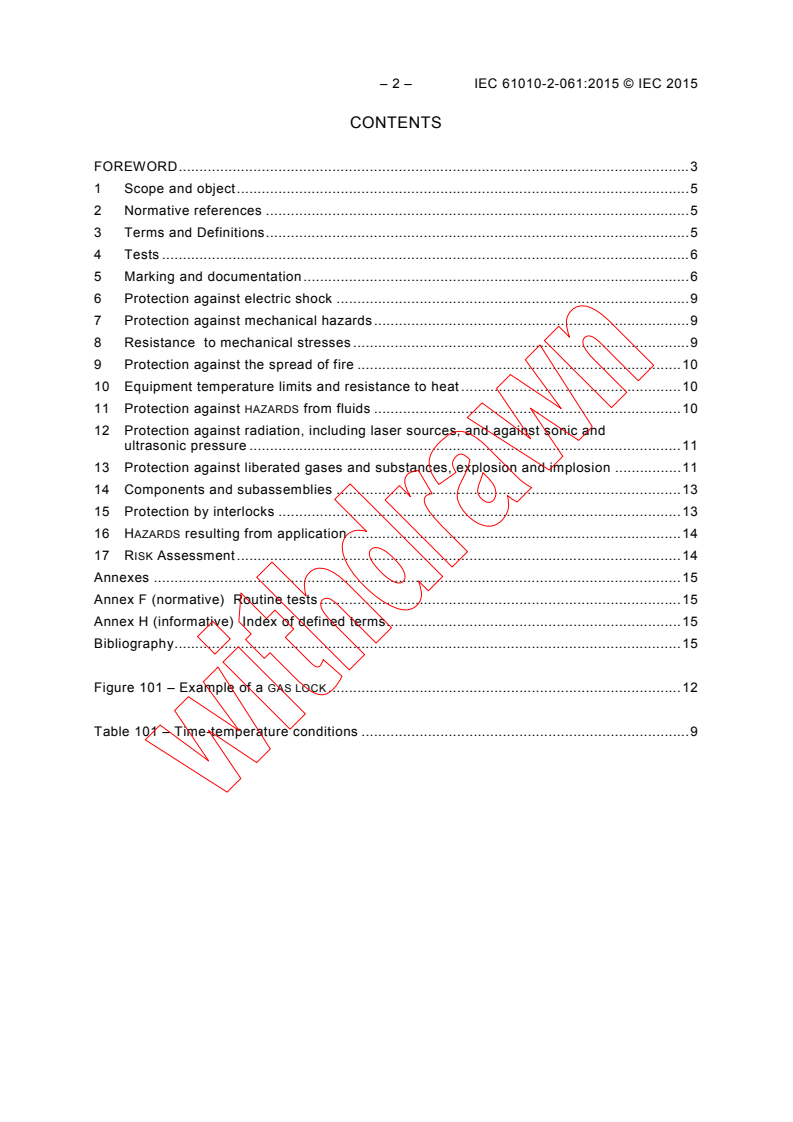
CONTENTS
FOREWORD . 3
1 Scope and object . 5
2 Normative references . 5
3 Terms and Definitions . 5
4 Tests . 6
5 Marking and documentation . 6
6 Protection against electric shock . 9
7 Protection against mechanical hazards . 9
8 Resistance to mechanical stresses . 9
9 Protection against the spread of fire . 10
10 Equipment temperature limits and resistance to heat . 10
11 Protection against HAZARDS from fluids . 10
12 Protection against radiation, including laser sources, and against sonic and
ultrasonic pressure . 11
13 Protection against liberated gases and substances, explosion and implosion . 11
14 Components and subassemblies . 13
15 Protection by interlocks . 13
16 HAZARDS resulting from application . 14
17 RISK Assessment . 14
Annexes . 15
Annex F (normative) Routine tests . 15
Annex H (informative) Index of defined terms . 15
Bibliography . 15
Figure 101 – Example of a GAS LOCK . 12
Table 101 – Time-temperature conditions . 9
INTERNATIONAL ELECTROTECHNICAL COMMISSION
____________
SAFETY REQUIREMENTS FOR ELECTRICAL EQUIPMENT
FOR MEASUREMENT, CONTROL, AND LABORATORY USE –
Part 2-061: Particular requirements for laboratory atomic
spectrometers with thermal atomization and ionization
FOREWORD
1) The International Electrotechnical Commission (IEC) is a worldwide organization for standardization comprising
all national electrotechnical committees (IEC National Committees). The object of IEC is to promote
international co-operation on all questions concerning standardization in the electrical and electronic fields. To
this end and in addition to other activities, IEC publishes International Standards, Technical Specifications,
Technical Reports, Publicly Available Specifications (PAS) and Guides (hereafter referred to as “IEC
Publication(s)”). Their preparation is entrusted to technical committees; any IEC National Committee interested
in the subject dealt with may participate in this preparatory work. International, governmental and non-
governmental organizations liaising with the IEC also participate in this preparation. IEC collaborates closely
with the International Organization for Standardization (ISO) in accordance with conditions determined by
agreement between the two organizations.
2) The formal decisions or agreements of IEC on technical matters express, as nearly as possible, an international
consensus of opinion on the relevant subjects since each technical committee has representation from all
interested IEC National Committees.
3) IEC Publications have the form of recommendations for international use and are accepted by IEC National
Committees in that sense. While all reasonable efforts are made to ensure that the technical content of IEC
Publications is accurate, IEC cannot be held responsible for the way in which they are used or for any
misinterpretation by any end user.
4) In order to promote international uniformity, IEC National Committees undertake to apply IEC Publications
transparently to the maximum extent possible in their national and regional publications. Any divergence
between any IEC Publication and the corresponding national or regional publication shall be clearly indicated in
the latter.
5) IEC itself does not provide any attestation of conformity. Independent certification bodies provide conformity
assessment services and, in some areas, access to IEC marks of conformity. IEC is not responsible for any
services carried out by independent certification bodies.
6) All users should ensure that they have the latest edition of this publication.
7) No liability shall attach to IEC or its directors, employees, servants or agents including individual experts and
members of its technical committees and IEC National Committees for any personal injury, property damage or
other damage of any nature whatsoever, whether direct or indirect, or for costs (including legal fees) and
expenses arising out of the publication, use of, or reliance upon, this IEC Publication or any other IEC
Publications.
8) Attention is drawn to the Normative references cited in this publication. Use of the referenced publications is
indispensable for the correct application of this publication.
9) Attention is drawn to the possibility that some of the elements of this IEC Publication may be the subject of
patent rights. IEC shall not be held responsible for identifying any or all such patent rights.
International Standard IEC 61010-2-061 has been prepared by IEC technical committee 66:
Safety of measuring, control and laboratory equipment.
It has the status of a group safety publication in accordance with IEC Guide 104.
This third edition cancels and replaces the second edition published in 2003. It constitutes a
technical revision and includes the following change from the second edition:
• exclusion of equipment, whose size and weight make unintentional movement unlikely,
from the drop test in Clause 8.
• notes have been re-phrased according to ISO/IEC Directives.
– 4 – IEC 61010-2-061:2015 © IEC 2015
The text of this standard is based on the following documents:
FDIS Report on voting
66/553/FDIS 66/568/RVD
Full information on the voting for the approval of this standard can be found in the report on
voting indicated in the above table.
This publication has been drafted in accordance with the ISO/IEC Directives, Part 2.
A list of all parts of the IEC 61010 series, under the general title: Safety requirements for
electrical equipment for measurement, control, and laboratory use, may be found on the IEC
website.
This Part 2-061 is intended to be used in conjunction with IEC 61010-1. It was established
on the basis of the third edition (2010).
This Part 2-061 supplements or modifies the corresponding clauses in IEC 61010-1 so as to
convert that publication into the IEC standard: Safety requirements for laboratory atomic
spectrometers with thermal atomization and ionization.
Where a particular subclause of Part 1 is not mentioned in this part 2, that subclause applies
as far as is reasonable. Where this part states “addition”, “modification” or “replacement”, or
“deletion”, the relevant requirement, test specification or note in Part 1 should be adapted
accordingly.
In this standard:
1) the following print types are used:
– requirements: in roman type;
– NOTES: in small roman type;
– conformity and test: in italic type;
– terms used throughout this standard which have been defined in clause 3: SMALL ROMAN
CAPITALS;
2) subclauses, figures, tables and notes which are additional to those in Part 1 are numbered
starting from 101. The additional annexes are lettered starting from AA.
The committee has decided that the contents of this publication will remain unchanged until
the stability date indicated on the IEC web site under "http://webstore.iec.ch" in the data
related to the specific publication. At this date, the publication will be
• reconfirmed,
• withdrawn,
• replaced by a revised edition, or
• amended.
SAFETY REQUIREMENTS FOR ELECTRICAL EQUIPMENT
FOR MEASUREMENT, CONTROL, AND LABORATORY USE –
Part 2-061: Particular requirements for laboratory atomic
spectrometers with thermal atomization and ionization
1 Scope and object
This clause of Part 1 is applicable except as follows:
1.1 Scope
1.1.1 Equipment included in scope
Replacement:
Replace the text by the following:
This part of IEC 61010 applies to electrically powered laboratory atomic spectrometers with
thermal atomization.
NOTE 1 Examples include atomic absorption spectrometers, emission flame photometers, atomic fluorescence
spectrophotometers, inductively coupled plasma spectrometers, microwave coupled plasma spectrometers and
mass spectrometers, all with thermal atomization and ionization (including tubing and connectors which are
provided by the manufacturer for connection to external supplies).
NOTE 2 If all or part of the equipment falls within the scope of one or more other part 2 standards of IEC 61010
as well as within the scope of this standard, consideration is to be given to those other part 2 standards.
1.1.2 Equipment excluded from scope
Addition:
Add as the first paragraph:
This standard does not apply to thermal atomization detectors (flame ionization detectors)
used in gas chromatography.
2 Normative references
This clause of Part 1 is applicable.
3 Terms and Definitions
This clause of Part 1 is applicable except as follows:
Additions:
Add the following definitions:
3.2.101
SPRAY CHAMBER
chamber in which droplets of sample in aerosol are allowed to separate so that the droplets of
necessary size can be passed onward to the burner, with the remainder draining to waste
– 6 – IEC 61010-2-061:2015 © IEC 2015
3.2.102
GAS LOCK
device to allow drainage of waste sample liquid, and to prevent unintentional escape of gas
from the SPRAY CHAMBER through its drain outlet
Note 1 to entry: See for example Figure 101.
3.5.101
FLASH-BACK
event during which the flame travels back through the burner with the result that the gas in
the mixing chamber is caused to ignite.
4 Tests
This clause of Part 1 is applicable except as follows:
Addition:
Add the following subclauses:
4.4.2.101 Sampling probe tip
Any system designed to withdraw a sampling probe tip after sampling has been completed
shall be overridden, so as to leave the tip in its most exposed position when a sample vessel
is removed.
Exceptions:
The withdrawal system need not be overridden if the sampling probe:
a) cannot cause a HAZARD to the OPERATOR when it is exposed;
b) is designed in such a manner that no SINGLE FAULT CONDITION can cause the tip to remain
exposed after sampling has been completed.
4.4.2.102 Failure, or partial failure, of the MAINS supply
The voltage of the power supply to the equipment from the MAINS supply shall first be reduced
to just less than 90 % of the RATED voltage, and shall then be switched off.
5 Marking and documentation
This clause of Part 1 is applicable except as follows:
Addition:
Add the following subclause:
5.1.5.101 Gas and liquid connections
The following shall be unambiguously marked adjacent to the connector on the equipment
(see 5.2):
a) the identity of the gas or liquid;
b) the maximum permitted pressure,
c) flow direction of the gas and liquid, if applicable.
NOTE Such markings may be specific (for example acetylene, propane, water) or generic (for example fuel gas,
oxidant gas, coolant, waste liquid).
Where no internationally recognized symbol (such as a chemical formula) exists, the equip-
ment shall be marked with symbol 14 of Table 1 together with an unambiguous text in English.
The documentation accompanying the equipment shall provide an adequate translation of this
text (where it is required) in the language of the country in which it is to be installed, to assure
that the installer or OPERATOR is able to connect the equipment correctly.
Conformity is checked by inspection.
5.2 Warning markings
Addition:
Add the following paragraph before the conformity statement:
Where hot gases or plasma emerge from equipment, the protective structure provided (for
example a chimney, see 10.1), shall be clearly marked by symbol 13 of Table 1, to indicate
where excessively hot temperatures may exist.
5.4.3 Equipment installation
Addition:
Add before the first paragraph the following new paragraph:
The documentation shall state that the RESPONSIBLE BODY shall ensure that the type of
connector used at the outlet side of the gas-pressure regulator conforms to applicable
national requirements;
Deletion:
Delete item f).
Addition:
Add, after item g) and before the note, the following new items:
aa) requirements for liquid connection;
bb) requirements for a fume extraction system to remove exhaust gases which may be
hazardous. In the case of equipment using only a propane flame in a ventilated room,
and when it is known that samples will not leave any hazardous residues, it is not
necessary to provide an extraction system, since the exhaust gases from a propane
flame will themselves not present any hazard.
cc) requirements for appropriate filtering or other systems which may be necessary to trap
hazardous sample residues present in the exhaust gas stream;
dd) the documentation shall state that the RESPONSIBLE BODY shall carry out appropriate
leakage tests necessary for safety on those gas and liquid connections which the
OPERATOR is directed to assemble during installation, NORMAL USE, or maintenance;
ee) instructions for examining, during installation and maintenance, parts of the external gas
supply system including tubing connected to the equipment, in order to confirm that
their condition is satisfactory, for example to detect stress cracks. In addition any
special national regulations for the safe use of gases and gas cylinders shall be
observed.
– 8 – IEC 61010-2-061:2015 © IEC 2015
ff) instructions for necessary provisions for collection of waste from the SPRAY CHAMBER,
including the requirements for any waste container which may be specified by the
manufacturer;
gg) requirements for connection of the equipment to supplies of air, fuel gas (for example
hydrogen, acetylene, or propane) and oxidant (for example oxygen or nitrous oxide).
See also 11.103.
Add, after the existing note, the following new notes:
NOTE 101 Connections on the outlet side of gas regulators (from which tubing connects to the equipment) vary
from country to country and are often covered by national regulations. Variations can include thread type, whether
left-hand or right-hand, types of tubing and means of attachment.
NOTE 102 Warning markings are specified in 5.1.101, 5.1.5.2 c), 6.1.2 b), 7.3.2 b) 3), 7.4, 10.1, 13.2.2.
5.4.4 Equipment operation
Additions:
Add, after item j), the following new items:
aa) a reminder to the RESPONSIBLE BODY of the responsibility for the correct collection and
disposal of waste materials, including the necessity for:
1) a suitably sized waste container of appropriately resistant material for the collection
of organic solvent waste;
NOTE The proper disposal of waste materials is well documented by national authorities and it is these
procedures supersede the requirements of this standard in regard of waste disposal. This part 2 should only
bring to the attention of the OPERATOR that potentially hazardous waste materials are present and national
(local) regulations for the proper disposal can apply.
2) provision for the removal into an appropriate exhaust system of any gases or
vapours which may be produced in hazardous concentrations;
bb) a list of fluids known by the manufacturer to be potentially unsafe if used with the
equipment.
Add a new paragraph after the list of items as follows:
Documentation shall also indicate that this list cannot be taken to be exhaustive and that, in
case of uncertainty about a specific fluid, that fluid shall not be used until confirmation by the
manufacturer that it will not present a HAZARD.
Add the following subclause:
5.4.4.101 Cleaning and decontamination
Documentation shall indicate:
a) that the RESPONSIBLE BODY has the responsibility for carrying out appropriate
decontamination if hazardous material is spilt on or inside the equipment;
b) manufacturer's recommendations for cleaning and, where necessary, decontamination,
together with the recognized generic names of recommended materials for cleaning and
decontamination.
The following wording shall appear in the documentation:
“Before using any cleaning or decontamination methods except those specified by the
manufacturer, the RESPONSIBLE BODY should check with the manufacturer that the proposed
method will not damage the equipment.”
If a manufacturer claims that an item can be decontaminated by steam sterilization, it shall be
capable of withstanding steam sterilization under at least one of the time-temperature
conditions given in Table 101. Cleaning and decontamination shall be necessary as a
safeguard when spectrometers and their accessories are maintained, repaired, or transferred.
Manufacturers shall provide a format for the RESPONSIBLE BODY to certify that such a treatment
has been carried out.
NOTE Information on decontaminants their use, dilution and potential application is contained in the Laboratory
Biosafety Manual, published by the World Health Organization and the Biosafety in Microbiological and Biomedical
Laboratories, published by Centers for Disease Control and Prevention and National Institutes of Health,
Washington. There are also national guidelines that cover these areas.
Table 101 – Time-temperature conditions
Corresponding steam temperature
Absolute pressure Minimum hold time
Nominal Range
kPa min
°C °C
325 136,0 134 – 138 3
250 127,5 126 – 129 10
215 122,5 121 – 124 15
175 116,5 115 – 118 30
NOTE “Minimum hold time” means the time the contaminant is at the steam temperature.
5.4.5 Equipment maintenance and service
Addition:
Add, after the first paragraph, the following new paragraph:
Instructions shall include any instructions for examination and tests which are to be carried
out on parts and connections containing gases or liquids inside the equipment, in order to
check that no leakage is occurring.
6 Protection against electric shock
This clause of Part 1 is applicable.
7 Protection against mechanical hazards
This clause of Part 1 is applicable.
8 Resistance to mechanical stresses
This clause of Part 1 is applicable except as follows:
8.1 General
Replacement:
Replace the text of item 3) by the following:
3) except for FIXED EQUIPMENT, for equipment with a mass over 100 kg, or for equipment
whose size and weight make unintentional movement unlikely and which is not moved in
NORMAL USE, the appropriate test of 8.3. The equipment is not operated during the tests.
– 10 – IEC 61010-2-061:2015 © IEC 2015
9 Protection against the spread of fire
This clause of Part 1 is applicable.
10 Equipment temperature limits and resistance to heat
This clause of Part 1 is applicable, except as follows:
10.1 Surface temperature limits for protection against burns
Addition:
Add, before Table 19, a new paragraph as follows:
Protection shall be provided to minimize the possibility of unintentional direct access by the
OPERATOR or other persons in the vicinity to hot gases or plasma emerging from the
equipment. This shall comprise a protective structure, for example a chimney of sufficient
height to indicate its function (see also 5.2).
11 Protection against HAZARDS from fluids
This clause of Part 1 is applicable except as follows:
11.1 General
Replacement:
Replace the first paragraph by the following:
Equipment shall be designed to give protection to the OPERATOR, other persons in the vicinity,
and the surrounding area against hazards from direct contact with fluids encountered in
NORMAL USE, and from hazards resulting from degradation of parts in contact with these.
Addition:
Add the following subclauses:
11.101 Sampling probes
Sample fluid remaining on the outside of a sampling probe shall not cause a HAZARD to the
OPERATOR or other persons in the vicinity.
Conformity is checked by inspection and, if necessary, by a test using a suitable fluid, for
example a solution of fluorescein in water.
11.102 Gases
Components within the fuel-gas and oxidant paths shall be resistant to the gases specified by
the manufacturer, and to any associated solvent vapours. In the case of acetylene, a solvent,
for example acetone, will be present in the cylinder which contains the acetylene. Any special
national regulations for the safe use of gases and pressurized gas cylinders shall be
observed.
Conformity is checked by inspection and by examination of the specification of the materials
used.
11.103 Solvents
Parts in contact with solvents, including any which will be contacted by diffusion of vapour in
the stand-by condition, shall be resistant to the solvents specified by the manufacturer.
Conformity is checked by inspection and examination of the specification of the materials
used.
11.104 Parts in contact with acetylene
The following materials shall not be used for parts intended to be in contact with acetylene:
a) copper and copper alloys with a copper content of more than 70 %;
b) copper alloys (even with a copper content of less than 70 %) in the case of filters and
sieves;
c) silver and silver alloys, except for brazing. Silver filler used for brazing shall have a silver
content of less than 43 %, and a copper content of less than 21 %. The width of a solder
gap, where silver filler might come into contact with acetylene, shall be less than 0,3 mm;
d) any other material which may form an explosive acetylide.
Conformity is checked by inspection of the materials used and their specification according to
the manufacturer.
12 Protection against radiation, including laser sources, and against sonic and
ultrasonic pressure
This clause of Part 1 is applicable except as follows:
12.5.1 Sound level
Addition:
Add, before note 1, a new paragraph as follows:
Equipment which may generate occasional and unavoidable short-duration high sound
pressure levels, for example as a result of FLASH-BACK in a burner gas mixing chamber, shall
not produce a sound power level in excess of 140 dB(A).
Add a note as follows:
NOTE 101 Exposure to noise has been categorized in many countries by three action levels of “daily personal
noise exposure” at 85 dBA, 90 dBA, and 140 dBA. “Daily personal noise exposure” is defined as the total exposure
over the whole working day, taking into account the varying noise levels in the working environment and how long a
person is exposed to them, without taking account of whether ear protectors are worn.
The peak action level of 140 dBA relates to cartridge operated tools, shooting guns, and similar loud explosive
noises. This action level is most important where workers are subject to a small number of loud impulses during an
otherwise quiet day.
Employers in many countries are required to reduce the risk of damage to the hearing of employees from exposure
to noise to the lowest level reasonably practicable. For example some countries require manufacturers to provide
suitable and efficient ear protectors on request, to employees whose daily personal exposure is between 80 dBA
and 90 dBA. For exposures above 90 dBA, exposure is required to be reduced to the lowest level reasonably
practicable without taking account of the use of ear protectors. At the same time, suitable ear protectors are to be
provided by the employer.
13 Protection against liberated gases and substances, explosion and implosion
This clause of Part 1 is applicable except as follows:
– 12 – IEC 61010-2-061:2015 © IEC 2015
13.1 Poisonous and injurious gases and substances
Addition:
Add, after the first paragraph, the following new notes:
NOTE 101 Discharge of gases into a fume extraction system is not considered to be liberation (see 5.4.3 bb)).
NOTE 102 Absence of fluid from the type of GAS LOCK shown in Figure 101 is a typical SINGLE FAULT CONDITION.
SPRAY CHAMBER
Water forming the
GAZ LOCK
To waste
IEC
Figure 101 – Example of a GAS LOCK
13.2.1 Components
Replacement:
Replace the first paragraph by the following:
If an explosion could occur either by FLASH-BACK of gases in a burner and mixing chamber, or
if components if overheated or overcharged are not provided with a pressure relief device,
protection for the OPERATOR and other persons shall be incorporated in the equipment (see
also 7.7).
Replace the conformity statement by the following:
Conformity is checked by inspection, and for burners by test a) or b) as appropriate.
a) For burners designed to prevent FLASH-BACK, the flame is ignited and the flow of gas
mixture, maintained at a constant fuel-oxidant ratio, is gradually reduced to zero. The
flame shall extinguish without FLASH-BACK;
b) for other burners, the flame is ignited and the gas mixture adjusted so as to generate the
maximum energy flame. Ignition is then initiated inside the burner to simulate FLASH-BACK.
No parts shall be expelled outside the equipment.
Addition:
Add the following subclauses:
13.101 Flame ignition system
For equipment which has an automatically controlled ignition system, the ignition procedure
when started shall either cause the flame to ignite in a time less than that required for 0,8 l of
fuel-gas to be delivered, or the ignition procedure shall be ended automatically and the
equipment returned to stand-by condition. For equipment which does not have an
automatically controlled ignition system, it shall not be possible to open the valves which
control the flows of fuel-gas and oxidant-gas (except compressed air) for purposes of igniting
the flame, unless a manually operated device as described below is provided.
An acceptable manually operated device is one which satisfies the following criteria:
a) it shall override the flame-failure gas shut-off device for not longer than the time for 0,8 l
of fuel-gas to be delivered.
NOTE For fuel-gas, the litre (l) will be understood as that which is measured at 0 °C and 0,1 MPa (1 bar);
b) it shall allow the gases to flow to permit the necessary adjustment of the flow rates before
the ignition system is operated;
c) if ignition is not achieved, the gas flow valves shall close immediately the device
is released.
Conformity is checked by fitting a gas flow-rate meter in the fuel-gas pipe and measuring both
the rate of gas escaping during the ignition procedure in NORMAL USE, and the time from
opening the fuel-gas inlet valve to closing it after ignition failures. The gas volume is
calculated from these measurements.
13.102 Non-interchangeability of gas connectors
Connectors available to the OPERATOR for fuel-gas shall not be interchangeable with
connectors for oxidant-gas.
Conformity is checked by inspection.
13.103 Interchangeable burners
In equipment with interchangeable burners (for example to permit the use of either air or
HAZARD could arise if the incorrect gas is fed to
nitrous oxide as the oxidant gas) and where a
a burner, it shall only be possible to operate with a gas appropriate to the burner fitted.
Conformity is checked by fitting, in turn, each available burner specified by the manufacturer,
and confirming that only the gases specified for a burner can flow to the burner.
14 Components and subassemblies
This clause of Part 1 is applicable.
15 Protection by interlocks
This clause of Part 1 is applicable.
– 14 – IEC 61010-2-061:2015 © IEC 2015
16 HAZARDS resulting from application
This clause of Part 1 is applicable.
17 RISK Assessment
This clause of Part 1 is applicable.
Annexes
The annexes of Part 1 are applicable except as follows:
Annex F
(normative)
Routine tests
Addition:
Add the following subclause:
F.101 Gas leakage test
A test is carried out to measure leakage of gas from the internal system leading to the burner.
The worst-case gas intended to be used in that internal system is applied at 1,2 times the
maximum inlet pressure for NORMAL USE. An alternative gas (for example helium) can be used
provided that the results, when converted, are equivalent to the results had the worst-case
gas been used. Leakage shall not exceed 5 ml/min.
Annex H
(informative)
Index of defined terms
Addition:
Add the following defined terms to the list:
FLASH-BACK . 3.5.101
GAS LOCK . 3.2.102
SPRAY CHAMBER . 3.2.101
Bibliography
Addition:
Add the following entries to the list:
Laboratory biosafety manual, World Health Organization
Biosafety in microbiological and biomedical laboratories, Centers for Disease Control and
Prevention and National Institutes of Health, Washington
_____________
– 16 – IEC 61010-2-061:2015 © IEC 2015
SOMMAIRE
AVANT-PROPOS . 17
1 Domaine d’application et objet . 19
2 Références normatives . 19
3 Termes et définitions . 19
4 Essais . 20
5 Marquage et documentation . 20
6 Protection contre les chocs électriques . 23
7 Protection contre les dangers mécaniques . 23
8 Résistance aux contraintes mécaniques . 23
9 Protection contre la propagation du feu . 24
10 Limites de température de l’appareil et résistance à la chaleur . 24
11 Protection contre les DANGERS des fluides . 24
12 Protection contre les radiations, y compris les sources laser, et contre la pression
acoustique et ultrasonique . 25
13 Protection contre les émissions de gaz et substances, les explosions et les
implosions . 26
14 Composants et sous-ensembles . 28
15 Protection par systèmes de verrouillage . 28
16 DANGERS résultant de l’application . 28
17 Appréciation du RISQUE . 28
Annexes . 29
Annexe F (normative) Essais individuels de série . 29
Annexe H (informative) Index des termes définis . 29
Bibliographie . 29
Figure 101 – Exemple de DISPOSITIF DE RETENUE DE GAZ . 26
Tableau 101 – Conditions de température-temps . 23
COMMISSION ÉLECTROTECHNIQUE INTERNATIONALE
____________
RÈGLES DE SÉCURITÉ POUR APPAREILS ÉLECTRIQUES
DE MESURAGE, DE RÉGULATION ET DE LABORATOIRE –
Partie 2-061: Exigences particulières pour spectromètres atomiques
de laboratoire avec vaporisation et ionisation thermiques
AVANT-PROPOS
1) La Commission Electrotechnique Internationale (IEC) est une organisation mondiale de normalisation
composée de l'ensemble des comités électrotechniques nationaux (Comités nationaux de l’IEC). L’IEC a pour
objet de favoriser la coopération internationale pour toutes les questions de normalisation dans les domaines
de l'électricité et de l'électronique. À cet effet, l’IEC – entre autres activités – publie des Normes
internationales, des Spécifications techniques, des Rapports techniques, des Spécifications accessibles au
public (PAS) et des Guides (ci-après dénommés "Publication(s) de l’IEC"). Leur élaboration est confiée à des
comités d'études, aux travaux desquels tout Comité national intéressé par le sujet traité peut participer. Les
organisations internationales, gouvernementales et non gouvernementales, en liaison avec l’IEC, participent
également aux travaux. L’IEC collabore étroitement avec l'Organisation Internationale de Normalisation (ISO),
selon des conditions fixées par accord entre les deux organisations.
2) Les décisions ou accords officiels de l’IEC concernant les questions techniques représentent, dans la mesure
du possible, un accord international sur les sujets étudiés, étant donné que les Comités nationaux de l’IEC
intéressés sont représentés dans chaque comité d’études.
3) Les Publications de l’IEC se présentent sous la forme de recommandations internationales et sont agréées
comme telles par les Comités nationaux de l’IEC. Tous les efforts raisonnables sont entrepris afin que l’IEC
s'assure de l'exactitude du contenu technique de ses publications; l’IEC ne peut pas être tenue responsable de
l'éventuelle mauvaise utilisation ou interprétation qui en est faite par un quelconque utilisateur final.
4) Dans le but d'encourager l'uniformité internat
...