

IEC 60286-2:2008
(Main)Packaging of components for automatic handling - Part 2: Packaging of components with unidirectional leads on continuous tapes
General Information
- Abstract
IEC 60286-2:2008 applies to the packaging of components with two or more unidirectional leads for use in electronic equipment. In general, the tape is applied to the component leads. This standard covers requirements for taping techniques used with equipment for automatic handling, preforming of leads, insertion and other operations and includes only those dimensions which are essential to the taping of components intended for the above-mentioned purposes. This third edition cancels and replaces the second edition published in 1997 and its amendment 1 (2002) and constitutes a minor revision related to tables, figures and references.
- Status
- Published
- Publication Date
- 10-Mar-2008
- Technical Committee
- TC 40 - Capacitors and resistors for electronic equipment
- Drafting Committee
- MT 60286-2 - TC 40/MT 60286-2
- Current Stage
- DELPUB - Deleted Publication
- Start Date
- 22-Apr-2015
- Completion Date
- 28-Aug-2026
Buy Documents


IEC 60286-2:2008 - Packaging of components for automatic handling - Part 2: Packaging of components with unidirectional leads on continuous tapes Released:3/11/2008
IEC 60286-2:2008 - Packaging of components for automatic handling - Part 2: Packaging of components with unidirectional leads on continuous tapes Released:3/11/2008
Overview - IEC 60286-2:2008 (Packaging of components for automatic handling)
IEC 60286-2:2008 specifies requirements for the packaging of electronic components that have two or more unidirectional leads when supplied on continuous tapes for automatic handling. This third edition (2008) replaces earlier editions and focuses on taping techniques where the tape is normally applied to the component leads. The standard addresses only those dimensions and performance requirements that are essential to reliable automatic feeding, insertion and other automated operations.
Key topics and technical requirements
The standard covers practical, machine-relevant specifications including:
- Tape geometry and coordinate system - reference planes, tape width and pitch, and sprocket-hole positioning to ensure consistent indexing during unreeling.
- Component-to-tape dimensions - lead spacing, lead diameter, permissible protrusion and maximum deviations needed for reliable handling and insertion.
- Taping variants - treatment of two‑lead and three‑lead components, straight or formed leads, and cases with short terminals not held by cover tape.
- Taping details - cover/carrier tape interaction, splices, leader and trailer lengths, and how components are secured to the tape for feeding.
- Performance tests - pull strength from taping, peel strength of cover tape, tape break force, acceptable kinks/bends and storage handling.
- Packing and delivery formats - reel dimensions, fan‑fold containers, reel filling, component protection, marking and recycling considerations.
- Tolerances and tables/figures - normative and informative annexes provide dimensional tables and drawings for common lead configurations and sprocket-hole placement.
Practical applications and who uses this standard
IEC 60286-2 is used by:
- Component manufacturers specifying how resistors, capacitors and other leaded parts should be taped for automated assembly.
- Electronics manufacturers and contract assemblers who need reliable inbound taped components for through‑hole or mixed assembly lines.
- Packaging and test engineers designing carrier tapes, reels and automated feeders.
- Equipment manufacturers (tape-and-reel machines, insertion machines, feeders) that require consistent dimensions and performance criteria. Practical benefits include improved feed reliability, reduced jams and misfeeds, standardized reel interchangeability, and smoother automated insertion and preforming operations.
Related standards
Relevant normative references cited in the standard include:
- IEC 60097 (grid systems for printed circuits)
- IEC 60301 (preferred diameters of wire terminations)
- IEC 60717 (space required by components with unidirectional terminations)
- ISO 11469 (plastics identification and marking)
By standardizing tape geometry, tolerances and performance tests, IEC 60286-2 helps ensure compatibility between taped components, feeders and automated assembly equipment - reducing downtime and increasing yield in electronic manufacturing.
Relations
- Effective Date
- 05-Sep-2023
- Effective Date
- 05-Sep-2023
- Effective Date
- 05-Sep-2023
Buy Documents
IEC 60286-2:2008 - Packaging of components for automatic handling - Part 2: Packaging of components with unidirectional leads on continuous tapes Released:3/11/2008
IEC 60286-2:2008 - Packaging of components for automatic handling - Part 2: Packaging of components with unidirectional leads on continuous tapes Released:3/11/2008
Frequently Asked Questions
IEC 60286-2:2008 is a standard published by the International Electrotechnical Commission (IEC). Its full title is "Packaging of components for automatic handling - Part 2: Packaging of components with unidirectional leads on continuous tapes". This standard covers: IEC 60286-2:2008 applies to the packaging of components with two or more unidirectional leads for use in electronic equipment. In general, the tape is applied to the component leads. This standard covers requirements for taping techniques used with equipment for automatic handling, preforming of leads, insertion and other operations and includes only those dimensions which are essential to the taping of components intended for the above-mentioned purposes. This third edition cancels and replaces the second edition published in 1997 and its amendment 1 (2002) and constitutes a minor revision related to tables, figures and references.
IEC 60286-2:2008 applies to the packaging of components with two or more unidirectional leads for use in electronic equipment. In general, the tape is applied to the component leads. This standard covers requirements for taping techniques used with equipment for automatic handling, preforming of leads, insertion and other operations and includes only those dimensions which are essential to the taping of components intended for the above-mentioned purposes. This third edition cancels and replaces the second edition published in 1997 and its amendment 1 (2002) and constitutes a minor revision related to tables, figures and references.
IEC 60286-2:2008 is classified under the following ICS (International Classification for Standards) categories: 31.020 - Electronic components in general; 31.240 - Mechanical structures for electronic equipment. The ICS classification helps identify the subject area and facilitates finding related standards.
IEC 60286-2:2008 has the following relationships with other standards: It is inter standard links to IEC 60286-2:1997/AMD1:2002, IEC 60286-2:2015, IEC 60286-2:1997. Understanding these relationships helps ensure you are using the most current and applicable version of the standard.
IEC 60286-2:2008 is available in PDF format for immediate download after purchase. The document can be added to your cart and obtained through the secure checkout process. Digital delivery ensures instant access to the complete standard document.
Standards Content (Sample)
IEC 60286-2
Edition 3.0 2008-03
INTERNATIONAL
STANDARD
Packaging of components for automatic handling –
Part 2: Packaging of components with unidirectional leads on continuous tapes
All rights reserved. Unless otherwise specified, no part of this publication may be reproduced or utilized in any form
or by any means, electronic or mechanical, including photocopying and microfilm, without permission in writing from
either IEC or IEC's member National Committee in the country of the requester.
If you have any questions about IEC copyright or have an enquiry about obtaining additional rights to this publication,
please contact the address below or your local IEC member National Committee for further information.
IEC Central Office
3, rue de Varembé
CH-1211 Geneva 20
Switzerland
Email: inmail@iec.ch
Web: www.iec.ch
About the IEC
The International Electrotechnical Commission (IEC) is the leading global organization that prepares and publishes
International Standards for all electrical, electronic and related technologies.
About IEC publications
The technical content of IEC publications is kept under constant review by the IEC. Please make sure that you have the
latest edition, a corrigenda or an amendment might have been published.
ƒ Catalogue of IEC publications: www.iec.ch/searchpub
The IEC on-line Catalogue enables you to search by a variety of criteria (reference number, text, technical committee,…).
It also gives information on projects, withdrawn and replaced publications.
ƒ IEC Just Published: www.iec.ch/online_news/justpub
Stay up to date on all new IEC publications. Just Published details twice a month all new publications released. Available
on-line and also by email.
ƒ Electropedia: www.electropedia.org
The world's leading online dictionary of electronic and electrical terms containing more than 20 000 terms and definitions
in English and French, with equivalent terms in additional languages. Also known as the International Electrotechnical
Vocabulary online.
ƒ Customer Service Centre: www.iec.ch/webstore/custserv
If you wish to give us your feedback on this publication or need further assistance, please visit the Customer Service
Centre FAQ or contact us:
Email: csc@iec.ch
Tel.: +41 22 919 02 11
Fax: +41 22 919 03 00
IEC 60286-2
Edition 3.0 2008-03
INTERNATIONAL
STANDARD
Packaging of components for automatic handling –
Part 2: Packaging of components with unidirectional leads on continuous tapes
INTERNATIONAL
ELECTROTECHNICAL
COMMISSION
PRICE CODE
V
ICS 31.020; 31.240 ISBN 2-8318-9546-4
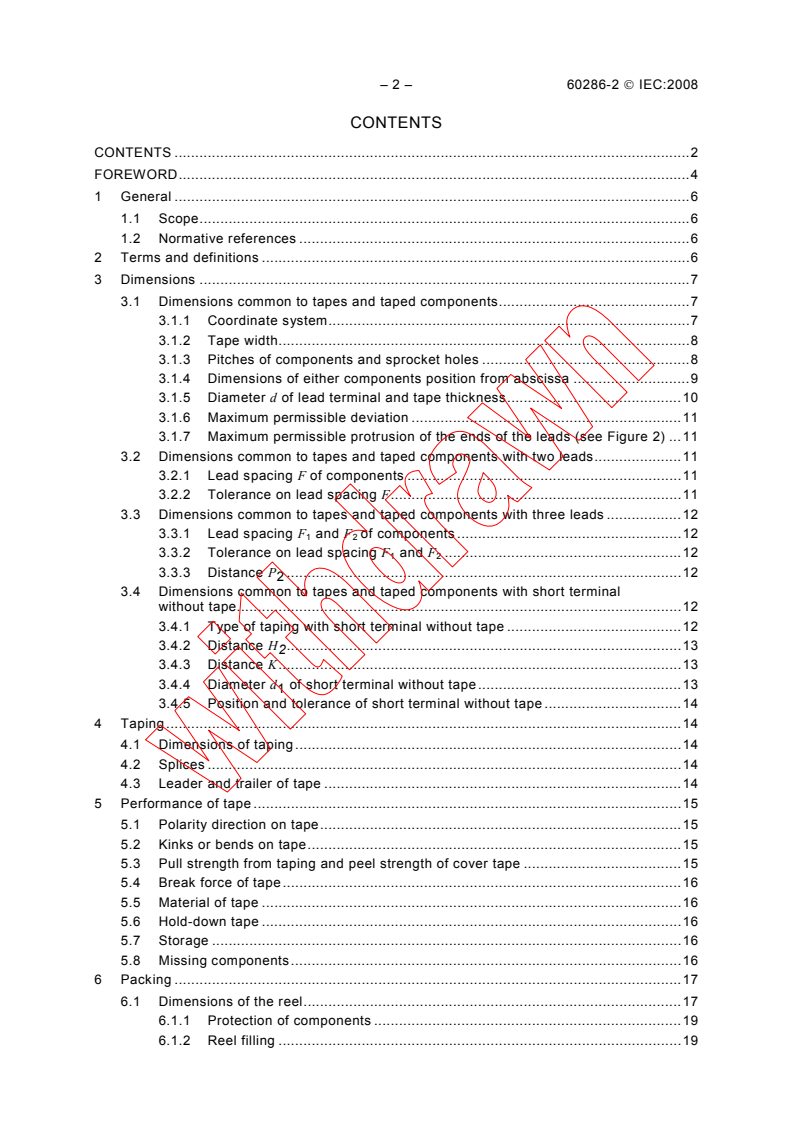
– 2 – 60286-2 © IEC:2008(E)
CONTENTS
FOREWORD.5
1 General .7
1.1 Scope.7
1.2 Normative references .7
2 Terms and definitions .7
3 Dimensions .8
3.1 Dimensions common to tapes and taped components.8
3.1.1 Coordinate system.8
3.1.2 Tape width.9
3.1.3 Pitches of components and sprocket holes .9
3.1.4 Dimensions of either components position from abscissa .10
3.1.5 Diameter d of lead terminal and tape thickness.11
3.1.6 Maximum permissible deviation .12
3.1.7 Maximum permissible protrusion of the ends of the leads (see Figure 2) .12
3.2 Dimensions common to tapes and taped components with two leads.12
3.2.1 Lead spacing F of components .12
3.2.2 Tolerance on lead spacing F.12
3.3 Dimensions common to tapes and taped components with three leads .13
3.3.1 Lead spacing F and F of components .13
1 2
3.3.2 Tolerance on lead spacing F and F .13
1 2
3.3.3 Distance P .13
3.4 Dimensions common to tapes and taped components with short terminal
without tape.13
3.4.1 Type of taping with short terminal without tape .13
3.4.2 Distance H .14
3.4.3 Distance K.14
3.4.4 Diameter d of short terminal without tape.14
3.4.5 Position and tolerance of short terminal without tape .15
4 Taping.15
4.1 Dimensions of taping.15
4.2 Splices .15
4.3 Leader and trailer of tape .15
5 Performance of tape .16
5.1 Polarity direction on tape.16
5.2 Kinks or bends on tape.16
5.3 Pull strength from taping and peel strength of cover tape .16
5.4 Break force of tape.17
5.5 Material of tape .17
5.6 Hold-down tape .17
5.7 Storage .17
5.8 Missing components.17
6 Packing .18
6.1 Dimensions of the reel.18
6.1.1 Protection of components .20
6.1.2 Reel filling .20
60286-2 © IEC:2008(E) – 3 –
6.2 Dimensions of the fan-fold container .20
6.3 Recycling .20
6.4 Marking .20
Annex A (informative) Dimensions for two formed leads, sprocket hole between parts .22
Annex B (informative) Dimensions for two formed leads, sprocket hole between leads .24
Annex C (informative) Dimensions for two straight leads, sprocket hole between parts .26
Annex D (informative) Dimensions for two straight leads, sprocket hole between leads .28
Annex E (informative) Dimensions for three formed leads, sprocket hole between parts .30
Annex F (informative) Dimensions for three formed leads, sprocket hole between
leads .32
Figure 1 – Short terminal without tape .8
Figure 2 – Dimensions common to tapes and taped components .8
Figure 3 – Coordinate system .9
Figure 4 – Pitches of components sprocket holes .10
Figure 5 – Reference plane.11
Figure 6 – Diameter d of lead terminal and thickness and maximum permissible
deviation.11
Figure 7 – Dimensions common to tapes and taped components with two leads .12
Figure 8 – Dimensions common to tapes and taped components with three leads.13
Figure 9 – Single line for carrier tape with short terminal without tape.13
Figure 10 – Double line for carrier tape with short terminal without tape .14
Figure 11 – Position and tolerance of short terminal without tape.15
Figure 12 – Leader and trailer of tape .16
Figure 13 – Pull strength from taping and peel strength of cover tape .16
Figure 14 – Missing components.18
Figure 15 – Reel dimensions.19
Figure 16 – Reeling .19
Figure 17 – Outer dimensions for a fan-fold arrangement.20
Figure A.1 – Dimensions for two formed leads, sprocket hole between parts.22
Figure B.1 – Dimensions for two formed leads, sprocket hole between leads .24
Figure C.1 – Dimensions for two straight leads, sprocket hole between parts.26
Figure D.1 – Dimensions for two straight leads, sprocket hole between leads .28
Figure E.1 – Dimensions for three formed leads, sprocket hole between parts .30
Figure F.1 – Dimensions for three formed leads, sprocket hole between leads.32
Table 1 – Dimensions common to tapes and taped components with short terminal
without tape .14
Table 2 – Reel dimensions and unit dimensions.19
Table 3 – Outer dimensions for a fan-fold arrangement.20
Table A.1 – Dimensions for two formed leads, sprocket hole between parts.23
Table B.1 – Dimensions for two formed leads, sprocket hole between leads .25
Table C.1 – Dimensions for two straight leads, sprocket hole between parts.27
– 4 – 60286-2 © IEC:2008(E)
Table D.1 – Dimensions for two straight leads, sprocket hole between leads .29
Table E.1 – Dimensions for three formed leads, sprocket hole between parts .31
Table F.1 – Dimensions for three formed leads, sprocket hole between leads.33
60286-2 © IEC:2008(E) – 5 –
INTERNATIONAL ELECTROTECHNICAL COMMISSION
____________
PACKAGING OF COMPONENTS FOR AUTOMATIC HANDLING –
Part 2: Packaging of components with unidirectional
leads on continuous tapes
FOREWORD
1) The International Electrotechnical Commission (IEC) is a worldwide organization for standardization comprising
all national electrotechnical committees (IEC National Committees). The object of IEC is to promote
international co-operation on all questions concerning standardization in the electrical and electronic fields. To
this end and in addition to other activities, IEC publishes International Standards, Technical Specifications,
Technical Reports, Publicly Available Specifications (PAS) and Guides (hereafter referred to as “IEC
Publication(s)”). Their preparation is entrusted to technical committees; any IEC National Committee interested
in the subject dealt with may participate in this preparatory work. International, governmental and non-
governmental organizations liaising with the IEC also participate in this preparation. IEC collaborates closely
with the International Organization for Standardization (ISO) in accordance with conditions determined by
agreement between the two organizations.
2) The formal decisions or agreements of IEC on technical matters express, as nearly as possible, an international
consensus of opinion on the relevant subjects since each technical committee has representation from all
interested IEC National Committees.
3) IEC Publications have the form of recommendations for international use and are accepted by IEC National
Committees in that sense. While all reasonable efforts are made to ensure that the technical content of IEC
Publications is accurate, IEC cannot be held responsible for the way in which they are used or for any
misinterpretation by any end user.
4) In order to promote international uniformity, IEC National Committees undertake to apply IEC Publications
transparently to the maximum extent possible in their national and regional publications. Any divergence
between any IEC Publication and the corresponding national or regional publication shall be clearly indicated in
the latter.
5) IEC provides no marking procedure to indicate its approval and cannot be rendered responsible for any
equipment declared to be in conformity with an IEC Publication.
6) All users should ensure that they have the latest edition of this publication.
7) No liability shall attach to IEC or its directors, employees, servants or agents including individual experts and
members of its technical committees and IEC National Committees for any personal injury, property damage or
other damage of any nature whatsoever, whether direct or indirect, or for costs (including legal fees) and
expenses arising out of the publication, use of, or reliance upon, this IEC Publication or any other IEC
Publications.
8) Attention is drawn to the Normative references cited in this publication. Use of the referenced publications is
indispensable for the correct application of this publication.
9) Attention is drawn to the possibility that some of the elements of this IEC Publication may be the subject of
patent rights. IEC shall not be held responsible for identifying any or all such patent rights.
International Standard IEC 60286-2 has been prepared by IEC technical committee 40:
Capacitors and resistors for electronic equipment.
This third edition cancels and replaces the second edition published in 1997 and its
amendment 1 (2002) and constitutes a minor revision related to tables, figures and references.
The text of this standard is based on the following documents:
FDIS Report on voting
40/1870/FDIS 40/1887/RVD
Full information on the voting for the approval of this standard can be found in the report on
voting indicated in the above table.
This publication has been drafted in accordance with the ISO/IEC Directives, Part 2.
– 6 – 60286-2 © IEC:2008(E)
A list of all the parts of the IEC 60286 series, under the general title Packaging of components
for automatic handling, can be found on the IEC website.
The committee has decided that the contents of this publication will remain unchanged until
the maintenance result date indicated on the IEC web site under "http://webstore.iec.ch" in
the data related to the specific publication. At this date, the publication will be
• reconfirmed,
• withdrawn,
• replaced by a revised edition, or
• amended.
A bilingual version of this publication may be issued at a later date
60286-2 © IEC:2008(E) – 7 –
PACKAGING OF COMPONENTS FOR AUTOMATIC HANDLING –
Part 2: Packaging of components with unidirectional
leads on continuous tapes
1 General
1.1 Scope
This part of IEC 60286 applies to the packaging of components with two or more
unidirectional leads for use in electronic equipment. In general, the tape is applied to the
component leads.
This standard covers requirements for taping techniques used with equipment for automatic
handling, preforming of leads, insertion and other operations and includes only those
dimensions which are essential to the taping of components intended for the above-mentioned
purposes.
1.2 Normative references
The following referenced documents are indispensable for the application of this document.
For dated references, only the edition cited applies. For undated references, the latest edition
of the referenced document (including any amendments) applies.
IEC 60097, Grid systems for printed circuits
IEC 60301, Preferred diameters of wire terminations of capacitors and resistors
IEC 60717, Method for the determination of the space required by capacitors and resistors
with unidirectional terminations
ISO 11469, Plastics – Generic identification and marking of plastics products
2 Terms and definitions
For the purposes of this document, the following terms and definitions apply.
2.1
package
product made of any material of any nature to be used for the containment, protection,
structured alignment for automatic assembly, handling and delivery
2.2
short terminal without tape
not held between the carrier tape and the cover tape (see Figure 1)
– 8 – 60286-2 © IEC:2008(E)
Short terminal
without tape
IEC 2383/07
Figure 1 – Short terminal without tape
3 Dimensions
NOTE For the symbols and dimensions given below, reference is made to Figures 2, 4, 6, 7, 8, 9, and 10, and
Annex A through Annex F.
3.1 Dimensions common to tapes and taped components
See Figure 2 and 3.1.1 to 3.1.7.
Reference plane
F
P
D
0 d
Direction of unreeling
P
IEC 2384/07
Figure 2 – Dimensions common to tapes and taped components
3.1.1 Coordinate system
The coordinate system as shown in Figure 3 shall be used as follows.
– The abscissa is a straight line through the centres of the sprocket holes in the direction of
unreeling.
– The ordinate is a straight line perpendicular to the abscissa through the centre of the
sprocket hole that follows the component to be checked.
H
L
L
W W
0 2
W
W
H
H
H
60286-2 © IEC:2008(E) – 9 –
Upper edges of the carrier tape
Hold-down tape
Abscissa
Carrier tape
Sprocket holes
IEC 2385/07
Figure 3 – Coordinate system
3.1.2 Tape width
– Carrier tape width W
+1
W = 18 mm mm
−0,5
– Hold-down tape width W
This dimension is governed by the retention of the components in the tape. The hold-down
tape shall not protrude beyond the carrier tape.
– Position of sprocket hole W
– Distance W
Between the upper edges of the carrier tape and the hold-down tape
W = 3 mm max.
3.1.3 Pitches of components and sprocket holes
– Pitch P of the mutual components (see Annex A to Annex F)
– Pitch P of the sprocket holes (see Annex A to Annex F)
– Pitch P between ordinate and first lead terminal of the drawer side (see Annex A to Annex
F)
– Diameter D of the sprocket holes
Ordinate
– 10 – 60286-2 © IEC:2008(E)
P P P
P P P
1 1 1
P P P
0 0 0
Direction of unreeling
IEC 2386/07
NOTE The tolerance over any 20 sprockets hole pitches is ±1 mm.
Figure 4 – Pitches of components sprocket holes
The grid is defined as lead spacing e = 2,5 mm shall be used (see IEC 60097).
NOTE 1 Components with a lead spacing of F = 3 × e may be delivered with the sprocket holes arranged between
the leads of the component (see Figure 4).
NOTE 2 Components with a lead spacing of F = 8 × e to 11 × e may be delivered with one or two sprocket holes
arranged between the leads of the component (see Figure 4).
3.1.4 Dimensions of either components position from abscissa
– Distance H
Between the abscissa and the bottom plane of the component body
+2
H = 18 mm mm
−0
Seating plane
The method for determining the seating plane is given in IEC 60717.
– For components with straight leads: The bottom of the component body, including any
projections which support the component on the printed board (line in parallel to the
reference abscissa through the bottom point nearest to the tape).
– For components with crimped (or otherwise preformed) leads: The seating plane depends
on the profile of the crimp, the diameter of the leads and the hole size in the printed board.
For this reason a reference plane is defined, for components with crimped leads only, as
follows.
Reference plane
The line parallel to the abscissa through the lowest centre of the radius of curvature of the
bending of the crimp (see Figure 5).
60286-2 © IEC:2008(E) – 11 –
Reference plane
IEC 2387/07
Figure 5 – Referenc
...
IEC 60286-2 ®
Edition 3.0 2008-03
INTERNATIONAL
STANDARD
NORME
INTERNATIONALE
Packaging of components for automatic handling –
Part 2: Packaging of components with unidirectional leads on continuous tapes
Emballage de composants pour opérations automatisées –
Partie 2: Emballage des composants à sorties unilatérales en bandes continues
All rights reserved. Unless otherwise specified, no part of this publication may be reproduced or utilized in any form or by
any means, electronic or mechanical, including photocopying and microfilm, without permission in writing from either IEC or
IEC's member National Committee in the country of the requester.
If you have any questions about IEC copyright or have an enquiry about obtaining additional rights to this publication,
please contact the address below or your local IEC member National Committee for further information.
Droits de reproduction réservés. Sauf indication contraire, aucune partie de cette publication ne peut être reproduite
ni utilisée sous quelque forme que ce soit et par aucun procédé, électronique ou mécanique, y compris la photocopie
et les microfilms, sans l'accord écrit de la CEI ou du Comité national de la CEI du pays du demandeur.
Si vous avez des questions sur le copyright de la CEI ou si vous désirez obtenir des droits supplémentaires sur cette
publication, utilisez les coordonnées ci-après ou contactez le Comité national de la CEI de votre pays de résidence.
IEC Central Office
3, rue de Varembé
CH-1211 Geneva 20
Switzerland
Email: inmail@iec.ch
Web: www.iec.ch
About the IEC
The International Electrotechnical Commission (IEC) is the leading global organization that prepares and publishes
International Standards for all electrical, electronic and related technologies.
About IEC publications
The technical content of IEC publications is kept under constant review by the IEC. Please make sure that you have the
latest edition, a corrigenda or an amendment might have been published.
ƒ Catalogue of IEC publications: www.iec.ch/searchpub
The IEC on-line Catalogue enables you to search by a variety of criteria (reference number, text, technical committee,…).
It also gives information on projects, withdrawn and replaced publications.
ƒ IEC Just Published: www.iec.ch/online_news/justpub
Stay up to date on all new IEC publications. Just Published details twice a month all new publications released. Available
on-line and also by email.
ƒ Electropedia: www.electropedia.org
The world's leading online dictionary of electronic and electrical terms containing more than 20 000 terms and definitions
in English and French, with equivalent terms in additional languages. Also known as the International Electrotechnical
Vocabulary online.
ƒ Customer Service Centre: www.iec.ch/webstore/custserv
If you wish to give us your feedback on this publication or need further assistance, please visit the Customer Service
Centre FAQ or contact us:
Email: csc@iec.ch
Tel.: +41 22 919 02 11
Fax: +41 22 919 03 00
A propos de la CEI
La Commission Electrotechnique Internationale (CEI) est la première organisation mondiale qui élabore et publie des
normes internationales pour tout ce qui a trait à l'électricité, à l'électronique et aux technologies apparentées.
A propos des publications CEI
Le contenu technique des publications de la CEI est constamment revu. Veuillez vous assurer que vous possédez
l’édition la plus récente, un corrigendum ou amendement peut avoir été publié.
ƒ Catalogue des publications de la CEI: www.iec.ch/searchpub/cur_fut-f.htm
Le Catalogue en-ligne de la CEI vous permet d’effectuer des recherches en utilisant différents critères (numéro de référence,
texte, comité d’études,…). Il donne aussi des informations sur les projets et les publications retirées ou remplacées.
ƒ Just Published CEI: www.iec.ch/online_news/justpub
Restez informé sur les nouvelles publications de la CEI. Just Published détaille deux fois par mois les nouvelles
publications parues. Disponible en-ligne et aussi par email.
ƒ Electropedia: www.electropedia.org
Le premier dictionnaire en ligne au monde de termes électroniques et électriques. Il contient plus de 20 000 termes et
définitions en anglais et en français, ainsi que les termes équivalents dans les langues additionnelles. Egalement appelé
Vocabulaire Electrotechnique International en ligne.
ƒ Service Clients: www.iec.ch/webstore/custserv/custserv_entry-f.htm
Si vous désirez nous donner des commentaires sur cette publication ou si vous avez des questions, visitez le FAQ du
Service clients ou contactez-nous:
Email: csc@iec.ch
Tél.: +41 22 919 02 11
Fax: +41 22 919 03 00
IEC 60286-2 ®
Edition 3.0 2008-03
INTERNATIONAL
STANDARD
NORME
INTERNATIONALE
Packaging of components for automatic handling –
Part 2: Packaging of components with unidirectional leads on continuous tapes
Emballage de composants pour opérations automatisées –
Partie 2: Emballage des composants à sorties unilatérales en bandes continues
INTERNATIONAL
ELECTROTECHNICAL
COMMISSION
COMMISSION
ELECTROTECHNIQUE
PRICE CODE
INTERNATIONALE
V
CODE PRIX
ICS 31.020; 31.240 ISBN 2-8318-9546-4
– 2 – 60286-2 © IEC:2008
CONTENTS
CONTENTS .2
FOREWORD.4
1 General .6
1.1 Scope.6
1.2 Normative references .6
2 Terms and definitions .6
3 Dimensions .7
3.1 Dimensions common to tapes and taped components.7
3.1.1 Coordinate system.7
3.1.2 Tape width.8
3.1.3 Pitches of components and sprocket holes .8
3.1.4 Dimensions of either components position from abscissa .9
3.1.5 Diameter d of lead terminal and tape thickness.10
3.1.6 Maximum permissible deviation .11
3.1.7 Maximum permissible protrusion of the ends of the leads (see Figure 2) .11
3.2 Dimensions common to tapes and taped components with two leads.11
3.2.1 Lead spacing F of components .11
3.2.2 Tolerance on lead spacing F.11
3.3 Dimensions common to tapes and taped components with three leads .12
3.3.1 Lead spacing F and F of components .12
1 2
3.3.2 Tolerance on lead spacing F and F .12
1 2
3.3.3 Distance P .12
3.4 Dimensions common to tapes and taped components with short terminal
without tape.12
3.4.1 Type of taping with short terminal without tape .12
3.4.2 Distance H .13
3.4.3 Distance K.13
3.4.4 Diameter d of short terminal without tape.13
3.4.5 Position and tolerance of short terminal without tape .14
4 Taping.14
4.1 Dimensions of taping.14
4.2 Splices .14
4.3 Leader and trailer of tape .14
5 Performance of tape .15
5.1 Polarity direction on tape.15
5.2 Kinks or bends on tape.15
5.3 Pull strength from taping and peel strength of cover tape .15
5.4 Break force of tape.16
5.5 Material of tape .16
5.6 Hold-down tape .16
5.7 Storage .16
5.8 Missing components.16
6 Packing .17
6.1 Dimensions of the reel.17
6.1.1 Protection of components .19
6.1.2 Reel filling .19
60286-2 © IEC:2008 – 3 –
6.2 Dimensions of the fan-fold container .19
6.3 Recycling .19
6.4 Marking .19
Annex A (informative) Dimensions for two formed leads, sprocket hole between parts .21
Annex B (informative) Dimensions for two formed leads, sprocket hole between leads .23
Annex C (informative) Dimensions for two straight leads, sprocket hole between parts .25
Annex D (informative) Dimensions for two straight leads, sprocket hole between leads .27
Annex E (informative) Dimensions for three formed leads, sprocket hole between parts .29
Annex F (informative) Dimensions for three formed leads, sprocket hole between
leads .31
Figure 1 – Short terminal without tape .7
Figure 2 – Dimensions common to tapes and taped components .7
Figure 3 – Coordinate system .8
Figure 4 – Pitches of components sprocket holes .9
Figure 5 – Reference plane.10
Figure 6 – Diameter d of lead terminal and thickness and maximum permissible deviation.10
Figure 7 – Dimensions common to tapes and taped components with two leads .11
Figure 8 – Dimensions common to tapes and taped components with three leads.12
Figure 9 – Single line for carrier tape with short terminal without tape.12
Figure 10 – Double line for carrier tape with short terminal without tape .13
Figure 11 – Position and tolerance of short terminal without tape.14
Figure 12 – Leader and trailer of tape .15
Figure 13 – Pull strength from taping and peel strength of cover tape .15
Figure 14 – Missing components.17
Figure 15 – Reel dimensions.18
Figure 16 – Reeling .18
Figure 17 – Outer dimensions for a fan-fold arrangement.19
Figure A.1 – Dimensions for two formed leads, sprocket hole between parts.21
Figure B.1 – Dimensions for two formed leads, sprocket hole between leads .23
Figure C.1 – Dimensions for two straight leads, sprocket hole between parts.25
Figure D.1 – Dimensions for two straight leads, sprocket hole between leads .27
Figure E.1 – Dimensions for three formed leads, sprocket hole between parts .29
Figure F.1 – Dimensions for three formed leads, sprocket hole between leads.31
Table 1 – Dimensions common to tapes and taped components with short terminal
without tape .13
Table 2 – Reel dimensions and unit dimensions.18
Table 3 – Outer dimensions for a fan-fold arrangement.19
Table A.1 – Dimensions for two formed leads, sprocket hole between parts.22
Table B.1 – Dimensions for two formed leads, sprocket hole between leads .24
Table C.1 – Dimensions for two straight leads, sprocket hole between parts.26
Table D.1 – Dimensions for two straight leads, sprocket hole between leads .28
Table E.1 – Dimensions for three formed leads, sprocket hole between parts .30
Table F.1 – Dimensions for three formed leads, sprocket hole between leads.32
– 4 – 60286-2 © IEC:2008
INTERNATIONAL ELECTROTECHNICAL COMMISSION
____________
PACKAGING OF COMPONENTS FOR AUTOMATIC HANDLING –
Part 2: Packaging of components with unidirectional
leads on continuous tapes
FOREWORD
1) The International Electrotechnical Commission (IEC) is a worldwide organization for standardization comprising
all national electrotechnical committees (IEC National Committees). The object of IEC is to promote
international co-operation on all questions concerning standardization in the electrical and electronic fields. To
this end and in addition to other activities, IEC publishes International Standards, Technical Specifications,
Technical Reports, Publicly Available Specifications (PAS) and Guides (hereafter referred to as “IEC
Publication(s)”). Their preparation is entrusted to technical committees; any IEC National Committee interested
in the subject dealt with may participate in this preparatory work. International, governmental and non-
governmental organizations liaising with the IEC also participate in this preparation. IEC collaborates closely
with the International Organization for Standardization (ISO) in accordance with conditions determined by
agreement between the two organizations.
2) The formal decisions or agreements of IEC on technical matters express, as nearly as possible, an international
consensus of opinion on the relevant subjects since each technical committee has representation from all
interested IEC National Committees.
3) IEC Publications have the form of recommendations for international use and are accepted by IEC National
Committees in that sense. While all reasonable efforts are made to ensure that the technical content of IEC
Publications is accurate, IEC cannot be held responsible for the way in which they are used or for any
misinterpretation by any end user.
4) In order to promote international uniformity, IEC National Committees undertake to apply IEC Publications
transparently to the maximum extent possible in their national and regional publications. Any divergence
between any IEC Publication and the corresponding national or regional publication shall be clearly indicated in
the latter.
5) IEC itself does not provide any attestation of conformity. Independent certification bodies provide conformity
assessment services and, in some areas, access to IEC marks of conformity. IEC is not responsible for any
services carried out by independent certification bodies.
6) All users should ensure that they have the latest edition of this publication.
7) No liability shall attach to IEC or its directors, employees, servants or agents including individual experts and
members of its technical committees and IEC National Committees for any personal injury, property damage or
other damage of any nature whatsoever, whether direct or indirect, or for costs (including legal fees) and
expenses arising out of the publication, use of, or reliance upon, this IEC Publication or any other IEC
Publications.
8) Attention is drawn to the Normative references cited in this publication. Use of the referenced publications is
indispensable for the correct application of this publication.
9) Attention is drawn to the possibility that some of the elements of this IEC Publication may be the subject of
patent rights. IEC shall not be held responsible for identifying any or all such patent rights.
International Standard IEC 60286-2 has been prepared by IEC technical committee 40:
Capacitors and resistors for electronic equipment.
This third edition cancels and replaces the second edition published in 1997 and its
amendment 1 (2002) and constitutes a minor revision related to tables, figures and references.
This bilingual version, published in 2010-03, corresponds to the English version.
60286-2 © IEC:2008 – 5 –
The text of this standard is based on the following documents:
FDIS Report on voting
40/1870/FDIS 40/1887/RVD
Full information on the voting for the approval of this standard can be found in the report on
voting indicated in the above table.
The French version of this standard has not been voted upon.
This publication has been drafted in accordance with the ISO/IEC Directives, Part 2.
A list of all the parts of the IEC 60286 series, under the general title Packaging of components
for automatic handling, can be found on the IEC website.
The committee has decided that the contents of this amendment and the base publication will
remain unchanged until the stability date indicated on the IEC web site under
"http://webstore.iec.ch" in the data related to the specific publication. At this date, the
publication will be
• reconfirmed,
• withdrawn,
• replaced by a revised edition, or
• amended.
– 6 – 60286-2 © IEC:2008
PACKAGING OF COMPONENTS FOR AUTOMATIC HANDLING –
Part 2: Packaging of components with unidirectional
leads on continuous tapes
1 General
1.1 Scope
This part of IEC 60286 applies to the packaging of components with two or more
unidirectional leads for use in electronic equipment. In general, the tape is applied to the
component leads.
This standard covers requirements for taping techniques used with equipment for automatic
handling, preforming of leads, insertion and other operations and includes only those
dimensions which are essential to the taping of components intended for the above-mentioned
purposes.
1.2 Normative references
The following referenced documents are indispensable for the application of this document.
For dated references, only the edition cited applies. For undated references, the latest edition
of the referenced document (including any amendments) applies.
IEC 60097, Grid systems for printed circuits
IEC 60301, Preferred diameters of wire terminations of capacitors and resistors
IEC 60717, Method for the determination of the space required by capacitors and resistors
with unidirectional terminations
ISO 11469, Plastics – Generic identification and marking of plastics products
2 Terms and definitions
For the purposes of this document, the following terms and definitions apply.
2.1
package
product made of any material of any nature to be used for the containment, protection,
structured alignment for automatic assembly, handling and delivery
2.2
short terminal without tape
not held between the carrier tape and the cover tape (see Figure 1)
60286-2 © IEC:2008 – 7 –
Short terminal
without tape
IEC 2383/07
Figure 1 – Short terminal without tape
3 Dimensions
NOTE For the symbols and dimensions given below, reference is made to Figures 2, 4, 6, 7, 8, 9, and 10, and
Annex A through Annex F.
3.1 Dimensions common to tapes and taped components
See Figure 2 and 3.1.1 to 3.1.7.
Reference plane
F
P
D
0 d
Direction of unreeling
P
IEC 2384/07
Figure 2 – Dimensions common to tapes and taped components
3.1.1 Coordinate system
The coordinate system as shown in Figure 3 shall be used as follows.
– The abscissa is a straight line through the centres of the sprocket holes in the direction of
unreeling.
– The ordinate is a straight line perpendicular to the abscissa through the centre of the
sprocket hole that follows the component to be checked.
H
L
L
W W
0 2
W
W
H
H
H
– 8 – 60286-2 © IEC:2008
Upper edges of the carrier tape
Hold-down tape
Abscissa
Carrier tape
Sprocket holes
IEC 2385/07
Figure 3 – Coordinate system
3.1.2 Tape width
– Carrier tape width W
+1
W = 18 mm mm
−0,5
– Hold-down tape width W
This dimension is governed by the retention of the components in the tape. The hold-down
tape shall not protrude beyond the carrier tape.
– Position of sprocket hole W
– Distance W
Between the upper edges of the carrier tape and the hold-down tape
W = 3 mm max.
3.1.3 Pitches of components and sprocket holes
– Pitch P of the mutual components (see Annex A to Annex F)
– Pitch P of the sprocket holes (see Annex A to Annex F)
– Pitch P between ordinate and first lead terminal of the drawer side (see Annex A to Annex
F)
– Diameter D of the sprocket holes
Ordinate
60286-2 © IEC:2008 – 9 –
P P P
P P P
1 1 1
P P P
0 0 0
Direction of unreeling
IEC 2386/07
NOTE The tolerance over any 20 sprockets hole pitches is ±1 mm.
Figure 4 – Pitches of components sprocket holes
The grid is defined as lead spacing e = 2,5 mm shall be used (see IEC 60097).
NOTE 1 Components with a lead spacing of F = 3 × e may be delivered with the sprocket holes arranged between
the leads of the component (see Figure 4).
NOTE 2 Components with a lead spacing of F = 8 × e to 11 × e may be delivered with one or two sprocket holes
arranged between the leads of the component (see Figure 4).
3.1.4 Dimensions of either components position from abscissa
– Distance H
Between the abscissa and the bottom plane of the component body
+2
H = 18 mm mm
−0
Seating plane
The method for determining the seating plane is given in IEC 60717.
– For components with straight leads: The bottom of the component body, including any
projections which support the component on the printed board (line in parallel to the
reference abscissa through the bottom point nearest to the tape).
– For components with crimped (or otherwise preformed) leads: The seating plane depends
on the profile of the crimp, the diameter of the leads and the hole size in the printed board.
For this reason a reference plane is defined, for components with crimped leads only, as
follows.
Reference plane
The line parallel to the abscissa through the lowest centre of the radius of curvature of the
bending of the crimp (see Figure 5).
– 10 – 60286-2 © IEC:2008
Reference plane
IEC 2387/07
Figure 5 – Reference plane
– Distance H (for crimped leads only)
Between the abscissa and the reference plane of components with crimped leads.
H = 16 mm ± 0,5 mm
– Distance H1
Between the abscissa and the top of the body of the components (see Annex A to
Annex F).
3.1.5 Diameter d of lead terminal and tape thickness
– Diameter d of lead terminal
Diameter d of lead terminal select in accordance with IEC 60301.
Market trend for automatic insertion: Where lead spacing is F = 5 mm, the recommended lead
diameters are 0,6 mm max.; and where lead spacing is F = 7,5 mm, the recommended lead
diameters are 0,8 mm max.
Δh Δh Δp Δp
AB
-
A B
IEC 2388/07
NOTE When the lead type is not a circle, a circle going through the corners of the non-circular cross-section is
considered to be the equivalent circular cross-section.
Figure 6 – Diameter d of lead terminal and thickness and
maximum permissible deviation
– Thickness T
(See Annex A to Annex F.)
T
T
60286-2 © IEC:2008 – 11 –
– Thickness T
T = T + d
3.1.6 Maximum permissible deviation
From the nominal position: Maximum lateral deviation Δh of the component body vertical to
the tape plane: lΔhl = 2 mm max.
Maximum deviation of the component body in the tape plane ΔP: lΔpl = 1,3 mm max.
Maximum deviation of the component leads in the seating plane (valid from the upper edge of
the tape for all values of P to the seating plane or reference plane respectively) ΔP :
1 1
lΔP1l = 0,7 mm max.
P is the distance between the ordinate and the first lead of the following component (in the
direction of unreeling).
NOTE 1 For new designs, e = 2,5 mm should be used (see IEC 60097).
NOTE 2 When this option (sprocket holes between the leads) is used, care should be taken that the leads do not
interfere with the sprocket holes.
NOTE 3 For cases where interchangeability cannot be guaranteed, see the notes in 3.1.3.
3.1.7 Maximum permissible protrusion of the ends of the leads (see Figure 2)
– Protrusion L beyond the lower side of the carrier tape L = 2 mm max.
1 1
NOTE 1 Market trend is towards smaller values.
– Protrusion L (In the case of cut-out components)
The length L of the residual leads beyond the upper tape edge measured from the abscissa:
L = 11 mm max.
NOTE 2 Any protrusion on either side should be avoided whenever possible.
3.2 Dimensions common to tapes and taped components with two leads
(See Figures 2, 6 and 7.)
F
IEC 2389/07
Figure 7 – Dimensions common to tapes and taped components with two leads
3.2.1 Lead spacing F of components
(See Annex A to Annex F.)
3.2.2 Tolerance on lead spacing F
+0,5
Tolerance on lead spacing F shall be mm
-0,2
– 12 – 60286-2 © IEC:2008
NOTE Components should be taped and handled so that the lead spacings can easily be maintained within
tolerances after separation or removal from the tape.
3.3 Dimensions common to tapes and taped components with three leads
(See Figure 8.)
F
F
P
IEC 2390/07
Figure 8 – Dimensions common to tapes and taped components with three leads
3.3.1 Lead spacing F and F of components
1 2
(See Annex E to Annex F.)
3.3.2 Tolerance on lead spacing F and F
1 2
+0,4
Tolerance on lead spacing F and F shall be mm
1 2
−0,1
3.3.3 Distance P
Between the ordinate and the centre lead of the component on the drawer side (see Annex E
and Annex F).
3.4 Dimensions common to tapes and taped components with short terminal
without tape
3.4.1 Type of taping with short terminal without tape
3.4.1.1 Single line for carrier tape with short terminal without tape
d
K
IEC 2391/07
Figure 9 – Single line for carrier tape with short terminal without tape
H
H
H H
2 3
60286-2 © IEC:2008 – 13 –
3.4.1.2 Double line for carrier tape short terminal without tape
d
K
IEC 2392/07
Figure 10 – Double line for carrier tape with short terminal without tape
3.4.2 Distance H
Between the abscissa and tip of short terminal without tape.
3.4.3 Distance K
Between the lead terminal and the short terminal without tape in single line for carrier tape.
3.4.4 Diameter d of short terminal without tape
Table 1 – Dimensions common to tapes and taped components
with short terminal without tape
Dimensions in mm
Symbols H H H H d T T = d + T d K
2 3 1 1 1
a b
Tolerance +2/0 +2/0
± 0,5 ± 0,3
Dimension (20,0) 17,0 – 46,5 0,6 0,9 1,5 0,6 2,5
Dimension (20,0) 17,0 – 46,5 0,8 0,9 1,7 0,8 2,5
a
Distance between abscissa and the bottom of components
b
Dimension H is partly sticking out of the lower part of the printed circuit board after inserting components to it.
Tolerance shall only be specified because of soldering part.
H
H
H H
2 3
– 14 – 60286-2 © IEC:2008
3.4.5 Position and tolerance of short terminal without tape
1,0 mm min. 1,0 mm min.
K K
Tip of lead cut by V shape
IEC 2393/07
Figure 11 – Position and tolerance of short terminal without tape
4 Taping
4.1 Dimensions of taping
a) Dimensions of taping shall be in accordance with Annex A and Annex F.
b) Unless otherwise specified by agreement between the manufacture and the customer, the
thickness of the tape shall be as follows.
Total thickness T of the combined carrier T = 0,9 mm max.
and hold-down tape
Total thickness T1 of the combined carrier T1 = T + d
and hold-down tape including the leads.
c) When the lead terminal is formed, the types and the dimensions shall be agreed upon
between the manufacturer and the customer.
4.2 Splices
Splices shall be at least as strong as the original tape and shall not hamper the transport and
the cutting of the tape. When splicing is applied, the misalignment of the holes on each side
of the splice shall not be more than ± 0,3 mm in any direction. Splices shall not interfere with
sprocket feed holes nor shall the overall thickness exceed 1,5 mm. When used, staples shall
not interfere with the transport and cutting operations.
NOTE This includes deformation of lead ends due to shearing operations.
4.3 Leader and trailer of tape
When the leader and/or trailer of tape is required, the length of such leader and/or trailer shall
be at least three (3) sprocket-hole distance (see Figure 12).
If necessary, a leader and a trailer either of which may include at least three (3) sprocket
holes (see Figure 10).
60286-2 © IEC:2008 – 15 –
1 pitch
2 pitch
3 pitch
IEC 2394/07
Figure 12 – Leader and trailer of tape
5 Performance of tape
5.1 Polarity direction on tape
All polarized components shall be oriented in one direction. The cathode lead and, for
transistors (except for TO-92 packages), the emitter lead shall be the last one to leave the
package, unless otherwise specified in the detail specification. For TO-92 packages the flat
side shall be on the upper side of the tape.
5.2 Kinks or bends on tape
The wire terminations of the taped components shall be free from kinks or bends between the
seating or reference plane and the carrier tape.
5.3 Pull strength from taping and peel strength of cover tape
The components shall be held sufficiently in the tape, so that their position remains within the
permitted tolerances.
The extraction force for components in the tape plane, vertical to the direction of unreeling
shall be 5 N or more (see Figure 13).
Pull strength
Component body
Lead terminal
Carrier tape
Cover tape
Fixer (an example)
IEC 2395/07
Figure 13 – Pull strength from taping and peel strength of cover tape
– 16 – 60286-2 © IEC:2008
5.4 Break force of tape
The break force of the tape shall be 15 N or more.
5.5 Material of tape
The tapes shall be suitable to withstand storage of the taped components. The tape material
shall not migrate along the leads or give off vapour that may affect solderability or deteriorate
the mechanical and electrical characteristics of component or leads by chemical reaction (for
example, corrosion).
In addition, the hold-down tape shall not become detached so that the components do not
remain in position after storage, and the carrier tape material shall not age and therefore lose
strength in such a way that it breaks on unreeling when the taped components are fed from
the package by hand into the assembly machines.
Tapes in adjacent layers shall not stick together in the packaging because of exposed
adhesive, for instance.
The sprocket holes shall be free from burrs and traces of adhesive from the hold-down tape.
5.6 Hold-down tape
For tapes in fan-fold arrangement, the hold-down tape shall preferably not become separated
from the carrier tape in the region of the fold. If this cannot be avoided, the value of the
maximum tape thickness shall not be exceeded.
5.7 Storage
Under consideration
5.8 Missing components
For automatic insertion, the number of empty places in the tape per reel or fan-fold
arrangement shall not exceed consecutive three (3) sprocket holes (see Figure 14).
Empty places, for example, programmed empty places at the bend or fan-fold package, or for
other reasons, shall be by agreement between the manufacturer and the customer.
60286-2 © IEC:2008 – 17 –
1 pitch among components 2 pitch among components
Good
1 pitch 1 pitch
2 pitch 2 pitch
3 pitch 3 pitch
1 pitch among components 2 pitch among components
Bad
1 pitch 1 pitch
2 pitch 2 pitch
3 pitch 3 pitch
4 pitch 4 pitch
IEC 2396/07
Figure 14 – Missing components
6 Packing
The tapes of components may either be wound on reels or folded (for example, in a fan-fold
arrangement).
The unit of packing shall preferably be
a) for all components with lead spacing: F ≤ 9 × e: multiples of 100;
b) for all components with lead spacing: F > 9 × e: multiples of 50.
When winding the tape on the reel, the carrier tape shall be closest to the centre of the reel.
6.1 Dimensions of the reel
The preferred reel dimensions are shown in Figure 15 and Table 2. The reeling is shown in
Figure 16.
– 18 – 60286-2 © IEC:2008
Optional shape: circular or square or polygonal
X
W
N
C
W
X X
X
IEC 2397/07
Figure 15 – Reel dimensions
Table 2 – Reel dimensions and unit dimensions
Total reel width, Width between Reel diameter Hub diameter Arbour hole
measured at hub flanges,
measured at hub
W W A N C
2 1
65 mm max. See the NOTE 320 mm max. 80 mm min. 14 mm to 38 mm
below.
370 mm max.
400 mm max.
90 mm max. 500 mm max. 125 mm max.
609 mm max.
NOTE The distance W between the flanges is governed by the overall dimensions of taped component and is
allowed proper reeling and unreeling.
Reel
Upper side
(hold-down tape)
Tape
Lower side
(carrier tape)
IEC 2398/07
Figure 16 – Reeling
Direction of unreeling
A
60286-2 © IEC:2008 – 19 –
6.1.1 Protection of components
In order to prevent component damage and lead distortion, protection between layers of
components and over the last layer may be necessary.
In this case protection materials shall not cause deterioration of the components or of lead
solderability.
6.1.2 Reel filling
The total number of components on the reel shall be such that the components and the final
cover shall not extend beyond the smallest dimension of the flange in the radial direction.
6.2 Dimensions of the fan-fold container
Z
Y
X
IEC 2399/07
Figure 17 – Outer dimensions for a fan-fold arrangement
Table 3 – Outer dimensions for a fan-fold arrangement
Dimension Standard Exceptions
X - Width 65 mm max. 78 mm max.
Y - Length 372 mm max. 510 mm max.
Z - Height 372 mm max. 450 mm max.
NOTE 1 The depth of the box fan-fold arrangement is about 3 mm.
NOTE 2 X-width is: 65 mm max. = dimension 46,5 mm + half of width of tape 9 mm + protrusion L1 beyond the
lower side of the carrier tape 0,5 mm + clearance in box fan-hold arrangement 1,5 mm × 2 mm + depth of box
fan-fold arrangement 3 mm × 2 mm.
NOTE 3 The normal dimension of X-width suggested as a design limit value from a machine maker is 65 mm
max.
NOTE 4 The fan-fold arrangement has outer dimension for each component. The dimensions are designed so
that components do not collapse in a fan-fold container and are for the maximum.
6.3 Recycling
Reels as defined in Figure 15 shall preferably be made of recyclable material. When such
material is used, the reel shall be permanently marked with the recycling symbol.
ISO 11469 shall preferably be used.
6.4 Marking
The information given in the marking on the containers shall be, at least, as listed below.
Items c) and d) may be omitted when space is limited.
– 20 – 60286-2 © IEC:2008
a) Manufacturer’s type designation
b) Quantity
c) Year and month (or week) of manufacture
d) Lot number
e) Manufacturer’s name and trademark
60286-2 © IEC:2008 – 21 –
Annex A
(informative)
Dimensions for two formed leads, sprocket hole between parts
P
P
P
Δh Δp Δp
Δh
F
1,0 max.
D
0 P P
1 1
P1
d
P
Direction of unreeling
Direction of unreeling
Direction of unreeling
IEC 2400/07
Figure A.1 – Dimensions for two formed leads, sprocket hole between parts
H
H
L
L
W W
0 2
W
W
T
T
– 22 – 60286-2 © IEC:2008
Table A.1 – Dimensions for two formed leads, sprocket hole between parts
P P P F H H d T T = d + T W W W W D L L Δh Δp ΔP
0 1 0 1 1 0 1 2 0 1 1
+1,0 +0,75
+/-1 +/-0,3 +/-0,7 +0,5/ +/-0,5 max. max. max. max. min. max. +/-0,2 max. max. max. max. max.
-0,5 -0,5
-0,2
12,7 12,7 5,10 2,5 16,0 32,2 0,6 0,9 1,5
12,7 12,7 3,85 5,0 16,0 32,2 0,6 0,9 1,5
12,7 12,7 3,85 5,0 16,0 46,5 0,6 0,9 1,5
15,0 15,0 5,00 5,0 16,0 46,5 0,8 0,9 1,7
15,0 15,0 3,75 7,5 16,0 46,5 0,8 0,9 1,7
15,0 15,0 3,75 7,5 16,0 58,0 1,0 0,9 1,9
15,0 15,0 3,75 7,5 16,0 62,0 1,0 0,9 1,9
25,4 12,7 3,85 5,0 16,0 46,5 0,8 0,9 1,7
18,0 5,0 9,0 3,0 4,0 11,0 0,5 2,0 1,3 0,7
30,0 15,0 5,00 5,0 16,0 46,5 0,8 0,9 1,7
30,0 15,0 3,75 7,5 16,0 46,5 0,8 0,9 1,7
30,0 15,0 3,75 7,5 16,0 58,0 1,2 0,9 2,1
30,0 15,0 3,75 7,5 16,0 62,0 1,2 0,9 2,1
38,1 12.7 5,10 2,5 16,0 46,5 0,8 0,9 1,7
38,1 12,7 3,85 5,0 16,0 46,5 0,8 0,9 1,7
45,0 15,0 5,00 5,0 16,0 58,0 1,2 0,9 2,1
45,0 15,0 3,75 7,5 16,0 58,0 1,2 0,9 2,1
45,0 15,0 3,75 7,5 16,0 62,0 1,2 0,9 2,1
60286-2 © IEC:2008 – 23 –
Annex B
(informative)
Dimensions for two formed leads, sprocket hole between leads
P
P Δh Δh Δp P
Δp
F
1,0 max.
D
d
F P P
1 1
P Direction of unreeling Direction of unreeling
0 P
Direction of unreeling
IEC 2401/07
Figure B.1 – Dimensions for two formed leads, sprocket hole between leads
H
H
L
L
W
W0 2
W
W
T
T
– 24 – 60286-2 © IEC:2008
Table B.1 – Dimensions for two formed leads, sprocket hole between leads
P P P F H H d T T = d + T W W W W D L L Δh Δp ΔP
0 1 0 1 1 0 1 2 0 1 1
+1,0 +0,75
+/-1 +/-0,3 +/-0,7 +0,5/ +/-0,5 max. max. max. max. min. max. +/-0,2 max. max. max. max. max.
-0,5 -0,5
-0,2
12,7 12,7 8,95 7,5 16,0 46,5 0,8 0,9 1,7
15,0 15,0 10,0 10,0 16,0 46,5 0,8 0,9 1,7
25,4 12,7 8,95 7,5 16,0 46,5 0,8 0,9 1,7
25,4 12,7 7,70 10,0 16,0 46,5 0,8 0,9 1,7
25,4 12,7 6,45 12,5 16,0 46,5 0,8 0,9 1,7
25,4 12,7 5,20 15,0 16,0 46,5 0,8 0,9 1,7
30,0 15,0 11,25 7,5 16,0 46,5 0,8 0,9 1,7
18,0 5,0 9,0 3,0 4,0 11,0 0,5 2,0 1,3 0,7
30,0 15,0 10,0 10,0 16,0 46,5 0,8 0,9 1,7
30,0 15,0 8,75 12,5 16,0 46,5 0,8 0,9 1,7
30,0 15,0 7,50 15,0 16,0 46,5 0,8 0,9 1,7
30,0 15,0 5,00 20,0 16,0 46,5 0,8 0,9 1,7
38,1 12,7 8,95 7,5 16,0 46,5 0,8 0,9 1,7
38,1 12,7 7,70 10,0 16,0 46,5 0,8 0,9 1,7
38,1 12,7 6,45 12,5 16,0 46,5 0,8 0,9 1,7
38,1 12,7 5,20 15,0 16,0 46,5 0,8 0,9 1,7
60286-2 © IEC:2008 – 25 –
Annex C
(informative)
Dimensions for two straight leads, sprocket hole between parts
Δh Δh Δp Δp P P
P
F
1,0 max.
P D P
1 0 1
P
F
d
P
Direction of unreeling
Direction of unreeling
Direction of unreeling
IEC 2402/07
Figure C.1 – Dimensions for two straight leads, sprocket hole between parts
H
H
L
L
W W
0 2
1
W
W
T
T
– 26 – 60286-2 © IEC:2008
Table C.1 – Dimensions for two straight leads, sprocket hole between parts
P P P F H H d T T = d + T W W W W D L L Δh Δp ΔP
0 1 1 1 0 1 2 0 1 1
+2 +1,0 +0,75
+/-1 +/-0,3 +/-0,7 +0,5/ max. max. max. max. min. max. +/-0,2 max. max. max. max. max.
0 -0,5 -0,5
-0,2
12,7 12,7 5,10 2,5 18,0 32,2 0,6 0,9 1,5
12,7 12,7 3,85 5,0 18,0 46,5 0,6 0,9 1,5
15,0 15,0 5,00 5,0 18,0 46,5 0,8 0,9 1,7
15,0 15,0 3,75 7,5 18,0 46,5 0,8 0,9 1,7
15,0 15,0 3,75 7,5 18,0 58,0 1,2 0,9 2,1
18,0 5,0 9,0 3,0 4,0 11,0 0,5 2,0 1,3 0,7
15,0 15,0 3,75 7,5 18,0 62,0 1,2 0,9 2,1
25,4 12,7 3,85 5,0 18,0 46,5 0,8 0,9 1,7
30,0 15,0 5,00 5,0 18,0 46,5 0,8 0,9 1,7
30,0 15,0 3,75 7,5 18,0 46,5 0,8 0,9 1,7
30,0 15,0 3,75 7,5 18,0 58,0 1,2 0,9 2,1
30,0 15,0 3,75 7,5 18,0 62,0 1,2 0,9 2,1
38,1 12,7 3,85 5,0 18,0 46,5 0,8 0,9 1,7
60286-2 © IEC:2008 – 27 –
Annex D
(informative)
Dimensions for two straight leads, sprocket hole between leads
P P
P
Δh Δh Δp
Δp
F
D
1,0 max.
F
d
P P
0 P P 1
1 1
Direction of unreeling
Direction of unreeling
Direction of unreeling
IEC 2403/07
Figure D.1 – Dimensions for two straight leads, sprocket hole between leads
H
H
L
L
W
W
W
W
T
T
– 28 – 60286-2 © IEC:2008
Table D.1 – Dimensions for two straight leads, sprocket hole between leads
P P P F H H d T T = d + T W W W W D L L Δh Δp ΔP
0 1 1 1 0 1 2 0 1 1
+2 +1,0 +0,75
+/-1 +/-0,3 +/-0,7 +0,5/ max. max. max. max. min. max. +/-0,2 max. max. max. max. max.
0 -0,5 -0,5
-0,2
12,7 12,7 8,95 7,5 18,0 46,5 0,8 0,9 1,7
15,0 15,0 10,00 10,0 18,0 46,5 0,8 0,9 1,7
25,4 12,7 8,95 7,5 18
...