

IEC 61000-4-11:2020
(Main)Electromagnetic compatibility (EMC) - Part 4-11: Testing and measurement techniques - Voltage dips, short interruptions and voltage variations immunity tests for equipment with input current up to 16 A per phase
General Information
- Abstract
IEC 61000-4-11:2020 defines the immunity test methods and range of preferred test levels for electrical and electronic equipment connected to low-voltage power supply networks for voltage dips, short interruptions, and voltage variations. This document applies to electrical and electronic equipment having a rated input current not exceeding 16 A per phase, for connection to 50 Hz or 60 Hz AC networks. It does not apply to electrical and electronic equipment for connection to 400 Hz AC networks. Tests for these networks will be covered by future IEC documents. The object of this document is to establish a common reference for evaluating the immunity of electrical and electronic equipment when subjected to voltage dips, short interruptions and voltage variations.
NOTE 1 Voltage fluctuation immunity tests are covered by IEC 61000-4-14. The test method documented in this document describes a consistent method to assess the immunity of equipment or a system against a defined phenomenon.
NOTE 2 As described in IEC Guide 107, this is a basic EMC publication for use by product committees of the IEC. As also stated in Guide 107, the IEC product committees are responsible for determining whether this immunity test standard should be applied or not, and, if applied, they are responsible for defining the appropriate test levels. Technical committee 77 and its sub-committees are prepared to co-operate with product committees in the evaluation of the value of particular immunity tests for their products. This third edition cancels and replaces the second edition published in 2004 and Amendment 1:2017. This edition constitutes a technical revision. This edition includes the following significant technical changes with respect to the previous edition:
- rise time and fall time of transients are now defined terms in Clause 3;
- the origin of voltage dips and short interruptions is now stated in Clause 4.
The contents of the corrigendum of May 2020 and October 2022 have been included in this copy.
- Status
- Published
- Publication Date
- 27-Jan-2020
- Technical Committee
- SC 77A - EMC - Low frequency phenomena
- Drafting Committee
- WG 6 - TC 77/SC 77A/WG 6
- Current Stage
- PPUB - Publication issued
- Start Date
- 28-Jan-2020
- Completion Date
- 22-Nov-2019
Buy Documents
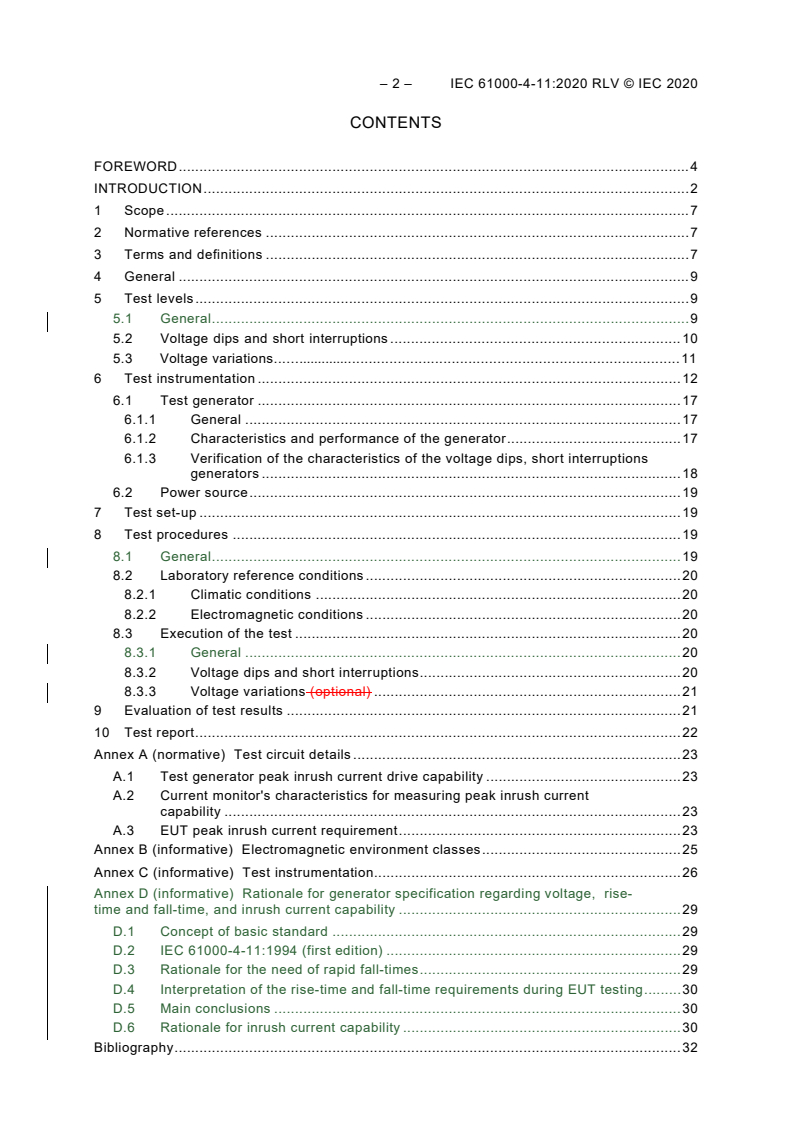
IEC 61000-4-11:2020 RLV - Electromagnetic compatibility (EMC) - Part 4-11: Testing and measurement techniques - Voltage dips, short interruptions and voltage variations immunity tests for equipment with input current up to 16 A per phase Released:1/28/2020
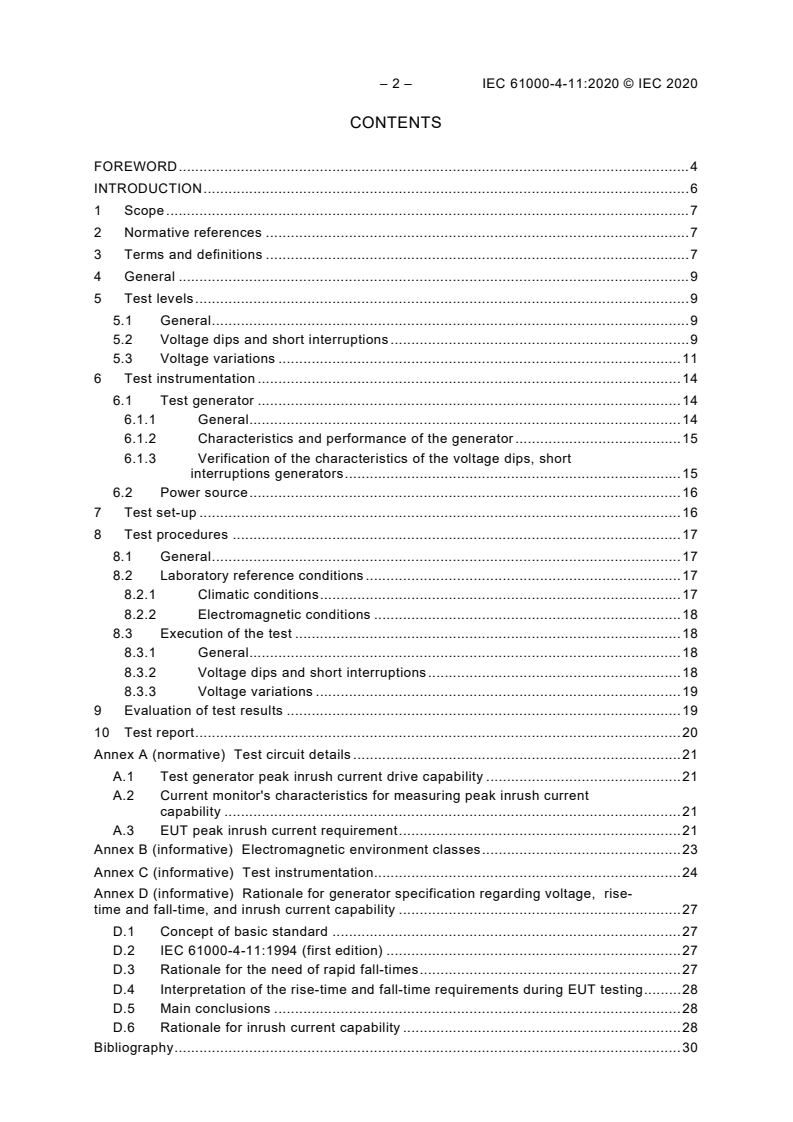
IEC 61000-4-11:2020 - Electromagnetic compatibility (EMC) - Part 4-11: Testing and measurement techniques - Voltage dips, short interruptions and voltage variations immunity tests for equipment with input current up to 16 A per phase Released:1/28/2020
Overview
IEC 61000-4-11:2020 is an international EMC (electromagnetic compatibility) basic publication that defines standardized testing and measurement techniques for immunity of electrical and electronic equipment to voltage dips, short interruptions and voltage variations on low-voltage AC networks. It applies to equipment with a rated input current up to 16 A per phase and to 50 Hz or 60 Hz networks (excludes 400 Hz). The standard establishes common test methods, preferred test levels and criteria to evaluate how equipment behaves during supply voltage disturbances.
Key topics and technical requirements
- Scope and applicability: Equipment connected to low-voltage (50/60 Hz) mains with input current ≤ 16 A per phase. Not for 400 Hz systems.
- Immunity phenomena covered: Voltage dips, short interruptions and voltage variations (distinct from voltage fluctuation tests covered by IEC 61000-4-14).
- Test levels and durations: The standard specifies a range of preferred test levels and durations to create repeatable, comparable immunity tests.
- Test instrumentation and generators: Requirements for test generators, power sources and measurement instrumentation including verification of generator characteristics and inrush-current drive capability.
- Test set-up and procedures: Laboratory reference conditions, execution steps for dips, interruptions and optional variations, and guidance on phase-to-neutral and phase-to-phase testing for three-phase equipment.
- Timing and waveform parameters: Definitions for rise time and fall time of transients are explicitly included in this edition; the origin of dips and short interruptions is also addressed.
- Result evaluation and reporting: Criteria for assessing EUT (equipment under test) behavior, reporting formats and required test-circuit details (see normative and informative annexes).
Practical applications - who uses IEC 61000-4-11
- Product designers and electrical engineers: to design resilient power-input stages and specify components that tolerate mains disturbances.
- EMC test laboratories and certification bodies: to perform standardized immunity testing and issue compliance reports.
- Manufacturers and QA teams: for pre‑compliance testing, production validation and to support product standards that reference this basic EMC publication.
- Standards committees and product technical committees: to decide appropriate test levels for specific product families using this basic reference.
Related standards and guidance
- IEC 61000 series (Part 4 family) - testing and measurement techniques.
- IEC 61000-4-14 - voltage fluctuation immunity tests (distinct scope).
- IEC Guide 107 - identifies this document as a basic EMC publication and guides product committees on application.
IEC 61000-4-11:2020 is essential when assessing and demonstrating a product’s immunity to common mains disturbances such as dips and short interruptions, helping ensure reliable operation in real-world low-voltage power networks.
Relations
- Effective Date
- 09-Feb-2026
- Effective Date
- 09-Feb-2026
- Effective Date
- 05-Sep-2023
- Effective Date
- 05-Sep-2023
- Effective Date
- 05-Sep-2023
- Effective Date
- 05-Sep-2023
- Effective Date
- 05-Sep-2023
Buy Documents
IEC 61000-4-11:2020 RLV - Electromagnetic compatibility (EMC) - Part 4-11: Testing and measurement techniques - Voltage dips, short interruptions and voltage variations immunity tests for equipment with input current up to 16 A per phase Released:1/28/2020
IEC 61000-4-11:2020 - Electromagnetic compatibility (EMC) - Part 4-11: Testing and measurement techniques - Voltage dips, short interruptions and voltage variations immunity tests for equipment with input current up to 16 A per phase Released:1/28/2020
Get Certified
Connect with accredited certification bodies for this standard

ANCE
Mexican certification and testing association.

Intertek Slovenia
Intertek testing, inspection, and certification services in Slovenia.

LNE (Laboratoire National de Métrologie et d'Essais)
French national laboratory for metrology and testing.
Sponsored listings
Frequently Asked Questions
IEC 61000-4-11:2020 is a standard published by the International Electrotechnical Commission (IEC). Its full title is "Electromagnetic compatibility (EMC) - Part 4-11: Testing and measurement techniques - Voltage dips, short interruptions and voltage variations immunity tests for equipment with input current up to 16 A per phase". This standard covers: IEC 61000-4-11:2020 defines the immunity test methods and range of preferred test levels for electrical and electronic equipment connected to low-voltage power supply networks for voltage dips, short interruptions, and voltage variations. This document applies to electrical and electronic equipment having a rated input current not exceeding 16 A per phase, for connection to 50 Hz or 60 Hz AC networks. It does not apply to electrical and electronic equipment for connection to 400 Hz AC networks. Tests for these networks will be covered by future IEC documents. The object of this document is to establish a common reference for evaluating the immunity of electrical and electronic equipment when subjected to voltage dips, short interruptions and voltage variations. NOTE 1 Voltage fluctuation immunity tests are covered by IEC 61000-4-14. The test method documented in this document describes a consistent method to assess the immunity of equipment or a system against a defined phenomenon. NOTE 2 As described in IEC Guide 107, this is a basic EMC publication for use by product committees of the IEC. As also stated in Guide 107, the IEC product committees are responsible for determining whether this immunity test standard should be applied or not, and, if applied, they are responsible for defining the appropriate test levels. Technical committee 77 and its sub-committees are prepared to co-operate with product committees in the evaluation of the value of particular immunity tests for their products. This third edition cancels and replaces the second edition published in 2004 and Amendment 1:2017. This edition constitutes a technical revision. This edition includes the following significant technical changes with respect to the previous edition: - rise time and fall time of transients are now defined terms in Clause 3; - the origin of voltage dips and short interruptions is now stated in Clause 4. The contents of the corrigendum of May 2020 and October 2022 have been included in this copy.
IEC 61000-4-11:2020 defines the immunity test methods and range of preferred test levels for electrical and electronic equipment connected to low-voltage power supply networks for voltage dips, short interruptions, and voltage variations. This document applies to electrical and electronic equipment having a rated input current not exceeding 16 A per phase, for connection to 50 Hz or 60 Hz AC networks. It does not apply to electrical and electronic equipment for connection to 400 Hz AC networks. Tests for these networks will be covered by future IEC documents. The object of this document is to establish a common reference for evaluating the immunity of electrical and electronic equipment when subjected to voltage dips, short interruptions and voltage variations. NOTE 1 Voltage fluctuation immunity tests are covered by IEC 61000-4-14. The test method documented in this document describes a consistent method to assess the immunity of equipment or a system against a defined phenomenon. NOTE 2 As described in IEC Guide 107, this is a basic EMC publication for use by product committees of the IEC. As also stated in Guide 107, the IEC product committees are responsible for determining whether this immunity test standard should be applied or not, and, if applied, they are responsible for defining the appropriate test levels. Technical committee 77 and its sub-committees are prepared to co-operate with product committees in the evaluation of the value of particular immunity tests for their products. This third edition cancels and replaces the second edition published in 2004 and Amendment 1:2017. This edition constitutes a technical revision. This edition includes the following significant technical changes with respect to the previous edition: - rise time and fall time of transients are now defined terms in Clause 3; - the origin of voltage dips and short interruptions is now stated in Clause 4. The contents of the corrigendum of May 2020 and October 2022 have been included in this copy.
IEC 61000-4-11:2020 is classified under the following ICS (International Classification for Standards) categories: 33.100.20 - Immunity. The ICS classification helps identify the subject area and facilitates finding related standards.
IEC 61000-4-11:2020 has the following relationships with other standards: It is inter standard links to EN ISO 11608-4:2022, EN ISO 4064-2:2025, IEC 61000-4-11:2020/COR2:2022, IEC 61000-4-11:2020/COR1:2020, IEC 61000-4-11:2004, IEC 61000-4-11:2004/ISH1:2010, IEC 61000-4-11:2004/AMD1:2017. Understanding these relationships helps ensure you are using the most current and applicable version of the standard.
IEC 61000-4-11:2020 is available in PDF format for immediate download after purchase. The document can be added to your cart and obtained through the secure checkout process. Digital delivery ensures instant access to the complete standard document.
Standards Content (Sample)
IEC 61000-4-11 ®
Edition 3.0 2020-01
REDLINE VERSION
INTERNATIONAL
STANDARD
colour
inside
BASIC EMC PUBLICATION
Electromagnetic compatibility (EMC) –
Part 4-11: Testing and measurement techniques – Voltage dips, short
interruptions and voltage variations immunity tests for equipment with input
current up to 16 A per phase
All rights reserved. Unless otherwise specified, no part of this publication may be reproduced or utilized in any form
or by any means, electronic or mechanical, including photocopying and microfilm, without permission in writing from
either IEC or IEC's member National Committee in the country of the requester. If you have any questions about IEC
copyright or have an enquiry about obtaining additional rights to this publication, please contact the address below or
your local IEC member National Committee for further information.
IEC Central Office Tel.: +41 22 919 02 11
3, rue de Varembé info@iec.ch
CH-1211 Geneva 20 www.iec.ch
Switzerland
About the IEC
The International Electrotechnical Commission (IEC) is the leading global organization that prepares and publishes
International Standards for all electrical, electronic and related technologies.
About IEC publications
The technical content of IEC publications is kept under constant review by the IEC. Please make sure that you have the
latest edition, a corrigendum or an amendment might have been published.
IEC publications search - webstore.iec.ch/advsearchform Electropedia - www.electropedia.org
The advanced search enables to find IEC publications by a The world's leading online dictionary on electrotechnology,
variety of criteria (reference number, text, technical containing more than 22 000 terminological entries in English
committee,…). It also gives information on projects, replaced and French, with equivalent terms in 16 additional languages.
and withdrawn publications. Also known as the International Electrotechnical Vocabulary
(IEV) online.
IEC Just Published - webstore.iec.ch/justpublished
Stay up to date on all new IEC publications. Just Published IEC Glossary - std.iec.ch/glossary
details all new publications released. Available online and 67 000 electrotechnical terminology entries in English and
once a month by email. French extracted from the Terms and Definitions clause of
IEC publications issued since 2002. Some entries have been
IEC Customer Service Centre - webstore.iec.ch/csc collected from earlier publications of IEC TC 37, 77, 86 and
If you wish to give us your feedback on this publication or CISPR.
need further assistance, please contact the Customer Service
Centre: sales@iec.ch.
IEC 61000-4-11 ®
Edition 3.0 2020-01
REDLINE VERSION
INTERNATIONAL
STANDARD
colour
inside
BASIC EMC PUBLICATION
Electromagnetic compatibility (EMC) –
Part 4-11: Testing and measurement techniques – Voltage dips, short
interruptions and voltage variations immunity tests for equipment with input
current up to 16 A per phase
INTERNATIONAL
ELECTROTECHNICAL
COMMISSION
ICS 33.100.20 ISBN 978-2-8322-7832-1
– 2 – IEC 61000-4-11:2020 RLV © IEC 2020
CONTENTS
FOREWORD . 4
INTRODUCTION . 2
1 Scope . 7
2 Normative references . 7
3 Terms and definitions . 7
4 General . 9
5 Test levels . 9
5.1 General . 9
5.2 Voltage dips and short interruptions . 10
5.3 Voltage variations. 11
6 Test instrumentation . 12
6.1 Test generator . 17
6.1.1 General . 17
6.1.2 Characteristics and performance of the generator . 17
6.1.3 Verification of the characteristics of the voltage dips, short interruptions
generators . 18
6.2 Power source . 19
7 Test set-up . 19
8 Test procedures . 19
8.1 General . 19
8.2 Laboratory reference conditions . 20
8.2.1 Climatic conditions . 20
8.2.2 Electromagnetic conditions . 20
8.3 Execution of the test . 20
8.3.1 General . 20
8.3.2 Voltage dips and short interruptions . 20
8.3.3 Voltage variations (optional) . 21
9 Evaluation of test results . 21
10 Test report . 22
Annex A (normative) Test circuit details . 23
A.1 Test generator peak inrush current drive capability . 23
A.2 Current monitor's characteristics for measuring peak inrush current
capability . 23
A.3 EUT peak inrush current requirement . 23
Annex B (informative) Electromagnetic environment classes . 25
Annex C (informative) Test instrumentation. 26
Annex D (informative) Rationale for generator specification regarding voltage, rise-
time and fall-time, and inrush current capability . 29
D.1 Concept of basic standard . 29
D.2 IEC 61000-4-11:1994 (first edition) . 29
D.3 Rationale for the need of rapid fall-times . 29
D.4 Interpretation of the rise-time and fall-time requirements during EUT testing . 30
D.5 Main conclusions . 30
D.6 Rationale for inrush current capability . 30
Bibliography . 32
Figure 1 – Voltage dip - Examples . 13
Figure 2 – Short interruption . 14
Figure 3 – Detailed view of rise and fall time . 15
Figure 4 – Voltage variation . 16
Figure 5 – Phase-to-neutral and phase-to-phase testing on three-phase systems . 21
Figure A.1 – Circuit for determining the inrush current drive capability of the short
interruptions generator . 24
Figure A.2 – Circuit for determining the peak inrush current requirement of an EUT . 24
Figure C.1 – Schematics of test instrumentation for voltage dips, short interruptions
and voltage variations . 27
Figure C.2 – Schematic of test instrumentation for three-phase voltage dips, short
interruptions and voltage variations using a power amplifier . 28
Table 1 – Preferred test levels and durations for voltage dips . 11
Table 2 – Preferred test levels and durations for short interruptions . 11
Table 3 – Timing of short-term supply voltage variations . 11
Table 4 – Generator specifications . 17
– 4 – IEC 61000-4-11:2020 RLV © IEC 2020
INTERNATIONAL ELECTROTECHNICAL COMMISSION
____________
ELECTROMAGNETIC COMPATIBILITY (EMC) –
Part 4-11: Testing and measurement techniques –
Voltage dips, short interruptions and voltage variations immunity
tests for equipment with input current up to 16 A per phase
FOREWORD
1) The International Electrotechnical Commission (IEC) is a worldwide organization for standardization comprising
all national electrotechnical committees (IEC National Committees). The object of IEC is to promote international
co-operation on all questions concerning standardization in the electrical and electronic fields. To this end and
in addition to other activities, IEC publishes International Standards, Technical Specifications, Technical Reports,
Publicly Available Specifications (PAS) and Guides (hereafter referred to as “IEC Publication(s)”). Their
preparation is entrusted to technical committees; any IEC National Committee interested in the subject dealt with
may participate in this preparatory work. International, governmental and non-governmental organizations liaising
with the IEC also participate in this preparation. IEC collaborates closely with the International Organization for
Standardization (ISO) in accordance with conditions determined by agreement between the two organizations.
2) The formal decisions or agreements of IEC on technical matters express, as nearly as possible, an international
consensus of opinion on the relevant subjects since each technical committee has representation from all
interested IEC National Committees.
3) IEC Publications have the form of recommendations for international use and are accepted by IEC National
Committees in that sense. While all reasonable efforts are made to ensure that the technical content of IEC
Publications is accurate, IEC cannot be held responsible for the way in which they are used or for any
misinterpretation by any end user.
4) In order to promote international uniformity, IEC National Committees undertake to apply IEC Publications
transparently to the maximum extent possible in their national and regional publications. Any divergence between
any IEC Publication and the corresponding national or regional publication shall be clearly indicated in the latter.
5) IEC itself does not provide any attestation of conformity. Independent certification bodies provide conformity
assessment services and, in some areas, access to IEC marks of conformity. IEC is not responsible for any
services carried out by independent certification bodies.
6) All users should ensure that they have the latest edition of this publication.
7) No liability shall attach to IEC or its directors, employees, servants or agents including individual experts and
members of its technical committees and IEC National Committees for any personal injury, property damage or
other damage of any nature whatsoever, whether direct or indirect, or for costs (including legal fees) and
expenses arising out of the publication, use of, or reliance upon, this IEC Publication or any other IEC
Publications.
8) Attention is drawn to the Normative references cited in this publication. Use of the referenced publications is
indispensable for the correct application of this publication.
9) Attention is drawn to the possibility that some of the elements of this IEC Publication may be the subject of patent
rights. IEC shall not be held responsible for identifying any or all such patent rights.
This redline version of the official IEC Standard allows the user to identify the changes
made to the previous edition. A vertical bar appears in the margin wherever a change has
been made. Additions are in green text, deletions are in strikethrough red text.
International Standard IEC 61000-4-11 has been prepared by subcommittee 77A: EMC – Low
frequency phenomena, of IEC technical committee 77: Electromagnetic compatibility.
It forms Part 4-11 of IEC 61000. It has the status of a basic EMC publication in accordance with
IEC Guide 107.
This third edition cancels and replaces the second edition published in 2004 and
Amendment 1:2017. This edition constitutes a technical revision.
This edition includes the following significant technical changes with respect to the previous
edition:
a) rise time and fall time of transients are now defined terms in Clause 3;
b) the origin of voltage dips and short interruptions is now stated in Clause 4.
The text of this International Standard is based on the following documents:
FDIS Report on voting
77A/1039/FDIS 77A/1056/RVD
Full information on the voting for the approval of this International Standard can be found in the
report on voting indicated in the above table.
This document has been drafted in accordance with the ISO/IEC Directives, Part 2.
A list of all parts in the IEC 61000 series, published under the general title Electromagnetic
compatibility (EMC), can be found on the IEC website.
The committee has decided that the contents of this document will remain unchanged until the
stability date indicated on the IEC website under "http://webstore.iec.ch" in the data related to
the specific document. At this date, the document will be
• reconfirmed,
• withdrawn,
• replaced by a revised edition, or
• amended.
The contents of the corrigenda 1 (2020-05) and 2 (2022-10) have been included in this copy.
IMPORTANT – The 'colour inside' logo on the cover page of this publication indicates
that it contains colours which are considered to be useful for the correct understanding
of its contents. Users should therefore print this document using a colour printer.
– 6 – IEC 61000-4-11:2020 RLV © IEC 2020
INTRODUCTION
IEC 61000 is published in separate parts according to the following structure:
Part 1: General
General considerations (introduction, fundamental principles)
Definitions, terminology
Part 2: Environment
Description of the environment
Classification of the environment
Compatibility levels
Part 3: Limits
Emission limits
Immunity limits (in so far as they do not fall under the responsibility of the product
committees)
Part 4: Testing and measurement techniques
Measurement techniques
Testing techniques
Part 5: Installation and mitigation guidelines
Installation guidelines
Mitigation methods and devices
Part 6: Generic standards
Part 9: Miscellaneous
Each part is further subdivided into several parts, published either as International Standards
or as technical specifications or technical reports, some of which have already been published
as sections. Others will be published with the part number followed by a dash and a second
number identifying the subdivision (example: IEC 61000-6-1).
ELECTROMAGNETIC COMPATIBILITY (EMC) –
Part 4-11: Testing and measurement techniques –
Voltage dips, short interruptions and voltage variations immunity
tests for equipment with input current up to 16 A per phase
1 Scope
This part of IEC 61000 defines the immunity test methods and range of preferred test levels for
electrical and electronic equipment connected to low-voltage power supply networks for voltage
dips, short interruptions, and voltage variations.
This document applies to electrical and electronic equipment having a rated input current not
exceeding 16 A per phase, for connection to 50 Hz or 60 Hz AC networks.
It does not apply to electrical and electronic equipment for connection to 400 Hz AC networks.
Tests for these networks will be covered by future IEC documents.
The object of this document is to establish a common reference for evaluating the immunity of
electrical and electronic equipment when subjected to voltage dips, short interruptions and
voltage variations.
NOTE 1 Voltage fluctuation immunity tests are covered by IEC 61000-4-14.
The test method documented in this document describes a consistent method to assess the
immunity of equipment or a system against a defined phenomenon.
NOTE 2 As described in IEC Guide 107, this is a basic EMC publication for use by product committees of the IEC.
As also stated in Guide 107, the IEC product committees are responsible for determining whether this immunity test
standard should be applied or not, and, if applied, they are responsible for defining the appropriate test levels.
Technical committee 77 and its sub-committees are prepared to co-operate with product committees in the evaluation
of the value of particular immunity tests for their products.
2 Normative references
The following documents are referred to in the text in such a way that some or all of their content
constitutes requirements of this document. For dated references, only the edition cited applies.
For undated references, the latest edition of the referenced document (including any
amendments) applies.
IEC TR 61000-2-8, Electromagnetic compatibility (EMC) − Part 2-8: Environment − Voltage dips
and short interruptions on public electric power supply systems with statistical measurement
results
3 Terms and definitions
For the purposes of this document, the following terms and definitions apply.
ISO and IEC maintain terminological databases for use in standardization at the following
addresses:
• IEC Electropedia: available at http://www.electropedia.org/
• ISO Online browsing platform: available at http://www.iso.org/obp
– 8 – IEC 61000-4-11:2020 RLV © IEC 2020
3.1
basic EMC standard
standard giving general and fundamental conditions or rules for the achievement of EMC, which
are related or applicable to all products and systems and serve as reference documents for
product committees
NOTE As determined by the Advisory Committee on Electromagnetic Compatibility (ACEC) – see IEC Guide 107.
3.1
immunity (to a disturbance)
ability of a device, equipment or system to perform without degradation in the presence of an
electromagnetic disturbance
[SOURCE: IEC 60050-161:1990, 161-01-20]
3.2
voltage dip
sudden reduction of the voltage at a particular point of an electricity supply system below a
specified dip threshold followed by its recovery after a brief interval
Note 1 to entry: Typically, a dip is associated with the occurrence and termination of a short circuit or other extreme
current increase on the system or installations connected to it.
Note 2 to entry: A voltage dip is a two-dimensional electromagnetic disturbance, the level of which is determined
by both voltage and time (duration).
3.3
short interruption
sudden reduction of the voltage on all phases at a particular point of an electric supply system
below a specified interruption threshold followed by its restoration after a brief interval
Note 1 to entry: Short interruptions are typically associated with switchgear operations related to the occurrence
and termination of short circuits on the system or on installations connected to it.
3.4
residual voltage
minimum value of RMS voltage recorded during a voltage dip or short interruption
Note 1 to entry: The residual voltage may can be expressed as a value in volts or as a percentage or per unit value
relative to the reference voltage.
3.5
malfunction
the termination breakdown of the ability of equipment to carry out intended functions or the
execution of unintended functions by the equipment
3.6
calibration
method to prove that the measurement equipment is in compliance with its specifications
Note 1 to entry: For the purposes of this document, calibration is applied to the test generator.
3.7
verification
set of operations which are used to check the test equipment system (e.g. the test generator
and the interconnecting cables) to demonstrate that the test system is functioning within the
specifications given in Clause 6
Note 1 to entry: The methods used for verification may can be different from those used for calibration.
Note 2 to entry: The verification procedure of 6.1.23 is meant as a guide to ensure the correct operation of the test
generator and other items making up the test set-up so that the intended waveform is delivered to the EUT.
3.8
rise time
interval of time between the instants at which the instantaneous value of a transition first
reaches a specified lower value and then a specified upper value
Note 1 to entry: The lower and upper values are fixed at 10 % and 90 % of the transition magnitude.
[SOURCE: IEC 60050-161:1990, 161-02-05]
3.9
fall time
interval of time between the instants at which the instantaneous value of a transition first
reaches a specified upper value and then a specified lower value
Note 1 to entry: The lower and upper values are fixed at 10 % and 90 % of the transition magnitude.
Note 2 to entry: This definition is derived from IEC 60050-161:1990, 161-02-05.
4 General
Electrical and electronic equipment may can be affected by voltage dips, short interruptions or
voltage variations of the power supply.
Voltage dips and short interruptions are caused by faults in the network, primarily short circuits
(see also IEC 61000-2-8), in installations or by sudden large changes of load. In certain cases,
two or more consecutive dips or interruptions may occur. Voltage dips and short interruptions
occur due to faults in a (public or non-public) network or in installations by sudden changes of
large loads. In certain cases, two or more consecutive dips or interruptions can occur.Voltage
variations are caused by continuously varying loads connected to the network.
These phenomena are random in nature and can be minimally characterized for the purpose of
laboratory simulation in terms of the deviation from the rated voltage and duration.
Consequently, different types of tests are specified in this document to simulate the effects of
abrupt voltage change. These tests are to be used only for particular and justified cases, under
the responsibility of product specification or product committees.
It is the responsibility of the product committees to establish which phenomena among the ones
considered in this document are relevant and to decide on the applicability of the test.
5 Test levels
5.1 General
The voltages in this document use the rated voltage for the equipment (U ) as a basis for the
T
voltage test level specification.
Where the equipment has a rated voltage range the following shall apply:
• if the voltage range does not exceed 20 % of the lower voltage specified for the rated voltage
range, a single voltage within that range may be specified as a basis for the test level
specification (U );
T
• in all other cases, the test procedure shall be applied for both the lowest and highest
voltages declared in the voltage range;
• guidance for the selection of test levels and durations is given in IEC TR 61000-2-8.
– 10 – IEC 61000-4-11:2020 RLV © IEC 2020
5.2 Voltage dips and short interruptions
The change between U and the changed voltage is abrupt. The step can start and stop at any
T
phase angle on the mains voltage. The following test voltage levels (in % U ) are used: 0 %,
T
40 %, 70 % and 80 %, corresponding to dips with residual voltages of 0 %, 40 %, 70 % and
80 %.
For voltage dips, the preferred test levels and durations are given in Table 1, and an example
is shown in Figure 1a) and Figure 1b).
For short interruptions, the preferred test levels and durations are given in Table 2, and an
example is shown in Figure 2.
The rise and fall time are detailed in Figure 3.
The preferred test levels and durations given in Table 1 and Table 2 take into account the
information given in IEC TR 61000-2-8.
The preferred test levels in Table 1 are reasonably severe, and are representative of many real
world dips, but are not intended to guarantee immunity to all voltage dips. More severe dips,
for example 0 % for 1 s and balanced three-phase dips, may be considered by product
committees.
The generator specification for voltage rise time, t , and voltage fall time, t , during abrupt
r f
changes is indicated in Table 4.
The levels and durations shall be given in the product specification. A test level of 0 %
corresponds to a total supply voltage interruption. In practice, a test voltage level from 0 % to
20 % of the rated voltage may be considered as a total interruption.
Shorter durations in Table 1, in particular the half-cycle, should be tested to ensure that the
equipment under test (EUT) operates within the performance limits specified for it.
When setting performance criteria for disturbances of a half-period duration for products with a
mains transformer, product committees should pay particular attention to effects which may can
result from inrush currents. For such products, these may can reach 10 times to 40 times the
rated current because of the magnetic flux saturation of the transformer core after the voltage
dip.
High inrush currents can also occur in products with capacitors (e.g. EMC filters, bridge
rectifiers connected to DC capacitors).
Table 1 – Preferred test levels and durations for voltage dips
a
Test levels and durations for voltage dips (t ) (50 Hz/60 Hz)
Class
s
Class 1 Case-by-case according to the equipment requirements
c
Class 2 0 % during 0 % during 70 % during 25/30 cycles
½ cycle 1 cycle
Class 3 0 % during 0 % during 40 % during 70 % during 80 % during
c c c
½ cycle 1 cycle 10/12 cycles 25/30 cycles 250/300 cycles
b
Class X X X X X X
a
Classes as per IEC 61000-2-4; see Annex B.
b
To be defined by product committee. For equipment connected directly or indirectly to the public network, the
levels must shall not be less severe than class 2.
c
"25/30 cycles" means "25 cycles for 50 Hz test" and "30 cycles for 60 Hz test".
Table 2 – Preferred test levels and durations for short interruptions
a
Class Test levels and durations for short interruptions (t ) (50 Hz/60 Hz)
s
Class 1 Case-by-case according to the equipment requirements
c
Class 2 0 % during 250/300 cycles
c
Class 3 0 % during 250/300 cycles
b
Class X X
a
Classes as per IEC 61000-2-4; see Annex B.
b
To be defined by product committee. For equipment connected directly or indirectly to the public network, the
levels must shall not be less severe than class 2.
c
"250/300 cycles" means "250 cycles for 50 Hz test" and "300 cycles for 60 Hz test".
5.3 Voltage variations
This test considers a defined transition between the rated voltage U and the changed voltage.
T
NOTE The voltage change takes place over a short period, and may can occur due to a change of load.
The preferred duration of the voltage changes and the time for which the reduced voltages are
to be maintained are given in Table 3. The rate of change should be constant; however, the
voltage may be stepped. The steps should be positioned at zero crossings, and should be no
larger than 10 % of U . Steps under 1 % of U are considered as constant rates of change of
T T
voltage.
Table 3 – Timing of short-term supply voltage variations
Voltage test level Time for decreasing Time at reduced Time for increasing
voltage (t ) voltage(t ) voltage (t ) (50 Hz/60 Hz)
d s i
b
70 % Abrupt 1 cycle 25/30 cycles
a a a a
X X X X
a
To be defined by product committee.
b
"25/30 cycles" means "25 cycles for 50 Hz test" and "30 cycles for 60 Hz test".
This shape is the typical shape of a motor starting.
– 12 – IEC 61000-4-11:2020 RLV © IEC 2020
U
t (periods)
0 5 25
IEC 270/04
NOTE The voltage decreases to 70 % for 25 periods. Step at zero crossing.
Figure 1a) – Voltage dip – 70 % voltage dip sine wave graph
U (r.m.s.)
T
100 %
40 %
0 %
t
t t
f
s r
IEC 271/04
Key
t Voltage rising time
r
t Voltage fall time
f
t Time at reduced voltage
s
Figure 1b) – Voltage dip – 40 % voltage dip r.m.s. graph
NOTE The voltage decreases to 70 % for 25 periods. Step at zero crossing.
a) Voltage dip: 70 % voltage dip sine wave graph at 0°
Key
t fall time
f
t rise time
r
t duration of reduced voltage
s
b) Voltage dip: 40 % voltage dip sine wave graph at 90°
Figure 1 – Voltage dip - Examples
– 14 – IEC 61000-4-11:2020 RLV © IEC 2020
U
T (r.m.s.)
100 %
0 %
t
f t t
s
r
IEC 272/04
Key
t Voltage rising time
r
t Voltage fall time
f
t Time at reduced voltage
s
Key
t fall time
f
t rise time
r
t duration of reduced voltage
s
Figure 2 – Short interruption
Figure 3 – Detailed view of rise and fall time
Figure 4 shows the RMS voltage as a function of time. Other values may be taken in justified
cases and shall be specified by the product committee.
– 16 – IEC 61000-4-11:2020 RLV © IEC 2020
U (r.m.s.)
T
100 %
70 %
0 %
t
t
d
s t
i
IEC 273/04
Key
t Time for decreasing voltage
d
t Time for increasing voltage
i
t Time at reduced voltage
s
Key
t Time for decreasing voltage
d
t Time for increasing voltage
i
t Time at reduced voltage
s
Figure 4 – Voltage variation
6 Test instrumentation
6.1 Test generator
6.1.1 General
The following features are common to the generator for voltage dips, short interruptions and
voltage variations, except as indicated.
Examples of generators are given in Annex C.
The generator shall have provisions to prevent the emission of heavy disturbances, which, if
injected in the power supply network, may can influence the test results.
Any generator creating a voltage dip of equal or more severe characteristics (amplitude and
duration) than that prescribed specified by the present document is permitted.
6.1.2 Characteristics and performance of the generator
Table 4 – Generator specifications
Output voltage at no load As required in Table 1, ±5 % of residual voltage value
Voltage change with load at the output of the generator
100 % output, 0 A to 16 A less than 5 % of U
T
80 % output, 0 A to 20 A
less than 5 % of U
T
70 % output, 0 A to 23 A
less than 5 % of U
T
40 % output, 0 A to 40 A
less than 5 % of U
T
Output current capability 16 A RMS per phase at rated voltage. The generator
shall be capable of carrying 20 A at 80 % of rated value
for a duration of 5 s. It shall be capable of carrying 23 A
at 70 % of rated voltage and 40 A at 40 % of rated
voltage for a duration of 3 s. (This requirement may be
reduced according to the EUT's rated steady-state
supply current, see Clause A.3.)
Peak inrush current capability (no requirement for Not to be limited by the generator. However, the
voltage variation tests) maximum peak capability of the generator need not
exceed 1 000 A for 250 V to 600 V mains, 500 A for
200 V to 240 V mains, or 250 A for 100 V to 120 V
mains.
Instantaneous peak overshoot/undershoot of the Less than 5 % of U
T
actual voltage, generator loaded with 100 Ω resistive
load
Voltage rise (and fall) time t (and t ), see Figure 1b),
Between 1 µs and 5 µs
r f
Figure 2 and Figure 3, during abrupt change, generator
loaded with 100 Ω resistive load
Phase shifting (if necessary) 0° to 360°
Phase relationship of voltage dips and interruptions Less than +10 °
with the power frequency
Zero crossing control of the generators ±10°
The output impedance shall be predominantly resistive.
The output impedance of the test voltage generator shall be low enough even during transitions
(for example, less than 0,4 + j0,25 Ω).
– 18 – IEC 61000-4-11:2020 RLV © IEC 2020
NOTE 1 The 100 Ω resistive load used to test the generator should not have additional
inductivity.
NOTE 2 To test equipment which regenerates energy, an external resistor connected in parallel
to the load can be added. The test result must should not be influenced by this load.
6.1.3 Verification of the characteristics of the voltage dips, short interruptions
generators
In order to compare the test results obtained from different test generators, the generator
characteristics shall be verified according to the following:
• the 100 %, 80 %, 70 % and 40 % RMS output voltages of the generator shall conform to the
percentages of the selected operating voltage: 230 V, 120 V, etc.;
• the 100 %, 80 %, 70 % and 40 % RMS output voltages of the generator shall be measured
at no load, and shall be maintained within a specified percentage of the U ;
T
• load regulation shall be verified at nominal load current at each of the output voltages and
the variation shall not exceed 5 % of the nominal power supply voltage at 100 %, 80 %,
70 % and 40 % of the nominal power supply voltage.
For output voltage of 80 % of the nominal value, the above requirements need only be verified
for a maximum of 5 s duration.
For output voltages of 70 % and 40 % of the nominal value, the above requirements need only
be verified for a maximum of 3 s duration.
For output voltages of 40% of the nominal value it is acceptable to verify the load regulation
requirements either at 200 V to 240 V nominal voltage or at 100 V to 120 V nominal voltage.
If it is necessary to verify the peak inrush drive current capability, the generator shall be
switched from 0 % to 100 % of full output, when driving a load consisting of a suitable rectifier
with an uncharged capacitor whose value is 1 700 µF on the DC side. The test shall be carried
out at phase angles of both 90° and 270°. The circuit required to measure the generator inrush
current drive capability is given in Figure A.1.
When it is believed that a generator with less than the specified standard generator peak inrush
current may can be used because the EUT may can draw less than the specified standard
generator peak inrush current (e.g., 500 A for 220 V to 240 V mains), this shall first be confirmed
by measuring the EUT peak inrush current. When power is applied from the test generator, the
measured EUT peak inrush current shall be less than 70 % of the peak current drive capability
of the generator, as already verified according to Annex A. The actual EUT inrush current shall
be measured both from a cold start and after a 5 s turn-off, using the procedure of Clause A.3.
Generator switching characteristics shall be measured with a 100 Ω load of suitable power-
dissipation rating.
NOTE The 100 Ω resistive load used to test the generator should not have additional inductivity.
Rise and fall time, as well as overshoot and undershoot, shall be verified for switching at both
90° and 270°, from 0 % to 100 %, 100 % to 80 %, 100 % to 70 %, 100 % to 40 %, and 100 %
to 0 %.
Phase angle accuracy shall be verified for switching from 0 % to 100 % and 100 % to 0 %, at
nine phase angles from 0° to 360° in 45° increments. It shall also be verified for switching
from 100 % to 80 % and 80 % to 100 %, 100 % to 70 % and 70 % to 100 %, as well as from
100 % to 40 % and 40 % to 100 %, at 90° and 180°.
The voltage generators shall, preferably, be recalibrated at defined time periods in accordance
with a recognized quality assurance system.
Annex D provides the rationale for generator specification regarding the voltage rise and fall
time and the inrush current capability.
6.2 Power source
The frequency of the test voltage shall be within ±2 % of rated frequency.
7 Test set-up
The test shall be performed with the EUT connected to the test generator with the shortest
power supply cable as specified by the EUT manufacturer. If no cable length is specified, it
shall be the shortest possible length suitable to the application of the EUT.
The test set-ups are defined for the three types of phenomena described in this document:
• voltage dips;
• short interruptions;
• voltage variations with gradual transition between the rated voltage and the changed voltage
(option).
Examples of test set-ups are given in Annex C.
Figure C.1a) shows a schematic for the generation of voltage dips, short interruptions and
voltage variations with gradual transition between rated and changed voltage using a generator
with internal switching. In Figure C.1b) a generator and a power amplifier are used.
Figure C.2 shows a schematic for the generation of voltage dips, short interruptions and voltage
variations using a generator and a power amplifier for three-phase equipment.
8 Test procedures
8.1 General
Before starting the test of a given EUT, a test plan shall be prepared.
The test plan should be representative of the way the system is actually used.
Systems may can require a precise pre-analysis to define which system configurations must
shall be tested to reproduce field situations.
Test cases must shall be explained and indicated in the test report.
It is recommended that the test plan include the following items:
• the type designation of the EUT;
• information on possible connections (plugs, terminals, etc.) and corresponding cables, and
peripherals;
• input power port of equipment to be tested;
• representative operational modes of the EUT for the test;
• performance criteria used and defined in the technical specifications;
• operational mode(s) of equipment;
– 20 – IEC 61000-4-11:2020 RLV © IEC 2020
• description of the test set-up.
If the actual operating signal sources are not available to the EUT, they may can be simulated.
For each test, any degradation of performance shall be recorded. The monitoring equipment
should be capable of displaying the status of the operational mode of the EUT during and after
the tests. After each group of tests, a full functional check shall be performed.
8.2 Laboratory reference conditions
8.2.1 Climatic conditions
Unless otherwise specified by the committee responsible for the generic or product standard,
the climatic conditions in the laboratory shall be within any limits specified for the operation of
the EUT and the test equipment by their respective manufacturers.
Tests shall not be performed if the relative humidity is so high as to cause condensation on the
EUT or the test equipment.
NOTE Where it is considered that there is sufficient evidence to demonstrate that the effects of the phenomenon
covered by this document are influenced by climatic conditions, this should be is brought to the attention of the
committee responsible for this document.
8.2.2 Electromagnetic conditions
The electromagnetic conditions of the laboratory shall be such as to guarantee the correct
operation of the EUT in order not to influence the test results.
8.3 Execution of the test
8.3.1 General
During the tests, the mains voltage for testing shall be monitored within an accuracy of 2 %.
8.3.2 Voltage dips and short interruptions
The EUT shall be tested for each selected combination of test level and duration with a
sequence of three dips/interruptions with intervals of 10 s minimum (between each test event).
Each representative mode of operation shall be tested.
For voltage dips, changes in supply voltage shall occur at zero crossings of the voltage, and at
additional angles considered critical by product committees or individual product specifications
preferably selected from 45°, 90°, 135°, 180°, 225°, 270° and 315° on each phase.
For short interruptions, the angle shall be defined by the product committee as the worst case.
In the absence of definition, it is recommended to use 0° for one of the phases.
For the short interruption test of three-phase systems, all the three phases shall be
simultaneously tested according to 5.2.
For the voltage dips test of single-phase systems, the voltage shall be tested according to 5.2.
This implies one series of tests.
For the voltage dips test of three-phase systems with neutral, each individual voltage (phase-
to-neutral and phase-to-phase) shall be tested, one at a time, according to 5.2. This implies six
different series of tests. See Figure 5.
For the voltage dips test of three-phase systems without neutral, each phase-to-phase voltage
shall be tested, one at a time, according to 5.2. This implies three different series of tests. See
Figure 5b).
NOTE For three-phase systems, during a dip on a phase-to-phase voltage a change will occur on one or two of the
other voltages as well.
For EUTs with more than one power cord, each power cord should be tested individually.
NOTE Phase-to-neutral testing on three-phase systems is performed one phase at a time.
a) Phase-to-neutral testing on three-phase systems
NOTE Phase-to-phase testing on three-phase systems is also performed one phase at a time. Both (A) and (B)
show a 70 % dip. (A) is preferred, but (B) is also acceptable.
b) Pha
...
IEC 61000-4-11 ®
Edition 3.0 2020-01
INTERNATIONAL
STANDARD
NORME
INTERNATIONALE
colour
inside
BASIC EMC PUBLICATION
PUBLICATION FONDAMENTALE EN CEM
Electromagnetic compatibility (EMC) –
Part 4-11: Testing and measurement techniques – Voltage dips, short
interruptions and voltage variations immunity tests for equipment with input
current up to 16 A per phase
Compatibilité électromagnétique (CEM) –
Partie 4-11: Techniques d'essai et de mesure – Essais d'immunité aux creux
de tension, coupures brèves et variations de tension pour les appareils
à courant d’entrée inférieur ou égal à 16 A par phase
All rights reserved. Unless otherwise specified, no part of this publication may be reproduced or utilized in any form
or by any means, electronic or mechanical, including photocopying and microfilm, without permission in writing from
either IEC or IEC's member National Committee in the country of the requester. If you have any questions about IEC
copyright or have an enquiry about obtaining additional rights to this publication, please contact the address below or
your local IEC member National Committee for further information.
Droits de reproduction réservés. Sauf indication contraire, aucune partie de cette publication ne peut être reproduite ni
utilisée sous quelque forme que ce soit et par aucun procédé, électronique ou mécanique, y compris la photocopie et
les microfilms, sans l'accord écrit de l'IEC ou du Comité national de l'IEC du pays du demandeur. Si vous avez des
questions sur le copyright de l'IEC ou si vous désirez obtenir des droits supplémentaires sur cette publication, utilisez
les coordonnées ci-après ou contactez le Comité national de l'IEC de votre pays de résidence.
IEC Central Office Tel.: +41 22 919 02 11
3, rue de Varembé info@iec.ch
CH-1211 Geneva 20 www.iec.ch
Switzerland
About the IEC
The International Electrotechnical Commission (IEC) is the leading global organization that prepares and publishes
International Standards for all electrical, electronic and related technologies.
About IEC publications
The technical content of IEC publications is kept under constant review by the IEC. Please make sure that you have the
latest edition, a corrigendum or an amendment might have been published.
IEC publications search - webstore.iec.ch/advsearchform Electropedia - www.electropedia.org
The advanced search enables to find IEC publications by a The world's leading online dictionary on electrotechnology,
variety of criteria (reference number, text, technical containing more than 22 000 terminological entries in English
committee,…). It also gives information on projects, replaced and French, with equivalent terms in 16 additional languages.
and withdrawn publications. Also known as the International Electrotechnical Vocabulary
(IEV) online.
IEC Just Published - webstore.iec.ch/justpublished
Stay up to date on all new IEC publications. Just Published IEC Glossary - std.iec.ch/glossary
details all new publications released. Available online and once 67 000 electrotechnical terminology entries in English and
a month by email. French extracted from the Terms and definitions clause of IEC
publications issued between 2002 and 2015. Some entries
IEC Customer Service Centre - webstore.iec.ch/csc have been collected from earlier publications of IEC TC 37, 77,
If you wish to give us your feedback on this publication or need 86 and CISPR.
further assistance, please contact the Customer Service
Centre: sales@iec.ch.
A propos de l'IEC
La Commission Electrotechnique Internationale (IEC) est la première organisation mondiale qui élabore et publie des
Normes internationales pour tout ce qui a trait à l'électricité, à l'électronique et aux technologies apparentées.
A propos des publications IEC
Le contenu technique des publications IEC est constamment revu. Veuillez vous assurer que vous possédez l’édition la
plus récente, un corrigendum ou amendement peut avoir été publié.
Recherche de publications IEC - Le premier dictionnaire d'électrotechnologie en ligne au monde,
webstore.iec.ch/advsearchform avec plus de 22 000 articles terminologiques en anglais et en
La recherche avancée permet de trouver des publications IEC français, ainsi que les termes équivalents dans 16 langues
en utilisant différents critères (numéro de référence, texte, additionnelles. Egalement appelé Vocabulaire
comité d’études,…). Elle donne aussi des informations sur les Electrotechnique International (IEV) en ligne.
projets et les publications remplacées ou retirées.
Glossaire IEC - std.iec.ch/glossary
IEC Just Published - webstore.iec.ch/justpublished 67 000 entrées terminologiques électrotechniques, en anglais
Restez informé sur les nouvelles publications IEC. Just et en français, extraites des articles Termes et définitions des
Published détaille les nouvelles publications parues. publications IEC parues entre 2002 et 2015. Plus certaines
Disponible en ligne et une fois par mois par email. entrées antérieures extraites des publications des CE 37, 77,
86 et CISPR de l'IEC.
Service Clients - webstore.iec.ch/csc
Si vous désirez nous donner des commentaires sur cette
publication ou si vous avez des questions contactez-nous:
sales@iec.ch.
Electropedia - www.electropedia.org
IEC 61000-4-11 ®
Edition 3.0 2020-01
INTERNATIONAL
STANDARD
NORME
INTERNATIONALE
colour
inside
BASIC EMC PUBLICATION
PUBLICATION FONDAMENTALE EN CEM
Electromagnetic compatibility (EMC) –
Part 4-11: Testing and measurement techniques – Voltage dips, short
interruptions and voltage variations immunity tests for equipment with input
current up to 16 A per phase
Compatibilité électromagnétique (CEM) –
Partie 4-11: Techniques d'essai et de mesure – Essais d'immunité aux creux
de tension, coupures brèves et variations de tension pour les appareils
à courant d’entrée inférieur ou égal à 16 A par phase
INTERNATIONAL
ELECTROTECHNICAL
COMMISSION
COMMISSION
ELECTROTECHNIQUE
INTERNATIONALE
ICS 33.100.20 ISBN 978-2-8322-7546-7
– 2 – IEC 61000-4-11:2020 © IEC 2020
CONTENTS
FOREWORD . 4
INTRODUCTION . 6
1 Scope . 7
2 Normative references . 7
3 Terms and definitions . 7
4 General . 9
5 Test levels . 9
5.1 General . 9
5.2 Voltage dips and short interruptions . 9
5.3 Voltage variations . 11
6 Test instrumentation . 14
6.1 Test generator . 14
6.1.1 General. 14
6.1.2 Characteristics and performance of the generator . 15
6.1.3 Verification of the characteristics of the voltage dips, short
interruptions generators . 15
6.2 Power source . 16
7 Test set-up . 16
8 Test procedures . 17
8.1 General . 17
8.2 Laboratory reference conditions . 17
8.2.1 Climatic conditions . 17
8.2.2 Electromagnetic conditions . 18
8.3 Execution of the test . 18
8.3.1 General. 18
8.3.2 Voltage dips and short interruptions . 18
8.3.3 Voltage variations . 19
9 Evaluation of test results . 19
10 Test report . 20
Annex A (normative) Test circuit details . 21
A.1 Test generator peak inrush current drive capability . 21
A.2 Current monitor's characteristics for measuring peak inrush current
capability . 21
A.3 EUT peak inrush current requirement . 21
Annex B (informative) Electromagnetic environment classes . 23
Annex C (informative) Test instrumentation. 24
Annex D (informative) Rationale for generator specification regarding voltage, rise-
time and fall-time, and inrush current capability . 27
D.1 Concept of basic standard . 27
D.2 IEC 61000-4-11:1994 (first edition) . 27
D.3 Rationale for the need of rapid fall-times . 27
D.4 Interpretation of the rise-time and fall-time requirements during EUT testing . 28
D.5 Main conclusions . 28
D.6 Rationale for inrush current capability . 28
Bibliography . 30
Figure 1 – Voltage dip – Examples . 12
Figure 2 – Short interruption . 13
Figure 3 – Detailed view of rise and fall time . 13
Figure 4 – Voltage variation . 14
Figure 5 – Phase-to-neutral and phase-to-phase testing on three-phase systems . 19
Figure A.1 – Circuit for determining the inrush current drive capability of the short
interruptions generator . 22
Figure A.2 – Circuit for determining the peak inrush current requirement of an EUT . 22
Figure C.1 – Schematics of test instrumentation for voltage dips, short interruptions
and voltage variations . 25
Figure C.2 – Schematic of test instrumentation for three-phase voltage dips, short
interruptions and voltage variations using a power amplifier . 26
Table 1 – Preferred test levels and durations for voltage dips . 10
Table 2 – Preferred test levels and durations for short interruptions . 11
Table 3 – Timing of short-term supply voltage variations . 11
Table 4 – Generator specifications . 15
– 4 – IEC 61000-4-11:2020 © IEC 2020
INTERNATIONAL ELECTROTECHNICAL COMMISSION
____________
ELECTROMAGNETIC COMPATIBILITY (EMC) –
Part 4-11: Testing and measurement techniques –
Voltage dips, short interruptions and voltage variations immunity
tests for equipment with input current up to 16 A per phase
FOREWORD
1) The International Electrotechnical Commission (IEC) is a worldwide organization for standardization comprising
all national electrotechnical committees (IEC National Committees). The object of IEC is to promote
international co-operation on all questions concerning standardization in the electrical and electronic fields. To
this end and in addition to other activities, IEC publishes International Standards, Technical Specifications,
Technical Reports, Publicly Available Specifications (PAS) and Guides (hereafter referred to as “IEC
Publication(s)”). Their preparation is entrusted to technical committees; any IEC National Committee interested
in the subject dealt with may participate in this preparatory work. International, governmental and non-
governmental organizations liaising with the IEC also participate in this preparation. IEC collaborates closely
with the International Organization for Standardization (ISO) in accordance with conditions determined by
agreement between the two organizations.
2) The formal decisions or agreements of IEC on technical matters express, as nearly as possible, an international
consensus of opinion on the relevant subjects since each technical committee has representation from all
interested IEC National Committees.
3) IEC Publications have the form of recommendations for international use and are accepted by IEC National
Committees in that sense. While all reasonable efforts are made to ensure that the technical content of IEC
Publications is accurate, IEC cannot be held responsible for the way in which they are used or for any
misinterpretation by any end user.
4) In order to promote international uniformity, IEC National Committees undertake to apply IEC Publications
transparently to the maximum extent possible in their national and regional publications. Any divergence
between any IEC Publication and the corresponding national or regional publication shall be clearly indicated in
the latter.
5) IEC itself does not provide any attestation of conformity. Independent certification bodies provide conformity
assessment services and, in some areas, access to IEC marks of conformity. IEC is not responsible for any
services carried out by independent certification bodies.
6) All users should ensure that they have the latest edition of this publication.
7) No liability shall attach to IEC or its directors, employees, servants or agents including individual experts and
members of its technical committees and IEC National Committees for any personal injury, property damage or
other damage of any nature whatsoever, whether direct or indirect, or for costs (including legal fees) and
expenses arising out of the publication, use of, or reliance upon, this IEC Publication or any other IEC
Publications.
8) Attention is drawn to the Normative references cited in this publication. Use of the referenced publications is
indispensable for the correct application of this publication.
9) Attention is drawn to the possibility that some of the elements of this IEC Publication may be the subject of
patent rights. IEC shall not be held responsible for identifying any or all such patent rights.
International Standard IEC 61000-4-11 has been prepared by subcommittee 77A: EMC – Low
frequency phenomena, of IEC technical committee 77: Electromagnetic compatibility.
It forms Part 4-11 of IEC 61000. It has the status of a basic EMC publication in accordance
with IEC Guide 107.
This third edition cancels and replaces the second edition published in 2004 and
Amendment 1:2017. This edition constitutes a technical revision.
This edition includes the following significant technical changes with respect to the previous
edition:
a) rise time and fall time of transients are now defined terms in Clause 3;
b) the origin of voltage dips and short interruptions is now stated in Clause 4.
The text of this International Standard is based on the following documents:
FDIS Report on voting
77A/1039/FDIS 77A/1056/RVD
Full information on the voting for the approval of this International Standard can be found in
the report on voting indicated in the above table.
This document has been drafted in accordance with the ISO/IEC Directives, Part 2.
A list of all parts in the IEC 61000 series, published under the general title Electromagnetic
compatibility (EMC), can be found on the IEC website.
The committee has decided that the contents of this document will remain unchanged until the
stability date indicated on the IEC website under "http://webstore.iec.ch" in the data related to
the specific document. At this date, the document will be
• reconfirmed,
• withdrawn,
• replaced by a revised edition, or
• amended.
IMPORTANT – The 'colour inside' logo on the cover page of this publication indicates
that it contains colours which are considered to be useful for the correct
understanding of its contents. Users should therefore print this document using a
colour printer.
– 6 – IEC 61000-4-11:2020 © IEC 2020
INTRODUCTION
IEC 61000 is published in separate parts according to the following structure:
Part 1: General
General considerations (introduction, fundamental principles)
Definitions, terminology
Part 2: Environment
Description of the environment
Classification of the environment
Compatibility levels
Part 3: Limits
Emission limits
Immunity limits (in so far as they do not fall under the responsibility of the product
committees)
Part 4: Testing and measurement techniques
Measurement techniques
Testing techniques
Part 5: Installation and mitigation guidelines
Installation guidelines
Mitigation methods and devices
Part 6: Generic standards
Part 9: Miscellaneous
Each part is further subdivided into several parts, published either as International Standards
or as technical specifications or technical reports, some of which have already been published
as sections. Others will be published with the part number followed by a dash and a second
number identifying the subdivision (example: IEC 61000-6-1).
ELECTROMAGNETIC COMPATIBILITY (EMC) –
Part 4-11: Testing and measurement techniques –
Voltage dips, short interruptions and voltage variations immunity
tests for equipment with input current up to 16 A per phase
1 Scope
This part of IEC 61000 defines the immunity test methods and range of preferred test levels
for electrical and electronic equipment connected to low-voltage power supply networks for
voltage dips, short interruptions, and voltage variations.
This document applies to electrical and electronic equipment having a rated input current not
exceeding 16 A per phase, for connection to 50 Hz or 60 Hz AC networks.
It does not apply to electrical and electronic equipment for connection to 400 Hz AC networks.
Tests for these networks will be covered by future IEC documents.
The object of this document is to establish a common reference for evaluating the immunity of
electrical and electronic equipment when subjected to voltage dips, short interruptions and
voltage variations.
NOTE 1 Voltage fluctuation immunity tests are covered by IEC 61000-4-14.
The test method documented in this document describes a consistent method to assess the
immunity of equipment or a system against a defined phenomenon.
NOTE 2 As described in IEC Guide 107, this is a basic EMC publication for use by product committees of the
IEC. As also stated in Guide 107, the IEC product committees are responsible for determining whether this
immunity test standard should be applied or not, and, if applied, they are responsible for defining the appropriate
test levels. Technical committee 77 and its sub-committees are prepared to co-operate with product committees in
the evaluation of the value of particular immunity tests for their products.
2 Normative references
The following documents are referred to in the text in such a way that some or all of their
content constitutes requirements of this document. For dated references, only the edition
cited applies. For undated references, the latest edition of the referenced document (including
any amendments) applies.
IEC TR 61000-2-8, Electromagnetic compatibility (EMC) − Part 2-8: Environment − Voltage
dips and short interruptions on public electric power supply systems with statistical
measurement results
3 Terms and definitions
For the purposes of this document, the following terms and definitions apply.
ISO and IEC maintain terminological databases for use in standardization at the following
addresses:
• IEC Electropedia: available at http://www.electropedia.org/
• ISO Online browsing platform: available at http://www.iso.org/obp
– 8 – IEC 61000-4-11:2020 © IEC 2020
3.1
immunity (to a disturbance)
ability of a device, equipment or system to perform without degradation in the presence of an
electromagnetic disturbance
[SOURCE: IEC 60050-161:1990, 161-01-20]
3.2
voltage dip
sudden reduction of the voltage at a particular point of an electricity supply system below a
specified dip threshold followed by its recovery after a brief interval
Note 1 to entry: Typically, a dip is associated with the occurrence and termination of a short circuit or other
extreme current increase on the system or installations connected to it.
Note 2 to entry: A voltage dip is a two-dimensional electromagnetic disturbance, the level of which is determined
by both voltage and time (duration).
3.3
short interruption
sudden reduction of the voltage on all phases at a particular point of an electric supply system
below a specified interruption threshold followed by its restoration after a brief interval
Note 1 to entry: Short interruptions are typically associated with switchgear operations related to the occurrence
and termination of short circuits on the system or on installations connected to it.
3.4
residual voltage
minimum value of RMS voltage recorded during a voltage dip or short
interruption
Note 1 to entry: The residual voltage can be expressed as a value in volts or as a percentage or per unit value
relative to the reference voltage.
3.5
malfunction
breakdown of the ability of equipment to carry out intended functions or the execution of
unintended functions by the equipment
3.6
calibration
method to prove that the measurement equipment is in compliance with its specifications
Note 1 to entry: For the purposes of this document, calibration is applied to the test generator.
3.7
verification
set of operations which are used to check the test equipment system (e.g. the test generator
and the interconnecting cables) to demonstrate that the test system is functioning within the
specifications given in Clause 6
Note 1 to entry: The methods used for verification can be different from those used for calibration.
Note 2 to entry: The verification procedure of 6.1.3 is meant as a guide to ensure the correct operation of the test
generator and other items making up the test set-up so that the intended waveform is delivered to the EUT.
3.8
rise time
interval of time between the instants at which the instantaneous value of a transition first
reaches a specified lower value and then a specified upper value
Note 1 to entry: The lower and upper values are fixed at 10 % and 90 % of the transition magnitude.
[SOURCE: IEC 60050-161:1990, 161-02-05]
3.9
fall time
interval of time between the instants at which the instantaneous value of a transition first
reaches a specified upper value and then a specified lower value
Note 1 to entry: The lower and upper values are fixed at 10 % and 90 % of the transition magnitude.
Note 2 to entry: This definition is derived from IEC 60050-161:1990, 161-02-05.
4 General
Electrical and electronic equipment can be affected by voltage dips, short interruptions or
voltage variations of the power supply.
Voltage dips and short interruptions occur due to faults in a (public or non-public) network or
in installations by sudden changes of large loads. In certain cases, two or more consecutive
dips or interruptions can occur. Voltage variations are caused by continuously varying loads
connected to the network.
These phenomena are random in nature and can be minimally characterized for the purpose
of laboratory simulation in terms of the deviation from the rated voltage and duration.
Consequently, different types of tests are specified in this document to simulate the effects of
abrupt voltage change. These tests are to be used only for particular and justified cases,
under the responsibility of product specification or product committees.
It is the responsibility of the product committees to establish which phenomena among the
ones considered in this document are relevant and to decide on the applicability of the test.
5 Test levels
5.1 General
The voltages in this document use the rated voltage for the equipment (U ) as a basis for the
T
voltage test level specification.
Where the equipment has a rated voltage range the following shall apply:
• if the voltage range does not exceed 20 % of the lower voltage specified for the rated
voltage range, a single voltage within that range may be specified as a basis for the test
level specification (U );
T
• in all other cases, the test procedure shall be applied for both the lowest and highest
voltages declared in the voltage range;
• guidance for the selection of test levels and durations is given in IEC TR 61000-2-8.
5.2 Voltage dips and short interruptions
The change between U and the changed voltage is abrupt. The step can start and stop
T
at any phase angle on the mains voltage. The following test voltage levels (in % U )
T
are used: 0 %, 40 %, 70 % and 80 %, corresponding to dips with residual voltages of 0 %,
40 %, 70 % and 80 %.
For voltage dips, the preferred test levels and durations are given in Table 1, and an example
is shown in Figure 1a) and Figure 1b).
– 10 – IEC 61000-4-11:2020 © IEC 2020
For short interruptions, the preferred test levels and durations are given in Table 2, and an
example is shown in Figure 2.
The rise and fall time are detailed in Figure 3.
The preferred test levels and durations given in Table 1 and Table 2 take into account the
information given in IEC TR 61000-2-8.
The preferred test levels in Table 1 are reasonably severe, and are representative of many
real world dips, but are not intended to guarantee immunity to all voltage dips. More severe
dips, for example 0 % for 1 s and balanced three-phase dips, may be considered by product
committees.
The generator specification for voltage rise time, t , and voltage fall time, t , during abrupt
r f
changes is indicated in Table 4.
The levels and durations shall be given in the product specification. A test level of 0 %
corresponds to a total supply voltage interruption. In practice, a test voltage level from 0 % to
20 % of the rated voltage may be considered as a total interruption.
Shorter durations in Table 1, in particular the half-cycle, should be tested to ensure that the
equipment under test (EUT) operates within the performance limits specified for it.
When setting performance criteria for disturbances of a half-period duration for products with
a mains transformer, product committees should pay particular attention to effects which can
result from inrush currents. For such products, these can reach 10 times to 40 times the rated
current because of the magnetic flux saturation of the transformer core after the voltage dip.
High inrush currents can also occur in products with capacitors (e.g. EMC filters, bridge
rectifiers connected to DC capacitors).
Table 1 – Preferred test levels and durations for voltage dips
a
Class Test levels and durations for voltage dips (t ) (50 Hz/60 Hz)
s
Class 1 Case-by-case according to the equipment requirements
c
Class 2 0 % during 0 % during 70 % during 25/30 cycles
½ cycle 1 cycle
Class 3 0 % during 0 % during 40 % during
70 % during 80 % during
c c c
½ cycle 1 cycle 10/12 cycles 25/30 cycles 250/300 cycles
b
Class X X X X X X
a
Classes as per IEC 61000-2-4; see Annex B.
b
To be defined by product committee. For equipment connected directly or indirectly to the public network, the
levels shall not be less severe than class 2.
c
"25/30 cycles" means "25 cycles for 50 Hz test" and "30 cycles for 60 Hz test".
Table 2 – Preferred test levels and durations for short interruptions
a
Class Test levels and durations for short interruptions (t ) (50 Hz/60 Hz)
s
Class 1 Case-by-case according to the equipment requirements
c
Class 2 0 % during 250/300 cycles
c
Class 3 0 % during 250/300 cycles
b
Class X X
a
Classes as per IEC 61000-2-4; see Annex B.
b
To be defined by product committee. For equipment connected directly or indirectly to the public network, the
levels shall not be less severe than class 2.
c
"250/300 cycles" means "250 cycles for 50 Hz test" and "300 cycles for 60 Hz test".
5.3 Voltage variations
This test considers a defined transition between the rated voltage U and the changed
T
voltage.
NOTE The voltage change takes place over a short period, and can occur due to a change of load.
The preferred duration of the voltage changes and the time for which the reduced voltages are
to be maintained are given in Table 3. The rate of change should be constant; however, the
voltage may be stepped. The steps should be positioned at zero crossings, and should be no
larger than 10 % of U . Steps under 1 % of U are considered as constant rates of change of
T T
voltage.
Table 3 – Timing of short-term supply voltage variations
Voltage test level Time for decreasing Time at reduced Time for increasing
voltage (t ) voltage(t ) voltage (t ) (50 Hz/60 Hz)
d s i
b
70 % Abrupt 1 cycle 25/30 cycles
a a a a
X X X X
a
To be defined by product committee.
b
"25/30 cycles" means "25 cycles for 50 Hz test" and "30 cycles for 60 Hz test".
This shape is the typical shape of a motor starting.
– 12 – IEC 61000-4-11:2020 © IEC 2020
NOTE The voltage decreases to 70 % for 25 periods. Step at zero crossing.
a) Voltage dip: 70 % voltage dip sine wave graph at 0°
Key
t fall time
f
t rise time
r
t duration of reduced voltage
s
b) Voltage dip: 40 % voltage dip sine wave graph at 90°
Figure 1 – Voltage dip – Examples
Key
t fall time
f
t rise time
r
t duration of reduced voltage
s
Figure 2 – Short interruption
Figure 3 – Detailed view of rise and fall time
Figure 4 shows the RMS voltage as a function of time. Other values may be taken in justified
cases and shall be specified by the product committee.
– 14 – IEC 61000-4-11:2020 © IEC 2020
Key
t Time for decreasing voltage
d
t Time for increasing voltage
i
t Time at reduced voltage
s
Figure 4 – Voltage variation
6 Test instrumentation
6.1 Test generator
6.1.1 General
The following features are common to the generator for voltage dips, short interruptions and
voltage variations, except as indicated.
Examples of generators are given in Annex C.
The generator shall have provisions to prevent the emission of heavy disturbances, which, if
injected in the power supply network, can influence the test results.
Any generator creating a voltage dip of equal or more severe characteristics (amplitude and
duration) than that specified by the present document is permitted.
6.1.2 Characteristics and performance of the generator
Table 4 – Generator specifications
Output voltage at no load As required in Table 1, ±5 % of residual voltage value
Voltage change with load at the output of the generator
100 % output, 0 A to 16 A less than 5 % of U
T
80 % output, 0 A to 20 A less than 5 % of U
T
70 % output, 0 A to 23 A less than 5 % of U
T
40 % output, 0 A to 40 A less than 5 % of U
T
Output current capability 16 A RMS per phase at rated voltage. The generator
shall be capable of carrying 20 A at 80 % of rated value
for a duration of 5 s. It shall be capable of carrying 23 A
at 70 % of rated voltage and 40 A at 40 % of rated
voltage for a duration of 3 s. (This requirement may be
reduced according to the EUT's rated steady-state
supply current, see Clause A.3.)
Peak inrush current capability (no requirement for Not to be limited by the generator. However, the
voltage variation tests) maximum peak capability of the generator need not
exceed 1 000 A for 250 V to 600 V mains, 500 A for
200 V to 240 V mains, or 250 A for 100 V to 120 V
mains.
Instantaneous peak overshoot/undershoot of the Less than 5 % of U
T
actual voltage, generator loaded with 100 Ω resistive
load
Voltage rise (and fall) time t (and t ), see Figures 1b)
Between 1 µs and 5 µs
r f
and 2, during abrupt change, generator loaded with
100 Ω resistive load
Phase shifting (if necessary) 0° to 360°
Phase relationship of voltage dips and interruptions Less than +10 °
with the power frequency
Zero crossing control of the generators ±10°
The output impedance shall be predominantly resistive.
The output impedance of the test voltage generator shall be low enough even during
transitions.
The 100 Ω resistive load used to test the generator should not have additional inductivity.
To test equipment which regenerates energy, an external resistor connected in parallel to the
load can be added. The test result should not be influenced by this load.
6.1.3 Verification of the characteristics of the voltage dips, short interruptions
generators
In order to compare the test results obtained from different test generators, the generator
characteristics shall be verified according to the following:
• the 100 %, 80 %, 70 % and 40 % RMS output voltages of the generator shall conform to
the percentages of the selected operating voltage: 230 V, 120 V, etc.;
• the 100 %, 80 %, 70 % and 40 % RMS output voltages of the generator shall be measured
at no load, and shall be maintained within a specified percentage of the U ;
T
• load regulation shall be verified at nominal load current at each of the output voltages and
the variation shall not exceed 5 % of the nominal power supply voltage at 100 %, 80 %,
70 % and 40 % of the nominal power supply voltage.
– 16 – IEC 61000-4-11:2020 © IEC 2020
For output voltage of 80 % of the nominal value, the above requirements need only be verified
for a maximum of 5 s duration.
For output voltages of 70 % and 40 % of the nominal value, the above requirements need only
be verified for a maximum of 3 s duration.
For output voltages of 40% of the nominal value it is acceptable to verify the load regulation
requirements either at 200 V to 240 V nominal voltage or at 100 V to 120 V nominal voltage.
If it is necessary to verify the peak inrush drive current capability, the generator shall be
switched from 0 % to 100 % of full output, when driving a load consisting of a suitable rectifier
with an uncharged capacitor whose value is 1 700 µF on the DC side. The test shall be
carried out at phase angles of both 90° and 270°. The circuit required to measure the
generator inrush current drive capability is given in Figure A.1.
When it is believed that a generator with less than the specified standard generator peak
inrush current can be used because the EUT can draw less than the specified standard
generator peak inrush current (e.g., 500 A for 220 V to 240 V mains), this shall first be
confirmed by measuring the EUT peak inrush current. When power is applied from the test
generator, the measured EUT peak inrush current shall be less than 70 % of the peak current
drive capability of the generator, as already verified according to Annex A. The actual EUT
inrush current shall be measured both from a cold start and after a 5 s turn-off, using the
procedure of Clause A.3.
Generator switching characteristics shall be measured with a 100 Ω load of suitable power-
dissipation rating.
The 100 Ω resistive load used to test the generator should not have additional inductivity.
Rise and fall time, as well as overshoot and undershoot, shall be verified for switching at both
90° and 270°, from 0 % to 100 %, 100 % to 80 %, 100 % to 70 %, 100 % to 40 %, and 100 %
to 0 %.
Phase angle accuracy shall be verified for switching from 0 % to 100 % and 100 % to 0 %,
at nine phase angles from 0° to 360° in 45° increments. It shall also be verified for switching
from 100 % to 80 % and 80 % to 100 %, 100 % to 70 % and 70 % to 100 %, as well as from
100 % to 40 % and 40 % to 100 %, at 90° and 180°.
The voltage generators shall, preferably, be recalibrated at defined time periods in
accordance with a recognized quality assurance system.
Annex D provides the rationale for generator specification regarding the voltage rise and fall
time and the inrush current capability.
6.2 Power source
The frequency of the test voltage shall be within ±2 % of rated frequency.
7 Test set-up
The test shall be performed with the EUT connected to the test generator with the shortest
power supply cable as specified by the EUT manufacturer. If no cable length is specified, it
shall be the shortest possible length suitable to the application of the EUT.
The test set-ups for the three types of phenomena described in this document are:
• voltage dips;
• short interruptions;
• voltage variations with gradual transition between the rated voltage and the changed
voltage (option).
Examples of test set-ups are given in Annex C.
Figure C.1a) shows a schematic for the generation of voltage dips, short interruptions and
voltage variations with gradual transition between rated and changed voltage using a
generator with internal switching. In Figure C.1b) a generator and a power amplifier are used.
Figure C.2 shows a schematic for the generation of voltage dips, short interruptions and
voltage variations using a generator and a power amplifier for three-phase equipment.
8 Test procedures
8.1 General
Before starting the test of a given EUT, a test plan shall be prepared.
The test plan should be representative of the way the system is actually used.
Systems can require a precise pre-analysis to define which system configurations shall be
tested to reproduce field situations.
Test cases shall be explained and indicated in the test report.
It is recommended that the test plan include the following items:
• the type designation of the EUT;
• information on possible connections (plugs, terminals, etc.) and corresponding cables, and
peripherals;
• input power port of equipment to be tested;
• representative operational modes of the EUT for the test;
• performance criteria used and defined in the technical specifications;
• operational mode(s) of equipment;
• description of the test set-up.
If the actual operating signal sources are not available to the EUT, they can be simulated.
For each test, any degradation of performance shall be recorded. The monitoring equipment
should be capable of displaying the status of the operational mode of the EUT during and
after the tests. After each group of tests, a full functional check shall be performed.
8.2 Laboratory reference conditions
8.2.1 Climatic conditions
Unless otherwise specified by the committee responsible for the generic or product standard,
the climatic conditions in the laboratory shall be within any limits specified for the operation of
the EUT and the test equipment by their respective manufacturers.
Tests shall not be performed if the relative humidity is so high as to cause condensation on
the EUT or the test equipment.
– 18 – IEC 61000-4-11:2020 © IEC 2020
NOTE Where it is considered that there is sufficient evidence to demonstrate that the effects of the phenomenon
covered by this document are influenced by climatic conditions, this is brought to the attention of the committee
responsible for this document.
8.2.2 Electromagnetic conditions
The electromagnetic conditions of the laboratory shall be such as to guarantee the correct
operation of the EUT in order not to influence the test results.
8.3 Execution of the test
8.3.1 General
During the tests, the mains voltage for testing shall be monitored within an accuracy of 2 %.
8.3.2 Voltage dips and short interruptions
The EUT shall be tested for each selected combination of test level and duration with a
sequence of three dips/interruptions with intervals of 10 s minimum (between each test
event). Each representative mode of operation shall be tested.
For voltage dips, changes in supply voltage shall occur at zero crossings of the voltage, and
at additional angles considered critical by product committees or individual product
specifications preferably selected from 45°, 90°, 135°, 180°, 225°, 270° and 315° on each
phase.
For short interruptions, the angle shall be defined by the product committee as the worst
case. In the absence of definition, it is recommended to use 0° for one of the phases.
For the short interruption test of three-phase systems, all the three phases shall be
simultaneously tested according to 5.2.
For the voltage dips test of single-phase systems, the voltage shall be tested according to
5.2. This implies one series of tests.
...