

IEC 61882:2001
(Main)Hazard and operability studies (HAZOP studies) - Application guide
General Information
- Abstract
Provides a guide for HAZOP studies of systems utilizing the specific set of guide words defined in this standard. Also gives guidance on application of the technique and on the HAZOP study procedure, including definition, preparation, examination sessions and resulting documentation and follow-up.
- Status
- Published
- Publication Date
- 27-May-2001
- Technical Committee
- TC 56 - Dependability
- Current Stage
- DELPUB - Deleted Publication
- Start Date
- 10-Mar-2016
- Completion Date
- 28-Aug-2026
Overview
IEC 61882:2001 is an international standard published by the International Electrotechnical Commission (IEC) that provides a comprehensive application guide for Hazard and Operability (HAZOP) studies. This standard outlines a systematic methodology for conducting HAZOP studies, focusing on the use of specific guide words to identify hazards and operability issues in industrial systems. It offers guidance on the entire HAZOP procedure, including preparation, examination sessions, documentation, and follow-up.
HAZOP is a critical technique widely used in risk management and safety assessment to proactively identify potential hazards or operational problems before they occur. IEC 61882:2001 ensures that HAZOP studies are performed consistently, effectively, and in alignment with best international practices.
Key Topics
Scope and Application
Defines where and how HAZOP studies should be applied throughout the different phases of a system’s lifecycle- from concept and design phases to operation, maintenance, and decommissioning.HAZOP Study Principles
Describes the core principles underlying HAZOP, including the use of guide words such as "No," "More," "Less," and "Reverse" to identify deviations and hazards.Study Procedure
Details the step-by-step process for launching and conducting a HAZOP study, covering:- Definition of scope and objectives
- Roles and responsibilities of team members
- Preparatory work including design descriptions and selection of guide words
- Structured examination sessions
- Effective documentation practices
Documentation and Reporting
Recommends best practices for recording and reporting the findings of a HAZOP study, ensuring traceability and accountability.Follow-up and Audit
Explains how to track the implementation of recommendations and maintain continuous safety improvement through audit mechanisms.Relation to Other Safety Tools
Discusses how HAZOP complements other hazard identification and risk analysis methods, highlighting its role within an integrated safety management system.
Applications
IEC 61882:2001 is applicable to a wide range of industries and systems where hazard identification and operability analysis are crucial, including:
Chemical and Process Industries
To identify potential deviations in equipment or process parameters that could lead to unsafe conditions.Power Generation
For assessing operational hazards in power plants and electrical systems.Manufacturing and Automation Systems
Ensuring safe and reliable operation of complex automated production lines.Transportation Systems
For assessing safety and operability in railway protection systems and other transport applications.Design and Development Phases
Integrating HAZOP during early stages enables the identification of design flaws and operational issues before construction or installation.Operations and Maintenance
Continual hazard assessment helps prevent failures during system operation and supports effective maintenance planning.Decommissioning and Disposal
Ensuring safety during system shutdown and dismantling activities.
By following this standard, organizations can enhance their risk management strategies, improve safety culture, and reduce the likelihood of incidents and downtime caused by unforeseen hazards or operability issues.
Related Standards
IEC 61882:2001 is closely aligned with and may be used in conjunction with other international standards and guidelines related to risk management and functional safety, including:
IEC 61508 - Functional Safety of Electrical/Electronic/Programmable Electronic Safety-related Systems
Complementing HAZOP by focusing on safety lifecycle management and failure analysis.ISO 31000 - Risk Management Guidelines
Providing broader risk management principles that support the application of HAZOP in organizational contexts.IEC 61511 - Functional Safety for the Process Industry Sector
Tailoring safety instrumented system standards for the process industries, where HAZOP is often the primary hazard identification technique.ISO 17776 - Guidelines on Techniques for Hazard Identification in Offshore Operations
Offering additional methods to complement HAZOP in specific environments.
Using IEC 61882:2001 in combination with these standards strengthens a comprehensive approach to safety engineering, risk assessment, and operational reliability.
Keywords: IEC 61882, HAZOP studies, hazard and operability studies, risk assessment, safety management, guide words, industrial safety, hazard identification, operational safety, safety auditing, process safety, functional safety standards.
Relations
- Referred By
EN 62282-3-1:2007 - Fuel cell technologies - Part 3-1: Stationary fuel cell power systems - Safety - Effective Date
- 10-Feb-2026
- Referred By
EN 62282-5-1:2012 - Fuel cell technologies - Part 5-1: Portable fuel cell power systems - Safety - Effective Date
- 10-Feb-2026
- Effective Date
- 10-Feb-2026
- Referred By
EN 62282-5-1:2007 - Fuel cell technologies - Part 5-1: Portable fuel cell power systems - Safety - Effective Date
- 10-Feb-2026
- Effective Date
- 10-Feb-2026
- Effective Date
- 10-Feb-2026
- Effective Date
- 10-Feb-2026
- Effective Date
- 05-Sep-2023
Get Certified
Connect with accredited certification bodies for this standard

BSI Group
BSI (British Standards Institution) is the business standards company that helps organizations make excellence a habit.

Bureau Veritas
Bureau Veritas is a world leader in laboratory testing, inspection and certification services.

DNV
DNV is an independent assurance and risk management provider.
Sponsored listings
Frequently Asked Questions
IEC 61882:2001 is a standard published by the International Electrotechnical Commission (IEC). Its full title is "Hazard and operability studies (HAZOP studies) - Application guide". This standard covers: Provides a guide for HAZOP studies of systems utilizing the specific set of guide words defined in this standard. Also gives guidance on application of the technique and on the HAZOP study procedure, including definition, preparation, examination sessions and resulting documentation and follow-up.
Provides a guide for HAZOP studies of systems utilizing the specific set of guide words defined in this standard. Also gives guidance on application of the technique and on the HAZOP study procedure, including definition, preparation, examination sessions and resulting documentation and follow-up.
IEC 61882:2001 is classified under the following ICS (International Classification for Standards) categories: 03.100.50 - Production. Production management; 03.120.01 - Quality in general; 13.020.30 - Environmental impact assessment. The ICS classification helps identify the subject area and facilitates finding related standards.
IEC 61882:2001 has the following relationships with other standards: It is inter standard links to EN 62282-3-1:2007, EN 62282-5-1:2012, CLC/TR 50126-2:2007, EN 62282-5-1:2007, EN 62282-3-3:2008, EN 62308:2006, EN 60300-3-1:2004, IEC 61882:2016. Understanding these relationships helps ensure you are using the most current and applicable version of the standard.
IEC 61882:2001 is available in PDF format for immediate download after purchase. The document can be added to your cart and obtained through the secure checkout process. Digital delivery ensures instant access to the complete standard document.
Standards Content (Sample)
NORME CEI
INTERNATIONALE IEC
INTERNATIONAL
Première édition
STANDARD
First edition
2001-05
Etudes de danger et d'exploitabilité
(études HAZOP) –
Guide d'application
Hazard and operability studies
(HAZOP studies) –
Application guide
Numéro de référence
Reference number
CEI/IEC 61882:2001
Numérotation des publications Publication numbering
Depuis le 1er janvier 1997, les publications de la CEI As from 1 January 1997 all IEC publications are
sont numérotées à partir de 60000. Ainsi, la CEI 34-1 issued with a designation in the 60000 series. For
devient la CEI 60034-1. example, IEC 34-1 is now referred to as IEC 60034-1.
Editions consolidées Consolidated editions
Les versions consolidées de certaines publications de la The IEC is now publishing consolidated versions of its
CEI incorporant les amendements sont disponibles. Par publications. For example, edition numbers 1.0, 1.1
exemple, les numéros d’édition 1.0, 1.1 et 1.2 indiquent and 1.2 refer, respectively, to the base publication,
respectivement la publication de base, la publication de the base publication incorporating amendment 1 and
base incorporant l’amendement 1, et la publication de the base publication incorporating amendments 1
base incorporant les amendements 1 et 2. and 2.
Informations supplémentaires Further information on IEC publications
sur les publications de la CEI
Le contenu technique des publications de la CEI est The technical content of IEC publications is kept
constamment revu par la CEI afin qu'il reflète l'état under constant review by the IEC, thus ensuring that
actuel de la technique. Des renseignements relatifs à the content reflects current technology. Information
cette publication, y compris sa validité, sont dispo- relating to this publication, including its validity, is
nibles dans le Catalogue des publications de la CEI available in the IEC Catalogue of publications
(voir ci-dessous) en plus des nouvelles éditions, (see below) in addition to new editions, amendments
amendements et corrigenda. Des informations sur les and corrigenda. Information on the subjects under
sujets à l’étude et l’avancement des travaux entrepris consideration and work in progress undertaken by the
par le comité d’études qui a élaboré cette publication, technical committee which has prepared this
ainsi que la liste des publications parues, sont publication, as well as the list of publications issued,
également disponibles par l’intermédiaire de: is also available from the following:
• Site web de la CEI (www.iec.ch) • IEC Web Site (www.iec.ch)
• Catalogue des publications de la CEI • Catalogue of IEC publications
Le catalogue en ligne sur le site web de la CEI The on-line catalogue on the IEC web site
(www.iec.ch/catlg-f.htm) vous permet de faire des (www.iec.ch/catlg-e.htm) enables you to search
recherches en utilisant de nombreux critères, by a variety of criteria including text searches,
comprenant des recherches textuelles, par comité technical committees and date of publication. On-
d’études ou date de publication. Des informations line information is also available on recently
en ligne sont également disponibles sur les issued publications, withdrawn and replaced
nouvelles publications, les publications rempla- publications, as well as corrigenda.
cées ou retirées, ainsi que sur les corrigenda.
• IEC Just Published
• IEC Just Published
Ce résumé des dernières publications parues
This summary of recently issued publications
(www.iec.ch/JP.htm) est aussi disponible par
(www.iec.ch/JP.htm) is also available by email.
courrier électronique. Veuillez prendre contact
Please contact the Customer Service Centre (see
avec le Service client (voir ci-dessous) pour plus
below) for further information.
d’informations.
• Service clients
• Customer Service Centre
Si vous avez des questions au sujet de cette
If you have any questions regarding this
publication ou avez besoin de renseignements
publication or need further assistance, please
supplémentaires, prenez contact avec le Service
contact the Customer Service Centre:
clients:
Email: custserv@iec.ch
Email: custserv@iec.ch
Tél: +41 22 919 02 11
Tel: +41 22 919 02 11
Fax: +41 22 919 03 00
Fax: +41 22 919 03 00
.
NORME CEI
INTERNATIONALE IEC
INTERNATIONAL
Première édition
STANDARD
First edition
2001-05
Etudes de danger et d'exploitabilité
(études HAZOP) –
Guide d'application
Hazard and operability studies
(HAZOP studies) –
Application guide
IEC 2001 Droits de reproduction réservés Copyright - all rights reserved
Aucune partie de cette publication ne peut être reproduite ni No part of this publication may be reproduced or utilized in
utilisée sous quelque forme que ce soit et par aucun procédé, any form or by any means, electronic or mechanical,
électronique ou mécanique, y compris la photocopie et les including photocopying and microfilm, without permission in
microfilms, sans l'accord écrit de l'éditeur. writing from the publisher.
International Electrotechnical Commission 3, rue de Varembé Geneva, Switzerland
Telefax: +41 22 919 0300 e-mail: inmail@iec.ch IEC web site http://www.iec.ch
CODE PRIX
Commission Electrotechnique Internationale
XA
PRICE CODE
International Electrotechnical Commission
Pour prix, voir catalogue en vigueur
For price, see current catalogue
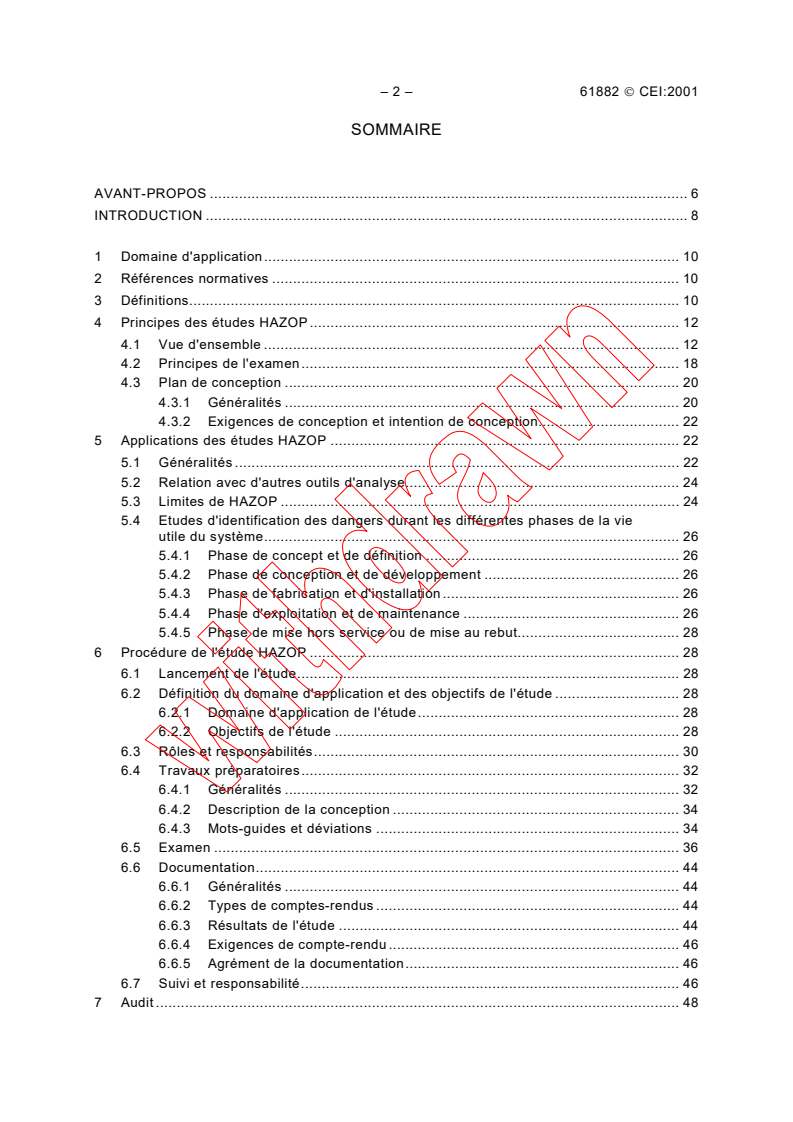
– 2 – 61882 CEI:2001
SOMMAIRE
AVANT-PROPOS . 6
INTRODUCTION .8
1 Domaine d'application. 10
2 Références normatives . 10
3 Définitions. 10
4 Principes des études HAZOP. 12
4.1 Vue d'ensemble . 12
4.2 Principes de l'examen. 18
4.3 Plan de conception . 20
4.3.1 Généralités . 20
4.3.2 Exigences de conception et intention de conception. 22
5 Applications des études HAZOP . 22
5.1 Généralités . 22
5.2 Relation avec d'autres outils d'analyse. 24
5.3 Limites de HAZOP . 24
5.4 Etudes d'identification des dangers durant les différentes phases de la vie
utile du système. 26
5.4.1 Phase de concept et de définition . 26
5.4.2 Phase de conception et de développement . 26
5.4.3 Phase de fabrication et d'installation . 26
5.4.4 Phase d'exploitation et de maintenance . 26
5.4.5 Phase de mise hors service ou de mise au rebut. 28
6 Procédure de l'étude HAZOP . 28
6.1 Lancement de l'étude. 28
6.2 Définition du domaine d'application et des objectifs de l'étude . 28
6.2.1 Domaine d'application de l'étude. 28
6.2.2 Objectifs de l'étude . 28
6.3 Rôles et responsabilités. 30
6.4 Travaux préparatoires. 32
6.4.1 Généralités . 32
6.4.2 Description de la conception . 34
6.4.3 Mots-guides et déviations . 34
6.5 Examen . 36
6.6 Documentation. 44
6.6.1 Généralités . 44
6.6.2 Types de comptes-rendus . 44
6.6.3 Résultats de l'étude . 44
6.6.4 Exigences de compte-rendu. 46
6.6.5 Agrément de la documentation. 46
6.7 Suivi et responsabilité. 46
7 Audit . 48
61882 IEC:2001 – 3 –
CONTENTS
FOREWORD . 7
INTRODUCTION .9
1 Scope . 11
2 Normative references. 11
3 Definitions. 11
4 Principles of HAZOP . 13
4.1 Overview . 13
4.2 Principles of examination . 19
4.3 Design representation. 21
4.3.1 General. 21
4.3.2 Design requirements and design intent . 23
5 Applications of HAZOP . 23
5.1 General. 23
5.2 Relation to other analysis tools . 25
5.3 HAZOP limitations . 25
5.4 Hazard identification studies during different system life cycle phases . 27
5.4.1 Concept and definition phase. 27
5.4.2 Design and development phase . 27
5.4.3 Manufacturing and installation phase . 27
5.4.4 Operation and maintenance phase. 27
5.4.5 Decommissioning or disposal phase . 29
6 The HAZOP study procedure . 29
6.1 Initiation of the study. 29
6.2 Definition of scope and objectives of the study. 29
6.2.1 Scope of the study . 29
6.2.2 Objectives of the study. 29
6.3 Roles and responsibilities . 31
6.4 Preparatory work . 33
6.4.1 General. 33
6.4.2 Design description . 35
6.4.3 Guide words and deviations . 35
6.5 The examination . 37
6.6 Documentation. 45
6.6.1 General. 45
6.6.2 Styles of recording . 45
6.6.3 Output of the study. 45
6.6.4 Reporting requirements. 47
6.6.5 Signing off the documentation. 47
6.7 Follow-up and responsibility. 47
7 Audit . 49
– 4 – 61882 CEI:2001
Annexe A (informative) Méthodes de compte-rendu. 50
A.1 Options de compte-rendu. 50
A.2 Feuille de programmation HAZOP. 50
A.3 Rapport d'étude HAZOP . 52
Annexe B (informative) Exemples d'études HAZOP . 54
B.1 Exemple introductif . 54
B.2 Procédures . 66
B.3 Système de protection automatique des trains . 74
B.3.1 Application . 74
B.4 Exemple avec planification en cas d'urgence . 80
B.5 Système de commande de vanne piézoélectrique . 90
B.6 Vaporiseur de mazout. 102
Bibliographie . 112
Tableau 1 – Principaux mots-guides avec leur signification générale. 18
Tableau 2 – Mots-guides relatifs à l’heure et à un ordre ou une séquence. 20
Tableau 3 – Exemples de déviations et mots-guides associés . 36
Tableau B.1 – Feuille de programmation HAZOP pour un exemple introductif . 58
Tableau B.2 – Exemple de feuille de programmation HAZOP pour les procédures. 68
Tableau B.3 – Exemple de feuille de programmation HAZOP pour un système de
protection automatique des trains. 76
Tableau B.4 – Exemple de feuille de programmation HAZOP pour une planification en
cas d'urgence. 82
Tableau B.5 – Exemple de feuille de programmation HAZOP pour un système de
commande de vanne piézoélectrique. 96
Tableau B.6 – Exemple de feuille de programmation HAZOP pour un vaporiseur de
mazout . 104
Figure 1 – Déroulement d'une étude HAZOP . 16
Figure 2a – Organigramme de la procédure de l'examen HAZOP – Séquence élément
d'abord. 40
Figure 2b – Organigramme de la procédure d'examen HAZOP – Séquence mot-guide
d'abord. 42
Figure B.1 – Schéma de circulation simple . 56
Figure B.2 – Equipement ATP embarqué. 74
Figure B.3 – Système de commande de vanne piézoélectrique . 92
Figure B.4 – Vaporiseur de mazout . 102
61882 IEC:2001 – 5 –
Annex A (informative) Methods of reporting. 51
A.1 Reporting options. 51
A.2 HAZOP worksheet . 51
A.3 HAZOP study report. 53
Annex B (informative) Examples of HAZOP . 55
B.1 Introductory example . 55
B.2 Procedures . 67
B.3 Automatic train protection system . 75
B.3.1 The application . 75
B.4 Example involving emergency planning. 81
B.5 Piezo valve control system. 91
B.6 Oil vaporizer . 103
Bibliography . 113
Table 1 – Basic guide words and their generic meanings. 19
Table 2 – Guide words relating to clock time and order or sequence . 21
Table 3 – Examples of deviations and their associated guide words . 37
Table B.1 – Example HAZOP worksheet for introductory example . 59
Table B.2 – Example HAZOP worksheet for procedures example . 69
Table B.3 – Example HAZOP worksheet for automatic train protection system . 77
Table B.4 – Example HAZOP worksheet for emergency planning . 83
Table B.5 – Example HAZOP worksheet for piezo valve control system . 97
Table B.6 – Example HAZOP worksheet for oil vaporizer. 105
Figure 1 – The HAZOP study procedure . 17
Figure 2a – Flow chart of the HAZOP examination procedure – Element first sequence . 41
Figure 2b – Flow chart of the HAZOP examination procedure – Guide word first
sequence . 43
Figure B.1 – Simple flow sheet . 57
Figure B.2 – Train-carried ATP equipment. 75
Figure B.3 – Piezo valve control system . 93
Figure B.4 – Oil vaporizer. 103
– 6 – 61882 CEI:2001
COMMISSION ÉLECTROTECHNIQUE INTERNATIONALE
____________
ÉTUDES DE DANGER ET D'EXPLOITABILITÉ (ÉTUDES HAZOP) –
GUIDE D’APPLICATION
AVANT-PROPOS
1) La CEI (Commission Électrotechnique Internationale) est une organisation mondiale de normalisation
composée de l'ensemble des comités électrotechniques nationaux (Comités nationaux de la CEI). La CEI a
pour objet de favoriser la coopération internationale pour toutes les questions de normalisation dans les
domaines de l'électricité et de l'électronique. A cet effet, la CEI, entre autres activités, publie des Normes
internationales. Leur élaboration est confiée à des comités d'études, aux travaux desquels tout Comité national
intéressé par le sujet traité peut participer. Les organisations internationales, gouvernementales et non
gouvernementales, en liaison avec la CEI, participent également aux travaux. La CEI collabore étroitement
avec l'Organisation Internationale de Normalisation (ISO), selon des conditions fixées par accord entre les
deux organisations.
2) Les décisions ou accords officiels de la CEI concernant les questions techniques représentent, dans la mesure
du possible, un accord international sur les sujets étudiés, étant donné que les Comités nationaux intéressés
sont représentés dans chaque comité d’études.
3) Les documents produits se présentent sous la forme de recommandations internationales. Ils sont publiés
comme normes, spécifications techniques, rapports techniques ou guides et agréés comme tels par les
Comités nationaux.
4) Dans le but d'encourager l'unification internationale, les Comités nationaux de la CEI s'engagent à appliquer de
façon transparente, dans toute la mesure possible, les Normes internationales de la CEI dans leurs normes
nationales et régionales. Toute divergence entre la norme de la CEI et la norme nationale ou régionale
correspondante doit être indiquée en termes clairs dans cette dernière.
5) La CEI n’a fixé aucune procédure concernant le marquage comme indication d’approbation et sa responsabilité
n’est pas engagée quand un matériel est déclaré conforme à l’une de ses normes.
6) L’attention est attirée sur le fait que certains des éléments de la présente Norme internationale peuvent faire
l’objet de droits de propriété intellectuelle ou de droits analogues. La CEI ne saurait être tenue pour
responsable de ne pas avoir identifié de tels droits de propriété et de ne pas avoir signalé leur existence.
La Norme internationale CEI 61882 a été établie par le comité d’études 56 de la CEI: Sûreté
de fonctionnement.
Le texte de cette norme est issu des documents suivants:
FDIS Rapport de vote
56/731/FDIS 56/733/RVD
Le rapport de vote indiqué dans le tableau ci-dessus donne toute information sur le vote ayant
abouti à l’approbation de la présente norme.
Cette publication a été rédigée selon les Directives ISO/CEI, Partie 3.
Les annexes A et B sont données uniquement à titre d’information.
Le comité a décidé que le contenu de cette publication ne sera pas modifié avant 2005. A
cette date, la publication sera
reconduite;
supprimée;
remplacée par une édition révisée, ou
amendée.
61882 IEC:2001 – 7 –
INTERNATIONAL ELECTROTECHNICAL COMMISSION
____________
HAZARD AND OPERABILITY STUDIES (HAZOP STUDIES) –
APPLICATION GUIDE
FOREWORD
1) The IEC (International Electrotechnical Commission) is a worldwide organization for standardization comprising
all national electrotechnical committees (IEC National Committees). The object of the IEC is to promote
international co-operation on all questions concerning standardization in the electrical and electronic fields. To
this end and in addition to other activities, the IEC publishes International Standards. Their preparation is
entrusted to technical committees; any IEC National Committee interested in the subject dealt with may
participate in this preparatory work. International, governmental and non-governmental organizations liaising
with the IEC also participate in this preparation. The IEC collaborates closely with the International
Organization for Standardization (ISO) in accordance with conditions determined by agreement between the
two organizations.
2) The formal decisions or agreements of the IEC on technical matters express, as nearly as possible, an
international consensus of opinion on the relevant subjects since each technical committee has representation
from all interested National Committees.
3) The documents produced have the form of recommendations for international use and are published in the form
of standards, technical specifications, technical reports or guides and they are accepted by the National
Committees in that sense.
4) In order to promote international unification, IEC National Committees undertake to apply IEC International
Standards transparently to the maximum extent possible in their national and regional standards. Any
divergence between the IEC Standard and the corresponding national or regional standard shall be clearly
indicated in the latter.
5) The IEC provides no marking procedure to indicate its approval and cannot be rendered responsible for any
equipment declared to be in conformity with one of its standards.
6) Attention is drawn to the possibility that some of the elements of this International Standard may be the subject
of patent rights. The IEC shall not be held responsible for identifying any or all such patent rights.
International Standard IEC 61882 has been prepared by IEC technical committee 56:
Dependability.
The text of this standard is based on the following documents:
FDIS Report on voting
56/731/FDIS 56/733/RVD
Full information on the voting for the approval of this standard can be found in the report on
voting indicated in the above table.
This publication has been drafted in accordance with the ISO/IEC Directives, Part 3.
Annexes A and B are for information only.
The committee has decided that the contents of this publication will remain unchanged until
2005. At this date, the publication will be
reconfirmed;
withdrawn;
replaced by a revised edition, or
amended.
– 8 – 61882 CEI:2001
INTRODUCTION
L'objet de la présente norme est de décrire les principes et procédures des études sur
l'identification des dangers et l'exploitabilité (études HAZOP). HAZOP est une technique
structurée et systématique appliquée à l'examen d'un système défini en vue de:
• l'identification des dangers potentiels dans le système. Le danger peut se limiter à la
proximité immédiate du système ou étendre ses effets bien au-delà, comme dans le cas
des dangers environnementaux;
• l’identification des problèmes potentiels d'exploitabilité posés par le système et, en
particulier, l’identification des causes des perturbations du fonctionnement et des
déviations dans la production susceptibles d'entraîner la fabrication de produits non
conformes.
Un avantage important des études HAZOP est que la connaissance qu'elles apportent en
identifiant de manière structurée et systématique les dangers potentiels et les problèmes
d'exploitabilité s’avère d'une grande utilité pour déterminer les mesures à prendre.
Une des caractéristiques d'une étude HAZOP est la «session d'examen» durant laquelle une
équipe multidisciplinaire dirigée par un chef d'étude examine systématiquement toutes les
parties d'une conception ou d'un système concernées par l’étude. Elle identifie les déviations
par rapport à l'intention de conception du système, en utilisant un ensemble de «mots-
guides». La technique vise à stimuler de manière systématique l'imagination des participants
pour les aider à identifier les dangers et les problèmes d'exploitabilité. Il y a lieu de
considérer HAZOP comme une amélioration d'une conception juste, utilisant des approches
basées sur l'expérience, telles que les règles de l'art, plutôt qu'un succédané de ces
approches.
Il existe de nombreux outils et techniques pour l'identification des dangers potentiels et des
problèmes d'exploitabilité, allant des listes de contrôle (checklists) à HAZOP en passant par
l'analyse des modes de défaillance et de leurs effets (AMDE), ou l'analyse par arbre de panne
(AAP). Certaines techniques, telles que les listes de contrôle et l'analyse par simulation
(What-If), peuvent être utilisées dès le début du cycle de vie du système alors qu'il existe peu
d'informations, ou lors d'une phase ultérieure si une analyse moins détaillée est nécessaire.
Les études HAZOP demandent plus de détails sur le système considéré, mais fournissent des
informations plus complètes sur les dangers et les erreurs dans la conception du système.
Le terme HAZOP a souvent été associé, dans un sens plus large, à d'autres techniques
d'identification des dangers (par exemple HAZOP sur checklist, HAZOP 1 ou 2, HAZOP basé
sur les connaissances, etc.). L'utilisation du terme HAZOP en relation avec ces techniques
est considérée comme inappropriée et elle est volontairement exclue de ce document.
Avant de commencer une étude HAZOP, il convient de s’assurer qu'il s'agit de la technique la
plus appropriée (autant individuellement qu'en combinaison avec d'autres techniques) pour la
présente tâche. Cette appréciation tient compte de l'objet de l'étude, de la sévérité de toutes
les conséquences possibles, du niveau approprié de détail, de la disponibilité des données et
des ressources pertinentes.
La présente norme a été mise au point pour donner les lignes directrices dans un grand
nombre d'industries et types de systèmes. Dans certaines industries, notamment les
industries de transformation où cette technique a vu le jour, il existe des normes et des
guides plus spécifiques qui établissent des méthodes d'application particulièrement adaptées
à ces industries. Pour plus de détails, voir la bibliographie donnée en annexe.
61882 IEC:2001 – 9 –
INTRODUCTION
The purpose of this standard is to describe the principles and procedures of Hazard and
Operability (HAZOP) Studies. HAZOP is a structured and systematic technique for examining
a defined system, with the objective of:
• identifying potential hazards in the system. The hazards involved may include both those
essentially relevant only to the immediate area of the system and those with a much wider
sphere of influence, e.g. some environmental hazards;
• identifying potential operability problems with the system and in particular identifying
causes of operational disturbances and production deviations likely to lead to non-
conforming products.
An important benefit of HAZOP studies is that the resulting knowledge, obtained by identifying
potential hazards and operability problems in a structured and systematic manner, is of great
assistance in determining appropriate remedial measures.
A characteristic feature of a HAZOP study is the ”examination session” during which a multi-
disciplinary team under the guidance of a study leader systematically examines all relevant
parts of a design or system. It identifies deviations from the system design intent utilizing a
core set of guide words. The technique aims to stimulate the imagination of participants in a
systematic way to identify hazards and operability problems. HAZOP should be seen as an
enhancement to sound design using experience-based approaches such as codes of practice
rather than a substitute for such approaches.
There are many different tools and techniques available for the identification of potential
hazards and operability problems, ranging from Checklists, Fault Modes and Effects Analysis
(FMEA), Fault Tree Analysis (FTA) to HAZOP. Some techniques, such as Checklists and
What-If/analysis, can be used early in the system life cycle when little information is available,
or in later phases if a less detailed analysis is needed. HAZOP studies require more details
regarding the systems under consideration, but produce more comprehensive information on
hazards and errors in the system design.
The term HAZOP has been often associated, in a generic sense, with some other hazard
identification techniques (e.g. checklist HAZOP, HAZOP 1 or 2, knowledge-based HAZOP).
The use of the term with such techniques is considered to be inappropriate and is specifically
excluded from this document.
Before commencing a HAZOP study, it should be confirmed that it is the most appropriate
technique (either individually or in combination with other techniques) for the task in hand. In
making this judgement, consideration should be given to the purpose of the study, the
possible severity of any consequences, the appropriate level of detail, the availability of
relevant data and resources.
This standard has been developed to provide guidance across many industries and types of
system. There are more specific standards and guides within some industries, notably the
process industries where the technique originated, which establish preferred methods of
application for these industries. For details see the bibliography at the end of this text.
– 10 – 61882 CEI:2001
ÉTUDES DE DANGER ET D'EXPLOITABILITÉ (ÉTUDES HAZOP) –
GUIDE D’APPLICATION
1 Domaine d'application
La présente Norme internationale est un guide d’application des études HAZOP aux
systèmes. Elle utilise l'ensemble spécifique de mots-guides définis dans ce document. Elle
donne également des indications sur l'application de la technique et sur la procédure de
l'étude HAZOP, y compris la définition, la préparation, les sessions d'examen ainsi que les
documents et le suivi qui en résultent.
Elle fournit également la documentation ainsi qu'un grand choix d'exemples couvrant diverses
industries, illustrant la procédure d'un examen HAZOP.
2 Références normatives
Les documents normatifs suivants contiennent des dispositions qui, par suite de la référence
qui y est faite, constituent des dispositions valables pour la présente Norme internationale.
Pour les références datées, les amendements ultérieurs ou les révisions de ces publications
ne s’appliquent pas. Toutefois, les parties prenantes aux accords fondés sur la présente
Norme internationale sont invitées à rechercher la possibilité d'appliquer les éditions les plus
récentes des documents normatifs indiqués ci-après. Pour les références non datées, la
dernière édition du document normatif en référence s’applique. Les membres de la CEI et de
l'ISO possèdent le registre des Normes internationales en vigueur.
CEI 60300-3-9, Gestion de la sûreté de fonctionnement – Partie 3: Guide d’application –
Section 9: Analyse du risque des systèmes technologiques
CEI 60812, Techniques d’analyse de la fiabilité des systèmes – Procédure d’analyse des
modes de défaillance et de leurs effets (AMDE)
CEI 61025, Analyse par arbre de panne (AAP)
CEI 61160, Revue de conception formalisée
3 Définitions
Pour les besoins de la présente Norme internationale, les termes définis dans la
CEI 60050(191), ainsi que les définitions suivantes, s’appliquent.
3.1
caractéristique
propriété qualitative ou quantitative d'un élément
NOTE Par exemple pression, température, tension.
3.2
intention de conception
façon dont les éléments et les caractéristiques doivent se comporter pour être conformes aux
désirs du concepteur ou à une plage spécifiée
61882 IEC:2001 – 11 –
HAZARD AND OPERABILITY STUDIES (HAZOP STUDIES) –
APPLICATION GUIDE
1 Scope
This International Standard provides a guide for HAZOP studies of systems utilizing the
specific set of guide words defined in this document. It also gives guidance on application of
the technique and on the HAZOP study procedure, including definition, preparation,
examination sessions and resulting documentation and follow-up.
Documentation, as well as a broad set of examples encompassing various industries,
illustrating HAZOP examination is also provided.
2 Normative references
The following normative documents contain provisions which, through reference in this text,
constitute provisions of this International Standard. For dated references, subsequent
amendments to, or revisions of, any of these publications do not apply. However, parties to
agreements based on this International Standard are encouraged to investigate the possibility
of applying the most recent editions of the normative documents indicated below. For undated
references, the latest edition of the normative document referred to applies. Members of IEC
and ISO maintain registers of currently valid International Standards.
IEC 60300-3-9, Dependability management – Part 3: Application guide – Section 9: Risk
analysis of technological systems
IEC 60812, Analysis techniques for system reliability – Procedure for failure mode and effects
analysis (FMEA)
IEC 61025, Fault tree analysis (FTA)
IEC 61160, Formal design review
3 Definitions
For the purposes of this International Standard, definitions contained in IEC 60050(191) as
well as the following terms and definitions apply:
3.1
characteristic
qualitative or quantitative property of an element
NOTE Examples of characteristics are pressure, temperature, voltage.
3.2
design intent
designer’s desired, or specified range of behaviour for elements and characteristics
– 12 – 61882 CEI:2001
3.3
déviation
écart par rapport à l’intention de conception
3.4
élément
composant d'une partie servant à identifier les caractéristiques essentielles de la partie
NOTE Le choix des éléments peut dépendre de l'application particulière, mais les éléments peuvent inclure des
caractéristiques telles que le matériel concerné, l'activité exécutée, l'équipement utilisé, etc. Le matériel est
généralement considéré dans le sens large et comprend les données, le logiciel, etc.
3.5
mot-guide
mot ou phrase qui exprime et définit un type particulier de déviation par rapport à l'intention
de conception d'un élément
3.6
dommage
blessure physique et/ou atteinte à la santé, à la propriété ou à l'environnement
3.7
danger
source potentielle de dommage
3.8
partie
section du système faisant l'objet de l'étude actuelle
NOTE Une partie peut être physique (par exemple matériel) ou logique (par exemple étape d'une séquence de
fonctionnement).
3.9
risque
combinaison de la probabilité d'occurrence d'un dommage et de la sévérité de ce dommage
4 Principes des études HAZOP
4.1 Vue d'ensemble
Une étude HAZOP est un processus d'identification détaillée des dangers et des problèmes
d'exploitabilité, exécuté par une équipe. HAZOP s'attache à l'identification des déviations
potentielles par rapport à l'intention de conception, à l'examen de leurs causes possibles et à
l'évaluation de leurs conséquences.
Les principales caractéristiques d'un examen HAZOP sont, entre autres, celles indiquées ci-
dessous.
• L'examen est un processus créatif. Il consiste à utiliser systématiquement une série de
mots-guides pour identifier des déviations potentielles par rapport à l'intention de
conception et à employer ces déviations comme «déclencheurs» stimulant l'imagination
des membres de l'équipe dans la recherche du pourquoi de la déviation et dans
l’évaluation des conséquences qu'elle peut engendrer.
• L'examen se déroule sous la direction d'un chef d'étude qualifié et expérimenté qui doit
veiller à l’examen exhaustif du système étudié, s'appuyant sur une pensée logique et
analytique. Le chef d'étude est assisté de préférence par un rapporteur qui consigne les
dangers et/ou les perturbations en exploitation identifiées en vue de leur évaluation et de
la recherche d'une solution.
61882 IEC:2001 – 13 –
3.3
deviation
departure from the design intent
3.4
element
constituent of a part which serves to identify the part’s essential features
NOTE The choice of elements may depend upon the particular application, but elements can include features
such as the material involved, the activity being carried out, the equipment employed, etc. Material should be
considered in a general sense and includes data, software, etc.
3.5
guide word
word or phrase which expresses and defines a specific type of deviation from an element’s
design intent
3.6
harm
physical injury or damage to the health of people or damage to property or the environment
3.7
hazard
potential source of harm
3.8
part
section of the system which is the subject of immediate study
NOTE A part may be physical (e.g. hardware) or logical (e.g. step in an operational sequence).
3.9
risk
combination of the probability of occurrence of harm and the severity of that harm
4 Principles of HAZOP
4.1 Overview
A HAZOP study is a detailed hazard and operability problem identification process, carried out
by a team. HAZOP deals with the identification of potential deviations from the design intent,
examination of their possible causes and assessment of their consequences.
Key features of HAZOP examination include the following.
• The examination is a creative process. The examination proceeds by systematically using
a series of guide words to identify potential deviations from the design intent and
employing these deviations as “triggering devices” to stimulate team members to envisage
how the deviation might occur and what might be the consequences.
• The examination is carried out under the guidance of a trained and experienced study
leader, who has to ensure comprehensive coverage of the system under study, using
logical, analytical thinking. The study leader is preferably assisted by a recorder who
records identified hazards and/or operational disturbances for further evaluation and
resolution.
– 14 – 61882 CEI:2001
• La qualité de l'examen repose sur les qualifications et l'expérience de spécialistes de
diverses disciplines, faisant preuve d'intuition et de perspicacité.
• Il convient d'effectuer l'examen dans un climat de pensée positive et de franche
discussion. Lorsqu'un problème est identifié, il est consigné pour être ultérieurement
évalué et résolu.
• Les solutions aux problèmes identifiés ne constituent pas le principal objectif de l'examen
HAZOP, mais elles peuvent, le cas échéant, être consignées pour être soumises aux
responsables de la conception.
Les études HAZOP comprennent essentiellement quatre étap
...