

IEC 62359:2005
(Main)Ultrasonics - Field characterization - Test methods for the determination of thermal and mechanical indices related to medical diagnostic ultrasonic fields
General Information
- Abstract
This standard establishes - parameters related to thermal and non-thermal aspects of diagnostic ultrasonic fields; - methods for the determination of an exposure parameter relating to temperature rise in theoretical tissue-equivalent models, resulting from absorption of ultrasound; - methods for the determination of an exposure parameter appropriate to certain non-thermal effects.
- Status
- Published
- Publication Date
- 12-Apr-2005
- Technical Committee
- TC 87 - Ultrasonics
- Drafting Committee
- WG 8 - TC 87/WG 8
- Current Stage
- DELPUB - Deleted Publication
- Start Date
- 27-Oct-2010
- Completion Date
- 28-Aug-2026
Buy Documents
IEC 62359:2005 - Ultrasonics - Field characterization - Test methods for the determination of thermal and mechanical indices related to medical diagnostic ultrasonic fields Released:4/13/2005
IEC 62359:2005 - Ultrasonics - Field characterization - Test methods for the determination of thermal and mechanical indices related to medical diagnostic ultrasonic fields Released:4/13/2005
Overview
IEC 62359:2005 - "Ultrasonics - Field characterization - Test methods for the determination of thermal and mechanical indices related to medical diagnostic ultrasonic fields" - specifies standardized methods to characterize medical diagnostic ultrasound fields in terms of thermal and non‑thermal (mechanical) exposure indices. Published by IEC (first edition 2005), the standard defines exposure parameters (Thermal Index, TI, and Mechanical Index, MI), measurement quantities and attenuation corrections needed to estimate temperature rise and certain non‑thermal effects in tissue‑equivalent models.
Key topics and technical requirements
- Exposure indices: Procedures to determine the Thermal Index (TI) and Mechanical Index (MI) used to assess potential heating and mechanical bioeffects in diagnostic ultrasound.
- Measurement methods: Test methods for non‑scanning and scanning modes, including requirements for spatial‑peak and pulse‑average intensities, pulse‑intensity integrals, and attenuated values accounting for acoustic attenuation (α), distance (z) and working frequency (f).
- Attenuation correction: Definitions and formulae for attenuated output power, attenuated peak‑rarefactional pressure, and attenuated pulse‑average intensity to translate water‑tank measurements into tissue‑equivalent values.
- TI variants: Specific models such as the bone thermal index (TIB) for scenarios where a focus is near bone (e.g., fetal/neonatal cranial exams).
- Scanning vs non‑scanning: Separate determination methods for scanning (imaging) and non‑scanning (continuous or pulsed single‑beam) operating modes, and procedures for combined‑mode calculations.
- Required quantities: Lists of measured acoustic quantities (beam area, spatial‑peak temporal‑average intensity, pulse intensity integral, etc.) needed to compute indices.
- Guidance annexes: Informative annexes provide relationships with other standards, measurement guidance for scanning mode power, rationale for index models, and interpretation notes for TI and MI.
Practical applications & users
IEC 62359 is intended for:
- Ultrasound manufacturers - to characterize device output and implement compliant TI/MI displays.
- Test laboratories and calibration facilities - to perform standardized hydrophone and power measurements and convert water‑tank data to tissue estimates.
- Regulatory and conformity bodies - to assess compliance with safety requirements (supporting IEC 60601‑2‑37).
- Clinical engineers and medical physicists - to interpret acoustic output data and inform risk assessments for diagnostic procedures.
Use cases include device development, pre‑market testing, routine output verification, and safety labelling of diagnostic ultrasound equipment.
Related standards
- IEC 60601‑2‑37 - Safety requirements for ultrasonic medical diagnostic and monitoring equipment (TI/MI display requirements).
- IEC 61102 - Hydrophone measurement and field characterisation (0.5–15 MHz).
- IEC 61157 - Requirements for acoustic output declaration.
- IEC 61161 - Ultrasonic power measurement in liquids.
Keywords: IEC 62359, thermal index, mechanical index, ultrasound field characterization, medical diagnostic ultrasound, ultrasonic safety, TI MI determination, acoustic attenuation, hydrophone measurement.
Relations
- Effective Date
- 05-Sep-2023
Buy Documents
IEC 62359:2005 - Ultrasonics - Field characterization - Test methods for the determination of thermal and mechanical indices related to medical diagnostic ultrasonic fields Released:4/13/2005
IEC 62359:2005 - Ultrasonics - Field characterization - Test methods for the determination of thermal and mechanical indices related to medical diagnostic ultrasonic fields Released:4/13/2005
Get Certified
Connect with accredited certification bodies for this standard

BSMI (Bureau of Standards, Metrology and Inspection)
Taiwan's standards and inspection authority.
Sponsored listings
Frequently Asked Questions
IEC 62359:2005 is a standard published by the International Electrotechnical Commission (IEC). Its full title is "Ultrasonics - Field characterization - Test methods for the determination of thermal and mechanical indices related to medical diagnostic ultrasonic fields". This standard covers: This standard establishes - parameters related to thermal and non-thermal aspects of diagnostic ultrasonic fields; - methods for the determination of an exposure parameter relating to temperature rise in theoretical tissue-equivalent models, resulting from absorption of ultrasound; - methods for the determination of an exposure parameter appropriate to certain non-thermal effects.
This standard establishes - parameters related to thermal and non-thermal aspects of diagnostic ultrasonic fields; - methods for the determination of an exposure parameter relating to temperature rise in theoretical tissue-equivalent models, resulting from absorption of ultrasound; - methods for the determination of an exposure parameter appropriate to certain non-thermal effects.
IEC 62359:2005 is classified under the following ICS (International Classification for Standards) categories: 17.140.50 - Electroacoustics. The ICS classification helps identify the subject area and facilitates finding related standards.
IEC 62359:2005 has the following relationships with other standards: It is inter standard links to IEC 62359:2010. Understanding these relationships helps ensure you are using the most current and applicable version of the standard.
IEC 62359:2005 is available in PDF format for immediate download after purchase. The document can be added to your cart and obtained through the secure checkout process. Digital delivery ensures instant access to the complete standard document.
Standards Content (Sample)
INTERNATIONAL IEC
STANDARD 62359
First edition
2005-04
Ultrasonics –
Field characterization –
Test methods for the determination of
thermal and mechanical indices related
to medical diagnostic ultrasonic fields
Reference number
Publication numbering
As from 1 January 1997 all IEC publications are issued with a designation in the
60000 series. For example, IEC 34-1 is now referred to as IEC 60034-1.
Consolidated editions
The IEC is now publishing consolidated versions of its publications. For example,
edition numbers 1.0, 1.1 and 1.2 refer, respectively, to the base publication, the
base publication incorporating amendment 1 and the base publication incorporating
amendments 1 and 2.
Further information on IEC publications
The technical content of IEC publications is kept under constant review by the IEC,
thus ensuring that the content reflects current technology. Information relating to
this publication, including its validity, is available in the IEC Catalogue of
publications (see below) in addition to new editions, amendments and corrigenda.
Information on the subjects under consideration and work in progress undertaken
by the technical committee which has prepared this publication, as well as the list
of publications issued, is also available from the following:
• IEC Web Site (www.iec.ch)
• Catalogue of IEC publications
The on-line catalogue on the IEC web site (www.iec.ch/searchpub) enables you to
search by a variety of criteria including text searches, technical committees
and date of publication. On-line information is also available on recently issued
publications, withdrawn and replaced publications, as well as corrigenda.
• IEC Just Published
This summary of recently issued publications (www.iec.ch/online_news/ justpub)
is also available by email. Please contact the Customer Service Centre (see
below) for further information.
• Customer Service Centre
If you have any questions regarding this publication or need further assistance,
please contact the Customer Service Centre:
Email: custserv@iec.ch
Tel: +41 22 919 02 11
Fax: +41 22 919 03 00
INTERNATIONAL IEC
STANDARD 62359
First edition
2005-04
Ultrasonics –
Field characterization –
Test methods for the determination of
thermal and mechanical indices related
to medical diagnostic ultrasonic fields
IEC 2005 Copyright - all rights reserved
No part of this publication may be reproduced or utilized in any form or by any means, electronic or
mechanical, including photocopying and microfilm, without permission in writing from the publisher.
International Electrotechnical Commission, 3, rue de Varembé, PO Box 131, CH-1211 Geneva 20, Switzerland
Telephone: +41 22 919 02 11 Telefax: +41 22 919 03 00 E-mail: inmail@iec.ch Web: www.iec.ch
PRICE CODE
Commission Electrotechnique Internationale X
International Electrotechnical Commission
МеждународнаяЭлектротехническаяКомиссия
For price, see current catalogue
– 2 – 62359 IEC:2005(E)
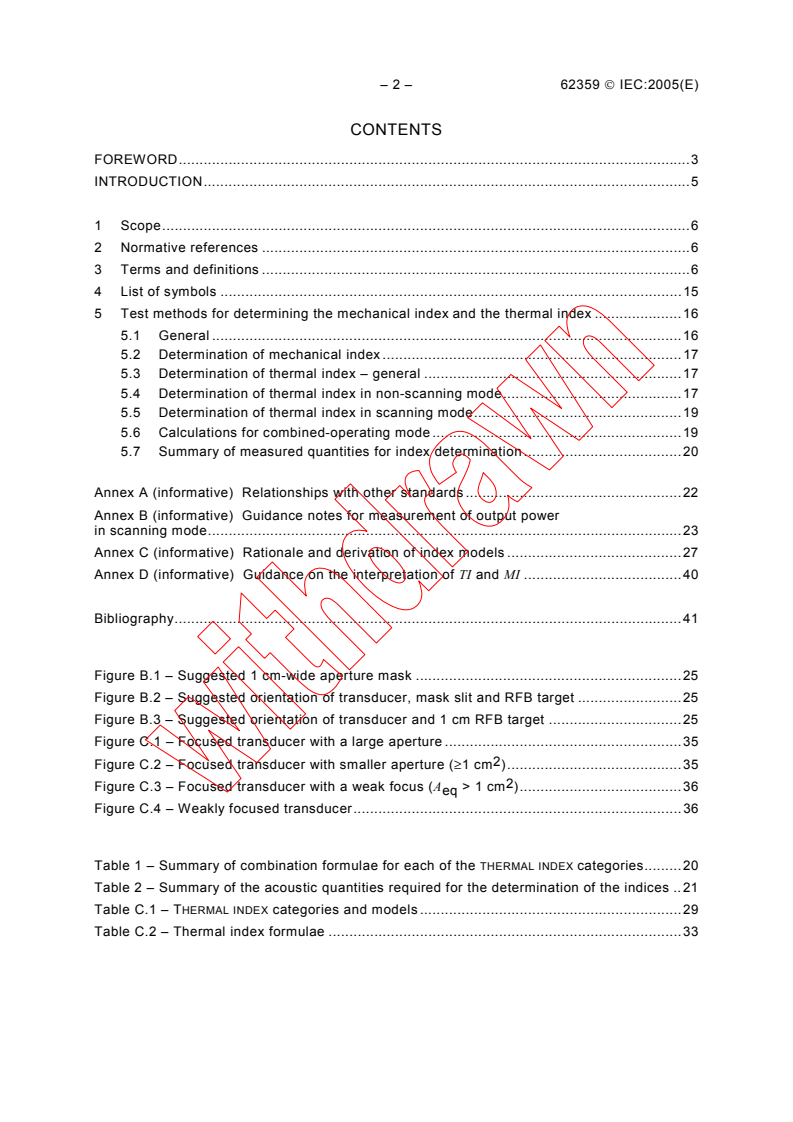
CONTENTS
FOREWORD.3
INTRODUCTION.5
1 Scope.6
2 Normative references .6
3 Terms and definitions .6
4 List of symbols .15
5 Test methods for determining the mechanical index and the thermal index .16
5.1 General .16
5.2 Determination of mechanical index .17
5.3 Determination of thermal index – general .17
5.4 Determination of thermal index in non-scanning mode.17
5.5 Determination of thermal index in scanning mode.19
5.6 Calculations for combined-operating mode .19
5.7 Summary of measured quantities for index determination .20
Annex A (informative) Relationships with other standards .22
Annex B (informative) Guidance notes for measurement of output power
in scanning mode.23
Annex C (informative) Rationale and derivation of index models .27
Annex D (informative) Guidance on the interpretation of TI and MI .40
Bibliography.41
Figure B.1 – Suggested 1 cm-wide aperture mask .25
Figure B.2 – Suggested orientation of transducer, mask slit and RFB target .25
Figure B.3 – Suggested orientation of transducer and 1 cm RFB target .25
Figure C.1 – Focused transducer with a large aperture .35
Figure C.2 – Focused transducer with smaller aperture (≥1 cm ).35
Figure C.3 – Focused transducer with a weak focus (A > 1 cm ).36
eq
Figure C.4 – Weakly focused transducer.36
Table 1 – Summary of combination formulae for each of the THERMAL INDEX categories.20
Table 2 – Summary of the acoustic quantities required for the determination of the indices .21
Table C.1 – THERMAL INDEX categories and models .29
Table C.2 – Thermal index formulae .33
62359 IEC:2005(E) – 3 –
INTERNATIONAL ELECTROTECHNICAL COMMISSION
____________
ULTRASONICS –
FIELD CHARACTERIZATION –
TEST METHODS FOR THE DETERMINATION OF THERMAL
AND MECHANICAL INDICES RELATED TO
MEDICAL DIAGNOSTIC ULTRASONIC FIELDS
FOREWORD
1) The International Electrotechnical Commission (IEC) is a worldwide organization for standardization comprising
all national electrotechnical committees (IEC National Committees). The object of IEC is to promote
international co-operation on all questions concerning standardization in the electrical and electronic fields. To
this end and in addition to other activities, IEC publishes International Standards, Technical Specifications,
Technical Reports, Publicly Available Specifications (PAS) and Guides (hereafter referred to as “IEC
Publication(s)”). Their preparation is entrusted to technical committees; any IEC National Committee interested
in the subject dealt with may participate in this preparatory work. International, governmental and non-
governmental organizations liaising with the IEC also participate in this preparation. IEC collaborates closely
with the International Organization for Standardization (ISO) in accordance with conditions determined by
agreement between the two organizations.
2) The formal decisions or agreements of IEC on technical matters express, as nearly as possible, an international
consensus of opinion on the relevant subjects since each technical committee has representation from all
interested IEC National Committees.
3) IEC Publications have the form of requirements for international use and are accepted by IEC National
Committees in that sense. While all reasonable efforts are made to ensure that the technical content of IEC
Publications is accurate, IEC cannot be held responsible for the way in which they are used or for any
misinterpretation by any end user.
4) In order to promote international uniformity, IEC National Committees undertake to apply IEC Publications
transparently to the maximum extent possible in their national and regional publications. Any divergence
between any IEC Publication and the corresponding national or regional publication shall be clearly indicated in
the latter.
5) IEC provides no marking procedure to indicate its approval and cannot be rendered responsible for any
equipment declared to be in conformity with an IEC Publication.
6) All users should ensure that they have the latest edition of this publication.
7) No liability shall attach to IEC or its directors, employees, servants or agents including individual experts and
members of its technical committees and IEC National Committees for any personal injury, property damage or
other damage of any nature whatsoever, whether direct or indirect, or for costs (including legal fees) and
expenses arising out of the publication, use of, or reliance upon, this IEC Publication or any other IEC
Publications.
8) Attention is drawn to the Normative references cited in this publication. Use of the referenced publications is
indispensable for the correct application of this publication.
9) Attention is drawn to the possibility that some of the elements of this IEC Publication may be the subject of
patent rights. IEC shall not be held responsible for identifying any or all such patent rights.
International Standard IEC 62359 has been prepared by IEC technical committee 87:
Ultrasonics
The text of this standard is based on the following documents:
FDIS Report on voting
87/300/FDIS 87/305/RVD
Full information on the voting for the approval of this standard can be found in the report on
voting indicated in the above table.
This publication has been drafted in accordance with the ISO/IEC Directives, Part 2.
This standard may be used to support the requirements of IEC 60601-2-37.
– 4 – 62359 IEC:2005(E)
The committee has decided that the contents of this publication will remain unchanged until
the maintenance result date indicated on the IEC web site under "http://webstore.iec.ch" in
the data related to the specific publication. At this date, the publication will be
• reconfirmed;
• withdrawn;
• replaced by a revised edition, or
• amended.
A bilingual version of this standard may be issued at a later date.
62359 IEC:2005(E) – 5 –
INTRODUCTION
Medical diagnostic ultrasonic equipment is widely used in clinical practice for imaging and
monitoring purposes. Equipment normally operates at frequencies in the low megahertz
frequency range and comprises an ultrasonic transducer acoustically coupled to the patient
and associated electronics. There is an extremely wide range of different types of systems in
current clinical practice.
The ultrasound entering the patient interacts with the patient's tissue and this interaction can
be considered in terms of both thermal and non-thermal effects. The purpose of this
International Standard is to specify methods of determining thermal and non-thermal exposure
indices which can be used to help in assessing the hazard caused by exposure to a particular
ultrasonic field used for medical diagnosis or monitoring. It is recognised that these indices
have limitations and a knowledge of the indices at the time of an examination is not sufficient
in itself to make an informed clinical risk assessment. It is intended that these limitations will
be addressed in future revisions of this standard and as scientific understanding increases.
Under certain conditions specified in IEC 60601-2-37 these indices are displayed on medical
ultrasonic equipment intended for these purposes.
– 6 – 62359 IEC:2005(E)
ULTRASONICS –
FIELD CHARACTERIZATION –
TEST METHODS FOR THE DETERMINATION OF THERMAL
AND MECHANICAL INDICES RELATED TO
MEDICAL DIAGNOSTIC ULTRASONIC FIELDS
1 Scope
This International Standard is applicable to medical diagnostic ultrasound fields.
This standard establishes
– parameters related to thermal and non-thermal aspects of diagnostic ultrasonic fields;
– methods for the determination of an exposure parameter relating to temperature rise in
theoretical tissue-equivalent models, resulting from absorption of ultrasound;
– methods for the determination of an exposure parameter appropriate to certain non-
thermal effects.
NOTE In this standard where multiples or submultiples of SI units are used this is clearly stated and the usage is
self-consistent.
2 Normative references
The following referenced documents are indispensable for the application of this document.
For dated references, only the edition cited applies. For undated references, the latest edition
of the referenced document (including any amendments) applies.
IEC 60601-2-37, Medical electrical equipment – Part 2-37: Particular requirements for the
safety of ultrasonic medical diagnostic and monitoring equipment
IEC 61102:1991, Measurement and characterisation of ultrasonic fields using hydrophones in
the frequency range 0,5 MHz to 15 MHz
IEC 61157:1992, Requirements for the declaration of the acoustic output of medical
diagnostic ultrasonic equipment
IEC 61161:1992, Ultrasonic power measurement in liquids in the frequency range 0,5 MHz to
1)
25 MHz
Amendment 1 (1998)
3 Terms and definitions
For the purposes of this International standard, the terms and definitions given in
IEC 61102:1991, IEC 61157:1992 and IEC 61161:1998 (several of which are repeated below
for convenience) and the following apply.
3.1
acoustic attenuation coefficient
coefficient intended to account for ultrasonic attenuation of tissue between the source and a
specified point
Symbol: α
–1 –1
Unit: decibels per centimetre per megahertz, dB cm MHz
———————
1)
A consolidated edition (1.1) exists, including IEC 61161:1992 and its Amendment 1 (1998).
62359 IEC:2005(E) – 7 –
3.2
acoustic working frequency
arithmetic mean of the most widely separated frequencies f and f at which the amplitude of
1 2
the pressure spectrum of the acoustic signal is 3 dB lower than the peak amplitude
[3.4.2 of IEC 61102:1991, modified]
Symbol: f
awf
Unit: megahertz, MHz
3.3
attenuated output power
value of the acoustic output power after attenuation and at a specified distance from the
transducer, and given by
(-α z f /10 dB)
awf
P = P 10
α
where
α is the acoustic attenuation coefficient;
z is the distance from the source to the point of interest;
f is the acoustic working frequency;
awf
P is the output power measured in water.
Symbol: P
α
Unit: milliwatts, mW
3.4
attenuated peak-rarefactional acoustic pressure
value of the peak-rarefactional acoustic pressure after attenuation and at a specified point,
and given by
(-α z f /20 dB)
awf
p (z) = p (z) 10
r,α r
where
α is the acoustic attenuation coefficient;
z is the distance from the source to the point of interest;
f is the acoustic working frequency;
awf
p (z) is the peak-rarefactional acoustic pressure measured in water.
r
Symbol: p
r,α
Unit: megapascals, MPa
3.5
attenuated pulse-average intensity
value of the acoustic pulse-average intensity after attenuation and at a specified point, and
given by
(-α z f /10 dB)
awf
I = I (z) 10
pa,α pa
– 8 – 62359 IEC:2005(E)
where
α is the acoustic attenuation coefficient;
z is the distance from the source to the point of interest;
f is the acoustic working frequency;
awf
I (z) is the pulse-average intensity measured in water.
pa
Symbol: I
pa,α
–2
Unit: watts per centimetre squared, W cm
3.6
attenuated pulse-intensity integral
value of the pulse-intensity integral after attenuation and at a specified point, and given by
(-α z f /10 dB)
awf
I = I 10
pi,α pi
where
α is the acoustic attenuation coefficient;
z is the distance from the source to the point of interest;
f is the acoustic working frequency;
awf
I is the pulse-intensity integral measured in water.
pi
Symbol: I
pi,α
–2
Unit: millijoules per centimetre squared, mJ cm
3.7
attenuated spatial-peak temporal-average intensity
value of the spatial-peak temporal-average intensity after attenuation and at a specified
distance z, and given by
(-α z f /10 dB)
awf
I (z) = I (z) 10
zpta,α zpta
where
α is the acoustic attenuation coefficient;
z is the distance from the source to the point of interest;
f is the acoustic working frequency;
awf
I (z) is the spatial-peak temporal-average intensity, at a specified distance z measured in
zpta
water.
Symbol: I (z)
zpta,α
–2
Unit: milliwatts per centimetre squared, mW cm
3.8
attenuated temporal-average intensity
value of the temporal-average intensity after attenuation and at a specified point, and given by
(-α z f /10 dB)
awf
I (z) = I (z) 10
ta,α ta
where
α is the acoustic attenuation coefficient;
z is the distance from the source to the point of interest;
62359 IEC:2005(E) – 9 –
f is the acoustic working frequency;
awf
I (z) is the temporal-average intensity measured in water.
ta
Symbol: I (z)
ta,α
–2
Unit: milliwatts per centimetre squared, mW cm
3.9
beam area
area in a specified plane perpendicular to the beam-alignment axis consisting of all points at
which the pulse-intensity integral is greater than a specified fraction of the maximum pulse-
intensity integral in that plane
[3.6 of IEC 61102:1991, modified]
NOTE For measurement purposes the pulse intensity integral can be taken as being proportional to the pulse
pressure-squared integral
3.10
beam alignment axis
straight line joining the points of maximum pulse intensity integral measured at several
different distances in the far field. For the purposes of alignment, this line may be projected to
the face of the ultrasonic transducer
[3.5 of IEC 61102:1991, modified]
3.11
bone thermal index
thermal index for applications, such as foetal (second and third trimester) or neonatal
cephalic (through the fontanelle), in which the ultrasound beam passes through soft tissue
and a focal region is in the immediate vicinity of bone
Symbol: TIB
Unit: None
NOTE See 5.4.2 and 5.5.2 for methods of determining the bone thermal index.
3.12
bounded output power
output power emitted in scanning mode from a region of the active area of the transducer
whose width in the scan plane is limited to 1 cm
Symbol: P
Unit: milliwatts, mW
3.13
break-point depth
value equal to 1,5 times the equivalent aperture diameter, and given by
z = 1,5 D
bp eq
where
D is the equivalent aperture diameter.
eq
Symbol: z
bp
Unit: centimetres, cm
– 10 – 62359 IEC:2005(E)
3.14
combined-operating mode
mode of operation of an equipment which combines more than one discrete-operating mode
[3.6 of IEC 61157:1992, modified]
3.15
cranial-bone thermal index
thermal index for applications, such as paediatric and adult cranial applications, in which the
ultrasound beam passes through bone near the beam entrance into the body
Symbol: TIC
Unit: None
NOTE See 5.4.3 and 5.5.3 for methods of determining the cranial bone thermal index.
3.16
default setting
specific state of control, the ultrasonic diagnostic equipment will enter upon power-up, new
patient select or change from non-foetal to foetal applications
3.17
depth for bone thermal index
distance from the plane where the –12 dB output beam dimensions are determined along
the beam alignment axis to the plane where the product of attenuated output power and
attenuated pulse-intensity integral is maximum
Symbol: z
b
Unit: centimetres, cm
3.18
depth for soft-tissue thermal index
distance from the plane where the –12 dB output beam dimensions are determined along
the beam alignment axis to the plane at which the lower value of the attenuated output
power and the product of the attenuated spatial-peak temporal-average intensity and
1 cm is maximized over the distance range equal to, or more than, 1,5 times the equivalent
aperture diameter
Symbol: z
s
Unit: centimetres, cm
NOTE In this standard, the restricted definition of spatial-peak temporal-average intensity from 3.49 of
IEC 61102:1991 relating to a specified plane is used where spatial-peak temporal-average intensity is replaced
by attenuated spatial-peak temporal-average intensity.
3.19
discrete-operating mode
mode of operation of ultrasonic diagnostic equipment in which the purpose of the excitation
of the ultrasonic transducer or ultrasonic transducer element group is to utilize only one
diagnostic methodology
[3.7 of IEC 61157:1992]
62359 IEC:2005(E) – 11 –
3.20
equivalent aperture diameter
diameter of a circle whose area is the –12 dB output beam area and given by
D ≡ A
eq aprt
π
where A is the –12 dB output beam area.
aprt
Symbol: D
eq
Unit: centimetres, cm
NOTE This formula gives the diameter of a circle whose area is the –12 dB output beam area. It is used in the
calculation of the cranial-bone thermal index and the soft tissue thermal index.
3.21
equivalent beam area
value of the area of the acoustic beam at the distance z in terms of power and intensity, and given by
P ()z P
α
A (z) ≡ =
eq
I (z) I (z)
zpta,α zpta
where
P (z) is the attenuated output power, at the distance z;
α
I (z) is the attenuated spatial-peak temporal-average intensity, at the distance z;
zpta,α
P is the output power;
I (z) is the spatial-peak temporal-average intensity, at the distance z; and
zpta
z is the distance from the source to the specified point.
Symbol: A (z)
eq
Unit: centimetres squared, cm
3.22
equivalent beam diameter
value of the diameter of the acoustic beam at the distance z in terms of the equivalent beam
area, and given by
d (z) = A (z)
eq eq
π
where
A (z) is the equivalent beam area;
eq
z is the distance from the source to the specified point.
Symbol: d (z)
eq
Unit: centimetres, cm
– 12 – 62359 IEC:2005(E)
3.23
mechanical index
mechanical index is given by
−1/2
p f
r,α awf
MI =
C
MI
where
–1/2
C = 1 MPa MHz ;
MI
p is the attenuated peak-rarefactional acoustic pressure;
r,α
f is the acoustic-working frequency.
awf
Symbol: MI
Unit: None
3.24
non-scanning mode
mode of operation of ultrasonic diagnostic equipment that involves a sequence of ultra-
sonic pulses which give rise to ultrasonic scan lines that follow the same acoustic path
[3.12 of IEC 61157:1992, modified]
3.25
–12 dB output beam area
area of the ultrasonic beam derived from the –12 dB output beam dimensions
[3.13 of IEC 61157:1992, modified]
Symbol: A
aprt
Unit: centimetre squared, cm
3.26
–12 dB output beam dimensions
dimensions of the ultrasonic beam (–12 dB pulse beam width) in specified directions normal
beam alignment axis and at the transducer output face
to the
[3.14 of IEC 61157:1992, modified]
NOTE 1 For reasons of measurement accuracy, the –12 dB output beam dimensions can be derived from
measurements at a distance chosen to be as close as possible to the face of the transducer, and if possible no
more than 1 mm from the face.
NOTE 2 For contact transducers, these dimensions can be taken as the dimensions of the radiating element.
Symbol: X, Y
Unit: centimetres, cm
3.27
output power
time-average ultrasonic power radiated by an ultrasonic transducer into an approximately
free field under specified conditions in a specified medium, preferably water
[3.5 of IEC 61161:1998]
Symbol: P
Unit: milliwatts, mW
62359 IEC:2005(E) – 13 –
3.28
peak-rarefactional acoustic pressure
maximum of the modulus of the negative instantaneous acoustic pressure in an acoustic field
during an acoustic repetition period
[3.34 of IEC 61157:1992, modified]
Symbol: p
r
Unit: megapascals, MPa
3.29
prudent-use statement
affirmation of the principle advising avoidance of primarily high exposure levels and
secondarily long exposure times while acquiring necessary clinical information
2)
NOTE See Bibliography [1, 2, 3, 4, 5 ]
3.30
pulse beam-width
distance between two points, on a specified surface in a specified direction passing through
the point of maximum pulse-pressure-squared integral (p) in that surface, at which the
i
pulse-pressure-squared integral is a specified fraction of the maximum value in that surface
[3.18 of IEC 61157:1992, modified]
Symbol: d (for pulse beam-width defined at –6dB)
–6
Unit: centimetres, cm
3.31
pulse duration
1,25 times the interval between the time when the time integral of intensity in an acoustic
pulse at a point reaches 10 % and when it reaches 90 % of the pulse intensity integral
[3.30 of IEC 61102:1991, modified]
Symbol: t
d
Unit: seconds, s
3.32
pulse-intensity integral
time integral of the instantaneous intensity at a particular point in an acoustic field integrated
over the acoustic pulse waveform
[3.31 of IEC 61102:1991]
Symbol: I
pi
–2
Unit: millijoules per centimetre squared, mJ cm
3.33
pulse-pressure-squared integral
time integral of the square of the instantaneous acoustic pressure at a particular point in an
acoustic field integrated over the acoustic pulse waveform
[3.33 of IEC 61102:1991]
———————
2)
Figures in square brackets refer to the Bibliography.
– 14 – 62359 IEC:2005(E)
Symbol: p
i
Unit: Pascal squared seconds, Pa s
3.34
pulse repetition rate
inverse of the time interval between two successive acoustic pulses
[3.35 of IEC 61102:1991, modified]
Symbol: prr
Unit: hertz, Hz
3.35
scan line
ultrasonic scan line
for automatic scanning systems, the beam alignment axis either for a particular ultrasonic
transducer element group, or for a single or multiple excitation of an ultrasonic transducer or
of an ultrasonic transducer element group.
[3.27 of IEC 61157:1992]
3.36
scanning mode
mode of operation of an ultrasonic diagnostic equipment that involves a sequence of
ultrasonic pulses which give rise to scan lines that do not follow the same acoustic path
[3.21 of IEC 61157:1992, modified]
3.37
soft tissue thermal index
thermal index related to soft tissues
Symbol: TIS
Unit: None
NOTE 1 See 5.4.1 and 5.5.1 and the following for methods of determination of the soft-tissue thermal index.
NOTE 2 For the purposes of this document, soft tissue includes all body tissues and fluids but excludes skeletal
tissues.
3.38
spatial-peak temporal-average intensity
maximum value of the temporal-average intensity in a specified plane at a specified
distance z from the transducer
[3.49 of IEC 61102:1991, modified]
Symbol: I (z)
zpta
–2
Unit: milliwatts per centimetre squared, mW cm
NOTE In this standard the restricted definition from 3.49 of IEC 61102 relating to a specified plane is used.
3.39
system
medical diagnostic ultrasonic equipment
combination of the ultrasound instrument console and the transducer assembly making up a
complete system
[3.11 of IEC 61157:1992]
62359 IEC:2005(E) – 15 –
3.40
temporal-average intensity
time-average of the instantaneous intensity at a particular point in an acoustic field
[3.53 of IEC 61102:1991, modified]
Symbol: I (z)
ta
–2
Unit: milliwatts per centimetre squared, mW cm
3.41
thermal index
ratio of attenuated acoustic power at a specified point to the attenuated acoustic power
required to raise the temperature at that point in a specific tissue model by 1 °C
Symbol: TI
Unit: None
3.42
transducer assembly
transducer housing (probe), any associated electronic circuitry and any liquids contained in
the housing and the integral cable which connects the transducer probe to an ultrasound
console
[see 3.22 of IEC 61157:1992]
3.43
transmit pattern
combination of a specific set of transducer beam-forming characteristics (determined by the
transmit aperture size, apodization shape and relative timing/phase delay pattern across the
aperture, resulting in a specific focal length and direction), and an electrical drive waveform of
a specific fixed shape but variable amplitude
3.44
ultrasonic diagnostic equipment
medical electrical equipment which is intended for in vivo ultrasonic and monitoring
examination for obtaining a medical diagnosis
NOTE See also definition 3.11 of IEC 61157:1992: medical diagnostic ultrasonic equipment (or system) –
combination of the ultrasound instrument console and the transducer assembly making up a complete diagnostic
system.
3.45
ultrasonic transducer
device capable of converting electrical energy to mechanical energy and/or mechanical
energy to electrical energy, both within the ultrasonic frequency range
4 List of symbols
acoustic attenuation coefficient
α
A –12dB output beam area
aprt
A (z) equivalent beam area
eq
C normalizing coefficient
MI
D equivalent aperture diameter
eq
d pulse beam width
–6
d equivalent beam diameter
eq
– 16 – 62359 IEC:2005(E)
f acoustic working frequency
awf
I pulse-average intensity
pa
I attenuated pulse-average intensity
pa,α
I pulse-intensity integral
pi
I attenuated pulse-intensity integral
pi,α
I (z) temporal-average intensity
ta
I (z) attenuated temporal-average intensity
ta,α
I (z) spatial-peak temporal-average intensity
zpta
I (z) attenuated spatial-peak temporal-average intensity
zpta,α
MI mechanical index
P output power
P attenuated output power
α
P bounded output power
p pulse pressure squared integral
i
p peak-rarefactional acoustic pressure
r
p attenuated peak-rarefactional acoustic pressure
r,α
prr pulse repetition rate
TI thermal index
TIB bone thermal index
TIC cranial-bone thermal index
TIS soft-tissue thermal index
t pulse duration
d
X, Y –12 dB output beam dimensions
z distance from the source to a specified point
z depth for TIB
b
z break-point depth
bp
z depth for TIS
s
5 Test methods for determining the mechanical index and the thermal index
5.1 General
This clause defines methods for determining an exposure parameter relating to temperature
rise in theoretical tissue-equivalent models, and also an exposure parameter for non-thermal
effects. These exposure parameters, referred to as indices, are related to the safety of
ultrasonic diagnostic equipment. The indices are intended to be used in IEC 60601-2-37.
These indices shall be determined in accordance with 5.2 to 5.5 for a particular ultrasonic
field configuration generated by a discrete-operating mode of a specific ultrasonic
diagnostic equipment. Background material is given in Annex C. For combined operating
modes, the procedures specified in 5.6 shall be used.
Acoustic output measurements shall be undertaken using test methods based on the use of
hydrophones in accordance with IEC 61102 or the use of radiation force balances for power
measurements in accordance with IEC 61161. All such measurements shall be made in water
(see also Annex B). The measurement uncertainty is to be determined following [6].
In all cases where bounded output power is determined, the location of the bounding mask
or equivalent means (see Annex B) shall be such as to determine the largest value.
62359 IEC:2005(E) – 17 –
–1 –1
The value of the acoustic attenuation coefficient shall be 0,3 dB cm MHz . This value is
selected as an appropriate attenuating coefficient for a homogeneous model intended to be
equivalent to the attenuation in reasonable worst-case conditions of clinical use. The meaning
of “reasonable worst case” is taken as that given by the World Federation for Ultrasound in
Medicine and Biology [7], namely “that set of tissue properties and dimensions such that less
than 2,5 % of patients have a higher calculated temperature increase or other thermal
endpoint if their actual tissue properties or thickness differ from those employed in the
calculations”.
NOTE 1 The attenuation model used is not always applicable. Recent literature suggests that sometimes other
models should be used [8].
NOTE 2 Temperature rise in tissue due to transducer surface self heating has not been taken into account in the
determination of the thermal index [9].
The –12 dB output beam area may be determined by using a raster scanned hydrophone.
5.2 Determination of mechanical index
5.2.1 Determination of attenuated peak-rarefactional acoustic pressure
The calculation of mechanical index requires the determination of the attenuated peak-
rarefactional acoustic pressure. This shall be determined at the location of the maximum
attenuated pulse-intensity integral. This location should be determined according to the
pulse-pressure-squared integral,
procedures set out in IEC 61102 for the location of peak
with the addition that for all measurement locations an acoustic attenuation coefficient shall
be applied to the pulse-pressure squared integral.
5.2.2 Calculation of mechanical index
The mechanical index shall be calculated from the expression as defined under 3.23:
−1/2
p f
r,α awf
MI =
C
MI
where
–1/2
C = 1 MPa MHz ;
MI
p is the attenuated peak-rarefactional acoustic pressure;
r,α
f is the acoustic-working frequency.
awf
5.3 Determination of thermal index – general
The method of determination of the thermal index depends upon whether the field is formed
in scanning mode or non-scanning mode. Also for the soft-tissue thermal index in non-
scanning mode the method of determination depends on the –12 dB output beam area.
Each determination method is set out in the following sections.
5.4 Determination of thermal index in non-scanning mode
5.4.1 Determination of soft-tissue thermal index, TIS, for non-scanning modes
When the –12 dB output beam area for the particular transmit pattern satisfies the
condition A ≤ 1,0 cm then the soft-tissue thermal index shall be determined following the
aprt
procedures described in 5.4.1.3. Otherwise, the soft-tissue thermal index shall be
determined according to the procedures given in 5.4.1.1 and 5.4.1.2 below.
5.4.1.1 Determination of the depth for TIS, z , in non-scanning mode
s
The depth for TIS, z , shall be determined as the depth at which the lower value of P and
s α
I (z) × 1 cm is maximized over z, where z > 1,5 D . For this determination, P shall be in
zpta,α eq α
milliwatts and I (z) shall be in milliwatts per centimetre squared.
zpta,α
– 18 – 62359 IEC:2005(E)
5.4.1.2 Determination of soft-tissue thermal index, TIS, for A > 1 cm
aprt
The soft-tissue thermal index, TIS, shall be calculated at the depth for TIS, z , from:
s
P f
α awf
TIS =
C
TIS1
or
I (z ) f
zpta,α s awf
TIS =
C
TIS2
whichever is the lesser,
where
C = 210 mW MHz;
TIS1
–2
C = 210 mW cm MHz;
TIS2
P is the attenuated output power;
α
f is the acoustic working frequency;
awf
I (z ) is the attenuated spatial-peak temporal-average intensity at the depth of TIS, z .
zpta,α s s
5.4.1.3 Determination of soft-tissue thermal index, TIS, for A ≤ 1 cm
aprt
If the –12 dB output beam area satisfies the condition A ≤ 1 cm , the soft-tissue thermal
aprt
index shall be calculated from
P f
awf
TIS =
C
TIS1
where
C = 210 mW MHz;
TIS1
P is the output power;
f is the acoustic working frequency.
awf
5.4.2 Determination of bone thermal index, TIB, for non-scanning modes
The location of depth for TIB, z , shall be carried out by determining the variation with the
b
distance of the attenuated output power multiplied by the attenuated pulse-intensity
integral. The position of the maximum value of this parameter shall be z .
b
The attenuated spatial-peak temporal-average intensity, I (z ), at the depth for TIB, z ,
zpta,α b b
shall be calculated from
I (z ) = I (z )prr
zpta,α b pi,α b
where
I (z ) is the attenuated pulse-intensity integral at the depth for TIB, z ,;
pi,α b b
prr is the pulse repetition rate.
The bone thermal index, TIB, for the model where bone is insonified, shall be calculated
from:
P (z) I (z)
α zpta,α
TIB =
C
TIB1
62359 IEC:2005(E) – 19 –
P (z )
α b
or TIB =
C
TIB2
whichever is the lesser;
where
–1
C = 50 mW cm ;
TIB1
C = 4,4 mW;
TIB2
P (z ) is the attenuated output power, at the depth for TIB, z ;
α b b
I (z ) is the attenuated spatial-peak temporal-average intensity, at the depth for
zpta,α b
TIB, z .
b
5.4.3 Determination of cranial-bone thermal index, TIC, for non-scanning modes
The cranial-bone thermal index shall be calculated from
−1
PD
eq
TIC =
C
TIC
where
–1
C = 40 mW cm ;
TIC
P is the output power;
D is the equivalent aperture diameter.
eq
5.5 Determination of thermal index in scanning mode
5.5.1 Determination of soft tissue thermal index, TIS, for scanning modes
For each transmit pattern in a scanning mode, the soft-tissue thermal index shall be
calculated from
P f
1 awf
TIS =
C
TIS1
where
C = 210 mW MHz;
TIS1
P is the bounded output power;
f is the acoustic working frequency.
awf
5.5.2 Determination of bone thermal index, TIB, for scanning mode
The determination of bone thermal index for scanning mode shall be identical to that for
soft-tissue thermal index for scanning mode, as specified in 5.5.1.
5.5.3 Determination of cranial-bone thermal index, TIC, for scanning mode
In a scanning mode the cranial-bone thermal index for a particular transmit pattern shall
be calculated with the same parameters as for non-scanning mode
5.6 Calculations for combined-operating mode
5.6.1 Acoustic working frequency
In a combined-operating mode with more than one type of transmit pattern employed
during the scan period, the acoustic working frequency shall be considered separately
for each different transmit pattern as appropriate in calculating the thermal index or the
mechanical index.
– 20 – 62359 IEC:2005(E)
5.6.2 Thermal index
For combined-operating modes, the thermal index for the contribution of each discrete
mode shall be calculated separately and the individual values summed appropriately, as
shown in Table 1. The location of the maximum temperature increase is near the surface of
the transducer assembly for scanning mode in all three categories, TIS, TIB and TIC. The
location of maximum temperature is also near the surface for non-scanning mode for TIS
when A ≤ 1,0 cm , and for TIC. The location is at greater depth for non-scanning mode
aprt
for TIB and for TIS when A > 1,0 cm . Table 1 summarizes the combination formulae for
aprt
each of the thermal index categories.
Table 1 – Summary of combination formulae for each of the THERMAL INDEX categories
Thermal index categories Combining discrete mode values of thermal index
TIC, TIS for A ≤ 1,0 cm Thermal index at the surface = Σ (thermal index values for all modes)
aprt
TIB, TIS for A > 1,0 cm Maximum of thermal index at surface or thermal index at depth, i.e. the maximum
aprt
of Σ (thermal index values for scanning modes)
or
Σ (thermal index values for non-scanning modes)
5.6.3 Mechanical index
For combined-operating mode, the mechanical index shall be that for the discrete-
operating mode with the largest mechanical index.
5.7 Summary of measured quantities for index determination
Table 2 gives a summary of the acoustic quantities required for the determination of each of
the defined safety indices. Since attenuated quantities are derived by calculation from
associated measured free-field quantities, both attenuated and free-field quantities are
included.
62359 IEC:2005(E) – 21 –
Table 2 – Summary of the acoustic quantities required
for the determination of the indices
Index
MI TIS TIS TIS TIB TIB TIC
Non- Non- Non-
Mode Scanning Scanning
scanning scanning scanning
A > 1 cm
A 1 cm
aprt
aprt ≤
f x x x x x x
awf
P x x x x
P x x
P x x
α
I x x
zpta
I
x x
zpta,α
I x x
pi
I
x x
pi,α
p
x
r
p x
r,α
A x x x
aprt
D x x
eq
z x
s
z x
b
z at max. I x
pi,α
– 22 – 62359 IEC:2005(E)
Annex A
(informative)
Relationships with other standards
The methods of determinations set out in this standard are intended to yield identical results
to those contained in UD-3 Rev.2:2004, Standard for real-time display of thermal and
mechanical acoustic output indices on diagnostic ultrasound equipment [33], American
Institute of Ultrasound in Medicine/ National Electrical Manufacturers Association.
The models on which these determinations are based and the measurement and calculation
rationale are contained in the document UD-3 Rev.2:2004 and in its secondary references.
This document has been followed in this standard (see Annex C).
62359 IEC:2005(E) – 23 –
Annex B
(informative)
Guidance notes for measurement of output power
in scanning mode
This annex deals primarily with the exceptions that must be made for scanning modes from
the standard acoustic measurement procedures set out in IEC 61102 and IEC 61161.
B.1 Measurement of output power, P, in scanning modes
This standard requires the measurement of the output power transmitted from the 1 cm linear
length of the active array which transmits the most power. This is termed the bounded output
power.
The following paragraphs provide guidance for the measurement of output power in addition
to the requirements set out in IEC 61161 and when these requirements are inappropriate.
a) In a combined-operating mode with more than one type of transmit pattern employed
during the scan period, the output power may be considered separately for different
transmit patterns when necessary to permit accurate measurement of output power and
determination of thermal index by combining values appropriately as shown in Table 1.
Such an approach may, for example, enable the appropriate acoustic working frequency to
be used for each calculation. Caution is needed to ensure that the selected single transmit
pattern is identical to that used during combined-operating mode.
b) When performing these measurements in non-scanning mode with the beam scan arrested
(when possible), the measured output power should be corrected to compensate for any
beam-former related output variability
...
IEC 62359
Edition 1.0 2005-04
INTERNATIONAL
STANDARD
NORME
INTERNATIONALE
Ultrasonics – Field characterization – Test methods for the determination of
thermal and mechanical indices related to medical diagnostic ultrasonic fields
Ultrasons – Caractérisation du champ – Essais pour la détermination d’indices
d’échauffement et mécanique des champs d’ultrasons utilisés pour le diagnostic
médical
All rights reserved. Unless otherwise specified, no part of this publication may be reproduced or utilized in any form or by
any means, electronic or mechanical, including photocopying and microfilm, without permission in writing from either IEC or
IEC's member National Committee in the country of the requester.
If you have any questions about IEC copyright or have an enquiry about obtaining additional rights to this publication,
please contact the address below or your local IEC member National Committee for further information.
Droits de reproduction réservés. Sauf indication contraire, aucune partie de cette publication ne peut être reproduite
ni utilisée sous quelque forme que ce soit et par aucun procédé, électronique ou mécanique, y compris la photocopie
et les microfilms, sans l'accord écrit de la CEI ou du Comité national de la CEI du pays du demandeur.
Si vous avez des questions sur le copyright de la CEI ou si vous désirez obtenir des droits supplémentaires sur cette
publication, utilisez les coordonnées ci-après ou contactez le Comité national de la CEI de votre pays de résidence.
IEC Central Office
3, rue de Varembé
CH-1211 Geneva 20
Switzerland
Email: inmail@iec.ch
Web: www.iec.ch
About the IEC
The International Electrotechnical Commission (IEC) is the leading global organization that prepares and publishes
International Standards for all electrical, electronic and related technologies.
About IEC publications
The technical content of IEC publications is kept under constant review by the IEC. Please make sure that you have the
latest edition, a corrigenda or an amendment might have been published.
ƒ Catalogue of IEC publications: www.iec.ch/searchpub
The IEC on-line Catalogue enables you to search by a variety of criteria (reference number, text, technical committee,…).
It also gives information on projects, withdrawn and replaced publications.
ƒ IEC Just Published: www.iec.ch/online_news/justpub
Stay up to date on all new IEC publications. Just Published details twice a month all new publications released. Available
on-line and also by email.
ƒ Electropedia: www.electropedia.org
The world's leading online dictionary of electronic and electrical terms containing more than 20 000 terms and definitions
in English and French, with equivalent terms in additional languages. Also known as the International Electrotechnical
Vocabulary online.
ƒ Customer Service Centre: www.iec.ch/webstore/custserv
If you wish to give us your feedback on this publication or need further assistance, please visit the Customer Service
Centre FAQ or contact us:
Email: csc@iec.ch
Tel.: +41 22 919 02 11
Fax: +41 22 919 03 00
A propos de la CEI
La Commission Electrotechnique Internationale (CEI) est la première organisation mondiale qui élabore et publie des
normes internationales pour tout ce qui a trait à l'électricité, à l'électronique et aux technologies apparentées.
A propos des publications CEI
Le contenu technique des publications de la CEI est constamment revu. Veuillez vous assurer que vous possédez
l’édition la plus récente, un corrigendum ou amendement peut avoir été publié.
ƒ Catalogue des publications de la CEI: www.iec.ch/searchpub/cur_fut-f.htm
Le Catalogue en-ligne de la CEI vous permet d’effectuer des recherches en utilisant différents critères (numéro de référence,
texte, comité d’études,…). Il donne aussi des informations sur les projets et les publications retirées ou remplacées.
ƒ Just Published CEI: www.iec.ch/online_news/justpub
Restez informé sur les nouvelles publications de la CEI. Just Published détaille deux fois par mois les nouvelles
publications parues. Disponible en-ligne et aussi par email.
ƒ Electropedia: www.electropedia.org
Le premier dictionnaire en ligne au monde de termes électroniques et électriques. Il contient plus de 20 000 termes et
définitions en anglais et en français, ainsi que les termes équivalents dans les langues additionnelles. Egalement appelé
Vocabulaire Electrotechnique International en ligne.
ƒ Service Clients: www.iec.ch/webstore/custserv/custserv_entry-f.htm
Si vous désirez nous donner des commentaires sur cette publication ou si vous avez des questions, visitez le FAQ du
Service clients ou contactez-nous:
Email: csc@iec.ch
Tél.: +41 22 919 02 11
Fax: +41 22 919 03 00
IEC 62359
Edition 1.0 2005-04
INTERNATIONAL
STANDARD
NORME
INTERNATIONALE
Ultrasonics – Field characterization – Test methods for the determination of
thermal and mechanical indices related to medical diagnostic ultrasonic fields
Ultrasons – Caractérisation du champ – Essais pour la détermination d’indices
d’échauffement et mécanique des champs d’ultrasons utilisés pour le diagnostic
médical
INTERNATIONAL
ELECTROTECHNICAL
COMMISSION
COMMISSION
ELECTROTECHNIQUE
PRICE CODE
INTERNATIONALE
X
CODE PRIX
ICS 17.140.50 ISBN 2-8318-8674-0
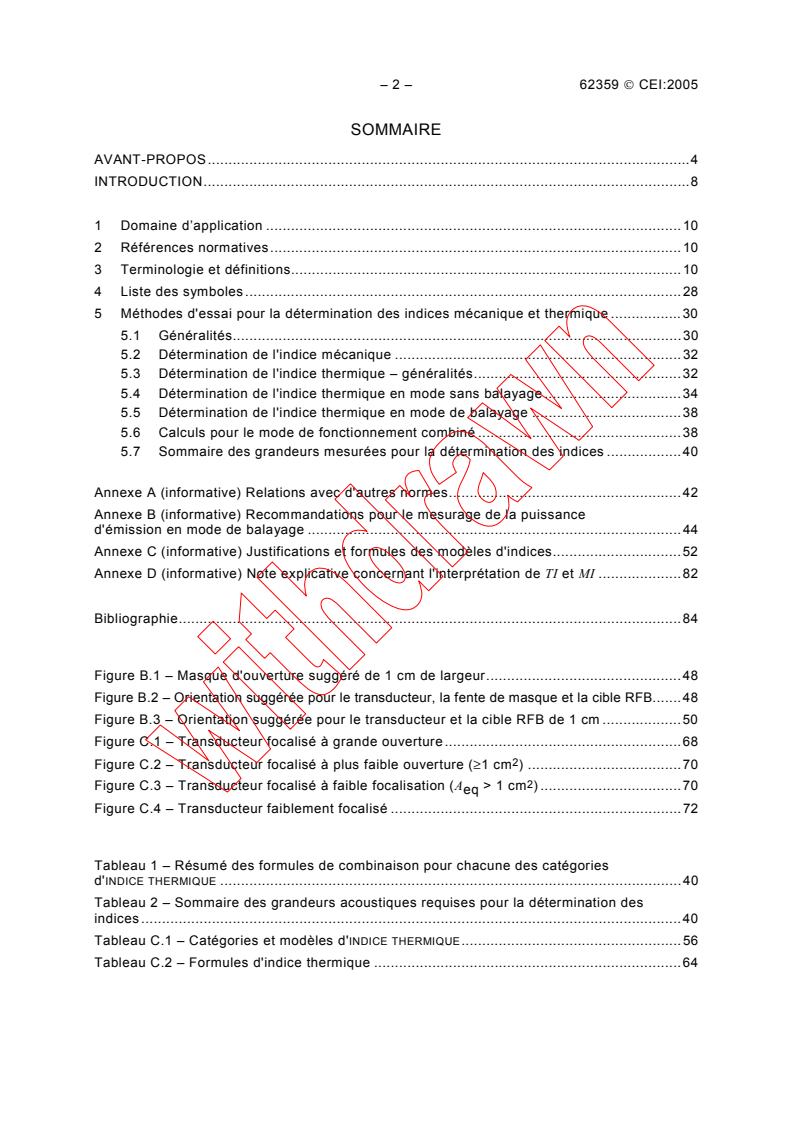
– 2 – 62359 © CEI:2005
SOMMAIRE
AVANT-PROPOS.4
INTRODUCTION.8
1 Domaine d’application .10
2 Références normatives.10
3 Terminologie et définitions.10
4 Liste des symboles.28
5 Méthodes d'essai pour la détermination des indices mécanique et thermique .30
5.1 Généralités.30
5.2 Détermination de l'indice mécanique .32
5.3 Détermination de l'indice thermique – généralités.32
5.4 Détermination de l'indice thermique en mode sans balayage .34
5.5 Détermination de l'indice thermique en mode de balayage .38
5.6 Calculs pour le mode de fonctionnement combiné .38
5.7 Sommaire des grandeurs mesurées pour la détermination des indices .40
Annexe A (informative) Relations avec d'autres normes.42
Annexe B (informative) Recommandations pour le mesurage de la puissance
d'émission en mode de balayage .44
Annexe C (informative) Justifications et formules des modèles d'indices.52
Annexe D (informative) Note explicative concernant l'interprétation de TI et MI .82
Bibliographie.84
Figure B.1 – Masque d'ouverture suggéré de 1 cm de largeur.48
Figure B.2 – Orientation suggérée pour le transducteur, la fente de masque et la cible RFB.48
Figure B.3 – Orientation suggérée pour le transducteur et la cible RFB de 1 cm .50
Figure C.1 – Transducteur focalisé à grande ouverture.68
Figure C.2 – Transducteur focalisé à plus faible ouverture (≥1 cm ) .70
Figure C.3 – Transducteur focalisé à faible focalisation (A > 1 cm ) .70
eq
Figure C.4 – Transducteur faiblement focalisé .72
Tableau 1 – Résumé des formules de combinaison pour chacune des catégories
d'INDICE THERMIQUE .40
Tableau 2 – Sommaire des grandeurs acoustiques requises pour la détermination des
indices .40
Tableau C.1 – Catégories et modèles d'INDICE THERMIQUE.56
Tableau C.2 – Formules d'indice thermique .64
62359 © IEC:2005 – 3 –
CONTENTS
FOREWORD.5
INTRODUCTION.9
1 Scope.11
2 Normative references .11
3 Terms and definitions .11
4 List of symbols .29
5 Test methods for determining the mechanical index and the thermal index .31
5.1 General .31
5.2 Determination of mechanical index .33
5.3 Determination of thermal index – general .33
5.4 Determination of thermal index in non-scanning mode.35
5.5 Determination of thermal index in scanning mode.39
5.6 Calculations for combined-operating mode .39
5.7 Summary of measured quantities for index determination .41
Annex A (informative) Relationships with other standards .43
Annex B (informative) Guidance notes for measurement of output power
in scanning mode.45
Annex C (informative) Rationale and derivation of index models .53
Annex D (informative) Guidance on the interpretation of TI and MI .83
Bibliography.85
Figure B.1 – Suggested 1 cm-wide aperture mask .49
Figure B.2 – Suggested orientation of transducer, mask slit and RFB target .49
Figure B.3 – Suggested orientation of transducer and 1 cm RFB target .51
Figure C.1 – Focused transducer with a large aperture .69
Figure C.2 – Focused transducer with smaller aperture (≥1 cm ) .71
Figure C.3 – Focused transducer with a weak focus (A > 1 cm ) .71
eq
Figure C.4 – Weakly focused transducer.73
Table 1 – Summary of combination formulae for each of the THERMAL INDEX categories.41
Table 2 – Summary of the acoustic quantities required for the determination of the indices .41
Table C.1 – THERMAL INDEX categories and models .57
Table C.2 – Thermal index formulae .65
– 4 – 62359 © CEI:2005
COMMISSION ÉLECTROTECHNIQUE INTERNATIONALE
____________
ULTRASONS –
CARACTÉRISATION DU CHAMP –
ESSAIS POUR LA DÉTERMINATION D'INDICES D'ÉCHAUFFEMENT
ET MÉCANIQUE DES CHAMPS D'ULTRASONS UTILISÉS
POUR LE DIAGNOSTIC MÉDICAL
AVANT-PROPOS
1) La Commission Electrotechnique Internationale (CEI) est une organisation mondiale de normalisation
composée de l'ensemble des comités électrotechniques nationaux (Comités nationaux de la CEI). La CEI a
pour objet de favoriser la coopération internationale pour toutes les questions de normalisation dans les
domaines de l'électricité et de l'électronique. A cet effet, la CEI – entre autres activités – publie des Normes
internationales, des Spécifications techniques, des Rapports techniques, des Spécifications accessibles au
public (PAS) et des Guides (ci-après dénommés "Publication(s) de la CEI"). Leur élaboration est confiée à des
comités d'études, aux travaux desquels tout Comité national intéressé par le sujet traité peut participer. Les
organisations internationales, gouvernementales et non gouvernementales, en liaison avec la CEI, participent
également aux travaux. La CEI collabore étroitement avec l'Organisation Internationale de Normalisation (ISO),
selon des conditions fixées par accord entre les deux organisations.
2) Les décisions ou accords officiels de la CEI concernant les questions techniques représentent, dans la mesure
du possible, un accord international sur les sujets étudiés, étant donné que les Comités nationaux de la CEI
intéressés sont représentés dans chaque comité d’études.
3) Les Publications de la CEI se présentent sous la forme de recommandations internationales et sont agréées
comme telles par les Comités nationaux de la CEI. Tous les efforts raisonnables sont entrepris afin que la CEI
s'assure de l'exactitude du contenu technique de ses publications; la CEI ne peut pas être tenue responsable
de l'éventuelle mauvaise utilisation ou interprétation qui en est faite par un quelconque utilisateur final.
4) Dans le but d'encourager l'uniformité internationale, les Comités nationaux de la CEI s'engagent, dans toute la
mesure possible, à appliquer de façon transparente les Publications de la CEI dans leurs publications
nationales et régionales. Toutes divergences entre toutes Publications de la CEI et toutes publications
nationales ou régionales correspondantes doivent être indiquées en termes clairs dans ces dernières.
5) La CEI n’a prévu aucune procédure de marquage valant indication d’approbation et n'engage pas sa
responsabilité pour les équipements déclarés conformes à une de ses Publications.
6) Tous les utilisateurs doivent s'assurer qu'ils sont en possession de la dernière édition de cette publication.
7) Aucune responsabilité ne doit être imputée à la CEI, à ses administrateurs, employés, auxiliaires ou
mandataires, y compris ses experts particuliers et les membres de ses comités d'études et des Comités
nationaux de la CEI, pour tout préjudice causé en cas de dommages corporels et matériels, ou de tout autre
dommage de quelque nature que ce soit, directe ou indirecte, ou pour supporter les coûts (y compris les frais
de justice) et les dépenses découlant de la publication ou de l'utilisation de cette Publication de la CEI ou de
toute autre Publication de la CEI, ou au crédit qui lui est accordé.
8) L'attention est attirée sur les références normatives citées dans cette publication. L'utilisation de publications
référencées est obligatoire pour une application correcte de la présente publication.
9) L’attention est attirée sur le fait que certains des éléments de la présente Publication de la CEI peuvent faire
l’objet de droits de propriété intellectuelle ou de droits analogues. La CEI ne saurait être tenue pour
responsable de ne pas avoir identifié de tels droits de propriété et de ne pas avoir signalé leur existence.
La Norme internationale CEI 62359 a été établie par le comité d'études 87 de la CEI:
Ultrasons.
Cette version bilingue, publiée en 2006-05, correspond à la version anglaise.
Le texte anglais de cette norme est issu des documents 87/300/FDIS et 87/305/RVD. Le
rapport de vote 87/305/RVD donne toute information sur le vote ayant abouti à l’approbation
de cette norme.
La version française de cette norme n’a pas été soumise au vote.
62359 © IEC:2005 – 5 –
INTERNATIONAL ELECTROTECHNICAL COMMISSION
____________
ULTRASONICS –
FIELD CHARACTERIZATION –
TEST METHODS FOR THE DETERMINATION OF THERMAL
AND MECHANICAL INDICES RELATED TO
MEDICAL DIAGNOSTIC ULTRASONIC FIELDS
FOREWORD
1) The International Electrotechnical Commission (IEC) is a worldwide organization for standardization comprising
all national electrotechnical committees (IEC National Committees). The object of IEC is to promote
international co-operation on all questions concerning standardization in the electrical and electronic fields. To
this end and in addition to other activities, IEC publishes International Standards, Technical Specifications,
Technical Reports, Publicly Available Specifications (PAS) and Guides (hereafter referred to as “IEC
Publication(s)”). Their preparation is entrusted to technical committees; any IEC National Committee interested
in the subject dealt with may participate in this preparatory work. International, governmental and non-
governmental organizations liaising with the IEC also participate in this preparation. IEC collaborates closely
with the International Organization for Standardization (ISO) in accordance with conditions determined by
agreement between the two organizations.
2) The formal decisions or agreements of IEC on technical matters express, as nearly as possible, an international
consensus of opinion on the relevant subjects since each technical committee has representation from all
interested IEC National Committees.
3) IEC Publications have the form of requirements for international use and are accepted by IEC National
Committees in that sense. While all reasonable efforts are made to ensure that the technical content of IEC
Publications is accurate, IEC cannot be held responsible for the way in which they are used or for any
misinterpretation by any end user.
4) In order to promote international uniformity, IEC National Committees undertake to apply IEC Publications
transparently to the maximum extent possible in their national and regional publications. Any divergence
between any IEC Publication and the corresponding national or regional publication shall be clearly indicated in
the latter.
5) IEC provides no marking procedure to indicate its approval and cannot be rendered responsible for any
equipment declared to be in conformity with an IEC Publication.
6) All users should ensure that they have the latest edition of this publication.
7) No liability shall attach to IEC or its directors, employees, servants or agents including individual experts and
members of its technical committees and IEC National Committees for any personal injury, property damage or
other damage of any nature whatsoever, whether direct or indirect, or for costs (including legal fees) and
expenses arising out of the publication, use of, or reliance upon, this IEC Publication or any other IEC
Publications.
8) Attention is drawn to the Normative references cited in this publication. Use of the referenced publications is
indispensable for the correct application of this publication.
9) Attention is drawn to the possibility that some of the elements of this IEC Publication may be the subject of
patent rights. IEC shall not be held responsible for identifying any or all such patent rights.
International Standard IEC 62359 has been prepared by IEC technical committee 87:
Ultrasonics
This bilingual version, published in 2006-05, corresponds to the English version.
The text of this standard is based on the following documents:
FDIS Report on voting
87/300/FDIS 87/305/RVD
Full information on the voting for the approval of this standard can be found in the report on
voting indicated in the above table.
The French version of this standard has not been voted upon.
– 6 – 62359 © CEI:2005
Cette publication a été rédigée selon les Directives ISO/CEI, Partie 2.
Cette norme peut être utilisée en complément aux exigences de la CEI 60601-2-37.
Le comité a décidé que le contenu de cette publication ne sera pas modifié avant la date de
maintenance indiquée sur le site web de la CEI sous "http://webstore.iec.ch" dans les
données relatives à cette publication spécifique. À cette date, la publication sera:
• reconduite;
• supprimée;
• remplacée par une édition révisée; ou
• amendée.
62359 © IEC:2005 – 7 –
This publication has been drafted in accordance with the ISO/IEC Directives, Part 2.
This standard may be used to support the requirements of IEC 60601-2-37.
The committee has decided that the contents of this publication will remain unchanged until
the maintenance result date indicated on the IEC web site under "http://webstore.iec.ch" in
the data related to the specific publication. At this date, the publication will be
• reconfirmed;
• withdrawn;
• replaced by a revised edition, or
• amended.
– 8 – 62359 © CEI:2005
INTRODUCTION
Les appareils ultrasonores de diagnostic médical sont largement utilisés en pratique clinique
à des fins d'imagerie ou de surveillance. Les appareils fonctionnent normalement à des
fréquences appartenant à la gamme de fréquences mégahertz basse et comprennent un
transducteur couplé acoustiquement au patient et à l'électronique associée. Il existe une très
grande diversité de systèmes dans la pratique clinique actuelle.
Les ultrasons pénétrant dans le patient interagissent avec ses tissus et cette interaction peut
être considérée en termes d'effets aussi bien thermiques que non thermiques. La présente
Norme internationale a pour but de spécifier des méthodes de détermination d'indices
d'exposition thermiques et non thermiques qui peuvent contribuer à l'évaluation des dangers
liés à l'exposition à un champ ultrasonore spécifique utilisé pour le diagnostic ou la
surveillance médicale. Il est bien connu que ces indices ont des limitations et que la
connaissance des indices au moment de l'examen n'est pas suffisante en soi pour effectuer
une évaluation de risque clinique avertie. Il est prévu que ces limitations seront étudiées dans
des révisions futures de la présente norme et en fonction des progrès de leur étude
scientifique.
Sous certaines conditions spécifiées dans la CEI 60601-2-37, ces indices sont affichés par
les appareils ultrasonores médicaux prévus à cet effet.
62359 © IEC:2005 – 9 –
INTRODUCTION
Medical diagnostic ultrasonic equipment is widely used in clinical practice for imaging and
monitoring purposes. Equipment normally operates at frequencies in the low megahertz
frequency range and comprises an ultrasonic transducer acoustically coupled to the patient
and associated electronics. There is an extremely wide range of different types of systems in
current clinical practice.
The ultrasound entering the patient interacts with the patient's tissue and this interaction can
be considered in terms of both thermal and non-thermal effects. The purpose of this
International Standard is to specify methods of determining thermal and non-thermal exposure
indices which can be used to help in assessing the hazard caused by exposure to a particular
ultrasonic field used for medical diagnosis or monitoring. It is recognised that these indices
have limitations and a knowledge of the indices at the time of an examination is not sufficient
in itself to make an informed clinical risk assessment. It is intended that these limitations will
be addressed in future revisions of this standard and as scientific understanding increases.
Under certain conditions specified in IEC 60601-2-37 these indices are displayed on medical
ultrasonic equipment intended for these purposes.
– 10 – 62359 © CEI:2005
ULTRASONS –
CARACTÉRISATION DU CHAMP –
ESSAIS POUR LA DÉTERMINATION D'INDICES D'ÉCHAUFFEMENT
ET MÉCANIQUE DES CHAMPS D'ULTRASONS UTILISÉS
POUR LE DIAGNOSTIC MÉDICAL
1 Domaine d’application
La présente Norme internationale est applicable aux champs d'ultrasons utilisés pour le
diagnostic médical.
La présente norme définit:
– des paramètres relatifs aux aspects thermiques et non thermiques des champs ultra-
sonores de diagnostic;
– des méthodes de détermination d'un paramètre d'exposition relatif à l'échauffement dans
les modèles théoriques équivalents aux tissus, résultant de l'absorption d'ultrasons;
– des méthodes de détermination d'un paramètre d'exposition approprié pour certains effets
non thermiques.
NOTE Lorsque des multiples ou sous-multiples d'unités SI sont utilisés dans la présente norme, ils sont
clairement indiqués et leur usage est cohérent.
2 Références normatives
Les documents de référence suivants sont indispensables pour l'application du présent
document. Pour les références datées, seule l'édition citée s'applique. Pour les références
non datées, la dernière édition du document de référence s'applique (y compris les éventuels
amendements).
CEI 60601-2-37, Medical electrical equipment – Part 2-37: Particular requirements for the
safety of ultrasonic medical diagnostic and monitoring equipment (disponible en anglais
seulement)
CEI 61102:1991, Mesurage et caractérisation des champs ultrasonores à l'aide d'hydro-
phones dans la gamme de fréquences de 0,5 MHz à 15 MHz
CEI 61157:1992, Critères pour la déclaration des émissions acoustiques des appareils de
diagnostic médical à ultrasons
CEI 61161:1992, Mesurage de puissance ultrasonore dans les liquides dans la gamme de
fréquences de 0,5 MHz à 25 MHz
Amendement 1 (1998)
3 Terminologie et définitions
Pour les besoins de la présente Norme internationale, les termes et définitions donnés dans
les normes CEI 61102:1991, CEI 61157:1992 et CEI 61161:1998 (dont certains sont repris ci-
dessous pour des raisons de commodité) et les suivants s'appliquent.
———————
)
Une édition consolidée (1.1) existe, qui inclut la CEI 61161:1992 et son amendement 1 (1998).
62359 © IEC:2005 – 11 –
ULTRASONICS –
FIELD CHARACTERIZATION –
TEST METHODS FOR THE DETERMINATION OF THERMAL
AND MECHANICAL INDICES RELATED TO
MEDICAL DIAGNOSTIC ULTRASONIC FIELDS
1 Scope
This International Standard is applicable to medical diagnostic ultrasound fields.
This standard establishes
– parameters related to thermal and non-thermal aspects of diagnostic ultrasonic fields;
– methods for the determination of an exposure parameter relating to temperature rise in
theoretical tissue-equivalent models, resulting from absorption of ultrasound;
– methods for the determination of an exposure parameter appropriate to certain non-
thermal effects.
NOTE In this standard where multiples or submultiples of SI units are used this is clearly stated and the usage is
self-consistent.
2 Normative references
The following referenced documents are indispensable for the application of this document.
For dated references, only the edition cited applies. For undated references, the latest edition
of the referenced document (including any amendments) applies.
IEC 60601-2-37, Medical electrical equipment – Part 2-37: Particular requirements for the
safety of ultrasonic medical diagnostic and monitoring equipment
IEC 61102:1991, Measurement and characterisation of ultrasonic fields using hydrophones in
the frequency range 0,5 MHz to 15 MHz
IEC 61157:1992, Requirements for the declaration of the acoustic output of medical
diagnostic ultrasonic equipment
IEC 61161:1992, Ultrasonic power measurement in liquids in the frequency range 0,5 MHz to
25 MHz
Amendment 1 (1998)
3 Terms and definitions
For the purposes of this International standard, the terms and definitions given in
IEC 61102:1991, IEC 61157:1992 and IEC 61161:1998 (several of which are repeated below
for convenience) and the following apply.
———————
1)
A consolidated edition (1.1) exists, including IEC 61161:1992 and its Amendment 1 (1998).
– 12 – 62359 © CEI:2005
3.1
coefficient d'atténuation acoustique
coefficient permettant de prendre en compte l'atténuation acoustique des tissus entre la
source et un point spécifique
α
Symbole:
–1 –1
Unité: décibel par centimètre par mégahertz, dB cm MHz
3.2
fréquence de fonctionnement acoustique
moyenne arithmétique des fréquences les plus éloignées l'une de l'autre, f et f , pour
lesquelles l'amplitude du spectre de pression du signal acoustique est inférieure de 3 dB à
l'amplitude de crête
[3.4.2 de la CEI 61102:1991, modifiée]
Symbole: f
awf
Unité: mégahertz, MHz
3.3
puissance d'émission atténuée
valeur de la puissance d'émission acoustique après atténuation et à une distance spécifique
du transducteur, fournie par l'expression
(-α z f /10 dB)
awf
P = P 10
α
où
α est le coefficient d'atténuation acoustique;
z est la distance depuis la source au point considéré;
f est la fréquence de fonctionnement acoustique;
awf
P est la puissance d'émission mesurée dans l'eau.
Symbole: P
α
Unité: milliwatt, mW
3.4
dépression acoustique de crête atténuée
valeur de la dépression acoustique de crête après atténuation, en un point spécifique,
fournie par l'expression
(-α z f /20 dB)
awf
p (z) = p (z) 10
r,α r
où
α est le coefficient d'atténuation acoustique;
z est la distance depuis la source au point considéré;
f est la fréquence de fonctionnement acoustique;
awf
p (z) est la dépression acoustique de crête mesurée dans l'eau.
r
Symbole: p
r,α
Unité: mégapascal, MPa
62359 © IEC:2005 – 13 –
3.1
acoustic attenuation coefficient
coefficient intended to account for ultrasonic attenuation of tissue between the source and a
specified point
α
Symbol:
–1 –1
Unit: decibels per centimetre per megahertz, dB cm MHz
3.2
acoustic working frequency
arithmetic mean of the most widely separated frequencies f and f at which the amplitude of
1 2
the pressure spectrum of the acoustic signal is 3 dB lower than the peak amplitude
[3.4.2 of IEC 61102:1991, modified]
Symbol: f
awf
Unit: megahertz, MHz
3.3
attenuated output power
value of the acoustic output power after attenuation and at a specified distance from the
transducer, and given by
(-α z f /10 dB)
awf
P = P 10
α
where
α is the acoustic attenuation coefficient;
z is the distance from the source to the point of interest;
f is the acoustic working frequency;
awf
P is the output power measured in water.
Symbol: P
α
Unit: milliwatts, mW
3.4
attenuated peak-rarefactional acoustic pressure
value of the peak-rarefactional acoustic pressure after attenuation and at a specified point,
and given by
(-α z f /20 dB)
awf
p (z) = p (z) 10
r,α r
where
α is the acoustic attenuation coefficient;
z is the distance from the source to the point of interest;
f is the acoustic working frequency;
awf
p (z) is the peak-rarefactional acoustic pressure measured in water.
r
Symbol: p
r,α
Unit: megapascals, MPa
– 14 – 62359 © CEI:2005
3.5
intensité atténuée moyenne de l'impulsion
valeur de l'intensité acoustique moyenne de l'impulsion après atténuation, en un point
spécifique, fournie par l'expression
(-α z f /10 dB)
awf
I = I (z) 10
pa,α pa
où
α est le coefficient d'atténuation acoustique;
z est la distance depuis la source au point considéré;
f est la fréquence de fonctionnement acoustique à une distance z;
awf
I (z) est l'intensité moyenne sur l'impulsion mesurée dans l'eau.
pa
Symbole: I
pa,α
–2
Unité: watt par centimètre carré, W cm
3.6
intégrale sur l'impulsion de l'intensité atténuée
valeur de l'intégrale sur l'impulsion de l'intensité après atténuation, en un point spécifique,
fournie par l'expression
(-α z f /10 dB)
awf
I = I 10
pi,α pi
où
α est le coefficient d'atténuation acoustique;
z est la distance depuis la source au point considéré;
f est la fréquence de fonctionnement acoustique;
awf
I est l'intégrale sur l'impulsion de l'intensité mesurée dans l'eau.
pi
Symbole: I
pi,α
–2
Unité: millijoule par centimètre carré, mJ cm
3.7
intensité crête spatiale moyenne temporelle atténuée
valeur de l'intensité crête spatiale moyenne temporelle après atténuation, à une distance
spécifique z, fournie par l'expression
(-α z f /10 dB)
awf
I (z) = I (z) 10
zpta,α zpta
où
α est le coefficient d'atténuation acoustique;
z est la distance depuis la source au point considéré;
f est la fréquence de fonctionnement acoustique;
awf
I (z) est l'intensité crête spatiale moyenne temporelle, à une distance spécifique z
zpta
mesurée dans l'eau.
Symbole: I (z)
zpta,α
–2
Unité: milliwatt par centimètre carré, mW cm
62359 © IEC:2005 – 15 –
3.5
attenuated pulse-average intensity
value of the acoustic pulse-average intensity after attenuation and at a specified point, and
given by
(-α z f /10 dB)
awf
I = I (z) 10
pa,α pa
where
α is the acoustic attenuation coefficient;
z is the distance from the source to the point of interest;
f is the acoustic working frequency;
awf
I (z) is the pulse-average intensity measured in water.
pa
Symbol: I
pa,α
–2
Unit: watts per centimetre squared, W cm
3.6
attenuated pulse-intensity integral
value of the pulse-intensity integral after attenuation and at a specified point, and given by
(-α z f /10 dB)
awf
I = I 10
pi,α pi
where
α is the acoustic attenuation coefficient;
z is the distance from the source to the point of interest;
f is the acoustic working frequency;
awf
I is the pulse-intensity integral measured in water.
pi
Symbol: I
pi,α
–2
Unit: millijoules per centimetre squared, mJ cm
3.7
attenuated spatial-peak temporal-average intensity
value of the spatial-peak temporal-average intensity after attenuation and at a specified
distance z, and given by
(-α z f /10 dB)
awf
I (z) = I (z) 10
zpta,α zpta
where
α is the acoustic attenuation coefficient;
z is the distance from the source to the point of interest;
f is the acoustic working frequency;
awf
I (z) is the spatial-peak temporal-average intensity, at a specified distance z measured in
zpta
water.
Symbol: I (z)
zpta,α
–2
Unit: milliwatts per centimetre squared, mW cm
– 16 – 62359 © CEI:2005
3.8
intensité atténuée moyenne temporelle
valeur de l'intensité moyenne temporelle après atténuation, en un point spécifique, fournie par
l'expression
(-α z f /10 dB)
awf
I (z) = I (z) 10
ta,α ta
où
α est le coefficient d'atténuation acoustique;
z est la distance depuis la source au point considéré;
f est la fréquence de fonctionnement acoustique;
awf
I (z) est l'intensité moyenne temporelle mesurée dans l'eau.
ta
Symbole: I (z)
ta,α
–2
Unité: milliwatt par centimètre carré, mW cm
3.9
surface du faisceau
surface dans un plan spécifique perpendiculaire à l'axe d'alignement du faisceau consistant
en tous les points où l'intégrale sur l'impulsion de l'intensité est supérieure à une fraction
spécifique de la valeur maximale de l'intégrale sur l'impulsion de l'intensité dans ce plan
[3.6 de la CEI 61102:1991, modifiée]
NOTE Pour les mesurages, l'intégrale sur l'impulsion de l'intensité peut être considérée comme étant
proportionnelle à l'intégrale sur l'impulsion du carré de la pression
3.10
axe d’alignement du faisceau
ligne droite joignant les points de valeur maximale de l'intégrale sur l'impulsion de
l'intensité, mesurée à plusieurs distances dans le champ lointain; cette ligne peut être
projetée sur la face du transducteur ultrasonore afin d'obtenir un alignement
[3.5 de la CEI 61102:1991, modifiée]
3.11
indice thermique osseux
pour des applications dans lesquelles le faisceau ultrasonore passe au
indice thermique
travers de tissus mous et où une région focale se trouve à proximité immédiate d'un os, telles
que les applications foetales (second et troisième trimestre) ou céphaliques néonatales (à
travers la fontanelle)
Symbole: TIB
Unité: aucune
NOTE Voir 5.4.2 et 5.5.2 pour des méthodes de détermination de l'indice thermique osseux.
3.12
puissance d'émission restreinte
puissance d'émission émise en mode de balayage à partir d'une région de la surface active
du transducteur dont la largeur dans le plan de balayage est restreinte à 1 cm
Symbole: P
Unité: milliwatt, mW
62359 © IEC:2005 – 17 –
3.8
attenuated temporal-average intensity
value of the temporal-average intensity after attenuation and at a specified point, and given by
(-α z f /10 dB)
awf
I (z) = I (z) 10
ta,α ta
where
α is the acoustic attenuation coefficient;
z is the distance from the source to the point of interest;
f is the acoustic working frequency;
awf
I (z) is the temporal-average intensity measured in water.
ta
Symbol: I (z)
ta,α
–2
Unit: milliwatts per centimetre squared, mW cm
3.9
beam area
area in a specified plane perpendicular to the beam-alignment axis consisting of all points at
which the pulse-intensity integral is greater than a specified fraction of the maximum pulse-
intensity integral in that plane
[3.6 of IEC 61102:1991, modified]
NOTE For measurement purposes the pulse intensity integral can be taken as being proportional to the pulse
pressure-squared integral
3.10
beam alignment axis
straight line joining the points of maximum pulse intensity integral measured at several
different distances in the far field. For the purposes of alignment, this line may be projected to
the face of the ultrasonic transducer
[3.5 of IEC 61102:1991, modified]
3.11
bone thermal index
thermal index for applications, such as foetal (second and third trimester) or neonatal
cephalic (through the fontanelle), in which the ultrasound beam passes through soft tissue
and a focal region is in the immediate vicinity of bone
Symbol: TIB
Unit: None
NOTE See 5.4.2 and 5.5.2 for methods of determining the bone thermal index.
3.12
bounded output power
output power emitted in scanning mode from a region of the active area of the transducer
whose width in the scan plane is limited to 1 cm
Symbol: P
Unit: milliwatts, mW
– 18 – 62359 © CEI:2005
3.13
profondeur de point de rupture
valeur égale à 1 fois et demie le diamètre d'ouverture équivalent et fournie par l'expression
z = 1,5 D
bp eq
où
D est le diamètre d'ouverture équivalent.
eq
Symbole: z
bp
Unité: centimètre, cm
3.14
mode de fonctionnement combiné
mode de fonctionnement d'un appareil combinant plusieurs modes de fonctionnement
discrets
[3.6 de la CEI 61157:1992, modifiée]
3.15
indice thermique crânien
indice thermique pour des applications dans lesquelles le faisceau ultrasonore passe à
travers l'os à proximité de l'entrée du faisceau dans le corps, telles que des applications
crâniennes pédiatriques et adultes
Symbole: TIC
Unité: aucune
NOTE Voir 5.4.3 et 5.5.3 pour des méthodes de détermination de l'indice thermique crânien.
3.16
configuration par défaut
état de contrôle spécifique dans lequel se trouve l'appareil de diagnostic par ultrasons lors
de la mise en marche, de la sélection d'un nouveau patient ou du passage d'applications non
foetales à des applications foetales
3.17
profondeur pour l'indice thermique osseux
distance entre le plan où les dimensions du faisceau d'émission –12 dB sont déterminées
le long de l'axe d'alignement de faisceau et le plan dans lequel le produit de la puissance
d'émission atténuée par l'intégrale sur l'impulsion de l'intensité est maximal
Symbole: z
b
Unité: centimètre, cm
3.18
profondeur pour l'indice thermique de tissus mous
distance entre le plan où les dimensions du faisceau d'émission –12 dB sont déterminées
le long de l'axe d'alignement de faisceau et le plan dans lequel la valeur la plus faible de la
puissance d'émission atténuée et le produit de l'intensité crête spatiale moyenne
atténuée par 1 cm est maximisée sur une plage de distance égale ou supérieure
temporelle
à une fois et demie le diamètre d'ouverture équivalent
Symbole: z
s
Unité: centimètre, cm
NOTE Dans la présente norme, la définition restreinte de l'intensité crête spatiale moyenne temporelle donnée
en 3.49 de la CEI 61102:1991 relative à un plan spécifique est utilisée lorsque l'intensité crête spatiale moyenne
temporelle est remplacée par l'intensité crête spatiale moyenne temporelle atténuée.
62359 © IEC:2005 – 19 –
3.13
break-point depth
value equal to 1,5 times the equivalent aperture diameter, and given by
z = 1,5 D
bp eq
where
D is the equivalent aperture diameter.
eq
Symbol: z
bp
Unit: centimetres, cm
3.14
combined-operating mode
mode of operation of an equipment which combines more than one discrete-operating mode
[3.6 of IEC 61157:1992, modified]
3.15
cranial-bone thermal index
thermal index for applications, such as paediatric and adult cranial applications, in which the
ultrasound beam passes through bone near the beam entrance into the body
Symbol: TIC
Unit: None
NOTE See 5.4.3 and 5.5.3 for methods of determining the cranial bone thermal index.
3.16
default setting
specific state of control, the ultrasonic diagnostic equipment will enter upon power-up, new
patient select or change from non-foetal to foetal applications
3.17
depth for bone thermal index
distance from the plane where the –12 dB output beam dimensions are determined along
the beam alignment axis to the plane where the product of attenuated output power and
attenuated pulse-intensity integral is maximum
Symbol: z
b
Unit: centimetres, cm
3.18
depth for soft-tissue thermal index
distance from the plane where the –12 dB output beam dimensions are determined along
the beam alignment axis to the plane at which the lower value of the attenuated output
power and the product of the attenuated spatial-peak temporal-average intensity and
1 cm is maximized over the distance range equal to, or more than, 1,5 times the equivalent
aperture diameter
Symbol: z
s
Unit: centimetres, cm
NOTE In this standard, the restricted definition of spatial-peak temporal-average intensity from 3.49 of
IEC 61102:1991 relating to a specified plane is used where spatial-peak temporal-average intensity is replaced
by attenuated spatial-peak temporal-average intensity.
----------------
...