

IEC 61162-1:2007
(Main)Maritime navigation and radiocommunication equipment and systems - Digital interfaces - Part 1: Single talker and multiple listeners
General Information
- Abstract
Contains the requirements for data communication between maritime electronic instruments, navigation and radiocommunication equipment when interconnected via an appropriate system. Is intended to support one-way serial data transmission from a single talker to one or more listeners. This data is in printable ASCII form and may include information such as position, speed, depth, frequency allocation, etc. For applications where a faster transmission rate is necessary, reference should be made to IEC 61162-2. Is closely aligned with NMEA 0183 version 3.01. The main changes with respect to the previous edition include among others: - Clause 7 (Clause 5 in the previous edition) has been expanded to include two types of start of sentence delimiters. The conventional delimiter "$" is used with the conventional sentences which are now called parametric sentences. A new delimiter "!" identifies sentences that conform to special purpose encapsulation.
- Status
- Published
- Publication Date
- 10-Apr-2007
- Technical Committee
- TC 80 - Maritime navigation and radiocommunication equipment and systems
- Drafting Committee
- WG 6 - TC 80/WG 6
- Current Stage
- DELPUB - Deleted Publication
- Start Date
- 25-Nov-2010
- Completion Date
- 28-Aug-2026
Overview
IEC 61162-1:2007 defines a standardized digital interface for maritime navigation and radiocommunication equipment implementing a single talker - multiple listeners serial data link. Intended for printable ASCII sentences carrying navigation data (for example position, speed, depth, frequency allocation), the standard specifies message format, electrical and hardware requirements, and protocol rules for interconnecting marine instruments and systems. IEC 61162-1 is the third edition (2007) and is closely aligned with NMEA 0183 version 3.01.
Key topics and technical requirements
- One-way serial data transmission: Supports a single talker broadcasting to one or more listeners; typical messages ~11–79 characters and generally transmitted no faster than once per second.
- Data format and protocol: Printable ASCII characters organized into fields and sentences, with defined start delimiters:
- "$" for conventional parametric sentences
- "!" for special-purpose encapsulation sentences
- Hardware and electrical: Guidance on interconnecting wire, conductor definitions, shield and connector requirements, and listener receive circuits (see Clause 5).
- Error handling and limits: Checksum and error detection rules are defined, but the protocol offers only limited error checking and no guaranteed delivery.
- Data content and approved sentences: Defines character sets, field types, talker identifiers and many sentence types (including new/revised sentences for DDC, NAVTEX, ROR, THS, UID and voyage data recorder-related messages).
- Supporting annexes: Normative and informative annexes provide testing guidelines, six-bit binary conversions, alarm field definitions, and example encapsulation use.
Applications and who uses it
IEC 61162-1 is widely used by marine electronics manufacturers, system integrators, shipbuilders and operators for low-bandwidth point-to-multipoint links such as:
- GPS/GNSS to chartplotters and autopilots
- Depth sounder and speed sensors to bridge displays
- AIS/NAVTEX receivers and simple radio/data equipment
- Voyage Data Recorder (VDR) sentence transport and legacy instrument interfacing
Note: Because the standard does not guarantee delivery and has limited error checking, it should be used with caution for safety-critical systems. For higher data rates (e.g., radar/video), refer to IEC 61162-2.
Related standards
- IEC 61162 family: 61162-2 (high-speed single talker), 61162-3/4 (multiple talkers / ship systems interconnection - under development)
- NMEA 0183 v3.01 - close alignment and common sentence formats
- Relevant IMO and equipment-specific standards for VDR, AIS and bridge systems
Keywords: IEC 61162-1, maritime navigation, digital interfaces, single talker multiple listeners, NMEA 0183, serial ASCII sentences, encapsulation, marine electronics.
Relations
- Effective Date
- 05-Sep-2023
- Effective Date
- 05-Sep-2023
- Effective Date
- 05-Sep-2023
- Effective Date
- 05-Sep-2023
- Effective Date
- 05-Sep-2023
Get Certified
Connect with accredited certification bodies for this standard

DNV
DNV is an independent assurance and risk management provider.

Lloyd's Register
Lloyd's Register is a global professional services organisation specialising in engineering and technology.

FSC International
Forest Stewardship Council certification.
Sponsored listings
Frequently Asked Questions
IEC 61162-1:2007 is a standard published by the International Electrotechnical Commission (IEC). Its full title is "Maritime navigation and radiocommunication equipment and systems - Digital interfaces - Part 1: Single talker and multiple listeners". This standard covers: Contains the requirements for data communication between maritime electronic instruments, navigation and radiocommunication equipment when interconnected via an appropriate system. Is intended to support one-way serial data transmission from a single talker to one or more listeners. This data is in printable ASCII form and may include information such as position, speed, depth, frequency allocation, etc. For applications where a faster transmission rate is necessary, reference should be made to IEC 61162-2. Is closely aligned with NMEA 0183 version 3.01. The main changes with respect to the previous edition include among others: - Clause 7 (Clause 5 in the previous edition) has been expanded to include two types of start of sentence delimiters. The conventional delimiter "$" is used with the conventional sentences which are now called parametric sentences. A new delimiter "!" identifies sentences that conform to special purpose encapsulation.
Contains the requirements for data communication between maritime electronic instruments, navigation and radiocommunication equipment when interconnected via an appropriate system. Is intended to support one-way serial data transmission from a single talker to one or more listeners. This data is in printable ASCII form and may include information such as position, speed, depth, frequency allocation, etc. For applications where a faster transmission rate is necessary, reference should be made to IEC 61162-2. Is closely aligned with NMEA 0183 version 3.01. The main changes with respect to the previous edition include among others: - Clause 7 (Clause 5 in the previous edition) has been expanded to include two types of start of sentence delimiters. The conventional delimiter "$" is used with the conventional sentences which are now called parametric sentences. A new delimiter "!" identifies sentences that conform to special purpose encapsulation.
IEC 61162-1:2007 is classified under the following ICS (International Classification for Standards) categories: 33.060.01 - Radiocommunications in general; 47.020.70 - Navigation and control equipment. The ICS classification helps identify the subject area and facilitates finding related standards.
IEC 61162-1:2007 has the following relationships with other standards: It is inter standard links to IEC PAS 61162-101:2003, IEC PAS 61162-100:2002, IEC PAS 61162-102:2003, IEC 61162-1:2010, IEC 61162-1:2000. Understanding these relationships helps ensure you are using the most current and applicable version of the standard.
IEC 61162-1:2007 is available in PDF format for immediate download after purchase. The document can be added to your cart and obtained through the secure checkout process. Digital delivery ensures instant access to the complete standard document.
Standards Content (Sample)
INTERNATIONAL IEC
STANDARD 61162-1
Third edition
2007-04
Maritime navigation and radiocommunication
equipment and systems –
Digital interfaces
Part 1:
Single talker and multiple listeners
Reference number
All rights reserved. Unless otherwise specified, no part of this publication may be reproduced or utilized in any form
or by any means, electronic or mechanical, including photocopying and microfilm, without permission in writing from
either IEC or IEC's member National Committee in the country of the requester.
If you have any questions about IEC copyright or have an enquiry about obtaining additional rights to this publication,
please contact the address below or your local IEC member National Committee for further information.
IEC Central Office
3, rue de Varembé
CH-1211 Geneva 20
Switzerland
Email: inmail@iec.ch
Web: www.iec.ch
About the IEC
The International Electrotechnical Commission (IEC) is the leading global organization that prepares and publishes
International Standards for all electrical, electronic and related technologies.
About IEC publications
The technical content of IEC publications is kept under constant review by the IEC. Please make sure that you have the
latest edition, a corrigenda or an amendment might have been published.
ƒ Catalogue of IEC publications: www.iec.ch/searchpub
The IEC on-line Catalogue enables you to search by a variety of criteria (reference number, text, technical committee,…).
It also gives information on projects, withdrawn and replaced publications.
ƒ IEC Just Published: www.iec.ch/online_news/justpub
Stay up to date on all new IEC publications. Just Published details twice a month all new publications released. Available
on-line and also by email.
ƒ Customer Service Centre: www.iec.ch/webstore/custserv
If you wish to give us your feedback on this publication or need further assistance, please visit the Customer Service
Centre FAQ or contact us:
Email: csc@iec.ch
Tel.: +41 22 919 02 11
Fax: +41 22 919 03 00
INTERNATIONAL IEC
STANDARD 61162-1
Third edition
2007-04
Maritime navigation and radiocommunication
equipment and systems –
Digital interfaces
Part 1:
Single talker and multiple listeners
PRICE CODE
Commission Electrotechnique Internationale XF
International Electrotechnical Commission
МеждународнаяЭлектротехническаяКомиссия
For price, see current catalogue
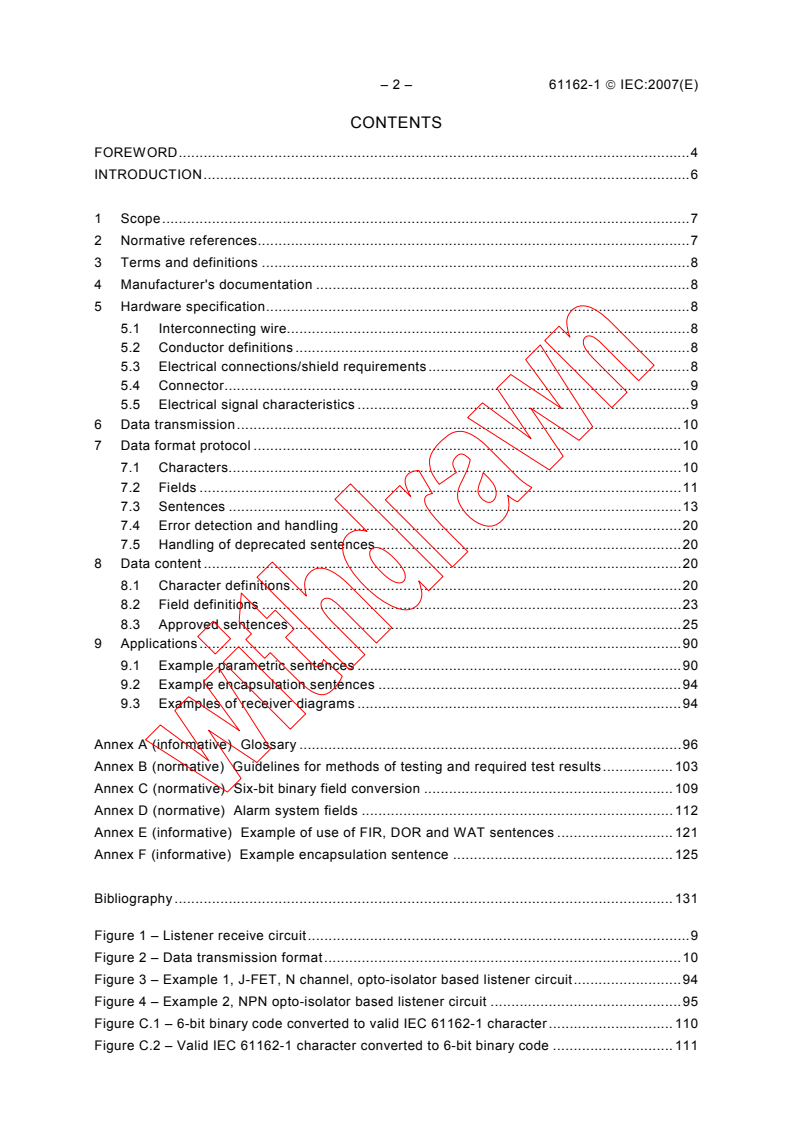
– 2 – 61162-1 © IEC:2007(E)
CONTENTS
FOREWORD.4
INTRODUCTION.6
1 Scope.7
2 Normative references.7
3 Terms and definitions .8
4 Manufacturer's documentation .8
5 Hardware specification.8
5.1 Interconnecting wire.8
5.2 Conductor definitions .8
5.3 Electrical connections/shield requirements.8
5.4 Connector.9
5.5 Electrical signal characteristics .9
6 Data transmission.10
7 Data format protocol .10
7.1 Characters.10
7.2 Fields .11
7.3 Sentences .13
7.4 Error detection and handling .20
7.5 Handling of deprecated sentences .20
8 Data content .20
8.1 Character definitions.20
8.2 Field definitions .23
8.3 Approved sentences .25
9 Applications .90
9.1 Example parametric sentences .90
9.2 Example encapsulation sentences .94
9.3 Examples of receiver diagrams .94
Annex A (informative) Glossary .96
Annex B (normative) Guidelines for methods of testing and required test results. 103
Annex C (normative) Six-bit binary field conversion . 109
Annex D (normative) Alarm system fields . 112
Annex E (informative) Example of use of FIR, DOR and WAT sentences . 121
Annex F (informative) Example encapsulation sentence . 125
Bibliography . 131
Figure 1 – Listener receive circuit.9
Figure 2 – Data transmission format.10
Figure 3 – Example 1, J-FET, N channel, opto-isolator based listener circuit.94
Figure 4 – Example 2, NPN opto-isolator based listener circuit .95
Figure C.1 – 6-bit binary code converted to valid IEC 61162-1 character . 110
Figure C.2 – Valid IEC 61162-1 character converted to 6-bit binary code . 111
61162-1 © IEC:2007(E) – 3 –
Figure E.1 – Example system diagram. 122
Figure F.1 – Message data format . 126
Figure F.2 – Work sheet for decoding and interpreting encapsulated string. 130
Table 1 – Reserved characters.20
Table 2 – Valid characters.21
Table 3 – Character symbol.22
Table 4 – Talker identifier mnemonics .23
Table 5 – Field type summary.24
Table B.1 – Example – Data string GGA sent by the EUT to the test receiver (listener) . 106
Table B.2 – Checksum .107
Table B.3 – Example – data string GGA received by the EUT . 107
Table B.4 – Example – Checksum . 108
Table B.5 – Break of data line . 108
Table C.1 – Six-bit binary field conversion table. 109
Table D.1 – System alarm fields . 112
Table F.1 – Example message from ITU-R M.1371. 129
– 4 – 61162-1 © IEC:2007(E)
INTERNATIONAL ELECTROTECHNICAL COMMISSION
___________
MARITIME NAVIGATION AND RADIOCOMMUNICATION
EQUIPMENT AND SYSTEMS –
DIGITAL INTERFACES –
Part 1: Single talker and multiple listeners
FOREWORD
1) The International Electrotechnical Commission (IEC) is a worldwide organization for standardization comprising
all national electrotechnical committees (IEC National Committees). The object of IEC is to promote
international co-operation on all questions concerning standardization in the electrical and electronic fields. To
this end and in addition to other activities, IEC publishes International Standards, Technical Specifications,
Technical Reports, Publicly Available Specifications (PAS) and Guides (hereafter referred to as “IEC
Publication(s)”). Their preparation is entrusted to technical committees; any IEC National Committee interested
in the subject dealt with may participate in this preparatory work. International, governmental and non-
governmental organizations liaising with the IEC also participate in this preparation. IEC collaborates closely
with the International Organization for Standardization (ISO) in accordance with conditions determined by
agreement between the two organizations.
2) The formal decisions or agreements of IEC on technical matters express, as nearly as possible, an international
consensus of opinion on the relevant subjects since each technical committee has representation from all
interested IEC National Committees.
3) IEC Publications have the form of recommendations for international use and are accepted by IEC National
Committees in that sense. While all reasonable efforts are made to ensure that the technical content of IEC
Publications is accurate, IEC cannot be held responsible for the way in which they are used or for any
misinterpretation by any end user.
4) In order to promote international uniformity, IEC National Committees undertake to apply IEC Publications
transparently to the maximum extent possible in their national and regional publications. Any divergence
between any IEC Publication and the corresponding national or regional publication should be clearly indicated
in the latter.
5) IEC provides no marking procedure to indicate its approval and cannot be rendered responsible for any
equipment declared to be in conformity with an IEC Publication.
6) All users should ensure that they have the latest edition of this publication.
7) No liability should attach to IEC or its directors, employees, servants or agents including individual experts and
members of its technical committees and IEC National Committees for any personal injury, property damage or
other damage of any nature whatsoever, whether direct or indirect, or for costs (including legal fees) and
expenses arising out of the publication, use of, or reliance upon, this IEC Publication or any other IEC
Publications.
8) Attention is drawn to the Normative references cited in this publication. Use of the referenced publications is
indispensable for the correct application of this publication.
9) Attention is drawn to the possibility that some of the elements of this IEC Publication may be the subject of
patent rights. IEC should not be held responsible for identifying any or all such patent rights.
International Standard IEC 61162-1 has been prepared by IEC technical committee 80:
Maritime navigation and radiocommunication equipment and systems.
This third edition cancels and replaces the second edition published in 2000, and constitutes a
technical revision. This part of IEC 61162 is closely aligned with NMEA 0183 version 3.01.
It also replaces PAS 61162-100 (2002), PAS 61162-101 (2003) and PAS 61162-102 (2003).
The main changes with respect to the previous edition are listed below:
• Normative references have been renumbered from 1.2 to 2, Terms and definitions from 1.3
to 3 and Manufacturers documentation from 2 to 4. Thereafter all clauses are numbered
two ahead of those in the previous edition.
• Clause 7 (Clause 5 in the previous edition) has been expanded to include two types of start
of sentence delimiters. The conventional delimiter “$” is used with the conventional
sentences which are now called parametric sentences. A new delimiter “!” identifies
61162-1 © IEC:2007(E) – 5 –
sentences that conform to special purpose encapsulation. The example applications in
Clause 9 (Clause 7 in the previous edition) have been expanded to describe both types.
• The tables in Clause 8 (Clause 6 in the previous edition) have been updated. The previous
Table 5 (Approved sentence formatters) and the associated Annex A (Minimum required
sentences) have been deleted.
• Clause 8 has been expanded to include new and revised sentences.
• Four new annexes have been added to support the text.
The text of this standard is based upon the following documents:
FDIS Report on voting
80/464/FDIS 80/473/RVD
Full information on the voting for the approval of this standard can be found in the report on
voting indicated in the above table.
This publication has been drafted in accordance with the ISO/IEC Directives, Part 2.
The committee has decided that the contents of this publication will remain unchanged until the
maintenance result date indicated on the IEC web site under "http://webstore.iec.ch" in the data
related to the specific publication. At this date, the publication will be
• reconfirmed;
• withdrawn;
• replaced by a revised edition, or
• amended.
A bilingual version of this publication may be issued at a later date.
– 6 – 61162-1 © IEC:2007(E)
INTRODUCTION
International standard IEC 61162 is a four part standard which specifies four digital interfaces
for application in marine navigation, radiocommunication and system integration. The four parts
are:
IEC 61162-1 Single talker and multiple listeners
IEC 61162-2 Single talker and multiple listeners, high speed transmission
IEC 61162-3 Multiple talkers and multiple listeners – Serial data instrument network
(under consideration)
IEC 61162-4 Multiple talkers and multiple listeners – Ship systems interconnection
IEC technical committee 80 interface standards are developed with input from manufacturers,
private and government organisations and equipment operators. The information is intended to
meet the needs of users at the time of publication, but users should recognise that as
applications and technology change, interface standards should change as well. Users of this
standard are advised to immediately inform the IEC of any perceived inadequacies therein.
This edition is a complete revision of the second edition of IEC 61162-1. Liaison has been
maintained with NMEA and this edition has been aligned as closely as possible with NMEA
0183 version 3.01. It incorporates three previously issued publicly available specifications: PAS
61162-100 Extra requirements to IEC 61162-1 for UAIS, PAS 61162-101 Modified sentences
and requirements for IEC 61162 and PAS 61162-102 Extra requirements to IEC 61162-1 for the
voyage data recorder.
The second edition included details of the ship equipment defined in IMO resolutions together
with appropriate sentences for communication between them. It is now the practice to specify
the sentence formatters in the individual standards for equipment, so, in this edition the
previous Table 5 (Approved sentence formatters) and Annex A (Minimum required sentences)
have not been included.
NOTE The equipment responses and behaviour is beyond the scope for this standard and should be included in
the individual equipment standards, for example alarm handling.
This edition introduces (from PAS 61162-100) two types of start of sentence delimiters. The
conventional delimiter “$” is used with the conventional sentences which are now called
parametric sentences. The new delimiter “!” identifies sentences that conform to special
purpose encapsulation. The example applications in Clause 9 (Clause 7 in second edition)
have been expanded to describe both types.
The list of sentences in Clause 8 (Clause 6 in second edition) has been updated to include all
the sentences which were developed in the three public available specifications together with
new sentences for display dimming (DDC), NAVTEX (NRM and NRX), rudder order (ROR),
heading (THS) and user identification code transmission (UID).
As a result of experience the sentences given in PAS 61162-102 for the voyage data recorder;
ALA, AKD, DOR, ETL, EVE, FIR, GEN, HSS, PRC, TRC, TRD and WAT have been modified in
this edition.
61162-1 © IEC:2007(E) – 7 –
MARITIME NAVIGATION AND RADIOCOMMUNICATION
EQUIPMENT AND SYSTEMS –
DIGITAL INTERFACES –
Part 1: Single talker and multiple listeners
1 Scope
This part of IEC 61162 contains the requirements for data communication between maritime
electronic instruments, navigation and radiocommunication equipment when interconnected via
an appropriate system.
This standard is intended to support one-way serial data transmission from a single talker to
one or more listeners. This data is in printable ASCII form and may include information such as
position, speed, depth, frequency allocation, etc. Typical messages may be from about 11 to a
maximum of 79 characters in length and generally require transmission no more rapidly than
one message per second.
The electrical definitions in this standard are not intended to accommodate high-bandwidth
applications such as radar or video imagery, or intensive database or file transfer applications.
Since there is no provision for guaranteed delivery of messages and only limited error checking
capability, this standard should be used with caution in all safety applications.
For applications where a faster transmission rate is necessary, reference should be made to
IEC 61162-2.
2 Normative references
The following referenced documents are indispensable for the application of this document. For
dated references, only the edition cited applies. For undated references, the latest edition of
the referenced document (including any amendments) applies.
IEC 60945: Maritime navigation and radiocommunication equipment and systems – General
requirements – Methods of testing and required test results
IEC 61162-2:1998, Maritime navigation and radiocommunication equipment and systems –
Digital interfaces – Part 2: Single talker and multiple listeners, high-speed transmission
ISO/IEC 8859-1:1998, Information technology – 8-bit single-byte coded graphic character
sets – Part 1: Latin alphabet No.1
ITU-R M.493, Digital selective-calling system for use in the maritime mobile service
ITU-R M.821, Optional expansion of the digital selective-calling system for use in the maritime
mobile service
ITU-R M.825, Characteristics of a transponder system using digital selective calling techniques
for use with vessel traffic services and ship-to-ship identification
ITU-R M.1371, Technical characteristics for an automatic identification system using time
division multiple access in the VHF band
– 8 – 61162-1 © IEC:2007(E)
ITU-T X.27/V.11:1996, Electrical characteristics for balanced double-current interchange
circuits operating at data signalling rates up to 10 Mbit/s
3 Terms and definitions
Common terms are defined in the glossary of Annex A. Where there is a conflict, terms shall
be interpreted wherever possible in accordance with the references in Clause 2.
For the purposes of this document, the following terms and definitions apply.
talker
any device which sends data to other devices. The type of talker is identified by a 2-character
mnemonic as listed in 8.2 (Table 4)
listener
any device which receives data from another device
4 Manufacturer's documentation
Operator manuals or other appropriate literature provided for equipment that is intended to
meet the requirements of this standard shall contain the following information:
a) identification of the A and B signal lines;
b) the output drive capability as a talker;
c) a list of approved sentences, noting unused fields, proprietary sentences transmitted as a
talker and transmission interval for each sentence;
d) the load requirements as a listener;
e) a list of sentences and associated data fields that are required as a listener;
f) the current software and hardware revision if this is relevant to the interface;
g) an electrical description or schematic of the listener/talker input/output circuits citing actual
components and devices used, including connector type and part number;
h) the version number and date of update of the standard for which compliance is sought.
5 Hardware specification
NOTE Guidelines on methods of testing are given in Annex B.
One talker and multiple listeners may be connected in parallel over an interconnecting wire.
The number of listeners depends on the output capability and input drive requirements of
individual devices.
5.1 Interconnecting wire
Interconnection between devices may be by means of a two-conductor, shielded, twisted-pair
wire.
5.2 Conductor definitions
The conductors referred to in this standard are the signal lines A and B, and shield.
5.3 Electrical connections/shield requirements
All signal line A connections are connected in parallel with all device A connections and all
signal line B connections are connected in parallel with all device B connections. The shields of
all listener cables should be connected to the talker chassis only and should not be connected
at each listener.
61162-1 © IEC:2007(E) – 9 –
5.4 Connector
No standard connector is specified. Wherever possible readily available commercial
connectors shall be used. Manufacturers shall provide means for user identification of the
connections used.
5.5 Electrical signal characteristics
This subclause describes the electrical characteristics of transmitters and receivers.
5.5.1 Signal state definitions
The idle, marking, logical 1, OFF or stop bit states are defined by a negative voltage on line A
with respect to line B.
The active, spacing, logical 0, ON or start bit states are defined by a positive voltage on line A
with respect to line B.
It should be noted that the above A with respect to B levels are inverted from the voltage
input/output requirements of standard UARTs and that many line drivers and receivers provide
a logic inversion.
5.5.2 Talker drive circuits
No provision is made for more than a single talker to be connected to the bus. The drive circuit
used to provide the signal A and the return B shall meet, as a minimum, the requirements of
ITU-T X.27/V.11.
5.5.3 Listener receive circuits
Multiple listeners may be connected to a single talker. The listener receive circuit shall consist
of an opto-isolator and shall have protective circuits to limit current, reverse bias and power
dissipation at the opto-diode as shown in Figure 1. Reference is made to example circuits
in 9.2.
The receive circuit shall be designed for operation with a minimum differential input voltage of
2,0 V and shall not take more than 2,0 mA from the line at that voltage.
A
Protective
circuits
B
Opto-isolator
Listener No. 2
A A
Protective
circuits
B B
Opto-isolator
Shields
Listener No. 1
Talker
IEC 910/2000
Figure 1 – Listener receive circuit
___________
For reasons of compatibility with equipment designed to comply with earlier versions of NMEA 0183, it is noted
that the idle, marking, logical "1", OFF or stop bit state had previously been defined to be in the range –15,0 V to
+0,5 V. The active, spacing, logical "0", ON or start bit state was defined to be in the range +4,0 V to +15,0 V
while sourcing was not less than 15 mA.
– 10 – 61162-1 © IEC:2007(E)
5.5.4 Electrical isolation
Within a listener, there shall be no direct electrical connection between the signal line A, return
line B, or shield and ship’s ground or power. Isolation from ships’ ground is required.
5.5.5 Maximum voltage on bus
The maximum applied voltage between signal lines A and B and between either line and
ground shall be in accordance with ITU-T X.27/V.11.
For protection against mis-wiring and for use with earlier talker designs, all receive circuit
devices shall be capable of withstanding 15 V between signal lines A and B and between either
line and ground for an indefinite period.
6 Data transmission
Data is transmitted in serial asynchronous form in accordance with the standards referenced in
Clause 2. The first bit is a start bit and is followed by data bits, least-significant-bit first, as
illustrated by Figure 2.
The following parameters are used:
– baud rate 4 800;
– data bits 8 (D7 = 0), parity none;
– stop bits 1.
D0 D1 D2 D3 D4 D5 D6 D7
Data bits Stop bit
Start bit
IEC 911/2000
Figure 2 – Data transmission format
7 Data format protocol
7.1 Characters
All transmitted data shall be interpreted as ASCII characters. The most significant bit of the
eight-bit character shall always be transmitted as zero (D7 = 0).
7.1.1 Reserved characters
The reserved character set consists of those ASCII characters shown in 8.1 (Table 1). These
characters are used for specific formatting purposes, such as sentence and field delimiting,
and except for code delimiting, shall not be used in data fields.
7.1.2 Valid characters
The valid character set consists of all printable ASCII characters (HEX 20 to HEX 7E) except
those defined as reserved characters. The list of the valid character set is given in 8.1
(Table 2).
61162-1 © IEC:2007(E) – 11 –
7.1.3 Undefined characters
ASCII values not specified as either “reserved characters” or “valid characters” are excluded
and shall not be transmitted at any time.
When it is necessary to communicate an 8-bit character defined by ISO/IEC 8859-1 that is a
reserved character (Table 1) or not listed in Table 2 as a valid character (e.g. in a proprietary
sentence or text sentence), three characters shall be used.
The reserved character “^“ (HEX 5E) is followed by two ASCII characters (0-9, A-F)
representing the HEX value of the character to be communicated. For example:
– to send heading as "127.5°", transmit “127.5 ^F8”;
– to send the reserved characters , transmit “^0D^0A”;
– to send the reserved character "^", transmit “^5E”.
IEC 60945 states that, as a minimum requirement, English language shall be used for controls
and displays. Other languages/characters are only supported by the TUT sentence.
7.1.4 Character symbols
When individual characters are used in this standard to define units of measurement, to
indicate the type of data field, type of sentence, etc. they shall be interpreted according to the
character symbol in 8.1 (Table 3).
7.2 Fields
A field consists of a string of valid characters, or no characters (null field), located between two
appropriate delimiter characters.
7.2.1 Address field
An address field is the first field in a sentence and follows the "$" or “!” delimiter; it serves to
define the sentence. The "$" delimiter identifies sentences that conform to the conventional
parametric and delimited field composition rules as described in 7.3.2. The "!" delimiter
identifies sentences that conform to the special-purpose encapsulation and non-delimited field
composition rules as described in 7.3.3. Characters within the address field are limited to digits
and upper case letters. The address field shall not be a null field. Only sentences with the
following three types of address fields shall be transmitted.
7.2.1.1 Approved address field
Approved address fields consist of five digits and upper case letter characters defined by
this standard. The first two characters are the talker identifier, listed in 8.2 (Table 4). The talker
identifier serves to define the nature of the data being transmitted.
Devices that have the capability to transmit data from multiple sources shall transmit the
appropriate talker identifier (for example a device with both a GPS receiver and a LORAN-C
receiver shall transmit GP when the position is GPS-based, LC when the position is LORAN-C-
based, and IN for integrated navigation shall be used if lines of position from LORAN-C and
GPS are combined into a position fix).
Devices capable of re-transmitting data from other sources shall use the appropriate identifier
(for example GPS receivers transmitting heading data shall not transmit $GPHCD unless the
compass heading is actually derived from the GPS signals).
The next three characters form the sentence formatter used to define the format and the type
of data. A list of sentence formatters is given in 8.3.
– 12 – 61162-1 © IEC:2007(E)
7.2.1.2 Query address field
The query address field consists of five characters and is used for the purpose of requesting
transmission of a specific sentence on a separate bus from an identified talker.
The first two characters are the talker identifier of the device requesting data, the next two
characters are the talker identifier of the device being addressed and the final character is the
query character “Q”.
7.2.1.3 Proprietary address field
The proprietary address field consists of the proprietary character “P” followed by a three-
character manufacturer's mnemonic code, used to identify the talker issuing a proprietary
sentence, and any additional characters as required.
NOTE A list of valid manufacturer's mnemonic codes may be obtained from NMEA (see 7.3.5).
7.2.2 Data fields
Data fields in approved sentences follow a "," delimiter and contain valid characters (and code
delimiters “^”) in accordance with the formats illustrated in 8.2 (Table 5). Data fields in
proprietary sentences contain only valid characters and the delimiter characters “,” and “^”, but
are not defined by this standard.
Because of the presence of variable data fields and null fields, specific data fields shall only be
located within a sentence by observing the field delimiters ",". Therefore, it is essential for the
listener to locate fields by counting delimiters rather than counting the total number of
characters received from the start of the sentence.
7.2.2.1 Variable length fields
Although some data fields are defined to have fixed length, many are of variable length in order
to allow devices to convey information and to provide data with more or less precision,
according to the capability or requirements of a particular device.
Variable length fields may be alphanumeric or numeric fields. Variable numeric fields may
contain a decimal point and may contain leading or trailing zeros.
7.2.2.2 Data field types
Data fields may be alpha, numeric, alphanumeric, variable length, fixed length or fixed/ variable
(with a portion fixed in length while the remainder varies). Some fields are constant, with their
value dictated by a specific sentence definition. The allowable field types are summarized in
8.2 (Table 5).
7.2.2.3 Null fields
A null field is a field of length zero, i.e. no characters are transmitted in the field. Null fields
shall be used when the value is unreliable or not available.
For example, if heading information were not available, sending data of "000" is misleading
because a user cannot distinguish between "000" meaning no data and a legitimate heading of
"000". However, a null field, with no characters at all, clearly indicates that no data is being
transmitted.
Null fields with their delimiters can have the following appearance depending on where they are
located in the sentence:
",," ",*"
61162-1 © IEC:2007(E) – 13 –
The ASCII NULL character (HEX 00) shall not be used as the null field.
7.2.3 Checksum field
A checksum field shall be transmitted in all sentences. The checksum field is the last field in a
sentence and follows the checksum delimiter character "*". The checksum is the eight-bit
exclusive OR (no start or stop bits) of all characters in the sentence, including "," and “^”
delimiters, between but not including the "$" or “!” and the "*" delimiters.
The hexadecimal value of the most significant and least significant four bits of the result is
converted to two ASCII characters (0-9, A-F) for transmission. The most significant character is
transmitted first.
Examples of the checksum field are:
$GPGLL,5057.970,N,00146.110,E,142451,A*27 and
$GPVTG,089.0,T,,,15.2,N,,,*53.
7.2.4 Sequential message identifier field
This is a field that is critical to identifying groups of 2 or more sentences that make up a multi-
sentence message. This field is incremented each time a new multi-sentence message is
generated with the same sentence formatter. The value is reset to zero when it is incremented
beyond the defined maximum value. The maximum value, size, and format of this field is
determined by the applicable sentence definition in Clause 8. This is one of three key fields
supporting the multi-sentence message capability (see 7.3.8).
7.3 Sentences
This subclause describes the general structure of sentences. Details of specific sentence
formats are found in 8.3. Some sentences may specify restrictions beyond the general
limitations given in this standard. Such restrictions may include defining some fields as fixed
length, numeric or text only, required to be non-null, transmitted with a certain frequency, etc.
The maximum number of characters in a sentence shall be 82, consisting of a maximum of 79
characters between the starting delimiter "$" or “!” and the terminating delimiter .
The minimum number of fields in a sentence is one (1). The first field shall be an address field
containing the identity of the talker and the sentence formatter which specifies the number of
data fields in the sentence, the type of data they contain and the order in which the data fields
are transmitted. The remaining portion of the sentence may contain zero or multiple data fields.
The maximum number of fields allowed in a single sentence is limited only by the maximum
sentence length of 82 characters. Null fields may be present in the sentence and shall always
be used if data for that field is unavailable.
All sentences begin with the sentence-starting delimiter character "$" or “!” and end with the
sentence-terminating delimiter .
7.3.1 Description of approved sentences
Approved sentences are those designed for general use and detailed in this standard.
Approved sentences are listed in 8.3 and shall be used wherever possible. When a deprecated
sentence has been replaced by an approved sentence, this is indicated in 8.3 by a note.
Other sentences, not recommended for new designs, may be found in practice.
NOTE Such sentences are listed in NMEA 0183. Information on such sentences may be obtained from the
National Marine Electronics Association (NMEA) (see 7.3.5).
– 14 – 61162-1 © IEC:2007(E)
An approved sentence contains, in the order shown, the following elements:
ASCII HEX Description
"$" or “!” 24 or 21 – start of sentence
["," ] – zero or more data fields
["," ]
"*" – checksum field
0D 0A – end of sentence
7.3.2 Parametric sentences
7.3.2.1 Description
These sentences start with the "$" delimiter, and represent the majority of sentences defined
by this standard. This sentence structure, with delimited and defined data fields, is the
preferred method for conveying information.
The basic rules for parametric sentence structures are:
• the sentence begins with the "$" delimiter;
• only approved sentence formatters are allowed. Formatters used by special-purpose
encapsulation sentences cannot be reused. See 8.2;
• only valid characters are allowed. See 8.1 (Tables 1 and 2);
• only approved field types are allowed. See 8.2 (Table 5);
• data fields (parameters) are individually delimited, and their content is identified and often
described in detail by this standard;
• encapsulated non-delimited data fields are NOT ALLOWED.
7.3.2.2 Structure
The following provides a summary explanation of the approved parametric sentence structure:
$aaccc, c---c*hh
ASCII HEX Description
"$" 24 Start of sentence: starting delimiter.
aaccc Address field: alphanumeric characters identifying type of talker,
and sentence formatter. The first two characters identify the talker.
The last three are the sentence formatter mnemonic code identifying
the data type and the string format of the successive fields.
Mnemonics will be used as far as possible to facilitate read-outs by
users.
"," 2C Field delimiter: starts each field except address and checksum
fields. If it is followed by a null field, it is all that remains to indicate
no data in a field.
c---c Data sentence block: follows address field and is a series of data
fields containing all of the data to be transmitted. Data field
sequence is fixed and identified by the third and subsequent
characters of the address field (the sentence formatter). Data fields
may be of variable length and are preceded by delimiters ",".
61162-1 © IEC:2007(E) – 15 –
"*" 2A checksum delimiter: follows last data field of the sentence. It
indicates that the following two alpha-numeric characters show the
HEX value of the checksum.
hh Checksum field: the absolute value calculated by exclusive- OR'ing
the eight data bits (no start bits or stop bits) of each character in the
sentence between, but excluding, "$" and "*". The hexadecimal
value of the most significant and least significant four bits of the
result are converted to two ASCII characters (0-9, A-F) for
transmission. The most significant character is transmitted first. The
checksum field is required in all cases.
0D 0A End of sentence: sentence terminating delimiter.
7.3.3 Encapsulation sentences
7.3.3.1 Description
These sentences start with the "!" delimiter. The function of this special-purpose sentence
structure is to provide a means to convey information, when the specific data content is
unknown or greater information bandwidth is needed. This is similar to a modem that transfers
information without knowing how the information is to be decoded or interpreted.
The basic rules for encapsulation sentence structures are:
• the sentence begins with the "!" delimiter;
• only approved sentence formatters are allowed. Formatters used by conventional
parametric sentences cannot be reused. See 8.2;
• only valid characters are allowed. See 8.1 (Tables 1 and 2);
• only approved field types are allowed. See 8.2 (Table 5);
• only six-bit coding may be used to create encapsulated data fields. See 8.2 (Table 5);
• encapsulated data fields may consist of any number of parameters, and their content is not
identified or described by this standard;
• the sentence shall be defined with one encapsulated data field and any number of
parametric data fields separated by the "," data field delimiter. The encapsulated data field
shall always be the second to last data field in the sentence, not counting the checksum
field. See 7.2.2;
• the sentence contains a "total number of sentences" field. See 7.3.3.1;
• the sentence contains a "sentence number" field. See 7.3.3.1,
• the sentence contains a "sequential message identifier" field. See 7.3.3.1;
• the sentence contains a "fill bits" field immediately following the encapsulated data field.
The fill bits field shall always be the last data field in the sentence, not counting the
checksum field. See 7.3.3.1.
NOTE This method to convey information is to be used only when absolutely necessary, and will only be
considered when one or both of two conditions are true, and when there is no alternative.
Condition 1: The data parameters are unknown by devices having to convey the information. For example, the ABM
and BBM sentences meet this condition, because the content is not known to the Automatic Identification System
(AIS).
Condition 2: When information requires a significantly higher data rate than can be achieved by the IEC 61162-1
(4 800 baud) and IEC 61162-2 (38 400 baud) standards utilizing parametric sentences.
By encapsulating a large amount of information, the number of overhead characters, such as "," field delimiters can
be reduced, resulting in higher data transfer rates. It is very unusual for this second condition to be fulfilled. As an
example, an AIS has a data rate capability of 4 500 messages per minute, and satisfies this condition, resulting in
the VDM and VDO sentences.
– 16 – 61162-1 © IEC:2007(E)
7.3.3.2 Structure
The following provides a summary explanation of the approved encapsulation sentence
structure:
!aaccc,x1,x2,x3,c--c,x4*hh
ASCII HEX description
"!" 21 start of sentence: starting delimiter.
aaccc address field: alphanumeric characters identifying type of talker, and
sentence formatter. The first two characters identify the talker. The
last three are the sentence formatter mnemonic code identifying the
data type and the string format of the successive fields. Mnemonics
will be used as far as possible to facilitate readouts by users.
"," 2C field delimiter: starts each field except address and checksum fields.
If it is followed by a null field, it is all that remains to indicate no data
in a field.
x1 total number of sentences field: encapsulated information often
requires more than one sentence. This field represents the total
number of encapsulated sentences needed. This may be a fixed or
variable length, and is defined by the sentence definitions in 8.3.
x2 sentence number field: encapsulated information often requires
more than one sentence. This field identifies which sentence of the
total number of sentences this is. This may be fixed or variable
length, and is defined by the sentence definitions in 8.3.
x3 sequential message identifier f
...