

IEC 60911:2025
(Main)Nuclear power plants - Instrumentation systems - Measurements for monitoring adequate cooling within the core of pressurized light water reactors
General Information
- Abstract
IEC 60911:2025 applies to pressurized water reactors (PWRs) and presents requirements for the monitoring of adequate cooling within the core in all operations, including normal and abnormal operations. Requirements for core cooling monitoring during conditions beyond a design basis accident, i.e. a design extension condition of type A or type B, are also covered in this document.
This document defines requirements for instrumentation to measure coolant parameters, which are of interest when abnormal conditions arise with either one or two phases of coolant or with gas included in the reactor pressure vessel (RPV).
This second edition cancels and replaces the first edition published in 1987. This edition includes the following significant technical changes with respect to the previous edition:
a) Modification of the title.
b) Integration and merging with the content of IEC 62117:1999 relative to the monitoring of core cooling during cold shutdown.
c) Integration of feedback following the 2011 Fukushima accident.
- Status
- Published
- Publication Date
- 11-Jun-2025
- Technical Committee
- SC 45A - Instrumentation, control and electrical power systems of nuclear facilities
- Drafting Committee
- WG 5 - TC 45/SC 45A/WG 5
- Current Stage
- PPUB - Publication issued
- Start Date
- 12-Jun-2025
- Completion Date
- 16-May-2025
Overview
IEC 60911:2025 - "Nuclear power plants - Instrumentation systems - Measurements for monitoring adequate cooling within the core of pressurized light water reactors" - is the 2nd edition international standard that defines requirements for instrumentation used to monitor core cooling in pressurized water reactors (PWRs). It replaces the 1987 edition, integrates content from IEC 62117:1999 (cold shutdown monitoring) and incorporates feedback following the 2011 Fukushima accident. The standard addresses monitoring in normal, abnormal and design‑extension conditions (type A and B), including situations with single‑ or two‑phase coolant and gas presence in the reactor pressure vessel (RPV).
Key topics and requirements
- Scope and operational conditions: Coverage of PWR cooling configurations such as steam generator operation, residual heat removal systems (RHRS/PRHRS), primary loop feed-and-bleed, containment recirculation (CIS), cold shutdown and extreme conditions (post-core melt scenarios).
- Measurement methods: Defined approaches for crucial coolant parameters including:
- Water level measurement (RPV, outlet piping, pressurizer, cavity, containment flood-up)
- Temperature sensing (core exit temperature, RPV inlet/outlet, system and cavity temperatures)
- Flow measurement (RPV outlet, RHRS, RSIS, CIS)
- Pressure and differential pressure techniques
- Ultrasonic liquid level, heated sensors, magnetic float devices
- Instrumentation requirements: Emphasis on safety classification, required accuracy and response time, reliability, single‑failure considerations, hydraulic instrument line practices, heated sensor installation and special human‑machine interface needs.
- Support processes: Operator displays, calibration, in‑service testing and maintenance, qualification, documentation.
- Analytical guidance: Annexes provide thermodynamic analysis and recommended display parameters (pressure‑temperature deviations, subcooling history, etc.).
Practical applications and users
IEC 60911:2025 is intended for:
- Nuclear instrumentation and control engineers designing and specifying core cooling monitoring systems
- Plant system designers and integrators for PWR instrumentation suites
- Nuclear power plant operators and control‑room designers developing operator displays and procedures
- Safety assessors, regulators and licensing authorities evaluating monitoring strategies for normal, abnormal and design‑extension conditions
- Suppliers of sensors, transmitters and measurement systems for nuclear applications
Practical uses include specifying sensor types and locations, setting acceptance criteria for accuracy/response, creating diagnostic displays for operators, and defining calibration, testing and qualification programs.
Related standards
- IEC 62117:1999 (content integrated into this edition)
- Developed by IEC TC 45 (Nuclear instrumentation); consult IEC publications portal for related nuclear instrumentation standards and normative references.
Get Certified
Connect with accredited certification bodies for this standard

DNV
DNV is an independent assurance and risk management provider.

Lloyd's Register
Lloyd's Register is a global professional services organisation specialising in engineering and technology.
DNV Energy Systems
Energy and renewable energy certification.
Sponsored listings
Frequently Asked Questions
IEC 60911:2025 is a standard published by the International Electrotechnical Commission (IEC). Its full title is "Nuclear power plants - Instrumentation systems - Measurements for monitoring adequate cooling within the core of pressurized light water reactors". This standard covers: IEC 60911:2025 applies to pressurized water reactors (PWRs) and presents requirements for the monitoring of adequate cooling within the core in all operations, including normal and abnormal operations. Requirements for core cooling monitoring during conditions beyond a design basis accident, i.e. a design extension condition of type A or type B, are also covered in this document. This document defines requirements for instrumentation to measure coolant parameters, which are of interest when abnormal conditions arise with either one or two phases of coolant or with gas included in the reactor pressure vessel (RPV). This second edition cancels and replaces the first edition published in 1987. This edition includes the following significant technical changes with respect to the previous edition: a) Modification of the title. b) Integration and merging with the content of IEC 62117:1999 relative to the monitoring of core cooling during cold shutdown. c) Integration of feedback following the 2011 Fukushima accident.
IEC 60911:2025 applies to pressurized water reactors (PWRs) and presents requirements for the monitoring of adequate cooling within the core in all operations, including normal and abnormal operations. Requirements for core cooling monitoring during conditions beyond a design basis accident, i.e. a design extension condition of type A or type B, are also covered in this document. This document defines requirements for instrumentation to measure coolant parameters, which are of interest when abnormal conditions arise with either one or two phases of coolant or with gas included in the reactor pressure vessel (RPV). This second edition cancels and replaces the first edition published in 1987. This edition includes the following significant technical changes with respect to the previous edition: a) Modification of the title. b) Integration and merging with the content of IEC 62117:1999 relative to the monitoring of core cooling during cold shutdown. c) Integration of feedback following the 2011 Fukushima accident.
IEC 60911:2025 is classified under the following ICS (International Classification for Standards) categories: 27.120.20 - Nuclear power plants. Safety. The ICS classification helps identify the subject area and facilitates finding related standards.
IEC 60911:2025 is available in PDF format for immediate download after purchase. The document can be added to your cart and obtained through the secure checkout process. Digital delivery ensures instant access to the complete standard document.
Standards Content (Sample)
IEC 60911 ®
Edition 2.0 2025-06
INTERNATIONAL
STANDARD
Nuclear power plants – Instrumentation systems – Measurements for monitoring
adequate cooling within the core of pressurized light water reactors
ICS 27.120.20 ISBN 978-2-8327-0397-7
All rights reserved. Unless otherwise specified, no part of this publication may be reproduced or utilized in any form or
by any means, electronic or mechanical, including photocopying and microfilm, without permission in writing from either
IEC or IEC's member National Committee in the country of the requester. If you have any questions about IEC copyright
or have an enquiry about obtaining additional rights to this publication, please contact the address below or your local
IEC member National Committee for further information.
IEC Secretariat Tel.: +41 22 919 02 11
3, rue de Varembé info@iec.ch
CH-1211 Geneva 20 www.iec.ch
Switzerland
About the IEC
The International Electrotechnical Commission (IEC) is the leading global organization that prepares and publishes
International Standards for all electrical, electronic and related technologies.
About IEC publications
The technical content of IEC publications is kept under constant review by the IEC. Please make sure that you have the
latest edition, a corrigendum or an amendment might have been published.
IEC publications search - IEC Products & Services Portal - products.iec.ch
webstore.iec.ch/advsearchform Discover our powerful search engine and read freely all the
The advanced search enables to find IEC publications by a
publications previews, graphical symbols and the glossary.
variety of criteria (reference number, text, technical With a subscription you will always have access to up to date
committee, …). It also gives information on projects, content tailored to your needs.
replaced and withdrawn publications.
Electropedia - www.electropedia.org
IEC Just Published - webstore.iec.ch/justpublished The world's leading online dictionary on electrotechnology,
Stay up to date on all new IEC publications. Just Published containing more than 22 500 terminological entries in English
details all new publications released. Available online and and French, with equivalent terms in 25 additional languages.
once a month by email. Also known as the International Electrotechnical Vocabulary
(IEV) online.
IEC Customer Service Centre - webstore.iec.ch/csc
If you wish to give us your feedback on this publication or
need further assistance, please contact the Customer
Service Centre: sales@iec.ch.
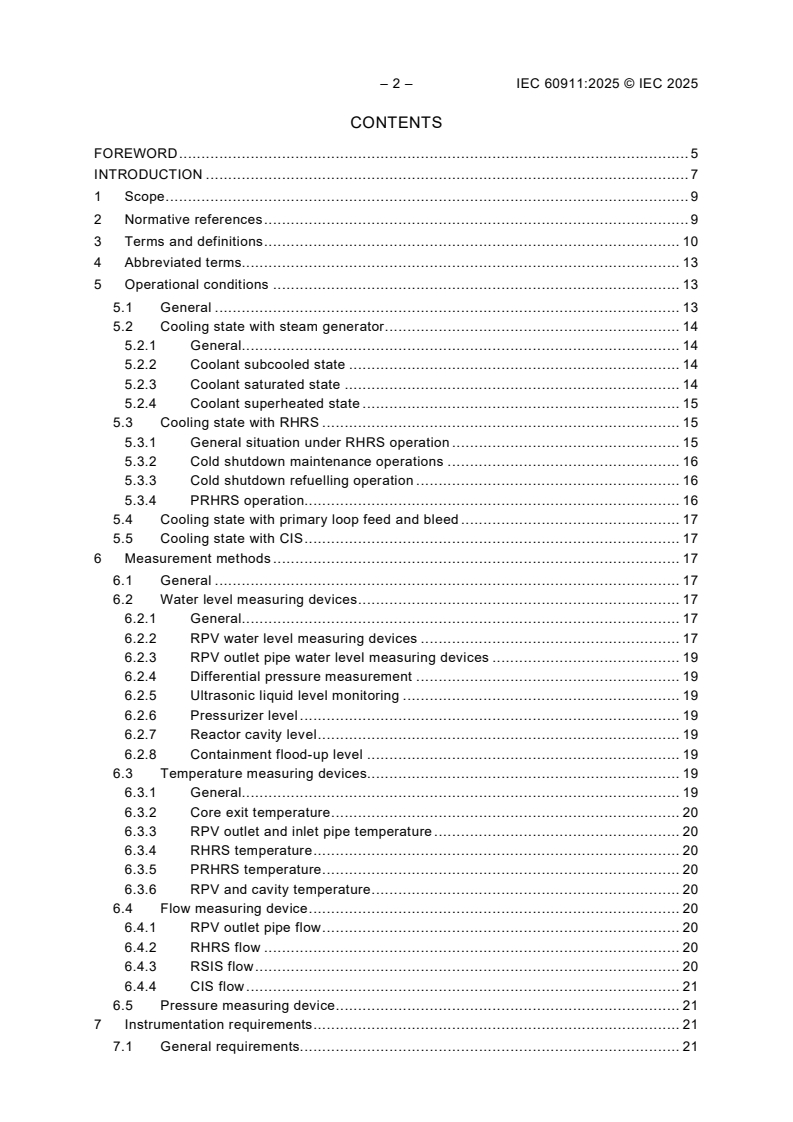
– 2 – IEC 60911:2025 © IEC 2025
CONTENTS
FOREWORD . 5
INTRODUCTION . 7
1 Scope . 9
2 Normative references . 9
3 Terms and definitions . 10
4 Abbreviated terms. 13
5 Operational conditions . 13
5.1 General . 13
5.2 Cooling state with steam generator . 14
5.2.1 General. 14
5.2.2 Coolant subcooled state . 14
5.2.3 Coolant saturated state . 14
5.2.4 Coolant superheated state . 15
5.3 Cooling state with RHRS . 15
5.3.1 General situation under RHRS operation . 15
5.3.2 Cold shutdown maintenance operations . 16
5.3.3 Cold shutdown refuelling operation . 16
5.3.4 PRHRS operation. 16
5.4 Cooling state with primary loop feed and bleed . 17
5.5 Cooling state with CIS . 17
6 Measurement methods . 17
6.1 General . 17
6.2 Water level measuring devices . 17
6.2.1 General. 17
6.2.2 RPV water level measuring devices . 17
6.2.3 RPV outlet pipe water level measuring devices . 19
6.2.4 Differential pressure measurement . 19
6.2.5 Ultrasonic liquid level monitoring . 19
6.2.6 Pressurizer level . 19
6.2.7 Reactor cavity level . 19
6.2.8 Containment flood-up level . 19
6.3 Temperature measuring devices. 19
6.3.1 General. 19
6.3.2 Core exit temperature . 20
6.3.3 RPV outlet and inlet pipe temperature . 20
6.3.4 RHRS temperature . 20
6.3.5 PRHRS temperature . 20
6.3.6 RPV and cavity temperature . 20
6.4 Flow measuring device . 20
6.4.1 RPV outlet pipe flow . 20
6.4.2 RHRS flow . 20
6.4.3 RSIS flow . 20
6.4.4 CIS flow . 21
6.5 Pressure measuring device . 21
7 Instrumentation requirements . 21
7.1 General requirements. 21
7.1.1 Overview . 21
7.1.2 Safety classification . 21
7.1.3 Accuracy and response time . 21
7.1.4 Reliability . 21
7.1.5 Single failure considerations . 21
7.2 Differential pressure measurement . 22
7.2.1 Differential pressure transmitters . 22
7.2.2 Reference columns . 22
7.2.3 Differential pressure tap locations . 22
7.2.4 Hydraulic instrument line installations . 23
7.2.5 Hydraulic instrument line temperature . 23
7.2.6 Type and quality of the fluid in the instrument lines . 24
7.3 Heated sensor measurement . 24
7.4 Ultrasonic liquid level measurement. 24
7.4.1 Application . 24
7.4.2 Accuracy and response time . 24
7.4.3 Installation considerations. 24
7.4.4 Special human machine considerations . 24
7.5 Temperature sensing devices . 24
7.6 Magnetic float sensing devices . 25
8 Operator displays . 25
9 Calibration . 26
10 In-service testing and maintenance . 26
11 Qualification . 26
12 Documentation . 26
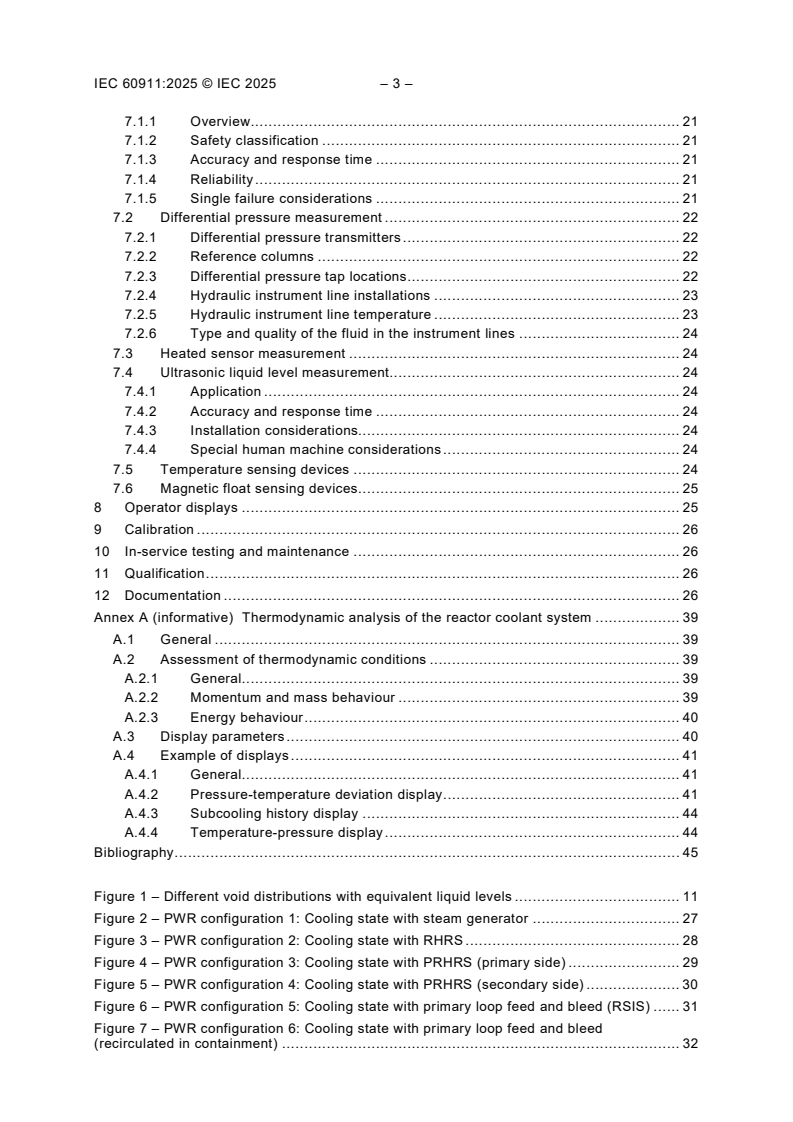
Annex A (informative) Thermodynamic analysis of the reactor coolant system . 39
A.1 General . 39
A.2 Assessment of thermodynamic conditions . 39
A.2.1 General. 39
A.2.2 Momentum and mass behaviour . 39
A.2.3 Energy behaviour . 40
A.3 Display parameters . 40
A.4 Example of displays . 41
A.4.1 General. 41
A.4.2 Pressure-temperature deviation display . 41
A.4.3 Subcooling history display . 44
A.4.4 Temperature-pressure display . 44
Bibliography . 45
Figure 1 – Different void distributions with equivalent liquid levels . 11
Figure 2 – PWR configuration 1: Cooling state with steam generator . 27
Figure 3 – PWR configuration 2: Cooling state with RHRS . 28
Figure 4 – PWR configuration 3: Cooling state with PRHRS (primary side) . 29
Figure 5 – PWR configuration 4: Cooling state with PRHRS (secondary side) . 30
Figure 6 – PWR configuration 5: Cooling state with primary loop feed and bleed (RSIS) . 31
Figure 7 – PWR configuration 6: Cooling state with primary loop feed and bleed
(recirculated in containment) . 32
– 4 – IEC 60911:2025 © IEC 2025
Figure 8 – PWR configuration 7: Cooling state after core melting . 33
Figure 9 – Water level measurement by differential pressure method . 34
Figure 10 – Heated temperature sensor measurement. 35
Figure 11 – Magnetic float actuated reed switches for water level measurements . 36
Figure 12 – Flow measurement by differential pressure method . 37
Figure 13 – Thermal-hydraulic considerations affecting water level measurements . 38
Figure A.1 – Pressure-temperature deviation display . 42
Figure A.2 – Subcooling history display . 43
Figure A.3 – Temperature-pressure display . 43
Table A.1 – Thirteen different cases of changing pressure, temperature and subcooling . 41
INTERNATIONAL ELECTROTECHNICAL COMMISSION
____________
NUCLEAR POWER PLANTS – INSTRUMENTATION SYSTEMS –
MEASUREMENTS FOR MONITORING ADEQUATE COOLING WITHIN
THE CORE OF PRESSURIZED LIGHT WATER REACTORS
FOREWORD
1) The International Electrotechnical Commission (IEC) is a worldwide organization for standardization comprising
all national electrotechnical committees (IEC National Committees). The object of IEC is to promote international
co-operation on all questions concerning standardization in the electrical and electronic fields. To this end and
in addition to other activities, IEC publishes International Standards, Technical Specifications, Technical Reports,
Publicly Available Specifications (PAS) and Guides (hereafter referred to as “IEC Publication(s)”). Their
preparation is entrusted to technical committees; any IEC National Committee interested in the subject dealt with
may participate in this preparatory work. International, governmental and non-governmental organizations liaising
with the IEC also participate in this preparation. IEC collaborates closely with the International Organization for
Standardization (ISO) in accordance with conditions determined by agreement between the two organizations.
2) The formal decisions or agreements of IEC on technical matters express, as nearly as possible, an international
consensus of opinion on the relevant subjects since each technical committee has representation from all
interested IEC National Committees.
3) IEC Publications have the form of recommendations for international use and are accepted by IEC National
Committees in that sense. While all reasonable efforts are made to ensure that the technical content of IEC
Publications is accurate, IEC cannot be held responsible for the way in which they are used or for any
misinterpretation by any end user.
4) In order to promote international uniformity, IEC National Committees undertake to apply IEC Publications
transparently to the maximum extent possible in their national and regional publications. Any divergence between
any IEC Publication and the corresponding national or regional publication shall be clearly indicated in the latter.
5) IEC itself does not provide any attestation of conformity. Independent certification bodies provide conformity
assessment services and, in some areas, access to IEC marks of conformity. IEC is not responsible for any
services carried out by independent certification bodies.
6) All users should ensure that they have the latest edition of this publication.
7) No liability shall attach to IEC or its directors, employees, servants or agents including individual experts and
members of its technical committees and IEC National Committees for any personal injury, property damage or
other damage of any nature whatsoever, whether direct or indirect, or for costs (including legal fees) and
expenses arising out of the publication, use of, or reliance upon, this IEC Publication or any other IEC
Publications.
8) Attention is drawn to the Normative references cited in this publication. Use of the referenced publications is
indispensable for the correct application of this publication.
9) IEC draws attention to the possibility that the implementation of this document may involve the use of (a)
patent(s). IEC takes no position concerning the evidence, validity or applicability of any claimed patent rights in
respect thereof. As of the date of publication of this document, IEC had not received notice of (a) patent(s), which
may be required to implement this document. However, implementers are cautioned that this may not represent
the latest information, which may be obtained from the patent database available at https://patents.iec.ch. IEC
shall not be held responsible for identifying any or all such patent rights.
IEC 60911 has been prepared by subcommittee 45A: Instrumentation, control and electrical
power systems of nuclear facilities, of IEC technical committee 45: Nuclear instrumentation. It
is an International Standard.
This second edition cancels and replaces the first edition published in 1987. This edition
constitutes a technical revision.
This edition includes the following significant technical changes with respect to the previous
edition:
a) Modification of the title.
b) Integration and merging with the content of IEC 62117:1999 relative to the monitoring of
core cooling during cold shutdown.
c) Integration of feedback following the 2011 Fukushima accident.
– 6 – IEC 60911:2025 © IEC 2025
The text of this International Standard is based on the following documents:
Draft Report on voting
45A/1580/FDIS 45A/1602/RVD
Full information on the voting for its approval can be found in the report on voting indicated in
the above table.
The language used for the development of this International Standard is English.
This document was drafted in accordance with ISO/IEC Directives, Part 2, and developed in
accordance with ISO/IEC Directives, Part 1 and ISO/IEC Directives, IEC Supplement, available
at www.iec.ch/members_experts/refdocs. The main document types developed by IEC are
described in greater detail at www.iec.ch/publications.
The committee has decided that the contents of this document will remain unchanged until the
stability date indicated on the IEC website under webstore.iec.ch in the data related to the
specific document. At this date, the document will be
• reconfirmed,
• withdrawn, or
• revised.
INTRODUCTION
a) Technical background, main issues and organisation of the document
This document focuses on the methods and requirements relating to the measurement of
adequate cooling within the core of pressurised water reactors.
Adequate core cooling can be achieved only by providing sufficient coolant flow to the core to
remove the heat. Under normal power operation, cooling of the core is adequately monitored
by the normal reactor protection measurement. Normally, the coolant is forced circulation to
facilitate the heat transfer. However, during certain abnormal shutdown conditions, the coolant
might circulate naturally, or the coolant might even become stationary.
The coolant can be in one phase or two phases:
1) one phase: either liquid, or steam, or a mixture of steam and gas;
2) two phases: a mixture of liquid and steam or gas.
To monitor that adequate cooling is being achieved under those abnormal conditions for which
operator action can be necessary or for which confirmation of coolant inventory status is of
value, sufficient measurements of the coolant inventory shall be provided, including the level
measurement.
Measurement of the subcooling and its time history shall also be provided to assist the operator
in avoiding those abnormal conditions.
It is intended that this document be used by operators of NPPs (utilities), systems evaluators
and by licensors.
b) Situation of the current document in the structure of the IEC SC45A standard series
IEC 60911 is a level 3 IEC SC 45A document covering the methods and requirements for the
monitoring of cooling within the core of pressurised water reactors.
For more details on the structure of the IEC SC45A standard series, see item d) of this
introduction.
c) Recommendations and limitations regarding the application of the document
To ensure that this document will continue to be relevant in future years, the emphasis has
been placed on issues of principle, rather than specific technologies.
d) Description of the structure of the IEC SC45A standard series and relationships with
other IEC documents and other bodies documents (IAEA, ISO)
The IEC SC 45A standard series comprises a consistent set of documents organised in a
hierarchy of four levels. The top-level documents of the IEC SC 45A standard series are
IEC 61513 and IEC 63046, covering respectively general requirements for instrumentation and
control (I&C) systems and general requirements for electrical power systems of NPPs.
IEC 61513 and IEC 63046 adopt an overall system life-cycle framework and constitute, along
with the relevant second-level standards, the nuclear implementation of the basic safety series
IEC 61508.
IEC 61513 and IEC 63046 refer directly to other IEC SC 45A standards for general requirements
for specific topics, such as categorization of functions and classification of systems,
qualification, separation, defence against common cause failure, control room design,
electromagnetic compatibility, human factors engineering, cybersecurity, software and
hardware aspects for programmable digital systems, coordination of safety and security
requirements and management of ageing.
– 8 – IEC 60911:2025 © IEC 2025
At a third level, IEC SC 45A standards not directly referenced by IEC 61513 or by IEC 63046
are standards related to specific requirements for specific equipment, technical methods, or
activities. Usually, these documents refer to second-level documents for general requirements
and can be used on their own.
A fourth level extending the IEC SC 45A standard series, corresponds to the Technical Reports
which are not normative.
The IEC SC 45A standards series consistently implements and details the safety and security
principles and basic aspects provided in the relevant IAEA safety standards and in the relevant
documents of the IAEA nuclear security series (NSS). In particular this includes the IAEA
requirements SSR-2/1 , establishing safety requirements related to the design of nuclear power
plants (NPPs), the IAEA safety guide SSG-30 dealing with the safety classification of structures,
systems and components in NPPs, the IAEA safety guide SSG-39 dealing with the design of
instrumentation and control systems for NPPs, the IAEA safety guide SSG-34 dealing with the
design of electrical power systems for NPPs, the IAEA safety guide SSG-51 dealing with human
factors engineering in the design of NPPs and the implementing guide NSS42-G for computer
security at nuclear facilities. The safety and security terminology and definitions used by the
SC 45A standards are consistent with those used by the IAEA.
IEC 61513 and IEC 63046 refer to ISO 9001 as well as to IAEA GSR part 2 and IAEA GS-G-3.1
and IAEA GS-G-3.5 for topics related to quality assurance (QA).
At level 2, regarding nuclear security, IEC 62645 is the entry document for the IEC SC 45A
security standards. It builds upon the valid high-level principles and main concepts of the
generic security standards, in particular ISO/IEC 27001 and ISO/IEC 27002; it adapts them and
completes them to fit the nuclear context and coordinates with the IEC 62443 series. At level 2,
IEC 60964 is the entry document for the IEC SC 45A control rooms standards, IEC 63351 is the
entry document for the human factors engineering standards and IEC 62342 is the entry
document for the ageing management standards.
NOTE IEC TR 63400 provides a more comprehensive description of the overall structure of the IEC SC 45A
standards series and of its relationship with other standards bodies and standards.
NUCLEAR POWER PLANTS – INSTRUMENTATION SYSTEMS –
MEASUREMENTS FOR MONITORING ADEQUATE COOLING WITHIN
THE CORE OF PRESSURIZED LIGHT WATER REACTORS
1 Scope
This document applies to pressurized water reactors (PWRs) and presents requirements for the
monitoring of adequate cooling within the core in all operations, including normal and abnormal
operations. Requirements for core cooling monitoring during conditions beyond a design basis
accident, i.e. a design extension condition of type A or type B, are also covered in this document.
This document defines requirements for instrumentation to measure coolant parameters, which
are of interest when abnormal conditions arise with either one or two phases of coolant or with
gas included in the reactor pressure vessel (RPV).
PWR users can acquire this instrumentation to present information on coolant conditions, to
assist the operator to decide on actions necessary to maintain adequate core cooling.
Typical applications in operating nuclear power plants are also presented in this document.
2 Normative references
The following documents are referred to in the text in such a way that some or all of their content
constitutes requirements of this document. For dated references, only the edition cited applies.
For undated references, the latest edition of the referenced document (including any
amendments) applies.
IEC 60880, Nuclear power plants – Instrumentation and control systems important to safety –
Software aspects for computer-based systems performing category A functions
IEC 60964, Nuclear power plants – Control rooms – Design
IEC 61225, Nuclear power plants – Instrumentation, control and electrical power systems –
Requirements for static uninterruptible DC and AC power supply systems
IEC 61226, Nuclear power plants – Instrumentation, control and electrical power systems
important to safety – Categorization of functions and classifications of systems
IEC 61227, Nuclear power plants – Control rooms – Operator controls
IEC 62566, Nuclear power plants – Instrumentation and control important to safety –
Development of HDL-programmed integrated circuits for systems performing category A
functions
IEC 62828-2, Reference conditions and procedures for testing industrial and process
measurement transmitters – Part 2: Specific procedures for pressure transmitters
IEC 63147, Criteria for accident monitoring instrumentation for nuclear power generating
stations
IEC/IEEE 60780-323, Nuclear facilities – Electrical equipment important to safety – Qualification
– 10 – IEC 60911:2025 © IEC 2025
IEC/IEEE 60980-344:2020, Nuclear facilities – Equipment important to safety – Seismic
qualification
3 Terms and definitions
For the purposes of this document, the following terms and definitions apply.
ISO and IEC maintain terminology databases for use in standardization at the following
addresses:
• IEC Electropedia: available at https://www.electropedia.org/
• ISO Online browsing platform: available at https://www.iso.org/obp
3.1
anticipated operational occurrences
deviation of an operational process from normal operation that is expected to occur at least
once during the operating lifetime of a facility but which, in view of appropriate design
provisions, does not cause any significant damage to items important to safety or lead to
accident conditions
[SOURCE: IAEA Nuclear Safety and Security Glossary, 2022]
3.2
cavity injection and cooling system
CIS
auxiliary system in a pressurized water reactor (PWR) for injecting coolant to the reactor cavity
during severe accidents
3.3
coolant
water and/or steam for heat removal from the core
[SOURCE: IEC 61343:1996, 3.2]
3.4
diversity
presence of two or more independent (redundant) systems or components to perform an
identified function, where the different systems or components have different attributes so as
to reduce the possibility of common cause failure, including common mode failure
[SOURCE: IAEA Nuclear Safety and Security Glossary, 2022]
3.5
equivalent liquid level
level that would result in the reactor pressure vessel (RPV) if the steam and water phases of
the coolant were completely separated, and which is also described as the collapsed water
level
Note 1 to entry: Different void distributions can have the same equivalent liquid level as shown in Figure 1, where
Figure 1 c) illustrates the equivalent level for the same volume of liquid as Figure 1 a) and Figure 1 b).
a) Void distribution 1 b) Void distribution 2 c) Collapsed water level
Figure 1 – Different void distributions with equivalent liquid levels
3.6
impulse line
sensing line
piping or tubing connecting the process to the sensor
Note 1 to entry: Impulse lines/sensing lines are usually used to connect pressure, level, and flow transmitters to
the process. They vary in length from a few meters to a few hundred meters. Sensing lines may also include isolation
and root valves and other piping hardware along their length.
[SOURCE: IEC 62385:2007, 3.8, modified – The second and third sentences have been
included into Note 1 to entry]
3.7
liquid level
level of the horizontal surface dividing liquid from steam or gas
3.8
monitoring
means provided to indicate continuously the state or condition of a system, sub-system,
equipment or assembly
[SOURCE: IEC 60671:2007, 3.6]
3.9
passive residual heat removal system
PRHRS
passive auxiliary system in a PWR for removing heat from the reactor core during abnormal
operations
– 12 – IEC 60911:2025 © IEC 2025
3.10
pressurized water reactor
PWR
nuclear steam supply system in which the pressurized coolant is heated by the reactor core,
and process steam is generated in the steam generator by heat transfer from the coolant
3.11
reactor pressure vessel
RPV
vessel which contains the reactor core
3.12
reactor safety injection system
RSIS
auxiliary system in a PWR for injecting coolant to the reactor core during abnormal operations
3.13
reduced inventory condition
intentional condition that exists during specific maintenance operations whenever water level
in the RPV is lower than the top of the RPV hot leg piping nozzle elevation, plus an allowance
for water level measurement uncertainty
3.14
redundancy
provision of alternative (identical or diverse) structures, systems and components, so that any
single structure, system or component can perform the required function regardless of the state
of operation or failure of any other
[SOURCE: IAEA Nuclear Safety and Security Glossary, 2022]
3.15
residual heat removal system
RHRS
auxiliary system in a PWR for removing heat from the reactor core during shutdown operations
3.16
severe accident
accident more severe than a design basis accident and involving significant core degradation
[SOURCE: IAEA Nuclear Safety and Security Glossary, 2022]
3.17
single failure criterion
criterion (or requirement) applied to a system such that it must be capable of performing its task
in the presence of any single failure
[SOURCE: IAEA Nuclear Safety and Security Glossary, 2022]
3.18
subcooled water
water at a temperature lower than the saturation temperature corresponding to the existing
pressure
3.19
subcooling
difference by which the saturation temperature corresponding to the pressure existing in the
liquid exceeds the liquid temperature at that point
3.20
superheated steam
steam at a temperature higher than the saturation temperature corresponding to the existing
pressure
3.21
superheating
difference by which the saturation temperature corresponding to the pressure existing in the
steam is below the steam temperature at that point
3.22
void
volume occupied by steam or gas
Note 1 to entry: This definition applies both to bubbles dispersed within a liquid phase and to large homogeneous
volumes.
3.23
void fraction
ratio of void to total volume
4 Abbreviated terms
CIS cavity injection and cooling system
PRHRS passive residual heat removal system
PWR pressurized water reactor
RCS reactor coolant system
RHRS residual heat removal system
RPV reactor pressure vessel
RSIS reactor safety injection system
5 Operational conditions
5.1 General
Clause 5 should be considered with the safety analysis for the plant in normal and abnormal
conditions. It explains the conditions for which this instrumentation is used for measurement
and display of coolant parameters. The thermodynamic analysis of the reactor coolant system
can be carried out in accordance with Annex A. Adequate core cooling can be confirmed by a
measurement indicating that coolant is being circulated through the RPV at an appropriate
temperature, pressure and flow to remove heat from the core. The requirement for adequate
cooling exists for all operating modes.
The plant states of a typical nuclear power plant can be categorized as follows (see IAEA Safety
Standards Series No. SSR-2/1 (Rev. 1)):
Operational states Accident conditions
Design extension conditions
Anticipated
Normal operation operational Design basis accident
Without significant
With core melting
occurrences
fuel degradation
Among them, the normal operating conditions of nuclear power plants include power operation,
hot standby, reactor criticality, hot shutdown, biphasic intermediate shutdown with steam
generator operation, biphasic intermediate shutdown with RHRS, monophasic intermediate
shutdown, normal cold shutdown, maintenance cold shutdown, refuelling cold shutdown, etc.
– 14 – IEC 60911:2025 © IEC 2025
For core cooling, nuclear power plants can be divided into steam generator cooling and residual
heat removal system cooling states under normal operating conditions.
In case of an anticipated operational occurrence or under accident conditions, the cooling state
of the reactor core can be covered by the division of subclauses 5.2 through 5.5.
This document covers instrumentation considerations for monitoring core cooling at PWRs with
configurations similar to those shown in Figure 2 to Figure 8. Although PWR configurations
shown in Figure 2 to Figure 6 use vertical U-tube steam generators, there is no impact on core
cooling monitoring if they are changed into superheat steam generators.
5.2 Cooling state with steam generator
5.2.1 General
When the reactor is in the cooled state of the steam generator, the primary loop is closed, and
the flow of reactor coolant can be forced or natural. Core heat is transferred to the coolant and
exported through the steam generator.
As described in Annex A, the reactor coolant may be in three thermal states. For PWRs, these
correspond to subcooled water, saturated state, and superheated steam.
The PWR configuration is shown in Figure 2.
5.2.2 Coolant subcooled state
Once the reactor coolant is subcooled, it indicates that the RPV is filled with water at this time,
which can be characterized by measuring the pressurizer level. As a special case, especially in
the event of an accident, where the pressurizer level can be lost, the water load of the RPV can
be directly monitored by measuring the RPV water level. Adequate core cooling can be
confirmed by a measurement indicating that coolant is being circulated at an appropriate RPV
outlet pipe flow to remove heat from the core.
In addition, adequate core cooling can also be confirmed by monitoring the subcooling of the
coolant through measurement of the reactor coolant pressure and reactor coolant temperatures
(core exit, RPV outlet pipe, RPV inlet pipe).
5.2.3 Coolant saturated state
Under anticipated operational occurrences and accident conditions, the coolant in the RPV can
be saturated, leaving the coolant in a two-phase state. At this time, the core exit temperature
detector measures the temperature of saturated water or steam. As a result, it cannot fully
indicate the cooling level of the core or provide trend information. Therefore, supplementary
monitoring of other parameters is necessary. When the coolant is in the two-phase condition, it
is important to know the equivalent liquid level or the void fraction. The equivalent liquid level
is important because it indicates the extent to which the core could be uncovered if the phases
are completely separated. Normally, there is a greater cooling capacity than what is indicated
by the equivalent liquid level.
Once a saturated coolant condition exists, voids can form in the coolant system. The
significance of void formation relative to adequate core cooling is dependent on the two coolant
circulation modes as follows:
• In natural circulation or stagnant conditions, void formation will result in the development of
an equivalent liquid level in the RPV. Adequate cooling under this condition exists if the core
remains covered with water.
• In forced circulation, reactor coolant pumps will continue to circulate the coolant as a
homogeneous mixture of liquid and steam or gas. Adequate core cooling under this condition
is ensured even with a relatively high void fraction.
Considering the above analysis, the RPV water level, RPV outlet pipe temperature, RPV inlet
pipe temperature, RPV outlet pipe flow and core exit temperature should be monitored.
5.2.4 Coolant superheated state
Superheating of the coolant often corresponds to a significant loss of core coolant capacity, a
high void fraction or an excessively lower equivalent liquid level than the top of the core active
zone.
To monitor the severity of the superheated condition, instrumentation should be provided to
indicate the core exit temperature and the amount of superheating. The reactor coolant pressure
and the core exit temperature are required. The same instrument used to measure subcooling
can be used to measure the amount of superheating. From this information it is possible to
derive the amount of superheating, i.e. the difference between steam temperature and
saturation temperature.
5.3 Cooling state with RHRS
5.3.1 General situation under RHRS operation
Normally, RHRS is put into operation to remove the core residual heat from biphasic
intermediate shutdown condition to cold shutdown condition.
It is important that plant operators have reliable information to confirm that the temperature and
flow of coolant circulated through the RPV are adequate to remove heat from the core.
Unreliable information can result in an interruption of core cooling, a condition that has occurred
at several PWRs. Information regarding previous loss of cooling events can be consulted in the
IAEA/NEA International Reporting System for Operating Experience (IRS).
In general, the RHRS draws water from the hot leg of the main system, cools it in the heat
exchanger, and injects it back into the cold leg of the main system. Therefore, in addition to the
existing coolant-related monitoring parameters (RPV water level and RPV outlet pipe
temperature, etc.), the flow rate and inlet temperature of the RHRS can also effectively
represent the adequate cooling of the core.
In order to maintain the normal operation of the RHRS, the water inventory of hot leg section
shall remain submerged to avoid cavitation of the RHRS pump. Therefore, it is also necessary
to monitor the RPV outlet pipe water level.
The PWR configurations are shown in Figure 3, Figure 4, and Figure 5.
General scenarios under RHRS operation comprise biphasic intermediate shutdown,
monophasic intermediate shutdown and normal cold shutdown. The connections between the
RCS and the RHRS are open, part of the reactor coolant flows into the RHRS, after heat
exchanging, the flow returns back to the RCS through the injection lines. The core cooling is
controlled by adjusting the reactor coolant flow through the RHRS heat exchangers.
Biphasic intermediate shutdown with RHRS operations cover operations at coolant
temperatures between 120 °C and 180 °C with the reactor sufficiently subcritical (that is,
multiplication factor k < 0,99).
Monophasic intermediate shutdown with RHRS operations cover operations at coolant
temperatures between 90 °C and 180 °C with the reactor sufficiently subcritical (that is,
multiplication factor k < 0,99).
Normal cold shutdown with RHRS operations cover operations at coolant temperatures between
10 °C and 90 °C with the reactor sufficiently subcritical at least 1 000 pcm. When the reactor
coolant temperature is below 70 °C, the reactor coolant uniformity is maintained by use of the
RHRS pumps.
– 16 – IEC 60911:2025 © IEC 2025
To ensure adequate core cooling under above operation, the RPV water level, RPV outlet pipe
water level, RPV outlet pipe temperature, core exit temperature, RHRS flow and RHRS
temperature should be monitored as shown in Figure 3.
5.3.2 Cold shutdown maintenance operations
Cold shutdown maintenance operations cover operations at coolant temperatures below 60 °C,
with the reactor sufficiently subcritical (that is, multiplication factor k < 0,99) and with all RPV
head closure bolts fully tensioned. Core residual heat is removed by the RHRS, which has
redundant components to minimize the possibility of a loss of core cooling capability.
Emergency power is available to maintain coolant flow to remove heat with the RHRS in the
event that offsite power is lost.
A reduced inventory condition exists for specific maintenance operations (for example, steam
generator tube plugging or reactor coolant pump seal replacement) whenever the water level in
the RPV is lower than the top of the RPV outlet piping nozzle elevation, plus an allowance for
water level measurement uncertainty. In these specific operations, coolant inventory is
maintained at or above the water level in the RPV outlet piping required to circulate coolant to
the RHRS.
During a reduced inventory condition, an inadvertent coolant inventory increase could result in
coolant overflow through openings in the RCS pressure boundary, resulting in personnel
contamination. An inadvertent coolant inventory decrease could interrupt the RHRS flow and
core cooling, resulting in the rise in core temperature and possible boiling of the remaining
coolant in the RPV. To preclude these conditions, a reliable measurement of coolant inventory
and temperature is required, including RPV water level, RPV outlet pipe water level, RPV outlet
pipe temperature, core exit temperature, RHRS flow and RHRS temperature, as show
...