

CISPR TR 16-3:2003
(Main)Specification for radio disturbance and immunity measuring apparatus and methods - Part 3: CISPR technical reports
General Information
- Abstract
This part of CISPR 16 contains specific technical reports and information on the history of CISPR. CISPR 16-3 has been reorganised into 4 parts, to accommodate growth and easier maintenance. This second edition of CISPR 16-3, together with CISPR 16-4-1, CISPR 16-4-3 and CISPR 16-4-4, cancels and replaces the first edition of CISPR 16-3, published in 2000, and its amendment 1 (2002). It contains the relevant clauses of CISPR 16-3 without technical changes.
- Status
- Published
- Publication Date
- 25-Nov-2003
- Technical Committee
- CIS/A - Radio-interference measurements and statistical methods
- Current Stage
- DELPUB - Deleted Publication
- Start Date
- 10-Aug-2010
- Completion Date
- 28-Aug-2026
Overview
CISPR TR 16-3:2003 (CISPR 16-3/TR:2003(E)) is an IEC technical report that collects CISPR technical reports and background material related to measurements of radio disturbance and immunity. Published as the second edition in November 2003, it was reorganized (together with CISPR 16-4-1, 16-4-3 and 16-4-4) to replace the first edition (2000) and its 2002 amendment. The document preserves the original technical content without substantive technical changes and provides historic context, definitions and focused guidance for electromagnetic compatibility (EMC) measurement practice.
Key Topics
The report compiles technical reports and supporting material on measurement and interpretation of radio disturbance and immunity, including:
- Correlation of measurements made with apparatus that differ from CISPR reference characteristics - guidance on comparing non‑CISPR and CISPR measurements.
- Interference simulators - documentation on tools used to reproduce disturbance phenomena.
- Open-area test site vs. reverberation chamber - relationships between limits and measurement environments.
- Disturbance sources on telephone lines induced by AM broadcast transmitters (LW, MW, SW) - characterization and classification of asymmetrical sources.
- Predictability of radiation in vertical directions at frequencies above 30 MHz and up to 30 MHz.
- Background and history - history of CISPR, and historical measurement methods such as VHF interference power from household appliances.
- Definitions and measurement concepts - bandwidth, impulse bandwidth and impulse area, electrical charge/discharge time constants, mechanical time constants, and other metrological terms used in CISPR measurement standards.
Applications
CISPR 16-3 is a reference for:
- EMC test laboratories validating measurement methods and interpreting results across different test set-ups.
- Standards and compliance engineers comparing results from open-area test sites, anechoic chambers and reverberation chambers.
- Test-equipment manufacturers developing measurement receivers, interference simulators and calibration tools.
- Telecom operators and product designers dealing with line-induced disturbances from broadcast services.
- Regulators and technical committees needing historical and methodological context for radio disturbance limits.
Who Should Use It
- EMC engineers and test lab managers
- Instrumentation and antenna calibration specialists
- Regulatory compliance professionals
- Standards developers and technical committee members
Related Standards
- CISPR 16-1 (measuring apparatus)
- CISPR 16-2 (methods of measurement)
- CISPR 16-4 (uncertainties, statistics and limit modelling)
- CISPR 11 (industrial, scientific and medical equipment limits and methods)
- ITU‑R Recommendation BS.468-4 (audio‑frequency noise measurement)
CISPR TR 16-3 is particularly valuable when you need consolidated technical reports, authoritative definitions, and cross-references to the broader CISPR measurement framework for reliable EMC testing and interpretation.
Relations
- Effective Date
- 05-Sep-2023
- Effective Date
- 05-Sep-2023
- Effective Date
- 05-Sep-2023
- Effective Date
- 05-Sep-2023
- Effective Date
- 05-Sep-2023
Get Certified
Connect with accredited certification bodies for this standard

ANCE
Mexican certification and testing association.

Intertek Slovenia
Intertek testing, inspection, and certification services in Slovenia.

LNE (Laboratoire National de Métrologie et d'Essais)
French national laboratory for metrology and testing.
Sponsored listings
Frequently Asked Questions
CISPR TR 16-3:2003 is a technical report published by the International Electrotechnical Commission (IEC). Its full title is "Specification for radio disturbance and immunity measuring apparatus and methods - Part 3: CISPR technical reports". This standard covers: This part of CISPR 16 contains specific technical reports and information on the history of CISPR. CISPR 16-3 has been reorganised into 4 parts, to accommodate growth and easier maintenance. This second edition of CISPR 16-3, together with CISPR 16-4-1, CISPR 16-4-3 and CISPR 16-4-4, cancels and replaces the first edition of CISPR 16-3, published in 2000, and its amendment 1 (2002). It contains the relevant clauses of CISPR 16-3 without technical changes.
This part of CISPR 16 contains specific technical reports and information on the history of CISPR. CISPR 16-3 has been reorganised into 4 parts, to accommodate growth and easier maintenance. This second edition of CISPR 16-3, together with CISPR 16-4-1, CISPR 16-4-3 and CISPR 16-4-4, cancels and replaces the first edition of CISPR 16-3, published in 2000, and its amendment 1 (2002). It contains the relevant clauses of CISPR 16-3 without technical changes.
CISPR TR 16-3:2003 is classified under the following ICS (International Classification for Standards) categories: 33.100.10 - Emission; 33.100.20 - Immunity. The ICS classification helps identify the subject area and facilitates finding related standards.
CISPR TR 16-3:2003 has the following relationships with other standards: It is inter standard links to CISPR TR 16-3:2003/AMD1:2005, CISPR TR 16-3:2003/AMD2:2006, CISPR TR 16-3:2000/AMD1:2002, CISPR TR 16-3:2010, CISPR TR 16-3:2000. Understanding these relationships helps ensure you are using the most current and applicable version of the standard.
CISPR TR 16-3:2003 is available in PDF format for immediate download after purchase. The document can be added to your cart and obtained through the secure checkout process. Digital delivery ensures instant access to the complete standard document.
Standards Content (Sample)
TECHNICAL CISPR
REPORT 16-3
Second edition
2003-11
INTERNATIONAL SPECIAL COMMITTEE ON RADIO INTERFERENCE
Specification for radio disturbance and immunity
measuring apparatus and methods –
Part 3:
CISPR technical reports
Reference number
CISPR 16-3/TR:2003(E)
Publication numbering
As from 1 January 1997 all IEC publications are issued with a designation in the
60000 series. For example, IEC 34-1 is now referred to as IEC 60034-1.
Consolidated editions
The IEC is now publishing consolidated versions of its publications. For example,
edition numbers 1.0, 1.1 and 1.2 refer, respectively, to the base publication, the
base publication incorporating amendment 1 and the base publication incorporating
amendments 1 and 2.
Further information on IEC publications
The technical content of IEC publications is kept under constant review by the IEC,
thus ensuring that the content reflects current technology. Information relating to
this publication, including its validity, is available in the IEC Catalogue of
publications (see below) in addition to new editions, amendments and corrigenda.
Information on the subjects under consideration and work in progress undertaken
by the technical committee which has prepared this publication, as well as the list
of publications issued, is also available from the following:
• IEC Web Site (www.iec.ch)
• Catalogue of IEC publications
The on-line catalogue on the IEC web site (www.iec.ch/searchpub) enables you to
search by a variety of criteria including text searches, technical committees
and date of publication. On-line information is also available on recently issued
publications, withdrawn and replaced publications, as well as corrigenda.
• IEC Just Published
This summary of recently issued publications (www.iec.ch/online_news/ justpub)
is also available by email. Please contact the Customer Service Centre (see
below) for further information.
• Customer Service Centre
If you have any questions regarding this publication or need further assistance,
please contact the Customer Service Centre:
Email: custserv@iec.ch
Tel: +41 22 919 02 11
Fax: +41 22 919 03 00
TECHNICAL CISPR
REPORT 16-3
Second edition
2003-11
INTERNATIONAL SPECIAL COMMITTEE ON RADIO INTERFERENCE
Specification for radio disturbance and immunity
measuring apparatus and methods –
Part 3:
CISPR technical reports
© IEC 2003 Copyright - all rights reserved
No part of this publication may be reproduced or utilized in any form or by any means, electronic or
mechanical, including photocopying and microfilm, without permission in writing from the publisher.
International Electrotechnical Commission, 3, rue de Varembé, PO Box 131, CH-1211 Geneva 20, Switzerland
Telephone: +41 22 919 02 11 Telefax: +41 22 919 03 00 E-mail: inmail@iec.ch Web: www.iec.ch
PRICE CODE
Commission Electrotechnique Internationale
XH
International Electrotechnical Commission
Международная Электротехническая Комиссия
For price, see current catalogue
– 2 – CISPR 16-3/TR IEC:2003(E)
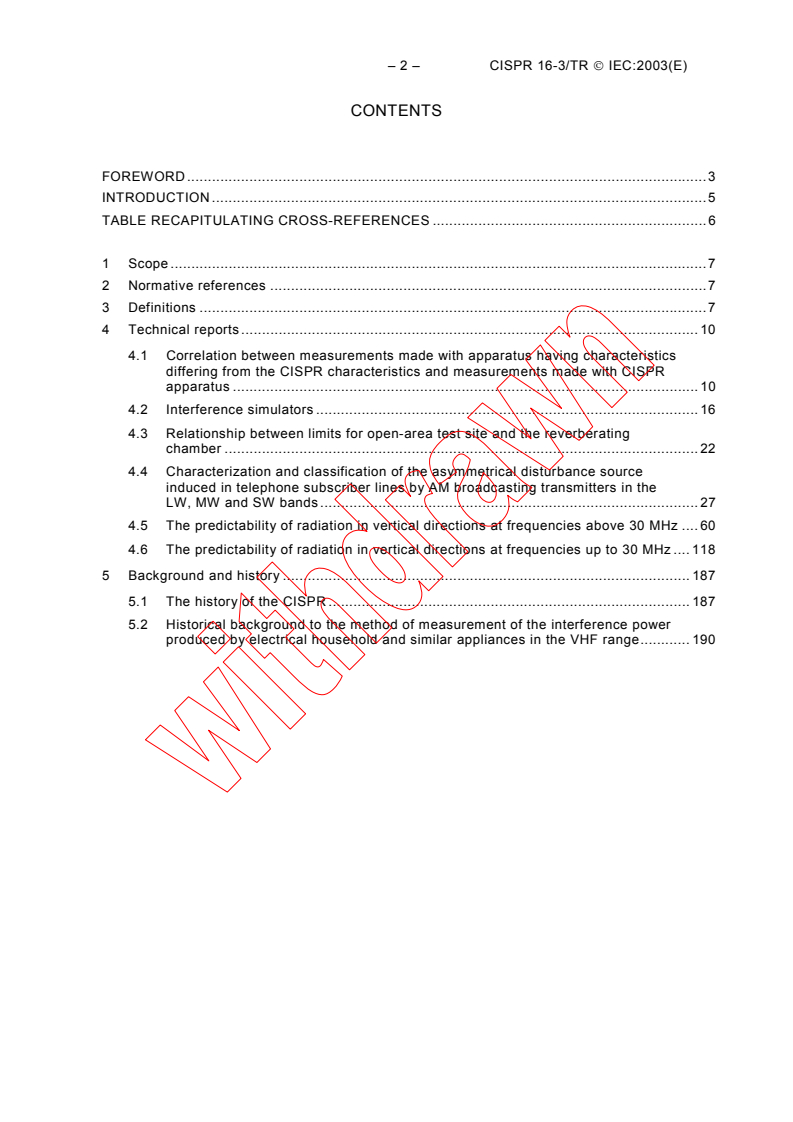
CONTENTS
FOREWORD .3
INTRODUCTION .5
TABLE RECAPITULATING CROSS-REFERENCES .6
1 Scope .7
2 Normative references .7
3 Definitions.7
4 Technical reports. 10
4.1 Correlation between measurements made with apparatus having characteristics
differing from the CISPR characteristics and measurements made with CISPR
apparatus . 10
4.2 Interference simulators . 16
4.3 Relationship between limits for open-area test site and the reverberating
chamber . 22
4.4 Characterization and classification of the asymmetrical disturbance source
induced in telephone subscriber lines by AM broadcasting transmitters in the
LW, MW and SW bands . 27
4.5 The predictability of radiation in vertical directions at frequencies above 30 MHz . 60
4.6 The predictability of radiation in vertical directions at frequencies up to 30 MHz . 118
5 Background and history . 187
5.1 The history of the CISPR . 187
5.2 Historical background to the method of measurement of the interference power
produced by electrical household and similar appliances in the VHF range. 190
CISPR 16-3/TR © IEC:2003(E) – 3 –
INTERNATIONAL ELECTROTECHNICAL COMMISSION
____________
SPECIFICATION FOR RADIO DISTURBANCE
AND IMMUNITY MEASURING APPARATUS AND METHODS –
Part 3: CISPR technical reports
FOREWORD
1) The International Electrotechnical Commission (IEC) is a worldwide organization for standardization
comprising all national electrotechnical committees (IEC National Committees). The object of IEC is to
promote international co-operation on all questions concerning standardization in the electrical and
electronic fields. To this end and in addition to other activities, IEC publishes International Standards,
Technical Specifications, Technical Reports, Publicly Available Specifications (PAS) and Guides (hereafter
referred to as “IEC Publication(s)”). Their preparation is entrusted to technical committees; any IEC National
Committee interested in the subject dealt with may participate in this preparatory work. International,
governmental and non-governmental organizations liaising with the IEC also participate in this preparation.
IEC collaborates closely with the International Organization for Standardization (ISO) in accordance with
conditions determined by agreement between the two organizations.
2) The formal decisions or agreements of IEC on technical matters express, as nearly as possible, an
international consensus of opinion on the relevant subjects since each technical committee has
representation from all interested IEC National Committees.
3) IEC Publications have the form of recommendations for international use and are accepted by IEC National
Committees in that sense. While all reasonable efforts are made to ensure that the technical content of IEC
Publications is accurate, IEC cannot be held responsible for the way in which they are used or for any
misinterpretation by any end user.
4) In order to promote international uniformity, IEC National Committees undertake to apply IEC Publications
transparently to the maximum extent possible in their national and regional publications. Any divergence
between any IEC Publication and the corresponding national or regional publication shall be clearly indicated
in the latter.
5) IEC provides no marking procedure to indicate its approval and cannot be rendered responsible for any
equipment declared to be in conformity with an IEC Publication.
6) All users should ensure that they have the latest edition of this publication.
7) No liability shall attach to IEC or its directors, employees, servants or agents including individual experts and
members of its technical committees and IEC National Committees for any personal injury, property damage
or other damage of any nature whatsoever, whether direct or indirect, or for costs (including legal fees) and
expenses arising out of the publication, use of, or reliance upon, this IEC Publication or any other IEC
Publications.
8) Attention is drawn to the Normative references cited in this publication. Use of the referenced publications is
indispensable for the correct application of this publication.
9) Attention is drawn to the possibility that some of the elements of this IEC Publication may be the subject of
patent rights. IEC shall not be held responsible for identifying any or all such patent rights.
The main task of IEC technical committees is to prepare International Standards. However,
a technical committee may propose the publication of a technical report when it has
collected data of a different kind from that which is normally published as an International
Standard, for example "state of the art".
CISPR 16-3, which is a technical report, has been prepared by CISPR subcommittee A:
Radio interference measurements and statistical methods.
This second edition of CISPR 16-3, together with CISPR 16-4-1, CISPR 16-4-3 and
CISPR 16-4-4 cancels and replaces the first edition of CISPR 16-3, published in 2000, and
its amendment 1 (2002). It contains the relevant clauses of CISPR 16-3 without technical
changes.
This publication has been drafted in accordance with the ISO/IEC Directives, Part 2.
A bilingual version of this publication may be issued at a later date.
– 4 – CISPR 16-3/TR IEC:2003(E)
The committee has decided that the contents of this publication will remain unchanged until
2006. At this date, the publication will be
• reconfirmed;
• withdrawn;
• replaced by a revised edition, or
• amended.
The text of this report is based on the following documents:
Report 33 – p/o CISPR 8, 1969; Report 38 – p/o CISPR 8, 1969; Report 49 – p/o CISPR
8C, 1980; Report: CIS/A(Sec)67 + CIS/A(Sweden)29; RM 2828/CISPR/A, 1985;
CIS/A(CO)32, 1985; CIS/A(Sec)58, 1983; CIS/A(Sec)58A, 1983; CIS/A(Sec)67, 1985;
CIS/A(CO)77A, 1993; CIS/A(CO)81, 1987; CIS/A(CO)82, 1994; CIS/A(CO)84, 1994;
CIS/A(Sec)84, 1987; CIS/A(Sec)88, 1988; CIS/A(Sec)88A, 1988; CIS/A(Sec)94, 1989;
CIS/A(Sec)115, 1991; CIS/A(Sec)115A, 1991; CIS/A(Sec)116, 1991; CIS/A(Sec)124, 1991;
CIS/A(Sec)128, 1992; CIS/A(Sec)132, 1993; CIS/A/166/CD, 1995.
CISPR 16-3/TR © IEC:2003(E) – 5 –
INTRODUCTION
CISPR 16-1, CISPR 16-2, CISPR 16-3 and CISPR 16-4 have been reorganised into 14
parts, to accommodate growth and easier maintenance. The new parts have also been
renumbered. See the list given below.
Old CISPR 16 publications New CISPR 16 publications
CISPR 16-1-1 Measuring apparatus
CISPR 16-1-2 Ancillary equipment – Conducted disturbances
Radio disturbance
and immunity
CISPR 16-1-3 Ancillary equipment – Disturbance power
CISPR 16-1
measuring
apparatus
Ancillary equipment – Radiated disturbances
CISPR 16-1-4
Antenna calibration test sites for 30 MHz to
CISPR 16-1-5
1 000 MHz
CISPR 16-2-1 Conducted disturbance measurements
Methods of
CISPR 16-2-2 Measurement of disturbance power
measurement of
CISPR 16-2
disturbances and
CISPR 16-2-3 Radiated disturbance measurements
immunity
CISPR 16-2-4
Immunity measurements
CISPR 16-3 CISPR technical reports
CISPR 16-4-1 Uncertainties in standardised EMC tests
Reports and
CISPR 16-3 recommendations Measurement instrumentation uncertainty
CISPR 16-4-2
of CISPR
Statistical considerations in the
CISPR 16-4-3
determination of EMC compliance of mass-
produced products
Statistics of complaints and a model for the
Uncertainty in EMC
CISPR 16-4 CISPR 16-4-4
calculation of limits
measurements
More specific information on the relation between the ‘old’ CISPR 16-3 and the present
‘new’ CISPR 16-3 is given in the table after this introduction (TABLE RECAPITULATING
CROSS REFERENCES).
Measurement instrumentation specifications are given in five new parts of CISPR 16-1,
while the methods of measurement are covered now in four new parts of CISPR 16-2.
Various reports with further information and background on CISPR and radio disturbances
in general are given in CISPR 16-3. CISPR 16-4 contains information related to
uncertainties, statistics and limit modelling.
– 6 – CISPR 16-3/TR IEC:2003(E)
TABLE RECAPITULATING CROSS-REFERENCES
First edition of CISPR 16-3 Second edition of CISPR 16-3
Clauses, subclauses Clauses, subclauses
1.1 1
1.2 2
1.3 3
4 4
4.1 4.1
4.2 4.2
4.3 4.3
4.4 4.4
4.5 4.5
4.6 4.6
5 5
5.1 5.1
5.2 5.2
CISPR 16-3/TR © IEC:2003(E) – 7 –
SPECIFICATION FOR RADIO DISTURBANCE
AND IMMUNITY MEASURING APPARATUS AND METHODS –
Part 3: CISPR technical reports
1 Scope
This part of CISPR 16 contains specific technical reports and information on the history of
CISPR.
Over the years, the CISPR prepared a number of recommendations and reports that have
significant technical merit but were not generally available. Reports and recommendations
were for some time published in CISPR 7 and 8.
At its meeting in Campinas, Brazil, in 1988, subcommittee A agreed on the table of contents
of part 3 and to publish the reports for posterity by giving the reports a permanent place in
part 3.
With the reorganization of CISPR 16 in 2003, the significance of CISPR limits has been
moved to CISPR 16-4-3, whereas recommendations on statistics of disturbance complaints
and on the report on the determination of limits has been moved to CISPR 16-4-4. The
contents of Amendment 1 (2002) has been moved to CISPR 16-4-1.
2 Normative references
The following referenced documents are indispensable for the application of this document. For
dated references, only the edition cited applies. For undated references, the latest edition of the
referenced document (including any amendments) applies.
CISPR 11, Industrial, scientific and medical (ISM) radio-frequency equipment – Electro-
magnetic disturbance characteristics – Limits and methods of measurement
CISPR 16-1 (all parts), Specification for radio disturbance and immunity measuring
apparatus and methods – Radio disturbance and immunity measuring apparatus
CISPR 16-2 (all parts), Specification for radio disturbance and immunity measuring
apparatus and methods – Methods of measurement of disturbances and immunity
CISPR 16-4 (all parts), Specification for radio disturbance and immunity measuring
apparatus and methods – Uncertainties, statistics and limit modelling
ITU-R Recommendation BS. 468-4, Measurement of audio-frequency noise voltage level in
sound broadcasting
3 Definitions
For the purpose of this part of CISPR 16, the definitions of CISPR 16-1 and IEV 60050(161)
as well as the following definitions apply.
3.1
bandwidth (B )
n
width of the overall selectivity curve of the receiver between two points at a stated
attenuation, below the midband response. The bandwidth is represented by the symbol B ,
n
where n is the stated attenuation in decibels
– 8 – CISPR 16-3/TR IEC:2003(E)
3.2
impulse bandwidth (B )
imp
B = A(t) / (2G × IS)
imp max o
where
A(t) is the peak of the envelope at the IF output of the receiver with an impulse area IS
max
applied at the receiver input;
G is the gain of the circuit at the centre frequency.
o
Specifically, for two critically coupled tuned transformers,
B = 1,05 × B = 1,31 × B
imp 6 3
where B and B are respectively the bandwidths at the –6 dB and –3 dB points (see
6 3
CISPR 16-1-1 for further information)
3.3
impulse area (sometimes called impulse strength) (IS)
the voltage-time area of a pulse defined by the integral:
+∞
IS = V (t )dt (expressed in µVs or dB(µVs))
∫
− ∞
NOTE Spectral density (D) is related to impulse area and expressed in µV/MHz or dB(µV)/MHz. For
rectangular impulses of pulse duration T at frequencies f <<1/T, the relationship D (µV/MHz) = 2 × 10 /IS (µVs)
applies since D is calibrated in r.m.s. values of a corresponding sine wave.
3.4
electrical charge time constant (T )
C
time needed after the instantaneous application of a constant sine-wave voltage to the
stage immediately preceding the input of the detector for the output voltage of the detector
to reach 63 % of its final value
NOTE This time constant is determined as follows. A sine-wave signal of constant amplitude and having a
frequency equal to the mid-band frequency of the i.f. amplifier is applied to the input of the stage immediately
preceding the detector. The indication, D, of an instrument having no inertia (for example, a cathode-ray
oscilloscope) connected to a terminal in the d.c. amplifier circuit so as not to affect the behaviour of the
detector, is noted. The level of the signal is chosen such that the response of the stages concerned remains
within the linear operating range. A sine-wave signal of this level, applied for a limited time only and having a
wave train of rectangular envelope is gated such that the deflection registered is 0,63D. The duration of this
signal is equal to the charge time of the detector.
3.5
electrical discharge time constant (T )
D
time needed after the instantaneous removal of a constant sine-wave voltage applied to the
stage immediately preceding the input of the detector for the output of the detector to fall to
37 % of its initial value
NOTE The method of measurement is analogous to that for the charge time constant, but instead of a signal
being applied for a limited time, the signal is interrupted for a definite time. The time taken for the deflection to
fall to 0,37D is the discharge time constant of the detector.
3.6
mechanical time constant (T ) of a critically damped indicating instrument
M
T = T / 2π
M L
where T is the period of free oscillation of the instrument with all damping removed.
L
CISPR 16-3/TR © IEC:2003(E) – 9 –
NOTE 1 For a critically damped instrument, the equation of motion of the system may be written as
2 2 2
T (d α / dt ) + 2T (dα / dt ) + α = ki
M
M
where
α is the deflection;
i is the current through the instrument;
k is a constant.
It can be deduced from this relation that this time constant is also equal to the duration of a rectangular pulse
(of constant amplitude) that produces a deflection equal to 35 % of the steady deflection produced by a
continuous current having the same amplitude as that of the rectangular pulse.
NOTE 2 The methods of measurement and adjustment are deduced from one of the following:
a) The period of free oscillation having been adjusted to 2πT , damping is added so that α = 0,35 α .
TM
M max
b) When the period of oscillation cannot be measured, the damping is adjusted to be just below critical such
that the overswing is not greater than 5 % and the moment of inertia of the movement is such that α = 0,35
TM
α .
max
3.7
overload factor
ratio of the level that corresponds to the range of practical linear function of a circuit (or a
group of circuits) to the level that corresponds to full-scale deflection of the indicating
instrument.
The maximum level at which the steady-state response of a circuit (or group of circuits)
does not depart by more than 1 dB from ideal linearity defines the range of practical linear
function of the circuit (or group of circuits)
3.8
symmetric voltage
in a two-wire circuit, such as a single-phase mains supply, the symmetric voltage is the
radio-frequency disturbance voltage appearing between the two wires. This is sometimes
called the differential mode voltage. If Va is the vector voltage between one of the mains
terminals and earth and Vb is the vector voltage between the other mains terminal and
earth, the symmetric voltage is the vector difference (Va – Vb)
3.9
asymmetric voltage
radio-frequency disturbance voltage appearing between the electrical mid-point of the
mains terminals and earth. It is sometimes called the common-mode voltage and is half the
vector sum of Va and Vb, i.e. (Va + Vb)/2.
3.10
unsymmetric voltage
amplitude of the vector voltage, Va or Vb defined in 3.8 and 3.9. This is the voltage
measured by the use of an artificial mains V-network
3.11
CISPR indicating range
range specified by the manufacturer which gives the maximum and the minimum meter
indications within which the receiver meets the requirements of CISPR 16-1-1.
– 10 – CISPR 16-3/TR IEC:2003(E)
4 Technical reports
4.1 Correlation between measurements made with apparatus having characteristics
differing from the CISPR characteristics and measurements made with CISPR
apparatus
4.1.1 Introduction
CISPR standards for instrumentation and methods of measurement have been established
to provide a common basis for controlling radio interference from electrical and electronic
equipment in international trade.
The basis for establishing limits is that of providing a reasonably good correlation between
measured values of the interference and the degradation it produces in a given
communications system. The acceptable value of signal-to-noise ratio in any given
communication system is a function of its parameters including bandwidth, type of
modulation and other design factors. As a consequence, various types of measurements
are used in the laboratory in research and development work in order to carry out the
required investigations.
The purpose of this subsection is to analyse the dependence of the measured values on the
parameters of the measuring equipment and on the waveform of the measured interference.
4.1.2 Critical interference measuring instrument parameters
The most critical factors in determining the response of an instrument for measuring
interference are the following: the bandwidth, the detector, and the type of interference being
measured. Considered to be of secondary importance, but, nevertheless, quite significant in
correlating instruments under particular circumstances, are: overload factor, AGC design (if
used), image and other spurious responses, and meter time constant and damping.
For purposes of discussion, reference is made to three fundamental types of radio noise:
impulse, random and sine wave. The dependence of the response to each of these on the
bandwidth and the type of detector is given in table 4.1-1. In this table, δ is the magnitude
of the impulse strength, ∆f is the impulse bandwidth, ∆f is the random noise bandwidth,
imp rn
P(α) is the pulse response for the quasi-peak detector, f is the pulse repetition
PR
frequency, and E′ is the spectral amplitude of the random noise. The relative responses of
various detectors to impulse interference for one instrument are shown in figure 4.1-1.
Table 4.1-1 shows that the dependence of the noise meter response on bandwidth is
different for all three types of interference. If the waveform being measured can be defined
as being any of the three types listed in table 4.1-1, and if a standard source provides that
type of waveform, then by using the substitution method, a satisfactory calibration can be
obtained for any instrument with adequate overload factor independent of its bandwidth.
Thus, with a purely random interference or a purely impulsive interference of known
repetition rate, calibration can be made using a corresponding source, or a correlation
factor calculated on the basis of known circuit parameters.
If a particular interference waveform is of a type intermediate between these three types,
then the correction or correlation factors will also be intermediate. In any given case, it will
be necessary to classify the noise waveform in such a manner that a significant correlation
factor can be established. Hence, in order to develop this subject to any significant extent,
it will be necessary to examine typical interference sources and to determine the extent to
which they are of impulsive, random, or sine-wave type.
If an interference measuring set with several types of detectors is available, for example,
peak, quasi-peak and average, the type of interference can be assessed by measuring the
ratios of the readings obtained with these detectors. These ratios will, of course, depend
CISPR 16-3/TR © IEC:2003(E) – 11 –
upon the bandwidth and other characteristics of the instrument being used for the
measurement.
4.1.3 Impulse interference – Correlation factors
The quasi-peak detector response of any interference measuring set to regularly repeated
impulses of uniform amplitude can be determined by the use of the "pulse response curve"
which is shown in figure 4.1-2. This figure shows the response of the detector in percentage
of peak response for any given bandwidth and value of charge resistance and discharge
resistance. Applying this curve, it should be noted that the peak itself is dependent upon
the bandwidth, so that as the bandwidth increases, peak value increases, but the
percentage of peak, which is read by the detector, decreases; over a narrow range of
bandwidth, these effects tend to counteract each other. The bandwidth used in this curve is
the 6 dB bandwidth, which, for the passband characteristics typical of most interference
measuring equipment, is about 5 % less than the so-called impulse bandwidth. A theoretical
comparison of instruments having various bandwidths and detector parameters with the
CISPR instrument is shown in figure 4.1-3.
The response of the average detector to impulsive noise is an interesting case. The reading
of an average detector for impulsive noise is independent of the bandwidth of the pre-
detector stages. It is, of course, directly proportional to the repetition rate. In most cases,
the reading obtained with an average detector for impulsive noise is so low as to be of no
practical value unless the noise meter bandwidth is exceedingly narrow, such as of the
order of a few hundred hertz. For a repetition rate of 100 Hz and a bandwidth of the order
of 10 kHz, the average value would be approximately 1 % of the peak value. Such a value
is too low to measure with any degree of precision. Furthermore, for many communication
systems, the annoyance effect may be well above the reading obtained with the average
meter. This, of course, is one of the justifications for the use of the quasi-peak instrument.
4.1.4 Random noise
The response of a noise meter to random noise is proportional to the square root of the
bandwidth. This result is independent of the type of detector used. The ratio of the random
noise bandwidth to the 3 dB bandwidth is a function of the type of filter circuit. On the other
hand, it has been shown that for many circuits typical of those used in interference
measuring equipment, a ratio of effective random noise bandwidth to the 3 dB bandwidth of
about 1,04 is a reasonable figure.
4.1.5 The r.m.s. detector
One of the advantages of the r.m.s. detector in correlation work is that for broadband noise
the output obtained from it will be proportional to the square root of the bandwidth, i.e. the
noise power is directly proportional to the bandwidth. This feature makes the r.m.s. detector
particularly desirable and is one of the main reasons for adopting the r.m.s. detector to
measure atmospheric noise. Another advantage is that the r.m.s. detector makes a correct
addition of the noise power produced by different sources, for example, impulsive noise and
random noise, thus for instance allowing a high degree of background noise.
The r.m.s. values of noise often give a good assessment of the subjective effect of inter-
ference to a.m. sound and television reception. However, the very wide dynamic range
needed when using very wide-band instruments for measuring impulsive noise, limits the
use of r.m.s. detectors to narrow-band instruments.
4.1.6 Discussion
The preceding paragraphs have indicated the theoretical basis for comparing
measurements obtained with different instruments. As mentioned previously, the possibility
of establishing significant correlation factors depends upon the extent to which noise can
be classified and identified so that the proper correlation factors may be used. In many
frequency ranges, impulsive interference appears to be the most serious; however, for
– 12 – CISPR 16-3/TR IEC:2003(E)
power lines where corona interference is the primary concern, random interference would
be expected to be more characteristic. Additional quantitative data are needed on typical
interference characteristics. Another important parameter is the overload factor.
4.1.7 Application to typical noise sources
Commutator motors
The noise generated by commutator motors is usually a combination of impulse and random
noise. The random noise originates in the varying brush contact resistance, while the
impulse noise is generated from the switching action at the commutator bars. For optimum
adjustment of commutation the impulse noise can be minimized. However, where variable
loading is possible, measurements have confirmed that for the peak and quasi-peak
detectors, the dominant noise is of impulse type and the random component may be
neglected. While the repetition rate may be of the order of 4 kHz, the effective rate is lower
because the amplitude of the impulses is usually modulated at twice the line frequency.
Hence, experimental results have shown that quasi-peak readings are consistent with
bandwidth variations if the repetition rate of the impulse is assumed to be twice the line
frequency.
Peak measurements show fluctuating levels on such noise because of the irregular nature
of the commutator switching action.
The quasi-peak to average ratio is lower than would be obtained for pure impulse noise for
two reasons.
1) The modulation of the commutator switching transients by line frequency produces
many pulses below the measured quasi-peak level. These pulses do not contribute to
the quasi-peak value but do contribute to the average.
2) The relatively low level, but continuous, random noise can likewise contribute
substantially only to the average value. Experimental values of quasi-peak to average
ratio ranged from 13 dB to 23 dB with the highest ratios for the widest bandwidths
(120 kHz).
Impulsive sources
Tests on an ignition model, commutator motor appliances, and appliances using vibrating
regulators showed reasonable agreement on instruments with the same nominal bandwidth,
but with time constant ratios of the order of 3 to 1 on restricted portions of the output
indicator scale. Deviations at higher scale values are without explanation. Relatively poor
correlation was obtained on sources producing very low repetition rate pulses.
Ignition interference
CISPR Recommendation 35 recognizes that correlation between quasi-peak and peak
detectors can be established as a practical matter. The conversion factor of 20 dB is
explained partly on the basis of theory for uniform repeated impulses, and partly on the
basis of the actual irregularity of the amplitude and wave shape of such impulses.
Noise from high-voltage lines
Comparative tests were made with an instrument meeting CISPR specification and one
meeting those of the U.S.A. Standards Institute. The latter read 0 dB to 1 dB higher in one
test and 1 dB to 3 dB higher in another (see IEEE Special Publication 31C44).
CISPR 16-3/TR © IEC:2003(E) – 13 –
Dependence on bandwidth
Comparisons of measurements made in the U.K. with two instruments having bandwidths of
90 kHz and 9 kHz respectively have been reported to show that for most interference
sources, the values obtained are in the ratio 14 dB to 18 dB. This figure is consistent with
the concept that the interference is dominated by impulse type noise but that some random
components are present.
4.1.8 Conclusions
Analysis of data comparing the responses of various instruments shows that it is possible to
explain in almost every case the differences in measured values on the basis of theoretical
and practical considerations. In many instances, it is indicated that waveform
characteristics are known to predict correlation factors adequately with an accuracy of 2 dB
to 4 dB.
Further studies are needed
a) to characterize in some detail the waveforms of various sources of interference, and
b) to correlate these waveform characteristics with measured values and the instrument
parameters.
Table 4.1-1 – Comparative response of slideback peak, quasi-peak and average detectors
to sine wave, periodic pulse and Gaussian waveform
Detector type
Input waveform
Slideback peak Quasi-peak:1/600 Field intensity RMS
(sb) (qp) (average)
CW sine wave e† e e e
Periodic pulse (no
1,41 δ ∆f 1,41 δ ∆f P(α)* 1,41 δ f +
PR
imp imp
1,41 δ f ∆f
imp
PR
overlap)
Random ++ –
1,85 ∆f E ′** 0,88 ∆f E ′ ∆f E ′
rn rn rn
† e is the r.m.s. value of the applied sine wave.
* P(α) is given in figure 4.1-2.
** E′ is spectral strength in r.m.s. volts/hertz bandwidth.
+ δ is impulse strength. It is assumed the instrument is calibrated in terms of the r.m.s. value of a sine wave.
++ It is assumed that characteristics of the envelope are measured by the detector on random noise.
– 14 – CISPR 16-3/TR IEC:2003(E)
IEC 784/2000
Figure 4.1-1 – Relative response of various detectors to impulse interference
IEC 785/2000
(πR ∆F )
c
α =
()R f
d PR
R = charging resistance, in ohms
c
R = discharging resistance, in ohms
d
∆F = 6 dB bandwidth, in hertz
f = pulse repetition frequency, in hertz
PR
Figure 4.1-2 – Pulse rectification coefficient P(α)
CISPR 16-3/TR © IEC:2003(E) – 15 –
-
-
B = 6 dB bandwidth
B = 9 kHz
t
d
r = Ω
t
c
r = 160 Ω
/
Figure 4.1-3 – Pulse repetition frequency
– 16 – CISPR 16-3/TR IEC:2003(E)
4.2 Interference simulators
4.2.1 Introduction
Interference simulators can be used for various applications, in particular to study signal
processing in systems and equipment in the presence of interference (for example,
overloading of receivers, synchronization of TV receivers, error rate of data signals, etc.)
and for assessment of the annoyance caused by disturbances in broadcast and
communication services.
A simulator should produce a stable and reproducible output signal, which requirement is
normally not fulfilled by an actual interference source, and the simulator output waveform
should show a good resemblance to the actual interference signal.
4.2.2 Types of interference signals
The following interference sources can be simulated.
a) Narrowband interference sources generating sine-wave signals, for example receiver
oscillators and ISM equipment. These sources can be simulated by an appropriate RF
standard signal generator. ISM interference is often modulated by the mains voltage which
can be simulated by modulating the RF signal with a full-wave rectified mains signal.
b) Broadband interference sources producing continuous broadband noise, for example,
gaseous discharges and corona. For simulating purposes a standard broadband noise
source (saturated vacuum tube diode, zener diode or gas tube followed by a suitable
broadband amplifier) can be used. In mains-fed sources of this type, mains modulation is
present, but because of the non-linear behaviour of gaseous discharges the envelope of the
actual noise signal can deviate appreciably from the normal full-wave rectified mains
waveform. In this case, gating the noise of the simulator at a repetition frequency of twice
the mains frequency can yield a good correspondence with the actual interference signal.
c) Thyristor controlled regulators with phase control generate in a RF-channel narrow
pulses of constant amplitude at a repetition frequency equal to twice the mains
frequency. They can be simply simulated by standard pulse generators with narrow
–7 –9
output pulses (10 s to 10 s width) of the same repetition frequency.
d) Ignition systems, mechanical contacts and commutator motors generate short periods
(bursts) of quasi-impulsive noise. This type of noise is caused by very short pulses of
regular or irregular height at random time intervals; if the average interval between
adjacent pulses is less than the reciprocal of the channel bandwidth under test (τ <
av
1/B) the pulses overlap and because of the random phase conditions a random
fluctuating output signal (noise) results. Therefore, bursts of quasi-impulsive
interference of this type can be simulated by a gated broadband noise signal.
The duration and the repetition frequency of the bursts depend on the type of interference
source (see table 4.2-1).
Ignition interference is characterized by burst durations between 20 µs and 200 µs and
repetition frequencies between 30 bursts/s and 300 bursts/s depending on the number of
cylinders and revolutions/minute of the engine.
Mechanical contacts produce bursts (clicks) which can vary between some milliseconds
(snap-off switches) and more than 200 ms. In the case of a contact device in a mains-fed
circuit, the noise during the burst is modulated with the full-wave rectified mains voltage.
Commutator motors produce much shorter bursts with durations between 20 µs and 200 µs
3 4
at repetition frequencies between 10 bursts/s and 10 bursts/s, depending on the number
of commutator bars and revolutions/minute of the rotor. Also in this case, mains supply
causes a similar envelope modulation of the noise bursts.
CISPR 16-3/TR © IEC:2003(E) – 17 –
4.2.3 Circuits for simulating broadband interference
Simulators of this type should generate gated noise bursts with or without mains modulation
according to the characteristics laid down in table 4.2-1. Figure 4.2-1 shows a
straightforward design with a noise source followed by an appropriate amplifier of 70 dB to
80 dB gain, a gating circuit to simulate the bursts, a mains envelope modulator and an
output attenuator to adjust the required output level.
Table 4.2-1 – Characteristics of gate generator and modulator
to simulate various types of broadband interference
a
Simulator signal Burst duration Burst repetition frequency
Mains modulation
b
Gaseous discharge Continuous Yes/no
Ignition 20-200 µs 30-300 bursts/s No
Switches 5-500 ms 0,2-30 bursts/min or single Yes/no
3 4
Commutator motors 30-300 µs Yes/no
10 -10 bursts/s
a
Depending on a.c. or d.c. supply.
b
In the case of mains modulation, gating at a repetition frequency 2f and gate width of 1 ms to 2 ms may be
mains
more appropriate.
The disadvantage of this layout is that a wide usable frequency range requires a broad
bandwidth for the entire circuit between noise source and output terminal. The most critical
part in this respect is the high-gain amplifier. For applications in a wide frequency range
(for example, 0 MHz to 1 000 MHz) such a range can be split up in several smaller ranges
or a tunable amplifier may be used. Such a design complicates the construction of the
simulator appreciably.
Another way to produce a gated wideband noise signal is given in the diagram of figure 4.2-
2. In this design, nanosecond pulses are generated in the output stage, for example, a step
recovery diode or similar device. These pulses of constant height are triggered at random
time intervals and at a sufficiently high repetition rate to cause overlap in the RF channel
under test in order to result in quasi-impulsive noise in the output of the channel. Average
repetition rates of a few megahertz are required for measurements in a TV channel of at
least 100 kHz for measurements in an FM channel and of at least 10 kHz in an AM channel.
The random occurrence of the trigger pulses is obtained from the zero crossings of a
broadband signal. For this purpose the output of a noise source is fed to an appropriate
amplifier which is followed by a gating circuit for burst simulation. The gated noise signal is
fed to a bistable multivibrator which converts the zero crossings into pulses of random
varying width from which narrow trigger pulses at random distances are generated by the
monostable multivibrator.
The advantage of this system over the circuit of figure 4.2-1 is that the usable frequency
range is determined by the output pulses of the step recovery diode only. An example of
such a circuit is given in figure 4.2-3, in which circuit output pulses are generated by the
step recovery diode HP0102, the pulse width is determined by the length of a short-
circuited coaxial cable L. Ringing effects are suppressed by the fast switch diode HP2301
and mains modulation can be effected simply by modulating the supply voltage of the step
recovery diode with a full-wave rectified mains voltage. Pulses of 1 ns duration and 5 V
amplitude are applicable and offer an output spectrum flat to about 500 MHz. Such a single
pulse causes a 50 mV pulse in a TV channel and a 1 mV pulse in an FM channel;
overlapping pulses add up, and the peak and quasi-peak value of the resulting signal is
considerably higher.
– 18 – CISPR 16-3/TR IEC:2003(E)
The bandwidth of the preceding stages which generate the trigger signal (noise source,
amplifier and gating circuit) should be sufficient for the required pulse repetition rate, so for
measurements in a TV channel a bandwidth of 5 MHz to 10 MHz is quite satisfactory.
Moreover, the linearity of these stages is not critical because only the position of the zero
crossings is important. The multivibrators have to generate steep pulses of short duration
(about 0,1 µs) to drive the step recovery diode.
In summary, the circuit according to figure 4.2-1 is very useful for broadband interference
simulators to be operated in a limited frequency range, whereas the circuit of figure 4.2-2 is
more suitable for simulators intended for wideband use.
CISPR 16-3/TR © IEC:2003(E) – 19 –
Figure 4.2-1 – Block diagram and waveforms of a simulator generating noise bursts
– 20 – CISPR 16-3/TR IEC:2003(E)
Figure 4.2-2 – Block diagram of a simulator generating noise bursts
according to the pulse principle
CISPR 16-3/TR © IEC:2003(E) – 21 –
L
IEC 787/2000
Figure 4.2-3 – Details of a typical output stage
– 22 – CISPR 16-3/TR IEC:2003(E)
4.3 Relationship between limits for open-area test site and the reverberating
chamber
4.3.1 Introduction
At present there are limits for use with the open-area test site method of measurement
specified in several CISPR publications. For equipment which can be measured using the
reverberating chamber method, a procedure is required to relate the limit to be used with
the open-area test site limit. The procedure is described in this report.
4.3.2 Correlation between measurements of the reverberating chamber
and the open-area test site
The open-area test site measurement sets out to find the maximum level of radiation of
...