

IEC 60747-6:2000
(Main)Semiconductor devices - Part 6: Thyristors
General Information
- Abstract
Provides standards for the following categories of discrete semi-conductor devices: - (reverse-blocking) (triode) thyristors, - asymmetrical (reverse-blocking) (triode) thyristors, - reverse-conducting (triode) thyristors, - bidirectional triode thyristors (triacs), - gate turn-off thyristors (GTO thyristors).
- Status
- Published
- Publication Date
- 20-Dec-2000
- Technical Committee
- SC 47E - Discrete semiconductor devices
- Drafting Committee
- WG 3 - TC 47/SC 47E/WG 3
- Current Stage
- DELPUB - Deleted Publication
- Start Date
- 13-Apr-2016
- Completion Date
- 28-Aug-2026
Overview
IEC 60747-6:2000 is an international standard issued by the International Electrotechnical Commission (IEC) focusing on semiconductor devices, specifically Part 6 which covers thyristors. This standard establishes comprehensive guidelines for various categories of thyristors including:
- Reverse-blocking (triode) thyristors
- Asymmetrical reverse-blocking (triode) thyristors
- Reverse-conducting (triode) thyristors
- Bidirectional triode thyristors (commonly known as triacs)
- Gate turn-off (GTO) thyristors
The document serves as a critical resource for manufacturers, designers, and engineers working with discrete semiconductor devices, ensuring consistent terminology, characteristics definitions, and performance ratings across the semiconductor industry worldwide.
Key Topics
The IEC 60747-6 standard covers extensive technical content relevant to thyristors. Key subjects include:
Types and definitions
Clear identification and classification of various thyristor types to facilitate proper device selection and application.Static voltage-current characteristics
Detailed definitions of the static I-V characteristics for both triode and diode thyristors, assisting in the precise understanding of device behavior under different electrical conditions.Ratings and characteristics terms
Standardized terms related to:- Principal voltages and currents
- Gate voltages and currents
- Power dissipation, energy ratings, and losses
- Recovery times and switching characteristics
Symbol conventions
Use of uniform letter symbols and subscripts for key parameters, improving clarity in technical documentation and datasheets.Thermal and electrical rating conditions
Specifications of temperature ranges, voltage limits (including non-repetitive and repetitive peak voltages), current ratings (average, peak, and surges), and other critical operating parameters.Performance parameters
Parameters such as firing current, holding current, turn-on delay, turn-off time, and voltage and current transient limits are comprehensively standardized.
This systematic approach ensures that all stakeholders refer to thyristor specifications with a common framework, enhancing interoperability and reliability.
Applications
IEC 60747-6:2000 is widely applicable in fields utilizing thyristors for high-power switching and control tasks. Practical applications include:
Power electronics
Thyristors play a pivotal role in AC/DC converters, motor drives, and power control units where controlled switching of high voltages and currents is essential.Industrial automation
Used extensively in controlling induction heating, lighting dimmers, and phase control circuits.Energy management
Critical for renewable energy systems, battery chargers, and power regulation devices that require precise switching elements.Consumer electronics and appliances
Thyristors are integral in devices like electric ovens, washing machines, and HVAC systems, benefiting from standardized characteristics for safety and performance.Transportation
In electric traction systems for railways and electric vehicles, thyristors contribute to efficient power conversion and regulation.
Adhering to the IEC standard ensures device compatibility, predictable behavior, and enhanced safety in these domain-specific implementations.
Related Standards
For a holistic approach to semiconductor and power device standardization, users should consider complementary IEC and international standards such as:
- IEC 60747 series – Covers different semiconductor devices including diodes, transistors, and optoelectronic components.
- IEC 60034 series – Regarding rotating electrical machines, often interfacing with thyristor-controlled drives.
- IEC 61000 series – Electromagnetic compatibility standards to ensure thyristor-based systems do not cause or suffer from EMI.
- ISO standards on electronic components – Overlapping topics on component reliability and testing methods.
Utilizing IEC 60747-6 along with these related standards aids in achieving robust design, manufacturing consistency, and compliance with global regulations.
Keywords: IEC 60747-6, thyristors standard, semiconductor devices, triacs, gate turn-off thyristors, GTO, semiconductor ratings, power electronics, thyristor applications, electrical characteristics, IEC standards, voltage-current characteristics.
Relations
- Effective Date
- 10-Feb-2026
- Referred By
EN 60747-15:2004 - Discrete semiconductor devices - Part 15: Isolated power semiconductor devices - Effective Date
- 10-Feb-2026
- Effective Date
- 10-Feb-2026
- Effective Date
- 10-Feb-2026
- Effective Date
- 10-Feb-2026
- Effective Date
- 05-Sep-2023
Frequently Asked Questions
IEC 60747-6:2000 is a standard published by the International Electrotechnical Commission (IEC). Its full title is "Semiconductor devices - Part 6: Thyristors". This standard covers: Provides standards for the following categories of discrete semi-conductor devices: - (reverse-blocking) (triode) thyristors, - asymmetrical (reverse-blocking) (triode) thyristors, - reverse-conducting (triode) thyristors, - bidirectional triode thyristors (triacs), - gate turn-off thyristors (GTO thyristors).
Provides standards for the following categories of discrete semi-conductor devices: - (reverse-blocking) (triode) thyristors, - asymmetrical (reverse-blocking) (triode) thyristors, - reverse-conducting (triode) thyristors, - bidirectional triode thyristors (triacs), - gate turn-off thyristors (GTO thyristors).
IEC 60747-6:2000 is classified under the following ICS (International Classification for Standards) categories: 31.080.20 - Thyristors. The ICS classification helps identify the subject area and facilitates finding related standards.
IEC 60747-6:2000 has the following relationships with other standards: It is inter standard links to EN 60749-34:2010, EN 60747-15:2004, EN 61803:1999/A1:2010, EN 60747-15:2012, EN IEC 60747-15:2024, IEC 60747-6:2016. Understanding these relationships helps ensure you are using the most current and applicable version of the standard.
IEC 60747-6:2000 is available in PDF format for immediate download after purchase. The document can be added to your cart and obtained through the secure checkout process. Digital delivery ensures instant access to the complete standard document.
Standards Content (Sample)
NORME CEI
INTERNATIONALE IEC
60747-6
INTERNATIONAL
Deuxième édition
STANDARD
Second edition
2000-12
Dispositifs à semiconducteurs –
Partie 6:
Thyristors
Semiconductor devices –
Part 6:
Thyristors
Numéro de référence
Reference number
CEI/IEC 60747-6:2000
Numérotation des publications Publication numbering
Depuis le 1er janvier 1997, les publications de la CEI As from 1 January 1997 all IEC publications are
sont numérotées à partir de 60000. Ainsi, la CEI 34-1 issued with a designation in the 60000 series. For
devient la CEI 60034-1. example, IEC 34-1 is now referred to as IEC 60034-1.
Editions consolidées Consolidated editions
Les versions consolidées de certaines publications de la The IEC is now publishing consolidated versions of its
CEI incorporant les amendements sont disponibles. Par publications. For example, edition numbers 1.0, 1.1
exemple, les numéros d’édition 1.0, 1.1 et 1.2 indiquent and 1.2 refer, respectively, to the base publication,
respectivement la publication de base, la publication de the base publication incorporating amendment 1 and
base incorporant l’amendement 1, et la publication de the base publication incorporating amendments 1
base incorporant les amendements 1 et 2. and 2.
Informations supplémentaires Further information on IEC publications
sur les publications de la CEI
Le contenu technique des publications de la CEI est The technical content of IEC publications is kept
constamment revu par la CEI afin qu'il reflète l'état under constant review by the IEC, thus ensuring that
actuel de la technique. Des renseignements relatifs à the content reflects current technology. Information
cette publication, y compris sa validité, sont dispo- relating to this publication, including its validity, is
nibles dans le Catalogue des publications de la CEI available in the IEC Catalogue of publications
(voir ci-dessous) en plus des nouvelles éditions, (see below) in addition to new editions, amendments
amendements et corrigenda. Des informations sur les and corrigenda. Information on the subjects under
sujets à l’étude et l’avancement des travaux entrepris consideration and work in progress undertaken by the
par le comité d’études qui a élaboré cette publication, technical committee which has prepared this
ainsi que la liste des publications parues, sont publication, as well as the list of publications issued,
également disponibles par l’intermédiaire de: is also available from the following:
• Site web de la CEI (www.iec.ch) • IEC Web Site (www.iec.ch)
• Catalogue des publications de la CEI • Catalogue of IEC publications
Le catalogue en ligne sur le site web de la CEI The on-line catalogue on the IEC web site
(www.iec.ch/catlg-f.htm) vous permet de faire des (www.iec.ch/catlg-e.htm) enables you to search
recherches en utilisant de nombreux critères, by a variety of criteria including text searches,
comprenant des recherches textuelles, par comité technical committees and date of publication. On-
d’études ou date de publication. Des informations line information is also available on recently
en ligne sont également disponibles sur les issued publications, withdrawn and replaced
nouvelles publications, les publications rempla- publications, as well as corrigenda.
cées ou retirées, ainsi que sur les corrigenda.
• IEC Just Published
• IEC Just Published
Ce résumé des dernières publications parues
This summary of recently issued publications
(www.iec.ch/JP.htm) est aussi disponible par
(www.iec.ch/JP.htm) is also available by email.
courrier électronique. Veuillez prendre contact
Please contact the Customer Service Centre (see
avec le Service client (voir ci-dessous) pour plus
below) for further information.
d’informations.
• Service clients
• Customer Service Centre
Si vous avez des questions au sujet de cette
If you have any questions regarding this
publication ou avez besoin de renseignements
publication or need further assistance, please
supplémentaires, prenez contact avec le Service
contact the Customer Service Centre:
clients:
Email: custserv@iec.ch
Email: custserv@iec.ch
Tél: +41 22 919 02 11
Tel: +41 22 919 02 11
Fax: +41 22 919 03 00
Fax: +41 22 919 03 00
.
NORME CEI
INTERNATIONALE IEC
60747-6
INTERNATIONAL
Deuxième édition
STANDARD
Second edition
2000-12
Dispositifs à semiconducteurs –
Partie 6:
Thyristors
Semiconductor devices –
Part 6:
Thyristors
IEC 2000 Droits de reproduction réservés Copyright - all rights reserved
Aucune partie de cette publication ne peut être reproduite ni No part of this publication may be reproduced or utilized in
utilisée sous quelque forme que ce soit et par aucun procédé, any form or by any means, electronic or mechanical,
électronique ou mécanique, y compris la photocopie et les including photocopying and microfilm, without permission in
microfilms, sans l'accord écrit de l'éditeur. writing from the publisher.
International Electrotechnical Commission 3, rue de Varembé Geneva, Switzerland
Telefax: +41 22 919 0300 e-mail: inmail@iec.ch IEC web site http://www.iec.ch
CODE PRIX
Commission Electrotechnique Internationale
XH
PRICE CODE
International Electrotechnical Commission
Pour prix, voir catalogue en vigueur
For price, see current catalogue
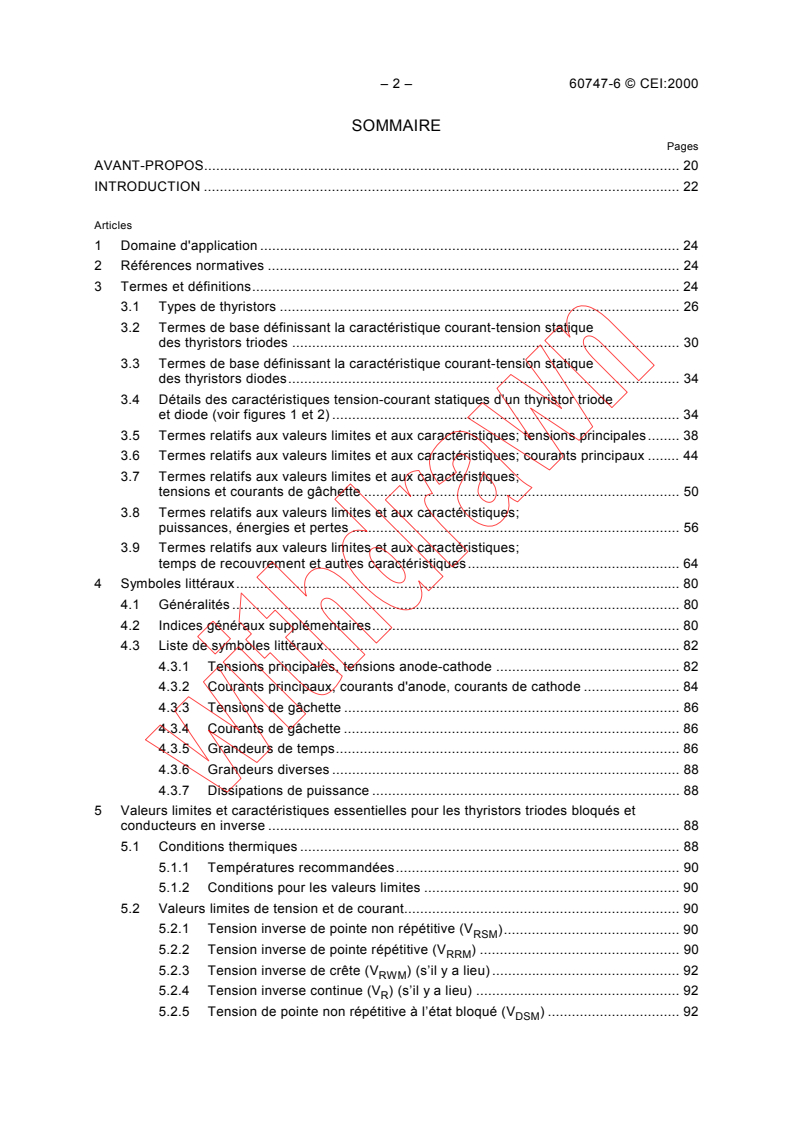
– 2 – 60747-6 © CEI:2000
SOMMAIRE
Pages
AVANT-PROPOS. 20
INTRODUCTION . 22
Articles
1 Domaine d'application . 24
2 Références normatives . 24
3 Termes et définitions. 24
3.1 Types de thyristors . 26
3.2 Termes de base définissant la caractéristique courant-tension statique
des thyristors triodes . 30
3.3 Termes de base définissant la caractéristique courant-tension statique
des thyristors diodes. 34
3.4 Détails des caractéristiques tension-courant statiques d’un thyristor triode
et diode (voir figures 1 et 2) . 34
3.5 Termes relatifs aux valeurs limites et aux caractéristiques; tensions principales. 38
3.6 Termes relatifs aux valeurs limites et aux caractéristiques; courants principaux . 44
3.7 Termes relatifs aux valeurs limites et aux caractéristiques;
tensions et courants de gâchette . 50
3.8 Termes relatifs aux valeurs limites et aux caractéristiques;
puissances, énergies et pertes . 56
3.9 Termes relatifs aux valeurs limites et aux caractéristiques;
temps de recouvrement et autres caractéristiques . 64
4 Symboles littéraux. 80
4.1 Généralités . 80
4.2 Indices généraux supplémentaires. 80
4.3 Liste de symboles littéraux. 82
4.3.1 Tensions principales, tensions anode-cathode . 82
4.3.2 Courants principaux, courants d'anode, courants de cathode . 84
4.3.3 Tensions de gâchette . 86
4.3.4 Courants de gâchette . 86
4.3.5 Grandeurs de temps. 86
4.3.6 Grandeurs diverses . 88
4.3.7 Dissipations de puissance . 88
5 Valeurs limites et caractéristiques essentielles pour les thyristors triodes bloqués et
conducteurs en inverse . 88
5.1 Conditions thermiques . 88
5.1.1 Températures recommandées. 90
5.1.2 Conditions pour les valeurs limites . 90
5.2 Valeurs limites de tension et de courant. 90
5.2.1 Tension inverse de pointe non répétitive (V ). 90
RSM
5.2.2 Tension inverse de pointe répétitive (V ) . 90
RRM
5.2.3 Tension inverse de crête (V ) (s’il y a lieu) . 92
RWM
5.2.4 Tension inverse continue (V
) (s’il y a lieu) . 92
R
5.2.5 Tension de pointe non répétitive à l’état bloqué (V ) . 92
DSM
60747-6 © IEC:2000 – 3 –
CONTENTS
Page
FOREWORD.21
INTRODUCTION.23
Clause
1 Scope.25
2 Normative references.25
3 Terms and definitions .25
3.1 Types of thyristors .27
3.2 Basic terms defining the static voltage-current characteristics of triode
thyristors .31
3.3 Basic terms defining the static voltage-current characteristics of diode
thyristors .35
3.4 Particulars of the static voltage-current characteristics of triode and diode
thyristors (see figures 1 and 2).35
3.5 Terms related to ratings and characteristics; principal voltages .39
3.6 Terms related to ratings and characteristics; principal currents.45
3.7 Terms related to ratings and characteristics; gate voltages and currents .51
3.8 Terms related to ratings and characteristics; powers, energies and losses .57
3.9 Terms related to ratings and characteristics; recovery times and other
characteristics .65
4 Letter symbols .81
4.1 General .81
4.2 Additional general subscripts .81
4.3 List of letter symbols.83
4.3.1 Principal voltages, anode-cathode voltages .83
4.3.2 Principal currents, anode currents, cathode currents .85
4.3.3 Gate voltages .87
4.3.4 Gate currents.87
4.3.5 Time quantities .87
4.3.6 Sundry quantities .89
4.3.7 Power loss.89
5 Essential ratings and characteristics for reverse-blocking and reverse-conducting
triode thyristors.89
5.1 Thermal conditions .89
5.1.1 Recommended temperatures .91
5.1.2 Rating conditions .91
5.2 Voltage and current ratings (limiting values).91
5.2.1 Non-repetitive peak reverse voltage (V ).91
RSM
5.2.2 Repetitive peak reverse voltage (V ).91
RRM
5.2.3 Crest (peak) working reverse voltage (V ) (where appropriate).93
RWM
5.2.4 Continuous (direct) reverse voltage (V ) (where appropriate) .93
R
5.2.5 Non-repetitive peak off-state voltage (V ) .93
DSM
– 4 – 60747-6 © CEI:2000
Articles Pages
5.2.6 Tension de pointe répétitive à l’état bloqué (V ). 92
DRM
5.2.7 Tension de crête à l’état bloqué (V ) (s’il y a lieu) . 92
DWM
5.2.8 Tension continue à l’état bloqué (V ) (s’il y a lieu) . 92
D
5.2.9 Tension directe de pointe de gâchette (anode positive par rapport à la
cathode) . 92
5.2.10 Tension directe de pointe de gâchette (anode négative par rapport à la
cathode) . 92
5.2.11 Tension inverse de pointe de gâchette (s il y a lieu). 94
5.2.12 Courant moyen à l'état passant . 94
5.2.13 Courant de pointe répétitif à l’état passant (s’il y a lieu) . 94
5.2.14 Courant efficace à l’état passant (s’il y a lieu). 94
5.2.15 Courant de surcharge prévisible à l’état passant (s'il y a lieu ) . 94
5.2.16 Courant de surcharge accidentelle à l’état passant. 94
5.2.17 Courant continu à l’état passant (s’il y a lieu). 96
5.2.18 Valeur de pointe d’un courant sinusoïdal à l’état passant aux
fréquences élevées (s’il y a lieu). 96
5.2.19 Valeur de pointe d’un courant trapézoïdal à l’état passant aux
fréquences élevées (s’il y a lieu). 98
5.2.20 Vitesse critique de croissance du courant à l'état passant .102
5.2.21 Courant de pointe pour non-rupture du boîtier .102
5.2.22 Courant direct de pointe de gâchette .104
5.3 Autres valeurs limites .104
5.3.1 Valeurs limites de fréquence .104
5.3.2 Puissance dissipée de pointe de gâchette .104
5.3.3 Thyristors à température ambiante spécifiée et à température de boîtier
spécifiée.104
5.3.4 Températures de stockage.104
5.3.5 Température virtuelle de jonction (s’il y a lieu) .104
5.4 Caractéristiques électriques.104
5.4.1 Caractéristiques à l’état passant (s’il y a lieu) .104
5.4.2 Tension à l’état passant.104
5.4.3 Courant hypostatique (ou de maintien) .106
5.4.4 Courant d’accrochage .106
5.4.5 Courant de pointe répétitif à l’état bloqué .106
5.4.6 Courant inverse de pointe répétitif .106
5.4.7 Courant de gâchette d'amorçage et tension de gâchette d'amorçage .106
5.4.8 Courant de gâchette de non-amorçage et tension de gâchette de non-
amorçage .106
5.4.9 Temps de retard d'amorçage commandé par la gâchette .108
5.4.10 Temps de désamorçage par commutation du circuit.108
5.4.11 Vitesse critique de croissance de la tension à l'état bloqué.110
5.4.12 Dissipation de puissance totale .110
5.4.13 Charge recouvrée (s’il y a lieu) .116
5.4.14 Courant de recouvrement inverse de pointe (s’il y a lieu).116
5.4.15 Temps de recouvrement inverse (s’il y a lieu).116
60747-6 © IEC:2000 – 5 –
Clause Page
5.2.6 Repetitive peak off-state voltage (V ) .93
DRM
5.2.7 Crest (peak) working off-state voltage (V ) (where appropriate).93
DWM
5.2.8 Continuous (direct) off-state voltage (V ) (where appropriate) .93
D
5.2.9 Peak forward gate voltage (V ) (anode positive with respect
FGM
to cathode) .93
5.2.10 Peak forward gate voltage (V ) (anode negative with respect
FGM
to cathode) .93
5.2.11 Peak reverse gate voltage (V ) (where appropriate).95
RGM
5.2.12 Mean on-state current.95
5.2.13 Repetitive peak on-state current (where appropriate).95
5.2.14 RMS on-state current (where appropriate).95
5.2.15 Overload on-state current (where appropriate) .95
5.2.16 Surge on-state current .95
5.2.17 Continuous (direct) on-state current (where appropriate) .97
5.2.18 Peak value of sinusoidal on-state current at higher frequencies
(where appropriate).97
5.2.19 Peak value of a trapezoidal on-state current at higher frequencies
(where appropriate).99
5.2.20 Critical rate of rise of on-state current . 103
5.2.21 Peak case non-rupture current . 103
5.2.22 Peak forward-gate current. 105
5.3 Other ratings (limiting values) . 105
5.3.1 Frequency ratings . 105
5.3.2 Peak gate power dissipation. 105
5.3.3 Ambient-rated and case-rated thyristors . 105
5.3.4 Storage temperatures . 105
5.3.5 Virtual junction temperature (where appropriate) . 105
5.4 Electrical characteristics . 105
5.4.1 On-state characteristics (where appropriate) . 105
5.4.2 On-state voltage . 105
5.4.3 Holding current . 107
5.4.4 Latching current. 107
5.4.5 Repetitive peak off-state current . 107
5.4.6 Repetitive peak reverse current. 107
5.4.7 Gate-trigger current and gate-trigger voltage . 107
5.4.8 Gate non-trigger current and gate non-trigger voltage. 107
5.4.9 Gate-controlled turn-on delay time . 109
5.4.10 Circuit commutated turn-off-time . 109
5.4.11 Critical rate of rise of off-state voltage. 111
5.4.12 Total power loss . 111
5.4.13 Recovered charge (Q )(where appropriate). 117
r
5.4.14 Peak reverse recovery current (I ) (where appropriate) . 117
RM
5.4.15 Reverse recovery time (t ) (where appropriate) . 117
rr
– 6 – 60747-6 © CEI:2000
Articles Pages
5.5 Caractéristiques thermiques .116
5.5.1 Résistance thermique de la jonction à la température ambiante (R ).116
th(j-a)
5.5.2 Résistance thermique de la jonction à la température de boîtier (R ).116
th(j-c)
5.5.3 Résistance thermique du boîtier par rapport à celle du dissipateur
thermique (R ).116
th(c-h)
5.5.4 Résistance thermique de la jonction par rapport à celle du dissipateur
thermique (R ).116
th(j-h)
5.5.5 Impédance thermique transitoire de jonction à la température ambiante
(Z ) .118
th(j-a)
5.5.6 Impédance thermique transitoire de jonction à la température de boîtier
(Z ).118
th(j-c)
5.5.7 Impédance thermique transitoire de jonction par rapport à celle du
dissipateur thermique (Z ) .118
th(j-h)
5.6 Caractéristiques mécaniques et autres informations .118
5.7 Données d’applications.118
6 Valeurs limites et caractéristiques essentielles pour les thyristors triode bidirectionnels
(triacs) .118
6.1 Conditions thermiques .118
6.1.1 Températures recommandées.118
6.1.2 Conditions pour les valeurs limites .118
6.2 Valeurs limites de tension et de courant.120
6.2.1 Tension de pointe non répétitive à l’état bloqué (V ) .120
DSM
6.2.2 Tension de pointe répétitive à l’état bloqué (V ).120
DRM
6.2.3 Tension de crête à l'état bloqué (V ) .120
DWM
6.2.4 Tension positive de pointe de gâchette.120
6.2.5 Tension négative de pointe de gâchette .120
6.2.6 Courant efficace à l’état passant .122
6.2.7 Courant de pointe répétitif à l'état passant (s’il y a lieu) .122
6.2.8 Courant de surcharge prévisible à l’état passant .122
6.2.9 Courant de surcharge accidentelle à l’état passant.122
6.2.10 Vitesse critique de croissance du courant à l'état passant .122
6.2.11 Courant de gâchette .124
6.3 Autres valeurs limites .124
6.3.1 Valeurs limites de fréquence .124
6.3.2 Puissance moyenne de gâchette .124
6.3.3 Puissance de pointe de gâchette .124
6.3.4 Triacs à température ambiante spécifiée et à température de boîtier
spécifiée.124
6.3.5 Températures de stockage.124
6.3.6 Température virtuelle de jonction.124
6.4 Caractéristiques électriques (à une température ambiante ou de boîtier de
25 °C, sauf indication contraire).126
6.4.1 Caractéristiques à l'état passant (s’il y a lieu) .126
6.4.2 Tension à l'état passant.126
6.4.3 Courant hypostatique ou de maintien.126
6.4.4 Courant d’accrochage .126
60747-6 © IEC:2000 – 7 –
Clause Page
5.5 Thermal characteristics. 117
5.5.1 Thermal resistance junction to ambient (R ). 117
th(j-a)
5.5.2 Thermal resistance junction to case (R ) . 117
th(j-c)
5.5.3 Thermal resistance case to heatsink (R ) . 117
th(c-h)
5.5.4 Thermal resistance junction to heatsink (R ) . 117
th(j-h)
5.5.5 Transient thermal impedance junction to ambient (Z ) . 119
th(j-a)
5.5.6 Transient thermal impedance junction to case (Z ) . 119
th(j-c)
5.5.7 Transient thermal impedance junction to heatsink (Z ) . 119
th(j-h)
5.6 Mechanical characteristics and other data. 119
5.7 Application data. 119
6 Essential ratings and characteristics for bidirectional triode thyristors (triacs) . 119
6.1 Thermal conditions . 119
6.1.1 Recommended temperatures . 119
6.1.2 Rating conditions . 119
6.2 Voltage and current ratings (limiting values). 121
6.2.1 Non-repetitive peak off-state voltage (V ) . 121
DSM
6.2.2 Repetitive peak off-state voltage (V ) . 121
DRM
6.2.3 Crest (peak) working off-state voltage (V ). 121
DWM
6.2.4 Peak positive gate voltage . 121
6.2.5 Peak negative gate voltage . 121
6.2.6 RMS on-state current. 123
6.2.7 Repetitive peak on-state current (where appropriate). 123
6.2.8 Overload on-state current . 123
6.2.9 Surge on-state current . 123
6.2.10 Critical rate of rise of on-state current . 123
6.2.11 Gate currents. 125
6.3 Other ratings (limiting values) . 125
6.3.1 Frequency ratings . 125
6.3.2 Mean gate power . 125
6.3.3 Peak gate power. 125
6.3.4 Ambient-rated and case-rated triacs. 125
6.3.5 Storage temperatures . 125
6.3.6 Virtual junction temperature . 125
6.4 Electrical characteristics (at 25 °C ambient or case temperature,
unless otherwise stated) . 127
6.4.1 On-state characteristics (where appropriate) . 127
6.4.2 On-state voltage . 127
6.4.3 Holding current . 127
6.4.4 Latching current. 127
– 8 – 60747-6 © CEI:2000
Articles Pages
6.4.5 Courant de pointe répétitif à l'état bloqué.126
6.4.6 Vitesse critique de croissance de la tension à l’état bloqué.126
6.4.7 Vitesse critique de croissance de la tension de commutation.128
6.4.8 Courant de gâchette d’amorçage et tension de gâchette d’amorçage .128
6.4.9 Courant de gâchette de non-amorçage et tension de gâchette de non-
amorçage .128
6.4.10 Temps de retard d'amorçage commandé par la gâchette .130
6.4.11 Dissipation de puissance totale .130
6.5 Caractéristiques thermiques .132
6.5.1 Résistance thermique de la jonction à la température ambiante (R ).132
th(j-a)
6.5.2 Résistance thermique de la jonction à la température de boîtier (R ).132
th(j-c)
6.5.3 Résistance thermique du boîtier par rapport à celle du dissipateur
thermique (R ).132
th(c-h)
6.5.4 Résistance thermique de la jonction par rapport à celle du dissipateur
thermique (R ).132
th(j-h)
6.5.5 Impédance thermique transitoire de jonction à la température ambiante
(Z ) .132
th(j-a)
6.5.6 Impédance thermique transitoire de jonction à la température de boîtier
(Z ).132
th(j-c)
6.5.7 dissipateur thermique (Z ) .132
th(j-h)
6.6 Caractéristiques mécaniques et autres informations .132
6.7 Données d’applications.132
7 Valeurs limites et caractéristiques essentielles pour les transistors blocables par la
gâchette (thyristors GTO).132
7.1 Conditions thermiques .132
7.1.1 Températures recommandées.134
7.1.2 Conditions pour les valeurs aux limites.134
7.2 Valeurs limites de tension et de courant.134
7.2.1 Tension inverse de pointe non répétitive (V ).134
RSM
7.2.2 Tension inverse de pointe répétitive (V ) .134
RRM
7.2.3 Tension inverse continue (V ) (s’il y a lieu) .134
RD
7.2.4 Tension de pointe non répétitive à l’état bloqué (V ) (s’il y a lieu).134
DSM
7.2.5 Tension de pointe répétitive à l’état bloqué (V ).136
DRM
7.2.6 Tension continue à l’état bloqué (V
) (s’il y a lieu) .136
D(D)
7.2.7 Tension de blocage de gâchette (V ) .136
RG
7.2.8 Courant de pointe non répétitif contrôlable à l’état passant (I ) .136
TQSM
7.2.9 Courant de pointe répétitif contrôlable à l’état passant (I ) .136
TQRM
7.2.10 Courant efficace à l'état passant (I ) (s’il y a lieu).136
T(RMS)
7.2.11 Courant en fonctionnement temporaire ou intermittent .138
7.2.12 Courant de surcharge accidentelle à l’état passant (I ).138
TSM
7.2.13 Vitesse critique de croissance du courant à l’état passant ((di /dt) ).138
T cr
7.3 Autres valeurs limites .138
7.3.1 Puissance de pointe de gâchette dans le sens direct (P ).138
FGM
7.3.2 Température virtuelle de jonction (T ).140
vj
7.3.3 Températures de stockage (T ).140
stg
60747-6 © IEC:2000 – 9 –
Clause Page
6.4.5 Repetitive peak off-state current . 127
6.4.6 Critical rate of rise of off-state voltage. 127
6.4.7 Critical rate of rise of commutating voltage. 129
6.4.8 Gate trigger current and gate trigger voltage . 129
6.4.9 Gate non-trigger current and gate non-trigger voltage. 129
6.4.10 Gate-controlled turn-on delay time . 131
6.4.11 Total power loss . 131
6.5 Thermal characteristics. 133
6.5.1 Thermal resistance junction to ambient (R ). 133
th(j-a)
6.5.2 Thermal resistance junction to case (R ) . 133
th(j-c)
6.5.3 Thermal resistance case to heatsink (R ) . 133
th(c-h)
6.5.4 Thermal resistance junction to heatsink (R ) . 133
th(j-h)
6.5.5 Transient thermal impedance junction to ambient (Z ) . 133
th(j-a)
6.5.6 Transient thermal impedance junction to case (Z ) . 133
th(j-c)
6.5.7 Transient thermal impedance junction to heatsink (Z ) . 133
th(j-h)
6.6 Mechanical characteristics and other data. 133
6.7 Application data. 133
7 Essential ratings and characteristics for gate turn-off thyristors (GTO thyristors). 133
7.1 Thermal conditions . 133
7.1.1 Recommended temperatures . 135
7.1.2 Rating conditions . 135
7.2 Voltage and current ratings (limiting values). 135
7.2.1 Non-repetitive peak reverse voltage (V ). 135
RSM
7.2.2 Repetitive peak reverse voltage (V ). 135
RRM
7.2.3 Direct reverse voltage (V ) (where appropriate). 135
R(D)
7.2.4 Non-repetitive peak off-state voltage (V ) (where appropriate) . 135
DSM
7.2.5 Repetitive peak off-state voltage (V ) . 137
DRM
7.2.6 Direct off-state voltage (V ) (where appropriate) . 137
D(D)
7.2.7 Turn-off gate voltage (V ) . 137
RG
7.2.8 Non-repetitive peak controllable on-state current (I ). 137
TQSM
7.2.9 Repetitive peak controllable on-state current (I ). 137
TQRM
7.2.10 RMS on-state current (I ) (where appropriate). 137
T(RMS)
7.2.11 Short-time and intermittent duty current. 139
7.2.12 Surge on-state current (I ) . 139
TSM
7.2.13 Critical rate of rise of on-state current ((di /dt) ). 139
T cr
7.3 Other ratings (limiting values) . 139
7.3.1 Peak forward gate power (P ). 139
FGM
7.3.2 Virtual junction temperature (T ). 141
vj
7.3.3 Storage temperatures (T ) . 141
stg
– 10 – 60747-6 © CEI:2000
Articles Pages
7.3.4 Température de soudage maximale pour les thyristors blocables par la
gâchette munis de bornes de soudage (T ) .140
sld
7.3.5 Couple au montage (pour les thyristors blocables par la gâchette munis
de connexions par vis) (M) .140
7.3.6 Force de serrage (pour les dispositifs de type à disques) (F).140
7.4 Caractéristiques électriques.140
7.4.1 Tension à l'état passant (V ) .140
T
7.4.2 Tension de seuil (V ).140
T(TO)
7.4.3 Résistance apparente à l'état passant (r ).140
T
7.4.4 Courant de maintien (I ).140
H
7.4.5 Courant d'accrochage (I ).142
L
7.4.6 Vitesse critique de croissance de la tension à l'état bloqué ((dv /dt) ) .142
D cr
7.4.7 Courant de gâchette permanent (I ).142
FGsus
7.4.8 Courant de queue de pointe (I ) .142
ZM
7.4.9 Courant d'amorçage par la gâchette (I ) et tension d'amorçage par la
GT
gâchette (V ).142
GT
7.4.10 Courant de gâchette de non-amorçage (I ) et tension de gâchette de
GD
non-amorçage (V ) .142
GD
7.4.11 Courant de gâchette de pointe pour le blocage (I ).144
RGQM
7.4.12 Dissipation d’énergie à l’établissement du courant (E ).144
ON
7.4.13 Dissipation d’énergie à l'état passant (E ) .144
T
7.4.14 Dissipation d’énergie à la coupure du courant (E ).144
Q
7.4.15 Retard à la croissance (commandé par la gâchette) (t ) .144
gd
7.4.16 Intervalles de temps de blocage .146
7.5 Caractéristiques thermiques .146
7.5.1 Résistance thermique de la jonction à la température ambiante (R ).146
th(j-a)
7.5.2 Résistance thermique de la jonction à la température de boîtier (R ).146
th(j-c)
7.5.3 Résistance thermique du boîtier par rapport à celle du dissipateur
thermique (R ).146
th(j-h)
7.5.4 Impédance thermique transitoire de jonction à la température ambiante
(Z ) .
...