

IEC 62827-3:2016
(Main)Wireless power transfer - Management - Part 3: Multiple source control management
General Information
- Abstract
IEC 62827-3:2016 specifies methods and procedures to form groups for a spatial wireless power-transfer system. The group of spatial wireless power-transfer systems that include multiple power sources provides power transfer to receiving devices based on magnetic resonance technology. In order to achieve efficient power transfer to multiple receiving devices, this document also specifies methods and procedures to set, share, and control the conditions of power transfer between multiple power sources and receiving devices.
- Status
- Published
- Publication Date
- 13-Dec-2016
- Technical Committee
- TA 15 - Wireless Power Transfer
- Drafting Committee
- WG 1 - TC 100/TA 15/WG 1
- Current Stage
- PPUB - Publication issued
- Start Date
- 14-Dec-2016
- Completion Date
- 28-Feb-2017
Buy Documents
IEC 62827-3:2016 - Wireless power transfer - Management - Part 3: Multiple source control management Released:12/14/2016
IEC 62827-3:2016 - Wireless power transfer - Management - Part 3: Multiple source control management Released:12/14/2016
Overview
IEC 62827-3:2016 - Wireless power transfer – Management – Part 3: Multiple source control management (IEC) defines methods and procedures for coordinating multiple wireless power sources in a spatial wireless power-transfer system based on magnetic resonance technology. The standard focuses on forming groups of power sources (WPMS-S networks) and managing power delivery to multiple receiving devices (WPMS-D) to achieve efficient, reliable spatial wireless power transfer.
Key topics and technical requirements
- Group formation and topology: Procedures to form and manage groups of power sources (WPMS-S and WPMS-SN) that communicate over wired or wireless networks to cooperate in a shared spatial area.
- Power transfer condition setting and sharing: Methods to set, share and control wireless power transmitting conditions (e.g., power level, phase) across multiple sources to optimize delivery to receiving devices.
- Device identification and authentication: Requirements and procedures for identifying and authenticating WPMS-Ds before initiating power transfer.
- Position detection and power mapping: Procedures for detecting WPMS-D positions in the spatial zone and mapping power-transfer areas and communication areas to manage coverage and efficiency.
- Wireless power distribution and synchronization: Guidelines for distributing power among multiple sources and synchronizing magnetic fields (magnetic resonance coupling) across sources to prevent interference and improve efficiency.
- Control messaging and states: Defined message types and interaction sequences for negotiation, notification, suspension, resumption, and termination of power transfer between WPMS-S and WPMS-D.
- Reconfiguration and fault handling: Processes to handle dynamic events such as appearance/disappearance of sources or devices, completion/resumption of charging, flat-battery scenarios, and orderly termination of power transfer.
- Interoperability and management functions: Overall model for a wireless power management system, including required functionalities for cooperative control.
Practical applications and users
IEC 62827-3 is intended for organizations and professionals designing, deploying, or testing spatial wireless charging and management systems, particularly those using magnetic resonance:
- Device manufacturers (audio, video and multimedia equipment noted in the standard)
- OEMs and system integrators building multi-coil or multi-transmitter wireless charging platforms
- Smart home, office and public-charging solution providers deploying spatial wireless power for multiple devices
- Standards engineers, test labs and certification bodies validating interoperability, safety and management behavior
- Network and control-software developers implementing WPMS messaging and synchronization logic
Implementing IEC 62827-3 helps ensure coordinated, efficient wireless power distribution in environments where multiple power sources and multiple receivers operate simultaneously.
Related standards
- IEC 62827-1 - Wireless power transfer – Management – Part 1: Common components (normative reference)
- Other parts of the IEC 62827 series cover complementary management components and can be consulted for a complete wireless power management solution.
Buy Documents
IEC 62827-3:2016 - Wireless power transfer - Management - Part 3: Multiple source control management Released:12/14/2016
IEC 62827-3:2016 - Wireless power transfer - Management - Part 3: Multiple source control management Released:12/14/2016
Get Certified
Connect with accredited certification bodies for this standard

TÜV Rheinland
TÜV Rheinland is a leading international provider of technical services.

TÜV SÜD
TÜV SÜD is a trusted partner of choice for safety, security and sustainability solutions.

DEKRA Certification Inc.
DEKRA US certification services.
Sponsored listings
Frequently Asked Questions
IEC 62827-3:2016 is a standard published by the International Electrotechnical Commission (IEC). Its full title is "Wireless power transfer - Management - Part 3: Multiple source control management". This standard covers: IEC 62827-3:2016 specifies methods and procedures to form groups for a spatial wireless power-transfer system. The group of spatial wireless power-transfer systems that include multiple power sources provides power transfer to receiving devices based on magnetic resonance technology. In order to achieve efficient power transfer to multiple receiving devices, this document also specifies methods and procedures to set, share, and control the conditions of power transfer between multiple power sources and receiving devices.
IEC 62827-3:2016 specifies methods and procedures to form groups for a spatial wireless power-transfer system. The group of spatial wireless power-transfer systems that include multiple power sources provides power transfer to receiving devices based on magnetic resonance technology. In order to achieve efficient power transfer to multiple receiving devices, this document also specifies methods and procedures to set, share, and control the conditions of power transfer between multiple power sources and receiving devices.
IEC 62827-3:2016 is classified under the following ICS (International Classification for Standards) categories: 01 - GENERALITIES. TERMINOLOGY. STANDARDIZATION. DOCUMENTATION; 43.120 - Electric road vehicles. The ICS classification helps identify the subject area and facilitates finding related standards.
IEC 62827-3:2016 is available in PDF format for immediate download after purchase. The document can be added to your cart and obtained through the secure checkout process. Digital delivery ensures instant access to the complete standard document.
Standards Content (Sample)
IEC 62827-3 ®
Edition 1.0 2016-12
INTERNATIONAL
STANDARD
colour
inside
Wireless power transfer – Management –
Part 3: Multiple source control management
All rights reserved. Unless otherwise specified, no part of this publication may be reproduced or utilized in any form
or by any means, electronic or mechanical, including photocopying and microfilm, without permission in writing from
either IEC or IEC's member National Committee in the country of the requester. If you have any questions about IEC
copyright or have an enquiry about obtaining additional rights to this publication, please contact the address below or
your local IEC member National Committee for further information.
IEC Central Office Tel.: +41 22 919 02 11
3, rue de Varembé Fax: +41 22 919 03 00
CH-1211 Geneva 20 info@iec.ch
Switzerland www.iec.ch
About the IEC
The International Electrotechnical Commission (IEC) is the leading global organization that prepares and publishes
International Standards for all electrical, electronic and related technologies.
About IEC publications
The technical content of IEC publications is kept under constant review by the IEC. Please make sure that you have the
latest edition, a corrigenda or an amendment might have been published.
IEC Catalogue - webstore.iec.ch/catalogue Electropedia - www.electropedia.org
The stand-alone application for consulting the entire The world's leading online dictionary of electronic and
bibliographical information on IEC International Standards, electrical terms containing 20 000 terms and definitions in
Technical Specifications, Technical Reports and other English and French, with equivalent terms in 15 additional
documents. Available for PC, Mac OS, Android Tablets and languages. Also known as the International Electrotechnical
iPad. Vocabulary (IEV) online.
IEC publications search - www.iec.ch/searchpub IEC Glossary - std.iec.ch/glossary
The advanced search enables to find IEC publications by a 65 000 electrotechnical terminology entries in English and
variety of criteria (reference number, text, technical French extracted from the Terms and Definitions clause of
committee,…). It also gives information on projects, replaced IEC publications issued since 2002. Some entries have been
and withdrawn publications. collected from earlier publications of IEC TC 37, 77, 86 and
CISPR.
IEC Just Published - webstore.iec.ch/justpublished
Stay up to date on all new IEC publications. Just Published IEC Customer Service Centre - webstore.iec.ch/csc
details all new publications released. Available online and If you wish to give us your feedback on this publication or
also once a month by email. need further assistance, please contact the Customer Service
Centre: csc@iec.ch.
IEC 62827-3 ®
Edition 1.0 2016-12
INTERNATIONAL
STANDARD
colour
inside
Wireless power transfer – Management –
Part 3: Multiple source control management
INTERNATIONAL
ELECTROTECHNICAL
COMMISSION
ICS 43.120 ISBN 978-2-8322-3683-3
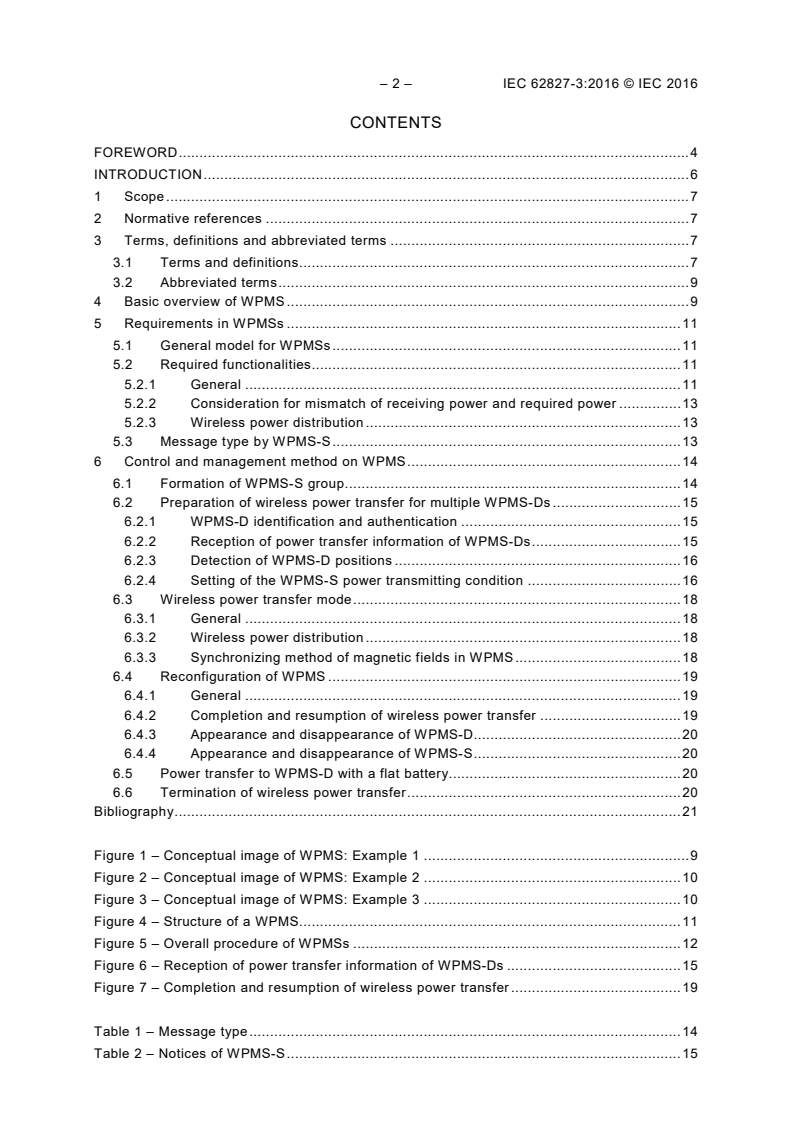
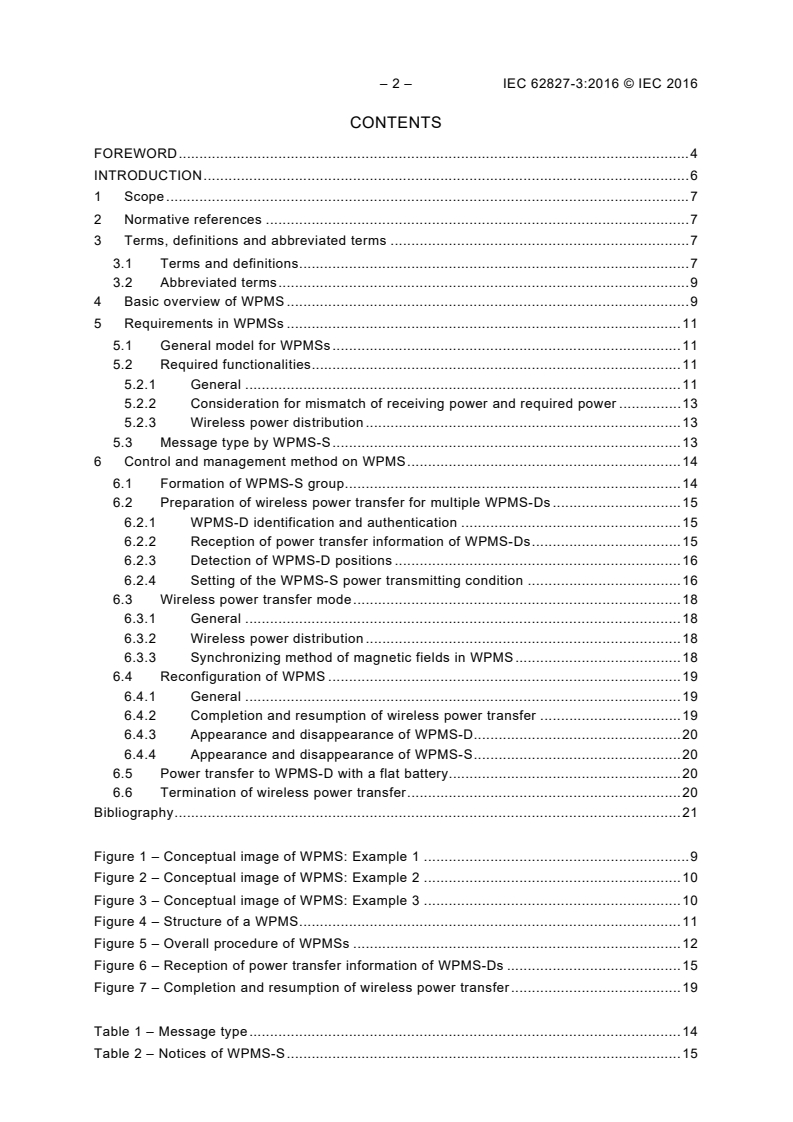
– 2 – IEC 62827-3:2016 © IEC 2016
CONTENTS
FOREWORD . 4
INTRODUCTION . 6
1 Scope . 7
2 Normative references . 7
3 Terms, definitions and abbreviated terms . 7
3.1 Terms and definitions . 7
3.2 Abbreviated terms . 9
4 Basic overview of WPMS . 9
5 Requirements in WPMSs . 11
5.1 General model for WPMSs . 11
5.2 Required functionalities. 11
5.2.1 General . 11
5.2.2 Consideration for mismatch of receiving power and required power . 13
5.2.3 Wireless power distribution . 13
5.3 Message type by WPMS-S . 13
6 Control and management method on WPMS . 14
6.1 Formation of WPMS-S group . 14
6.2 Preparation of wireless power transfer for multiple WPMS-Ds . 15
6.2.1 WPMS-D identification and authentication . 15
6.2.2 Reception of power transfer information of WPMS-Ds . 15
6.2.3 Detection of WPMS-D positions . 16
6.2.4 Setting of the WPMS-S power transmitting condition . 16
6.3 Wireless power transfer mode . 18
6.3.1 General . 18
6.3.2 Wireless power distribution . 18
6.3.3 Synchronizing method of magnetic fields in WPMS . 18
6.4 Reconfiguration of WPMS . 19
6.4.1 General . 19
6.4.2 Completion and resumption of wireless power transfer . 19
6.4.3 Appearance and disappearance of WPMS-D. 20
6.4.4 Appearance and disappearance of WPMS-S . 20
6.5 Power transfer to WPMS-D with a flat battery. 20
6.6 Termination of wireless power transfer . 20
Bibliography . 21
Figure 1 – Conceptual image of WPMS: Example 1 . 9
Figure 2 – Conceptual image of WPMS: Example 2 . 10
Figure 3 – Conceptual image of WPMS: Example 3 . 10
Figure 4 – Structure of a WPMS . 11
Figure 5 – Overall procedure of WPMSs . 12
Figure 6 – Reception of power transfer information of WPMS-Ds . 15
Figure 7 – Completion and resumption of wireless power transfer . 19
Table 1 – Message type . 14
Table 2 – Notices of WPMS-S . 15
Table 3 – Configuration on mutual work areas . 16
Table 4 – Find WPMS-D . 16
Table 5 – Request for sending power information . 17
Table 6 – Exchange manageable WPMS-D . 17
Table 7 – Notify power transfer setting . 17
Table 8 – Suspend power transfer . 20
– 4 – IEC 62827-3:2016 © IEC 2016
INTERNATIONAL ELECTROTECHNICAL COMMISSION
______________
WIRELESS POWER TRANSFER –
MANAGEMENT –
Part 3: Multiple source control management
FOREWORD
1) The International Electrotechnical Commission (IEC) is a worldwide organization for standardization comprising
all national electrotechnical committees (IEC National Committees). The object of IEC is to promote international
co-operation on all questions concerning standardization in the electrical and electronic fields. To this end and in
addition to other activities, IEC publishes International Standards, Technical Specifications, Technical Reports,
Publicly Available Specifications (PAS) and Guides (hereafter referred to as "IEC Publication(s)"). Their
preparation is entrusted to technical committees; any IEC National Committee interested in the subject dealt with
may participate in this preparatory work. International, governmental and non-governmental organizations liaising
with the IEC also participate in this preparation. IEC collaborates closely with the International Organization for
Standardization (ISO) in accordance with conditions determined by agreement between the two organizations.
2) The formal decisions or agreements of IEC on technical matters express, as nearly as possible, an international
consensus of opinion on the relevant subjects since each technical committee has representation from all
interested IEC National Committees.
3) IEC Publications have the form of recommendations for international use and are accepted by IEC National
Committees in that sense. While all reasonable efforts are made to ensure that the technical content of IEC
Publications is accurate, IEC cannot be held responsible for the way in which they are used or for any
misinterpretation by any end user.
4) In order to promote international uniformity, IEC National Committees undertake to apply IEC Publications
transparently to the maximum extent possible in their national and regional publications. Any divergence between
any IEC Publication and the corresponding national or regional publication shall be clearly indicated in the latter.
5) IEC itself does not provide any attestation of conformity. Independent certification bodies provide conformity
assessment services and, in some areas, access to IEC marks of conformity. IEC is not responsible for any
services carried out by independent certification bodies.
6) All users should ensure that they have the latest edition of this publication.
7) No liability shall attach to IEC or its directors, employees, servants or agents including individual experts and
members of its technical committees and IEC National Committees for any personal injury, property damage or
other damage of any nature whatsoever, whether direct or indirect, or for costs (including legal fees) and expenses
arising out of the publication, use of, or reliance upon, this IEC Publication or any other IEC Publications.
8) Attention is drawn to the Normative references cited in this publication. Use of the referenced publications is
indispensable for the correct application of this publication.
9) Attention is drawn to the possibility that some of the elements of this IEC Publication may be the subject of patent
rights. IEC shall not be held responsible for identifying any or all such patent rights.
International Standard IEC 62827-3 has been prepared by technical area 15: Wireless power
transfer, of IEC technical committee 100: Audio, video and multimedia systems and equipment.
The text of this standard is based on the following documents:
CDV Report on voting
100/2604/CDV 100/2724/RVC
Full information on the voting for the approval of this standard can be found in the report on
voting indicated in the above table.
This publication has been drafted in accordance with the ISO/IEC Directives, Part 2.
A list of all parts in the IEC 62827 series, published under the general title Wireless power
transfer – Management, can be found on the IEC website.
The committee has decided that the contents of this publication will remain unchanged until the
stability date indicated on the IEC website under "http://webstore.iec.ch" in the data related to
the specific publication. At this date, the publication will be
• reconfirmed,
• withdrawn,
• replaced by a revised edition, or
• amended.
A bilingual version of this publication may be issued at a later date.
IMPORTANT – The 'colour inside' logo on the cover page of this publication indicates
that it contains colours which are considered to be useful for the correct understanding
of its contents. Users should therefore print this document using a colour printer.
– 6 – IEC 62827-3:2016 © IEC 2016
INTRODUCTION
Wireless power transfer technology transmits electric power from the power source to the
power-consuming device without the use of wire. The most widely used technology is
electromagnetic induction technology and magnetic resonance technology. The wireless power
transfer system eliminates the need for the user to connect a power cable to the electrical outlet.
Through electromagnetic induction technology, users place the power-receiving device within a
short distance from the power source in order to charge a battery without removing it from its
device.
In parallel to this, magnetic resonance technology for wireless power transfer systems is also
being developed. Magnetic resonance technology gives a spatial effect to power transfer. A
spatial effect on wireless power transfer enables multiple power sources to deliver electric
power to multiple receiving devices at a distance in the same vicinity.
In order to efficiently manage and support the wireless power transfer in spatial space, multiple
power sources need to communicate and coordinate with each other.
WIRELESS POWER TRANSFER –
MANAGEMENT –
Part 3: Multiple source control management
1 Scope
This document specifies methods and procedures to form groups for a spatial wireless
power-transfer system. The group of spatial wireless power-transfer systems that include
multiple power sources provides power transfer to receiving devices based on magnetic
resonance technology.
In order to achieve efficient power transfer to multiple receiving devices, this document also
specifies methods and procedures to set, share, and control the conditions of power transfer
between multiple power sources and receiving devices.
NOTE Expected power-receiving devices are audio, video and multimedia equipment.
2 Normative references
The following documents are referred to in the text in such a way that some or all of their content
constitutes requirements of this document. For dated references, only the edition cited applies.
For undated references, the latest edition of the referenced document (including any
amendments) applies.
IEC 62827-1, Wireless power transfer – Management – Part 1: Common components
3 Terms, definitions and abbreviated terms
For the purposes of this document, the terms, definitions and abbreviated terms given in
IEC 62827-1, and the following apply.
ISO and IEC maintain terminological databases for use in standardization at the following
addresses:
• IEC Electropedia: available at http://www.electropedia.org
• ISO Online browsing platform: available at http://www.iso.org/obp
3.1 Terms and definitions
3.1.1
magnetic resonance
subset of electromagnetic induction methods utilizing non-radiative, near-field or mid-field
resonance coupling between two electromagnetic resonators where the coupling coefficient
between the primary or source coil and the secondary or receiving coil is low (k much less than
1)
3.1.2
spatial wireless power transfer
concept of wireless power transfer between multiple sources and multiple receiving devices
which are placed at a distance within a spatial space
– 8 – IEC 62827-3:2016 © IEC 2016
Note 1 to entry: "Spatial" means that receiving devices will take various positions and postures, and will lead to
variable transfer efficiency including almost zero per cent. This situation may occur when receiving devices are placed
far apart from the power source and are freely rearranged.
3.1.3
spatial wireless power transfer system
group implementing spatial wireless power transfer in which the power source can deliver power
and data to the power-receiving device
Note 1 to entry: In special cases, a spatial wireless power transfer system can consist of only a single power source
and only a single power-receiving device.
Note 2 to entry: Spatial wireless power transfer system includes the case in which a power source has the ability to
access a power-receiving device through a relay from other power sources when the power source attempts to deliver
data to the receiving device. In this document, "data" means control and management data for wireless power transfer.
3.1.4
wireless power management system-source network
WPMS-SN
group of power sources which can communicate with each other via a network connection, such
as wired LAN, wireless LAN, Bluetooth and so on
Note 1 to entry: As a special case, spatial wireless power transfer system-source network can consist of only a
single source.
3.1.5
power transfer area
area in which a power source can deliver power to power-receiving devices wirelessly
3.1.6
communication area
area in which a power source can communicate with power-receiving devices via a network
connection, such as wired LAN, wireless LAN, Bluetooth and so on
3.1.7
power transfer level
power strength of a power source transfer to the receiving device
3.1.8
wireless power transmitting condition
condition for transmitting power such as power strength and phase
3.1.9
wireless power receiving condition
condition for receiving power such as the received power, the relative value for required power
and the voltage after receiving the required power which are calculated on the power-receiving
device which receives or has received power from the power source
3.1.10
wireless power transfer mode
distinct methods of transferring power from sources to receiving devices
3.1.11
wireless power distribution
effective power delivery based on power required by the receiving devices
3.2 Abbreviated terms
WPMSn the n-th WPMS if n is specified
WDCZn the n-th WDCZ if n is specified
WPTZn the n-th WPTZ if n is specified
WPMS-Sn the n-th WPMS-S if n is specified
WPMS-SN wireless power management system-source network
WPMS-SNn the n-th WPMS-SN if n is specified
WPMS-Dn the n-th WPMS-D if n is specified
4 Basic overview of WPMS
Wirelss power management system (WPMS) is a system to deliver power to WPMS-Ds within a
spatial space on the basis of wireless power transfer technology, such as magnetic resonance.
In this document, WPMS is regarded as spatial wireless power transfer system. A WPMS
consists of multiple WPMS-Ss and multiple WPMS-Ds as shown in Figure 1, Figure 2 and
Figure 3. In special cases, WPMS is allowed to consist of only one WPMS-S as shown in
Figure 1.
WPMS-S
WPMS-D1
WPMS-D2
WPMS-D3
IEC
Figure 1 – Conceptual image of WPMS: Example 1
Figure 2 and Figure 3 illustrate that multiple WPMS-Ss transfer power to multiple WPMS-Ds at
a distance. With magnetic resonance technology, a spatial wireless power transfer can have a
wide range and cover more space, as shown in Figure 3.
– 10 – IEC 62827-3:2016 © IEC 2016
WPMS-S1 WPMS-S2
WPMS-D1
WPMS-D2
WPMS-D3
IEC
Figure 2 – Conceptual image of WPMS: Example 2
WPMS-S2
WPMS-D1
WPMS-D2
WPMS-D3
WPMS-S1
IEC
Figure 3 – Conceptual image of WPMS: Example 3
WPMS-Ss collect authentication information and wireless power receiving conditions from
WPMS-Ds, and communicate this information with other WPMS-Ss. After that, each WPMS-S
decides whic
...
IEC 62827-3 ®
Edition 1.0 2016-12
INTERNATIONAL
STANDARD
NORME
INTERNATIONALE
colour
inside
Wireless power transfer – Management –
Part 3: Multiple source control management
Transfert de puissance sans fil – Gestion –
Partie 3: Gestion du contrôle de sources multiples
All rights reserved. Unless otherwise specified, no part of this publication may be reproduced or utilized in any form
or by any means, electronic or mechanical, including photocopying and microfilm, without permission in writing from
either IEC or IEC's member National Committee in the country of the requester. If you have any questions about IEC
copyright or have an enquiry about obtaining additional rights to this publication, please contact the address below or
your local IEC member National Committee for further information.
Droits de reproduction réservés. Sauf indication contraire, aucune partie de cette publication ne peut être reproduite
ni utilisée sous quelque forme que ce soit et par aucun procédé, électronique ou mécanique, y compris la photocopie
et les microfilms, sans l'accord écrit de l'IEC ou du Comité national de l'IEC du pays du demandeur. Si vous avez des
questions sur le copyright de l'IEC ou si vous désirez obtenir des droits supplémentaires sur cette publication, utilisez
les coordonnées ci-après ou contactez le Comité national de l'IEC de votre pays de résidence.
IEC Central Office Tel.: +41 22 919 02 11
3, rue de Varembé info@iec.ch
CH-1211 Geneva 20 www.iec.ch
Switzerland
About the IEC
The International Electrotechnical Commission (IEC) is the leading global organization that prepares and publishes
International Standards for all electrical, electronic and related technologies.
About IEC publications
The technical content of IEC publications is kept under constant review by the IEC. Please make sure that you have the
latest edition, a corrigendum or an amendment might have been published.
IEC publications search - webstore.iec.ch/advsearchform IEC online collection - oc.iec.ch
The advanced search enables to find IEC publications by a Discover our powerful search engine and read freely all the
variety of criteria (reference number, text, technical publications previews. With a subscription you will always
committee, …). It also gives information on projects, replaced have access to up to date content tailored to your needs.
and withdrawn publications.
Electropedia - www.electropedia.org
IEC Just Published - webstore.iec.ch/justpublished
The world's leading online dictionary on electrotechnology,
Stay up to date on all new IEC publications. Just Published
containing more than 22 000 terminological entries in English
details all new publications released. Available online and
and French, with equivalent terms in 18 additional languages.
once a month by email.
Also known as the International Electrotechnical Vocabulary
(IEV) online.
IEC Customer Service Centre - webstore.iec.ch/csc
If you wish to give us your feedback on this publication or
need further assistance, please contact the Customer Service
Centre: sales@iec.ch.
A propos de l'IEC
La Commission Electrotechnique Internationale (IEC) est la première organisation mondiale qui élabore et publie des
Normes internationales pour tout ce qui a trait à l'électricité, à l'électronique et aux technologies apparentées.
A propos des publications IEC
Le contenu technique des publications IEC est constamment revu. Veuillez vous assurer que vous possédez l’édition la
plus récente, un corrigendum ou amendement peut avoir été publié.
Recherche de publications IEC - IEC online collection - oc.iec.ch
webstore.iec.ch/advsearchform Découvrez notre puissant moteur de recherche et consultez
La recherche avancée permet de trouver des publications IEC gratuitement tous les aperçus des publications. Avec un
en utilisant différents critères (numéro de référence, texte, abonnement, vous aurez toujours accès à un contenu à jour
comité d’études, …). Elle donne aussi des informations sur adapté à vos besoins.
les projets et les publications remplacées ou retirées.
Electropedia - www.electropedia.org
IEC Just Published - webstore.iec.ch/justpublished
Le premier dictionnaire d'électrotechnologie en ligne au
Restez informé sur les nouvelles publications IEC. Just
monde, avec plus de 22 000 articles terminologiques en
Published détaille les nouvelles publications parues.
anglais et en français, ainsi que les termes équivalents dans
Disponible en ligne et une fois par mois par email.
16 langues additionnelles. Egalement appelé Vocabulaire
Electrotechnique International (IEV) en ligne.
Service Clients - webstore.iec.ch/csc
Si vous désirez nous donner des commentaires sur cette
publication ou si vous avez des questions contactez-nous:
sales@iec.ch.
IEC 62827-3 ®
Edition 1.0 2016-12
INTERNATIONAL
STANDARD
NORME
INTERNATIONALE
colour
inside
Wireless power transfer – Management –
Part 3: Multiple source control management
Transfert de puissance sans fil – Gestion –
Partie 3: Gestion du contrôle de sources multiples
INTERNATIONAL
ELECTROTECHNICAL
COMMISSION
COMMISSION
ELECTROTECHNIQUE
INTERNATIONALE
ICS 43.120 ISBN 978-2-8322-9453-6
– 2 – IEC 62827-3:2016 © IEC 2016
CONTENTS
FOREWORD . 4
INTRODUCTION . 6
1 Scope . 7
2 Normative references . 7
3 Terms, definitions and abbreviated terms . 7
3.1 Terms and definitions . 7
3.2 Abbreviated terms . 9
4 Basic overview of WPMS . 9
5 Requirements in WPMSs . 11
5.1 General model for WPMSs . 11
5.2 Required functionalities. 11
5.2.1 General . 11
5.2.2 Consideration for mismatch of receiving power and required power . 13
5.2.3 Wireless power distribution . 13
5.3 Message type by WPMS-S . 13
6 Control and management method on WPMS . 14
6.1 Formation of WPMS-S group . 14
6.2 Preparation of wireless power transfer for multiple WPMS-Ds . 15
6.2.1 WPMS-D identification and authentication . 15
6.2.2 Reception of power transfer information of WPMS-Ds . 15
6.2.3 Detection of WPMS-D positions . 16
6.2.4 Setting of the WPMS-S power transmitting condition . 16
6.3 Wireless power transfer mode . 18
6.3.1 General . 18
6.3.2 Wireless power distribution . 18
6.3.3 Synchronizing method of magnetic fields in WPMS . 18
6.4 Reconfiguration of WPMS . 19
6.4.1 General . 19
6.4.2 Completion and resumption of wireless power transfer . 19
6.4.3 Appearance and disappearance of WPMS-D. 20
6.4.4 Appearance and disappearance of WPMS-S . 20
6.5 Power transfer to WPMS-D with a flat battery. 20
6.6 Termination of wireless power transfer . 20
Bibliography . 21
Figure 1 – Conceptual image of WPMS: Example 1 . 9
Figure 2 – Conceptual image of WPMS: Example 2 . 10
Figure 3 – Conceptual image of WPMS: Example 3 . 10
Figure 4 – Structure of a WPMS . 11
Figure 5 – Overall procedure of WPMSs . 12
Figure 6 – Reception of power transfer information of WPMS-Ds . 15
Figure 7 – Completion and resumption of wireless power transfer . 19
Table 1 – Message type . 14
Table 2 – Notices of WPMS-S . 15
Table 3 – Configuration on mutual work areas . 16
Table 4 – Find WPMS-D . 16
Table 5 – Request for sending power information . 17
Table 6 – Exchange manageable WPMS-D . 17
Table 7 – Notify power transfer setting . 17
Table 8 – Suspend power transfer . 20
– 4 – IEC 62827-3:2016 © IEC 2016
INTERNATIONAL ELECTROTECHNICAL COMMISSION
______________
WIRELESS POWER TRANSFER –
MANAGEMENT –
Part 3: Multiple source control management
FOREWORD
1) The International Electrotechnical Commission (IEC) is a worldwide organization for standardization comprising
all national electrotechnical committees (IEC National Committees). The object of IEC is to promote international
co-operation on all questions concerning standardization in the electrical and electronic fields. To this end and in
addition to other activities, IEC publishes International Standards, Technical Specifications, Technical Reports,
Publicly Available Specifications (PAS) and Guides (hereafter referred to as "IEC Publication(s)"). Their
preparation is entrusted to technical committees; any IEC National Committee interested in the subject dealt with
may participate in this preparatory work. International, governmental and non-governmental organizations liaising
with the IEC also participate in this preparation. IEC collaborates closely with the International Organization for
Standardization (ISO) in accordance with conditions determined by agreement between the two organizations.
2) The formal decisions or agreements of IEC on technical matters express, as nearly as possible, an international
consensus of opinion on the relevant subjects since each technical committee has representation from all
interested IEC National Committees.
3) IEC Publications have the form of recommendations for international use and are accepted by IEC National
Committees in that sense. While all reasonable efforts are made to ensure that the technical content of IEC
Publications is accurate, IEC cannot be held responsible for the way in which they are used or for any
misinterpretation by any end user.
4) In order to promote international uniformity, IEC National Committees undertake to apply IEC Publications
transparently to the maximum extent possible in their national and regional publications. Any divergence between
any IEC Publication and the corresponding national or regional publication shall be clearly indicated in the latter.
5) IEC itself does not provide any attestation of conformity. Independent certification bodies provide conformity
assessment services and, in some areas, access to IEC marks of conformity. IEC is not responsible for any
services carried out by independent certification bodies.
6) All users should ensure that they have the latest edition of this publication.
7) No liability shall attach to IEC or its directors, employees, servants or agents including individual experts and
members of its technical committees and IEC National Committees for any personal injury, property damage or
other damage of any nature whatsoever, whether direct or indirect, or for costs (including legal fees) and expenses
arising out of the publication, use of, or reliance upon, this IEC Publication or any other IEC Publications.
8) Attention is drawn to the Normative references cited in this publication. Use of the referenced publications is
indispensable for the correct application of this publication.
9) Attention is drawn to the possibility that some of the elements of this IEC Publication may be the subject of patent
rights. IEC shall not be held responsible for identifying any or all such patent rights.
International Standard IEC 62827-3 has been prepared by technical area 15: Wireless power
transfer, of IEC technical committee 100: Audio, video and multimedia systems and equipment.
The text of this standard is based on the following documents:
CDV Report on voting
100/2604/CDV 100/2724/RVC
Full information on the voting for the approval of this standard can be found in the report on
voting indicated in the above table.
This publication has been drafted in accordance with the ISO/IEC Directives, Part 2.
A list of all parts in the IEC 62827 series, published under the general title Wireless power
transfer – Management, can be found on the IEC website.
The committee has decided that the contents of this publication will remain unchanged until the
stability date indicated on the IEC website under "http://webstore.iec.ch" in the data related to
the specific publication. At this date, the publication will be
• reconfirmed,
• withdrawn,
• replaced by a revised edition, or
• amended.
IMPORTANT – The 'colour inside' logo on the cover page of this publication indicates
that it contains colours which are considered to be useful for the correct understanding
of its contents. Users should therefore print this document using a colour printer.
– 6 – IEC 62827-3:2016 © IEC 2016
INTRODUCTION
Wireless power transfer technology transmits electric power from the power source to the
power-consuming device without the use of wire. The most widely used technology is
electromagnetic induction technology and magnetic resonance technology. The wireless power
transfer system eliminates the need for the user to connect a power cable to the electrical outlet.
Through electromagnetic induction technology, users place the power-receiving device within a
short distance from the power source in order to charge a battery without removing it from its
device.
In parallel to this, magnetic resonance technology for wireless power transfer systems is also
being developed. Magnetic resonance technology gives a spatial effect to power transfer. A
spatial effect on wireless power transfer enables multiple power sources to deliver electric
power to multiple receiving devices at a distance in the same vicinity.
In order to efficiently manage and support the wireless power transfer in spatial space, multiple
power sources need to communicate and coordinate with each other.
WIRELESS POWER TRANSFER –
MANAGEMENT –
Part 3: Multiple source control management
1 Scope
This document specifies methods and procedures to form groups for a spatial wireless
power-transfer system. The group of spatial wireless power-transfer systems that include
multiple power sources provides power transfer to receiving devices based on magnetic
resonance technology.
In order to achieve efficient power transfer to multiple receiving devices, this document also
specifies methods and procedures to set, share, and control the conditions of power transfer
between multiple power sources and receiving devices.
NOTE Expected power-receiving devices are audio, video and multimedia equipment.
2 Normative references
The following documents are referred to in the text in such a way that some or all of their content
constitutes requirements of this document. For dated references, only the edition cited applies.
For undated references, the latest edition of the referenced document (including any
amendments) applies.
IEC 62827-1, Wireless power transfer – Management – Part 1: Common components
3 Terms, definitions and abbreviated terms
For the purposes of this document, the terms, definitions and abbreviated terms given in
IEC 62827-1, and the following apply.
ISO and IEC maintain terminological databases for use in standardization at the following
addresses:
• IEC Electropedia: available at http://www.electropedia.org
• ISO Online browsing platform: available at http://www.iso.org/obp
3.1 Terms and definitions
3.1.1
magnetic resonance
subset of electromagnetic induction methods utilizing non-radiative, near-field or mid-field
resonance coupling between two electromagnetic resonators where the coupling coefficient
between the primary or source coil and the secondary or receiving coil is low (k much less than
1)
3.1.2
spatial wireless power transfer
concept of wireless power transfer between multiple sources and multiple receiving devices
which are placed at a distance within a spatial space
– 8 – IEC 62827-3:2016 © IEC 2016
Note 1 to entry: "Spatial" means that receiving devices will take various positions and postures, and will lead to
variable transfer efficiency including almost zero per cent. This situation may occur when receiving devices are placed
far apart from the power source and are freely rearranged.
3.1.3
spatial wireless power transfer system
group implementing spatial wireless power transfer in which the power source can deliver power
and data to the power-receiving device
Note 1 to entry: In special cases, a spatial wireless power transfer system can consist of only a single power source
and only a single power-receiving device.
Note 2 to entry: Spatial wireless power transfer system includes the case in which a power source has the ability to
access a power-receiving device through a relay from other power sources when the power source attempts to deliver
data to the receiving device. In this document, "data" means control and management data for wireless power transfer.
3.1.4
wireless power management system-source network
WPMS-SN
group of power sources which can communicate with each other via a network connection, such
as wired LAN, wireless LAN, Bluetooth and so on
Note 1 to entry: As a special case, spatial wireless power transfer system-source network can consist of only a
single source.
3.1.5
power transfer area
area in which a power source can deliver power to power-receiving devices wirelessly
3.1.6
communication area
area in which a power source can communicate with power-receiving devices via a network
connection, such as wired LAN, wireless LAN, Bluetooth and so on
3.1.7
power transfer level
power strength of a power source transfer to the receiving device
3.1.8
wireless power transmitting condition
condition for transmitting power such as power strength and phase
3.1.9
wireless power receiving condition
condition for receiving power such as the received power, the relative value for required power
and the voltage after receiving the required power which are calculated on the power-receiving
device which receives or has received power from the power source
3.1.10
wireless power transfer mode
distinct methods of transferring power from sources to receiving devices
3.1.11
wireless power distribution
effective power delivery based on power required by the receiving devices
3.2 Abbreviated terms
WPMSn the n-th WPMS if n is specified
WDCZn the n-th WDCZ if n is specified
WPTZn the n-th WPTZ if n is specified
WPMS-Sn the n-th WPMS-S if n is specified
WPMS-SN wireless power management system-source network
WPMS-SNn the n-th WPMS-SN if n is specified
WPMS-Dn the n-th WPMS-D if n is specified
4 Basic overview of WPMS
Wirelss power management system (WPMS) is a system to deliver power to WPMS-Ds within a
spatial space on the basis of wireless power transfer technology, such as magnetic resonance.
In this document, WPMS is regarded as spatial wireless power transfer system. A WPMS
consists of multiple WPMS-Ss and multiple WPMS-Ds as shown in Figure 1, Figure 2 and
Figure 3. In special cases, WPMS is allowed to consist of only one WPMS-S as shown in
Figure 1.
WPMS-S
WPMS-D1
WPMS-D2
WPMS-D3
IEC
Figure 1 – Conceptual image of WPMS: Example 1
Figure 2 and Figure 3 illustrate that multiple WPMS-Ss transfer power to multiple WPMS-Ds at
a distance. With magnetic resonance technology, a spatial wireless power transfer can have a
wide range and cover more space, as shown in Figure 3.
– 10 – IEC 62827-3:2016 © IEC 2016
WPMS-S1 WPMS-S2
WPMS-D1
WPMS-D2
WPMS-D3
IEC
Figure 2 – Conceptual image of WPMS: Example 2
WPMS-S2
WPMS-D1
WPMS-D2
WPMS-D3
WPMS-S1
IEC
Figure 3 – Conceptual image of WPMS: Example 3
WPMS-Ss collect authentication information and wireless power receiving conditions from
WPMS-Ds, and communicate this information with other WPMS-Ss. After that, each WPMS-S
decides which power transfer mode to use and sets up power transmitting conditions. According
to the power transfer mode, the power transmitting conditions and the wireless power receiving
conditions which are decided by the WPMS-Ss, power is transferred to WPMS-Ds. When
"simultaneous power-transfer mode" or "mixed simultaneous and time-division mode" is
selected, effective wireless power distribution is carried out to control the receiving power based
on the required power. See 6.3 for power transfer modes.
Therefore, if WPMS-Ds enter a WPMS, the WPMS-Ss within the WPMS can provide those
WPMS-Ds of various positions and posture with efficient power transfer according to the control
management based on information collected on the transmitting and wireless power receiving
conditions by network communications and sensors.
In a spatial power transfer area, the power transfer level is flexible and dependent on the type of
WPMS-Ds and their wireless power receiving conditions.
5 Requirements in WPMSs
5.1 General model for WPMSs
In Figure 4, two WPMSs in the same special vicinity shows the basic structure of multiple
WPMSs, i.e. WPMS1 and WPMS2. Each WPMS-S in a WPMS forms its WPMS-S-centred star
topology network with WPMS-Ds in the communication area of the WPMS-S. In addition, the
WPMS-Ss form mesh or star topology network in the WPMS. Multiple WPMS-Ss set up the union
of spatial power transfer areas which is WDTZ and the union of communication areas which is
WPTZ. The communication area includes the power transfer area.
In one WPMS, one WPMS-S is selected as master WPMS-Ss and the remaining WPMS-Ss
become slave WPMS-S. The master WPMS-S sends instructions about communication and
power transfer conditions to slave WPMS-Ss. The master WPMS-S can communicate with all
WPMS-Ds via the slave WPMS-Ss and control the entire behaviour, such as communication and
power transfer situations, within the WPMS.
NOTE A single WPMS-S cannot belong to multiple WPMSs at the same time. In that case, WPMS1 and WPMS2 will
be merged into one WPMS. Similarly, a WPMS-D cannot belong to both WPMS1 and SPWS2 at the same time. In that
case, WPMS1 and WPMS2 will be merged into one WPMS.
WPMS-S
z
Slave
Master
Slave
Master
Slave
y
WPMS2
WDCZ
WPMS1
WPTZ
x
: Device (WPMS-D)
IEC
Figure 4 – Structure of a WPMS
5.2 Required functionalities
5.2.1 General
WPMS-Ss in a WPMS communicate and coordinate with each other to efficiently deliver power
within a spatial power transfer area. 5.2 describes the required procedure for coordination
among WPMS-Ss.
As shown in Figure 5, the following functionalities are required to set up and control a WPMS.
a) Configure a group by communication among WPMS-Ss.
b) Identify and authenticate WPMS-Ds by WPMS-Ss.
– 12 – IEC 62827-3:2016 © IEC 2016
c) Prepare wireless power delivery.
d) Transfer power to WPMS-Ds.
e) Manage and monitor WPMS.
f) Terminate power transfer.
WPMS-S1 WPMS-S2 WPMS-S3
Identification
Identification
Information exchange
Information exchange
Formation of
WPMS-Ss group
WPMS-01 WPMS-02 WPMS-03 WPMS-04
Identification
Identification Identification Identification
Information Information Information
Information
exchange exchange exchange
exchange
Identification
Information
exchange
Power transfer
preparation
Power
Power Power Power Power
transfer
transfer transfer transfer transfer
Power transfer
Notification of
Notification of Notification of
termination
Notification of
termination Notification of
termination termination
termination
termination
IEC
Figure 5 – Overall procedure of WPMSs
In this document, it is assumed that each WPMS-S and WPMS-D have an ID allocation
mechanism and are identified by their IDs.
NOTE This document does not specify how to create an ID. WPMS-Ss and WPMS-Ds can hold their own IDs in
advance or create their own IDs in some way, such as distributed network computing.
For fast authentication and preparation of wireless power transfers, the master WPMS-S
recognizes the ID of the slave WPMS-Ss and WPMS-Ds, and exchanges the required data with
WPMS-Ss and WPMS-Ds before serving wireless power transfer services. Multiple slave
WPMS-Ss are controlled by the master WPMS-S, and they configure the power transfer area of
the WPMS so that any of the WPMS-Ss can deliver power to each WPMS-D in the WPMS. Based
upon identification and authentication between WPMS-Ss and WPMS-Ds, one or multiple
WPMS-Ss select the target WPMS-D(s) and deliver power wirelessly. Each WPMS-D receives
power from multiple WPMS-Ss. In special cases, WPMS-Ds can also receive power from only
one WPMS-S. The master WPMS-S determines how much power each WPMS-S should
transmit.
A WPMS has three kinds of power transfer modes:
• simultaneous power transfer mode;
• time-division power transfer mode;
• mixed simultaneous and time-division mode.
In the case of "simultaneous power transfer mode" or "mixed simultaneous and time-division
mode", multiple receiving devices will be charged simultaneously with wireless power
distribution.
The power delivery can be terminated on the condition that all WPMS-Ds have received the
power they requested or if the user demands to stop the power transfer.
5.2.2 Consideration for mismatch of receiving power and required power
In the case of a spatial wireless power transfer, mismatching of receiving power and required
power may become a problem.
The receiving power can be calculated as follows:
receiving power = transfer power × efficiency.
In the case of a single power-receiving device, it is easy to match the receiving power and
required power by setting the transfer power as follows:
transfer power = required power / efficiency.
However, in the case of multiple power-receiving devices, the variety of required power and
efficiency makes it difficult. In the case of two receiving devices A and B, the below equations
need to be satisfied:
receiving power A = transfer power × efficiency A;
receiving power B = transfer power × efficiency B.
Distinct power requirements and efficiency will cause the following result:
required power A / efficiency A ≠ required power B / efficiency B
which leads to the mismatch of receiving power and required power, and difficulties in setting the
transfer power.
5.2.3 Wireless power distribution
To solve the mismatch problem given in 5.2.2, effective wireless power distribution is necessary.
Effective power distribution shall decrease the efficiency of at least one of receiving devices.
The least loss method is recommended. The method corresponding to the mismatch is
described in 6.3.2.
5.3 Message type by WPMS-S
There are several kinds of message types sent out by WPMS-Ss, as shown in Table 1.
– 14 – IEC 62827-3:2016 © IEC 2016
Table 1 – Message type
Usage Sent from Sent to
Notice of WPMS-S: Master WPMS-S Slave WPMS-S
A WPMS-S notifies the other WPMS-Ss of its existence
Slave WPMS-S Slave WPMS-S
Configuration on mutual work areas: Slave WPMS-S Master WPMS-S
A WPMS-S notifies other WPMS-Ss of its own
Slave WPMS-S Slave WPMS-S
communication area, power transfer area or maximum
power transfer.
Find WPMS-D: Master WPMS-S WPMS-D
A WPMS-S searches WPMS-Ds which the WPMS-S can Slave WPMS-S WPMS-D
transfer power to.
Request for sending power information: Master WPMS-S WPMS-D
A WPMS-S requests WPMS-Ds to send its position, Slave WPMS-S WPMS-D
device type or needed power.
Exchange manageable WPMS-D: Slave WPMS-S Master WPMS-S
A WPMS-S sends other WPMS-Ss’ IDs or position of
Slave WPMS-S Slave WPMS-S
WPMS-Ds which the WPMS-S can transfer power to.
Notify power transfer setting: Master WPMS-S Slave WPMS-S
Master WPMS-S notifies slave WPMS-S to set wireless
power transmitting condition
Suspend power transfer: Master WPMS-S Slave WPMS-S
Master WPMS-S requests slave WPMS-S to suspend
power transfer
6 Control and management method on WPMS
6.1 Formation of WPMS-S group
A WPMS-S sends out ID periodically or at the timing interval set by the user, and recognizes
WPMS-Ss which can communicate mutually by receiving ID. One wireless power management
system-source network (WPMS-SN) consists of WPMS-Ss which can communicate with each
other or relay information via one of the WPMS-Ss.
Each WPMS-S exchanges information such as position, wireless power transfer area, wireless
communication area, and maximum transfer power via the WPMS-SN. If the power transfer area
of the WPMS-Ss overlaps based on the received information through the wireless
communication area, WPMS-Ss form a group. One of the WPMS-Ss included in each group is
allocated as the master WPMS-S, and the others are allocated as slave WPMS-Ss. The master
WPMS-S controls the communication and the wireless power transfer of all WPMS-Ss which
belong to the WPMS. Table 2 shows the structure of the message used in order to form the
WPMS-S group.
Table 2 – Notices of WPMS-S
Parameter Mandatory/optional Special notes
Message ID M
Message type M
WPMS-S ID M Sender source ID
Intermediate WPMS-S ID O Intermediate source ID for
relaying/routing
Reserved O
Key
M: mandatory
O: optional
6.2 Preparation of wireless power transfer for multiple WPMS-Ds
6.2.1 WPMS-D identification and authentication
According to the instruction of the master WPMS-S, each WPMS-S included in one WPMS group
sends the signal at the interval of a predetermined time, and WPMS-Ds which receive the signal
reply with their IDs to the WPMS-S. The WPMS-Ss estimate whether each WPMS-D is ready and
suitable for wireless power transfer based on IDs the WPMS-S received. A WPMS-D may
respond to multiple WPMS-Ss in the same WPMS.
6.2.2 Reception of power transfer information of WPMS-Ds
As shown in Figure 6, the master WPMS-S requests the authenticated WPMS-D to send the
necessary information for wireless power transfer, such as device type (2-dimensional or
3-dimensional), electrical energy demand, and device posture information. The WPMS-D which
receives the request shall send the information, and the WPMS-S relays information which the
WPMS-D sends to the master WPMS-S.
WPMS-S1 WPMS-S2 WPMS-S3 WPMS-S4
(Slave) (Master) (Slave) (Slave)
Request
Request
Request
WPMS-D2
Request
WPMS-D1 WPMS-D3
Power transfer
Request
information (D2)
Request WPMS-D4
Power transfer
Request
information (D1)
Power transfer
information (D3)
Power transfer
information (D4)
IEC
Figure 6 – Reception of power transfer information of WPMS-Ds
Table 3 shows the structure of the message relayed to the master WPMS-S.
– 16 – IEC 62827-3:2016 © IEC 2016
Table 3 – Configuration on mutual work areas
Parameter Mandatory/optional Special notes
Message ID M
Message type M
WPMS-S ID M Sender source ID
Intermediate WPMS-S ID O Intermediate source ID for
relaying/routing
WPMS-S ID M Destination source ID
Position M
Power transfer area M
Communication area M
Maximum transfer power M
Reserved O
Key
M: mandatory
O: optional
6.2.3 Detection of WPMS-D positions
The WPMS-S detects WPMS-Ds which exist in its wireless power transfer area by the position
sensor of the WPMS-Ds and sends their position information and ID to the master WPMS-S.
Table 4 shows the structure of the message sent out by the WPMS-S to detect the WPMS-D.
Table 4 – Find WPMS-D
Parameter Mandatory/optional Special notes
Message ID M
Message type M
WPMS-S ID M Sender source ID
Reserved O
Key
M: mandatory
O: optional
6.2.4 Setting of the WPMS-S power transmitting condition
The master WPMS-S collects the information on position and posture of WPMS-Ds in the
wireless power transfer area of the WPMS, and calculates the expected power transfer
efficiency to each WPMS-D on the basis of the relative position and posture information of the
WPMS-D. The master WPMS-S determines the wireless power transmitting condition of all
WPMS-Ss in the WPMS based on the information of both the wireless power receiving condition
of each WPMS-D and the wireless power transmitting condition of each WPMS-S, and then
sends the determined wireless power transmitting condition to each WPMS-S. Table 5 shows
the structure of the message for collecting the information on position and posture of WPMS-Ds.
Table 5 – Request for sending power information
Parameter Mandatory/optional Special notes
Message ID M
Message type M
WPMS-S ID M sender source ID
Reserved O
Key
M: mandatory
O: optional
Table 6 shows the structure of the message to inform the master WPMS-S about the information
on position and posture of WPMS-Ds handled by each WPMS-S.
Table 6 – Exchange manageable WPMS-D
Parameter Mandatory/optional Special notes
Message ID M
Message type M
WPMS-S ID M Sender source ID
Intermediate WPMS-S ID O Intermediate source ID for
relaying/routing
WPMS-S ID M Destination source ID
Information on manageable WPMS-D
WPMS-S ID M ID of power source in charge of the
WPMS-Ds below
WPMS-D ID M ID of receiving device which is managed
by WPMS-S
Reserved O
Key
M: mandatory
O: optional
Table 7 shows the structure of the message to set the wireless power transmitting condition on
each WPMS-S.
Table 7 – Notify power transfer setting
Parameter Mandatory/optional Special notes
Message ID M
Message type M
WPMS-S ID M Sender source ID
Intermediate WPMS-S ID O Intermediate source ID for
relaying/routing
WPMS-S ID M Destination source ID
Information on power transfer setting
WPMS-D ID M Targeted receiving device
Reserved O
Key
M: mandatory
O: optional
– 18 – IEC 62827-3:2016 © IEC 2016
6.3 Wireless power transfer mode
6.3.1 General
The three power transfer modes for power receiving devices are as follows.
a) Simultaneous power transfer mode:
power shall be transferred to all receiving devices simultaneously.
b) Time-division power transfer mode:
power shall be transferred to each receiving device one by one.
c) Mixed simultaneous and time-division mode:
receiving devices are divided into groups, and power shall be transferred to each group one
by one.
The master WPMS-S shall calculate the wireless power-transmitting condition of all WPMS-Ss
and the resonance condition of all WPMS-Ds with the method described in 6.2.4, and send the
conditions to the WPMS-Ss and the WPMS-Ds.
6.3.2 Wireless power distribution
6.3.2.1 Effective wireless power distribution
A WPMS, which is controlled by the (master) WPMS-S, can decrease the power transfer
efficiency on each WPMS-D. The WPMS-S shall select at least one WPMS-D which does not
decrease its transfer efficiency, and set others so that they decrease their power transfer
efficiency. WPMS-Ds can match their receiving power to the required power.
6.3.2.2 Wireless power distribution method
As far as possible, it is recommended to decrease power transfer efficiency without producing a
new loss factor. When there is no new loss factor, total power transfer efficiency can remain
stable or can be similar to the power transfer efficiency without the wireless power distribution.
One concrete example of the wireless power distribution method is to use a variable condenser
as a resonant condenser. By changing the capacity of the variable condenser in a given
WPMS-D, the resonant frequency will change from the transfer frequency, and the effective Q
factor at the transfer efficiency of the device will decrease. The decrease of the effective Q factor
will cause the decrease of the transfer efficiency. But since there is no new loss factor, the power
which was to be transferred to the given WPMS-D will go to the other WPMS-Ds, and total
transfer efficiency will be almost the same. The above loss factor indicates mainly the coil
resistance and the dielectric tangent of the capacitance.
6.3.2.3 Wireless power distribution procedure
The wireless power distribution shall proceed in the following order.
a) The WPMS-S shall select at least one WPMS-D which does not decrease its power transfer
efficiency.
To achieve high total transfer efficiency, the selection of a WPMS-D which requires the
maximum transfer power (receiving power / transfer efficiency) is suitable.
b) The WPMS-S shall set the low efficiency level for unselected WPMS-Ds owing to the
required power and wireless power receiving conditions.
c) The WPMS-S shall transfer power to the WPMS-Ds simultaneously.
6.3.3 Synchronizing method of magnetic fields in WPMS
Alternating magnetic fields generated by multiple WPMS-Ss need to be synchronized so that
multiple WPMS-Ss coordinate and provide efficient wireless power transfer.
As an example, the wired or wireless communication among WPMS-Ss can be used to
synchronize the generated alternating magnetic field.
6.4 Reconfiguration of WPMS
6.4.1 General
To calculate the total amount of electric energy received by WPMS-Ds, the WPMS monitors the
transfer conditions of WPMS-Ss and WPMS-Ds. The WPMS may be reconfigured, if needed.
6.4.2 Completion and resumption of wireless power transfer
When a WPMS-D receives its required electric energy, the WPMS-D notifies WPMS-Ss by
sending a signal and the completion information, which is then relayed to the master WPMS-S.
Then, the master WPMS-S suspends all power transfer in the WPMS. The WPMS-D confirms the
termination of power transfer and sets its required electrical energy as the value "0". The WPMS
resumes the power transfer to the rest of the WPMS-Ds after the preparation process shown in
6.2 is done.
Figure 7 shows the operating sequences when WPMS-D, which is illustrated as WPMS-D4,
receives the necessary electric energy.
WPMS-S1 WPMS-S2 WPMS-S3
WPMS-S4
(Slave) (Master) (Slave)
(Slave)
WPMS-D2
Power transfer
WPMS-D1 WPMS-D3
Power transfer
Power transfer WPMS-D4
Power transfer
Power transfer
completed (D4)
Suspend transfer
Suspend transfer
Suspend transfer
Suspend transfer
Restart preparation stage shown in Clause 6.2
IEC
Figure 7 – Completion and resumption of wireless power transfer
Table 8 shows the structure of the message to instruct each WPMS-S to suspend power
transfer.
– 20 – IEC 62827-3:2016 © IEC 2016
Table 8 – Suspend power transfer
Parameter Mandatory/optional Special notes
Message ID M
Message type M
WPMS-S ID M Sender source ID
Intermediate WPMS-S ID O Intermediate source ID for
relaying/routing
WPMS-S ID M Destination source ID
Key
M: mandatory
O: optional
6.4.3 Appearance and disappearance of WPMS-D
During the power transfer phase, a new WPMS-D may appear or the existing WPMS-D may
disappear. In that case, the master WPMS-S recognizes the appearance or the disappearance
of the WPMS-D. Then, wireless power transfer is resumed after the preparation process shown
in 6.2
6.4.4 Appearance and disappearance of WPMS-S
During the power transfer phase, a new WPMS-S may appear or the existing WPMS-S may
disappear. In that case, the master WPMS-S recognizes the appearance or the disappearance
of the WPMS-S. Then, wireless power transfer is suspended and the WPMS moves back to the
process on the formation of a WPMS-S group shown in 6.1.
6.5 Power transfer to WPMS-D with a flat battery
In the case of a dead battery, the WPMS-D cannot join the WPMS because the WPMS-D cannot
communicate with any WPMS-Ss via network connection.
If the user wants to wirelessly charge the dead battery of the WPMS-D in WPMS, the WPMS-D
needs to be set on the predetermined location. Then, the user notifies the WPMS-Ss of the
user’s intention to charge the WPMS-D and the master WPMS-S suspends the power transfer
once in order to readjust the WPMS.
After that, the WPMS-S which is located near the WPMS-D takes charge of the power
transmitting conditions on the WPMS-D and starts the lower-level power transfer. Little by little,
the WPMS-S accelerates the power stren
...