

IEC 61000-5-6:2024
(Main)Electromagnetic compatibility (EMC) - Part 5-6: Installation and mitigation guidelines - Mitigation of external EM influences
General Information
- Abstract
IEC 61000-5-6:2024 covers guidelines for the mitigation of external electromagnetic influences impinging upon a facility or installation, aimed at ensuring electromagnetic compatibility (EMC) among electrical and electronic apparatus or systems. These influences include lightning, RF transmitters, power-line and telecom transients, high-altitude electromagnetic pulse (HEMP) and other high-power electromagnetic transients such as those from intentional electromagnetic interference (IEMI). This document is intended for use by installers, manufacturers and users of sensitive electrical or electronic installations or systems. It applies primarily to new installations but, where economically feasible, it can be applied to extensions or modifications to existing facilities. While the technical principles are applicable to individual equipment or apparatus, such application is not included in the scope of this document.
This first edition cancels and replaces the first edition of IEC TR 61000-5-6 published in 2002. This edition constitutes a technical revision. This edition includes the following significant technical changes with respect to the previous edition:
a) updating the whole document to include other HPEM environments including IEMI;
b) adding a new Annex A which provides details on the concept of EM resilience and includes information on HPEM detectors, recovery and restoration.
- Status
- Published
- Publication Date
- 04-Apr-2024
- Technical Committee
- SC 77C - High power transient phenomena
- Current Stage
- PPUB - Publication issued
- Start Date
- 05-Apr-2024
- Completion Date
- 03-May-2024
Overview
IEC 61000-5-6:2024 - Electromagnetic compatibility (EMC) - Part 5-6: Installation and mitigation guidelines - Mitigation of external EM influences is an international IEC standard that provides guidance on protecting facilities and installations from external electromagnetic threats. It covers mitigation of lightning, RF transmitters, power-line and telecom transients, high-altitude electromagnetic pulse (HEMP) and high-power electromagnetic environments (HPEM) including intentional electromagnetic interference (IEMI). This 2024 edition replaces IEC TR 61000-5-6 (2002) and adds modern HPEM/IEMI considerations and a new Annex A on EM resilience, detection and recovery.
Key topics and technical requirements
- Scope and application: Guidance primarily for new installations; applicable to economically feasible extensions or modifications of existing sites. Not intended for single equipment EMC qualification.
- Shielding and protection zones: Design principles for building, room, equipment and apparatus shields; maintaining shielding effectiveness and managing apertures and penetrations.
- Filters and insertion loss: Selection, installation and testing of AC/DC and signal-line filters, including attenuation, insertion loss and HF transient performance.
- Decoupling devices: Use of isolation transformers, motor-generator sets, UPS and optical links for isolation and immunity.
- Surge-protective devices (SPDs): Principles for direct equipment protection, coordinated SPD cascades and typical SPD technologies (voltage-limiting and switching types).
- Topology and interfaces: Barrier topology, ports and interfaces at enclosure boundaries to control conducted and radiated coupling.
- Resilience-based approach (Annex A): EM resilience model - Identify, Protect, Detect, Respond, Recover - and guidance on detectors, recovery strategies and restoration planning for HPEM/IEMI events.
- Testing and verification: Installation-level checks for shielding, filter insertion loss and SPD performance (general guidance; consult product standards for component tests).
Practical applications and who uses this standard
IEC 61000-5-6:2024 is intended for:
- Installers and system integrators designing shielded rooms, secure facilities, or critical infrastructure sites.
- Manufacturers of enclosures, filtering systems, SPDs and site mitigation products.
- Facility owners/operators of data centers, hospitals, control rooms, telecommunications hubs and other sensitive installations requiring EMC resilience against external EM threats. Practical uses include site design, retrofit planning, procurement specifications, and risk assessments for HEMP/IEMI and transient events.
Related standards
- Other parts of the IEC 61000 series (EMC testing and measurement methods, immunity and emission standards).
- Component and product standards for filters, SPDs, transformers and EMC testing - consult relevant IEC product standards for specific test methods and numerical limits.
Keywords: IEC 61000-5-6:2024, EMC, mitigation of external EM influences, HEMP, IEMI, shielding, filters, surge-protective devices, EM resilience, HPEM.
Relations
- Effective Date
- 12-Apr-2024
Get Certified
Connect with accredited certification bodies for this standard

ANCE
Mexican certification and testing association.

Intertek Slovenia
Intertek testing, inspection, and certification services in Slovenia.

LNE (Laboratoire National de Métrologie et d'Essais)
French national laboratory for metrology and testing.
Sponsored listings
Frequently Asked Questions
IEC 61000-5-6:2024 is a standard published by the International Electrotechnical Commission (IEC). Its full title is "Electromagnetic compatibility (EMC) - Part 5-6: Installation and mitigation guidelines - Mitigation of external EM influences". This standard covers: IEC 61000-5-6:2024 covers guidelines for the mitigation of external electromagnetic influences impinging upon a facility or installation, aimed at ensuring electromagnetic compatibility (EMC) among electrical and electronic apparatus or systems. These influences include lightning, RF transmitters, power-line and telecom transients, high-altitude electromagnetic pulse (HEMP) and other high-power electromagnetic transients such as those from intentional electromagnetic interference (IEMI). This document is intended for use by installers, manufacturers and users of sensitive electrical or electronic installations or systems. It applies primarily to new installations but, where economically feasible, it can be applied to extensions or modifications to existing facilities. While the technical principles are applicable to individual equipment or apparatus, such application is not included in the scope of this document. This first edition cancels and replaces the first edition of IEC TR 61000-5-6 published in 2002. This edition constitutes a technical revision. This edition includes the following significant technical changes with respect to the previous edition: a) updating the whole document to include other HPEM environments including IEMI; b) adding a new Annex A which provides details on the concept of EM resilience and includes information on HPEM detectors, recovery and restoration.
IEC 61000-5-6:2024 covers guidelines for the mitigation of external electromagnetic influences impinging upon a facility or installation, aimed at ensuring electromagnetic compatibility (EMC) among electrical and electronic apparatus or systems. These influences include lightning, RF transmitters, power-line and telecom transients, high-altitude electromagnetic pulse (HEMP) and other high-power electromagnetic transients such as those from intentional electromagnetic interference (IEMI). This document is intended for use by installers, manufacturers and users of sensitive electrical or electronic installations or systems. It applies primarily to new installations but, where economically feasible, it can be applied to extensions or modifications to existing facilities. While the technical principles are applicable to individual equipment or apparatus, such application is not included in the scope of this document. This first edition cancels and replaces the first edition of IEC TR 61000-5-6 published in 2002. This edition constitutes a technical revision. This edition includes the following significant technical changes with respect to the previous edition: a) updating the whole document to include other HPEM environments including IEMI; b) adding a new Annex A which provides details on the concept of EM resilience and includes information on HPEM detectors, recovery and restoration.
IEC 61000-5-6:2024 is classified under the following ICS (International Classification for Standards) categories: 33.100.01 - Electromagnetic compatibility in general. The ICS classification helps identify the subject area and facilitates finding related standards.
IEC 61000-5-6:2024 has the following relationships with other standards: It is inter standard links to IEC TR 61000-5-6:2002. Understanding these relationships helps ensure you are using the most current and applicable version of the standard.
IEC 61000-5-6:2024 is available in PDF format for immediate download after purchase. The document can be added to your cart and obtained through the secure checkout process. Digital delivery ensures instant access to the complete standard document.
Standards Content (Sample)
IEC 61000-5-6 ®
Edition 1.0 2024-04
INTERNATIONAL
STANDARD
Electromagnetic compatibility (EMC) –
Part 5-6: Installation and mitigation guidelines – Mitigation of external EM
influences
All rights reserved. Unless otherwise specified, no part of this publication may be reproduced or utilized in any form
or by any means, electronic or mechanical, including photocopying and microfilm, without permission in writing from
either IEC or IEC's member National Committee in the country of the requester. If you have any questions about IEC
copyright or have an enquiry about obtaining additional rights to this publication, please contact the address below or
your local IEC member National Committee for further information.
IEC Secretariat Tel.: +41 22 919 02 11
3, rue de Varembé info@iec.ch
CH-1211 Geneva 20 www.iec.ch
Switzerland
About the IEC
The International Electrotechnical Commission (IEC) is the leading global organization that prepares and publishes
International Standards for all electrical, electronic and related technologies.
About IEC publications
The technical content of IEC publications is kept under constant review by the IEC. Please make sure that you have the
latest edition, a corrigendum or an amendment might have been published.
IEC publications search - webstore.iec.ch/advsearchform IEC Products & Services Portal - products.iec.ch
The advanced search enables to find IEC publications by a Discover our powerful search engine and read freely all the
variety of criteria (reference number, text, technical publications previews, graphical symbols and the glossary.
committee, …). It also gives information on projects, replaced With a subscription you will always have access to up to date
and withdrawn publications. content tailored to your needs.
IEC Just Published - webstore.iec.ch/justpublished
Electropedia - www.electropedia.org
Stay up to date on all new IEC publications. Just Published
The world's leading online dictionary on electrotechnology,
details all new publications released. Available online and once
containing more than 22 500 terminological entries in English
a month by email.
and French, with equivalent terms in 25 additional languages.
Also known as the International Electrotechnical Vocabulary
IEC Customer Service Centre - webstore.iec.ch/csc
(IEV) online.
If you wish to give us your feedback on this publication or need
further assistance, please contact the Customer Service
Centre: sales@iec.ch.
IEC 61000-5-6 ®
Edition 1.0 2024-04
INTERNATIONAL
STANDARD
Electromagnetic compatibility (EMC) –
Part 5-6: Installation and mitigation guidelines – Mitigation of external EM
influences
INTERNATIONAL
ELECTROTECHNICAL
COMMISSION
ICS 33.100.01 ISBN 978-2-8322-8687-6
– 2 – IEC 61000-5-6:2024 © IEC 2024
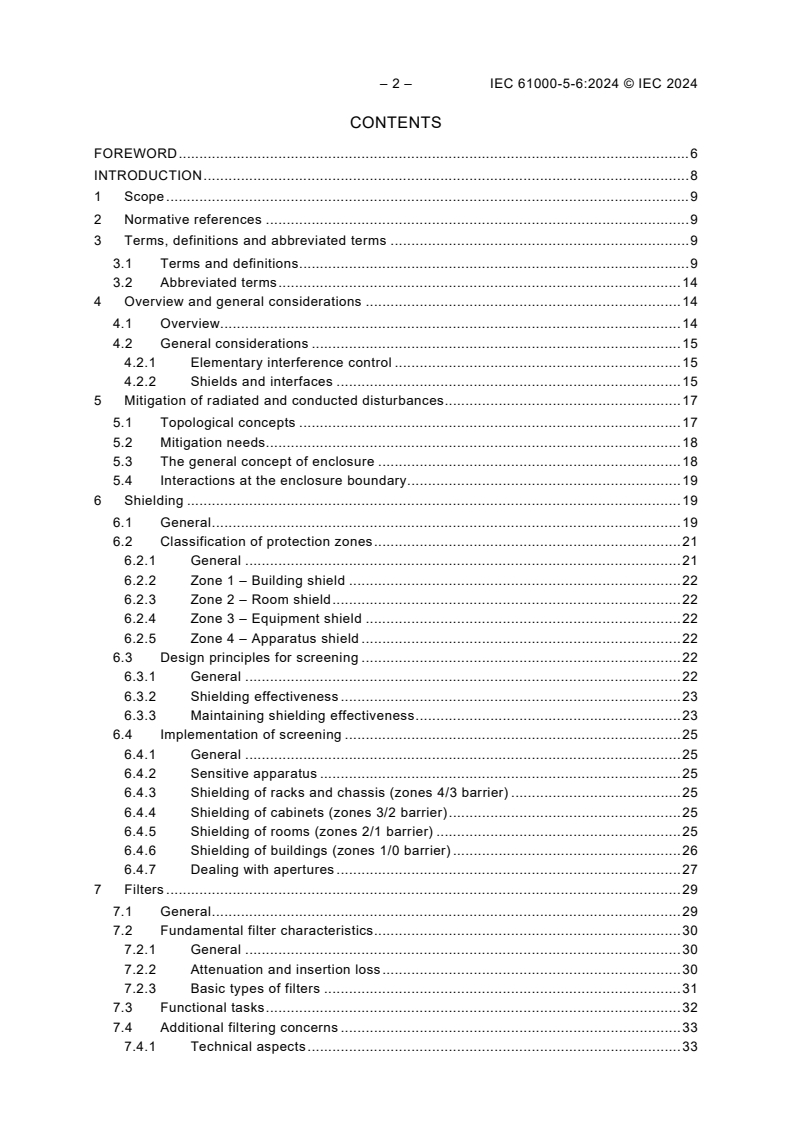
CONTENTS
FOREWORD . 6
INTRODUCTION . 8
1 Scope . 9
2 Normative references . 9
3 Terms, definitions and abbreviated terms . 9
3.1 Terms and definitions . 9
3.2 Abbreviated terms . 14
4 Overview and general considerations . 14
4.1 Overview. 14
4.2 General considerations . 15
4.2.1 Elementary interference control . 15
4.2.2 Shields and interfaces . 15
5 Mitigation of radiated and conducted disturbances. 17
5.1 Topological concepts . 17
5.2 Mitigation needs. 18
5.3 The general concept of enclosure . 18
5.4 Interactions at the enclosure boundary. 19
6 Shielding . 19
6.1 General . 19
6.2 Classification of protection zones . 21
6.2.1 General . 21
6.2.2 Zone 1 – Building shield . 22
6.2.3 Zone 2 – Room shield . 22
6.2.4 Zone 3 – Equipment shield . 22
6.2.5 Zone 4 – Apparatus shield . 22
6.3 Design principles for screening . 22
6.3.1 General . 22
6.3.2 Shielding effectiveness . 23
6.3.3 Maintaining shielding effectiveness . 23
6.4 Implementation of screening . 25
6.4.1 General . 25
6.4.2 Sensitive apparatus . 25
6.4.3 Shielding of racks and chassis (zones 4/3 barrier) . 25
6.4.4 Shielding of cabinets (zones 3/2 barrier) . 25
6.4.5 Shielding of rooms (zones 2/1 barrier) . 25
6.4.6 Shielding of buildings (zones 1/0 barrier) . 26
6.4.7 Dealing with apertures . 27
7 Filters . 29
7.1 General . 29
7.2 Fundamental filter characteristics. 30
7.2.1 General . 30
7.2.2 Attenuation and insertion loss . 30
7.2.3 Basic types of filters . 31
7.3 Functional tasks . 32
7.4 Additional filtering concerns . 33
7.4.1 Technical aspects . 33
7.4.2 Economic aspects . 33
7.5 Selection criteria . 34
7.5.1 General . 34
7.5.2 Voltage rating . 34
7.5.3 Current rating . 34
7.5.4 Duty-cycle and overload operating conditions . 34
7.5.5 Operating frequency and range of frequencies to be filtered . 35
7.5.6 Voltage drop and signal loss . 35
7.5.7 Ambient temperature range . 35
7.5.8 Insertion loss and attenuation . 35
7.5.9 Withstand voltage . 36
7.5.10 Attenuation of HF transient disturbances . 36
7.5.11 Leakage current to protective earthing conductor. 36
7.5.12 Permissible reactive current . 37
7.6 Filter installation . 37
7.6.1 General . 37
7.6.2 Installation and mounting techniques . 37
7.6.3 Wiring . 38
7.6.4 Installation of cabinet filters . 38
7.7 Filter testing . 39
7.7.1 General considerations . 39
7.7.2 Insulation to earth and withstand voltage of installed filters . 40
7.7.3 Insertion loss . 40
7.7.4 Attenuation of HF transient disturbances . 40
8 Decoupling devices . 41
8.1 Isolation transformers . 41
8.2 Motor-generator sets . 43
8.3 Engine generators. 43
8.4 Uninterruptible power supply (UPS) . 43
8.5 Optical links . 44
9 Surge-protective devices . 44
9.1 General . 44
9.2 Direct equipment protection . 45
9.3 Installation of multiple SPDs . 46
9.4 Side-effects of uncoordinated cascades . 47
9.5 Typical protective devices . 47
9.5.1 General . 47
9.5.2 Voltage-limiting type SPDs . 47
9.5.3 Voltage-switching type SPDs . 47
Annex A (informative) Resilience-based approach for the mitigation of external high-
power electromagnetic environments . 48
A.1 Overview. 48
A.2 The concept of resilience . 48
A.2.1 General . 48
A.2.2 Discussion on the protection-led approach. 49
A.2.3 Benefits of a resilience-based approach . 50
A.2.4 Affordability and risk . 50
A.2.5 Appropriate application of a resilience-based approach . 51
A.3 EM resilience model and framework . 52
– 4 – IEC 61000-5-6:2024 © IEC 2024
A.3.1 General . 52
A.3.2 Identify function . 52
A.3.3 Protect function . 52
A.3.4 Detect function . 53
A.3.5 Respond function . 53
A.3.6 Recover function. 53
A.3.7 Adaptation of the NIST framework to HPEM resilience . 53
A.4 HPEM resilience framework implementation . 53
A.4.1 Overview . 53
A.4.2 Identify . 53
A.4.3 Protect . 55
A.4.4 Detect . 60
A.4.5 Respond . 68
A.4.6 Recover . 69
A.5 Summary . 69
Bibliography . 70
Figure 1 – System barrier topology . 15
Figure 2 – Generalized system topology . 17
Figure 3 – Ports of an apparatus or facility . 19
Figure 4 – Topological concept of shields with interfaces at penetration points . 20
Figure 5 – Zones of protection of shielding and earthing systems . 21
Figure 6 – Example of performance of high-efficiency shielded enclosure . 26
Figure 7 – Honeycomb inserts for different cut-off frequencies . 27
Figure 8 – Typical screening attenuation of honeycomb inserts . 28
Figure 9 – Parameters for attenuation and insertion loss. 30
Figure 10 – Prevention of interference on installed equipment . 32
Figure 11 – Reduction of electromagnetic disturbances in the power network and the
environment . 32
Figure 12 – Examples of insertion loss characteristics of AC/DC power port filters . 36
Figure 13 – Mounting of filters . 38
Figure 14 – Connection of screened cables . 38
Figure 15 – Example of integration of filters inside an equipment cabinet . 39
Figure 16 – Example of filter mounting in a dedicated unit . 39
Figure 17 – Laboratory measurement showing the propagation of a 0,5 μs to 100 kHz
ring wave, applied in differential mode, through an ordinary isolation transformer . 41
Figure 18 – Propagation of a 0,5 μs to 100 kHz ring wave operating in the differential
mode through a "line isolator" transformer . 42
Figure 19 – Inter-winding coupling in an isolation transformer . 42
Figure A.1 – Protection-led approach . 49
Figure A.2 – Resilience-based approach . 49
Figure A.3 – The five functions of the NIST cyber security framework . 52
Figure A.4 – Protection scheme utilising shielded cables and shielded cabinets . 58
Figure A.5 – IEMI detector developed by Fraunhofer INT, Germany . 65
Figure A.6 – TOTEM detector developed by QinetiQ ltd., UK . 66
Figure A.7 – Example of some HPEM events detected during a field-trial installation . 67
Table 1 – Measured shielding effectiveness of a 2 m × 2 m cage made of concrete
building armour, against a 20 ns rise-time pulse (equivalent frequency less than
20 MHz) . 26
Table A.1 – Protection levels based on operational criticality . 50
Table A.2 – Appropriate application of the resilience-based approach . 51
Table A.3 – Identify function of the HPEM resilience framework . 54
Table A.4 – Protect function of the HPEM resilience framework . 56
Table A.5 – Detect function of the HPEM resilience framework . 60
Table A.6 – Some advantages and limitations of different technologies for HPEM
detection applications . 63
Table A.7 – Respond function of the HPEM resilience framework . 68
Table A.8 – Recover function of the HPEM resilience framework . 69
– 6 – IEC 61000-5-6:2024 © IEC 2024
INTERNATIONAL ELECTROTECHNICAL COMMISSION
____________
ELECTROMAGNETIC COMPATIBILITY (EMC) –
Part 5-6: Installation and mitigation guidelines –
Mitigation of external EM influences
FOREWORD
1) The International Electrotechnical Commission (IEC) is a worldwide organization for standardization comprising
all national electrotechnical committees (IEC National Committees). The object of IEC is to promote international
co-operation on all questions concerning standardization in the electrical and electronic fields. To this end and
in addition to other activities, IEC publishes International Standards, Technical Specifications, Technical Reports,
Publicly Available Specifications (PAS) and Guides (hereafter referred to as "IEC Publication(s)"). Their
preparation is entrusted to technical committees; any IEC National Committee interested in the subject dealt with
may participate in this preparatory work. International, governmental and non-governmental organizations liaising
with the IEC also participate in this preparation. IEC collaborates closely with the International Organization for
Standardization (ISO) in accordance with conditions determined by agreement between the two organizations.
2) The formal decisions or agreements of IEC on technical matters express, as nearly as possible, an international
consensus of opinion on the relevant subjects since each technical committee has representation from all
interested IEC National Committees.
3) IEC Publications have the form of recommendations for international use and are accepted by IEC National
Committees in that sense. While all reasonable efforts are made to ensure that the technical content of IEC
Publications is accurate, IEC cannot be held responsible for the way in which they are used or for any
misinterpretation by any end user.
4) In order to promote international uniformity, IEC National Committees undertake to apply IEC Publications
transparently to the maximum extent possible in their national and regional publications. Any divergence between
any IEC Publication and the corresponding national or regional publication shall be clearly indicated in the latter.
5) IEC itself does not provide any attestation of conformity. Independent certification bodies provide conformity
assessment services and, in some areas, access to IEC marks of conformity. IEC is not responsible for any
services carried out by independent certification bodies.
6) All users should ensure that they have the latest edition of this publication.
7) No liability shall attach to IEC or its directors, employees, servants or agents including individual experts and
members of its technical committees and IEC National Committees for any personal injury, property damage or
other damage of any nature whatsoever, whether direct or indirect, or for costs (including legal fees) and
expenses arising out of the publication, use of, or reliance upon, this IEC Publication or any other IEC
Publications.
8) Attention is drawn to the Normative references cited in this publication. Use of the referenced publications is
indispensable for the correct application of this publication.
9) IEC draws attention to the possibility that the implementation of this document may involve the use of (a)
patent(s). IEC takes no position concerning the evidence, validity or applicability of any claimed patent rights in
respect thereof. As of the date of publication of this document, IEC had not received notice of (a) patent(s), which
may be required to implement this document. However, implementers are cautioned that this may not represent
the latest information, which may be obtained from the patent database available at https://patents.iec.ch. IEC
shall not be held responsible for identifying any or all such patent rights.
IEC 61000-5-6 has been prepared by subcommittee 77C: High power transient phenomena, of
IEC technical committee 77: Electromagnetic compatibility. It is an International Standard.
This first edition cancels and replaces the first edition of IEC TR 61000-5-6 published in 2002.
This edition constitutes a technical revision.
This edition includes the following significant technical changes with respect to the previous
edition:
a) updating the whole document to include other HPEM environments including IEMI;
b) adding a new Annex A which provides details on the concept of EM resilience and includes
information on HPEM detectors, recovery and restoration.
The text of this International Standard is based on the following documents:
Draft Report on voting
77C/339/FDIS 77C/340/RVD
Full information on the voting for its approval can be found in the report on voting indicated in
the above table.
The language used for the development of this International Standard is English.
This document was drafted in accordance with ISO/IEC Directives, Part 2, and developed in
accordance with ISO/IEC Directives, Part 1 and ISO/IEC Directives, IEC Supplement, available
at www.iec.ch/members_experts/refdocs. The main document types developed by IEC are
described in greater detail at www.iec.ch/publications.
A list of all parts in the IEC 61000 series, published under the general title Electromagnetic
compatibility (EMC), can be found on the IEC website.
The committee has decided that the contents of this document will remain unchanged until the
stability date indicated on the IEC website under webstore.iec.ch in the data related to the
specific document. At this date, the document will be
• reconfirmed,
• withdrawn, or
• revised.
IMPORTANT – The "colour inside" logo on the cover page of this document indicates
that it contains colours which are considered to be useful for the correct understanding
of its contents. Users should therefore print this document using a colour printer.
– 8 – IEC 61000-5-6:2024 © IEC 2024
INTRODUCTION
IEC 61000 is published in separate parts according to the following structure:
Part 1: General
General considerations (introduction, fundamental principles)
Definitions, terminology
Part 2: Environment
Description of the environment
Classification of the environment
Compatibility levels
Part 3: Limits
Emission limits
Immunity limits (in so far as they do not fall under the responsibility of the product
committees)
Part 4: Testing and measurement techniques
Measurement techniques
Testing techniques
Part 5: Installation and mitigation guidelines
Installation guidelines
Mitigation methods and devices
Part 6: Generic standards
Part 9: Miscellaneous
Each part is further subdivided into several parts, published either as international standards
or as technical specifications or technical reports, some of which have already been published
as sections. Others will be published with the part number followed by a dash and a second
number identifying the subdivision (example: IEC 61000-6-1).
ELECTROMAGNETIC COMPATIBILITY (EMC) –
Part 5-6: Installation and mitigation guidelines –
Mitigation of external EM influences
1 Scope
This part of IEC 61000 covers guidelines for the mitigation of external electromagnetic
influences impinging upon a facility or installation, aimed at ensuring electromagnetic
compatibility (EMC) among electrical and electronic apparatus or systems. These influences
include lightning, RF transmitters, power-line and telecom transients, high-altitude
electromagnetic pulse (HEMP) and other high-power electromagnetic transients such as those
from intentional electromagnetic interference (IEMI).
This document is intended for use by installers, manufacturers and users of sensitive electrical
or electronic installations or systems. It applies primarily to new installations but, where
economically feasible, it can be applied to extensions or modifications to existing facilities.
While the technical principles are applicable to individual equipment or apparatus, such
application is not included in the scope of this document.
2 Normative references
The following documents are referred to in the text in such a way that some or all of their content
constitutes requirements of this document. For dated references, only the edition cited applies.
For undated references, the latest edition of the referenced document (including any
amendments) applies.
IEC 60364 (all parts), Low-voltage electrical installations
IEC TR 61000-5-2, Electromagnetic compatibility (EMC) – Part 5: Installation and mitigation
guidelines – Section 2: Earthing and cabling
IEC 61508-1, Functional safety of electrical/electronic/programmable electronic safety-related
systems – Part 1: General requirements
IEC 62305 (all parts), Protection against lightning
IEEE Std 1848-2020, Techniques and Measurement to Manage Functional Safety and Other
Risks with Regards to Electromagnetic Disturbances
3 Terms, definitions and abbreviated terms
3.1 Terms and definitions
For the purposes of this document, the following terms and definitions apply.
ISO and IEC maintain terminology databases for use in standardization at the following
addresses:
• IEC Electropedia: available at https://www.electropedia.org/
• ISO Online browsing platform: available at https://www.iso.org/obp
– 10 – IEC 61000-5-6:2024 © IEC 2024
3.1.1
apparatus
device or assembly of devices which can be used as an independent unit for specific functions
Note 1 to entry: In English, the term "apparatus" sometimes implies use by skilled persons for professional
purposes.
[SOURCE: IEC 60050-151:2001, 151-11-22]
3.1.2
attenuation
ratio of the input to the output values of quantities of the same kind in a device or system
Note 1 to entry: When this ratio is less than unity it is usually replaced by its reciprocal, the gain.
[SOURCE: IEC 60050-312:2001, 312-06-06]
3.1.3
device
material element or assembly of such elements intended to perform a required function
Note 1 to entry: A device may form part of a larger device.
[SOURCE: IEC 60050-151:2001,151-11-20]
3.1.4
earthing
grounding, US
electric connections between conductive parts and local earth
[SOURCE: IEC 60050-195:2021, 195-01-24]
3.1.5
earth electrode
ground electrode, US
conductive part that is in electric contact with local earth, directly or through an intermediate
conductive medium
[SOURCE: IEC 60050-195:2021,195-02-01]
3.1.6
earthing arrangement
grounding arrangement, US
all electrical means involved in the earthing of a system, installation or equipment
Note 1 to entry: Electric connection and devices used for earthing are examples of electrical means.
[SOURCE: IEC 60050-195:2021,195-02-20]
3.1.7
electromagnetic compatibility
EMC
ability of equipment or a system to function satisfactorily in its electromagnetic environment
without introducing intolerable electromagnetic disturbances to anything in that environment
[SOURCE: IEC 60050-161:2018,161-01-07]
3.1.8
electromagnetic disturbance
electromagnetic phenomenon that can degrade the performance of a device, equipment or
system, or adversely affect living or inert matter
Note 1 to entry: An electromagnetic disturbance can be an electromagnetic noise, an unwanted signal or a change
in the propagation medium itself.
Note 2 to entry: In French, the terms "perturbation électromagnétique" and "brouillage électromagnétique"
designate respectively the cause and the effect and should not be used indiscriminately.
Note 3 to entry: In English, the terms "electromagnetic disturbance" and "electromagnetic interference" designate
respectively the cause and the effect and should not be used indiscriminately.
[SOURCE: IEC 60050-161:2018, 161-01-05]
3.1.9
electromagnetic interference
EMI
degradation in the performance of equipment or transmission channel or a system caused by
an electromagnetic disturbance
Note 1 to entry: In French, the terms "perturbation électromagnétique" and "brouillage électromagnétique"
designate respectively the cause and the effect and should not be used indiscriminately.
Note 2 to entry: In English, the terms "electromagnetic disturbance" and "electromagnetic interference" designate
respectively the cause and the effect and should not be used indiscriminately.
[SOURCE: IEC 60050-161:2018,161-01-06]
3.1.10
electromagnetic screen
electromagnetic shield (US)
screen of conductive material intended to reduce the penetration of a time-varying
electromagnetic field into a given region
[SOURCE: IEC 60050-151:2001, 151-13-12]
3.1.11
equipment
single apparatus or set of devices or apparatuses, or the set of main devices of an installation,
or all devices necessary to perform a specific task
Note 1 to entry: Examples of equipment are a power transformer, the equipment of a substation, measuring
equipment.
[SOURCE: IEC 60050-151:2001,151-11-25]
3.1.12
equipotential bonding
set of electric connections intended to achieve equipotentiality between conductive parts
[SOURCE: IEC 60050-195:2021, 195-01-10]
3.1.13
facility
entity (such as a hospital, a factory, machinery, etc.) that is built, constructed, installed or
established to perform some particular function or to serve or facilitate some particular end
– 12 – IEC 61000-5-6:2024 © IEC 2024
3.1.14
filter
linear two-port device designed to transmit spectral components of the input quantity according
to a specified law, generally in order to pass the components in certain frequency bands and to
attenuate those in other bands
[SOURCE: IEC 60050-151:2001,151-13-55]
3.1.15
high-altitude electromagnetic pulse
HEMP
electromagnetic pulse produced by a nuclear explosion outside the earth's atmosphere
Note 1 to entry: This typically occurs above an altitude of 30 km.
3.1.16
intentional electromagnetic environment
IEME
totality of high-power transient radiated or conducted electromagnetic phenomena, which are
generated intentionally to produce interference in electrical and electronic systems
Note 1 to entry: IEMEs can be generated for defence, law enforcement or for malicious purposes.
3.1.17
intentional electromagnetic interference
IEMI
effect of an intentional electromagnetic environment introducing noise or signals into electrical
and electronic systems, thus disrupting, confusing or damaging these systems
3.1.18
installation
one apparatus or a set of devices and/or apparatuses associated in a given location to fulfil
specified purposes, including all means for their satisfactory operation
[SOURCE: IEC 60050-151:2001, 151-11-26]
3.1.19
local earth
local ground, US
part of the earth that is in electric contact with an earth electrode and that has an electric
potential not necessarily equal to zero
[SOURCE: IEC 60050-195:2011, 195-01-03]
3.1.20
port of entry
PoE
physical location (point) on an electromagnetic barrier, where EM energy can enter or exit a
topological volume, unless an adequate PoE protective device is provided
Note 1 to entry: A PoE is not limited to a geometrical point.
Note 2 to entry: PoEs are classified as aperture PoEs or conductive PoEs according to the type of penetration.
They are also classified as architectural, mechanical, structural or electrical PoEs according to the functions they
serve.
3.1.21
residual current
peak current that appears at the output terminals of an SPD or filter during application of a
standard stress at the input terminals
3.1.22
residual voltage
peak value of voltage that appears at the output terminals of an SPD or filter during application
of a standard stress at the input terminals
3.1.23
resilience
electromagnetic resilience
features of a system that enable the system to be prepared for, to withstand, to respond to and
to recover from a transient electromagnetic disturbance(s) in a timely and efficient manner
3.1.24
screen
shield (US)
device intended to reduce the penetration of an electric, magnetic or electromagnetic field into
a given region
[SOURCE: IEC 60050-151:2001, 151-13-09]
3.1.25
shielded enclosure
screened room
mesh or sheet metallic housing designed expressly for the purpose of separating
electromagnetically the internal and the external environment
[SOURCE:IEC 60050-161:1990, 161-04-37]
3.1.26
shielding effectiveness
for a given external source, ratio of electric or magnetic field strength at a point before and after
the placement of the shield in question
3.1.27
surge-protective device
SPD
device that is intended to protect the electrical apparatus from transient overvoltages and to
divert surge currents
Note 1 to entry: A surge-protective device contains at least one non-linear component.
[SOURCE: IEC 60050-614:2016, 614-03-48, modified – "SPD" has been added to the term.]
3.1.28
system
set of interrelated elements considered in a defined context as a whole and separated from
their environment
Note 1 to entry: A system is generally defined with the view of achieving a given objective, e.g. by performing a
definite function.
Note 2 to entry: Elements of a system can be natural or man-made material objects, as well as modes of thinking
and the results thereof (e.g. forms of organization, mathematical methods, programming languages).
Note 3 to entry: The system is considered to be separated from the environment and the other external systems by
an imaginary surface, which cuts the links between them and the system.
Note 4 to entry: The term "system" should be qualified when it is not clear from the context to what it refers, e.g.
control system, colorimetric system, system of units, transmission system.
[SOURCE: IEC 60050-151:2001, 151-11-27]
– 14 – IEC 61000-5-6:2024 © IEC 2024
3.1.29
waveguide below cut-off
evanescent waveguide (deprecated)
cut-off waveguide (deprecated)
waveguide used below the waveguide cut-off frequency
[SOURCE: IEC 60050-726:1982, 726-03-19]
3.2 Abbreviated terms
CCTV closed circuit television
DM-DM differential-mode-to-differential-mode
EMC electromagnetic compatibility
EMI electromagnetic interference
ESM Electronic surveillance measures
HEMP high-altitude electromagnetic pulse
HPEM high-power electromagnetic
HVAC heating ventilation and air conditioning
ICT information communications technology
IEMI intentional electromagnetic interference
PoE port of entry
SPD surge-protective device
UPS uninterruptible power supply
4 Overview and general considerations
4.1 Overview
This part of IEC 61000 covers guidelines for the mitigation of external electromagnetic
influences impinging upon a facility, aimed at ensuring electromagnetic compatibility (EMC)
among electrical and electronic apparatus or systems. These influences include lightning, RF
transmitters, power-line and telecom transients, high-altitude electromagnetic pulse (HEMP)
and other high-power electromagnetic transients such as those from intentional electromagnetic
interference (IEMI). More particularly, this document is concerned with a protection-led
approach which includes concepts such as the arrangement of shielding and screening against
radiated disturbances, and with mitigation of conducted disturbances. These arrangements
include appropriate electromagnetic barriers for industrial, commercial, and residential
installations. Mitigation shall be required if EMC between an apparatus and its intended
operating environment is not achieved or is not likely to be achievable.
The concept of barriers installed for mitigating potentially penetrating and unwanted
electromagnetic noise is applicable even when there is no designed-in electromagnetic shield.
The enclosure through which power and signal (communications, control, etc.) cables can enter
or exit, can be considered as a potential electromagnetic barrier that will provide some level of
protection. The concept of enclosures can be understood as the perimeter walls of a building,
the walls of a single room, or the housing of an apparatus, with protection installed at all points
of electromagnetic penetration into the enclosure.
Where human functional safety risks (as defined in IEC 61508-1) have to be reduced to
acceptable levels, it is probable that the EMI protections and mitigations described in this
document will not be sufficient, and that the electromagnetic resilience approach described in
TM
IEEE Std 1848 -2020 will also be necessary.
This document includes an informative annex (Annex A) describing the concept of a
resilience-based approach for the mitigation of external high power electromagnetic
environments.
4.2 General considerations
4.2.1 Elementary interference control
In its simplest form, the interference problem consists of a source of disturbance, a victim and
the medium between the two. Interference control consists in suppressing the disturbance
source, strengthening the victim, or impeding the source-victim interaction through the medium.
When the source is not controllable (for example, lightning, portable transmitters, HEMP, etc.),
and the inherent strength of the victim is dictated by other considerations (for example, circuit
density and operating power), interference control is relegated to the intervening medium.
Furthermore, for interference control oriented toward victim protection, control measures tend
to be applied fairly close to the susceptible circuits (at the apparatus, system or subsystem
levels).
Increasing the separation between them, enclosing one or the other in a shield or orientating
them in the direction that reduces cross-coupling (for example, rejecting common-mode
interference on differential-mode signalling lines) can reduce the interaction between source
and victim. All three techniques can be combined to form a closed electromagnetic barrier
between the source and the victim. For sources outside the system, the barrier can be applied
at the system level. Where the system is considered to be the whole installation or facility, then
the barrier can be a whole room or even the whole building. For sources inside the system,
electromagnetic compatibility requires two barriers: one at the source to control emissions, and
one at the victim to control susceptibility. This concept is illustrated in Figure 1. In this
document, there will be a focus on sources outside the system.
Figure 1 – System barrier topology
4.2.2 Shields and interfaces
Shields are used for attenuating the direct coupling of radiated electromagnetic disturbances
from the external environment onto the internal electronics circuits and, conversely, to limit the
radiation of disturbances from the internal circuits to the exterior, thus contribut
...