

IEC 62841-2-21:2017
(Main)Electric motor-operated hand-held tools, transportable tools and lawn and garden machinery - Safety - Part 2-21: Particular requirements for hand-held drain cleaners
General Information
- Abstract
IEC 62841-2-21:2017 applies to hand-held drain cleaners (drain cleaners are also known as pipe cleaners) the rated voltage is not more than 250 V for single-phase a.c. or d.c. tools, and 480 V for three-phase a.c. tools. The rated input is not more than 3 700 W. The limits for the applicability of this standard for battery tools are given in K.1 and L.1. This standard deals with the hazards presented by tools which are encountered by all persons in the normal use and reasonably foreseeable misuse of the tools. Hand-held electric tools, which can be mounted on a support or working stand for use as fixed tools without any alteration of the tool itself, are within the scope of this standard and such combination of a hand-held tool and a support is considered to be a transportable tool and thus covered by the relevant Part 3.
This standard does not apply to transportable drain cleaners.
This standard does not apply to machines that use a solid rod to clean drains.
This Part 2-21 is to be used in conjunction with the first edition of IEC 62841-1:2014.
The attention of National Committees is drawn to the fact that equipment manufacturers and testing organizations may need a transitional period following publication of a new, amended or revised IEC publication in which to make products in accordance with the new requirements and to equip themselves for conducting new or revised tests.
It is the recommendation of the committee that the content of this publication be adopted for implementation nationally not earlier than 36 months from the date of publication.
- Status
- Published
- Publication Date
- 19-Dec-2024
- Technical Committee
- TC 116 - Safety of motor-operated electric tools
- Drafting Committee
- WG 8 - TC 116/WG 8
- Current Stage
- PPUB - Publication issued
- Start Date
- 23-May-2017
- Completion Date
- 12-May-2017
Buy Documents
IEC 62841-2-21:2017+AMD1:2024 CSV - Electric motor-operated hand-held tools, transportable tools and lawn and garden machinery - Safety - Part 2-21: Particular requirements for hand-held drain cleaners Released:20. 12. 2024
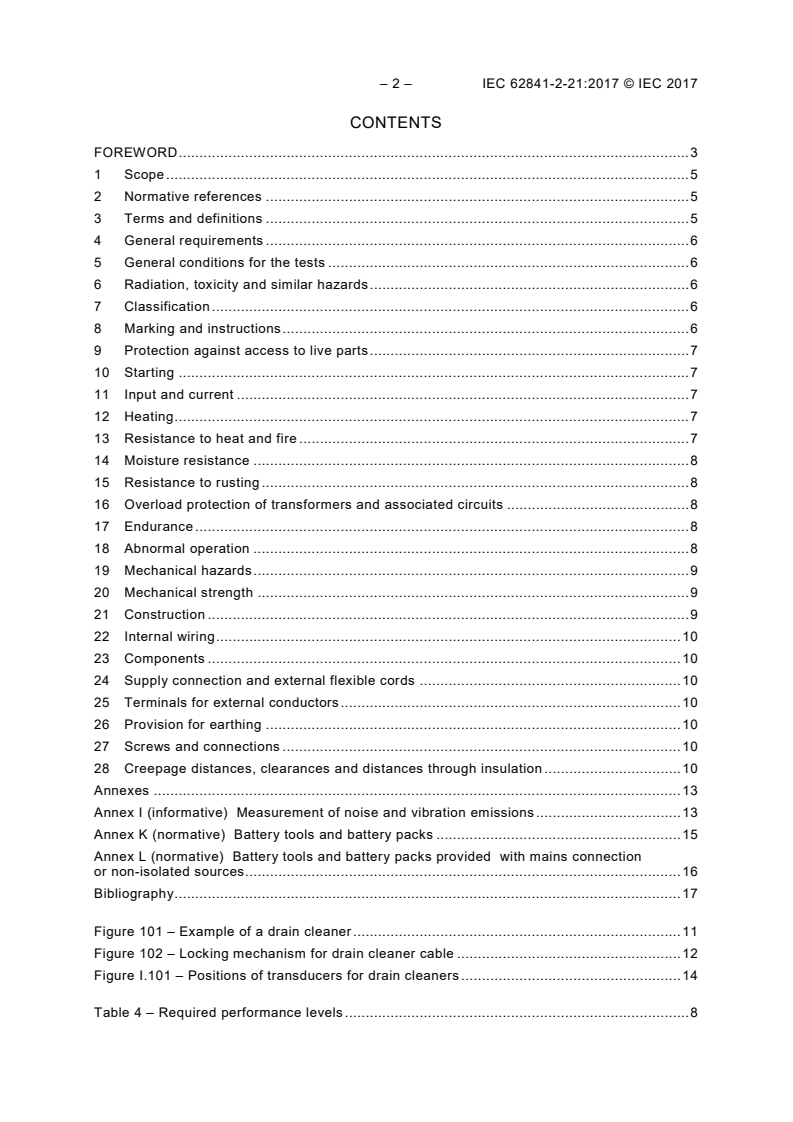
IEC 62841-2-21:2017 - Electric motor-operated hand-held tools, transportable tools and lawn and garden machinery - Safety - Part 2-21: Particular requirements for hand-held drain cleaners Released:5/23/2017
Overview
IEC 62841-2-21:2017 (consolidated with Amendment 1, Edition 1.1, 2024‑12) is the IEC safety standard for hand‑held drain cleaners (also called pipe cleaners). It supplements the general requirements of IEC 62841‑1:2014 and defines particular safety, testing and marking requirements for electrically motor‑driven hand‑held drain cleaning tools. Key scope limits include a rated supply voltage up to 250 V for single‑phase a.c./d.c., 480 V for three‑phase a.c., and a rated input of up to 3 700 W. This Part does not apply to transportable drain cleaners or machines that use a solid rod to clean drains; battery tool applicability is addressed in Annexes K and L.
Key topics and requirements
The standard focuses on hazards encountered in normal use and reasonably foreseeable misuse. Major technical topics include:
- General safety requirements and conditions for testing (accessories such as drain cleaner cables are treated separately).
- Marking and instructions, including specific safety instructions for drain cleaners (for example testing RCD/GFCI, use of RCD‑protected extension cords, glove and PPE guidance, and hygiene precautions).
- Electrical safety: protection against live parts, starting controls, input/current limits, earth/earthing provisions, terminals and cord requirements.
- Thermal and environmental resistance: heating, resistance to heat/fire, moisture resistance and resistance to rusting.
- Mechanical safety: mechanical hazards, mechanical strength, construction, internal wiring and components, cable drums and cutter attachments.
- Endurance, overload and abnormal operation tests to verify durability and safe behavior under fault or misuse conditions.
- Emissions: noise and vibration measurement guidance (informative Annex I).
- Battery tool considerations: normative guidance for battery‑powered tools and battery packs (Annex K and L).
Practical applications and users
Who uses IEC 62841‑2‑21?
- Manufacturers of hand‑held drain cleaners and accessories (cables, cutters, drums) to design compliant products.
- Testing laboratories and certification bodies for conformity assessment and product safety testing.
- Product safety engineers and compliance managers preparing technical files and instructions for use.
- Procurement teams, regulators and standards bodies who specify safety requirements for purchase or market access.
- Service technicians and trainers who must understand required PPE, RCD use and safe operating procedures.
Related standards
- IEC 62841‑1:2014 - General requirements for electric motor‑operated hand‑held tools.
- Other parts of the IEC 62841 series, including a future Part 3 addressing transportable tools (transportable drain cleaners).
Keywords: IEC 62841-2-21, hand-held drain cleaners, drain cleaner safety, electric motor-operated tools, RCD, IEC 62841-1, battery tools, pipe cleaner standard.
Relations
- Effective Date
- 08-Dec-2023
Buy Documents
IEC 62841-2-21:2017+AMD1:2024 CSV - Electric motor-operated hand-held tools, transportable tools and lawn and garden machinery - Safety - Part 2-21: Particular requirements for hand-held drain cleaners Released:20. 12. 2024
IEC 62841-2-21:2017 - Electric motor-operated hand-held tools, transportable tools and lawn and garden machinery - Safety - Part 2-21: Particular requirements for hand-held drain cleaners Released:5/23/2017
Get Certified
Connect with accredited certification bodies for this standard

DVS-ZERT GmbH
German welding certification society.
CARES (UK Certification Authority for Reinforcing Steels)
UK certification for reinforcing steels and construction.
EWF/IIW (European/International Welding Federation)
International welding personnel certification.
Sponsored listings
Frequently Asked Questions
IEC 62841-2-21:2017 is a standard published by the International Electrotechnical Commission (IEC). Its full title is "Electric motor-operated hand-held tools, transportable tools and lawn and garden machinery - Safety - Part 2-21: Particular requirements for hand-held drain cleaners". This standard covers: IEC 62841-2-21:2017 applies to hand-held drain cleaners (drain cleaners are also known as pipe cleaners) the rated voltage is not more than 250 V for single-phase a.c. or d.c. tools, and 480 V for three-phase a.c. tools. The rated input is not more than 3 700 W. The limits for the applicability of this standard for battery tools are given in K.1 and L.1. This standard deals with the hazards presented by tools which are encountered by all persons in the normal use and reasonably foreseeable misuse of the tools. Hand-held electric tools, which can be mounted on a support or working stand for use as fixed tools without any alteration of the tool itself, are within the scope of this standard and such combination of a hand-held tool and a support is considered to be a transportable tool and thus covered by the relevant Part 3. This standard does not apply to transportable drain cleaners. This standard does not apply to machines that use a solid rod to clean drains. This Part 2-21 is to be used in conjunction with the first edition of IEC 62841-1:2014. The attention of National Committees is drawn to the fact that equipment manufacturers and testing organizations may need a transitional period following publication of a new, amended or revised IEC publication in which to make products in accordance with the new requirements and to equip themselves for conducting new or revised tests. It is the recommendation of the committee that the content of this publication be adopted for implementation nationally not earlier than 36 months from the date of publication.
IEC 62841-2-21:2017 applies to hand-held drain cleaners (drain cleaners are also known as pipe cleaners) the rated voltage is not more than 250 V for single-phase a.c. or d.c. tools, and 480 V for three-phase a.c. tools. The rated input is not more than 3 700 W. The limits for the applicability of this standard for battery tools are given in K.1 and L.1. This standard deals with the hazards presented by tools which are encountered by all persons in the normal use and reasonably foreseeable misuse of the tools. Hand-held electric tools, which can be mounted on a support or working stand for use as fixed tools without any alteration of the tool itself, are within the scope of this standard and such combination of a hand-held tool and a support is considered to be a transportable tool and thus covered by the relevant Part 3. This standard does not apply to transportable drain cleaners. This standard does not apply to machines that use a solid rod to clean drains. This Part 2-21 is to be used in conjunction with the first edition of IEC 62841-1:2014. The attention of National Committees is drawn to the fact that equipment manufacturers and testing organizations may need a transitional period following publication of a new, amended or revised IEC publication in which to make products in accordance with the new requirements and to equip themselves for conducting new or revised tests. It is the recommendation of the committee that the content of this publication be adopted for implementation nationally not earlier than 36 months from the date of publication.
IEC 62841-2-21:2017 is classified under the following ICS (International Classification for Standards) categories: 25.140.20 - Electric tools. The ICS classification helps identify the subject area and facilitates finding related standards.
IEC 62841-2-21:2017 has the following relationships with other standards: It is inter standard links to IEC 62841-2-21:2017/AMD1:2024. Understanding these relationships helps ensure you are using the most current and applicable version of the standard.
IEC 62841-2-21:2017 is available in PDF format for immediate download after purchase. The document can be added to your cart and obtained through the secure checkout process. Digital delivery ensures instant access to the complete standard document.
Standards Content (Sample)
IEC 62841-2-21 ®
Edition 1.1 2024-12
CONSOLIDATED VERSION
INTERNATIONAL
STANDARD
colour
inside
Electric motor-operated hand-held tools, transportable tools and lawn and
garden machinery – Safety –
Part 2-21: Particular requirements for hand-held drain cleaners
All rights reserved. Unless otherwise specified, no part of this publication may be reproduced or utilized in any form
or by any means, electronic or mechanical, including photocopying and microfilm, without permission in writing from
either IEC or IEC's member National Committee in the country of the requester. If you have any questions about IEC
copyright or have an enquiry about obtaining additional rights to this publication, please contact the address below or
your local IEC member National Committee for further information.
IEC Secretariat Tel.: +41 22 919 02 11
3, rue de Varembé info@iec.ch
CH-1211 Geneva 20 www.iec.ch
Switzerland
About the IEC
The International Electrotechnical Commission (IEC) is the leading global organization that prepares and publishes
International Standards for all electrical, electronic and related technologies.
About IEC publications
The technical content of IEC publications is kept under constant review by the IEC. Please make sure that you have the
latest edition, a corrigendum or an amendment might have been published.
IEC publications search - webstore.iec.ch/advsearchform IEC Products & Services Portal - products.iec.ch
The advanced search enables to find IEC publications by a Discover our powerful search engine and read freely all the
variety of criteria (reference number, text, technical publications previews, graphical symbols and the glossary.
committee, …). It also gives information on projects, replaced With a subscription you will always have access to up to date
and withdrawn publications. content tailored to your needs.
IEC Just Published - webstore.iec.ch/justpublished
Electropedia - www.electropedia.org
Stay up to date on all new IEC publications. Just Published
The world's leading online dictionary on electrotechnology,
details all new publications released. Available online and once
containing more than 22 500 terminological entries in English
a month by email.
and French, with equivalent terms in 25 additional languages.
Also known as the International Electrotechnical Vocabulary
IEC Customer Service Centre - webstore.iec.ch/csc
(IEV) online.
If you wish to give us your feedback on this publication or need
further assistance, please contact the Customer Service
Centre: sales@iec.ch.
IEC 62841-2-21 ®
Edition 1.1 2024-12
CONSOLIDATED VERSION
INTERNATIONAL
STANDARD
colour
inside
Electric motor-operated hand-held tools, transportable tools and lawn and
garden machinery – Safety –
Part 2-21: Particular requirements for hand-held drain cleaners
INTERNATIONAL
ELECTROTECHNICAL
COMMISSION
ICS 25.140.20 ISBN 978-2-8327-0124-9
REDLINE VERSION – 2 – IEC 62841-2-21:2017+AMD1:2024 CSV
© IEC 2024
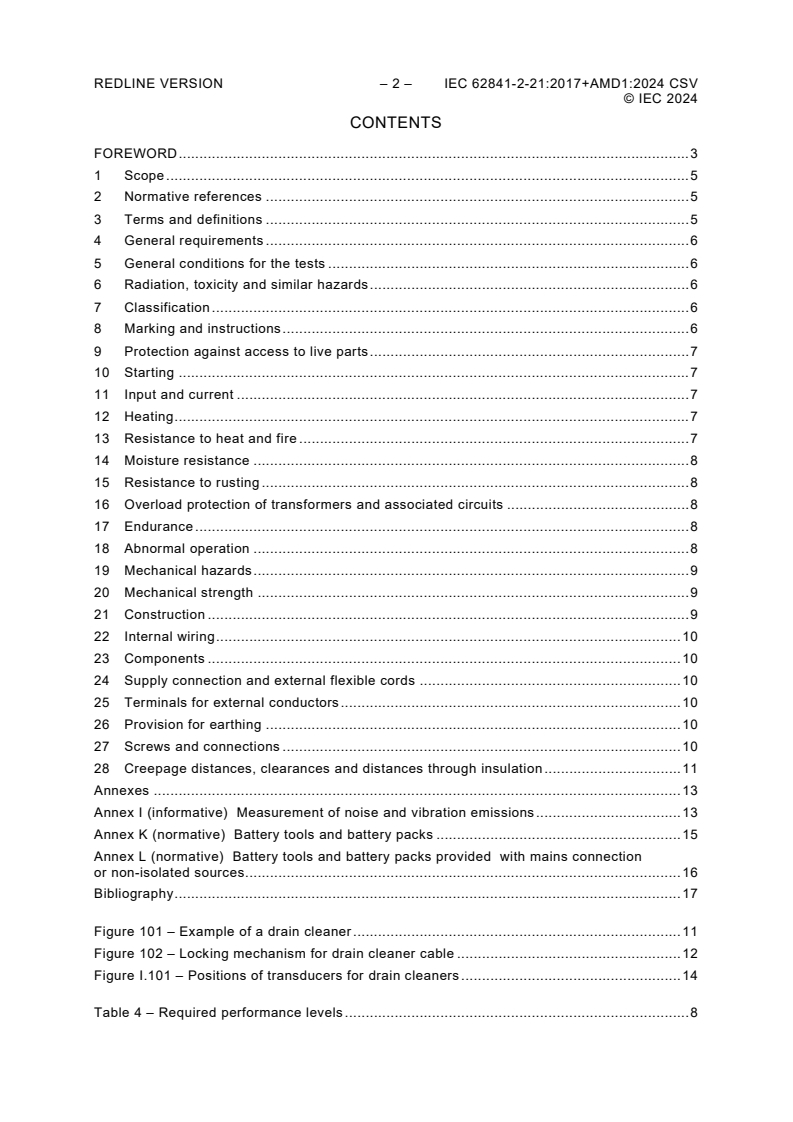
CONTENTS
FOREWORD . 3
1 Scope . 5
2 Normative references . 5
3 Terms and definitions . 5
4 General requirements . 6
5 General conditions for the tests . 6
6 Radiation, toxicity and similar hazards . 6
7 Classification . 6
8 Marking and instructions . 6
9 Protection against access to live parts . 7
10 Starting . 7
11 Input and current . 7
12 Heating . 7
13 Resistance to heat and fire . 7
14 Moisture resistance . 8
15 Resistance to rusting . 8
16 Overload protection of transformers and associated circuits . 8
17 Endurance . 8
18 Abnormal operation . 8
19 Mechanical hazards . 9
20 Mechanical strength . 9
21 Construction . 9
22 Internal wiring . 10
23 Components . 10
24 Supply connection and external flexible cords . 10
25 Terminals for external conductors . 10
26 Provision for earthing . 10
27 Screws and connections . 10
28 Creepage distances, clearances and distances through insulation . 11
Annexes . 13
Annex I (informative) Measurement of noise and vibration emissions . 13
Annex K (normative) Battery tools and battery packs . 15
Annex L (normative) Battery tools and battery packs provided with mains connection
or non-isolated sources . 16
Bibliography . 17
Figure 101 – Example of a drain cleaner . 11
Figure 102 – Locking mechanism for drain cleaner cable . 12
Figure I.101 – Positions of transducers for drain cleaners . 14
Table 4 – Required performance levels . 8
© IEC 2024
INTERNATIONAL ELECTROTECHNICAL COMMISSION
____________
ELECTRIC MOTOR-OPERATED HAND-HELD TOOLS, TRANSPORTABLE
TOOLS AND LAWN AND GARDEN MACHINERY – SAFETY –
Part 2-21: Particular requirements for hand-held drain cleaners
FOREWORD
1) The International Electrotechnical Commission (IEC) is a worldwide organization for standardization comprising
all national electrotechnical committees (IEC National Committees). The object of IEC is to promote
international co-operation on all questions concerning standardization in the electrical and electronic fields. To
this end and in addition to other activities, IEC publishes International Standards, Technical Specifications,
Technical Reports, Publicly Available Specifications (PAS) and Guides (hereafter referred to as "IEC
Publication(s)"). Their preparation is entrusted to technical committees; any IEC National Committee interested
in the subject dealt with may participate in this preparatory work. International, governmental and non-
governmental organizations liaising with the IEC also participate in this preparation. IEC collaborates closely
with the International Organization for Standardization (ISO) in accordance with conditions determined by
agreement between the two organizations.
2) The formal decisions or agreements of IEC on technical matters express, as nearly as possible, an international
consensus of opinion on the relevant subjects since each technical committee has representation from all
interested IEC National Committees.
3) IEC Publications have the form of recommendations for international use and are accepted by IEC National
Committees in that sense. While all reasonable efforts are made to ensure that the technical content of IEC
Publications is accurate, IEC cannot be held responsible for the way in which they are used or for any
misinterpretation by any end user.
4) In order to promote international uniformity, IEC National Committees undertake to apply IEC Publications
transparently to the maximum extent possible in their national and regional publications. Any divergence
between any IEC Publication and the corresponding national or regional publication shall be clearly indicated in
the latter.
5) IEC itself does not provide any attestation of conformity. Independent certification bodies provide conformity
assessment services and, in some areas, access to IEC marks of conformity. IEC is not responsible for any
services carried out by independent certification bodies.
6) All users should ensure that they have the latest edition of this publication.
7) No liability shall attach to IEC or its directors, employees, servants or agents including individual experts and
members of its technical committees and IEC National Committees for any personal injury, property damage or
other damage of any nature whatsoever, whether direct or indirect, or for costs (including legal fees) and
expenses arising out of the publication, use of, or reliance upon, this IEC Publication or any other IEC
Publications.
8) Attention is drawn to the Normative references cited in this publication. Use of the referenced publications is
indispensable for the correct application of this publication.
9) IEC draws attention to the possibility that the implementation of this document may involve the use of (a)
patent(s). IEC takes no position concerning the evidence, validity or applicability of any claimed patent rights in
respect thereof. As of the date of publication of this document, IEC had not received notice of (a) patent(s),
which may be required to implement this document. However, implementers are cautioned that this may not
represent the latest information, which may be obtained from the patent database available at
https://patents.iec.ch. IEC shall not be held responsible for identifying any or all such patent rights.
This consolidated version of the official IEC Standard and its amendment has been
prepared for user convenience.
IEC 62841-2-21 edition 1.1 contains the first edition (2017-05) [documents 116/316/FDIS
and 116/326/RVD] and its amendment 1 (2024-12) [documents 116/726/CDV and
116/778A/RVC].
In this Redline version, a vertical line in the margin shows where the technical content
is modified by amendment 1. Additions are in green text, deletions are in strikethrough
red text. A separate Final version with all changes accepted is available in this
publication.
REDLINE VERSION – 4 – IEC 62841-2-21:2017+AMD1:2024 CSV
© IEC 2024
International Standard IEC 62841-2-21 has been prepared by IEC technical committee 116:
Safety of motor-operated electric tools.
This document has been drafted in accordance with the ISO/IEC Directives, Part 2.
This Part 2-21 is to be used in conjunction with the first edition of IEC 62841-1 (2014).
This Part 2-21 supplements or modifies the corresponding clauses in IEC 62841-1, so as to
convert it into the IEC standard: Particular requirements for hand-held drain cleaners.
Where a particular subclause of Part 1 is not mentioned in this Part 2-21, that subclause
applies as far as relevant. Where this standard states “addition”, “modification” or
“replacement”, the relevant text in Part 1 is to be adapted accordingly.
The following print types are used:
• requirements: in roman type;
• test specifications: in italic type;
• notes: in small roman type.
The terms defined in Clause 3 are printed in bold typeface.
Subclauses, notes and figures which are additional to those in Part 1 are numbered starting
from 101.
A list of all parts of the IEC 62841 series, under the general title: Electric motor-operated
hand-held tools, transportable tools and lawn and garden machinery – Safety, can be found
on the IEC website.
The committee has decided that the contents of this document and its amendment will remain
unchanged until the stability date indicated on the IEC website under webstore.iec.ch in the
data related to the specific document. At this date, the document will be
• reconfirmed,
• withdrawn, or
• revised.
NOTE The attention of National Committees is drawn to the fact that equipment manufacturers and testing
organizations may need a transitional period following publication of a new, amended or revised IEC publication in
which to make products in accordance with the new requirements and to equip themselves for conducting new or
revised tests.
It is the recommendation of the committee that the content of this publication be adopted for implementation
nationally not earlier than 36 months from the date of publication.
IMPORTANT – The 'colour inside' logo on the cover page of this publication indicates
that it contains colours which are considered to be useful for the correct
understanding of its contents. Users should therefore print this document using a
colour printer.
© IEC 2024
ELECTRIC MOTOR-OPERATED HAND-HELD TOOLS, TRANSPORTABLE
TOOLS AND LAWN AND GARDEN MACHINERY – SAFETY –
Part 2-21: Particular requirements for hand-held drain cleaners
1 Scope
This clause of Part 1 is applicable, except as follows:
Addition:
This part of IEC 62841 applies to hand-held drain cleaners.
NOTE 101 Drain cleaners are also known as pipe cleaners.
This standard does not apply to transportable drain cleaners.
NOTE 102 Transportable drain cleaners will be covered by a future part of IEC 62841-3.
This standard does not apply to machines that use a solid rod to clean drains.
2 Normative references
This clause of Part 1 is applicable.
3 Terms and definitions
This clause of Part 1 is applicable, except as follows:
Additional definitions:
3.101
cutter
accessory that is attached to the end of the drain cleaner cable or is a specially formed
section of the drain cleaner cable
Note 1 to entry: See Figure 101.
3.102
drain cleaner
tool designed to clean out drains and pipes with a rotating drain cleaner cable that is either
fed manually or with an automatic feed mechanism
Note 1 to entry: See Figure 101.
3.103
drain cleaner cable
flexible accessory of a drain cleaner that is inserted into the pipe or drain
Note 1 to entry: See Figure 101.
3.104
drum
cylindrical container that rotates and houses the drain cleaner cable
REDLINE VERSION – 6 – IEC 62841-2-21:2017+AMD1:2024 CSV
© IEC 2024
Note 1 to entry: See Figure 101.
4 General requirements
This clause of Part 1 is applicable.
5 General conditions for the tests
This clause of Part 1 is applicable, except as follows:
5.17 Addition:
A drain cleaner cable is considered to be an accessory and is not included in the mass of
the tool.
6 Radiation, toxicity and similar hazards
This clause of Part 1 is applicable.
7 Classification
This clause of Part 1 is applicable.
8 Marking and instructions
This clause of Part 1 is applicable, except as follows:
8.14.1 Addition:
For drain cleaners, the additional safety instructions as specified in 8.14.1.101 shall be
given. This part may be printed separately from the “General Power Tool Safety Warnings”.
8.14.1.1 Addition:
Item 2) b) is not applicable.
8.14.1.101 Safety instructions for drain cleaners
NOTE In the instructions below, at the discretion of the manufacturer the term “drain” is replaced with the term
“pipe”.
a) Before using the tool, test the residual current device (RCD) provided with the
supply cord to ensure it is operating correctly. A properly operating RCD reduces the
risk of electrical shock.
NOTE It is possible to replace the term “residual current device (RCD)” with the term “ground fault circuit
interrupter (GFCI)” or “earth leakage circuit breaker (ELCB)”.
b) Only use extension cords that are protected by an RCD. The RCD on the machine
power cord will not prevent electrical shock from the extension cords.
NOTE It is possible to replace the term “residual current device (RCD)” with the term “ground fault circuit
interrupter (GFCI)” or “earth leakage circuit breaker (ELCB)”.
c) Only grasp the rotating cable with gloves recommended by the manufacturer. Latex
or loose-fitting gloves or rags can become wrapped around the cable and may result in
serious personal injury.
© IEC 2024
d) Do not allow the cutter to stop turning while the cable is turning. This can overstress
the cable and may cause twisting, kinking or breaking of the cable and may result in
serious personal injury.
e) Use latex or rubber gloves inside the gloves recommended by the manufacturer,
goggles, face shields, protective clothing, and respirator when chemicals, bacteria
or other toxic or infectious substances are suspected to be in a drain line. Drains
may contain chemicals, bacteria and other substances that may cause burns, be toxic or
infectious or may result in other serious personal injury.
f) Practice good hygiene. Do not eat or smoke while handling or operating the tool.
After handling or operating drain cleaning equipment, use hot, soapy water to wash
hands and other body parts exposed to drain contents. This will help reduce the risk of
health hazards due to exposure to toxic or infectious material.
g) Only use the drain cleaner for the recommended drain sizes. Using the wrong size
drain cleaner can lead to twisting, kinking or breaking of the cable and may result in
personal injury.
8.14.2 a) Additional items:
101) Information on the permitted length(s) and diameter(s) of the drain cleaner cable;
102) Instruction on how to install the drain cleaner cable;
103) Information on recommended drain cleaner cable diameters for different pipe
diameters.
8.14.2 b) Additional items:
101) Information on the correct gloves to wear during operation;
102) Information on the distance the drain cleaner is to be placed from the drain or pipe
opening.
8.14.2 c) Additional item:
101) Instruction on how to inspect and maintain the drain cleaner cable.
9 Protection against access to live parts
This clause of Part 1 is applicable.
10 Starting
This clause of Part 1 is applicable.
11 Input and current
This clause of Part 1 is applicable.
12 Heating
This clause of Part 1 is applicable.
13 Resistance to heat and fire
This clause of Part 1 is applicable.
REDLINE VERSION – 8 – IEC 62841-2-21:2017+AMD1:2024 CSV
© IEC 2024
14 Moisture resistance
This clause of Part 1 is applicable, except as follows:
14.5 Replacement:
A residual current device used to provide protection from shock in the case of moisture shall
comply with IEC 61540:1999 and shall meet the following requirements a) to c):
a) The RCD shall disconnect both mains conductors, but not the earth conductor if provided,
when the leakage exceeds 10 mA and with a maximum response of 300 ms.
Compliance is checked by inspection and the test of 9.9.2 of IEC 61540:1997. In addition,
during the test, the earthing conductor shall not become disconnected.
b) The RCD shall be reliable for its intended use.
Compliance is checked at rated voltage by operating the residual current device under
conditions of simulated leakage as in a) above during conditions of locked rotor of the tool
for 50 cycles. The residual current device shall operate correctly for all cycles.
c) The RCD shall be installed such that it is unlikely to be removed during use or normal
maintenance.
This requirement is considered fulfilled if the residual current device is fixed to the tool
or the power supply cord connected to the tool.
Compliance is checked by inspection.
15 Resistance to rusting
This clause of Part 1 is applicable.
16 Overload protection of transformers and associated circuits
This clause of Part 1 is applicable.
17 Endurance
This clause of Part 1 is applicable.
18 Abnormal operation
This clause of Part 1 is applicable, except as follows:
18.8.1 Replacement of Table 4:
Table 4 – Required performance levels
Type and purpose of SCF Minimum performance level (PL)
Power switch – prevent unwanted switch-on a
Power switch – provide desired switch-off a
Provide desired direction of rotation a
Any electronic control to pass the test of 18.3 a
Any speed limiting device Not an SCF
Prevent exceeding thermal limits as in Clause 18 18.4 a
and 18.5.3
© IEC 2024
19 Mechanical hazards
This clause of Part 1 is applicable, except as follows:
19.1 Replacement of the first paragraph:
Moving dangerous parts and other dangerous parts other than the drain cleaner cable and
the drum, which is covered by 19.101, shall be so positioned or enclosed to provide adequate
protection against personal injury.
The drain cleaner cable shall be smooth and free from sharp edges except for the cutter.
19.4 Replacement:
Drain cleaners shall have at least two handles or grasping surfaces to ensure safe handling
during use.
Compliance is checked by inspection.
19.6 This subclause is not applicable.
19.101 The drum shall have a continuous outer surface without any openings. Any
protrusions from or indentations in the drum shall be smooth, free of burrs and shall not have
an acute angle in the forward direction of rotation and protrusions shall not exceed 12 mm.
Compliance is checked by inspection and by measurement.
20 Mechanical strength
This clause of Part 1 is applicable, except as follows:
20.1 Addition:
Damage to the drum, drum mounting or drain cleaner cable feed mechanism is permitted,
provided that protection against access to live parts in accordance with Clause 9 is not
impaired.
20.5 This subclause is not applicable.
21 Construction
This clause of Part 1 is applicable, except as follows:
21.15 Replacement:
Drain cleaners shall protect the user against the increased risk of shock due to the presence
of moisture.
Drain cleaners shall be either:
• of class III construction; or
REDLINE VERSION – 10 – IEC 62841-2-21:2017+AMD1:2024 CSV
© IEC 2024
• of class I construction or class II construction, be provided with a residual current
device and comply with 14.5; or
• of class I construction or class II construction and be designed for use in combination
with an isolating transformer.
Compliance is checked by inspection.
21.18.1.1 Addition:
The power switch shall not have any locking device to lock it in the “on” position.
21.18.1.2 This subclause is not applicable.
21.30 This subclause is not applicable.
21.35 This subclause is not applicable.
21.101 A drain cleaner cable locking mechanism that rotates with the drain cleaner cable
shall be smooth and free from burrs. To prevent entanglement, protrusions shall
• not exceed 12 mm radially; and
• not have an acute angle in the forward direction of rotation.
Compliance is checked by inspection and by measurement with the locking mechanism fully
tightened with the largest drain cleaner cable installed in accordance with 8.14.2 b) 102).
See Figure 102.
22 Internal wiring
This clause of Part 1 is applicable.
23 Components
This clause of Part 1 is applicable, except as follows:
23.3 This subclause is not applicable.
24 Supply connection and external flexible cords
This clause of Part 1 is applicable.
25 Terminals for external conductors
This clause of Part 1 is applicable.
26 Provision for earthing
This clause of Part 1 is applicable.
27 Screws and connections
This clause of Part 1 is applicable.
© IEC 2024
28 Creepage distances, clearances and distances through insulation
This clause of Part 1 is applicable.
6 3 2
IEC
Key
1 drum
2 drain cleaner cable forward/reverse feed mechanism
3 drain cleaner cable
4 handle/grasping surface
5 motor
6 cutter
Figure 101 – Example of a drain cleaner
REDLINE VERSION – 12 – IEC 62841-2-21:2017+AMD1:2024 CSV
© IEC 2024
Dimensions in millimetres
≥ 90°
IEC
Key
1 locking collar
2 drain cleaner cable locking mechanism
3 direction of rotation
Figure 102 – Locking mechanism for drain cleaner cable
≤ 12
© IEC 2024
Annexes
The annexes of Part 1 are applicable except as follows:
Annex I
(informative)
Measurement of noise and vibration emissions
NOTE In Europe (EN 62841-2-21), Annex I is normative.
I.2 Noise test code (grade 2)
This clause of Part 1 is applicable except as follows:
I.2.4 Installation and mounting conditions of the power tools during noise tests
Addition:
Drain cleaners are suspended in such a way as to correspond to normal use. They are
tested without a drain cleaner cable installed.
I.2.5 Operating conditions
Addition:
Drain cleaners are tested at no-load. Speed settings are set to the highest speed.
The temperature requirements of 5.6 are not applicable.
I.3 Vibration
This clause of Part 1 is applicable except as follows:
I.3.3.2 Location of measurement
Addition:
Figure I.101 shows the positions for drain cleaners.
I.3.5.1 General
Addition:
For battery operated tools, the tests are conducted with the lightest battery in accordance
with K.8.14.2 e) 2) of Part 1 that has sufficient capacity to operate the tool at no-load for at
least 25 min.
I.3.5.3 Operating conditions
Addition:
Drain cleaners are tested at no-load with no drain cleaner cable installed. Speed settings
are set to the highest speed.
REDLINE VERSION – 14 – IEC 62841-2-21:2017+AMD1:2024 CSV
© IEC 2024
The drain cleaner is held horizontally during the test.
I.3.6.2 Declaration of the vibration total value
Addition:
The vibration total value a of the handle with the highest emission and the uncertainty K shall
h
be declared.
Detail of transducers
(measurement in axes X, Y, Z)
IEC
Figure I.101 – Positions of transducers for drain cleaners
© IEC 2024
Annex K
(normative)
Battery tools and battery packs
K.1 Scope
Addition:
All clauses of this Part 2-21 apply unless otherwise specified in this annex.
K.8.14.1.101 Safety instructions for drain cleaners
Items a) and b) are not applicable.
K.14.5 This subclause is not applicable.
K.21.15 This subclause is not applicable.
NOTE In Europe (EN 62841-2-21), the following additional subclause applies:
K.21.18.Z101 Isolation and disabling device
Tools with an integral battery shall either be equipped
– with an isolation device to prevent the risk of injury from mechanical hazards during servicing or user
maintenance; or
– with a disabling device that prevents unintentional starting of the tool.
An isolation device shall
– provide disconnection of all poles of the battery from the serviceable region of the tool;
– be equipped with an unambiguous indication of the state of the disconnection device which corresponds to
each position of its manual control (actuator);
– be provided with protection against accidental reconnection.
NOTE 1 Examples of methods to achieve this disconnection include removable jumpers, integral batteries
that can be disconnected for servicing or user maintenance, or an electromechanical power switch with a
direct mechanical link between the actuator and the contact.
NOTE 2 The risk of accidental reconnection for a power switch is addressed by the requirement of
21.18.1.2. The other examples in NOTE 1 achieve this by the necessary actions for reconnection.
A disabling device may be achieved by any of the following:
– a self-restoring or non-self-restoring lock-off device where two separate and dissimilar actions are
necessary before the motor is switched on (e.g. a power switch which has to be pushed in before it can
be moved laterally to close the contacts to start the motor). It shall not be possible to achieve these two
actions with a single grasping motion or a straight line motion;
– a removable disabling device provided with the tool where it shall not be possible for the tool to be
operated when either applied or removed.
Compliance is checked by inspection and by manual test.
REDLINE VERSION – 16 – IEC 62841-2-21:2017+AMD1:2024 CSV
© IEC 2024
Annex L
(normative)
Battery tools and battery packs provided
with mains connection or non-isolated sources
L.1 Scope
Addition:
All clauses of this Part 2-21 apply unless otherwise specified in this annex.
NOTE In Europe (EN 62841-2-21), the following additional subclause applies:
L.21.18.Z101 Isolation and disabling device
Tools with an integral battery shall either be equipped
– with an isolation device to prevent the risk of injury from mechanical hazards during servicing or user
maintenance; or
– with a disabling device that prevents unintentional starting of the tool.
An isolation device shall
– provide disconnection of all poles of the battery from the serviceable region of the tool;
– be equipped with an unambiguous indication of the state of the disconnection device which corr
...
IEC 62841-2-21 ®
Edition 1.0 2017-05
INTERNATIONAL
STANDARD
NORME
INTERNATIONALE
Electric motor-operated hand-held tools, transportable tools and lawn and
garden machinery – Safety –
Part 2-21: Particular requirements for hand-held drain cleaners
Outils électroportatifs à moteur, outils portables et machines pour jardins et
pelouses – Sécurité –
Partie 2-21: Exigences particulières pour les furets portatifs
All rights reserved. Unless otherwise specified, no part of this publication may be reproduced or utilized in any form
or by any means, electronic or mechanical, including photocopying and microfilm, without permission in writing from
either IEC or IEC's member National Committee in the country of the requester. If you have any questions about IEC
copyright or have an enquiry about obtaining additional rights to this publication, please contact the address below or
your local IEC member National Committee for further information.
Droits de reproduction réservés. Sauf indication contraire, aucune partie de cette publication ne peut être reproduite
ni utilisée sous quelque forme que ce soit et par aucun procédé, électronique ou mécanique, y compris la photocopie
et les microfilms, sans l'accord écrit de l'IEC ou du Comité national de l'IEC du pays du demandeur. Si vous avez des
questions sur le copyright de l'IEC ou si vous désirez obtenir des droits supplémentaires sur cette publication, utilisez
les coordonnées ci-après ou contactez le Comité national de l'IEC de votre pays de résidence.
IEC Central Office Tel.: +41 22 919 02 11
3, rue de Varembé Fax: +41 22 919 03 00
CH-1211 Geneva 20 info@iec.ch
Switzerland www.iec.ch
About the IEC
The International Electrotechnical Commission (IEC) is the leading global organization that prepares and publishes
International Standards for all electrical, electronic and related technologies.
About IEC publications
The technical content of IEC publications is kept under constant review by the IEC. Please make sure that you have the
latest edition, a corrigenda or an amendment might have been published.
IEC Catalogue - webstore.iec.ch/catalogue Electropedia - www.electropedia.org
The stand-alone application for consulting the entire The world's leading online dictionary of electronic and
bibliographical information on IEC International Standards, electrical terms containing 20 000 terms and definitions in
Technical Specifications, Technical Reports and other English and French, with equivalent terms in 16 additional
documents. Available for PC, Mac OS, Android Tablets and languages. Also known as the International Electrotechnical
iPad. Vocabulary (IEV) online.
IEC publications search - www.iec.ch/searchpub IEC Glossary - std.iec.ch/glossary
The advanced search enables to find IEC publications by a 65 000 electrotechnical terminology entries in English and
variety of criteria (reference number, text, technical French extracted from the Terms and Definitions clause of
committee,…). It also gives information on projects, replaced IEC publications issued since 2002. Some entries have been
and withdrawn publications. collected from earlier publications of IEC TC 37, 77, 86 and
CISPR.
IEC Just Published - webstore.iec.ch/justpublished
Stay up to date on all new IEC publications. Just Published IEC Customer Service Centre - webstore.iec.ch/csc
details all new publications released. Available online and If you wish to give us your feedback on this publication or
also once a month by email. need further assistance, please contact the Customer Service
Centre: csc@iec.ch.
A propos de l'IEC
La Commission Electrotechnique Internationale (IEC) est la première organisation mondiale qui élabore et publie des
Normes internationales pour tout ce qui a trait à l'électricité, à l'électronique et aux technologies apparentées.
A propos des publications IEC
Le contenu technique des publications IEC est constamment revu. Veuillez vous assurer que vous possédez l’édition la
plus récente, un corrigendum ou amendement peut avoir été publié.
Catalogue IEC - webstore.iec.ch/catalogue Electropedia - www.electropedia.org
Application autonome pour consulter tous les renseignements
Le premier dictionnaire en ligne de termes électroniques et
bibliographiques sur les Normes internationales,
électriques. Il contient 20 000 termes et définitions en anglais
Spécifications techniques, Rapports techniques et autres
et en français, ainsi que les termes équivalents dans 16
documents de l'IEC. Disponible pour PC, Mac OS, tablettes
langues additionnelles. Egalement appelé Vocabulaire
Android et iPad.
Electrotechnique International (IEV) en ligne.
Recherche de publications IEC - www.iec.ch/searchpub
Glossaire IEC - std.iec.ch/glossary
65 000 entrées terminologiques électrotechniques, en anglais
La recherche avancée permet de trouver des publications IEC
en utilisant différents critères (numéro de référence, texte, et en français, extraites des articles Termes et Définitions des
comité d’études,…). Elle donne aussi des informations sur les publications IEC parues depuis 2002. Plus certaines entrées
projets et les publications remplacées ou retirées. antérieures extraites des publications des CE 37, 77, 86 et
CISPR de l'IEC.
IEC Just Published - webstore.iec.ch/justpublished
Service Clients - webstore.iec.ch/csc
Restez informé sur les nouvelles publications IEC. Just
Published détaille les nouvelles publications parues. Si vous désirez nous donner des commentaires sur cette
Disponible en ligne et aussi une fois par mois par email. publication ou si vous avez des questions contactez-nous:
csc@iec.ch.
IEC 62841-2-21 ®
Edition 1.0 2017-05
INTERNATIONAL
STANDARD
NORME
INTERNATIONALE
Electric motor-operated hand-held tools, transportable tools and lawn and
garden machinery – Safety –
Part 2-21: Particular requirements for hand-held drain cleaners
Outils électroportatifs à moteur, outils portables et machines pour jardins et
pelouses – Sécurité –
Partie 2-21: Exigences particulières pour les furets portatifs
INTERNATIONAL
ELECTROTECHNICAL
COMMISSION
COMMISSION
ELECTROTECHNIQUE
INTERNATIONALE
ICS 25.140.20 ISBN 978-2-8322-4278-0
– 2 – IEC 62841-2-21:2017 © IEC 2017
CONTENTS
FOREWORD . 3
1 Scope . 5
2 Normative references . 5
3 Terms and definitions . 5
4 General requirements . 6
5 General conditions for the tests . 6
6 Radiation, toxicity and similar hazards . 6
7 Classification . 6
8 Marking and instructions . 6
9 Protection against access to live parts . 7
10 Starting . 7
11 Input and current . 7
12 Heating . 7
13 Resistance to heat and fire . 7
14 Moisture resistance . 8
15 Resistance to rusting . 8
16 Overload protection of transformers and associated circuits . 8
17 Endurance . 8
18 Abnormal operation . 8
19 Mechanical hazards . 9
20 Mechanical strength . 9
21 Construction . 9
22 Internal wiring . 10
23 Components . 10
24 Supply connection and external flexible cords . 10
25 Terminals for external conductors . 10
26 Provision for earthing . 10
27 Screws and connections . 10
28 Creepage distances, clearances and distances through insulation . 10
Annexes . 13
Annex I (informative) Measurement of noise and vibration emissions . 13
Annex K (normative) Battery tools and battery packs . 15
Annex L (normative) Battery tools and battery packs provided with mains connection
or non-isolated sources . 16
Bibliography . 17
Figure 101 – Example of a drain cleaner . 11
Figure 102 – Locking mechanism for drain cleaner cable . 12
Figure I.101 – Positions of transducers for drain cleaners . 14
Table 4 – Required performance levels . 8
INTERNATIONAL ELECTROTECHNICAL COMMISSION
____________
ELECTRIC MOTOR-OPERATED HAND-HELD TOOLS, TRANSPORTABLE
TOOLS AND LAWN AND GARDEN MACHINERY – SAFETY –
Part 2-21: Particular requirements for hand-held drain cleaners
FOREWORD
1) The International Electrotechnical Commission (IEC) is a worldwide organization for standardization comprising
all national electrotechnical committees (IEC National Committees). The object of IEC is to promote
international co-operation on all questions concerning standardization in the electrical and electronic fields. To
this end and in addition to other activities, IEC publishes International Standards, Technical Specifications,
Technical Reports, Publicly Available Specifications (PAS) and Guides (hereafter referred to as “IEC
Publication(s)”). Their preparation is entrusted to technical committees; any IEC National Committee interested
in the subject dealt with may participate in this preparatory work. International, governmental and non-
governmental organizations liaising with the IEC also participate in this preparation. IEC collaborates closely
with the International Organization for Standardization (ISO) in accordance with conditions determined by
agreement between the two organizations.
2) The formal decisions or agreements of IEC on technical matters express, as nearly as possible, an international
consensus of opinion on the relevant subjects since each technical committee has representation from all
interested IEC National Committees.
3) IEC Publications have the form of recommendations for international use and are accepted by IEC National
Committees in that sense. While all reasonable efforts are made to ensure that the technical content of IEC
Publications is accurate, IEC cannot be held responsible for the way in which they are used or for any
misinterpretation by any end user.
4) In order to promote international uniformity, IEC National Committees undertake to apply IEC Publications
transparently to the maximum extent possible in their national and regional publications. Any divergence
between any IEC Publication and the corresponding national or regional publication shall be clearly indicated in
the latter.
5) IEC itself does not provide any attestation of conformity. Independent certification bodies provide conformity
assessment services and, in some areas, access to IEC marks of conformity. IEC is not responsible for any
services carried out by independent certification bodies.
6) All users should ensure that they have the latest edition of this publication.
7) No liability shall attach to IEC or its directors, employees, servants or agents including individual experts and
members of its technical committees and IEC National Committees for any personal injury, property damage or
other damage of any nature whatsoever, whether direct or indirect, or for costs (including legal fees) and
expenses arising out of the publication, use of, or reliance upon, this IEC Publication or any other IEC
Publications.
8) Attention is drawn to the Normative references cited in this publication. Use of the referenced publications is
indispensable for the correct application of this publication.
9) Attention is drawn to the possibility that some of the elements of this IEC Publication may be the subject of
patent rights. IEC shall not be held responsible for identifying any or all such patent rights.
International Standard IEC 62841-2-21 has been prepared by IEC technical committee 116:
Safety of motor-operated electric tools.
The text of this standard is based on the following documents:
FDIS Report on voting
116/316/FDIS 116/326/RVD
Full information on the voting for the approval of this International Standard can be found in
the report on voting indicated in the above table.
This document has been drafted in accordance with the ISO/IEC Directives, Part 2.
This Part 2-21 is to be used in conjunction with the first edition of IEC 62841-1 (2014).
– 4 – IEC 62841-2-21:2017 © IEC 2017
This Part 2-21 supplements or modifies the corresponding clauses in IEC 62841-1, so as to
convert it into the IEC standard: Particular requirements for hand-held drain cleaners.
Where a particular subclause of Part 1 is not mentioned in this Part 2-21, that subclause
applies as far as relevant. Where this standard states “addition”, “modification” or
“replacement”, the relevant text in Part 1 is to be adapted accordingly.
The following print types are used:
• requirements: in roman type;
• test specifications: in italic type;
• notes: in small roman type.
The terms defined in Clause 3 are printed in bold typeface.
Subclauses, notes and figures which are additional to those in Part 1 are numbered starting
from 101.
A list of all parts of the IEC 62841 series, under the general title: Electric motor-operated
hand-held tools, transportable tools and lawn and garden machinery – Safety, can be found
on the IEC website.
The committee has decided that the contents of this document will remain unchanged until the
stability date indicated on the IEC website under "http://webstore.iec.ch" in the data related to
the specific document. At this date, the document will be
• reconfirmed,
• withdrawn,
• replaced by a revised edition, or
• amended.
NOTE The attention of National Committees is drawn to the fact that equipment manufacturers and testing
organizations may need a transitional period following publication of a new, amended or revised IEC publication in
which to make products in accordance with the new requirements and to equip themselves for conducting new or
revised tests.
It is the recommendation of the committee that the content of this publication be adopted for implementation
nationally not earlier than 36 months from the date of publication.
ELECTRIC MOTOR-OPERATED HAND-HELD TOOLS, TRANSPORTABLE
TOOLS AND LAWN AND GARDEN MACHINERY – SAFETY –
Part 2-21: Particular requirements for hand-held drain cleaners
1 Scope
This clause of Part 1 is applicable, except as follows:
Addition:
This part of IEC 62841 applies to hand-held drain cleaners.
NOTE 101 Drain cleaners are also known as pipe cleaners.
This standard does not apply to transportable drain cleaners.
NOTE 102 Transportable drain cleaners will be covered by a future part of IEC 62841-3.
This standard does not apply to machines that use a solid rod to clean drains.
2 Normative references
This clause of Part 1 is applicable.
3 Terms and definitions
This clause of Part 1 is applicable, except as follows:
Additional definitions:
3.101
cutter
accessory that is attached to the end of the drain cleaner cable or is a specially formed
section of the drain cleaner cable
Note 1 to entry: See Figure 101.
3.102
drain cleaner
tool designed to clean out drains and pipes with a rotating drain cleaner cable that is either
fed manually or with an automatic feed mechanism
Note 1 to entry: See Figure 101.
3.103
drain cleaner cable
flexible accessory of a drain cleaner that is inserted into the pipe or drain
Note 1 to entry: See Figure 101.
3.104
drum
cylindrical container that rotates and houses the drain cleaner cable
– 6 – IEC 62841-2-21:2017 © IEC 2017
Note 1 to entry: See Figure 101.
4 General requirements
This clause of Part 1 is applicable.
5 General conditions for the tests
This clause of Part 1 is applicable, except as follows:
5.17 Addition:
A drain cleaner cable is considered to be an accessory and is not included in the mass of
the tool.
6 Radiation, toxicity and similar hazards
This clause of Part 1 is applicable.
7 Classification
This clause of Part 1 is applicable.
8 Marking and instructions
This clause of Part 1 is applicable, except as follows:
8.14.1 Addition:
For drain cleaners, the additional safety instructions as specified in 8.14.1.101 shall be
given. This part may be printed separately from the “General Power Tool Safety Warnings”.
8.14.1.1 Addition:
Item 2) b) is not applicable.
8.14.1.101 Safety instructions for drain cleaners
NOTE In the instructions below, at the discretion of the manufacturer the term “drain” is replaced with the term
“pipe”.
a) Before using the tool, test the residual current device (RCD) provided with the
supply cord to ensure it is operating correctly. A properly operating RCD reduces the
risk of electrical shock.
NOTE It is possible to replace the term “residual current device (RCD)” with the term “ground fault circuit
interrupter (GFCI)” or “earth leakage circuit breaker (ELCB)”.
b) Only use extension cords that are protected by an RCD. The RCD on the machine
power cord will not prevent electrical shock from the extension cords.
NOTE It is possible to replace the term “residual current device (RCD)” with the term “ground fault circuit
interrupter (GFCI)” or “earth leakage circuit breaker (ELCB)”.
c) Only grasp the rotating cable with gloves recommended by the manufacturer. Latex
or loose-fitting gloves or rags can become wrapped around the cable and may result in
serious personal injury.
d) Do not allow the cutter to stop turning while the cable is turning. This can overstress
the cable and may cause twisting, kinking or breaking of the cable and may result in
serious personal injury.
e) Use latex or rubber gloves inside the gloves recommended by the manufacturer,
goggles, face shields, protective clothing, and respirator when chemicals, bacteria
or other toxic or infectious substances are suspected to be in a drain line. Drains
may contain chemicals, bacteria and other substances that may cause burns, be toxic or
infectious or may result in other serious personal injury.
f) Practice good hygiene. Do not eat or smoke while handling or operating the tool.
After handling or operating drain cleaning equipment, use hot, soapy water to wash
hands and other body parts exposed to drain contents. This will help reduce the risk of
health hazards due to exposure to toxic or infectious material.
g) Only use the drain cleaner for the recommended drain sizes. Using the wrong size
drain cleaner can lead to twisting, kinking or breaking of the cable and may result in
personal injury.
8.14.2 a) Additional items:
101) Information on the permitted length(s) and diameter(s) of the drain cleaner cable;
102) Instruction on how to install the drain cleaner cable;
103) Information on recommended drain cleaner cable diameters for different pipe
diameters.
8.14.2 b) Additional items:
101) Information on the correct gloves to wear during operation;
102) Information on the distance the drain cleaner is to be placed from the drain or pipe
opening.
8.14.2 c) Additional item:
101) Instruction on how to inspect and maintain the drain cleaner cable.
9 Protection against access to live parts
This clause of Part 1 is applicable.
10 Starting
This clause of Part 1 is applicable.
11 Input and current
This clause of Part 1 is applicable.
12 Heating
This clause of Part 1 is applicable.
13 Resistance to heat and fire
This clause of Part 1 is applicable.
– 8 – IEC 62841-2-21:2017 © IEC 2017
14 Moisture resistance
This clause of Part 1 is applicable, except as follows:
14.5 Replacement:
A residual current device used to provide protection from shock in the case of moisture shall
comply with IEC 61540:1999 and shall meet the following requirements a) to c):
a) The RCD shall disconnect both mains conductors, but not the earth conductor if provided,
when the leakage exceeds 10 mA and with a maximum response of 300 ms.
Compliance is checked by inspection and the test of 9.9.2 of IEC 61540:1997. In addition,
during the test, the earthing conductor shall not become disconnected.
b) The RCD shall be reliable for its intended use.
Compliance is checked at rated voltage by operating the residual current device under
conditions of simulated leakage as in a) above during conditions of locked rotor of the tool
for 50 cycles. The residual current device shall operate correctly for all cycles.
c) The RCD shall be installed such that it is unlikely to be removed during use or normal
maintenance.
This requirement is considered fulfilled if the residual current device is fixed to the tool
or the power supply cord connected to the tool.
Compliance is checked by inspection.
15 Resistance to rusting
This clause of Part 1 is applicable.
16 Overload protection of transformers and associated circuits
This clause of Part 1 is applicable.
17 Endurance
This clause of Part 1 is applicable.
18 Abnormal operation
This clause of Part 1 is applicable, except as follows:
18.8.1 Replacement of Table 4:
Table 4 – Required performance levels
Type and purpose of SCF Minimum performance level (PL)
Power switch – prevent unwanted switch-on a
Power switch – provide desired switch-off
a
Provide desired direction of rotation a
Any electronic control to pass the test of 18.3 a
Any speed limiting device Not an SCF
Prevent exceeding thermal limits as in Clause 18 a
19 Mechanical hazards
This clause of Part 1 is applicable, except as follows:
19.1 Replacement of the first paragraph:
Moving dangerous parts and other dangerous parts other than the drain cleaner cable and
the drum, which is covered by 19.101, shall be so positioned or enclosed to provide adequate
protection against personal injury.
The drain cleaner cable shall be smooth and free from sharp edges except for the cutter.
19.4 Replacement:
Drain cleaners shall have at least two handles or grasping surfaces to ensure safe handling
during use.
Compliance is checked by inspection.
19.6 This subclause is not applicable.
19.101 The drum shall have a continuous outer surface without any openings. Any
protrusions from or indentations in the drum shall be smooth, free of burrs and shall not have
an acute angle in the forward direction of rotation and protrusions shall not exceed 12 mm.
Compliance is checked by inspection and by measurement.
20 Mechanical strength
This clause of Part 1 is applicable, except as follows:
20.1 Addition:
Damage to the drum, drum mounting or drain cleaner cable feed mechanism is permitted,
provided that protection against access to live parts in accordance with Clause 9 is not
impaired.
20.5 This subclause is not applicable.
21 Construction
This clause of Part 1 is applicable, except as follows:
21.15 Replacement:
Drain cleaners shall protect the user against the increased risk of shock due to the presence
of moisture.
Drain cleaners shall be either:
• of class III construction; or
• of class I construction or class II construction, be provided with a residual current
device and comply with 14.5; or
– 10 – IEC 62841-2-21:2017 © IEC 2017
• of class I construction or class II construction and be designed for use in combination
with an isolating transformer.
Compliance is checked by inspection.
21.18.1.1 Addition:
The power switch shall not have any locking device to lock it in the “on” position.
21.30 This subclause is not applicable.
21.35 This subclause is not applicable.
21.101 A drain cleaner cable locking mechanism that rotates with the drain cleaner cable
shall be smooth and free from burrs. To prevent entanglement, protrusions shall
• not exceed 12 mm radially; and
• not have an acute angle in the forward direction of rotation.
Compliance is checked by inspection and by measurement with the locking mechanism fully
tightened with the largest drain cleaner cable installed in accordance with 8.14.2 b) 102).
See Figure 102.
22 Internal wiring
This clause of Part 1 is applicable.
23 Components
This clause of Part 1 is applicable.
24 Supply connection and external flexible cords
This clause of Part 1 is applicable.
25 Terminals for external conductors
This clause of Part 1 is applicable.
26 Provision for earthing
This clause of Part 1 is applicable.
27 Screws and connections
This clause of Part 1 is applicable.
28 Creepage distances, clearances and distances through insulation
This clause of Part 1 is applicable.
6 3 2
IEC
Key
1 drum
2 drain cleaner cable forward/reverse feed mechanism
3 drain cleaner cable
4 handle/grasping surface
5 motor
6 cutter
Figure 101 – Example of a drain cleaner
– 12 – IEC 62841-2-21:2017 © IEC 2017
Dimensions in millimetres
≥ 90°
IEC
Key
1 locking collar
2 drain cleaner cable locking mechanism
3 direction of rotation
Figure 102 – Locking mechanism for drain cleaner cable
≤ 12
Annexes
The annexes of Part 1 are applicable except as follows:
Annex I
(informative)
Measurement of noise and vibration emissions
NOTE In Europe (EN 62841-2-21), Annex I is normative.
I.2 Noise test code (grade 2)
This clause of Part 1 is applicable except as follows:
I.2.4 Installation and mounting conditions of the power tools during noise tests
Addition:
Drain cleaners are suspended in such a way as to correspond to normal use. They are
tested without a drain cleaner cable installed.
I.2.5 Operating conditions
Addition:
Drain cleaners are tested at no-load. Speed settings are set to the highest speed.
The temperature requirements of 5.6 are not applicable.
I.3 Vibration
This clause of Part 1 is applicable except as follows:
I.3.3.2 Location of measurement
Addition:
Figure I.101 shows the positions for drain cleaners.
I.3.5.3 Operating conditions
Addition:
Drain cleaners are tested at no-load with no drain cleaner cable installed. Speed settings
are set to the highest speed.
The drain cleaner is held horizontally during the test.
I.3.6.2 Declaration of the vibration total value
Addition:
The vibration total value a of the handle with the highest emission and the uncertainty K shall
h
be declared.
– 14 – IEC 62841-2-21:2017 © IEC 2017
Detail of transducers
(measurement in axes X, Y, Z)
IEC
Figure I.101 – Positions of transducers for drain cleaners
Annex K
(normative)
Battery tools and battery packs
K.1 Scope
Addition:
All clauses of this Part 2-21 apply unless otherwise specified in this annex.
K.8.14.1.101 Safety instructions for drain cleaners
Items a) and b) are not applicable.
K.14.5 This subclause is not applicable.
K.21.15 This subclause is not applicable.
NOTE In Europe (EN 62841-2-21), the following additional subclause applies:
K.21.18.Z101 Isolation and disabling device
Tools with an integral battery shall either be equipped
– with an isolation device to prevent the risk of injury from mechanical hazards during servicing or user
maintenance; or
– with a disabling device that prevents unintentional starting of the tool.
An isolation device shall
– provide disconnection of all poles of the battery from the serviceable region of the tool;
– be equipped with an unambiguous indication of the state of the disconnection device which corresponds to
each position of its manual control (actuator);
– be provided with protection against accidental reconnection.
NOTE 1 Examples of methods to achieve this disconnection include removable jumpers, integral batteries
that can be disconnected for servicing or user maintenance, or an electromechanical power switch with a
direct mechanical link between the actuator and the contact.
NOTE 2 The risk of accidental reconnection for a power switch is addressed by the requirement of
21.18.1.2. The other examples in NOTE 1 achieve this by the necessary actions for reconnection.
A disabling device may be achieved by any of the following:
– a self-restoring or non-self-restoring lock-off device where two separate and dissimilar actions are
necessary before the motor is switched on (e.g. a power switch which has to be pushed in before it can
be moved laterally to close the contacts to start the motor). It shall not be possible to achieve these two
actions with a single grasping motion or a straight line motion;
– a removable disabling device provided with the tool where it shall not be possible for the tool to be
operated when either applied or removed.
Compliance is checked by inspection and by manual test.
– 16 – IEC 62841-2-21:2017 © IEC 2017
Annex L
(normative)
Battery tools and battery packs provided
with mains connection or non-isolated sources
L.1 Scope
Addition:
All clauses of this Part 2-21 apply unless otherwise specified in this annex.
NOTE In Europe (EN 62841-2-21), the following additional subclause applies:
L.21.18.Z101 Isolation and disabling device
Tools with an integral battery shall either be equipped
– with an isolation device to prevent the risk of injury from mechanical hazards during servicing or user
maintenance; or
– with a disabling device that prevents unintentional starting of the tool.
An isolation device shall
– provide disconnection of all poles of the battery from the serviceable region of the tool;
– be equipped with an unambiguous indication of the state of the disconnection device which corresponds to
each position of its manual control (actuator);
– be provided with protection against accidental reconnection.
NOTE 1 Examples of methods to achieve this disconnection include removable jumpers, integral batteries
that can be disconnected for servicing or user maintenance, or an electromechanical power switch with a
direct mechanical link between the actuator and the contact.
NOTE 2 The risk of accidental reconnection for a power switch is addressed by the requirement of
21.18.1.2. The other examples in NOTE 1 achieve this by the necessary actions for reconnection.
A disabling device may be achieved by any of the following:
– a self-restoring or non-self-restoring lock-off device where two separate and dissimilar actions are
necessary before the motor is switched on (e.g. a power switch which has to be pushed in before it can
be moved laterally to close the contacts to start the motor). It shall not be possible to achieve these two
actions with a single grasping motion or a straight line motion;
– a removable disabling device provided with the tool where it shall not be possible for the tool to be
operated when either applied or removed.
Compliance is checked by inspection and by manual test.
Bibliography
The bibliography of Part 1 is applicable, except as follows:
Addition:
IEC 62841-3-14, Electric motor-operated hand-held tools, transportable tools and lawn and
garden machinery – Safety – Part 3-14: Particular requirements for transportable drain
cleaners
___________
_____________
Under preparation. Stage at time of publication: IEC CDV 62841-3-14:2016.
– 18 – IEC 62841-2-21:2017 © IEC 2017
SOMMAIRE
AVANT-PROPOS . 19
1 Domaine d'application . 21
2 Références normatives . 21
3 Termes et définitions . 21
4 Exigences générales . 22
5 Conditions générales d'essai . 22
6 Rayonnement, toxicité et dangers analogues . 22
7 Classification . 22
8 Marquage et indications . 22
9 Protection contre l'accès aux parties actives. 23
10 Démarrage . 23
11 Puissance et courant . 24
12 Échauffements. 24
13 Résistance à la chaleur et au feu . 24
14 Résistance à l'humidité . 24
15 Protection contre la rouille . 24
16 Protection contre la surcharge des transformateurs et des circuits associés . 24
17 Endurance . 24
18 Fonctionnement anormal . 25
19 Dangers mécaniques . 25
20 Résistance mécanique . 25
21 Construction . 26
22 Conducteurs internes. 26
23 Composants . 26
24 Raccordement au réseau et câbles souples extérieurs . 27
25 Bornes pour conducteurs externes . 27
26 Dispositions de mise à la terre . 27
27 Vis et connexions . 27
28 Lignes de fuite, distances d’isolement et distances à travers l’isolation . 27
Annexes . 30
Annexe I (informative) Mesure des émissions acoustique et de vibration . 30
Annexe K (normative) Outils fonctionnant sur batteries et blocs de batteries . 32
Annexe L (normative) Outils fonctionnant sur batteries et blocs de batteries équipés
d’une connexion avec le réseau ou avec des sources non isolées . 33
Bibliographie . 34
Figure 101 – Exemple de furet . 28
Figure 102 – Mécanisme de blocage pour câble de furet . 29
Figure I.101 – Positions des transducteurs pour les furets . 31
Tableau 4 – Niveaux de performance exigés . 25
COMMISSION ÉLECTROTECHNIQUE INTERNATIONALE
____________
OUTILS ÉLECTROPORTATIFS À MOTEUR, OUTILS PORTABLES
ET MACHINES POUR JARDINS ET PELOUSES – SÉCURITÉ –
Partie 2-21: Exigences particulières pour les furets portatifs
AVANT-PROPOS
1) La Commission Electrotechnique Internationale (IEC) est une organisation mondiale de normalisation
composée de l'ensemble des comités électrotechniques nationaux (Comités nationaux de l’IEC). L’IEC a pour
objet de favoriser la coopération internationale pour toutes les questions de normalisation dans les domaines
de l'électricité et de l'électronique. A cet effet, l’IEC – entre autres activités – publie des Normes internationales,
des Spécifications techniques, des Rapports techniques, des Spécifications accessibles au public (PAS) et des
Guides (ci-après dénommés "Publication(s) de l’IEC"). Leur élaboration est confiée à des comités d'études, aux
travaux desquels tout Comité national intéressé par le sujet traité peut participer. Les organisations
internationales, gouvernementales et non gouvernementales, en liaison avec l’IEC, participent également aux
travaux. L’IEC collabore étroitement avec l'Organisation Internationale de Normalisation (ISO), selon des
conditions fixées par accord entre les deux organisations.
2) Les décisions ou accords officiels de l’IEC concernant les questions techniques représentent, dans la mesure
du possible, un accord international sur les sujets étudiés, étant donné que les Comités nationaux de l’IEC
intéressés sont représentés dans chaque comité d’études.
3) Les Publications de l’IEC se présentent sous la forme de recommandations internationales et sont agréées
comme telles par les Comités nationaux de l’IEC. Tous les efforts raisonnables sont entrepris afin que l’IEC
s'assure de l'exactitude du contenu technique de ses publications; l’IEC ne peut pas être tenue responsable de
l'éventuelle mauvaise utilisation ou interprétation qui en est faite par un quelconque utilisateur final.
4) Dans le but d'encourager l'uniformité internationale, les Comités nationaux de l’IEC s'engagent, dans toute la
mesure possible, à appliquer de façon transparente les Publications de l’IEC dans leurs publications nationales
et régionales. Toutes divergences entre toutes Publications de l’IEC et toutes publications nationales ou
régionales correspondantes doivent être indiquées en termes clairs dans ces dernières.
5) L’IEC elle-même ne fournit aucune attestation de conformité. Des organismes de certification indépendants
fournissent des services d'évaluation de conformité et, dans certains secteurs, accèdent aux marques de
conformité de l’IEC. L’IEC n'est responsable d'aucun des services effectués par les organismes de certification
indépendants.
6) Tous les utilisateurs doivent s'assurer qu'ils sont en possession de la dernière édition de cette publication.
7) Aucune responsabilité ne doit être imputée à l’IEC, à ses administrateurs, employés, auxiliaires ou mandataires,
y compris ses experts particuliers et les membres de ses comités d'études et des Comités nationaux de l’IEC,
pour tout préjudice causé en cas de dommages corporels et matériels, ou de tout autre dommage de quelque
nature que ce soit, directe ou indirecte, ou pour supporter les coûts (y compris les frais de justice) et les
dépenses découlant de la publication ou de l'utilisation de cette Publication de l’IEC ou de toute autre
Publication de l’IEC, ou au crédit qui lui est accordé.
8) L'attention est attirée sur les références normatives citées dans cette publication. L'utilisation de publications
référencées est obligatoire pour une application correcte de la présente publication.
9) L’attention est attirée sur le fait que certains des éléments de la présente Publication de l’IEC peuvent faire
l’objet de droits de brevet. L’IEC ne saurait être tenue pour responsable de ne pas avoir identifié de tels droits
de brevets et de ne pas avoir signalé leur existence.
La Norme internationale IEC 62841-2-21 a été établie par le comité d’études 116 de l'IEC:
Sécurité des outils électroportatifs à moteur.
...