

IEC 62529:2024
(Main)Standard for Signal and Test Definition
General Information
- Abstract
IEC 62529:2024 provides the means to define and describe signals used in testing. It provides a set of common basic signal definitions, built upon formal mathematical specifications, so that signals can be combined to form complex signals usable across all test platforms. The standard provides support for structural textual languages and programming language interfaces for interoperability. This second edition cancels and replaces the first edition, published in 2007, and constitutes a technical revision.
- Status
- Published
- Publication Date
- 26-Jun-2024
- Technical Committee
- TC 91 - Electronics assembly technology
- Drafting Committee
- WG 15 - TC 91/WG 15
- Current Stage
- PPUB - Publication issued
- Start Date
- 27-Jun-2024
- Completion Date
- 26-Apr-2024
Overview
IEC 62529:2024 - Standard for Signal and Test Definition defines a formal, platform‑independent method to describe signals used in test systems. The 2024 edition (Edition 3.0) is a technical revision that cancels and replaces the 2007 edition and is aligned with IEEE Std 1641. The standard provides mathematically founded, reusable signal definitions and supports structural textual languages and programming language interfaces for interoperability across test platforms.
Key topics and technical requirements
- Signal Modeling Language (SML): A normative layer that defines physical types, pure signals, transformations, and mechanisms for composing signals using formal mathematical specifications.
- Basic Signal Components (BSC) layer: Library of reusable building blocks (base classes and subclasses) for constructing signal functions and components.
- Test Signal Framework (TSF) layer: Higher‑level signal templates and libraries (XML/TSF examples included) enabling common, application‑oriented signals (analog, digital, pulsed, radar, avionics, etc.).
- Test Procedure Language (TPL): Language constructs to express test procedures and use signals in procedural test logic.
- Dynamic signal descriptions & IDL: Normative annexes covering dynamic behaviors, an Interface Definition Language (IDL) for programmatic integration, and carrier language requirements to maximize portability.
- Interoperability & platform independence: Emphasis on structural textual languages, XML representations, and API/IDL interfaces so signal definitions are reusable across equipment, ATE systems, and software toolchains.
- Annexes: Normative and informative annexes provide extensive component libraries, digital pulse classes, examples (e.g., C/ATLAS), FFT support, and application‑specific TSF libraries.
Applications and practical value
IEC 62529 is applicable wherever precise, repeatable signal definitions are needed for testing and verification:
- Automated Test Equipment (ATE) and manufacturing test setups
- Test frameworks for avionics, radar, communications, and automotive ECUs
- Signal generation and measurement tool vendors seeking standard component libraries
- Test procedure developers creating portable, vendor‑neutral test scripts
- System integrators who require consistent signal descriptions across software and hardware
Practical benefits include improved reusability, reduced ambiguity in signal definitions, easier automation, and greater interoperability between test tools and platforms.
Who should use this standard
- Test engineers and validation teams
- Test framework and ATE developers
- Software vendors implementing signal modeling or TPL/IDL interfaces
- Systems integrators and QA organizations in electronics, aerospace, automotive, and communications industries
Keywords: IEC 62529, signal and test definition, Signal Modeling Language (SML), basic signal components (BSC), Test Signal Framework (TSF), Test Procedure Language (TPL), interoperability, test platforms, IEEE Std 1641.
Relations
- Effective Date
- 05-Jul-2024
Get Certified
Connect with accredited certification bodies for this standard

BSI Group
BSI (British Standards Institution) is the business standards company that helps organizations make excellence a habit.

DVS-ZERT GmbH
German welding certification society.
CARES (UK Certification Authority for Reinforcing Steels)
UK certification for reinforcing steels and construction.
Sponsored listings
Frequently Asked Questions
IEC 62529:2024 is a standard published by the International Electrotechnical Commission (IEC). Its full title is "Standard for Signal and Test Definition". This standard covers: IEC 62529:2024 provides the means to define and describe signals used in testing. It provides a set of common basic signal definitions, built upon formal mathematical specifications, so that signals can be combined to form complex signals usable across all test platforms. The standard provides support for structural textual languages and programming language interfaces for interoperability. This second edition cancels and replaces the first edition, published in 2007, and constitutes a technical revision.
IEC 62529:2024 provides the means to define and describe signals used in testing. It provides a set of common basic signal definitions, built upon formal mathematical specifications, so that signals can be combined to form complex signals usable across all test platforms. The standard provides support for structural textual languages and programming language interfaces for interoperability. This second edition cancels and replaces the first edition, published in 2007, and constitutes a technical revision.
IEC 62529:2024 is classified under the following ICS (International Classification for Standards) categories: 25.040.01 - Industrial automation systems in general; 35.060 - Languages used in information technology. The ICS classification helps identify the subject area and facilitates finding related standards.
IEC 62529:2024 has the following relationships with other standards: It is inter standard links to IEC 62529:2012. Understanding these relationships helps ensure you are using the most current and applicable version of the standard.
IEC 62529:2024 is available in PDF format for immediate download after purchase. The document can be added to your cart and obtained through the secure checkout process. Digital delivery ensures instant access to the complete standard document.
Standards Content (Sample)
IEC 62529 ®
Edition 3.0 2024-06
™
IEEE Std 1641
INTERNATIONAL
STANDARD
colour
inside
Standard for Signal and Test Definition
All rights reserved. IEEE is a registered trademark in the U.S. Patent & Trademark Office, owned by the Institute of
Electrical and Electronics Engineers, Inc. Unless otherwise specified, no part of this publication may be reproduced or
utilized in any form or by any means, electronic or mechanical, including photocopying and microfilm, without
permission in writing from the IEC Central Office. Any questions about IEEE copyright should be addressed to the
IEEE. Enquiries about obtaining additional rights to this publication and other information requests should be addressed
to the IEC or your local IEC member National Committee.
IEC Secretariat Institute of Electrical and Electronics Engineers, Inc.
3, rue de Varembé 3 Park Avenue
CH-1211 Geneva 20 New York, NY 10016-5997
Switzerland United States of America
Tel.: +41 22 919 02 11 stds.info@ieee.org
info@iec.ch www.ieee.org
www.iec.ch
About the IEC
The International Electrotechnical Commission (IEC) is the leading global organization that prepares and publishes
International Standards for all electrical, electronic and related technologies.
About IEC publications
The technical content of IEC publications is kept under constant review by the IEC. Please make sure that you have the
latest edition, a corrigendum or an amendment might have been published.
IEC publications search - webstore.iec.ch/advsearchform IEC Products & Services Portal - products.iec.ch
The advanced search enables to find IEC publications by a Discover our powerful search engine and read freely all the
variety of criteria (reference number, text, technical publications previews, graphical symbols and the glossary.
committee, …). It also gives information on projects, replaced With a subscription you will always have access to up to date
and withdrawn publications. content tailored to your needs.
IEC Just Published - webstore.iec.ch/justpublished
Electropedia - www.electropedia.org
Stay up to date on all new IEC publications. Just Published
The world's leading online dictionary on electrotechnology,
details all new publications released. Available online and once
containing more than 22 500 terminological entries in English
a month by email.
and French, with equivalent terms in 25 additional languages.
Also known as the International Electrotechnical Vocabulary
IEC Customer Service Centre - webstore.iec.ch/csc
(IEV) online.
If you wish to give us your feedback on this publication or need
further assistance, please contact the Customer Service
Centre: sales@iec.ch.
IEC 62529 ®
Edition 3.0 2024-06
IEEE Std 1641™
INTERNATIONAL
STANDARD
colour
inside
Standard for Signal and Test Definition
INTERNATIONAL
ELECTROTECHNICAL
COMMISSION
ICS 25.040.01; 35.060 ISBN 978-2-8322-8703-3
IEEE Std 1641™-2022
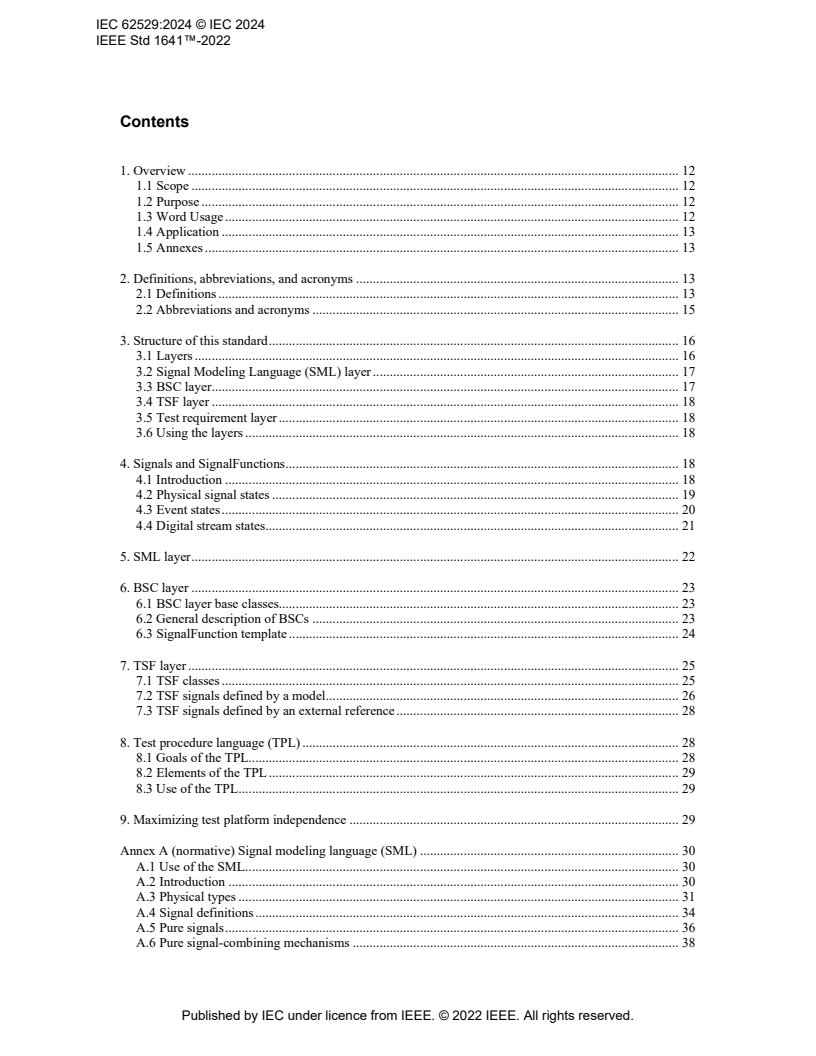
Contents
1. Overview . 12
1.1 Scope . 12
1.2 Purpose . 12
1.3 Word Usage . 12
1.4 Application . 13
1.5 Annexes . 13
2. Definitions, abbreviations, and acronyms . 13
2.1 Definitions . 13
2.2 Abbreviations and acronyms . 15
3. Structure of this standard . 16
3.1 Layers . 16
3.2 Signal Modeling Language (SML) layer . 17
3.3 BSC layer . 17
3.4 TSF layer . 18
3.5 Test requirement layer . 18
3.6 Using the layers . 18
4. Signals and SignalFunctions . 18
4.1 Introduction . 18
4.2 Physical signal states . 19
4.3 Event states . 20
4.4 Digital stream states . 21
5. SML layer . 22
6. BSC layer . 23
6.1 BSC layer base classes. 23
6.2 General description of BSCs . 23
6.3 SignalFunction template . 24
7. TSF layer . 25
7.1 TSF classes . 25
7.2 TSF signals defined by a model . 26
7.3 TSF signals defined by an external reference . 28
8. Test procedure language (TPL) . 28
8.1 Goals of the TPL . 28
8.2 Elements of the TPL . 29
8.3 Use of the TPL . 29
9. Maximizing test platform independence . 29
Annex A (normative) Signal modeling language (SML) . 30
A.1 Use of the SML . 30
A.2 Introduction . 30
A.3 Physical types . 31
A.4 Signal definitions . 34
A.5 Pure signals . 36
A.6 Pure signal-combining mechanisms . 38
Published Published by IEC under licence by IEC under licence from IEEE. from IEEE. © 2022 IEEE. © 2022 IEEE. All rights reserved.All rights reserved.
IEEE Std 1641™-2022
A.7 Pure function transformations . 44
A.8 Measure, limiting, and sampling signals . 44
A.9 Digital signals . 46
A.10 Basic component SML. 50
A.11 Fast Fourier analysis support . 76
Annex B (normative) Basic signal components (BSC) layer . 78
B.1 BSC layer base classes . 78
B.2 BSC subclasses . 78
B.3 Description of a BSC . 83
B.4 Physical class . 91
B.5 PulseDefns class .103
B.6 SignalFunction class .104
Annex C (normative) Dynamic signal descriptions .163
C.1 Introduction .163
C.2 Basic classes .164
C.3 Dynamic signal goals and use cases .172
Annex D (normative) Interface definition language (IDL) basic components .174
D.1 Introduction .174
D.2 IDL BSC library .174
Annex E (informative) Test signal framework (TSF) for C/ATLAS .175
E.1 Introduction .175
E.2 TSF library definition in extensible markup language (XML) .175
E.3 Interface definition language (IDL) for the TSF for C/ATLAS .175
E.4 AC_SIGNAL .176
E.5 AM_SIGNAL .178
E.6 DC_SIGNAL .180
E.7 DIGITAL_PARALLEL .182
E.8 DIGITAL_SERIAL .184
E.9 DIGITAL_TEST .186
E.10 DME_INTERROGATION .189
E.11 DME_RESPONSE .192
E.12 FM_SIGNAL .195
E.13 ILS_GLIDE_SLOPE .198
E.14 ILS_LOCALIZER .201
E.15 ILS_MARKER .204
E.16 PM_SIGNAL .207
E.17 PULSED_AC_SIGNAL .209
E.18 PULSED_AC_TRAIN .211
E.19 PULSED_DC_SIGNAL .213
E.20 PULSED_DC_TRAIN .216
E.21 RADAR_RX_SIGNAL .218
E.22 RADAR_TX_SIGNAL .220
E.23 RAMP_SIGNAL .222
E.24 RANDOM_NOISE .224
E.25 RESOLVER .226
E.26 RS_232 .229
E.27 SQUARE_WAVE .230
E.28 SSR_INTERROGATION .232
E.29 SSR_RESPONSE .235
E.30 STEP_SIGNAL .239
E.31 SUP_CAR_SIGNAL .241
E.32 SYNCHRO .243
Published Published by IEC under licence by IEC under licence from IEEE. from IEEE. © 2022 IEEE. © 2022 IEEE. All rights reserved.All rights reserved.
IEEE Std 1641™-2022
E.33 TACAN .247
E.34 TRIANGULAR_WAVE_SIGNAL .251
E.35 VOR .253
Annex F (informative) Test signal framework (TSF) library for digital pulse classes .257
F.1 Introduction .257
F.2 TSF library definition in extensible markup language (XML) .257
F.3 Graphical models of TSFs .257
F.4 Pulse class family of TSFs .257
F.5 DTIF .274
Annex G (normative) Carrier language requirements .276
G.1 Carrier language requirements .276
G.2 Interface definition language (IDL) .276
G.3 Datatypes .276
Annex H (normative) Test procedure language (TPL) .282
H.1 TPL layer .282
H.2 Elements of the TPL .282
H.3 Structure of test requirements .282
H.4 Carrier language .282
H.5 Signal statements .282
H.6 Mapping of test statements to carrier language .284
H.7 Test statement definitions .285
H.8 Elements used in test statement definitions .303
H.9 Attributes with multiple properties .306
H.10 Transferring data in digital signals .310
H.11 Creating test requirements .314
H.12 Delimiting TPL statements .316
Annex I (normative) Extensible markup language (XML) signal descriptions .318
I.1 Introduction .318
I.2 XSD for BSCs .319
I.3 XSD for TSFs .325
Annex J (informative) Support for ATLAS nouns and modifiers .333
J.1 Signal and test definition (STD) support for ATLAS signals .333
J.2 STD support for ATLAS nouns .333
J.3 STD support for C/ATLAS noun modifiers .336
J.4 Support for C/ATLAS extensions .344
Annex K (informative) Guide for maximizing test platform independence .345
K.1 Introduction .345
K.2 Guiding principles .345
K.3 Best practice rules .345
Annex L (informative) IEEE download web-site material associated with this document .349
Annex M (informative) Bibliography .350
Annex N (informative) Participants . .352
Published Published by IEC under licence by IEC under licence from IEEE. from IEEE. © 2022 IEEE. © 2022 IEEE. All rights reserved.All rights reserved.
– i – IEEE Std 1641™-2022
Standard for Signal and Test Definition
FOREWORD
1) The International Electrotechnical Commission (IEC) is a worldwide organization for standardization comprising
all national electrotechnical committees (IEC National Committees). The object of IEC is to promote international
co-operation on all questions concerning standardization in the electrical and electronic fields. To this end and
in addition to other activities, IEC publishes International Standards, Technical Specifications, Technical
Reports, Publicly Available Specifications (PAS) and Guides (hereafter referred to as "IEC document(s)"). Their
preparation is entrusted to technical committees; any IEC National Committee interested in the subject dealt with
may participate in this preparatory work. International, governmental and non-governmental organizations
liaising with the IEC also participate in this preparation.
IEEE Standards documents are developed within IEEE Societies and Standards Coordinating Committees of the
IEEE Standards Association (IEEE SA) Standards Board. IEEE develops its standards through a consensus
development process, approved by the American National Standards Institute, which brings together volunteers
representing varied viewpoints and interests to achieve the final product. Volunteers are not necessarily members
of IEEE and serve without compensation. While IEEE administers the process and es tablishes rules to promote
fairness in the consensus development process, IEEE does not independently evaluate, test, or verify the
accuracy of any of the information contained in its standards. Use of IEEE Standards documents is wholly
voluntary. IEEE documents are made available for use subject to important notices and legal disclaimers (see
https://standards.ieee.org/ipr/disclaimers.html for more information).
IEC collaborates closely with IEEE in accordance with conditions determined by agreement between the two
organizations. This Dual Logo International Standard was jointly developed by the IEC and IEEE under the terms
of that agreement.
2) The formal decisions of IEC on technical matters express, as nearly as possible, an international consensus of
opinion on the relevant subjects since each technical committee has representation from all interested IEC
National Committees. The formal decisions of IEEE on technical matters, once consensus within IEEE Societies
and Standards Coordinating Committees has been reached, is determined by a balanced ballot of materially
interested parties who indicate interest in reviewing the proposed standard. Final approval of the IEEE standards
document is given by the IEEE Standards Association (IEEE SA) Standards Board.
3) IEC/IEEE Publications have the form of recommendations for international use and are accepted by IEC National
Committees/IEEE Societies in that sense. While all reasonable efforts are made to ensure that the technical
content of IEC/IEEE Publications is accurate, IEC or IEEE cannot be held responsible for the way in which they
are used or for any misinterpretation by any end user.
4) In order to promote international uniformity, IEC National Committees undertake to apply IEC Publications
(including IEC/IEEE Publications) transparently to the maximum extent possible in their national and regional
publications. Any divergence between any IEC/IEEE Publication and the corresponding national or regional
publication shall be clearly indicated in the latter.
5) IEC and IEEE do not provide any attestation of conformity. Independent certification bodies provide conformity
assessment services and, in some areas, access to IEC marks of conformity. IEC and IEEE are not responsible
for any services carried out by independent certification bodies.
6) All users should ensure that they have the latest edition of this publication.
7) No liability shall attach to IEC or IEEE or their directors, employees, servants or agents including individual
experts and members of technical committees and IEC National Committees, or volunteers of IEEE Societies
and the Standards Coordinating Committees of the IEEE Standards Association (IEEE SA) Standards Board, for
any personal injury, property damage or other damage of any nature whatsoever, whether direct or indirect, or
for costs (including legal fees) and expenses arising out of the publication, use of, or reliance upon, this IEC/IEEE
Publication or any other IEC or IEEE Publications.
8) Attention is drawn to the normative references cited in this publication. Use of the referenced publications is
indispensable for the correct application of this publication.
9) Attention is drawn to the possibility that implementation of this IEC/IEEE Publication may require use of material
covered by patent rights. By publication of this standard, no position is taken with respect to the existence or
validity of any patent rights in connection therewith. IEC or IEEE shall not be held responsible for identifying
Essential Patent Claims for which a license may be required, for conducting inquiries into the legal validity or
scope of Patent Claims or determining whether any licensing terms or conditions provided in connection with
submission of a Letter of Assurance, if any, or in any licensing agreements are reasonable or non -discriminatory.
Users of this standard are expressly advised that determination of the validity of any pa tent rights, and the risk
of infringement of such rights, is entirely their own responsibility.
IEC 62529/IEEE Std 1641™-2022 was processed through IEC technical committee 91:
Electronics assembly technology, under the IEC/IEEE Dual Logo Agreement. It is an
International Standard.
Published Published by IEC under licence by IEC under licence from IEEE. from IEEE. © 2022 IEEE. © 2022 IEEE. All rights reserved.All rights reserved.
IEEE Std 1641™-2022 – ii –
The text of this International Standard is based on the following documents:
IEEE Std FDIS Report on voting
1641 (2022) 91/1933/FDIS 91/1945/RVD
Full information on the voting for its approval can be found in the report on voting indicated in
the above table.
The language used for the development of this is English.
The IEC Technical Committee and IEEE Technical Committee have decided that the contents
of this document will remain unchanged until the stability date indicated on the IEC website
under webstore.iec.ch in the data related to the specific document. At this date, the document
will be
• reconfirmed,
• withdrawn, or
• revised.
IMPORTANT – The "colour inside" logo on the cover page of this document indicates
that it contains colours which are considered to be useful for the correct understanding
of its contents. Users should therefore print this document using a colour printer.
Published Published by IEC under licence by IEC under licence from IEEE. from IEEE. © 2022 IEEE. © 2022 IEEE. All rights reserved.All rights reserved.
– iii – IEEE Std 1641™-2022
Published by IEC under licence from IEEE. © 2022 IEEE. All rights reserved.
IEEE Std 1641™-2022 – iv –
IEEE Std 1641™-2022
(Revision of IEEE Std 1641-2010)
IEEE Standard for Signal and Test
Definition
Developed by the
Test and Diagnosis for Electronic Systems Standards Committee (SCC20)
on
IEEE Standards and Standards Innovations (S&SI)
Strategic Management and Delivery Committee (SMDC)
Approved 21 September 2022
IEEE SA Standards Board
Published Published by IEC under licence by IEC under licence from IEEE. from IEEE. © 2022 IEEE. © 2022 IEEE. All rights reserved.All rights reserved.
– v – IEEE Std 1641™-2022
Abstract: The means to define and describe signals used in testing ae provided in this standard.
It also provides a set of common basic signals, built upon formal mathematical specifications so
that signals can be combined to form complex signals usable across all test platforms.
Keywords: ATE, ATLAS, automatic test equipment, IEEE 1641™, signal definitions, test
definitions, test requirements, test signals, unit under test, UUT
•
Published Published by IEC under licence by IEC under licence from IEEE. from IEEE. © 2022 IEEE. © 2022 IEEE. All rights reserved.All rights reserved.
IEEE Std 1641™-2022 – vi –
Important Notices and Disclaimers Concerning IEEE Standards Documents
IEEE Standards documents are made available for use subject to important notices and legal disclaimers.
These notices and disclaimers, or a reference to this page (https://standards.ieee.org/ipr/disclaimers.html),
appear in all standards and may be found under the heading “Important Notices and Disclaimers
Concerning IEEE Standards Documents.”
Notice and Disclaimer of Liability Concerning the Use of IEEE Standards
Documents
IEEE Standards documents are developed within IEEE Societies and subcommittees of IEEE Standards
Association (IEEE SA) Board of Governors. IEEE develops its standards through an accredited consensus
development process, which brings together volunteers representing varied viewpoints and interests to
achieve the final product. IEEE Standards are documents developed by volunteers with scientific,
academic, and industry-based expertise in technical working groups. Volunteers are not necessarily
members of IEEE or IEEE SA and participate without compensation from IEEE. While IEEE administers
the process and establishes rules to promote fairness in the consensus development process, IEEE does not
independently evaluate, test, or verify the accuracy of any of the information or the soundness of any
judgments contained in its standards.
IEEE makes no warranties or representations concerning its standards, and expressly disclaims all
warranties, express or implied, concerning this standard, including but not limited to the warranties of
merchantability, fitness for a particular purpose and non-infringement. In addition, IEEE does not warrant
or represent that the use of the material contained in its standards is free from patent infringement. IEEE
standards documents are supplied “AS IS” and “WITH ALL FAULTS.”
Use of an IEEE standard is wholly voluntary. The existence of an IEEE Standard does not imply that there
are no other ways to produce, test, measure, purchase, market, or provide other goods and services related
to the scope of the IEEE standard. Furthermore, the viewpoint expressed at the time a standard is approved
and issued is subject to change brought about through developments in the state of the art and comments
received from users of the standard.
In publishing and making its standards available, IEEE is not suggesting or rendering professional or other
services for, or on behalf of, any person or entity, nor is IEEE undertaking to perform any duty owed by
any other person or entity to another. Any person utilizing any IEEE Standards document, should rely upon
his or her own independent judgment in the exercise of reasonable care in any given circumstances or, as
appropriate, seek the advice of a competent professional in determining the appropriateness of a given
IEEE standard.
IN NO EVENT SHALL IEEE BE LIABLE FOR ANY DIRECT, INDIRECT, INCIDENTAL, SPECIAL,
EXEMPLARY, OR CONSEQUENTIAL DAMAGES (INCLUDING, BUT NOT LIMITED TO: THE
NEED TO PROCURE SUBSTITUTE GOODS OR SERVICES; LOSS OF USE, DATA, OR PROFITS;
OR BUSINESS INTERRUPTION) HOWEVER CAUSED AND ON ANY THEORY OF LIABILITY,
WHETHER IN CONTRACT, STRICT LIABILITY, OR TORT (INCLUDING NEGLIGENCE OR
OTHERWISE) ARISING IN ANY WAY OUT OF THE PUBLICATION, USE OF, OR RELIANCE
UPON ANY STANDARD, EVEN IF ADVISED OF THE POSSIBILITY OF SUCH DAMAGE AND
REGARDLESS OF WHETHER SUCH DAMAGE WAS FORESEEABLE.
Published Published by IEC under licence by IEC under licence from IEEE. from IEEE. © 2022 IEEE. © 2022 IEEE. All rights reserved.All rights reserved.
– vii – IEEE Std 1641™-2022
Translations
The IEEE consensus development process involves the review of documents in English only. In the event
that an IEEE standard is translated, only the English version published by IEEE is the approved IEEE
standard.
Official statements
A statement, written or oral, that is not processed in accordance with the IEEE SA Standards Board
Operations Manual shall not be considered or inferred to be the official position of IEEE or any of its
committees and shall not be considered to be, nor be relied upon as, a formal position of IEEE. At lectures,
symposia, seminars, or educational courses, an individual presenting information on IEEE standards shall
make it clear that the presenter’s views should be considered the personal views of that individual rather
than the formal position of IEEE, IEEE SA, the Standards Committee, or the Working Group. Statements
made by volunteers may not represent the formal position of their employer(s) or affiliation(s).
Comments on standards
Comments for revision of IEEE Standards documents are welcome from any interested party, regardless of
membership affiliation with IEEE or IEEE SA. However, IEEE does not provide interpretations,
consulting information, or advice pertaining to IEEE Standards documents.
Suggestions for changes in documents should be in the form of a proposed change of text, together with
appropriate supporting comments. Since IEEE standards represent a consensus of concerned interests, it is
important that any responses to comments and questions also receive the concurrence of a balance of
interests. For this reason, IEEE and the members of its Societies and subcommittees of the IEEE SA Board
of Governors are not able to provide an instant response to comments, or questions except in those cases
where the matter has previously been addressed. For the same reason, IEEE does not respond to
interpretation requests. Any person who would like to participate in evaluating comments or in revisions to
an IEEE standard is welcome to join the relevant IEEE working group. You can indicate interest in a
working group using the Interests tab in the Manage Profile & Interests area of the IEEE SA myProject
system. An IEEE Account is needed to access the application.
Comments on standards should be submitted using the Contact Us form.
Laws and regulations
Users of IEEE Standards documents should consult all applicable laws and regulations. Compliance with
the provisions of any IEEE Standards document does not constitute compliance to any applicable
regulatory requirements. Implementers of the standard are responsible for observing or referring to the
applicable regulatory requirements. IEEE does not, by the publication of its standards, intend to urge action
that is not in compliance with applicable laws, and these documents may not be construed as doing so.
Available at: https://development.standards.ieee.org/myproject-web/public/view.html#landing.
Available at: https://standards.ieee.org/content/ieee-standards/en/about/contact/index.html.
Published Published by IEC under licence by IEC under licence from IEEE. from IEEE. © 2022 IEEE. © 2022 IEEE. All rights reserved.All rights reserved.
IEEE Std 1641™-2022 – viii –
Data privacy
Users of IEEE Standards documents should evaluate the standards for considerations of data privacy and
data ownership in the context of assessing and using the standards in compliance with applicable laws and
regulations.
Copyrights
IEEE draft and approved standards are copyrighted by IEEE under US and international copyright laws.
They are made available by IEEE and are adopted for a wide variety of both public and private uses. These
include both use, by reference, in laws and regulations, and use in private self-regulation, standardization,
and the promotion of engineering practices and methods. By making these documents available for use and
adoption by public authorities and private users, neither IEEE nor its licensors waive any rights in
copyright to the documents.
Photocopies
Subject to payment of the appropriate licensing fees, IEEE will grant users a limited, non-exclusive license
to photocopy portions of any individual standard for company or organizational internal use or individual,
non-commercial use only. To arrange for payment of licensing fees, please contact Copyright Clearance
Center, Customer Service, 222 Rosewood Drive, Danvers, MA 01923 USA; +1 978 750 8400;
https://www.copyright.com/. Permission to photocopy portions of any individual standard for educational
classroom use can also be obtained through the Copyright Clearance Center.
Updating of IEEE Standards documents
Users of IEEE Standards documents should be aware that these documents may be superseded at any time
by the issuance of new editions or may be amended from time to time through the issuance of amendments,
corrigenda, or errata. An official IEEE document at any point in time consists of the current edition of the
document together with any amendments, corrigenda, or errata then in effect.
Every IEEE standard is subjected to review at least every 10 years. When a document is more than 10 years
old and has not undergone a revision process, it is reasonable to conclude that its contents, although still of
some value, do not wholly reflect the present state of the art. Users are cautioned to check to determine that
they have the latest edition of any IEEE standard.
In order to determine whether a given document is the current edition and whether it has been amended
through the issuance of amendments, corrigenda, or errata, visit IEEE Xplore or contact IEEE. For more
information about the IEEE SA or IEEE’s standards development process, visit the IEEE SA Website.
Errata
Errata, if any, for all IEEE standards can be accessed on the IEEE SA Website. Search for standard
number and year of approval to access the web page of the published standard. Errata links are located
under the Additional Resources Details section. Errata are also available in IEEE Xplore. Users are
encouraged to periodically check for errata.
Available at: https://ieeexplore.ieee.org/browse/standards/collection/ieee.
Available at: https://standards.ieee.org/standard/index.html.
Published Published by IEC under licence by IEC under licence from IEEE. from IEEE. © 2022 IEEE. © 2022 IEEE. All rights reserved.All rights reserved.
– ix – IEEE Std 1641™-2022
Patents
IEEE Standards are developed in compliance with the IEEE SA Patent Policy.
Attention is called to the possibility that implementation of this standard may require use of subject matter
covered by patent rights. By publication of this standard, no position is taken by the IEEE with respect to
the existence or validity of any patent rights in connection therewith. If a patent holder or patent applicant
has filed a statement of assurance via an Accepted Letter of Assurance, then the statement is listed on the
IEEE SA Website at https://standards.ieee.org/about/sasb/patcom/patents.html. Letters of Assurance may
indicate whether the Submitter is willing or unwilling to grant licenses under patent rights without
compensation or under reasonable rates, with reasonable terms and conditions that are demonstrably free of
any unfair discrimination to applicants desiring to obtain such licenses.
Essential Patent Claims may exist for which a Letter of Assurance has not been received. The IEEE is not
responsible for identifying Essential Patent Claims for which a license may be required, for conducting
inquiries into the legal validity or scope of Patents Claims, or determining whether any licensing terms or
conditions provided in connection with submission of a Letter of Assurance, if any, or in any licensing
agreements are reasonable or non-discriminatory. Users of this standard are expressly advised that
determination of the validity of any patent rights, and the risk of infringement of such rights, is entirely
their own responsibility. Further information may be obtained from the IEEE Standards Association.
IMPORTANT NOTICE
IEEE Standards do not guarantee or ensure safety, security, health, or environmental protection, or ensure
against interference with or from other devices or networks. IEEE Standards development activities
consider research and information presented to the standards development group in developing any safety
recommend
...