

IEC 63152:2020
(Main)Smart cities - City service continuity against disasters - The role of the electrical supply
General Information
- Abstract
IEC 63152:2020 establishes concepts and gives guidelines to help sustain a variety of city services on the occasion of a disaster from the perspective of providing electricity. It outlines the basic concepts on how multiple city services can cooperate and continue by electricity continuity plan(s) and electricity continuity system(s). It also specifies methods and means to establish these.
The users of this document are assumed to be city developers, city operators, equipment manufacturers, essential service providers and disaster management personnel.
Cities are facing many kinds of potential threats which affect the continuity of city services. There exists, therefore, a great need to establish safe and secure societies in which negative impacts on city services to the citizens are minimized and city services are continuously available to them during a period of emergency. There is no doubt that, in modern cities, electricity plays a critical role in maintaining city services.
- Status
- Published
- Publication Date
- 12-Jul-2020
- Technical Committee
- SyC Smart Cities - Electrotechnical aspects of Smart Cities
- Drafting Committee
- PT 63152-2 - SyC Smart Cities/PT 63152-2
- Current Stage
- PPUB - Publication issued
- Start Date
- 13-Jul-2020
- Completion Date
- 24-Jul-2020
Buy Documents
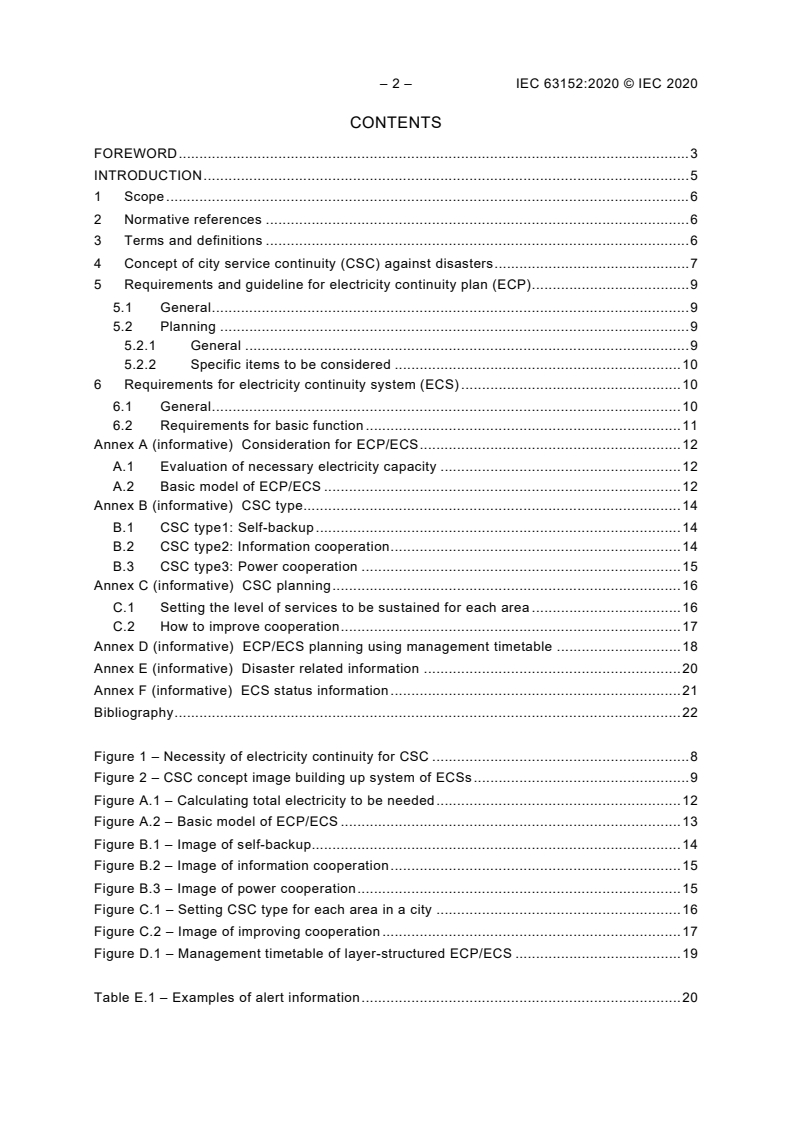
IEC 63152:2020 - Smart cities - City service continuity against disasters - The role of the electrical supply Released:7/13/2020
IEC 63152:2020 - Smart cities - City service continuity against disasters - The role of the electrical supply Released:7/13/2020
Overview
IEC 63152:2020 - "Smart cities - City service continuity against disasters - The role of the electrical supply" provides concepts, guidelines and methods to sustain city services during disasters from the perspective of electricity. It defines the city service continuity (CSC) concept and specifies how organizations should prepare an electricity continuity plan (ECP) and implement an electricity continuity system (ECS) so that essential public services remain available when grid power is disrupted.
Keywords: IEC 63152, smart cities, city service continuity, electricity continuity, disaster resilience, ECP, ECS.
Key topics and technical requirements
- Concepts and definitions: CSC, ECP, ECS and related terminology tied to business continuity planning.
- ECP requirements and guidelines: planning steps and specific items to consider when documenting electricity continuity as part of a broader business continuity plan.
- ECS requirements: functional requirements for systems that implement the ECP, including reliability and operational considerations for maintaining power during outages.
- Evaluation methods: guidance to assess required electricity capacity and build a basic model for ECP/ECS design (annexes include calculation approaches and models).
- CSC types and cooperation models: classifications such as self-backup, information cooperation and power cooperation to tailor continuity strategies to different urban contexts.
- Planning and management tools: timetables, status information and disaster-related information to support coordinated response and recovery (informative annexes provide templates and examples).
Note: IEC 63152 focuses on concepts and guidelines rather than prescriptive electrical design values.
Practical applications
- Designing and specifying resilient power strategies for smart cities, municipalities and special districts.
- Developing coordinated emergency power policies across utilities, hospitals, transport, communications and water/wastewater providers.
- Creating procurement and testing requirements for backup generators, microgrids, energy storage and control systems that support ECP/ECS objectives.
- Integrating electricity continuity into city-wide business continuity management and disaster response plans.
- Informing interoperability and information-sharing workflows for multi‑stakeholder disaster response.
Who should use this standard
- City developers and urban planners who need to embed electricity continuity into urban development.
- City and utility operators planning resilient grids, microgrids and distributed energy resources.
- Equipment manufacturers specifying features for backup power, control and status-reporting.
- Essential service providers (healthcare, transport, water, communications) that must maintain critical functions during outages.
- Disaster management personnel and business continuity professionals coordinating multi-agency responses.
Related standards
- ISO 22301 (Societal security - Business continuity management systems) is cited as a normative reference and complements IEC 63152 for organizational continuity processes.
IEC 63152 is a practical guide for integrating electricity resilience into smart-city planning, enabling coordinated, electricity-focused strategies that reduce service disruption during disasters.
Buy Documents
IEC 63152:2020 - Smart cities - City service continuity against disasters - The role of the electrical supply Released:7/13/2020
IEC 63152:2020 - Smart cities - City service continuity against disasters - The role of the electrical supply Released:7/13/2020
Get Certified
Connect with accredited certification bodies for this standard

BSI Group
BSI (British Standards Institution) is the business standards company that helps organizations make excellence a habit.

Bureau Veritas
Bureau Veritas is a world leader in laboratory testing, inspection and certification services.

DNV
DNV is an independent assurance and risk management provider.
Sponsored listings
Frequently Asked Questions
IEC 63152:2020 is a standard published by the International Electrotechnical Commission (IEC). Its full title is "Smart cities - City service continuity against disasters - The role of the electrical supply". This standard covers: IEC 63152:2020 establishes concepts and gives guidelines to help sustain a variety of city services on the occasion of a disaster from the perspective of providing electricity. It outlines the basic concepts on how multiple city services can cooperate and continue by electricity continuity plan(s) and electricity continuity system(s). It also specifies methods and means to establish these. The users of this document are assumed to be city developers, city operators, equipment manufacturers, essential service providers and disaster management personnel. Cities are facing many kinds of potential threats which affect the continuity of city services. There exists, therefore, a great need to establish safe and secure societies in which negative impacts on city services to the citizens are minimized and city services are continuously available to them during a period of emergency. There is no doubt that, in modern cities, electricity plays a critical role in maintaining city services.
IEC 63152:2020 establishes concepts and gives guidelines to help sustain a variety of city services on the occasion of a disaster from the perspective of providing electricity. It outlines the basic concepts on how multiple city services can cooperate and continue by electricity continuity plan(s) and electricity continuity system(s). It also specifies methods and means to establish these. The users of this document are assumed to be city developers, city operators, equipment manufacturers, essential service providers and disaster management personnel. Cities are facing many kinds of potential threats which affect the continuity of city services. There exists, therefore, a great need to establish safe and secure societies in which negative impacts on city services to the citizens are minimized and city services are continuously available to them during a period of emergency. There is no doubt that, in modern cities, electricity plays a critical role in maintaining city services.
IEC 63152:2020 is classified under the following ICS (International Classification for Standards) categories: 03.100.70 - Management systems; 29.240.01 - Power transmission and distribution networks in general. The ICS classification helps identify the subject area and facilitates finding related standards.
IEC 63152:2020 is available in PDF format for immediate download after purchase. The document can be added to your cart and obtained through the secure checkout process. Digital delivery ensures instant access to the complete standard document.
Standards Content (Sample)
IEC 63152 ®
Edition 1.0 2020-07
INTERNATIONAL
STANDARD
colour
inside
Smart cities – City service continuity against disasters – The role of the
electrical supply
All rights reserved. Unless otherwise specified, no part of this publication may be reproduced or utilized in any form
or by any means, electronic or mechanical, including photocopying and microfilm, without permission in writing from
either IEC or IEC's member National Committee in the country of the requester. If you have any questions about IEC
copyright or have an enquiry about obtaining additional rights to this publication, please contact the address below or
your local IEC member National Committee for further information.
IEC Central Office Tel.: +41 22 919 02 11
3, rue de Varembé info@iec.ch
CH-1211 Geneva 20 www.iec.ch
Switzerland
About the IEC
The International Electrotechnical Commission (IEC) is the leading global organization that prepares and publishes
International Standards for all electrical, electronic and related technologies.
About IEC publications
The technical content of IEC publications is kept under constant review by the IEC. Please make sure that you have the
latest edition, a corrigendum or an amendment might have been published.
IEC publications search - webstore.iec.ch/advsearchform Electropedia - www.electropedia.org
The advanced search enables to find IEC publications by a The world's leading online dictionary on electrotechnology,
variety of criteria (reference number, text, technical containing more than 22 000 terminological entries in English
committee,…). It also gives information on projects, replaced and French, with equivalent terms in 16 additional languages.
and withdrawn publications. Also known as the International Electrotechnical Vocabulary
(IEV) online.
IEC Just Published - webstore.iec.ch/justpublished
Stay up to date on all new IEC publications. Just Published IEC Glossary - std.iec.ch/glossary
details all new publications released. Available online and 67 000 electrotechnical terminology entries in English and
once a month by email. French extracted from the Terms and Definitions clause of
IEC publications issued since 2002. Some entries have been
IEC Customer Service Centre - webstore.iec.ch/csc collected from earlier publications of IEC TC 37, 77, 86 and
If you wish to give us your feedback on this publication or CISPR.
need further assistance, please contact the Customer Service
Centre: sales@iec.ch.
IEC 63152 ®
Edition 1.0 2020-07
INTERNATIONAL
STANDARD
colour
inside
Smart cities – City service continuity against disasters – The role of the
electrical supply
INTERNATIONAL
ELECTROTECHNICAL
COMMISSION
ICS 03.100.70; 29.240.01 ISBN 978-2-8322-8552-7
– 2 – IEC 63152:2020 © IEC 2020
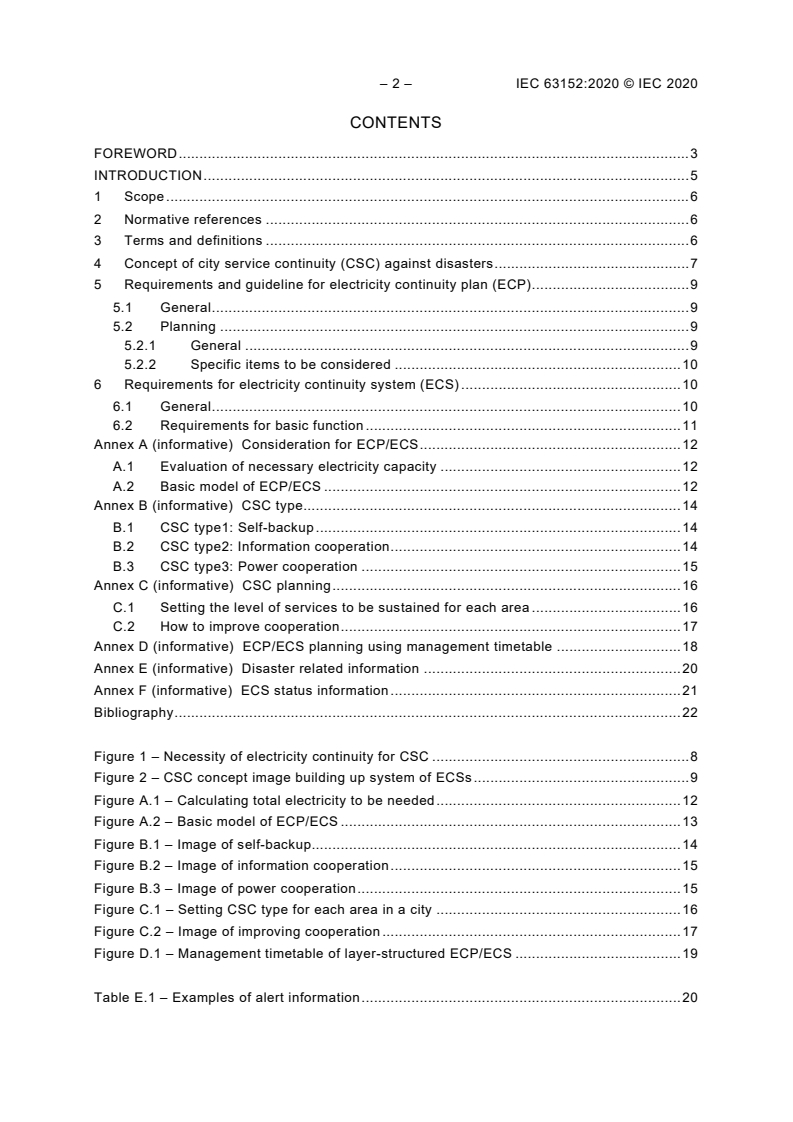
CONTENTS
FOREWORD . 3
INTRODUCTION . 5
1 Scope . 6
2 Normative references . 6
3 Terms and definitions . 6
4 Concept of city service continuity (CSC) against disasters . 7
5 Requirements and guideline for electricity continuity plan (ECP) . 9
5.1 General . 9
5.2 Planning . 9
5.2.1 General . 9
5.2.2 Specific items to be considered . 10
6 Requirements for electricity continuity system (ECS) . 10
6.1 General . 10
6.2 Requirements for basic function . 11
Annex A (informative) Consideration for ECP/ECS . 12
A.1 Evaluation of necessary electricity capacity . 12
A.2 Basic model of ECP/ECS . 12
Annex B (informative) CSC type. 14
B.1 CSC type1: Self-backup . 14
B.2 CSC type2: Information cooperation . 14
B.3 CSC type3: Power cooperation . 15
Annex C (informative) CSC planning . 16
C.1 Setting the level of services to be sustained for each area . 16
C.2 How to improve cooperation . 17
Annex D (informative) ECP/ECS planning using management timetable . 18
Annex E (informative) Disaster related information . 20
Annex F (informative) ECS status information . 21
Bibliography . 22
Figure 1 – Necessity of electricity continuity for CSC . 8
Figure 2 – CSC concept image building up system of ECSs . 9
Figure A.1 – Calculating total electricity to be needed . 12
Figure A.2 – Basic model of ECP/ECS . 13
Figure B.1 – Image of self-backup. 14
Figure B.2 – Image of information cooperation . 15
Figure B.3 – Image of power cooperation . 15
Figure C.1 – Setting CSC type for each area in a city . 16
Figure C.2 – Image of improving cooperation . 17
Figure D.1 – Management timetable of layer-structured ECP/ECS . 19
Table E.1 – Examples of alert information . 20
INTERNATIONAL ELECTROTECHNICAL COMMISSION
____________
SMART CITIES –
CITY SERVICE CONTINUITY AGAINST DISASTERS –
THE ROLE OF THE ELECTRICAL SUPPLY
FOREWORD
1) The International Electrotechnical Commission (IEC) is a worldwide organization for standardization comprising
all national electrotechnical committees (IEC National Committees). The object of IEC is to promote
international co-operation on all questions concerning standardization in the electrical and electronic fields. To
this end and in addition to other activities, IEC publishes International Standards, Technical Specifications,
Technical Reports, Publicly Available Specifications (PAS) and Guides (hereafter referred to as "IEC
Publication(s)"). Their preparation is entrusted to technical committees; any IEC National Committee interested
in the subject dealt with may participate in this preparatory work. International, governmental and non-
governmental organizations liaising with the IEC also participate in this preparation. IEC collaborates closely
with the International Organization for Standardization (ISO) in accordance with conditions determined by
agreement between the two organizations.
2) The formal decisions or agreements of IEC on technical matters express, as nearly as possible, an international
consensus of opinion on the relevant subjects since each technical committee has representation from all
interested IEC National Committees.
3) IEC Publications have the form of recommendations for international use and are accepted by IEC National
Committees in that sense. While all reasonable efforts are made to ensure that the technical content of IEC
Publications is accurate, IEC cannot be held responsible for the way in which they are used or for any
misinterpretation by any end user.
4) In order to promote international uniformity, IEC National Committees undertake to apply IEC Publications
transparently to the maximum extent possible in their national and regional publications. Any divergence
between any IEC Publication and the corresponding national or regional publication shall be clearly indicated in
the latter.
5) IEC itself does not provide any attestation of conformity. Independent certification bodies provide conformity
assessment services and, in some areas, access to IEC marks of conformity. IEC is not responsible for any
services carried out by independent certification bodies.
6) All users should ensure that they have the latest edition of this publication.
7) No liability shall attach to IEC or its directors, employees, servants or agents including individual experts and
members of its technical committees and IEC National Committees for any personal injury, property damage or
other damage of any nature whatsoever, whether direct or indirect, or for costs (including legal fees) and
expenses arising out of the publication, use of, or reliance upon, this IEC Publication or any other IEC
Publications.
8) Attention is drawn to the Normative references cited in this publication. Use of the referenced publications is
indispensable for the correct application of this publication.
9) Attention is drawn to the possibility that some of the elements of this IEC Publication may be the subject of
patent rights. IEC shall not be held responsible for identifying any or all such patent rights.
International Standard IEC 63152 has been prepared by IEC systems committee Smart Cities.
The text of this International Standard is based on the following documents:
FDIS Report on voting
SyCSmartCities/139/FDIS SyCSmartCities/144/RVD
Full information on the voting for the approval of this International Standard can be found in
the report on voting indicated in the above table.
This document has been drafted in accordance with the ISO/IEC Directives, Part 2.
– 4 – IEC 63152:2020 © IEC 2020
The committee has decided that the contents of this document will remain unchanged until the
stability date indicated on the IEC website under "http://webstore.iec.ch" in the data related to
the specific document. At this date, the document will be
• reconfirmed,
• withdrawn,
• replaced by a revised edition, or
• amended.
IMPORTANT – The 'colour inside' logo on the cover page of this publication indicates
that it contains colours which are considered to be useful for the correct
understanding of its contents. Users should therefore print this document using a
colour printer.
INTRODUCTION
Cities are facing many kinds of potential threats which affect the continuity of city services.
There exists, therefore, a great need to establish safe and secure societies in which negative
impacts on city services to the citizens are minimized and city services are continuously
available to them during a period of emergency. There is no doubt that, in modern cities,
electricity plays a critical role in maintaining city services.
This document provides requirements and guidelines to ensure that city services can be
sustained when the power supply from the grids is discontinued because of disasters.
The users of this document are assumed to be city developers, city operators, equipment
manufacturers, essential service providers and disaster management personnel.
– 6 – IEC 63152:2020 © IEC 2020
SMART CITIES –
CITY SERVICE CONTINUITY AGAINST DISASTERS –
THE ROLE OF THE ELECTRICAL SUPPLY
1 Scope
This document establishes concepts and gives guidelines to help sustain a variety of city
services on the occasion of a disaster from the perspective of providing electricity. It outlines
the basic concepts on how multiple city services can cooperate and continue by electricity
continuity plan(s) and electricity continuity system(s). It also specifies methods and means to
establish these.
2 Normative references
The following documents are referred to in the text in such a way that some or all of their
content constitutes requirements of this document. For dated references, only the edition
cited applies. For undated references, the latest edition of the referenced document (including
any amendments) applies.
ISO 22301, Societal security – Business continuity management systems – Requirements
3 Terms and definitions
For the purposes of this document, the following terms and definitions apply.
ISO and IEC maintain terminological databases for use in standardization at the following
addresses:
• IEC Electropedia: available at http://www.electropedia.org/
• ISO Online browsing platform: available at http://www.iso.org/obp
3.1
business continuity plan
BCP
documented procedures that guide organizations to respond, recover, resume, and restore to
a pre-defined level of operation following disruption
[SOURCE: ISO 22301:2012, 3.6]
3.2
electricity continuity plan
ECP
documented procedures that guide organizations to ensure continuity of electricity supply to
maintain city services in a business continuity plan that addresses disruption caused by a
critical event
3.3
electricity continuity system
ECS
system required to ensure reliable and effective implementation of functions which are
necessary for ECP
3.4
city service
service that is performed for the benefit of the public
Note 1 to entry: In this document, services depend on provision of electricity supply.
3.5
city service continuity
CSC
status in which, and capability with which, city services (i.e. public, medical, transportation
communication services) that are provided to users in normal times, continue to be fully or
partly provided, even in a state of emergency in which the normal functions of city
infrastructures are interrupted
3.6
disaster
rapid or slow onset event that causes significant disruption to one or more city services for an
extended period of time
Note 1 to entry: This can include natural disasters, failures of key components or systems whether in hardware or
software, physical damage to systems, and cyber attacks.
3.7
organization
person or group of people that has its own functions with responsibilities, authorities and
relationships to achieve its objectives
Note 1 to entry: The concept of organization includes, but is not limited to, sole-trader, company, corporation, firm,
enterprise, authority, partnership, charity or institution, or part or combination thereof, whether incorporated or not,
public or private.
Note 2 to entry: For organizations with more than one operating unit, a single operating unit can be defined as an
organization.
[SOURCE: ISO 22301:2012, 3.33]
4 Concept of city service continuity (CSC) against disasters
Organizations that receive grid electricity supply need to secure back-up power sources in
order to be able to continue providing their services when the grid electricity supply is
discontinued due to disasters, up until the time when the electricity supply is back to normal.
Activities in a city are supported by the continuous supply of various services (water and
sewage, gas, transport, hospitals, communications, logistics, etc.), and such services are
supplied through facilities and devices, most of which, in general, need electricity from the
grid to operate. Therefore, the loss of the grid electricity supply due to disasters results in the
potential impact of a massive loss of s
...
IEC 63152 ®
Edition 1.0 2020-07
INTERNATIONAL
STANDARD
NORME
INTERNATIONALE
colour
inside
Smart cities – City service continuity against disasters – The role of the
electrical supply
Villes intelligentes – Continuité des services urbains en cas de catastrophes –
Rôle de l’alimentation électrique
All rights reserved. Unless otherwise specified, no part of this publication may be reproduced or utilized in any form
or by any means, electronic or mechanical, including photocopying and microfilm, without permission in writing from
either IEC or IEC's member National Committee in the country of the requester. If you have any questions about IEC
copyright or have an enquiry about obtaining additional rights to this publication, please contact the address below or
your local IEC member National Committee for further information.
Droits de reproduction réservés. Sauf indication contraire, aucune partie de cette publication ne peut être reproduite
ni utilisée sous quelque forme que ce soit et par aucun procédé, électronique ou mécanique, y compris la photocopie
et les microfilms, sans l'accord écrit de l'IEC ou du Comité national de l'IEC du pays du demandeur. Si vous avez des
questions sur le copyright de l'IEC ou si vous désirez obtenir des droits supplémentaires sur cette publication, utilisez
les coordonnées ci-après ou contactez le Comité national de l'IEC de votre pays de résidence.
IEC Central Office Tel.: +41 22 919 02 11
3, rue de Varembé info@iec.ch
CH-1211 Geneva 20 www.iec.ch
Switzerland
About the IEC
The International Electrotechnical Commission (IEC) is the leading global organization that prepares and publishes
International Standards for all electrical, electronic and related technologies.
About IEC publications
The technical content of IEC publications is kept under constant review by the IEC. Please make sure that you have the
latest edition, a corrigendum or an amendment might have been published.
IEC publications search - webstore.iec.ch/advsearchform IEC online collection - oc.iec.ch
The advanced search enables to find IEC publications by a Discover our powerful search engine and read freely all the
variety of criteria (reference number, text, technical publications previews. With a subscription you will always
committee, …). It also gives information on projects, replaced have access to up to date content tailored to your needs.
and withdrawn publications.
Electropedia - www.electropedia.org
IEC Just Published - webstore.iec.ch/justpublished
The world's leading online dictionary on electrotechnology,
Stay up to date on all new IEC publications. Just Published
containing more than 22 000 terminological entries in English
details all new publications released. Available online and
and French, with equivalent terms in 18 additional languages.
once a month by email.
Also known as the International Electrotechnical Vocabulary
(IEV) online.
IEC Customer Service Centre - webstore.iec.ch/csc
If you wish to give us your feedback on this publication or
need further assistance, please contact the Customer Service
Centre: sales@iec.ch.
A propos de l'IEC
La Commission Electrotechnique Internationale (IEC) est la première organisation mondiale qui élabore et publie des
Normes internationales pour tout ce qui a trait à l'électricité, à l'électronique et aux technologies apparentées.
A propos des publications IEC
Le contenu technique des publications IEC est constamment revu. Veuillez vous assurer que vous possédez l’édition la
plus récente, un corrigendum ou amendement peut avoir été publié.
Recherche de publications IEC - IEC online collection - oc.iec.ch
webstore.iec.ch/advsearchform Découvrez notre puissant moteur de recherche et consultez
La recherche avancée permet de trouver des publications IEC gratuitement tous les aperçus des publications. Avec un
en utilisant différents critères (numéro de référence, texte, abonnement, vous aurez toujours accès à un contenu à jour
comité d’études, …). Elle donne aussi des informations sur adapté à vos besoins.
les projets et les publications remplacées ou retirées.
Electropedia - www.electropedia.org
IEC Just Published - webstore.iec.ch/justpublished
Le premier dictionnaire d'électrotechnologie en ligne au
Restez informé sur les nouvelles publications IEC. Just
monde, avec plus de 22 000 articles terminologiques en
Published détaille les nouvelles publications parues.
anglais et en français, ainsi que les termes équivalents dans
Disponible en ligne et une fois par mois par email.
16 langues additionnelles. Egalement appelé Vocabulaire
Electrotechnique International (IEV) en ligne.
Service Clients - webstore.iec.ch/csc
Si vous désirez nous donner des commentaires sur cette
publication ou si vous avez des questions contactez-nous:
sales@iec.ch.
IEC 63152 ®
Edition 1.0 2020-07
INTERNATIONAL
STANDARD
NORME
INTERNATIONALE
colour
inside
Smart cities – City service continuity against disasters – The role of the
electrical supply
Villes intelligentes – Continuité des services urbains en cas de catastrophes –
Rôle de l’alimentation électrique
INTERNATIONAL
ELECTROTECHNICAL
COMMISSION
COMMISSION
ELECTROTECHNIQUE
INTERNATIONALE
ICS 03.100.70; 29.240.01 ISBN 978-2-8322-9994-4
– 2 – IEC 63152:2020 © IEC 2020
CONTENTS
FOREWORD . 3
INTRODUCTION . 5
1 Scope . 6
2 Normative references . 6
3 Terms and definitions . 6
4 Concept of city service continuity (CSC) against disasters . 7
5 Requirements and guideline for electricity continuity plan (ECP) . 9
5.1 General . 9
5.2 Planning . 9
5.2.1 General . 9
5.2.2 Specific items to be considered . 10
6 Requirements for electricity continuity system (ECS) . 10
6.1 General . 10
6.2 Requirements for basic function . 11
Annex A (informative) Consideration for ECP/ECS . 12
A.1 Evaluation of necessary electricity capacity . 12
A.2 Basic model of ECP/ECS . 12
Annex B (informative) CSC type. 14
B.1 CSC type1: Self-backup . 14
B.2 CSC type2: Information cooperation . 14
B.3 CSC type3: Power cooperation . 15
Annex C (informative) CSC planning . 16
C.1 Setting the level of services to be sustained for each area . 16
C.2 How to improve cooperation . 17
Annex D (informative) ECP/ECS planning using management timetable . 18
Annex E (informative) Disaster related information . 20
Annex F (informative) ECS status information . 21
Bibliography . 22
Figure 1 – Necessity of electricity continuity for CSC . 8
Figure 2 – CSC concept image building up system of ECSs . 9
Figure A.1 – Calculating total electricity to be needed . 12
Figure A.2 – Basic model of ECP/ECS . 13
Figure B.1 – Image of self-backup. 14
Figure B.2 – Image of information cooperation . 15
Figure B.3 – Image of power cooperation . 15
Figure C.1 – Setting CSC type for each area in a city . 16
Figure C.2 – Image of improving cooperation . 17
Figure D.1 – Management timetable of layer-structured ECP/ECS . 19
Table E.1 – Examples of alert information . 20
INTERNATIONAL ELECTROTECHNICAL COMMISSION
____________
SMART CITIES –
CITY SERVICE CONTINUITY AGAINST DISASTERS –
THE ROLE OF THE ELECTRICAL SUPPLY
FOREWORD
1) The International Electrotechnical Commission (IEC) is a worldwide organization for standardization comprising
all national electrotechnical committees (IEC National Committees). The object of IEC is to promote
international co-operation on all questions concerning standardization in the electrical and electronic fields. To
this end and in addition to other activities, IEC publishes International Standards, Technical Specifications,
Technical Reports, Publicly Available Specifications (PAS) and Guides (hereafter referred to as "IEC
Publication(s)"). Their preparation is entrusted to technical committees; any IEC National Committee interested
in the subject dealt with may participate in this preparatory work. International, governmental and non-
governmental organizations liaising with the IEC also participate in this preparation. IEC collaborates closely
with the International Organization for Standardization (ISO) in accordance with conditions determined by
agreement between the two organizations.
2) The formal decisions or agreements of IEC on technical matters express, as nearly as possible, an international
consensus of opinion on the relevant subjects since each technical committee has representation from all
interested IEC National Committees.
3) IEC Publications have the form of recommendations for international use and are accepted by IEC National
Committees in that sense. While all reasonable efforts are made to ensure that the technical content of IEC
Publications is accurate, IEC cannot be held responsible for the way in which they are used or for any
misinterpretation by any end user.
4) In order to promote international uniformity, IEC National Committees undertake to apply IEC Publications
transparently to the maximum extent possible in their national and regional publications. Any divergence
between any IEC Publication and the corresponding national or regional publication shall be clearly indicated in
the latter.
5) IEC itself does not provide any attestation of conformity. Independent certification bodies provide conformity
assessment services and, in some areas, access to IEC marks of conformity. IEC is not responsible for any
services carried out by independent certification bodies.
6) All users should ensure that they have the latest edition of this publication.
7) No liability shall attach to IEC or its directors, employees, servants or agents including individual experts and
members of its technical committees and IEC National Committees for any personal injury, property damage or
other damage of any nature whatsoever, whether direct or indirect, or for costs (including legal fees) and
expenses arising out of the publication, use of, or reliance upon, this IEC Publication or any other IEC
Publications.
8) Attention is drawn to the Normative references cited in this publication. Use of the referenced publications is
indispensable for the correct application of this publication.
9) Attention is drawn to the possibility that some of the elements of this IEC Publication may be the subject of
patent rights. IEC shall not be held responsible for identifying any or all such patent rights.
International Standard IEC 63152 has been prepared by IEC systems committee Smart Cities.
The text of this International Standard is based on the following documents:
FDIS Report on voting
SyCSmartCities/139/FDIS SyCSmartCities/144/RVD
Full information on the voting for the approval of this International Standard can be found in
the report on voting indicated in the above table.
This document has been drafted in accordance with the ISO/IEC Directives, Part 2.
– 4 – IEC 63152:2020 © IEC 2020
The committee has decided that the contents of this document will remain unchanged until the
stability date indicated on the IEC website under "http://webstore.iec.ch" in the data related to
the specific document. At this date, the document will be
• reconfirmed,
• withdrawn,
• replaced by a revised edition, or
• amended.
IMPORTANT – The 'colour inside' logo on the cover page of this publication indicates
that it contains colours which are considered to be useful for the correct
understanding of its contents. Users should therefore print this document using a
colour printer.
INTRODUCTION
Cities are facing many kinds of potential threats which affect the continuity of city services.
There exists, therefore, a great need to establish safe and secure societies in which negative
impacts on city services to the citizens are minimized and city services are continuously
available to them during a period of emergency. There is no doubt that, in modern cities,
electricity plays a critical role in maintaining city services.
This document provides requirements and guidelines to ensure that city services can be
sustained when the power supply from the grids is discontinued because of disasters.
The users of this document are assumed to be city developers, city operators, equipment
manufacturers, essential service providers and disaster management personnel.
– 6 – IEC 63152:2020 © IEC 2020
SMART CITIES –
CITY SERVICE CONTINUITY AGAINST DISASTERS –
THE ROLE OF THE ELECTRICAL SUPPLY
1 Scope
This document establishes concepts and gives guidelines to help sustain a variety of city
services on the occasion of a disaster from the perspective of providing electricity. It outlines
the basic concepts on how multiple city services can cooperate and continue by electricity
continuity plan(s) and electricity continuity system(s). It also specifies methods and means to
establish these.
2 Normative references
The following documents are referred to in the text in such a way that some or all of their
content constitutes requirements of this document. For dated references, only the edition
cited applies. For undated references, the latest edition of the referenced document (including
any amendments) applies.
ISO 22301, Societal security – Business continuity management systems – Requirements
3 Terms and definitions
For the purposes of this document, the following terms and definitions apply.
ISO and IEC maintain terminological databases for use in standardization at the following
addresses:
• IEC Electropedia: available at http://www.electropedia.org/
• ISO Online browsing platform: available at http://www.iso.org/obp
3.1
business continuity plan
BCP
documented procedures that guide organizations to respond, recover, resume, and restore to
a pre-defined level of operation following disruption
[SOURCE: ISO 22301:2012, 3.6]
3.2
electricity continuity plan
ECP
documented procedures that guide organizations to ensure continuity of electricity supply to
maintain city services in a business continuity plan that addresses disruption caused by a
critical event
3.3
electricity continuity system
ECS
system required to ensure reliable and effective implementation of functions which are
necessary for ECP
3.4
city service
service that is performed for the benefit of the public
Note 1 to entry: In this document, services depend on provision of electricity supply.
3.5
city service continuity
CSC
status in which, and capability with which, city services (i.e. public, medical, transportation
communication services) that are provided to users in normal times, continue to be fully or
partly provided, even in a state of emergency in which the normal functions of city
infrastructures are interrupted
3.6
disaster
rapid or slow onset event that causes significant disruption to one or more city services for an
extended period of time
Note 1 to entry: This can include natural disasters, failures of key components or systems whether in hardware or
software, physical damage to systems, and cyber attacks.
3.7
organization
person or group of people that has its own functions with responsibilities, authorities and
relationships to achieve its objectives
Note 1 to entry: The concept of organization includes, but is not limited to, sole-trader, company, corporation, firm,
enterprise, authority, partnership, charity or institution, or part or combination thereof, whether incorporated or not,
public or private.
Note 2 to entry: For organizations with more than one operating unit, a single operating unit can be defined as an
organization.
[SOURCE: ISO 22301:2012, 3.33]
4 Concept of city service continuity (CSC) against disasters
Organizations that receive grid electricity supply need to secure back-up power sources in
order to be able to continue providing their services when the grid electricity supply is
discontinued due to disasters, up until the time when the electricity supply is back to normal.
Activities in a city are supported by the continuous supply of various services (water and
sewage, gas, transport, hospitals, communications, logistics, etc.), and such services are
supplied through facilities and devices, most of which, in general, need electricity from the
grid to operate. Therefore, the loss of the grid electricity supply due to disasters results in the
potential impact of a massive loss of such services.
For the city services to recover quickly so that the major loss of services can be minimized
when a disaster strikes, organizations should prepare in advance to ensure that they can
secure a minimum level of services until electricity supply returns to normal, making
arrangements to facilitate full recovery of services at the earliest possible stage as shown in
Figure 1. Each organization shall establish a business continuity plan (BCP) in order to
address this need.
– 8 – IEC 63152:2020 © IEC 2020
There are various approaches to develop an effective BCP. Some cities may conduct it in
order of their specific priorities for critical and lifeline services while others may start trials in a
part of the municipality. It might be implemented in an area where the private sector promotes
urban development, or in a commercial zone or a residential area. It is important that the BCP
takes into consideration the fact that the discontinuity of grid electricity supply due to
disasters may occur in a limited area, not necessarily throughout a whole city, or may occur in
a much wider area than the whole city.
Figure 1 – Necessity of electricity continuity for CSC
In order to secure services in a city at a minimum level during grid power loss due to disasters,
each organization which provides services shall establish a BCP to secure its electricity
supplies appropriately. In addition, plans for interactions between organizations should be
prepared to support the continuity of services according to the requirements of each city, so
that city administrators as well as citizens are able to obtain information on the availability of
services, allowing them to make decisions and to take appropriate actions. This is the concept
of city service continuity (CSC) as shown in Figure 2.
In order to realize this concept, each organization needs to develop an electricity continuity
plan (ECP) focusing on electricity supply in its BCP, while installing an electricity continuity
system (ECS) for implementing its ECP.
Uniform service continuity is not necessarily required for every area in the city as shown in
Figure 2. Areas may include the following.
– Power cooperation area: In some areas, organizations should sustain prioritized services
mainly in critical and lifeline fields by exchanging status information and stabilizing each
other’s electricity supply to the planned service levels.
– Information cooperation area: In some areas, organizations should exchange status
information to provide support, for a situation in hand, such as by provisioning fuel for
generators or sending electric vehicles (EVs) to the affected organizations when grid
electricity supply is disrupted.
– Self-backup area: In some areas without adequate equipment to cooperate with other
areas, organizations should implement backup power to sustain their own planned power
level by themselves.
Figure 2 – CSC concept image building up system of ECSs
5 Requirements and guideline for electricity continuity plan (ECP)
5.1 General
The ECP is a plan to address critical events caused by disasters, and focuses on the
continuity of electricity supply to maintain city services. The ECP is included in a BCP that
ensures business continuity during disasters.
The ECP provides procedures and criteria to prepare, plan, introduce and operate readiness
options to secure continuous supply on the electricity demand side, as well as identify
elements to be reviewed in order to ensure continuity of city services, as a preparation
against potential stoppage of electricity supply from the grid.
The ECP can be developed at related organizations in public and private sectors, including
the entire city, the town, the neighbourhood, the block, the individual facility, etc.
Stakeholders that develop the ECP include municipal governments, community associations,
area developers and facility managers of buildings such as hospitals, factories and offices
according to criticality.
The ECP includes an emergency plan that helps operators of city services continue to receive
the required electricity supply during disasters, instructions on how to work with other ECPs in
implementation of the emergency plan, and restoration measures to recover the electricity
supply after disasters.
5.2 Planning
5.2.1 General
Organizations shall develop the ECP in reference to ISO 22301 and in the following order of
content: "Context of the organization," "Leadership," "Planning," "Support," "Operation,"
"Performance evaluation" and "Improvement".
– 10 – IEC 63152:2020 © IEC 2020
5.2.2 Specific items to be considered
Organizations shall consider the following matters in development of the ECP. Organizations
need to carry out business impact analysis, risk assessment and strategy selection in the
development of ECP and in addition, to consider the following matters.
a) Evaluate necessary electricity capacity (refer to Clause A.1):
1) assessing classification of type and magnitude of disaster;
2) identifying priorities of facilities of the greatest need (e.g. hospitals, public buildings,
transportation systems, communication systems, etc.);
3) analysing the minimum level of services acceptable for the facilities identified and
standing time required;
4) estimating the potential impact caused by stoppage of individual city services due to
grid power loss;
5) estimating the required amount, quality, and cost of electricity.
b) Consider CSC type of cooperation with other ECS (refer to Annex B):
1) selecting ECSs for future cooperation in continuity of electricity supply (refer to
Annex C);
2) identifying and introducing facilities necessary to switch electricity mode when the grid
power supply is halted and to secure safety when electricity supply is back to normal.
c) Design ECS:
1) developing a procedure to disconnect from the grid electricity;
2) classifying and prioritizing the technologies, devices and equipment necessary to
continue power supply;
3) securing safety to avoid unintentional activation of electrotechnical equipment during
recovery process, including to switch them off when the disaster occurs and on after
the disaster;
4) identifying ways to protect against cyber attack;
5) developing a procedure to connect to the grid when electricity supply is back to normal.
d) Assure measures to ensure implementation during disasters such as operation,
maintenance, education and training sessions.
e) Develop a procedure to check the soundness of electrotechnical equipment.
f) Assure critical human resources, conduct periodical training, exercises and continual
improvement of the ECP, including lessons learned from the BCP testing.
As a result, a set of ECP and ECS based on BCP shall be formulated as a series of actions
along temporal phases including preparation for disaster, disaster strike, disaster response,
recovery, and subsequent reviewing for preparation against future disaster (refer to Annex D
as an example.)
6 Requirements for electricity continuity system (ECS)
6.1 General
The ECS indicates the elements required for an effective implementation of the ECP such as
facilities, electrotechnical equipment and operational rules, and also covers the whole system
as an aggregation of each such element, in order to enable continuous electricity supply
during disasters.
6.2 Requirements for basic function
Organizations shall consider the following practices to establish the ECS:
a) gathering disaster-related information;
b) maintaining electricity at the required level;
c) providing cyber security protection;
d) sending/receiving status information regarding the operation of the ECS;
e) disconnecting from/connecting to power grid;
f) sharing surplus electricity;
g) receiving needed electricity;
h) controlling management systems of xEMS (Energy Management System), e.g. CEMS
(Community Energy Management System), BEMS (Building Energy Management System),
FEMS (Factory Energy Management System), HEMS (Home Energy Management System).
Interface of information and power is needed for the above functions, and the contents of
information should be decided among areas/facilities to cooperate as shown in Clause A.2.
– 12 – IEC 63152:2020 © IEC 2020
Annex A
(informative)
Consideration for ECP/ECS
A.1 Evaluation of necessary electricity capacity
To calculate the total electricity capacity required, when developing the ECP, it is necessary
to decide services to be sustained. Their priority, required level and duration should also be
decided by considering the required operation in the event of discontinuity of grid electricity
supply. Finally, the level of electricity required for each service to operate on the agreed level
is figured out, and these are summed up to the total electricity needed. The priorities and
sustaining levels are decided in the BCP.
Figure A.1 indicates a sample case with four services (A, B, C, D).
Figure A.1 – Calculating total electricity to be needed
Sustaining level is a level of planned services.
Examples of sustaining level include:
– lighting the emergency exit signs for lighting service,
– enabling hotline with emergency bureaus for emergency support service,
– keeping ICUs (intensive care unit) operational and maintaining ICUs' air conditioned for
medical service,
– sustaining electricity to charge smart phones for communication service.
A.2 Basic model of ECP/ECS
ECP (electricity continuity plan) is included in BCP. ECS (electricity continuity system) is
implemented based on ECP.
ECS should be able to receive disaster information in order to trigger the ECS and wake it up
(regarding disaster related information, refer to Annex E).
ECS may need to have two connections – status information and power – to help with
exchanging electricity among other ECSs (regarding status information, refer to Annex F).
Figure A.2 shows basic model of ECP/ECS.
Figure A.2 – Basic model of ECP/ECS
– 14 – IEC 63152:2020 © IEC 2020
Annex B
(informative)
CSC type
B.1 CSC type1: Self-backup
Each ECS independently maintains the required electricity level. Organizations may choose
self-backup type in areas without adequate equipment to cooperate with other areas.
Figure B.1 shows an image of self-backup.
NOTE Strike-out lines indicate unnecessary items to be implemented.
Figure B.1 – Image of self-backup
B.2 CSC type2: Information cooperation
Each ECS exchanges its status information with others in order to coordinate, monitor and
provide support for damaged areas.
Figure B.2 shows an image of information cooperation.
NOTE Strike-out lines indicate unnecessary items to be implemented.
Figure B.2 – Image of information cooperation
B.3 CSC type3: Power cooperation
Each ECS exchanges its status information with others and stabilizes electricity consumption
to maintain planned service level.
Figure B.3 shows an image of power cooperation.
Figure B.3 – Image of power cooperation
– 16 – IEC 63152:2020 © IEC 2020
Annex C
(informative)
CSC planning
C.1 Setting the level of services to be sustained for each area
Here is an example of how city planners may decide on a configuration as shown in
Figure C.1, to ensure the sustaining level of city services when the city loses some or all grid
power as a result of a disaster.
a) Extract services to be sustained when power loss occurs due to a disaster.
b) Estimate sustaining level required for those services.
c) Classify them into three types of area to achieve the sustaining level, and consider for
each area how to implement required cooperation and conditions.
d) Decide how to cooperate between areas to sustain services from an overall perspective.
The boundary and structure of areas may be decided in other ways. For example, areas may
be based on the administrative district.
In any case, it is necessary to consider the sustaining level required in the area, taking into
account the priority and needs of each service, the base of the service, and the capability of
service. Furthermore, it is recommended to confirm that the sustaining level of service can be
achieved from an overall perspective.
Services such as medical, water, sewage and communications are examples of prioritized city
services.
Figure C.1 – Setting CSC type for each area in a city
C.2 How to improve cooperation
City planner may plan a step-by-step process to improve cooperation to increase service
sustaining level in a city even once an ECP has been established.
Figure C.2 shows an image of improving cooperation.
Figure C.2 – Image of improving cooperation
– 18 – IEC 63152:2020 © IEC 2020
Annex D
(informative)
ECP/ECS planning using management timetable
Management timetable is used to plan ECP/ECS. Management timetable describes whole
configuration and temporal relationship of disaster alert, power securing and information
sharing systems for city service continuity.
A sample of ECP/ECS is shown in Figure D.1. The horizontal axis indicates time-based
phases regarding disaster occurrence and the vertical axis indicates interoperability layers.
ECP/ECS are studied and designed along with the disaster phases on a stacked structure of
the layers.
The disaster phases comprise: preparation for disaster, disaster strike, response, recovery
and review for next preparation. Necessary elements and actions for disaster response and
recovery should be listed and broken down for description in related phases.
The total set of ECP/ECS should be constructed in a stacked structure of layers so as to
analyse and design the necessary elements and actions in each layer separately. The top
layer would be the business layer corresponding to ECP. The other lower layers,
corresponding to ECS, are function layer, information layer, communication layer and
component layer.
The management timetable of layer-structured ECP/ECS is achieved by cascading each of the
necessary elements and actions for disaster response and recovery through the phases and
linking them in a phase among the layers.
Figure D.1 – Management timetable of layer-structured ECP/ECS
– 20 – IEC 63152:2020 © IEC 2020
Annex E
(informative)
Disaster related information
This document assumes that each organization will make use of disaster information in order
to obtain several kinds of information regarding the occurrence of disaster and control ECS
based on the information.
Disaster information may mainly include switch information notifying switch of electricity
supply and alert information notifying prediction of disaster or evacuation order and so on.
This document does not specify the type and data format for the information, but assumes
that each organization will select and decide an appropriate format for the information.
Annex E lists examples of disaster information data.
The following are examples of switch information:
– loss of power;
– trigger by
• type of disaster,
• location of occasion,
• time of occasion,
• disaster grade;
Examples of alert information are given in Table E.1.
Table E.1 – Examples of alert information
Type of disaster Related information
Typhoon, hurricane, cyclone Atmospheric pressure, direction/speed, storm area
Earthquake Epicentre, seismic intensity, magnitude
Tsunami Estimated time for arrival, predicted wave height
Avalanche Time of occurrence, location of occurrence
NOTE This list includes some kinds of natural disaster, but this document does not specify their type.
Annex F
(informative)
ECS status information
This document assumes that each organization will make use of the following information as
status information for ECS in order to monitor or control systems or equipment or devices.
This document assumes that each organization will select and decide an appropriate format
for ECS status information.
The following are examples of status information:
– connection status to power grid:
• disconnected / connected;
– time disconnected;
– operating status:
• working / standby / not available / no response;
– latest power consumption status:
• e.g. last x hours;
– battery level.
– 22 – IEC 63152:2020 © IEC 2020
Bibliography
IEC White Paper, Microgrids for disaster preparedness and recovery, with electricity
continuity plans and systems
___________
– 24 – IEC 63152:2020 © IEC 2020
SOMMAIRE
AVANT-PROPOS . 25
INTRODUCTION . 27
1 Domaine d’application . 28
2 Références normatives . 28
3 Termes et définitions . 28
4 Concept de continuité des services urbains (CSU) en cas de catastrophes . 29
5 Exigences et lignes directrices relatives au plan de continuité de l’alimentation
électrique (PCAE) . 31
5.1 Généralités . 31
5.2 Planification . 32
5.2.1 Généralités . 32
5.2.2 Éléments spécifiques à prendre en considération . 32
6 Exigences relatives au système de continuité de l’alimentation électrique (SCAE) . 33
6.1 Généralités . 33
6.2 Exigences relatives à une fonctionnalité de base . 33
Annexe A (informative) Prise en considération de PCAE/SCAE . 34
A.1 Évaluation de la puissance électrique nécessaire . 34
A.2 Modèle de base de PCAE/SCAE . 34
Annexe B (informative) Type de CSU . 36
B.1 CSU de type1: Autoalimentation électrique de réserve . 36
B.2 CSU de type2: Coopération en matière d’informations . 36
B.3 CSU de type3: Coopération en matière d’alimentation électrique . 37
Annexe C (informative) Planification de la CSU . 38
C.1 Détermination du niveau de services à maintenir pour chaque secteur . 38
C.2 Méthode d’amélioration de la coopération . 39
Annexe D (informative) Planification de PCAE/SCAE à l’aide d’un calendrier de
gestion . 40
Annexe E (informative) Informations relatives aux catastrophes . 42
Annexe F (informative) Informations d’état pour le SCAE . 43
Bibliographie . 44
Figure 1 – Nécessité de la continuité de l’alimentation électrique pour la CSU . 30
Figure 2 – Système de construction d’images conceptuelles de la CSU dans le cas des
SCAE . 31
Figure A.1 – Calcul de l’électricité totale qu’il est nécessaire de fournir . 34
Figure A.2 – Modèle de base de PCAE/SCAE . 35
Figure B.1 – Représentation graphique de l’autoalimentation électrique de réserve . 36
Figure B.2 – Représentation graphique de la coopération en matière d’informations . 37
Figure B.3 – Représentation graphique de la coopération en matière d’alimentation
électrique . 37
Figure C.1 – Détermination du type de CSU pour chaque secteur de la ville . 38
Figure C.2 – Représentation graphique de l’amélioration de la coopération . 39
Figure D.1 – Calendrier de gestion des PCAE/SCAE à structure en couches . 41
Tableau E.1 – Exemples d’informations d’alerte . 42
COMMISSION ÉLECTROTECHNIQUE INTERNATIONALE
____________
VILLES INTELLIGENTES –
CONTINUITÉ DES SERVICES URBAINS EN CAS DE CATASTROPHES –
RÔLE DE L’ALIMENTATION ÉLECTRIQUE
AVANT-PROPOS
1) La Commission Électrotechnique Internationale (IEC) est une organisation mondiale de normalisation composée
de l'ensemble des comités électrotechniques nationaux (Comités nationaux de l’IEC). L’IEC a pour objet de
favoriser la coopération internationale pour toutes les questions de normalisation dans les domaines de
l'électricité et de l'électronique. À cet effet, l’IEC – entre autres activités – publie des Normes internationales,
des Spécifications techniques, des Rapports techniques, des Spécifications accessibles au public (PAS) et des
Guides (ci-après dénommés "Publication(s) de l’IEC"). Leur élaboration est confiée à des comités d'études, aux
travaux desquels tout Comité national intéressé par le sujet traité peut participer. Les organisations
internationales, gouvernementales et non gouvernementales, en liaison avec l’IEC, participent également aux
travaux. L’IEC collabore étroitement avec l'Organisation Internationale de Normalisation (ISO), selon des
conditions fixées par accord entre les deux organisations.
2) Les décisions ou accords officiels de l’IEC concernant les questions techniques représentent, dans la mesure du
possible, un accord international sur les sujets étudiés, étant donné que les Comités nationaux de l’IEC intéressés
sont représentés dans chaque comité d’études.
3) Les Publications de l’IEC se présentent sous la forme de recommandations internationales et sont agréées
comme telles par les Comités nationaux de l’IEC. Tous les efforts raisonnables sont entrepris afin que l’IEC
s'assure de l'exactitude d
...